Introduction
Elevated rates of mental health problems have been reported in non-heterosexual individuals (those reporting same-sex sexual partners and/or homosexual/bisexual identities) compared with heterosexual men and women (Meyer, Reference Meyer2003; Herek & Garnets, Reference Herek and Garnets2007). Although this finding did court some controversy (Friedman & Downey, Reference Friedman and Downey1998; Bailey, Reference Bailey1999), population-based reports (Fergusson et al. Reference Fergusson, Horwood and Beautrais1999; Cochran & Mays, Reference Cochran and Mays2000a, b; Sandfort et al. Reference Sandfort, de Graaf, Bijl and Schnabel2001; Cochran et al. Reference Cochran, Mays and Sullivan2003) and two meta-analyses (Meyer, Reference Meyer2003; King et al. Reference King, Semlyen, See Tai, Killaspy, Osborn, Popelyuk and Nazareth2008) suggest that non-heterosexual men and women have at least twice the risk of mood and anxiety disorders compared with heterosexual individuals of the same gender. Studies also indicate increased rates of suicide attempts among non-heterosexual adolescents (Fergusson et al. Reference Fergusson, Horwood and Beautrais1999; Wichstrøm & Hegna, Reference Wichstrøm and Hegna2003; Silenzio et al. Reference Silenzio, Pena, Duberstein, Cerel and Knox2007) and increased lifetime self-harm and suicidality among adult non-heterosexual men (Herrell et al. Reference Herrell, Goldberg, True, Ramakrishnan, Lyons, Eisen and Tsuang1999; King et al. Reference King, McKeown, Warner, Ramsay, Johnson, Cort, Wright, Blizard and Davidson2003; Fergusson et al. Reference Fergusson, Horwood, Ridder and Beautrais2005; de Graaf et al. Reference de Graaf, Sandfort and ten Have2006; Cochran et al. Reference Cochran, Mays, Alegria, Ortega and Takeuchi2007) and women (King et al. Reference King, McKeown, Warner, Ramsay, Johnson, Cort, Wright, Blizard and Davidson2003; Fergusson et al. Reference Fergusson, Horwood, Ridder and Beautrais2005). Understanding the origins of these prevalence patterns is important for mental health professionals working with sexual minority populations.
It is often assumed that minority stress accounts for the increased psychiatric morbidity in non-heterosexual individuals (Meyer, Reference Meyer2003; Herek & Garnets, Reference Herek and Garnets2007). The minority stress model posits that actual discrimination, internalized homophobia or expectations of being maltreated are powerful stressors on non-heterosexual individuals, resulting in poorer mental health (Meyer, Reference Meyer2003). Correlational evidence supporting this theory has accumulated; homosexual and bisexual individuals suffer more actual discrimination, more physical and psychological abuse both as children and adults (Balsam et al. Reference Balsam, Beauchaine, Mickey and Rothblum2005a), and non-heterosexual men (but not women) report lower quality of life (Sandfort et al. Reference Sandfort, de Graaf and Bijl2003). Although less studied, minority stress seems to be associated with psychiatric morbidity. Experiencing multiple episodes of homophobic violence is related to distress in non-heterosexual men (Mills et al. Reference Mills, Paul, Stall, Pollack, Canchola, Chang, Moskowitz and Catania2004), and adjusting for perceived discrimination slightly lowers the increased lifetime risk of psychiatric disorder among non-heterosexual individuals (Mays & Cochran, Reference Mays and Cochran2001). In addition, a population survey suggests that perceived discrimination because of sexual orientation is associated with more psychological distress among men and women (Wamala et al. Reference Wamala, Boström and Nyqvist2007). Except for the latter report, previous studies suffer from small or unrepresentative samples or lack comparison groups.
We addressed the impact of minority stress on psychiatric morbidity in non-heterosexual individuals (defined as those with same-sex sexual partners) using a large, population-based sample of 20- to 47-year-old twins in Sweden. Furthermore, because familial factors (genetic and/or environmental) may confound the association between non-heterosexual behaviour and psychiatric disorder, we tested this possibility by comparing psychiatric morbidity between twins in pairs discordant for self-reported same-sex sexual behaviour and with unrelated twins.
Method
The Swedish Twin Registry and STAGE
The Swedish Twin Registry encompasses all twins born in Sweden since 1886: more than 170 000 individuals, with some 135 000 still alive and currently residing in Sweden (Lichtenstein et al. Reference Lichtenstein, Sullivan, Cnattingius, Gatz, Johansson, Carlström, Björk, Svartengren, Wolk, Klareskog, de Faire, Schalling, Palmgren and Pedersen2006). In the Study of Twin Adults: Genes and Environment (STAGE), all twins in the Swedish Twin Registry born 1959–1985 and where both siblings were alive and living in the country (n=42 224; 21 174 men, 21 050 women) were invited to participate in a large web-based survey. The questionnaire consisted of about 1300 items, many of which were follow-up questions not relevant for all respondents. Items addressed sociodemographic factors, trauma, physical and mental health, substance use, and sexual behaviour. Participants could also choose a telephone interview supplemented with a self-administered paper questionnaire for sensitive topics. Non-responders were reminded up to three times and the overall response rate for the survey, conducted in 2005–2006, was 60.1% (n=25 381). Linkage with Swedish national registries has shown that STAGE non-responders do not differ from responders regarding age, birthweight or in-patient treatment for neurological disorders. However, non-responders were more often male, criminally convicted, and had been treated as in-patients for a psychiatric condition. They were also less educated and scored lower on mental acuity testing at mandatory (males only) conscription at age 18 (all p values <0·001) (Furberg et al. Reference Furberg, Lichtenstein, Pedersen, Thornton, Bulik, Lerman and Sullivan2008). The majority of our responders (72.2%, n=18 327) chose to answer over the web, 11.6% (n=2949) completed the telephone interview and sent in a complementing paper questionnaire, and 16.2% (n=4105) completed the telephone interview but did not send in the paper questionnaire. As many of the items relevant to this study were considered sensitive and were therefore included in the paper questionnaire, we had to exclude those who only undertook the telephone interview. We also excluded those who did not provide information on relationship status or level of education, resulting in a sample of 17 379 (41% of all those eligible in the general population). As all of the twins were born in Sweden, none was a first-generation immigrant.
In the last section of the survey, two items asked about the lifetime number of individuals of the opposite and same sex respectively that the respondent had ‘been sexually together with’. We used this wording in an attempt to present a more gender- and sexual orientation-neutral definition than ‘sexual intercourse’. From the answer to this question, we constructed a dichotomous measure: having had any same-sex sexual partner (cf. Långström et al. Reference Långström, Rahman, Carlström and Lichtenstein2008). Individuals reporting no sexual partners of either sex were excluded from further analysis.
Determination of zygosity was based on responses to one of the following questions: (1) During childhood, were you and your twin partner as like as ‘two peas in a pod’ or not more alike than siblings in general? and (2) How often did strangers have difficulty in distinguishing between you and your twin partner when you were children? Twin pairs who responded alike as two peas in a pod on the first question and almost always or often on the second were classified as monozygotic (MZ). If both twins responded not alike for the first question and seldom, almost never, or never for the second, they were classified as dizygotic (DZ). All other twins were classified as ‘not determined’. We validated this algorithm with a panel of 47 single nucleotide polymorphisms in a random sample of 198 twin pairs. Ninety-five per cent (n=188) were correctly classified. Of the misclassified twin pairs, eight were MZ and two were DZ. This zygosity algorithm has been validated previously with similar results (Lichtenstein et al. Reference Lichtenstein, De Faire, Floderus, Svartengren, Svedberg and Pedersen2002).
For the co-twin control analyses, we could not use data from the 7147 individuals whose twin did not participate. As all analyses were stratified by sex, we also excluded 1285 opposite-sex DZ twin pairs. The resulting subsample consisted of 2278 MZ pairs (788 male and 1490 female) and 1487 DZ same-sex twin pairs (513 male and 974 female). Because of the rareness of non-heterosexual behaviour, we pooled MZ with DZ twin pairs, yielding 102 male and 307 female same-sex twin pairs who were discordant with respect to non-heterosexual sexual behaviour and could be used in co-twin control analyses. The Regional Ethics Committee in Stockholm, Sweden approved the study.
Psychiatric health variables
Lifetime major depression, generalized anxiety disorder (GAD), eating disorders, and alcohol dependence were all measured using a structured diagnostic questionnaire based on the Structured Clinical Interview for DSM-IV-TR (SCID; First et al. Reference First, Spitzer, Gibbon and Williams2002) and DSM-IV-TR criteria (APA, 2000). The diagnosis of major depression did not differentiate between single-episode and recurrent major depressive disorder because items addressed ‘at least one’ major depressive episode. Because of the low prevalence of specific eating disorders, any lifetime eating disorder included anorexia nervosa, bulimia nervosa and binge eating disorder. Alcohol dependence did not include alcohol abuse and was diagnosed only for those strictly fulfilling DSM-IV-TR criteria for a complete diagnosis. Co-morbidity was not taken into account; however, all diagnostic algorithms otherwise closely followed DSM-IV-TR criteria.
Despite controversy concerning the best way to assess attention deficit hyperactivity disorder (ADHD) among adults, several studies suggest that self-reports validly measure current ADHD (Murphy & Schachar, Reference Murphy and Schachar2000). We assessed current ADHD with the 18 symptom criteria from DSM-IV-TR, some slightly rephrased to better suit adults (e.g. ‘often has difficulty playing or engaging in leisure activities quietly’ was rephrased into ‘Do you have problems engaging in calm leisure activities?’). Respondents endorsed the presence of symptoms persisting for at least 6 months on a three-point format (0=no, 1=yes, to some extent, or 2=yes). From this, we created an ADHD summary score, defined as the sum of all 18 DSM-IV-TR items (range 0–36, Cronbach's α=0.84). We also constructed a dichotomous measure of ‘possible adult ADHD’ according to DSM-IV-TR diagnostic cut-offs of six or more out of nine items endorsed with a ‘yes, to some extent’ or a clear ‘yes’, in either the attention deficit or the hyperactivity/impulsivity criteria subsets. Age of symptom onset, pervasiveness across settings, and disorder-specific distress or impairment criteria were not taken into account in the present analyses.
Current depressive symptoms were tapped with the Center for Epidemiological Studies Depression Scale (CES-D); the briefer 11-item Iowa form was used with a four-point response format (0=never or almost never, 1=seldom, 2=often, 3=always or almost always). Thus, total CES-D scores could vary between 0 and 33. The Iowa form has similar psychometric properties to the full CES-D (Carpenter et al. Reference Carpenter, Andrykowski, Wilson, Hall, Rayens, Sachs and Cunningham1998), including satisfactory internal consistency (in our sample: Cronbach's α=0.85).
Minority stress and covariates
We adjusted the analyses for several possible confounders of the relationship between same-sex sexual behaviour and psychiatric morbidity: age, education, and relationship status. The highest educational level was categorized as low (⩽9 years of elementary school), medium (high school or the equivalent) or high (university-level degree). Relationship status was defined as being in a committed relationship (including being married, cohabiting, and not cohabiting) or being single (including being a widow/widower or separated/divorced).
Perceived discrimination and hate crime victimization, our measures of minority stress, were based on the respondent's endorsement of ever having been ‘discriminated against in an insulting or disparaging way’ or ‘experienced violence directed at him/her’ because of ‘race, ethnicity, gender, sexual orientation, or religion’ respectively.
Statistical analyses
Regression modelling
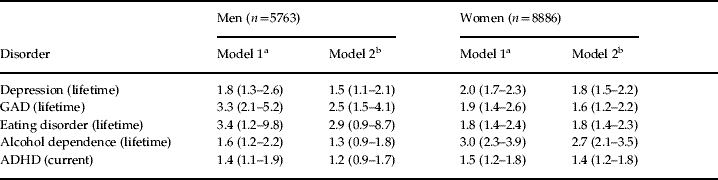
Associations between dichotomous diagnostic measures of illness and same-sex sexual behaviour were analysed with multiple logistic regression. We first adjusted for possible sociodemographic confounders: age, education and relationship status (Table 3: model 1). Thereafter, we expanded the model by including our measures of minority stress: perceived discrimination and hate crime victimization (Table 3: model 2). To account for dependency within twin-pairs, we used Generalized Estimating Equations (GEEs) in both models. Count measures of number of current depression and current ADHD symptoms were approximately continuous and analysed with t tests to simplify interpretation. Although the distributions of symptom scores were not perfectly normal, sample sizes were large enough to justify the use of t tests without transformation of the variables according to the central limit theorem. We conducted linear regressions for each continuous measure of psychiatric morbidity as a function of same-sex sexual experience and adjusted for the covariates age, education, relationship status, discrimination, and hate crime victimization. From each regression equation, we calculated residuals that could be interpreted as the proportion of depression and ADHD not attributable to any of the tested covariates. Finally, we performed a second t test and used a co-twin control procedure also with these residuals.
Co-twin control procedures
Co-twin control methodology is used to compare twins within a pair to test for familial confounding of an observed association. This can generally be achieved by ‘within-and-between’ regression analysis, where differences within twin pairs are compared with differences between the twin pair mean and the population mean (i.e. ‘between’ twin pairs). However, this is problematic when the exposure variable is dichotomous, as with same-sex sexual behaviour in this study (Carlin et al. Reference Carlin, Gurrin, Sterne, Morley and Dwyer2005). Therefore, we used a within twin-pair differences approach and calculated paired t tests for differences in symptoms of current depression and current ADHD between individuals with any same-sex sexual experience and their co-twin with only opposite-sex sexual experience (i.e. twin pairs discordant for same-sex partners). If the increase in mental ill-health is of the same magnitude when comparing this mean difference to that for unrelated individuals in the full sample, this strongly suggests that the association between mental disorder and same-sex sexual behaviour is free from familial confounding (i.e. the effects of genetic and/or environmental factors that are shared by twins). If the association is still present but of lesser magnitude, then it is partly confounded by familial factors, suggesting that these influence both the likelihood of mental disorder and that of having same-sex partners. Finally, if the association completely disappears, then familial confounding explains the co-occurrence of the studied disorder and same-sex sexual behaviour. As familial confounding should not entail any sexual minority-related stressors (one twin in each discordant pair did not report any same-sex sexual experiences), this last scenario would provide evidence against a causal relationship between minority stress and psychiatric morbidity. To adjust for age, relationship status, education, perceived discrimination and hate crime victimization, we also performed linear regression with these covariates, calculated residuals for psychiatric ill-health, and used these in a second paired t test. Although it is possible to conduct co-twin control analyses with dichotomous measures of morbidity (e.g. with conditional logistic regression), the relative rareness of the disorders and same-sex sexual behaviour yielded very low power for such analyses. Therefore, we present within-twin pair analyses only for the two continuous measures of current depression and current ADHD symptoms. To increase statistical power for the co-twin control analyses, we pooled all same-sex sexual behaviour-discordant same-sex twin pairs regardless of zygosity. However, the pooling meant that we could not separate genetic from environmental confounding, only adjust for a combined familial confounding effect. All calculations were performed using SAS version 9.1.3 (SAS Institute Inc., USA) with proc ttest, proc means (paired t test) and proc genmod (logistic regressions with GEEs).
Results
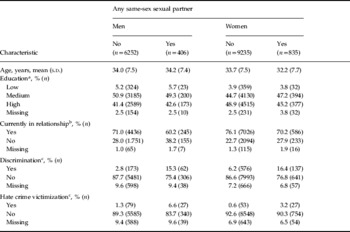
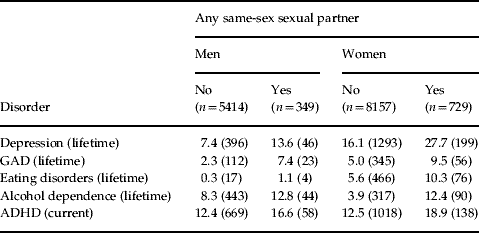
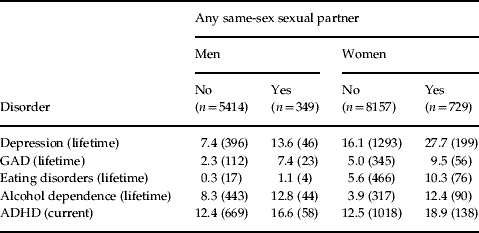
Four hundred and seven men (5.6%) and 835 women (7.8%) reported at least one lifetime same-sex sexual partner [χ2(1)=32.11, p<0.001]. Although men and women with same-sex sexual partners differed only slightly from men and women with only opposite-sex sexual partners regarding age, education and relationship status, they reported discrimination and hate crime victimization much more often (Table 1). Prevalences of psychiatric disorder are presented in Table 2. Overall, prevalences were comparable to those found in other large population-based studies. For example, 12.9% (2057) of all individuals in our sample, regardless of same-sex partner experiences, had ever suffered from major depression, compared with an average of 16.6% US men and women (Kessler et al. Reference Kessler, Berglund, Demler, Jin, Merikangas and Walters2005). The high prevalence of ‘probable’ ADHD probably reflects the fact that we did not take into account distress and impairment or stability of symptoms across settings.
Sociodemographic characteristics among 20- to 47-year-old Swedish twins with and without any same-sex sexual partner

s.d., Standard deviation.
a Highest educational level obtained or currently completing. ‘Low’ denotes elementary school, ‘medium’ denotes high school, and ‘high’ denotes university degree.
b ‘Yes’ includes being married, cohabiting or being in a committed relationship without cohabiting. ‘No’ includes being single, divorced, separated or widowed.
c Due to respondent's race, ethnicity, gender, sexual orientation or religion.
Psychiatric disorder among 20- to 47-year-old Swedish twins with and without any same-sex sexual partner
GAD, Generalized anxiety disorder; ADHD, attention deficit hyperactivity disorder.
Values given as % (n).
The ascertainment of all disorders was based on DSM-IV-TR symptom criteria.
All internal sample sizes were within 5% of the values given in the column heads, except for GAD (4926, 311, 6905 and 592 respectively).
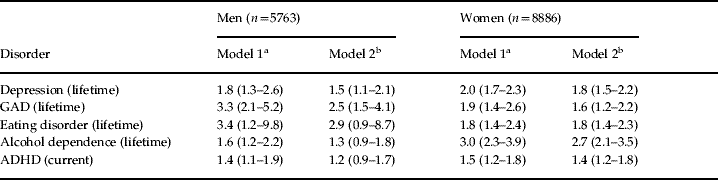
Both men and women with any same-sex sexual partner had higher prevalences of psychiatric disorder than individuals with only opposite-sex sexual partners. After adjusting for age, education and relationship status, the risk increases remained for depression, GAD, eating disorder, alcohol dependence and ADHD among men and women with any same-sex sexual partner compared with individuals with only opposite-sex sexual partners (Table 3, model 1). Adjusting for perceived discrimination and hate crime victimization reduced the association between same-sex sexual experience and psychiatric morbidity (Table 3, model 2).
Impact of minority stress. Logistic regression modelling of risk of psychiatric disorder among 20- to 47-year-old Swedish twins with any same-sex sexual partner compared with those without
GAD, Generalized anxiety disorder; ADHD, attention deficit hyperactivity disorder.
Values are given as odds ratios (95% confidence interval).
The ascertainment of all disorders was based on DSM-IV-TR symptom criteria.
a Adjusted for age, education and relationship status.
b Adjusted for age, education, relationship status, discrimination and hate crime victimization.
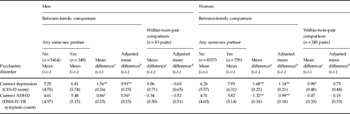
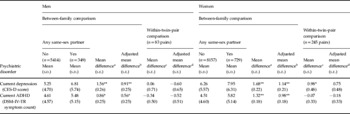
When using continuous measures, we also found more current depressive and ADHD symptoms among individuals with any same-sex sexual partner experience (Table 4). Adjusting for age, education, relationship status, discrimination and hate crime victimization lowered the increase of both measures. However, for both current depression and ADHD symptoms, the increased rate remained significant at the α=0.05 level. Even without adjusting for any covariates, increased risks were substantially reduced or eliminated when we controlled for familial (genetic and/or shared environmental) factors in within-twin-pair comparisons. Adjusting for age, education, relationship status, discrimination and hate crime victimization further reduced the risk for psychiatric symptomatology; even leading to less depression (men only) and ADHD symptoms among twins (both men and women) with any same-sex sexual experience compared with their heterosexual co-twins.
Impact of familial confounding. Differences in psychiatric symptoms between 20- to 47-year-old Swedish twins with any same-sex sexual partner and those without
CES-D, Center for Epidemiological Studies Depression Scale; ADHD, attention deficit hyperactivity disorder; s.d., standard deviation; s.e., standard error.
a Mean difference between those with any same-sex sexual partner compared with those without.
b Mean difference between those with any same-sex sexual partner compared with those without, adjusted for age, education, relationship status, discrimination and hate crime victimization.
c Mean difference between twins reporting any same-sex sexual partner and their co-twin who did not.
d Mean difference between twins reporting any same-sex sexual partner and their co-twin who did not, adjusted for age, education, relationship status, discrimination and hate crime victimization.
* p<0.05 (Satterthwaite, assuming unequal variances), ** p<0.001 (Satterthwaite, assuming unequal variances).
Discussion
We used a contemporary Swedish sample of 20- to 47-year-old twins to conduct the largest population-based study of its kind. First, we replicated findings of increased risk of depression (current and lifetime) and GAD among both men and women with same-sex sexual partners compared with those with only opposite-sex partners (Cochran & Mays, Reference Cochran and Mays2000b; Gilman et al. Reference Gilman, Cochran, Mays, Hughes, Ostrow and Kessler2001; Sandfort et al. Reference Sandfort, de Graaf, Bijl and Schnabel2001). Second, a novel finding was the increased risk for ADHD symptoms among individuals with same-sex sexual partners. ADHD is a neuropsychiatric disorder for which little is known about prevalence and correlates in the adult general population and that is previously unstudied in the context of sexual minority mental health. Some ADHD symptoms defined in DSM-IV-TR are not necessarily specific to ADHD; for example, forgetfulness and restlessness might also indicate anxiety. Hence, these findings should ideally be reproduced with clinically diagnosed ADHD; not available with the present study design. Third, we found evidence for gender-specific patterns; increased alcohol dependence among women and eating disorders among men with same-sex sexual partners, consistent with prior work showing a ‘reversed’ gender difference in the risk increase for these two mental disorders. Nevertheless, there was an overall, albeit smaller, increase in these disorders for both men and women who had same-sex sexual partners. Although it has been hypothesized that the higher risk for these disorders might be due to gender-atypical attitudes and behaviours among individuals with same-sex partners (e.g. eating disorders caused by increased body dissatisfaction among non-heterosexual men: Conner et al. Reference Conner, Johnson and Grogan2004; Hospers & Jansen, Reference Hospers and Jansen2005), our results suggest that gender-atypicality cannot explain the entire risk increase. These results stress the importance of analysing psychiatric morbidity in non-heterosexually active men and women separately and in adequately powered studies so that gender-specific effects are not overlooked.
Fourth, as predicted by the minority stress hypothesis, the risk for psychiatric morbidity was lowered when we controlled for perceived discrimination and hate crime victimization. However, the causal direction of this association is not clear (mental disorder may increase the actual risk of suffering discrimination and victimization but also the likelihood of recalling and reporting of such). Fifth, these components of minority stress were not sufficient to explain all the excess risk for mental ill-health in individuals with same-sex sexual partners. We hypothesized that familial factors might confound the association between same-sex sexual behaviour and psychiatric disorder and tested this with a co-twin control procedure. Indeed, genetic and/or environmental familial factors explained most or all of the increased current depression and ADHD symptoms among individuals with any same-sex sexual partner, independent of the adjustment for perceived discrimination or hate crime victimization. However, poor statistical power meant that controlling of familial confounding was only possible for disorders for which we had continuous measures. Therefore, we constructed severity and symptom count indices for GAD and alcohol dependence respectively (see Online Appendix). Although the distributions were highly skewed, the results from these analyses were compatible with familial confounding (possibly with the exception of GAD in men). In conclusion, the observation of familial confounding across several types of psychiatric ill-health suggests that shared genetic and/or environmental factors are important in the aetiology of common psychiatric disorders among individuals with same-sex sexual partner experience.
Although these results might seem surprising, the few earlier studies that included siblings or twins of non-heterosexual individuals partly support this finding. Balsam et al. (Reference Balsam, Rothblum and Beauchaine2005b) found no increased distress or psychiatric hospitalization in a convenience sample of self-identified non-heterosexual US men and women when compared with their heterosexual siblings. This is noteworthy because the authors also reported that being the victim of abuse as child or adult was more common among non-heterosexual subjects, also compared with heterosexual siblings (Balsam et al. Reference Balsam, Beauchaine, Mickey and Rothblum2005a), thereby casting some doubt on the generalized causal association assumed by the minority stress model. However, Balsam et al.'s results might be biased towards the null; heterosexual siblings were recruited through the non-heterosexual index individual, which could indicate that these individuals were more open about their sexuality and had stronger familial support, that is suffered from less minority stress, than the average non-heterosexual individual. A counter-argument to the latter is that Balsam et al. did find increased suicidal ideation, self-injurious behaviour, and use of psychotherapy and psychiatric medications, none of which were measured in the present study. Increased suicidality among non-heterosexual compared with heterosexual men was also found in the only prior study of sexual minority health that used co-twin controls (Herrell et al. Reference Herrell, Goldberg, True, Ramakrishnan, Lyons, Eisen and Tsuang1999), but the heterosexual twins of non-heterosexual individuals were also more suicidal than were twins from pairs concordant for heterosexuality (Bailey, Reference Bailey1999).
Methodological considerations
Despite the strengths of this study, some limitations should be noted. Although this was a large population-based investigation, the sample size did not permit analysis of the relative importance of heritability and shared environment for the identified familial confounding. Future research should attempt to do this by performing co-twin control analyses separately for MZ and DZ twins. The statistical power in this study was decreased by the relatively high level of non-responding, which is especially problematic in twin control analyses, where both twins have to answer to provide informative pairs. Although 40.1% of the source population were included in our overall analysis, only approximately 25% of all twin pairs were fully informative in co-twin control analyses. Non-responders either did not answer the STAGE at all, or participated in the telephone interview but did not return the accompanying paper questionnaire with items central to this study. The internal response rate was high, however. Among the individuals responding to items concerning age, sex, education, relationship status, perceived discrimination, hate crime victimization and current ADHD, 93% of all men and 96% of all women also answered items regarding sexual partners. This indicates that non-responding was not specific to sexual health questions but instead was due to a general unwillingness to participate in this rather lengthy survey. We are probably underestimating the true prevalence of some mental disorders in the general population; however, our findings concerning sexual minority health should be generalizable unless non-heterosexual individuals with mental disorder were more prone to answer this questionnaire than heterosexual individuals with mental disorder. Considering that the levels of increased depression and anxiety disorder found here are well in line with findings in a systematic review of literature (King et al. Reference King, Semlyen, See Tai, Killaspy, Osborn, Popelyuk and Nazareth2008), we find this unlikely.
We also recognize limitations with our measures. The continuous measures of depression and ADHD symptoms reflected current and not lifetime psychiatric morbidity. Therefore, we cannot know whether putative familial factors contributing to the covariation between same-sex behaviour and psychiatric morbidity do so similarly throughout development (for example, minority stress may play a stronger role during adolescence). As stated previously, the summation of DSM-IV-TR ADHD symptoms might measure something subtly different from clinically diagnosed ADHD. Inability to relax and be attentive might also be symptoms of generalized anxiety rather than ADHD. The measures of minority stress were restricted; in only asking about particularly stressful events (being discriminated against or victimized from hate crime), we lack a measure of chronic stress such as internalized homophobia or a feeling of social exclusion. This could possibly lead to underestimation of potential long-term effects of minority stress without specific events of discrimination or hate crime.
The present study also focused on self-reported experience with same-sex sexual partners rather than sexual orientation per se. Because of the survey design, we were unable to assess directly sexual attraction, sexual fantasies and sexual self-identification. It is likely that those reporting same-sex sexual partners constitute a heterogeneous group, including both people choosing same-sex partners more exclusively (with or without defining themselves as homosexual), and those having had same-sex partners more sporadically, perhaps as an expression of a bisexual sexual identity or sexual experimentation in a heterosexually identified individual. In an attempt to consider part of this variability, we performed additional analyses adjusting for total number of sexual partners (same- and opposite-sex) (see Online Appendix). However, although this slightly reduced the increased risks, the overall pattern remained largely the same. In addition, when cross-validated in a contemporary referred sample (n=555) of adult men (20–47 years old) in Toronto, Canada, having had any same-sex sexual partner correlated strongly (r=0.70) with self-reported same-sex sexual attraction, suggesting substantial external validity at least for men (Dr Ray Blanchard, personal communication, 16 August 2007). These complementary analyses suggest that same-sex behaviour is a reasonable proxy for homosexual sexual attraction on the group level; if the increased risk of mental disorder is related to self-defined sexual orientation or sexual fantasies rather than sexual behaviour, the heterogeneity in our measure would reduce the precision, but not the validity, of our results. Finally, we lacked information on participants' HIV status, which may affect psychiatric morbidity in our population of interest. However, as the prevalence of HIV/AIDS is relatively low in Sweden (Heinrup, Reference Heinrup2005), also among men who have sex with men, this is unlikely to have had any substantial impact on our results.
We conclude that, even though adjusting for discrimination and hate crime victimization reduces some of the increased risk for depression, GAD, eating disorder, alcohol dependence and ADHD among people reporting same-sex sexual partners, our findings of considerable familial confounding suggest that the minority stress hypothesis may have been overstated. Identifying the familial factors, be they genetic or environmental, that increase the risk for psychiatric morbidity among non-heterosexually active individuals should be a research priority.
Acknowledgements
We thank Dr Ray Blanchard of the Centre for Addiction and Mental Health in Toronto, Canada for generously providing validation data for our sexual orientation measure. The Swedish Twin Registry is supported by unrestricted grants from the Swedish Department of Higher Education and the Swedish Research Council. Niklas Långström is supported by the Swedish Research Council – Medicine. The funding bodies were not involved in the design and conduct of the study, collection, management, analysis, and interpretation of the data, or preparation, review or approval of the manuscript.
Declaration of Interest
None.
Note
Supplementary material accompanies this paper on the Journal's website (http://journals.cambridge.org/psm).