




No CrossRef data available.
Article contents
COSTS OF INFORMAL CARE FOR PATIENTS IN ADVANCED HOME CARE: A POPULATION-BASED STUDY
Published online by Cambridge University Press: 21 April 2004
Abstract
Objectives: Several studies have sought to analyze the cost-effectiveness of advanced home care and home rehabilitation. However, the costs of informal care are rarely included in economic appraisals of home care. This study estimates the cost of informal care for patients treated in advanced home care and analyses some patient characteristics that influence informal care costs.
Methods: During one week in October 1995, data were collected on all 451 patients in advanced home care in the Swedish county of Östergötland. Costs were calculated by using two models: one including leisure time, and one excluding leisure time. Multiple regression analysis was used to analyze factors associated with costs of informal care.
Results: Seventy percent of the patients in the study had informal care around the clock during the week investigated. The patients had, on average, five formal care visits per week, each of which lasted for almost half an hour. Thus, the cost of informal care constituted a considerable part of the cost of advanced home care. When the cost of leisure time was included, the cost of informal care was estimated at SEK 5,880 per week per patient, or twice as high as total formal caregiver costs. When leisure time was excluded, the cost of informal care was estimated at SEK 3,410 per week per patient, which is still 1.2 times higher than formal caregiver costs (estimated at SEK 2,810 per week per patient). Informal care costs were higher among patients who were men, who were younger, who had their own housing, and who were diagnosed with cancer.
Conclusions: Studies of advanced home care that exclude the cost of informal care substantially underestimate the costs to society, regardless of whether or not the leisure time of the caregiver is included in the calculations.
Information
- Type
- GENERAL ESSAYS
- Information
- International Journal of Technology Assessment in Health Care , Volume 19 , Issue 4 , December 2003 , pp. 656 - 663
- Copyright
- © 2004 Cambridge University Press
Advanced home care has become an alternative to hospital care in many countries, mainly as an attempt to cut costs and also to meet patient demands. Literature reviews (9;21) have suggested that patients can be treated in advanced home care and home rehabilitation at similar costs and effectiveness compared with hospital care. It has been shown that care provided by family and significant others, that is, informal care, constitutes a substantial part of the total care effort needed in advanced home care and in the care of the elderly (1;12;16;18). However, the costs associated with these efforts are rarely included in published evaluations of home care programs.
Evaluations with a societal perspective (6;14) should include all costs and effects associated with a certain health care program. However, there is still no consensus regarding how to incorporate the costs of informal care, for instance, the cost associated with reduced leisure time of the informal caregiver (4;5).
In Sweden, the County Councils are responsible for providing hospital care and advanced home care. Home rehabilitation is often included in advanced home care. The municipalities provide nonacute geriatric care and public housing for the elderly as well as home help service, that is, domestic help.
The first aim of this population-based study was to estimate the time cost of informal care among patients treated in advanced home care. Two opportunity cost models were used for estimating the cost of informal care: one including leisure time and the other excluding leisure time. The second aim was to study some factors including diagnosis group, which may have an influence on costs associated with informal care.
MATERIALS AND METHODS
In 1995, the total population of the county of Östergötland, Sweden, was 415,000. The county comprised thirteen municipalities, two of which were among Sweden's ten largest. The age structure in Östergötland corresponds to that reflected in national data. The costs for all in-hospital care were estimated at SEK 2,675 million for 1996. The cost for the advanced home care was calculated to be SEK 66 million, which constituted 2.5% of the total cost for hospital care. In 1995, there were 2,100 hospital beds in Östergötland and there were 6,500 accommodations in nursing homes and similar facilities run by the municipality. In the same year, 1,600 patients were treated in advanced home care and home rehabilitation, an average of 410 patients per day. This number represented 30% of all patients treated within advanced home care in Sweden (7). Östergötland is a forerunner in advanced home care in Sweden, which has been a part of the health care structure since 1976. Advanced home care is mainly palliative. The original aim of advanced home care was to offer gravely ill and dying patients, or patients with extensive care needs, an alternative to hospital care. This group of patients is still the dominant group in advanced home care (7).
In this study, advanced home care is defined as care managed by a team of medical professionals that includes a medical doctor and a registered nurse and other professionals that cares for the patient in his/her home. The team must be available around the clock and a hospital bed must be available, if needed, as back-up. Had the care not been given in the patient's home, hospitalization would have been necessary, that is, home care constitutes a direct substitute for hospital care. Informal care is defined as the care provided by close relatives and friends.
In this population-based study, we have used data collected for the purpose of mapping out advanced home care and home rehabilitation. Data on 451 patients was collected during one week in October 1995 and included all patients who were registered in advanced home care (92%) or home rehabilitation (8%). The week investigated was considered by the management at each unit to be representative of their ongoing work. Five units providing advanced home care and two units providing home rehabilitation throughout Östergötland were involved in the data collection. A standardized form was used containing twenty-three questions regarding background data, diagnosis, time spent giving care by home care providers, home help service, and informal care. The nurse or medical doctor in charge recorded all the answers, representing joint statements from the staff and for some questions also the patient and informal caregiver at each unit. The medical professionals who recorded the answers were all familiar with the patient and his/her care situation. Based also on joint statements, the amount of informal care was recorded on a five grade scale with the alternatives “around the clock,” “daytime seven days per week,” “night-time seven days per week,” “at least one day/night per week,” and “a few times per month.” The patients were also categorized into four patient disease groups (cancer, diseases of the circulatory system, diseases of the respiratory system, and other diseases or injuries) based on primary diagnosis (10).
Costs
In this study, we have chosen to determine the value of informal care through its opportunity cost estimated as lost gross value during time absent from usual activities (13), as opposed to time absent from work. Thus, retired or unemployed persons who provide informal care are not excluded. We have assumed that usual activities consist of three parts: main activity (8 hr), leisure time (8 hr), and time for sleep (8 hr). The value of time spent providing informal care is estimated by its market price as recommended by Luce et al. (14), that is, the hourly gross salary. However, we have not used a targeted wage, because we did not have adequate data on the characteristics of the informal caregivers. The hourly gross salary is the employer's labor cost, that is, the salary including payroll taxes (SEK 160 per hour) for an average full-time Swedish employee in 1999 (17). The value of leisure time is estimated as the hourly net salary (after taxes), that is, an estimated value of the time spent by the informal caregiver (SEK 77 per hour) and, thus, an estimate of the informal caregiver's valuation of his/her leisure time. As a reference point, the average exchange rate for one euro was 8.81 in 1999.
Two models have been designed to fit the patient data. Both models assume a 40-hour working week. In the first model, which includes leisure time, the value of informal care for the “around the clock” alternative is estimated assuming eight hours of main activity, eight hours of leisure time, and eight hours of non-care time each day. The alternatives “one day” and “one night” are assumed to be eight hours. In the second model, leisure time is excluded. The cost of informal care during one week was calculated by using the following expressions:
- Informal care cost including leisure time=((hourly gross salary*8 hours)*5 days)+((hourly net salary*8 hours)*5 days)+((hourly net salary*16 hours)*2 weekend-days);
- Informal care cost excluding leisure time=((hourly gross salary*8 hours)*5 days).
Statistical Analysis
A linear multiple regression analysis was used to estimate the influence of different background factors on the costs for informal care. Background factors were age, sex, housing, and diagnosis. In the regression analysis, the diagnostic categories diseases of the circulatory system, diseases of the respiratory system, and other diagnoses were merged into one large group, because there were no substantial differences in costs between these groups. Because the cost variable was skewed, we also performed an analysis on the logarithmic scale, however, there were only minor changes in the results (p values); therefore, we, present only the untransformed results.
RESULTS
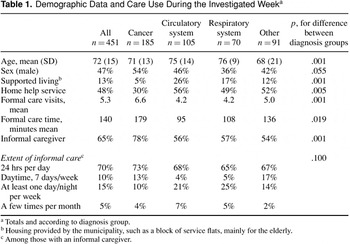
The patients in the study were divided into four major disease categories: cancer (41%), diseases of the circulatory system (23%), diseases of the respiratory system (16%), and other diseases/injuries (20%) such as fractures, poisoning, psychological disorders, and diseases of the musculoskeletal system. Most of the patients lived in their own housing and most of them did not have home help service (Table 1).

The mean age of the patients was 72 years, and 47% were men. Sixty-five percent of the patients had an informal caregiver, either a close relative or significant other, and 70% of those had informal care around the clock. Ten percent of the patients with an informal caregiver had care during the daytime seven days per week. Fifteen percent had informal care at least one day or night per week, and five percent once or twice per week. None of the included patients had informal care seven days per week during the nights only. Regarding formal care, the patients had an average of five visits per week and each visit lasted for almost half an hour. Thirty percent of the patients had scheduled daily contact with the advanced home care team, and 52% had at least one scheduled contact per week. Sixty-one percent of the visits took place during the daytime, 21% during the evening, and 18% during the night. Seventy-four percent of the visits were made by a single caregiver. A physician was present during 9% of the visits.
Cost
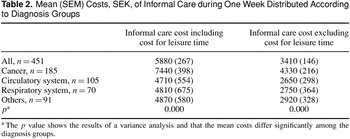
The costs of informal care are shown in Table 2. The mean cost of informal care, including leisure time for all patients, was SEK 5,880 per week per patient. When leisure time is excluded in the calculations, the mean cost of informal care was SEK 3,410 per week per patient.

Regarding formal care costs, the annual health care costs for advanced home care, including home rehabilitation, were calculated to be SEK 66 million. The cost per week, thus, was calculated to be SEK 2,810 per patient. This would mean that the cost of informal care, including leisure time, was twice as high as formal caregiver costs (home help service not included). When leisure time was excluded, the cost of informal care was still 1.2 times higher.
In Table 2, there is also a comparison of diagnosis groups regarding informal care costs. Patients with cancer had the highest informal care cost, whereas the differences between other groups were small.
Factors Influencing Informal Care Costs
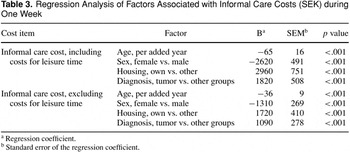
The results of multiple regression analyses showed that age, sex, housing, and diagnosis influenced informal care costs. For older patients and female patients, informal care costs were lower, whereas patient's with their own housing who had cancer had higher costs for informal care (Table 3).

DISCUSSION
The inclusion of and methods for calculating the costs of informal care in the home care setting, which is an issue of debate (4;5). There seems to be general agreement that forgone paid work time should to be given a monetary value. Forgone unpaid work and leisure time, however, are seldom estimated in economic evaluations, and methods for calculating forgone paid work differ. Brouwer et al. (3) states that capturing the loss of quality of life due to lost leisure time in monetary terms seems difficult if not impossible. In assessment of home care, the inclusion of a monetary value for unpaid work and leisure time, however, can be justified: if the informal caregiver had not spent time providing care, he/she would have been able to do other things with his/her time. A conservative assumption would be that the value for this alternative time use exceeds zero. Thus, the time spent on informal care, regardless of what type of time is forgone, can be valued in monetary terms, that is, there is an opportunity cost.
In this study, we argue that, as long as there is an opportunity cost for informal care, as is often the case in advanced home care, the cost of informal care should be given a monetary value in economic appraisals. We have shown that the cost of informal care constitutes a considerable part of the cost of advanced home care and home rehabilitation. Furthermore, Andersson et al. (1) state that the cost of home care programs may be underestimated if indirect costs or productivity costs are excluded or overlooked. The valuation of time for informal caregivers' efforts has also become more important, because new treatments, such as the drugs that are now available for Alzheimer's disease and related disorders, might have a great impact on informal care (3;15).
The five-point scale used to collect data on the amount of informal care in this study may have been somewhat crude. Many normal household chores can be performed at the same time or during caring; joint production exists. Some informal caregivers state that they give care “around the clock.” However, this activity may include lighter chores or surveillance and may be an expression of the feeling of being tied down rather than reflecting actual care time. This is a measuring problem, and the use of diaries or detailed interviews, or perhaps a combination of both, may help to collect truthful data.
Our goal has been to form a practical alternative for use in cost-effectiveness analyses. One condition is access to information about the actual time spent on care by informal caregivers. In our approach, we have used a broad interpretation of the human capital approach (21) presented by Liljas (13) and have considered absence from usual activities (main activity and leisure time) as the basis for calculation of indirect costs. We have used the average monthly salary for all Swedish employees, assuming a normal population, to value time for informal care, as recommended by Gold et al. (8). Our data did not allow us to revise this valuation to take into consideration the informal caregivers' own valuation of the time spent providing care. We have chosen to estimate the value of informal care in two steps. The first is an estimate of the opportunity cost of work and the second is an estimate of leisure time. However, it could be argued that foregone leisure time includes more than giving care and could involve activities such as normal household work that would have been carried out regardless of the home care situation, as well as social activities. Brouwer et al. (2) argue that the loss of leisure time should be captured by a reduction in quality of life and, thus, should be incorporated in the denominator of the cost-effectiveness ratio. Johannesson (11) has taken a similar standpoint to avoid double-counting. The aspect of double-counting, however, is discussed regarding the patient. It seems unlikely that leisure time foregone by informal caregivers would be included in the patient's quality weights, and thus double-counting is not a risk here. If quality of life of the informal caregiver is being measured and included, caution is recommended as double-counting may be a risk.
We have used hourly net salary to estimate the value of time spent caring by the informal caregiver. This estimate is based on the assumption that the shadow price of labor is equal to the gross wage and that the worker will only give up leisure time for work when the net-of-tax wage is high enough to compensate him/her for forgone leisure time, that is, the shadow price of leisure time is equal to the net-of-tax wage (19). It is possible that the time of a retired person should be estimated by a net-of-tax wage for all the time spent providing care, thus excluding payroll taxes for this category of individuals, because they do not give up work time to perform informal care. However, in this study we were unable to do so, as we did not have this information on the informal caregivers.
It might seem inconsistent to estimate the value of informal care as absence from normal activities on the one hand, and then on the other hand, to use different prices for different time episodes during the day. We have made this choice so that the value of the informal caregivers' normal activities is not underestimated because of the lack of information and also as a way of illustrating a possible way of making such estimates. This approach is also supported in the literature (19).
Patients with cancer constitute the largest group in the sample. This group had significantly less home help service compared with the other four groups and significantly more help from informal caregivers. It comprised more terminally ill patients, and the efforts of informal caregivers, therefore, were substantial. Costs of informal care were higher among patients who were men and who also had their own housing. In turn, if the patients do not live in their own homes, there may be a turnover between formal caregivers, that is, from the County Council to the municipality. This is also an important aspect, as demographic trends in Sweden indicate that there will be more single households in the future; therefore, there will be increased pressure on the municipalities if home care expands.
In this study, we lack certain data, such as the age and sex of the informal caregivers, the normal activities they gave up to care for the patient, and more detailed information regarding time spent providing care. This does not, however, compromise our main conclusion. Furthermore, in comparison with the so called “hospice movement” (that developed in Great Britain and Ireland), the availability around the clock, seven days a week was characteristic for the Swedish model. The advanced home care in Sweden is more of a substitute for hospital care rather than a complement to hospital care as is often the case in other countries. This aspect is true in, for example, palliative care. This finding indicates a possible shortcoming in the generalizibility of the results regarding the relative magnitude of the cost of informal care.
POLICY IMPLICATIONS
The results of this study are important, as there might be incentives for formal care providers to initiate home care, regardless of its societal cost-effectiveness, to increase efficiency. Studies of advanced home care that exclude the cost of informal care are likely to substantially underestimate the costs to society. Costs for informal care should be included in cost-effectiveness studies of advanced home care and home rehabilitation and should preferably be presented as a separate item in these studies.
The County Council of Östergötland, Sweden, funded this study.
References
Andersson A,
Levin L-Å,
Emtinger BG.
2002
The economic burden of informal care.
Int J Technol Assess Health Care.
18:
46-
54.Google Scholar
Brouwer WBF,
Koopmanschap MA,
Rutten FFH.
1998
Patient and informal caregiver time in cost-effectiveness analysis. A response to the recommendations of the Washington panel.
Int J Technol Assess Health Care.
14:
505-
513.Google Scholar
Brouwer WBF,
Van Exel NJA,
Koopmanschap MA,
Rutten FFH.
1999
The valuation of informal care in economic appraisal. A consideration of individual choice and societal costs of time.
Int J Technol Assess Health Care.
15:
147-
160.Google Scholar
Canadian Coordinating Office for Health Technology Assessment (CCOHTA).
1997
Guidelines for economic evaluation of pharmaceuticals.
2nd ed.
Ottawa:
Canadian Coordinating Office for Health Technology Assessment (CCOHTA)
Commonwealth of Australia.
1995
Guidelines for the pharmaceutical industry on preparation of submissions to the Pharmaceutical Benefits Advisory Committee: Including economic analyses.
Canberra:
Department of Health and Community Services
Drummond MF,
Stoddart GL,
Torrance GW,
O'Brien BJ.
1997
Methods for the evaluation of health care programmes.
2nd ed.
Oxford:
Oxford Medical Publications
The County Council of Östergötland (Emtinger BG.).
1996
Vå rda och vå rdas hemma. Kartlå ggning av LAH – den lasarettsanslutna hemsjukvå rden i Östergötland. Beställarstaben för hälso-och sjukvå rd.
[Caring for and being cared for at home. Mapping LAH-general associated home health care in Östergötland.] (In Swedish).
Linköping:
The County Council of Östergötland
Gold MR,
Siegel JE,
Russel LB,
Weinstein MC, eds.
1996
Cost-effectiveness in health and medicine.
Oxford:
Oxford University Press
Health Services Utilization and Research Commission (HSURC).
1996
The cost-effectiveness of home care. A rigorous review of the literature.
Background paper.
Saskatoon:
HSURC
World Health Organization.
1980
International Classification of Diseases and Related Health Problems.
9th revision, ICD9.
Geneva:
World Health Organization
Johannesson M.
1997
Avoiding double-counting in pharmacoeconomic studies.
Pharmacoeconomics.
11:
385-
388.Google Scholar
Johansson L.
1991
Caring for the next of kin. On informal care of the elderly in Sweden.
(Thesis no. 330). Socialmedicinska institutionen,
Uppsala:
Almqvist & Wiksell International
Liljas B.
1998
How to calculate indirect costs in economic evaluations.
Pharmacoeconomics.
13
(Pt 1)
1-
7.Google Scholar
Luce BR,
Manning WG,
Siegel JE,
Lipscomb J.
1996
Estimating costs in cost-effectiveness analysis.
In: Gold MR,
Siegel JE,
Russel LB,
Weinstein MC, eds.
Cost-effectiveness in health and medicine.
Oxford:
Oxford University Press
McDaid D.
2001
Estimating the costs of informal care for people with Alzheimer's disease: Methodological and practical challenges.
Int J Geriatr Psychiatry.
16:
400-
405.Google Scholar
Muurinen J.
1986
The economics of informal care. Labour market effects in the National Hospice study.
Med Care.
24:
1007-
1017.Google Scholar
Official Statistics of Sweden.
1999
Statistical Reports No. AM 61. 1999.
Stockholm
Stommel M,
Given CW,
Given BA.
1993
The cost of cancer home care to families.
Cancer.
71:
1867-
1874.Google Scholar
Sugden R,
Williams A.
1978
The principles of practical cost-benefit analysis.
Oxford:
Oxford University Press
The Swedish Council on Technology Assessment in Health Care (SBU).
1999
Advanced home care and home rehabilitation: Reviewing the scientific evidence on costs and effects.
Report no. 1999:146. (In Swedish, summary in English).
Stockholm:
SB Offset AB
Demographic Data and Care Use During the Investigated Weeka
Mean (SEM) Costs, SEK, of Informal Care during One Week Distributed According to Diagnosis Groups
Regression Analysis of Factors Associated with Informal Care Costs (SEK) during One Week
 You have
Access
- 18
- Cited by