Introduction
This review article is expanding the horizon of social citizenship by juxtaposing it along with the question of property in land. The choice to include property within the discourses of social policy is completely dependent on whether welfare (state) is approached narrowly or broadly. A narrow approach with an objective to find ways to deliver services or cash may not move beyond the question of housing among other issues (Esping-Andersen, Reference Esping-Andersen1990: 1).Footnote 1 A broader approach, as we expand the horizon, finds the social function of property serves the realisation of social rights.
In contrast to the Global North, property in land has taken centre stage in the welfare analysis of nations in the Global South. A driving force behind this emerging interest is the tectonic changes in the traditional agrarian societies in land use patterns. Simultaneously, rapid urbanisation has defined the process of growth in most of the Global South. This has exposed the limits of the realisation of social justice through granting home ownership or property titles to citizens (Payne, Reference Payne2001; Elsinga and Hoekstra, Reference Elsinga and Hoekstra2015). The search for social rights in property is a response to this crisis. In this context, social citizenship as a meeting point of legal and economic rearrangement of property rights leads to the revision of social policy debates in the Global South.
The article is organised in the following sequence. First, we undertake a review of developments to the idea of social citizenship since Marshall (Reference Marshall1950). In this review we show how reconceptualisation has brought property rights within the ambit of social citizenship. Second, we review how property in land is essential for the enjoyment of social rights across different world regions. In the third and fourth sections, respectively, we discuss the core element of property rights as social citizenship, and ask the question: what should be the nature of property relations to advance social citizenship? The discussion helps us to make conclusions on the principle of reciprocity and the relevance of private ownership of property and its social function. In the fifth and sixth sections, we discuss how structural transformations are taking place to land ownership in contemporary times, and its emerging patterns in the context of the increasing rate of urbanisation. Here, we discuss how novel modalities of residential patterns require creative imagination beyond minimal housing requirements for the realisation of social citizenship. In the final section of the article, we argue how social policy as a discipline has cross-cutting interests in urban planning, which is emerging as a tool in aiding the realisation of social citizenship.
Is social citizenship complete without property rights?
The idea of citizenship has emerged through the legacy of several theorists – Aristotle, Machiavelli, Hobbes, Locke, Burke, de Tocqueville, and Arendt among several others. All of them also linked the property question to that of citizenship. However, T.H. Marshall’s seminal article ‘Citizenship and Social Class’ (Reference Marshall1950) is considered as the benchmark for academic discussions on the idea of social citizenshipFootnote 2. While distinguishing three layers of citizenshipFootnote 3 – civil, political and social – Marshall considered right to own property as a civil right and housing as a social right. Marshall was aware that simplistic bifurcation of rights would not capture the complexity, as evident from his discussion on the role of town planning for the realisation of housing rights. Yet, his theory of citizenship visualised ‘equality of status more important than equality of income’ (p.33). This position of Marshall is criticised for its elitist bias and neglect of vertical redistribution (Powell, Reference Powell1995, Reference Powell2002; Hay, Reference Hay1996). However, Marshallian idea of social citizenship opens up the search for realisation of the ideals of citizenship beyond the formal rights granted through legal status (Stewart, Reference Stewart1995). Access to property could bridge the yawning gap between status and income.
Marshall’s theory of citizenship was trying to find a solution to the tension between political equality (within the liberal tradition) and escalating social inequality (in his life time), where the latter was partly generated by civil rights such as the private property rights (to the means of production). In this sense, citizenship as an idea was necessary for capitalist arrangements: ‘…a social system in which there were perpetual tensions between the need for economic profitability, the taxation requirements of the modern state and the rights of citizens to welfare provisions’ (Turner, Reference Turner1990: 192).
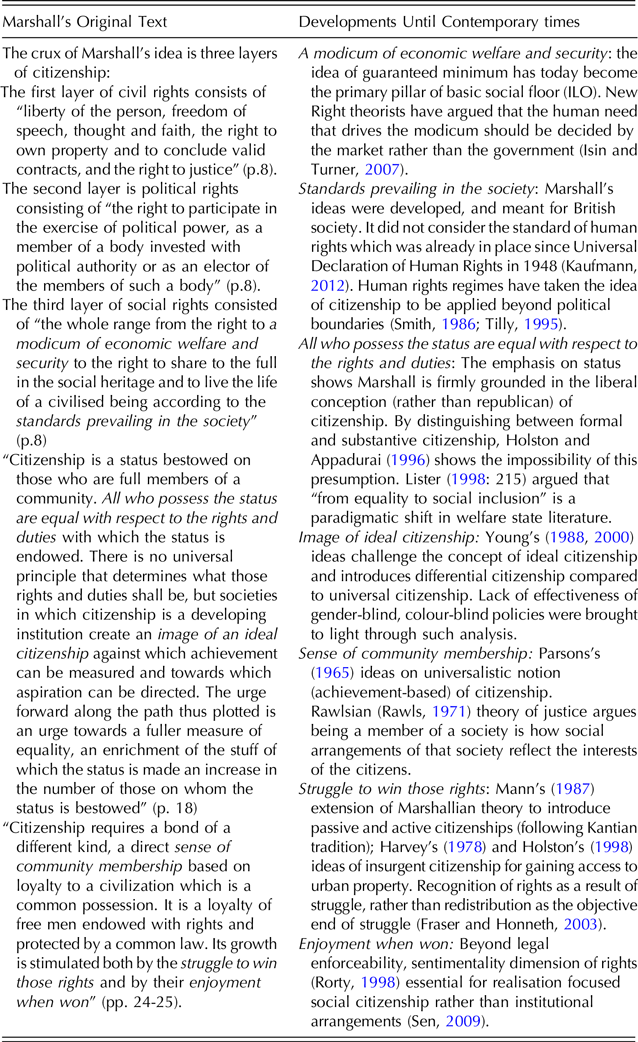
As the idea of social citizenship expanded, however, the inseparability of social rights from what was considered civil rights became evident. This inseparability is mediated through the complex relationship between the aspirations of individuals for emancipation and the desire for collective common good. Property rights take the centre stage in this struggle. ‘As long as capitalism remained a world of small property owners, the property itself would have little to fear from democracy. But with industrialisation, the proletarian masses emerged, for whom democracy was a means to curtail the privileges of property’ (Esping-Andersen, Reference Esping-Andersen1990: 10). This tension of how property rights could be aligned for social aims has influenced the idea of social citizenship, and Table 1 summarises how the idea has evolved since Marshall (Reference Marshall1950).
Extensions of the idea of social citizenship since Marshall (Reference Marshall1950)

In an agrarian production system, the land one lives on significantly shapes social identity. These ascriptive identities, within feudal ownership of sources of production, denied the emergence of citizenship. In this sense, the emergence of a new political order in the eighteenth and nineteenth century around the idea of rule of law (Moore, Reference Moore1966; Fukuyama, Reference Fukuyama2011) shaped the concept of citizenship. This contextual milieu is at the core of the Marshallian ideal of social citizenship. ‘Entitlement to a minimum is seen both as a reward for citizenship and as a pre-requisite for participation in society’ (Atkinson, Reference Atkinson1985: 4). Here reference is to income. In the liberal conception when territoriality is irrelevant (for example, slaves or migrants being included in the nation-state) for attainment of citizenshipFootnote 4, land is replaced by income.
As Table 1 shows, several Marshallian ideas are challenged and expanded in the universalistic notion of social citizenship, which does not include property rights at its core. Both the ideas of property and citizenship were developed within the legitimating authority of territoriality of nation-states. The emergence of a human rights regime, which has redefined the objects of social citizenship, has witnessed ‘deterritorialisation of politics and a depoliticisation of territories’ (Kaufmann, Reference Kaufmann2012: 199). This has taken the attention away from the focus on ‘provision’ of modicum to ‘recognition’ of a set of rights in a polity, which is at the core of both property and citizenship (Lund, Reference Lund2011; Davy et al., Reference Davy, Davy and Leisering2013).
Another challenge that Marshallian ideal citizenship experienced is from the idea of active citizenship. Social identity, which was underplayed in the notion of universal citizenship, came back as a bedrock on which citizens struggled to make claim to social rights (Bloemraad, Reference Bloemraad2018). These struggles for citizenship from below (compared to citizenship granted from above) required the political mobilisation for which democracy was an important instrument (Mann, Reference Mann1987; Turner, Reference Turner1990). ‘In this way, the democratisation of property rights become both a novel type of stabilisation politics and at the same time a source of de-stabilisation’ (Esping-Andersen, Reference Esping-Andersen1990: 188).
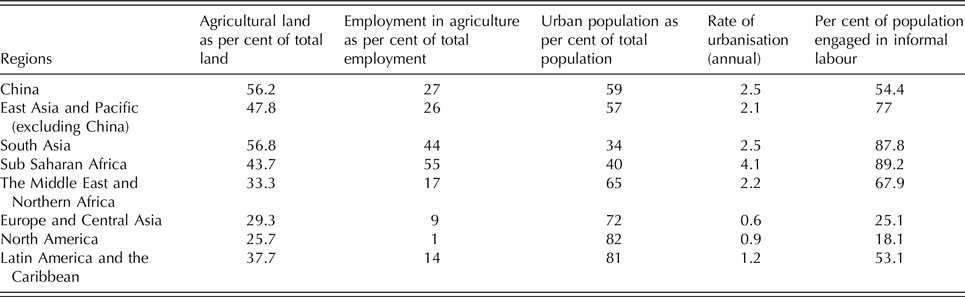
Radical democratisation of property relations is rooted in the urban settings (see urbanisation trends in Table 2). The active citizenship, and its variant of insurgent citizenship, became an important aspect of redefining urban property relations, an aspect we delve deeper into in the last two parts of this article. Holston (Reference Holston2009), who has developed this connection between citizenship and urban property, distinguishes formal citizenship – referring to membership in a nation-state – from substantive citizenship – referring to civil, political, socioeconomic and cultural rights that people possess and exercise. Since the formal citizenship is ‘neither a necessary nor a sufficient condition for substantive citizenship’ (Holston and Appadurai, Reference Holston and Appadurai1996: 190), citizens rearrange the property relations; this brings new forms of membership in the society they want to be in (see this Rawlsian notion explained in King and Waldron, Reference King and Waldron1988).

While we have reviewed the idea of social citizenship as developed by Marshall with reference to property rights, a begging question is the applicability of these ideas in hugely different contexts such as in the Global South. Primacy of the land in human welfare in the Global South enables us to think about the centrality of the property rights in social citizenship, which may not be developed indigenously in those nation-states.
Primacy of land in Global South welfare systems
In much of the Global South, access to land determines human welfare. Most important of these welfare needs is food and nutrition requirements for which subsistence agriculture is still relied upon (Table 2). One and a half billion people across the world depend on small farms for their food requirements (World Bank, 2014)Footnote 5. This scenario is markedly different from the land use patterns in the Global North. Though in North America and several Western European countries, farmland constitutes about 50 per cent of total land, mechanised food production and distribution integrated through regulated markets reduces the need of direct access to land for food/nutrition requirements. This is evident from the variations in column three of Table 2 regarding the proportion of population depending on agriculture.
A pre-dominance of agriculture and agrarian labour should not lead us to conclude that the relationship with land, and land use patterns, are the same today as that of seventeenth or eighteenth century in Europe. It is exactly these changes in land use over time that necessitate a juxtaposing of the idea of social citizenship with property rights. Columns four and five in Table 2 show this emerging pattern. Values associated with agrarian landFootnote 6 are rapidly changing as an intense urbanisation process is taking place in the Global South (we discuss these issues later in the article). A welfare state could not also be organised around the de-commodification principle (Polanyi, Reference Polanyi1944; Esping-Andersen, Reference Esping-Andersen1990) in the Global South since informal labour dominates (see column six of Table 2). A lion’s share of this informal labour is agriculture. Yet, most of the new jobs are being created in urban centres.
Davy (Reference Davy2012, Reference Davy, Pellissery, Davy and Jacobs2014) systematically examines how land is instrumental to advance human capabilities, and how socio-economic rights are dependent on access to land. He concludes that property could be considered as a civil right or political right as well as economic, social or cultural right. Beyond these anthropocentric arguments for the use value of land, in a world of increased environmental consciousness, land is valued for its own sake (Leopold, Reference Leopold1968). Human beings’ responsibility to protect land in its quality in turn ensures human security through better environmental standards.
Though land is the main source of livelihood across the Global South, property relations are organised in hugely different ways. While in some states private property rights are not recognised (e.g. Urban China), in some other states, ability of the states to grant those property rights from feudal forces is limited (see Bromley, Reference Bromley2006 for dominant types of property types). These variations are accepted today as the continuum of land rights. On the one extreme of the continuum is the formal land rights, while on the other extreme is informal land rights – ‘each step along the continuum providing different sets of rights and degrees of security and responsibility’ (UN Habitat and GLTN, 2008: 8). Aligning social citizenship with property rights is to find the appropriate fit as to what step in the continuum ensures social justice in a particular context. While finding this appropriate fit, the tension is between the principle of private property and the reciprocity principle in property relations. These two ideas are taken up for discussion in the next two sections of the article.
Reciprocity principle in property
It was Thomas Paine (Reference Paine1797), in his Agrarian Justice, who pointed out the reciprocity principleFootnote 7 that lies at the heart of societal obligations when human being ‘improves’ the land:
But the earth in its natural state… is capable of supporting but a small number of inhabitants compared with what it is capable of doing in a cultivated state. And as it is impossible to separate the improvement made by cultivation from the earth itself, upon which that improvement is made, the idea of landed property arose from that inseparable connection; but it is nevertheless true, that it is the value of the improvement only, and not the earth itself, that is individual property (p. 8).
In such instance, human beings owe a ground rent to society, which brings forth the reciprocal action from the citizen to elevate him/herself to social citizenship through property relations. In other words, production relations with the ‘world of things’ is transformed to social relations with the ‘world of human beings’ through the mediation of social citizenship. In the history of social policy, these ideas have been re-emphasised (Tawney, Reference Tawney1912; Polanyi, Reference Polanyi1944). In the literature on property rights, the reciprocity principle was emphasised by Marx in his response to Pierre-Joseph Proudhon (who is known for his bold claim that ‘property is theft’): ‘The right of property, is, …the right to enjoy one’s fortunes…without regard for other men and independently of society…It leads every man to see in other men…the limitation of his own liberty’ (Marx, Reference Marx1844).
Complex societies experience reciprocity relations in complex ways. The evolution of property rights from agrarian production relations – where enclosures that gave exclusive ownership rights – to multiple usage of land created new forms of social citizenship. Freehold property, where the land owner was free from any obligations, was an imaginary idea of absolute right. However, no owner ever has absolute rights. Society and government reserved some of the rights. For instance, the exclusion principle of private ownership could be violated by the right of government to enter into property to carry out its social function. Similarly, government could bring restrictions on the type of permissible land use by the property owner.
The limits imposed on private property were most clearly articulated in the Brazilian Constitution of 1938, which gained inspiration from French philosopher Léon Duguit (see Foster and Bonilla, Reference Foster and Bonilla2011). Duguit argued that property owners have certain obligations to society (such as making it productive), and thus control on property is internal to its structure. These ideas have become central to define social rights. The 1988 Brazilian Constitution articulated that the State has the power to expropriate rural property that was not performing its social function (art 184). Article 186 of the Constitution specified:
The social function is met when the rural property complies simultaneously with, according to the criteria and standards prescribed by law, the following requirements:
(I) rational and adequate use;
(II) adequate use of available natural resources and preservation of the environment;
(III) compliance with the provisions that regulate labour relations;
(IV) exploitation that favours the well-being of the owners and labourers.Footnote 8
In other words, the use rights of property owners are subjected to the human flourishment (Alexander and Peñalver, Reference Alexander and Peñalver2010). Further, the human flourishment is considered possible only when the ‘socio-environmentalism’ (Crawford, Reference Crawford2011), that emphasises the reciprocal relationship between society and environment, is admitted.
The complex arrangements of property relations are recognised through the concept of bundle of rights (Klein and Robinson, Reference Klein and Robinson2011). The idea of bundle of rights recognises a range of rights apart from ownership. Some of these are enjoyment (use) rights, transferability rights, easement rights, and control rights. Recognition of multiple rights, as may be exercisable for different users of same property, opens up the sociality of property.
Property is, therefore, not a single absolute right, but a bundle of rights. The different rights which compose it may be distributed among individuals and society – some are public and some private, some definite, and there is one that is indefinite. The terms which will best indicate this distinction are partial and full rights of property. Partial rights are definite. Full rights are the indefinite residuum (Commons, Reference Commons1893: 92).Footnote 9
From the point view of social citizenship, the key tension is which right should be emphasised in the bundle. Property ownership as individual freedom derives from the principle of the autonomy of citizens. While important, it has serious implications for other elements in the principle of social citizenship, namely the relationship with other members of society. Laying the emphasis on ownership rights has been found to be exclusionary. Within a liberal framework, those who have control over resources also have access to court and legal systems to enforce the exclusion of other members of society (Allen, Reference Allen2007).
This dynamic understanding of property rights as relations among people (rather than rights over things)Footnote 10 challenges the primacy of the state. Rather, the public sphere (distinct from the arena of state, arena of market relations and arena of democratic associations) where the deliberations of citizens take place comes to the forefront (Habermas, Reference Habermas1989). This idea of reciprocity in property relations is more transformative than the reciprocity in The Gift Relationship (Titmus, Reference Titmus1970), where the State had a stronger role to facilitate reciprocity.
Social citizenship in property rights is not among equals. Rather ‘appropriateness and mutuality, rather than in terms of comparative determinacy’ (Mau, Reference Mau2004: 62) guides the deliberative consent of the property user. In this sense, genuine property relations as deliberative space increase citizens’ capacityFootnote 11 through an institutionalist logic rather than minimal contractarianism (Ellis, Reference Ellis2006; also see Rothstein, Reference Rothstein1998).
Private property debate
One of the intense debates in the realm of achieving the goals of social citizenship was how assets should be organised in the society. In the Greek city-states, where the idea of the citizen entering into public sphere emerged, ownership of property was a precondition for participation (Turner, Reference Turner1990).Footnote 12 In a world that was predominantly rural, ‘it was land ownership which would allow people to have political freedom, and it was land ownership which would allow people to make innovative and creative decisions about land use’ (Pellissery and Jacobs, Reference Pellissery, Jacobs, Pellissery, Davy and Jacobs2014: 208). However, the struggle against feudal forces in the form of the revolutions in Russia, Cuba, and China during the twentieth century disdained the idea of private property.
Theoretically, collectivisation as an idea that denied meaningful autonomy for the individual (Arendt, Reference Arendt1958) was found to be antithetical to the very idea of citizenship. The exact opposite of this, namely, state protection to property owners at the cost of friction between those who own property and those who do not ownFootnote 13, also does not foster the ideals of citizenship. Yet, in the century old debate between capitalism and socialism, collectivisation of land (and state ownership) was an experiment in socialist countries. Starting in 1917 Russia’s land reforms encouraged state ownership. In China, rural collectives held the ownership of the land and the state owned the urban land. However, in 2007 property laws were revised to benefit real-estate developers for land development (Chen, Reference Chen2011). In Vietnam too, state-ownership of land was the pattern.
In countries where a mixed-economy was followed, state-led land reforms aimed for the distribution of land from feudal holding to the masses. In several post-colonial democracies (India, Africa and South American countries) giving property titles to small holders or tenants or landless peasants was considered a pre-requisite for poverty alleviation (Scoones, Reference Scoones2009). However, democracies have not successfully surmounted the resistance from both feudal land holding classes as well as the bureaucratic impasse in land registration (see review in Sikor and Muller, Reference Sikor and Muller2009). Further, state-led land reforms failed to recognise plural meanings of land (as required by the user) as well as plurality of legal meanings in property relations (Dey Biswas, Reference Dey Biswas2019).
At the international level, the right to private property was opposed by socialist blocs in the formulation of the United Nation’s Declaration of Human Rights (Jacobs, Reference Jacobs2013; Davy, Reference Davy, Pellissery, Davy and Jacobs2014). Thus, despite recognition of the right to property in the UDHR (Article 17), it is a ‘binding law only with regard to particularly vulnerable humans’ (Davy, Reference Davy, Pellissery, Davy and Jacobs2014: 11). Though the route of human rights has not made a headway to promote private property, the interventions of the World Bank (through its computerisation of land records, land titling and land governance project in several countries) since the 1990s have encouraged private property regimes in many countries in the Global South. This was a strategy to find collaterals for the small informal property holders (which we discuss in a later section in this article). The debate on whether property should be state-owned or privately owned for the realisation of social citizenship is incomplete without a discussion on common property.
An important development that took place amidst the debate on private property vs state-owned was the discovery of the potential of common property through the works of Garret Hardin (Reference Hardin1968)Footnote 14. Ostrom (Reference Ostrom1990, Reference Ostrom, Ingram and Hong2009), through empirical examination of rule-making in the Global South found how livelihoods of people significantly improved through preservation and rejuvenation of common resources. This community based property preservation of defined user groups has radicalised the idea of social citizenship into an engagement model. These localised models have helped us to transcend universalistic notions of citizenship, and to incorporate the ideas of ‘differentiated citizenship’ (identified earlier in the article) with reference to the property question. Some of the concrete examples are rights of indigenous communities, rights of forest dwellers, rights of fisher folk etc. These are particularistic rights strengthening the differentiated (social identity-based) nature of citizenship entitlements. In this themed section the article from Latin American context (Davis and Fernández, Reference Davis and Fernández2019) shows how Community Land Trusts enable citizenship entitlements in the context of urban inequality and exclusion.
Now, we turn our attention to structural transformations that are being meted out on land holding. These changes primarily take the form of displacement in rural areas and claim-making for land in urban areas.
Land grabbing
A paradox on property in agrarian land is at play globally. On the one hand, the value of farmland has diminished to a considerable extent, particularly where subsistence agriculture is taking place. On the other hand, it is exactly these farmlands that have become the centre of conflicts. In India, China and several African countries, farmers are engaged in armed struggle against the State and private corporations to protect agrarian land. What drives this phenomenon is global in nature, but has severe implications for social citizenship within national boundaries.
Three traditional reasons for displacement of property owners used to be a) thermal power including mineral extraction, b) dam, irrigation and canals and c) urban infrastructure. Across the world, the power of the state to take private property for a public purpose is recognised through the principle of ‘eminent domain’.Footnote 15 However, both, whether the state adequately compensated the affected individual as well as whether the exercise of the power of eminent domain by the state was for public purpose, have been questioned.
Since the late 1990s, a new trend is acquisition of land by global players. A price spike of agricultural commodities has encouraged speculative investment in land by global corporations (Lipton and Saghai, Reference Lipton and Saghai2016). Agricultural commodities such as Sugar, Soy and Palm Oil are hugely dependent on land. Jatropha for biofuel is another commodity preferred by investors. Practices of food production companies in their supply chain have shown inclinations to encourage land grab. Forest grabs, particularly from indigenous communities who had depended on natural resources through hunting and gathering life-style, by companies mining for minerals form another modality of land grab.
In the year 2007 alone, Foreign Direct Investment (FDI) to sub-Saharan Africa amounted to over US$ thirty billion. The largest shares of this FDI are concentrated in countries which have important oil and mineral resources, such as Nigeria. Countries which were previously ignored like Ghana, Mozambique, Sudan, Tanzania, etc., at least until the early 1990s have seen an upsurge in FDI due to demand for agricultural lands (UNCTAD, 2008). The farmland sold and leased to these foreign investors is used for producing food for export and not for domestic use. The irony is that the country is not able to meet its demand for food and is receiving aid in order to fulfil the required demand, whereas foreign investment is being made in order to ensure food security of another nation.
Further, countries which are the most affected by land grabbing lack a strong judicial systemFootnote 16 and have a weakness of means for complainants. The governments are highly corrupt and the rich and wealthy are the ones who have political power. The governance deficits are costly for welfare. A model that may serve as a contrast is found in Norway. When the country first discovered large reserves of oil and gas under its continental shelf, a private bid to purchase and harvest the resources was rejected by Parliament. With the state as the major owner, revenue from this resource has added great wealth to the nation. In order to secure that the influx of cash would not impact negatively on the long term economy (‘Dutch disease’), the revenue was kept separate from the state budget – with a spending limit of 4 per cent annually – and put into a fund symbolically entitled the Pension Fund – for future generations. Today this is the world’s largest sovereign fund in existence (Stjerno and Halvorsen, Reference Stjerno and Halvorsen2008).Footnote 17
One of the impacts of displacements from rural areas is directly visible in the informal settlements in urban areas. Having lost the livelihoods based on natural resources, specifically land, people move to cities where small jobs can be found and small businesses can be created. But, access to these cities requires living in the fringes of city. This is how property relations in cities become the corner stone of social rights.
Squalor or informal housing?
Squalor was one of the giants to be annihilated by the sword of social policy, as visualised by Beveridge. The question of decent minimum living conditions remained the ‘wobbly pillar of the welfare state’ (Torgersen, Reference Torgersen, Turner, Kemeny and Lundqvist1987) since the expectation was that most of the housing requirements would be met by the private sector. Through a range of instruments such as public housing, housing allowance, interventions in the rental markets and house construction subsidies, homelessness was addressed with varying successesFootnote 18. A well-developed property titling system and housing market was central to this success in Europe and North America. Peruvian economist Hernando de Soto (Reference De Soto2000) showed this difference in property titling system (and its implications for asset ownership) in the Global South and North.
Approximately 30 per cent of total urban population (about 800 million people) lived in slums as of 2014 (UN Habitat, 2015). Known as favelas, bosti, shanty town, gecekondu, informal settlement or slum they provide shelter similar to what Beveridge called squalor in the 1940s in Great Britain. Today, across the world, cities such as Cape Town, Manila, Sao Paulo, Mumbai, Caracas, Cairo, Dhaka, Buenos Aires, Delhi, Dhaka, Cairo, Jakarta, Ho Chi Minh, Kolkata, are the places of hope and aspiration for populations who are escaping the grinding poverty in rural areas. The Sustainable Development Goals (SDG) explicitly acknowledge this as a policy priority area: ‘By 2030, ensure access for all to adequate, safe and affordable housing and basic services and upgrade slums’ (SDG 11 Target 11.1). At the same time, the focus of policy intervention is not through the range of instruments previously applied in the Global North, typically by granting formal titles to property.
The physical features of what Beveridge termed as squalor was to stay as a unique form of housing. However, social features of these physical locations had very different characteristics. Security of tenure is the single most important consideration for the improvement of life in informal settlements. The dwellers of informal settlements constantly feared eviction by municipal authorities. Therefore, citizenship struggle was to gain recognition of these settlements. This struggle was essentially social – interactions with others in this physical space as well as social production of space. Through a process of appropriation, citizens created dynamic interaction between physical spaces and social identities (Lefebvre, Reference Lefebvre1991; Perlman, Reference Perlman2010).Footnote 19 Through complex uses of open spaces in informal settlements, which transcended the traditional classification of private and public spaces (Dovey, Reference Dovey2010), a citizen-led movement to upgrade slums took place in several countries of the Global South. In other words, informal settlements served more purposes in urban life than housing. The parameters of the modicum of housing could be determined only by how access to other socio-economic rights (e.g. right to employment) could be related to the housing question.
Davy and Pellissery (Reference Davy and Pellissery2013) reviewed the housing conditions in slums across the world using the parameters of adequate housing as specified by the UN Committee on Economic, Social and Cultural Rights.Footnote 20 It was found that claiming formal property rights is not merely difficult in informal contexts, but undesirable since sentimentality and enjoyment dimensions of the realisation of rights are constitutive elements of social citizenship in non-state welfare institutions. Can these insights gained on non-state welfare practices translate as policy instruments? That is what we will examine in the next section.
Sociality in the heart of planning process
Marshall (Reference Marshall1950) in his discussion on the role of town planning for housing rights, emphasises that ‘individual rights must be subordinated’ when a total planning for design of societies takes place. In an important way, the principle of eminent domain in the land acquisition by the state reflects this Marshallian idea. This social purpose of planning is the mediating core principle between property rights and citizenship. Most of the social policy literature does not approach housing questions through the lens of town planning, as Marshall attempted (see for example, Olsen, Reference Olsen and Greve2018).
Town planning as an instrument, as developed in the Western European countries, has been legislated (through Town Planning Acts) in most of the Global South. However, today practitioners have pointed out the ill-effects of adopting those town planning tools. This is because the ‘Western approach abstracts from most of the conditions that are peculiar to the South Asian countries [Global South]’ (Myrdal, Reference Myrdal1968: 20). Creative ways of merging the essential social purposes of planning with citizen-centric ideals are possible. This requires planners to shift their agenda from physical planning to incorporate people’s aspirations (Friedmann, Reference Friedmann1987, Reference Friedmann1992). This is the arena where there is an overlapping consensus between the disciplines of social policy and planning.
Town planning relied on the instrument of the master plan, which was developed using assumptions on physical features of a city and its predicted growth. Though procedural compliance to the planning processes, as mandated by Town Planning Acts, was carried out in most of the cities, their liveabilityFootnote 21 quotient did not improve. This deficit is attributed to a technocratic approach to the planning process (led by experts) resulting in the exclusion of participation of people from the same. Considering these criticisms, it is noteworthy to observe that Constitutions of Brazil and India have mandated Municipal elected bodies to prevail over professionals when it comes to city planning (Indian Constitutional amendment No 73, Article 243; Brazilian Constitution 1988 Article 182). As part of these new changes many areas of functional aspects of social policy have been brought under the subject matter of planning objectives.
This radical approach in planning, by giving primacy to the democratic politics, is the recognition of distance between enacted legislations and informal practices. Informal practices allowed powerful persons in the city to take control of property, yet to be legally compliant. ‘Space reveals itself as a mediation tool used by the practices aimed at redesigning citizenship conditions’ (Mazza, Reference Mazza and Haselsberger2017: 82). Planning by keeping social policy goals as the primary objectives redefines both the city and the notions of social citizenship.
Conclusion
Property rights as an essential constitutive feature of social citizenship are not merely an extension of the relationship between property rights and citizenship. This article aimed to review the developments in the symbiotic development of these two concepts since the classic formulation of the idea of social citizenship by T. H. Marshall. We have shown four unique features when property rights are considered necessary for the realisation of social citizenship.
First, the emphasis on ownership rights is essentially exclusionary in nature. Property as a bundle of rights could have multiple uses. This conceptualisation downplays the debate on private property vs state-owned property. Imaginative combinations of different rights in the arrangement of property relations provide a deliberative space for citizenship. The impacts of different usages are not modular. Rather, property as an institution has radiating effects on the realisation of other socio-economic rights.
Second, both the ideas of citizenship and social citizenship were developed within the boundaries of territorial nation-states. In an age of rapid movement of capital across borders of nation-states, the question of how property relations are being shaped because of trans-national movements of trade and communication becomes important. The deepening of inequality through dispossession of property could be a challenge to the very idea of global social citizenship.
Third, the idea of universal citizenship is challenged subsequently after Marshall’s formulation of ideal images of citizenship. Rights valued by differentiated citizenship are hugely different from what the state grants. In this sense, active citizens or citizenship from below make claims in the way they imagine membership in those communities. In the case of property relations, active citizens create new spaces, where social relations define the quality of physical spaces. These become the arenas of non-state welfare rights.
Fourth, planning as a tool has the potential to mediate between spatial dimensions of land, and social dimensions of individual rights in property. This calls for a renewed engagement between the disciplines of social policy and town planning.
Acknowledgments
Authors have hugely benefited from the comments of Ben Davy and two anonymous reviewers. We would also like to place our gratitude to the FLOOR research group at ZiF, University of Bielefeld led by Ulrike Davy, Lutz Leisering and Ben Davy with whom scholars across the world worked during 2011-2018. Being part of this research group and interactions with these scholars enabled to initiate this themed section.