“A shift into a new niche or adaptive zone is, almost without exception, initiated by a change in behavior.”
Ernst Mayr (Animal Species and Evolution)Introduction
The idea has come down from our predecessors as received wisdom that most articulate brachiopods have been epifaunal animals or nestled in cavities, while some have been considered by some workers to have lived semi-infaunally. This paper challenges these life-habit interpretations for the largest class of brachiopods, asserting that it consisted predominantly of infaunal burrowers.
The class Strophomenata includes two large orders, the Strophomenida and the Productida, which together contain more than one-third of all recognized Paleozoic genera of articulate brachiopods. A large majority of strophomenatan genera were free-living and have often been described, represented in figures, and positioned in experiments as epifaunal animals (Ziegler et al. Reference Ziegler, Cocks and Bambach1968; Bretsky Reference Bretsky1969; Walker and Laporte Reference Walker and Laporte1970; Richards Reference Richards1972; Alexander Reference Alexander1975; Bretsky and Bretsky Reference Bretsky and Bretsky1975; Beus Reference Beus1984; Wiedman Reference Wiedman1985; Leighton and Savarese Reference Leighton, Savarese, Copper and Jin1996; Watkins Reference Watkins2000; Watkins et al. Reference Watkins, Coorough and Mayer2000; Bonuso and Bottjer Reference Bonuso and Bottjer2006; Chen et al. Reference Chen, Shi, Yang, Gao, Tong and Peng2006, Reference Chen, Jin and Lenz2012; Frisk and Harper Reference Frisk and Harper2013). It has nonetheless been asserted by some workers that at least some productides were semi-infaunal occupants of soft substrates (Muir-Wood and Cooper Reference Muir-Wood and Cooper1960; Rudwick Reference Rudwick and Williams1965, Reference Rudwick1970; Grant Reference Grant1966, Reference Grant, Dutro and Boardman1981: Thayer Reference Thayer, Tevesz and McCall1983; Alexander Reference Alexander1984, Reference Alexander1986). I conclude, however, that a fully infaunal mode of life characterized nearly all strophomenatans, except for the groups attached by cementation.
I will show that a habitual epifaunal life would not have been viable for unattached strophomenatans. The only other possibilities are that these animals lived semi-infaunally or infaunally. I conclude that strophomenatans were only able to enter the sediment by hydraulic burrowing, and if they were able to do this, why would they have stopped halfway to display themselves to predators in semi-infaunal positions? I will show that several key features of this group, the most important being their iconic concave brachial valve, are consistent with a shallow infaunal habit.
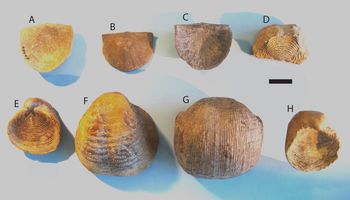
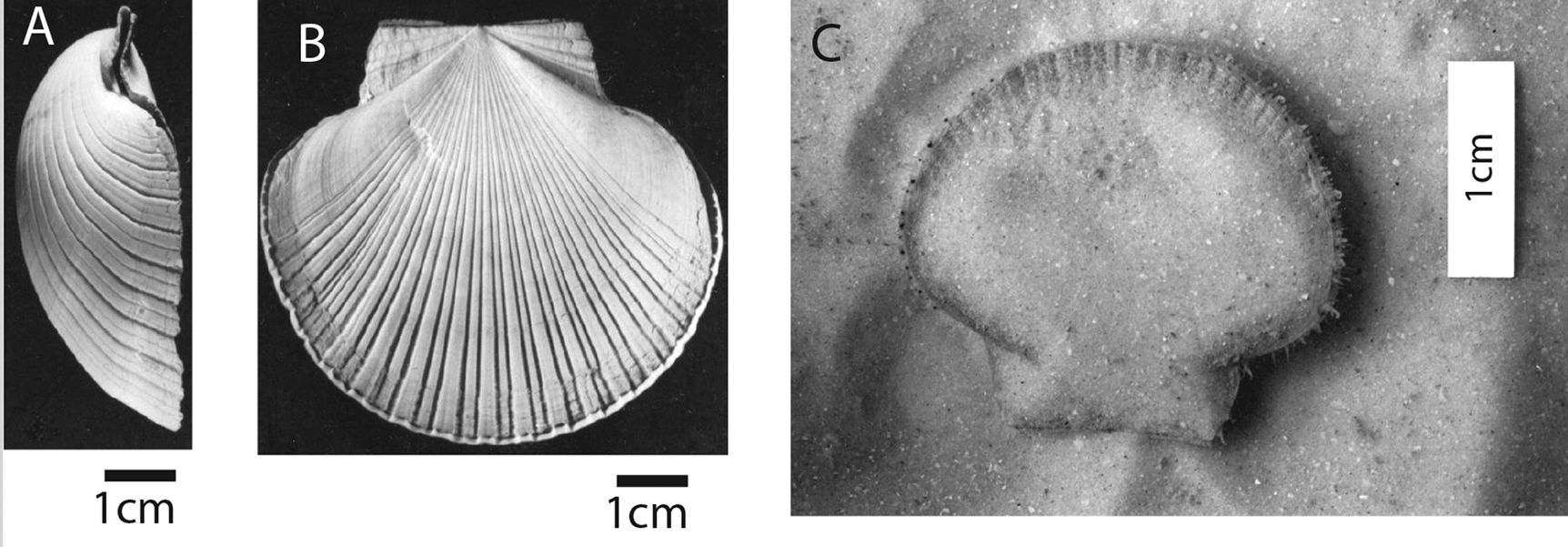
Except for some late Paleozoic genera that attached by cementation, strophomenatans were characterized by unusual concavo-convex shells (Fig. 1). The concave valve was so pervasive among strophomenatans that it must have evolved to perform a function, and I conclude that this was to fill with sediment and conceal these animals in their shallow infaunal mode of life. I can conceive of no hypothetical function that this concave valve might have served if these animals had lived epifaunally or semi-infaunally, but this issue is moot if, as I will argue, an unattached life position on the sediment surface would not even have been viable for these animals. By analogy with concavo-convex scallops (family Pectinidae) (Stanley Reference Stanley1970: p. 49; Waller Reference Waller1976) (Fig. 2), I offer functional morphologic evidence that unattached strophomenides and productides lived almost universally as shallow burrowers that expelled water to make a pit into which they slid and then ended up buried, with their concave upper valve covered with sediment and normally only their commissure visible (Fig. 3B).
Concavo-convex shells of representative Strophomenata at the U.S. National Museum of Natural History. A–D, Strophomenides; E–H, productides, which generally have a more convex pedical valve than strophomenides. A, Strophodonta gregaria (Middle Devonian, NMNH 40449). B, Strophomena planiconvexa (Late Ordovician, NMNH 636035). C, Rafinesquina ponderosa (Late Ordovician, NMNH,636036). D, Leptaena sp. (Middle Devonian, NMNH 636038). E, Echinaria semipunctata (upper Carboniferous, NMNH 636040). F, Dictyoclostus semireticulatus (Carboniferous, NMNH 45681). G, Dictyoclostus sp. (upper Carboniferous, NMNH 636042). H, Linoproductus sp. (upper Carboniferous, NMNH 636041). Scale bar, 1 cm.

The living scallop Euvola ziczac. A, Lateral view. B, View of the concave left valve. C, An animal that has reached its life position; the commissure is more or less even with the sediment surface, and the concave upper valve is already largely covered with sand. (From Stanley Reference Stanley1970: plate 12, figs. 6–8).

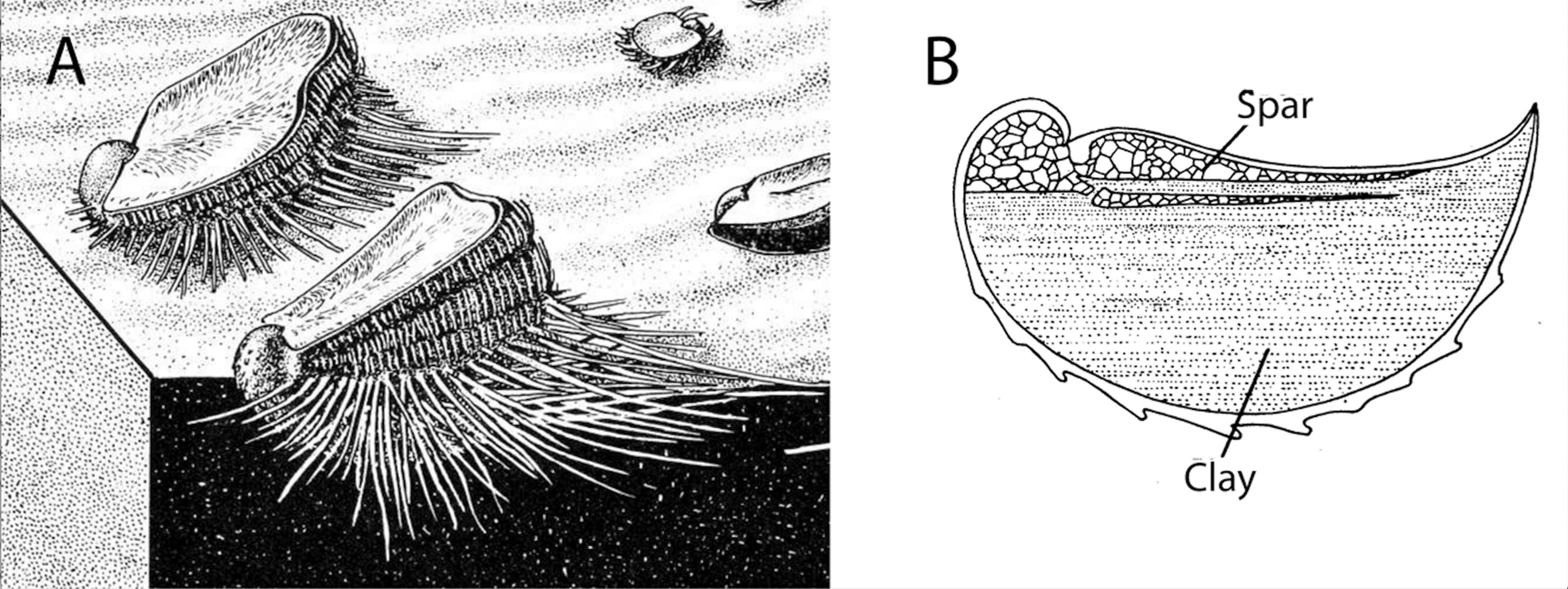
A, Cartoon of a linguloid in its observed life position, based on Rudwick (Reference Rudwick1970). B, Reconstruction of a strophomenatan in the life position envisioned here. The setae of the linguloid form “pseudosiphons.” The setae of the strophomenatan are interfingered, forming a barrier to sediment.

I will figure two specimens of a strophomenide that actually have their disguising sediment preserved on the concave valve. I will also figure a specimen with sediment attached to brushes of spines extending outward from just below its commissure. These specimens provide direct evidence for the mode of life I am proposing.
The newest edition of the Treatise on Invertebrate Paleontology replaces the familiar name Articulata with the name Rhynchonelliformia (Curry and Brunton Reference Curry, Brunton and Williams2007). To avoid this tongue-twister, I will refer to members of this group by their familiar informal name “articulates.” Also, to avoid innumerable repetitions of a five-syllable name, I will employ the nickname “strophs” for the Strophomenata.
Success of the Strophs
The strophomenides arose in the Early Ordovician and constituted ~40% of all articulate genera throughout the rest of the Ordovician. The productides appeared during the Devonian, and together the two groups represented ~20%–30% of articulate genera during that interval. However, the strophomenides declined in diversity during the Devonian, barely surviving into the Carboniferous, while the productides diversified markedly. Williams and Rowell (Reference Williams, Rowell and Williams1965: p. H177) concluded: “Subsequent to their introduction, the productoids [productides] underwent what is probably the most prolific diversification in the brachiopod phylum.” As a result of this expansion, this group constituted ~45% of articulate genera in the Permian. Here I will offer evidence that the strophs owed their success to their mode of life, which reduced the impact on them of benthic bulldozing and predation. I will also evaluate the early disappearance of the strophomenides.
Only a single productide genus is considered to have survived the terminal Permian extinction. Thus, the terminal Permian event ended what I conclude was a major incursion into the infaunal realm by the articulates.
Names for the Two Valves of Brachiopods
I am employing the traditional labels “brachial ” and “pedical” for the two valves of articulates. The second edition of the Treatise on Invertebrate Paleontology on brachiopods (Williams et al. Reference Williams, Brunton, McKinnon and Williams1997) employed the terms “dorsal” instead of “brachial” and “ventral” instead of “pedical.” This is problematic because, although I conclude that for the strophs the pedical valve was on the bottom in life position, for living members of the Terebratulida and Rhynchonellida, the normal life position on a horizontal surface is with the pedical valve on top. Because there is no consistent top or bottom for articulates, the terms “dorsal” and “ventral” are inappropriate for them. Because a particular valve supports the lophophore of articulates, the adjective “brachial” is appropriate. Although the pedicle of most juvenile strophs atrophied and disappeared (Rudwick Reference Rudwick and Williams1965: p. H201), the pedicle is presumably a plesiomorphic feature for them and for all articulates. It is legitimate to refer to all articulate valves traversed by a pedicle at some time in their ontogeny or ancestry as pedical valves.
Definitions of “Infaunal” and “Semi-infaunal.”
There seem to exist no rigorous definitions for “infaunal” or “semi-infaunal” life habits for benthic animals. Without mutually exclusive definitions, assignments for some species will be unclear. There is a fundamental ecological difference between the two groups. Infaunal animals avoid many predators to which semi-infaunal animals are exposed and are also less vulnerable to physical disturbance.
I define the term “infaunal” as pertaining to an animal that has a genetically based inclination to live fully within the substratum, always for protection from predation but also often for stability and sometimes for acquisition of food or avoidance of unstable environmental conditions. Most infauna are burrowers, but some occupy other animals’ burrows. Nonetheless, the structures (usually soft-bodied) of some protrude above the substratum. For example, the tips of the siphons of most siphonate infaunal suspension-feeding bivalves whose shells are buried are visible at the sediment surface or project slightly above it (Stanley Reference Stanley1970: plates 19 [fig. 4], 20 [fig. 6], 29 [fig. 4], and 30 [fig. 8]). Furthermore, the siphons of certain deep-burrowing tellinids extend horizontally well beyond where they emerge from the sediment, acting as vacuum cleaners for deposit feeding (Stanley Reference Stanley1970: plates 32 [fig. 6] and 34 [figs. 8–10]). Siphons, however, are quickly retracted at any sign of danger and can be regrown if nipped. Tentacles of some infaunal polychaetes are similarly exposed for feeding. Some bivalve species that are nonsiphonate or have very short siphons sometimes fail to bury themselves fully when they burrow or remain with their shell slightly exposed if uncovered by scour. (Stanley Reference Stanley1970: pp. 124–128, Reference Stanley1977a). They are, however, habitual burrowers that aim to bury themselves when exhumed and have been universally classified as infauna.
A, Reconstruction of the life position of Waagenoconcha by Grant (Reference Grant1966), in which about half of the shell is exposed and the commissure is at a substantial angle. B, Grant's figure in the same publication of a fossil for which geopetal filling indicates a life position with the commissure more or less horizontal.

According to the definition I have offered for “infaunal” and the life position I ascribe to strophs (Fig. 3B), these animals must be classified as infauna even if in their normal life position their setae and sometimes the edge of their mantle margin or shell was exposed at the sediment–water interface. Note that the setae of Lingula also project above the sediment surface (Fig. 3A). Strophs, as I reconstruct their mode of life, were just as infaunal as bivalve species universally considered to be infaunal but sometimes partly exposed at or above the sediment–water interface. From a low viewing angle, burrowed strophs would have been invisible to many sighted enemies.
I define the term “semi-infaunal” as pertaining to an animal that habitually occupies a position of partial burial in the substratum that provides it with physical support and, in some cases, food. Semi-infaunal animals are vulnerable to physical disruption and many kinds of predators, however. Many are sedentary, but others, including some deposit-feeding echinoids, such many clypeasteroids (Telford et al. Reference Telford, Mooi and Harold1987), are mobile. The term “quasi-infaunal” (Rudwick Reference Rudwick1970: p. 91) is synonymous with “semi-infaunal” but has failed to gain currency.
Strophs as Burrowers
The Cambridge Dictionary defines “burrow” as “a hole or excavation in the ground made by an animal . . . for shelter or habitation.” This means that the strophs’ life habits, as envisioned here, qualified them as burrowers. The method by which a burrow is created is irrelevant. In fact, some extant marine animals that squirt water as part or all of their excavating process are referred to as “hydraulic burrowers.” In fact, most infaunal bivalves burrow in part by hydraulic burrowing. As they adduct their valves before rocking back-and-forth to take a step downward, they squirt water to send sediment below them into suspension (Trueman Reference Trueman1966; Trueman et al. Reference Trueman, Brand and Davis1966; see also Checa and Cadee Reference Checa and Cadee1997). It has even been suggested that some bivalves burrow exclusively by the hydraulic method (Savazzi Reference Savazzi1990, also informally citing Adolph Seilacher). Furthermore, at least one octopus species employs nothing but hydraulic burrowing to excavate a burrow that it then enters for habitation (Montana et al. Reference Montana, Finn and Norman2015). Thus, I am asserting that strophs were hydraulic burrowers.
Many burrowing bivalves, if suddenly buried beneath a few centimeters of sediment, can use their foot to push upward and reestablish themselves at an appropriate depth (Kranz Reference Kranz1974). Strophs might not have been able to escape this kind of burial, but if so, this clearly did not prevent many of their families from prospering, just it did not prevent the evolutionary success of many Paleozoic endobyssate bivalve taxa that lacked the ability to survive burial.
Previous Assertions of Semi-infaunal Life Habits
Grant (Reference Grant1966, Reference Grant1969) reconstructed the life position of the productide Waagenoconcha as having been convex-down and semi-infaunal, with the commissure plane angled from the hinge line at about 40° from horizontal. This, however, conflicts with his figure of geopetal filling, which indicates that the commissure was approximately horizontal in life, as will be asserted here (Fig. 4). Employing experiments, Shino and Suzuki (Reference Shino and Suzuki2011) concluded that Waagenoconcha could have been fed passively by water currents if it had lived in a semi-infaunal life position, convex-down but with the commissure at an angle closer to vertical than horizontal and most of the shell above the substratum. However, in the face of occasional strong water movements, a shell in this posture would have been too vulnerable to overturning to be viable. In addition, this interpretation conflicts with the aforementioned geopetal evidence (Fig. 4B) indicating an approximately horizontal life position for this genus. Certainly, some productides may have lived with their commissure at a low angle to the substratum, with the anterior margin of the shell at a slightly higher level than the hinge axis, but normally not enough higher to make the animal highly visible. Also, the angle of the commissure would normally have had to be small enough for this valve to maintain a covering of sediment.
Muir-Wood and Cooper (Reference Muir-Wood and Cooper1960: p. 46) and Brenchley and Harper (Reference Brenchley and Harper1998) also believed that some productides lived convex-down but only partly buried in the sediment, and Rudwick (Reference Rudwick and Williams1965: p. H202) suggested that the concavo-convex shape of strophomenides was “suitable” for lying on soft substrata with the pedical valve underneath. He submitted that many productides must also have lived in this position, but that some “may have adopted a virtually infaunal mode of life, with only the margins of the valves projecting above the surface.” Some additional authors have accepted the notion that many productides lived partially buried (e.g., Thayer Reference Thayer, Tevesz and McCall1983; Alexander Reference Alexander1984, Reference Alexander1986). Rudwick (Reference Rudwick1970: pp. 91–93) cogently suggested that the concave valve of a “quasi-infaunal” productide might have collected sediment that provided protection from predators. He did not assert that the concavity had evolved specifically for this purpose, perhaps because it had originated in the ancestral strophomenides, which he presumably viewed as having lived epifaunally. Richards (Reference Richards1972), however, suggested that sediment also accumulated on the brachial valves of what he regarded as epifaunal strophomenides. In fact, it would be difficult for sediment to arrive here or on a semi-infaunal productide, and if it did it would be unlikely to survive for very long. Figure 4A of Rudwick's Reference Rudwick1970 book shows Waagenoconcha in the orientation I envision for it, although the shell is not fully buried; the beak and trail are exposed. Rudwick also recognized the stabilizing value of this animal's spines in this position. Unfortunately, Rudwick's interpretations of some productide's life positions as being nearly infaunal have not been universally incorporated into the literature.
Grant (Reference Grant1969) suggested that the productide Waagenoconcha floated in soft sediment. However, some productides resembling Waagenoconcha inhabited coarse sand (Leighton Reference Leighton2000), so Grant's idea cannot be generally applicable. This implies that it is probably not valid even for Waagenoconcha, for which Grant did not analyze the physical properties of the underlying sediment. I conclude that the only way in which Waagenoconcha and other strophs could have entered coarse-grained substrata would have been by squirting away sediment and slipping into the resulting pit, as I will describe later is done by certain scallop taxa.
Curiously, apart from Grant, no one who has favored a semi-infaunal life habit for at least some productides appears to have explained how these animals might have moved into the sediment. The mode of burrowing advocated in the present paper fills this void.
Why an Epifaunal Life Would Not Have Been Viable for Free-living Strophs
Neither a concave-up nor a concave-down epifaunal posture would have allowed a stroph species to survive. Apparently previous workers have nonetheless felt compelled to consider strophs to have employed one or the other of these two problematical postures because they have assumed that these animals lived epifaunally, so there appeared to be no alternative.
Assuming that free-living brachiopods lived epifaunally, many workers have attempted to use the shapes of their shells or locations of their epibionts to evaluate which valve was on top. The results, however, have been debated (e.g., Lamont Reference Lamont1934; Rudwick Reference Rudwick1970; Richards Reference Richards1972; Alexander Reference Alexander1975; Savarese Reference Savarese1994; Lescinsky Reference Lescinsky1995; Leighton and Savarese Reference Leighton, Savarese, Copper and Jin1996; Plotnick et al. Reference Plotnick, Dattilo, Piquard, Bauer and Corrie2013). Richards (Reference Richards1972) made impressive use of preservational features to establish the life orientations of several brachiopod species. He argued cogently that the indiscriminant use of epibionts to establish brachiopods’ orientations in life is inappropriate, because epibionts would have attached to dead animals that were usually in convex-up positions. Richards found that a small coral attached to a particular individual of the strophomenide Leptaena continued to grow while confined to the interior of the pedical valve close to the commissure (marginal to the brachial valve); therefore, this Leptaena necessarily lived in a concave-up position with the brachial valve slightly recessed. Richards assumed that the Leptaena lived epifaunally, but his conclusion is consistent with my contention that Leptaena would have lived infaunally with the coral itself growing upward along with the exposed margin of the growing brachiopod. Lescinsky (Reference Lescinsky1995) found epibionts and borings seeming to represent life associations and indicating a variety of life positions for strophs. Thus, a few specimens of this type cannot make a case for a habitual life position. Also, modern-day infaunal and semi-infaunal animals occasionally become marooned upside-down on pebbly sediment or other problematical substrata in abnormal life positions (see Stanley [Reference Stanley1970: p. 192] for the bivalve Pandora gouldiana).
As undergraduates we all learn that “convex-up” is usually the stable position for a single bivalve or brachiopod valve on the seafloor, and a double-valved concavo-convex stroph is similar in overall shape to a single concave valve. Thus, convex-up would have been the more stable of the two hypothetical epifaunal positions for bivalved strophs (Plotnick et al. Reference Plotnick, Dattilo, Piquard, Bauer and Corrie2013). Results of flume experiments by Leighton and Savarese (Reference Leighton, Savarese, Copper and Jin1996) were in agreement with this conclusion.
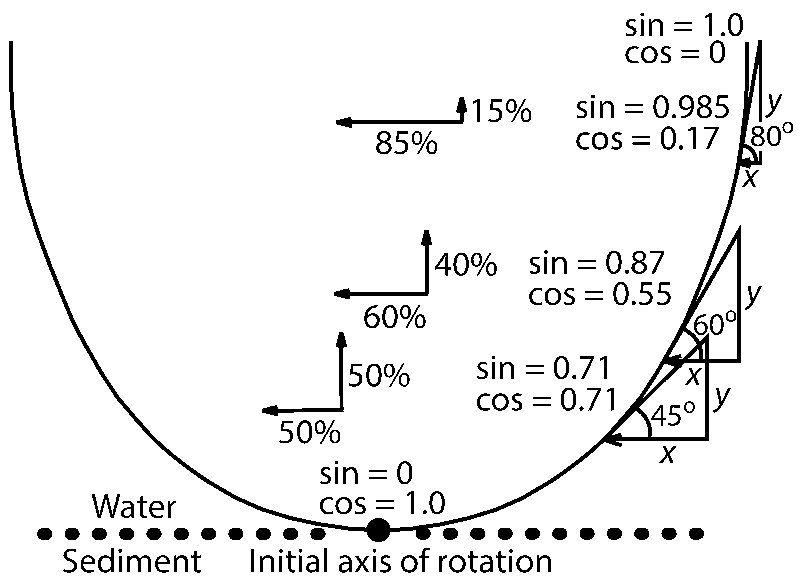
In fact, Plotnick et al. (Reference Plotnick, Dattilo, Piquard, Bauer and Corrie2013) concluded that an epifaunal life habit with the convex valve underneath would have been impossible for a productide because of physical instability. This is a valid point. Even a weak current could have initiated rotation. The disrupted animal would have turned onto its side instead of beginning to slide laterally. The most important factor here would have been that a water current striking the side of the upright shell at a particular height would have produced a horizontal component of force proportional to the sine of the angle between the direction of the force and the tangent to the curved shell surface. (See Fig. 5, in which I have employed a strongly convex shape to illustrate this situation effectively.) The horizontal component of force would have been zero at a shell's base and increased toward its top, even reaching unity if the shell surface curved enough that the tangent to it became vertical. Also, the lever arm of a force impinging on the shell would have increased in an upward direction. The pressure multiplied by the lever arm length would have increased markedly in an upward direction, resulting in initial rotation of the shell about an axis at the center of its base. In fact, a strong horizontal current striking an epifaunal animal could quickly have rotated it to a concave-down position.
Horizontal and vertical components of pressures for a hypothetical productide sitting convex-down on the seafloor and impacted by a horizontal water current. If not powerful enough to levitate the animal, a strong horizontal current would have caused initial rotation about an axis at the base of the shell. The horizontal component of pressure at any level of the shell would have increased upward, varying with the sine of the angle between the impinging current and the tangent to the shell surface. In addition, the lever arm of the force would have increased upward. These two patterns would have caused the shell to rotate.

An epifaunal convex-down position would even have made a stroph vulnerable to levitation by a strong water movement. The lifting force of a horizontal current would have decreased upward with the cosine of the angle identified in Figure 5, but what would have mattered would have been the total lifting force. To levitate the animal, this force would have had to offset the weight of the animal in seawater, and this would have had suddenly to exceed the total force required to rotate the animal. Currents strong enough to lift an animal of this shape would normally have resulted in a convex-down position when the animal settled to the seafloor after passively “flying” through the water, and the animal would again have been vulnerable to disruption.
Most productide shells, to varying degrees, have a fold-and-sulcus. This functioned not only to separate the exhalant current from the inhalant currents, but also to narrow and thus strengthen the former. The presence of the fold-and-sulcus has implications for the productides’ life positions. Brunton (Reference Brunton1972, Reference Brunton1982) asserted that for chonetoids and some productides, the fold-and-sulcus was instead the site at which water entered the mantle cavity, while it exited laterally in both directions. This not only would have been the reverse of the situation for all extant articulates, but it would also defy the fluid mechanical principles normally adhered to by suspension feeders, nearly all of which shoot used water away in a narrow current of high velocity.
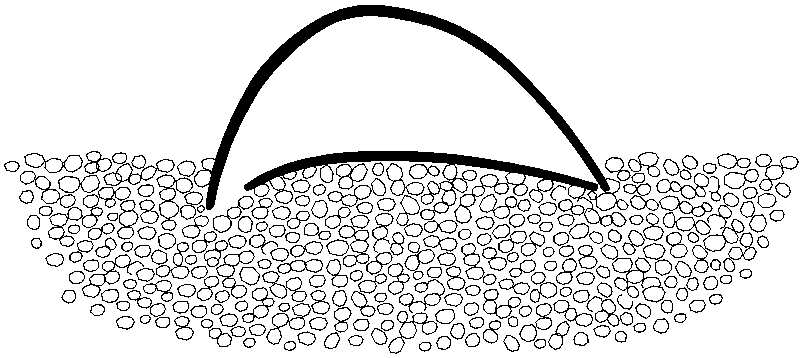
For a concave-down epifaunal stroph, the commissure would have been forced into the sediment (Fig. 6). Clogging would therefore have posed a major problem regardless of the animal's gape. In a concave-down position, a fold-and-sulcus would have projected down into the sediment so that the animal could not have expelled water properly (Fig. 6). This problem has been generally ignored by those who favor a concave-down epifaunal life position for strophs.
Blockage of the commissure of a productide in a hypothetical concave-down position. In this cartoon the center of the concave valve rests on the sediment surface with the commissure, including that of the train, forced into the sediment.

In accordance with the Bernoulli principle, an external water current of sufficient strength would have scoured sediment from around a concave-down stroph resting on the sediment surface by accelerating around the shell, as it does when flowing around a pebble on the floor of a stream. Wave-tank experiments have demonstrated such scour for partly exposed infaunal bivalves (Stanley Reference Stanley1981) and brachiopods (Alexander Reference Alexander1984). However, this would not have prevented a stronger flow from disrupting an animal.
Dattilo et al. (Reference Dattilo, Meyer, Dewing and Gaynor2009) published figures purporting to show “motes” produced by Rafinesquina living in convex-up positions and blowing away sediment in order to survive. (These motes do not resemble those produced by scouring.) The shells are resting on grainstone or packstone overlain by mudstone, in which the motes occur. I think it likely that the shells simply moved to slightly new positions under the influence of water currents, probably in small steps and not always in exactly the same direction. According to this scenario, they are empty bivalve shells that remained articulated, as many stroph shells do, and slid slightly over the firm underlying sediments. In other words, they ploughed very short distances through the surrounding soft mud, thereby increasing their “footprints.” They may have undergone slight rotations but would have tended to move posteriorly, because their anterior regions were relatively steep and would have caught water movements more effectively than their posterior regions.
Productides had thin shells and, given their obesity, very low overall specific gravities in life that would have made them unstable when resting on the substratum. Because of this instability, it would have been virtually impossible for a typical unattached productide to have lived epifaunally in any posture.
Today there are very few sessile unattached epifaunal marine invertebrate that have the size, general morphology, and specific gravity of an average productide. Richardson and Watson (Reference Richardson and Watson1975: p. 380) described the terebratulide Magadina cumingi as “a free-living epibenthic” animal, but it actually lives semi-infaunally; they noted (p. 385) that its “normal position” is with its posterior half-buried. These authors do mention that one New Zealand terebratulide species, Neothyris lenticularis, lives epifaunally and unattached as an adult. However, attachment or mobility is normally a requisite for an epifaunal marine animal. A typical unattached one would frequently be disrupted and transported by water movements.
The free-living ostreid Gryphaea lived in fine-grained sediments (Hallam and Gould Reference Hallam and Gould1975). Many of its species had laterally compressed morphologies and could only have stood upright with their coiled valves partly buried by way of passive settlement into the sediment. Gryphaea should be classified as a semi-infaunal animal and so should Ostrea compressirostra, which had a more flattened morphology and lived with its lower valve buried in the sediment (Seilacher Reference Seilacher1984; Stanley Reference Stanley2015). The extant unattached epifaunal chamid Echinochama is covered by spines that anchor it in the sediment and resist rolling (Stanley Reference Stanley2015). In addition, all of these animals have thick shells that have given them much higher overall specific gravities in life than productides. Another free-living form was an aberrant pentameride brachiopod present in the Lower Devonian Oriskany Sandstone. But it lived clustered in pits scoured by currents, where it was anchored by a thickened anterior region of its shell (Seilacher Reference Seilacher, Muller and Friedman1969).
Stony Paleozoic bryozoans that were free-living had sheet-like morphologies (McKinney and Jackson Reference McKinney and Jackson1989: p. 191) and much higher overall specific gravities in life than productides. They would have been less easily moved or overturned. Also, at least some lived below the wave base of epicontinental seas (Ross Reference Ross1970).
Lunulitid bryozoans (Cretaceous to Holocene) are cap-shaped and quite small (typically 0.5–1 cm in diameter). They are often described as free-living but actually anchor themselves in sediment by way of long structures called mandibles; these animals are also mobile and can exhume themselves if buried and also right themselves if overturned (McKinney and Jackson Reference McKinney and Jackson1989: p. 193).
Direct Evidence for the Pectinid Model for Strophs
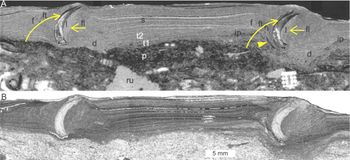
In defense of his position that strophomenides lived concave-down, Dattilo (Reference Dattilo2004) hypothesized that two particular specimens of the genus Sowerbyella rugosa had lived epifaunally in a concave-down position and pushed themselves upward to escape from their buried position. (Dattilo referred to this as “burrowing”; actually, this would simply have amounted to rotation, and it is not clear how they would have accomplished this.) I offer an alternative interpretation, which is that, having lived infaunally in a concave-up position, the animals were passively tilted clockwise by strongly flowing water disrupting the sediment in which they lived. Their burial, after all, was in a tempestite. My hypothesis is confirmed by the presence of what Dattilo (Reference Dattilo2004: p. 337) himself described as “a concavity-filling lens of sediment [labeled “l” in Fig. 7; and see small arrows] on the brachial valve” of each animal. It would have been impossible for these distinctive bodies of sediment to have been emplaced on the concave valves if, as Dattilo suggested, these had been facing downward and then rotated counterclockwise. The filling had to have accumulated, as I have described for strophs in general, when these two shells were originally concave-up. The shells must then have been rotated clockwise by the disruptive current that produced the tempestite (curved arrows in Fig. 7). The sediment remained on the brachial valves, apparently held in place by the sediment that was burying them as they rotated. Thus, the presence of these “concavity-filling lenses” is extremely important evidence showing that these animals actually lived in a concave-up, not a concave-down, position. This appears to be the first time that strophs have been found preserved in a way that permits one to recognize intact sediment that in life filled their concave-up brachial valves.
Photographs featuring two specimens of the strophomenide Sowerbyella rugosa preserved in a tempestite (A, etched specimen; B, acetate peel). These are from Dattilo (Reference Dattilo2004), who asserted that these animals lived epifaunally in a concave-down position and rotated themselves upward (“burrowed” in Datillo's words) in a counterclockwise direction in attempting to escape from their buried position. One problem with this interpretation is that, having been surrounded by sediment, these animals could not have burrowed hydraulically, and they had no other means of burrowing. A second problem is that the concave valve of each specimen is filled with sediment that is distinct from the tempestite sediment (small arrows). This must be inherited sediment (present before burial). It could not have been held in place if the shells had been in a concave-down posture and rotated to a high angle. The shells must have accumulated this sediment when in a concave-up position, as I have concluded they did in life. The current that produced the tempestite must have tilted the shells upward in a clockwise direction (curved arrows), with the tempestite sediment holding in place the sediment already present on their concave valves. The triangle points to a band of dark sediment marking a position of the right-hand shell on its way to its final station. Thus, these specimens provide direct evidence of the mode of life I advocate for strophs. Lithologies and structures, from Dattilo (Reference Dattilo2004): d, disrupted zone, f, zone of folded sediments, fl, faintly laminated zone, ft, folded transitional sediments, ip, isolated packstone lamina, l, concavity-filling lenses on brachial valves, p, packstone, ru, shale rip-up clast, s, laminated siltstone, t1, transitional silty packstone, and t2, transitional siltstone with bioclasts.

The Strophomenatans’ Concave Brachial Valve
Although a concave brachial valve characterized strophomenides and uncemented productides, in a few strophomenides this valve was only partly concave. These forms are termed “resupinate.” At some point (usually late) in their ontogeny, their valve contours were reversed: the brachial valve became partly convex and the pedical valve became partly concave. The sagittal cross section of the shell thereby became broadly S-shaped. The commissure remained more or less planar, however, and the brachial valve actually remained mostly concave.
The brachial valves of a few strophomenide genera have been described as either “planar” or “plano-convex to concavo-convex,” but published images suggest that these shapes have nearly always resulted from postburial flattening. Examples in the Treatise on Invertebrate Paleontology (Williams et al. Reference Williams, Brunton, Cox and Williams2000) are figures 157, 2a (Rhactomena); 159, 2c and 2d (Tashanomena); 183, 4b and 4c (Palaeoleptostrophia); 184, 3d and 3e (Viodostrophia); 198b (Ingria); 200, 1b (Taphia); and 219, 2b (Multiridgia). Strophomenide species exhibit considerable variation in the degree of concavity of their brachial valves, but in many cases this is obviously at least in part the result of differing degrees of postburial flattening, which is often evidenced by visible fractures.
A Mode of Burrowing, Analogous to That of Pectinids
The curious concave brachial valve is the key morphologic feature for reconstruction of a concave-up life infaunal position for the strophs with the commissure more or less even with the sediment–water interface (Fig. 3B). Analogues for the strophs in form and, I conclude, burrowing mode of life are concavo-convex pectinids (scallops). I have observed the behavior of one of these, the pectinid Euvola ziczac, first in Florida (Stanley Reference Stanley1970) (see Fig. 2), and later, informally, in Bermuda. Although this and some other concavo-convex scallop species have been assigned to Euvola, others remain in the iconic genus Pecten. These two genera are able to swim if disturbed, but they normally live buried in the sediment, with only their commissure exposed. Being surrounded by sediment, they have relatively stable life positions and are not easily detected by predators. They nonetheless have access to the water above, with their tentacled mantle margins maintaining a narrow space free of sediment along a slightly gaping commissure. The concave upper (anatomically left) valve of these animals has the special function of becoming covered with sediment that largely conceals them.
Euvola ziczac burrows by blowing sand away from itself and settling into the resulting depression (Fig. 2C). By way of movies, Waller (Reference Waller1976) provided a detailed account of this behavior. First, by clapping its valves, the animal tilts its anterior region downward. Next it ejects water from the anterior and posterior regions of the shell through the spaces between its pallial curtains. The anterior expulsion blows away sand adjacent to the animal to make a depression, while the posterior expulsion maintains the animal's orientation. After numerous expulsions, which have a slight lateral component so that the shell rotates, the animal slides into the depression. Some of the scoured-out sand settles on the concave upper valve. Because seafloor sediment seeks its own level, normal movement of sand in the environment soon fills the empty margins of the depression that border the descended scallop. The same process fills the concave valve with sand to the level of the sediment surface if valve clapping has not brought it to that level.
The European concavo-convex pectinid Pecten maximus, though having a less concave upper valve and being more strongly plicate than E. ziczac, burrows in a similar manner (Baird Reference Baird1958). All species of Euvola and Pecten are concavo-convex, Because this morphology functions as it does for the two species of these genera whose habits have been studied, it is reasonable to conclude that all species of these genera have also been burrowers. No other extant pectinid genera are concavo-convex or are known to be burrowers.
Waller (Reference Waller1976) observed that Euvola has “exploratory” tentacles bordering its mantle that can extend to a length half the diameter of the shell. These probably determine when the animal has dug its pit to an appropriate depth. Shorter “guard tentacles” interfinger along the commissure to screen out particles of sediment, and they flick outward to bat away any grains that threaten to enter the mantle cavity.
Just as mantle-margin tentacles maintain an unobstructed space for water movement in and out of a burrowed scallop's mantle cavity, setae perform this function for infaunal linguloid brachipods, for which they are arrayed in circles to form what might be termed “pseudosiphons” (Rudwick Reference Rudwick1970: fig. 48) (Fig. 3A). Setae must also have performed a guardian function for strophs, with those emerging from the upper and lower mantle margin crisscrossing each other (Fig. 3B). This pattern was presumably inevitable, because the mantle margins bearing the setae followed the contours of the two valves, which converged at the commissure. At the same time, strophs presumably, like linguloids, must have been able to direct inflowing and outflowing currents by configuring their mantle margins appropriately. The setae presumably played a major role in directing water downward for burrowing, just as they direct water flow for linguloids,
Both populations of E. ziczac that I observed lived in clean sand, but I know of no literature assessing the variety of sediments that this species inhabits. Pecten maximus, however, is known to live in muddy as well as clean sand (Tebble Reference Tebble1966: p. 57). Because water content and concentration of organic matter strongly influence the viscosity and specific gravity of fine-grained marine sediment, it is difficult to reconstruct the original physical properties of an ancient muddy sediment after it has been compacted, dewatered, and lost volatiles. There is no reason to believe that a stroph could not have lived like P. maximus in muddy sand that was of sufficient viscosity and density to support its weight. Any claim that a stroph species could not have been physically supported infaunally in life by a particular fine-grained sediment in which it is found must be fallacious, because the animal would not have been able to rest on such a sediment epifaunally either.
Strophs may not have burrowed in precisely the manner of concavo-convex pectinids, but I conclude that they would have employed the same general behavior, clapping their valves and blowing away sediment to create a depression for habitation. Free-living scallops can squirt water not only anteriorly and posteriorly, but also dorsally (though usually at a slight angle). On both sides of their hinges are gapes between the valves through which they send jets dorsally in order to swim (Stanley Reference Stanley1970). Strophs could not possess similar gapes because of their great hinge breadth. They could have squirted water anteriorly and laterally, but posteriorly only at an angle to their hinge.
Stroph adductor muscles were attached close to the hinge so as to have a small lever arm and hence to provide little leverage but substantial angular velocity for clapping the brachial valve against the pedical valve. This angular velocity is precisely what would have been needed to blast sand away from the animal. As happens for burrowing scallops, external wafting of sediment would have filled in the margins of the pit after the animal reached its burial depth, and, to the extent that the act of burrowing failed to cover the brachial valve fully, would have finished this job. Rapid clapping would also have aided an animal in righting itself when disinterred and resting upside-down on the sediment surface (a behavior that will be discussed later).
Wilkens (Reference Wilkens1978a,Reference Wilkensb) stated that living terebratulides open their valves very slowly, but Richardson and Watson (Reference Richardson and Watson1975: p. 384) noted that “the dorsal posterior striated ‘quick’ fibers of the terebratulide Aiagellana australis snap the shell shut in response to stimuli.” Slow valve opening would have been inappropriate for burrowing strophs, with their need to burrow and right themselves quickly, but there is no reason to assume that it characterized them. As noted earlier, the lever arm of the stroph diductor muscle was very short, which would have increased the rate of valve opening. Given the suggestion of Rudwick (Reference Rudwick1970: p. 91) that strophs might have been able to swim, it is implicit that he believed these animals both opened and closed their valves quickly. In 1970 (p. 58) he proposed that brachiopod diductors, under tension supplied by adductors, could act as passive springs, comparable to the ligaments of bivalves, causing rapid opening of the valves. Wilkens (Reference Wilkens1978b) confirmed this for a terebratulid, but in a limited way. In his experiments the diductors briefly acted as springs when the adductors suddenly hesitated while opening the shell. There is no reason why strophs could not have used their diductor as a spring to open their valves more widely, as proposed by Rudwick. Furthermore, strophs belong to a different class of articulates than terebratulides and rhynchonellides (Carlson Reference Carlson2016). Strophs have a different kind of shell structure from these groups (Williams Reference Williams and Williams1997), so they may also have had different muscle properties.
In fact, there is an adaptive benefit for the slow valve opening of terebratulides. Terebratulides are epifaunal animals that snap their valves shut when disturbed by a vibration or moving shadow (Wilkens Reference Wilkens1978b). In the exposed life positions of many of these animals, slow gaping is of value for caution for avoidance of predators. Feeding strophs, in order to maintain their blanket of sediment in a cryptic posture, would not have opened nearly as wide to feed as many terebratulides (see Fig. 3). They were also exposed to fewer predators. It is possible, of course, that strophs as a matter of habit opened slowly after closing under threat, but this does not mean that natural selection did not endow them with the ability to gape widely quite rapidly in order to burrow or right themselves quickly.
If by chance an aberrantly strong flow of water washed some sediment from an infaunal stroph's brachial valve, the animal would, in effect, have been protected by its environment. When conditions returned to normal, minor movements of sand would automatically have refilled the valve. In other words, the concave valve would have performed its function passively. All the animal had to do was sit there.
If a concave-up stroph had lived epifaunally or semi-infaunally, the brachial valve would have been positioned above the benthic boundary layer and usually above the level of sediment transport by traction. As a result, not much sediment would have settled on the valve, and any that did would likely soon have been swept away. This renders dubious the suggestions of Rudwick (Reference Rudwick1970: pp. 91–93) and Richards (Reference Richards1972) that semi-infaunal or epifaunal strophs habitually used their concave valve to collect sediment.
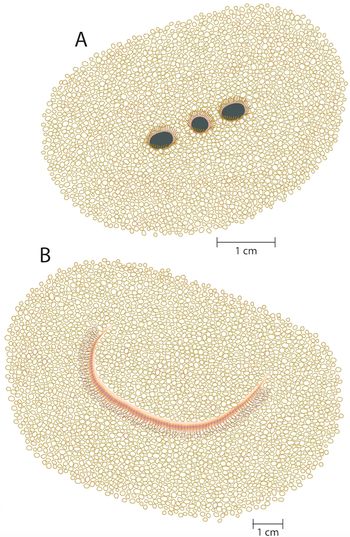
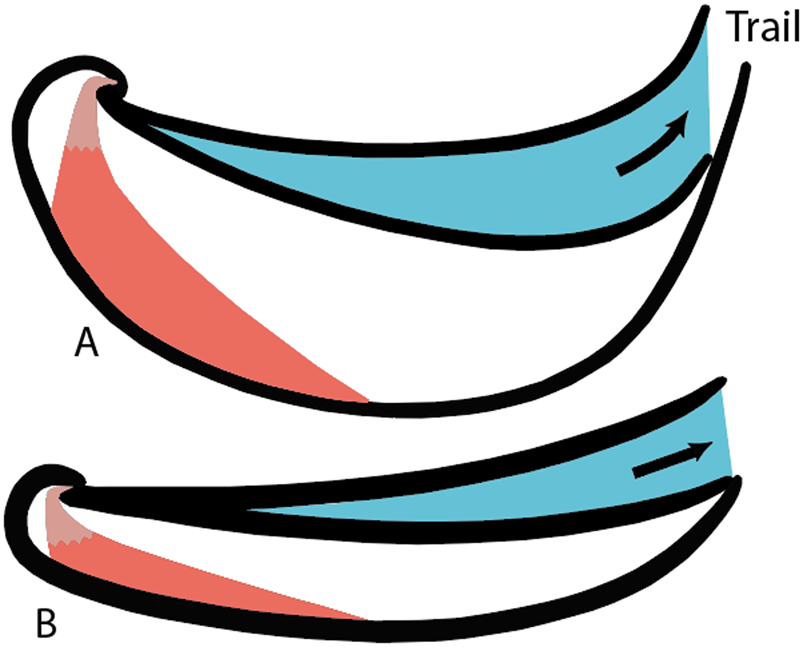
The water squirted by strophs would not have come from within the mantle cavity, where existing water would have remained. It would have come from within the space provided by the gaping brachial valve. Therefore, for a given percentage of diductor shortening and a given commissure area, the volume of water expelled would have been proportional to the length of the diductors, which was related to shell obesity. The following index of obesity is employed here: the height of the shell (from the external surface of the brachial valve to the external surface of the pedical valve at the position of maximum obesity) as a fraction of the geometric mean of the shell length and shell width. (The latter is a surrogate for the square root of the commissure area and is, in effect, a linear dimension.) The average value of this obesity index was found to be ~0.37 for productides and only ~0.13 for strophomenides (see Supplementary Material). As a result, the diductor muscles of a productide would have been, on average, about 30% longer than those of an average strophomenide of the same commissure area (Fig. 8). Therefore, for a given percentage of diductor contraction, a productide would have expelled about 30% more water in a single squirt than a strophomenide having the same commissure area. This estimate assumes that for the two groups the lever arms of the diductors were of approximately the same length relative to the square root of the commissure area. It also assumes that the percentage of the diductor that was muscular was approximately the same for the two groups. Note also that the diductor of a productide was also necessarily of much greater girth, and therefore strength, than that of a strophomenide (Fig. 8).
Cartoons of a productide (A) and a strophomenide (B) illustrating relative lengths of diductors, widths of gapes, and exhalant currents. The diductors of both productides and strophomenides extend about halfway across the pedical valve of each but are larger in the productide. For the cross-sectional shapes of the animals illustrated here, which are typical and are posited to have the same area in the plane of the commissure, the muscular portion of the diductor (darker color) of the productide is ~30% longer than that of the strophomenide. The water expelled is only that between the opened valves. The result is that ~30% more water would be expelled per squirt for the productide. Also, the constriction produced by the productide's morphology, which entailed a trail, would have accelerated the outward flow.

The obesity of a stroph shell also determined the necessary depth for burial in life position. Given an average productide's ejection of more water for its size than an average strophomenide, one might conclude that the number of squirts required for burial would have been similar for the two groups. But, as will be described later, because of its shell configuration, a typical productide would have ejected water at a higher velocity for burial than a typical strophomenide. Also, as will be described later, because of these attributes productides would have been more proficient than strophomenides at righting themselves when overturned.
The Subdued Fold-and-Sulcus and Beak of Productides
The weak central fold-and-sulcus of productides was absent from nearly all strophomenides. It was almost certainly the site along the anterior margin where the exhalant current exited from the productide shell. Although a more pronounced fold-and-sulcus would have increased the distance an infaunal productide shot used water away from its inhalant regions, the animals’ life habits would have made such a structure problematical. For these animals to have been cryptic, the inflection of their commissure could not have protruded very conspicuously above the sediment–water interface. This can account for the fact that the folds of many productides were relatively subdued compared with those of groups like the spiriferides and rhynchonellides.
Although sometimes erroneously figured as being quite prominent (Rudwick Reference Rudwick1970: fig. 4A), the beaks of productides were actually quite small, aligning or nearly aligning with the commissure. This would have been adaptive for the animals’ cryptic life position.
The Righting of Exhumed, Overturned Animals
Both water movements and benthic bulldozing would occasionally have disinterred strophs. Disinterment would have exposed animals to predators, and they would easily have been transported to an unfavorable environment. Thus, there would have been strong selection pressure for the evolution of adaptations enabling overturned strophs to right themselves rapidly in order to reburrow. Rudwick (Reference Rudwick and Williams1965: p. H202, Reference Rudwick1970: p. 90) suggested that strophs might have been able to right themselves if overturned by squirting water powerfully downward from the commissure opposite the hinge in order to rotate the shell. As I will describe below, this was highly likely behavior.
Loss of Hinge Teeth, Which Reduced the Friction of Clapping
When strophs with hinge teeth opened or closed their valves, contact between the teeth would have produced friction. It is significant, therefore, that the strophomenides experienced polyphyletic reduction of their dental plates and final loss of them before the late Silurian (Williams Reference Williams1953; Carlson Reference Carlson1992; Cocks and Jia-Yu Reference Cocks, Jia-Yu and Williams2000). The articulating function of these structures was progressively taken over by a row of small denticles along the hinge line. The Productidina, by far the largest suborder of the Productida, also lost their toothed articulation, near the start of the Carboniferous (Brunton et al. Reference Brunton, Lazarev, Grant and Williams2000). The strophs’ polyphyletic loss of hinge teeth, by reducing friction, would have been beneficial for the rapid clapping of valves when animals burrowed or righted themselves.
The Functionality of Productide Spines
The Nature of Productide Spines
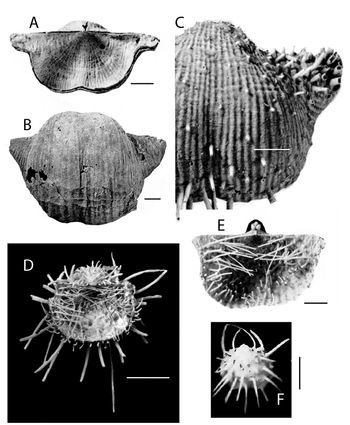
A productide spine is unusual for an invertebrate animal in two ways: in being only gently tapered and in being hollow rather than solid. The walls of the spinal tubes of productides are thin, not only relative to their external diameter but also in absolute terms; thus, they are fragile (Fig. 9C). Small spines on the central region of the pedical valve of some productides are only a fraction of a millimeter in diameter, so that the mantle protrusions forming them would have amounted to filaments. These small spines were generally quite straight (Fig. 10D). Attached near the commissure, some species had long spines (Fig. 10E–H) that in some taxa were clustered (Fig. 10A–C).
Silicified productides from the Permian of West Texas, some with spines preserved or partly preserved. A, Xestosia schucherti (NMNH 152744a), with stabilizing lateral flanges. B, Peniculauris costata (NMNH 148829), also with stabilizing lateral flanges. C, Spinifrons magna (NMNH 148932c), enlargement showing spines on the flange of the pedical valve that, because of breakage, reveal their hollow construction; these would have projected downward in life to provide additional stability. Small stabilizing spines, partly broken off, also project downward from the center of the valve. D, Costispinifera rugatula (NMNH 149708d), with spines resembling those in D, but longer and covering the wider shell (many have been broken off). E, Holotricharina hirsuta (NMNH 153899o), with very slender spines extending proximally from near the margin of the brachial valve to form a disorganized screen that presumably trapped sediment. F, Echinauris lateralis (NMNH 124052d), a juvenile with preservation of some of the curved spines that would have encircled an object of attachment. Scale bars, 1 cm. (From Cooper and Grant Reference Cooper and Grant1975.)

Additional silicified productides from the Permian of West Texas with spines preserved. A, Peniculauris peniculifera (NMNH 148839a), which has brushes of long spines to which are attached numerous particles of the sediment in which it must have lived. The brush was only preserved on the left side of the shell; this is a fabricated illustration with the brush added as a mirror image on the right side, where a brush would originally have existed as well. B, C, Lateral and brachial views of Thamnosia anterospina (NMNH 149852). D, Cancrinella sparsispinosa (NMNH 152780j), with short spines, many of which would have aimed downward at a high angle in life; although recognized as the adult of a distinctive small species, this may have been a juvenile of another species. E, F, Yakovlevia hessorum (NMNH 153980h), possessing four very long spines emerging close to the commissure (F is a lateral view). G, Kutorginella sullivanensis (NMNH 149871b), with a highly concave damaged brachial valve but nearly entire spines emerging close to the commissure. H, Grandaurispina kingorum (NMNH 153887a), in life position with spines emerging close to the commissure; these range from some that would have been nearly horizontal in life for an infaunal animal to ones that would have angled downward at about 45°. Scale bars, 1 cm. (From Cooper and Grant Reference Cooper and Grant1975.)

The spines of the extant oyster Hyotissa might also be described as tubular, but they are actually more or less horseshoe-shaped in cross section, being open along their entire length (Stenzel Reference Stenzel, Moore and Teichert1971: p. N1021). These spines arise along the commissure as extensions of costae along ridges and are secreted by protrusions of the mantle that grow and thicken a spine while extending its length or even after ceasing to do so. The extant rhynchonellide Acanthobasiliola produces tubular spines in the manner of Hyotissa, but the two sides are sutured (Alvarez and Brunton Reference Alvarez, Brunton, Brunton, Cocks and Long2001), so that they cannot be expanded after forming.
The pipe-like spine of a productide had to be secreted by an extension of the mantle confined to the spine's hollow center. Spine formation must have begun at a small embayment along the margin of the shell that was enclosed to form a circular aperture through which the extension of the mantle projected and grew to secrete the spine (Alvarez and Brunton Reference Alvarez, Brunton, Brunton, Cocks and Long2001). Secretion of the spine was confined to the tip of the mantle extension, which grew longer to lengthen the spine. Thus, unlike the condition for Hyotissa, no portion of the productide spine could have been thickened after it formed. This accounts for the thinness of adult strophs’ spines and their nearly even diameter from end to end. Spines that began to form on a young animal remained slender as an animal grew.
Before silicified specimens received extensive study, the widespread presence of long productide spines went unrecognized, because for unsilicified fossil shells, they have nearly always been broken off. The revelations of silicification demonstrated that the bumps on the surfaces of unsilicified productide pedical valves are usually the bases of broken elongate spines. Their ends are usually rounded by abrasion, with the stub either remaining open or having been filled diagenetically (Fig. 9C).
Figure 9C illustrates stages of postmortem spine destruction. Presumably the elimination of fragile spines usually occurred after an animal died and its obese shell was scoured from its shallowly buried position to roll about on the seafloor. In fact, for unsilicified strophomenatans, the tip ends of hinge areas have also often been broken off. In addition, the thin anterior margins of bivalved productide specimens have usually been chipped to some degree because of their fragility.
Spines as Anti-predator Devices?
Signor and Brett (Reference Signor and Brett1984) suggested that productide spines served primarily to ward off durophagous predators, but these attackers would have easily crushed not only small productide spines (see Figs. 9D,E and 10D), but even larger clustered spines that were fragile because of being thin and hollow (Fig. 10A–C). In addition, the latter were not located in positions that, even if they had been more durable, would have thwarted durophages, which would have focused on the unprotected shell margins.
Johnsen et al. (Reference Johnsen, Ahmed and Leighton2013) tallied shell margin damage inflicted by predators on two strophomenatan species, one that was spinose and one that was not. They concluded that the spinose form entered a size refuge from predators at an earlier stage of development than the form lacking spines and that the spines thwarted predators. Problems with this study, however, were that the samples were very small and the spines of the spinose form were too far from the chipped shell margin to have protected it.
Leighton (Reference Leighton2001) found that a Devonian stroph species with spines suffered less predation by shell borers than a co-occurring stroph species that lacked spines. This was the expected result, but it entailed a sample of just two species, so there was a fifty-fifty chance that this would be the outcome.
In fact, it can be concluded that stroph spines did not evolve to thwart drilling predators, because drilling is extremely rare for Paleozoic faunas, so rare that such drilling was clearly ecologically insignificant on a global scale. Surveying the huge monographs of Cooper and Grant on the Permian silicified brachiopod faunas of West Texas, Kowalewski et al. (Reference Kowalewski, Somões, Torello, Mello and Ghilardi2000) found that only 25 of 5000 specimens displayed drill holes. Of the hundreds of local Devonian marine faunas studied, Harper (Reference Harper2003) tallied only 12 for which drilled skeletons had been reported. The fact that extremely few spiny brachiopod species exhibit drill holes shows that such species could be drilled, but these animals belong to clades containing large numbers of spineless species for which drill holes are extremely rare. Therefore, spines must have evolved in basal groups that did not suffer from significant boring predation, and the spines must have originated for a function unrelated to drilling.
Spines as Stabilizing Devices
By way of flume experiments, Alexander (Reference Alexander1984) concluded that elongate spines of productides reduced scour for semi-infaunal animals, extending out to touch the substratum with their tips. The problem with this idea is that these productide spines, unlike those of the experiments, were, as I have already emphasized, extremely fragile. This is demonstrated by the fact that they have almost always been broken off of unsilicified fossils. Sudden rotation of a shell in the position of Alexander's experiments would have readily caused breakage of the spines by placing pressure on their tips.
Grant (Reference Grant1966) famously inferred that the productide Waagenoconcha lived in a semi-infaunal position and employed the clustered spines that angled downward from its pedical valve as snowshoe-like devices to prevent sinkage into the sediment. Rudwick (Reference Rudwick1970: p. 93) viewed spines of this type as likely serving both for anchorage and flotation. Grant (Reference Grant, Dutro and Boardman1981) suggested that other brachiopod genera had frills on their shells that also functioned for flotation. Actually, it would have been very difficult for marginal structures to keep many Waagenoconcha individuals floating at an appropriate depth, because the sediments they occupied would have varied in density and viscosity. Also, as previously noted, some genera having the same general morphology as Waagenoconcha inhabited coarse sand (Leighton Reference Leighton2000), so Grant's idea cannot be generally applicable.
I conclude that curved, sometimes slightly irregular spines that were commonly clustered on the pedical valves of adult productides (Fig. 10A–C) anchored animals in the substratum. It is notable that many of the clustered spines of productides that extended outward from near the commissure (Fig. 10A–C) would have been out of contact with the substratum if their possessor had lived semi-infaunally or epifaunally and convex-down. However, for an animal in a fully infaunal convex-down position with the commissure nearly horizontal, the totally buried spines would have functioned to resist the animal's being ripped from the sediment when partially exposed by scouring currents or disrupted by benthic bulldozers. I conclude that this is how the spines functioned. This interpretation is consistent with Grant's illustration of the Waagenoconcha specimen providing geopetal evidence that it lived with the commissure virtually horizontal (Fig. 4B).
The spines of the specimen figured as 10A have attached sediment that apparently surrounded the spines during the animal's life. The occurrence of this sediment attached close to the commissure provides strong evidence in support of the life position advocated here.
For some productides, very thin, short, straight spines projected at roughly right angles from central margin of the pedical valve (Figs. 9C and 10D,H). These would also have functioned as anchors by projecting downward, opposing rotation of the animal by a disruptive force. They could not have served as flotation devices. Some small forms had spines that were largely of this type (Fig. 10D); some of these may have been small adults, but many were juveniles that later added larger spines near the commissure as they grew (Cooper and Grant Reference Cooper and Grant1975). These spines were too fragile to have survived if they had projected downward from a convex-down epifaunal animal, and they could have performed no function at all for a convex-up animal.
Occasionally present among productides were clustered spines that extended laterally and angled slightly upward from near the hinge area. This configuration suggests that their possessors lived with the commissure at a slight angle and the hinge slightly buried.
A few productide species had extremely long, nearly straight spines that emerged from the pedical valve quite close to the commissure and extended parallel to it or at a small angle to it (downward in the life position advocated here) (Fig. 10E–H). Spines of this type occur in the subfamilies Strophochonetinae, Productininae, Marginiferinae, Plicatiferinae, and Grandaurispininae. Such spines would have rested on the sediment or would have been buried shallowly within it.
For infaunal productides, sediment would have supported spines resting on it or buried within it. It would have offered weak resistance (giving way slightly under pressure), cushioning the spines against breakage by benthic bulldozing or by water movements that tended to rotate an animal after exposing part of its shell by scouring. Support by underlying sediment would also have reduced pressure on this kind of spine by spreading any torque applied to it over the spine's full length instead of its being concentrated at one end.
Spines that would have performed a stabilizing function for infaunal animals also extend in small numbers from the hinge regions of some Siluro-Devonian strophoconiodontide and anopliide chonetoids (Brunton et al. Reference Brunton, Lazarev, Grant and Williams2000). In a small percentage of species these extend more or less parallel to the commissure, but in most they angle downward.
Delicate Sediment-trapping Spines on the Brachial Valve
A few productide genera grew numerous short, extremely thin spines near the margin of the brachial valve, bending proximally to form a tangled array (Fig. 9D,E). Also, Grandaurispina kingorum grew many short, very thin, straight spines that were nearly parallel and extended upward at a low angle over a large central area of the brachial valve (these spines are not figured here, but a view of the pedical valve of this species appears as Fig. 10H). As suggested also by Grant (Reference Grant, Dutro and Boardman1981) and Rudwick (Reference Rudwick1970: p. 9, fig. 47), these two types of brachial spines presumably formed baffles that trapped sediment on the concave brachial valve. To a visual predator passing by, these spines probably looked like small, inedible objects to be ignored.
Flanged Hinge Areas That Provided Stability
The hinge areas of some productides were extended as flange-like structures (Fig. 9A–C). These must have functioned to prevent overturning of an animal with its commissure close to the substratum. Seilacher (Reference Seilacher1984) recognized this role for lateral flanges of laterally compressed bivalves that he viewed as recliners (but that were semi-infaunal). For these structures to have functioned in this way for productides, all or nearly all of the obese shell would have to have been buried in the sediment.
Growing Larger as an Infaunal Productide with Many Spines
Like all other productides, those that possessed large clusters of spines needed to move downward into the sediment as they grew. Productides must have done this by occasionally renewing their burrowing by blowing away sediment and sliding into a deeper pit. The clustered spines, which grew near the commissure, would have been unobstructed while the animal burrowed because of the space created posteriorly as it slid forward (Fig. 11C). In fact, most of the clustered spines grew on animals that were near their maximum size. The small spines that projected downward in life from the central region of some species’ pedical valves (Figs. 9C and 10D,H) would have been able to move with the shell as the sediment beneath it was loosened. By blowing sediment away from below its margins, an animal would have caused sediment beneath it to spill out from under it (Fig. 11C).
Diagrams illustrating how a productide with spines could have moved deeper into the substratum as it grew while also rotating to restore its normal life position. A, A juvenile in life position. B, The same animal having grown and rotated to maintain its life position; the brown dashed outline represents the portion of the shell representing the juvenile in A. C, The same animal having grown larger, with a suggestion of modes of rotation and deeper movement into the sediment. The straight black lines represent previous positions of the shell's commissure. The blue dashed lines depict water squirted by the animal to excavate sediment and drive it into suspension. Water expelled anteriorly creates a space that will allow the animal to extend farther forward as it rotates downward (short arrow). The red arrows indicate where sediment is sliding downward away from the base of the animal to be blown away; this will soon permit the animal to rotate by way of gravity into a lower position (long curved arrow).

The accretionary growth of the productide pedical valve in the form of a logarithmic spiral (McGhee Reference McGhee2001) produced preferential growth of the shell region opposite the hinge. As a result, growth of a stationary pedical valve would automatically have tended to produce an increasingly tilted commissure, elevating the region of the shell opposite the hinge above the sediment–water interface (Fig. 11). Therefore, in the process of burrowing more deeply, a growing animal must have restored the lower angle of its commissure by rotating as it excavated sand from around and beneath it. Figure 11 illustrates how a stroph could have burrowed more deeply as it grew and performed the corrective rotations. A productide could not have expelled water directly in a posterior direction but, by manipulating its mantle margins and setae, it could have expelled water downward anteriorly or laterally or backward at an angle to the hinge. It could also have expelled water horizontally.
Productides that grew a few very long, straight spines would have been unable to burrow appreciably more deeply after secreting these structures. This explains why such spines are normally restricted to positions near the commissures of adult animals (Fig. 10E–H). The individual of G. kingorum illustrated as Figure 10H at close to its final size grew spines within the sediment that angled downward by as much as 45°. Interestingly, the specimen of Kutorginella sullivanensis displayed as Figure 10F has spines of this type emerging from the pedical valve a short distance from the commissure. They angle slightly downward from the adult plane of commissure, but when they formed they would have nearly paralleled the commissure and extended nearly horizontally. This animal grew a small amount after the spines formed but certainly would have been unable to burrow more deeply while doing so. Thus, late in this particular animal's life, the portion of the pedical valve between the elongate spines and the final position of the commissure would have come to stand problematically at a slight angle above the sediment surface.
A Relatively Simple Evolutionary Origin for Stroph Burrowing
The evolution of an infaunal mode of life has often been difficult. It has been necessary to evolve a way of moving down into, and sometimes laterally through, sediment and also, for many animals, to evolve a mechanism for maintaining contact with the water above. However, the strophs would have accomplished these two requisites simultaneously and relatively easily. Like other brachiopod taxa, before evolving infaunal habits they must have possessed the ability to clap their valves in order to exclude predators and clear their mantle cavity of unwanted material. It was only necessary to evolve the behavior of directing the squirted water downward, and perhaps strengthening the squirting process, to create a depression and also to evolve the habit of sliding into this feature. Already present were the setae required to keep the commissure open and direct the currents. The origin of the strophs presumably exemplified the generalization made by Mayr (Reference Mayr1963: p. 604) that the evolution of a key behavioral trait has initiated the shift to a new adaptive zone. Thus, related morphologic adaptations—in this case, things like the concave brachial valve, stabilizing spines, marginal flanges, and spines for trapping sediment on the brachial valve—undoubtedly evolved secondarily.
For scallops, the evolution of burrowing would have been similarly easy, but in order for other bivalves to burrow with a foot, the required features were difficult to evolve. It was necessary to evolve a laterally compressed shell that was divided in half, with a central portion decalcified to form a ligament. It was also necessary to evolve adductor muscles and an entirely new kind of thin-walled, hollow foot into which blood could be forced to provide an anchor. In addition, it was necessary to evolve the sequence of repetitious, stereotypical movements by which these animals burrow (Trueman Reference Trueman1966; Trueman et al. Reference Trueman, Brand and Davis1966).
Functions for Spines of Non-burrowing Productides
Not all productide spines served as stabilizers for life in soft sediment. Muir-Wood and Cooper (Reference Muir-Wood and Cooper1960: p. 43) suggested that spines spread across an entire pedical valve might have functioned to stabilize small, nestling productides, tangling “among branches of bryozoans and seaweeds.” This is possible, although small spines spread over the central portion of the pedical valve of some productide species are not curved but straight (Fig. 10D), so that they could not have clasped supporting structures. Grant (Reference Grant1966) showed that Waagenoconcha had curved, clutching spines as a juvenile and presumably broke away from a temporary elevated host to fall to the substratum, where it grew to adulthood. Muir-Wood and Cooper (Reference Muir-Wood and Cooper1960) described similar clasping juveniles.
Some stroph genera (including some orthotetides as well as the iconic Prorichthofenia and a few other productides) cemented a portion of their pedical valve to hard substrata, including reefs, on which some of these animals played significant roles. In addition, some productides were cemented to hard objects by their spines. It is important to note that these spines are often tangled and highly irregular in shape (Fig. 12). Thus, they differ from the straighter clustered spines of burrowers (Fig. 10A–C).
Echinostages tuberculatus (NMNH 139039b) from the Permian of West Texas, attached by tangled, crooked spines of the pedical valve. The arrow points to one of this animal's spines that is curved because it grew around a small coral, which was presumably upside down and therefore dead when the brachiopod became attached. Scale bar, 1 cm.

The Question of Swimming
Rudwick (Reference Rudwick1970: p. 91) suggested that some chonetidine productides might have had the ability to swim like scallops in order to avoid predators. A comparison of scallops with strophs renders this unlikely.
The infaunal mode of life of concavo-convex pectinids assists them in survival against predation. Also important is their ability to swim, if more awkwardly than some other scallops. Scallops, of course, swim by jet propulsion via rapid clapping of their valves. However, strophs lacked a structure like the scallops’ ligament, which springs the valves open rapidly as the first step of clapping (Truman Reference Trueman1953). As noted earlier, Rudwick proposed that brachiopod diductors, under tension supplied by adductors, could act as passive springs, comparable to a bivalve ligament. Nonetheless, this process might not have matched the speed of pectinid clapping.
Even adult scallop species that ordinarily attach by a byssus can swim awkwardly if they break free. Free-living scallops, however, have the advantage of possessing broad gapes adjacent to the umbones that provide for controlled jets of water that propel the animal through the water with the hinge in the rear (Stanley Reference Stanley1970: p. 42). Strophs lacked such gapes and would not have been able to eject water from their broad hinge area. To move horizontally by jet propulsion, they could only have moved posteriorly. This would have required the squirting of water anteriorly or else laterally in both directions at an angle to the hinge.
Swimming scallops gain lift in a variety of ways (Stanley Reference Stanley1970: pp. 38–42). The most elegant is by making use of a cross-sectional shape that provides lift in the manner of an airplane wing: the upper valve is more convex than the lower one. This adaptation is present in the most adept pectinid swimmers, such as Placopecten and Amussium, which can make flights of many meters by ejecting water simultaneously on both sides of the hinge. It is as if they fly horizontally through the water. The lift for these species when swimming is evident in their slight rise every time they squirt out water and jet forward. Even concavo-convex pectinids and biconvex ones in which the upper (left) valve is not more convex than the lower (right) valve gain lift by elevating the commissure to a higher angle than the direction of movement. These forms squirt water out alternately from the two shell margins adjacent to the hinge. As a result, their shell oscillates clockwise and counterclockwise as they swim for short distances upward at an angle. In addition to providing shell strength, the plications of many of the latter forms presumably act like the dimples on a golf ball by creating a turbulent boundary layer as the shell rotates back and fort; this produces a low-pressure wake, reducing pressure drag (Stanley Reference Stanley2015).
Productides, with their strongly inflated pedical valves, and often spines, could not possibly have been able to swim. Although strophomenides are generally much less obese than productides and lack spines, on the average they had relatively higher overall specific gravities than productides that would have resisted levitation and flight through the water. I have employed as a shell thickness index the fraction of the total shell height at the position of its maximum obesity that consists of the shell itself. This index is more than twice as large, on average, for strophomenides as for productides: means ~0.19 versus ~0.085, respectively (Fig. 13) (actually, shell thickness is virtually identical for the two groups: 0.015 and 0.016, respectively, measured as a percentage of the geometric mean of shell width and shell length) (see Supplementary Material). As discussed earlier, because of their slender shape, most strophomenides would also have squirted less water in a single squirt than a typical productide having the same commissure area (Fig. 8). Given their relatively high specific gravity and weak expulsion of water, it is doubtful that strophomenides could have swum.
Bar diagram showing that strophomenides typically had larger shell thickness indices and therefore overall specific gravities than productides; the shell thickness index is the fraction of the total shell height at the position of shell's maximum obesity that consists of the shell itself (see Supplementary Material).

Despite their limitations for lateral movement, some strophs may have been able to move a very short distance via a small, single clap-hop. And possibly they could have made a short movement above the seafloor via two, three, or four claps. This, however, would be appropriately viewed as simply a jump rather than a swimming flight. Such a jump, if repeated, might have permitted a stroph to outpace the movements of a sea star or some other sluggish predator.
The Early Disappearance of the Strophomenides
The strophomenides barely and only briefly survived the Frasnian mass extinction, but before this they had already declined dramatically to very low diversity (Fig. 14A). From the end of the Wenlock through the end of the Emsian, they underwent only minor changes in standing diversity, measured here at the ends of intervals. Then, during the Eifellian and continuing through the Givetian, their rate of extinction rose dramatically and their diversity declined substantially (Fig. 14). Only six strophomenide genera are recorded as passing from the Givetian into the Frasnian. Just two strophomenide genera are known to have existed after the Frasnian/Famennian crisis (Williams et al. Reference Williams, Brunton, Cox and Williams2000)
Marked decline of the strophomenides during Middle Devonian time because of an increase in rate of extinction and decrease in rate of origination before their sudden near disappearance in the Frasnian/Famennian mass extinction. A, Changes in the generic diversity of this group during the Silurian and Devonian. B, Rates of origination and extinction for the same interval. (Data from Williams et al. Reference Williams, Brunton, Cox and Williams2000; timescale from Cohen et al. Reference Cohen, Finney, Gibard and Fan2017.)

Strophomenides were in many ways less well adapted than productides for life on the seafloor, and I conclude that these deficiencies led to their early demise. Their relatively high specific gravity would have increased their resistance to disinterment, but this would have failed to compensate for three deficiencies: (1) The only slightly convex lower valve of a strophomenide positioned the center of gravity closer to the sediment–water interface than that of a more obese productide. (2) A horizontal current would have produced a stronger disruptive uplifting force for a partially exposed strophomenide than for a partially exposed obese productide because of the small angle between the current and the lower margin of its shell (see Fig. 5). (3) Unlike many productides, strophomenides did not benefit from spines for anchorage.
It would have been crucial for an overturned stroph to right itself and reburrow quickly to avoid being preyed upon or swept to an unfavorable environment. Righting would have been more difficult for strophomenides than for productides, however, for four reasons: (1) The relatively high specific gravity of a typical strophomenide would have offered more resistance to righting. (2) As discussed earlier, because of its slender morphology, a typical strophomenide ejected less water in single squirt than a productide having the same commissure area (Fig. 8). (3) Also, as previously discussed, the anterior region of the shell of many productides was extended somewhat to form a “trail,” which, by narrowing the flow of water exiting the mantle cavity, accelerated its flow to become a stronger jet (Fig. 8); a productide fold-and sulcus would have had the same effect; strophomenides lacked a trail, and nearly all lacked a fold-and-sulcus. (4) To right itself, a stroph would have had to rotate its center of gravity beyond a position directly above the axis of rotation to change the effect of gravity from negative to positive; because of a strophomenide's slender shape, the amount of rotation required here would have been considerably larger than that for a more obese productide (Fig. 15).
Diagram showing how an overturned slender strophomenide (A) had to rotate through a larger angle than an obese productide (B) from a position concave-down on the substratum to reach the position, depicted here, at which gravity assumed the rotational role to bring the animal to its convex-down orientation for burrowing. Dashed lines depict angles of commissures. The upper circle in each cartoon represents the center of gravity, which had to rotate past a position directly above the axis of rotation (lower circle), at which point gravity would take over (heavy arrow). (Centers of gravity were estimated by hanging models from multiple marginal points.)

The relatively wide hinge line of all strophs would have provided stability at the start of rotation for righting. The typical obesity of a productide would have made rotating animals susceptible to sideways overturning except for two things. First, the sulcus of many productides left a rounded region to its left and right on the pedical valve (Fig. 1F). These structures would have tended to prevent an animal from rolling over sideways while righting itself. Second, most productides that lacked a conspicuous sulcus nonetheless had a pedical valve with a broad, flattened central region (Fig. 1G) that would similarly have provided stability during rotation.
The Roles of Increasingly Effective Benthic Bulldozing and Predation
Because of their greater vulnerability to disinterment and weaker ability to right themselves compared with productides, strophomenides would more frequently have been dislodged by a strong current before managing to reburrow. Early on, a significant percentage of overturned strophomenides may have managed to right themselves before tragedy struck, but once predation by shell-crushing predators increased in the mid-Paleozoic (Signor and Brett Reference Signor and Brett1984; Brett and Walker Reference Brett and Walker2002), the mortality rate of strophomenides must have increased substantially. At the same time the intensity of benthic bulldozing increased (Thayer Reference Thayer, Tevesz and McCall1983), and this would have compounded the strophomenides’ problems by increasing their exposure to predation as well as their chance of being transported to an unfavorable environment.
The Parallel Decline of Other Slender Strophomenatans
This interpretation of the strophomenides’ decline can be tested by examining the history of the Chilidiopsinae, a group of strophs within the order Orthotetidina that resembled strophomenides. They had concavo-convex or resupinate brachial valves and relatively compressed pedicle valves. Like the strophomenides, they would have been readily exhumed and had difficulty righting themselves. Therefore, like the strophomenides, this group would be expected to have experienced heavy extinction as a result of the Devonian intensification of benthic bulldozing and shell-crushing by fishes. The Chilidiopsinae included eight genera. Although its diversity was not great, it appears significant that this subfamily became extinct in the Middle Devonian.
Why the Chonetoidea Were Exceptions
The Chonetoidea is a large group of productides within which many species were similar in shape to the strophomenides, yet they flourished in the late Paleozoic. They were, however, ecologically very different from the great majority of other strophs. Many were plano-convex, and some were strongly sulcate. The latter forms, and perhaps others, would not have lived infaunally. Furthermore, chonetoids were mostly minute in size. In the comprehensive taxonomic compilation of this group by Brunton et al. (Reference Brunton, Lazarev, Grant and Williams2000), the modal shell width of 59 figured late Paleozoic genera is only 1.3 cm; furthermore, only ~14% are wider than 2 cm, ~3% are wider than 2.5 cm, and none are as wide as 3 cm. (Not included here are Airtonia, Delepinea, Megachonetes, and Daviesiella, the very large shells of which are size outliers). Like many other relatively very small animals, typical chonetoids have been widely regarded as having been extreme ecological opportunists (“r-selected” forms; e.g., Jacobs Reference Jacobs1976; Simanauskas and Cisterna Reference Simanauskas and Cisterna2000; Kammer Reference Kammer2006; Chen and Liao Reference Chen and Liao2009; Hubman and Stuttner Reference Hubman and Stuttner2009). I say “extreme,” because it has been pointed out that most marine species that occupy soft substrata can, in fact, be viewed as opportunists (Young et al. Reference Young, Buzas and Young1976). Chonetoids often occur sporadically in great abundance in the stratigraphic record. Like modern extreme opportunists on the seafloor, they would have appeared suddenly in large numbers in a particular area and had short life spans there but high reproductive rates that, before they died out, produced swarming invasions elsewhere (Levinton Reference Levinton1970). Although, as individuals, extreme benthic opportunists living in soft sediment may be highly vulnerable to predation and benthic bulldozing, their arrival in large numbers during their brief existence tends to overwhelm these disrupters, and they quickly send numerous progeny elsewhere. The prospering of the tiny chonetoids after the Devonian, in contrast to the history of the strophomenides, can be attributed to their entirely different, “boom and bust” ecological strategy.
The Post-Devonian Expansion of the Productides
The productides’ total generic diversity was more than 50% higher for the Permian than for the Devonian. (These comparisons require no temporal adjustment, because the Devonian and Permian were of nearly equal duration.) A variety of shell-crushing sharks and other chondrosteans arose and became important predators in the Carboniferous (Brett and Walker Reference Brett and Walker2002). In addition, benthic bulldozing continued to intensify during the late Paleozoic, as illustrated by an increase in the diversity of benthic bulldozing taxa that have survived to the present and have large populations today (Thayer Reference Thayer, Tevesz and McCall1983). The dramatic late Paleozoic radiation of the productides supports the hypothesis that the ability of members of this group to maintain their infaunal life positions protected them from the newly evolving predators and benthic bulldozers. Also, a physically disturbed productide could have resumed its infaunal life position relatively rapidly.
Had productides survived the terminal Permian crisis in sufficient diversity, they would probably have diversified substantially on early Mesozoic seafloors because of their cryptic habits. The rise of teleost fishes, new predatory gastropod taxa, and crabs later in the Mesozoic, however, would likely have caused a decline of the productides, as I have suggested in two publications happened to other brachiopod taxa as well as endobyssate bivalves and stalked crinoids (Stanley Reference Stanley1974, Reference Stanley and Hallam1977b). This intensification of predation is what Vermeij (Reference Vermeij1977), citing the second of these publications, named the “Mesozoic marine revolution.”
Discussion
I have brought to light a variety of observations that are consistent with my hypothesis that strophomenatans were infaunal animals. This “consistency” approach is a legitimate method of doing science. It is exactly the approach Darwin took in dealing with the two much more important issues of evolution in general and natural selection in particular, when he could not test these ideas directly (and he found the fossil record of little use). It is also the approach that Harry Hess (Reference Hess, Engel, James and Leonard1962) took in making the initial classic case for what came to be known as plate tectonics. Hess cited a variety of phenomena, never before explained, that were consistent with what he called “seafloor spreading.” This included the presence of guyots, which he recognized had been seamounts conveyor-belted out from shallow midocean ridges; high heat flow and low seismic velocities on these ridges, reflecting the upward movement of magma that formed new seafloor; deep-sea trenches bordered by volcanoes and with the Benioff Zone of earthquakes angling downward from them, all reflecting the subduction of seafloor; and a thin layer of deep-sea sediment pointing to a youthful age for ocean basins. In combination, these features made a powerful argument.
Here I summarize the relevant facts for my case and my interpretations of them. Some represent negative evidence, in that they are features that would have been maladaptive for a brachiopod with the morphology of strophs living epifaunally; the only other possibility would have been for them to have lived infaunally or semi-infaunally, and I have noted that the latter habits would have left these animals vulnerable to predation. Some observations I have provided apply only to certain kinds of strophs, but the conclusion that these animals were infaunal, by extension, applies to other kinds of strophs as well. For example, given strophs’ universal concavo-convex shape, it is very likely that if some lived infaunally, making use of this shape, the rest normally did too.
The following are the most significant observations and interpretations offered here:
1. The unusual concave brachial valve, a pervasive feature of strophs, must have had a function. I have shown that this feature would have performed like the concave valves of extant infaunal concavo-convex scallops to conceal an infaunal stroph by filling with sediment to the level of the surrounding seafloor. I can conceive of no other function that this concave valve could have performed. For an epifaunal or semi-infaunal animal, it could not have maintained a sediment filling effectively.
2. Because strophs have a concavo-convex shape similar to that of scallops that are hydraulic burrowers, clapping their valves to make a pit for them to occupy, it is reasonable to postulate that strophs would have done the same thing.
3. The contention of Grant (Reference Grant1966) that Waagenoconcha was a semi-infaunal passive floater in soft sediment is inconsistent with the fact that some animals of similar morphology lived in sand.
4. Other authors who have suggested that some strophs were semi-infaunal animals have never explained how they would have entered the substratum. And if strophs employed the hydraulic burrowing mechanism I propose, it would have been detrimental for them to have remained only partly buried. They would have been exposed to predators and more vulnerable to disruptive water movements than if totally buried. Why would they not have assumed fully infaunal positions?
5. Stroph species living epifaunally simply would not have been able to function well enough to survive in the presence of substantial water movements. In a convex-down position, these animals would have been highly unstable, but even one in a concave-down position would have been quite insecure.
6. Also, a stroph living epifaunally in a concave-down position would have had its commissure buried, and sediment would have fouled its mantle cavity (Fig. 6). This problem would have been especially severe for a productide having a sulcus or train for expelling water, These structures would have projected downward into the sediment, which would have blocked water expulsion.
7. Extremely few immobile, unattached benthic invertebrate species having the general size, inflated shape, and low specific gravity of a productide are able to live epifaunally in modern shallow seas. Although predation and benthic bulldozing were less intense in the Paleozoic, they would have been severe enough to devastate most populations of such animals, as would frequent transport to unsuitable environments.
8. Despite productides’ globose shape, their beaks were relatively small and projected very little or not at all beyond the commissure. This condition would have helped to conceal them when living infaunally with the commissure close to the sediment surface.
9. The strophs experienced polyphyletic reduction or loss of their hinge plates. This would have reduced friction for the valve clapping used by animals to burrow or right themselves.
10. Productides exhibit a variety of long spines on their pedical valves that would have stabilized them in infaunal positions (Fig. 10A–C,E–H). Many of these spines could not have been in contact with the substratum for an epifaunal or infaunal animal. In addition, if these spines had rested on the sediment at an angle, they would have been too fragile to avoid breakage. Infaunal positions spread any rotational forces along the spines’ full length rather than having them concentrated at the tips.
11. Some productides had thin, short spines that projected directly out from the centers of their pedical valves (Fig. 10D). These would have helped to anchor them in sediment in a convex-down position but would have snapped easily if projecting downward from an epifaunal animal resting on the pedical valve. They could have had no function at all for an animal sitting epifaunally in a convex-up posture. Predators would have attacked the shell margins.
12. Very long, straight spines confined to the commissure regions of the pedical valves of some productides (Fig 10E–H) would have stabilized these animals in infaunal positions with their commissures close to the sediment surface. These spines did not form earlier in life, because if they had, an animal would have been unable to burrow as it grew.
13. A few productides had numerous short, thin spines on their concave brachial valves that would have served as baffles for trapping sediment (Fig. 9D,E).
14. The hinge areas of some productides extended laterally to form broad flanges (Fig. 9A–C). These would have stabilized burrowed animals.
15. The areas bounding the sulcus of many productides (Fig. 1F) would have prevented them from rolling sideways when righting themselves after being exhumed and overturned. The broad central areas of the pedical valves of many others (Fig. 1G) would have functioned in the same way.
16. Whereas evolving the ability to burrow was a complex process for most taxa, for strophs is would have been relatively simple, because they already had the ability to squirt out water and, when burrowed, they would automatically have been in contact with the water above.
17. Photographs of cross sections of two strophomenides published by Dattilo (Reference Dattilo2004) provide direct evidence of the mode of life that I propose for strophs. These animals were tilted clockwise from a concave-up position while being suddenly buried in a tempestite, and they retained the distinctive sediment that had filled their brachial valves in life position (Fig. 7A). In addition. Cooper and Grant (Reference Cooper and Grant1975) figured a specimen of the productide Penicularis with numerous grains of sediment that were preserved trapped among spines that extend laterally from slightly below the animal's commissure (Fig. 10A). This sediment apparently surrounded the animal in an infaunal life position.
Acknowledgments
I thank B. Dattilo and two other reviewers for helpful comments; J. Sinton for assistance in slicing specimens; and, at the National Museum of Natural History, the collection managers for providing specimens, J. Wingerath for help in processing them, and T. Jorstadt for photographs.