1. Introduction: Contextualising intermedial audiovisual practice
1.1. Historical foundations of visual music and audiovisual composition
In the early 1910s, the Italian Futurists Arnaldo Ginna and Bruno Corra created several films by painting directly on filmstrips, using abstract images and repainting a work by Giovanni Segantini frame by frame (Moritz Reference Moritz1999). Their work explored cinematic potential, as Moritz (Reference Moritz1999) notes, highlighting that cinema features fluid, dynamic imagery with rhythmic pacing through editing techniques such as dissolves, superimposition and split screens, among others. Ginna and Corra, anticipating artists of the following decade, explored cinema’s unique ability to ‘present a visual spectacle comparable to auditory music’ (Moritz Reference Moritz1999).
The formalisation of visual music as a distinct artistic discipline emerged in the early 1920s, alongside avant-garde cinema and experimental animation. Pioneers such as Walter Ruttmann and Viking Eggeling endeavoured to translate musical structures into visual forms, creating abstract films that aspired to produce ‘pure visual music’ (Moritz Reference Moritz1999), which did not require sound to convey its artistic message. By the second half of the twentieth century, Norman McLaren’s abstract films and John Whitney’s analogue computer animations had expanded both the technical and conceptual scope of visual music. McLaren used ‘animated sound’ (McLaren Reference McLaren1971) to shoot musical soundtracks optically onto film. Whitney showed how algorithmic processes and digital computers could generate visual patterns that reflect the same harmonic movement found in music (Alves Reference Alves2005), foreshadowing the emergence of digital intermedial practices.
The emergence of electroacoustic music in the 1950s, notably Pierre Schaeffer’s musique concrète, advanced media manipulation by treating recorded sounds as malleable ‘objects’ detached from their sources (Schaeffer Reference Schaeffer1966). This approach later influenced electroacoustic audiovisual composition, part of the broader visual music family (Hill Reference Hill2010a), and shaped the work of Joseph Hyde. Hyde aims to incorporate ‘ideas unique to musique concrète’ (Hyde Reference Hyde2012: 171) into visual music, defining ‘“concrète” visual materials’ as camera-sourced material (ibid.: 172). Garro (Reference Garro2012; Reference Garro2015) explored visual music’s mimetic potential through theory and practice, expanding Emmerson’s (Reference Emmerson and Emmerson1986) concept of mimesis to include audiovisual compositions created within electroacoustic music, asserting that its language is ‘intrinsically visual, even within its acousmatic paradigm’ (Garro Reference Garro2012: 103).
According to Garro (Reference Garro2012; Reference Garro2015), whose definition is informed by Evans (Reference Evans2005), visual music comprises non-narrative artworks, though it does not necessarily exclude representational forms. The key difference between mimetic visual music and cinema is the absence of storytelling. Mimetic visual music relies on combining abstract and mimetic elements, along with textural and gestural morphologies in both sound and video, to convey artistic meaning and create a perceptual experience described as ‘audio-visual poetry’ (Piché Reference Piché2003).
Composers like Jean Piché recognise the potential of synchronised sound and visuals to enhance each other within the aesthetic experience. He advocates for the use of representational imagery and narrative in his visual music approach, offering a new definition of ‘video-music’ (Piché Reference Piché2003). His work exemplifies how blending sound and visuals – using representational imagery – can deepen auditory experience and foster immersive, cinematic engagement. This fusion aims to bridge traditional media gaps, creating a new form of visual music that emphasises their connection and interaction, providing a cinema-rooted experience. While audiovisual composition thrives in fixed-media works, installations and live performances, theoretical frameworks for understanding media interactions remain partly unexplored, a gap this paper seeks to address.
1.2. Intermediality: Beyond multimedia juxtaposition
Intermediality, as defined by Rajewsky (Reference Rajewsky2005: 46), denotes phenomena that ‘in some way take place between media’, emphasising their interaction rather than coexistence. This differentiates it from multimedia, where discrete media operate in parallel, often with one dominant medium (Chion Reference Chion and Gorbman1994). For instance, narrative cinema’s ‘vococentric’ hierarchy prioritises dialogue while relegating music and other elements to supportive roles (Chion Reference Chion1999). In contrast, intermedial works such as those of Hermes Intermedia – an Italian collective renowned for fusing poetry, sound, calligraphy and video into ‘simultaneous visions’Footnote 1 – dissolve such hierarchies, creating artefacts where media features reciprocally shape meaning through a compositional technique they call ‘intermedial writing’ (Morricone Reference Morricone and Gazzano2019: 9).
The term ‘intermedia’ was introduced by Dick Higgins in the mid-1960s to differentiate ‘intermedia’ works from ‘mixed media’ and ‘multimedia’ (Rajewsky Reference Rajewsky2005). Higgins drew inspiration from Samuel Taylor Coleridge (Reference Coleridge and Coleridge1812), referencing his use of the term ‘intermedium’ to define narrative allegory. In his 1981 addendum to ‘Intermedia’ (Higgins and Higgins Reference Higgins and Higgins2001), Higgins explains that Coleridge used the term to describe works that conceptually fall between already known media (ibid.: 52). In intermedia works, the involved media neither accompany nor illustrate each other; instead, their collision produces a third, irreducible experience. For example, composer Natasha Barrett, with Marc Downie, utilises Ambisonic spatial sound and 3D visuals in Innermost (Reference Barrett and Downie2019–2021) to create immersive intermedial environments. Their 3D audiovisual installation aligns with contemporary discourse on intermediality, developing new mechanisms of sound/image relationships (Barrett and Downie Reference Barrett and Downie2021) to potentially dissolve sensory hierarchies and craft a unified perceptual experience in the ‘intermedial space’ (Chiaramonte Reference Chiaramonte2024). This concept, central to the discussion, will be defined later in the article.
1.3. From musique concrète to mimetic visual music
Musique concrète revolutionised sound composition by treating recorded sounds, detached from their source, as raw material and introducing the ‘sound object’ concept (Chion Reference Chion, Dack and North1983: 37). This ethos extends to visual music through concrète visual material – footage abstracted from reality and processed algorithmically (Hyde Reference Hyde2012). For example, Diego Garro’s Dammtor (Reference Garro2013a), an audiovisual work based on James Sheard’s eponymous poem, transforms field recordings and original footage of Hamburg’s Dammtor station into a meditative reflection on memory and desolation. The poem’s verses evoke granulated sonic and visual reflections: the train station soundscape fractures into rhythmic pulses, while slow-motion footage of commuters dissolves into glitched abstractions. Garro (Reference Garro2014) calls this practice ‘mimetic visual music’, where referential sounds and images evoke mental narratives without explicit storytelling, instead emphasising the ‘rifts’ and ‘unspoken tales’ latent in the text (Garro Reference Garro2013b, Reference Garro2015).
While Schaeffer advocated for ‘reduced listening’, prioritising sound morphology over sources, real-world recordings and visuals still carry semantic traces. In Dammtor, granulation obscures literal meaning, yet the creak of train brakes and a blurred commuter’s silhouette retain emotional resonance, possibly symbolising transience and anonymity. Composers thus adopt a dual approach: harnessing the expressive power of referentiality while avoiding narrative literalism. This duality fosters meta-narratives – multiple, non-linear, subjective interpretations arising from media feature interference. For example, Andean (Reference Andean2016) employs processed field recordings in his acousmatic works to evoke personal memories and narratives, a strategy mirrored in Dammtor’s interplay of text, sound and image, where audiences ‘linger with [their] senses over the rifts’ (Garro Reference Garro2013b) rather than seek resolution.
1.4. Research gaps and objectives
Despite growing interest in audiovisual composition from an intermedial perspective, applying theoretical models to practical compositional frameworks offers a significant opportunity for expansion. This study highlights two specific research gaps:
-
1. Practical Frameworks for Intermedial Audiovisual Composition: While theorists like Rajewsky (Reference Rajewsky2005) and Kapuscinski (Reference Kapuscinski1997) have mapped intermedial relationships, few methodologies address the compositional challenges of balancing sound and image in the creative process. How can composers manage perceptual interference between media features? What strategies can prevent one medium from overpowering another?
-
2. Intermedial Interference: The term ‘intermedial interference’ (Chiaramonte Reference Chiaramonte2024) is a novel concept and therefore remains underexplored in artistic contexts. How do the shared features of media (e.g., rhythm, motion, texture, and perceptual and conceptual attributes) interact both constructively and destructively within the intermedial space? Can interference be strategically controlled in the compositional process?
This essay addresses these gaps by presenting the author’s doctoral research findings through a critical analysis of an electroacoustic audiovisual work. The objectives include:
-
• Presenting the concepts of intermedial interference and intermedial space in their perceptual nature.
-
• Drawing on Elleström’s ‘media characteristics’ (Reference Elleström and Leitch2017: 511), the concept of media features will be introduced.
-
• Expanding Garro’s (Reference Garro2012) continuum of audiovisual association strategies with associative mapping.
-
• Proposing balance as a dynamic process for equilibrating the interactions of media features and their interference.
-
• Defining synchrony typologies (Primary/Secondary Synchronisation Points) to structure temporal relationships.
2. Theoretical framework: Intermedial interference, space and media features
2.1. Defining intermedial interference and intermedial space
This research presents three key concepts: intermedial interference, media features and the intermedial space where these features interact.
Intermedial interference is defined as the perceptual phenomenon that arises from the interaction of different media features within the intermedial space. It can be either constructive or destructive. As a novel concept, understanding its proposed application in audiovisual composition and addressing the various connotations and preconceptions associated with the term are essential.
Intermedial space refers to the perceptual space created by the integration and interaction of different media features. It describes the phenomenological experience of engaging with integrated media elements in intermedial audiovisual composition. This space is neither purely aural nor visual but arises from their fusion, similar to Harris’s (Reference Harris2021: 43) ‘audiovisual space’. Her concept is comparable; however, the term ‘intermedial space’ specifically emphasises the phenomenological outcome of engaging with diverse media features, aligning with the intermedial theory framework central to this discussion.
Examining the etymology of ‘interference’ reveals two plausible interpretations. One derives from the Latin ‘inter’ (between) and ‘ferio’ (I hit, strike; infinitive ‘ferire’) (Lewis and Short Reference Lewis and Short1879), while the other derives from ‘inter’ and ‘fero’ (I bear, carry or bring; infinitive ‘ferre’) (ibid.). The latter suggests a neutral interaction or transmission process between elements rather than an inherently disruptive force, implying ‘to set in motion’ or ‘to bear, produce, yield’ (ibid.: 737–738). This perspective portrays interference as a neutral, natural dynamic interplay and mutual influence, setting the stage for a nuanced understanding of its role in intermedial contexts.
The concept of interference encompasses multiple disciplines. In physics, interference is described as ‘the combination of two or more electromagnetic waveforms to form a resultant wave in which the displacement is either reinforced or cancelled’ (OED 2022), highlighting both constructive and destructive effects. In psychology, a reconceptualisation of interference theory (Anderson Reference Anderson2003) redefines it as a natural consequence of inhibitory control mechanisms, rather than an inherently negative force. This cognitive perspective, alongside Metz’s concept of ‘semiotic interferences’ (Reference Metz1974: 212) – which describes how a code or semiotic figure migrates and adapts from one artistic language system to another – broadens our understanding and encourages a neutral interpretation of the term in intermedial contexts.
It is essential to recognise that ‘interference’ frequently possesses negative connotations in colloquial discourse. Such preconceptions may pose difficulties when using the term in an academic or artistic context that seeks to explore its constructive potential alongside its disruptive aspects. Intermedial interference involves both constructive and potentially disruptive aspects.
Interference can simultaneously produce positive effects, such as the amplitude summing of phase-coherent sound waves, and negative effects, such as phase cancellation. For example, visual rhythm matching musical tempo can enhance the sense of rhythm, whereas misaligned audiovisual synchronisation may cause discomfort or emphasise disconnections between sight and sound.
Constructive and destructive interference often co-occur in complex, unpredictable media interactions, generating tension, challenging expectations or obscuring meaning to foster deeper engagement. This dynamic produces a superimposition of significance across various media features that extends beyond simple binary classifications. Recognising both harmonious and tension-filled interactions allows for a nuanced understanding of the range of media interferences and their potential to unify or generate productive tension.
In intermedial composition, maintaining or adjusting balance is crucial for guiding a passage and clarifying media interactions. In audiovisual works, all events occur at the audiovisual level, where the relationship between vision and hearing is shaped by media interplay and the interference of their features. Composers must recognise and manage unexpected or unintentional media interactions, controlling the balance to prevent destructive interference that could hinder reception, while using constructive interference to enhance meaning. Without delving deeply into semiotics, understanding emerges through juxtaposing elements with their opposites. As Fiske (Reference Fiske2011: 55) states, ‘Where there is choice there is meaning, and the meaning of what was chosen is determined by the meaning of what was not’. Opposites create dialectics; deliberate selection of elements influences, modifies or obscures potential meanings within a balanced intermedial context.
This study explores interference as a complex perceptual phenomenon resulting from interactions between media features, rather than merely categorising the features themselves. Although key media features are defined and categorised within a conceptual framework in the following section, creating a comprehensive taxonomy to fully capture this complexity is not the primary aim. Instead, this proposal shows how intentional engagement with these feature interactions – intermedial interference – shapes audiovisual compositions.
2.2. Media features
Wolf (Reference Wolf1999: 37) defines intermediality as the relationship between different forms of media used for expression or communication. This relationship involves a discernible, or at least convincingly identifiable, engagement of two or more media in conveying meaning within an artefact. Building on this foundation, this paper argues that when distinct medial forms contribute to creating an artefact, their combination and integration yield intermedial interference by interacting with their specific features. Therefore, intermedial interference can play a crucial role in facilitating the understanding of the artefact.
This paper proposes a definition of media features, adapted from Elleström’s ‘media characteristics’ (Reference Elleström2014: 39–45). Elleström defines ‘media characteristics’ as all ‘media traits related to form and content’ (Elleström Reference Elleström and Leitch2017: 511). Everything a medium can represent – generally making it apparent to the perceiver’s mind – is considered a media characteristic.
The concept of media features is refined by emphasising artistic expression and the creative process. Media features are defined as the all-encompassing, expressive traits related to form and content, both at macro- and microstructural levels, where expressive denotes the ability to convey perceptual qualities, abstract concepts or aesthetic effects. This differs from Elleström’s broader framework, which seems not to address details that can be significant at the compositional level. All expressive traits conveyed through a medium – making them accessible to the observer’s intellect via sensory experience – are considered features of that medium.
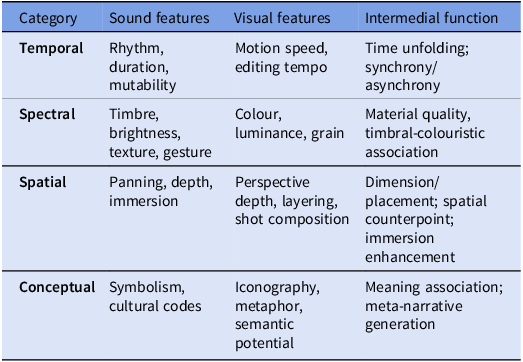
Although outlining a taxonomy of media features is not the main goal, providing some examples helps to clarify:
-
1. Temporal features govern the unfolding, duration and pace of events.
-
• Sound features: rhythm, tempo, duration, mutability, attack and decay profiles.
-
• Visual features: motion speed (magnitude) and velocity (magnitude plus direction), editing pace, visual persistence, temporal modulation.
-
-
2. Spectral features govern qualities such as timbre, light, material texture and sensory profiles.
-
• Sound features: timbre, spectral brightness or darkness, textural density, harmonic–inharmonic complexity.
-
• Visual features: colour properties (hue and saturation), luminance, grain and noise, surface texture.
-
-
3. Spatial features govern dimensionality, placement, movement, kinetic properties, and how sound and image occupy, traverse and interact within physical and perceptual space (intermedial space).
-
• Sound features: spatial width and immersion, source localisation, trajectory, movement, panning.
-
• Visual features: depth and dimensionality, layered transparency, object and camera movements, compositional layering, perspective depth and kinetic energy.
-
-
4. Conceptual features govern symbolic, metaphorical and cultural associations.
-
• Sound features: cultural connotations, emotional resonance and significance, narrative potential.
-
• Visual features: iconographic symbolism, visual metaphors, metaphorical resonance, intertextual references.
-
Intermedial functions operate across all media involved in the artefact, with each category supporting different perceptual modes. Temporal features facilitate synchronising and desynchronising time perception. Spectral features establish material contrasts and connections, while spatial features shape depth, movement and immersion. Conceptual features generate layered signification. This basic taxonomy (Table 1) distils media interactions into fundamental perceptual routes, enabling compositional control within intermedial space.
Integrated taxonomy of media features

3. Compositional strategies: Associative mapping, balance and synchrony
3.1. Extending Garro’s continuum: Associative mapping
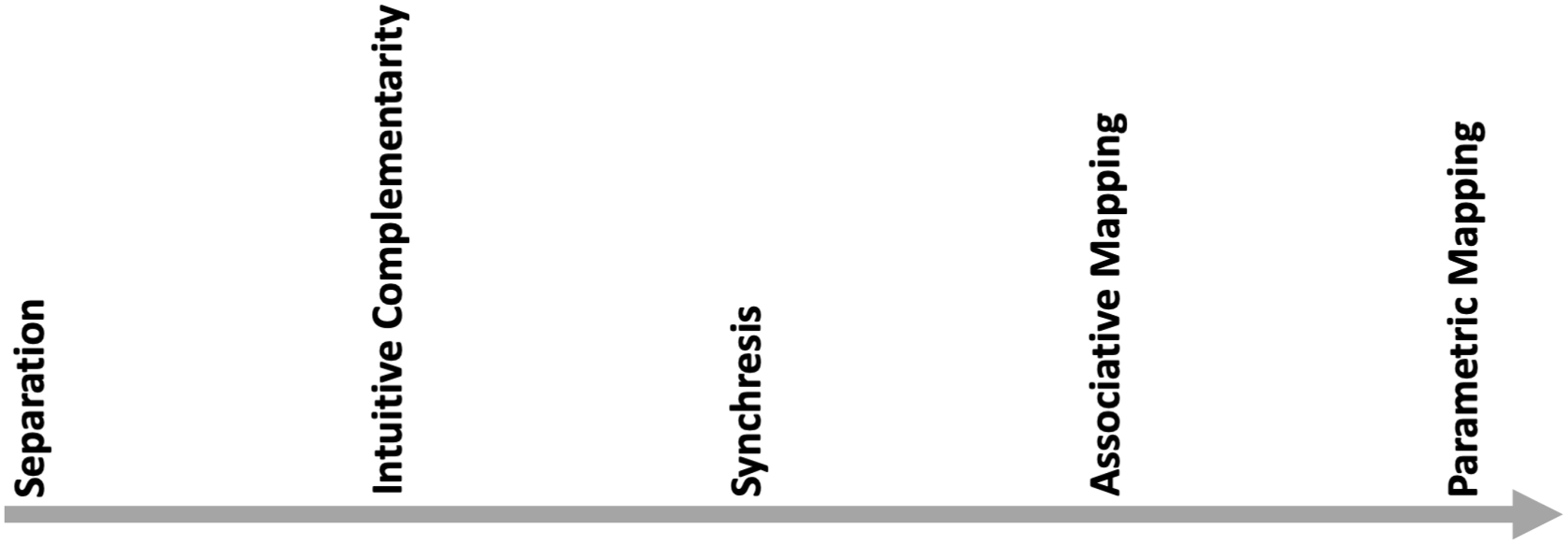
In examining audio and visual-gestural associations, Garro (Reference Garro2005; Reference Garro2012) proposes a continuum of various sound and visual combinations and levels of integration. The author provides limited explanation of the relationship between parametric mapping and shared spectromorphological features of both media, so clarifying his possible implications would be beneficial. Parametric mapping between sonic and visual-gestural profiles cannot rely on exact spectromorphological correspondences, as these media operate within different physical domains. Even the most advanced audiovisual parametric mapping systems are inherently discretionary, based on the composer’s deliberate choices and, in some cases, perceptual associations that can influence the parametric rules.
Garro (Reference Garro2005) indicates that parametric mapping involves connecting sonic and visual parameters through software managing data workflows and processing. The composer deliberately establishes this connection as a strategic choice at the poietic level. Changes to audio features as parametric values affect related visual parameters. In contemporary digital arts terminology, ‘parametric mapping’ typically refers to precise, numerical and algorithmic relationships between parameters across different domains, linked for expressive purposes. Building on Garro’s model, the author proposes a minor extension, introducing a new level called Associative Mapping (Figure 1) positioned within Garro’s continuum between ‘synchresis’ (after Chion Reference Chion and Gorbman1994: 63) and ‘parametric mapping’.
Garro’s continuum of gestural audio vs visual association strategies revised by Chiaramonte.

This mapping type does not depend on data exchange between software environments. Instead, it relies on the composer’s choices based on shared phenomenological, perceptual attributes and gestural profiles, collectively called media features. Once established, these associations can foster various levels of integration and synergy. Unlike synchresis, associative mapping is a deliberate and cohesive compositional strategy, conceived and planned during the pre-compositional phase of the audiovisual work. In contrast, synchresis may involve looser, more casual associations, often influenced by material interactions during studio work. Associative mapping enables the creation of intermedial audiovisual relationships at the compositional level, grounded in shared media features, particularly within the conceptual category.
3.2. Balance as perceptual equilibrium
According to Arnheim (Reference Arnheim1974: 19), balance in the arts can be defined as ‘the state in which the forces acting upon a body compensate one another. In its simplest form, balance is achieved when two forces of equal strength pull in opposite directions. The definition applies to visual balance’. In art, balance refers to achieving a sense of equilibrium, stability or harmony through the proper distribution of elements within a work (DeWitte et al. Reference DeWitte, Larmann and Shields2023). In audiovisual arts, it involves distributing sonic and visual elements so that no part overpowers or dominates others (Evans Reference Evans2005), indicating a harmonious arrangement among competing components. It is important to note that overall balance often results from the dynamic interplay between stable and unstable sections, where localised disequilibrium generates tension that is then resolved or integrated into the whole. Achieving balance often requires a dynamic adjustment process to maintain stability amid changing conditions. Balance is essential across various art forms. For example, a composer might use it in a piece of music to create contrast and tension. Similarly, an artist working in audiovisual art may employ balance to harmonise visual and auditory elements. By understanding different types of balance and strategies to achieve them, artists can produce appealing, harmonious works. Balance also involves the arrangement and structuring of elements within a composition (Bowers Reference Bowers1999), including principles such as symmetry, asymmetry, weight distribution, equilibrium, harmony and proportion (Wong Reference Wong1993).
The ability to judge balance develops through experiencing diverse artworks. Over time, individuals can develop a conceptual understanding of balance, which helps them assess balance in new artworks and compare them with previously encountered works. Balance emerges as a perceptual category within visual aesthetics and composition through sustained engagement with artistic practice. Colour, shape, line, texture, space and weight influence the perceptual impression of balance. Ultimately, categorising balance depends on subjective factors, shaped by aesthetic and visual preferences. Artists utilise balance to prevent instability (Arnheim Reference Arnheim1974); otherwise, ‘under conditions of imbalance, the artistic statement becomes incomprehensible’ (ibid.: 20). In summary, balance can be regarded as a perceptual category centred on the visual and auditory impressions of equilibrium, stability and evenness. It arises from human perceptual faculties, enabling judgement of equilibrium in art and being essential for stability and coherence in visual art (Arnheim Reference Arnheim1974).
3.3. Synchrony typologies: PSPs and SSPs
The author developed an audiovisual composition method during doctoral research that involves technical aspects, though its detailed presentation is not included here. As a new conceptual approach based on practice, the specific element of audiovisual synchrony is worth introducing. The method comprises a set of synchrony typologies, including two distinct approaches to establishing synchronic relationships between moving images, visual gestures and musical sounds. This intuitive method has been developed since the author’s audiovisual practice began (Chiaramonte and Cirulli Reference Chiaramonte and Cirulli2011). It notably considers the perceptual phenomenon of synchresis (Chion Reference Chion and Gorbman1994), which arises from the composer’s deliberate creative choices regarding synchronisation.
The first type of synchrony is called the Primary Synchronisation Point (PSP). A PSP is a perceptually salient event that emphasises an audiovisual gesture and marks a specific structural moment, acting as a compositional accent. It conveys intentional meaning and is a key element of the work’s form. A PSP may be visually driven, where the visual element guides the creative process regarding synchrony, or musically driven, where the musical gesture controls the synchronisation. While in a shot/cut-based audiovisual style, a PSP typically occurs at a cut, the concept applies to any style; in an audiovisual composition characterised by a continuous flow where the moving image is constantly transforming, a PSP might be triggered by the appearance of a new visual gesture, a sudden camera movement or a significant transformation; the composer could intentionally synchronise a musical gesture to match the moving image.
A Secondary Synchronisation Point (SSP) is a subtle synchrony often identified when reviewing an audiovisual passage, where the composer’s attention is drawn to an unplanned alignment between a visual and musical gesture. An SSP usually occurs within a continuous sequence rather than at a major structural boundary such as a cut. While its initial discovery may be accidental, its integration is intentional, often requiring precise micro-editing and careful mixing to achieve the intended effect. This process is the audiovisual equivalent of an electroacoustic compositional method where the typomorphological features of sound objects influence the composer’s approach. In works characterised by a continuous visual flow, an SSP may emerge from the contingent alignment of a musical gesture with a visual change or motion within the visual sequence.
4. Case study: An angel as a flame of fire
4.1. Compositional framework and introduction to the composition
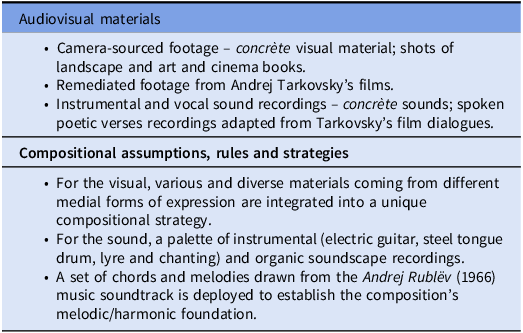
An Angel as a Flame of Fire (Chiaramonte Reference Chiaramonte2023) is the final piece in a series of six compositional studies that explore, reflect on and develop the new concept of intermedial interference. The initial focus of this study was to identify which types of media features the diverse materials planned for use could share. It also examined how these various media materials could be integrated and interact to generate intermedial interference. The aim was to create a multifaceted audiovisual composition employing several different media elements to foster the combination, integration and fusion of moving images and music. The following paragraphs describe the author’s perspective (as an intermedial composer) during the creative process, including the pre-compositional stage, the studio composition and the final artefact auto-analysis, to connect theory with practice. Table 2 depicts concisely the compositional plan.
An Angel as a Flame of Fire: contents and compositional plan

An Angel as a Flame of Fire was designed to incorporate a broader range of media beyond just original footage and sound, including remediated shots from Tarkovsky’s films and other medial forms of expression. Combining different media within the intermedial strategy posed a significant challenge, as each has specific modalities for handling and organising expressive materials. The primary aim of this study was to control and integrate various media materials into a single creative project. Additionally, the enquiry investigated shared features across these media types and how materials from different sources can be combined within the same context to create intermedial interference, thus generating diverse and innovative modes of fruition and perception.
While organising the composition project, it became evident that the remediated shots from Tarkovsky’s films and manipulated dialogues from his Mirror (Reference Tarkovsky1975) create a broader network of references, which may also depend on the audience’s familiarity with his filmography. Incorporating this remediated material required a different approach from the original footage, as it retains traces of visual and textual significance. The piece was structured into movements, enabling all material to interact more expressively. Diverse footage and sounds were grouped based on shared media features, primarily expressive, and considered as conceptual and poetic links. Examples of shared media features are highlighted in the following paragraphs.
4.2. A critical perspective
The composition’s structure includes a prologue and three movements, lasting approximately 11 minutes. In the first movement, visual subjects share similar media features, such as Tarkovsky’s silver birches from Ivan’s Childhood (Reference Tarkovsky1962) and original shots of silver birches from Arne Woods (Arne Nature Reserve, Dorset). Here, sound-mimetic features, such as wind and bird sounds, connect to visual features from similar environmental sources. In the second movement, the visual subject is books. Although books convey meaning in various ways, video is the unifying medium. Tarkovsky’s books and others from original shots share similar subjects, such as Russian icon images and Leonardo da Vinci’s artworks, revealing shared symbolic and iconographic media features. One book, for example, contains photographs linking cinema’s history to Tarkovsky’s life. The textual element is minimal, and its significance is solely determined by the specific years shown alongside the photos. Consequently, the photographs from those pages also function as an independent medial form of expression. During the compositional phase, such predetermined groupings – based on associative mapping – facilitated intermedial interference through the interaction of shared media features.
The sounds in this movement possess mimetic qualities, originating solely from page-turning or paper-related sounds. Although heavily processed and disconnected from their original sources, they retain mimetic and gestural characteristics, creating intermedial connections when combined with moving images of books by linking sound spectral and mimetic features with realistic and iconographic visual features of the subject.
Tarkovsky’s audiovisual poetics inspire everything in An Angel as a Flame of Fire; the original footage relates explicitly or implicitly to his work. Tarkovsky’s visual poetry features long, dreamlike sequences with landscapes juxtaposed with symbolic images, exploring spiritual and metaphysical themes. His poetic style resonates with the composer’s artistic intuition. This work includes numerous citations and references to his films, ranging from obvious imagery and dialogue extracts to nearly undetectable biographical and musical hints, such as the typeface and colour from one of his film titles and natural audiovisual elements commonly seen in Tarkovsky’s movies. All these referential elements are considered media features and have contributed, overtly or covertly, to creating associative mapping groups. Using remediated passages from Tarkovsky’s films has been a core element of the author’s artistic concept since the beginning of this project.
Remediation, as a concept, is a practice that has been intentionally used in media production of all types for many years and ‘refers to a historical process through which newer media forms interact with earlier ones’ (Bolter Reference Bolter and Donsbach2008). However, it is also a creative practice employed in the arts for centuries and in music, using various techniques such as paraphrasing and citation. Remediation creates a complex and often ambivalent relationship between new and old media forms. Bolter (Reference Bolter and Donsbach2008) argues that the creators of the new form borrow elements from the older one and implicitly or explicitly suggest that their new media artefacts are somehow superior, more authentic or more realistic (ibid.).
In An Angel as a Flame of Fire, remediation functions as a creative device with two interconnected yet distinct aspects. First, it recalls the source of inspiration, referencing it and establishing the foundation for the composition’s discourse. Second, it enables the exploration of perceptual connections between the composer’s and Tarkovsky’s memories. Tarkovsky faced significant challenges in producing Mirror, revising the script and film editing extensively and multiple times. Ultimately, he allowed the film to unfold naturally (Tarkovsky Reference Tarkovsky2019). Mirror exemplifies a film where a predominantly non-linear narrative intertwines with a non-narrative exploration of poetic imagery and concepts, allowing audiences to experience a continuum of unrelated images, memories and profoundly personal childhood references. The approach to composing the piece follows a method that echoes Tarkovsky’s. Throughout the creative process, the author permitted himself and the composition to recall and connect Tarkovsky’s and his own memories through analogy.
The methods used to identify and map the common features shared by different media were relatively unrestricted. Tarkovsky’s films often centre on childhood themes. Childhood memories are also a visual and sonic feature of An Angel as a Flame of Fire, particularly in the third movement. All original footage portrays similar subjects to Tarkovsky’s, sharing what can be perceived as emotional content.
The composition delivery features include a final mix in 5.1 surround sound, emphasising the importance of a multichannel soundtrack in providing a comprehensive experience and facilitating engagement with intermedial audiovisual composition. An immersive sound experience that more closely reflects auditory perception leads to more effective generation of higher intermedial interference and increased overall engagement. Experiments with the Ambisonics format are planned, potentially involving a remix of the piece in this format. However, it is noted that enhancing the sonic experience without corresponding visual improvements could cause perceptual imbalance. These considerations offer valuable insights for advancing practice-based research and artistic practice in this domain.
4.3. Intermedial interference inferred from practice
The prologue and three movements of An Angel as a Flame of Fire showcase various expressive materials, compositional strategies and styles. The intermedial interference resulting from the interaction of different media depends on their specific shared features.
In the prologue (00:30:00→01:36:00), original shots of a garden bin on fire and remediated footage introduce the composition’s intent. This section allows audioviewers to experience both PSP and SSP. At 00:30:00, a close-up of fire is deliberately synchronised on a cut with an explosive sound, marking the beginning of the visual experience (PSP). At 00:58:22, a processed rumpling paper sound aligns with a flickering effect. Although the sound initially occurred a few frames after the visual, the composer edited this passage to synchronise the sound perfectly and increased its volume for greater impact (SSP). As a natural and symbolic element, fire acts as a central unifying theme. The music emphasises recurring elements, including sounds of flipping pages, scribbling pencils and crumpled paper – concrète sonic components. The sound palette is further enriched by processed choral passages and granular-manipulated dialogue lines from Mirror. All harmonic and melodic materials originate from a choral track from the Andrej Rublëv score (Ovchinnikov Reference Ovchinnikov1966) (track no. 15). In the prologue’s music, gestural moments stand out against a textural background; slow motion and time stretching serve as unifying compositional devices, fusing visual and sound elements.
The interaction between original and remediated footage, grounded in symbolic elements, creates intermedial interference, supported by mimetic sounds that evoke a prominent synchresis effect. This occurs between 00:50:00 and 01:10:11, when the bin on fire initially seen combines with Aleksei’s bonfire (the child’s name in the film). At 00:50:20, a green visual effect distinctly outlines Aleksei’s fire. A crackling mimetic sound (spectral features) fuses the two shots, contributing to intermedial interference through interaction with other media features, enhancing perceptual experience and potential meaning reception. At 01:03:00, a female voice reinterprets Aleksei’s father’s line from Mirror. The voice is placed in the central speaker, but its granular elaboration, time stretching and immersive reverb do not render it a traditional film dialogue. Additionally, the voice interacts with visual features (woman close-up) due to its textual significance and timbre. At 01:10:11, another PSP occurs. The word ‘set’ is synchronised with a cut and flicker effect, creating an audiovisual accent.
The following three movements explore intermedial interference and balance through various compositional techniques related to audiovisual relationships. Remediation is one of these techniques; although it is explicit and referenced in the final titles, the audience does not need to know the specific origins of the source material. Nonetheless, the remediation process has served as an artistic and poetic device, significant to the intermedial composer in shaping and creating the artefact.
In the first movement (01:57:00→05:33:00), abstract and ambiguous soundscapes blend with referential sound objects, such as children’s voices, to evoke a meta-narrative effect through synchresis and voice narrativity. The scene combines original footage with remediated shots from Ivan’s Childhood, both centred on silver birch trees. This movement encourages exploration of the natural environment while prompting investigation into an unconscious space where childhood memories lie dormant. The shared visual and auditory motifs (media features) carry symbolic and metaphorical significance. When transitioning from the contemporary woods to the Tarkovsky sequence, a flicker effect and lyre arpeggio on cuts (02:46:00 and 03:34:08) determine PSPs. They are employed to shift into a different perceptual realm inhabited by a new acousmatic presence (children). Intermedial interference occurs throughout the entire movement, particularly between 02:46:00→02:58:00 and 03:34:08→03:52:22, and is further reinforced by the contribution of PSPs. It arises from the interaction of media features, such as the processed woods’ ambience (wind and birds), processed (low-pitched textures) and unprocessed children’s voices, original and remediated footage sharing a similar subject (conceptual feature) and spectral features (B&W), as well as instrumental and vocal sounds. These elements work together to craft an immersive perceptual experience, offering multiple layers of interpretation.
In the second movement (05:59:00), an abstract approach uses the split-screen technique and spectral/spatial processing methods for the sound, mainly featuring third-order surrogacy (Smalley Reference Smalley1997: 112). The visual element is representational (books and photographs), while sound objects originate from paper and possess mimetic qualities abstracted from reality, forming connections through synchresis – a mimetic discourse with an abstracted syntax (Emmerson Reference Emmerson and Emmerson1986). The compositional strategy employs explicit gestural behaviour in a classical acousmatic style.
The movement begins with remediated footage from The Sacrifice (Reference Tarkovsky1986), depicting a girl looking out of a window, sitting down and opening a book on Russian icons. The visual discourse is mimetic; however, the syntax remains abstract as the material conforms to a preconceived visual idea. The music creates an abstracted, processed/spatialised soundscape featuring a manipulated choral take. This introduction acts as a bridge, with intermedial interference occurring in this scene (05:59:00→06:19:00) through the interaction of familiar sound features (woods’ ambience/textural) and specific visual features (the girl’s action/semantic potential). Intermedial interference enhances audiovisual coherence by suggesting that the girl is looking out at the woods already seen in the first movement, generating anticipation. The opening serves as a catalyst for the central section of the movement, where original and remediated footage share a common subject; note it ends with a PSP, not on a cut (06:18:10).
The symbolic and metaphorical significance of the shots in the upcoming section is clear and contributes to the composition’s form and discourse. The interaction between sound and visual features generates noticeable intermedial interference, enabling multiple interpretations, supported by techniques such as material accumulation, multiplication, flicker effects with sound granulation and PSP/SSP. For instance, at 06:35:05, a sound ‘gestural’ feature interacts with a visual ‘semantic potential’ feature (a hand caressing a book page/icon) at a PSP, producing intermedial interference that elicits an emotional perceptual response in the audioviewer (the composer) concerning love for books. This initial instance of intermedial interference influences several similar subsequent events on SSPs, strengthening that emotional response (07:06:20/07:12:00/07:30:15/07:46:15).
Tension, release and surprise are created through rhythmically blackout specific split screens (07:35:17 and 07:44:11), adding an extra layer to the interaction of media features. Maintaining balance within this movement was crucial, requiring multiple attempts to achieve equilibrium among all audiovisual elements during the composition. This need for balance arose because the prominent gestural features of the sound objects initially interacted with the complex visual structure to produce destructive interference, resulting in a form of information overload. For example, the flickering and split-screen blackout effects (from 07:35:17) were introduced after several trials. The initial version lacked these effects, and after about 75 seconds, the tension and sense of direction diminished; the work became dull and less engaging. Incorporating these changes into the video, and consequently into the music’s pace, helped restore balance to the overall perceptual experience.
The third movement (08:28:00) features an intimate atmosphere by avoiding bass frequencies and employing a nearly diegetic soundscape. It depicts a tranquil marine scene with themes of dawn/childhood and dusk/old age that shape the audiovisual relationship. Poetry’s inclusion as an additional expressive medium enriches the final artefact, adding a layer of complexity worth considering in intermedial thinking. Both original and remediated footage were processed with visual superimpositions, transparencies, shot multiplications and extreme slow motion (09:03:02). Achieving visual balance was essential to maintain formal and perceptual equilibrium. The placement and reframing of overlaid shots, along with assessing contrast and colour interaction, proved to be challenging. This was achieved through a meticulous process of trial and error, involving numerous adjustments to the transparency levels and reframing of the superimposed shots.
The interaction of specific visual (temporal, spatial and conceptual) and sound (spectral, spatial and conceptual) features with poetry features (temporal, spectral and conceptual) creates intermedial interference (from 08:48:15 to the end). Human voices conveying textual meaning act as a pole of inevitable attraction. Chion (Reference Chion1999: 5) states that ‘the presence of a human voice structures the sonic space that contains it’. The voice holds a special status among auditory elements in audiovisual media, exerting hierarchical influence. In films and similar media, voices take precedence over all other elements. For example, in the initial version, the voices were positioned at the centre with some reverb in the LR and surround channels. This approach directed the experience towards a traditional filmic style, which was not the intention; it was perceived as unbalanced by the composer. Therefore, voices were treated as sound objects to better balance all medial materials. Displaced from the central channel and moved with panning and delays, the male and female voices were not synchronised, creating rhythmic counterpoint. The result is a perceptual experience where all elements contribute equally to signification. Intermedial interference and balance shape a meaningful, multifaceted experience within the intermedial space.
5. Conclusion
5.1. Summary and implications
This essay presents a novel theoretical framework for creating, evaluating and analysing audiovisual compositions, based on the concept of intermedial interference. The main contribution is the identification and definition of this phenomenological concept, which describes how different media features interact within the intermedial space and can be strategically controlled during the compositional process.
To define intermedial interference, the concept of media features was established as the all-encompassing, expressive traits related to both form and content at macro- and microstructural levels. The research showed that effective intermedial relationships occur when media features share common expressive traits, and that connections between audio and visual elements can be established through associative mapping – an extension of Garro’s (Reference Garro2012) continuum that provides a practical approach for linking media features conceptually.
An original compositional method was developed, including a taxonomy of synchronisation strategies (PSPs and SSPs), enabling a structured approach to designing or discovering audiovisual synchronicity. Recognising and applying balance played a critical role during the compositional process, requiring a continuous cycle of adjusting media presence to preserve equilibrium among elements.
When composing An Angel as a Flame of Fire, it was observed that highly referential materials naturally elicited subjective meta-narratives without preconceived storytelling. This challenges assumptions of non-narrativity and supports findings within mimetic visual music, demonstrating the capacity to direct perception towards a more cinematic narrative experience. This insight originated from retrospective auto-analysis. Although auto-analysis is complex and not always straightforward, it aligns with Chion’s (Reference Chion and Gorbman1994: 185) notion of ‘aesthetic refinement’, revealing that the deliberate use of intermedial interference and balance was instrumental in realising the work’s aesthetic aim.
A significant limitation is that intermedial interference is a perceptual phenomenon rooted in intuition and experience, not a measurable metric. Its subjective nature limits empirical validation or quantification.
Current trends in creative practices and scholarly work point towards immersive audiovisual experiences that could deepen understanding of intermedial interference. Building on these directions, future research could investigate the integration of emerging technologies such as virtual reality (VR), augmented reality (AR) and sound installations, as proposed by Harris’s (Reference Harris and Knight-Hill2020) Expanded Audiovisual Format (EAF), to extend the boundaries of intermedial composition. Understanding how these technologies relate to intermedial interference may reveal new opportunities for artistic creation and audience engagement.
5.2. Conclusion
This research explored how medial materials from various sources can be integrated and controlled to generate intermedial interference through the interaction of shared media features. This approach constructs a network of complex, layered meanings that enables different levels of audience interpretation. Intermedial interference can produce novel and meaningful perceptual experiences, creating new modalities of perception while preserving balance and coherence.
The main findings indicate that intermedial interference can be both beneficial and detrimental. Successfully combining sound and moving images requires a comprehensive approach that balances the mutual influence of all compositional elements.
The research reveals significant potential for refining compositional strategies and transforming practitioners’ engagement with audiovisual composition. Including an intermedial perspective into compositional approaches can lead to transformative changes in how composers conceive and develop audiovisual works. This framework provides tools to deepen understanding and foster innovation within academia, the audiovisual composer community and the broader artistic field.
This research extends beyond electroacoustic audiovisual composition by shedding light on how intermedial interference manifests across multimedia works, thereby increasing its relevance for practitioners interested in the interaction of sound, music and visual media. The concept warrants further theoretical and empirical investigation. Creating educational resources based on this study’s insights could improve the education and training of future audiovisual composers.
In conclusion, this research is not an endpoint but a threshold to many possibilities for further exploration and innovation in intermedial audiovisual composition. Future directions in this field will foster ongoing evolution and transformation, providing fertile ground for creative experimentation, theoretical advancement and interdisciplinary collaboration.
Acknowledgements
The author wishes to express sincere gratitude to EMERGE (Experimental Media Research Centre) for offering a supportive environment within the Faculty of Media and Communication at Bournemouth University, which provided the resources that facilitated the research presented in this article. Furthermore, he extends his appreciation to Dr Ambrose Seddon, Dr Panos Amelidis, Dr Trevor Hearing and Prof Stephen Deutsch for their invaluable guidance, advice and support throughout his long PhD journey.