

Many of our most contentious social and political debates are conflicts between opposing moral visions. On issues as varied as same-sex marriage, gun control, and health care reform, people base their positions on their sense of morality (Skitka & Morgan, Reference Skitka and Morgan2014). Considerable research has demonstrated that associating a social or political attitude with one’s moral beliefs has meaningful consequences. Stronger feelings of moral conviction about an attitude, for example, are associated with greater political engagement, diminished willingness to compromise, and rejection of nonpreferred decisions and policy outcomes (see Skitka, Reference Skitka, Wright and Sarkissian2014). What has not been fully explored, however, is the process of attitude moralization: what psychological factors heighten the moral conviction of a person’s attitude about an issue? In particular, what role do emotions play in the process? Can emotions, such as disgust, increase the extent to which people view an attitude as morally relevant? What role does harm perception play, independent of emotions, in the moralization process?
The goal of this preregistered study was to help answer these questions by testing whether experimentally induced feelings of disgust increase people’s tendency to associate one of their political attitudes with their sense of moral right and wrong and whether the effects of disgust are independent of harm perceptions or other negative emotions such as anger. As described here, our experimental manipulations meant to induce feelings of disgust and anger appear to have failed to produce the desired emotions. We were, nonetheless, able to run exploratory analyses that might inform future research. Specifically, correlational tests found evidence that perceptions of harm predicted increases in moral conviction over time, whereas no evidence was found for self-reported feelings of disgust, anger, or sadness. Although these findings are inconsistent with results showing that emotion, but not harm, moralized people’s attitudes toward the issue of abortion (Wisneski & Skitka, Reference Wisneski and Skitka2017) and presidential candidates (Brandt, Wisneski & Skitka, Reference Brandt, Wisneski and Skitka2015), they are consistent with recent evidence that harm might play a role in the moralization of animal rights attitudes (Feinberg et al., Reference Feinberg, Kovacheff, Teper and Inbar2019).
Moral conviction theory
Moral conviction refers to a meta-cognition about an attitude—specifically, one’s belief that a given attitude is a reflection of one’s core feelings or beliefs about fundamental right and wrong, or morality and immorality (Skitka et al., Reference Skitka, Hanson, Morgan and Wisneskiin press). A core proposition of moral conviction theory is that the moral relevance of a political attitude is determined by the perceiver rather than being a definitional property of the attitude itself. Even issues commonly thought of as inherently “moral,” such as abortion or same-sex marriage, are not viewed to be morally relevant for all people. Rather, for any given political issue, people vary in terms of how much they view their own attitude on the issue as relevant to their personal sense of moral right and wrong (Ryan, Reference Ryan2014).
Consistent with the idea that individuals vary in terms of how much they moralize their political attitudes and that this variation is meaningful, considerable research has found that people’s level of moral conviction on issues of the day predicts important downstream consequences (for a review, see Skitka, Reference Skitka, Wright and Sarkissian2014). For example, people’s feelings of moral conviction about issues such as same-sex marriage and gun control predict their willingness to engage in political activism (Skitka et al., Reference Skitka, Hanson and Wisneski2017; van Zomeren et al., Reference van Zomeren, Postmes and Spears2012; Zaal et al., Reference Zaal, Laar, Ståhl, Ellemers and Derks2011), and their moral conviction about their preferred political candidates predicts greater willingness to vote and self-reported voting (Skitka & Bauman, Reference Skitka and Bauman2008; Morgan et al., Reference Morgan, Skitka and Wisneski2010). People are also unwilling to accept attitude-inconsistent outcomes (even resulting from fair procedures) when the outcome violates one of their morally convicted attitudes (e.g., Skitka et al., Reference Skitka, Bauman and Lytle2009) and, similarly, are willing to accept otherwise unethical means to achieve outcomes they see as morally righteous (e.g., Mueller & Skitka, Reference Mueller and Skitka2018). In sum, moralizing an attitude has a number of important consequences of social and political importance.
Although considerable work has documented the consequences of political attitudes that are held with moral conviction, relatively little has investigated how political attitudes come to be held with moral conviction in the first place—a process known as moralization. The goal of the current study is to provide evidence that speaks to how an attitude changes from low to high moral conviction. Specifically, we tested whether associating a political attitude with strong emotion or with harm might increase its moral relevance.
Disgust and political attitude moralization
Although disgust may have originally evolved to help humans avoid infection and disease, it has since expanded to also be applied within the moral domain as what has been referred to as our “behavioral immune system” (Schaller, Reference Schaller2006). Similarly, while it is likely that political attitudes can be moralized through a variety of different routes, moralization that results from associating one’s attitude with feelings of disgust has received perhaps the most empirical attention and support. Early work on moralization emphasized disgust as a possible “moral amplifier” (Rozin, Reference Rozin1999). Looking at issues such as cigarette smoking and vegetarianism, this work showed that those who moralized their opinions often also associated these issues with stronger feelings of disgust compared to those who held the same opinions but for nonmoral reasons (e.g., being a vegetarian for health reasons, Rozin et al., Reference Rozin, Markwith and Stoess1997; Rozin & Singh, Reference Rozin and Singh1999).
More recent research has also experimentally tested the relationship between disgust and morality. For example, participants who tend to pay close attention to their internal bodily states (i.e., are high in “private body consciousness”; Miller et al., Reference Miller, Murphy and Buss1981) make harsher moral judgments when exposed to judgment-irrelevant (i.e., incidental) disgust such as a foul smell (Schnall et al., Reference Schnall, Haidt, Clore and Jordan2008; but see Landy & Goodwin, Reference Landy and Goodwin2015). That said, similar incidental disgust manipulations have failed to affect people’s feelings of moral conviction about their political attitudes (see Skitka, Reference Skitka, Wright and Sarkissian2014 for a discussion). One possible explanation for the lack of effect of incidental emotion manipulations on moral conviction is that people’s political attitudes about important issues such as abortion or same-sex marriage may be highly rehearsed and cognitively “embedded” (Pomerantz et al., Reference Pomerantz, Chaiken and Tordesillas1995) relative to one-off moral judgments about fictitious people. As such, relatively subtle incidental emotion manipulations simply may be too weak to affect attitude related moral conviction.
In response to the failed attempts to produce attitude moralization through incidental emotion, other research sought to test whether integral emotion (i.e., emotion directly related to the attitude object) might be strong enough to increase moral conviction. Along these lines, recent research has found that integral emotions can moralize people’s political attitudes (for a review, see Skitka et al., Reference Skitka, Wisneski and Brandt2018).Footnote 1 One set of studies, for example, found that attitude-relevant (integral), but not attitude-irrelevant (incidental), disgust increased feelings of moral conviction about the issue of abortion (Wisneski & Skitka, Reference Wisneski and Skitka2017). In this work, participants were exposed to one of three sets of disgusting images that varied in their relevance to the issue of abortion (i.e., images of aborted fetuses versus disgusting images overflowing toilets or images of animal abuse) or they were shown neutral images (i.e., office furniture). These images were also presented to participants either at speeds that did not allow for conscious processing of the image’s content or at speeds that allowed them to be aware of what the images depicted. After being exposed to the images, participants reported their feelings of moral conviction about the issue of abortion. The results showed an increase in moral conviction (relative to control) only for participants exposed to the attitudinally relevant (i.e., abortion) images at speeds that allowed for conscious processing of the image’s content. No other experimental conditions showed evidence of moralization. Furthermore, this past work also found that this increase in moral conviction could not be explained by participants’ self-reported feelings of anger (a moral emotion related to disgust) or appraisals of harm about the issue of abortion.
Other research that has used a within-person, though correlational, approach has also found evidence consistent with the importance of emotion in the moralization process (Brandt et al., Reference Brandt, Wisneski and Skitka2015; Feinberg et al., Reference Feinberg, Kovacheff, Teper and Inbar2019). One set of studies, for example, found that emotions (including disgust) as well as perceptions of harm increased moralization of people’s animal rights attitudes over the course of several months during which they were presented with potentially moralizing stimuli related to the issue (Feinberg et al., Reference Feinberg, Kovacheff, Teper and Inbar2019). Similarly, Brandt et al. (Reference Brandt, Wisneski and Skitka2015) tested whether (1) emotions related to participants’ preferred and nonpreferred candidates in the 2012 U.S. presidential election or (2) their anticipated harms and benefits at the thought of preferred/nonpreferred electoral outcomes predicted changes in their feelings of moral conviction about the candidates in the run-up to the election. Their results showed that only participants’ feelings of enthusiasm and hostility about their preferred and nonpreferred candidates, respectively, predicted increases in their feelings of moral conviction over the election cycle. Perceived harms and benefits related to different electoral outcomes did not predict moralization but were found to be consequences of increased moral conviction.
Compared to the experimental tests of emotion on moralization using between-person manipulations discussed earlier, these longitudinal studies more closely modeled the within-person nature of moralization. Attitude moralization is by definition a within-person process; a person’s attitude becomes more strongly associated with their sense of morality over time (a point also noted by Rhee et al., Reference Rhee, Schein and Bastian2019). Between-person designs, therefore, provide only limited insights about the within-person processes underlying the moralization of individuals’ political opinions (for a discussion of the limitations of using between-person designs to make inferences about within-person effects, see Molenaar, Reference Molenaar2004).
In sum, previous studies have consistently found that emotions such as disgust can play an important role in the moralization process. This work, however, has been limited in that it used either an experimental but between-person approach or a within-person but correlational approach. The study described in this article will thus build on past work looking into the role of disgust in attitude moralization by using a within-person design paired with a between-person experimental manipulation. This approach has the potential to allow for strong causal conclusions while still maintaining the within-person nature of the moralization process.
The current study
The current study used an experimental within-person paradigm to investigate the role of disgust in the attitude moralization process in the context of the water crisis in Flint, Michigan. This design draws on the two key strengths of previous research by looking at change in moral conviction over time within the same person while also experimentally manipulating disgust to strengthen the causal conclusions we can draw. Furthermore, we also attempted to manipulate anger in addition to disgust. Anger is an emotion related to disgust, but past research has found mixed results for its role in the moralization process, with it sometimes predicting increases in moral conviction (Brandt et al., Reference Brandt, Wisneski and Skitka2015) and sometimes not (Wisneski & Skitka, Reference Wisneski and Skitka2017).
We examined the relations between variables in the context of the water crisis in Flint, Michigan—a sociopolitical issue that we thought had the possibility to elicit feelings of disgust. Briefly, the water crisis began in 2014 after the City of Flint switched the source of its water supply to the Flint River. Shortly thereafter, elevated lead levels were found in the city’s drinking water. Solving the issue has been an ongoing problem for the city. In terms of the current study, the Flint water crisis represents a context framing the issue in either normatively nonmoral terms (e.g., changing the city water supply as a cost-saving measure) or in moral terms. Indeed, in the years that followed, many in the media and politics have framed the crisis in both nonmoral (Soave, Reference Soave2019) and moral terms (Chozick, Reference Chozick2016).
Beyond disgust, we also attempted to elicit feelings of anger related to the water crisis. Doing so provided the opportunity to test for the possibility of anger’s moralizing effect given its possible relevance to the issue and the mixed evidence in previous moralization research. Finally, we measured participants’ perceptions of harm related to the water crisis. Although, as discussed earlier, there has been mixed evidence that harm can moralize, recent theories in moral psychology have argued for it playing a central role in moral perception. In particular, the dyadic model of morality includes harm as a necessary element for perceiving an action as immoral (Schein & Gray, Reference Schein and Gray2018). Therefore, we thought it was important to include measures of harm perception in the current study to test for its role in the moralization process.
We hypothesized that participants induced to feel disgust related to the water crisis in Flint, Michigan, would report increased feelings of moral conviction (relative to baseline) about attitudes related to the crisis. Conversely, we did not predict any such increase in moral conviction among control participants. In terms of participants induced to feel anger, we had no strong hypotheses given the mixed findings for that emotion in past work. The hypotheses, method, and analysis plan were preregistered prior to the start of data collection. The sample size was also determined using G*Power (Faul et al., Reference Faul, Erdfelder, Lang and Buchner2007) prior to data collection to achieve approximately 98% power to detect a small effect (i.e., a Cohen’s d of .20). The preregistration documents and the complete questionnaires for both waves of data collection can be found at https://osf.io/tbfa4/.
Method
Participants
We recruited 1,143 participants for the first wave of data collection via Amazon’s Mechanical Turk. Participants for this wave were paid $1 to complete the survey that took less than 10 minutes to complete. Furthermore, we also took steps in the first wave of data collection to recruit roughly equal numbers of liberals and conservatives to ensure that we had adequate representation from across the political spectrum. Of the final Wave 1 participants, 116 were dropped because they failed two or more (out of three) instructional manipulation checks (n = 16), left key open-ended responses blank (n = 9), or completed open-ended responses in ways that were suspicious or nonsensicalFootnote 2 (n = 91). A total of 1,027 participants were recruited for the second wave of data collection, in which they were paid $1.25 to complete a less than 10 minute survey. Of those, 706 completed the second wave of data collection (a response rate of approximately 69%). The total sample included 386 males, 317 females, and 3 people with another gender identity, as well as 317 liberals, 291 conservatives, and 98 people who identified as neither liberal nor conservative. Participants ranged in age from 19 to 82 years (M = 38.60, SD = 11.74).
Procedure
Participants completed the study in two waves, no less than one month apart. In Wave 1, participants reported their awareness of and knowledgeability about the Flint water crisis, including a brief open-ended question to assess what they knew about it. Participants who reported that they were aware of the water crisis but did not respond to the open-ended question and participants who gave nonsensical responses for the open-ended question were not retained for Wave 2. Participants then read a brief description of the water crisis:
The controversy regarding Flint, Michigan’s water supply began in 2014, after the city’s drinking water source was changed from Lake Huron and the Detroit River to the Flint River as a part of cost saving efforts. Due to insufficient water treatment, lead leached from water pipes into the drinking water, exposing over 100,000 residents to elevated lead levels. Flint residents were instructed to use only bottled or filtered water for drinking, cooking, cleaning, and bathing. As of January 2019, residents and officials still express doubt over whether the water in Flint is safe to drink.
After reading the description, participants reported their emotional reactions to the water crisis and the degree to which they perceived the water crisis as harmful. Participants then reported their attitude, attitude importance, and degree of moral conviction about the issue of government efforts to reduce spending when there is potential risk to public health (i.e., an issue closely related to the water crisis). Emotion, harm, and attitude items were presented in random order across participants. Participants then completed a disgust sensitivity scale (Olatunji et al. Reference Olatunji, Williams, Tolin, Sawchuck, Abramowitz and Lohr2007). Finally, participants reported their political orientation and other demographic information.
In Wave 2, participants reread the same description of the water crisis that was presented in Wave 1. Participants were then randomly assigned to one of four emotion manipulation conditions adapted from Small et al. (Reference Small, Lerner and Fischhoff2006)Footnote 3: the disgust condition, the anger condition, a writing control condition, and a nonwriting control condition. In the disgust condition, participants responded to the following prompt:
The water crisis in Flint, Michigan evoked a lot of emotion in Americans. We are particularly interested in what makes you most DISGUSTED about the crisis. Please describe in detail at least one thing that makes you most DISGUSTED about the crisis. Write as detailed a description as possible. If you can, write your description so that someone reading it might even feel DISGUST from learning about the situation. What aspect of the Flint water crisis makes you the most DISGUSTED? Why does it make you so DISGUSTED?
In the anger condition, participants responded to a similar prompt with the words ANGER/ANGRY in place of DISGUST/DISGUSTED. In the writing prompt control condition, participants responded to the following prompt: “In the box below, please write out a brief description of the water crisis in Flint, Michigan, in your own words as though you were explaining it to someone who is unfamiliar with the issue.” In the no writing prompt control condition, participants received no writing prompt and directly proceeded to the outcome measures.
After responding to the prompt, participants responded to the same emotion, harm perception, attitude, attitude importance, and moral conviction items as in Wave 1.
Measures
Awareness of the issue. Participants reported their awareness of the Flint water crisis by responding with yes or no to the question “Are you aware of news stories about a water crisis in Flint, Michigan?” If participants responded that they were not aware, they proceeded to read a brief description of the water crisis. If participants responded that they were aware of the crisis, they were asked “What have you heard about the water crisis in Flint, Michigan?” and provided with a text box in which to write their response and then proceeded to read the brief description of the issue.
Emotions. We assessed participants’ emotional reactions to the water crisis on both waves using the Discrete Emotions Questionnaire (Harmon-Jones et al., Reference Harmon-Jones, Bastian and Harmon-Jones2016). Participants reported their emotional reactions to the Flint water crisis in response to the item “Thinking about the water crisis in Flint, Michigan, to what extent do you feel the following emotions?” To assess their feelings of disgust, participants reported how much they felt disgust, grossed out, nausea, and revulsion (Wave 1: α = .91, Wave 2: α = .91). To assess how angry participants felt, they reported how much they felt anger, rage, mad, and pissed off (Wave 1: α = .94, Wave 2: α = .94). Finally, to assess how sad they felt (a negative emotion that we did not attempt to manipulate), participants reported how much they felt sadness and grief (Wave 1: α = .83, Wave 2: α = .82). Answers to these questions were reported using a 7-point scale with the response options not at all, slightly, somewhat, moderately, quite a bit, very much, an extreme amount.
Perceptions of harm. Participants reported perceptions of harm in response to two items: thinking about the people living in Flint, Michigan, to what extent do you think “the water crises has resulted in harm to them?” and “they have suffered as a result of the water crises?” Participants responded on a 5-point scale with the response options not at all, slightly, moderately, much, and very much. Participants responses were averaged to create a single perception of harm score (Wave 1: α = .88; Wave 2: α = .84).
Crisis-related attitudes. We asked participants to report their attitude on an issue related to the water crisis, but that would still likely produce some variability in people’s support or opposition (assuming that all participants would oppose the water crisis itself). Specifically, participants responded to the item “To what extent do you support or oppose state and local governments trying to reduce government spending, even if it results in a possible increase in the risk to public health?” from strongly oppose to strongly support with a midpoint of neither support nor oppose.
Moral conviction. Participants reported their degree of moral conviction by responding to four items: to what extent is your position on this issue “a reflection of your core moral beliefs and convictions?,” “a reflection of your fundamental beliefs about right and wrong?,” “a moral stance?,” and “based on strong moral principles?” Participants responded on a 5-point scale with the response options not at all, slightly, moderately, much, and very much. The four items were averaged together to form a reliable scale (Wave 1: α = .93; Wave 2: α = .94).
Attitude importance. Participants also reported their degree of attitude importance related to the issue by responding to two items asking them the extent to which their position was “something that you care a lot about?” and “personally important to you?” Similar to moral conviction, they responded using a 5-point scale with the response options not at all, slightly, moderately, much, and very much. These two items were averaged to create a single index of people’s attitude importance related to the issue (Wave 1: α = .86; Wave 2: α = .87).
Disgust sensitivity. Participants reported their disgust sensitivity by responding to two scales (Olatunji, et al. Reference Olatunji, Williams, Tolin, Sawchuck, Abramowitz and Lohr2007). First, participants reported how disgusted they would be by 12 scenarios, such as “You see maggots on a piece of meat in an outdoor garbage pail,” “While you are walking through a tunnel under a railroad track, you smell urine,” and “You take a sip of soda, and then realize that you drank from the glass that an acquaintance of yours had been drinking from.” Participants responded using a 5-point scale with response options not at all disgusted, slightly disgusted, moderately disgusted, very disgusted, and extremely disgusted.
Second, participants responded to the stem “how much you agree with each of the following statements, or how true it is about you” for 13 statements, such as “I might be willing to try eating monkey meat, under some circumstances” (R), “It would bother me to be in a science class, and to see a human hand preserved in a jar,” and “It bothers me to hear someone clear a throat full of mucous.” Participants responded using a 5-point scale with the point labels strongly disagree, mildly disagree, neither agree nor disagree, mildly agree, and strongly agree. All 25 items were averaged together to form a reliable index of participants’ sensitivity to feeling disgusted (α = .89).
Political orientation. Participants reported their political orientation by first responding to the item “Generally speaking, do you usually think of yourself as a liberal, conservative, moderate, or something else?” The response options were liberal, conservative, moderate, uncertain/don’t know, and other. Participants who responded they were either liberal or conservative were asked to report the degree to which they “consider yourself a Liberal/Conservative?,” with the options slightly, moderately, and strongly. All other participants responded to the item “If you had to choose, would you say that you lean more toward considering yourself liberal, conservative, or neither” with the options liberal, neither, or conservative. Participants’ responses were used to generate a single 7-point political orientation scale that ranged from strongly liberal to strongly conservative with a midpoint of neither. Participants who reported that they “lean” liberal or conservative in the follow-up question were recoded into the “slightly liberal/conservative” group.
Demographics. Participants reported their age and gender using open-ended prompts. They also reported their education level using eight different possibilities ranging from less than high school (eighth grade or below) to doctoral professional degree (e.g., MD, JD, or PhD).
Results
Emotion manipulation checks
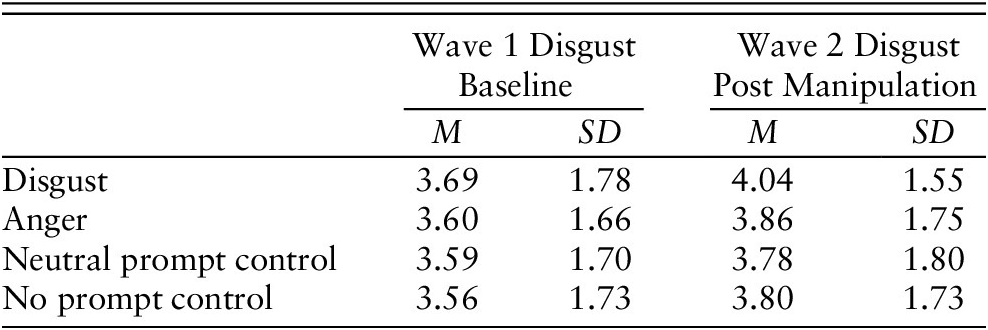
To test whether our manipulation was successful in increasing participants’ feelings of disgust, we conducted a two (wave: baseline disgust, post-manipulation disgust) by four (emotion condition: disgust, anger, neutral writing prompt control, and no writing prompt control) mixed ANOVA with the participants’ reported level of disgust as a within-subjects factor. If the manipulation of disgust was successful, we would expect a wave-by-emotion-condition interaction such that reported disgust would be higher during Wave 2 (post-manipulation) compared to Wave 1 (baseline) in the disgust condition. In contrast, there should be no difference in participants’ reported levels of disgust from Wave 1 to Wave 2 in the remaining three conditions: anger, neutral writing prompt control, and no writing prompt control. Results indicated that our manipulation of disgust was not successful. The change in reported levels of disgust from Wave 1 to Wave 2 did not differ as a function of the emotion manipulation condition, F(3, 702) = 0.39, p = .76, η2p = .002, η2G < .001Footnote 4. The analyses did, however, reveal a main effect of wave, F(1, 702) = 25.60, p < .001, η2p = .04, η2G = .006, such that participants reported more disgust during Wave 2 (post-manipulation) compared to Wave 1 (baseline) (see Table 1 for means and standard deviations). There was no main effect of emotion condition, F(3, 702) = 0.50, p = .68, η2p = .002, η2G = .006.
Means and standard deviations of reported disgust as a function of survey wave and manipulated emotion conditions.

To test whether the manipulation of integral anger was successful, we conducted a two (wave: baseline anger, post-manipulation anger) by four (emotion condition: disgust, anger, neutral writing prompt control, and no writing prompt control) mixed ANOVA with the participants’ reported level of anger as a within-subjects factor. Similar to disgust, if the manipulation of anger was successful, we would expect a wave-by-emotion-condition interaction such that reported anger would be higher during Wave 2 (post-manipulation) compared to Wave 1 (baseline) in the anger condition. In contrast, there should be no difference in participants’ reported levels of anger from Wave 1 to Wave 2 in the remaining three conditions. The analyses revealed a main effect of wave, F(1, 702) = 87.27, p < .001, η2p = .11, η2G = .02, such that participants reported more anger during Wave 2 (post-manipulation) compared to Wave 1 (baseline) (see Table 2 for means and standard deviations). There was no main effect of emotion condition, F(3, 702) = 0.18, p = .91, η2p = .001, η2G = .02. There was, however, a significant interaction: changes in reported level of anger from Wave 1 to Wave 2 did differ as a function of the experimental emotion manipulation condition, F(3,702) = 5.76, p < .001, η2p = .02, η2G = .004. In all four emotion manipulation conditions, participants reported more anger at Wave 2 compared to Wave 1 (see Table 2). However, the mean differences in reported anger were larger in the anger and disgust conditions compared to the control conditions.
Means and standard deviations of reported anger as a function of survey wave and manipulated emotion conditions.

Note: df = 1,702.
In summary, we found no evidence that our disgust manipulation was effective at increasing participants’ feelings of disgust related to the water crisis and some support for the effectiveness of our anger manipulation. In both cases, participants’ feelings of anger and disgust seemed to increase over time regardless of what experimental condition they were in, with the anger and disgust manipulations increasing anger slightly more than the control conditions. Despite these results showing that our disgust manipulation was ineffective at inducing disgust, we still tested our preregistered analyses on moral conviction given that we found some evidence that we induced anger in the anger and disgust conditions.
Preregistered analyses
We hypothesized that participants in the disgust condition would report greater moral conviction at Wave 2 compared to Wave 1 and that no such increase would be found for the participants in the two control conditions.Footnote 5 Furthermore, we had no strong hypothesis about whether participants in the anger condition would show an increase in moral conviction given the mixed results of past research.
To test our hypothesis, we ran a two (wave: baseline moral conviction, post-manipulation moral conviction) by four (emotion condition: disgust, anger, neutral writing prompt control, and no writing prompt control) mixed ANOVA with moral conviction as a within-subjects factor. Inconsistent with the hypothesis that disgust would increase moral conviction from Wave 1 to Wave 2 relative to control, change in moral conviction did not differ as a function of the experimental emotion manipulation condition, F(3, 702) = 0.85, p = .47, η2p = .004, η2G = .001. The analysis revealed a main effect of time, F(1, 702) = 11.78, p < .001, η2p = .02, η2G = .003, such that moral conviction was higher during Wave 2 (post-manipulation) compared to Wave 1 (baseline) (see Table 3 for means and standard deviations). There was no main effect of emotion condition, F(3, 702) = 0.55, p = .65, η2p = .002, η2G = .003.
Means and standard deviations of moral conviction as a function of survey wave and manipulated emotion conditions.

In sum, we found no support for our hypothesis that our disgust manipulation would result in an increase in moral conviction. We also found no support for feelings of anger causing an increase in moral conviction despite some evidence that our disgust and anger manipulations effectively induced it. Rather, mirroring the results showing that participants in all of our experimental conditions reported an increase in both anger and disgust, they also all reported an increase in moral conviction over time. Given the lack of evidence for the effectiveness of our disgust manipulation, these findings are inconclusive about the relationship between disgust and moralization. Therefore, we decided to run additional exploratory analyses to test correlationally whether the participants’ self-reported emotions at Wave 1 predict increases in moral conviction.
Furthermore, the exploratory analyses also allowed us to test whether participants’ perceptions of harm related to the water crisis at Wave 1 predicted changes in their moral conviction. Perceptions of harm are commonly thought to form a central part of people’s moral judgments. Gray’s dyadic model, for example, includes harm appraisals as one of the three necessary components for perceiving an action as immoral along with an intentional agent and a suffering patient (Schein & Gray, Reference Schein and Gray2018). Therefore, harm is often hypothesized to be an important contributing factor to moralization. Past research testing the role of harm in attitude moralization, however, has been mixed, with some finding support (Feinberg et al., Reference Feinberg, Kovacheff, Teper and Inbar2019) and others not (Brandt et al., Reference Brandt, Wisneski and Skitka2015; Wisneski & Skitka, Reference Wisneski and Skitka2017). The exploratory analyses presented next will provide another test of harm’s role in the moralization process.
Exploratory analysis
The goal of our exploratory analysis was to test whether Wave 1 disgust, anger, sadness, or perceptions of harm predicted changes in moral conviction from Wave 1 to Wave 2. If people’s emotions or perceptions of harm related to the water crisis are important in the moralization process, then we would expect participants’ Wave 1 levels of these variables to predict their change in moral conviction over time. Such an analysis allowed us to test two of the three requirements to establish causality: (1) that there is a correlation between the variables and (2) that the hypothesized causal variables precede the measure of moral conviction at Wave 2. We were also interested in whether Wave 1 moral conviction predicted changes in reported disgust, anger, sadness, and perceptions of harm (for a similar analysis, see Brandt et al., Reference Brandt, Wisneski and Skitka2015).
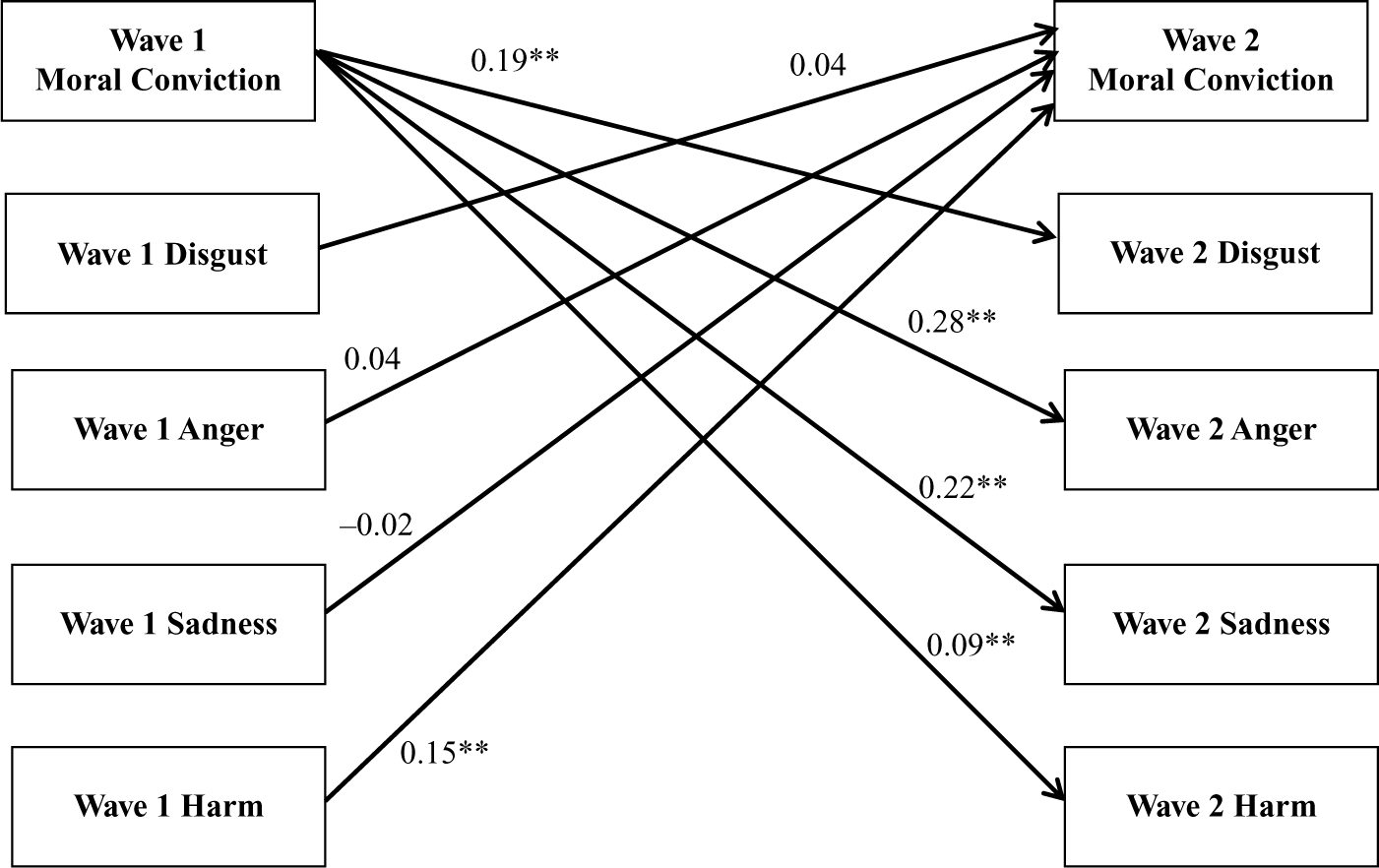
To test both possible causal directions simultaneously (i.e., the effect of emotion/harm on changes in moral conviction and the effect of moral conviction on changes in emotion/harm), we ran a cross-lagged path model estimated with MPlus Version 6.12 (Muthén & Muthén, Reference Muthén and Muthén2010) with full information maximum likelihood estimation. First, our model included Wave 1 disgust, anger, sadness, and perception of harm predicting Wave 2 moral conviction, as well as the moral conviction autocorrelation (i.e., Wave 1 moral conviction predicting itself at Wave 2), thus allowing us to predict change in moral conviction over time. Second, to test the possible consequences of moral conviction, we also included Wave 1 moral conviction predicting Wave 2 disgust, anger, sadness, and perception of harm, as well as their autocorrelations. Again, including the autocorrelations of the four emotion/harm measures allowed us to predict change in those variables over time. Finally, we allowed all measures within each wave to correlate. This model had acceptable to good fit to the data, with RMESA less than .08 (acceptable), SRMR below .08 (acceptable), and CFI above .97 (good; West et al., Reference West, Taylor, Wu and Hoyle2012), χ2 (12) = 60.05, p < .001, RMSEA = .075, 90% CI [.057, .095], SRMR = .052, and CFI = .98 (see Figure 1 for the simplified path diagram). All estimated coefficients, including path estimates, covariances, residual variances, and intercepts are available in Table S1 in the supplemental materials.
Exploratory cross-lagged path diagram. Path estimates are unstandardized. ** p < .001.

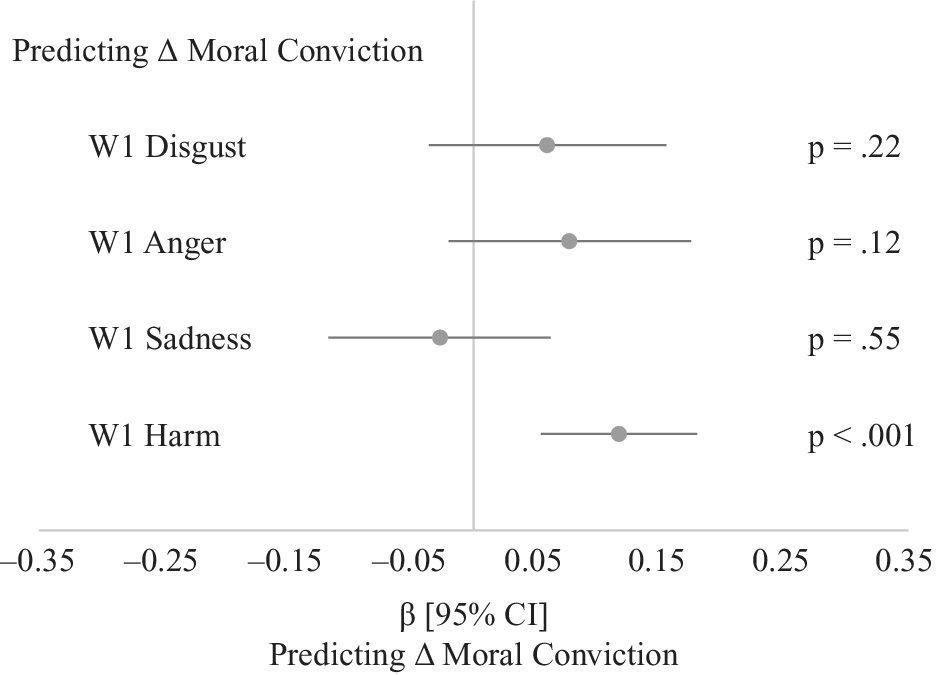
Figure 2 shows the standardized coefficients and their 95% confidence intervals for Wave 1 disgust, anger, sadness, and perception of harm predicting change in moral conviction (e.g., Wave 2 moral conviction controlling for Wave 1 moral conviction). Only the effect for harm was significantly different from zero such that higher levels of perceived harm at Wave 1 predicted an increase in moral conviction from Wave 1 to Wave 2. The three measured emotions—disgust, anger, and sadness—did not predict change in moral conviction.
Standardized estimates, 95% confidence intervals, and p-values of Wave 1 emotion and perceptions of harm predicting change in moral conviction.

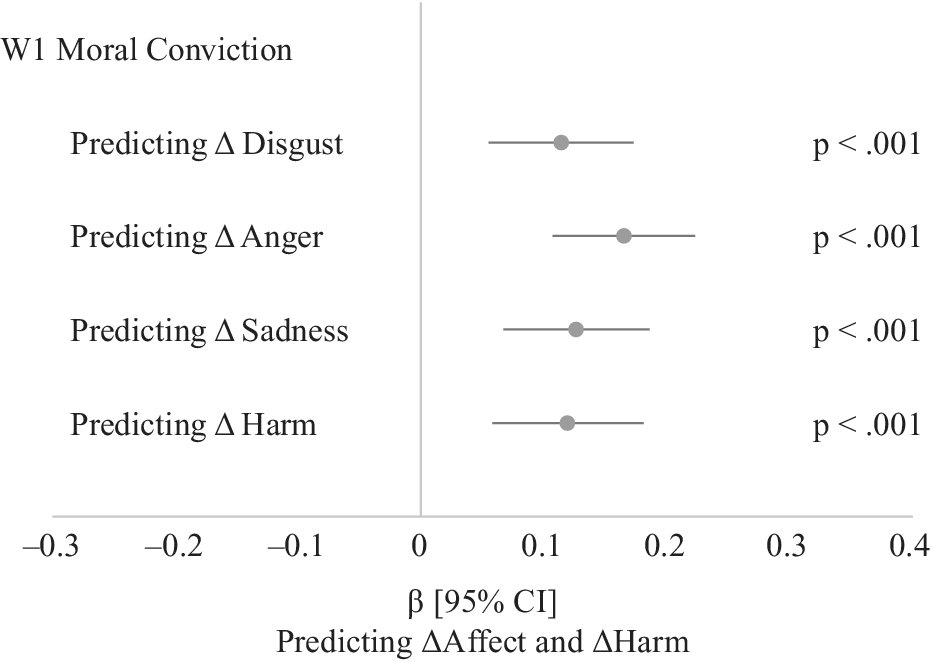
Next, we looked at the possible consequences of attitude moralization by testing whether moral conviction at Wave 1 predicted changes in harm perceptions or our three emotion variables. Figure 3 shows the standardized coefficients and their 95% confidence intervals for Wave 1 moral conviction predicting change in disgust, anger, sadness, and perception of harm (e.g., the Wave 2 emotion controlling for the Wave 1 emotion). Moral conviction significantly predicted change in all four variables, such that greater Wave 1 moral conviction predicted an increase in disgust, anger, sadness, and perceived harm from Wave 1 to Wave 2.
Standardized estimates, 95% confidence intervals, and p-values of wave 1 moral conviction predicting change in emotion and perceptions of harm.

In sum, the results of our exploratory analyses yielded several interesting results about what might moralize people’s attitudes and what the consequences of moralization may be. First, it provided evidence that, in this context, the harm people associate with the water crisis was a better predictor of attitude moralization than their feelings of anger, disgust, or sadness. Second, these analyses also found that stronger emotions and greater perceived harm was a consequence of people holding their attitude with stronger moral conviction at Wave 1.
Discussion
The current study explored the relationship between disgust and attitude moralization. Using a high-powered preregistered study, we measured people’s moral conviction about an attitude related to the water crisis in Flint, Michigan, at two time points a month apart. Furthermore, we attempted to experimentally induce disgust to determine whether it could cause people’s attitudes to moralize relative to control participants or those induced to feel anger. Unfortunately, the results from our experimental manipulation found no evidence that the disgust condition effectively increased disgust or that it changed participants’ level of moral conviction. We did find evidence that our anger and disgust manipulations increased self-reported anger relative to baseline; however, that increase did not appear to affect moral conviction.
Despite the failure of our preregistered disgust manipulation, additional exploratory analyses found evidence that participants’ perceptions of harm related to the water crisis at Wave 1 predicted an increase in moral conviction over time. Although these exploratory results should be interpreted with caution and need to be replicated with future confirmatory work, they provide contrasting evidence from past work that has found harm perceptions to be a consequence, rather than an antecedent, of moralization (Brandt et al., Reference Brandt, Wisneski and Skitka2015; Wisneski & Skitka, Reference Wisneski and Skitka2017). That said, this finding is also consistent with other recent research finding that harm, along with emotion, predicted moralization of animal rights attitudes (Feinberg et al., Reference Feinberg, Kovacheff, Teper and Inbar2019). Although there are still only a small number of studies looking at the role of emotion and harm in the moralization process, the picture that is emerging so far is one that is complex and variable.
Multiple people have identified moralization and emotion’s possible role in it as important avenues for future research in moral psychology (e.g., Avramova & Inbar, Reference Avramova and Inbar2013). Looking across recent work into the moralization process, it seems clear that no single answer exists to the question: “what moralizes?” Rather, there are multiple routes to increased moral conviction that may depend on a variety of factors. Moralization may vary, for example, depending on the specific attitude object being moralized and whether it has clear elements related to harm or clear aspects that elicit a morally relevant emotion such as disgust. The Flint water crisis, for example, may have had such clear ties to harm, given that it involved the contamination of a city’s water source, that these perceptions overwhelmed people’s emotional reactions to the issue. Future theories and research into moralization should attempt to account for the possibility that multiple variables may contribute to the process in different ways at different times and for different issues. The recently proposed “push-pull model of moralization,” for example, attempts to include both moral cognitions (such as harm appraisals) and moral emotions as possible moralizing factors (Feinberg et al., Reference Feinberg, Kovacheff, Teper and Inbar2019). Although this model is a good first step, more work is needed to determine under what conditions these factors do or do not matter for moralization.
The current exploratory results also replicate previous research showing that stronger emotions and perceptions of harm are also consequences of attitude moralization. Specifically, in the current study, we found that moral conviction at Wave 1 predicted increased feelings of disgust, anger, and sadness about the water crisis and increased harm perceptions over the two waves. This is consistent with findings showing that people’s feelings of moral conviction about their preferred and nonpreferred candidates during the 2012 U.S. presidential election predicted increases in their emotions related to the candidates and the anticipated harms and benefits of different electoral outcomes (Brandt et al., Reference Brandt, Wisneski and Skitka2015).
Limitations
Despite using an emotion manipulation that was effective in previous research (Small et al., Reference Small, Lerner and Fischhoff2006), the current study failed to effectively induce feelings of disgust. Furthermore, although we were able to induce increased anger in some participants, this increase was not unique to the anger condition and was found also in the disgust condition. It is not entirely clear why it was that our manipulation failed to produce the intended emotions (particularly disgust) in the current study. One reason could be the online context in which the study was conducted. Although we were careful during Wave 1 to identify participants who were not taking the study seriously and to not invite them back for Wave 2, it is possible participants still did not take the manipulation seriously enough for it to produce a strong emotional response.
Another possible explanation for why we were unable to induce disgust and why disgust showed no effect on moral conviction could relate to the specific issue we chose. Perhaps the Flint water crisis was not intrinsically “disgusting” enough for our manipulation to produce the desired effect. Early news reports on the crisis did include potentially disgusting images of discolored water coming out of the faucets of Flint residents. Since that time, however, it is possible that people’s emotions associated with the issue have shifted to anger at public officials who they see as not doing enough to fix the problem or to concerns about harm to the residents of Flint who continued to live without clean water. This possibility is also mirrored in our finding that participants in the disgust and anger conditions reported a greater increase in self-reported anger from Wave 1 to Wave 2 compared to the increases found in the control conditions. It should be noted, however, that this increase in anger did not appear to result in greater feelings of moral conviction. Similarly, it is also possible that our manipulation produced a primarily “interpersonal” form of disgust toward the inaction of government office in the City of Flint. If that is the case, we would not have expected disgust sensitivity, which measures pathogen avoidance disgust, to moderate its effects. Rather, had we measured participants’ sensitivity toward this alternative form of disgust, we may have found moralization effects among those high in that construct who were in the disgust condition.
Another unexpected finding was that people’s feelings of disgust, anger, and moral conviction increased from Wave 1 to Wave 2 regardless of their experimental condition (i.e., we found main effects for each of these variables). Regardless of our attempt to induce discrete emotional reactions in some of our participants, it appears that something was increasing their emotions and moral conviction across the two waves. This overall increase in each of these variables likely undermined our ability to differentiate between the discrete emotional reactions of the participants in each experimental condition as well as any effects they could have had on moral conviction. One possible explanation is that simply reminding participants of the water crisis was sufficient to induce some emotional response that may have undermined any increase that our manipulations might have had produced.
Conclusion
The current study makes a novel contribution to the literature on attitude moralization. First, our manipulation was able to successfully induce increased feelings of anger in some participants. Given the large sample size and high statistical power of the current study, it is reasonable to conclude that anger did not affect moralization in this context. Second, our exploratory analyses provide evidence that harm might moralize under some circumstances. Although some past research has found that harm plays no role in the moralization process (Brandt et al., Reference Brandt, Wisneski and Skitka2015; Wisneski & Skitka, Reference Wisneski and Skitka2017), other work has found that harm can predict increases in moral conviction (Feinberg et al., Reference Feinberg, Kovacheff, Teper and Inbar2019). In sum, the current study points to interesting and novel directions for future work and serves to highlight the possibility that moralization is a complex process that likely results from a variety of different factors (both emotional and not) that vary across contexts.
Supplementary Materials
To view supplementary material for this article, please visit http://dx.doi.org/10.1017/pls.2020.22.