Public legal education: an introduction
Over recent years there has been increasing policy concern in the UK about whether citizensFootnote 1 are equipped with sufficient legal ‘know-how’. In January 2006 the Department for Constitutional Affairs (DCA), now Ministry of Justice, announced a Public Legal Education and Support (PLEAS) Task Force.Footnote 2 The move came after the Legal Action Group, the Citizenship Foundation and the Advice Services Alliance urged a national strategy to fund public legal education on citizens’ rights and knowledge of the law (Advice Services Alliance, Citizenship Foundation, Legal Action Group, 2004, 2005). The Task Force published a report in July 2007, identifying a number of strategic tasks: creating a coherent focus and identity for public legal education; overcoming the fragmented nature of current provision; developing and spreading good practice; and securing sustainable funding (PLEAS Task Force, 2007). The Task Force also argued for the establishment of an independent Public Legal Education Centre.
One of the first aims of the Task Force was to offer a broad definition of public legal education, referred to as PLE in their report:
PLE provides people with awareness, knowledge and understanding of rights and legal issues, together with the confidence and skills needed to deal with disputes and gain access to justice. Equally important, it helps people recognise when they may need support, what sort of advice is available, and how to go about getting it.
PLE has a further key role to play in helping citizens to better understand everyday life issues, making better decisions and anticipating and avoiding problems. (PLEAS Task Force, 2007: 9)
Public legal education is therefore not about teaching every person about the detailed contents of the law. It is about being able to recognise a legal issue and knowing how to deal with it. Public legal education is ‘the tool we need to achieve legal capability’ (PLEAS Task Force, 2007: 9). As currently defined, public legal education covers both civil and criminal issues. The PLEAS Task Force also see it advancing human rights, enabling citizens to understand and pursue their own and others’ human rights (PLEAS Task Force, 2007). Civil legal issues in particular are everyday and widespread (Pleasence, Reference Pleasence2006; Genn, Reference Genn1999): including problems with family and ex-family members, landlords, creditors, retailers, service providers, and government agencies. Criminal justice matters, more often in the forefront of people's minds when they hear the word ‘legal’, are not the focus of this article.
In encompassing the varied dimensions of awareness, knowledge, understanding and skills and confidence, parallels can be drawn between public legal education and citizenship education. The Crick Report (1998) on education for citizenship and the teaching of democracy in schools emphasised participation and active citizenship, and argued that citizenship education should go beyond knowledge and understanding. The definition for public legal education above echoes this approach. However, public legal education as a term and concept is clearly not as distinct and developed as that of citizenship education. As yet, there is no demarcation where citizenship education ends and public legal education begins. In English schools, for example, citizenship education includes a framework for understanding rights and obligations.Footnote 3 However, the National Foundation for Educational Research (Kerr et al., Reference Kerr, Cleaver, White and Judkins2005) concluded that there was an urgent need for the then DCA to explain how its priorities dovetail with citizenship education in schools. While citizenship education has entered the collective discourse, public legal education by comparison is far less tangible and, at present, is a term used by a limited number of experts.
Public legal education: its potential
Public legal education undoubtedly has the potential to reduce inequality and deliver social justice:
There is no point in creating a complex system of entitlements if the public are unable to make those rights and entitlements effective. We would argue that public legal education and support – properly prepared and effectively delivered – are essential to the delivery of a social justice strategy. (Professor Dame Hazel Genn, Task Force Chair, in a speech to the PLEAS reception at the House of Commons on 22 June 2006, www.pleas.org.uk)
Equality and inequality have been at the heart of most social policy debates, with identification of needs taking a central role. Rights are important in this context, with the welfare state in principle granting citizens the right to have their basic needs met. The relationship between rights, responsibilities and citizenship was set out in Marshall's (Reference Marshall1950) seminal analysis. The rights and duties with which his citizenship status is endowed have little real substance if they are not put into practice.
Therefore, in order to realise one's citizenship status, an individual needs to know their rights and responsibilities. The consequences of not knowing them can lead to, or exacerbate, inequality and ‘social exclusion’, a (contested) concept encompassing a combination of linked problems and caused not just by poverty, but also through discrimination, chronic ill-health and geographical or cultural isolation (for example, Burchardt et al., Reference Burchardt, Le Grand, Piachaud, Hills, Le Grand and Piachaud2002; Hills et al., Reference Hills, Le Grand and Piachaud2002; Social Exclusion Unit, 2001). It may result in wrongly assuming nothing can be done about a problem with an employer, believing that one has to ‘put up’ with problems such as anti-social neighbours or unsafe council housing, or not being confident or knowledgeable enough to enforce one's right to receive welfare benefits. The importance of this last point for alleviating the poverty and social exclusion experienced by some older people has been demonstrated previously in this journal (Craig, Reference Craig2004). At the opposite end of the age distribution, young people are often unaware of their rights and unable to exercise them, leaving them at greater risk of social exclusion (Youth Access, 2002). Public legal education, tailored and delivered at the right time, could improve the experiences of these vulnerable groups, which include people who may not legally hold citizenship status. Importantly, it can result, through facilitating appropriate action, in problems not spiralling out of control, leading to further problems: legal issues frequently occur in combination both with other legal issues (Pleasence et al., Reference Pleasence, Balmer, Buck, O'Grady and Genn2004) and wider problems of social exclusion (Buck et al., Reference Buck, Pleasence and Balmer2005).
Sommerlad (Reference Sommerlad2004) has pointed out how, under New Labour, legal aid has been conceptualised as a social policy tool in the struggle against social exclusion. At the same time, access to justice has been characterised by a limited legal aid budget. Resulting debates focus on equity, the prioritisation of cases and resources as a rationing means, and how ‘legal need’ may be measured to achieve equitable rationing (for example, Moorhead and Pleasence, Reference Moorhead, Pleasence, Moorhead and Pleasence2003; Baker and Barrow, Reference Baker and Barrow2006). As Moorhead and Pleasence state, many ideas – such as public legal education or self-help – of the radical legal services movement ‘have moved centre stage at the same time as the rationing process has become more explicit’ (Reference Moorhead, Pleasence, Moorhead and Pleasence2003: 2). This is partly due to their potential for more effective management of limited resources. Education initiatives that help people recognise and deal with problems earlier may result in improved and less costly solutions, both financially and emotionally. Law-related problems have knock-on effects on health and other public services (Pleasence, Reference Pleasence2006); they can result in expensive court action and significant administrative burden.
The potential of public legal education also lies in showing the practical and everyday dimension of the law. Law is often seen as something abstract and specialist. However, legal issues touch on most areas of people's lives, and on many topical social policy debates: from equal opportunities to domestic violence, from the rights of same-sex partnerships to children's access to schooling, from medical mistreatment to anti-social neighbours. In the UK, increased policy demand for social research in the civil justice field reflects this recognition of how legal and social issues are interconnected (Buck, Reference Buck2007). By demystifying the law through education initiatives, it may lose its association as being intimidating or irrelevant.
Public legal education: lessons from experience
There is significant activity in the area of public legal education at a local level. However, initiatives often have time-limited funding and are small-scale. There is no public body with responsibility and a budget for public legal education. According to the Access to Justice Act 1999 (s.4), the Legal Services Commission's (LSC) responsibility for maintaining the Community Legal Service extends to providing ‘general information about the law and legal system and the availability of legal services’. However, the Act does not require the LSC to play a particularly extensive or proactive role in public legal education and there is no requirement for educating the public about criminal issues. In contrast, the New Zealand Legal Services Agency, the equivalent of the LSC in England and Wales, has statutory education responsibilities.
In lacking sustainability, a coordinated approach and a body with a clear education remit, public legal education lags behind financial capability (Financial Services Authority, 2004) and consumer education (Office of Fair Trading, 2004). In the UK, considerable resources have recently been spent on both these areas. They are also of interest as there is an overlap with public legal education: money problems or problems with consumer goods generally have a legal dimension.
The Financial Services Authority (FSA) has ‘established a road map for delivering a step change in the financial capability of the UK population’ (2006: 1). The aim is to combine initiatives that will lay the foundations for sustained improvement with other initiatives designed to have an immediate impact. The Office of Fair Trading (OFT) has set up a consumer education alliance, a coalition of organisations and individuals from the public, private and voluntary sector. The National Consumer Council, a key initiator in calling for a national strategy for consumer education (Coppack, Reference Coppack2003), asserts that ‘given the importance of consuming in today's world, consumer skills are a pre-requisite for active citizenship and full participation within society’ (www.ncc.org.uk). It could be suggested the same applies to legal capability.
Public legal education: research evidence
Recent examples of research evidence in the UK highlight the need for public legal education. ‘The Employees’ Awareness, Knowledge and Exercise of Employment Rights Survey’ (Casebourne et al., Reference Casebourne, Regan, Neathey and Tuohy2006) showed that groups expected to be vulnerable workers − such as younger workers, those without a Human Resources department, and non-union members – had lower levels of awareness and knowledge about their rights at work than other workers. A disparity in awareness also existed across different types of employment rights. Rights to do with ensuring employees are not discriminated against based on various personal characteristics had higher levels of awareness than those concerned with having children and dependants.
Genn et al. (Reference Genn, Lever, Gray and Balmer2006) highlighted weak levels of understanding about and access to systems of redress among tribunal users. Those who challenged administrative decisions tended to be the most determined and confident, or those successful in obtaining advice and support. Echoing the finding that awareness and knowledge are unevenly spread across the population in regard to employment rights, the research further showed that some population groups had different levels of awareness than others in regard to the use of tribunals as a means of redress.
Another example concerns cohabitation. Although cohabitants are now given legal protection in several areas, they and their families have significantly fewer rights and responsibilities than their married counterparts. Tennant et al. (Reference Tennant, Taylor and Lewis2006) found a lack of awareness among cohabitants about the wider legal framework for their cohabitation, and a general misunderstanding about the relative statuses of marriage and cohabitation.
These findings highlight knowledge and skill gaps in the population with regard to specific legal issues and processes. However, the studies quoted above are limited in scope. The results presented below provide a comprehensive picture across 18 different civil justice problem categories.
Methodology: the English and Welsh Civil and Social Justice Survey
The English and Welsh Civil and Social Justice Survey (CSJS) provides detailed information on the nature, pattern and impact of people's experience of civil justice problems and the use and success of problem resolution strategies (Pleasence, Reference Pleasence2006). The survey is representative of the household population of England and Wales.Footnote 4 All interviews for the 2004 survey were arranged and conducted face to face in respondents’ own homes by BMRB Social Research between July and December 2004.
The survey is a development from the earlier surveys of Pleasence et al. (Reference Pleasence, Buck, Balmer, O'Grady, Genn and Smith2004), Genn and Paterson (Reference Genn and Paterson2001) in Scotland and Genn (Reference Genn1999). Similar surveys have since been undertaken in other jurisdictions: for example, in the Netherlands (see van Velthovern and ter Voert, Reference van Velthoven and ter Voert2005), in Canada (Currie, Reference Currie2006) and in New Zealand (Ignite Research, 2006). Although these surveys show that the incidence of civil justice problems varies across jurisdictions, they confirm that problems are widespread and that there are issues around people's awareness and confidence in dealing with problems.
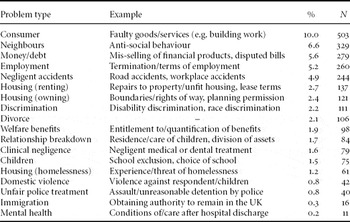
All CSJS respondents completed a screening interview in which they were asked if they had experienced a problem since January 2001 that had been difficult to solve in each of 18 distinct civil justice problem categories. Problem types are listed in Table 1, along with examples of constituent sub-categories and the proportion of respondents reporting having experienced one or more problem of each type. Respondents were asked for a range of details about themselves and the household in which they resided.
Discrete problem types reported in the survey, and percentage/number of respondents reporting one or more problem of each type

For the two most recent problems identified in each category, respondents were asked about their nature, action taken to resolve them, manners of conclusion and the impact on their lives. Only 36 of 1,674 respondents with problems reported more than two problems within a single category. If a respondent had experienced at least one problem, they progressed to a follow-up interview, addressing further aspects of a single problem drawn from those identified through the screening interview (including advice, objectives, costs and outcomes). The mean total interview duration was half an hour. A full technical report of the survey has been published elsewhere (Phelps et al., Reference Phelps, Hayward and Hanson2005).
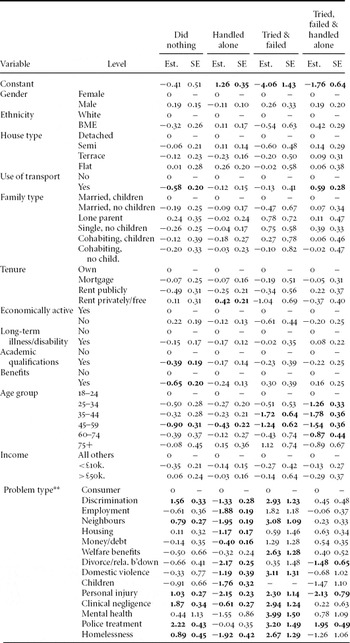
In addition to descriptive analyses of respondents’ responses, we also fitted a multilevel multinomial logistic regression model, implemented using MlwiN (Rasbash et al., Reference Rasbash, Steele, Browne and Prosser2004), to model general problem resolution strategy on the basis of a range of social and demographic predictors and type of civil justice problem reported. Predictors, and their constituent levels, are shown in the first two columns of Table 2. A multilevel model (Goldstein, Reference Goldstein2003) was used in order to correctly model the hierarchical structure in the data (respondents were nested within households, as all eligible adults within households were interviewed). Use of multilevel modelling also increased the percentage of correctly predicted strategies, with 64 per cent correctly predicted compared to 56 per cent in a single-level model. The model produces four sets of parameter estimates (columns) predicting the likelihood of each of ‘did nothing’ about the problem, ‘handled alone’, ‘tried and failed to obtain advice’ and ‘tried, failed and handled alone’ compared to ‘obtaining advice’. For each categorical predictor variable, there is a reference category to which other categories are compared. Reference categories are shown by zero estimates and missing standard errors in Table 2.
Multilevel multinomial logistic regression model of general problem resolution strategy on the basis of a range of social and demographic predictors and civil justice problem type. Each strategy (did nothing; handled alone; tried and failed; tried, failed and handled alone) is compared to the likelihood of obtaining advice (reference category)*

Notes: *Statistically significant predictors are in bold.
**A small number of immigration problems were excluded from the model since respondents either handled alone (4 of 15) or obtained advice (11 of 15). In the case of tried and failed, children problems are collapsed into the reference category since none tried and failed. Housing consists of both renting and owned housing problems, and divorce and problems ancillary to relationship breakdown are collapsed into a single category.
Results
General problem resolution strategies
Thirty-three per cent of respondents reported a civil justice problem over the three-and-a-half year survey reference period. However, these respondents adopted very different ways of addressing their problems, with some strategies indicating knowledge, confidence and/or skills gaps. While the majority of those with problems obtained advice (52 per cent), a substantial proportion did nothing to resolve their problem (11 per cent), tried but failed to obtain advice (2 per cent), or tried and failed to obtain advice and then went on to handle the problem alone (5 per cent). Respondents reporting the remaining 31 per cent of problems chose to handle them alone from the outset. In handling problems alone, most respondents simply talked or wrote to ‘the other side’ and attempted to negotiate a solution.
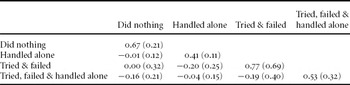
Table 2 shows multilevel multinomial logistic regression model output, modelling general problem resolution strategy on the basis of a range of social and demographic predictors and problem types. Table 3 shows the household-level covariance matrix, with the positive on-diagonal elements indicating the persistence of strategies within households. This is explored further below.
Household level covariance matrix of the model in Table 2 (standard errors in brackets)

Doing nothing
There were some social and demographic differences in tendency to do nothing rather than obtain advice, as well as marked differences across problem types. Referring to the multivariate model in Table 2, those with use of motorised transport were significantly less likely to do nothing than those without (when compared to obtaining advice), as were those in receipt of benefits and those with academic qualifications. There was also evidence of age having a significant impact, with 18–24 year olds most likely and 45–59 year olds least likely to do nothing rather than obtain advice.
In percentage terms, those with the use of motorised transport did nothing 9 per cent of the time compared with 53 per cent obtaining advice. This contrasted with, in the case of those without transport, just under 15 per cent doing nothing and 42 per cent obtaining advice. Those in receipt of benefits had a low rate of inaction and a high percentage seeking advice (9 per cent and 58 per cent respectively) compared to those not receiving benefits (11 per cent and 48 per cent). Youngest and oldest respondents had the highest rates of inaction, as well as a low percentage obtaining advice (18–24 year olds: 15 per cent doing nothing and 42 per cent obtaining advice; over 75 year olds: 18 per cent doing nothing and 39 per cent obtaining advice). While those with and those without academic qualifications had comparable rates of obtaining advice (52 and 51 per cent respectively), those without qualifications did nothing more often (14 per cent versus 10 per cent). If we expand academic qualifications, we find highest levels of inaction among those without any qualifications (14 per cent) and more handling alone among those with higher degrees (42 per cent).
Respondents experiencing different types of civil justice problems chose different ways of dealing with them (see Figure 1). There were highly significant differences in rates of inaction, compared to obtaining advice, between problem types (see Table 2). Those faced with problems relating to discrimination (28 per cent doing nothing), clinical negligence (28 per cent), unfair police treatment (24 per cent), homelessness (23 per cent), personal injury (22 per cent) and anti-social neighbours (15 per cent) were most likely to do nothing when faced with the problem. Arguably, ‘doing nothing’ about a problem was therefore most common for problems associated with a substantial imbalance of knowledge or power, and inter-personal conflict.
General problem resolution strategy by problem type.

Respondents were asked why they did nothing about a problem. The most common reason was that people thought it would make no difference (22 per cent). Uncertainty as to rights (7 per cent) and what to do or where to get help (8 per cent) were also mentioned.
Breaking results down further to show variation between different demographic groups and their reasoning behind doing nothing, there was some indication that black and minority ethnic respondents were more likely than white respondents to think nothing could be done to help them (37 per cent versus 21 per cent; χ22 = 3.97, p = 0.046). Not knowing what to do or who to go to was a particularly common reason for inaction among cohabitees (17 per cent and more than double the percentage elsewhere), among those renting publicly (14 per cent), among 35–44 year olds (16 per cent) and among those with personal or household income of less than £10,000 (15 per cent). No 18–24 year old gave ‘did not know where to go/who to go to’ as a reason, and only 3 per cent of those with income over £50,000 did so. Cohabitees without children were most likely to express uncertainty over rights as a reason for doing nothing about their civil justice problem (17 per cent), as were publicly renting respondents (12 per cent).
Reasons for inaction also varied significantly by problem type. Respondents most often said they did not act because they thought nothing could be done to resolve employment, discrimination, money/debt and mental health problems. They least often thought nothing could be done to resolve consumer and personal injury problems. A relatively high 36 per cent of respondents who did nothing about their money/debt problems reported not knowing what they could have done. They also reported relatively frequently being unaware of their rights. A high 44 per cent of respondents with employment problems they had done nothing about reported that this was because they were unaware of their rights.
Trying and failing to get advice
There were two different groups of respondents who tried but failed to obtain advice. One group did not make any other attempt to handle the problem. Compared to obtaining advice, young (18–24 years old) and older respondents (over 75 years old) were most likely to try and fail to obtain advice and take no other action. As can be seen in Table 2, 35–44 year olds and 45–59 year olds were both significantly less likely than 18–24 year olds to do so. In percentage terms, 18–24 year olds tried and failed for over 3 per cent of problems and obtained advice for 42 per cent, while those over 75 years old did so for just fewer than 8 per cent of problems while obtaining advice for only 39 per cent. Lone parents and single respondents without children were also more likely to try and fail rather than obtain advice and take no other action, although differences, when compared to married couples with children, did not reach significant levels (see Table 2).
Trying but failing to get advice and taking no other action were uncommon in a number of problem categories. In only one of 545 consumer and one of 146 rented housing problems did respondents do so (see Table 2). There were also no instances for immigration, divorce or children problems. In contrast, the (small number of) homelessness problems (n = 62) were associated with trying and failing to get advice and taking no other action (8 per cent), as were problems with anti-social neighbours (6 per cent).
A second group of respondents tried and failed to obtain advice and then went on to handle problems alone. There were few strong socio-demographic predictors of trying, failing and handling alone rather than obtaining advice, although those with use of motorised transport did tend to do so more often than those without (see Table 2). There were also age differences, which were broadly comparable to the differences observed for trying and failing without handling alone (see above). Young respondents (18–24 year olds) were most likely to try, fail and then handle alone. In percentage terms, 9 per cent of 18–24 year olds tried, failed and handled alone with 42 per cent obtaining advice, compared to just over 4 per cent and 53 per cent for other respondents.
For problem type, neighbours problems had relatively high rates of respondents trying and failing to get advice and then handling alone (7 per cent). The same was also true of owned and rented housing problems (10 per cent and 8 per cent respectively), and problems with unfair police treatment (15 per cent). In contrast, there were no respondents with divorce or immigration problems who tried, failed and handled alone (although, in the case of immigration, this is based on only 15 problems).
Handling problems alone
Respondents renting privately or rent-free were most likely to handle problems alone from the outset rather than obtain advice, and significantly more likely than those who owned their homes (see Table 2). In contrast, publicly renting respondents were the least likely to handle alone rather than obtain advice. In percentage terms, those renting privately or living rent-free handled alone 39 per cent of the time and obtained advice 41 per cent of the time. This compared to 21 per cent handling alone and 59 per cent obtaining advice for publicly renting respondents. There was some evidence of those in receipt of benefits being less likely to handle alone, although this fell just short of statistical significance. In terms of educational qualifications, while the binary predictor in Table 2 was non-significant, for expanded qualifications the highest rates of handling a problem alone from the outset were found among those with higher degrees (42 per cent). As with other strategies above, there was evidence of age having an impact, with 18–24 year olds more likely to handle alone rather than obtain advice, particularly when compared to 45–59 year olds (see Table 2). This significant difference was predominantly a result of a low percentage of 18–24 year olds obtaining advice (42 per cent versus 53 per cent of other respondents), with absolute percentage handling alone comparable between young respondents and those aged 25 or over (31 per cent in both cases).
For problem type, consumer problems had a high rate of respondents handling alone (59 per cent), no doubt reflecting their relative lack of severity compared to other problem types. High percentages were also recorded for money/debt (47 per cent) and welfare benefits problems (45 per cent). Not surprisingly, divorce problems had the lowest percentage of respondents handling them alone. Respondents with homelessness problems and personal injury problems also tended not to handle these problems alone (11 per cent and 12 per cent respectively).
Getting lost in the advice maze?
The majority of respondents (52 per cent) did obtain advice for their civil justice problem. However, this does not necessarily mean they went to the adviser most suited to deal with their problem, or that they received all the information and advice they hoped for.
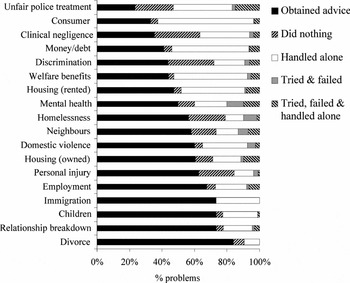
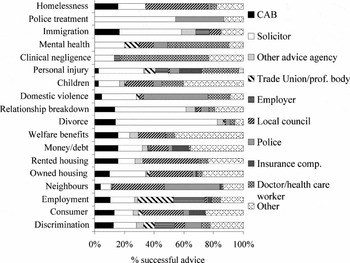
Figure 2 shows the type of adviser respondents went to. For some civil justice problems, the paths to advice are relatively clear. For divorce and relationship breakdown problems, most respondents went to a solicitor for advice, as did those with problems related to unfair treatment by the police. For other problem types, the adviser types approached were far more heterogeneous. For example, for problems relating to discrimination, employment, mental health or children, respondents went to a wide range of advisers. This indicates there might be knowledge and awareness gaps, with people seeking out advice from a variety of advisers, some of whom might not be the most appropriate advice source.
Percentage of successful advice received by problem type and adviser type.

Respondents who either obtained all or some of the advice or information they needed from their adviser were asked what made them consider obtaining advice from that adviser. Around three quarters simply claimed it was obvious to do so. Respondents who obtained advice but then said they received none of the advice or information needed and suggested that they ‘could have done with more’ advice, were asked a follow-up question about why they were not intending to get more advice/information. Out of 266 respondents, the two most frequent reasons given were that seeking more advice/information would not make any difference to the outcome (25 per cent) and that they did not know where to go (24 per cent).
Awareness of mainstream local advice provision
There was a mismatch between respondents’ perceptions of local advice provision and actual provision. Survey respondents were asked which of a list of advisers were within two miles of their homes. Around 46 per cent of those with a Citizens Advice Bureau within two miles of their home were unaware of it. At least 43 per cent of respondents were unaware that a solicitor was within two miles. Eighty-three per cent of those with a Law Centre within two miles were unaware of it. Although differences in strategy by overall awareness did not reach significance (χ28 = 10.99, p = 0.20), those lacking awareness did have relatively high Pearson residualsFootnote 5 for doing nothing about their problem (1.9) and handling alone (−1.6). Those lacking awareness did nothing around 13 per cent of the time and handled alone 24 per cent of the time, compared to around 8 per cent doing nothing and 30 per cent handling alone for those correctly identifying advisers. Even among those with a lack of awareness of local advisers, not knowing what to do or where to go remained a relatively rare reported reason for inaction (less than 12 per cent). Far more common was feeling that advice would make little difference to the outcome, accounting for a third of responses.
Entrenched behaviour patterns
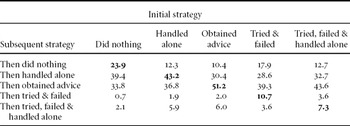
Problem-solving strategies were persistent. This tendency, which was identified for households in the covariance matrix in Table 3, is illustrated for individuals in Table 4. The percentage of those adopting particular strategies for subsequent problems is shown, in relation to earlier problems (not necessarily of the same type). Of those who did nothing for an initial civil justice problem, 24 per cent did nothing again for a problem experienced at a later date, a far higher percentage of inaction than among other groups. This trend of persistent strategies can be seen for all problem-solving strategies.
Strategy reported by respondents by subsequent strategy for later problems

Regrets
Out of 361 respondents who had not sought advice, 23 per cent said they wished they had obtained advice or information for their civil justice problem. These 81 respondents were asked why this was. Forty-one per cent said they would have got a better outcome, 32 per cent said the problem was more serious than initially thought, 32 per cent felt their problem would have been resolved sooner, 27 per cent thought the other side would have taken them more seriously, 23 per cent reported the situation would have been less stressful and 12 per cent said they could not handle the problem alone.
Of 116 respondents who tried and failed to get advice for their problem, a relatively high percentage (18 per cent) responded they did not know whether they now wished they had obtained help or advice. Forty-one respondents said they wished they had obtained it. Of these, 16 thought they would have got a better outcome with advice, 14 believed they could not handle their problem alone, 11 said their problem would not go away, ten said the problem was more serious than previously thought, and eight respondents said the other side would have taken them more seriously. However, when asked where they wished they had got advice or help from, the most common answer was ‘don't know’ (12 of 41 respondents).
For all concluded survey problems discussed in the follow-up interview, respondents were asked whether there was anything about the way in which they handled the situation that they now wished they had done differently. Of 679 respondents, 29 per cent said there was indeed something they wished they had done differently. The most common regret was not obtaining advice or more advice or advice elsewhere (26 per cent). This was followed by 17 per cent of respondents wishing they had acted sooner. Seven per cent specifically wished they had got advice sooner. Indicating the importance of confidence and determination, 12 per cent regretted they had not tried harder, been more resolved or more assertive. Five per cent wished they had used a formal process or had used it sooner. Only 2 per cent wished they had done nothing and only 4 per cent wished they had handled their problem alone. Three per cent regretted they had not got information or more information, indicating that respondents did not perceive a lack of general information to be greatly significant.
Some regrets may be linked to respondents having unrealistic and wrong expectations of the problem resolution process. Problems with welfare benefits (50 per cent), rented housing (46 per cent) and money/debt (42 per cent) had the highest rates of respondents subsequently saying they ‘took much longer than expected’.
Additional analysis confirms that respondents are justified in regretting not doing anything about their problem, as those who obtained advice generally fared much better in terms of attaining their objectives. Of those who obtained advice, 46 per cent attained their objectives, compared to only 11 per cent of those who tried in vain to obtain advice. Interestingly, of those who handled their civil justice problems alone, 42 per cent attained their objective. This illustrates that a significant number of those who feel confident, skilled and empowered enough to handle their problems alone are able to meet their objectives without seeking advice. However, as shown above, these tended to be respondents with higher educational qualifications and those with higher incomes. Importantly, some of the problems that were handled alone are likely to have been less serious problems and as a result objectives will have been easier to achieve.
Discussion
Research implications
Realising one's rights and responsibilities is a core requirement for active and democratic citizenship. The findings presented in this article illustrate that there are knowledge, skill and confidence barriers to this requirement.
The results from the CSJS indicate that those most vulnerable were more likely to choose inappropriate advice-seeking strategies. Respondents without any formal educational qualifications had high rates of not doing anything about their problem, as did those without use of motorised transport, while young respondents had higher rates of trying but failing to obtain advice. In contrast, those who handled their problems alone tended to have higher degrees and high incomes and were unlikely to be renting publicly. Interestingly, though, lone parents (66 per cent) had high rates of obtaining advice (see also Buck et al., Reference Buck, Pleasence, Balmer, O'Grady and Genn2004), as did those in benefit receipt (59 per cent). These socio-demographic results highlight how public legal education initiatives might best be focused on specific population groups. Similarly, findings at problem level show that public legal education might be of more benefit in relation to some legal issues than others. For example, clinical negligence, discrimination, unfair police treatment, personal injury and neighbour problems might be a sensible starting point, as people are more likely to do nothing about these problems.
Further results presented in this article provide a detailed picture of reasons behind choosing a particular advice strategy. Those who did nothing about their civil justice problems often thought advice would make no difference. Uncertainty as to rights, what to do and where to get help from were less frequently mentioned. Explicit awareness issues were therefore secondary to a perception that advice had little to offer. However, while believing that advice would not make a difference could be a realistic assessment of the situation, it may also point to a lack of knowledge of, and confidence in, the legal system and advice services.
People's advice-seeking behaviour was further influenced by previous advice-seeking strategy. Successful public legal education initiatives have the potential to break entrenched behaviour patterns, so people adopt an advice-seeking strategy based on appropriateness and not on previous behaviour.
Alongside targeting specific legal issues and specific groups, a public legal education strategy must consider different methods of delivery. This is crucial in regard to equity, unmet need and social exclusion issues: many of those who may face obstacles in seeking advice are also less likely to access a programme of education. Accessibility is therefore key, with different methods working better for some groups than others. Education outreach programmes might be best for those who are ‘hard to reach’; recent research has illustrated how excluded groups can be targeted through putting advice into outreach locations (Buck et al., Reference Buck, Tam and Fisher2007). Initiatives in community languages need to be provided to those not fluent in English. Specific education programmes can be targeted towards GPs or social services staff and many other professionals, so they can ‘signpost’ people appropriately to sources of legal advice. In terms of dedicated legal advisers, it can be difficult to identify and separate out activities involving ‘pure’ educational work as a discrete activity, and advice and legal services. Education and legal advice may often go hand in hand. Lastly, the school curriculum and, in particular, citizenship education offer the possibility to equip the next generation with a sound legal capability.
However, even when equipped with the necessary awareness and skills required to avoid or deal with a legal issue, some people might not take any action. Drawing on behavioural economics and psychology to understand an individual's propensity to engage with their creditors, Summers et al. (Reference Summers, Read and Fylan2005) highlight how people's behaviour is not always rational. Decision-making is influenced by many different factors. This highlights the complexity of human behaviour and suggests that a multi-dimensional approach to understanding the remit and limits of public legal education is required. Self-esteem, ability to cope, entrenched avoidance behaviour, life circumstances and support networks are all factors to be taken into account alongside anxiety about the implications of dealing with a problem. Basic levels of literacy and numeracy are further key tools required to deal with legal issues, again highlighting how general vulnerability intersects with potential to achieve access to justice.
Lastly, the timing of public legal education initiatives is crucial. People are likely to be more receptive to ‘just-in-time’ education: that is, at a time when they need information and help. As Barlow et al. conclude in their research on the Living Together Campaign:Footnote 6 ‘Initiatives to encourage cohabitants to make appropriate financial and legal provision are likely to be more successful if they are targeted at the key turning points of relationships such as moving home or the birth of a child when partners are already having to negotiate and take legal steps’ (Reference Barlow, Burgoyne and Smithson2007: 48).
The need for research
The findings from the CSJS go a considerable way in demonstrating the potential of public legal education. Specific education questions have recently been added to the survey.Footnote 7 However, a dedicated evaluation scheme will be necessary to assess the impact of any national public legal education strategy implemented in line with PLEAS Task Force suggestions. In comparison, the FSA has adopted an approach that sees their Financial Capability Survey repeated in the next four to five years to monitor progress.
Care will need to be taken to adequately define the concept of public legal education to ensure that any research is able to measure the concept and any progress in developing citizens’ knowledge of and confidence in dealing with a range of legal issues. There is no single indicator of what an adequate level of legal education entails. As Atkinson et al. have pointed out in regard to financial capability, it may be possible to define a basic level required by everyone: ‘Beyond that level, the degree and nature of financial capability required by any individual will depend on their circumstances’ (Reference Atkinson, McKay, Kempson and Collard2006: 10).
Taking account of the situated and contextual nature of knowledge is even more difficult for legal capability as it includes so many different legal issues, many of which are intimately linked to a range of social and personal problems. Adding to this complexity, there is a wide variety of sources of help and advice for legal issues, ranging from Citizens Advice Bureaux to solicitors, Law Centres, the police, telephone helplines and internet sites. Any evaluation would therefore need to develop research methods that allow for uncertainty, inter-subjectivity and complexity (Taylor, Reference Taylor2005).
Lastly, resources are likely to limit the potential impact of public legal education: it is unlikely that there will ever be enough to meet the entire education gap. Importantly, it remains an open question whether putting money into education initiatives produces better outcomes for people than investing public funds in a range of different advice services, including outreach advice. This is a particularly pertinent issue for vulnerable groups. Public legal education is one of many approaches that can be taken to improve access to justice. It will be a challenge for those supporting public legal education to gain the political momentum and funding needed to realise the PLEAS Task Force's ambitions.
Acknowledgements
The 2004 English and Welsh Civil and Social Justice Survey was funded by the Legal Services Commission. Survey fieldwork was carried out by BMRB Social Research.