Implications
Long-term supplementation with polyunsaturated fatty acids (PUFA) enhances primiparous fertility which is one of the main problems in commercial production. Also PUFA profile of milk is similar to the enriched diet, which is transferred to their offspring. Although this enrichment supposes increasing the price of diet around 90 €/t, the beneficial effects obtained by the offspring during pregnancy and lactation giving the possibility to obtain better reproductive outcome and a ‘Value-Added’ product that could compensate the cost of production.
Introduction
One of the main challenges in rabbit commercial production is the high nutritional demands of lactation in primiparous females (Xiccato et al., Reference Xiccato, Trocino, Sartori and Queaque2004), that together with their low capacity of ingestion, reduces their body fat deposits and is partly responsible for their low reproductive performance (Castellini et al., Reference Castellini, Dal Bosco and Cardinali2006). On the other hand, n-3 PUFA improve different parameters regarding reproductive function (Wathes et al., Reference Wathes, Abayasekara and Aitken2007). Therefore, their use in primiparous rabbits could compensate their usually observed low reproductive performance. In this regard, previous studies of Rebollar et al. (Reference Rebollar, Pérez-Cabal, Pereda, Lorenzo, Arias-Álvarez and García-Rebollar2014) established that long-term dietary enrichment with n-3 PUFA (half of the fat of diet was substituted for a fish oil supplement rich in EPA (C20:5n-3) and DHA (C22:6n-3) in a concentration of 15 g/kg) did not affect feed intake and tended to improve endocrine function of corpora lutea around the implantation period (day 5 to 7 post artificial insemination (AI)), increasing weight and size of kits, and reducing mortality at the second parturition. In this line of investigation, using the same commercial supplement, Rodríguez et al. (Reference Rodríguez, García-García, Arias-Álvarez, Formoso-Rafferty, Millán, López-Tello, Lorenzo, González-Bulnes and Rebollar2017a) observed in primiparous rabbit does an increase of plasma leptin during lactation and plasma estradiol concentrations at 32 days postpartum (dpp). This indicated better energy condition and enhanced sexual receptivity that could improve the fertility rate in followings inseminations and could help to mitigate the problematic of these animals.
Moreover, diet consumed around the fertilization period and first days of pregnancy conditions the oviductal ambient (Ashworth et al., Reference Ashworth, Toma and Hunter2009), affecting the first phases of embryo development. Thus, a continuous and higher level of n-3 PUFA supplementation during these periods, could have unknown effects on fertilization and early embryo development processes.
Similarly, dietary fatty acids (FA) are incorporated into diverse tissues of pregnant females (Rebollar et al., Reference Rebollar, Pérez-Cabal, Pereda, Lorenzo, Arias-Álvarez and García-Rebollar2014), which can be transferred to the offspring. This transfer is due, at least in part, to the appearance of FA in milk as has been demonstrated in sows (Mateo et al., Reference Mateo, Carroll, Hyun, Smith and Kim2009). Nonetheless, to our knowledge there are no studies that analyse the milk FA profile of rabbits after consumption of a PUFA enriched diet from fish oil origin.
Considering that the vegetable sources of PUFA suppose metabolic routes that involve a complex mechanism of desaturation-elongation until the obtaining of EPA and DHA, their direct inclusion using animal products as PUFA source (salmon oil) could avoid all these steps and suppose a greater efficiency of supplementation.
Therefore, this work intends to determine the extent to which a long-term supplementation with n-3 PUFA in a fourfold higher amount from rearing and during two reproductive cycles could affect: (1) feed intake of does, (2) performance parameters of does and viability of their litters, (3) progesterone response during gestation, (4) milk FA profile and (5) early embryo development and quality.
Material and methods
Animals and housing
The study was performed according to the Spanish Policy for Animal Protection RD53/2013, assessed and approved by the Animal Ethics Committee of the Community of Madrid (Ref. PROEX 302/15). A total of 127 New Zealand×California white rabbit does were fed the experimental diets from rearing (70 days of age) and during two reproductive cycles. All animals were always fed ad libitum and were housed individually in flat-deck cages (700×500×330 mm) with a 16 h of light and 8 h of darkness light program. Temperature, in a range of 18°C to 23°C, air circulation (15 renovations/h) and humidity (50±5%) of the building were maintained throughout the trial.
Experimental diets and fatty acid composition
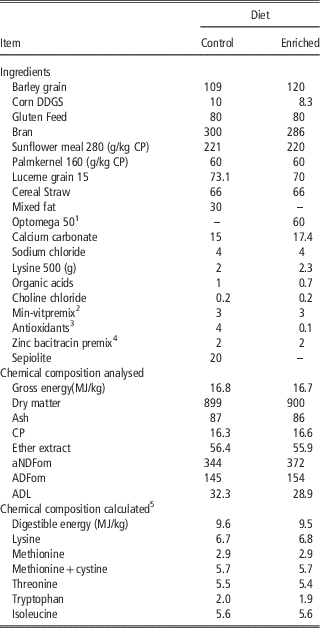
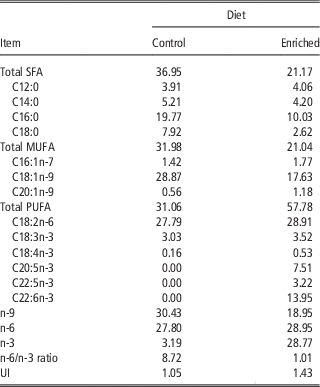
Two isofibrous, isoenergetic and isoproteic diets with the same basal mixture of ingredients, only differing in the type of added fat were used: either 30 g/kg mixed fat (Control group, n=63 does) or 60 g/kg of a commercial supplement (Optomega-50; Optivite International Ltd., Barcelona, Spain), derived from salmon oil, containing a 50% of ether extract and 35% of n-3 PUFA and 2 500 mg/kg of vitamin E (Enriched group, n=64 does). The ingredients and chemical composition of diets are given in Table 1 and their FA profiles in Table 2. One batch of each diet was used during all study. Diets were vacuum-packet and stored (5°C) protecting them of lipid oxidation. Samples of both diets were collected weekly and composited for further analysis. To assess the palatability of the diet, in the first cycle feed intake was determined in females during rearing, pregnancy, and lactation (considering both females and kits).
Ingredient and chemical composition of a control and an enriched diet with a supplement based on n-3 PUFA (g/kg, as-fed basis unless otherwise indicated)

aNDFom=alfa-amylase neutral detergent fibre corrected by organic matter; ADFom=acid detergent fibre corrected by organic matter.
1 Optivite International Ltd. (Barcelona, Spain). Contained salmon fish oil, 100%; ether extract, 50%; n-6, 8%; n-3, 35%; CP, 4%, ME, 5254 kcal/kg; and vitamin E, 2500 mg/kg.
2 Mineral and vitamin premix supplied per kg of complete diet: vitamin A 9999.9 IU; vitamin D 1080 IU; Vitamin E, 200 mg/kg; vitamin K3: 1.7 mg; Tiamine: 1.7 mg; Riboflavin: 4.3 mg; Pantithenic acid: 13.6 mg; Pyrodoxine: 1.7 mg; Mn: 22.7 mg; Co:595 µg; Se: 140 µg; I: 1.2 mg.
3 Suppliedperkg of diet: [E320 Butilhidroxianisol (BHA)+E324 Etoxiquina+E321 Butilhidroxitolueno (BHT) 30 000 mg; E562 sepiolite 910 000 mg] (Trow Nutrition Spain SA, Madrid, Spain); Luctanox 3000 mg (Lucta, Barcelona, Spain).
4 Contained 100 mg Zinc bacitracin/kg (Andrés Pintaluba, S.A., Reus, Spain).
5 According to Fundación Española Desarrollo Nutrición Animal (2010).
Fatty acid composition (g/100 kg total fatty acid methyl esters) of a control and an enriched diet with a supplement based on n-3 PUFA

SFA=saturated fatty acids; MUFA=monounsaturated fatty acids; PUFA=polyunsaturated fatty acids; UI=unsaturation index.
Chemical analysis of diets followed the AOAC official methods (AOAC, 2000) for DM (oven drying method: 934.01), ash (muffle furnace incineration: 923.03), ether extract (solvent extraction: 920.39) and CP (Dumas method: 968.06; FP-528 LECO, St. Joseph, MI, USA) determinations. Gross energy was determined by combustion in an adiabatic calorimetric pump (model 1356; Parr Instrument Company, Moline, IL, USA). Neutral detergent fibre, ADF and ADL were measured using a filter bag system (Ankom Technology, New York, NY, USA) and following the procedures of Mertens (Reference Mertens2002) for aNDFom and the AOAC official method 973.18 for ADFom and ADL (AOAC, 2000).
The FA profiles were analysed according to Sukhija and Palmquist (Reference Sukhija and Palmquist1988). A Hewlett Packard HP-5890 (Avondale, PA, USA) gas chromatograph equipped with a flame ionization detector was used (capillary column HP-Innowax, 30 m×0.32 mm id and 0.25 m film thickness) (Agilent Technologies GmbH, Ratingen, Germany). A split ratio of 50 : 1 was used and C15:0 was included as internal standard. The unsaturation index (UI) was calculated as the addition of the unsaturated FA, each one multiplied by the number of double bonds in their chain and divided by 100.
Productive trial
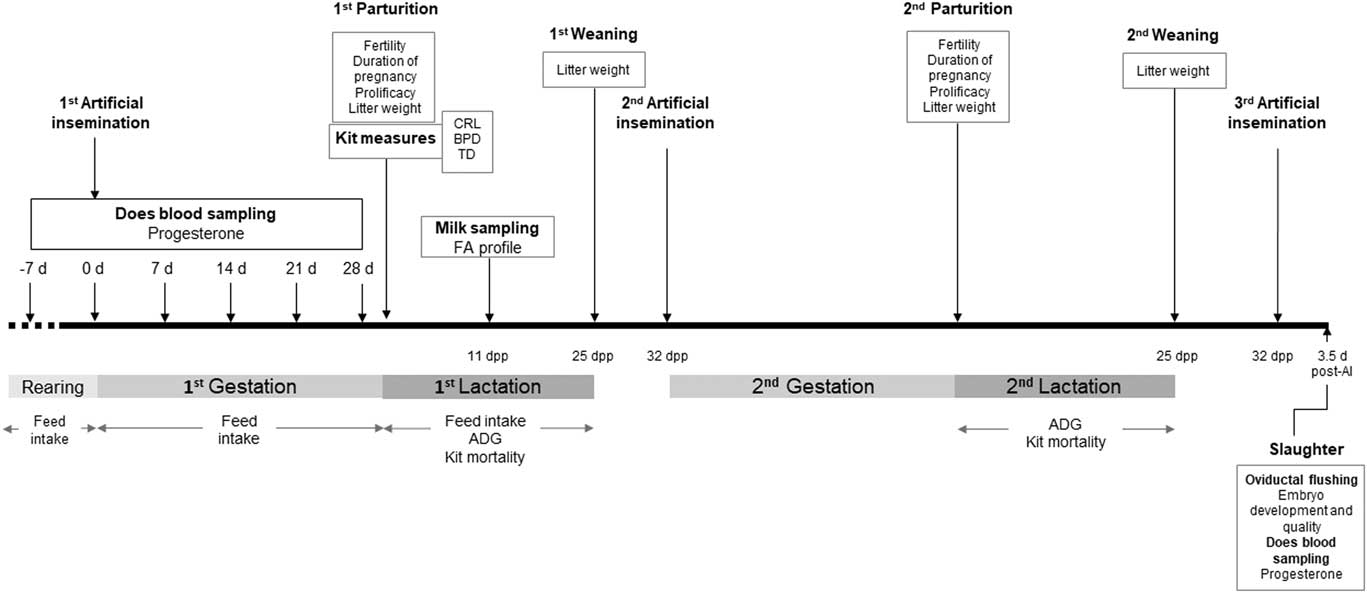
Experimental design is shown in Figure 1. Animals started to eat the experimental diets during rearing (70 days old). All females were artificial inseminated at 16 weeks of age and AI after first parturition was performed at 32 dpp according to the recommendations for primiparous does (Arias-Álvarez et al., Reference Arias-Álvarez, García-García, Rebollar, Nicodemus, Millán, Revuelta and Lorenzo2009). Females not pregnant after the first AI were excluded from the experiment. Seminal doses with at least 20 million spermatozoa in 0.5 ml of diluent (Magapor S.L., Zaragoza, Spain) were prepared using a pool of fresh heterospermic semen from selected bucks. To induce ovulation, does were given an intramuscular injection of 20 µg gonadorelin (Inducel-GnRH, Lab. Ovejero, León, Spain).
Sampling timeline. Fertility=[(number of does giving parturition/total number of does inseminated)×100]; Prolificacy=number of newborn, live born, and stillborn kits; CRL=crown-rump length; BPD=biparietal diameter; TD=thoracic diameter; dpp=days postpartum; AI=artificial insemination.

Fertility [(number of parturitions/number of AI)×100] and duration of pregnancy were determined. Total number of newborn, kits born alive and stillborn per litter was recorded, and litters (total born alive) were weighed.
To reaffirm previous works of Rebollar et al. (Reference Rebollar, Pérez-Cabal, Pereda, Lorenzo, Arias-Álvarez and García-Rebollar2014) with lower level of inclusion than in the current study, a subsample of 10 does per experimental group were used to determine the individual development of kits at first parturition. The litter size criterion to select mothers was 10-11 kits born alive. Using a slide calliper, crown-rump length (CRL; distance from crown to tail basis), biparietal (BPD; from one parietal eminence to the other) and transversal thoracic diameters (TD) were measured when they were 1 day old. Then, litter size of all does was standardized to 10–12 pups in average by removing or adding kits within each dietary treatment. At weaning (25 dpp), kits were counted, litters were weighed and average daily gain (ADG) was determined. Lactation mortality of kits was recorded and expressed as the percentage of rabbits dead at weaning with respect to the number of rabbits after standardizing litter size.
Plasma progesterone determination
A random subsample of 24 pregnant females (12 control and 12 enriched does) were taken to assess plasma progesterone levels during their first pregnancy. Considering that time 0 was the AI moment, blood samples were taken from the marginal ear vein (2.5 ml) at −7, 0, 7, 14 and 28 days of gestation between 0900 h and 1000 h by collecting samples in tubes containing ethylenediaminetetraacetic acid. Plasma was obtained after centrifugation at 1200×g for 10 min at 4°C and stored at −20°C until further analysed.
Plasma progesterone concentrations were analysed using a commercial kit (Progesterone ELISA; Demeditec Diagnostics GmbH, Kiel, Germany). Previously, plasma samples were extracted with petroleum ether at a 5 : 1 (vol/vol) ether : sample ratio (extraction efficiency: 85%). Sensitivity was 0.045 ng/ml. The intra- and inter-assay coefficients of variation were 5.5% and 6.9%, respectively. Absorbance was measured in a Bio-Tek automatic plate reader (EpochTM Microplate Spectrophotometer, Bio-Tek Instruments, Winooski, VT, USA) at 450 and 630 nm, and concentrations calculated by means of a software (Gen5TM ELISA; Bio-Tek Instruments, Winooski, VT, USA).
Milk sampling and fatty acid composition
During first lactation (at 11 dpp), a random subsample of 10 animals (five control and five enriched does), were used to collect milk. To stimulate the secretion of milk, does were injected intravenously 5 IU of oxytocin (IVEN Laboratories, Madrid, Spain) in the marginal ear vein. We shaved the chest and abdominal area leaving visible the nipples. Milk was collected in clean glass tubes and frozen until further analysed.
Milk lipids extraction was performed in triplicate as proposed by Segura and López-Bote (Reference Segura and López-Bote2014). The lipid content was determined gravimetrically. Lipids obtained were methylated following the procedure of Sandler and Karo (Reference Sandler and Karo1992) and FA were identified and quantified by gas chromatography according to conditions previously described. The UI was calculated with the above-mentioned formula.
Embryo development and quality
At the end of trial, a random subsample of 28 multiparous rabbit does with two previous cycles (14 control and 14 enriched does) were chosen and inseminated under the same conditions above mentioned. Three days and a half after AI, a punctual blood sample was obtained to determine progesterone concentration and was stored until analysis as previously mentioned. Immediately, animals were euthanized with an overdose of barbiturate (30 mg/kg of Pentothal; Dolethal, Lab, Vetoquinol, Madrid, Spain). The ovaries and reproductive tract were collected in PBS at 37°C. Ovulation rate was determined as the percentage of females with corpora lutea respect to the number of females inseminated, and the number of corpora lutea per female was counted. Subsequently, embryos were recovered by flushing the reproductive tract from the infundibulum to uterus with PBS+0.1% BSA at 37°C. The flushing fluid was deposited in a Petri dish on a heated plate (Minitub, Tiefenbach, Germany) at 37°C to proceed with the evaluation of the embryos with a stereoscopic microscope (Nikon SMZ-800; Nikon, Tokyo, Japan). To determine fertility, does without embryos in their tract were considered non-pregnant.
Embryo recovery rate was calculated as the percentage of embryos recovered respect to the number of corpora lutea counted on ovarian surface. The different embryonic stages observed were defined according to the guidelines of the International Embryo Technology Society and were classified into the following categories: morula, blastocyst and retarded embryos (embryos with delayed development, e.g.: oocyte, 2-cell, 4-cell…). The percentage of these categories was given over total of recovered structures.
Embryo quality was determined analysing the apoptosis rate. A total of 37 embryos (19 for control and 18 for enriched group) were washed in PBS supplemented with 1 mg/ml PVP, fixed in 4% paraformaldehyde solution for 30 min at room temperature, washed and stored in PBS at 4°C until their use. Protocol was adapted from that previously described by Arias-Álvarez et al. (Reference Arias-Álvarez, García-García, Rebollar, Nicodemus, Millán, Revuelta and Lorenzo2009). First, embryos were permeabilized by incubation in 0.5% Triton X-100 in PBS containing 1 mg/ml BSA during 80 min in humidified chamber, in darker conditions at room temperature. Strand breaks of DNA were detected using terminal deoxynucleotidyltransferase-mediated dUTP nick-end labelling kit (TUNEL; In Situ Cell Death Detection Kit, POD; Roche Diagnostics S.L., Applied Science, Barcelona, Spain). The positive control sections were treated with DNAse I (Roche Diagnostics S.L.) for 1 h at 37°C, before incubation with the TUNEL reagent. For negative controls, samples were incubated with the label solution of the TUNEL reaction mixture without the enzymatic solution. Embryos were treated with RNAses before staining. Finally, embryos were counterstained with 10 μg/ml Bisbenzamide (Hoechst 33342; Sigma, Madrid, Spain) and fixed on glass slides in mounting solution (ProLong Gold antifade reagent; Invitrogen, OR, USA). Slides were examined under confocal microscope (Leica TCS SP2; Leica Microsystems, Wetzlar, Germany) using a 488 nm excitation laser to visualize TUNEL-positive cells and 460 nm excitation laser to assess the blue fluorescence. The format, laser, gain and offset were kept constant for all samples. The images were analysed using Image J software (from NIH website: http://rsbweb.nih.gov/ij/). Apoptosis rate [(number of green cells/total cells)×100] was calculated.
Statistical analysis
Statistical analysis was performed with SAS software (SAS Institute Inc., Cary, NC, USA). The experimental unit was the rabbit doe. The feed intake, body size of kits, milk FA profile, and the determinations of punctual progesterone, embryo morphology, ovulation and apoptosis rates were analysed as a completely randomized design with feeding regime as the main source of variation (proc GLM). Progesterone concentrations during first pregnancy were analysed by repeated measure analysis (proc MIXED) considering the diet as the main effect. The effect of diet and cycle (1st and 2nd) on fertility rate was analysed by means a χ 2 test (proc CATMOD). Prolificacy, litter weight, ADG and mortality data were also analysed by repeated measures (proc MIXED) to study the effect of diet, cycle and their interaction. All means were compared using a protected t-test. Differences were considered significant at P<0.05 and a trend when P<0.07. Results are presented as least squared mean (lsmeans).
Results
Reproductive and productive outcome during the trial
Feed intake of rabbit does was similar between experimental groups in all periods (240±3.9 g/day) increasing during lactation respect to rearing and pregnancy (351±8.99 v. 185±7.69 and 183±4.78 g/day respectively; P<0.05).
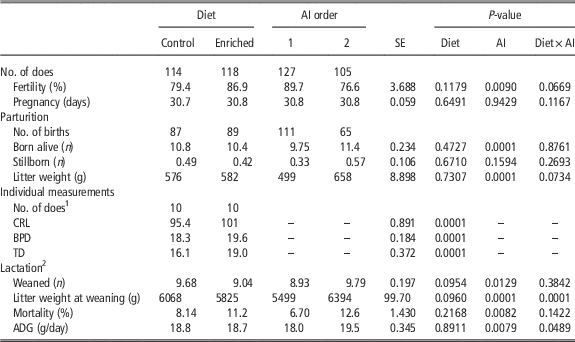
Reproductive performance traits of does and viability of their litters during the first two production cycles were unaffected by diet (Table 3), except for the individuals measurements of kits born alive, where the CRL, BPD and TD were higher in kits from mothers fed enriched diet than in control ones (P<0.05).
Productive variables of rabbit does fed a control and an enriched diet with a supplement based on n-3 PUFA and artificially inseminated (AI) either at 16 weeks of age (AI 1) or at 32 days postpartum (AI 2)

CRL=crown-rump length; BPD=biparietal diameter; TD=thoracic diameter; ADG=average daily gain.
All values are least squares means.
1 Does with litters of 10-11 kits.
2 Lactation at 25 day post partum.
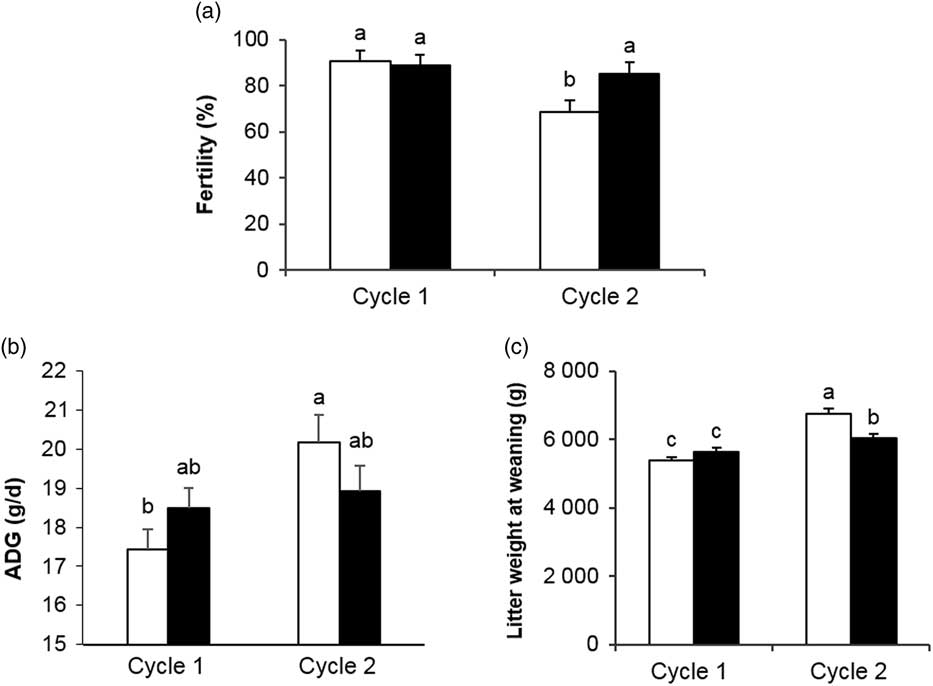
In the second cycle, fertility rate was lower (P<0.05) compared with the first one in both experimental groups. Nonetheless, the number of born alive kits, weaned kits, litter weight at parturition and at weaning, as well as kits mortality and ADG during the second lactation were greater (P<0.05) compared with the first cycle. However, pregnancy duration and the number of stillborn were similar in both cycles (P>0.05). Dietary treatment affected differently to fertility rate in function of the cycle (P=0.067; Figure 2a). Control does had a lower fertility rate at second AI comparing to the first one (P<0.05), but this reduction was lower and not significant for n-3 PUFA supplemented does. There was a significant interaction on the ADG during lactation period (Figure 2b; P<0.05), and on litter weight at weaning time (Figure 2c; P<0.0001). The ADG significantly increased for the control group in the second lactation, whilst this increase was lower and not significant for the enriched group. The litter weight increased in the two groups in the second cycle at weaning, although the enriched group did not augment so much as control group, keeping in intermediate values.
(a) Fertility of rabbit does, (b) average daily gain (ADG) during lactation and (c) litter weight at weaning of kits from rabbit does fed a control and an enriched diet with a supplement based on n-3 PUFA, at first (cycle 1) and second (cycle 2) cycle. (a, b, c) Significant differences of interaction between diet and cycle (P<0.05); (white bars=control, darkened bars=enriched). Each bar represents from left to right the least squares means of: (a) 63, 51, 64 and 54 rabbit does, (b) and (c) 53, 54, 30 and 35 litters.

Plasma progesterone concentration
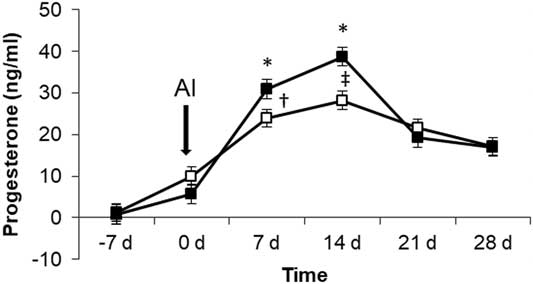
During the first pregnancy, plasma progesterone concentrations (Figure 3) increased at 7 (P<0.05) and 14 days (P<0.05) after AI and decreased without reaching baseline levels at 21 and 28 days of gestation in both experimental groups. Enriched does had greater progesterone concentrations than control does at 7 and 14 (P<0.05) days after AI.
Plasma progesterone concentrations in pregnant rabbit does fed a control (; n=12) and an enriched diet with a supplement based on n-3 PUFA (; n=12) at −7, 0, 7, 14, 21 and 28 days of gestation, respectively, being day 0 when artificial insemination (AI) was performed. All values are least squares means; *time effect at 7 and 14 days (P<0.05); diet effect at 7 days († P=0.029) and at 14 days (‡ P=0.001).

Fatty acid composition of milk
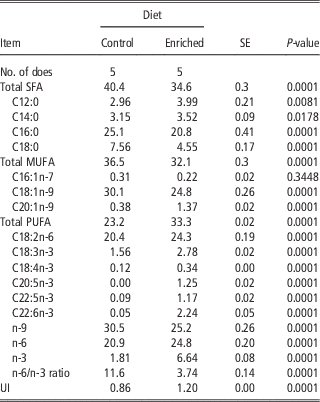
Milk FA profile is shown in Table 4. The diet consumed had a significant effect on the FA analysed (P<0.05), except for the palmitoleic acid (C16:1n-7) concentration. Milk analysis showed 5.8 and 4.4 points of percentage more of total saturated FA (SFA) and monounsaturated FA (MUFA) in the control group than in the enriched group (P<0.05), respectively. Moreover, milk of enriched does had 10.1 points of percentage more total PUFA than milk of control ones (P<0.05). This resulted in greater milk UI in that group compared to the control one (P<0.05).
Fatty acids profile (g/100 g total fatty acid methyl esters) of rabbit milk does of females fed control or an enriched diet with a supplement based on n-3 PUFA

SFA=saturated fatty acids; MUFA=monounsaturated fatty acids; PUFA=polyunsaturated fatty acids; UI=unsaturation index.
Embryo development and quality
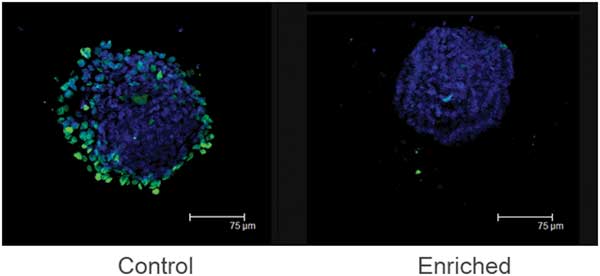
No differences in plasma progesterone concentration (mean 3.4±0.31 ng/ml; P>0.05) between experimental groups were observed at 3.5 days after third AI. The ovulation rate (100%; P>0.05) with a mean of 12.5±1.24 corpora lutea/doe, the fertility rate (mean 71.5%; P>0.05) and embryo recovery rate (mean 69.9±9.04%; P>0.05) have non-significant differences between groups. Similar percentage of morula (mean 75.8±10.69%), blastocyst (mean 10.65±6.32%) and retarded embryos (mean 13.6±10.28%) were observed (P>0.05) among the experimental groups. Apoptosis rate was higher in control group than in enriched one, being 31.1±4.56 and 17.1±3.87%, respectively (P<0.05) (Figure 4).
Embryo quality assessed by apoptosis rate in early embryos (3.5 days post artificial insemination) from rabbit does fed a control and an enriched diet with a supplement based on n-3 PUFA. Green immunofluorescence shows apoptotic cells and blue denotes nucleus cell.

Discussion
According to the present data, the long-term use of an enriched diet with 60 g/kg of level of inclusion of a supplement based on n-3 PUFA from rearing and during two reproductive cycles maintains high reproductive and productive outcomes, also confirming the endocrine features enhancement that we showed in previous works (Rebollar et al., Reference Rebollar, Pérez-Cabal, Pereda, Lorenzo, Arias-Álvarez and García-Rebollar2014; Rodríguez et al., Reference Rodríguez, García-García, Arias-Álvarez, Formoso-Rafferty, Millán, López-Tello, Lorenzo, González-Bulnes and Rebollar2017a).
A supplement derived from salmon oil rich in n-3 PUFA was used in previous research (Rebollar et al., Reference Rebollar, Pérez-Cabal, Pereda, Lorenzo, Arias-Álvarez and García-Rebollar2014), in which there were no differences on feed intake due to the possible fish flavour of the diet. In the current study, the chosen amount of the same supplement was fourfold higher and could generate lipid oxidation problems and lesser palatability. Nonetheless, no differences on feed intake were found. This result could be attributed to the long-term administration of the supplement and the adaptation of animals in their different physiological status.
At first AI high fertility was observed in both groups, difficult to improve with the enriched diet probably due to an adequate corporal condition and a proper live BW of does at this time (Rebollar et al., Reference Rebollar, García-García, Arias-Álvarez, Millán, Rey, Rodríguez, Formoso-Rafferty, De la Riva, Masdeu and Lorenzo2009). By contrast, at the second AI, fertility of control females significantly decreased. However, n-3 PUFA enriched diet maintained the high fertility of the first cycle. It could be related to a possible positive effect of a high plasma estradiol concentrations observed at the end of lactation period and before the second AI in n-3 PUFA supplemented does described in previous studies of our group (Rodríguez et al., Reference Rodríguez, García-García, Arias-Álvarez, Formoso-Rafferty, Millán, López-Tello, Lorenzo, González-Bulnes and Rebollar2017a).
For the productive parameters, in accordance to the similar basal chemical composition and digestible energy content of the two diets, there was not significant effect on litter size and weight at birth. The similar litter size at birth obtained in both experimental groups determined a similar duration of pregnancy because the available space of foetuses in uterus which conditions the pregnancy length (Manchisi et al., Reference Manchisi, Gambacorta and D’Alessandro1991). Nonetheless, although there were no differences in the weight of neonates, PUFA supplementation had a favourable effect on the individual kits body size. That was evident the day of parturition, probably due to the higher plasma progesterone concentration when placenta formation occurs (Khan et al., Reference Khan, Kusakabe, Wakitani, Hiyama, Takeshita and Kiso2012). In this connection, several evidences from animals and humans suggest that the dietary n-3 PUFA during pregnancy promotes early neural and retinal tissues development and regulates behavioural and neurochemical aspects related to stress responses, growth and cognitive functions, being very important in order to vitality of newborns (Bernardi et al., Reference Bernardi, Escobar, Ferreira and Silveira2012). Hence, the significant increment of their size observed in the current study is important from a practical point of view because it has been described that the size of the newborn is directly related to their vitality around the first days of life (Bautista et al., Reference Bautista, García-Torres, Martínez-Gómez and Hudson2008), when the location of nipples to survival is very important.
The lower weight of kits from enriched mothers at 32 dpp could be due to diets rich in PUFA use to generate smaller abdominal fat deposits than diets rich in MUFA and SFA as it was described in chicken (Crespo and Esteve-García, Reference Crespo and Esteve-García2002). In humans, Rosqvist et al. (Reference Rosqvist, Iggman, Kullberg, Cedernaes, Johansson, Arner, Dahlman and Risérus2014) also observed that fat deposits in the liver and visceral fat were lower with rich PUFA diets. Furthermore, some rabbit researchers concluded that with PUFA diets less carcass fat (Kowalska and Bielánski, Reference Kowalska and Bielánski2009) or abdominal and perirenal fat (Rodríguez et al., Reference Rodríguez, López-Tello, Arias-Álvarez, García-García, Formoso-Rafferty, Lorenzo and Rebollar2017b) is obtained. All these findings would support the low weaning weight of kits of enriched does.
Other positive result obtained in the current study was that pregnant animals fed enriched diet showed increased plasma progesterone concentrations at 7 and 14 days of pregnancy. In this period, embryo implantation and immediately placenta formation occur (Khan et al., Reference Khan, Kusakabe, Wakitani, Hiyama, Takeshita and Kiso2012), therefore, the higher the progesterone concentrations, the better implantation and placentation process would take place, with an improved survival post-implantation of foetuses (Froment et al., Reference Froment, Gizard, Defever, Staels, Dupont and Monget2006). In this regard, similar progesterone results have been obtained in previous work (Rebollar et al., Reference Rebollar, Pérez-Cabal, Pereda, Lorenzo, Arias-Álvarez and García-Rebollar2014) at 7 days of pregnancy and in additional trials with the same supplement (Rodríguez et al., Reference Rodríguez, Carro, Valiente, Formoso-Rafferty and Rebollar2016) we have observed more born alive in enriched does. Regarding hormonal response, MacLaren et al. (Reference MacLaren, Guzeloglu, Michel and Thatcher2006) suggested that the possible beneficial effects of n-3 PUFA on progesterone production could be due to the activation of the nuclear family of peroxisome proliferator activated receptors (PPAR) in luteinized cells. According to Zerani et al. (Reference Zerani, Maranesi, Brecchia, Gobbetti, Boiti and Parillo2013), PPAR have the function of preserving the rabbit corpora lutea benefiting the fertility found at second AI in enriched group in present work.
Focusing on the milk composition, Lin et al. (Reference Lin, Anderson and Connor1991) observed that in rabbits, PUFA represented 34% of total FA, almost all of which were linoleic acid and α-linolenic acid (ALA; C18:3n-3), with only some traces of DHA, likewise to the current study. Moreover, using fish oil to enrich the diet, these authors observed a higher total level of PUFA in the milk, principally by increasing the proportion of long-chain n-3, where DHA represented 3.8% of total FA. We observed that milk of the enriched group had a higher total PUFA concentration, UI and DHA concentrations than the control one. A mechanism through which n-3 PUFA could influence kits survival is by improving their immune system. Immunoglobulin G (IgG) in colostrum is the main source of antibodies that boosts the passive immune system of neonatal pigs, and colostral IgG concentrations were greater in sows fed a n-3 PUFA rich diet (Mateo et al., Reference Mateo, Carroll, Hyun, Smith and Kim2009) and FA influenced the expression of immune related genes (Kitajka et al., Reference Kitajka, Sinclair, Weisinger, Weisinger, Mathai, Jayasooriya, Halver and Puskas2004). In this regard, Maertens et al. (Reference Maertens, Aerts and De Brabander2005) observed that in a farm affected by epizootic rabbit enteropathy, animals weaned from does fed with a n-3 PUFA diet and that continued consuming the same diet after weaning, reduced their mortality with respect to a control diet. The lack of differences in terms of mortality between groups that could evidence the beneficial effect of n-3 PUFA in the current work could be due to the trials were carried out in an experimental farm under optimal controlled ambient and sanitary conditions, and consequently, very low mortality values throughout the entire experience were found.
Aligned with Rebollar et al. (Reference Rebollar, Pérez-Cabal, Pereda, Lorenzo, Arias-Álvarez and García-Rebollar2014), there were no differences between diets in plasma progesterone concentration at 3.5 days after AI. This is probably because in early stages of gestation corpora lutea produce scant but still enough amount of progesterone to sustain early embryo events which also could explain the similar embryo development observed in the current study. On the other hand, embryo rate was similar to that usually obtained on 3.5 days after AI as previously described (Arias-Álvarez et al., Reference Arias-Álvarez, García-García, Rebollar, Revuelta, Millán and Lorenzo2010). In this regard, in cows, Fouladi-Nashta et al. (Reference Fouladi-Nashta, Wonnacott, Gutierrez, Gong, Sinclair, Garnsworthy and Webb2009) confirmed that despite altering proportions of major FA in plasma and milk, dietary PUFA supplementation had little effect on FA composition of granulosa cells, and consequently, there was no effect of diet on follicle numbers and post-fertilization development of oocytes in vitro.
The current study reports that embryo quality in terms of apoptosis rate was better for enriched group. Previous research showed that adding ALA to bovine and goat oocytes maturation media resulted in better-quality blastocysts in terms of apoptosis rate (Marei et al., Reference Marei, Wathes and Fouladi-Nashta2009; Veshkini et al., Reference Veshkini, Khadem, Mohammadi-Sangcheshmeh, Alamouti, Soleimani and Gastal2016, respectively).
In conclusion, our data suggest that the use of a supplement based on n-3 PUFA in a higher level of inclusion than previously employed in rabbit does: (1) did not influence feed intake, (2) maintained fertility rate on critical second insemination and improved size of kits at parturition even though the lower ADG observed during lactation period was translated in lower litter weight at weaning time, (3) increased plasma progesterone concentrations at 7 and 14 days of gestation, (4) modified the milk FA profile and (5) did not improve development of early embryos but their quality, in terms of apoptosis rate, was enhanced.
Acknowledgements
This research was supported by AGL2011-23822 and S2013/ABI-2913.
Declaration of interest
The authors declared no competing interest.
Ethics Statement
None.
Software and data repository resources
None.