


Introduction
Domestic abuse is a broad term encompassing physical, sexual, financial, emotional, or psychological abuse perpetrated by one person against another who is a family member or a current or former intimate partner, regardless of gender or sexuality (An Garda Síochána 2022). While Ireland’s Domestic, Sexual & Gender-Based Violence Strategy (Department of Justice 2022) uses the term “domestic violence,” it is intended to capture a full spectrum of abusive behaviours beyond physical violence alone. Accordingly, terms such as “domestic abuse” are also used to “ensure that all damaging behaviour is captured by the definition” (An Garda Síochána 2022). In this paper, the inclusive and comprehensive term “Domestic Violence and Abuse” (DVA) is used to reflect these variations and to encompass broader patterns of harmful or coercive behaviours occurring in a domestic context, except when citing specific studies.
DVA is pervasive. National survey data on the prevalence of DVA are not currently collected in Ireland; however, estimates from other sources highlight its scale and severity. For example, data from the EU Gender-Based Violence Survey across 37 Member States indicate that 35% of women in Ireland have experienced psychological or physical violence, threats, and/or sexual violence from an intimate partner in their lifetime (FRA 2024). This figure is higher than the EU-27 state average (31.8%), with the highest prevalence in Hungary (54.6%) and Finland (52.6%) and the lowest in Poland (19.6%) and Bulgaria (20.5%) (FRA 2024). Gender disparities are also evident. An earlier national survey of over 3,000 adults showed that women are more than twice as likely as men to have experienced severe physical abuse from a partner, seven times more likely to have experienced sexual abuse, and nearly three times more likely to have experienced emotional abuse (Watson and Parsons Reference Watson and Parsons2005). A similar pattern can be found in administrative data from police and specialist services. For example, Women’s Aid recorded over 46,000 disclosures of domestic abuse in 2024 alone (Women’s Aid 2025), while An Garda Síochána received in excess of 65,000 domestic abuse-related contacts, equivalent to approximately 1,250 reports every week (An Garda Síochána 2025; Women’s Aid 2025). However, a prior inquiry into Garda handling of domestic violence 999 emergency calls found that 3,120 calls were “cancelled” between the start of 2019 and October 2020 without an appropriate police response or investigation (Irish Times 2021). As in other countries, DVA in Ireland is persistent and widespread.
DVA has wide-ranging impacts on physical and mental health outcomes (Oram et al. Reference Oram, Fisher, Minnis, Seedat, Walby, Hegarty, Rouf, Angénieux, Callard, Chandra, Fazel, Garcia-Moreno, Henderson, Howarth, MacMillan, Murray, Othman, Robotham, Rondon, Sweeney, Taggart and Howard2022), resulting in profound and long-lasting consequences for individuals and communities. Studies have consistently shown that exposure to violence from current or former intimate partners is associated with elevated rates of suicide attempts and suicidal ideation (McManus et al. Reference McManus, Walby, Barbosa, Appleby, Brugha, Bebbington, Cook and Knipe2022; Munro and Aitken Reference Munro and Aitken2020).This association is also observed among perpetrators, with research demonstrating links between DVA perpetration and suicidal behaviours among adolescents, psychiatric inpatients, and men with alcohol dependency (Conner et al. Reference Conner, Duberstein and Conwell2000; Heru et al. Reference Heru, Stuart, Rainey, Eyre and Ryan Recupero2006; Renner and Whitney Reference Renner and Whitney2012). Furthermore, a recent UK cohort study of high-harm DVA perpetrators identified an elevated suicide rate (461 deaths per 100,000), far exceeding rates observed in many other high-risk groups (Knipe et al. Reference Knipe, Vallis, Kendall, Snow, Kirkpatrick, Jarvis, Metcalfe, Eisenstadt and Bickham2024).
In Ireland, a population-based study by Joksimovic and others demonstrated a strong association between intimate partner violence (IPV) and suicidality (Joksimovic et al. Reference Joksimovic, Vallières and Hyland2023). The study found that more women than men were exposed to IPV, with approximately one in three women and one in four men in Ireland reporting lifetime exposure. Critically, both women and men who had experienced IPV were significantly more likely to report suicidal ideation, and a history of suicide attempts. These findings echo previous studies indicating that exposure to DVA, including IPV, is associated with an increased risk of suicidality (McManus et al. Reference McManus, Walby, Barbosa, Appleby, Brugha, Bebbington, Cook and Knipe2022; Turnbull et al. Reference Turnbull, Hunt, Woodhouse, Monk, Kapur and Appleby2025).
DVA not only increases the risk of suicidal behaviour, but it is also associated with increased mortality. Extensive research has established a strong relationship between DVA and homicide, showing that when women are killed, they are most often killed by someone they know, such as an intimate partner or family member (McGoldrick et al. Reference McGoldrick, Collis and Mulligan2024). However, comparatively little research exists regarding the relationship between DVA and suicide and the characteristics of those who die in these circumstances. The limited research that has emerged on DVA-related suicides in the UK comes from a range of data sources. This includes suicide prevention data from Real Time Suicide Surveillance (RTSS) in Kent and Medway in England, as well as police records from forces in England and Wales identifying suspected victim suicides following domestic abuse. The analysis situates risk factors and characteristics of these deaths relative to domestic homicides (Hoeger et al. Reference Hoeger, Gutierrez-Munoz, Sadullah and Whitaker2025; Woodhouse et al. Reference Woodhouse, Abbott and Kemsley2023).
Most recently, Turnbull et al., presented the first national analysis to date, examining women who had died by suicide and had been in contact with mental health services within the last 12 months, using data from the National Confidential Inquiry into Suicide and Safety in Mental Health. They found that more than one-in-four (26%) had experienced domestic violence (Turnbull et al. Reference Turnbull, Hunt, Woodhouse, Monk, Kapur and Appleby2025). Click or tap here to enter text.Although the evidence base is growing, DVA-related suicides remain underexamined and are commonly obscured within broader suicide statistics and under-represented in national prevention strategies.
To date, no study has explored DVA-related suicides in Ireland, nor the characteristics of those who die in these circumstances. This may reflect, in part, the fact that suicide is a statistically rare outcome, even within high-risk populations (Large et al. Reference Large, Ryan, Carter and Kapur2017), and that robust analysis requires comprehensive, multiyear national data. This study seeks to begin addressing this gap by examining DVA-related suicide deaths using six years of coronial data from the Irish Probable Suicide Deaths Study (IPSDS). By analysing the sociodemographic and clinical characteristics, along with adverse events experienced by individuals with histories of DVA who have died by suicide, this work aims to identify themes that may inform more targeted, coordinated prevention efforts.
Methods
Data for this study were obtained from the Irish Probable Suicide Deaths Study (IPSDS 2015–2020, a six-year collaboration between the Health Service Executive National Office for Suicide Prevention (HSE NOSP), the Health Research Board (HRB), and coroners across Ireland (Cox et al. Reference Cox, Munnelly, Rochford and Kavalidou2022). As part of the collaboration, HRB nurse researchers conducted an annual census of all closed coroner files, for each corresponding calendar year. Full access was provided to each file. Files consist of both clinical and non-clinical data, including (where available) depositions from family and friends, autopsy and toxicology reports, police reports, verdict records, and the coroner’s certificate, thereby enabling the systematic extraction of detailed demographic, contextual, and circumstantial information for all selected cases (Cox et al. Reference Cox, Munnelly, Rochford and Kavalidou2022).
Ascertainment of suicide
The IPSDS employed a comprehensive case-identification approach that incorporated both coroner-determined and research-determined suicides. Research-determined cases were classified using the civil standard of proof “on the balance of probabilities,” which aligns with the revised standards of proof for suicide verdicts at inquests adopted in England from 2018 (Appleby et al. Reference Appleby, Turnbull, Kapur, Gunnell and Hawton2019). Inclusion criteria were based on international consensus guidelines, incorporating both direct and indirect indicators of suicidal intent (Cox et al. Reference Cox, Munnelly, Rochford and Kavalidou2022; Rosenberg et al. Reference Rosenberg, Davidson, Smith, Berman, Buzbee, Gantner, Gay, Moore-Lewis, Mills, Murray, O’Carroll and Jobes1988).
Identification of DVA-related suicides
For this study, all 3,622 coroner- and research-determined suicides in the IPSDS database were screened for eligibility. Cases were included if “victim of domestic violence/abuse” was recorded as a risk factor, as per the information in the coroner’s file. Following completion of eligibility screening, one study author manually extracted all relevant data for each case from the IPSDS database into a new database Extracted variables included demographic information (age, sex, employment and relationship status, living arrangements, parental status), clinical factors (including history of mental health conditions, substance use, and prior suicide attempts), suicide method, and verdictalong with any documented adverse events or stressors and any contact with medical services. A second study author then converted the quantitative data into qualitative narratives for analysis.
Data analysis
A qualitative approach was applied to the data analysis, with thematic analysis used as the primary analytic method. This approach provides a systematic and flexible means of identifying patterned meanings within qualitative data, facilitating the development of themes that address the research aims (Roberts et al. Reference Roberts, Dowell and Nie2019). This method has been widely applied in studies analysing coroners’ records (Milner et al. Reference Milner, Maheen, Currier and LaMontagne2017; Reynolds et al. Reference Reynolds, Cox, Lyons, McAvoy, O’Connor and Kavalidou2025; Shiner et al. Reference Shiner, Scourfield, Fincham and Langer2009; Wallace et al. Reference Wallace, Revie, Schneider, Mais and Sharland2024; Wang et al. Reference Wang, Ho, Au and Cheung2018). In this context, thematic qualitative analysis of coroners’ records offers crucial contextual depth, illuminating the circumstances and contributing factors underlying deaths in ways that complement the broader patterns revealed by quantitative data (Pilkington et al. Reference Pilkington, Bird, Gray, Towner, Weld and McKibben2014). Although informed by the wider literature, data were coded inductively in a systematic but flexible manner, with codes refined iteratively as the analysis progressed. Following coding, related codes were grouped into preliminary themes, which were reviewed, refined, and organised to address the research aims. Due to the sensitive nature of the data, the small number of cases, and in accordance with the IPSDS guidelines, findings are presented using descriptive terms: raw counts are not reported. Instead, these values are presented using descriptive terms.
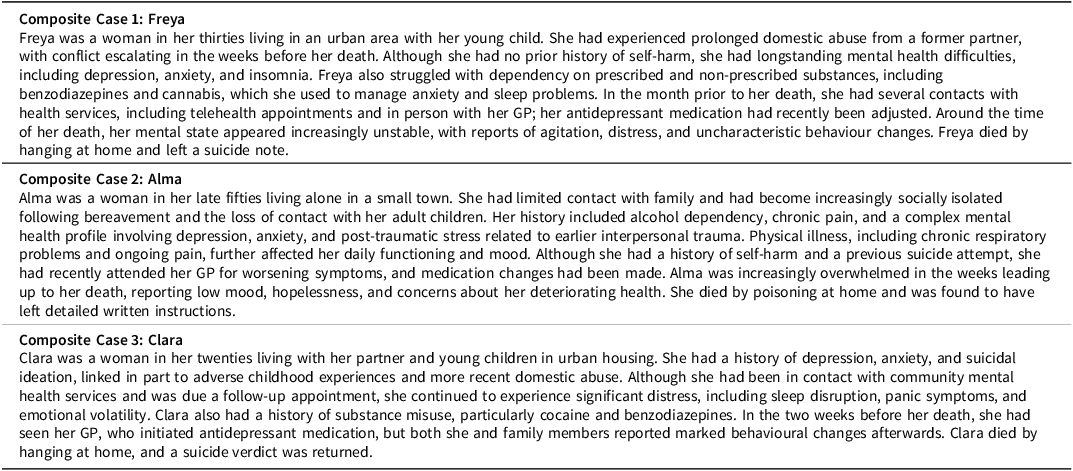
To illustrate the key themes identified in the analysis, a set of composite cases based on recurrent features across the dataset were developed. Composite narratives synthesise elements drawn from multiple individuals and present them as an integrated, “storied” account that reflects their combined experiences across cases (Bleakley Reference Bleakley2005). While a HSE AI-approved tool was used to support the drafting and organisation of these narratives, all analytical decisions and final narrative texts were produced and verified by the authors. Composite narratives are widely used in qualitative research to convey complex, context-rich experiences while preserving anonymity (McElhinney and Kennedy Reference McElhinney and Kennedy2022). This approach maintained the analytic and communicative strengths of narrative methods while avoiding the risk of identifying individuals, an essential consideration in suicide research involving detailed personal histories (Willis Reference Willis2019).
Ethical approval
The present study is a secondary, retrospective cohort analysis of IPSDS data. Ethical approval for the original IPSDS, including the extension of coronial data collection using an established data source methodology (blind for review), was granted in 2016 (blind for review).
Results
Table 1 presents three composite cases, each synthesising real patterns from the dataset while protecting anonymity. Across the three cases, several converging patterns highlight the complexity and multidimensional nature of suicide among women exposed to DVA. Each case reflects a distinct set of circumstances and life stage; a woman experiencing post relationship abuse and substance dependency (Composite Case 1), a young mother with dependent children (Composite Case 3), and a woman experiencing later life isolation with chronic illness (Composite Case 2). Viewed together they show the intersection of chronic psychological distress, cumulative trauma, substance dependency, and interpersonal instability.
DVA-related suicides: composite case examples

Table 1. Long description
A table presenting three composite cases of women exposed to domestic violence and abuse, highlighting patterns in suicide. The table has three rows and four columns. The columns are labeled Composite Case 1: Freya, Composite Case 2: Alma, and Composite Case 3: Clara. Each row describes the circumstances and life stages of the women. Row 1: Freya was a woman in her thirties living in an urban area with her young child. She had experienced prolonged domestic abuse from a former partner, with conflict escalating in the weeks before her death. Although she had no prior history of self-harm, she had longstanding mental health difficulties, including depression, anxiety, and insomnia. Freya also struggled with dependency on prescribed and non-prescribed substances, including benzodiazepines and cannabis, which she used to manage anxiety and sleep problems. In the month prior to her death, she had several contacts with health services, including telehealth appointments and in person with her GP; her antidepressant medication had recently been adjusted. Around the time of her death, her mental state appeared increasingly unstable, with reports of agitation, distress, and uncharacteristic behaviour changes. Freya died by hanging at home and left a suicide note. Row 2: Alma was a woman in her late fifties living alone in a small town. She had limited contact with family and had become increasingly socially isolated following bereavement and the loss of contact with her adult children. Her history included alcohol dependency, chronic pain, and a complex mental health profile involving depression, anxiety, and post-traumatic stress related to earlier interpersonal trauma. Physical illness, including chronic respiratory problems and ongoing pain, further affected her daily functioning and mood. Although she had a history of self-harm and a previous suicide attempt, she had recently attended her GP for worsening symptoms, and medication changes had been made. Alma was increasingly overwhelmed in the weeks leading up to her death, reporting low mood, hopelessness, and concerns about her deteriorating health. She died by poisoning at home and was found to have left detailed written instructions. Row 3: Clara was a woman in her twenties living with her partner and young children in urban housing. She had a history of depression, anxiety, and suicidal ideation, linked in part to adverse childhood experiences and more recent domestic abuse. Although she had been in contact with community mental health services and was due a follow-up appointment, she continued to experience significant distress, including sleep disruption, panic symptoms, and emotional volatility. Clara also had a history of substance misuse, particularly cocaine and benzodiazepines. In the two weeks before her death, she had seen her GP, who initiated antidepressant medication, but both she and family members reported marked behavioural changes afterwards. Clara died by hanging at home, and a suicide verdict was returned.
Demographic characteristics
A total of 15 female cases were identified as DVA-related suicide deaths. This is equivalent to 1.7% of suicides among adult women (<18 years, n = 873) over the six-year period. The women ranged in age from 23 to 69 years, with an average age of 45.5 years. Most lived in urban or town settings, and family circumstances varied: some were married or cohabiting, one-third were single and living alone, many of the women had children and several were single mothers. Employment status was mixed, some were in paid work, while others were unemployed or outside the labour market. The composite cases reflect this heterogeneity, spanning early adulthood to later life, and including women parenting young children as well as those living alone following relationship breakdown or bereavement. Of note, the number of recorded DVA-related suicide deaths increased in 2020. In the previous years, they accounted for 0.3% of deaths per year, increasing to 0.9% in 2020.
Mental health, substance use and compounded risk
Mental health issues were pervasive across cases. Depression and anxiety were the most common conditions noted, with some women experiencing bipolar disorder, post-natal depression, post-traumatic stress disorder (“as a result of physical, violence and psychological trauma”) or personality disorders. Most of the women were in receipt of prescribed psychotropic medication, including antidepressants, hypnotics, and/or benzodiazepines.
All three composite cases show significant deterioration in mental health in the weeks preceding suicide, aligning with the broader pattern identified in the dataset. This deterioration included agitation, emotional volatility, panic symptoms, insomnia, and expressions of hopelessness. In Composite Cases 1 and 3, families and professionals observed uncharacteristic behavioural changes shortly after medication initiation or adjustment. Just under half of the women had a documented history of prior suicide attempts, further indicating chronic vulnerability.
Substance misuse/dependency was another prominent theme; the majority had a history of drug dependency. Drugs involved included benzodiazepines, opiates, cocaine, and cannabis; alcohol dependency was noted in a smaller number of cases. Substance misuse commonly co-occurred with mental health difficulties and, in some instances, polypharmacy. In Composite Cases 1 and 3, non-prescribed substance use co-existed with prescribed mental health medication, while in Composite Case 2 long-term alcohol dependency co-occurred with chronic illness and trauma.
Physical health and chronic pain
Chronic pain and serious physical health conditions were present in nearly half of the cases. Conditions such as Chronic Obstructive Pulmonary Disease, persistent pain, and other chronic illnesses likely exacerbated psychological distress. For some women, physical and psychological symptoms appeared to coalesce, with pain, insomnia, and deteriorating health, interacting with existing mental ill health. Composite Case 2 illustrates how chronic physical illness and pain can intensify suicide risk when combined with a trauma history, addiction, and social isolation. Recent hospital discharges were also noted in some cases, suggesting transitional care gaps.
Interpersonal and social factors
Domestic violence and interpersonal conflict were central to these cases. All of the women had documented evidence of DVA in their coroner files, with some cases also including explicit references to physical and/ or sexual abuse. Conflict with current or former partners was also noted in several cases, often occurring in the weeks leading up to death. In some instances, this conflict included evidence of escalating disputes with (ex)partners and/or broader relationship difficulties within the family. For example, Composite Case 1 highlights domestic abuse as both a longstanding issue and a proximal stressor. Composite Case 2 shows this compounded through the erosion of social supports brought on by social isolation, bereavement and fractured family relationships, thereby reducing protective factors. These interpersonal stressors frequently appeared as proximal risk factors, particularly where combined with mental health deterioration or substance misuse.
Service contact
A key finding, reinforced in all of the composite cases is recent contact with health services, particularly primary care. Across all three composite cases, each woman had engaged with services shortly before death, on occasion resulting in medication review or planned follow-up.
Method of death
A majority of the women died by violent methods; hanging was the most frequent method followed by poisoning. Poisoning cases frequently occurred against a background of polypharmacy or access to prescribed sedatives, often combined with substance dependency.
Several deaths involved suicide notes or written instructions. The presence of a suicide note or detailed instructions in Composite Cases 1 and 2 shows varying levels of planning and intentionality. The majority received a coronial verdict of suicide, while a smaller number were recorded in the IPSDS as research-determined suicides.
Discussion
This study presents the first national analysis in Ireland of suicide deaths of individuals with documented experiences of DVA in coroner records. Two key findings emerged: first, the complex intersection of adversities and vulnerabilities among women who died by suicide and the likely under-identification and – reporting of DVA within coronial processes.
The high prevalence of mental health difficulties, prior suicide attempts, substance misuse, and physical illness observed in this cohort reflects a pattern of cumulative risk described in both epidemiological and clinical studies (Oram et al. Reference Oram, Fisher, Minnis, Seedat, Walby, Hegarty, Rouf, Angénieux, Callard, Chandra, Fazel, Garcia-Moreno, Henderson, Howarth, MacMillan, Murray, Othman, Robotham, Rondon, Sweeney, Taggart and Howard2022). These findings are consistent with evidence identifying previous self-harm and mental disorder as among the strongest predictors of suicide (Favril et al. Reference Favril, Yu, Geddes and Fazel2023; Griffin et al. Reference Griffin, Corcoran, Arensman, Kavalidou, Perry and McMahon2023; McManus et al. Reference McManus, Walby, Barbosa, Appleby, Brugha, Bebbington, Cook and Knipe2022; Nicolau-Subires et al. Reference Nicolau-Subires, Irigoyen-Otiñano, Arenas-Pijoan, Adrados-Pérez, Albert-Porcar, Ibarra-Pertusa, Mur-Laín, López-Castroman and Llorca-Bofí2025). Interpersonal stressors, were frequently observed as proximal factors proceeding death, aligned with literature on relationship-related triggers in suicide (Munro and Aitken Reference Munro and Aitken2020). The presence of recent service contact across cases supports previous research demonstrating that transition points in care, such as medication changes or post-discharge periods, may represent heightened windows of risk (Musgrove et al. Reference Musgrove, Carr, Kapur, Chew-Graham, Mughal, Ashcroft and Webb2022). Taken together, these findings reinforce the understanding of DVA-related suicide as multifactorial and cumulative, shaped by the interaction of psychological, relational, and structural vulnerabilities over time.
The composite cases show how women experiencing DVA are simultaneously living with multiple adversities and vulnerabilities, including poor mental and physical health, substance dependency, and social isolation. This pattern is consistent with the literature showing that experiences of violence intersect with broader disadvantage, physical ill health and disability, co-occurrence of chronic pain, insomnia or other sleep disturbances, poverty, debt, homelessness and discrimination (Adawi et al. Reference Adawi, Chen, Bragazzi, Watad, McGonagle, Yavne, Kidron, Hodadov, Amital and Amital2021; Scott and McManus Reference Scott and McManus2016). The composite cases also demonstrate that DVA-related suicide is not confined to single demographic profiles, reinforcing the need for prevention strategies that address risk across the lifecourse (Bows et al. Reference Bows, Pullerits and Brennan2025). These findings support the need for integrated, cross-sector responses, including holistic assessment and coordinated service provision (Qin et al. Reference Qin, Syeda, Canetto, Arya, Liu, Menon, Lew, Platt, Yip and Gunnell2022) particularly at points of service transition where vulnerabilities may intensify.
A notable finding, is the relatively low proportion of cases identified as DVA-related within the IPSDS dataset (1.7% of adult women) with no DVA-related cases identified among men). Aside from the high prevalence of DVA in the general population (FRA 2024), this is considerably lower than estimates reported in international research (FRA 2024; Oram et al. Reference Oram, Fisher, Minnis, Seedat, Walby, Hegarty, Rouf, Angénieux, Callard, Chandra, Fazel, Garcia-Moreno, Henderson, Howarth, MacMillan, Murray, Othman, Robotham, Rondon, Sweeney, Taggart and Howard2022). For example, UK-based studies have identified substantially higher proportions of suspected victim suicides linked to DVA. Analysis of the RTSS system from Kent Police between January 2018 and December 2022 showed 13% of all males and 22% of females who died from suspected suicide had experienced domestic abuse as a victim (Woodhouse et al. Reference Woodhouse, Abbott and Kemsley2023). Similarly, police-recorded data from the Vulnerability Knowledge and Practice Programme in the year ending March 2024 reported that, from a total of 262 deaths, suspected victim suicides (n = 98, 37%) outnumbered those of intimate partner homicides (n = 80, 31%) indicating an increase in recognition and identification (Hoeger et al. Reference Hoeger, Gutierrez-Munoz, Sadullah and Whitaker2025). Therefore, higher rates might have reasonably been expected within the current study.
These discrepancies could be due to various reasons, including potential differences in data sources and case identification practices, particularly between coroner, police and healthcare systems (McGeechan et al. Reference McGeechan, Richardson, Weir, Wilson, O’Neill and Newbury-Birch2018) as well as regional variations (Turnbull et al. Reference Turnbull, Hunt, Woodhouse, Monk, Kapur and Appleby2025).
It may also reflect challenges for coroners in understanding the relationship between domestic violence and suicide, as well as the complexity of overlapping vulnerabilities and needs in these cases. Women in this study frequently experienced multiple co-occuring adversities, including mental ill health, physical health issue, substance misuse, and social isolation which may obscure the role of DVA. Similar patterns have been identified in multi-agency statutory reviews of DVA-related deaths in the UK. For example, Dangar et al.’s analysis of 32 multi-agency reviews of domestic abuse-related victim suicides in England and Wales identified that a majority of cases had a documented history of mental health issues (94%) and half of cases indicated difficulties with alcohol or drug misuse (50%) (Dangar et al. Reference Dangar, Munro and Young Andrade2024). This study also suggested that the relationship between mental ill health, for example, and domestic abuse is often poorly understood with professionals not acknowledging or recognising that poor mental health can be exacerbated, if not created, by the DVA a victim is being subjected to. This is also true of coronial systems that may seek to pathologise suicide rather than recognise the broader social and relational determinants associated with DVA.
Unlike some jurisdictions, Ireland does not have a dedicated domestic violence death review mechanism linked to the coronial system. In contrast, other jurisdictions such as Australia operate established domestic and family violence death review processes, often led by or closely involving coroners, which allows for more systematic identification and analysis of deaths occurring in a domestic violence context (Domestic and Family Violence Death Review and Advisory Board 2025; Domestic violence death review team 2024).
The relatively low number of DVA-related suicides identified in this study may therefore, in part, reflect inconsistent identification and recording practices within coronial reports. Coroners seek to establish who died, and where, when, and how the death occurred. Their findings are based on the evidence available to them at inquest. However, evidence of a history of DVA, particularly non-physical forms such as coercive control or economic abuse, may be limited or absent, and the scope of the inquest process may not always permit their systematic exploration or identification. In the absence of empirical studies examining how coroners determine the presence of domestic violence beyond medical or police evidence, previous research suggests that broader contextual indicators, including failed police protection and social isolation, may be useful to coronial investigations of non-physical domestic abuse (Eriksson et al. Reference Eriksson, Mazerolle and McPhedran2022). In England, recent landmark cases touching the lives of Jessie Laverack, Kellie Sutton and Georgia Barter, represent positive steps forward in the role of the inquest in making key links between the DVA an individual has been subjected to and their subsequent deaths by suicide. However, many more deaths by suicide in the context of domestic violence may not be routinely identified as such through the coronial process. As previous studies of domestic homicide reviews indicate (Rowlands and Bracewell Reference Rowlands and Bracewell2022), alongside focused research on domestic abuse–related deaths by suicide by Rowlands and Dangar, there may be challenges in identifying and establishing links between the death and domestic abuse (Rowlands and Dangar Reference Rowlands and Dangar2024).
Although the number of identified cases in this study was small, an increase in DVA-related suicides was observed in 2020. Considered alongside patterns of isolation, service disruption, and increased personal strain, this may reflect the impact of COVID-19 restrictions. While tentative, these findings underscore the importance of ongoing monitoring. The present study provides a baseline for examining DVA-related suicides in Ireland and highlights the need for improved identification, greater integration across services, and broader recognition of the role of DVA in shaping suicide risk.
Limitations of the study
The findings of this study should be interpreted in light of several limitations. Coronial records are created for legal and investigative reasons, not for research purposes. Reliance on coronial documentation means variability in investigative practice across coroners (Snowdon and Choi Reference Snowdon and Choi2020) and non-systematic recording of variables relevant to research, including, in this instance, indicators of DVA. This may reduce data completeness; where information was absent, variables were coded as negative or not present, which risks misclassification and likely underestimation of prevalence. DVA is known to be substantially under-reported in population-level data (Gracia Reference Gracia2004), and cases of suicide associated with DVA are therefore likely to be under-identified in administrative and coronial records. It is therefore plausible that at least a similar proportion of DVA exposure is missing in our suicide-related data as is observed in general DVA reporting. Moreover, coronial data rarely provides a complete picture of a person’s help-seeking history. Therefore, a lack of recorded engagement cannot be interpreted as a lack of engagement. Finally, the small study sample limits representativeness and statistical generalisability, even though such sample sizes are appropriate for qualitative inquiry (Guetterman Reference Guetterman2015; Marshall et al. Reference Marshall, Cardon, Poddar and Fontenot2013).
Conclusion and recommendations
This study has examined DVA-related suicides in Ireland over a six-year period (2015–2020) and identified key demographic, clinical, and social characteristics of those that die in these circumstances. The findings have several implications for policy and practice.
First, the findings suggest that greater and more systematic consideration by coroners of DVA as a contributing factor in suspected suicide cases is warranted. International evidence indicates that DVA is under reported within coronial processes and official mortality data, particularly as DVA may be long standing and cumulative, covert, minimised, or undisclosed, and occur without prior police involvement or engagement with services. For example, analysis of coronial reports and stakeholder interviews in Australia, indicated that the coronial system could play “a more active role” in identifying abuse and how it contributes to higher risk of suicide among victims (Vasil et al. Reference Vasil, Fitz-Gibbon and Segrave2025). In addition, coronial discretion may narrow the focus of investigations and individualise deaths, detaching them from the broader political, social, cultural, and economic contexts in which they occur (Scott Bray and Trabsky Reference Scott Bray and Trabsky2024).
In UK, inquests have begun to explicitly recognise DVA as a causal or contributory factor in suicide, for example, in the inquest into Jessie Laverack’s death (Stuart Harratt & Pritti Mistry BBC News 2025). These shifts in coronial practice underscore the importance of broader evidential approaches that extend beyond overt physical violence or evidence only through recorded criminal offences or service engagement. Strengthening and standardising coronial evidence-gathering processes, alongside appropriate training and guidance, may improve data quality and enhance learning for suicide prevention. This aligns with recommendations from the Domestic Abuse Commissioner for England and Wales, who proposes that inquests into unexpected deaths or suicide “must actively consider whether there is any evidence of ongoing or historic domestic abuse” (Domestic abuse commissioner for England and Wales 2025). The findings of this study suggest that additional guidance is required for coroners in understanding how DVA can contribute to a death.
Secondly, improved and more systematic data sources are needed to establish the prevalence and impact of DVA in Ireland. Current data rely heavily on the EU Agency for Fundamental Rights survey (FRA 2024) and administrative records, which do not fully capture the scale, nature or impact of DVA. While the Central Statistics Office Sexual Violence Survey (2023) represents an important milestone, it is limited to sexual violence only and does not capture physical, emotional, psychological, or financial abuse, or coercive control (Central Statistics Office 2023). As a result, Ireland lacks comprehensive national data on the full spectrum of DVA behaviours. Without this, the harms experienced by victims and survivors will continue to go under-recognised.
Thirdly, the findings highlight opportunities for early identification and prevention within health services, including primary and emergency care. Evidence from the UK demonstrates the effectiveness of system-level interventions such as the Identification and Referral to Improve Safety programme, which combines clinician training with clear referral pathways, and has been shown to significantly increase identification and referral to specialist services (Akbari et al. Reference Akbari, Alam, Ageed, Tse and Henry2021).
Research also indicates that DVA victimisation is more common among individuals presenting to the emergency department with self-harm, than in the general population (Dalton et al. Reference Dalton, Knipe, Feder, Williams, Gunnell and Moran2019), highlighting these settings as critical points for intervention. Routine enquiry and targeted screening for DVA, as part of the National Clinical Programme for Self-harm and Suicide-related Ideation and the Suicide Crisis Assessment Nurse Service (HSE 2022), offer potential opportunities for early identification and intervention. Given the high prevalence of DVA among women with substances misuse (Banka Cullen et al. Reference Banka Cullen, Lavelle, McDonagh, Walsh and Comiskey2022) and mental health conditions (Scott and McManus Reference Scott and McManus2016), trauma-informed approaches should be embedded within assessment and ongoing care (Donnelly and Holt Reference Donnelly and Holt2021).
Overall, the findings of this study highlight the need for integrated, cross-sectoral responses, including collaboration across suicide prevention, domestic abuse, and mental health services, to better address the complex and intersecting needs of individuals experiencing DVA.
Acknowledgements
The authors acknowledge the support of their respective organisations. We further recognise that each case examined in this study represents a life lost. Our work is undertaken with the intention of strengthening the understanding of suicide in Ireland and contributing to the development of evidence informed policies designed to prevent future deaths.
Author contributions
All authors have substantial contributions to conception, design, analysis and interpretation of data, drafting the article or revising it critically for important intellectual content. All authors have approved the final version before submission. The corresponding (KK) and first author (GC) affirm that they had access to all the data of the study.
Funding statement
The Irish Probable Suicide Death Study (2015-2020) was supported and funded by the HSE National Office for Suicide Prevention. This research output did not receive any specific grant from funding agencies in the public, commercial, or not-for-profit sectors. EC was funded by the UK Prevention Research Partnership [Violence, Health and Society; MR-VO49879/1], an initiative funded by UK Research and Innovation Councils, the Department of Health and Social Care (England) and the UK devolved administrations, and leading health research charities.
Competing interests
The authors have no conflict of interest to declare.
Ethical standards
The study was conducted in accordance with the principles of the Declaration of Helsinki. Ethical approval was sought and obtained through the National Drug Related Deaths Index from the Ethics Committee of the Irish College of General Practitioners in 2016.

 Open access

