The coronavirus disease 2019 (COVID-19) pandemic has caused catastrophic disease worldwide, although children were initially thought to have been relatively spared.Reference Feldstein, Rose and Horwitz1 However, in late April 2020, clinicians in the United Kingdom reported a cluster of previously healthy children presenting with cardiovascular shock, fever, and hyperinflammation.Reference Feldstein, Rose and Horwitz1 In May 2020, the Centers for Disease Control and Prevention issued a national health advisory to report on cases meeting the criteria for multisystem inflammatory syndrome in children.2,Reference Godfred-Cato, Bryant and Leung3 At the time, it was a new, rare, post-infectious complication of SARS-CoV-2 infection in children. Patients presented with a constellation of clinical features that included fever, rash, conjunctival injection, and gastrointestinal symptoms, sometimes progressing to multiorgan failure requiring admission to the paediatric ICU.Reference Penner, Abdel-Mannan and Grant4 The disease was initially characterised by a wide spectrum of presenting signs and symptoms, ranging from fever and inflammation to myocardial injury and development of coronary artery aneurysms.Reference Belhadjer, Meot and Bajolle5,Reference Whittaker, Bamford and Kenny6
In multisystem inflammatory syndrome in children, cardiovascular involvement is frequent (80–85% of cases), including shock, left ventricular dysfunction, coronary artery abnormalities, and biochemical evidence of myocardial injury.Reference Matsubara, Chang and Kauffman7 The reported incidence of coronary abnormalities varies widely (4%–24%), and there are reported cases of progressive coronary artery aneurysms following discharge.Reference Matsubara, Chang and Kauffman7 Previous studies have identified some of the short-term outcomes if multisystem inflammatory syndrome in children, indicating rapid clinical improvement of inflammatory and immunologic markers and resolution of all moderate to severe cardiac findings by the first follow-up.Reference Farooqi, Chan and Weller8 However, there have been reports of delayed coronary artery dilation and myocardial dysfunction beyond inpatient hospitalisation, indicating that cardiac sequelae may occur even in patients who received standard therapies.Reference Nelson, Mrosak and Hashemi9
Although the immediate and short-term follow-up characteristics of multisystem inflammatory syndrome in children have been addressed, the long-term sequelae, particularly cardiac, remain unclear. Our study aims to identify the 6-month cardiac sequelae after diagnosis of multisystem inflammatory syndrome in children. We hypothesise that children with multisystem inflammatory syndrome in children will have no significant long-term cardiac sequelae during this follow-up period, regardless of biochemical evidence of myocardial injury in the acute phase.
Materials and methods
We performed a retrospective cohort study of all children (aged 0–20 years, n = 304) who were admitted to a tertiary care centre with a diagnosis of multisystem inflammatory syndrome in children from March 1, 2020 to August 31, 2021 and had at least one follow-up visit with our outpatient cardiology practice through December 31, 2021. Cases were identified via weekly review of all potential hospital admissions by two authors (PJ, MO). Data were collected at initial presentation to the hospital as well as at 2 weeks, 6 weeks, 3 months, 6 months, and 1 year after diagnosis, where applicable. This study was reviewed and approved by the Children’s Healthcare of Atlanta Institutional Review Board.
In August 2020, Children’’s Healthcare of Atlanta guidelines for cardiac follow-up after diagnosis of multisystem inflammatory syndrome in children were created. Cardiac follow-up protocol consisted of: 2 weeks (ECG and echocardiogram), 6 weeks (ECG and echocardiogram), 3 months (ECG, echocardiogram only in patients with persistent coronary involvement at 6 weeks, MRI if ever cardiac dysfunction, and stress test if at least 8 years old and ever cardiac dysfunction), and 6 months (ECG, echocardiogram, MRI if abnormal cardiac MRI findings at 3 months, stress test if abnormal stress test at 3 months). In December 2020, the practice guidelines were updated to decrease the amount of testing at 3 months (MRI if ever cardiac ejection fraction less than 50%, and stress test if at least 8 years old and ever cardiac ejection fraction less than 50%), and 6 months (echocardiogram only if any concerns at either of the prior two echocardiograms or MRIs). Therefore, the new practice guidelines removed the routine echocardiogram at 6 months, unless there were specific cardiac concerns.
Data collected during multisystem inflammatory syndrome in children hospitalisation included demographics, clinical symptoms, laboratory results, and treatment. Demographics included age, sex, race, ethnicity, co-morbidities (asthma, obesity, CHD, genetic abnormality, haematologic, other), and weight category (underweight, normal weight, overweight, obese). Categorisation of hospitalisation (paediatric ICU admission or transfer) was also analysed. Symptoms at presentation were assessed based on reports from the initial history and physical exam from the admitting general paediatrics or critical care team. Clinical characteristics such as hypoxia or need for respiratory support, type of respiratory support, vasopressor requirement, and extracorporeal membrane oxygenation were assessed. Laboratory values were assessed on admission and if present during any of the follow-up cardiology visits. Values included B-type natriuretic peptide, troponin, ferritin, D-dimer, fibrinogen, white blood cell count, absolute lymphocyte count, absolute neutrophil count, haemoglobin, platelets, C-reactive protein, and erythrocyte sedimentation rate, and COVID-19 status (PCR positive and serology positive).
Cardiovascular outcomes included any abnormal cardiac echocardiogram findings and any abnormal electrocardiogram findings. These cardiovascular outcomes were assessed initially on presentation to the hospital as well as each follow-up cardiology visit, where applicable. Abnormal echocardiogram was defined as ejection fraction less than 55% (by any method), non-trivial pericardial effusion or any coronary artery abnormalities. Abnormal electrocardiogram was defined as any evidence of repolarisation abnormalities (ST segment changes), ventricular hypertrophy, QTc prolongation (> 460 ms), non-sinus rhythm, bundle branch block, or abnormal axis. Z-scores were recorded for any patient who had an abnormal coronary artery (Z-score ≥ 2), and these scores were trended at each follow-up visit. Z-scores were only recorded for patients with abnormal coronary artery findings on echocardiogram.
Descriptive statistics for each variable were reported. For cardiac outcomes such as left ventricular ejection fraction and coronary artery Z-scores, the mean and standard deviation were calculated and presented at each follow-up visit. Generalised linear mixed effects models were fit to determine statistically significant change in left ventricular ejection fraction and binary categorical outcomes over time. Fixed effects were time and random effects were patient-level intercepts. Results are reported as LS-means or odds ratios with their respective 95% confidence intervals and P-values. P < 0.05 was considered as statistically significant. All analyses were conducted using SAS v.9.4 (SAS Institute Inc., Cary, NC).
Results
We identified 304 patients diagnosed with multisystem inflammatory syndrome in children from March 1, 2020 to August 31, 2021 at Children’s Healthcare of Atlanta in Atlanta, Georgia. The population consisted of median age of 9 years (IQR 5–12), 62.2% male, 61.8% African American, and 15.8% Hispanic (Table 1). A co-morbidity was found in 41.1% of patients (28.9% obesity, 13.5% asthma). Most of the patients (51.3%) were considered normal weight, while 17.8% were overweight. Nearly two-thirds of patients (63.7%) spent part of their stay in an ICU. During initial hospitalisation, most patients presented symptomatically with vomiting, abdominal pain, conjunctivitis, and headache. Respiratory support was required in 29.4% of patients and 4.3% needed mechanical ventilation. Vasopressors were required in 41.4% of patients with epinephrine being the most common vasopressor used (32.9%). Extracorporeal membrane oxygenation support was required in 5 patients (1.6%).
Demographics, clinical characteristics, hospital course.

Missing frequencies- Hypoxia/need for respiratory support = 1, NC = 1, HFNC = 1 Admitted to ICU = 1, Transferred to ICU = 1, Any stay in ICU = 1, Mechanical Ventilation = 1, COVID PCR = 10, COVID Antibody = 14.
From a laboratory standpoint, normal values and units based on Children’s Healthcare of Atlanta guidelines are included in Supplementary Table 1. COVID-19 PCR testing was positive on admission in 80 patients (27.2%), and 284 patients (97.9%) had positive anti-nucleocapsid serology (Table 1). All patients (100%) presented to the hospital with an abnormal C-reactive protein (Supplementary Table 1). Most patients had an abnormal ferritin (98.3%), D-dimer (98.6%), fibrinogen (86.5%), and erythrocyte sedimentation rate (85.8%) (Supplementary Table 1). About half of patients had an abnormal B-type natriuretic peptide (58.7%), troponin (46.2%), absolute lymphocyte count (58%), absolute neutrophil count (48%), and platelet count (43.2%) (Supplementary Table 1). More than one-third of patients (38.9%) presented with an abnormal haemoglobin and slightly less than one-third (28.1%) presented with an abnormal white blood cell count.
At presentation, 291 patients (95.7%) received an electrocardiogram. Abnormal electrocardiograms were present in 19.6% of patients, with the most common abnormal findings being repolarisation abnormalities (16.1%), ventricular hypertrophy (2.2%), and QTc prolongation (1.0%) (Table 2). Of note, there was no evidence of severe arrythmias, such as ventricular tachycardia or ventricular fibrillation. In the acute phase, 302 subjects (99.3%) with multisystem inflammatory syndrome in children had evaluable echocardiograms. Abnormal echocardiogram findings were present in 57.24% of patients with a mean worst recorded left ventricular ejection fraction of 52.41 12.38%. A similar number of patients (36.88%) had an abnormal left ventricular ejection fraction during hospitalisation. Slightly less than half of patients (45.85%) had evidence of a pericardial effusion during hospitalisation. Coronary artery abnormalities on echocardiogram during hospitalisation were found in 32 patients (10.6%), with 22 (7.24%) having left anterior descending dilation (mean Z-score 4.02 4.96), 20 (6.58%) right coronary artery dilation (mean Z-score 3.59 3.57), and 13 (4.28%) left main coronary artery dilation (mean Z-score 3.46 1.99).
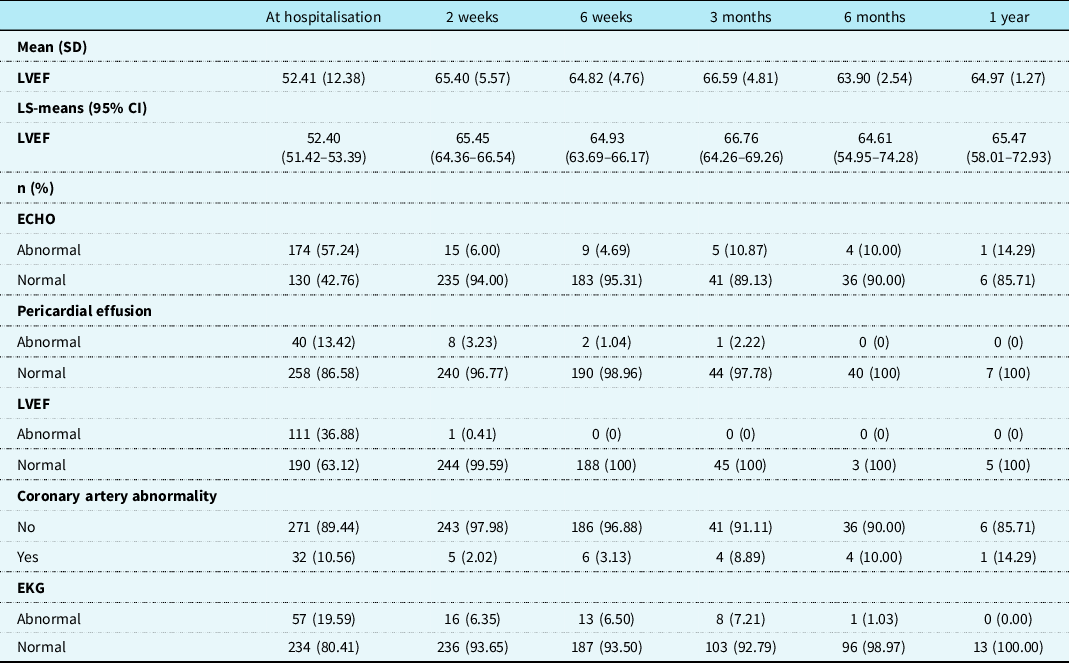
Cardiac outcome measures over follow-up periods.

Abnormal EKG findings at hospitalisation frequencies- Repolarisation abnormalities/ST segment changes = 47, Ventricular hypertrophy = 6, QTc prolongation = 3, Rhythm abnormality (non-sinus rhythm) = 3, Bundle branch block = 2, PACs = 1, Abnormal axis = 1, Other = 1, Multiple = 8.
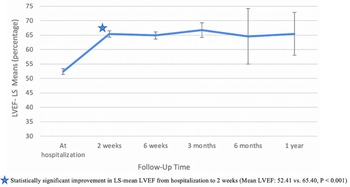
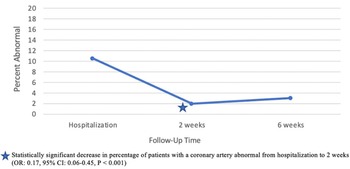
During the follow-up periods, 254 patients (83.6%) completed visits at 2 weeks, 200 (65.8%) at 6 weeks, 113 (37.2%) at 3 months, 98 (32.2%) at 6 months, and 13 (4.2%) at 1 year. The percentage of patients with an abnormal left ventricular ejection fraction (<55%) significantly decreased from 36.88% during hospitalisation to 0.41% at the 2-week follow-up (Table 2). No patients had an abnormal left ventricular ejection fraction after the 2-week follow-up visits. The percentage of patients with an abnormal electrocardiogram decreased to 6.35% at 2 weeks and remained significantly decreased from hospitalisation to all follow-up periods (Table 2). The percentage of patients with an abnormal echocardiogram decreased to 6.00% at 2 weeks and 4.69% at 6 weeks (Table 2). LS-mean left ventricular ejection fraction percentage significantly increased from hospitalisation to the 2-week visit and remained stable through subsequent follow-ups (Fig 1). Only 3.23% of patients had evidence of non-trivial pericardial effusion at 2 weeks, with almost none having pericardial effusion at the rest of the follow-up periods (Table 2). The percentage of patients with a coronary artery abnormality significantly decreased to 2.02% at 2 weeks (5/243) and 3.13% (6/186) at 6 weeks (Fig 2). Of note, one patient had a new instance of coronary artery dilation at 6 weeks.
Change in left ventricular ejection fraction over time. Left ventricular ejection fraction significantly increased from hospitalisation to 2-week follow-up and remained stable over all subsequent follow-up periods.

Change in percent coronary artery abnormality over time. percentage of patients with a coronary artery abnormality significantly decreased from hospitalisation to 2 week follow-up period.

On further statistical analysis, we found a significant increase in trend in mean left ventricular ejection fraction from hospitalisation to 2 weeks (LS-mean: 52.40 versus 65.45, p < 0.001) and from hospitalisation to 6 weeks (LS-mean: 52.40 versus 64.92, p < 0.001), however, no significant trend was observed from 2 to 6 weeks (LS-mean: 65.45 versus 64.92, p = 0.512) (Supplementary Table 2). The odds of having an abnormal electrocardiogram were 73% less (OR: 0.27, 95% CI 0.15–0.50, p < 0.001) at 2 weeks and 6 weeks compared to hospitalisation. The odds of having an abnormal echocardiogram were 95% less (OR: 0.05, 95% CI: 0.03–0.08, p < 0.001) at 2 weeks compared to abnormal echocardiogram at hospitalisation and 96% less (OR: 0.04, 95% CI: 0.02–0.07, p < 0.001) at 6 weeks compared to abnormal echocardiogram at hospitalisation. By the 2-week follow-up, the odds of having an abnormal coronary artery were 83% less (OR: 0.17, 95% CI: 0.06–0.45, p < 0.001) than during hospitalisation and this significant improvement remained at the 6-week follow-up. The odds of having a non-trivial pericardial effusion were 79% less (OR: 0.211, 95% CI: 0.10–0.47, p < 0.001) at 2 weeks compared to non-trivial pericardial effusion at hospitalisation and 93% (OR: 0.07, 95% CI: 0.02–0.29, p < 0.001) less at 6 weeks compared to hospitalisation. In coronary arteries, there were significant improvements in left anterior descending, right coronary artery, and left main coronary artery Z-scores from hospitalisation to 2 weeks and 6 weeks (Supplementary Table 3, with odds ratios demonstrated in Supplementary Table 4).
Discussion
In this study, the largest to date to characterise the follow-up clinical and cardiovascular findings of children diagnosed with multisystem inflammatory syndrome in children, we found that most parameters improved quickly within the first 2 weeks after discharge and continued to remain stable in the subsequent follow-up periods. There were statistically significant improvements in left ventricular ejection fraction, pericardial effusion, echocardiograms, and coronary artery abnormalities at 2 weeks when compared to hospitalisation, and these improvements persisted at 6 weeks. At 3 months, 6 months, and up to 1 year, parameters remained stable with no significant deterioration. There was a very small subset of patients with persistent coronary abnormalities.
In published case series, many patients with multisystem inflammatory syndrome in children also presented with fever and mucocutaneous manifestations like those of Kawasaki’s disease.Reference Dufort, Koumans and Chow10 Additional studies reported that patients can experience shock, cardiac dysfunction, abdominal pain, and markedly elevated inflammatory markers.Reference Abrams, Oster and Godfred-Cato11,Reference Abrams, Godfred-Cato and Oster12 Unlike Kawasaki’s disease, where the underlying cause usually remains unknown, in multisystem inflammatory syndrome in children, a preceding or active infection has been identified.Reference Feldstein, Rose and Horwitz1 However, like Kawasaki’s disease, multisystem inflammatory syndrome in children is a syndrome with a range of clinical presentations and an absence of pathognomonic findings or diagnostic tests.Reference Feldstein, Rose and Horwitz1 Our study demonstrated similar clinical findings at presentation and similar laboratory abnormalities during hospitalisation.
In Kawasaki disease, the long-term prognosis is determined by the initial and current level of coronary artery involvement.Reference McCrindle, Rowley and Newburger13 Some patients remain at risk for myocardial ischaemia from coronary artery thrombosis and stenoses, requiring medical management or even invasive revascularisation procedures.Reference McCrindle, Rowley and Newburger13 In addition, coronary artery dilation may not completely regress until up to 2 years after diagnosis.Reference Capone, Misra and Ganigara14 On the contrary, in multisystem inflammatory syndrome in children, little is known about the long-term cardiac outcomes and long-term complications of the disease.Reference Capone, Misra and Ganigara14 Although the immediate and short-term follow-up characteristics of multisystem inflammatory syndrome in children have been addressed, the long-term sequelae, particularly cardiac, remain unclear. Because of the lack of standardisation, follow-up care of these patients is highly variable.Reference Belay, Abrams and Oster15
When examining the cardiac outcomes, there were significant improvements in left ventricular ejection fraction from hospitalisation to the 2-week follow-up. After 2 weeks, left ventricular ejection fraction remained stable during all subsequent periods. This corroborates previous studies that have identified rapid improvement in LV systolic function in the subacute phase.Reference Matsubara, Chang and Kauffman7,Reference Fremed and Farooqi16 Our findings support other studies that mention rapid recovery of systolic function but expand that data to a much longer time point.Reference Capone, Misra and Ganigara14,Reference Patel, Kellerman and West17 We highlight that left ventricular ejection fraction rapidly improves after hospitalisation and remains normal in the short, medium, and long-term follow-up periods. Within echocardiogram findings, we found significant improvement in echocardiograms from hospitalisation to 2 weeks and 6 weeks, including systolic function, wall motion abnormalities, and coronary artery dilation. After 6 weeks, changes remained insignificant, supporting no long-term cardiac dysfunction. Moreover, there was a significant improvement in pericardial effusion from hospitalisation to 2 weeks and almost no patients had evidence of a pericardial effusion after 6 weeks. Similarly, there were significant resolutions of abnormal electrocardiogram findings from hospitalisation to all follow-up periods, further supporting no significant electrocardiographic dysfunction. While not included in this study, our group has previously published results of cardiac MRIs and exercise testing in a subset of our patients with multisystem inflammatory syndrome in children. These studies have similarly shown that long-term cardiac complications after multisystem inflammatory syndrome in children are rare.Reference Dove, Oster and Hashemi18,Reference Ziebell, Patel and Stark19
Coronary artery dilation has been reported in the acute phase of multisystem inflammatory syndrome in children.Reference Matsubara, Chang and Kauffman7 Previous studies have identified that coronary artery aneurysms in multisystem inflammatory syndrome in children typically resolve within 1–2 months.Reference Matsubara, Chang and Kauffman7,Reference Wong, Theocharis and Regan20 Our study showed statistically significant improvement in any coronary artery dilation from hospitalisation to 2 weeks as well as significant improvements in coronary artery Z-scores. In addition, coronary artery dilation remained improved from hospitalisation to 6 weeks. While our data show an increase in the proportion of coronary abnormalities on echocardiogram after 6 weeks, this is likely due to our practice guidelines, which recommended that only children with specific cardiac concerns should receive an echocardiogram after 6 weeks. As previously acknowledged, multisystem inflammatory syndrome in children frequently affects the cardiovascular system at presentation.Reference Regan, O’Byrne and Stewart21,Reference Vukomanovic, Krasic and Prijic22 Nevertheless, functional recovery is excellent, and this has important implications for the management of this population, especially as it relates to follow-up care and physical activity participation.Reference Farooqi, Chan and Weller8
There are important limitations in our study. Our data reflect patients hospitalised at a single tertiary care paediatric institution. Therefore, the results may not be comparable to other institutions with different guidelines for the management of multisystem inflammatory syndrome in children. Furthermore, the echocardiograms were read by multiple different cardiologists in the hospital and in the outpatient clinics. While there may be some differences between reads, we feel that any such differences would be minimal and that this approach reflects the actual experience. Telemetry findings were not included in this manuscript. However, our practice is to obtain a formal electrocardiogram when any concerning findings are noted on telemetry, so the lack of telemetry data is not expected to be of major clinical significance. In addition, the number of patients decreased at each follow-up period. While a majority of patients completed the 2-week visit and more than half at 6 weeks, less than half completed the 3-month and 6-month visits and very few had complete follow-up to 1 year. Healthier patients who had either clinically recovered or did not schedule follow-up visits could have biased some of the later data to sicker patients. This is particularly relevant when examining the percent change in coronary artery abnormality because there were few patients to analyse during the later follow-up periods. Finally, almost half of all patients in the study had a comorbidity such as obesity, asthma, or heart disease. These comorbidities may have contributed to both cardiac and noncardiac outcomes and could have affected some of the results.
In conclusion, lack of knowledge about the short and long-term consequences of multisystem inflammatory syndrome in children has led to uncertainty among physicians in making recommendations about follow-up and activity restrictions. Our study provides evidence that functional recovery and coronary outcomes are good. Moreover, our use of statistical analysis in longer-term periods provides further reassurance that there is no persistent subclinical dysfunction. These findings may inform guidelines for outpatient management strategies, cardiac follow-up, and recommendations for returning to competitive sports.
Supplementary material
For supplementary material accompanying this paper visit https://doi.org/10.1017/S1047951123000793
Acknowledgements
Joshua Kaltman, MD designed the outcome parameters of the study, conducted chart review of all patients, built, and maintained the database, worked with statistician to complete analysis, and wrote all sections of the manuscript.
Matthew E. Oster, MD, MPH served as principal investigator and mentor to Joshua Kaltman for this project. He helped plan the study design and provided oversight throughout the study. He reviewed the database, offered corrections, and edited the manuscript.
Rohali Keesari, PharmD, MPH assisted with the data coordination, statistical analysis, and modeling. She reviewed, edited, and approved the final manuscript.
Rohit Madani, MD assisted with reviewing ECG findings and documenting abnormalities. He reviewed, edited, and approved the final manuscript.
Financial support
This research received no specific grant from any funding agency, commercial, or not-for-profit sectors.
Conflicts of interest
None.