




No CrossRef data available.
Applying I-O theories in classrooms: An examination from the power perspective
Published online by Cambridge University Press: 08 February 2021
Abstract
An abstract is not available for this content. As you have access to this content, full HTML content is provided on this page. A PDF of this content is also available in through the ‘Save PDF’ action button.
Information
- Type
- Commentaries
- Information
- Copyright
- © The Author(s), 2021. Published by Cambridge University Press on behalf of the Society for Industrial and Organizational Psychology
Footnotes
1 In 1959, French and Raven proposed the five bases of power, which outlined how different forms of power, dependent on structured conditions such as individuals subjected to social control, could affect one’s leadership and success. The five bases of power are divided into two types: formal power and personal power. Formal power, which includes coercive, reward, and legitimate power, is defined by one’s position within an organization. In contrast, personal power, which includes referent and expert power, is defined by one’s followers.
References
Barbuto, J. E. Jr. (2005). Motivation and transactional, charismatic, and transformational leadership: A test of antecedents. Journal of Leadership & Organizational Studies, 11(4), 26–40.CrossRefGoogle Scholar
Bass, B. M., Avolio, B. J., Jung, D. I., & Berson, Y. (2003). Predicting unit performance by assessing transformational and transactional leadership. Journal of Applied Psychology, 88(2), 207–218.CrossRefGoogle ScholarPubMed
Ben-Elia, E., & Ettema, D. (2011). Rewarding rush-hour avoidance: A study of commuters’ travel behavior. Transportation Research Part A: Policy and Practice, 45(7), 567–582.Google Scholar
Carless, S. A., Wearing, A. J., & Mann, L. (2000). A short measure of transformational leadership. Journal of Business and Psychology, 14(3), 389–405.CrossRefGoogle Scholar
Dunn, E. J., Mills, P. D., Neily, J., Crittenden, M. D., Carmack, A. L., & Bagian, J. P. (2007). Medical team training: Applying crew resource management in the Veterans Health Administration. Joint Commission Journal on Quality and Patient Safety, 33(6), 317–325.CrossRefGoogle ScholarPubMed
Ericsson, K. A. (2004). Deliberate practice and the acquisition and maintenance of expert performance in medicine and related domains. Academic Medicine, 79(10), S70–S81.CrossRefGoogle Scholar
French, J. R. Jr. P., & Raven, B. H. (1959). The bases of social power. In Cartwright, D. (Ed.), Studies in social power (pp. 150–167). Institute for Social Research.Google Scholar
Garbers, Y., & Konradt, U. (2014). The effect of financial incentives on performance: A quantitative review of individual and team-based financial incentives. Journal of Occupational and Organizational Psychology, 87(1), 102–137.CrossRefGoogle Scholar
Gauld, D., & Miller, P. (2004). The qualifications and competencies held by effective workplace trainers. Journal of European Industrial Training, 28(1), 8–22.CrossRefGoogle Scholar
Grandey, A. A., Chi, N. W., & Diamond, J. A. (2013). Show me the money! Do financial rewards for performance enhance or undermine the satisfaction from emotional labor? Personnel Psychology, 66(3), 569–612.CrossRefGoogle Scholar
Haskell, R. E. (1997). Academic freedom, tenure, and student evaluation of faculty: Galloping polls in the 21st century. Education Policy Analysis Archives, 5(6).CrossRefGoogle Scholar
Hassi, A., Storti, G., & Azennoud, A. (2011). Corporate trainers’ credibility and cultural values: Evidence from Canada and Morocco. Cross Cultural Management: An International Journal, 18(4), 499–519.CrossRefGoogle Scholar
Jacobs, R. L. (1987). Human performance technology: A systems-based field for the training and development profession. National Center for Research in Vocational Education, Ohio State University.Google Scholar
Johnson, D. W., & Johnson, R. T. (2005). Cooperative learning, values, and culturally plural classrooms. In Mal Leicester, Sohan Modgil, & Sohan Modgil (Eds.), Classroom Issues (pp. 29–47). Routledge.Google Scholar
Johnson, M. D., Hollenbeck, J. R., Humphrey, S. E., Ilgen, D. R., Jundt, D., & Meyer, C. J. (2006). Cutthroat cooperation: Asymmetrical adaptation to changes in team reward structures. Academy of Management Journal, 49(1), 103–119.CrossRefGoogle Scholar
Kath, L., Salter, N., Bachiochi, P., Brown, K., & Hebl, M. (2021). Teaching I-O psychology to undergraduate students: Do we practice what we preach? Industrial and Organizational Psychology: Perspectives on Science and Practice, 13(4), 443–460.Google Scholar
Kouzes, J. M., & Posner, B. Z. (1990). The credibility factor: What followers expect from their leaders. Management Review, 79(1), 29–33.Google Scholar
Leach, J. (1996). Training, migration, and regional income disparities. Journal of Public Economics, 61(3), 429–443.CrossRefGoogle ScholarPubMed
Lin, Y. G., McKeachie, W. J., & Kim, Y. C. (2003). College student intrinsic and/or extrinsic motivation and learning. Learning and Individual Differences, 13(3), 251–258.CrossRefGoogle Scholar
Machin, M. A. (2002). Planning, managing, and optimizing transfer of training. In Kraiger, K. (Ed.), Creating, implementing, and managing effective training and development (pp. 263-301). John Wiley & Sons.Google Scholar
Miendlarzewska, E. A., Bavelier, D., & Schwartz, S. (2016). Influence of reward motivation on human declarative memory. Neuroscience & Biobehavioral Reviews, 61, 156–176.CrossRefGoogle ScholarPubMed
Murphy, J. C., & Coleman, J. L. (1990). Philosophy of law: An introduction to jurisprudence. Westview Press.Google Scholar
Pearsall, M. J., Christian, M. S., & Ellis, A. P. (2010). Motivating interdependent teams: Individual rewards, shared rewards, or something in between? Journal of Applied Psychology, 95(1), 183–191.CrossRefGoogle ScholarPubMed
Podsakoff, P. M., Bommer, W. H., Podsakoff, N. P., & MacKenzie, S. B. (2006). Relationships between leader reward and punishment behavior and subordinate attitudes, perceptions, and behaviors: A meta-analytic review of existing and new research. Organizational Behavior and Human Decision Processes, 99(2), 113–142.CrossRefGoogle Scholar
Pollard, D. S. (1989). Reducing the impact of racism on students. Educational Leadership, 47(2), 73–75.Google Scholar
Pounder, J. S. (2006). Transformational classroom leadership: The fourth wave of teacher leadership? Educational Management Administration & Leadership, 34(4), 533–545.CrossRefGoogle Scholar
Sabat, I. E., Martinez, L. R., & Wessel, J. L. (2013). Neo-activism: Engaging allies in modern workplace discrimination reduction. Industrial and Organizational Psychology, 6(4), 480–485.CrossRefGoogle Scholar
Sharot, T. (2017). What motivates employees more: Rewards or punishment. Harvard Business Review. https://hbr.org/2017/09/what-motivates-employees-more-rewards-or-punishments
Google Scholar
Thompson, K. D. (2001). Adult educator effectiveness within the training context: A study of trainee perceptions of effective trainer characteristics. [Unpublished Doctoral dissertation]. University of Wyoming, Laramie.Google Scholar
Tucker, B. A., & Russell, R. F. (2004). The influence of the transformational leader. Journal of Leadership & Organizational Studies, 10(4), 103–111.CrossRefGoogle Scholar
Yahaya, N., Taib, M. A. B. M., Ismail, J., Shariff, Z., Yahaya, A., Boon, Y., & Hashim, S. (2011). Relationship between leadership personality types and source of power and leadership styles among managers. African Journal of Business Management, 5(22), 9635–9648.Google Scholar
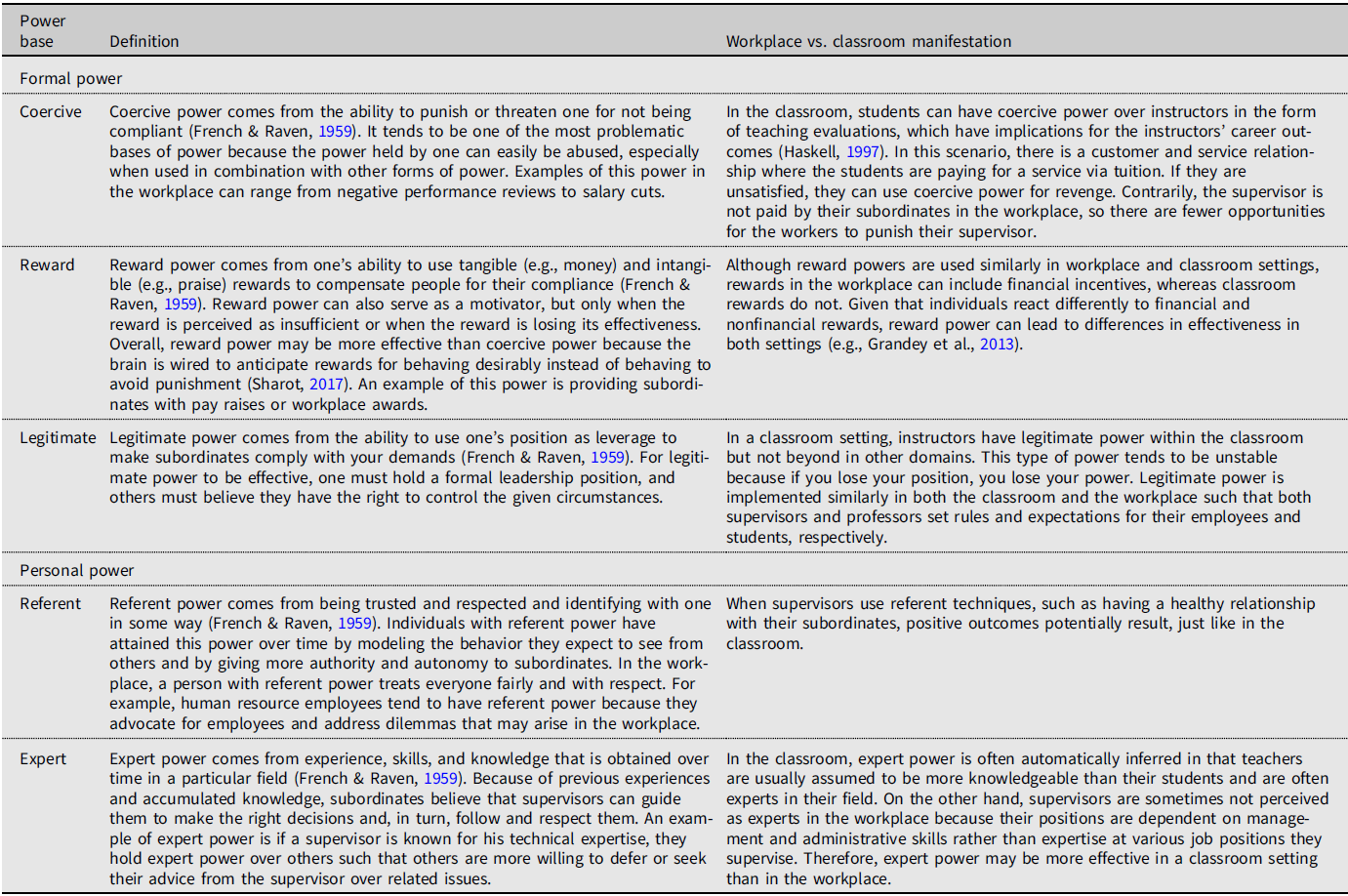
Table 1.The Five Bases of Power
 You have Access
Kath and colleagues (Reference Kath, Salter, Bachiochi, Brown and Hebl2021) argued that industrial and organizational (I-O) psychologists should draw from their unique expertise in organizational science to provide more effective teaching in the classroom. Although we agree with the premise that the overlap between workplace and classroom allows for the transfer of our I-O knowledge to teaching practices, we believe one key component that is not discussed but crucial to consider is the power dynamic. In this commentary, we will draw from French and Raven’s taxonomy of five bases of power (Reference French, Raven and Cartwright1959)Footnote 1 and explain how student–teacher power dynamics overlap and differ from those of subordinates and supervisors in each of these dimensions. We further provide implications for effectively implementing power in each of the content areas that were discussed in Kath etal.’s focal article.
Although the five bases of power were originally proposed to explain power and leadership in workplace settings, we argue that power is an important factor to consider in classroom settings due to its potential to facilitate learning effectiveness (see Table 1 for more details). Below we will further explain the implications of power on the content areas that were presented in Kath etal. (Reference Kath, Salter, Bachiochi, Brown and Hebl2021).
The Five Bases of Power
Coercive power
Training and development
Kath etal. (Reference Kath, Salter, Bachiochi, Brown and Hebl2021) discuss the critical role of motivation in training and development. When we are threatened with punishment, it not only demotivates us but also fails to result in the desired behavior simply because humans prefer to behave desirably to obtain a reward rather than receiving punishment (Sharot, Reference Sharot2017). Applying the coercive power base in training and development is not advised because it can discourage students.
Diversity and inclusion
Although applying coercive power in training and development is not recommended in certain circumstances, it may be beneficial to diversity and inclusion. When punishment is enforced with utilitarian goals that are directed at reducing the likelihood of undesirable behavior in the future, instructors can shape long-term behaviors with assignments that are meant to punish (Murphy & Coleman, Reference Murphy and Coleman1990). For example, if a student makes derogatory comments targeted at the LGBTQ+ community, instructors can assign a short paper to expose the struggles of this community. Because the students gain awareness of the hardships that are faced by this community, they may become more empathetic and inclusive of LGBTQ+ individuals. Therefore, coercive power is recommended when punishment includes utilitarian goals.
Groups and teams
Coercive power can be used to deter undesirable behaviors in groups and teams context. If students alert the instructor that a teammate is socially loafing or contributing to a toxic team dynamic, the instructor can apply punishment to motivate that person to contribute equally and healthily to the team. Nevertheless, using this approach can frighten students such that they hesitate to report team problems in the future. Therefore, instructors should use coercive power on teams with caution, as it can yield mixed results.
Transformational leadership
Punishment has historically been used in transactional leadership rather than in transformational leadership (Carless etal., Reference Carless, Wearing and Mann2000). A transactional leader is expected to grant a reward when followers successfully complete tasks as instructed (Bass etal., Reference Bass, Avolio, Jung and Berson2003). When followers fail to execute their tasks successfully, they are punished. Consequently, coercive power is negatively correlated with transformational leadership (Yahaya etal., Reference Yahaya, Taib, Ismail, Shariff, Yahaya, Boon and Hashim2011). Therefore, we do not suggest using coercive power techniques because such an approach could be an obstacle to achieving transformational leadership.
Reward power
Training and development
Research has shown that one technique that good trainers use is positive reinforcement (Leach, Reference Leach1996; Thompson, Reference Thompson2001). Research has suggested that rewards are related to an increase in declarative memory capacity (Miendlarzewska etal., Reference Miendlarzewska, Bavelier and Schwartz2016) and can help crystalize information while improving memory retention. Furthermore, the use of intangible rewards, such as public recognition, may facilitate students’ intrinsic motivation, which can facilitate better learning outcomes (Lin etal., Reference Lin, McKeachie and Kim2003). Therefore, we believe that reward power can be useful in facilitating learning outcomes.
Diversity and inclusion
Research has shown that using rewards can shape others’ behaviors (Ben-Elia & Ettema, Reference Ben-Elia and Ettema2011). For instance, employees’ altruism, courtesy, and sportsmanship are influenced by whether they receive rewards from their leader (Podsakoff etal., Reference Podsakoff, Bommer, Podsakoff and MacKenzie2006). Therefore, rewards shape both task and contextual behaviors and can be useful in creating an inclusive classroom. To use reward power to influence diversity and inclusion in the classroom, instructors can reward students who respect another person’s culture, essentially conditioning students to use inclusive language if they want to receive rewards.
Groups and teams
Research has long suggested that effective team rewards can be useful in facilitating team performance (Garbers & Konradt, Reference Garbers and Konradt2014; Johnson etal., Reference Johnson, Hollenbeck, Humphrey, Ilgen, Jundt and Meyer2006). Similar to the workplace, instructors can promote positive interdependence behavior in the classroom by employing a hybrid reward structure to encourage collaboration while avoiding social loafing (Johnson & Johnson, Reference Johnson and Johnson2005; Pearsall etal., Reference Pearsall, Christian and Ellis2010). Instructors should encourage learning by structuring activities to have students work together to accomplish their goals rather than working independently.
Transformational leadership
Like coercive power, reward power is closely aligned with transactional leadership (Barbuto, Reference Barbuto2005) as a response to the fulfillment of tasks. Therefore, it is reasonable to conclude that reward power is negatively correlated with transformational leadership (Yahaya etal., Reference Yahaya, Taib, Ismail, Shariff, Yahaya, Boon and Hashim2011) and can have detrimental effects on transformational leadership.
Legitimate power
Training and development
Kath etal. (Reference Kath, Salter, Bachiochi, Brown and Hebl2021) mention that to improve the retention of class materials, instructors should tell their students that they will be recycling test questions from previous exams. Setting rules and expectations are essential in training to ensure that trainees know what to anticipate (Dunn etal., Reference Dunn, Mills, Neily, Crittenden, Carmack and Bagian2007; Machin, Reference Machin and Kraiger2002). When instructors point out key information that will be tested early, they generate an expectation that the material must be revisited, thus reinforcing continuous memory retention through the end of the course. Using legitimate power methods can allow students to recognize what to expect early on from instructors.
Diversity and inclusion
Instructors can also use the legitimate power base to facilitate classroom diversity and inclusion by setting rules to prevent racism (Pollard, Reference Pollard1989). Despite the benefit of using this type of power, it can also hinder creating an inclusive environment if stringent rules are put in place. Harsh rules can inhibit students from sharing their experiences, which can lead to their feeling unwelcome. Therefore, we advise when using this power base that one proceeds with caution, as there are risks if it is misused.
Groups and teams
Kath etal. (Reference Kath, Salter, Bachiochi, Brown and Hebl2021) mention that there tends to be a negative stigma among students toward teamwork because they fear social loafing on the part of other team members. With legitimate power base techniques, instructors can establish clear rules and expectations and put accountability measures in place, which can alleviate the students’ concerns. Therefore, we believe a legitimate power base is useful for a positive team experience in the classroom.
Transformational leadership
Previous research has shown that excellent transformational leaders use authority to inspire followers (Tucker & Russell, Reference Tucker and Russell2004). In a classroom setting, this can be dubious because setting too many rules can stifle students’ creativity and prevent them from being intellectually stimulated. For example, assigning a paper with a strict rubric can prevent students from thinking outside the box and being creative for fear that if they do not abide by the rubric, their grades will suffer. Consequently, legitimate power negatively correlates with transformational leadership, which is why one should avoid this power base as it can hinder transformational leadership (Yahaya etal., Reference Yahaya, Taib, Ismail, Shariff, Yahaya, Boon and Hashim2011).
Referent power
Training and development
Research has suggested that trainers who build relationships and welcome feedback from trainees can facilitate positive learning (Gauld & Miller, Reference Gauld and Miller2004; Jacobs, Reference Jacobs1987). The same attributes can be applied in a classroom setting by instructors' efforts to build strong rapport with their students. By arriving to class early to converse with students or encouraging them to attend office hours, instructors can create a needs assessment to understand where the students can use additional assistance.
Diversity and inclusion
Kath etal. (Reference Kath, Salter, Bachiochi, Brown and Hebl2021) recommended that instructors become allies with their students, which is especially crucial for diversity and inclusion. When instructors position themselves as allies with their students, particularly those from marginalized groups, and educate themselves on their unique experiences and challenges, students will gain an appreciation for their educator and perceive a strong rapport. By using their referent power to display empathy toward students’ diverse experiences and engage in perspective-taking, instructors are better able to advocate for and support them in the face of the majority group, thus facilitating an overall more inclusive classroom atmosphere (Sabat etal., Reference Sabat, Martinez and Wessel2013).
Groups and teams
Like the reward power base, instructors who practice referential techniques can promote trust and encourage students to discuss difficulties they are facing in their group. Students often worry that their complaints about certain classmates will result in backlash and further conflict. Nevertheless, with strong referent power, students will be more open to discussing their experience and the instructor will have a better sense of what is working and what is not for groups and teams in their class.
Transformational leadership
Successful transformational leadership in a classroom setting is where teachers attend to their students’ difficulties (Pounder, Reference Pounder2006). According to Kath etal. (Reference Kath, Salter, Bachiochi, Brown and Hebl2021), an excellent transformational leader should consider their students’ individual needs. When instructors build strong rapport with their students, they will have a better idea of how to foster an environment that will lead to more personal growth. Therefore, it is no surprise that referent power has a significant positive correlation with transformational leadership (Yahaya etal., Reference Yahaya, Taib, Ismail, Shariff, Yahaya, Boon and Hashim2011).
Expert power
Training and development
Because trainer qualifications are equally important to trainees with respect to credibility, expert power is crucial to facilitating trainees’ willingness to learn (Hassi etal., Reference Hassi, Storti and Azennoud2011; Thompson, Reference Thompson2001). In a classroom setting, students are more likely to obey instructors that they believe are masters of the subject matter. To improve expertise, instructors can emphasize previous related projects that were successful.
Diversity and inclusion
To foster a diverse and inclusive classroom, instructors can share their stories of encountering discrimination, whether it is a personal experience or mere observations. Given that experiences can lead to expertise, instructors who have experienced discrimination or shared observations may be deemed experts by the students, allowing them to feel comfortable discussing personal encounters (Ericsson, Reference Ericsson2004). Instructors who have no stories but educate themselves can also nurture an environment where students feel safe sharing their experiences.
Groups and teams
For training and development, having credibility is imperative to show that team projects are great learning tools. As mentioned in the legitimate power section, students have negative opinions of group projects; when instructors use expert power, they can discuss how their experiences with team projects were beneficial. Sharing those experiences can convince students to be more receptive to team projects, leading to better team performance.
Transformational leadership
Being an expert is essential to motivation (Kouzes & Posner, Reference Kouzes and Posner1990). As Kath etal. (Reference Kath, Salter, Bachiochi, Brown and Hebl2021) mentioned, increasing student motivation is a significant aspect of being a transformational leader. When instructors demonstrate expertise, it is easier for them to become a transformational leader. Students are more likely to follow the classroom vision of instructors who are deemed more credible. Furthermore, expert power is positively related to transformational leadership, so it is appropriate to use in the classroom (Yahaya etal., Reference Yahaya, Taib, Ismail, Shariff, Yahaya, Boon and Hashim2011).
Conclusion
Expanding on the ideas proposed by Kath etal. (Reference Kath, Salter, Bachiochi, Brown and Hebl2021), we argued that one key factor for consideration when translating I-O theories from the workplace to the classroom is power dynamics. Supervisors and instructors share similarities in power such that both wield formal powers conferred by their formal position. However, they differ by the degree to which they can wield personal powers such as referent and expert powers. Understanding the limits of each of these powers depending on the context and how to combine them to address different areas of concern can allow I-O psychologists to be more effective educators.