1 Introduction
For a given expressive problem, a language will often provide one of a number of available solutions, and typically, one solution will be more frequently used, across languages, than others. For example, in ordering the main constituents of clauses, 89 percent of the world’s languages put subjects first, while only ten percent put verbs first, and only one percent put objects first (Dryer Reference Dryer2013a). Another example: In constructing polar questions, languages are far more likely to use particles than verb morphology, word order, or only intonation; and if a language has a polar question particle, the particle is far more likely to be placed utterance-finally than in any other position (Dryer Reference Dryer2013b).
Researchers have often been able to show that certain solutions are cross-linguistically dominant because they are easier or more natural to learn and use (Hawkins Reference Hawkins1988; Enfield Reference Enfield2014, Reference Enfield2017a; Himmelmann Reference Himmelmann2014), or, relatedly, that they have developed historically through similar language-internal processes (Cristofaro Reference Cristofaro2017), thus leading to their higher frequency in the world’s languages. When there is a statistical preference for one strategy over others, the question arises: What motivates the preference? Here, we pose this question in relation to the statistical preference for interjection-type answers for confirming polar questions.
2 Alternative strategies for answering polar questions
2.1 The two main options: Interjection-type and repetition-type answers
What alternatives do languages provide for answering polar questions? Sadock & Zwicky (Reference Sadock, Zwicky and Shopen1985: 189) propose a three-way distinction, summarized as follows:

Here is their example of an ‘echo system’ answer from Welsh, in which the answer repeats the verb used in the question:

While Sadock & Zwicky’s (Reference Sadock, Zwicky and Shopen1985) three-way distinction is a frequent point of reference, there are two problems with it. First, it obscures a more basic two-way distinction. The yes/no and agree/disagree strategies are variants of the same basic approach to answering the question: They both use an interjection or particle as opposed to some form of repetition. Sadock & Zwicky’s ‘agree/disagree’ is not of the same order as ‘echo’. Rather, ‘echo’ is distinguished from ‘interjection’, where interjection has two sub-types (yes/no and agree/disagree), distinguished not on grammatical grounds, but on the polarity principle by which the interjection is used.
The second issue is that Sadock & Zwicky’s proposal is often assumed to distinguish types of language, rather than types of system or strategy (though Sadock & Zwicky spoke only of types of system that a language may have, not ruling out that a language may have more than one system). It is likely that no language relies solely either on interjection-type answers or on repetition-type answers. While English is said to be a yes/no language, it obviously allows both strategies. Raymond (Reference Raymond2003) shows that when English speakers use repetition-type alternatives (e.g. I don’t see them or I don’t), marked pragmatic effects are introduced (see also Stivers et al. Reference Stivers, Enfield, Brown, Englert, Hayashi, Heinemann, Hoymann, Rossano, de Ruiter, Yoon and Levinson2009). Similarly, while Welsh and Finnish are often said to be canonical ‘echo’ languages, their speakers also use interjection-type answers (see Jones Reference Jones1999 on Welsh and Hakulinen Reference Hakulinen2001; Sorjonen Reference Sorjonen2001a, Reference Sorjonenb; Holmberg Reference Holmberg2016: 116–117 on Finnish).
In a more recent exploration of polar answer systems, Holmberg (Reference Holmberg2016) focuses on ‘verb-echo’ type answers. These are a subset of Sadock & Zwicky’s broader category of ‘echo’ answers. On Holmberg’s definition, a ‘verb-echo’ answer is done ‘by echoing the verb of the question’ (Reference Holmberg2016: 2).Footnote [2] As an answer to the question Has he gone?, for example, the complete clause He has gone is outside of Holmberg’s scope because the subject he is present. Such answers spell out entire propositions, and as such, Holmberg (Reference Holmberg2016: 8) says that ‘from a syntactic point of view they are uninteresting’. Holmberg’s interest – the hypothesis that verb-echo answers are syntactically derived by movement of a verb out of a clause followed by ellipsis of the clause, leaving just the verb as answer – is orthogonal to our interest here. Our interest is the speaker’s choice between an interjection strategy versus a strategy that involves repetition of any form, independent of whatever language-specific syntactic operations may be involved.
It is sometimes said that there are languages in which only the repetition-type answer strategy is used, and no interjection-type answers occur.Footnote [3] Holmberg (Reference Holmberg2016) risks inviting this reading when he states that there are languages ‘which just do not have any designated affirmative particle’, citing Thai, among other languages. However, he shows that the polite particles khrap and khaa can be used as polar answers, meaning ‘yes’ (Holmberg Reference Holmberg2016: 118; see Iwasaki & Ingkaphirom Reference Iwasaki and Ingkaphirom Horie2005: 179). He does not refer to the many other interjection-type answers that Thai speakers use for answering polar questions, such as the frequent informal variants [mː], [ʔəː], and [ʔɯː].Footnote [4] We see no reason to propose a category of ‘designated’ answer interjections distinct from the many ‘stylistic variants’ that occur (Sadock & Zwicky Reference Sadock, Zwicky and Shopen1985: 196; see also Gardner Reference Gardner1997). In terms of the linguistic phenomena we are studying here – how people answer polar questions – forms such as mm, uh-huh, yep, and head nods must be recognized and included in the set of interjections that mean, essentially, ‘yes’. We include them in the present study.
2.2 Pragmatic markedness
When multiple options are available for serving a communicative function within a system, one option typically emerges as the pragmatically unmarked one (see Haspelmath Reference Haspelmath2006). Unmarked forms are used in dialogue more frequently, more quickly, and more straightforwardly than marked forms (Schegloff, Jefferson & Sacks Reference Schegloff, Jefferson and Sacks1977, Schegloff Reference Schegloff1996, Clayman Reference Clayman, Lawler and Thye2002, Stivers & Robinson Reference Stivers and Robinson2006, Stivers et al. Reference Stivers, Enfield, Brown, Englert, Hayashi, Heinemann, Hoymann, Rossano, de Ruiter, Yoon and Levinson2009). In speech act terms, unmarked forms of utterances are designed to perform a simple action and nothing more, raising no red flags in the flow of communication (Grice Reference Grice1989). For example, in English, when people in informal conversation want to refer to a person who they both know well, first-name reference is the unmarked option. Searle (Reference Searle1958) argued that this was in order to avoid introducing aspects of the description of a person, which could ‘raise issues’ in the conversation by risking distraction from the basic act of referring. Alternative ways to refer to a person, such as the birthday boy, are used when the speaker wants to refer to someone and wants to add something to the linguistic action they are performing (see Stivers Reference Stivers, Enfield and Stivers2007 for a case study). We will argue that interjection-type answers represent a solution to the problem of how to answer a polar question and do nothing more than that, while repetition-type answers are marked relative to this simple function.
2.3 The structure of question–answer sequences
While questions have been extensively studied for their syntactic and semantic properties across languages, less is known about the answers that questions elicit, and almost no attention has been paid to the structural relationship between questions and their answers. We want to shed new light on research in this domain by drawing attention to precisely that relationship. To do this, we invoke the concept of the adjacency pair (Schegloff & Sacks Reference Schegloff and Sacks1973, Schegloff Reference Schegloff2007; see also Clark Reference Clark1996 on ‘projective pairs’).
The structure of an adjacency pair spans utterances that are produced by two people in interaction. An adjacency pair has two pair-parts. The first pair-part is spoken by Person A, the second by Person B. Examples include sequences in which a greeting elicits a return greeting, or in which a question elicits an answer. In the following extract, we see a canonical example, a polar question eliciting an answer, in lines 2 and 3:Footnote [5]

In an example from Lao (spoken in Laos, Thailand, and Cambodia), a polar question in line 1 elicits an answer in line 3:

A first pair-part is an initiating type of speech act. It is a kind of action that, in turn, projects a responsive type of speech act that Person B is required to make next (Sacks Reference Sacks1992, Clark Reference Clark1996). The first pair-part obliges Person B to provide a response of a normatively defined sort, such that if they do not produce an appropriate second pair-part, then it will be regarded as ‘officially absent’ (Schegloff Reference Schegloff1968). If Person B does nothing, or says something unrelated to the question, this will result in the pragmatic cousin of an ungrammatical sentence, drawing surprise, sanction, or other turbulence in the context of the conversation.
The adjacency pair is the core structural ingredient for the formal analysis of sequence structure in dialogue (Schegloff Reference Schegloff2007, Sidnell Reference Sidnell2010, Stivers Reference Stivers2013, Clift Reference Clift2016). A minimal sequence consists of a single adjacency pair (a base pair), as shown in example (3) (where the pair in question is made up of lines 1 and 4; note that strict contiguity is not criterial for ‘adjacency’ in the sense meant here). Minimal expansion, in the form of the Thank you after the second pair-part, is shown in (2). More complex sequences are built on the foundation of a base pair, with various forms of expansion, such as is illustrated with the following:

Here, lines 1 and 5 constitute a base pair, dealing with a main line of action. Line 1 launches a request for new information, and line 5 gives that information, closing the sequence. But a two-part sequence is inserted, in lines 3 and 4, between the two elements of the base pair. This insert expansion (Schegloff Reference Schegloff2007) is subordinate to the main line of action in this sequence. The expansion itself consists of a question–answer sequence, and it has the function of dealing with a matter of clarification that is required before the questionee can deal with the question that was asked in line 1. This is an example of other initiation of repair (Schegloff et al. Reference Schegloff, Jefferson and Sacks1977, Dingemanse & Enfield Reference Dingemanse and Enfield2015). It seeks to clarify the proposition that the questioner wants to put on the table. This kind of subordinate action sequence momentarily halts the progression of the main action sequence, and thus goes against a general preference for conversation to move forward without undue delay or derailment (Schegloff Reference Schegloff and Givon1979, Stivers & Robinson Reference Stivers and Robinson2006, Enfield Reference Enfield2017b).
2.4 The difference in semantic–pragmatic division of labour in polar answers
How do polar answers convey their meanings? While approaches may differ as to the technical details of their semantics, many analysts agree on the basic elements of a polar answer.Footnote [6] When someone asks a polar question, they put a proposition on the conversational table to be confirmed as true or otherwise (Farkas & Bruce Reference Farkas and Bruce2009: 86). In turn, a confirming answer to a polar question must do both of the following two things:

Compare the highlighted polar answers in examples (3) (a repetition-type answer) and (4) (an interjection-type answer) above. These two answers each convey the two things in (5), but they do so in distinct ways. The difference between (3) and (4) is in the division of labour between which of these two meaning elements is semantically coded and which is contextually implicated. We will refer to this as their semantic-pragmatic profile.
The interjection-type answer in (4) semantically codes ‘I answer and confirm that the proposition you put on the table is true’. But it does not in itself convey the propositional content in question (i.e. ‘I mean the bamboo shoots in the sack there’). Just what is being confirmed must be contextually retrieved, by accessing the question itself, and thus drawing on the specific formulation offered by the prior speaker. This can be diagrammed like so:

By contrast, a repetition-type answer semantically codes the assertion of a specific proposition (which happens to be the proposition put on the table by the question), but the meaning ‘I answer and confirm that the proposition you put on the table is true’ is implied by the context, in particular from the fact that this assertion is placed in the second pair-part position immediately after a question has been asked:

Some types of linguistic expression are intrinsically designed to act as second pair-parts. Interjection-type answers such as Yeah are classic examples (alongside a range of other expressions; e.g. You’re welcome). To see this, imagine that you turn on the TV and the first thing you see is someone saying Yeah to another person (e.g. at line 4 of example (4)). Simply by understanding what the word Yeah means, you will surmise that it is an answer to a question, and that it asserts that a proposition is true, but you will not know what that proposition is. But if you turn on the TV and the first thing you see is someone saying Her figure is beautiful (as at line 4 in example (3)), you will know what the speaker is asserting; however, because the assertion is not intrinsically marked as a second pair-part, you may never realize that it was an answer to a question.
On this basis, we observe different forms of alignment between the design of an expression and the sequential slot into which it is placed in a dialogue. Interjection-type answers show congruency between meaning and position because both are responsive. Repetition-type answers are less congruent, being assertive in meaning but responsive in position.
2.5 Interpersonal asymmetries in question–answer sequences
Question–answer sequences provide a bridge between semantico-syntactic organization (in the words and constructions involved) and pragmatic organization (in interpersonal dynamics). Because of this, question–answer sequences cannot be properly understood without taking into account the social-relational aspects of an exchange. Here, we want to emphasize the status of the interpersonal asymmetries between individuals that question–answer sequences create (see Enfield Reference Enfield2013: Chapter 10). We note three asymmetries that will be relevant below.
The first asymmetry is epistemic gradient (Enfield, Brown & de Ruiter Reference Enfield, Brown and de Ruiter2012, Heritage & Raymond Reference Heritage and Raymond2012). In the classical Austin/Searle model of speech acts, participants must fulfil certain conditions for a speech act to be felicitous. When a questioner puts a proposition on the table (test questions aside), such as ‘Her figure is beautiful’ in (3), it is assumed that the questioner does not know whether the proposition is true, and that Person B is likely in a position to know. A question has an epistemic gradient that is tilted away from the questioner, given their unknowing state. Depending on the way in which a question is phrased, and also on aspects of the context, that gradient can be more or less steep (Enfield et al. Reference Enfield, Brown and de Ruiter2012: 220; Heritage & Raymond Reference Heritage and Raymond2012: 181).
The second asymmetry is sequential agency. As noted above, a first pair-part is a form of social coercion. When Person A asks a question, she is unilaterally directing the course of the conversation, by setting constraints on what the other person should or can say next. This coercion is so minor and low-cost that we hardly notice it, but it is there. When Person B (HEL) says Yeah in (2), above, he is effectively yielding to Person A’s sequential agency, acquiescing to Person A’s unilateral imposition on him to produce an utterance of a certain kind, at that moment.
The third asymmetry is thematic agency. By contrast with epistemic gradient, this asymmetry provides a slight tilt in favour of the questioner. By putting a proposition on the table, a questioner thematizes it, and thus declares their interest in the proposition, not because they know its truth value (they openly claim not to), but because they are the one who initiated the sequence that put this particular proposition on the table, and chose the specific linguistic formulation that was chosen in the question (see Stivers Reference Stivers2018: 9). We suggest that when Person B responds with a designated interjection-type answer such as Yeah, they are designedly not pushing back against the questioner’s thematic agency, their claim to primary interest over this particular proposition. By using the interjection, the yes-answerer allows the proposition to be wholly formulated through the voice and words of the questioner. But when Person B responds with a repetition-type interjection, they may be understood to be pushing back against the implicit claim by the questioner to primary interest in thematizing this proposition, for example if the questionee has some independent reason to claim ‘ownership’ over the domain of the proposition, if, for example, it is in their special realm of knowledge (Raymond Reference Raymond2003; Heritage & Raymond Reference Heritage and Raymond2005, Reference Heritage and Raymond2012). This pushing-back is done by the mechanism that defines repetition-type answers: When an answerer repeats, she is at the same time independently articulating the proposition in the course of confirming its truth, as if she were the one putting it on the table.
2.6 Summary: The two alternative strategies are not equivalent
Given the qualitatively distinct semantic-pragmatic profiles of the alternative answer types, there is prima facie evidence to suggest that speakers’ choices between them cannot be arbitrary. The two options are not equivalent for performing the same communicative action. When you select one of these options over the other, you are not just answering a question, you are answering it in a certain way. In defining the difference here, we have drawn on features of how responses are formulated, the sequential structures they occur in, whether they are subordinate to a main line of action, and the pragmatic asymmetries that are inherent to these sequences, to provide the tools to analyze the distribution of polar answer types across languages. We now turn to our empirical study.
3 Data and method
We compare polar answers in a sample of fourteen languages, spoken (or signed, in the case of Sign Language of the Netherlands) on five continents (see Appendix). Each researcher contributed video recordings of maximally informal, spontaneous everyday data, all with participants’ informed consent. The type of interaction was controlled for maximum comparability: All data were from informal conversations occurring among family, friends or neighbors. This ensured three things. First, this maximized our likelihood of tapping into underlying, natural principles through which human interaction self-organizes in the absence of explicit stipulations for how talk should proceed (e.g. as in formal debates where there is overt regulation of who is to talk when). Second, by sampling multiple interactions involving diverse activities, we ensured a broad representation of language usage within each language. The full data set of fourteen languages draws on 172 distinct interactions, and thus variation due to differences in exact activity type (e.g. eating together versus doing handicraft together) is represented within languages as much as across them. Thus, we have done as much as possible to ensure comparability while insisting on maximal naturalness of the data. Third, we rely here exclusively on evidence from the direct coding of instances of usage across multiple speakers in spoken data, rather than on metalinguistic beliefs about how people answer questions in the languages of study. Before systematically coding our data, some of us had strong expectations about what would happen in certain languages. In the cases of Lao and Japanese, for example, the responsible researchers had expected that speakers would primarily rely on repetition-type answers, but this turned out not to be the case. Metalinguistic beliefs are no substitute for empirical data on questions of statistical distribution in language usage.
We rely on two types of analysis. First, all authors coded questions and their responses in the respective language corpora. We focus on questions that function to solicit answers, since rhetorical type questions make different sorts of responses relevant (Koshik Reference Koshik2005). In the coding for this study (for details of coding scheme, and instructions, see Stivers & Enfield Reference Stivers and Enfield2010), we defined interjection-type answers as those answers that do not assert a proposition in and of themselves but do confirm one. These range from variants of yes (yeah, yep, uh-huh, mm-hm, and head nods) to interjections such as of course or certainly (Stivers Reference Stivers, Stivers, Mondada and Steensig2011). We identified repetition-type answers as answers that fully or partially repeat elements of the question, without qualitative semantic alteration (irrespective of whether a verb is used in either the question or the answer). Thus, as an answer to the question Is John coming?, a repetition-type answer could be any of the following: John’s coming, John is, He is, He is coming, He’s coming. However, answers that add or replace elements of the question were coded as ‘transformative’ responses (Stivers & Hayashi Reference Stivers and Hayashi2010) and were thus not included in the scope of the present study. Transformative responses to the question Is John coming? would include responses such as the following: It’s Tom who’s coming, John’s coming later, John’s in London.
We coded for three main types of speech act that polar questions perform. Questions were coded as requests for information if ‘there was no other primary action to be coded’ (Stivers & Enfield Reference Stivers and Enfield2010: 2623), i.e. if the only business of the question was to get a piece of new information. Ambiguous cases were excluded. For example, the action performed by the question Are you busy tonight? is likely not only to be aimed at getting a piece of information, but is likely a preliminary to the main business, i.e. making an invitation or request. Questions were coded as other initiation of repair when they were dealing with a problem of hearing or understanding what was just said (e.g. ‘In the sack you mean?’ in example (4) above). These are, by definition, subordinate types of conversational action. Questions were coded as requests for confirmation when the questioner appears to assume that the proposition being put on the table is likely true, and merely requires confirmation. Requests for confirmation are often formally constructed as declaratives, not interrogatives, yet they are responded to with confirmation, as if they had been polar questions (e.g. A: You’ll be there tomorrow night, B: Yes). Requests for confirmation are the most constraining of these three main types of actions, in that they are most strongly presupposing of a certain type of answer. In all 14 languages, requests for confirmation were the most common speech act type performed by polar questions, followed by requests for new information, and then initiations of repair.
In our quantitative study of responses, we examine only confirming answers (rather than non-answers such as I don’t know, I can’t remember, or laughter; or disconfirming answers). This is because confirmations are more frequent than disconfirmations – a fact that holds across languages (Stivers et al. Reference Stivers, Enfield, Brown, Englert, Hayashi, Heinemann, Hoymann, Rossano, de Ruiter, Yoon and Levinson2009) – thus yielding more data, and because disconfirmations are socially dispreferred, thus meaning that they might be pragmatically marked across the board (Heritage Reference Heritage1984). Non-answer responses are also dispreferred relative to answers (Stivers & Robinson Reference Stivers and Robinson2006).
We noted all occurrences of combination answers (interjections followed by repetitions, or vice versa; see Holmberg Reference Holmberg2016: 68), and we found that they occurred in less than 4% of answers.Footnote [7] Because of the scarcity of combination answers, we re-coded these answers based on the first occurring answer type in the combination. This decision was grounded in the logic of turn-taking norms (Sacks, Schegloff & Jefferson Reference Sacks, Schegloff and Jefferson1974): at the end of each unit of talk, another speaker may begin speaking; the first unit of talk produced by a next speaker (i.e. the first of the two answer forms, in our case) must therefore be the respondent’s priority form, given that the other speaker could start talking in overlap when the second form is starting up. In other words, when an answerer gives two types of response one after the other, the second-given form is effectively deemed by the speaker to have been dispensable.
Our coding of question–answer sequences from interactional corpus data allows us to examine broad distributional patterns, while remaining grounded in qualitative analytic distinctions (Stivers Reference Stivers2015).
4 Analysis
4.1 Distributional evidence
Figure 1 shows the distribution of interjection-type responses and repetition-type responses in confirming answers to polar questions in the 14 languages.
Percentage of interjection-type vs. repetition-type confirming answers to polar questions, by language (total number of questions follows language name).

As this distributional pattern shows, in a majority of languages people rely on interjection-type answers over repetition-type answers to polar questions. Only three of the 14 languages drop below an 80% reliance on interjections: in Brazilian Portuguese, people rely on interjections 63% of the time; in ǂĀkhoe Haiǁom, people rely on interjections and repetitions virtually equally (51% vs. 49%); in Tzeltal, people rely on repetition-type answers a majority of the time (66%), but still far from an inverse of the pattern seen in most other languages.
The empirical findings reported in Figure 1 establish the global predominance of the interjection-type answer strategy. What might account for this predominance? We argue that this correlates with their being pragmatically unmarked. We argue that the semantic-pragmatic design of interjections (see Section 2.4 above) makes them intrinsically better suited to serving as an unmarked answer type, regardless of cultural or linguistic context. Because the interjection answer type semantically codes the function of confirming, it can be said to be a dedicated answer form. By contrast, a repetition in itself codes an assertion, independent of the fact that someone happens to be using it to answer a question. This independence means that repetition-type answers should be better fitted to pragmatically marked functions, because they do something other than what was projected by the first pair-part in a sequence, with the result that inferences can be drawn. To get a sense of what this means, we now look more closely at our findings in relation to the distribution of the two answer type options within languages.
4.2 Where interjection-type answers occur
Interjection-type answers are more common than repetition-type answers across each of the three speech act contexts we coded for: (i) requesting new information, (ii) requesting confirmation of topical information, and (iii) initiating repair through understanding checks. That said, interjection-type answers take up a greater proportion of answers within (ii) and (iii) than they do in (i). The distinguishing features of (ii) and (iii) are that they tend to occur in actions that are subordinate to a main line of action in a sequence.
Consider (8), from Brazilian Portuguese. The polar question of interest (in line 6) asks whether Alice knows where ‘FAAP’ is. This question is part of a local sequence which is subordinate to the main question at hand:

Lines 6 and 8, while constituting a question–answer sequence in themselves, serve structurally as an expansion sequence, subordinate to the base question–answer pair, which seeks to determine whether Maria lives close to here (answer: ‘no, I live close to FAAP’). We find that interjection-type answers are particularly common in these subordinate-action contexts, allowing the dialogue to move quickly back to the main line of action. In (6), that main line of action is determining whether Maria lives close by, not whether Alice knows where FAAP is. Examples like this one support the view that interjections are the unmarked way to confirm; they are designed not to introduce any pragmatic turbulence, thus allowing the dialogue to get quickly back on track. This, we argue, is why people are most strongly inclined to use interjection-type answers when confirming requests for confirmation and understanding checks.
4.3 Where repetition-type answers occur
Although there is no sequential, action, or morpho-syntactic context that we could identify where repetition-type answers were more likely than interjections, we find that they show their highest relative frequency in response to requests for new information, and in response to non-declarative questions. Because repetition-type answers make assertions in and of themselves, independent of their placement in dialogue as answers, they should be better suited to contexts in which the answerer aims not only to confirm the proposition that has just been put on the table by the questioner, but to claim a degree of thematic agency, or independent interest over that proposition. As Heritage & Raymond (Reference Heritage and Raymond2005, Reference Heritage and Raymond2012) note, when repetition is used for confirming, this does not just confirm but also asserts some prior or independent claim to ‘ownership’ over a proposition that has been put on the table (see also Schegloff Reference Schegloff1996).
If our hypothesis is correct that interjections are best suited to confirming-and-doing-nothing-more, and that this holds across languages, what accounts for the fact that some languages – Brazilian Portuguese, ǂĀkhoe Haiǁom, and Tzeltal – show distributional profiles that differ markedly from the norm?Footnote [8] For this, we turn to a multivariate statistical analysis of the data.
4.4 Multivariate model
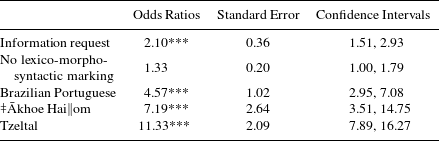
In order to examine possible effects on answer types (interjection-type versus repetition-type) of the language spoken, the action type of a question, or the question’s lexico-syntactic design, we used a logistic regression model (in STATA 13.1). We used the production of a repetition-type answer as the dependent variable. We find that among confirming answers, independent of the language spoken, the odds of providing a repetition-type answer increased two times if the question was a request for new information (rather than a request for confirmation or an initiation of repair done as an understanding check).Footnote [9] The probability that confirmation of a polar question is done using a repetition-type strategy also increased over four and a half times if the language spoken is Brazilian Portuguese, seven times if the language spoken is ǂĀkhoe Haiǁom, and eleven times if the language spoken is Tzeltal.Footnote [10] See Table 1.
Logistic regression predicting the odds of a speaker producing a repetition-type answer to a polar question in the context of confirmation.

***
 $=p<.001$
This suggests that the language spoken is a factor that contributes significantly to speakers’ relative reliance on repetition-type versus interjection-type answers. We now turn to examining the three stand-out cases: Brazilian Portuguese, ǂĀkhoe Haiǁom, and Tzeltal.
4.5 The case of Brazilian Portuguese: Evaluating methodology and analysis
Brazilian Portuguese has been analyzed as a repetition-dominant language (Urbano et al. Reference Urbano, Fávero, Andrare, Aquino and de Castilho2002, Guimaraes Reference Guimaraes2007). The most comprehensive examination of responses in spontaneous naturally occurring language use in Brazilian Portuguese claims that repetition-type answers are the unmarked type (Guimaraes Reference Guimaraes2007). The argument is that repetition-type answers are provided more straightforwardly and more frequently than interjections. However, there are reasons why Guimaraes’ analysis cannot be taken at face value.
The first is that Guimaraes underestimates the number of interjection-type answers. She focuses on one interjection: the word sim ‘yes’. Only 55 of around 2000 polar questions in her corpus are answered with sim (Guimaraes Reference Guimaraes2007: 115). Our data are consistent with this: Only two instances of sim were identified in our set of 94 confirming answers. However, there are other interjection-type answers in Brazilian Portuguese, and speakers use them far more frequently than sim. These include ‘mm hm’ as well as head nods (not observable unless the corpus includes video-recorded face-to-face interaction, as ours does). Together, these interjections make up a majority (63%) of answers in our sample of Brazilian Portuguese. We agree with Guimaraes that sim is a marked kind of answer in Brazilian Portuguese, but it does not follow that interjections are a marked kind of polar answer in Brazilian Portuguese.Footnote [11]
Alongside this under-counting of interjection-type answers, Guimaraes also inflates the category of repetition-type answers. She counts all polar answer uses of forms of the stative verb ser (‘to be’; usually in the third person singular form é ‘(it) is’) as repetition-type answers. But only some of these are actually repetitional. Ser is a repetition-type answer form when the (auxiliary) verb ser was used in the question. This is shown in example (9), in which Julia has been setting up a 3D DVD documentary about Grand Canyon. She is handing 3D glasses to two participants, when Ana asks about the DVD. The auxiliary verb é from the question (in line 1) occurs as the repetition-type answer in line 2.

But ser forms are also used as answers when ser did not appear in the question at all (Santos Reference Santos2003, Guimaraes Reference Guimaraes2007, Armstrong Reference Armstrong, de Garavito and Valenzuela2008). In these cases, it cannot be said that ser is a repetition-type answer. As Armstrong (Reference Armstrong, de Garavito and Valenzuela2008: 297) observes,

This type is illustrated in (10). Here, Luiza and Sara are in a third party’s kitchen, where Luiza sometimes helps cook. Sara’s (declaratively-phrased) question at line 2 asks Luiza whether she keeps her things organized at home equally well. At line 4, Luiza requests confirmation that she is correct in her understanding of tudo ‘everything’, namely that refers to as coisa ‘the stuff’. This is confirmed by Sara in line 5 with é, even though Luiza’s question did not feature the verb ser in any form.

Because ser ‘be’ can be used as an answer to questions that include it and to those that do not, an argument could be made, as has been made for Japanese (Ono & Suzuki Reference Ono and Suzuki2018), that the existential verb is polysemous.Footnote [12] The possibility that the Brazilian Portuguese polar answer é has now evolved to become an interjection and is no longer a verb (in the polar-answer function) may find further support in the fact that when ser appears outside of a repetition-type context, only é (third singular present) is used and not the plural-marked são ‘are’ or past tense-marked foi ‘was’, for instance.
A final point is that Guimaraes’ data involve extensive questioning, by police officers and counselors, of women who have experienced abuse. This means that many questions are about events that are well within the epistemic domain of the questionee, thus clashing with the thematic agency that a question introduces, and making marked repetitional answers more likely, as a form of push-back against any implied claim by the questioner to primary interest or investment in the proposition put on the table by the question.
When these issues are taken into account, Guimaraes’ claim that interjection-type answers are a marked strategy in Brazilian Portuguese is not supported. We conclude that Brazilian Portuguese does not show the aversion to interjection-type answers that is often suggested. This is because (i) the infrequent answer form sim is not the only interjection-type answer available (though paradoxically, it appears to be regarded as the canonical ‘yes’ answer), and (ii) the frequent answer form ser (é) is often not actually repetitional. The Brazilian Portuguese distribution of interjection-type and repetition-type answers turns out not to be far from the global norm.
4.6 The case of ǂĀkhoe Haiǁom: A cultural account?
ǂĀkhoe Haiǁom is spoken by a hunter-gatherer group in Namibia (Hoymann Reference Hoymann2010). As shown in Table 1 above, ǂĀkhoe Haiǁom speakers rely on interjections and repetitions with nearly equal frequency. We have proposed that because of their semantic-pragmatic profile, interjection-type answers facilitate the progress of a question–answer sequence. When questionees use interjection-type answers, they acquiesce to questioners’ sequential and thematic agency, allowing them to set the agenda of the local conversational sequence. Our data suggest that ǂĀkhoe Haiǁom speakers are more likely to avoid doing this, resulting in a higher rate of confirming by repetition in ǂĀkhoe Haiǁom. There is evidence to suggest a cultural explanation.
Researchers of social life in related hunter-gatherer groups have documented a strong norm against interpersonal constraint or coercion in these societies (Kitamura Reference Kitamura, Moerman and Nomura1990; Sugawara Reference Sugawara1996, Reference Sugawara and Bank1998). There is a distaste for overly constraining others, and for allowing oneself to be overly constrained. This norm is manifest in a range of ways in ǂĀkhoe Haiǁom language usage. Hoymann (Reference Hoymann2010) has argued that questions and answers in ǂĀkhoe Haiǁom conversation should be posed in ways that leave recipients relatively free of constraint. This is visible in several key respects of ǂĀkhoe Haiǁom speakers’ questions and their responses.
First, whereas speakers of many languages rely on more constraining polar questions most of the time – usually hovering around three quarters of questions (Stivers et al. Reference Stivers, Enfield, Brown, Englert, Hayashi, Heinemann, Hoymann, Rossano, de Ruiter, Yoon and Levinson2009) – ǂĀkhoe Haiǁom speakers rely primarily on content questions (59%) (Hoymann Reference Hoymann2010).
Second, when ǂĀkhoe Haiǁom speakers ask polar questions, they rarely use them for making the most constraining of the various action functions, namely requesting confirmation. Rather, when ǂĀkhoe Haiǁom speakers use questions, it is primarily to request new information or to initiate repair. Hoymann (Reference Hoymann2010) notes that in other languages, non-repair requests for confirmation constitute 20–50% of questions whereas they constitute only 2% of questions in ǂĀkhoe Haiǁom. Thus, in terms of both question form and action, ǂĀkhoe Haiǁom speakers prefer questions to be less coercive.
Third, speakers of ǂĀkhoe Haiǁom are less likely to respond to questions at all than speakers of other languages. They respond to questions only 80% of the time, leaving 20% of all questions without any response. In most languages, speakers respond to questions 87–96% of the time (Enfield, Stivers & Levinson Reference Enfield, Stivers and Levinson2010a). Although ǂĀkhoe Haiǁom speakers do pursue answers when they are missing, the frequency of non-response in the first instance is consistent with a cultural distaste for coercion.
Finally, ǂĀkhoe Haiǁom speakers were relatively more likely to tolerate longer silences than speakers in most other languages. A study of the timing of responses to polar questions showed a mean delay in ǂĀkhoe Haiǁom of more than 400 ms (compared to a global average of around 200 ms; Stivers et al. Reference Stivers, Enfield, Brown, Englert, Hayashi, Heinemann, Hoymann, Rossano, de Ruiter, Yoon and Levinson2009).
In Section 2 above, we described how interjection-type answers facilitate a questioner’s course of action, and thus acquiesce to the questioner’s sequential agency, while repetition-type answers can push back against this asymmetry. We suggest that this explains ǂĀkhoe Haiǁom speaker’s relatively strong preference for repetition-type answers. There is a tension between the inherently acquiescent semantic-pragmatic profile of interjection-type answers, on the one hand, and the cultural norm against coercion, on the other. Our hypothesis is that the ǂĀkhoe Haiǁom case shows a skewing away from the natural motivation for interjection-type answers (based on their intrinsic semantic-pragmatic profile). This skewing may be motivated by culture-specific norms, which we see manifest in a set of interactional phenomena, as well as more broadly in norms of social interaction and cultural life among ǂĀkhoe Haiǁom speakers.
4.7 The case of Tzeltal: A cultural account?
The Mayan language Tzeltal, spoken in the highlands of Chiapas in Mexico, is the only language in our corpus in which speakers are more likely to answer with a repetition-type answer than with an interjection-type answer (Brown Reference Brown2010). Again, we propose that a cultural explanation is possible.
Repetition in Mayan-language conversation is well known to be salient both in ritual speech and narrative (e.g. Gossen Reference Gossen1974, Norman Reference Norman1980), as well as in everyday conversation (e.g. Brown Reference Brown1979, Brody Reference Brody1986). Brown (Reference Brown1998) has documented children being corrected to use repetition in response to questions in Tzeltal. Still, Tzeltal speakers use interjection-type answers much of the time. We hypothesize that, as we have seen for ǂĀkhoe Haiǁom, the global motivations for using interjection-type answers may be countered by culture-specific norms in Tzeltal-speaking communities, which push against a universal tendency for interjection-type answers. This would result in the distribution we see, one that is overwhelmingly reliant neither on interjection-type answers nor on repetition-type answers.
In Section 2 above, we argued that when people use interjection-type answers, they are allowing a strong asymmetry to stand between participants, by choosing the option that does not resist the questioner’s sequential agency, nor their implicit claim to greater thematic agency, both of which are introduced by virtue of their having put the proposition on the table using a first pair-part – the question. That asymmetry has the effect of heightening the distinctness between individuals in interaction, distinct both in terms of epistemic gradient and communicative agency. We hypothesized, above, that ǂĀkhoe Haiǁom speakers resist that asymmetry because of an egalitarian social norm against interpersonal coercion. The issue for ǂĀkhoe Haiǁom speakers is the desire to avoid putting people on different levels. Tzeltal speakers appear to have a slightly different motivation to push back against the inherent asymmetry of question–answer sequences, namely, a desire to share a single position on matters, to be as one in relation to pragmatic matters of knowledge and stance. Evidence for this can be seen in the following example of the kinds of repetition sequences that are common in Tzeltal conversation. Here, M is telling a visitor (A) about her illness, about which A knows nothing:

M’s assessment – that it is not her ‘belly’ that is the worst (line 6) – receives a partial repeating acknowledgement from A in line 7. Then her assessment that her pee really hurt is responded to with a partial repeat (line 9), and there is yet another round of repetition as well (lines 11–12). In this context, there is a clear epistemic tilt away from A, because A has zero epistemic access to evaluate the truth of M’s assertion that her pee really hurt. It is noteworthy that A still acknowledges the new information by repeating it, which is also to independently assert it.
The greater the asymmetry between participants in a question–answer sequence, the less those participants might appear to be ‘as one’ in relation to what they are talking about. Using repetition-type answers provides a way to push back against this separation of stance-taking agents. In some cultural contexts (e.g. among the English speakers analyzed by Heritage & Raymond Reference Heritage and Raymond2005, Reference Heritage and Raymond2012 and Stivers Reference Stivers2018), repetition-type answers can come across as competitive. But if a questionee can use a repetition-type answer to redress a questioner’s implicit claim to greater sequential and thematic agency, this may also have the effect of prosocially leveling the epistemic playing field so that now speaker and recipient are sharing agency and access in the exchange.
Consider the following example:

With the question in line 1, Speaker AO shows sequential and thematic agency by asking a question that puts the proposition ‘He died too’ on the table, obliging Atz to respond. By providing a repetition-type answer in line 2, Atz is able to confirm that it is true, by way of independently asserting the proposition, thus to some degree redressing the questioner’s claim to greater thematic agency. But now see that, in lines 3 and 4, the two speakers then make the ultimate claim to co-ownership of a proposition: they utter it in unison (see Lerner Reference Lerner, Ford, Fox and Thompson2002). Rather than the questioner now having simply been informed by the questionee as to the truth of the proposition that they put on the table, the two speakers have effectively become one in relation to their state of knowledge and communicative agency over that proposition.
Brown, Sicoli & Le Guen (Reference Brown, Sicoli and Le Guen2010) estimate that half of all such sequences in Tzeltal involve the additional, follow-up repetition by a questioner after a questionee has produced their repetition-type response. They show that the same occurs in two other languages of the region: Yucatec (Mayan) and Lachixío Zapotec (Otomanguean), and they argue for a common cultural basis to the phenomenon.
In sum, repetition in response is a mechanism that Tzeltal speakers can use at the micro-level in conversation to display a value of symmetry of knowledge and epistemic access and thus co-membership in the making of, and commitment to, assertions in interaction. The same mechanism has been observed and remarked upon in other cultures as well. For instance, Mannheim & van Vleet (Reference Mannheim and van Vleet1998: 332) state that ‘Quechua’s conversation-like co-participation structure [in narratives] guarantees that no one has final authority over a set of narrated events. This is so even if the narrator personally experienced the events!’. This is illustrated in our example (11), above.
We have argued that interjection-type answers, by their nature, function to confirm a proposition and facilitate the questioner’s sequential, thematic, and action agenda. On the one hand, Tzeltal speakers often use interjection-type answers, serving this function. But on the other hand, because of their positive valuation of displaying common ground and shared epistemic access, Tzeltal speakers also often use repetition-type answers. We hypothesize that there is a tug-of-war at work in the Tzeltal-speaking cultural context between the universal functionality of interjection-type answers and a culture-specific desire to avoid asymmetry between individuals in sequential agency and thematic agency. When this desire takes priority, it is well served by the choice of repetition-type answers.
5 Conclusion
Advances in linguistic typology come when typological generalizations are held accountable to new data. In the functional domain of answering polar questions, a widely-held view among linguists has been that languages will either choose to rely on interjections or on repetitions for answering polar questions, as if these were interchangeable alternatives (see. Sadock & Zwicky Reference Sadock, Zwicky and Shopen1985, Holmberg Reference Holmberg2016). We have tested this claim against new corpora of spontaneous language usage in conversation in 14 languages, and we have found that it is not borne out by the data. Data from natural conversation have hardly figured in linguistic typology to date, though there are signs that this is changing (Stivers et al. Reference Stivers, Enfield, Brown, Englert, Hayashi, Heinemann, Hoymann, Rossano, de Ruiter, Yoon and Levinson2009, Dingemanse & Enfield Reference Dingemanse and Enfield2015, Dingemanse et al. Reference Dingemanse, Roberts, Baranova, Blythe, Drew, Floyd, Gisladottir, Kendrick, Levinson, Manrique, Rossi and Enfield2015). We hope that this shift may signal an empirically grounded approach to the typology of pragmatic aspects of language.
Our analysis suggests that as we learn more about the pragmatics of language in social interaction across the diverse languages of the world, we will not find many languages in which speakers will mostly rely on ‘echo’ or repetition-type strategies for answering polar questions. When speakers confirm using repetition-type answers, we expect that this will be either pragmatically marked, and reserved for specific communicative purposes, or it will reflect a countervailing cultural norm. We submit that not even strong pragmatic motivations or cultural norms will overwhelm the natural tendency for people to use interjection-type answers to polar questions, especially when those questions serve pragmatically subordinate functions in dialogue. Thus, we predict that no language will mirror the norm for dominance of interjection-type answers, consistently relying on repetition-type answers, say, 90% of the time. As our analysis of the semantic-pragmatic profile of the two answer types shows, the system of two polar answer options is an inherently asymmetrical one. Repetition-type answers and interjection-type answers are not two ways of doing the same thing. They do different things. The difference explains the strong typological preference in the world’s languages for using interjection-type answers to polar questions.
APPENDIX
Researchers responsible for data collection and language-specific analysis