Over the past decade, technological advancements have significantly enhanced researchers’ ability to access vast amounts of data made discoverable through digitization initiatives, databases, and linked data projects. At the same time, shifts in legal precedents and international agreements—combined with refinements in legal and ethical standards—have made conducting due diligence an imperative for all those involved in the collection, display and sale of art. The increasing involvement of law enforcement agencies in enforcing these standards further complicates and lends a sense of urgency to the question of a work’s ownership history. While provenance research is now an inescapable necessity for all who transact with art objects, there are few defined pathways to developing the appropriate expertise and establishing credentials in this rapidly evolving and professionalizing field. Traditionally, researchers acquired these skills ad hoc—through internships or in-house training at auction houses, galleries, and museums—with more formal learning opportunities often requiring travel or extended relocation, a commitment not all can manage or afford.
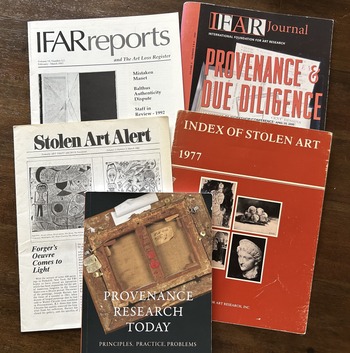
Recognizing the need for applied, methods-based training, the International Foundation for Art Research (IFAR), a private non-profit research organization, launched an online education initiative in 2024, the cornerstone of which was a practical, live-taught introductory course on provenance research.1 IFAR was well positioned to take up such an initiative; the organization was founded by scholars in 1969 to provide impartial and authoritative resources to promote ethics in the art world, with a focus on preventing the circulation of forged, misattributed, or misappropriated art. In the 1970s, IFAR created the first central database of lost and stolen art, which eventually served as the foundation for the Art Loss Register, and its publications frequently featured articles and information on stolen and looted art (Figure 1).2 In addition to offering authentication and provenance research services, IFAR provided digital public resources for provenance research, including the Catalogues Raisonnés Database, the Art Law and Cultural Property Database, and the online Provenance Guide.3
IFAR publications related to stolen art and provenance research.

Fig. 1 Long description
The image contains five separate publications. The top left publication is titled 'IFAR reports and The Art Loss Register' from February-March 1993, featuring articles on topics such as 'Mistaken Manet', 'Balthus Authenticity Dispute', and 'Staff in Review - 1992'. The top right publication is titled 'IFAR Journal' with a focus on 'Provenance & Due Diligence'. The middle left publication is titled 'Stolen Art Alert' from March 1986, highlighting a 'Forger's Oeuvre Comes to Light'. The middle center publication is titled 'Provenance Research Today' with a subtitle 'Principles. Practice. Problems'. The bottom right publication is titled 'Index of Stolen Art' from 1977, featuring images of various stolen art pieces.
Consistent with its mission, IFAR designed its Introduction to Provenance Research course as a practical guide to conducting research, with an emphasis on the fundamental skills and resources needed to investigate object histories for fine art, archaeological, and cultural heritage objects. As the course creators, our central conviction is that cooperative approaches are particularly effective in teaching provenance research, allowing participants to learn not only from instructors but also from one another’s expertise. This pedagogical approach models the cross-disciplinary inquiry required in conducting provenance research, which is inherently interdisciplinary and collaborative.
From the provenance guide to the classroom
IFAR’s course curriculum was informed by our extensive Provenance Guide, a free online how-to guide in conducting provenance research, which offers instruction on the primary resources and practical steps for building an object’s history.4 In constructing this guide, IFAR recognized the growing need for all those who engage with works of art, including scholars, collectors, lawyers, curators, and art market professionals, to conduct basic provenance research across a wide array of object types. Recognizing the diversity of our user base, the online tutorial was designed to help individuals navigate the complex issues surrounding Holocaust era restitution, cultural patrimony laws, and how to conduct due diligence in accordance with professional guidelines for best practices. More importantly, it provided an extensive list of online and print resources for conducting provenance research on a wide variety of art and heritage objects.5
Although never intended as a comprehensive review of source material on provenance research, the proliferation of digital resources—ranging from digitized bibliographic and archival material to overlapping aggregating databases and new semantic linking projects— the Provenance Guide nevertheless required almost constant updating. The ongoing struggle to keep pace with both the accretion of open-access online resources and, conversely, their rapid disappearance underscored the need to move beyond a basic guide and toward providing instruction on how to conduct research in this shifting information environment. IFAR recognized that more than just gaining familiarity with the resources and optimizing search skills, today’s provenance researchers need to learn how to locate archived sites, utilize and navigate aggregating provenance sources, and find data retrieved from deleted websites.6
IFAR offered Introduction to Provenance Research in July 2024 with registration capped at 30 participants, which was increased according to demand to 45 in subsequent sessions. The online format allowed participants to attend lectures live or asynchronously, making it easier to balance professional and educational commitments, and facilitated the participation of international scholars from five continents. Our methods-based approach focused on teaching the fundamental skills and resource knowledge needed to navigate the vast information landscape, while encouraging participants to develop strategies for tailoring searches to specific provenance goals.
Pedagogical methodology and structure
IFAR’s core curriculum focusing on object and data-based research training differed from other provenance courses, which relied heavily on case studies. Although valuable for understanding legal precedents and illustrating the complexity and interdisciplinarity of provenance work, case studies are limited in their transferability. By contrast, IFAR’s course offered a step-by-step guide in how to initiate provenance research—from analysing the art object to writing the provenance report—identifying key steps in how to evaluate and consult a variety of resource types and digital projects, the scope of which can overwhelm and hinder an investigation, when not searched effectively. We paired this flexible and adaptive research methodology with recommendations on organizing information using project management systems and digital lightboards like Airtable or Art Image Exploration Space (ARIES), how to create data visualizations using open access relationship mapping programs such as those provided by the remodelled Getty Provenance Index and Boston University’s Mapping Paintings, and provided tips to managing workflow.7 The goal, therefore, was not to attempt a comprehensive summary of all available options, but to encourage thorough and efficient research practices and help participants develop a research tool kit that could be adapted to suit diverse provenance queries and applications.
Drawing on our expertise in authentication research, forgery, museum collections documentation, and art theft, we guided participants in how to interrogate an object’s material properties, condition, and state of conservation for evidence of its history. Such analysis may reveal alterations to the work—whether it has been cut down, reframed, or overpainted—offer insight into past storage or handling conditions and illuminate potential attribution concerns. In these cases, consultation with a conservator or examination of an institution’s conservation files may reveal pre-conservation photographs, documentation of changes in format or mount, and previous labels and inscription information. IFAR’s history of conducing authentication research provided numerous examples of ‘red flags’ to look out for when assessing an object, and how to spot forged documentation – an insidious problem in the field, but one that comparatively few may have directly encountered.
In addition to these material questions, course lectures provided in-depth study of Nazi-era provenance resources, identifying and tracking trafficked antiquities, international cultural patrimony laws concerning archaeological finds, and special considerations for researching potentially culturally sensitive objects. The diversity of the object types and historical contexts enmeshed within these subjects reflect the interdisciplinary pathways their researchers must follow through the fields of social, military, art and religious history, genealogy, and law. The essential nature of this sort of cross-disciplinary and cross-temporal inquiry to provenance projects underscores the inherently integrative nature of the field.
Collaboration in practice
As co-teachers our professional and academic experiences — Lisa, from a provenance and authentication background, and Theresa, from a museum and collecting histories perspective— grounded our unique vantage point in our approaches to the material and modelled the benefits of interdisciplinary cooperation. The underlying theme of the course was the essential nature of cross-disciplinary collaboration and cooperation in the field, broadening participants’ understanding of what provenance research can accomplish. Such professional ‘networks’ operated both historically and contemporaneously: just as provenance research often exposes past connections among collectors, dealers, and institutions, so too do today’s practitioners rely on professional networks for shared resources, peer review, and cooperative problem-solving.
To encourage immediate and direct engagement with resources and to take advantage of the live-taught nature of the course, participants were given a final project on an artwork to present to the class. The project allowed for independent exploration of the resources shown in class, while demonstrating the collaborative nature of provenance research and the value of creating diverse professional connections. Each participant was assigned one of six art objects and provided with basic tombstone information (image, title, artist/culture). They were then tasked with identifying and filling gaps in its chain of ownership and selecting the most appropriate written format for the presentation of that provenance narrative. In the final session, all participants with the same artwork met to discuss what each discovered about its provenance and the resources they consulted, each group then presented its findings to the class in a 10-minute presentation.
In each of the group reports, the participants’ diverse professional experiences—in artist foundations, auction houses, libraries, museums, academia, the art market, and the law—revealed how each project was informed by different methods, goals, and problem-solving approaches. Distinct approaches in training, language specialties, and professional priorities meant that each group researched its object from multiple, often unexpected angles, enriching both the process and the outcomes. One of the most impactful takeaways for us as instructors was observing presentations of the same artworks over several sessions. Each new group of scholars addressed the provenance question from slightly different perspectives, often identifying new and different paths of inquiry and resources to consult, thereby underscoring the importance of integrated and collaborative research.
While the project encouraged exploration of the digital resources presented in class (and objects were chosen for which information would be discoverable online), we were impressed by participants’ willingness to seek out physical resources as well. For a group working on Lucas Cranach’s Lucretia with a member in The Hague, this meant consulting an annotated auction catalogue at the Netherlands Institute for Art History (RKD), which provided expanded sales data and new owners to investigate. For another group with a member in Scotland, it meant an on-site visit to the Scottish National Gallery to examine their assigned Georges Braque painting in person. In other cases, participants conducted research in library and archival collections and reached out to museum reference librarians and curatorial staff. While all groups produced compelling and well-researched results, these examples underscore the essential role of collaboration and the cultivation of diverse professional networks, as well as the continuing importance of in-person archival and library work in the field.
The changing landscape of provenance research
Anyone who has undertaken a provenance project knows that the work is iterative and never truly complete as digital and archival resources are constantly updated, and new information comes to light. In recent years, the question of ‘how much is enough’ is a moving target, complicated by shifting legal precedents, evolving ethical standards, and the active role of local and international police and customs agencies in enforcing compliance. But if provenance work is never finished then how can one claim to have exercised due diligence? A curator who took the course articulated this uncertainty regarding the ever-widening scope of inquiry into the ethical acquisition and transfer of art, confessing their hope the class would alleviate the feeling that they might be ‘missing a trick’ when it came to provenance research. Even at the introductory level, training must prepare students for a field that is simultaneously expanding its technical capabilities, refining its ethical and legal parameters, and reinventing itself in the market.
This situation is bound to continue, as technological developments in information systems continue to transform the field. Decades of digitization have produced vast datasets, which can now be analysed to reveal patterns and connections invisible in traditional research. This in turn has spurred innovations such as ontologies and digital mapping projects that reframe art sales and ownership transfers as discrete events within a broader historical narrative. These changes require the current generation of researchers to be fluent not only in archival sources and traditional art historical research, but also in emerging digital tools and data models, and have in many ways spurred the recognition of these skill sets as a rapidly professionalizing field.
While the transition to linked data operations offers exciting possibilities to analyse complex queries across institutions and disciplines, the transition from the recording of traditional ‘unstructured’ forms of provenance documentation to a structured machine-readable environment forces researchers to conceptualize provenance information in new ways.8
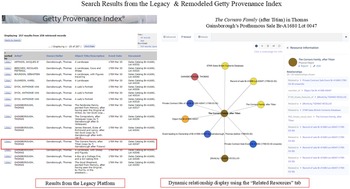
In their article on provenance linked open data, Rother, Koss and Mariani point out that the shift to provenance LOD involves transposing an object-centred structure to an event-oriented model that links people or organizations to transactions and events.Reference Rother, Koss and Mariani9 This transition not only impacts resource holding institutions, but also requires digital literacy for researchers, as they grapple with new ways of interacting with data using unfamiliar interfaces. In the wake of the celebrated rollout of the remodelled Getty Provenance Index, which contains over 12 million documents in a single open data framework, the Getty Research Institute was compelled to retain its legacy site while offering training courses on how to navigate the new platform (Figure 2).10 In setting this example, the Getty, like IFAR, has recognized provenance researchers’ needs for expanded access to integrated data and guidance in how to query structured data to make effective use of all current resource types.
A comparison of the search results for the Cornaro Family (after Titian) in Thomas Gainsborough’s posthumous sale as shown in the legacy Getty Provenance Index and the remodelled Provenance Index.

Takeaways and future directions
IFAR’s course modelled an innovative approach to the investigation of object histories, training a diverse cohort of graduate students and experienced art and information professionals in basic skills and strategies needed to conduct high-level research applicable to a wide spectrum of objects. As provenance researchers, we created a course that we ourselves would want to take. The course sold out quickly each time we offered it with this strong demand underscoring the need for professional development opportunities for those already engaged in provenance work and for those seeking to make it a career specialization. Expanding the range of participants in provenance research could yield new working group models and richer data usage, as each profession approaches sources with different questions and objectives.
International organizations like IFAR have a vital role to play in convening such stakeholders and fostering collaboration across disciplines, and it is gratifying to see other organizations emphasizing networking and collaboration in their provenance training programs. Former ‘Monuments Man’ Otto Wittmann, later director of the Toledo Museum of Art, reflecting on whether American museums should have retained the unclaimed looted artworks as trophies after the war, declared that the greatest benefit gained from his service in the Art Looting Investigation Unit (ALIU) was the relationships he forged within the European art market.11 Wittmann’s observations ring true as the field of provenance research continues to expand beyond art history. Both then as now, as our class projects demonstrated, the power of provenance lies in the strong interdisciplinary and professional networks it builds.