1. Introduction
Style refers to linguistic choices made by an author that distinguish his/her writing from those of other authors (Herdan Reference Herdan1966). Stylometric analysis, or authorship attribution, aims to distinguish texts written by different authors by analyzing textual styles. Layton, Watters, and Dazeley (Reference Layton, Watters and Dazeley2013a) pointed out that authorship analysis aims to extract information about the authorship of documents from the features within those documents. Quantitative approaches to authorship attribution identify the author of a text by comparing the values of textual measures in that text to their corresponding values in a candidate author’s writing samples (Grieve Reference Grieve2007). Textual measurements are assumed to include both consciously and unconsciously manipulated aspects of an author’s style. Thus features that cannot be consciously manipulated by the author are generally considered to be more effective (García and Martin Reference García and Martin2006). Stylometric analysis involves extracting style markers, that is, stylometric features, and classifying the texts from different authors depending on those features (Stamatatos, Fakotakis, and Kokkinakis Reference Stamatatos, Fakotakis and Kokkinakis2000).
Holmes (Reference Holmes1994) defined style as a set of patterns that can be measured and which might be unique to a particular author; style markers are used to assess writing style. Hence, stylometric analysis in this tradition cannot be done without prior analysis of a particular author’s work to extract the most effective features. Many linguistic lexical elements and measures have been used in stylometric analysis, including sentence length, word length, word frequency, character frequency, and vocabulary richness. For example, Savoy (Reference Savoy2012) compared the authorship attribution performance obtained when using word types and lemmas as text representations. Ruano San Segundo (Reference Ruano San Segundo2016) studied Dickens’ use of speech verbs using a corpus-stylistic approach. Yet, with the assumption that styles are defined by idiosyncratic features dependent on each author means that stylometric analysis and author attribution have not been treated as language engineering tasks that can be applied in a robust and effective way to all texts.
In contrast to the focus on the selection of style-specific features, Koppel, Schler, and Argamon (Reference Koppel, Schler and Argamon2009) showed that the choice of the learning algorithm is no more important than the choice of the features by which the texts are represented. The choice of effective stylometric markers can improve the authorship attribution, while good authorship attribution results validate the effectiveness of stylometric markers. The emergence of text categorization methods has marked an important turning point in authorship attribution studies. Jockers andWitten (Reference Jockers and Witten2010) compared and benchmarked the performance of five classification methods—four of which were taken from the machine learning field—in authorship attribution problems, and found that each of the tested methods, including support vector machines (SVMs) and random forests, performed well. Given these new developments, the time is ripe to explore the possibility of a robust set of stylometrics that can be used in text classification and authorship attribution without preprocessing analysis or annotation and can work effectively with machine learning technology. Our proposal is to leverage sub-lexical phonological features that can be extracted without preprocessing and, being sub-lexical, are not typically manipulated consciously by authors. In particular, in this paper we examine whether the tones and rimes of Chinese can be used to robustly classify Chinese texts in authorship attribution.
1.1 Literature review
The first attempts to quantify text style were the pioneering study of Mendenhall (Reference Mendenhall1887) on the plays of Shakespeare, followed by the statistical studies of Yule (Reference Yule1938, Reference Yule1944) and Zipf (Reference Zipf1932). Mosteller and Wallace’s (Reference Mosteller and Wallace1964) influential work on authorship attribution was based on Bayesian statistical analysis of the frequencies of a small set of common and topic-independent words (e.g., “and,” “to,” etc.) and produced significant discrimination results between the candidate authors. Since then and until the late 1990s, research in stylometric was dominated by attempts to define features for quantifying writing style (Holmes Reference Holmes1994, Reference Holmes1998) and to explore new modeling methods.
Stylometrics-based approaches in English and other European languages have generated rich literatures (Holmes Reference Holmes1998, Holmes and Kardos Reference Holmes and Kardos2003) that typically involve a set of common textual and lexical features such as function words, constituent lengths (Neal et al. Reference Neal, Sundararajan, Fatima, Yan, Xiang and Woodard2018), or frame semantics (Hinh, Shin, and Taylor Reference Hinh, Shin and Taylor2016). Yet, the use of sub-lexical features is still quite rare. Most stylometric analyses are lexically based, primarily because this is the level of language where repetitions may be reliably used as a basis for measurement (Holmes Reference Holmes1994). In terms of language engineering, lexical units are also the most obvious processing units with minimal preprocessing.
Grieve (Reference Grieve2007) compared thirty-nine different types of textual measurements commonly used in authorship attribution studies in order to determine which were the best indicators of authorship. Stamatatos (Reference Stamatatos2008) summarized the text representation features and style markers, as well as the computational requirements for measuring them. In this review, the lexical and character features, syntactic and semantic features, and application-specific features could be defined only in certain text domains or languages. The most common words (articles, prepositions, pronouns, etc.) were found to be among the best features to discriminate between authors (Argamon and Levitan Reference Argamon and Levitan2005). Similarly, García andMartin (Reference García and Martin2006) proposed that function words are reliable authorship attribution identifiers because of their high frequencies. Koppel et al. (Reference Koppel, Schler and Argamon2009), Love (Reference Love2002), Abbasi and Chen (Reference Abbasi and Chen2008), and Juola (Reference Juola2008) each surveyed a number of feature types for attribution problems. These studies aimed to determine the effectiveness of style markers for authorship attribution. Savoy (Reference Savoy2015) found that simple selection strategies (e.g., based on occurrence frequency or document frequency) may produce similar, and sometimes better, results compared with more complex ones. In addition to the supervised authorship attribution methods summarized above, there are also unsupervised authorship analysis methods, for example, by Layton, Watters, and Dazeley (Reference Layton, Watters and Dazeley2013b). All the above studies share the same restrictions of being applicable, or more effective, in certain textual genres or domains.
For Chinese authorship identification, the single most dominant issue is whether the last 40 chapters of the Dream of the Red Chamber was written by the same author as the first 80 chapters. This issue was first raised in Hu (Reference Hu1921) and has produced extensive literature from literary scholars with subjective and empirical approaches (e.g., Yu Reference Yu1950), focusing mostly on rhetorics and the description of the main characters; and proceeded by some statistical analysis (e.g., Chan Reference Chan1986; Chen Reference Chen1987; Hu, Wang, and Wu Reference Hu, Wang and Wu2014). Although a few stylometric attempts have been made based primarily on function words (e.g., Yu Reference Yu2012), these studies tended to focus on the applicability of certain statistical model instead of establishing a general methodology of authorship identification (Wei Reference Wei2002).
More recent studies on automatic identification are still in early stages, and attempts have been made from various directions, using punctuation (Jin and Jiang Reference Jin and Jiang2012), N-gram (Jin Reference Jin2002), topic model (Yang et al. Reference Yang, Zhu, Tang and Wang2017), or a hybrid analytical and statistical model (Bingenheimer, Hung, and Hsieh Reference Bingenheimer, Hung and Hsieh2017). Most of the researchers have focused on the distributions of characters and words (e.g., Peng et al. Reference Peng, Schuurmans, Wang and Keselj2003), as well as lexical, syntactic, and semantic features in the stylometric analysis (Wu, Huang, and Wu Reference Wu, Huang and Wu2006). Wei (Reference Wei2002) examined the authorship attribution of the Chinese classical literary masterpiece, “The Dream of Red Chamber,” using the distribution of common words. Ho (Reference Ho2015) suggested that Chinese auxiliary words, namely “ ,” “
 ,” and “
 ,” can represent the writing styles of different authors. Since these authorship identification studies have mostly been done in the spirit of digital humanities, in the sense that they are all directed towards a specific set of authors and aim to either resolve the authorship issues or show the validity of a certain methodology, no direct comparison is possible. There are also a few studies that use the PinYin of Chinese characters (Hanzi,
 ) as style markers in stylometric analysis. For example, He and Liu (Reference He and Liu2014) examined differences in the usage of rimes of Chinese syllables in the prose of different Chinese authors based on text clustering. The tone and rime motifs, as sub-lexical features, are perhaps among the very few content-independent stylometric features that are shared by all Chinese texts and cannot be easily manipulated consciously, yet there has not been any previously documented literature using them as stylometrics.
Thus the aim of this paper is two-folded. On one hand, we want to propose a set of content-independent sub-lexical features as stylometrics for authorship classification in order to fill a research gap in stylometrics in Chinese. On the other hand, we want to propose a robust approach based on sub-lexical phonological features such that it can apply to all texts regardless of topics and content and can hopefully lay the foundation for stylometric analysis and authorship attribution as a language engineering task.
1.2 Research question and methodology
Orthographic unit-level features, such as those at character level, can be easily extracted for any natural language or corpus and have been proven to be useful for evaluating writing style (Grieve Reference Grieve2007). However, hiding behind the writing system shared by all languages is the phonological word. It is well known that each language has a specific inventory of phonemes as phonological units as well as syllable structures. These are the sound systems of a language. Regardless of whether a writing system is phonologically based like English (Sproat Reference Sproat2000) or semantically based like Chinese (Huang and Hsieh Reference Huang, Hsieh, William and Sun2015), each lexical unit can be mapped to a specific phonological word. Hence, instead of taking lexical units and their orthographic components (like characters), we can also look at the phonological components of words. As these phonological units are either not explicitly (as in Chinese) or transparently (as in English) represented, they are good candidate stylometrics because they are not easy to be directly manipulated. This is especially true for Chinese. In terms of the phonological words in Chinese, the tone and rime are two prominent features. A phonological word represented by a Chinese character is composed of an onset, a rime, and a lexical tone. The rime is comprised of a vowel and a coda. The tone in Chinese is a suprasegmental feature, which has the effect of distinguishing words with identical segmental composition (i.e., identical onset and rime). These are rich sub-lexical linguistic features that have yet to be explored fully as stylometrics for authorship attribution in Chinese. In Putonghua (i.e., Modern Standard Chinese), there are four lexical tones: high-level tone ( YinPing), rising tone (
 YangPing), falling–rising tone (
 ShangSheng), and falling tone (
 QuSheng). These four tones were represented by the numbers from 1 to 4 in this study. In addition to these four tones, there is also a neutral tone represented by the number “0.” There are 35 rimes, which include both simple and compound rimes.Footnote a This paper studied whether the tones and rimes of Chinese phonology can be used as stylometric characteristics for Chinese literary works.
Both profile-based and instance-based approaches, as well as their combination, have been used in the field of stylometric analysis. The instance-based approach considers the differences between the various texts written by the same author, allowing it to determine the core linguistic characteristics of texts written by the same author, whereas the profile-based approach disregards such differences to establish a unique profile for each author. We adopt the instance-based approach in this study for its robust applicability to all authors and genres. This study hypothesizes that each author has his/her own characteristic patterns of tone and rime usage. We selected the tones and rimes in different sentence positions and their bigrams as the characteristics by which to classify texts according to their authors. In addition, the motifs of tones and rimes and the word length motif were also considered (see Section 3.2).
The literary texts of different authors were represented as numerical vectors, each of whose elements is the frequency of a particular selected characteristic, for example, tone and rime. In this process, the “bag of words” model was used to establish the text vectors. Treating every text of each author as a vector, powerful machine learning algorithms were used to build a classification model, specifically SVMs and random forests.
In authorship attribution, certain features that seem irrelevant when examined independently may be useful in combination with other variables (Stamatatos Reference Stamatatos2008). One of the advantages of modern machine learning methods is that they permit us to consider a wide variety of potentially relevant features without suffering great degradation in accuracy even if most of those features prove to be irrelevant (Koppel et al. Reference Koppel, Schler and Argamon2009). As a result, we can combine numerous features to represent the texts.
Some text classification algorithms can effectively handle high-dimensional, noisy, and sparse data, allowing more expressive representations of texts. SVMs are able to avoid overfitting problems, even when several thousand features are used, and are considered to be among the best solutions of current technology (Li, Zheng, and Chen Reference Li, Zheng and Chen2006; Stamatatos Reference Stamatatos2008). Comparative studies of machine learning methods for topic-based text categorization problems (Dumais et al. Reference Dumais, Platt, Heckerman and Sahami1998; Joachims Reference Joachims1998; Yang Reference Yang1999) have shown that SVMs learning is at least as good for text categorization as any other learning method; this has also been shown for authorship attribution (Zheng et al. Reference Zheng, Li, Chen and Huang2006; Abbasi and Chen Reference Abbasi and Chen2008). Moreover, it is easy to combine different kinds of stylometric features in an expressive representation using SVMs.
Random forests are useful for classifying high-dimensional data and selecting efficient characteristics with which to represent texts. Because texts can be represented by numerous characteristics, we hypothesize that random forests can achieve good results for authorship attribution.
This study compares the results of random forests and SVMs in authorship attribution. Two learning algorithms were implemented—one based on SVMs and the other based on random forests—to classify literary texts according to their authors. Training texts were represented as labeled numerical vectors, and the learning algorithms were used to find the boundaries between classes that minimize certain classification loss functions (Koppel et al. Reference Koppel, Schler and Argamon2009). 5-fold cross-validation was used to measure the generalization accuracy. All the texts of each author were randomly divided into five subsets of nearly equal size. Training was performed five times, each time leaving out one of the subsets and then using the omitted subset for testing. The overall classification accuracy rate was estimated. In order to avoid contingency, the 5-fold cross-validation was run 30 times. The average value of the classification error rates (Stamatatos et al. Reference Stamatatos, Fakotakis and Kokkinakis2000, Tan, Steinbach, and Kumar Reference Tan, Steinbach, Kumar, Fan and Fan2006), that is, erroneously classified texts/total texts, was used to validate the classification result.
Wei (Reference Wei2002) used the common words to examine the issue of authorship attribution of the Chinese classical literary masterpiece, “The Dream of Red Chamber.” In addition, both Argamon and Levitan (Reference Argamon and Levitan2005) and García and Martin (Reference García and Martin2006) showed the distinctiveness of function words in authorship attribution, respectively, in English. Thus we selected the Chinese function words to represent the texts. Then texts were classified and the corresponding average classification error rate was used to be the baseline. The average classification error rate was 12.11% when Chinese function words were used to represent these proses from four authors and random forest was used to establish the classification model. This average classification error rate will be the baseline for our current study.
We used the open source programming language and environment R (R Core Team 2016) to realize the classification experiments. The function ksvm in R package kernlab and the function randomForest in R package randomForest were used to establish the classification model to classify the texts from different authors. The parameters for the SVM and random forest algorithms were set to the default values of the functions ksvm and randomForest in R.
2 Establishment and preprocessing of corpus
One particular challenge in the studies of stylometric analysis is that the distribution of the training corpus over the different authors is uneven. For example, it is not unusual to have multiple training texts for some authors and very few training texts for other authors. In machine learning terms, this constitutes the class imbalance problem. Only a few studies have taken this factor into account (Marton, Wu, and Hellerstein Reference Marton, Wu and Hellerstein2005; Stamatatos Reference Stamatatos2007; Luyckx and Daelemans Reference Luyckx and Daelemans2008). From Stamatatos (Reference Stamatatos2007), the more a linguistic pattern deviates from its “normal” frequency, the more it contributes to the distances between texts. The normal frequency is the frequency of the linguistic pattern in the concatenation of all the available texts of all the authors.
Another important question is the length of each text sample for each author. The text samples should be long enough to adequately represent the author’s style via its text representation features. Stamatatos (Reference Stamatatos2008) discussed the issue of text length in authorship attribution. It is not possible to define a text-length threshold. Various lengths of text samples have been reported in the literature. Sanderson and Guenter (Reference Sanderson and Guenter2006) produced chunks of 500 characters. Koppel, Schler, and Bonchek-Dokow (Reference Koppel, Schler and Bonchek-Dokow2007) segmented the training texts into chunks of about 500 words. Hirst and Feiguina (Reference Hirst and Feiguina2007) conducted experiments with text blocks of varying length (i.e., 200, 500, and 1000 words) and reported significantly reduced accuracy as the text-block length decreases. It is possible that the inter-genre texts of a particular author are more distinct than the within-genre texts of different authors. For example, Williams (Reference Williams1976: 208) pointed out that Sidney’s prose more closely resembles the prose of Bacon than it does his own verse, and that Sidney’s verse more closely resembles the verse of Shakespeare than it does his own prose. Whether some linguistic characteristics can be used as stylometric features of an author may be dependent on a number of additional factors, genre being one of them (Grzybek et al. Reference Grzybek, Stadlober, Kelih, Antić and Weihs2005; Kelih et al. Reference Kelih, Antić, Grzybek, Stadlober and Weihs2005; Grzybek Reference Grzybek and Grzybek2007). We therefore took genre into account when examining the usage differences of tones and rimes in the texts from the different authors, selecting all texts from the same genre, prose, to establish the corpus.
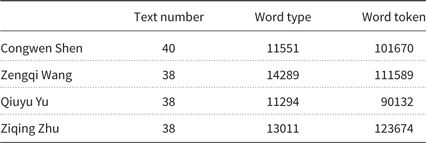
In this study, the proses of four Chinese writers—Congwen Shen (1902–1988), Zengqi Wang (1920–1997), Qiuyu Yu (1946–), and Ziqing Zhu (1898–1948)—were selected to build the corpus, as shown in Table 1. They are all influential writers in the modern Chinese literature. Most of the works of Ziqing Zhu and Qiuyu Yu are proses. Works of Congwen Shen and Zengqi Wang are composed of fictions and proses. Only proses were selected into the corpus. Their writing styles of these four authors have been frequent topics in literary studies, yet no systematic comparisons have been done so far. In general, the writing style of Congwen Shen is often considered to be authentic with nostalgic regionalism (Wang Reference Wang, Dun, She and Congwen1992). The writing of Ziqing Zhu, on the other hand, is often identified with its perceptive description and aesthetic perspective. Shen and Zhu are two of the best known prose writers among vernacular ( baíhuà) movement and definitely influenced the other two directly or indirectly. They also have roughly parallel period in their years of literary productivity, as Shen quit literary writing after mid-1940s. Wang is one generation later than Zhu and Shen and was mentee of Shen. Yu is another generation later and does not have any direct links with the other three authors other than the literary influence of having ready the other three authors.
Corpus scale in this study

As described above, the class imbalance problem and the length of each text should be considered in the establishment of the corpus. Luyckx and Daelemans (Reference Luyckx and Daelemans2011) showed that authorship attribution accuracy deteriorates as the number of candidate authors increases and the size of the training data decreases. This suggests that traditional methods are not robust. Hence, the current study on authorship attribution focuses on a robust language engineering solution to this issue and deals with stylometric analysis of Chinese prose from multiple authors with genre and topic-independent sub-lexical features of tones and rimes. Similar number of texts from each author and texts with similar sizes have been incorporated to establish the corpus for this study.
Chinese language texts are written as sequences of Chinese characters (Hanzi,  ). Yet, some characters could be homomorphs in the sense of representing more than one possible pronunciation. This phonological ambiguity can generally be resolved with word segmentation as each word typically has a unique pronunciation. Word segmentation is done using the Chinese lexical analysis system created by the Institute of Computing Technology of the Chinese Academy of Science (ICTCLAS). Once words are identified, they can be easily transferred to corresponding Pinyin romanization. Then the tone and the rimes features of text can be automatically extracted based on Pinyin romanization.
3 Experimental results
3.1 Text classification using tone as textual measure
Here, we describe the text classification results using the tones of all Chinese characters in the texts, the tones of sentence-final and sentence-initial characters, and the tones of word-final characters to represent texts from different authors.
It is necessary to specify the particular definition of Chinese sentence that is used in this study because sentence-initial and sentence-final characters will be considered. A sentence in Chinese text, however, is not easily defined due to the lack of a reliable convention for marking end-of-sentence, and because of the frequent omission of sentential components, including subjects and predicates (Huang and Shi Reference Huang and Shi2016). Consequently, Chinese sentences are often defined in terms of characteristics of speech, rather than text (Lu Reference Lu1993; Huang and Shi Reference Huang and Shi2016). Chao (Reference Chao1968) and Zhu (Reference Zhu1982) offered similar definitions that rely on pauses and intonation changes at the boundaries of sentences.
According to the approach of many Chinese treebanks (e.g., Chen et al. Reference Chen, Huang, Chang, Hsu, Park and Kim1996 for Sinica TreeBank, Huang and Chen Reference Huang, Chen, Ide and Pustejovsky2017) and the analysis of sentence length distribution in quantitative linguistics (Hou, Huang, and Liu Reference Hou, Huang and Liu2017), all segments between commas, semicolons, colons, periods, exclamation marks, and question marks that express pauses in utterances are marked as sentences. Actually, the sentences that are identified by this definition are clauses (Hou et al. Reference Hou, Huang, Do and Liu2017) and conform to the definitions that rely on pauses and intonation changes in the utterances. In Wang and Qin (Reference Wang and Qin2014) and Chen (Reference Chen1994), the sentences produced by this operational definition are called sentence segments (hereinafter, segments). Wang and Qin (Reference Wang and Qin2014) considered that segment length is particularly relevant to language use in Chinese. We used sentence segments as the units for extracting the sentence-initial and sentence-final characters.
After extracting the tones of all Chinese characters in the texts and of Chinese characters at specific positions in the texts, stylometric markers can be represented at two levels:
Token level: The sample texts are represented in terms of the tones of Chinese characters, both throughout the texts and at specific positions (segment-initial, segment-final, word-initial, and word-final) in the texts;
N-Gram level: The sample texts are represented in terms of N-grams of the tones or rimes in segments of the texts.
The tones of all the characters in the texts and the tones in the specific positions in the texts were selected to represent the texts, respectively. The usage differences of the tones can be shown through their distributions. The tones of all the characters and specific characters in specific positions are the high-level tone, rising tone, falling–rising tone, falling tone, and neutral tone. For example, the tone distributions of all the characters in the texts from different authors are shown in Figure 1. In Figure 1, the x-axis represents the tones and 1–5 represent the high-level tone, rising tone, falling–rising tone, falling tone, and neutral tone, respectively. In sum, there are no salient differences in the use of tones among the four authors.
The distribution of tone usages in the texts from different authors (“SCW” refers to Congwen Shen, “WZQ” refers to Zengqi Wang, “YQY” refers to Qiuyu Yu, and “ZZQ” refers to Ziqing Zhu).

The bigrams of word-final tones are “falling tone-falling tones,” “rising tone-rising tones,” etc. The texts were represented by the relative occurrence frequencies of these features and classified. The combination of two features is that using both two features to represent the texts, for example, the combination of word-final tones and bigrams of word-final tones in which the variables representing the texts are five tones and 25 bigrams of them.
The paragraph was used as the unit with which to compute the bigrams of segment-initial tones and segment-final tones. Similarly, the segment was used as the unit to compute the bigrams of word-final tones.
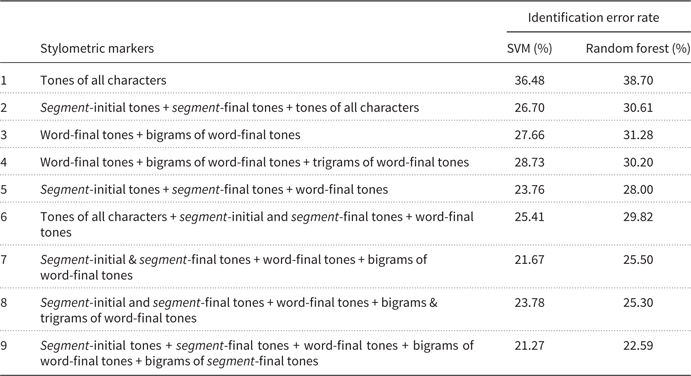
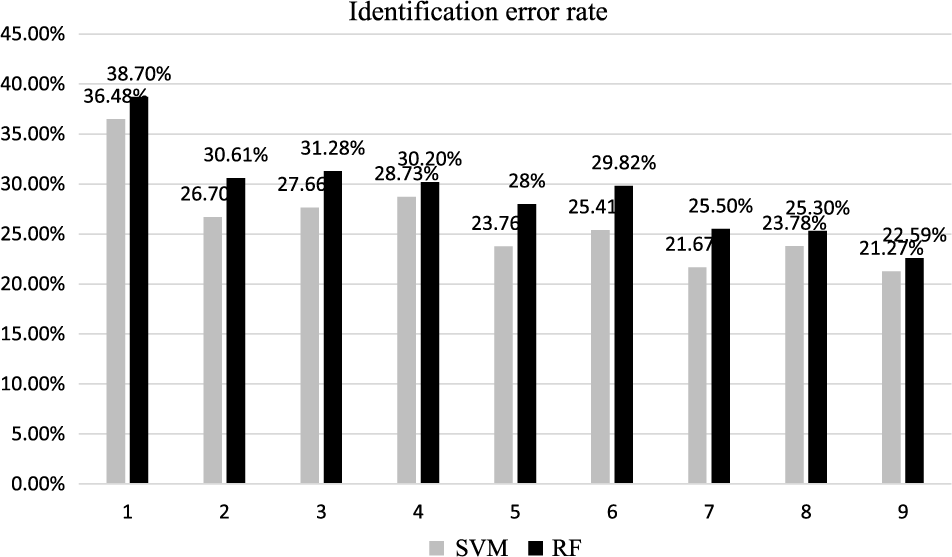
The texts of different authors were represented by the stylometric markers at both the token and N-gram level, and then classified, respectively. The SVM and random forest learning algorithms were used to build the classification models with which to classify the texts from different authors. Five-fold cross-validation was used to validate the text classification results and was repeated 30 times to avoid the contingency; the peak classification results are shown in Table 2. To allow the classification results to be compared visually, the average values of identification error rates are also shown in Figure 2 using histograms.
The classification results of texts represented by tones using SVM and random forest (segment refers to sentence segment, similarly hereinafter)

The classification results of texts represented by tones using SVM and random forest (RF) (1–9 on the horizontal axis represent the sets of stylometric markers shown in Table 2).

The classification results shown in Table 2 and Figure 2 using tones as textual characteristics contain significant error rates around 30% and hence are not good enough to be a robust classifier. The text classification was most accurate when using the tones at specific positions in the texts. Notably, the text classification result deteriorated when all tones were included in the learning algorithm. This indicates that the overall distribution of tones without considering their position in a sentence or text is not a distinctive characteristic for different authors. From the statistical results, the fact that falling tone is the most frequent tone and that the relative frequencies of each tone are similar for different authors leads to a poor classification result. Tones having only five values may be another reason for poor differentiation. The classification results also deteriorated when the trigrams of word-final tones were combined with other linguistic characteristics.
Comparing the two text classification results that were obtained using SVM and random forests, we see that the former method is superior because a smaller number of variables are required by this method. In order to improve the classification result, we should seek additional features of Chinese pronunciation.
The classification results using tones as stylometrical features were not as good as those using function words. Although tones as features can be found on every word, they are lexically determined by nature. That is, an author often has a few function words to choose in a given context, but the lexical tone is fixed once the word is chosen and cannot be manipulated. The small number of values and the deterministic nature of lexical tones are two likely reasons for the unsatisfactory classification result.
3.2 Tone motifs and word length motifs
Different pieces of prose are often read with unique rhythms—this is an inherent characteristic of prose. Wang, Dong, and Yan (Reference Wang, Dong and Bao-Ping2011) proposed that texts from different authors typically have different rhythms, whereas texts from a single author typically have similar rhythms.
Linguistic motif was inspired by the F-motiv for musical “texts” (Boroda Reference Boroda, Orlov, Boroda and Nadarejšvili1982) and was adopted for use in linguistics by Köhler (Reference Köhler, Genzor and Bucková2006, Reference Köhler2008), who used the concept of L-motifs, that is, length motifs. Boroda defined the “F-Motiv” in terms of the duration of the notes of a musical piece because units that are common in musicology were not suitable for this purpose.
According to Köhler and Naumann (Reference Köhler, Naumann, Grzybek, Kelih and Mačutek2010) and Köhler (Reference Köhler2015), linguistic motif is defined as the longest continuous sequence of equal or increasing values representing the numerical values of properties of adjacent linguistic units in the frame unit under study. Thus, an L-motif is a continuous sequence of values of equal or increasing length of a particular type of linguistic unit, for example, word length.
One obvious advantage of this definition is that it allows any text or discourse to be segmented in an objective, unambiguous, and exhaustive way, that is, it guarantees that no part of the text will be left unsegmented (Köhler Reference Köhler2008). Furthermore, motifs can be defined for any linguistic unit and for any linguistic property. Also, motifs have an appropriate granularity, with respect to which motifs are scalable.
Word length is an important indicator for stylometric analysis and has significance in prosodic linguistics. The L-Motif of a word, that is, word length motif, is defined as a maximal sequence of monotonically equal and increasing values that represent the lengths of the adjacent words in a sentence segment. The following sentence is an example (Köhler Reference Köhler2012: P117):
“In this way, a text or other frame unit can be represented as an uninterrupted sequence of motifs.”
Word length is measured in terms of the number of syllables. The lengths of the words in the above sentence are:
“1 1 1 1 1 1 2 1 2 1 1 4 1 1 5 2 1 1”
This sentence can be represented by the following sequence of six word length motifs:
“(1 1 1 1 1 1 2) (12) (1 1 4) (1 1 5) (2) (1 1)” Example (1)
According to this definition, a given text can be segmented into paragraphs that can be represented by an uninterrupted sequence of L-motifs of words. In Chinese, word length is defined as the number of Chinese characters (Hanzi,  ). The following Chinese sentence is an example:

Bai2he2 dao4 yuan2ling2 yu3 yuan2shui3 hui4liu2 hou4, bian4 lüe4 xian3 hun2zhuo2, you3 chu1shan1 quan2shui3 de0 yi4si0.
Bai_River at Wanling with Wanshui_river merge after, then slightly appear murky has out-of-mountain spring-water DE meaning
‘After merging with Wanshui river at Wanling, (the water of) Bai River become a bit murky; as if to indicate that it cannot no longer remain crystal clear once it leaves its mountain home.’
The lengths of the words in the above sentence are:
“2 1 2 1 2 2 1 1 1 1 2 1 2 2 1 2”
This Chinese sentence can be represented by the following word length motifs:
“(2) (1 2) (1 2 2) (1 1 1 1 2) (1 2 2) (1 2)” Example (2)
The prose texts were segmented by the sequence of the word length motifs and represented by the relative occurrence frequencies of each word length motifs using the “bag of words” model and the vector space model.
Köhler (Reference Köhler2008) proposed that the word length sequence in a text is organized in lawful patterns, rather than chaotically or according to a uniform distribution. Motifs display a rank-frequency distribution of the Zipf-Mandelbrot type, that is, they behave in this respect in a way that is similar to other, more intuitive units of linguistic analysis. Using tone as the categorical variable, we define tone motif as the longest continuous sequence of tones that are the same. For example, the tones of the Chinese characters in the sentence of Example (2) are as follows (“0” refers to neutral tones and 1–4 refer to high-level tones to falling tones):
“2 2 4 2 2 3 2 3 4 2 4 4 4 3 2 2 3 1 1 2 3 0 4 0”
This sentence can be represented as the following tone motifs:
(2 2) (4) (2 2) (3) (2) (3) (4) (2) (4 4 4) (3) (2 2) (3) (1 1) (2) (3) (0) (4) (0) Example (3)
Similarly, the texts can be segmented as the sequence of the tone motifs like in Example (3) and represented as the vector of the relative occurrence frequencies of tone motifs using the “bag of words” model. Here, we examined whether tone motif, word length motif, and their combination can be used as stylistic characteristics of different authors. The segment-initial and segment-final tone motifs as well as the word-final tone motif were considered. We used the paragraph as the unit by which to compute the segment-initial and segment-final tone motif, and used the sentence segment as the unit by which to compute the word-final tone motif and word length motif.
First, we extracted the tone motifs and word length motifs and calculated their relative occurrences frequencies. The distribution differences of word-final tone motifs by the different authors were shown in Figure 3. From that we can see there are no obvious differences of the usage of word-final tone motifs by these four authors.
The distribution of the word-final tone motifs in the texts written by these four authors (horizontal axis refers to the word-final tone motifs, e.g., 4-4, 3-3).

Similarly, the sentence segment-final tone motifs and word length motifs were extracted from the texts. Their distributions were shown in Figures 4 and 5, respectively. From Figure 4, we can see that there are more differences in segment-final tone motifs distribution than in word-final tone motifs between different authors.
The distribution of the segment-final tone motifs in the texts written by these four authors (horizontal axis refers to the segment-final tone motifs, e.g., 4-4, 3-3).

The distribution of the word length motifs in the texts written by these four authors (horizontal axis refers to the word length motifs, e.g., 1-2, 1-1-2).

Figure 5 only shows the distribution of word length motifs with relative high occurrence frequencies. From Figures 3–5, we can see roughly the usage differences of these three linguistic characteristics between these four authors.
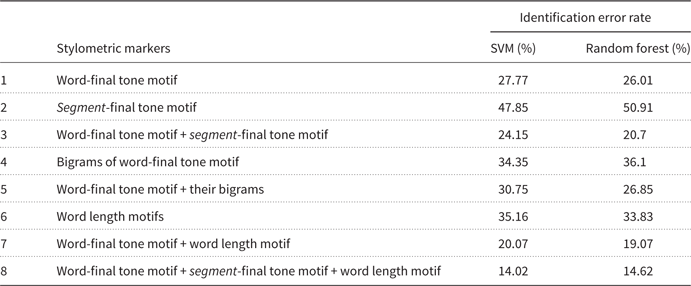
Then the texts from different authors were represented by these motifs and classified according to their authorship. Similarly, the SVM and random forest algorithms were used to establish the classification models, and 5-fold cross-validation was used to validate the classification results and was repeated 30 times, as shown in Table 3 and Figure 6.
The classification results using tone motif, word length motif, and their combination as characteristics

Classification results using the tone motif, word length motif, and their combination as characteristics (1–8 on the horizontal axis represent the sets of stylistic markers shown in Table 3).

Among the three stylometrics: word-final tone motif, segment-final tone motif, and word length motif, the stylometric that yields the best result for a single feature classification model was word-final tone motif. This suggests that word-final tone motif has better distinguishing power than segment-final tone motif and word length motif. Comparison between Figures 3 and 4 showed that there are more distribution differences of segment-final tone motifs than that of word-final tone motifs between different authors. However, performance of classification model using word-final tone motif to represent texts was better than using segment-final tone motifs to represent the texts. The higher occurrence frequencies of word-final tone motifs than the segment-final tone motifs are one of the reasons.
For textual characteristics 1 and 5 in Table 3, we observed that bigrams of the word-final tone motif do not improve the classification result when combined with the word-final tone motif. We infer that bigrams of the word-final tone motif do not improve the classification results and, therefore, cannot be used to discriminate the different authors. This might be because the bigrams of the word-final tone motif are sparse.
Although the identification error rate of the classification was very high when only the segment-final tone motif was used as the textual measurement, combining this with the word-final tone motif reduces the identification error rate substantially. This is an unexpected and interesting result. Compared with SVM, the classification model established using random forests has good performance.
The classification error rate was relatively high when using only word length motif to represent the texts from different authors. However, combining the word length motif and the word-final tone motif brings a relatively low error rate. Of the two, the word length motif contributed more directly to lower the error rate than when combined with segment-final tone motif. We suspect that these two features represent two different linguistic systems, hence different devices for self-organization that an author can choose. Thus they provide more information about the different author-based complexity systems and are better model to classify these complex systems than two features of similar nature.
From Table 3 and Figure 6, we see that the best classification result is obtained by combining the word length motif with the segment-final and word-final tone motifs to represent the texts of the different authors. Compared to the baseline, which has a classification error rate of 12.11%, this classification model is relatively poor (14.02%). However, it is more difficult to manipulate the combination of these features consciously than the function words. It is possible that one author simulate the writing style of another author if the linguistic style characteristic was manipulated consciously. More difficult to manipulate consciously one stylometric is, more possible it is the core characteristic of one author.
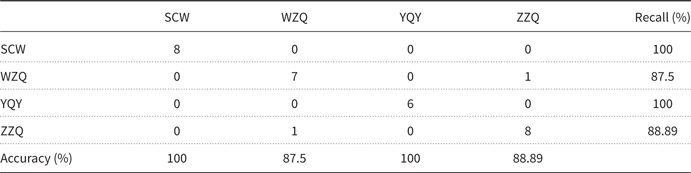
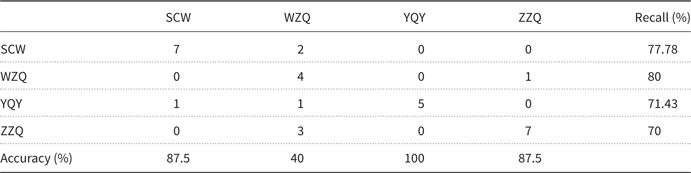
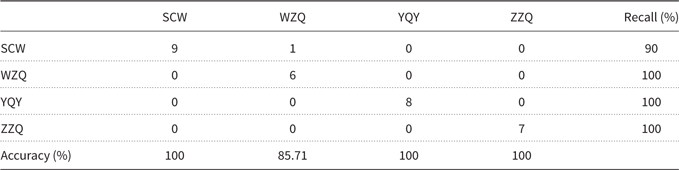
The rate between training and testing data was set to be 4:1 when holdout was used to validate the classification results and repeated more times. The maximum and minimum values of the classification accuracy rates were 93.55% and 74.19%, respectively, as shown in Tables 4 and 5, respectively.
The classification result using word-final and segment-final tone motifs and word length motifs to represent the texts (maximum classification accuracy rate)

SCW, Congwen Shen; WZQ, Zengqi Wang; YQY, Qiuyu Yu; ZZQ, Ziqing Zhu.
Tables 4 and 5 show that the probability is high when the author of an anonymous texts was identified as Congwen Shen, Qiuyu Yu, or Ziqing Zhu, and it is unreliable if the author of an anonymous text was identified as Zengqi Wang.
The classification result using word-final and segment-final tone motifs and word length motifs to represent the texts (minimum classification accuracy rate)

SCW, Congwen Shen; WZQ, Zengqi Wang; YQY, Qiuyu Yu; ZZQ, Ziqing Zhu.
3.3 Rime and rime motif
Sections 3.1 and 3.2 explored the different usage of tones, tone motifs, and word length motifs to identify texts from different authors and showed that the method is effective for author attribution for three out of four authors, but not for the fourth one. Hence, in this section we examined the usage of Chinese rimes and rime motifs in different texts in order to improve the result.
The texts from different authors were represented by the Chinese rimes. The number of Chinese rimes is 35. The features for representing texts are these 35 rimes of all the Chinese characters or in the specific positions, for example, word-final position. The texts were also represented by bigrams of rimes. In this case, the linguistic features in authorship attribution were the bigrams of rimes, for example, “e-e,” “i-i,” and “i-e”.
The first step was to extract the Chinese rimes from the texts. The rimes of specific positions, that is, segment-final and word-final, were studied as well as all rimes throughout the text.
The relative occurrence frequencies of word-final and segment-final rimes were calculated in the texts from the different authors. The distributions of the rimes were established, as shown in Figures 7 and 8, respectively, in order to see the differences between the texts from different authors.
The distributions of word-final rimes in the texts from different authors.

Classification results using rimes as text characteristics

The distributions of segment-final rimes between different authors.

Classification results using rimes as text characteristics (1–8 on the horizontal axis represent the sets of stylometric markers as shown in Table 6).

Figure 7 shows that there are little differences of the word-final rimes between different authors, especially for the frequent usage vowels. From Figure 8, there are relatively more differences of segment-final rimes usages between different authors. It is not difficult to imagine that occurrence frequencies of word-final rimes are higher than that of segment-final rimes.
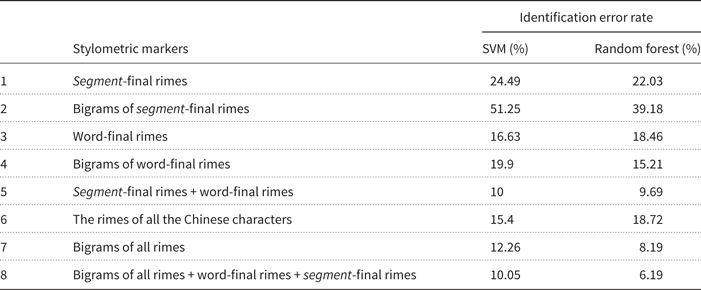
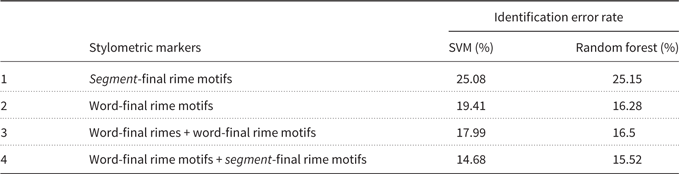
The classification results using rimes as the textual measurements are shown in Table 6 and Figure 9.
Compared to the segment-final rimes and their bigrams, word-final rimes and their bigrams classify the texts of different authors relatively effectively. From Figures 7 and 8, the differences of word-final rimes usages are less than that of segment-final rimes between different authors. However, the classification result is better when using word-final rimes to represent texts than when using segment-final rimes to represent texts. Maybe this is because the occurrence frequencies of word-final rimes are more than the segment-final rimes. Similar classification results were obtained when using all rimes in the texts and when using word-final rimes as the textual measurements, respectively. This demonstrates that word-final rimes are more important indicators for these four authors than the rimes at other positions in the texts.
The average identification error rate was much lower when word-final and segment-final rimes were combined to represent texts than that when only using word-final rimes to represent the texts. This shows that the word-final rimes in the segment-final position is the more distinctive characteristic in authorship attribution, when compared to that in the other positions. The classification result is good with an average identification error rate of 8.19% obtained when bigrams of all the rimes were selected to represent texts and the random forest model was used for classification. This showed that bigrams of all the rimes contributed to the identification of the anonymous texts relative to all the rimes. In the meantime, we can see that the bigrams of word-final rimes and segment-final rimes cannot improve the identification accuracy rates relative with word-final rimes and segment-final rimes.
In addition, comparison of all the classification results indicates that classification is improved when texts were represented by more variables and the random forest model was used for classification. For example, the bigrams of all rimes and the word-final rimes have about 1300 variables to represent the texts. The lowest identification error rate, 6.19%, was obtained when bigrams of all the rimes were combined with the segment-final and word-final rimes to represent the texts from different authors and the random forest model was used for classification. The random forest method is able to determine the most important variables from the high number of available variables.
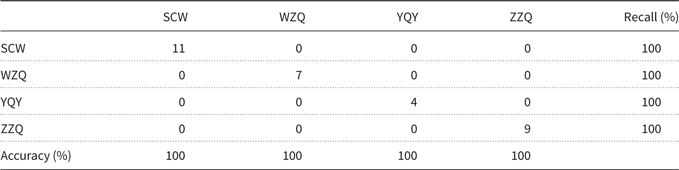
The rate between numbers of training and testing texts was set to 4:1 when the holdout validation was repeated more times to validate the classification result. The maximum and minimum values of classification accuracy rates were 100% and 93.55%, respectively, as shown in Tables 7 and 8. The classification accuracy rates were 100% in most holdout validation. It shows that the identified author of an anonymous text is reliable. Tables 7 and 8 show the classification results, accuracy rates, and recall rates for each author, when the bigrams of all rimes were combined with the segment-final and word-final rimes to represent the texts and the random forest method was used for classification. Tables 7 and 8 confirm that the system is able to identify the author of an anonymous text with high accuracy. The holdout was repeated more times to validate the classification result when the rate between training and testing data was set to 3:1. The classification result is good fit and achieves high accuracy when the bigrams of all rimes were combined with word-final and segment-final rimes were selected to represent the texts, in which the maximum and minimum values of classification accuracy rates were 94.87% and 87.18%, respectively. This also confirms the above conclusion.
Classification results of 20% of texts using random forest (maximum classification accuracy rate)

SCW, Congwen Shen; WZQ, Zengqi Wang; YQY, Qiuyu Yu; ZZQ, Ziqing Zhu.
From Table 6, we can see that the classification model using combination of word-final rimes and segment-final rimes to represent the texts outperforms that using function words to represent the texts. This is an interesting result as the number of rime feature, with 35 rimes, is smaller than the number of all function word features. However, each character carries a unique rime, and each word or sentence has a unique final rime, while function words may or may not occur in specific linguistic unit and is often nonunique as it can contain more than one function word. The obligatory presence of rimes makes it as a more versatile and robust stylometric feature and leads to improve the performance of the classification model. The bigrams of rimes improved the classification model when they combined the word-final and segment-final rimes greatly. We can also assume that it is more difficult to consciously manipulate the usage of rimes than function words by the authors. Thus, this combination (i.e., bigrams of rimes, word-final rimes, and segment-final rimes) is shown to be the better stylistic markers than the function words based on the classification result.
Classification results of 20% of texts using random forest (minimum classification accuracy rate)

SCW, Congwen Shen; WZQ, Zengqi Wang; YQY, Qiuyu Yu; ZZQ, Ziqing Zhu.
We next examined whether the rime motifs can reduce the identification error rate when they are used as text characteristics. Using rime as the categorical variable, we define rime motif as a sequence of identical rimes. For example, for the following sequence of rimes:
“ai a i ao o uo i i iou e ong ai in ai ou ou ai a an e”
the corresponding rime motifs are:
“(ai) (a) (i) (ao) (o) (uo) (i i) (iou) (e) (ong) (ai) (in) (ai) (ou ou) (ai) (a) (an) (e)” Example (4)
Segments and paragraphs (as segments) were selected as the units with which to extract the word-final and segment-final rime motifs, respectively. The texts were segmented as the sequence of the rime motifs and were represented by these rime motifs using Vector Space Model. The distributions of word-final rime motifs were established in order to explore the differences between the different author texts visually, as shown in Figure 10. This relative occurrence frequencies of the word-final rime motifs showed that most of the word-final rime motifs with high relative occurrences frequencies are single rimes.
The distribution of word-final rime motifs in different author texts.

The classification results are shown in Table 9 and Figure 11. Figure 11 shows a comparison of the classification results using rime motifs and rimes as textual characteristics at the same time.
Classification results using rime motifs as text characteristics

Classification results using rime motifs as text characteristics (1–4 on the right-hand side of the horizontal axis represent the sets of stylometric markers shown in Table 8).

From Figure 11, we can see that the classification results were not improved by using rime motifs as textual characteristics. The analysis showed that most rime motifs are composed of one rime, and the occurrence frequencies of most rime motifs including 2 and more rimes were very low. There was little difference in rime motif, including 2 or more rimes, usage by different authors, so they have almost no power to discriminate between different authors. Stamatatos (Reference Stamatatos2008) showed that the frequency of the selected features is a vital criterion. In general, the more frequent a feature, the more stylistic variation it captures. The random forest model was selected to compute the importance of variables, that is, their contributions to the classification results. The most important textual characteristics were found to be the single rimes when using the word-final rime motifs and segment-final rime motifs to represent the texts. From this, we can also conclude that most rime motifs consist of a single rime. The classification model, using combination of word-final rime motifs and segment-final rime motifs to represent texts, performed relatively well compared to others and was close to the classification model, using function words to represent the texts.
3.4 Frequency motif of rimes
The F-motif is a continuous sequence of equal and increasing frequency values (e.g., of morphs, words, or syntactic construction types) (Köhler and Naumann Reference Köhler, Naumann, Grzybek, Kelih and Mačutek2010). The F-motif of rimes is a continuous series of equal and increasing frequency values of Chinese rimes in text. For example, for the sequences of frequency values of rimes:
“111 214 213 229 213 117 480 501 501 29 501 501 501 117 501 214 480 50 143 174 143”
the corresponding F-motif of rimes is:
“(111-214) (213-229) (213) (117-480-501-501) (29-501-501-501) (117-501) (214-480) (50-143-174) (143)” Example (5)
F-motifs in texts from our corpus can be determined by three different methods of frequency count: the frequency of rimes can be determined on the basis of their number of occurrences in a particular text, in the texts of each author, or in the complete corpus.
We did not select the F-motif of rimes as a characteristic to represent texts because the rime frequencies in the texts by different authors are not equal; using the F-motif to represent the texts might result in overfitting of the classification model.
The length of an F-motif is the number of frequency values that it includes. For the F-motif sequence of rimes in Example (5):
(111-214) (213-229) (213) (117-480-501-501) (29-501-501-501) (117-501) (214-480) (50-143-174) (143)
the lengths of the F-motifs of rimes is: 2 2 1 4 4 2 2 3 1.
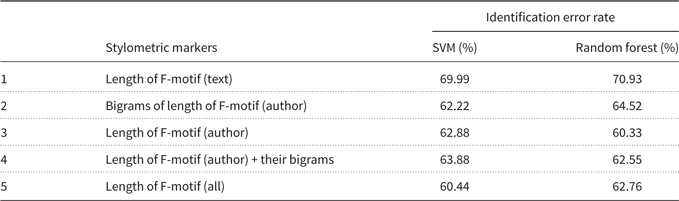
In this section, we use segments as the unit for computing the F-motifs of rimes. The frequency of a rime is its number of occurrence in a particular text. The lengths of the F-motifs were computed and used to represent the texts from different authors. The SVM and random forest were used to establish the text classification models. The average identification error rates are shown in Table 10.
The classification results using lengths of F-motifs as text characteristics

From Table 10, we see that the identification error rates exceed 50% and that classification result is poor. From that, we conclude that the lengths of F-motifs cannot be used as an effective measure by which to classify the texts according to their authors.
4 Conclusion
Most previous stylometric analyses have selected linguistic features at lexical or higher levels for author identification or text classification. Such features are shown to be highly sensitive to content, style, and topic domain variations. Yet, they are also volatile in the sense that a different set of features may be needed for effective classification when different authors, styles, genres, or domains are involved. In order to find a more realistic approach to stylometric analysis as a language technology, as well as to address this robustness issue, we propose the use of sub-lexical features. In this study, we examine whether Chinese tones and rimes can be effective stylometrics by conducting author attribution experiments using tones, tone motifs, and word length motifs, as well as rimes, rime motifs, and F-motifs of rimes and their lengths.
After comparing the classification results using all the aforementioned linguistic characteristics to represent texts, we conclude that the combination of bigrams of rimes, word-final rimes, and segment-final rimes can discriminate different texts from four selected authors most effectively and perform better than the traditional approaches relying on function words as stylometrics. The performances of classification models using tones motifs and rime motifs can also achieve comparable, though not superior, results. However, as mentioned, such features are robust and available across a wide range of texts types, unlike genre-dependent function words.
It is important to underline that the approach proposed in this study does not require complex text preprocessing or annotation. Our approach is highly efficient and only requires access to conventionalized phonological representation, which poses a very low threshold for most languages and can be applied to almost all types of text. Most critically, these stylometrics reflect the unconscious rhythms of writing and are neither topic-dependent nor volitionally controlled by the authors. Thus they are reliable and can be used as the baseline for future studies about authorship attribution. For languages without tones, a similar approach based on their prosodic features, such as word-final stress and intonation patterns, may be used for authorship analysis.
In terms of theoretical implications, it is important to note that among the sub-lexical stylometric features we introduced, some worked well while some did not in author attribution study. Why? We believe that it is because we treated author attribution as model selection among complex systems. That is, the writ of each author consists of a complex system that has its own self-organizing rules; and different authors’ outputs can be differentiated because each author should have his/her own set of self-organization rules. Given this theoretical foundation, we predict that the feature selected must be able to inform the self-organization competition among different levels, just like the Menzerath–Altmann Law are known to predict the self-organization behavior given constituent relations. Of the features we choose, the tonal feature is a parochial feature of the word/character and does not interact with higher phrasal levels. On the other hand, our proposal of the rime and tonal motifs turned the parochial elements to higher level as we use the motif to describe a paragraph or higher-level text. This theory model correctly predicts which set of stylometrics would work best and which would not. Note that recent development in probability-based network representation of the phonological lexicon, such as phonological neighborhood density (PND, Vitevitch Reference Vitevitch2002), can differentiate different rime groups in terms of their distance and probabilistic similarity. Data sets, such as the newly released Mandarin Chinese PND study (Neergaard and Huang Reference Neergaard and Huang2019), could provide significant boost as new resources to support our current approach. The PND approach, different from a phonological system of rules, directly models the phonological lexicon of a language as a complexity system. Interestingly, Neergaard and Huang (Reference Neergaard and Huang2019) found that, similar to our current stylometric author attribution study, tones are not effective predictors for phonological neighborhood condition. The possibility of extending our approach to other languages as well as incorporating probabilistic features from PND will be the directions for our future research. Another important issue is whether sub-lexical stylometrics will be effective for classification in terms of genres and registers. It has been shown that even though lexical and textual features are effective stylometrics for classification, it is possible that some genres and registers are closer to each other and may share some characteristics. For instance, Hou et al. (Reference Hou, Huang, Ahrens and Sophia Lee2019) showed that texts involving dialogs are more like each other in terms of constituency length distribution and are different from monologue or single speaker/writer texts. Will sub-lexical phonological features be similarly biased or can they be as effective and free of genre/register influence? This will be another line of research worthy of pursuing.
Acknowledgements
We would like to thank the anonymous NLE reviewers for their insightful and helpful comments.
Financial support
Research on this paper was funded by National Social Science Fund in China (Grant No. 16BYY110), the Hong Polytechnic University Grant 4-ZZFE.
Author ORCID
Renkui Hou 0000-0003-2510-6277
 ], ia[ia], ua[ua], o[o], uo[uo], e[ɣ], ie[iε], üe [yε], ai[ai], uai[uai], ei[ei], ui[uei], ao[au], iao[iau], ou[ou], iou[iou], an[an], ian[iæn], uan[uan], üan [yæn], en[ən], in[in], un[uən], ün[yn], ang[aŋ], iang[iaŋ], uang[uaŋ], eng[əŋ], ing[iŋ], ueng[uəŋ], ong[uŋ], iong[yŋ].
 (
 ——

 ” examining author’s unique writing style–and on dream of red chamber author issues
 (
 .
 . (
 .