Introduction
How horizontal foreign direct investment (FDI) in emerging economies affect local firms has attracted considerable attention in the management literature (Spencer, Reference Spencer2008; Zhang, Li, & Li, Reference Zhang, Li and Li2014). The literature has advanced our knowledge by emphasizing the spillover mechanism to explain the relationship between foreign and local firms (Spencer, Reference Spencer2008). Studies drawing on the spillover mechanism have mainly focused on the effects of productivity gap between the industry-frontier foreign firmFootnote 1 and local firms. This line of research implies that spillover from productivity gap can come through cooperation and competition (Giuliani, Martinelli, & Rabellotti, Reference Giuliani, Martinelli and Rabellotti2016; Gu & Lu, Reference Gu and Lu2011; Parente, Melo, Andrews, Kumaraswamy, & Vasconcelos, Reference Parente, Melo, Andrews, Kumaraswamy and Vasconcelos2021; Young, Huang, & McDermott, Reference Young, Huang and McDermott1996). However, the coexistence of cooperation and competition represents some paradoxical relations, and it remains ambiguous regarding how they evolve and jointly affect local firms’ strategic decisions.
Moreover, while previous studies have largely emphasized the importance of tangible assets in spillover, recent research has indicated that intangible assets of horizontal FDI, such as patents, trademarks, and copyrights (Tian, Reference Tian2007), can serve as barriers to imitation and reduce the foreign-firm spillover effect (Zhang et al., Reference Zhang, Li and Li2014). According to a recent study (He, Tong, & Xu, Reference He, Tong and Xu2022), intangible assets can be distinguished from tangible assets along three dimensions (i.e., excludability, tradability, and divisibility). First, intangible assets have lower excludability because they are often invisible. Second, intangible assets are less tradable because resource-specific contingencies impede market formation. Third, intangible assets are less divisible because such assets are difficult to evaluate and quantify (He et al., Reference He, Tong and Xu2022: 297–298). However, we know little about how and to what extent the difference in intangible assets between industry-frontier foreign firms and local firms influences the local firms’ behavior. Addressing these under-studied issues is important to identify new mechanisms to explain the complex relationships between foreign and local firms.
To address these issues, we adopt the coopetition perspective (Brandenburger & Nalebuff, Reference Brandenburger and Nalebuff1996), which suggests that (two or more) rival firms may simultaneously compete and cooperate (Bengtsson & Kock, Reference Bengtsson and Kock1999). Researchers have developed different typologies to examine the implications of coopetition on firm strategies and performance (for reviews, see Czachon & Mucha-Kuś, Reference Czachon and Mucha-Kuś2014; Devece, Ribeiro-Soriano, & Palacios-Marqués, Reference Devece, Ribeiro-Soriano and Palacios-Marqués2019; Walley, Reference Walley2007). One notable typology is the categorization of coopetition into (a) an equal relationship, (b) a competition-dominated relationship, and (c) a cooperation-dominated relationship (Bengtsson & Kock, Reference Bengtsson and Kock2000; Rusko, Reference Rusko2011). An equal relationship appears when cooperation and competition are equally distributed; a competition-dominated relationship consists of more competition than cooperation; and a cooperation-dominated relationship consists of more cooperation than competition (Bengtsson & Kock, Reference Bengtsson and Kock2000). We argue that coopetition is an important mechanism underlying the strategic responses of local firms in emerging economies when they are under a disadvantageous situation facing horizontal FDI.
We start with the concept of intangibility gap, defined as the difference in intangible asset intensities between industry-frontier foreign firms and local firms in emerging economies. In this context, frontier refers to a firm in the leading position in intangible resource development (Kaufmann & Schneider, Reference Kaufmann and Schneider2004) due to its highest intangible asset intensity in an industry-region segment (Zhang et al., Reference Zhang, Li and Li2014). Foreign firms often occupy this frontier position in many industries and regions within an emerging economy (Ozkan et al., Reference Ozkan, Khan, Deligonul, Yeniyurt, Gu, Cavusgil and Xu2022). Intangible assets that include knowledge and skills have been regarded as an important source of a firm's competitive advantage (He et al., Reference He, Tong and Xu2022; Kaufmann & Schneider, Reference Kaufmann and Schneider2004). We argue that the intangibility gap between industry-frontier foreign firms and local firms may create three types of coopetitive relationships (Bengtsson & Kock, Reference Bengtsson and Kock2000; Lacoste, Reference Lacoste2014) and influence local firms’ selection of internal research and development (R&D) strategies accordingly.Footnote 2
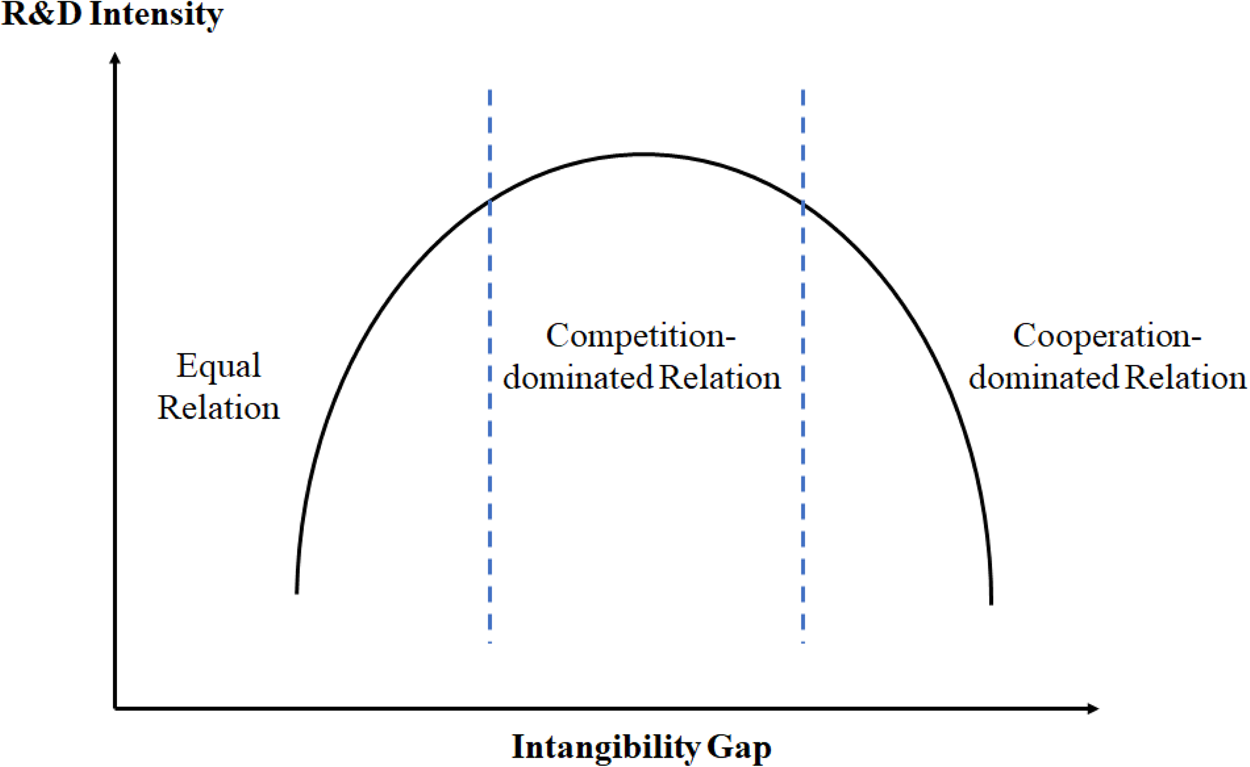
From the coopetition perspective, we propose an inverted U-shaped relationship between intangibility gap and the internal R&D effort of local firms. When the gap is small, it creates a situation of ‘equal relationship’ (Bengtsson & Kock, Reference Bengtsson and Kock2000). Local firms are less motivated to invest in R&D as they face limited threats from industry-frontier foreign competitors. However, when intangibility gap is moderate, local firms are highly motivated and have the potential to alter their disadvantageous positions by increasing internal R&D. That is, local firms may become contenders in the competition-dominated relationship to catch up. Nonetheless, when intangibility gap is too large to overcome, a cooperation-dominated relationship may materialize. Local firms may not be able to rely on internal R&D to catch up (Hudson, Reference Hudson1994; Levinthal & March, Reference Levinthal and March1993). Instead, these firms may seek cooperation with foreign firms. Research has shown that emerging economy firms have benefited tremendously from inward horizontal FDI at home by cooperating with global players through R&D alternatives such as original equipment manufacturing (OEM) (Luo & Tung, Reference Luo and Tung2007).
Moreover, as coopetition has not been frequently used as a mechanism to explain the relationship between foreign and local firms (Devece et al., Reference Devece, Ribeiro-Soriano and Palacios-Marqués2019), it is useful to clarify its boundary conditions – conditions that would influence local firms’ competitive status against foreign firms either through internal characteristics or through external help. We propose that local firms’ resource distribution and provision may serve as boundary conditions of the effect of intangibility gap. Accordingly, we introduce local firms’ export intensity and state ownership as two moderators in the inverted U-shaped relationship between intangibility gap and local-firm R&D effort. We choose these two moderators because they correspondingly represent a firm's resource distribution and provision that may change local firms’ cooperative and competitive positions with inward horizontal FDI in distinct ways. Specifically, exports reduce the direct competition of local firms against foreign firms at home. Thus, when the export intensity of local firms is high, the inverted U-shaped effect will be flattened. Moreover, state ownership is widely observed in emerging economies such as China (Wang, Hong, Kafouros, & Wright, Reference Wang, Hong, Kafouros and Wright2012). Local governments tend to encourage state-owned firms to innovate by providing policy support. Thus, local firms with higher levels of state ownership may be more responsive in a competition-dominated relationship. Thus, when the state ownership of local firms is high, the inverted U-shaped effect will be steepened.
To examine the ideas, we use a sample of manufacturing firms in China and find evidence that supports for our hypothesized relationships. Our study makes two primary contributions. First, we advance the understanding of local firms’ strategic responses to advantaged foreign firms from a coopetition perspective. Second, we introduce the intangibility gap construct to capture various coopetitive relationships and unravel the mechanism of coopetition by introducing export intensity and state ownership as boundary conditions. We detail our contributions in the discussion section.
Theoretical Background and Hypotheses Development
As postulated by the coopetition perspective, coopetition captures the idea of ‘duality in every relationship’ (Brandenburger & Nalebuff, Reference Brandenburger and Nalebuff1996: 39). Competition and cooperation are not two ends of a continuum but rather two independent dimensions (Dowling, Roering, Carlin, & Wisnieski, Reference Dowling, Roering, Carlin and Wisnieski1996; Gomez-Casseres, Reference Gomez-Casseres1999). Thus, firm strategies cannot be reduced to a simple choice between competition and cooperation but respond to complex combinations of competition and cooperation (Le Roy & Sanou, Reference Le Roy and Sanou2014; Luo, Reference Luo2005). Accordingly, coopetition models have been generated from coopetitive relationships (Chin, Chan, & Lam, Reference Chin, Chan and Lam2008). It has been argued that peer-firm relations can be dominated by coexistence, competition, or cooperation (Bengtsson & Kock, Reference Bengtsson and Kock1999, Reference Bengtsson and Kock2000). After making appropriate decisions, successful firms can benefit from these relations (Brandenburger & Nalebuff, Reference Brandenburger and Nalebuff1996). Thus, firms may adopt a range of strategic stances toward other firms in the same industry when responding to such different relations (Lado, Boyd, & Hanlon, Reference Lado, Boyd and Hanlon1997; Luo, Reference Luo2007).
Observations show that horizontal FDI creates a conundrum in understanding innovation engagement as a strategic response of local firms (Ayyagari, Dau, & Spencer, Reference Ayyagari, Dau and Spencer2015; Gu & Lu, Reference Gu and Lu2011; Spencer, Reference Spencer2008). On the one hand, local firms may increase their R&D effort to upgrade their capabilities in response to the competitive threat of advanced foreign firms (Blomström & Persson, Reference Blomström and Persson1983; Zhang, Li, Li, & Zhou, Reference Zhang, Li, Li and Zhou2010). On the other hand, local firms may decrease their R&D effort and seek cooperation with advanced foreign firms (Agosin & Machado, Reference Agosin and Machado2005; De Backer & Sleuwaegen, Reference De Backer and Sleuwaegen2003; Kosova, Reference Kosova2010). Although coopetition has attracted substantial attention in the organization literature, little effort has been made to understand how coopetition affects firm innovation. In particular, few empirical studies have examined how horizontal FDI affects emerging market firms’ innovation efforts. To address the conundrum, we advance the theoretical discussion of how coopetitive relations can be activated by introducing an intangibility gap construct.
Coopetition as a Mechanism of the Intangibility Gap Effect
As noted above, recent research has pointed out that intangible assets can be distinguished from tangible assets in terms of their excludability, tradability, and divisibility (He et al., Reference He, Tong and Xu2022). These three dimensions, put together, suggest that intangible assets are more ambiguous about the link between firm resources and competitive advantages. The value of intangible assets is more difficult to be measured, evaluated, and thus traded in a marketplace. These fundamental differences between tangible and intangible assets imply that the previous findings regarding spillovers based on tangible asset may not be readily applicable to explain the effect of intangible assets (Zhang et al., Reference Zhang, Li and Li2014). It has been widely acknowledged that foreign firms in emerging economies often possess more superior intangible resources than local firms (Blomström & Sjöholm, Reference Blomström and Sjöholm1999), thereby making it difficult for local firms to imitate (Zhang et al., Reference Zhang, Li and Li2014). Up to date, however, we know little about how and to what extent the differences apply to the context of competition–cooperation dynamics.
To provide additional insight, we focus on the effect of intangibility gap by considering differences between the intangible assets of both foreign and local firms. Foreign firms in an emerging market often find themselves on the frontier, whereas local firms are at a distance. The intangibility gap conceptualized in our study captures various coopetitive local–foreign firm relationships. Although the presence of frontier foreign firms can impose substantial competitive threats to local firms in emerging economies (Lamin & Livanis, Reference Lamin and Livanis2013; Lewin, Massini, & Peeters, Reference Lewin, Massini and Peeters2009), the intangibility gap varies across local firms.
From the coopetition perspective, the relationship between local and foreign firms may be differentiated when intangibility gap is at the low, moderate, or high level. Local firms may take different actions (e.g., aggressive or cooperative) to change the disadvantageous position and mitigate the competitive threat. In a competition-dominated relationship, for example, competitive threats were observed in emerging economies, as demonstrated by research on ‘market-stealing’ (Aitken & Harrison, Reference Aitken and Harrison1999) and ‘labor-stealing’ (Wang & Yu, Reference Wang and Yu2007). The former refers to local firms’ market loss because of the competitive advantage of horizontal FDI. The latter occurs when local firms lose their human capital to advantaged foreign competitors (Gu & Lu, Reference Gu and Lu2011; Lu & Ma, Reference Lu and Ma2008). Although local firms may benefit from technical and skilled personnel turnovers from foreign firms, the latter may also attract skilled personnel from the former. Thus, in these situations, local firms may take action to compete.
Coopetition research has focused on either balanced relationships (i.e., high cooperation–high competition and low cooperation–low competition) or imbalanced relationships (i.e., cooperation-dominated and competition-dominated relationships) (Czachon & Mucha-Kuś, Reference Czachon and Mucha-Kuś2014). Research on imbalanced relationships suggests that while cooperation-dominated relationship is more about value creation, competition-dominated relationship is more about value sharing (Zerbini & Castaldo, Reference Zerbini and Castaldo2007). However, this approach ignores balanced relationships. Our study considers both balanced and imbalanced relationships simultaneously to theorize that the degree of intangibility gap (low, moderate, or high) can capture such coopetitive relations as equal, competition-dominated, and cooperation-dominated relations (e.g., Bengtsson & Kock, Reference Bengtsson and Kock2000; Chin et al., Reference Chin, Chan and Lam2008; Lado et al., Reference Lado, Boyd and Hanlon1997; Le Roy & Sanou, Reference Le Roy and Sanou2014; Luo, Reference Luo2007). This theorization challenges the linear way of thinking, suggesting that the intangibility gap impact on firm strategies, such as innovation decisions, may be curvilinear.
Intangibility Gap and Local-Firm R&D Effort
We propose that intangibility gap may have an inverted U-shaped effect on local firms’ internal R&D efforts. According to Haans, Pieters, and He (Reference Haans, Pieters and He2016), developing the inverted U-shaped relationship needs to clarify the underlying causal mechanisms to explain why the causal quadratic relationship comes into existence. Moreover, we need to separately explain the relationship before and after the turning point based on different mechanisms. In addition, we need to explain the combination of different mechanisms resulting in an inverted U-shaped relationship. In line with its procedure, we argue that coopetition is the underlying mechanism of our argument. Given the coexistence of competition and cooperation between foreign and local firms. Our argument is additive. That is, before the turning point, the competition between foreign and local firms may dominate. In the competition-dominated situation (i.e., high competition, low cooperation), we argue that intangibility gap may increase internal R&D. In contrast, after the turning point, the cooperation between foreign and local firms may dominate. In the cooperation-dominated situation (i.e., low competition, high cooperation), intangibility gap may decrease the internal R&D of local firms. Taken together, the additive argument leads to an inverted U-shaped effect on local firms’ internal R&D efforts.
Specifically, before the turning point, intangibility gap changes from a very small or nonexistent equilibrium situation to a moderate level. This change will create a competition-dominated situation in which competitive threats may stimulate laggard local firms to close the gap through an R&D effort (Blomström & Kokko, Reference Blomström and Kokko1998; Spencer, Reference Spencer2008; Zhang et al., Reference Zhang, Li and Li2014). Local firms may become contenders that vie with foreign competitors for the technological upper hand (Chin et al., Reference Chin, Chan and Lam2008; Osarenkhoe, Reference Osarenkhoe2010). Internal R&D can enhance the absorptive capacity of local firms (Blalock & Gertler, Reference Blalock and Gertler2009; Cohen & Levinthal, Reference Cohen and Levinthal1989) to identify, assimilate, and exploit external knowledge (Cohen & Levinthal, Reference Cohen and Levinthal1989). In the same industry-region segment, foreign and local firms share many similarities in managerial know-how, materials and equipment, human resource management, fundamental technologies, and marketing activities. These commonalities lay the foundation for absorbing observable knowledge (Martin & Salomon, Reference Martin and Salomon2003). As catch-up is possible, local firms are likely to pursue internal R&D ‘to understand, interpret, and appraise knowledge that has been placed upon the shelf’ (Rosenberg, Reference Rosenberg1990: 171). In their study of more than 900 manufacturing firms in India, Basant and Fikkert (Reference Basant and Fikkert1996) found significant returns to in-house R&D investment when such an investment is used to assimilate knowledge from foreign firms.
Moreover, research on the leapfrog effect has suggested that technically laggard firms may catch up by engaging in innovation activities (Dore, Reference Dore1990). Internal R&D allows local firms to enhance their capabilities to neutralize competitive threats from foreign firms. Intangible resources, such as knowledge creation, trademarks, and operation process (Steward, Reference Steward1999), allow firms to create barriers to imitation (Barney, Reference Barney1991; Wernerfelt, Reference Wernerfelt1984). When intangibility gap is large, FDIs generate a high barrier to imitation, hindering local firms from absorbing foreign knowledge. In such a case, R&D may enhance firm competitiveness through process improvement or new product development (Grossman & Helpman, Reference Grossman and Helpman2015) to enhance efficiency or generate new knowledge to differentiate from advanced rivals (Cheung, Reference Cheung2010; Katrak, Reference Katrak1997; Lall, Reference Lall1989, Reference Lall1993). In the competition-dominated situation, catching up may occur as emerging market firms tend to develop technological capabilities and improve competitiveness through innovative activities against frontier foreign firms (Kumaraswamy, Mudambi, Saranga, & Tripathy, Reference Kumaraswamy, Mudambi, Saranga and Tripathy2012; Lamin & Livanis, Reference Lamin and Livanis2013; Mudambi, Reference Mudambi2008).
However, after the turning point, a very large intangibility gap may create a cooperation-dominated situation (Bengtsson & Kock, Reference Bengtsson and Kock2000) as internal R&D efforts may not be enough to push local firms to the industry-frontier. Developing new technologies may prove too costly for local firms to catch up. It has been argued that although competition stimulates innovation (for a review, see Gilbert, Reference Gilbert2006), substantial competitive threats may also discourage laggard firms from innovating via R&D (Aghion, Bloom, Blundell, Griffith, & Howitt, Reference Aghion, Bloom, Blundell, Griffith and Howitt2005). Due to the risky, expensive, and time-consuming nature of internal R&D, local firms may seek cost-effective strategies (e.g., reducing R&D investment) (Hudson, Reference Hudson1994; Levinthal & March, Reference Levinthal and March1993). In their study of Belgian manufacturing firms, Veugelers and Houte (Reference Veugelers and Houte1990) found that local firms had low innovation expenses when the share of FDI in the focal industry was high. Katz (Reference Katz, Kim and Nelson2000) showed that the massive arrival of foreign firms in the 1980s hindered local firms from overcoming the imitation barrier. Consequently, local firms’ gradual accumulation of technological development in Mexico, Brazil, and Argentina abruptly stopped.
Moreover, a large intangibility gap may separate local and foreign firms into different strategic groups for laggard local firms to avoid direct competition with frontier foreign firms. Hunt (Reference Hunt1972) coined the term ‘strategic group’ to identify firms that share similar resource combinations and strategic preferences, such as trademarks and product quality (Porac, Thomas, Wilson, Paton, & Kanfer, Reference Porac, Thomas, Wilson, Paton and Kanfer1995; Porter, Reference Porter1980; Reger & Huff, Reference Reger and Huff1993; Sonenshein, Nault, & Obodaru, Reference Sonenshein, Nault and Obodaru2017). Variations in these factors across strategic groups create intergroup mobility barriers (Dranove, Peteraf, & Shanley, Reference Dranove, Peteraf and Shanley1998; Smith, Grimm, Young, & Wally, Reference Smith, Grimm, Young and Wally1997).
In addition, when intangibility gap is very large, local firms are unable to compete with foreign firms. In this situation, advantaged foreign firms tend to exploit their superiority in emerging markets (McDermott & Corredoira, Reference McDermott and Corredoira2010; Ozkan et al., Reference Ozkan, Khan, Deligonul, Yeniyurt, Gu, Cavusgil and Xu2022). They may focus on core business for efficiency and outsource noncore business to disadvantaged local firms. This type of cooperation typically takes the form of OEM, which has been commonly observed in emerging economies (Lee, Song, & Kwak, Reference Lee, Song and Kwak2015; Luo & Tung, Reference Luo and Tung2007; Park, Kim, Kim, & Lee, Reference Park, Kim, Kim and Lee2007). As a result, technically laggard local firms are more likely to accumulate knowledge from cooperation with foreign firms through OEM arrangements, rather than conducting internal R&D.
Research shows that emerging market firms may benefit from the spillover effect of transferred technology in mass production through OEM arrangements (Luo & Tung, Reference Luo and Tung2007).Footnote 3 Such firms may focus on production efficiency with minimum R&D investments during the OEM stage (Lee et al., Reference Lee, Song and Kwak2015). As Hobday (Reference Hobday1995) showed, emerging market firms chose not to invest in R&D in the original stage when facing a large intangibility gap, but focused on OEM as preparation for their later technology catch-up. Such firms may then move on to original design manufacturing (ODM) by designing a few of the products they previously manufactured (Lee & Lim, Reference Lee and Lim2001) and gradually upgrade to original brand manufacturing (OBM) by developing and marketing differentiated products (Park et al., Reference Park, Kim, Kim and Lee2007). This approach is effective for laggard local firms facing a large intangibility gap to survive and grow (Lee et al., Reference Lee, Song and Kwak2015). Thus, a large intangibility gap between laggard local firms and industry-frontier foreign firms may stimulate joint cooperation, reducing local firms’ internal R&D efforts. Taken together, we propose the following curvilinear hypothesis:
Hypothesis 1 (H1): In an emerging economy, the intangibility gap, captured by the difference in intangible asset intensity between foreign and local firms, has an inverted U-shaped relationship with the internal R&D intensity of local firms.
Figure 1 summarizes the arguments above leading to the curvilinear relationship between intangibility gap and local firms’ internal R&D intensity.
Theoretical framework

Boundary Conditions of the Coopetition Perspective
As noted, coopetition is a central mechanism that explains the relationship between an intangibility gap and local firms’ strategic response in emerging economies. For a better understanding of the coopetition mechanism, we further examine how variations in local firms’ resource distribution and provision serve as boundary conditions of the above-proposed relationship. Specifically, we argue that export intensity and state ownership may allow local firms to respond differently to foreign competitive threats.
First, export intensity represents a firm's resource distribution. Coopetitive relationships between local and foreign firms are often geographically constrained within a host country. Thus, local firms with more proportional sales in international markets may be better able to avoid the home-market competition by taking advantage of market differences in terms of price or quality across countries, a strategy known as arbitrage (Ghemawat, Reference Ghemawat2007). As a result, export-intensive firms may harness market opportunities abroad where competition is not as strong as in their home market and deploy fewer resources in the home market. Therefore, we consider local firms’ export intensity as a boundary condition.
Second, state ownership represents a firm's resource provision. Compared to private firms, state-owned enterprises (SOEs) in emerging economies are more likely to leverage the resource support and protection of local governments to manage coopetitive relationships. SOEs are more likely to benefit from government innovation policies than other firms (Li, Xia, & Zajac, Reference Li, Xia and Zajac2018). For example, SOEs would petition the government to set up an infant–industry–protection scheme to fend off foreign competition in their home country (Grossman & Horn, Reference Grossman and Horn1988). Thus, we also consider state ownership as a salient boundary condition of coopetition since local firms receive external resources and support from their governments.
Export intensity as a moderator
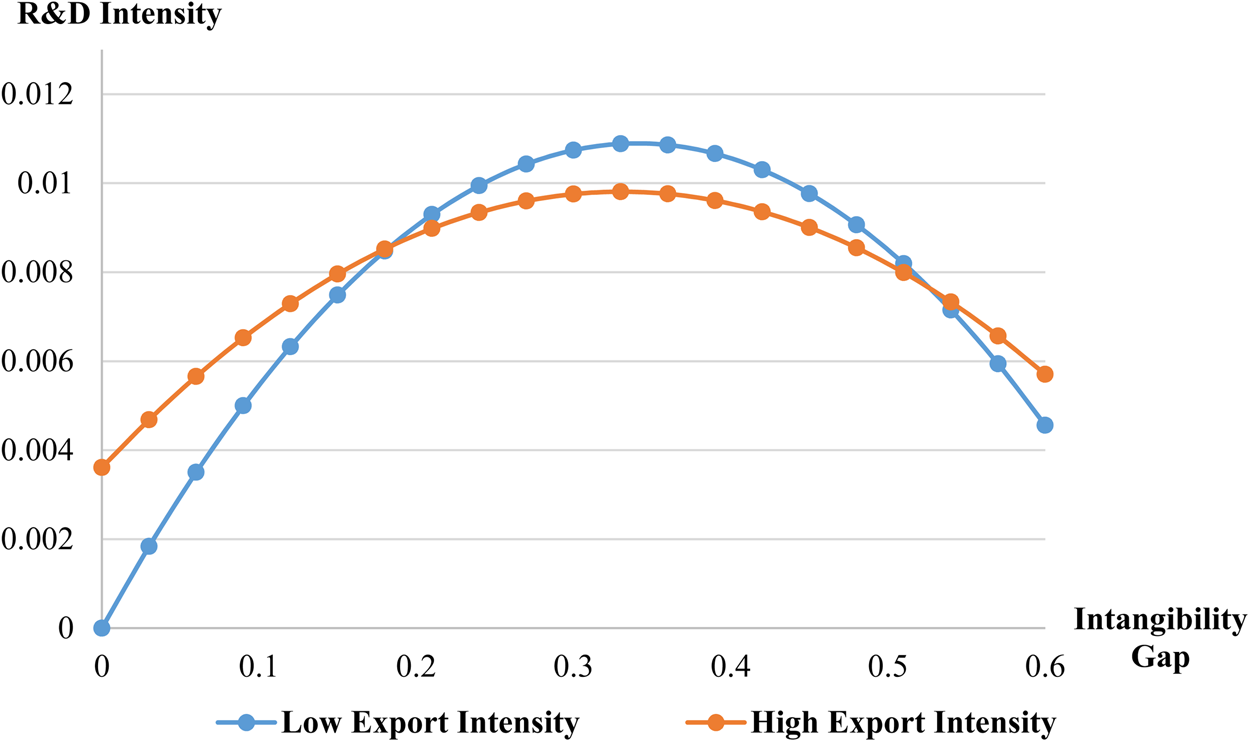
Export intensity, which is often defined as the ratio of exports over total sales (Bonaccorsi, Reference Bonaccorsi1992; Verwaal & Donkers, Reference Verwaal and Donkers2002), not only reflects a reduced dependence of local firms on the home market for sales (Carpenter, Sanders, & Gregersen, Reference Carpenter, Sanders and Gregersen2001; Sullivan, Reference Sullivan1994), but also allows them to benefit from knowledge in foreign markets (Buckley, Clegg, & Wang, Reference Buckley, Clegg and Wang2002; Liu, Lu, Filatotchev, Buck, & Wright, Reference Liu, Lu, Filatotchev, Buck and Wright2010; Wei & Liu, Reference Wei and Liu2006). We propose that by relying on foreign markets for sales, export-intensive local firms may be less responsive to coopetition with foreign firms in their home market compared with other local firms. In particular, they can avoid direct competition with foreign firms in the local market. Thus, export intensity will attenuate the curvilinear effect of intangibility gap on local firms’ internal R&D efforts.
More specifically, export-intensive local firms have a better ability to resort to foreign markets for sales and survival than other local firms (Carpenter et al., Reference Carpenter, Sanders and Gregersen2001; Sullivan, Reference Sullivan1994). When intangibility gap is small, the relationship between local and foreign firms is in an equal situation in which export-intensive firms may be more likely to seek a relative advantage abroad than less-export-intensive firms. When intangibility gap is moderate, a competition-dominated situation will prevail. Export-intensive firms are less vulnerable to domestic competition and market risks as they can diversify through foreign markets. Thus, they are less susceptible to foreign competition and less likely to respond through internal R&D. In contrast, local firms with a higher dependence on domestic markets for sales are more vulnerable to the competitive threats of foreign firms at home given that these local firms are less able to avoid competitive threats from inward FDI compared with export-intensive firms. Thus, less-export-intensive local firms have a stronger incentive to catch up with the industry-frontier by pursuing internal R&D than export-intensive firms.
When intangibility gap exceeds the turning point and becomes very large, a cooperation-dominated situation will prevail in which organizations search for synergies created from complementary resources (Chin et al., Reference Chin, Chan and Lam2008; Osarenkhoe, Reference Osarenkhoe2010). Local firms with a higher home-market dependence are more likely to reduce their internal R&D since a very large gap is more likely to drive such firms to seek cooperation with foreign firms through OEM arrangements (Luo, Reference Luo2004). By contrast, competition in international markets still exists among export-intensive firms, forcing them to maintain R&D efforts for adaptation (e.g., Ito & Pucik, Reference Ito and Pucik1993; Laursen, Masciarelli, & Prencipe, Reference Laursen, Masciarelli and Prencipe2012). For example, Isenberg (Reference Isenberg2008) showed that Tecsis, an export-intensive Brazil-based wind turbine blade manufacturer, focused its R&D only on foreign customers in the US and Europe instead of those in its home market due to competition outside the home market. Therefore, export-intensive firms are less likely to reduce internal R&D compared with their local market-focused counterparts when intangibility gap is large. Taken together, we propose the following hypothesis:
Hypothesis 2 (H2): When the export intensity of a local firm is higher, the inverted U-shaped relationship between the intangibility gap and internal R&D intensity will become flatter.
State ownership as a moderator
Governments in emerging economies rely more on SOEs than private firms to fulfill administrative mandates and political agendas. Hence, they often play important supportive and protective roles in helping SOEs cope with the competitive threats of inward FDIs (Buckley et al., Reference Buckley, Clegg and Wang2002; Chang & Xu, Reference Chang and Xu2008). When SOEs are able to catch up, they may rely on government support to make more R&D efforts. In contrast, when intangibility gap with foreign frontier firms becomes too large for SOEs to catch up, they can rely more on the government to seek cooperation with foreign firms. The critical distinction is whether they have the capacity to catch up. Thus, we propose that local firms with higher state ownership are more likely to adjust their R&D accordingly when responding to an intangibility gap in a competition-dominated situation (Lado et al., Reference Lado, Boyd and Hanlon1997).
If addressing foreign competitive threats is possible when an intangibility gap is at a moderate level, competition-dominated relationship may hold sway. Local firms with higher state ownership are more likely to maintain their R&D efforts in a ‘contending situation’ (Luo, Reference Luo2007) and become contenders due to stronger government support. Emerging market firms may catch up with the industry-frontier through innovation (Ernst & Kim, Reference Ernst and Kim2002; Lee & Lim, Reference Lee and Lim2001). Since SOEs are typically less efficient than private firms, they face a higher risk of bankruptcy or privatization (Xu, Lu, & Gu, Reference Xu, Lu and Gu2014) and are under greater pressure to innovate to stay alive (Zhou, Gao, & Zhao, Reference Zhou, Gao and Zhao2017). As innovation improves competitiveness, the government may view it as a national priority to encourage SOEs to invest in R&D. Therefore, local firms with higher state ownership are more likely to respond to foreign competitive threats through innovation.
Moreover, SOEs are likely to leverage government resources when a moderate intangibility-gap level can be bridged by pursuing internal R&D. Such resources may include government-subsidized financial capital and access to state-controlled infrastructure. Research shows that SOEs often enjoy greater privileges granted by the government, including subsidized credits, strategic planning, antitrust policies, financing, and bank regulations (Zhou et al., Reference Zhou, Gao and Zhao2017). For example, governments are more likely to support SOEs by providing bank loans with favorable terms, such as long-term, low interest rates, compared with private firms (Buckley et al., Reference Buckley, Clegg and Wang2002; Buckley, Cross, Tan, Xin, & Voss, Reference Buckley, Cross, Tan, Xin and Voss2008). Governments may also provide SOEs with relevant resources to enhance their competitive position in addressing foreign competitive threats (Jiang, Branzei, & Xia, Reference Jiang, Branzei and Xia2016). Thus, local firms with high state ownership tend to actively respond to moderate intangibility-gap levels by investing more aggressively in R&D to catch up with foreign firms than those with low or no state ownership.
However, when intangibility gap reaches a high level, cooperation-dominated relationship will prevail. Firms with high state ownership may decrease their R&D investment more quickly than those with low or no state ownership. SOEs tend to hire numerous employees to maintain social stability, conduct businesses critical to economic development, and perform certain administrative functions (Bai, Lu, & Tao, Reference Bai, Lu and Tao2006; Lin, Cai, & Li, Reference Lin, Cai and Li1998). Hence, they are likely to be protected by the government against serious competitive threats. When intangibility gap is very large, SOEs can leverage their connections with important government agencies (Brødsgaard, Reference Brødsgaard2012) and persuade them to adjust policies and regulations to the SOEs’ advantage, such as allowing monopolistic control and increasing segment-entry barriers (Hillman, Zardkoohi, & Bierman, Reference Hillman, Zardkoohi and Bierman1999). For example, the government can make special arrangements to secure critical raw materials and distribution channels for SOEs (Buckley et al., Reference Buckley, Clegg and Wang2002). In contrast, local firms with low or no state ownership may not attract sufficient attention from the government for such policy protections or arrangements. These firms are more likely to maintain their R&D to stay competitive.
Government connections can also help SOEs cooperate with foreign firms through OEM arrangements. In a cooperation-dominated relationship, leading competitors are more likely to share expertise with technically laggard firms (Ulaga, Reference Ulaga2003). Governments may facilitate foreign–local collaboration through FDI policies when SOEs experience difficulty catching up with technology advances (Buckley, Clegg, & Wang, Reference Buckley, Clegg and Wang2007; Chang & Xu, Reference Chang and Xu2008). For example, Chinese government regulations restrict wholly owned foreign subsidiaries, but allow international joint ventures in the automotive industry to pave the way for local–foreign technology development collaboration (Thun, Reference Thun2018). Local firms expect that the government will step in to arrange technology transfer either through purchase or through international joint ventures (Chang & Xu, Reference Chang and Xu2008). In this situation, foreign firms are also likely to cooperate with the host government (Luo, Reference Luo2004). Hence, when intangibility gap is very large, local firms with high state ownership may be more likely to reduce their in-house R&D than those with low or no state ownership. Taken together, we propose that:
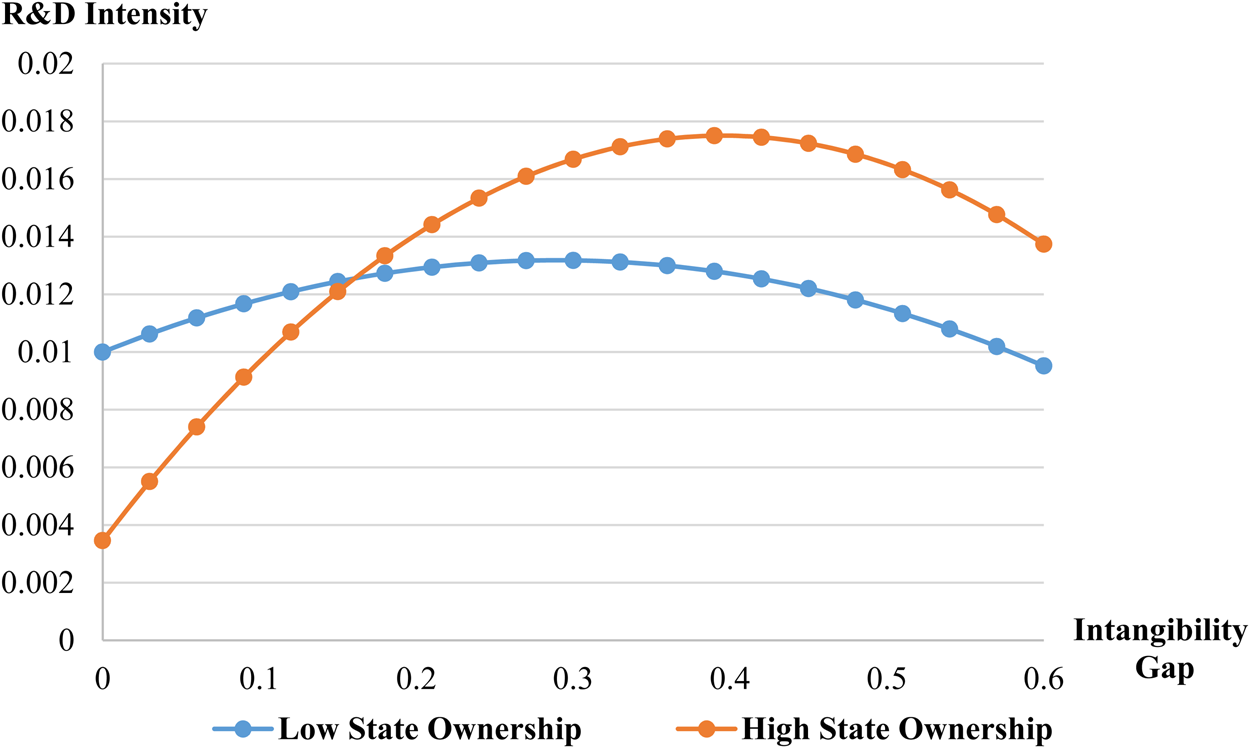
Hypothesis 3 (H3): When the state ownership of a local firm is higher, the inverted U-shaped relationship between the intangibility gap and internal R&D intensity will become steeper.
Methods
Sample
As an emerging economy that has amassed the largest inward FDI in the world over the past decades, China provides an ideal setting to test our theory. We collected data from the Chinese National Bureau of Statistics (CNBS) database that includes manufacturing firms in China. According to regulations, all firms in China must cooperate in surveys conducted by CNBS and submit their annual financial and organizational information. The CNBS database is the most comprehensive information provider on local and foreign firms in China (Xu et al., Reference Xu, Lu and Gu2014; Zhang et al., Reference Zhang, Li and Li2014) and has been widely used in previous studies (Chang & Xu, Reference Chang and Xu2008; Zhang et al., Reference Zhang, Li, Li and Zhou2010, Reference Zhang, Li and Li2014; Zhou & Li, Reference Zhou and Li2008). CNBS provides firm-level financial and R&D-related information from its Industry Department and Science and Technology Department, respectively. We merged these two data sources from the 2001–2007 period during which R&D data are available. The Chinese economy grew steadily without significant interruptions during this time, providing a proper window for our investigation. Given we lagged our independent variables by one year, our sample period ranged from 2002 to 2007.
Our conceptualization focuses on the catch-up strategies of local firms (i.e., 100% domestic-owned firms) with industry-frontier foreign firms (i.e., 100% foreign-owned firms or international joint ventures in which foreign firms have more than 50% ownership). Our final sample consisted of 27,972 firm-year observations from 2002 to 2007, including 10,097 local firms across 34 manufacturing industries at the two-digit level. We used the entire CNBS database rather than the selected sample to calculate all FDI-related variables.
Dependent Variable
R&D intensity
Consistent with previous studies (e.g., Cohen & Levinthal, Reference Cohen and Levinthal1990; Gentry & Shen, Reference Gentry and Shen2013), we measured R&D intensity as the ratio of internal R&D expenditures over sales each year. According to CNBS (2004), internal R&D expenditures include expenses on research, design, making and testing of prototypes, and experimentation; whereas external R&D expenditures refer to the expenses on delegating R&D tasks to other organizations (e.g., universities, research institutions, or other firms). We also used firms’ patent applications as an alternative dependent variable and found consistent results.
Independent and Moderating Variables
Intangibility gap was measured by the difference in intangible asset intensity between the frontier foreign firm and a local firm in the same two-digit industry sector and the same province in the past year (Girma, Greenaway, & Wakelin, Reference Girma, Greenaway and Wakelin1999; Kumaraswamy et al., Reference Kumaraswamy, Mudambi, Saranga and Tripathy2012). Intangible-asset intensity is the ratio of intangible assets over a firm's total assets (Zhang et al., Reference Zhang, Li and Li2014). According to CNBS, intangible assets are nonphysical assets utilized by the firm, including patents, nonpatented technologies, trademarks, copyrights, and goodwill (He et al., Reference He, Tong and Xu2022; Tian, Reference Tian2007; Zhang et al., Reference Zhang, Li and Li2014). We defined foreign firms as 100% foreign-owned firms or international joint ventures in which foreign firms have more than 50% ownership. Data for the intangible-asset intensities of foreign firms were obtained from the CNBS database.
Following previous studies (e.g., Verwaal & Donkers, Reference Verwaal and Donkers2002; Zhang et al., Reference Zhang, Li and Li2014), we measured export intensity by the percentage of export value over a firm's total sales. We captured state ownership with the ratio of a firm's capital received from the government to its total capital (Jia, Reference Jia2014; Marquis & Qian, Reference Marquis and Qian2014).
Control Variables
We controlled for four firm-level variables: firm age, firm size, firm performance, and leverage, which might influence internal R&D intensity (Zhang et al., Reference Zhang, Li and Li2014). Firm age was the natural logarithm of the number of years since a firm was established. Old firms are prone to the influence of organizational inertia, which may affect their internal R&D tendency. Firm size was calculated using the natural logarithm of total assets, which is related to the availability of a firm's slack resources that can be used as inputs to develop internal R&D. Firm performance was calculated as the return on assets (ROA) or percentage of net income over total assets because a better performing firm has more R&D resources. Leverage, which may limit a firm's ability to engage in R&D, was measured by the ratio of liabilities over assets. Marketing intensity was calculated as the ratio of advertising investment over total sales. This variable accounts for marketing costs that would have a complementary impact on firms’ R&D strategies.
At the macro level, we controlled for regional and industry effects. For regional effect, we constructed market environment to capture the level of institutional development in each province. This variable was developed by Fan, Wang, and Zhu (Reference Fan, Wang and Zhu2009) based on the following five factors: (1) development of market intermediary organizations, (2) producers’ legal rights and interests protection, (3) intellectual property protection, and (4) consumer rights protection. Higher scores indicate a better legal institution for R&D activities. This provincial-level marketization index, developed in 1997, is updated yearly and has been widely applied in economics and finance studies (e.g., Chen, Firth, Gao, & Rui, Reference Chen, Firth, Gao and Rui2006; Fan, Wong, & Zhang, Reference Fan, Wong and Zhang2013), management (e.g., Markóczy, Li Sun, Peng, & Ren, Reference Markóczy, Li Sun, Peng and Ren2013), and international business (e.g., Gao, Murray, Kotabe, & Lu, Reference Gao, Murray, Kotabe and Lu2010). For industry effect, we constructed industry complexity and industry dynamism. Industry complexity was measured by the degree of competition in the industry using a transformation of the Herfindahl index (Herfindahl, Reference Herfindahl1950; Raghunathan, Reference Raghunathan1995). The Herfindahl index was computed by squaring the market shares of each competitor among n competitors in an industry. We calculated industry complexity as:

Industry dynamism was captured by a volatility index calculated as the standard error of the regression slope coefficient in a regression of industry sales for each year over the five-year period against a time (year) variable (Keats & Hitt, Reference Keats and Hitt1988).
The Sino-U.S. trade friction may also impact firms’ R&D strategies. We thus controlled for Sino-U.S. trade volume, measured by the natural logarithm of yearly bilateral trade volume between China and the US.
Finally, we added year dummies in all models to control for unobservable temporal effects. Since we used the fixed effect regression to estimate the results, time-invariant variables, such as industry dummies, were dropped from the analysis.
Data Analysis
We used the Breusch–Pagan Lagrange multiplier test to identify unobserved individual firm effects in the sample. After confirming the existence of such effects, we used the panel data method instead of the generalized ordinary least squares approach to test our model (Wooldridge, Reference Wooldridge2002). We also conducted a Hausman test to determine whether fixed or random effects models should be used to test our hypotheses. Correlations were observed between the explanatory variables and the unobserved effects in the sample. Hence, the fixed effect regression was more appropriate for estimating our results. Therefore, we used fixed-effects models to estimate our predicted relationships.
Given the proportional nature of our dependent variable – internal R&D intensity bound between 0 and 1 – arbitrary limits on the range of variation in the dependent variable need to be imposed in the estimation (Papke & Wooldridge, Reference Papke and Wooldridge1996). Thus, we adopted a fixed-effects Tobit model to conduct our statistical analyses. The Tobit model, also known as a censored regression model, allows accurate estimation when the dependent variable is censored from above and/or below (i.e., limited dependent variable) (Long, Reference Long1997; Tobin, Reference Tobin1958). We used metobit command in STATA 15 in performing the analyses.
Results
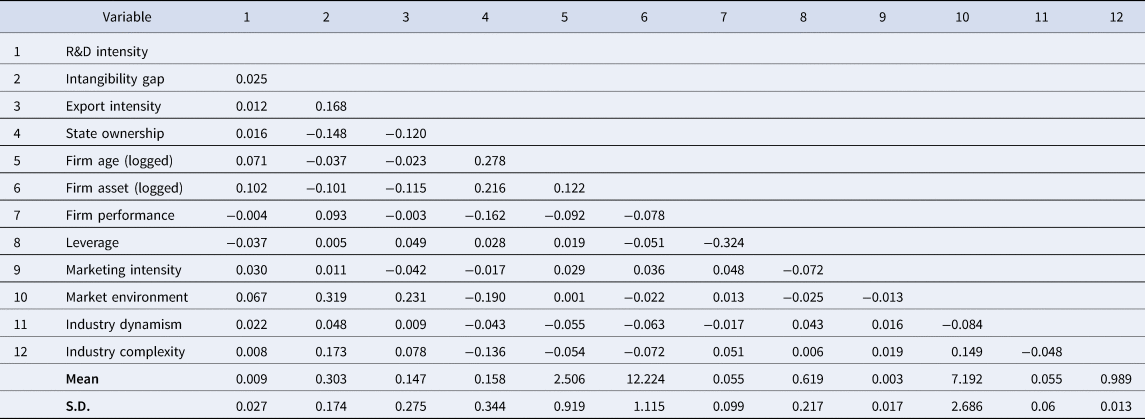
Table 1 presents the correlation matrix, means, and standard deviations of the variables. The variance inflation factor (VIF) test shows that all VIF values are below 1.21. Hence, multicollinearity is not a problem in our regression analyses.
Descriptive statistics and correlations of variables

Notes: a. N = 27,972. b. Correlation coefficients with a magnitude greater than 0.01 are significant at the p < 0.05 level (two-tailed test).
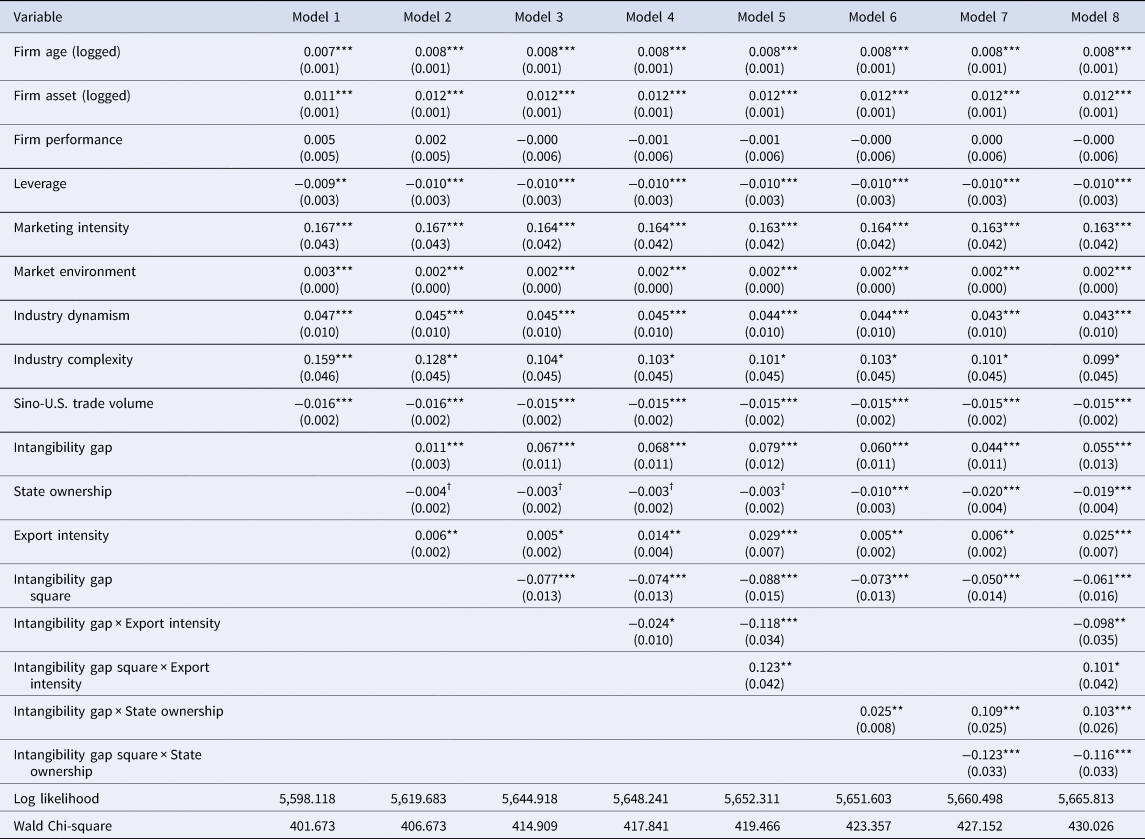
Table 2 presents estimations of the fixed-effects models. Model 1 only includes the control variables. Model 2 adds the main effects. Model 3 adds the square term of intangibility gaps. Models 4 and 5 include the interaction terms using export intensity as the moderator. Models 6 and 7 include the interaction terms using state ownership as the moderator. Model 8 is the full model that includes all individual and interactive effects. The results show model improvements as we added the independent variables and interactions in the regressions. Among significant controls, larger, older firms with high advertising fees or a lower level of debt financing tend to maintain higher levels of internal R&D compared with their counterparts, as expected. We also find that firms located in better market environments or in more dynamic and complex industries have higher levels of internal R&D.
Results of fixed-effects Tobit models

Notes: a. N = 27,972. b. Robust standard errors in parentheses. c. †p < 0.10; *p < 0.05; **p < 0.01; ***p < 0.001. d. Year dummies are included.
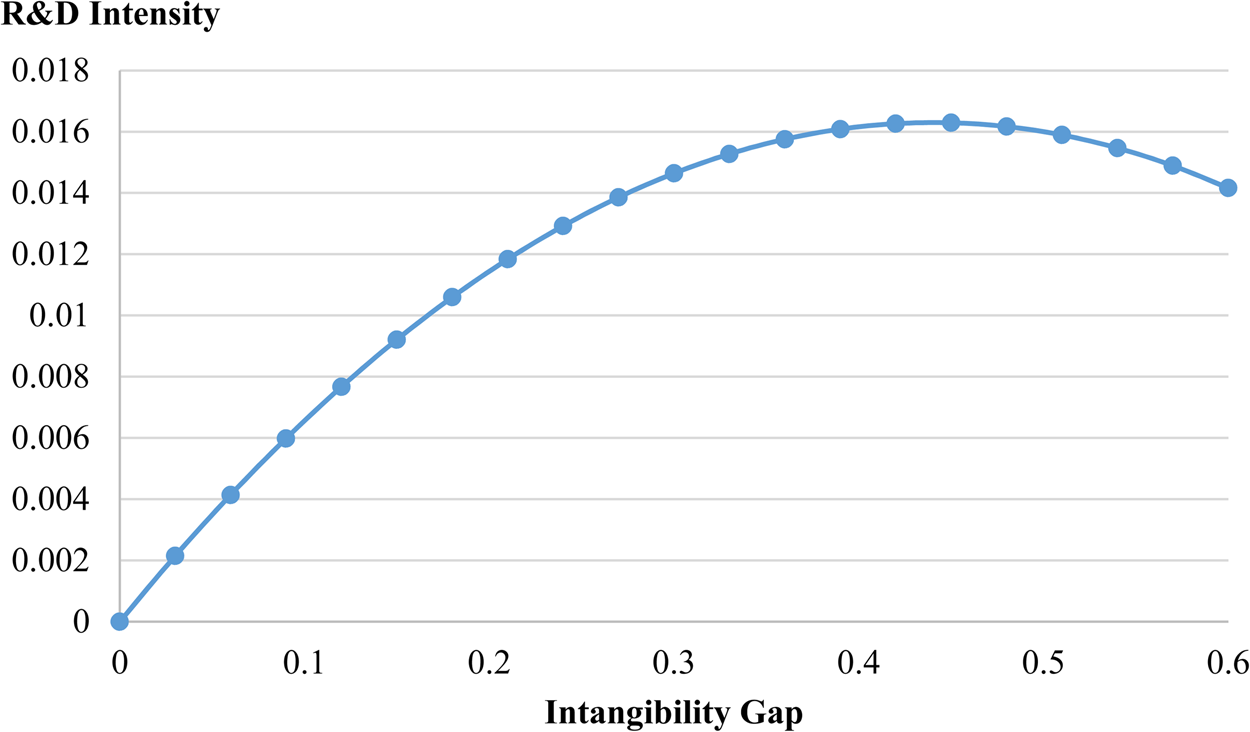
Hypothesis 1 suggests an inverted U-shaped relationship between intangibility gap and R&D intensity of local firms. The coefficient of the linear term of intangibility gap is positive and significant (b = 0.067, p < 0.001), and that of the square term of intangibility gap is negative and significant (b = −0.077, p < 0.001), as shown in Model 3. Following suggestions in prior studies (Haans et al., Reference Haans, Pieters and He2016; Lind & Mehlum, Reference Lind and Mehlum2010), we further tested whether the slope is sufficiently steep at both ends of the data range and whether the turning point locates well within the data range. Slope tests showed that both the positive slope at the lower bound (t-value = 2.959, p < 0.01) and the negative slope at the upper bound (t-value = −2.49, p < 0.01) are significant. As shown in Figure 2, local firm's R&D intensity first increases and then decreases as the intangibility gap increases, thereby supporting the inverted U-shaped prediction in Hypothesis 1.
Intangibility gap and R&D intensity

Hypothesis 2 proposes that the inverted U-shaped relationship between intangibility gap and internal R&D intensity will be less pronounced when the local firm's export intensity is high. In Model 5, the coefficient of the interaction between export intensity and intangibility gap is negative and significant (b = −0.118, p < 0.001). The interaction between export intensity and the square term of intangibility is positive and significant (b = 0.123, p < 0.01). Figure 3 demonstrates the moderating effect. Consistent with Hypothesis 2, the inverted U-shaped relationship becomes flatter when the local firm's level of export intensity is higher.
Moderating effect of export intensity

Hypothesis 3 posits that state ownership strengthens the inverted U-shaped relationship between intangibility gap and internal R&D intensity. Model 7 shows that the coefficient of the interaction between state ownership and intangibility gap is positive and significant (b = 0.109, p < 0.001) and that of the interaction between export intensity and the square term of intangibility gap is positive and significant (b = −0.123, p < 0.001). Figure 4 shows the moderating effect of state ownership. As expected, the inverted U-shaped relationship becomes steeper when the local firm has a higher level of state ownership.
Moderating effect of state ownership

Given that R&D intensity is a limited dependent variable, we must interpret our results with caution. Following suggestions in prior studies (Hoetker, Reference Hoetker2007; Wiersema & Bowen, Reference Wiersema and Bowen2009; Zelner, Reference Zelner2009), we examined the marginal effects of all interaction terms to provide more accurate interpretations of the predicted moderating effects. We found that all marginal effects are statistically significant with clear plots supporting our hypotheses.
Robustness Checks
We conducted two sensitivity analyses to check the robustness of our results. First, we used firm affiliation with the central government as an alternative measure to state ownership to capture the state influence. Firm affiliation captures the degree to which a local firm is under government administrative control. Each firm may be affiliated (have a lishu relationship) with the central, provincial, city/district, county, or town/township/street governments (Tan, Li, & Xia, Reference Tan, Li and Xia2007; Wang et al., Reference Wang, Hong, Kafouros and Wright2012). A local firm's affiliation with the central government can be associated with its institutional support and protection, which influences its motivation to invest in R&D. We coded the variable affiliation with the central government as 1 for firms affiliated with the central government and 0 otherwise. The results are consistent with the findings as reported.
Second, we recalculated intangibility gap using the maximum value of foreign firms in the same two-digit industry sector and city, as different operationalizations in geographic scope may capture different magnitudes of foreign competitive threats. The results also remain consistent with our predictions. All robustness test results are available upon request.
Discussion
From a cooperation perspective, we have examined how local firms in emerging economies respond to the intangibility gap between industry-frontier foreign firms and local firms through internal R&D. We find that a moderate level of intangibility gap is more likely to stimulate local firms’ internal R&D than a small or large intangibility gap. Moreover, export intensity weakens the inverted U-shaped relationship, whereas state ownership strengthens such a relationship. Our findings have important theoretical and practical implications.
Theoretical Contribution
Our study contributes to the coopetition perspective by developing a construct of intangibility gap to link different combinations of cooperation and competition. This contribution is important for two reasons. First, we advance the understanding of local firms’ strategic responses to advantaged foreign firms from the coopetition perspective, which extends the existing literature that has emphasized the spillover mechanism underlying productivity gap in explaining local firms’ strategic decisions (Aitken & Harrison, Reference Aitken and Harrison1999; Zhang et al., Reference Zhang, Li and Li2014). This literature falls short in accounting for intangibility gap between foreign and local firms which may increase barriers to imitation and reduce spillover effects. By focusing on how the coopetitive relationships between foreign and local firms change with different levels of intangibility gap, we advance the understanding of the antecedents of emerging market firms’ R&D efforts. Second, prior research drawing from the coopetition perspective has rarely examined how coopetitive relationships among firms may vary (i.e., equal, competition-dominated, and cooperation-dominated relationships) and generate varying effects on firms’ strategic decisions (Czachon & Mucha-Kuś, Reference Czachon and Mucha-Kuś2014). We extend this perspective by introducing the intangibility gap construct to capture various coopetitive relationships (Bengtsson & Kock, Reference Bengtsson and Kock2000), which explains why some firms tend to catch up through internal R&D investment while others do not (Balasubramanian, Reference Balasubramanian2011).
Importantly, our study shifts attention to show that the relationship between foreign and local firms may differ in coopetitive situations captured by intangibility gap, which departs from traditional approaches relying on coopetition in study of alliance partner relations (Czachon & Mucha-Kuś, Reference Czachon and Mucha-Kuś2014). In general, coopetitive actions can be categorized into mono-players (alienators), contenders, partners, and adapters (Chin et al., Reference Chin, Chan and Lam2008; Lado et al., Reference Lado, Boyd and Hanlon1997; Luo, Reference Luo2004; Osarenkhoe, Reference Osarenkhoe2010). Some firms may become complementors (Dussauge & Garrette, Reference Dussauge and Garrette1997), while others may become rivals (Wilhelm, Reference Wilhelm2011). In balanced situations of competition and cooperation, local firms can be mono-players or adapters to coexist with foreign firms. In competition-dominated situations, a local firm can be a contender to catch up. In cooperation-dominated situations, local firms can be partners to cooperate with foreign firms. A mismatch of roles and situations may lead to ineffective innovation strategies.
Our study helps address coopetitive relationships in which local firms respond to a foreign competitive threat at home by catching up through developing internal R&D strategies. Research on the effects of horizontal FDI on local firms’ decisions and outcomes can be traced back to the ‘technology-gap hypothesis’ (Gerschenkron, Reference Gerschenkron1962). The technology gap refers to the relative technology backwardness of local firms vis-à-vis frontier foreign firms that results in technological spillovers and competitive threats from inward FDI in emerging economies (Spencer, Reference Spencer2008; Zhou, Van Witteloostuijn, & Zhang, Reference Zhou, Van Witteloostuijn and Zhang2014). Traditionally, the literature examined the local firms’ catch-up behaviors either focusing on cooperation with foreign firms (e.g., Giuliani et al., Reference Giuliani, Martinelli and Rabellotti2016; Gu & Lu, Reference Gu and Lu2011; Parente et al., Reference Parente, Melo, Andrews, Kumaraswamy and Vasconcelos2021) or on competition against foreign firms (e.g., Young et al., Reference Young, Huang and McDermott1996). Our study looks into local firms’ strategic responses from a coopetition perspective, revealing a more complete picture of how local firms’ R&D strategies are influenced by local firms’ cooperative and competitive relationships with frontier foreign firms.
Furthermore, several studies followed the spillover approach to explore the monotonic effect of productivity gap (Girma et al., Reference Girma, Greenaway and Wakelin1999; Zhang et al., Reference Zhang, Li, Li and Zhou2010). This line of inquiry suggests that a larger productivity gap creates greater opportunities for technology upgrades in local firms (Eapen, Reference Eapen2012; Meyer & Sinani, Reference Meyer and Sinani2009). Nevertheless, research on productivity gap has been questioned in other studies (Perez, Reference Perez1997; Zhou et al., Reference Zhou, Van Witteloostuijn and Zhang2014) because it overlooks foreign firms’ intangible assets that can serve as a barrier to the spillover effect (Zhang et al., Reference Zhang, Li and Li2014). Especially, when intangibility gap is large, it creates a barrier for local firms to absorb advanced knowledge from foreign firms. Several studies have suggested that the relationship between competition and innovation can be nonmonotonic (Aghion, Harris, Howitt, & Vickers, Reference Aghion, Harris, Howitt and Vickers2001; Boone, Reference Boone2001; Sjöholm & Lundin, Reference Sjöholm and Lundin2013). However, even given this theoretical progress, existing studies have not systematically investigated the coopetitive relationships between local and foreign firms in terms of how intangibility gap affects local firms’ innovation strategies.
The lack of discussion on this important strategic issue challenges a clear understanding of the relationship between local–foreign coopetition and local firm strategy. For a more nuanced understanding of the effects of horizontal FDI, we focus on the intangibility gap, which captures the equal, competition-dominated, and cooperation-dominated relationships (Bengtsson & Kock, Reference Bengtsson and Kock2000; Rusko, Reference Rusko2011) between local and foreign firms. From the perspective of foreign firms, intangible resources are sources of sustainable competitive advantage (Reed & DeFillippi, Reference Reed and DeFillippi1990). By contrast, this advantage of foreign firms poses competitive threats from the local firms’ perspective. Our coopetition approach is fruitful in explaining how technically laggard local firms may coexist, cooperate, or compete with foreign firms.
We further unravel the mechanism of coopetition by introducing export intensity and state ownership as boundary conditions. Therefore, our study also adds to the literature on emerging market firm strategies by providing insights on how local firms adjust their internal R&D in different coopetitive relationships. Specifically, we deepen the understanding of the central mechanism of coopetition by showing export intensity as a boundary condition. The curvilinear relationship between intangibility gap and internal R&D intensity is less pronounced for export-intensive local firms. In a study of Japanese firms entering the U.K. in the 1980s, Dunning (Reference Dunning1988) showed that local firms react to mounting competitive threats by diversifying their product portfolios. Export intensity reflects the dependence of a firm on foreign markets (Carpenter et al., Reference Carpenter, Sanders and Gregersen2001; Verwaal & Donkers, Reference Verwaal and Donkers2002) and the degree to which the firm has to face competition beyond the home market (Buckley et al., Reference Buckley, Clegg and Wang2002; Liu et al., Reference Liu, Lu, Filatotchev, Buck and Wright2010; Wei & Liu, Reference Wei and Liu2006). Our study extends this body of research by drawing attention to the moderating effects of export intensity on inward FDI.
In addition, we advance the coopetition perspective by showing that firms with high state ownership are more responsive to the intangibility gap than those with low state ownership. Due to their lack of efficiency, SOEs are under greater pressure than private firms to address competitive threats from the industry-frontier foreign firms in their home market. Thus, SOEs are likely to leverage resources gained from the government to innovate when they can catch up. However, the competitive landscape may change when intangibility gap is very large, because the foreign frontier firms and the local firms may fall into different strategic groups within the industry, and thus the local firms may seek cooperation (Smith et al., Reference Smith, Grimm, Young and Wally1997). In cooperation-dominated situations, firms with high state ownership are likely to decrease their internal R&D efforts because they are more likely to gain foreign collaborations.
Our study contributes to the catch-up literature (Lamin & Livanis, Reference Lamin and Livanis2013) by showing how local firms respond strategically to the competitive threat of industry-frontier foreign firms. Traditional approaches have often treated the local firms’ R&D as a given condition (e.g., Kathuria, Reference Kathuria2000; Meyer & Sinani, Reference Meyer and Sinani2009) rather than as a strategic response to horizontal FDI. Our study fills this notable research gap. The inverted U-shaped impact of intangibility gap revealed in our study indicates that coopetition is at play for local firms. In addition, although previous studies have largely focused on imitative catch-up that emphasizes the spillover benefits from foreign firms (Meyer & Sinani, Reference Meyer and Sinani2009), they have neglected innovative catch-up to address competition via R&D. Given that FDI also brings barriers to imitation and poses competitive threats to local firms (Zhang et al., Reference Zhang, Li and Li2014), our study extends this literature by emphasizing another important approach to address foreign competition: innovative catch-up via internal R&D. Previous studies have shown that the effective deployment of strategic resources may thwart competitive threats (Barney, Reference Barney1991; Newbert, Reference Newbert2008). We suggest that competition-dominated situations likely stimulate emerging market firms to catch up as they have both the necessity and possibility to do so.
Our study enriches the understanding of cooperation as a strategic response of emerging market firms to inward FDI (Gu & Lu, Reference Gu and Lu2011). Most studies emphasized the competitive advantages of foreign firms as they possess superior resources (Kogut & Zander, Reference Kogut and Zander1993). When intangibility gap is small, it only poses limited competitive threats to local firms. Our study implies that in cooperation-dominated situations, technically laggard local firms are more likely to learn from foreign firms through OEM arrangements. More broadly, our findings imply that emerging market firms may use various cooperative strategies to catch up, such as joint ventures, alliances, and networks (McDermott & Corredoira, Reference McDermott and Corredoira2010), buyer–supplier relationships (Kumaraswamy et al., Reference Kumaraswamy, Mudambi, Saranga and Tripathy2012), and location choices (Lamin & Livanis, Reference Lamin and Livanis2013). Therefore, increasing internal R&D may not be the only choice and means for local firms to catch up. Partitioning foreign and local firms into different strategic groups becomes possible when intangibility gap is enormous, thereby reducing the direct foreign competitive threat to the local firms. In cooperation-dominated situations, local firms may pursue cost-effective strategies to stay alive. The implications of our findings are profound, which suggests that a cooperative strategy may occur in local firms when intangibility gap is large. In other words, when FDI poses serious competitive threats that a specific local firm is unable to address, the firm resorts to cooperation and thus reduces its R&D as a response. Future studies can explore other strategic choices of local firms, such as their decisions of external R&D and their ‘make-or-buy’ choice for the purpose of catching up.
Practical Implications
Our findings have implications for corporate leaders. In emerging economies, local firms are challenged by their foreign counterparts (Lamin & Livanis, Reference Lamin and Livanis2013). Technically laggard firms are encouraged to invest in R&D before competing effectively with advanced rivals (Aghion et al., Reference Aghion, Harris, Howitt and Vickers2001; Boone, Reference Boone2001; Sjöholm & Lundin, Reference Sjöholm and Lundin2013). Indeed, competition encourages innovative thinking, technological development, and the pursuit of internal R&D to upgrade technological capabilities. Investigating R&D strategies of local firms in response to foreign competitive threats in emerging economies yields insightful results that enrich the catch-up literature. However, the ways local firms change their internal R&D strategy as a response to coopetition remains unknown. Our study provides a fine-tuned analysis of the strategic responses of local firms. On the one hand, local firms can invest in internal R&D to improve their disadvantaged position. On the other hand, local firms must keep in mind that a large intangibility gap drives cooperation. Although internal R&D allows local firms to enhance their market positions through differentiation, this process may be costly, risky, and time-consuming. Thus, seeking local–foreign collaborations may be a more viable and rational choice. This approach allows firms to save costs and benefit from inward FDI. Our findings suggest that cooperation and competition strategies can be used in different situations.
In the meantime, managers may actively seek help from local governments to ease their disadvantages. Local governments are likely to step in to establish policies and regulations favorable to SOEs to enable them to survive in the face of foreign firms’ powerful aggression when facing a large intangibility gap. Finally, managers may consider using exports to manage competition at home. Increased exports can minimize competitive threats in home markets. Managers can adjust their R&D investments in response to various levels of intangibility gap by referring to the different scenarios identified in this study. In addition, local firms may turn to technology markets and purchase advanced technology (Arora, Fosfuri, & Gambardella, Reference Arora, Fosfuri and Gambardella2002).
Limitations and Future Research
Our findings must be interpreted in light of certain limitations that may spur new directions for future research. First, the coopetition between foreign and local firms is subject to the complex international competitive environment. Due to data limitations, we are unable to obtain foreign country information. Thus, we used the firm-year design as our unit of analysis. Although the firm-year design is frequently used in the same context in existing studies (e.g., Zhang et al., Reference Zhang, Li, Li and Zhou2010, Reference Zhang, Li and Li2014), this research design is unable to control the international competitive environment. Thus, future research may use a firm-country-year research design to control for such environmental influences, producing more robust results.
Second, intangible assets include different elements such as patents, trademarks, and copyrights (Tian, Reference Tian2007; Zhang et al., Reference Zhang, Li and Li2014). Because of data limitations, we are unable to differentiate different types of intangibility gap. Given that our study as a first step to test the coopetition in this field, the overarching approach may provide fresh insights for future research. Thus, we encourage future research to use separate measures of intangibility gaps that may provide a more nuanced understanding of the influences of specific intangible assets.
Third, we identify internal R&D as a strategic response to local–foreign coopetition. However, local firms can also use other strategies to stay competitive. For example, disadvantaged local firms prompted by increased competitive threats from horizontal FDI may rely on other solutions such as diversification, technology purchasing, or cooperative relationships through international joint ventures. Future research could examine how various strategies respond to intangibility gap in different ways.
Fourth, we tested our theoretical framework using data from a single-country setting (i.e., manufacturing firms in China). We believe that our theory can be applied to other countries where intangibility gap exists between foreign and local firms. Specifically, our theoretical framework on coopetition may provide a foundation for understanding the strategies of local firms to catch up in other emerging and transition economies that have attracted substantial FDI. Future research can extend our framework to other contexts to provide further insights.
Finally, future research may benefit from considering other boundary conditions of the coopetition perspective. We provide evidence on how export intensity and state ownership serve as boundary conditions of the inverted U-shaped relationship between intangibility gap and internal R&D in opposite directions. However, other boundary conditions may exist. Future research could investigate such conditions using other nuanced approaches.
Conclusion
This study advocates a coopetition perspective and provides insights into how intangibility gap, as a proxy of coopetition, affects local firms’ internal R&D decisions. Our study is among the first to unpack the black box on local firms’ strategic responses to the existence of advanced foreign counterparts through internal R&D. We also introduce the export intensity and state ownership of local firms as boundary conditions to clarify the mechanism that explains the proposed relationship. We show that as export intensity and state ownership increase, the inverted U-shaped relationship between the intangibility gap and local firms’ internal R&D effort is less and more pronounced, respectively. We hope that our theory and findings will inspire further research on the strategies of local firms in response to FDI externalities in different contexts.
Jun Xia (jun.xia@utdallas.edu) is a professor in Management and Strategy at the University of Texas at Dallas. His research interests include resource dependence and power, institutional theory, social networks, and corporate strategies. His work has been published in the Strategic Management Journal, Academy of Management Journal, Organization Science, Journal of Management, Journal of Management Studies, and Organizational Research Methods. He is a Senior Editor of Management and Organization Review and a review board member of Academy of Management Review and Journal of International Business Studies.
Qian Cecilia Gu (qgu@gsu.edu) is an associate professor at Georgia State University. Her research interests lie at the intersection of strategy, international business, and entrepreneurship. Her research advances the understanding of how emerging market firms address evolving stakeholder demands and global competition, and how these strategic choices affect firm performance. Her works have appeared in the Administrative Science Quarterly, Journal of Business Venturing, Journal of International Business Studies, Journal of Management, Organization Science, Personnel Psychology, and Strategic Management Journal.
Marshall S. Jiang (mjiang@brocku.ca) is a professor of International Business at Brock University. He received his PhD from York University. His research interests cover the areas of foreign entry mode (particularly licensing and joint ventures), international knowledge transfer, indigenous technology and management innovation, the effect of FDI on emerging markets, organizational learning through partnering. His papers have been published in the Journal of International Business Studies, Management International Review, Journal of World Business, and Journal of International Management.
Zhouyu Lin (linzhouyu@jnu.edu.cn) is an associate professor of Management School, Jinan University. He received his PhD from the University of International Business and Economics. His research focuses on innovation, corporate strategies, and foreign market expansion. His research has appeared in journals such as Strategic Management Journal, Journal of Management Studies, and Journal of World Business.