The sex ratio at birth (SRB), expressed as male per 100 female live births, is also termed the ‘secondary sex ratio’; the ‘primary’ is the ratio of males to females at conception. The average SRB worldwide is around 105 but it can vary appreciably across populations and over time periods (Teitelbaum, Reference Teitelbaum, Harrison and Boyce1972; Chahnazarian, Reference Chahnazarian1988; Jacobsen et al., Reference Jacobsen, Møller and Mouritsen1999; Dubuc & Coleman, Reference Dubuc and Coleman2007). This variability may be related to differences in the primary sex ratio and differential sex-specific intrauterine loss (Markle, Reference Markle1974; Tremblay et al., Reference Tremblay, Vezina and Houde2003). Measurement of these factors, however, has proved difficult and relevant data are scarce. Hence, a great amount of research relies on less direct evidence, based on factors associated with the underlying biological mechanisms.
Primary sex ratio is influenced by hormone levels around the time of the conception (James, Reference James1996a, Reference James2004) and, in particular, gonadotrophin and testosterone. It has been argued that demographic factors, such as parental ages, birth order, length of birth intervals (Teitelbaum, Reference Teitelbaum, Harrison and Boyce1972; Erickson, Reference Erikson1976; James, Reference James1987; Chahnazarian, Reference Chahnazarian1988; James, Reference James1996b), specific illnesses (Semple, Reference Semple1986), adverse occupational exposure of father (James, Reference James2004) and reproductive hazards attributable to environmental conditions (Van Larebeke et al., Reference Van Larebeke, Sasco, Brophy, Keith, Gilbertson and Watterson2008) may influence hormone levels. Moreover, socioeconomic status of parents may affect SRB through reduced rates of male fetal loss during pregnancy, related to maternal nutrition, health and prenatal care (Markle, Reference Markle1974; Chahnazarian, Reference Chahnazarian1988).
The largest natural variation in SRB is observed between ethnic groups (Jacobsen et al., Reference Jacobsen, Møller and Mouritsen1999). Differences by race are well documented; African-American and African populations have on average lower SRB compared with whites while the ratio seems highest among Asian people (James, Reference James1984, Reference James1985; Ruder, Reference Ruder1985; Garenne, Reference Garenne2002; Seth, Reference Seth2010). Variability between populations of the same race can also be substantial; for instance the ratio ranges from about 100 to 107 among African populations (Garenne, Reference Garenne2002). Such differentials have been attributed to hormonal and physiological differences but also, on some occasions, to the practice of sex-selective abortion, in countries such as China and India (Dubuc & Coleman, Reference Dubuc and Coleman2007; Seth, Reference Seth2010).
Greece's population has been subjected recently to a substantial alteration of its ethnic composition due to immigration. Since the early 1990s the country has experienced sizeable migration inflows as a result of significant historical events. Immigration has been the main steering force behind population changes over the past 20 years. According to recent estimates (2005) immigrants in Greece account for over one million persons, representing 9% of the total population of the country (Tsimbos, Reference Tsimbos2008). The majority of foreign-origin population comes from Albania (60%) but a considerable share also originates from other Balkan countries, the former USSR and Asian and African regions.
Under the pressure from increasing immigration streams, the Greek statistical authorities have made an effort since 2004 to collect vital registration data by citizenship, a criterion used by the Ministry of the Interior to identify foreign-origin population for administrative and legislative purposes (Ministry of the Interior, 2007).
The present study makes use, for the first time, of restricted access individual-level vital registration data of Greece for 2006 to investigate differentials in SRB between the native and immigrant populations. As Greece is a country with short immigration history, only first-generation migrants are considered. The available information includes live births classified by citizenship, age, live birth order, marital status, educational attainment and occupation of mother. For legitimate live births there is also some information on paternal characteristics. Birth registration in Greece is complete and since virtually all births (99.9%) to native as well as immigrant women occur in maternity wards and hospitals, the relevant data are considered reliable. Apart from the descriptive part of the analysis, logistic regression models are used to identify significant differences in the propensity to have a male birth between ethnic groups. Hence, the dependent variable is the sex of the birth, taking the value of 1 for boys and 0 for girls. Independent variables include demographic characteristics (maternal and paternal age at birth and live birth order) as well as indicators of citizenship for groups of immigrants with a fairly large size.
According to the official records, in 2006 immigrant births (19,458) represented 17.4% of the total number (112,042). This is a considerable share compared with other European countries with a much longer immigration history (Sobotka, Reference Sobotka2008). Sixty-one per cent of births to foreign-origin women are attributable to Albanian mothers, 5.7% to Romanian and 5.4% to Bulgarian mothers. Births to Asian and African mothers represent 6.4% and 2.8% of the total immigrant births, respectively. Births to mothers from other European countries represent 6.4%.
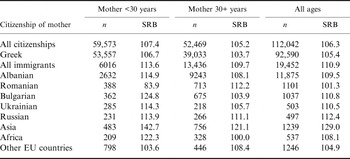
Sex ratios at birth for the native population and the more numerous groups of immigrants are presented in Table 1. Ratios are also shown for mothers below and above age 30; this dividing point was chosen as it represents both the median and the mean age of mothers in Greece in 2006. The SRB for Greek mothers is 105.4, considerably lower than that for immigrants (110.9). The ratio is fairly high among Albanian (109.5), Bulgarian (110.8), Ukrainian (110.5), Russian (112.4) and African (108.1) mothers, while it is exceptionally high for Asians (129.0). In contrast, it is quite low among Romanians (101.3). Given that numbers of births for most of these groups are small it seems that the only significant differences in comparison with Greeks are those concerning Albanians and Asians. Regarding mother's age, SRB seems higher among younger women; for Greek women the ratio is 106.7 compared with 103.7 for those aged at least 30. The respective figures for immigrants are 113.6 and 109.7.
Sex ratio at birth in broad age groups by citizenship of mother

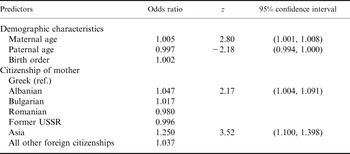
Odds ratios based on logistic regression are shown in Table 2. The results indicate that parental ages are significant, though relationships point in opposite directions. Nevertheless, more detailed analysis of the effects of demographic characteristics, not shown here, has proved that these factors are interdependent and associations of SRB with parental ages and birth order are complex and non-linear. The present analysis, however, focuses on differentials by ethnic origin controlling for parental ages and birth order; whether these variables are included in continuous or categorical form in the models, or interactions are added, does not make any appreciable difference regarding disparities between ethnic groups. The odds ratios indicate that Albanian mothers have a 5% higher chance of having a male birth compared with Greek mothers, a result significant at the 5% level. Mothers who originate in Asia also have a significantly (at the 1% level) greater propensity (by 25%) to have a male birth. Results for other ethnic groups (Bulgarians, Romanians and women from the former USSR) are not significant, primarily due to the very small numbers of observations.
The odds of a male over a female birth for selected citizenships based on logistic regression

The fairly high SRB observed for Albanians here seems typical of that population. According to the official statistics of Albania (INSTAT, 2009) for the period 2004–2007, for which data are fairly reliable, the SRB was quite high, around 113–114. A high SRB for Asian mothers is also consistent with findings of other studies (James, Reference James1985; Seth, Reference Seth2010); however, the exceptionally high figure recorded here may be also partly related to the small number of observations. Another plausible explanation in this instance may be sex-selective abortion. This notion is reinforced when SRB is considered in relation to the region of origin of the mother. Asian women in the data originate in equal proportions from the Middle East, and east and south Asia; the respective sex ratios at birth estimated here are 111.2, 121.7 and a staggering 156.1. Such high figures, particularly for women coming from south-east Asia where a strong son preference has been documented, provide indirect evidence of sex-selective practices, observed also in other receiving countries (Dubuc & Coleman, Reference Dubuc and Coleman2007; Almond & Edlund, Reference Almond and Edlund2008; Almond et al., Reference Almond, Edlund and Milligan2009). Nevertheless, this cannot be confirmed since data on abortions in Greece are non-existent.
To summarize, the SRB is higher in Greece among immigrant populations. The difference between Albanians and Asians, on the one hand, and the native population on the other, is significant. The high SRB observed for Albanian immigrants seems typical of that population since it is similar to values recorded in their country of origin. The exceptionally high SRB for Asians might be partly related to the small number of observations for that group but it may also provide indirect evidence of sex-selective abortion, although this cannot be confirmed. The present study is based on births recorded for 2006; it would be of interest to repeat the analysis for other years to observe whether differentials persist, and thus strengthen conclusions for small groups of immigrants.