NOMENCLATURE
- ALP
Aircraft Landing Problem
- ALS
Aircraft Landing Sequencing
- ATA
Actual Time of Arrival
- ASP
Aircraft Sequencing Problem
- ATCo
Air Traffic Controller
- B&B
Branch and Bound
- BADA
Base of Aircraft Data
- CDO
Continuous Descent Operations
- CDR
Conflict Detection and Resolution
- CPS
Constraint Positon Shifting
- ETA
Estimated Time of Arrival
- ETMA
Extended Terminal Maneuvering Area
- H
Heavy
- ILS
Iterated Local Search
- LP
Linear Programming
- M
Medium
- MILP
Mixed Integer Linear Programming
- MIP
Mixed Integer Programming
- PM
Point Merge
- RNAV
Area Navigation
- TAD
Total Airborne Delay
- TCRT
Total Conflict Resolution Time
- TFT
Total Flight Time
- TMA
Terminal Maneuvering Area
- TOTP
Total on Time Performance
- TPS
Total Position Shifting
- TRA
Total Route Allocation
- TVM
Total Vector Maneuver
1.0 INTRODUCTION
The air transportation system has been one of the most popular research areas in recent years due to its rapid growth rates and increasing traffic complexity. Global air traffic volumes have grown by an annual rate of 5.8% to 8.0%, in terms of revenue passenger kilometers, during 2013–20181. Innovative, proactive and multi-disciplinary approaches are needed to solve congestion at airports and in airspaces as a consequence of these rapid growth rates. Air traffic flow becomes denser and more complex, particularly within a Terminal Manoeuvering Area (TMA), where climb and descent manoeuvers of arriving and departing flight sequences interact around a single airport or multiple airports. In cases where air traffic demand exceeds TMA capacity, the resultant congestion leads to airborne and ground delays propagated throughout the system. In order to reduce these delays and increase airspace capacity without compromising flight safety, effective aircraft sequencing and conflict resolution techniques are critical in the management of air traffic flow in TMAsReference Aybek Cetek2. These techniques should also support new generation procedures, such as area navigation (RNAV) routes and continuous descent operations (CDO) for flexible, efficient and economic flight operations within TMAs3.
This study proposes a two-step mixed integer linear programming (MILP) model for aircraft landing problems (ALPs) using three different conflict resolution and sequencing techniques; flexible route allocation, airspeed reduction and vector manoeuver. The model was developed to optimise arrival sequencing through conflict-free routes along with CDO within the extended-TMA (ETMA) concept.
The contribution of this study is as follows. Firstly, the proposed model introduces an effective TMA management method using a new MILP model for the existing RNAV route network. Secondly, the model integrates three resolution techniques together while endorsing the CDO in the ETMA concept. Thirdly, the mathematical model controls the airspeeds between each subsequent waypoint pair for each aircraft. Airspeed reduction can be implemented between specific waypoints to resolve conflicts. After the resolution, aircraft can descend at their optimal airspeed along their routes for the rest of their flight. Therefore, the model reduces airborne delays and provides more economical descent profiles. The model appears to be the first to regulate airspeed between waypoints instead of determining average airspeed for an entire TMA. Lastly, the model also allows the implementation of innovative techniques, such as CDO in ETMA operations for RNAV route structures.
The rest of the paper is structured as follows: Section 2 presents the previous works about the problem. Section 3 describes the optimisation models; Sections 4 and 5 describe the application of the optimisation model and the conclusions, respectively.
2.0 LITERATURE REVIEW
The ALP involves the sequencing and scheduling of arrivals within TMAs. The broad literature of mathematical models regarding the solution of ALP is provided in a number of articlesReference Adler, Liebert and Yazhemsky4-Reference Samà, D’ariano, D’ariano and Pacciarelli6. Samà et al.Reference Samà, D’ariano, D’ariano and Pacciarelli6 present a mixed integer linear programming (MILP) model, developed for the ALP, for a single runway airport. The arrival route path is designed using an RNAV route structure. In the proposed model, aircraft information is accepted as static, including the entry point of airspace, aircraft performance category, entrance time and so on. Several other studies have been presented for the ALP. Ernst et al. (1999) developed a simplex algorithm to calculate aircraft landing times rapidlyReference Ernst, Krishnamoorthy and Storer7. They aimed to minimise the time deviations of target landing times. Beasley et al.Reference Beasley, Krishnamoorthy, Sharaiha and Abramson8 propose a model for aircraft sequencing problem (ASP) to reduce the cost of resequencing. Hu and ChenReference Hu and Chen9 present an ASP model to minimise airborne delays using receding horizontal control. Bianco et al.Reference Bianco, Dell’olmo and Giordani10 introduce a dynamic job scheduling model for both arrival and departure operations at one airport. They developed a heuristic approach to obtain a feasible result in a short time. Soomer and FranxReference Soomer and Franx11 developed an integer programming model to decrease the airline costs due to airborne delays. The model uses a scaling method to maintain cost equity among aircraft. Artiouchine et al.Reference Artiouchine, Baptiste and Dürr12 propose a mixed integer programming (MIP) model to reduce the time interval between two consecutive arrivals. Hu and PaoloReference Hu and Paolo13developed a Genetic Algorithm to minimise both total airborne delays and maximum arrival queues. Eun et al.Reference Eun, Hwang and Bang14 present a model to reduce airborne delay with constraint positon shifting (CPS) as a constraint using linear programming (LP), branch and bound (B&B) and Lagrangian dual decomposition methods. Zuniga et al.Reference Zuniga, Delahaye and Piera15 developed a stochastic optimisation algorithm to merge and sequence conflict-free arrival flows in TMAs using alternative extended flight paths in RNAV route networks. Sölveling et al.Reference Sölveling, Solak, Clarke and Johnson16 present an optimisation model that integrates the environmental effects and efficiency of runway scheduling. The model calculates important gains for environmental effects despite raised airline operational costs. Hancerliogullari et al.Reference Hancerliogullari, Rabadi, Al-Salem and Kharbeche17 propose a MILP model to optimise aircraft landing sequencing for both arrival and departure operations. Due to the complexity of the problem, they use two mate-heuristic algorithms to provide feasible solutions in a short time. They aim to minimise the total weighted tardiness of aircraft landings and departures. Samà et al.Reference Samà, D’ariano and Pacciarelli18 propose a mathematical formulation based alternative graph approach for aircraft scheduling, using a re-rerouting approach to minimise aircraft delays. They compare the algorithm first-come first-served (FCFS) approach. Sabar and KendallReference Sabar and Kendall19 present an iterated local search (ILS) algorithm for ALP to minimise the deviations of aircraft target landing time. Liang et al.Reference Liang, Delahaye and Maréchal20 introduces a multi-layer point merge (PM) concept to find operationally acceptable conflict-free solutions for integrated sequencing and merging arrival flows using a receding horizon control technique. Based on this multi-layer PM system, Liang et al.Reference Liang, Delahaye and Maréchal21 propose another model to solve the integration of arrival and departure flows within busy TMAs. Erkan et al.Reference Erkan, Erkip and Şafak22 propose a generic MIP model for rescheduling operations. They invite stakeholders to determine the objectives and constraints of the model and find the balance among them because, according to statistics, almost 20% of flights are rescheduled. Objectives minimise total average delay, minimising maximum delay and reducing delay differences among aircraft. Samà et al.Reference Samà, D’ariano, Palagachev and Gerdts23 propose a mixed integer linear programming approach for ASP. The model includes a trajectory optimisation process. The aim was to minimise aircraft delay travel times and fuel consumption. Dahlberg et al.Reference Sáez, Prats, Polishchuk, Polishchuk and Schmidt24 propose an MIP model to design aircraft arrival route structures in a TMA using CDOs. The arrival routes generate feasible merge trees and ensure conflict-free trajectories using turning manoeuvers. The aim was to minimise total route length from the entry points to a runway. In addition, the same airspeed was selected for all aircraft to simplify the model. Similarly, Sáez et al.Reference Dahlberg, Granberg, Polishchuk, Schmidt and Sedov25 present an MIP model to generate aircraft arrival routes in a TMA. Additionally, the aim was to design feasible arrival routes using merge trees while maintaining conflict-free trajectories using turning manoeuvers. They researched the optimal CDO speed profile to avoid aircraft conflicts for different lengths of route. Unlike Dahlberg et al.Reference Sáez, Prats, Polishchuk, Polishchuk and Schmidt24, they used different airspeed profiles according to aircraft type. Zhou et al.Reference Zhou, Cafieri, Delahaye and Sbihi26 present a branch and bound algorithm to design a 3D arrival route network. They use both new route design and level flight operations to overcome obstacles in the TMA.
While Dahlberg et al.Reference Sáez, Prats, Polishchuk, Polishchuk and Schmidt24 and Sáez et al.Reference Dahlberg, Granberg, Polishchuk, Schmidt and Sedov25 present a route design for an arrival network using turn changes with CDO, our model uses three different techniques to provide conflict-free arrival trajectories. They do not adopt either airspeed change manoeuvers or the ETMA concept to regulate arrival traffic. While their TMA’s route network consists of three existing merges and three entry points, our proposed route network in TMA has 11 merges and 9 entry points. Although Zhou et al.Reference Zhou, Cafieri, Delahaye and Sbihi26 present a new 3D route network design with level flights, we implement CDOs for arrival operations with merging routes using the ETMA concept. The proposed model deals with a more complex airspace in terms of merge and entry points and includes airspeed reduction techniques in addition to route allocation and vector manoeuver techniques. Therefore, the model can implement a more flexible combination of these resolution techniques in order to identify optimal solutions.
3.0 OPTIMISATION MODEL
When an arrival sequencing is started in the en route airspace before an aircraft enters a TMA, this concept is referred to as ETMA operations. Therefore, arrival sequencing techniques are assumed to be implemented at the ETMA boundaries where aircraft start their descent in the en route airspace. The proposed model focuses on ETMA operations with a flexible RNAV route structure in which aircraft can be allocated to alternative routes if necessary. Airspeed adjustment and vector manoeuver also support the model as a facilitator in order to reduce delay and conflict free sequencing decisions. Therefore, the model offers alternative RNAV routes for arrival traffic entering the extended TMA. Using this model, air traffic controllers at the approach unit can receive all necessary conflict-free trajectory and sequencing information before aircraft enter the TMA. Therefore, their task load may be significantly reduced while their monitoring time increases. The model with this feature is that it serves the pre-tactical part of air traffic flow and capacity managementReference Bianco and Bielli27.
In this section, a two-step mathematical model is presented. The model was developed to optimise arrival sequencing within the TMA. In the first and second steps, the model searches for the minimum TCRT and TAD using a lexicographic goal programming technique, respectively. The model performs route allocation and airspeed reduction techniques to provide conflict-free trajectories.
Sets
I set of aircraft
 $i,{i_1},{i_2}\; \in I$
J set of routes
$j,{j_1},{j_2}\; \in J$
K set of waypoints
$k,{k_1},{k_{2,}}{k_3} \in K$
N set of entry points
$n\; \in N$
S set of sequencing number
$s,\;{s_2}\; \in S$
L set of aircraft performance category
$l,{l_{1,\;}}{l_{2\;}}\; \in L$


Parameters
-
$M$
:
Big number enough
-
${g_i}$
:
Estimated entry time of the airspace for aircraft i
-
$ET{A_i}$
:
Estimated time of arrival for aircraft i
-
${t_i}$
:
Performance category of aircraft i
-
${r_i}$
:
Entry point of the airspace for aircraft i
-
$b{g_i}$
:
Route of aircraft i for baseline scenario
-
$tre{q_{{l_1}{l_2}}}$
:
Separation time for the aircraft performance categories for
${l_1}$
and
${l_2}$
-
${d_{{k_1}{k_2}}}$
:
The distance between waypoints of
${k_1}$
and
${k_2}$
-
${u_{mj}}$
:
-
$\left\{ \begin{array}{l@{\ \ \ }c}1& if\;entry\;point\;m\;belongs\;to\;the\;route\;j\\0&otherwise\end{array} \right\}$
-
${s_{jk}}$
:
-
$\left\{ {\begin{array}{l@{\ \ \ }c}1& if\;the\;route\;j\;includes\;the\;waypoint\;k\\0& otherwise\end{array}} \right\}$
-
$vel{2_{l{k_1}{k_2}}}$
:
The time travelled per unit distance of aircraft performance category l between waypoints
${k_1}$
and
${k_2}$
-
$g{a_{j{k_1}{k_2}}}$
:
-
$\left\{ {\begin{array}{l@{\ \ \ }c}1&if\;the\;route\;j\;has\;connection\;between\;waypoints\;{k_1}and\;{k_2}\;\\0&otherwise\end{array}} \right\}$
- bestsol:
The value of the first step objective function


Decision Variables
-
${q_{ijk}}$
:
Actual flyover time of the aircraft i in route j from waypoint k
-
$dela{y_i}$
:
Delay time of aircraft i.
-
$cr{t_i}$
:
Conflict resolution time of aircraft i.
-
$ve{l_{i,l,{k_1},{k_2}}}$
:
The amount of time travelled per unit distance by aircraft i with performance category l between waypoints
${k_1}$
and
${k_2}$
-
${x_{is}}$
:
-
$\left\{ {\begin{array}{l@{\ \ \ }c}1&if\;aircraft\;i\;is\;assingned\;the\;s\;order\;of\;sequencing\\0&otherwise\end{array}} \right\}$
-
${y_{i{i_2}}}$
:
-
$\left\{ {\begin{array}{l@{\ \ \ }c}1&\;if\;aircraft\;i\;is\;landing\;before\;{i_2}\\0&otherwise\end{array}} \right\}$
-
${w_{ij}}$
:
-
$\left\{ {\begin{array}{l@{\ \ \ }c}1&if\;aircraft\;i\;is\;assingned\;j.\;route\\0&otherwise\end{array}} \right\}$
-
$AT{A_{ij}}$
:
Actual time of arrival for aircraft i to final approach fix through route j
-
$ATA{K_i}$
:
Actual time of arrival for aircraft i to final approach fix through the selected route


The first and second step are as follows:
 \begin{equation}min\;\mathop \sum \limits_i cr{t_i}\end{equation}
 \begin{equation}min\mathop \sum \limits_i dela{y_i}\end{equation}
Subject to:
 \begin{equation}\mathop \sum \limits_s {x_{is}} = 1\;\;\;\forall \;i\end{equation}
 \begin{equation}\mathop \sum \limits_i {x_{is}} = 1\;\;\;\forall \;s\end{equation}
 \begin{align}&q_{ijk} = \mathop \sum \limits_{{k_2}} \mathop \sum \limits_{{k_3}} {d_{{k_2}{k_3}}}vel{2_{l{k_2}{k_3}}} + {g_i} + cr{t_i}\nonumber\\
&\forall \;i,j,k,m,l\;\;|\;l = {p_i},\;m = {r_i}\;,\;{u_{mj}} = 1,\;{k_2}
< {k_3},\;k \leq {k_3},\;{s_{jk}} = 1,\;{s_{j{k_2}}} = 1,\;{s_{j{k_3}}} = 1,\;g{a_{j{k_2}{k_3}}} = 1 \end{align}
 \begin{align}&{q_{ijk}} = \;\mathop \sum \limits_{{k_2}} \mathop \sum \limits_{{k_3}} {d_{{k_2}{k_3}}}ve{l_{il{k_2}{k_3}}} + {g_i}\; + cr{t_i}\nonumber\\
&\forall \;i,j,k,m,l\;\;|\;l = {p_i},\;m = {r_i}\;,\;{u_{mj}} = 1,\;{k_2}
< {k_3},\;k \leq {k_3},\;{s_{jk}} = 1,\;{s_{j{k_2}}} = 1,\;{s_{j{k_3}}} = 1,\;g{a_{j{k_2}{k_3}}} = 1\end{align}
 \begin{align}&{q_{ijk}} - {q_{i2j2k}} \ge Tre{q_{{l_2}l}} - {y_{i{i_2}}}M - \left( {2 - {w_{ij}} - {w_{{i_2}{j_2}}}} \right)M\nonumber\\
&\forall \;i,{i_2},j,{j_2},k,l,{l_2},m,{m_2}|\;i \ne {i_2}\;,\;{s_{jk}} = 1,\;{s_{{j_2}{k_2}}} = 1,\;m = {r_i}\;,\;{m_2} = {r_{{i_2}\;\;}},\;{u_{mj}} = 1,\;{u_{{m_2}{j_2}}} = 1,\nonumber\\
&\quad l = {p_i},\;{l_2} = {p_{{i_2}}}\end{align}
 \begin{align}&{q_{i2j2k}} - {q_{ijk}} \ge Tre{q_{l{l_2}}} - \left( {1 - {y_{i{i_2}}}} \right)M - \left( {2 - {w_{ij}} - {w_{{i_2}{j_2}}}} \right)M\nonumber\\
&\forall \;i,{i_2},j,{j_2},k,{l_1},{l_2},m,{m_2}|\;i \ne {i_2}\;,\;{s_{jk}} = 1,\;{s_{{j_2}{k_2}}} = 1,\;m = {r_i}\;,\;{m_2} = {r_{{i_2}\;\;}},\;{u_{mj}} = 1,\;{u_{{m_2}{j_2}}} = 1,\nonumber\\
&\quad l = {p_i},\;{l_2} = {p_{{i_2}}}\end{align}
 \begin{equation}{y_{i{i_2}}}M \ge \mathop \sum \limits_s \mathop \sum \limits_{{s_2}} {x_{{i_2}{s_2}}} \cdot {s_2} - {x_{is}} \cdot s\;\;\;\;\;\;\;\;\;\;\;\;\;\;\forall \;i,{i_2}\;|\;\;i \ne {i_2}\end{equation}
 \begin{equation}\left( {1 - {y_{i{i_2}}}} \right)M \ge \mathop \sum \limits_s \mathop \sum \limits_{{s_2}} {x_{is}} \cdot s - {x_{{i_2}{s_2}}} \cdot {s_2}\;\;\;\;\;\;\;\;\;\;\forall \;i,{i_2}\;\;|\;\;i \ne {i_2}\end{equation}
 \begin{equation}\mathop \sum \limits_{j|\;{u_{mj}} = 1} {w_{ij}} = 1\;\;\;\forall \;i,m\;|\;m = {r_i}\end{equation}
 \begin{equation}\mathop \sum \limits_{j|j = b{g_i}} {w_{ij}} = 1\;\;\;\forall \;i\end{equation}
 \begin{equation}AT{A_{ij}} \le {w_{ij}}M\;\forall \;\;\;\;\;\;\;\;\;\;\;\;\;\;\;i,j,k,m\;|\;m = {r_i}\;,\;{u_{mj}} = 1\end{equation}
 \begin{equation}AT{A_{ij}} \ge {q_{ijk}} - \left( {1 - {w_{ij}}} \right)M\;\;\;\;\;\;\;\;\;\;\;\;\;\;\;\forall ,i,j,k,m\;|\;k = 30,\;m = {r_i}\;,\;{u_{mj}} = 1\end{equation}
 \begin{equation}AT{A_{ij}} \le {q_{ijk}} - \left( {1 - {w_{ij}}} \right)M\;\;\;\;\;\;\;\;\;\;\;\;\;\;\;\forall ,\;i,j,k,m\;|\;k = 30,\;m = {r_i}\;,\;{u_{mj}} = 1\end{equation}
 \begin{equation}ATA{K_i} = \mathop \sum \limits_j AT{A_{ij}}\;\;\;\;\;\;\;\;\;\;\;\;\;\;\;\;\;\;\;\;\;\;\;\;\;\;\;\;\;\;\;\forall |\;i\end{equation}
 \begin{equation}dela{y_i} = \;ATA{K_i} - ET{A_i}\;\;\;\;\;\;\;\;\;\;\;\;\;\;\;\;\;\;\;\;\;\;\forall |\;i\end{equation}
 \begin{equation}\mathop \sum \limits_i cr{t_i} = bestsol\end{equation}
 \begin{equation}{q_{ijk}} \ge 0\;\;\;\forall \;i,j,k\end{equation}
 \begin{equation}{\rm{cr}}{{\rm{t}}_i} \ge 0\qquad \forall \;i\end{equation}
 \begin{equation}{\rm{dela}}{{\rm{y}}_i} \ge 0\qquad \forall \;i\end{equation}
 \begin{equation}{x_{is}},\;{w_{ij}},\;{y_{i{i_2}}}\; \in \left\{ {0,1} \right\} \qquad \forall \;i,j,{i_2},s\end{equation}
 \begin{equation}AT{A_{ij}},\;ATA{K_i}\; \ge 0 \qquad \forall \;i,j\end{equation}
 \begin{equation}1.17vel{2_{l{k_2}{k_3}}}\; \ge ve{l_{il{k_2}{k_3}}} \ge vel{2_{l{k_2}{k_3}}} \qquad \forall \;i,l,{k_2},{k_3}\end{equation}
The objective function (1) is to minimise the total conflict resolution time and the objective function (2) is to minimise total aircraft delay. Constraint sets (3) and (4) decide the order of the aircraft landing sequence. Constrain sets (5) and (6) calculate the fly over times from waypoints for each aircraft using airspeed as a parameter and a variable, respectively. Constrain sets (7) and (8) maintain the vortex separation between aircraft pairs for each waypoint. Constrain sets (9) and (10) determine the fly priority between aircraft pairs according to landing sequencing. Constrain set (11) maintains that each aircraft is assigned one suitable route. Constrain set (12) maintains that each aircraft is assigned a route according to baseline scenario. Constrain sets (13), (14), (15) and (16) calculate the actual time of arrival for each aircraft. Constraint set (17) calculates the airborne delay for each aircraft. Constraint set (18) is added in the second step to limit the TCRT values that are found in the first step. Constraints (19-23) are sign constraints. Constraint set (24) limits the upper and lower bounds of the time travelled per unit distance between each waypoint due to airspeed reduction. Airspeed reduction cannot be reduced more than 15% of the nominal airspeed of the aircraft in the given performance category and flight level. The first and second steps use objective function (1) and (2), respectively. The first step uses the constraints (3-4), (6-17) and (19-24) while the second step uses the constraints (3-4), (6-24). The baseline scenario uses the objective (1) and constraints (3-5), (7-17) and (19-24).
4.0 APPLICATION OF THE OPTIMISATION MODEL
In this section, we compare the baseline and proposed model results. The two-step model aims to minimise total conflict resolution time and total airborne delay, respectively. Therefore, the initial conflict number and total conflict resolution time is given in baseline scenarios. The results of the first and second steps are also given separately in order to explore the differences between the two steps.
4.1 Case study
Istanbul Yeşilköy TMA is chosen as the sample airspace for this study. This TMA accommodates four airports, including Istanbul New Airport, Ataturk Airport, Sabiha Gökçen Airport and Çorlu Airport. In this study, Ataturk Airport was selected to apply the proposed model. Ataturk airport was the 5th busiest airport in Europe and the 17th busiest airport in the world in 201828. Yeşilköy TMA, which serves arrivals and departures at Atatürk Airport, is an airspace that can serve as a model for the world with its high level of complexityReference Aybek Cetek2. The proposed model is developed within the Yeşilköy TMA routes and connected en route routes. The proposed model, with this feature, is adaptable to many different airspaces. Airspace entry point and aircraft performance category percentages are estimated based on August 2018 traffic data for both scenarios.
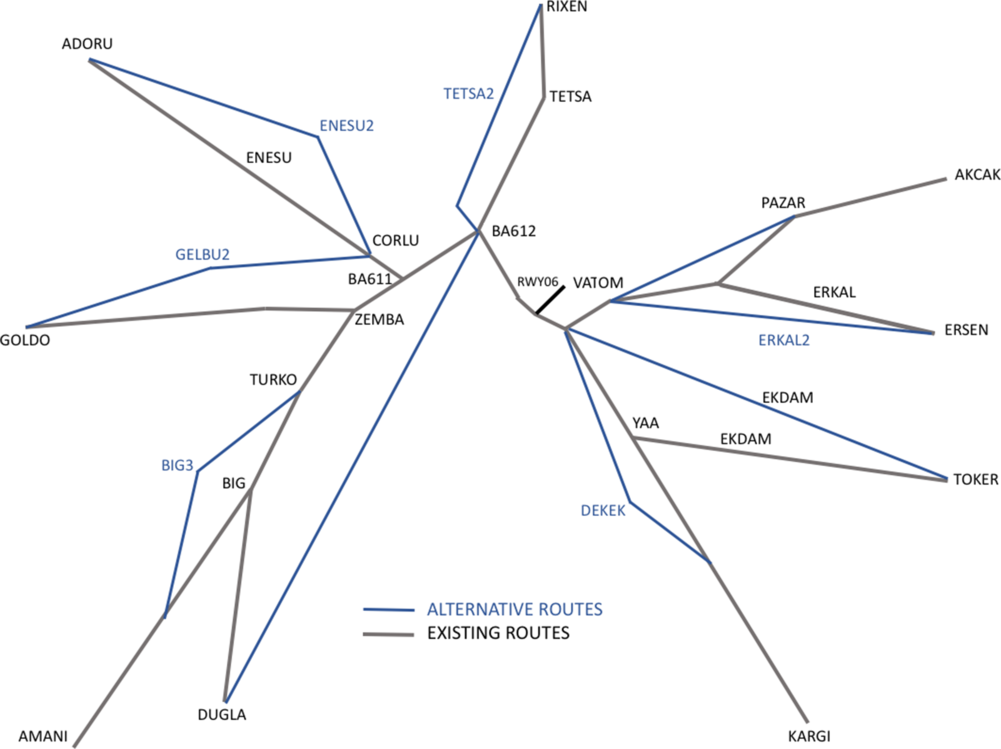
In the selected airspace, there are nine different entry points from en route airspace to the TMA29. The length of each route is known and the nominal airspeed of each aircraft along the route varies according to its performance category and flight levels. Two performance categories are selected based on wake turbulence categories, such that medium (M) and heavy (H), in accordance with the traffic demand mix of Atatürk Airport. The aircraft performance data was obtained from the Base of Aircraft DataReference Sheehan30 (BADA). For each waypoint, the flight levels required for CDO were calculated according to this aircraft performance data. While the existing routes and their lengths are shown in black, the alternative routes and their lengths are presented in blue in the Fig. 1.
Yesilkoy TMA with existing route configuration.

Continuous descent operation is one of the most important aims in this model. For this reason, the descent path is calculated based on BADA according to each route length and the flight levels established for each waypoint of the airspace, such as at the TETSA waypoint where aircraft should cross FL210, which is shown in red in Fig. 1. According to aircraft performance by type pf aircraft on the BADA and flight level, nominal airspeed is calculated for each flight path. The average airspeed is shown in Fig. 1 in green, such as 428kt between the RIXEN and TETSA route.
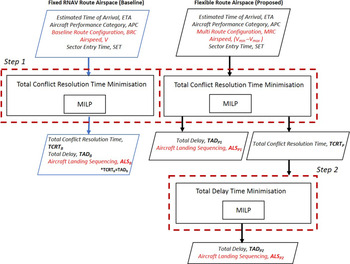
The proposed model is run for two scenarios: baseline, and proposed (Fig. 2). The baseline scenario represents the current TMA structure with a fixed RNAV route network. In this scenario, the inputs of the model are ETA, aircraft performance categories (medium and heavy), fixed nominal airspeed and airspace entry time. The model updates the TMA entry times of any conflicting aircraft to resolve conflicts. Based on these updates, TCRT, TAD and aircraft landing sequencing (ALS) are calculated for a comparison. In the proposed model, flexible route network and airspeed range for each aircraft category at specific waypoints are also included in the model as parameters. TCRT, TAD and ALS are also estimated for the proposed model and compared with the baseline results.
Flowchart of the model.

Radar separation minimum is selected as 3NM within the ETMA, respectively, according to Turkish AIPReference Dahlberg, Granberg, Polishchuk, Schmidt and Sedov25, while ICAO time separation minima31 are used for wake turbulence separation. All operations are assumed to take place under standard atmospheric conditions at the given flight levels of the airspace. Wind speed and acceleration are accepted as being zero. All arriving aircraft enter the ETMA from any of the entrance points of the en route airspace and leave it at the final approach point located 4NM from the threshold of the runway. Whenever required, a correct vector manoeuver, based on necessary conflict resolution time, is applied to the conflicted aircraft by the en route controller.
4.2 Inputs
The model adopts the ETMA concept to regulate air traffic based on actual EUROCONTROL statistics. The TMA has nine entry points and each entry point has one route for landing trajectories. The proposed model adds extra waypoints to the map and creates an extra route for each existing route structure. The new TMA presents 30 waypoints and 18 routes for landing operations. The model checks only for the horizontal separation among aircraft to maintain safe separation. Overtaking is not allowed for the trailing aircraft and fly priority is determined by the model. Therefore, vertical separation is provided because of the algorithm of the proposed model. The TMA capacity is estimated at approximately 30 aircraft per an hour, but in this study, we focus on a 20-minute time period so that 10 aircraft are tested in the scenarios. The entry points of aircraft are determined based on the EUROCONTROL statistics. These are 21.88% from ENESU, 8.99% from GELBU, 7.96% from TURKO, 19.2% from DEKEK, 20.99% from ERKAL, 12.42% from PAZAR and 8.56% from TETSA. Any traffic from EKDAM is not observed from the data, so only eight entry points are used in the scenarios. Arrivals only use runway 05 at Istanbul Atatürk Airport. Heavy and medium aircraft performance category rates are determined as 75.23% and 24.27%, respectively. In the model, aircraft airspeed between two waypoints is calculated based on the average airspeed with regard to the flight level.
4.3 Analysis of the results
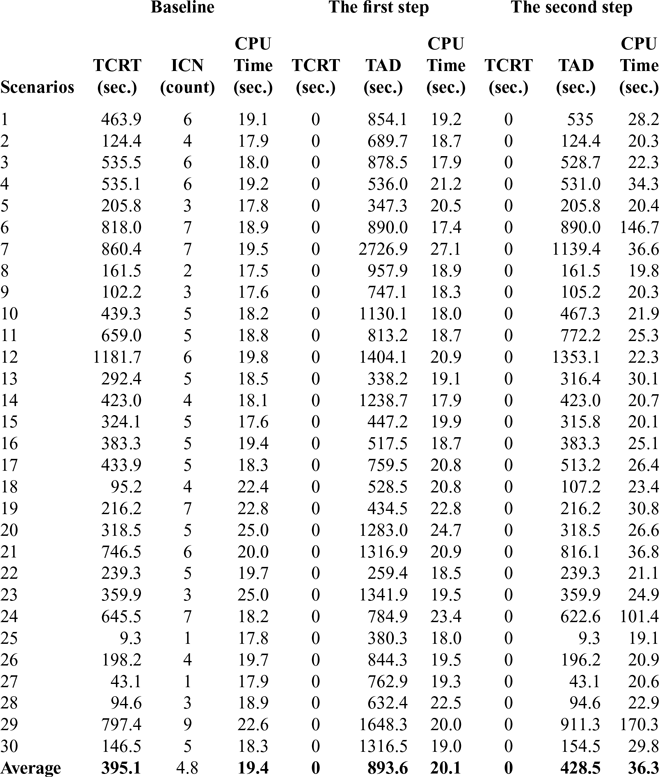
The first step aims to minimise only the total conflict resolution time, which means eliminating aircraft conflicts, without considering the total delay. The second step aims to minimise total airborne delay without worsening the total conflict resolution time. The first step is more important for an ATCos to ensure conflict-free trajectories for all aircraft. On the other hand, the first and second steps are extremely important for airline operators, so Table 1 is presented to compare the results of the baseline and the proposed model. In Table 1, the number of TCRT, initial conflict number (ICN) and CPU time are presented for the baseline results. Similarly, the number of TCRT, total airborne delay (TAD) and CPU time are presented for the results of both the first and the second steps.
Results of first and second steps

Aircraft conflict is a real challenge for air traffic controllers and takes up a lot of time in TMA operations. Therefore, to regulate air traffic with no conflict with the automated system decreases the ATCo’s occupancy time and increases the monitoring time. Decreasing TAD is essential for airport operators because aircraft on time performances conduce to increase airport and airspace capacities. In Table 1, while the first step aims to provide a maximum number of conflict-free trajectory sets for aircraft in minimum conflict resolution time without optimising total airborne delay, the second steps aims to minimise total airborne delay for the calculated minimum total conflict resolution time in the first step. Airborne delay is the difference between actual time of arrival and estimated time of arrival for an aircraft. Table 1 shows that average TCRT is found to be approximately 395.1 seconds for the baseline of 30 scenarios. Similarly, the average number of initial conflict numbers was found to be 4.8 for the baseline. The first step of the proposed model demonstrates that all potential conflicts are resolved. The average CPU time of the first objective is determined to be approximately 20 seconds, which enables an air traffic controller to apply this algorithm to find the optimal landing sequence in a short time. In addition to this, the proposed model is able to produce a new arrival sequence if any unexpected situation takes place in the TMA owing to the short computational time. The second objective function concerns both the air traffic controller and airline operators. To explore the benefits of the two-step approach in TMA arrival management, the results of the both steps are presented. The TAD that is found in the first and second steps are 893.6 and 428.5 seconds, respectively. This shows that adaptation of the second step decreases TAD by approximately 52.05%. Moreover, the proposed model can resolve all aircraft conflict and minimise the TAD less than 1 minute on average for 30 different scenarios. In certain cases, the model requires approximately 3 minutes, but it is also reasonable time duration for TMA arrival management operations.
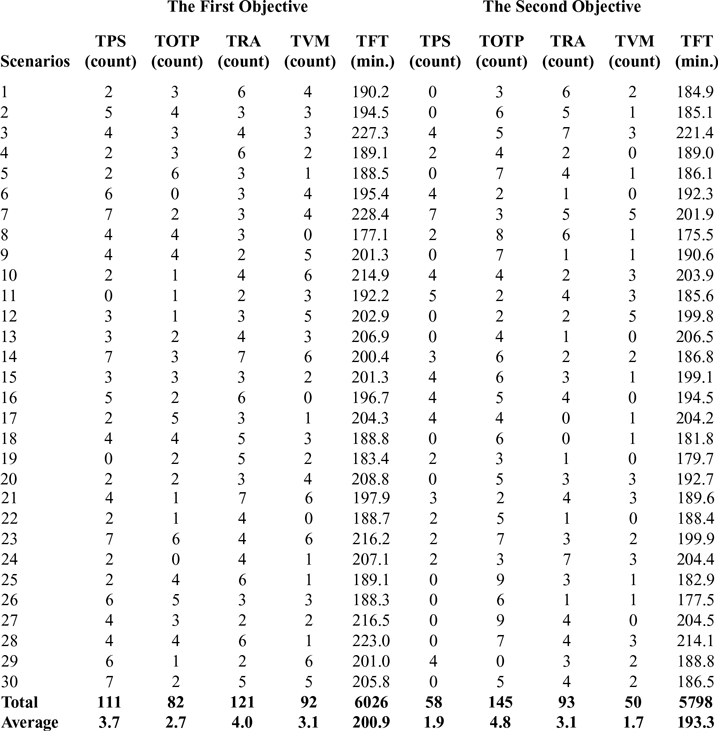
The results of Step 1 and Step 2 are compared for all scenarios in Table 2. This comparison is critical because it reflects the perspectives of two stakeholders: ATCos and the airlines. ATCos primarily focus on providing safe separation between aircraft in the TMA with minimum occupancy, which translates to minimum conflict resolution time. Airlines, on the other hand, demand conflict-free trajectories with minimum airborne delay, which leads to minimum deviation from their original flight schedules. The flight time of an aircraft refers to the difference between its arrival time to the entry points of the ETMA and its arrival time to the final approach point located four NM from the threshold of the runway. It contains any airborne delay during its flight within the TMA. The ratios of the total airborne delays in the total flight times are 7.4% and 3.8% for the first and second steps, respectively. In Table 2, the number of total position shifting (TPS), total on time performance (TOTP), total route allocation (TRA) and Total vector manoeuver (TVM) implementation, as well as total flight time (TFT), for each aircraft is presented.
TPS, TOTP, TRA, TVM and TFT performances

Position shifting operation is a real challenge for air traffic controllers since aircraft are generally sequenced according to the estimated time of arrival, therefore changing the aircraft landing sequences puts extra work on air traffic controllers. In the first step, the model alters the 111-aircraft’s position while the second steps change only 58 aircraft for all scenarios. The percentages of position shifted aircraft for the first and second steps are presented as 37% and 19%, respectively, inside all of the scenarios. Implementation of second steps creates an important effect on aircraft position shifting. Another output is the TOTP, which helps to maintain more precise ground operations for the airport manager. In the first and second steps, 82 and 145 aircraft, respectively, landed on time. The percentages of the on-time performance for the first and second steps are 27.3% and 48.3%, respectively, for the all scenarios. The increment of the on-time performance is determined to be approximately 21% between the two steps. The model also presents alternative route configurations to avoid conflict. The results show that the number of routes changed aircraft decreases from 121 to 93 between the two steps, which means that the model tends to choose conventional route configuration to provide time optimal operations. Moreover, the model provides good results in TFT performances. The average TFT is estimated as 201.91 minutes for the first step and 193.3 minutes for the second step. TFT contains total airborne delay, and the ratios of the total airborne delays in the total flight times are 7.4% and 3.8% for the first and second steps, respectively.
The results in Table 2 show that all outputs affect each other. Position shifting may be necessary for conflict resolution at merging routes. This changes the total number of on-time performances (i.e., airborne delay), vector manoeuvers, route allocations and total flight times. Therefore, effective sequencing, which may lead to increase in TPS, provides less TFT and more TOPT. Similarly, the extensive use of TRA also reduces the TVM since the vector manoeuver is preferred lastly in the model. Furthermore, the proposed model reduces total airborne delay and increases on-time performance. Therefore, this can increase airspace and airport capacities because of reduced airborne delay.
5.0 CONCLUSIONS
Aircraft arrival optimisation is a complex problem in TMA operations where provision of fast and efficient conflict-free trajectory is critical. In this paper, a new TMA arrival management model aims to minimise total conflict resolution time and total airborne delay. There is an order of priority between the objective functions, therefore, lexicographic goal programming is implemented. The model utilises airspeed reduction, route allocation and vector manoeuvering to resolve potential aircraft conflicts within the ETMA. Aircraft fly-over waypoints with predefined altitudes and they use CDO in the entire ETMA with RNAV route network. The first step of the model obtains conflict-free resolution with an average CPU time of 20.1 seconds while the second step finds optimal solutions of TAD with an average CPU time of 36.3 seconds. Besides the second step reduces the average TAD by more than 50% for 30 different air traffic scenarios. Based on the results of the second step, total position shifting in the arrival sequence is reduced considerably while on-time performance of aircraft landings is increased with respect to the first step where only the minimum TCRT is considered. The second step provides shorter flight times and less route allocation in arrival sequencing than the first step. In addition to operational benefits, the use of these two steps individually or together provide more flexible TMA management for all stakeholders. A two-step approach presents a new approach for ALP operations. This study presents a basis for real time implementation of ALP optimisation within ETMAs. After reducing the computational time of the mathematical model, it can enable ATCos to perform re-sequencing the aircraft set if any unexpected situation occurs. To implement this model in real time operations, a metaheuristic algorithm may be suggested for future studies. Additionally, many conflicts can take place in conventional RNAV operations and, therefore, advanced sequencing systems become indispensable for air traffic control system. Although, the additional decision support systems may introduce certain complications and require some adaption time for ATCos in the short term, their benefits can compensate these issues in the case where they provide rapid and implementable conflict resolution and sequencing advisories. This study provides promising results, but a real-time simulation study is planned to estimate the benefits of the proposed model regarding ATCo workload as a future study. The model may also be extended for multiple airport systems with mixed runway operations with wind effects being included in the analysis.
ACKNOWLEDGMENT
This research received no specific grant from any funding agency in the public, commercial or non-profit sectors.