It is well known that falls in older adults impose a large economic burden (Cotter et al., Reference Cotter, Timmons, O’Connor, Twomey and O’Mahony2006; Heinrich, Rapp, Rissman, Becker, & König, Reference Heinrich, Rapp, Rissmann, Becker and König2010; Siracuse et al., Reference Siracuse, Odell, Gondek, Odom, Kasper and Hauser2012; Stevens, Corso, Finkelstein, & Miller, Reference Stevens, Corso, Finkelstein and Miller2006; Woolcott, Khan, Mitrovic, Anis, & Marra, Reference Woolcott, Khan, Mitrovic, Anis and Marra2012) and can cause life-threatening injuries (Harris, Yong, McEvoy, & Thorn, Reference Harris, Yong, McEvoy and Thorn2010; Stevens, Reference Stevens2005) with potentially greater consequences for residents in long-term care (LTC) (Ayoung-Chee et al., Reference Ayoung-Chee, McIntyre, Ebel, Mack, McCormick and Maier2014; Cameron et al., Reference Cameron, Gillespie, Robertson, Murray, Hill and Cumming2012; Rubenstein, Josephson, & Robbins, Reference Rubenstein, Josephson and Robbins1994; Woolcott et al., Reference Woolcott, Khan, Mitrovic, Anis and Marra2012). The rate of falls for residents in LTC has been estimated to be 1.5 falls per bed per year, an incidence three times greater than that for older adults living in the community (Harris et al., Reference Harris, Yong, McEvoy and Thorn2010). Falls are a significant source of morbidity and mortality resulting in functional disability, fractures (Ooms et al., Reference Ooms, Vlasman, Lips, Nauta, Bouter and Valkenburg1994), and even death (Ayoung-Chee et al., Reference Ayoung-Chee, McIntyre, Ebel, Mack, McCormick and Maier2014; Harris et al., Reference Harris, Yong, McEvoy and Thorn2010). Indeed, a quarter of elderly persons who are hospitalized as a result of a fall die within one year (Ayoung-Chee et al., Reference Ayoung-Chee, McIntyre, Ebel, Mack, McCormick and Maier2014). To design targeted falls prevention strategies, researchers need an understanding of the underlying circumstances that have led to the fall.
Previous research has explored the circumstances contributing to falls in LTC. Robinovitch and colleagues (2013) video-recorded falls occurring in public places within an LTC home, such as hallways and common rooms. They determined that tasks that required weight shifting led to the highest proportion of falls (41% of recorded falls). Although illustrative, recorded falls only in public places, as per the methods used by Robinovitch et al. (Reference Robinovitch, Feldman, Yang, Schonnop, Leung, Sarraf and Loughin2013), might very well lack some critical information. The work of several other researchers (Ashley, Gryfe, & Amies, Reference Ashley, Gryfe and Amies1977; Büchele et al., Reference Büchele, Becker, Cameron, König, Robinovitch and Rapp2014; Cacha, Reference Cacha1979; Jantti, Pyyko, & Hervonen, Reference Jantti, Pyykko and Hervonen1993; Jensen, Lundin-Olsson, Nyberg, & Gustafson, Reference Jensen, Lundin-Olsson, Nyberg and Gustafson2002; Lester, Haq, Vadnerkar, & Feuerman, Reference Lester, Haq, Vadnerkar and Feuerman2008; Nurmi & Luthje, Reference Nurmi and Luthje2002; Rapp, Becker, Cameron, König, & Büchele, Reference Rapp, Becker, Cameron, König and Büchele2012), for instance, has shown that the majority of falls occurred in the bedroom, – a location that Robinovitch et al. (Reference Robinovitch, Feldman, Yang, Schonnop, Leung, Sarraf and Loughin2013) were unable to monitor because of privacy concerns – with as few as 22 per cent of captured falls occurring in common areas (Büchele et al., Reference Büchele, Becker, Cameron, König, Robinovitch and Rapp2014).
Furthermore, there is conflicting evidence about the activity occurring before a fall. Although Robinovitch et al. (Reference Robinovitch, Feldman, Yang, Schonnop, Leung, Sarraf and Loughin2013) reported most falls occurred during an LTC resident’s weight shifting, Büchele et al. (Reference Büchele, Becker, Cameron, König, Robinovitch and Rapp2014) and Rapp et al. (Reference Rapp, Becker, Cameron, König and Büchele2012) reported that most serious falls occurred during walking and transferring. Understanding both the most common location of falls and the circumstances surrounding the fall may inform preventive interventions. For example, problems with weight shifting might point to the need for balance training with weight shifting elements. Similarly, if the bedroom is the most common location for falls, shock-absorbent flooring (Knoefel, Patrick, Taylor, & Goubran, Reference Knoefel, Patrick, Taylor and Goubran2013), in bedroom areas only, might be an intervention target.
In addition to understanding the circumstances contributing to falls in general, understanding the types of falls that result in serious injuries may inform researchers of useful falls prevention strategies. Fractures, such as those of the hip (Grisso et al., Reference Grisso, Schwarz, Wishner, Weene, Holmes and Sutton1990) and wrist (Palvanen et al., Reference Palvanen, Kannus, Parkkari, Pitkajavri, Pasanen, Vuori and Jarvinen2000), can be serious consequences of a fall and can result in a sequelae of potentially life-threatening events. For example, 39 per cent of residents in LTC that experience a hip fracture will die within one year (Papaioannou et al., Reference Papaioannou, Wiktorowicz, Adachi, Goeree, Papadimitropoulos and Bedard2000). A potential strategy for reducing fracture risk is to characterize the residents who may be more prone to fractures after a fall, as well as what types of falls (i.e., what activity was performed) result in fractures. In a study by Berry et al. (Reference Berry, Samelson, Ngo, Bordes, Broe and Kiel2008) it was discovered that neither cognitive status, co-morbidities, or low scores on activities of daily living predicted who survived after experiencing a hip fracture as a result of a fall (seven years after).
In contrast, a systematic review concluded that being a woman, having cognitive impairment, and a prior history of falls and fractures were associated with a small to moderate increase risk of fracture for residents in LTC (Khatib et al., Reference Khatib, Santesso, Pickard, Osman, Giangregorio, Skidmore and Papaioannou2014). There are no studies that describe the circumstances surrounding falls that result in injuries, nor are there studies that also describe the characteristics of the participants with fall-related injuries. Exploring the characteristics of LTC residents who sustain a fracture as a result of a fall, and the activities during which the falls occurred, can allow researchers to target interventions for both specific residents and the risky activities they may be performing.
The purpose of our study, as discussed in this article, was to characterize the location, the time of day, and the activity that led to falls for LTC residents. The study also described the characteristics of residents who experienced a fracture following a fall.
Method
Study Population
Four LTC homes in Southern Ontario, Canada, participated in the data collection process. An LTC home is a residence for adults, generally over the age of 65 years, who are unable to live independently and who require 24-hour nursing and personal support. Two methods were used to recruit residents. First, letters were placed in all residents’ mailboxes with information about the study and the investigators’ contact information. Second, staff within the LTC homes were asked to identify eligible residents and provide them with the study information. For residents who did not have their own power of attorney, the information letter was sent to the individual designated as having their power of attorney. Residents were eligible to participate in the study if they were age 65 or older, able to walk 10 metres with or without an assistive device, and were able to follow a two-step command. A number of residents agreed to participate in the study, including our prospective collection of fall data.
The four LTC homes in Ontario had populations of 120, 144, 180, and 120 residents. Residents – 18, 23, 37, and 23 from the four separate homes for a total of 101 – agreed to participate in the study. All assessments were collected over a one-day period, with only one resident not completing data collection. After initially consenting to be in the study, the resident was excluded from data collection due to agitation and safety concerns secondary to dementia. Falls data were collected prospectively over a one-year period. Data on whether residents had died or left the home over the one-year period were not available, but falls data were available for all residents remaining in the home.
Falls prevention programs within the LTC homes at the time of the study included specialized group exercise classes focusing on developing core strength, individualized programs that challenge dynamic balance, generalized exercise classes to build strength and endurance, and customized falls prevention strategies developed by the interdisciplinary team based on the individual resident’s falling patterns. Written consent was obtained from all participants, and the ethics clearance was received from the University of Waterloo Ethics Board. Where participants had a designated power of attorney, or there was uncertainty as to whether the participant was capable of providing informed consent, the participant’s power of attorney, or family member if there was not a designated power of attorney, provided written informed consent.
Data Collection
All assessments were completed on one day at baseline and were performed in the participants’ respective LTC home. Assessments included the Modified Mini-Mental State Examination (3MS) (Teng & Chui, Reference Teng and Chui1987) and Activities-specific Fall Caution (AFC) scale (Blanchard, Myers, & Pearce, Reference Blanchard, Myers and Pearce2007). The 3MS is a widely used examination tool for screening of cognitive abilities. The 3MS is scored out of 100, with scores less than 79 indicating cognitive impairment and scores less than 48 indicating severe impairment (Teng & Chui, Reference Teng and Chui1987). The AFC scale is used to measure fear of falling for older adults living in residential care. A poorer AFC score is associated with poor balance as measured by the Berg Balance Scale, impaired functional mobility indicated by the Timed Up and Go (TUG) test, and a slower gait speed (Blanchard et al., Reference Blanchard, Myers and Pearce2007). The AFC is able to discriminate between residents on relevant clinical characteristics including fall risk, gait speed, balance impairment, and need for transfer assistance (Blanchard et al., Reference Blanchard, Myers and Pearce2007). Medical history and age were confirmed using the participants’ chart available on site.
All of the falls for each of the residents were recorded for a one-year period by the LTC home. A fall was defined as an unintentional and/or uncontrolled descent resulting in coming to rest at a lower level. Falls data were collected routinely in the LTC homes using a structured fall incident form. For each fall, the location in the LTC home, the time of day, and the activity the participant was doing prior to the fall were recorded by LTC home staff in accordance with corporate reporting policies. Furthermore, if the fall resulted in an injury, the part of the body and the nature of the injury (e.g., fracture, bruising) were documented. Staff were trained to use the falls incident report form, and an onsite kinesiologist reviewed each of the falls incident report forms in order to gather additional information if necessary.
Statistical Analysis
Mean and standard deviation (SD) were used to describe continuous data, and count and per cent were used to describe categorical data. Similar statistical analysis as those of Robinovitch et al. (Reference Robinovitch, Feldman, Yang, Schonnop, Leung, Sarraf and Loughin2013) were used; we also applied a generalized linear model to determine whether differences existed between the various causes of falls, various activities at the time of falling, and time of day when the fall occurred. The data were classified according to whether the participant fell at least once (1) or if they never fell (0) for each of the categories (cause, activity, and time of day). A generalized linear mixed model was run using the GLIMMIX procedure in the analytic software SAS (version 9.2), and odds ratios were computed with their corresponding 95 per cent confidence interval (CI) (Robinovitch et al., Reference Robinovitch, Feldman, Yang, Schonnop, Leung, Sarraf and Loughin2013). The falls that resulted in fractures (n = 17) were further described for purposes of our study.
Results
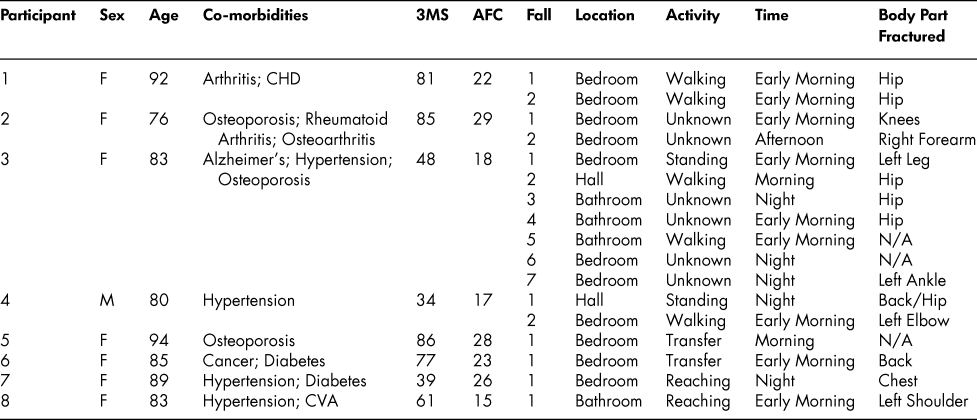
A description of the residents can be found in Table 1. Among 101 (31 males, M age = 85, SD = 6) residents, 41 (41%, Table 1) had at least one fall during the 12-month period. There were a total of 202 falls with 17 of them resulting in a fracture (see Table 3 for location of fractures). A description of the reported body parts that were fractured by each resident can be found in Table 3. Out of the 41 residents who fell, 30 residents had more than one fall (68%), with the number of falls ranging from 1 to 22.
Descriptive information about all individuals

3MS = Modified Mini-Mental State Examination
AFC = Activities-specific Fall Caution scale
SD = standard deviation
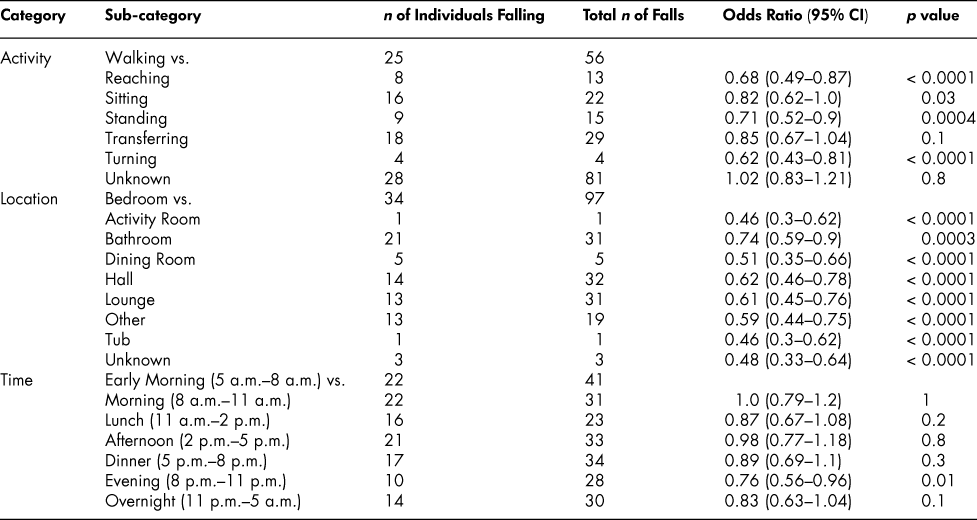
The majority of falls were reported to be during unknown activity, which is the category used when the activity occurring prior to the fall was unknown or could not be verified (40% or 81/202 of all falls; 69% or 28/41 of residents fell at least once during an unknown activity). The second most commonly reported activity was that of walking (28% or 56/202 of all falls; 61% or 25/41 of residents experienced at least one fall during walking). When walking was used as the reference category, the estimated proportion of residents reported to have fallen during walking was significantly greater than the proportion of individuals reported to have fallen during most of the other activities (as compared to reaching, sitting, standing, and turning), with the exception of falls reported to have occurred during transferring or during unknown activities (see Table 2).
Odds ratio of individuals falling at least once while undertaking various activities, with locations and times

The most common location for a fall to occur was in the bedroom (44% or 97/202 of all falls; 83% or 34/41 of residents fell at least once in the bedroom). Individuals with a reported history of falls were significantly more likely to have been reported falling in the bedroom (Table 2) compared to all other locations (activity room, bathroom, dining room, hall, lounge, tub, unknown, and other).
The time-of-day analyses revealed that reports of falls among residents occurred during all hours of the day. The most common time was in the early morning, or 5 a.m. to 8 a.m. (19% or 41/202 of all falls; 54% or 22/41 of residents fell at least once in the early morning). However, only evening or the 8 p.m. to 11 p.m. time frame had lower odds of having an individual fall, and which is where the difference was statistically significant (Table 2).
The characteristics of the 17 falls that resulted in fractures are described in Table 3. Of note, the bedroom and bathroom remained the most common locations for a report of a fall that resulted in a fracture. As well, all but one of the residents who had a fall resulting in a fracture were female, more than half (5/8) had cognitive impairment, and the most common time of the day for a fall was early morning. Furthermore, half of the participants who experienced a fracture (4/8 of the residents) had multiple falls resulting in a fracture.
Descriptive information about unique falls resulting in a fracture

3MS = Modified Mini-Mental State Examination
AFC = Activities-specific Fall Caution scale
CHD = coronary heart disease
CVA = cerebrovascular accident
Discussion
The current study reveals that the most common activity to result in a fall was unknown, followed by walking, with the most common location for a fall to occur being the bedroom. Furthermore, the bedroom was the most common location for fractures to occur. Therefore, our results suggest that when residents of LTC are alone or walking in private locations, they are at higher risk of falling and of experiencing a fracture. Alternatively, a higher prevalence of falls in the bedroom and bathroom could be the result of fallers spending more time in private locations in LTC homes rather than in public areas. Longer exposure to a risky environment may be increasing their risk of falling. Regardless, future fall and fracture prevention strategies should focus on environmental changes within residents’ bedrooms, and providing necessary support and supervision during ambulation. Improved monitoring of private locations will also allow for better data collection around the circumstances leading to a fall in addition to fall prevention.
In agreement with the findings of Büchele et al. (Reference Büchele, Becker, Cameron, König, Robinovitch and Rapp2014), the greatest number of falls, as well as the falls that resulted in a fracture, occurred in private locations (bedroom and bathroom). Therefore, to accurately capture fall data, there is a need to be able to characterize falls in private settings. However, monitoring via video capture in a private setting does give rise to very important ethical questions regarding how to properly implement such devices. For example, the work of Robinovitch et al. (Reference Robinovitch, Feldman, Yang, Schonnop, Leung, Sarraf and Loughin2013) characterizes the biomechanics of falls by performing analysis of continuous video in public areas, and resulted in a number of insights around the specific movements occurring before a fall. However, the findings are only generalizable to falls in public spaces and to residents who frequent those spaces. The circumstances surrounding falls in the bedroom or bathroom are likely different, and because they are common, warrant investigation and preventive efforts.
Our study was able to capture more information about falls and injuries in these spaces, but it was reliant on staff reporting. There was no information on the validity or reliability of staff reports of falls information, though this is a commonly used technique of gathering falls data in clinical practice. Therefore, a technique to gather falls data that is less intrusive than direct video recording but potentially more valid and reliable than staff reporting is required. Wearable monitoring devices, such as accelerometers, or other technologies, could be used to gather gait, posture, and activity information and may not be as intrusive as using a video camera. For example, there is evidence to suggest that the Microsoft Kinect system may be a viable technology for monitoring posture or even helping with rehabilitation. (Clark et al., Reference Clark, Pua, Fortin, Ritchie, Webster and Denehy2012; Galna et al., Reference Galna, Barry, Jackson, Mhiripiri, Olivier and Rochester2014; Huang, Reference Huang2011) The Kinect system has been used as a markerless system to measure hospital bed position to ensure that patients are being positioned appropriately, and it has been proposed as a method to detect gait modifications leading to increased falls risk within community-dwelling elderly persons’ homes (Dubois & Charpillet, Reference Dubois and Charpillet2014; Li, Berkowitz, Noskin, & Mehrotra, Reference Li, Berkowitz, Noskin and Mehrotra2014).
The markerless Kinect tracking system could be used in an LTC home as a non-intrusive, monitoring system which would bypass the ethical concerns associated with direct video recording. The system could monitor falls in private locations, such as the bedrooms and bathrooms, and would only capture body position rather than personal identifiers. Therefore, the system could provide insight into the activities residents are performing prior to falling in private locations, without having the same ethical concerns associated with direct video capturing.
Our results also agree with those of Büchele et al. (Reference Büchele, Becker, Cameron, König, Robinovitch and Rapp2014) regarding walking as the most common known activity that has been reported to result in a fall. This poses a serious question about the mobility of residents and the ability of current data collection tools to capture the reason for falls. First, walking is an activity that provides residents with independence (Bourret, Bernick, Cott, & Kontos, Reference Bourret, Bernick, Cott and Kontos2002); however, it may also place the residents at risk of serious injury given the risk of falling. Although it may be frustrating for residents, caution may be needed when determining when residents should have independent mobility. Importantly, physical activity is often advocated for older adults so that they can maintain mobility and function, which often translates into recommendations to walk more or move more. However, in individuals with gait and balance difficulties, it may be advisable to encourage “safe” walking strategies (e.g., use of gait aids, rails, or walls as support objects), and to implement supervised exercise programs targeting mobility and balance. Indeed, current recommendations suggest that people with gait and balance difficulties focus on balance and strength rather than walking activities (Giangregorio et al., Reference Giangregorio, Cheung, Heinonen, McGill, Laprade, Ashe and Papaioannou2014; Sherrington, Tiedeman, Fairhall, Close, & Lord, Reference Sherrington, Tiedemann, Fairhall, Close and Lord2011).
A meta-analysis revealed that long-term, frequent, and multicomponent exercise programs were most effective at reducing falls (Silva, Eslick, & Duque, Reference Silva, Eslick and Duque2013). Additionally, a recent review suggests that exercise should only be included as part of a multifactorial falls prevention program in LTC including risk assessment, assistive aid prescription, and individualized interventions that could include gait training (Stubbs, Denkinger, Brefka, & Dallmeier, Reference Stubbs, Denkinger, Brefka and Dallmeier2015). Therefore, although walking is often important for resident quality of life and independence, a multifactorial falls prevention program including a comprehensive exercise program with gait training is suggested to prevent falls. A second point from the current study is that “unknown” was reported as the most common activity occurring prior to a fall. This suggests that the majority of the falls were not witnessed and that the resident may have been found on the floor. Similarly, other studies have found the majority of falls were unwitnessed (Huang, Reference Huang2011), highlighting the need for improved direct observation to gain a full understanding of the mechanisms behind falls. Ambulatory monitoring via wearable monitors, such as accelerometers, may help uncover the predisposing factors to falls, and may inform falls prevention strategies.
Among the small number of residents experiencing a fracture, most were women with cognitive impairment (although most of the sample size was female, ∼70%), which is consistent with a meta-analysis by Khatib et al. (Reference Khatib, Santesso, Pickard, Osman, Giangregorio, Skidmore and Papaioannou2014), indicating that residents who are female and have cognitive impairment have a greater risk of subsequent fractures. Our analyses in this regard were exploratory, as our study did not have a large enough sample size to definitively examine the resident characteristics associated with injurious falls. It is also interesting to note that the residents who fell and fractured the most had lower cognitive abilities, were not afraid of falling yet experienced a high number of falls and injuries. Although these results are observational and we were unable to report a statistical difference between the two groups, our results are consistent with other studies. In particular, Kosse, de Groot, Vuillerme, Hortobágyi, and Lamoth (Reference Kosse, de Groot, Vuillerme, Hortobágyi and Lamoth2015) found that a higher falls rate in residents with dementia was related to disinhibited behaviour (e.g., unadjusted walking speeds in situations requiring adjustment) and mobility disability. It could be postulated that these individuals have poor insight into their own abilities and that they may have the greater amount of falls; however, further research is required to support this theory.
A limitation of the current study was that second-party reports by LTC staff were used to verify falls, which could have resulted in omissions or errors in attribution of cause, location, or resulting injuries. Therefore, our estimates are likely to be an underestimation of falls and injuries, and future studies should consider using other methods to verify the accuracy of reports. However, staff had the opportunity to list unknown as the cause of the fall, which would minimize guessing when the fall was not observed. We were able to characterize the causes and locations of a substantial number of falls, and several fractures. Additionally, it is possible that those who died during the period or who left the home may have been fallers, but it is unclear whether their fall characteristics would have been different. A final limitation is that we were unable to collect data on other potential risk factors for falls, such as visual acuity (Klein, Klein, Lee, & Cruickshanks, Reference Klein, Klein, Lee and Cruickshanks1998) or peripheral neuropathy (Richardson & Hurvitz, Reference Richardson and Hurvitz1995). However, risk factors for falls have been studied extensively and were not the focus of the current study.
Conclusion
Residents in LTC were more likely to fall while walking than during other activities, and the most common location of the fall was in the bedroom, with no specific “peak” time of day for falls. Fractures also occurred most often in the bedroom. The results of our study support the monitoring of falls not only in public places but also in private locations such as the bedroom to improve data collection and prevention efforts. Falls prevention programs should target reducing risk during walking activities and in the bedroom.