Eating disorders (i.e., anorexia nervosa, bulimia nervosa, binge eating disorder, and other specified feeding and eating disorders) are associated with significant health complications (Rome & Ammerman, Reference Rome and Ammerman2003) and substantial social and economic costs (Streatfeild et al., Reference Streatfeild, Hickson, Austin, Hutcheson, Kandel, Lampert, Myers, Richmond, Samnaliev, Velasquez, Weissman and Pezzullo2021). While the prevalence of clinical eating disorders is relatively low (e.g., 0.4–1.6%; American Psychiatric Association, 2013), eating disorder symptoms (e.g., binge eating, preoccupation with weight/shape, extreme weight loss behaviors, dietary restraint) are common, particularly earlier in development (e.g., 31.6% of adolescents experience disordered eating (Sparti et al., Reference Sparti, Santomauro, Cruwys, Burgess and Harris2019)). Importantly, disordered eating symptoms often act as precursors to clinical eating disorders (Killen et al., Reference Killen, Barr, Hayward, Farish, Wilson, Hammer, Kraemer, Blair-Greiner and Strachowski1996; Stice & Shaw, Reference Stice and Shaw2002) and research supports a dimensional conceptualization of eating pathology (Luo et al., Reference Luo, Donnellan, Burt and Klump2016) with clinical eating disorders existing on one end of the spectrum and disordered eating symptoms reflecting a subclinical manifestation of these disorders. Thus, understanding factors underlying disordered eating, particularly early in development, will help to inform eating disorder prevention and intervention efforts.
Data from classical twin studies have consistently demonstrated both genetic and environmental contributions to disordered eating symptoms in girls but importantly, their relative importance varies across development. Although genetic influences contribute substantially (≥50%) to the variance in these symptoms from post-puberty into adulthood (Bulik et al., Reference Bulik, Sullivan and Kendler1998, Reference Bulik, Thornton, Root, Pisetsky, Lichtenstein and Pedersen2010; Kendler et al., Reference Kendler, MacLean, Neale, Kessler, Heath and Eaves1991; Reichborn-Kjenerud et al., Reference Reichborn-Kjenerud, Bulik, Kendler, Roysamb, Maes, Tambs and Harris2003; Wade et al., Reference Wade, Bulik, Sullivan, Neale and Kendler2000b), environmental factors predominate in pre-early puberty, particularly shared environmental influences (i.e., environmental influences that make family members more similar to each other) (Klump et al., Reference Klump, McGue and Iacono2000, Reference Klump, McGue and Iacono2003; Klump, Burt, et al., Reference Klump, Burt, McGue and Iacono2007; Klump, Burt, et al., Reference Klump, Burt, Spanos, McGue, Iacono and Wade2010; Wade et al., Reference Wade, Hansell, Crosby, Bryant-Waugh, Treasure, Nixon, Byrne and Martin2012). Reasons for these critical etiologic shifts are unclear, although the activation of ovarian hormones during puberty may play a role (Klump et al., Reference Klump, Keel, Culbert and Edler2008; Klump, Keel, et al. Reference Klump, Keel, Sisk and Burt2010; Klump, Reference Klump2013; Ma et al., Reference Ma, Mikhail, Fowler, Culbert and Klump2019). Indeed, initial data indicate that ovarian hormones during puberty may activate genetic risk for disordered eating symptoms, particularly binge eating (Klump et al., Reference Klump, Fowler, Mayhall, Sisk, Culbert and Burt2018), and lead to increased rates of disordered eating in adulthood in humans (Klump et al., Reference Klump, Hildebrandt, O’Connor, Keel, Neale, Sisk, Boker and Burt2015) and animals (Klump, Culbert, & Sisk, Reference Klump, Culbert and Sisk2017; Klump et al., Reference Klump, Sinclair, Hildebrandt, Kashy, O’Connor, Mikhail, Culbert, Johnson and Sisk2020, Reference Klump, Kashy, Culbert, Sinclair, Hildebrandt, Van Huysee, O’Connor, Fowler, Johnson and Sisk2021).
However, these shifts in genetic influence across pubertal development may also reflect differences in gene–environment interplay, particularly passive gene–environment correlations (“passive rGE”). Passive rGE occurs when parents’ genes shape their children’s home environment, such that the parents’ genetic vulnerabilities for a trait or disorder indirectly influences the home environment they provide via the impact on the parents’ behavior (e.g., more commentary on weight/shape, modeling of dieting behavior). Importantly, when passive rGE is present, much stronger shared environmental influences are detected, as parents’ genes influence the home environment equally for monozygotic (MZ; twins that share 100% of their segregating genes) and dizygotic (DZ; twins that share 50% of their segregating genes) twin pairs. Passive rGE processes are typically much more common in early and middle childhood than later developmental periods, as the increased autonomy of adolescence decreases the importance of passive rGE and increases the importance of more active rGE processes (e.g., active rGE when individuals select into environments based on their own genetic predispositions). Given that developmental twin studies indicate substantial shared environmental influences during pre-early puberty (Klump et al., Reference Klump, McGue and Iacono2000, Reference Klump, McGue and Iacono2003; Klump, Burt, et al., Reference Klump, Burt, McGue and Iacono2007; Klump et al., Reference Klump, Burt, Spanos, McGue, Iacono and Wade2010; Wade et al., Reference Wade, Hansell, Crosby, Bryant-Waugh, Treasure, Nixon, Byrne and Martin2012), this may be a particularly important development period to explore the possibility of passive rGE. Developing a better understanding of the factors driving shared environmental influences in pre-early puberty will allow for increased clarity of mechanisms through which the home environment may be important. Specifically, it will allow for exploring the extent and means through which parents may influence their daughters’ disordered eating, including identifying important parental phenotypes. Further, understanding of these factors can refine existing etiologic models and focus future intervention/prevention efforts.
To date, only one study has explored the possibility of passive rGE for disordered eating in childhood and early adolescence in girls. Using a twin-family twin study design (i.e., a Nuclear Twin Family Model (NTFM)), our research team found minimal evidence of genetic influence and no evidence of passive rGE for disordered eating (using a total score of disordered eating including items assessing weight preoccupation, body dissatisfaction, binge eating, and compensatory behaviors) in a population-based sample of twins in pre-early puberty (aged 8–14 years) and their biological parents (O’Connor et al., Reference O’Connor, Burt, McGue, Iacono and Klump2019). Instead, the variance in girls’ eating pathology was attributed to sibling-specific and non-shared environmental influences (i.e., environmental influences that create dissimilarities between family members, including measurement error). Sibling-specific environmental influences are those that make siblings more similar to one another, but not more similar to their parents (e.g., a shared friend group that provides a strong emphasis on weight/shape/appearance). These types of environmental factors can only be identified in NTFMs (rather than other twin models), as NTFMs include data from the twins’ biological parents and allow for separate estimates of sibling-specific environmental influences versus family-specific environmental influences (i.e., environmental influences that create similarities between siblings and between parents and their children, for example, a shared emphasis within the family of the importance of being thin/fit).The fact we found no evidence for significant genetic factors or rGE in our previous study provided critical data suggesting that environmental factors are more important for the development of disordered eating in middle childhood and early adolescence in girls.
Nonetheless, these findings were limited by how we operationalized parental phenotypes of risk. In our initial paper, we focused specifically on how the parents’ own disordered eating symptoms may impact these same symptoms in the children via passive rGE, genetic, and environmental processes, reasoning that parents with eating pathology are more likely to pass on genetic risk for eating pathology as well as create a home environment that is “risky” for eating disorders (e.g., parents may comment about their child’s weight, encourage the child to lose weight, model disordered eating behaviors within the home). However, disordered eating is relatively rare among males who endorse overt disordered eating at much lower rates than females (Hoek, Reference Hoek2006; Striegel-Moore & Bulik, Reference Striegel-Moore and Bulik2007; Wittchen & Jacobi, Reference Wittchen and Jacobi2005). Thus, parents’ disordered eating may have been too narrow of a phenotype to model the extent to which parents may genetically or environmentally influence their offspring’s disordered eating through passive rGE processes. In that study, we proposed exploring other parental phenotypes that are more common and that contribute to the development of disordered eating symptoms in girls during pre-early adolescence (O’Connor et al., Reference O’Connor, Burt, McGue, Iacono and Klump2019).
One key broader phenotype of interest is internalizing traits and symptoms. The internalizing spectrum includes symptoms related to depression, anxiety, and negative affect more broadly, as well as perfectionistic and obsessive traits (e.g., preoccupation with details, rules, lists, order, and organization; excessive conscientiousness, rigidity, stubbornness). Importantly, extant data suggest that these types of symptoms/traits are highly comorbid with eating disorders and their symptoms across development and are strong predictors of the later development of clinical pathology (e.g., Bardone-Cone et al., Reference Bardone-Cone, Abramson, Vohs, Heatherton and Joiner2006; Boone et al., Reference Boone, Soenens and Luyten2014; Bulik et al., Reference Bulik, Sullivan, Fear and Joyce1997; Culbert et al., Reference Culbert, Racine and Klump2015; Davis & Fischer, Reference Davis and Fischer2013; Deep et al., Reference Deep, Nagy, Weltzin, Rao and Kaye1995; Garcia et al., Reference Garcia, Mikhail, Keel, Burt, Neale, Boker and Klump2020; Killen et al., Reference Killen, Barr, Hayward, Farish, Wilson, Hammer, Kraemer, Blair-Greiner and Strachowski1996; Leon et al., Reference Leon, Fulkerson, Perry, Keel and Klump1999; Stice, Reference Stice2002; Stice, Reference Stice2016 Tyrka et al., Reference Tyrka, Waldron, Graber and Brooks-Gunn2002; Vohs et al., Reference Vohs, Bardone, Joiner, Abramson and Heatherton1999). Indeed, some data suggest that eating disorders and their symptoms load on a factor with these types of internalizing symptoms (Forbush et al., Reference Forbush, Hagan, Kite, Chapa, Bohrer and Gould2017). Perhaps not surprising then, twin studies show strong genetic associations between eating disorders and internalizing symptoms/traits in late adolescence/adulthood, where disordered eating and clinical eating disorders have been found to share a common genetic factor with depression (Slane et al., Reference Slane, Burt and Klump2011; Wade et al., Reference Wade, Bulik, Neale and Kendler2000; Walters et al., Reference Walters, Neale, Eaves, Heath, Kessler and Kendler1992), anxiety (Kendler et al., Reference Kendler, Walters, Neale, Kessler, Heath and Eaves1995; Rowe et al., Reference Rowe, Pickles, Simonoff, Bulik and Silberg2002; Silberg and Bulik, Reference Silberg and Bulik2005), obsessive–compulsive disorder (Cederlof et al., Reference Cederlof, Thornton, Baker, Lichtenstein, Larsson, Ruck, Bulik and Mataix-Cols2015), perfectionism (Wade & Bulik, Reference Wade and Bulik2007), and negative emotionality (Klump et al., Reference Klump, McGue and Iacono2002; Koren et al., Reference Koren, Munn-Chernoff, Duncan, Bucholz, Madden, Heath and Agrawal2014).
Taken together, these data suggest that parents’ internalizing traits/symptoms could theoretically contribute to daughters’ disordered eating in childhood/early adolescence through the passive rGE processes described above. For instance, parental anxiety (Mitchell et al., Reference Mitchell, Brennan, Hayes and Miles2009) and parental depression (Francis et al., Reference Francis, Hofer and Birch2001) have been linked to more controlling feeding styles (i.e., encouraging children to eat certain foods, pressuring them to finish a meal, or withholding food to use as a reward; Haycraft & Blissett, Reference Haycraft and Blissett2008). Controlling feeding practices have been linked to a range of unhealthy eating behaviors in offspring, including eating in the absence of hunger (Birch & Fisher, Reference Birch and Fisher2000; Birch et al., Reference Birch, Fisher and Davison2003; Fisher & Birch, Reference Fisher and Birch1999, Reference Fisher and Birch2002) and lower ability to self-regulate energy intake (Johnson & Birch, Reference Johnson and Birch1994). In these examples, parents may pass on genetic risk for internalizing symptoms/eating pathology, and the parents’ genes may shape the home environment through their child feeding practices, both of which influence their offspring’s eating and relationship with food. Exploring parents’ broader internalizing phenotype may capture genetic and/or family-specific factors that contribute to disordered eating in pre-/early puberty that were not captured by exploring parents’ narrower disordered eating phenotype.
The present study thus sought to explore the possible role of passive rGE in associations between parents’ internalizing symptoms and daughters’ disordered eating using NTFMs. We also conducted these analyses within a sample that only partially overlaps (49.6%) with our initial study (O’Connor et al., Reference O’Connor, Burt, McGue, Iacono and Klump2019). Similar to O’Connor et al. (Reference O’Connor, Burt, McGue, Iacono and Klump2019), we focused on twins in the pre-early pubertal period when shared environmental factors predominate (Klump et al., Reference Klump, McGue and Iacono2000, Reference Klump, McGue and Iacono2003; Klump, Burt, et al., Reference Klump, Burt, Spanos, McGue, Iacono and Wade2010; Klump, Culbert, O’Connor, et al., Reference Klump, Culbert, O’Connor, Fowler and Burt2017; Klump, Burt, et al. Reference Klump, Burt, McGue and Iacono2007; O’Connor et al., Reference O’Connor, Culbert, Mayhall, Burt and Klump2020, Wade et al., Reference Wade, Hansell, Crosby, Bryant-Waugh, Treasure, Nixon, Byrne and Martin2012). Parents’ internalizing symptoms/traits were operationalized via an internalizing factor score composed of trait anxiety, depressive symptoms, obsessive–compulsive symptoms, perfectionism, and negative affect (see more information in the Methods section on the creation of this score). Notably, while perfectionism is not always specifically evaluated within internalizing factor scores, we included perfectionism given its association with disordered eating (see review in Bardone-Cone et al., Reference Bardone-Cone, Wonderlich, Frost, Bulik, Mitchell, Uppala and Simonich2007), and with other internalizing traits and symptoms (Antony et al., Reference Antony, Purdon, Huta and Swinson1998; Hewitt & Flett, Reference Hewitt and Flett1991; Moser et al., Reference Moser, Slane, Burt and Klump2012; Norman et al., Reference Norman, Davies, Nicholson, Cortese and Malla1998; Purdon et al., Reference Purdon, Antony and Swinson1999). Finally, given the age range of the twins in our sample (pre-adolescent), we examined a measure of overall disordered eating symptoms (including items assessing body dissatisfaction, weight preoccupation, binge eating and compensatory behaviors) as these symptoms have been shown to be precursors to later development of clinical eating disorders (Killen et al., Reference Killen, Barr, Hayward, Farish, Wilson, Hammer, Kraemer, Blair-Greiner and Strachowski1996; Stice & Shaw, Reference Stice and Shaw2002).
Methods
Participants
Our sample was comprised of 279 families that included 142 MZ (50.9%) and 137 DZ (49.1%) pre-early pubertal, same-sex female twin pairs (age range = 8–14; M = 10.44; SD = 1.24). The present study is a secondary analysis of archival, cross-sectional data from the Twin Study of Mood, Behavior, and Hormones during Puberty (TSMBHP; Burt & Klump, Reference Burt and Klump2019) from the Michigan State University Twin Registry (MSUTR; Burt & Klump, Reference Burt and Klump2013, Reference Burt and Klump2019; Klump & Burt, Reference Klump and Burt2006). The TSMBHP collected data on disordered eating symptoms from same-sex female adolescent twin pairs aged 8-16 years. The TSMBHP recruited from the larger MSUTR population-based registry that recruits twins born in Michigan using birth records (see Burt & Klump, Reference Burt and Klump2013, Klump & Burt, Reference Klump and Burt2006, and Burt & Klump, Reference Burt and Klump2019 for a description of registry recruitment). Response rates of the MSUTR (56-85%) and the TSMBHP (65%) are on par with or better than other twin studies using similar recruitment methods (Burt & Klump, Reference Burt and Klump2019; Klump et al., Reference Klump, Fowler, Mayhall, Sisk, Culbert and Burt2018). TSMBHP twins are demographically representative of the Michigan population with respect to race and ethnicity. Within our current sample, 86.0% identified as White, 4.3% as African American/Black, 3.6% as Hispanic/Latinx, 0.7% as Asian and 9% as Multiracial. Given the primary aim of the TSMBHP study (i.e., examining effects of ovarian hormone concentrations on disordered eating), twins had to meet the following eligibility criteria in order to participate: (a) no hormonal contraceptive use within the past 3 months; (b) no psychotropic or steroid medications within the past 4 weeks; (c) no pregnancy or lactation within the past 6 months; and (d) no history of genetic or medical conditions known to influence hormone functioning or appetite/weight.
Identical to O’Connor et al. (Reference O’Connor, Burt, McGue, Iacono and Klump2019), we focused our analysis on pre-early pubertal twins as assessed using the self-report Pubertal Development Scale (PDS; Petersen et al., Reference Petersen, Crockett, Richards and Boxer1988). The PDS asks participants to rate their development based on physical markers of puberty. Ratings for each physical marker are summed and averaged to obtain an overall PDS score. Maternal reports on the PDS were examined for a subset of twins who marked that they did not know if they started their period (n = 16, 1% of the sample). A cutoff PDS score of 2.5 has been used in past studies (e.g., Culbert et al., Reference Culbert, Burt, McGue, Iacono and Klump2009; Klump et al., Reference Klump, McGue and Iacono2003; Klump, Perkins, et al., Reference Klump, Perkins, Burt, McGue and Iacono2007; O’Connor et al., Reference O’Connor, Burt, McGue, Iacono and Klump2019) to dichotomize pre-early puberty from mid-late puberty. NTFMs are unable to include both concordant and discordant twin pairs, as even NTFMs that include a moderator (e.g., pubertal status) compare model fit constraining parameter estimates at one level of the moderator and another and thus, require co-twins to be concordant on the moderator. Consequently, only twin pairs concordant on pre-early pubertal status were included within our sample.
The TSMBHP only required participation of one parent (most often the mother), and thus, not all fathers participated in the study. Given that NTFM models require data from both biological parents, the MSUTR conducted a follow-up data collection of biological fathers an average of 3.90 years (SD = 1.45; range 1.73–6.58) after their family’s initial participation. The response rate for this follow-up data collection was 61.7%, and participation rate was 92.2%. Including parents (mostly fathers) from this follow-up data collection, 68.1% of families (n = 190) within our sample had data for both biological parents, 27.6% of families (n = 77) had data for biological mothers, but not biological fathers, 2.9% of families (n = 8) had data for biological fathers, but not mothers, and 1.4% of families (n = 4) were missing data for both biological mothers and biological fathers. Notably, a smaller subset of questionnaires was administered within this follow-up data collection, and the Multidimensional Personality Questionnaire (MPQ) was not included. Thus, a larger subset of families had missing data for fathers for this questionnaire (n = 176 fathers missing the MPQ). However, as described below, the full information maximum likelihood (FIML) raw data technique allows for retention of twin families with missing data.
Zygosity determination
Parental report on a physical similarity questionnaire (Lykken et al., Reference Lykken, Bouchard, McGue and Tellegen1990; Peeters et al., Reference Peeters, Van Gestel, Vlietinck, Derom and Derom1998) determined zygosity. This questionnaire has demonstrated 95% accuracy or better when compared to genotyping (Peeters et al., Reference Peeters, Van Gestel, Vlietinck, Derom and Derom1998). The MSUTR compares multiple ratings (i.e., parents’ report, and two trained research assistants) on the physical similarities questionnaire (Lykken et al., Reference Lykken, Bouchard, McGue and Tellegen1990; Peeters et al., Reference Peeters, Van Gestel, Vlietinck, Derom and Derom1998). If there were discrepancies in zygosity coding among raters, the principal investigator (KLK) reviewed twin photographs and questionnaire data or DNA makers were examined (Klump & Burt, Reference Klump and Burt2006).
Measures
Parent measures
To assess parents’ internalizing symptoms, a factor score including parents’ depressive symptoms, trait anxiety, obsessive–compulsive symptoms, perfectionism, and negative emotionality was created. More information on the creation of this factor score is provided following the description of how each individual construct was assessed.
Depressive symptoms
The Beck Depression Inventory-II (BDI-II; Beck et al., Reference Beck, Steer and Brown1996) is a 21-item questionnaire that assesses depressive symptoms. Participants rate items based on a 4-point scale, with higher numbers representing greater severity. The BDI-II total score, calculated by summing the rating from each item, has been shown to have acceptable reliability and validity (Beck et al., Reference Beck, Steer and Carbin1988; Dozois et al., Reference Dozois, Dobson and Ahnberg1998). Cronbach’s alpha suggested excellent internal consistency within the present sample (mothers: α = .88, fathers: α = .90).
Trait anxiety
The State-Trait Anxiety Inventory – Trait Version (STAI-T; Spielberger, Reference Spielberger1983) is a 20-item questionnaire that assesses levels of trait anxiety by asking subjects to rate items based on how they “generally feel.” Items are rated on a 4-point scale, ranging from “Almost Never” to “Almost Always”. Past studies indicate the scale has excellent internal consistency and test–retest reliability (Spielberger et al., Reference Spielberger, Gorsuch, Lushene, Vagg and Jacobs1983). Cronbach’s alpha suggested excellent internal consistency within the present sample (mothers: α = .90, fathers: α = .92).
Obsessive–compulsive symptoms
The Obsessive–Compulsive Inventory – Revised (OCI-R; Foa et al., Reference Foa, Huppert, Leiberg, Langner, Kichic, Hajcak and Salkovskis2002) is an 18-item scale that measures symptoms associated with obsessive–compulsive disorder. The OCI-R includes a total score to measure overall obsessive–compulsive symptoms and six subscales: (a) washing, (b) checking, (c) ordering, (d) obsessing, (e) hoarding, and (f) mental neutralizing. The OCI-R has demonstrated good psychometric properties with high test–retest reliability, and convergent and discriminant validity (Foa et al., Reference Foa, Huppert, Leiberg, Langner, Kichic, Hajcak and Salkovskis2002). Cronbach’s alpha suggested good internal consistency within the present sample (mothers: α = .85, fathers: α = .88).
Perfectionism
The Multidimensional Perfectionism Scale (MPS; Frost et al., Reference Frost, Marten, Lahart and Rosenblate1990) is a 35-item questionnaire that includes an overall perfectionism score and six subscales: (a) concern over mistakes, (b) personal standards, (c) parental expectations, (d) parental criticism, (e) doubts about actions, (f) and organization (Hewitt & Flett, Reference Hewitt and Flett2004). The present study included the overall perfectionism score, which is created by summing the various subscale, with the exception of the organization subscale. Cronbach’s alpha suggested excellent internal consistency for the overall perfectionism score within past studies (α = .90; Frost et al., Reference Frost, Marten, Lahart and Rosenblate1990) and within the present sample (mothers: α = .91, fathers: α = .89).
Negative emotionality
The Multidimensional Personality Questionnaire – Brief Form (MPQ-BF; Tellegen & Waller, Reference Tellegen, Waller, Boyle, Matthews and Saklofske2008) contains 155 true/false items that measure personality based on affective temperament disposition. The negative emotionality scale is one of three higher-order scales from the MPQ derived from combining select primary scale scores. The negative emotionality scale assesses an individual’s tendency to experience negative emotion based on three primary scales: (a) stress reaction, (b) alienation, and (c) aggression. The MPQ-BF negative emotionality scale demonstrates strong correlations with the negative emotionality scale from the original MPQ (r = .98) (Patrick et al., Reference Patrick, Curtin and Tellegen2002).
Internalizing factor
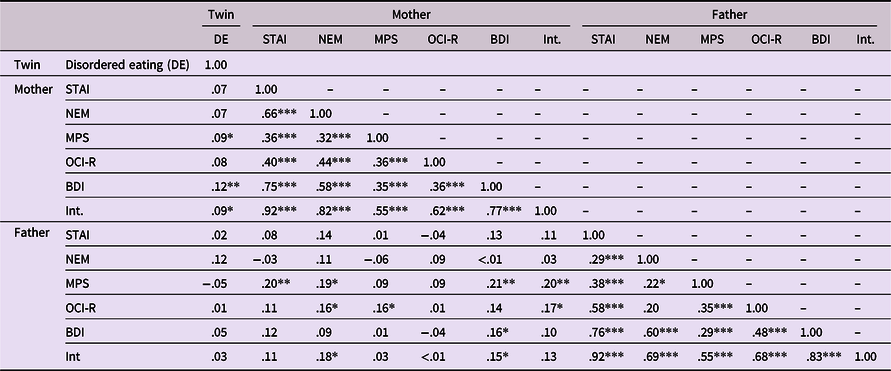
The internalizing factor score for parents was computed as a latent variable factor score incorporating information from the five individual scales: trait anxiety, depressive symptoms, obsessive–compulsive symptoms, negative emotionality, and perfectionism. Obsessive–compulsive symptoms were log-transformed for analyses due to positive skew. Pearson correlations between these internalizing scores in the parents and daughters’ disordered eating can be found in Table 1. Notably, missing data across multiple subscales was rare; 98% of mothers and 89.9% of fathers had data on at least 4 of 5 subscales, and all but one parent had data on at least 2 subscales. We used FIML to derive internalizing factor scores for all parents who had data on at least one underlying subscale.
Pearson correlations (N = 279 twin families)

Note. STAI = State-Trait Anxiety Inventory; NEM = Negative Emotionality; MPS = Multidimensional Perfectionism Scale; OCI-R = Obsessive–Compulsive Inventory – Revised; BDI = Beck Depression Inventory; Int. = Internalizing factor score. *p < .05, **p < .01, ***p < .001.
Exploratory factor analysis suggested that all five subscales should load on a single latent factor (the eigenvalue for the first latent factor extracted was 2.11, followed by .08 for the second latent factor). Therefore, we initially attempted to load all five subscales directly onto one Internalizing latent factor using confirmatory factor analysis. Fit for this model was fair to poor (RMSEA = .093, CFI = .969, TLI = .939, AIC = 23464.517, BIC = 23535.065). Model fit was not improved by excluding the perfectionism subscale, which had the lowest factor loading (β = .43; RMSEA = .120, CFI = .977, TLI = .930). Consequently, we fit a second model that first loaded trait anxiety symptoms and obsessive–compulsive symptoms on an “Anxiety” latent factor and negative emotionality and depressive symptoms on a “Depression” latent factor, then loaded the Anxiety and Depression factors and the perfectionism subscale onto a higher-order Internalizing factor. We also allowed the errors between anxiety symptoms and depressive symptoms to covary given the high correlation between these scales (r = .70). Fit for this model was excellent and improved over the first model on all indices (RMSEA = .048, CFI = .997, TLI = .984, AIC = 23436.179, BIC = 23520.836). The Anxiety (β = .98) and Depression (β = .87) latent variables and perfectionism subscale (β = .47) all displayed significant loadings on the higher-order Internalizing factor (ps < .001).
Twin measures
Disordered eating
Our primary analyses examined the twins’ self-report of their disordered eating symptoms as past findings question the utility of maternal report of child’s binge eating and related risk factors (Vo et al., Reference Vo, Racine, Burt and Klump2019). However, we also conducted the NTFM models using maternal report of daughters’ disordered eating. Results were identical (see Supplemental Tables 1 and 2). Similar to O’Connor et al. (Reference O’Connor, Burt, McGue, Iacono and Klump2019), twins’ overall disordered eating was assessed with the Minnesota Eating Behavior Survey (MEBS; von Ranson et al., Reference von Ranson, Klump, Iacono and McGue2005).Footnote 1 The MEBS is a 30-item questionnaire that assesses a spectrum of eating pathology using true/false questions. The total score measures general levels of disordered eating related to body dissatisfaction (i.e., discontent with body size and shape), weight preoccupation (i.e., preoccupation with dieting, weight, and the pursuit of thinness), binge eating (i.e., thinking about binge eating as well as engaging in binge eating/secretive eating), and compensatory behaviors (i.e., the use of, and thoughts of using, self-induced vomiting and other inappropriate compensatory behaviors to control weight) (von Ranson et al., Reference von Ranson, Klump, Iacono and McGue2005). This measure was developed for use from 10 years of age through adulthood, though studies have indicated that it can assess disordered eating in children as young as 8 years old (Luo et al., Reference Luo, Donnellan, Burt and Klump2016; O’Connor et al., Reference O’Connor, Burt, VanHuysse and Klump2016). We focused on the total score within this study as it demonstrates the strongest psychometric properties, including good 3-year stability, good convergent validity with the Eating Disorder Examination Questionnaire (EDED-Q; Fairburn & Beglin, Reference Fairburn and Beglin1994) and excellent internal consistency in females in past work (α = .86–.89) (von Ranson et al., Reference von Ranson, Klump, Iacono and McGue2005) and the current study (α = .84).
Statistical analysis
Data preparation
Given previous studies demonstrating phenotypic increases in disordered eating symptoms across adolescence (Hudson et al., Reference Hudson, Hiripi, Pope and Kessler2007), age was regressed out of the twins’ total score to control for the wide age range within the sample (aged 8–14 years). Past studies have demonstrated significant associations between body mass index (BMI) and symptoms of disordered eating (e.g., Jones et al., Reference Jones, Bennett, Olmsted, Lawson and Rodin2001; Keel et al., Reference Keel, Fulkerson and Leon1997), thus BMI percentile was regressed out of twins’ disordered eating total score prior to analyses to ensure that results were specific to disordered eating. BMI was calculated (kg/m2) using height and weight measured by trained research assistants. Age and BMI were not regressed out of parents’ internalizing scores, as internalizing symptoms have been demonstrated to be quite stable in middle age (Gustavson et al., Reference Gustavson, Franz, Panizzon, Lyons and Kremen2020), and there is a less clear relationship between BMI and internalizing symptoms (e.g., Haghighi et al., Reference Haghighi, Jahangard, Ahmadpanah, Bajoghli, Holsboer-Trachsler and Brand2016). Disordered eating was log-transformed to account for positive skew.
Twin family correlations
Pearson correlations between parents’ internalizing factor score and daughters’ disordered eating, as well as correlations between mother–father internalizing factor scores, were calculated as an initial indication of the potential pathways of influence. Specifically, significant correlations between mother–daughter’s and father–daughter’s scores could suggest the presence of passive rGE, family-specific shared environmental influences (F), or additive genetic influence (A), but not sibling-specific shared environmental influences (S) as S reflects similarities between co-twins only.
Next, twin intraclass correlations (e.g., correlations between Twin 1 and Twin 2 on the MEBS total score) were calculated in MZ and DZ twin pairs separately. If MZ correlations are greater than DZ correlations, but not greater than twice the DZ correlations, additive genetic influence (A) is suggested. If MZ correlations are more than two times greater than DZ correlations, dominant genetic influence (D) is suggested. If DZ correlations are greater than half the MZ correlation, shared environmental effects (C in classic twin designs) are suggested. Notably, twin correlations are unable to disentangle family-specific (F) and sibling-specific (S) shared environmental influences, as both types of shared environmental influence would make twins similar to each other. However, the combination of parent–offspring and twin correlations can provide an initial indication of the influences of A, D, F, S, and E. Non-shared environmental influences (E; factors that make co-twins dissimilar to each other, including measurement error) are suggested when MZ correlations are less than 1.00.
Nuclear twin family models (NTFMs)
NTFMs were conducted using the structural equation modeling program, Mx (Neale et al., Reference Neale, Boker, Xie and Maes1997) to explore the extent to which parents’ internalizing symptoms may genetically and/or environmentally contribute to variance in daughters’ disordered eating. Missing data was accounted for using Full-Information Maximum Likelihood (FIML) raw data techniques, which allow for less biased estimates than pairwise or listwise deletions if missing data are present (Little & Rubin, Reference Little and Rubin1987). FIML assumes any missing data is missing at random (i.e., the probability the data are missing is unrelated to the value). FIML also allows for the retention of families missing one or more family members (see Supplemental Table 3 for details about family member participation in our sample).
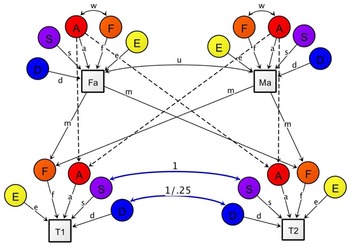
The NTFM (see Figure 1) partitions the variance in twins’ disordered eating into five components: additive genetic (A), dominant genetic (D), family-specific shared environment (F), sibling-specific shared environment (S), and non-shared environment (E). Within this model, genetic main effects would be indicated by A or D, shared environmental main effects by F and S, and non-shared environmental main effects by E. An estimate of passive rGE (labeled as “w” within Figure 1) is calculated by the covariance of parents’ A and F, reflecting the extent to which family environment is correlated with the additive genetic influences. Assortative mating (i.e., spousal similarity on a trait; μ in Figure 1) is also modeled within the NTFM. Should parents be more similar on a particular trait than expected by chance, this may reflect increased genetic similarity, which would then increase the proportion of genes shared by DZ twins (MZ twins are already considered to share 100% of their segregating genes). If DZ twins share a higher proportion of genes, this would decrease the difference in genetic relatedness between MZ and DZ twins, inflating estimates of C.
Path diagram of a univariate nuclear twin family model. The variance in a phenotype in fathers (Fa), mothers (Ma), and twins (T1 and T2) is divided into estimates of additive genetic effects (A), dominant genetic effects (D), sibling environmental influences (S), familial environmental influences (F), and non-shared environmental influences (E). u reflects assortative mating between the twins’ parents. w indicates the covariance between A and F (i.e., passive rGE). m reflects the familial transmission pathways (i.e., the contribution of the parental phenotype on twins’ variance attributable to familial environment). Squaring the path estimates indicates the proportion of variance accounted for. Only two of the three sources of variance (D, S, F) can be estimated at one time (along with A and E, that are always assumed to contribute to the phenotype).

The NTFM uses four pieces of information to calculate parameter estimates: the covariance between MZ twins, the covariance between DZ twins, the covariance between parents, and the covariance between parents and children. Because estimates are based on four pieces of information, the NTFM is unable to estimate all 5 parameters (i.e., A, D, F, S, E) simultaneously. One parameter must be fixed to zero. A and E are assumed to influence all traits to some extent. Thus, A and E are always estimated within the model, and D, S, F are differentially constrained to zero. Full models that can be estimated are the ADSE, ADFE, and ASFE. Additionally, nested submodels of these full models can be fit to the data to test the hypothesis that excluded parameters are negligible, including ADE, AFE, ASE, and AE.
A series of full models (ADSE, ADFE, ASFE) and submodels (ADE, AFE, ASE, AE) were fit to the data. Model fit statistics were calculated to compare these full models and submodels to determine the best-fitting model. Four information criteria indices that balance overall fit with model parsimony were examined: Akaike’s information criterion (AIC; Akaike, Reference Akaike1987), Bayesian information criterion (BIC; Raftery, Reference Raftery1995), sample-size adjusted Bayesian information criterion (SABIC; Sclove, Reference Sclove1987), and Deviances information criterion (DIC; Spiegelhalter et al., Reference Spiegelhalter, Best, Carlin and Van Der Linde2002). The best-fitting model is indicated by the lowest (most negative) values for all four indices. Further, model fit was compared by taking the difference in minus twice the log-likelihood (-2lnL) (for nested models). Large (statistically significant) differences in -2lnL values led to a rejection of the nested model in favor of the full model.
Results
Phenotypic and intraclass correlations
Twins endorsed a range of overall disordered eating scores (M = 3.81, SD = 3.88, range 0–19). A total of 2.5% of twins scored above the clinical cutoff (score = 15.55) for the MEBS total score (von Ranson et. al., 2005), which was expected given the lower age range of our sample (M = 10.44; SD = 1.24).
Pearson correlations between daughters’ disordered eating and parents’ internalizing factor scores are presented in Table 1. A significant positive association was observed between mother’s internalizing factor score and twins’ disordered eating (r = .09, p = .03), while these same associations were nonsignificant for the father’s internalizing factor score (r = .03, p = .50). The association between mother–father internalizing factor scores (r = .13, p = .07) was larger than the parent internalizing-offspring disordered eating correlations. Intraclass correlations indicated that MZ twin correlations and DZ twin correlations were relatively similar (MZ r = .42, p < .001, DZ r = .41, p < .001) and not significantly different from each other (z = .14, p = .44). The modest parent–offspring correlations paired with the significant (and moderate) correlations between both MZ and DZ co-twins suggests the importance of sibling-specific environmental influences (i.e., influences that make twins more similar to each other, but not more similar to their parents).
Nuclear twin family models
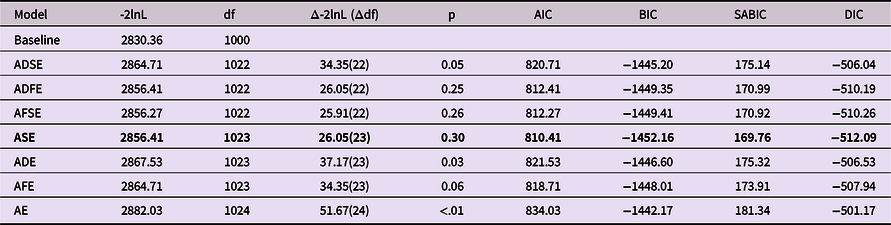
Model fit statistics indicated that the ASE model was the best-fitting model as demonstrated by the lowest AIC, BIC, SABIC, and DIC values and a nonsignificant change in chi-square from the baseline model (see Table 2). Variance in twins’ disordered eating was primarily attributed to environmental influences, specifically sibling-specific shared environmental (33.8%,) and non-shared environmental (57.0%) influences (see Table 3). Variance attributable to additive genetic influence was much lower (8.7%) (see Table 3).
NTFM model fit statistics using parent’s internalizing factor score and twins’ disordered eating (N = 279 twin families)

Note. A = additive genetic, D = dominant genetic, S = environmental influences shared by siblings; F = environmental influences shared by all family members, and E = non-shared environmental influences. AIC = Akaike’s information criterion, BIC = Bayesian information criterion, SABIC = sample size adjusted Bayesian information criterion, and DIC = deviance information criterion. STAI = State-Trait Anxiety Inventory, MPQ = Multidimensional Personality Questionnaire. The best-fitting model as determined by the lowest AIC, BIC, SABIC, and DIC, and nonsignificant change in -2lnL is bolded.
Standardized and unstandardized parameter estimates for the full and best-fitting models using parent’s internalizing factor score and twins’ disordered eating (N = 279 twin families)

Note. Std = standardized; Unstd = unstandardized; A = additive genetic, E = non-shared environmental, S = environmental influences shared by siblings, F = environmental influences shared by all family members. Passive rGE = passive gene–environment correlation. 95% confidence interval provided in parentheses. Any CI intervals that include zero are nonsignificant. Significant parameters are bolded. The best-fitting model (i.e., “ASE”) is indicated by “best” under model name. Given our interest in exploring the possibility of F and passive rGE, the full model including F was provided and labeled as “full”.
Importantly, the best-fitting model did not include family-specific influences (F) and thus, estimates of passive rGE were not calculated within the best-fitting models. However, given our study’s specific interest in exploring passive rGE, parameter estimates for the ASFE model was also included in Table 3. Notably, parameter estimates for F and passive rGE were nonsignificant, further suggesting these influences should be excluded from the best-fitting model. Estimates of assortative mating were small and nonsignificant (see Table 3).
Post hoc analyses
Our sample size was relatively modest for conducting NTFMs. Thus, we conducted post hoc analyses adding twins (N = 251 twin families (64.1% MZ, 35.9% DZ); total sample for analysis N = 530 families (57.2% MZ, 42.8% DZ) further sample description can be found in Supplemental Table 3) from the Minnesota Twin Family Study (MTFS; Iacono et al., Reference Iacono, Carlson, Taylor, Elkins and McGue1999; Iacono & McGue, Reference Iacono and McGue2002; Iacono et al., Reference Iacono, McGue and Krueger2006). A combined sample of twin from the MSUTR and MTFS was examined in our original paper (O’Connor et al, Reference O’Connor, Burt, McGue, Iacono and Klump2019); however, the same internalizing questionnaires were not administered in both studies. Both twin registries administered the STAI-T (Spielberger, Reference Spielberger1983) and the Multidimensional Personality Questionnaire-Negative Emotionality subscale (Tellegen, Reference Tellegen1982) to parents and the MEBS (von Ranson et al., Reference von Ranson, Klump, Iacono and McGue2005) to twins, and thus, we conducted post hoc NTFMs using a combined sample separately for these two questionnaires. Consistent with our initial findings, we did not find evidence for passive rGE within these post hoc analyses. Instead, model fit statistics once again indicated that the ASE model was best fitting for both STAI-T and MPQ-Negative Emotionality (see Supplemental Table 4) with similar variance estimates as our initial models (see Supplemental Table 5). These findings strongly suggest a lack of passive rGE even when explored in larger samples and across different related constructs.
Discussion
Our study substantially extends past developmental twin studies (Culbert et al., Reference Culbert, Burt, McGue, Iacono and Klump2009; Klump, Burt, et al., Reference Klump, Burt, McGue and Iacono2007; Klump, Perkins, et al., Reference Klump, Perkins, Burt, McGue and Iacono2007; Klump et al., Reference Klump, Culbert, Slane, Burt, Sisk and Nigg2012, Klump, Culbert, O’Connor, et al., Reference Klump, Culbert, O’Connor, Fowler and Burt2017) that have been unable to explore the possibility of passive rGE nor examine family-specific versus sibling-specific shared environmental influences. We did not indicate the presence of passive rGE in pre-early puberty even when taking into account the genetic and environmental contribution of parents’ broader internalizing phenotype. Instead, findings highlight the importance of sibling-specific and non-shared environmental influences.
Using both a broader internalizing parental phenotype (in the present study) and a narrow disordered eating phenotype (O’Connor et al., Reference O’Connor, Burt, McGue, Iacono and Klump2019), results consistently demonstrate a lack of passive rGE for disordered eating in girls. We had hypothesized that the lack of genetic influence in pre-early puberty demonstrated in past studies may be due to passive rGE, in that genetic influence could indirectly impact the environment but be hidden in estimates of shared environment in studies using classic twin designs. Taken together, findings demonstrate the lack of importance of genetic influence underlying disordered eating in pre-early puberty.
Notably, our findings from the NTFMs were consistent with our initial phenotypic parent–child correlations. Specifically, we observed small correlations between parents’ internalizing scores and daughters’ disordered eating. While past studies during childhood predominantly focus on the association between maternal internalizing symptoms (e.g., anxiety/depression) and offspring irregular eating, fussy eating, and food refusal (Blissett et al., Reference Blissett, Meyer and Haycraft2007; McDermott et al., Reference McDermott, Mamun, Najman, Williams, O’Callaghan and Bor2009; de Barse et al., Reference De Barse, Cardona Cano, Jansen, Jaddoe, Verhulst, Franco, Tiemeier and Tharner2016), the majority of studies that explore the relationship between parental internalizing symptoms and offspring disordered eating aggregate across age and/or pubertal status (i.e., their age range would suggest the inclusion of both pre-pubertal and pubertal offspring) making it a challenge to understand how consistent our small parent–child correlations are with the existing literature. Notably, the association between internalizing symptoms and cognitive disordered eating symptoms (e.g., weight/shape concerns, body dissatisfaction) seem to get stronger across puberty within individuals (Vo et al., Reference Vo, Fowler, Rolan, Culbert, Racine, Burt and Klump2021), suggesting that we would likely see stronger correlations between parent’s internalizing symptoms and offspring’s’ disordered eating with advancing pubertal development. Given past developmental twin studies indicate a substantial increase in genetic influence in mid-late puberty (Klump et al., Reference Klump, McGue and Iacono2000, Reference Klump, McGue and Iacono2003; Klump, Burt, et al., Reference Klump, Burt, Spanos, McGue, Iacono and Wade2010; Klump, Burt, et al., Reference Klump, Burt, McGue and Iacono2007; Wade et al., Reference Wade, Hansell, Crosby, Bryant-Waugh, Treasure, Nixon, Byrne and Martin2012), we would suspect that additive genetic influence would underlie these parent–child associations in mid-late puberty.
It is possible that a different parental phenotype could demonstrate passive rGE in pre-early puberty. For instance, externalizing symptoms (e.g., impulsivity, dysregulation, stimulus seeking) have also been associated with eating pathology (e.g., Adambegan et al., Reference Adambegan, Wagner, Nader, Fernandez-Aranda, Treasure and Karwautz2012; Slane et al., Reference Slane, Burt and Klump2010). However, eating disorders appear to load more strongly onto an internalizing latent factor (Mitchell et al., Reference Mitchell, Wolf, Reardon and Miller2014) and are more strongly associated with internalizing symptoms (Slane et al., Reference Slane, Burt and Klump2010), suggesting passive rGE may not be present with an externalizing phenotype as well. Importantly, these findings that highlight a lack of genetic influence during pre-early puberty further support that shifts in genetic influence appear to be specific to the pubertal period and may reflect other factors (e.g., activation of ovarian hormones; Klump et al., Reference Klump, Fowler, Mayhall, Sisk, Culbert and Burt2018) acting on the genetic diathesis of disordered eating.
Findings from the present study highlight the importance of sibling-specific and non-shared environmental influences in pre-early puberty. Sibling-specific influences include any environmental influences that would make twins similar to one another, but not their parents. These influences could be generational, as factors influencing adolescents may not impact the parents’ generation in the same way. For example, greater social media use has been linked to higher levels of body dissatisfaction, internalization of appearance ideals, drive for thinness, and dietary restraint in adolescent girls (De Vries et al., Reference De Vries, Peter, de Graaf and Nikken2016; McLean et al., Reference McLean, Paxton, Wertheim and Masters2015; Tiggemann & Slater, Reference Tiggemann and Slater2016). Thus, siblings may resemble one another in their disordered eating due to experiencing similar access to pressures to have the “perfect body” from viewing filtered and biased social media posts. Siblings could also share peer groups. Peer conversations about weight, shape, dieting, and appearance have been associated with elevated rates of disordered eating in girls (e.g., Keel & Forney, Reference Keel and Forney2013). Further, shared participation in sports or extracurricular activities could lead to similarities between siblings. For instance, past research has demonstrated a relationship between participation in leanness sports (i.e., sports that require low body weight and/or low fat/muscle ratio to achieve good results) and elevated levels of weight control behaviors in young elite athletes (Werner et al., Reference Werner, Thiel, Schneider, Mayer, Giel and Zipfel2013). Taken together if twins share the experience of engagement in social media, exposure to friend groups that frequently discuss weight/shape concerns, or participation in a leanness sport, these experiences may make them more similar to each other in their levels of disordered eating but not necessarily to their parents’ disordered eating or internalizing traits/symptoms (i.e., these influences would load onto S, not F).
Alternatively, if only one twin is exposed to one of these environments, and/or one twin experiences the environment differently than their co-twin (e.g., one twin internalizes the thin-ideal from conversations with friends, whereas the other twin does not), these experiences would make the co-twins less similar to each other in their disordered eating and thus, load onto non-shared environmental influences. An important point to highlight is that parents do not parent themselves. Thus, despite our study’s findings of the importance of sibling-specific and non-shared environmental influences, parents may still contribute to offspring’s eating pathology if, for instance, parents’ internalizing traits are experienced differently by each co-twin (e.g., one twin may internalize their depressed, anxious, or perfectionistic parents’ behavior, whereas the other twin may be unaffected by their parents’ internalizing traits). These different experiences of the parents and their environments may make co-twins dissimilar to one another on their disordered eating and thus, load onto non-shared environmental influences. Notably, longitudinal twin studies exploring etiologic influences across age indicates that these non-shared environmental influences likely carry over across age (Fairweather-Schmidt & Wade, Reference Fairweather-Schmidt and Wade2015; Klump, Burt, et al., Reference Klump, Burt, McGue and Iacono2007, Reference Klump, Burt, Spanos, McGue, Iacono and Wade2010). Thus, the environmental experiences that co-twins seek out independently or experience differently likely continue to influence their risk for disordered eating across development.
The present study has many strengths (e.g., use of an internalizing factor, post hoc analysis with a larger sample size and different measures). However, this study is not without limitations. First, the present study was conducted in a non-clinical sample; thus, it is unclear whether results would generalize to a clinical sample. Notably, recruiting enough pre-/early pubertal twins with clinical eating disorders to conduct a well-powered twin study would be a significant challenge. Fortunately, as noted, past research has demonstrated that disordered symptoms are precursors to clinical eating disorders (Killen et al., Reference Killen, Barr, Hayward, Farish, Wilson, Hammer, Kraemer, Blair-Greiner and Strachowski1996; Stice & Shaw, Reference Stice and Shaw2002) and that eating pathology is better conceptualized as dimensional than categorical (Luo et al., Reference Luo, Donnellan, Burt and Klump2016). Additionally, the heritabilities of clinical eating disorders are similar to those of eating disorder symptoms in adult women (Bulik et al., Reference Bulik, Thornton, Root, Pisetsky, Lichtenstein and Pedersen2010; Culbert et al., Reference Culbert, Burt, McGue, Iacono and Klump2009; Kendler et al., Reference Kendler, MacLean, Neale, Kessler, Heath and Eaves1991; Klump et al., Reference Klump, McGue and Iacono2000, Reference Klump, Miller, Keel, McGue and Iacono2001, Reference Klump, McGue and Iacono2003; Klump, Perkins, et al., Reference Klump, Perkins, Burt, McGue and Iacono2007; Klump et al., Reference Klump, Suisman, Burt, McGue and Iacono2009; Rutherford et al., Reference Rutherford, McGuffin, Katz and Murray1993; Slof-Op’t Landt et al., Reference Slof-Op’t Landt, Bartels, van Furth, van Beijsterveldt, Meulenbelt, Slagboom and Boomsma2008; Wade et al., Reference Wade, Bulik, Sullivan, Neale and Kendler2000b). Taken together, it is likely that results may generalize to clinical samples, although additional studies are needed.
Second, we focused analyses exclusively on female twins, and the sample was predominantly White and middle-to-upper class. It is, therefore, unclear whether results would generalize to males or samples with greater racial, ethnic, and socioeconomic diversity. Future studies are needed to explore rGE processes for disordered eating in these populations. Finally, the present study was conducted in largely the same sample as the initial study it sought to extend (i.e., overlap with O’Connor et al., Reference O’Connor, Burt, McGue, Iacono and Klump2019 was 49.6% for the internalizing factor score in the MSUTR, and 89.1% for the STAI and MPQ in the combined MSUTR-MTFS sample). While the present study consistently demonstrated similar findings using three different internalizing phenotypes in two overlapping data sets, further replication is needed in independent samples to ensure findings are not specific to the MSUTR-MTFS twin sample.
Taken together, the present study further highlighted the importance of sibling-specific and non-shared environmental factors for disordered eating in pre-early puberty. Results suggest that future studies should explore environmental factors that could lead to similarities between co-twins, but not their parents. These factors could be independent of parental influence (e.g., social media use), or could reflect the twins’ experience or interpretation of their parents’ behaviors or expectations. Developing a better understanding of the influences underlying eating pathology in pre-adolescence could highlight key places for future prevention and intervention and increase understanding of developmental trajectories of risk.
Supplementary material
The supplementary material for this article can be found at https://doi.org/10.1017/S0954579422000608
Funding statement
This research was supported by grants from the Blue Cross Blue Shield of Michigan Foundation and the Michigan State University Psychology Department awarded to Dr Shannon O’Connor, the National Institute of Mental Health (NIMH: 1 R01 MH09038) awarded to Drs. Kelly Klump and S. Alexandra Burt, and the National Institute of Alcohol Abuse and Alcoholism (R01 AA 09367) and the National Institute on Drug Abuse (R01 DA 013240) awarded to Drs. Matthew McGue and William Iacono.
Conflicts of interest
None.