During the pre-Columbian era the Maya, as well as some other Mesoamerican societies, manufactured finely made, highly polished plaques, more commonly called “mirrors” due to their size and highly reflective surfaces (Ekholm Reference Ekholm1973; Mason Reference Mason1927). Some of the oldest mirrors known from Mesoamerica were made by the Olmec culture of Mexico in the Early Formative period (ca.1200–1000 b.c.) from a single, highly polished, often concave, piece of iron-ore (Carlson Reference Carlson and Benson1981; Cheetham Reference Cheetham2006:45; Coe and Diehl Reference Coe and Diehl1980:243–244, Figure 251; Heizer and Gullberg Reference Heizer, Gullberg and Benson1981). Polished mirrors have been described as “enigmas” (Carlson Reference Carlson and Benson1981:131), “prestige” or “luxury” goods (Flannery Reference Flannery and Benson1968:79–110), indicators of high status (Brumfiel and Earle Reference Brumfiel, Earle, Brumfiel and Earle1987:4; LeCount Reference LeCount1999:249), “power objects” (Saunders Reference Saunders, Quilter and Hoopes2003:22), “elite markers” (Grove Reference Grove1997:76), and as “essential accompaniments” to elite Classic Maya burials (Coe Reference Coe, Benson and Griffin1988:227–228; Healy et al. Reference Healy, Awe, Helmuth and Garber2004a:234–235).
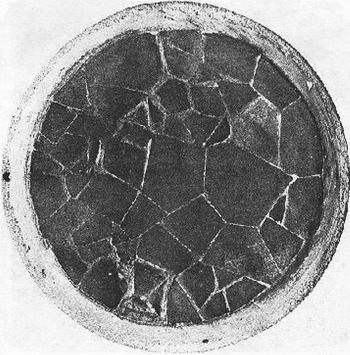
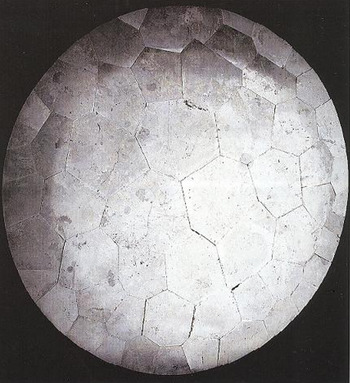
In contrast to the monolithic Olmec specimens, ancient Maya mirrors tended to be somewhat larger, composite artifacts—flat plaques usually composed of a slate backing with a shiny surface made of polished pyrite or hematite polygons assembled in a mosaic pattern (Kidder et al. Reference Kidder, Jennings and Shook1946:126–133) (Figure 1). Despite some differences in mirror construction and materials, we suspect that these Maya objects served the same purpose as the much earlier Olmec specimens, and that this function was both political and, especially, ritual in nature.
Round Maya mosaic mirror, pyrite with slate backing, from Kixpak, Guatemala (after Mason Reference Mason1927:205; courtesy of Robert Sharer, University Museum, University of Pennsylvania, Philadelphia). Diameter 11.3 cm.

Many of the Maya pyrite-encrusted plaques have drill holes in them, suggesting that they were once attached to another surface, such as clothing, or were mounted on wooden frames. Our research reveals that hundreds of archaeological specimens have been found at sites in the Maya subarea (southern Mexico, Guatemala, Belize, and the western portions of Honduras and El Salvador). Well preserved, whole specimens are relatively rare. Nonetheless, extant specimens do have a high degree of homogeneity in their design, raw materials, methods of manufacture, and final appearance. There is also considerable consistency in their archaeological contexts and associations. Surprisingly, there have been few detailed studies of these unusual products. Previous examinations have focused specifically on iconography and ethnohistory (Saunders Reference Saunders, Saunders and de Montmollin1988; Taube Reference Taube1983, Reference Taube and Berlo1992).
In this paper, we review what these material objects look like, how the mosaic plaques were made, their archaeological occurrences, and their representation in ancient Maya art and hieroglyphic texts. Blending archaeological, artistic, epigraphic, and ethnohistoric information, we present suggestions for the function and meaning of ancient Maya iron-ore mirrors. We conclude that these well-made, composite, lithic reflectors were highly valued ceremonial artifacts used by their owners (almost always elite individuals) for religious divination and prognostication, based on age-old rites of scrying in attempts to make direct communicative contact with a spiritual Otherworld.
ANCIENT MAYA MIRRORS
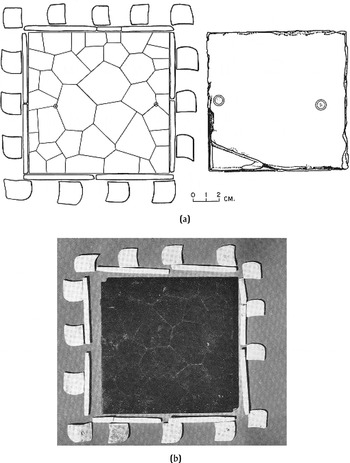
Recently, Blainey (Reference Blainey2007) described in detail the archaeological occurrence of over 500 mosaic mirrors found at 41 sites, in both the highlands and lowlands of the Maya subarea. Specimens were recorded for their size, raw materials, contexts, and age. Investigations have shown that iron-ore mosaic mirrors are relatively rare artifacts at most Lowland Maya sites, often with no more than one or two specimens found at a center. By contrast, several specific Highland Maya sites have produced large quantities of mirrors. Kaminaljuyu and Chama, for example, each have in excess of 35 recovered plaques, while over 200 mirrors were excavated from Nebaj early in the last century. Such concentration of these unusual artifacts suggests that the Highlands may have been important as a source of raw materials, as well as a production locale of mirrors, for both local consumption and possibly interregional export and trade. While some archaeological specimens are whole, most are broken (probably intentionally) and recovered as fragments in elite Maya burials or ceremonial caches. The vast majority (n = 276, 97%) of Maya mirrors of known form are circular, flat disks, although the occasional mirror was oval or even square in shape (Figure 2a and 2b). Of 73 whole mirror backs with documented dimensions, diagonal measurements range from 5.6–29 cm, with an average of 15.1 cm; of these, 17 have a measured thickness ranging from 3–72 mm, with an average of 12.3 mm (Blainey Reference Blainey2007:Appendix A). Many whole specimens are almost perfectly round, suggesting the use of a compass-like device to provide precision in design.
(a) Drawing (left, front view; right, back of plaque with drill holes) of an elaborate square Maya mosaic mirror, pyrite with slate, bone, and possibly wood, from Baking Pot, Belize (after Bullard and Bullard Reference Bullard and Bullard1965:Figure 16; with permission of the Royal Ontario Museum © ROM). 10.8 × 10.8 cm (excluding bone frame). Thickness 0.9 cm; (b) Photograph of same (front view) (after Bullard and Bullard Reference Bullard and Bullard1965:Plate XXI; with permission of the Royal Ontario Museum © ROM).

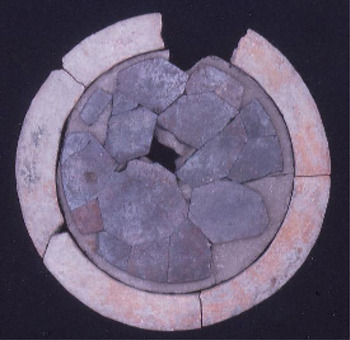
Most of the known Maya mirrors (n = 113, 72%) have slate backings (sometimes also labelled shale, schist, or mudstone by archaeologists), although a small portion were made of sandstone, pottery, or possibly even shell. A few plaques appear to have once had wood, or wood and bone, basal frames around them, although such organic additions rarely survive the harsh tropical climate (Bullard and Bullard Reference Bullard and Bullard1965:Figure 16). At least one Postclassic period specimen from Lamanai has an unusual pottery frame surrounding it (Figure 3).
Round Maya mosaic mirror, pyrite with slate backing, enclosed within a ceramic ring frame, from BU N10-4/3, Lamanai, Belize (courtesy of David M. Pendergast). Diameter 10.5 cm (excluding ceramic frame).

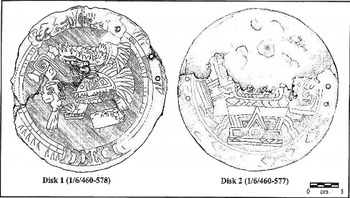
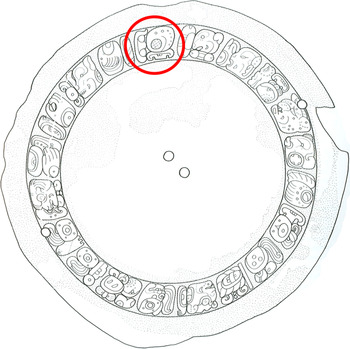
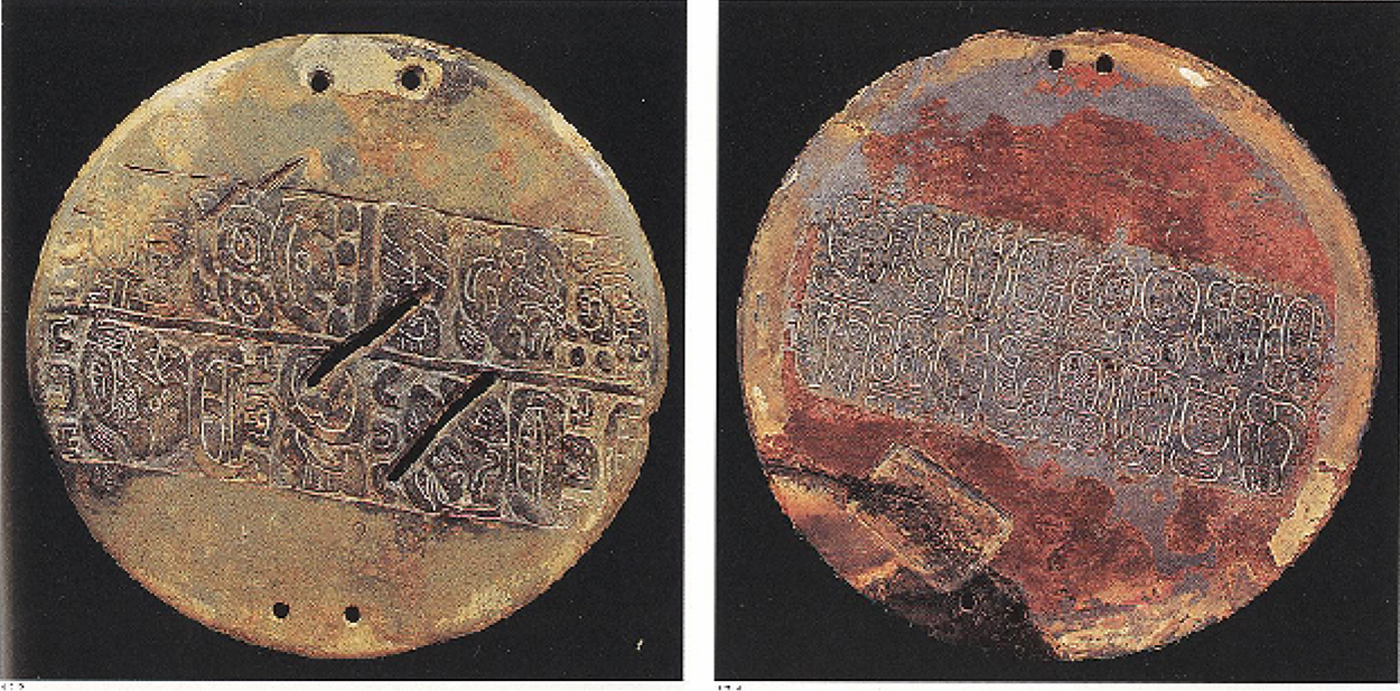
While most Maya slate mirror backs are plain, a few are more ornate in design. A carved specimen from Kaminaljuyu, for example, has a complex volute decoration on the back reminiscent of designs from the Classic Veracruz culture of the Gulf Coast of Mexico (Kidder et al. Reference Kidder, Jennings and Shook1946:Figure 14). Teotihuacan-style motifs, derived from highland central Mexico, are carved on the backs of several mirrors from Early Classic contexts at the site of Copan (Bell et al. Reference Bell, Sharer, Traxler, Sedat, Carrelli, Grant, Bell, Canuto and Sharer2004) (Figure 4). There are also slate mirror backs with Maya hieroglyphic texts carved on them, including specimens from Rio Azul (Adams Reference Adams1999) and Topoxte (Figure 5) in Guatemala, the latter of which yields a phonetic spelling of the phrase u-nen. In Maya, u means “his,” while nen probably means “shiny surface” or, more likely, “mirror” (Fialko Reference Fialko and Wurster2000; Martin et al. Reference Martin, Berrin and Miller2004:46). Other examples of mirrors bearing glyphs have been found in Costa Rica, over 850 km to the south of the Maya heartland (Schmidt et al. Reference Schmidt, de la Garza and Nalda1998:628–629, Plates 433–434; Stone and Balser Reference Stone and Balser1965), elucidations of which have yet to be published (Dennett and Blainey Reference Dennett and Blainey2008; Mora-Marín Reference Mora-Marín1996; Reents-Budet et al. Reference Reents-Budet, Fields and Mora-Marín1995) (Figure 6).Footnote 1 Some Maya mirrors also show traces of stucco (lime plaster) coatings—likely once painted—or traces of cinnabar (red ochre) commonly associated with elite Maya burials (Bell et al. Reference Bell, Sharer, Traxler, Sedat, Carrelli, Grant, Bell, Canuto and Sharer2004). Clearly, these objects were valued highly, and were widely-exchanged works of art executed by very skilled Maya artisans.
Drawings of round, carved, slate mirror backs from Margarita Tomb, Chamber 1, Copan, Honduras. Backs were both stuccoed and painted with Teotihucan-style designs (after Bell et al. Reference Bell, Sharer, Traxler, Sedat, Carrelli, Grant, Bell, Canuto and Sharer2004:140; courtesy of Robert J. Sharer and the University Museum, University of Pennsylvania, Philadelphia). Diameter ca. 21 cm. Drawings by Nelson Paredes.

Drawing of round, carved, slate mirror with hieroglyphs from Topoxte, Guatemala, with circle highlighting phonetic glyph u-nen, meaning “his mirror” or “his shiny surface” (Fialko Reference Fialko and Wurster2000).

Photographs of round, carved slate mirror backs with hieroglyphics, from La Fortuna (left) and Nicoya (right), Costa Rica (Schmidt et al. 1998:629, Entries 433–434). Left, Diameter 17.0 cm, Thickness 2.0 cm; Right, Diameter 22.0 cm, Thickness 2.0 cm.
Most of the mosaic iron-ore polygon pieces (n = 155, 81%) were made of pyrite (FeS2), with a smaller proportion (n = 37, 19%) identified as hematite (Fe2O3), often crystalline hematite, glued to the backing with an unknown adhesive. The highly polished pyrite polygons, frequently with a brassy-golden color, provided the mirrors with their reflective (if fractured) surface. Over the centuries, due to moisture, pyrite polygons have often deteriorated to a rust-like accretion atop their backings. Consequently, it is far more common to find the slate backing of a mirror than the original polygons, although the outlines of the decomposed reflectors occasionally remain as ridged deposits of adhesive on the slate surface (e.g., at Piedras Negras; see Coe Reference Coe1959).
PRODUCTION OF MAYA MOSAIC MIRRORS
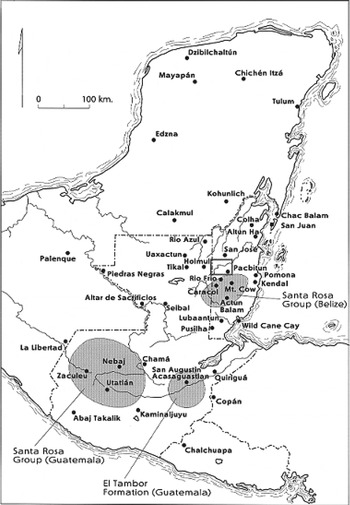
Given that the most common raw materials employed in Maya mirrors were slate and pyrite, the Guatemalan Highlands are a likely center for production, with completed plaques then being traded to the Lowlands (Willey Reference Willey1972:142).Footnote 2 Healy and associates (1995) have identified two slate-producing zones in the Highlands of southern Guatemala: the Santa Rosa Group (near Zaculeu, Nebaj, and Utatlan) and the El Tambor Group (near San Augustin Acasaguastlan) (Figure 7). Blainey (Reference Blainey2007:168–175) notes that significant raw iron-ore deposits (from which pyrite and hematite could have been extracted) also occur in southern Guatemala and neighbouring Honduras.
Map of Maya subarea. Shaded areas in Guatemala and Belize indicate concentrated geological deposits of slate and iron ores suitable for mirror manufacture. Prepared by Paul F. Healy.

An alternative (or additional) source of raw materials for the mirrors occurs further north. Slate is found in abundance in parts of the Maya Mountains of central Belize and northern Guatemala, closer to many of the Central Maya Lowland sites from which mirrors have been recovered. Indeed, the earliest archaeological evidence for slate mirrors comes not from the highlands but from the Belize Valley. Awe (Reference Awe1992:302, Figure 91a) reports a fragmentary slate mirror back from Cahal Pech that dates to the Middle Formative period (ca. 600 b.c.). In addition, considerable evidence for ancient Maya working of slate, including a Late Classic period (a.d. 550–900) slate workshop, occurs nearby at Pacbitun on the edge of this slate-bearing zone of the Maya Mountains (Healy et al. Reference Healy, Awe, Iannone and Bill1995:343, Reference Healy, Hohmann, Powis and Garber2004b:211).
As such, there are several possible resource zones which may have provided materials in antiquity for the slate backings. In the absence of definitive geological testing, the exact source of the raw materials used for the mirrors found across the Maya Subarea remains unclear. It is possible that multiple mirror-manufacturing centers were in operation by the Classic period but, if so, these adhered closely to an almost formulaic template for mosaic mirror production.
SPECIALIZED TECHNOLOGY
Several early writers have commented on the time-consuming and painstaking craftsmanship involved in mirror production (Kidder et al. Reference Kidder, Jennings and Shook1946; Smith and Kidder Reference Smith and Kidder1951:44). Figure 8 shows the carefully-layered construction of a typical Maya slate-backed pyrite mosaic mirror. Described as “masterpieces of the stoneworker's craft…the few undecayed…pieces of pyrite are so perfectly shaped and fitted that the joints are almost invisible, a result of long and careful grinding of each bit of pyrite” (Woodbury Reference Woodbury and Willey1965:172).Footnote 3
Drawing of a cross-section of an ancient Maya iron-ore mosaic mirror, revealing construction: (a) contact edges of polygonal pyrite plates bevelled for close surface fit; (b) pyrite plates forming periphery of incrustation probably had curving outer edge cut square, but with upper corner bevelled; (c) some slate backings are bevelled; and, (d) attachment holes drilled through the back in this image (after Kidder et al. Reference Kidder, Jennings and Shook1946:Figure 52).

The fact that some mirrors have hieroglyphic texts carved on them, with many others found in either elite burials or ritual caches honoring monumental architecture, points to an aristocratic, if not royal, association for many of these objects. Based on what is presently known about ancient Maya society, it is likely that the mirrors were made by artisans with specialized knowledge and skills, and perhaps even royal lineage (Reents-Budet Reference Reents-Budet1994:36–71). There are indications of exceptional artists (and even schools of art) being closely affiliated with site rulers, and producing elite goods as craftsmen attached to royal Maya courts (Houston and Stuart Reference Houston, Stuart, Inomata and Houston2001; Inomata Reference Inomata2001; Reents-Budet Reference Reents-Budet1994:164–233).Footnote 4
Given the amount of care and technology involved in their manufacture, each mosaic mirror was essentially a work of art. The exquisiteness of the mosaic mirrors led A.V. Kidder, a leading Mayanist of the early twentieth century, to state that: “Nothing produced in aboriginal America seems…to rival these plaques in the matter of skilled and meticulous craftsmanship…” (Kidder et al. Reference Kidder, Jennings and Shook1946:131).
ARCHAEOLOGICAL CONTEXTS
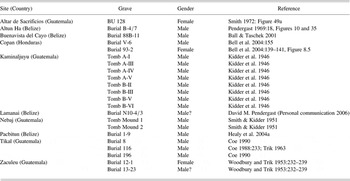
The majority of the 175 mirrors with secure archaeological contexts and chronological detail were found in the highly ritualized contexts of either burials (n = 64, 37%) or caches (n = 46, 26%), with smaller numbers occurring in miscellaneous locations (caves, plaza deposits, storage pits, mound fill, surface finds, etc.) (Blainey Reference Blainey2007:201). Sites from nearly every region of the Maya subarea have produced evidence of mirrors. Furthermore, some of the most spectacular and lavish burials known from the Maya subarea include mosaic mirrors among their contents. These include elaborate burials of both elite males and females (Table 1).
Examples of elite (royal) Maya burials with mosaic mirrors

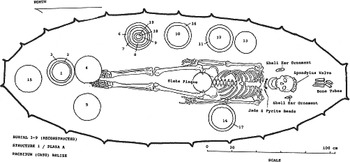
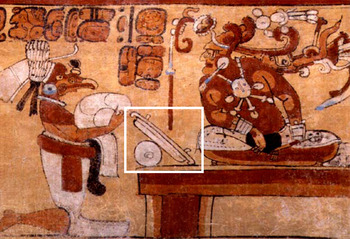
Tozzer (Reference Tozzer1941:89, Note 376), citing descriptive text from a Contact-period Maya book, states that “mirrors may have been worn on the back or shoulder.” From well preserved burial contexts, however, mirrors have been found lying near the head, chest, groin, lower back, and even at the feet of interred individuals (Figure 9). Occasionally, mirrors seem to have been placed on tomb floors at a distance from the body (Kidder et al. Reference Kidder, Jennings and Shook1946:126). Mirrors—or what appear to be mirrors—are also depicted in some Maya art as objects that could be hand-held, often by servants or dwarfs, in front of Maya elite individuals, or mounted on stands.
Plan of Burial 1-9, Pacbitun (Belize), a richly furnished, vaulted tomb, containing the remains of a tall adult male, lying extended, supine, with a complete slate plaque (pyrites eroded) placed over the pelvic area (after Healy et al. Reference Healy, Awe, Helmuth and Garber2004a: Figure 14.1; courtesy of University of Florida Press, Gainesville, FL).

Chronologically, Maya iron-ore mirrors have been found in contexts dating from the Middle Preclassic period (ca. 600 b.c.) until the close of the Late Postclassic period (ca. a.d. 1520). Based on current evidence, the majority of mirrors from the Maya Lowlands date to the Late Classic period (a.d. 600–900), while peak production and use in the Highlands was during the Early Classic period (a.d. 250–600).
THE ART, ICONOGRAPHY, AND EPIGRAPHY OF MAYA MIRRORS
Having discussed the appearance, manufacture, technology, and archaeological contexts for these elegant plaques, we turn to what we believe are representations of the use of mirrors in Classic Maya art, with observations on their role in Maya iconography, and to what appear to be epigraphic references to mirrors in Maya hieroglyphic writing. Fortunately, there are multiple artistic depictions on Maya ceramics which suggest the manner of mirror use. Ancient Maya polychrome, pictorial vases often reveal vivid depictions of elite Maya life (Reents-Budet Reference Reents-Budet1994). Many of these portray the royal Maya palace as “an active locale—a stage—for the rhetorical and performative processes of governance” (Reents-Budet Reference Reents-Budet, Inomata and Houston2001:225).
A key resource for painted representations of mirrors is Justin Kerr's online Maya Vase Database (Kerr Reference Kerr2006), an extensive collection of rollout photographs of these pictorial vases. A typology of Maya mirrors appearing on these painted polychromes from the Kerr database can be found in Blainey (Reference Blainey2007:Appendix B). Here we highlight just a few of the specimens which depict mirrors in use.
Mirrors on Maya Polychrome Vases
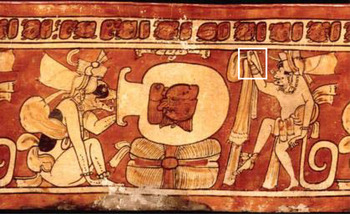
K505
In this scene a monkey with a scribal headdress dances while looking into a mirror that he holds in his hand, juxtaposed with a dog-scribe staring blankly into the dark cavity of a large olla or jar lying on its side (Figure 10). Reents-Budet (Reference Reents-Budet1994:50) describes the “pictorial manipulation, pictorial composition, hieroglyphic writing and historical and religious knowledge” evident in the remarkable works of Maya painters, indicating that the master artist or itz'at Footnote 5 “was truly a savant, a literate person in command of Maya history, cosmology, and religious knowledge.” In this way, the scene depicted on vase K505 suggests the elite artist's personal contemplation of light and dark, or life and death, such that the mirror in this scene represents a powerful symbol of life and light.
Roll-out of Classic Maya polychrome vase K505 detailing possible use of a mirror (boxed in white) (from Kerr Reference Kerr2006; Photograph K505 © Justin Kerr).

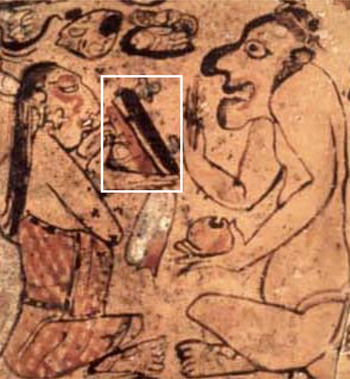
K530
The ritualized scene on this vase is described as: “4 toothless old deities prepare for a ceremony to (the Maya [supreme] god) Itzamna…2 will take enemas, 1 is inhaling drugs, and the last puts on makeup, all [to] the accompaniment…[of]… musicians” (Kerr Reference Kerr2006) (Figure 11). The one who is applying black paint to his face appears to be using a mirror, held by a female assistant, as a vanity aid. However, such practical use of mirrors is unlikely, as iron-ore mosaics would have produced a distorted, multiplied reflection of the onlooker. In contrast to the Western-centric interpretation of these Maya “mirrors” as serving a cosmetic function, it must be pointed out that the painting of the face in this scene, particularly the same black as the face of the mirror, more likely served a function of ritual metamorphosis associated with the mirror's dark surface: “The foregrounding of skin as a subject in some images makes clear that it was conceptualized as a bodily boundary, a site of conjunction of bodily identity, and a medium for transformation from one state to another” (Meskell and Joyce Reference Meskell and Joyce2003:49). Mirrors may have been tools to facilitate this transformational process.
Roll-out of Classic Maya polychrome vase K530 detailing possible use of a mirror (boxed in white) (from Kerr Reference Kerr2006; Photograph K530 © Justin Kerr).

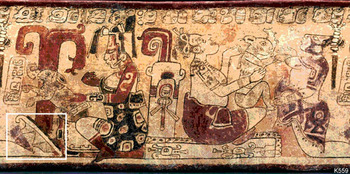
K559
On the left of the rollout photograph (Figure 12), one sees “the Moon Goddess giving birth to the rabbit,” while on the right there is Goddess O nursing the newborn rabbit (Kerr Reference Kerr2006). The rabbit, a Maya symbol of the moon, is shown falling onto (or in front of) a mirror situated directly where the cosmic World Tree grows (Miller and Taube Reference Miller and Taube1993:127, 142; Schele and Miller Reference Schele and Miller1986:143–144). The scene depicts deities employing mirrors which are made, and also used, by the elite Maya, suggesting that mirrors were perceived as jointly used by gods and humans.
Roll-out of Classic Maya polychrome vase K559 detailing possible use of a mirror (boxed in white) (from Kerr Reference Kerr2006; Photograph K559 © Justin Kerr).

K2929
This painted image is very revealing in terms of the functions of ancient Maya iron-ore mirrors. It is important to note that ancient Maya iconography utilizes synaesthesia where “the modality of sight gleans signs that are intended to carry meaning, sound, and scent” (Houston and Taube Reference Houston and Taube2000:263). In K2929 (Figure 13), the mirror partitions a human figure and an anthropomorphic rabbit. The latter character can be interpreted as a Maya way, or spiritual co-essence (Calvin Reference Calvin and Kerr1997; Grube and Nahm Reference Grube, Nahm and Kerr1994; Houston and Stuart Reference Houston and Stuart1989) with which the human figure is communicating via the mirror. In this scene, the mirror appears to act as a bridge between two normally divided worlds. This notion of the mirror as a possible communication device between the human realm and the spiritual Otherworld is strengthened by the fact that the way rabbit is emitting “speech scrolls” above and across the mirror towards the human figure (see Evans Reference Evans2004:271; Houston et al. Reference Houston, Stuart and Taube2006:139; Houston and Taube Reference Houston and Taube2000:275; Meskell and Joyce Reference Meskell and Joyce2003:46).
Roll-out of Classic Maya polychrome vase K2929 detailing possible use of a mirror (boxed in white) (from Kerr Reference Kerr2006; Photograph K2929 © Justin Kerr).

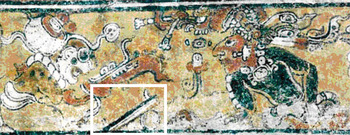
K5764 & K7265
These two vases present scenes with the familiar palace setting, but with godly actors replacing the more customary mortal figures. Both scenes involve the supreme Maya god Itzamna, identifiable by his headdress with overhanging front tassel (Freidel et al. Reference Freidel, Schele and Parker1993:40; Miller and Taube Reference Miller and Taube1993:100), interacting with animal spirits. In K5764, he sits before the Vulture deity connected with Maya kings (Schele and Miller Reference Schele and Miller1986:325), who presents a bundle to the supreme deity (Figure 14). In K7265, Itzamna sits with a dog, an animal customarily associated with the Underworld in Mesoamerican belief systems (Reents-Budet Reference Reents-Budet1994:275; Evans Reference Evans2004:215; see also K505) (Figure 15). A mirror is present in both scenes, suggesting that if deities also possess and use mirrors, that the surfaces of these Otherworld mirrors are merely the reverse side of the same mirrors used by rulers (and other elite individuals) in the human realm. Importantly, these two scenes seem to illustrate what the ancient Maya believed was taking place on the other side of their divinatory reflectors.
Roll-out of Classic Maya polychrome vase K5764 detailing possible use of a mirror (boxed in white) (from Kerr Reference Kerr2006, Photograph K5764 © Justin Kerr).

Roll-out of Classic Maya polychrome vase K7265 detailing possible use of a mirror (boxed in black) (from Kerr Reference Kerr2006, Photograph K7265 © Justin Kerr).

Curiously, mirrors do not seem to be depicted in Maya public art, such as on monuments (stelae and altars), or on architecture in public settings (Helmke et al. Reference Helmke, Colas, Awe and Awe1998:107).Footnote 6 To the best of our knowledge, no Maya inscribed monuments bear depictions of rulers holding mirrors or wearing mirrors on their elaborate regalia. Instead, representations of mirrors occur exclusively on what might be better termed “private,” or personal works of art, such as ornate carved or painted pottery.
Maya Epigraphy and the “Reflective Surface Complex”
Recent advances in the translation of Maya hieroglyphs have permitted modern researchers to undertake cognitive archaeology, beginning to peer “into the minds of ancients” to understand their pre-Columbian worldview (Coe Reference Coe1992; Flannery and Marcus Reference Flannery, Marcus, Preucel and Hodder1996; Golden and Borgstede Reference Golden, Borgstede, Golden and Borgstede2004:3; Houston Reference Houston2000). In the following discussion, we parse out signs which some Maya epigraphers have construed as referring to mirrors, or at least symbols indicative of “shininess,” and trace the wider distribution of these signs. This analysis will aid in the larger pursuit of insights into the functions of iron-ore mirrors within ancient Maya society, which increasingly point to their role in ritual scrying.
Glyph T24/T617
Originally assigned two different “T-numbers” in Thompson's (Reference Thompson1962) Catalog of Maya Hieroglyphs, the elliptical Maya hieroglyph encapsulating one, two, or three curved bands appears as both a supplement to larger glyphic compositions  (T24) and as a autonomous glyph with an independent meaning unto itself
 (T617). The glyph consists of curved bands either empty or crosshatched, and appears most frequently as an elemental component of a larger glyph whose meaning is not (so far) immediately related to mirrors. Nevertheless, the glyph is widely and consistently taken as the representation in Maya writing of a mirror (Montgomery Reference Montgomery2002a:95; Schele and Miller Reference Schele and Miller1983; Schele and Miller Reference Schele and Miller1986:49), perhaps signified by the curved lines as shafts of reflected light. Recently, the glyph has been interpreted as symbolizing a “celt” or “reflective stone” (Macri and Looper Reference Macri and Looper2003:273–275). The polyvalent nature of the Maya script, however, makes an assessment of this glyph's exact meaning difficult to pin down. This problem arises in the apparent use of T24/T617 by the Maya to indicate the notion of “shininess,” where its occurrence can also denote, for example, volcanic glass (obsidian) blades (Schele and Miller Reference Schele and Miller1986:176), shiny celts (Houston et al. Reference Houston, Stuart and Taube2006:72–73; Iannone Reference Iannone1993:238, 240), or even glossy shell “tinklers” (Kidder et al. Reference Kidder, Jennings and Shook1946:145–148).
The significance of the T24/T617 glyph was discussed in an influential work by Schele and Miller (Reference Schele and Miller1983). Although the original interpretations put forward by the authors are now dated (Mary Miller, personal communication 2005), they nevertheless succeeded in conveying the iconographic prominence of the glyph. Building on their 1975 collaborations, Jeffrey Miller is credited as the originator of the interpretation that the glyph T24/T617 represents a mirror (Schele and Miller Reference Schele and Miller1983:1).
Perhaps the most insightful passage in this publication concerns the linguistic concepts in the different dialects of the Mayan language family where the expressions nen or lem demonstrate significant ideational principles that inform the current discussion. In reviewing multiple dictionaries of Conquest-period and modern Mayan dialects, Schele and Miller (Reference Schele and Miller1983:12–14) identify multiple examples where the terms nen and lem function “as the root for (expressions such as) ‘lightning,’ ‘gleam,’ and ‘shine.’” They discover that variants of nen and lem during the Contact period also refer to the concepts of “rulers and persons of importance as ‘the reflection of the world’… ‘succession in office’… ‘to think,’ ‘to imagine,’ ‘to contemplate,’ and ‘to meditate.’” This linguistic data is complemented by the occurrence of a phonetic spelling for the same word (nen) as a carved glyph on a mirror from Topoxte, Guatemala (see Figure 5); here the full phrase is u-nen, meaning “his mirror” or “his shiny surface” (Fialko Reference Fialko and Wurster2000). This semantic continuity, from pre-Columbian period hieroglyphs to Conquest-period linguistics, acts to fortify the current proposition that mirrors (shiny, gleaming artifacts) served to function within a broader ideological construct encompassing all reflective surfaces found in the natural and human-made worlds. This ancient Maya reflective surface complex continues to appear as one observes the occurrence of T24/T617 glyphs in epigraphic contexts conflated with other elements.
The correlation between surfaces that reflect light and the human eye that perceives them appears to have been a pivotal concept in the ancient Maya view of human being-in-the-world. This becomes apparent in the fact that the T24 phonetic version of the “mirror” glyph stands for the syllable -il or sometimes -li. It is matched by the morpheme il (Houston et al. Reference Houston, Stuart and Taube2006:139), represented by  or
 meaning “to see,” showing what appears to be the cross-section of an eyeball with lines of vision radiating out from the inner chamber. The passive version of this is ilaj, “was seen”
 , where the curled elements on the left side of the glyph provides an overt connection with the flared-out mirror-back seen in the painted pottery scenes discussed above (Montgomery Reference Montgomery2002a:95–97). These examples suggest that the ancient Maya regarded the shiny surface of the eye as the human body's equivalent to a mirror; perhaps an acknowledgement of both entities as liminal thresholds partitioning separate realms. Even more, the T24 syllabic glyph was also used as a suffix to denote where something “exists as an inalienable part of something else…for example, (as) bark bears an inextricable relationship to the tree, and a door relates to its building….in such a way that a door by itself makes no sense” (Montgomery Reference Montgomery2002b:147; see also Houston et al. Reference Houston, Stuart and Taube2006:66–67). As the notion of the T24/T617 glyph is explored in further examples below as indicative of a reflective surface complex, the totality of evidence pertaining to iron-ore mirrors is enhanced by an awareness of ancient forms of thought that only these visual and linguistic expressions can reveal.
Some Incidences of T24/T617
 Ch'ab (T712)
 Ch'ab (T712)
This glyph, representing “an obsidian lancet,” has a metaphorical polyvalence and is listed as signifying “‘do penance, sacrifice’… ‘to pierce with a lance,’ ‘lancing;’ when used in parentage relationship statements it may have the meaning ‘to create’” (Montgomery Reference Montgomery2002a:72; see also Houston et al. Reference Houston, Stuart and Taube2006:130–132). The connection of the shiny obsidian lancet to the “piercing” act in bloodletting rituals, a widespread pre-Columbian sacrificial practice, is suggestive of the reflective surface complex and breaches in the liminal skin that separates the inside and outside of the atoner's body. This aperture, created by the piercing act of bloodletting, turning a once fixed boundary into a permeable membrane, stands as a possible evocation for the social functions of iron-ore mirrors.
(T24/617:713a:130.116)
 (T24/617:713a:130.116)
Identified as a glyph marking a Maya lord's accession to the royal throne by Schele and Miller (Reference Schele and Miller1983), allegedly found only on inscriptions at the site of Palenque, it is synonymous with other “accession expressions” (Montgomery Reference Montgomery2002b:169).Footnote 7 It consists of the phonetic elements in the Mayan language which would translate loosely as k'al (“bound/tied/wrapped”) the mirror (Montgomery Reference Montgomery2002a:145), suggesting a possible function of “suspension holes” found on most mirrors. If mirrors were official symbols of kingship, it is possible that this variant of the accession expression functioned much like the more common rite of k'al sak hun (bound/tied/wrapped the white headband), where a white “scarf…would be tied to the forehead” (Martin and Grube Reference Martin and Grube2000:14). In fact, the k'al sak hun glyph also appears directly associated with the headband-tying ceremony on the Yaxchilan Hieroglyphic Stairway 3, on Quirigua Stela J (Houston et al. Reference Houston, Stuart and Taube2006:62), and on one of the incised mirror backs from Costa Rica (Schmidt et al. Reference Schmidt, de la Garza and Nalda1998:628–629).
Considering the pre-eminent status of the king as divinely-sanctioned mediator between the natural and supernatural realms (Martin and Grube Reference Martin and Grube2000; Schele and Freidel Reference Schele and Freidel1990:65; Schele and Miller Reference Schele and Miller1986; Sharer and Golden Reference Sharer, Golden, Golden and Borgstede2004:32), it is understandable that the glyph describing their acquisition of power illustrates their role as custodian of ritual objects with reflective surfaces. During the Classic period, Maya kings were both political leaders and priests. They not only oversaw military expeditions, and long-distance trade, but also the construction of major temple-pyramids, and the performance of complex rituals (some with mirrors) ordained by the cosmological order. Indeed, we suggest that rulers in ancient Maya society functioned at least partly, in their leadership roles, as a “supreme shaman,” responsible for the well-being and security of their subjects (Blainey Reference Blainey2007; Sharer Reference Sharer1994:70).
If the accession to office made the new Maya ruler the foremost shaman of his polity, then the inclusion of the T24/T617 glyph in the Palenque accession glyph is plainly intended to convey the new king's responsibility for presiding over the liminal “portals of communication opened between the human and divine” (Freidel et al. Reference Freidel, Schele and Parker1993:317; see also Schele and Freidel Reference Schele and Freidel1990). The king had the tools and power to “see” beyond the mundane world occupied by humanity in the normal waking state of consciousness.
Mirror Maize-ball (T-86[24/617])
 Mirror Maize-ball (T-86[24/617])
Much like the K'an  sign for the “fourth day of the Maya tzolk'in calendar…probably represents a grain of maize” (Montgomery Reference Montgomery2002a:147), the images of balls of maize dough are an example of how “the association of the mirror sign with maize is pervasive” (Taube Reference Taube1989:46–47). A plausible explanation for this pairing of mirrors and maize incorporates text about the origin of maize from the Popol Vuh, a sacred Maya book. Here, Seven Hunahpu, the father of the Hero Twins in this story, is reassembled and resurrected by his sons. Taking the form of the ancient Maya maize god, the Hero Twins “left him at the Place of Ball Game Sacrifice” (Tedlock Reference Tedlock1996:141). Since, for the Maya, “the ballcourt was not only a place of sacrifice; it was an entry portal to the time and space of the last Creation” (Freidel et al. Reference Freidel, Schele and Parker1993:352), it appears that this initial portal between the human Middle realm and spiritual Underworld was associated with the emergent apotheosis of the Maize God. We see this notion illustrated clearly in painted images of the Maize God emerging from a cleft in the cosmic turtle's back, flanked by his Hero Twin sons, Hunahpu and Xbalanque (see Kerr Numbers 731 and 1892; Zender Reference Zender2006:9). Thus, the affiliation of the mirror glyph with the glyph for maize provides yet another reasonable connection between reflective surfaces and liminal portals. Of course, it is also possible that the mirror glyph on maize represents the shiny surface of corn kernels.
(T-1030b:178)
 (T-1030b:178)
Among the ancient Maya assemblage of deities, it is the god K'awil that has the closest ties to mirrors and the reflective surface complex. First labelled “God K” in the Schellhas (Reference Schellhas1904) system of deity classification, and specifically referred to as GII at Palenque, this god “was identified with lightning, fire, and dynastic descent” (Miller and Taube Reference Miller and Taube1993:146–147). Distinctive features of God K include a zoomorphic/serpent face complemented by one serpent-headed foot, an anthropomorphic body, and a forehead mirror that is perforated by either a “flaming axe” (Schele and Mathews Reference Schele and Mathews1998:152), “a celt, a smoking celt, a smoking cigar, a smoking torch or a ceramic torch holder” (Schele and Miller Reference Schele and Miller1986:49). He is also associated with conventional Maya symbols of kingship, such as the K'awil “Manikin Sceptre” and the Double-Headed Serpent Bar, suggesting that he is a deity associated with kingship and royal lineage (Clancy Reference Clancy1994; Freidel et al. Reference Freidel, Schele and Parker1993:195–196; Miller Reference Miller1999; Schele and Freidel Reference Schele and Freidel1990:78, 414). The most revealing aspect garnered from artistic illustrations of K'awil is the fact that the mirror affixed to his forehead is penetrated by an instrument of which we can only see half, because the other half is presumably located on the other side of the mirror.
Segueing into the final aspect of “indirect” incidences of the mirrors, it is interesting to evoke Schele and Miller's (1983:12) allusion to the Motul (Maya) Dictionary where the phrase nen “describes the title holder as the ‘mirror of the world’ and ‘the mirror of the pueblo’ (or people).” This translation has been used to rationalize what have been interpreted as mirrors (T24/T617) worn on headdresses in the depiction of the kings of Yaxchilan (Tate Reference Tate1992:103). The nen phrase in the Quiche (Maya) Dictionary is listed as “related to the Yucatec title as a term for ‘succeed in office’” (Edmonson Reference Edmonson1965:78; Vienna Dictionary Reference Dictionary1972:99r). Considering these linguistic references relative to the iconographic and epigraphic evidence discussed above, as well as the ethnohistoric sources addressed below, the enigma of the T24/T617 glyph, and ancient Maya iron-ore mirrors in general, might be resolved by perceiving them from an emic standpoint.
SYMBOLISM OF THE MAYA MIRROR
Saunders (Reference Saunders, Quilter and Hoopes2003:17–18) suggests that indigenous cultures of Mesoamerica, like the Maya, appreciated the aesthetic of “brilliance.” They were drawn to highly polished or shiny items as part of “…a worldview that saw light, dazzling colors, and shiny matter as indicating the presence of supernatural beings and essence.” They placed a value on reflective objects as part of their traditional symbol system. Early Mesoamericans associated light with the Otherworldly realm “…inhabited by bright spirit beings who became visible to shamans, priests, and rulers in visions aglow with multicoloured light.” For some Amerindians, then, “…all shiny matter, whether natural or artificial” was especially sacred, and infused with spirituality and cosmic power (Saunders Reference Saunders, Quilter and Hoopes2003:36).
Polished jade was a highly symbolic, power-bestowing material worn by the elite of most Mesoamerican societies, representing important elements of nature: water, rain, fertility, young, green, growing maize—all elements vital to life (Saunders Reference Saunders, Quilter and Hoopes2003:30–31). So too, polished, reflective, mosaic mirrors may have symbolized other crucial elements of nature: light, the sun, radiance, heat, the stars and, perhaps, fire—again, all components which were important (if not essential) to life (Taube Reference Taube and Berlo1992).
In the general absence of metals in the Classic Maya world, pyrite (or more rarely hematite) mosaic mirrors were one of the most effective pre-Columbian conveyors of light, sacredness, and brilliance (Saunders Reference Saunders, Quilter and Hoopes2003:18–21). In this way, lithic mirrors, as ritual items, acted as a bridge between the heavenly world (and the sun) and the physical world of the earth. The “mystery” surrounding the reflective qualities of mirrors—and the restricted knowledge associated with the specialized manufacture of mirrors—likely enhanced their value and mystique, making them ideal objects within a political system formed around the divine status of royalty.
Pyrite mosaic polygons, with their glossy, golden sheen, may have been seen as cosmically liminal and, hence, powerful material. Perhaps having one's visage reflected in a pyrite mirror, even if in a multi-fractured image, was the equivalent to acquiring the power of this material. Given the contextual data (in cases for which there is uncompromised provenience), mirrors are overwhelmingly restricted to the upper echelon of ancient Maya society (Blainey Reference Blainey2007).
ETHNOHISTORIC AND ETHNOGRAPHIC VIEWS OF MAYA MIRRORS
Narrative accounts involving mirrors, written either by the Maya of the Conquest period or the Spanish who documented the foreign incursion, offer an enlightening analogue for the ancient Maya versions considered here. In outlining these literary references to mirrors, the following section is intended as a buttressing device, accentuating the more inert evidence for ancient mirrors with the descriptive accounts of once-living agents.
Bishop Diego de Landa wrote his Relación de las Cosas de Yucatan during a stint in Spain in the 1560s, between appointments as a Franciscan friar and Bishop of Merida (Barrus Reference Barrus and Cline1973:147; Tozzer Reference Tozzer1941:vii). He mentions that “all the men use mirrors while the women had none; and to call each other cuckolds, they said that the wife had put the mirrors in the hair at the back of their heads” (Tozzer Reference Tozzer1941:89). This reference may imply that mirrors, after the Spanish Conquest, were no longer considered elite, luxury items denoting prestige as they appear to have been during pre-Columbian times.
Whenever iron ore was not readily available it seems that the Maya resorted to other purveyors of reflective surfaces: “among many contact period Mesoamerican peoples, including the Yucatec Maya, Aztecs, and Tarascans, the reflective surfaces of bowls filled with water were also used for divination, and it is possible that this is an especially old tradition, perhaps even dating from before the manufacture of stone mirrors” (Miller and Taube Reference Miller and Taube1993:114). Taube (Reference Taube1983:132, Figure 21) even identifies iconographically what have herein been considered elaborate mirror backs instead as mirrors submerged in bowls of water for “water-scrying.”
Early writings about the Aztecs by the Spanish chronicler Diego Durán (Reference Durán, Heyden and Horcasitas1964:220–221) include a story about the coronation of the ruler Moctezuma II in which he is referred to and made analogous to “a mirror in which we will be reflected,” “the torch which is to illuminate Mexico,” and as “a mirror to look into.” These statements match the meaning implied by the native portrayal of Maya rulers in ethnohistoric times as “the mirror of the people” (see also Schele and Miller Reference Schele and Miller1983).
All this suggests that whatever conjuring rituals were being performed with mirrors were an expansion of a larger, more archaic religious tradition that has been referred to herein as the reflective surface complex. The ethnohistorically documented use of bowls of water indicates that the reflective surface complex, to the pre-Columbian Maya, may also have been a part of non-elite ceremonies as well, and not restricted to only the elite class.
The Popol Vuh has provided an incomparable gateway into pre-Columbian Maya thought (Tedlock Reference Tedlock1996). Although it is widely confirmed that the first part of the Popol Vuh is based to a degree on post-Contact Christian influences, the text as a whole is considered by many to be “the most important single native-language text in all the New World” (Tedlock Reference Tedlock and Gossen1986:77).
One of the most significant passages in the Popol Vuh describes the belief that there were inborn deficiencies to human vision, stemming from an alteration performed on the original human beings by the Maya Creator Gods. The origin of the role of Maya rulers as “mediators between ‘mere’ human beings and the divine” is explained in the Popol Vuh as the result of Maya gods being unhappy with the first lords' divine capacities, and their seeking “to correct it by chipping their eyes…and thereby having their vision and understanding restricted” (Hendrickson Reference Hendrickson, Hanks and Rice1989:138):
“They were blinded as the face of a mirror is breathed upon. Their vision flickered. Now it was only from close up that they could see what was there with any clarity.
And such was the loss of the means of understanding along with the means of knowing everything, by the four humans. The root was implanted.” (Tedlock Reference Tedlock1996:148; emphasis added)
Based on pre-Columbian traditions of the Quiche Maya creation story, this passage asserts directly that human actions proceed according to the underlying ontological assumption that what appear as empty spaces were “not hollow or vacant, as we might understand them from an occidental perspective” (Houston and Taube Reference Houston and Taube2000:281). Instead, human beings were created to witness only a fraction of a wider monistic reality, thus manifesting a superficial dualism between what could and could not be “seen” by the naked eye. Mirrors, used properly by shamans and kings, could help overcome this inherent deficiency and create a temporary channel between the human domain and the normally unseen Otherworld.
For the purposes of the current discussion, the intriguing point here involves the use of a mirror-face fogged by breath as an analogy for hindered vision (see Tedlock Reference Tedlock1993:10). This connection with the eye and sight harmonizes with the iconographic and epigraphic evidence assessed above, which also supposes a connection between eyes, vision, and mirrors; this all heralds a strong probability that from an emic perspective, the ancient Maya can be said to have viewed a function of mirrors as comparable to that of eyes for the human agent. So, either iron-ore mirrors were used by elites as facilitators of their own vision, or the mirror itself was acting as an eye for something else that was looking out on the profane world from a spiritual Otherworld. Of course, there is the possibility that both the former and latter were functions of ancient Maya mirrors.
It is necessary for our review of iconographic, epigraphic, and Maya literary references to mirrors to be put into context relative to scholarly elaborations about the larger cosmological perspective of the ancient Maya. It may seem to some that “the obvious conclusion is that individual perceptions are largely unknowable in archaeology and this approach should be restricted to ethnographic studies in which such perceptions are accessible” (Earle and Preucel Reference Earle and Preucel1987:510). On the other hand, the last two decades have seen a series of credible interpretations of ancient cognition advance the notion that “particularistic approaches that equate prediction and explanation are no longer adequate to account for the diversity in the archaeological record” (Bruce Trigger, comment in Earle and Preucel Reference Earle and Preucel1987:523).
For many, the current era of Maya iconographic studies began with publication of The Blood of Kings:
“For the Maya, the World was a complex and awesome place, alive with sacred power. This power was part of the landscape, of the fabric of space and time, of things both living and inanimate, and of the forces of nature—storms, wind, mist, smoke, rain, earth, sky and water. Sacred beings moved between the three levels of the cosmos: The Overworld which is the heavens, the Middleworld where humans live, and the Underworld or Xibalba, the source of disease and death. The king acted as a transformer through whom, in ritual acts, the unspeakable power of the supernatural passed into the lives of mortal men and their works. The person of the king was also sacred…supernatural power was focused in the objects manipulated by the king, which seemed to accrue sacred energy through their use in ritual.” (Schele and Miller Reference Schele and Miller1986:301, emphasis added)
Such a concise breakdown of the ancient Maya view of the universe establishes a credible reference point for readings of the material evidence, to be tested and refined over and over again, against an ever expanding iconographic and epigraphic record.
Several major works exploring ancient Maya art, architecture, and hieroglyphic texts emphasize how Maya artistic remains demonstrate a preoccupation with the opening of liminal portals to the Otherworld through shamanistic rituals (Freidel et al. Reference Freidel, Schele and Parker1993; Schele and Freidel Reference Schele and Freidel1990; Schele and Mathews Reference Schele and Mathews1998):
“The sculptural record also demonstrates the shamanistic nature of Maya kingship, central to the Classic conception of the cosmos, by depicting the divine ahau (ruler) as a conductor of ritual…This ritual was most likely a public affirmation of his ability to open a portal to the supernatural realm.” (Schele and Freidel Reference Schele and Freidel1990:87)
Although the term “supernatural” has its pitfalls when used to describe the ideologies of non-Western peoples, so long as the etic and emic definitions of the supernatural “are distinguished, the supernatural concept both clarifies a scientific position on a major source of religious behaviour and improves our ability to understand religious worldviews” (Lohmann Reference Lohmann2003:176). The continued refinement of the archaeological techniques aimed at understanding ancient Maya cognition (i.e., how they conceived of the human condition) will likewise shed light on the significance of the political, economic, and ideological significance of iron-ore mirrors for the ancient Maya.
DISCUSSION
Although this type of mosaic, iron-ore mirror has been known for decades, there have been very few detailed discussions of their origin, manufacture, distribution, and dating, based on archaeological data. In this paper we also examined the possible varied uses and meanings of these Maya mirrors, based on iconography, epigraphy, and ethnohistory.
Some past studies of Maya mirrors have suggested that these curious, composite lithic artifacts were objects worn exclusively by rulers, as emblems of power and prestige (Coe Reference Coe, Benson and Griffin1988; Healy et al. Reference Healy, Awe, Helmuth and Garber2004a). In this interpretive scenario, mirrors served the Maya elite as politico-religious badges of power and authority. Mirrors (like jade jewellery, eccentric chipped flints, or shells of the thorny oyster) were important symbolic objects which served as a talisman, reflectors or enhancers of power, in elite Maya political settings (Taube Reference Taube and Berlo1992).
Others have wondered if these plaques with a shiny, reflective surface actually functioned as mirrors (in the Western sense). Despite some polychrome vase representations that might superficially suggest this, ancient Maya iron-ore mirrors appear more likely to have been ritual items rather than simple aids to vanity (David M. Pendergast, personal communication 2006). Taube (Reference Taube1983:112–113), referring to pyrite encrusted mirrors of Mesoamerica as a group, argues that they “were not used for cosmetic purposes,” or as looking glasses. We agree with this perspective.
An alternative interpretation for the role of Maya mirrors, and one not entirely contradictory from their use as emblems of power, was for meditative scrying, whereby the user gazed on the reflective surface of the mirror for purposes of divination (Bassie-Sweet Reference Bassie-Sweet2008; Besterman Reference Besterman1965; Eliade Reference Eliade2004). Indeed, mirrors in pre-Columbian pictorial art are often seen to be associated with pools of liquid (water, or perhaps even liquid mercury) or water-filled bowls (“mirror bowls”) that were studied for purposes of prognostication.Footnote 8 In this scenario, espoused herein, mirrors were linked historically to age-old shamanic rituals of divination. While Maya society had evolved a more complex, formalized priesthood and associated religious practices, rites of early shamanic scrying (and the tools to facilitate this) were passed down and continued through the Classic and Postclassic periods, providing the ancient Maya—literally—with a touchstone to their remarkable past. In this interpretation, ancient Maya iron-ore mirrors served in a ritualized, ceremonial context as valuable tools and religious icons to be gazed upon for divination (Blainey Reference Blainey2007).
While their possible use in divinatory scrying has been casually acknowledged in the literature on ancient Maya religion (Miller and Taube Reference Miller and Taube1993:114), their wider social significance to the ancient Maya has, heretofore, largely been ignored. Thus, in forwarding the hypothesis that iron-ore mirrors represent a vital aspect of a larger reflective surface complex, our analysis ventures both to refine the ideological understanding of mirrors, while also locating their functions in ancient Maya politics and economics.
CONCLUSIONS
In sum, these ancient “mirrors” are relatively rare, brilliant, and often beautiful works of Maya lithic art (Figure 16). Because of this connection, they were considered valuable, high-status items that retained a religious (and we could argue “shamanic”) function among the early Maya across a vast expanse of both time and space. Although the precise role of shamanism among the ancient Maya will likely remain a topic for debate, it is clear that the “polished, gleaming” qualities of iron-ore mirrors, being both “dark and light at once” (Joyce Reference Joyce2002:149), evoked the liminal connotations of its reflective surface. We believe that these affiliations with liminality, combined with their iconographic depiction as communicative devices, advocate an emic explanation of mirrors as instruments of shamanistic divination.
Round Maya mosaic mirror, pyrite with sandstone backing, from an elite tomb, Bonampak, Mexico (after Schmidt et al. Reference Schmidt, de la Garza and Nalda1998:569, Entry 203; ©Michel Zabé/AZA). Diameter 23.5 cm, Thickness 0.3 cm.

Just as their subjects might have been conjuring the portal to the Otherworld, opened by scrying with a bowl of water, the more sophisticated iron-ore mirrors wielded by the ancient Maya aristocracy summoned a grander, more regal, cosmic aperture. Shiny, iron-ore mirrors, as artistic masterpieces produced by skilled noble craftsman, embodied the power to breech the boundary between the human and spiritual realms in a permanent and portable form. Unlike water and eyes, polished pyrite mosaic mirrors authenticate their possessor as supreme mediator over the permeable membrane separating the two worlds, thus making this individual uniquely capable of communication across the cosmic divide incarnate in reflective surfaces.
RESUMEN
En el presente trabajo de investigación, se examinan los utensilios compuestos líticos poco corrientes comúnmente denominados “espejos” en la literatura que se trata de los mayas antiguos. Típicamente objetos planos y relucientes con polígonos de mineral de hiero pulidos en un diseño mosaico sobre un dorso de pizarra, estas placas se evalúan aquí para determinar los contextos tecnológico, espacio-temporal y funcional de su fabricación. Se examinaron los datos sobre más de 500 especímenes arqueológicos de docenas de yacimientos mayas en México, Guatemala, Belice y Honduras como parte de esta investigación. También se consideraron la iconografía, la epigrafía y el simbolismo posible de estos artefactos curiosos. Basado en este análisis, los autores concluyen que los espejos mosaicos de los maya antiguos se empleaban en ritos, muchas veces por individuos de la clase élite o por personas reales, como símbolos de autoridad y también, lo que más importante, como instrumentos que tenían la posibilidad de utilizarse para la adivinación vidente. Servían como puentes, o sea conductos, hacia las deidades y el mundo celestial de los mayas. Los espejos mosaicos de mineral de hiero que tenían gran valor y que muchas veces eran fabricados maravillosamente, eran objetos ceremoniales reflectivos cuyo uso posible para hacer pronósticos en los ritos de los chamanes probablemente tiene gran antigüedad en Mesoamérica.
ACKNOWLEDGMENTS
The authors wish to thank James Conolly, Gyles Iannone, Susan Jamieson, Roger Lohmann, and Joan Vastokas of the Department of Anthropology of Trent University for their advice regarding religion, shamanism, and the ancient Maya. James Garber of Texas State University at San Marcos, David M. Pendergast of the University College London, and Robert J. Sharer of the University of Pennsylvania provided useful insights about Maya artifacts in general, and Maya mirrors in particular. The Trent University Archaeological Research Centre (TUARC) provided funds for geological analyses, overseen by Stephanie Downing, SGS Lakefield Research Ltd. (Canada). An earlier version of this paper was presented at the (2008) annual meeting of the Canadian Archaeological Association in Peterborough, Ontario. The Spanish summary was kindly provided by Rita Granda (Trent University). The authors received helpful comments from Heather McKillop (Louisiana State University), David Mora-Marín (University of North Carolina-Chapel Hill), and one anonymous reviewer. The authors alone are responsible for any errors.