1. Introduction
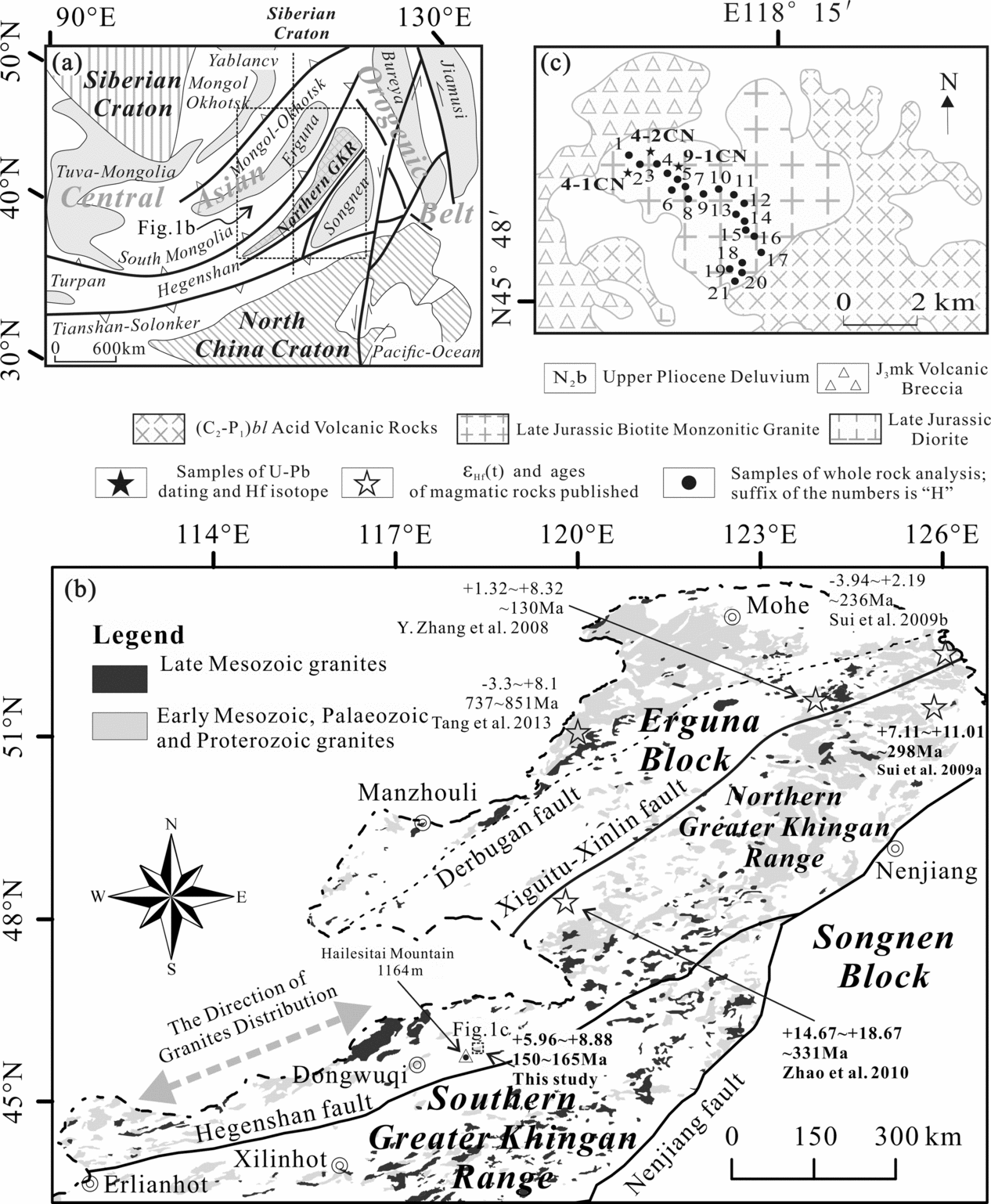
The northern Greater Khingan Range (GKR) is located in the east of the Central Asian Orogenic Belt (CAOB), which is well known for its orogenic characteristics and is the world's largest site of juvenile crustal formation from the Phanerozoic Eon (Jahn, Reference Jahn, Malpas, Fletcher, Ali and Aitcheson2004; Wu et al. Reference Wu, Sun, Ge, Zhang, Grant, Wilde and Jahn2011). There are a number of differing hypotheses regarding the evolution of the GKR: (1) a mantle plume (Shao et al. Reference Shao, Zang, Mou, Li and Wang1994; Ge et al. Reference Ge, Lin, Sun, Wu, Won, Lee, Jin and Yun1999; Lin et al. Reference Lin, Ge, Sun, Wu, Chong, Kyung, Myung, Moon, Chi and Sung1999), (2) the closure of the northern Mongol–Okhotsk Ocean (i.e. the east of the Palaeo-Asian Ocean) (Guo et al. Reference Guo, Fan, Wang and Lin2001; Wang et al. Reference Wang, Liu, Wang and Song2002; Fan et al. Reference Fan, Guo, Wang and Lin2003; Meng, Reference Meng2003), and (3) the subduction of the Palaeo-Pacific Plate (Wang et al. Reference Wang, Zhou, Zhang, Ying, Zhang, Wu and Zhu2006; J. Zhang et al. Reference Zhang, Ge, Wu and Liu2006, Reference Zhang, Ge, Wu, Wilde, Yang and Liu2008). The focus of controversy is the tectonic setting and timing of the GKR (Wu et al. Reference Wu, Han, Yang, Wilde, Zhai and Park2007, Reference Wu, Sun, Ge, Zhang, Grant, Wilde and Jahn2011). This issue might be addressed by the study of A-type (Collins et al. Reference Collins, Beams, White and Chappell1982; Whalen, Currie & Chappell, Reference Whalen, Currie and Chappell1987; Eby, Reference Eby1990, Reference Eby1992; Bonin, Reference Bonin2007; Frost & Frost, Reference Frost and Frost2010), which is the most important part of the alkaline magmatic belt in the GKR (Wu et al. Reference Wu, Sun, Li, Jahn and Wilde2002; Jahn et al. Reference Jahn, Litvinovsky, Zanvilevich and Reichow2009). Wu et al. (Reference Wu, Sun, Li, Jahn and Wilde2002) concluded that the A-type granites in NE China were generated at three different times, involving multiple processes operative in different tectonic environments. The study of Neoproterozoic intrusive rocks in the Erguna Massif of NE China, in the eastern segment of the CAOB, by Tang et al. (Reference Tang, Xu, Wang, Wang, Xu and Zhang2013) led to the conclusion that the Neoproterozoic A-type granitoids formed in an extensional environment. However, the petrological evidence provided in previous studies (Wu et al. Reference Wu, Lin, Wilde, Zhang and Yang2005; J. Zhang et al. Reference Zhang, Ge, Wu, Wilde, Yang and Liu2008; Lei & Wang, Reference Lei and Wang2011; D. Zhang et al. Reference Zhang, Wei, Fu, Chen, Tan, Li, Shi and Tian2015) may not have explained fully the evolution of the GKR, due to the lack of precise geochronological and geochemical data. In this work, the Hailesitai pluton (Fig. 1a, b, c) close to the north of the Hegenshan deep fault was chosen to reveal further the tectonic evolution of the northern GKR in the Late Mesozoic. According to whole rock geochemistry, zircon U−Pb dating and Hf isotope, the aim of this study is to interpret the genesis of the Hailesitai pluton and to provide preliminary evidence supporting the Late Mesozoic tectonic evolution of the northern GKR.
(a) Structural outline sketch of the Central Asian Orogenic Belt (CAOB) (after Zhou et al. Reference Zhou, Wilde, Zhang, Ren and Zheng2011). The dotted line represents the direction of the profile in Figure 11. (b) The distribution of Phanerozoic granites in the Greater Khingan Range (GKR) and adjacent area (modified from Zhang et al. Reference Zhang, Liu, Li, Han, Zhang, Zhao, Jian and Guo2013; data cited from Zhang, Ge & Liu, Reference Zhang, Ge, Wu, Wilde, Yang and Liu2008; Sui et al. Reference Sui, Ge, Xu and Zhang2009 a, b; Zhao et al. Reference Zhao, Chi, Liu, Wang and Hu2010; Tang et al. Reference Tang, Xu, Wang, Wang, Xu and Zhang2013). (c) Geological map of Hailesitai pluton (after Zhang et al. Reference Zhang, Nie, Liu, Jiang, Xu, Lai and Pi2007). (a) is after Zhou et al. (Reference Zhou, Wilde, Zhang, Ren and Zheng2011); the dotted line represents the direction of profile in Figure 11. (b) is modified from Zhang et al. (Reference Zhang, Liu, Li, Han, Zhang, Zhao, Jian and Guo2013) and data cited from Zhang, Ge & Liu (Reference Zhang, Ge, Wu, Wilde, Yang and Liu2008), Sui et al. (Reference Sui, Ge, Xu and Zhang2009 a, b), Zhao et al. (Reference Zhao, Chi, Liu, Wang and Hu2010) and Tang et al. (Reference Tang, Xu, Wang, Wang, Xu and Zhang2013). (c) is after Zhang et al. (Reference Zhang, Nie, Liu, Jiang, Xu, Lai and Pi2007).

2. Geological setting and petrography
The Hailesitai coarse-grained granite pluton is located in the northern GKR (Fig. 1b) and belongs to the East Ujimqin metallogenic belt of the GKR metallogenic province within the circum-Pacific metallogenic domain. The strata exposed in the northern GKR are Ordovician, Silurian, Devonian, Permian, Jurassic and Cretaceous volcanic sedimentary rocks and Tertiary and Quaternary sediments (Voo, Spakman & Bijwaard, Reference Voo, Spakman and Bijwaard1999; Wu et al. Reference Wu, Jahn, Wilde and Sun2000, Reference Wu, Lin, Wilde, Zhang and Yang2005; Lin et al. Reference Lin, Ge, Cao, Sun and Lim2003). The faults in the northern GKR can be divided into major NE-trending faults, distributed along the fold axis and the two wings, and secondary NW-trending extension faults, which have transformed and damaged the earlier fractures. The Indosinian (i.e. late Permian − Triassic) and Yanshanian (i.e. Jurassic−Cretaceous) granites, which show some spatial correlation with ore deposits, are widespread in the northern GKR. The Indosinian intrusive rocks, mainly fine-grained biotite granites and coarse-grained granites, have a scattered distribution. In contrast, the evidence of Yanshanian magmatic activity in this region is stronger, and is characterized by high-K alkaline rocks (J. Zhang et al. Reference Zhang, Ge, Wu and Liu2006). Spatially, volcanic rocks are often contemporaneous and dominant in the Early Cretaceous, although magmatic activity is generally multi-phase (Zhang et al. Reference Zhang, Gao, Ge, Wu, Yang, Wilde and Li2010).
The output strata in the study area comprise the early Ordovician Tongshan Formation (O1 t) with dense dark-brown siltstone, the late Carboniferous−early Permian Baoligaomiao Formation ((C2−P1)bl) with a series of volcanic rocks including volcanic breccia, rhyolite and dacite, the Late Jurassic Manketouebo Formation (J3 mk) with acid volcanic rocks, and the Pliocene Baogedawula Formation (N2 b) with brick-red clay. The Hailesitai pluton intruded into these lithologies. Two groups of NE- and NW-trending faults are identified, but there is no obvious evidence of altered cataclasites and mylonites. The K-feldspar cluster is widespread at the margins of the pluton. The syenogranite enclaves, which are angular−subangular, are wrapped in the syenogranite with sizes extending from one to tens of centimetres, and alteration and mineralization characteristics are not obvious.
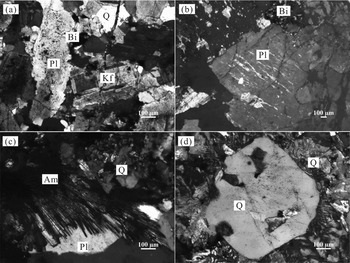
The Hailesitai coarse-grained monzogranitic pluton was named after the Hailesitai Mountain, which lies c. 20 km to the NE of the pluton (Fig. 1b). It crops out in an apple shape, c. 15 km2, and the shortest and longest axes are 1 and 6 km, respectively. A large number of quartz veins with widths of a few millimetres to tens of centimetres penetrate the pluton. In addition, some dense dark-brown siltstone fragments of the early Ordovician Tongshan Formation (O1 t) are visible in the pluton. The pluton consists of biotite granite, muscovite granite and two-mica granite. The biotite granite, with massive structure and porphyritic texture, is exposed in the NW of the pluton. It mainly contains K-feldspar (38−42%), plagioclase (18−34%), quartz (20−40%) and biotite (1−8%), and the accessory minerals consist of apatite, zircon, magnetite and sphene (<1%). In addition, the widespread biotite granite and rhyolite enclaves, with irregular circular or oval shapes that are one to tens of centimetres in diameter, show a gradual transitional relationship with the host rocks. The muscovite granite crops out in the south of the pluton with massive structure and porphyritic and granitic textures, whereas the two-mica granite is distributed in the middle of the pluton. The muscovite granite is composed of muscovite (1−4%), whereas, the the two-mica granite is composed of muscovite (1−2%) and biotite (1−5%). Both the biotite and muscovite granites show the general granite texture, and phanerocryst is coarse in granularity (Fig. 2a). The perhitic texture of plagioclase (Fig. 2b), amphibole ceramics (Fig. 2c) and the corrosion structure of quartz (Fig. 2d) could be seen frequently under the microscope.
Microscope photographs of Hailesitai pluton: (a) typical structure of granite; (b) perthitic texture of plagioclase; (c) amphibole ceramics; (d) corrosion structure of quartz. Q, quartz; Kf, potassium-feldspar; Pl, plagioclase; Bi, biotite; Am, amphibole.

3. Samples and methods
3.a. Samples
Systematic sampling of the coarse-grained granite in the Hailesitai pluton was implemented after detailed field studies. These samples included the biotite and muscovite granites from the NW to the SW of the pluton. The layout of the sampling was generally perpendicular to the change of lithology in order to collect representative samples effectively (Fig. 1c). The samples were fresh enough for geochemical analyses. In the NW of the pluton, three biotite granite whole-rock samples (1H, 2H and 3H) were collected for the analysis of the major and trace elements. Two samples (4−1CN and 4−2CN), which according to their interpenetration relationships belong to different stages, were collected for the zircon U−Pb dating and Hf isotopic analyses. In the middle of the pluton, where the biotite and muscovite granites are distributed, 14 whole-rock samples (from 4H to 7H) were collected for the analysis of major and trace elements, and a muscovite granite sample (9−1CN) was obtained for the zircon U−Pb dating and Hf isotopic analyses. In the SW of the pluton, four muscovite granite whole-rock samples (from 18H to 21H) were collected for the analysis of major and trace elements. The lithology of the muscovite granite in the SW of the pluton is consistent with that in the middle, and there are no features of multiple stages and cross interspersion. The spatial distribution of the samples collected was reasonable and considered to reflect the geochemical characteristics of the coarse-grained granite of the Hailesitai pluton adequately.
3.b. Whole-rock major and trace elements
The whole-rock major, trace and rare-earth element (REE) analyses were conducted at the Analytical Institute of the Hubei Bureau of Geology and Mineral Resources. Major element analyses were conducted using a Regaku 3080E XRF spectrometer. Analytical procedures are described in detail by Gao et al. (Reference Gao, Zhang, Gu, Xie, Gao and Guo1995). Trace elements, including REEs, were analysed at the State Key Laboratory of Geological Processes and Mineral Recourses (GPMR), China University of Geosciences, Wuhan, using an Agilent 7500a inductively coupled plasma mass spectrometer (ICP-MS). The analytical procedures are reported in detail by Liu et al (Reference Liu, Zong, Kelemen and Gao2008). Analytical precision (two standard deviations) estimated from repeated analyses of three standard reference samples G-2, AGV-1 and GSR-3 is better than 5% for REEs and 5–12% for other trace elements.
3.c. Zircon U−Pb dating
The zircon grains were separated after the rock was crushed using conventional techniques (i.e. heavy liquid and magnetic properties). They were then selected by examination using a binocular microscope, mounted in epoxy resin, and polished to approximately half exhumation. Finally, cathodoluminescence images were taken, which were used to study the internal structures of individual zircon grains and as a guide for in situ U−Pb dating and Hf isotope analysis. Zircon U−Pb dating was conducted using an ICP-MS (Neptune) coupled with a laser ablation (LA) system using a GeoLas 2005 DUV 193-nm UArF laser at the GPMR. A 32 μm spot size was adopted in this study, with a laser repetition rate of 10 Hz and energy up to 90 mJ. Helium was used as a carrier gas to enhance the transport efficiency of ablated material. The procedure applied is described in detail by Liu et al. (Reference Liu, Gao, Hu, Gao, Zong and Wang2010). Zircon 91500 were used as external standards for the U/Pb ratio. A common lead correction was performed after the method of Andersen (Reference Andersen2002), and the isotopic ratios and element concentrations were calculated using ICPMSDataCal8.9 (Liu et al. Reference Liu, Gao, Hu, Gao, Zong and Wang2010). Data-point uncertainties are 1σ at a confidence interval of 95%. The method for recalculating the LA-ICP-MS age uncertainties is reported by Horstwood et al. (Reference Horstwood, Košler, Gehrels, Jackson, Mclean, Paton, Pearson, Sircombe, Sylvester, Vermeesch, Bowring, Condon and Schoene2016). The concordia diagrams and U−Pb ages were obtained using the Isoplot program (Ludwig, Reference Ludwig2009).
3.d. Zircon Hf isotope
The Zircon Hf isotope analyses were performed using an excimer laser ablation system (193 nm, ArF) attached to a Neptune multicollector MC-ICP-MS at the GPMR. A laser repetition rate of 10 Hz at 100 mJ was used for ablating the zircon. The spot diameter was 44 μm, and the time of laser-ablation was 26 s. The detailed analytical technique is described by Yuan et al. (Reference Yuan, Gao, Dai, Zong, Günther, Fontaine, Liu and Diwu2008). The standard 176Hf/177Hf ratio of zircon 91500 obtained during the analyses was 0.282299 ± 17 (2σ, n = 38), which is consistent with the solution-method measurement (0.282306 ± 9) of Woodhead et al. (Reference Woodhead, Hergt, Shelley, Eggins and Kemp2004). The correction factor is 0.46–0.03%, and uncertainty in the preferred values for zircon 91500 was propagated to the ultimate results for the samples according to Liu et al. (Reference Liu, Gao, Hu, Gao, Zong and Wang2010). The 179Hf/177Hf and 173Yb/171Yb ratios were used to calculate the mass bias of Hf (β Hf) and Yb (β Yb), which were normalized to 179Hf/177Hf = 0.7325 and 173Yb/171Yb = 1.132685 (Fisher, Vervoort & Hanchar, Reference Fisher, Vervoort and Hanchar2014) using an exponential correction for mass bias. Interference of 176Yb on 176Hf was corrected by measuring the interference-free 173Yb isotope and using 176Yb/173Yb = 0.79639 (Fisher, Vervoort & Hanchar, Reference Fisher, Vervoort and Hanchar2014) to calculate 176Yb/177Hf. Similarly, the relatively minor interference of 176Lu on 176Hf was corrected by measuring the intensity of the interference-free 175Lu isotope and using the recommended 176Lu/175Lu = 0.02656 (Blichert-Toft, Chauvel & Albarède, Reference Blichert-Toft, Chauvel and Albarède1997) to calculate 176Lu/177Hf. We used the mass bias of Yb (β Yb) to calculate the mass fractionation of Lu because of their similar physicochemical properties. Offline selection and integration of analyte signals, and mass bias calibrations were performed using ICPMSDataCal (Liu et al. Reference Liu, Gao, Hu, Gao, Zong and Wang2010). Initial 176Hf/177Hf ratios, denoted as ε Hf (t), are calculated relative to a chondritic reservoir with a 176Hf/177Hf ratio of 0.282772 and 176Lu/177Hf of 0.0332 (Blichert-Toft, Chauvel & Albarède, Reference Blichert-Toft, Chauvel and Albarède1997). The decay constant value of 1.865 × 10⁻¹¹ a−1 for 176Lu reported by Scherer, Munker & Mezger (Reference Scherer, Munker and Mezger2001) and an fcc (continental crust) value of −0.55 (Griffin et al. Reference Griffin, Pearson, Belousova, Jackson, van Achterbergh, O'Reilly and Shee2000) for calculation of two-stage model age were used.
4. Results
4.a. Whole-rock major and trace elements
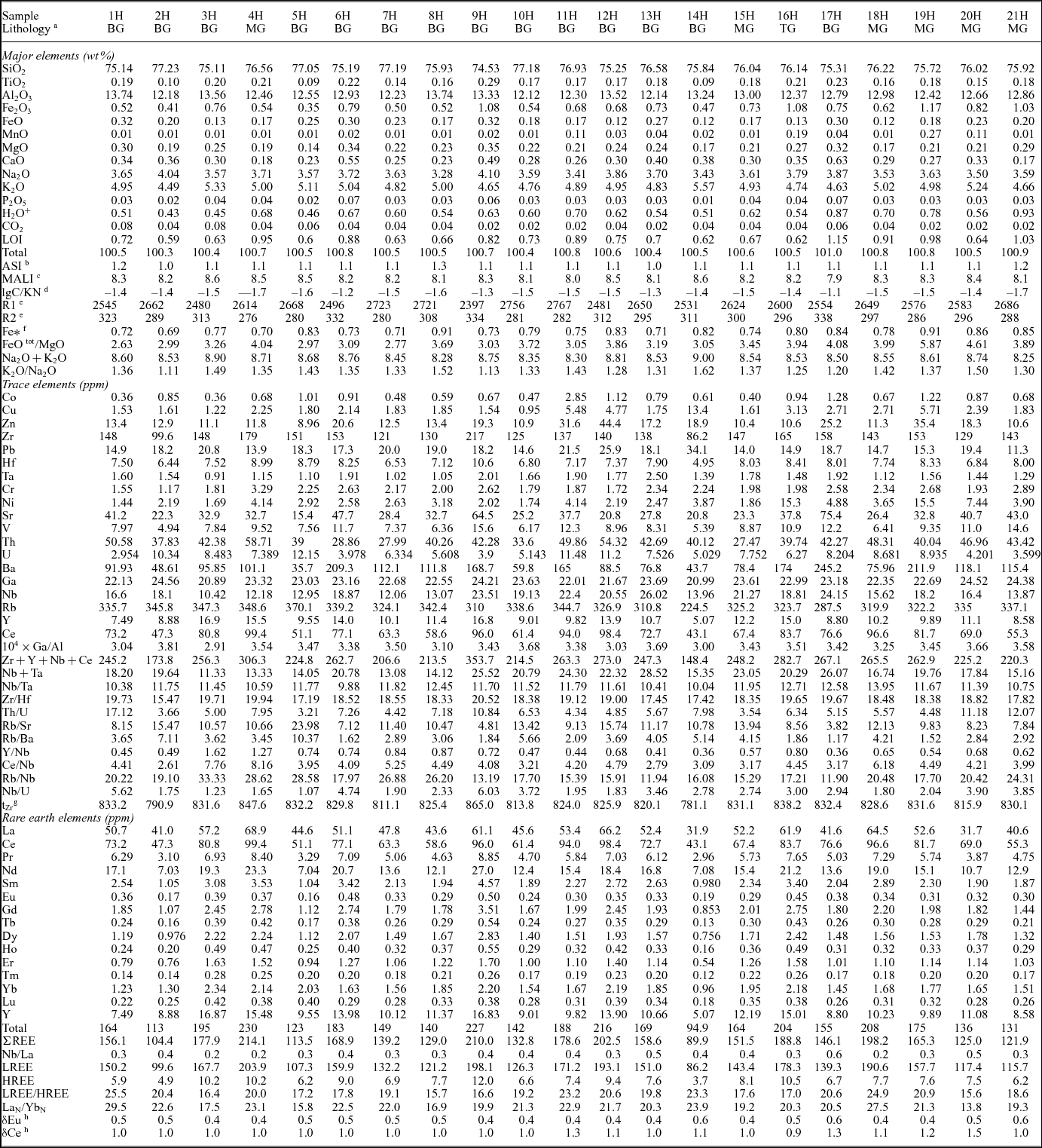
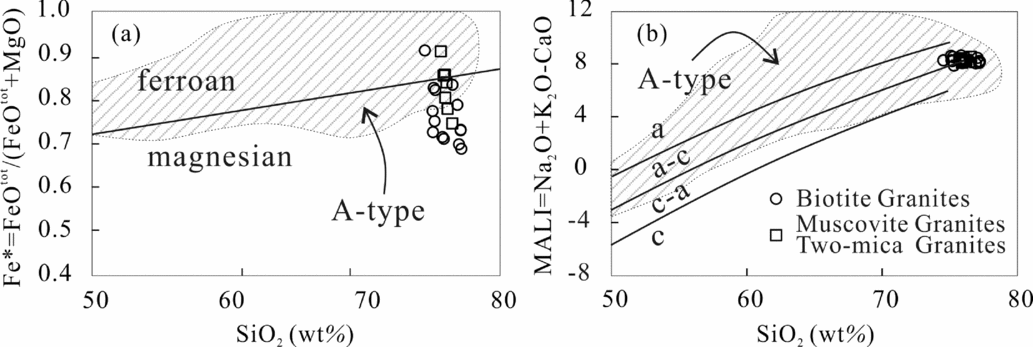
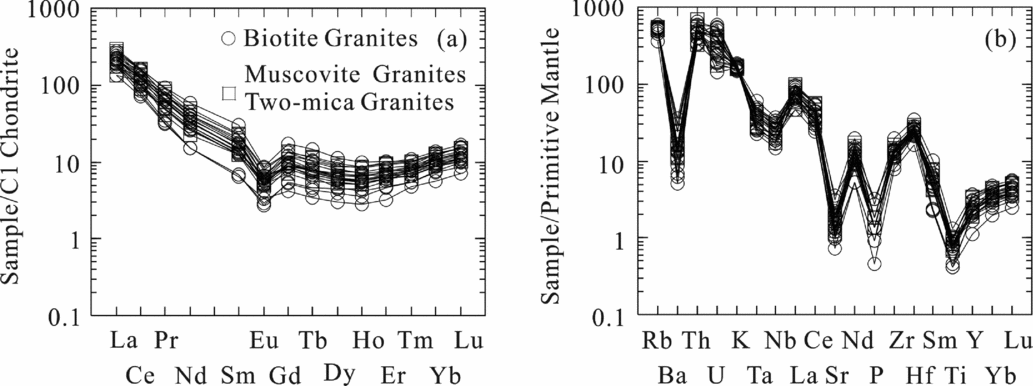
The results of the analyses of the whole-rock major and trace element contents of selected samples from the Hailesitai pluton are summarized in Table 1. The selected 21 samples show high contents of SiO2 varying from 74.53 to 77.23 wt% (average 75.50 wt%) (Table 1). The high K2O contents (4.49−5.57 wt%; average 4.78 wt%) and the high K2O+Na2O values (8.25−9.00 wt%; average 8.45 wt%) show the high alkali nature of the granites. The Al2O3 contents varying from 12.12 to 13.74 wt% with an average of 12.42 wt% indicate that the granites are rich in aluminium. Furthermore, ASI (Aluminium Saturation Index) is from 1.0 to 1.3 (average 1.1), which suggests that Hailesitai granites are peraluminous (Table 1). The MgO contents are within the range 0.14–0.35 wt%, which is similar to the FeO and Fe2O3 contents (0.12–0.32 wt% and 0.35–1.17 wt%). The Fe* (Fe* = FeOtot/(FeOtot+MgO)) ratios vary within the range 0.69−0.91 wt% (average 0.78 wt%). The CaO contents range from 0.17 to 0.63 wt% (average 0.36 wt%), and the TiO2 contents range from 0.09 to 0.29 wt% with an average of 0.26 wt%. The values from the Litman index (δ = (K2O+Na2O)2/SiO2 − 43) (2.03−2.46; average 2.19) of these samples show typical characteristics of calc-alkaline granites. The REE and trace element contents of the samples from the Hailesitai pluton are listed in Table 1. In diagrams of SiO2 versus Fe* (Molecular) and SiO2 versus MALI (Modified Alkali-Lime Index) (Frost et al. Reference Frost, Barnes, Collins, Arculus, Ellis and Frost2001), the Hailesitai granites show geochemical characteristics of calcic-alkali and transitional ferroan (Fig. 3a, b). The total REE contents of the biotite and muscovite granites (Table 1) range from 89.87 to 214.14 ppm (average 154.35 ppm) and 121.95–202.51 ppm (average 158.78 ppm), respectively. The Chondrite-normalized REE patterns exhibit similar characteristics between the biotite and muscovite granites in the Hailesitai pluton (Fig. 4a). They are both enriched in light REEs and relatively depleted in heavy REEs; both have a right-deviation Chondrite-normalized pattern with a light-to-heavy REE ratio of 15.16−25.46 (average 19.55) and 16.24−23.23 (average 19.47) and LaN/YbN ratios of 13.77−29.44 (average 21.38) and 17.52−22.89 (average 20.35), respectively. All samples show an obvious negative Eu anomaly. The trace element spider diagrams of the biotite and muscovite granites (Fig. 4b) are consistent. The contents of Rb, Th, U, K, Zr, Hf and other large-ion lithophile elements (LILEs) are enriched, whereas the contents of Nb, Ta, P, Ti, Ba, Sr and high-field-strength elements (HFSEs) are depleted. The biotite and muscovite granites show no significant depletion in Zr and Hf.
The whole rock analysis results of the Hailesitai pluton. Sample numbers are from 1H to 21H

a Lithology: HG, biotite granite; MG, muscovite granite; TG, two-mica granite.
b Aluminium Saturation Index, ASI = Al/(Ca− 1.67P+Na+K), molecular ratio.
c Modified Alkali-Lime Index, MALI = Na2O+K2O − CaO, wt%.
d lgC/NK = lg CaO/(Na2O+K2O), wt%.
e R1 = 4Si − 11(Na+K) − 2(Fe+Ti), R2 = 6Ca+2Mg + Al, molecular ratio.
f Fe* = FeOtot/(FeOtot+MgO), FeOtot = FeO+0.8998*Fe2O3, wt%.
g tZr /℃ = 12900/[2.95+0.85M+ln(496 000/Zrmelt)] − 273.15, M = (Na+K+2Ca) /(Al × Si), mole ratio; Zrmelt is the Zr content in the magma (Miller, Meschterwell & Mapes, Reference Miller, Meschterwell and Mapes2003).
h δEu = Eu N /(Sm N × Gd N )1/2, δCe = Ce N /(La N × Pr N )1/2, where N denotes chondrite normalization. The chondrite values are from McDonough & Sun (Reference McDonough and Sun1995).
Geochemistry characteristic diagrams of Hailesitai pluton. (a) SiO2 versus Fe* and (b) SiO2 versus MALI are from Frost et al. (Reference Frost, Barnes, Collins, Arculus, Ellis and Frost2001), Fe* = FeOtot/(FeOtot+MgO), FeOtot = FeO+0.8998*Fe2O3 (wt%); Modified Alkali-Lime Index, MALI = Na2O+K2O+CaO (wt%); c, calcic, a, alkali.

REE and trace elements distribution curves of Hailesitai pluton. Normalized spherical meteorite data is from Pearce, Harris & Tindle (Reference Pearce, Harris and Tindle1984), and normalized primordial mantle data is after McDonough & Sun (Reference McDonough and Sun1995).

4.b. Zircon U−Pb dating
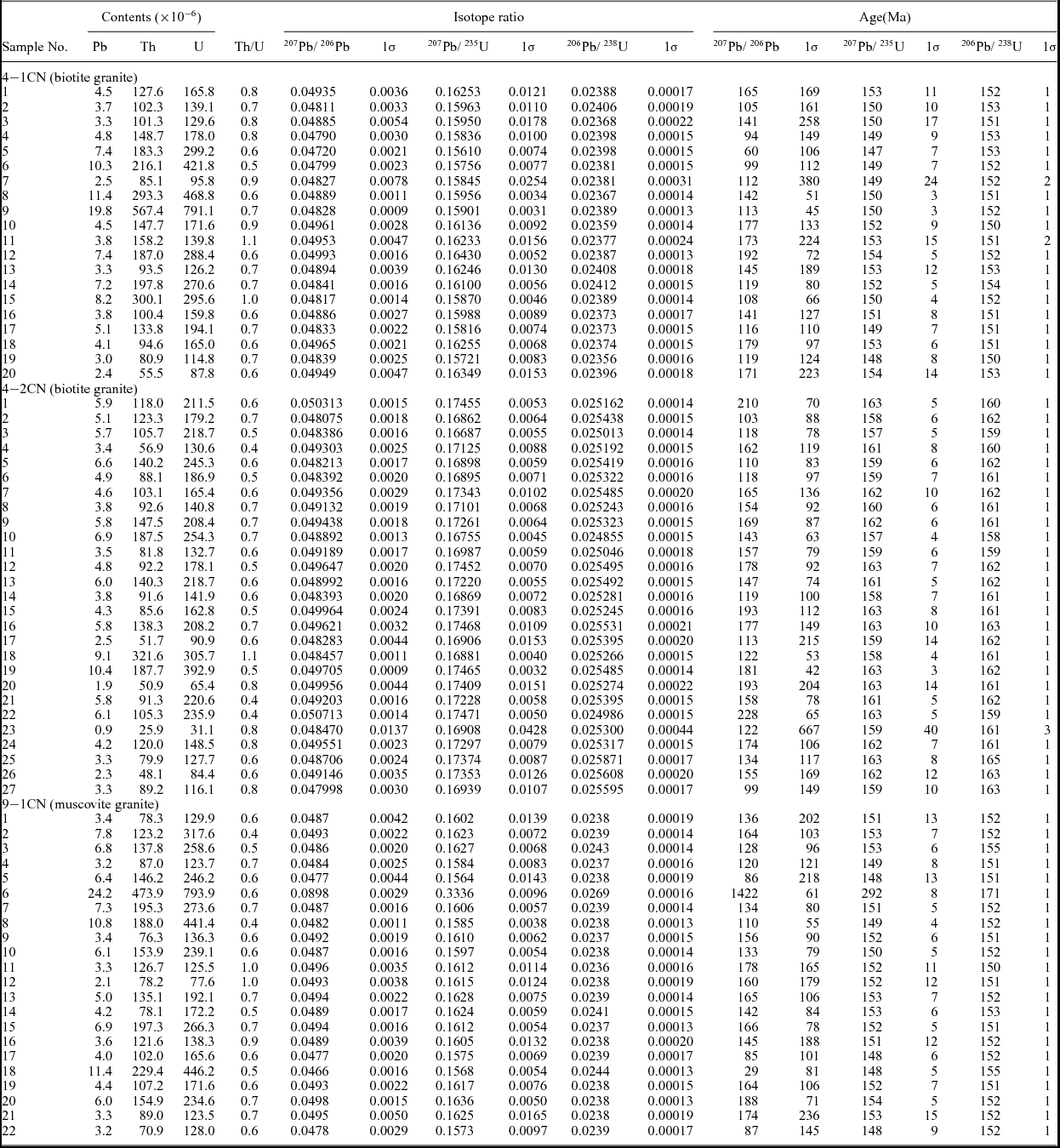
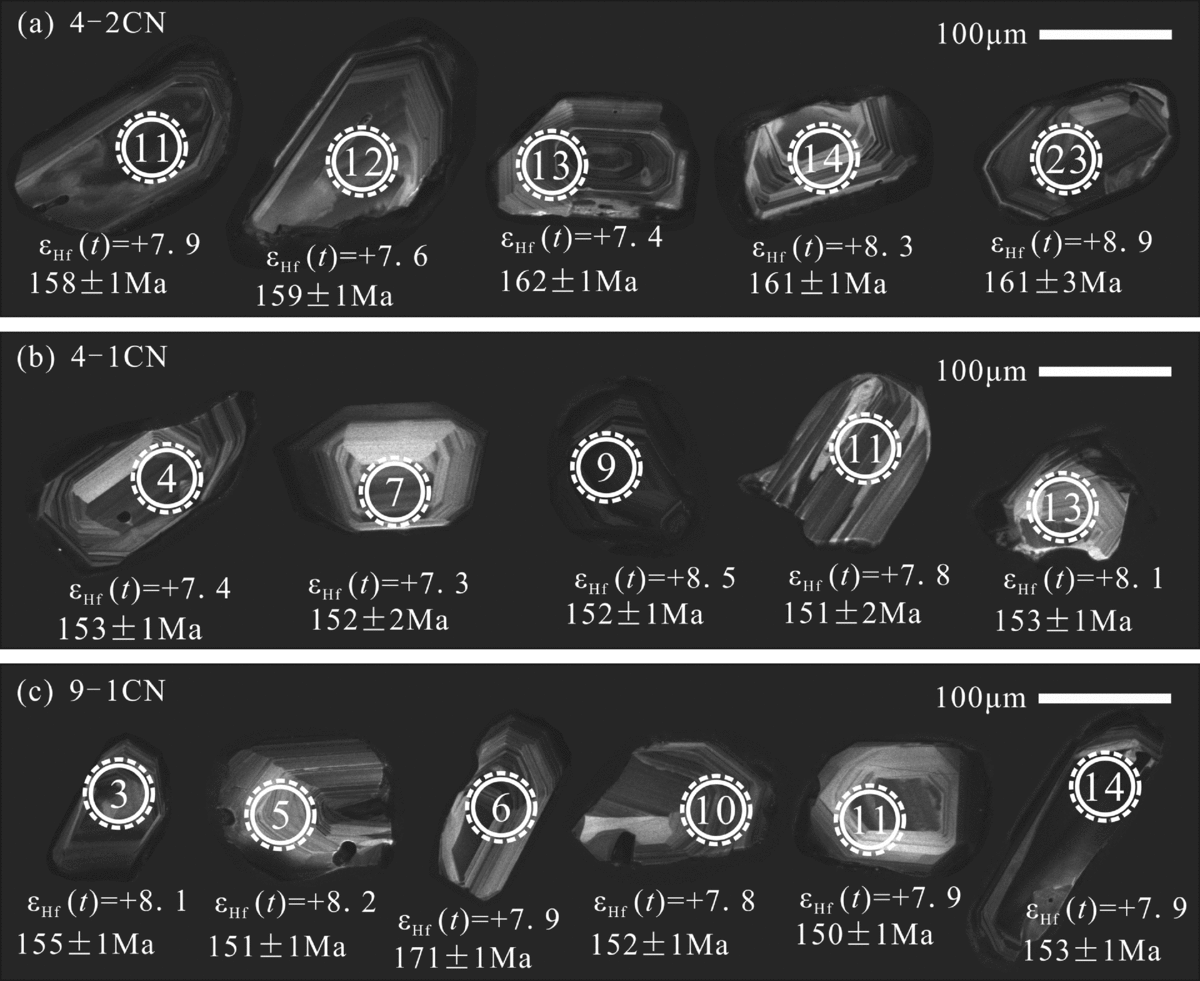
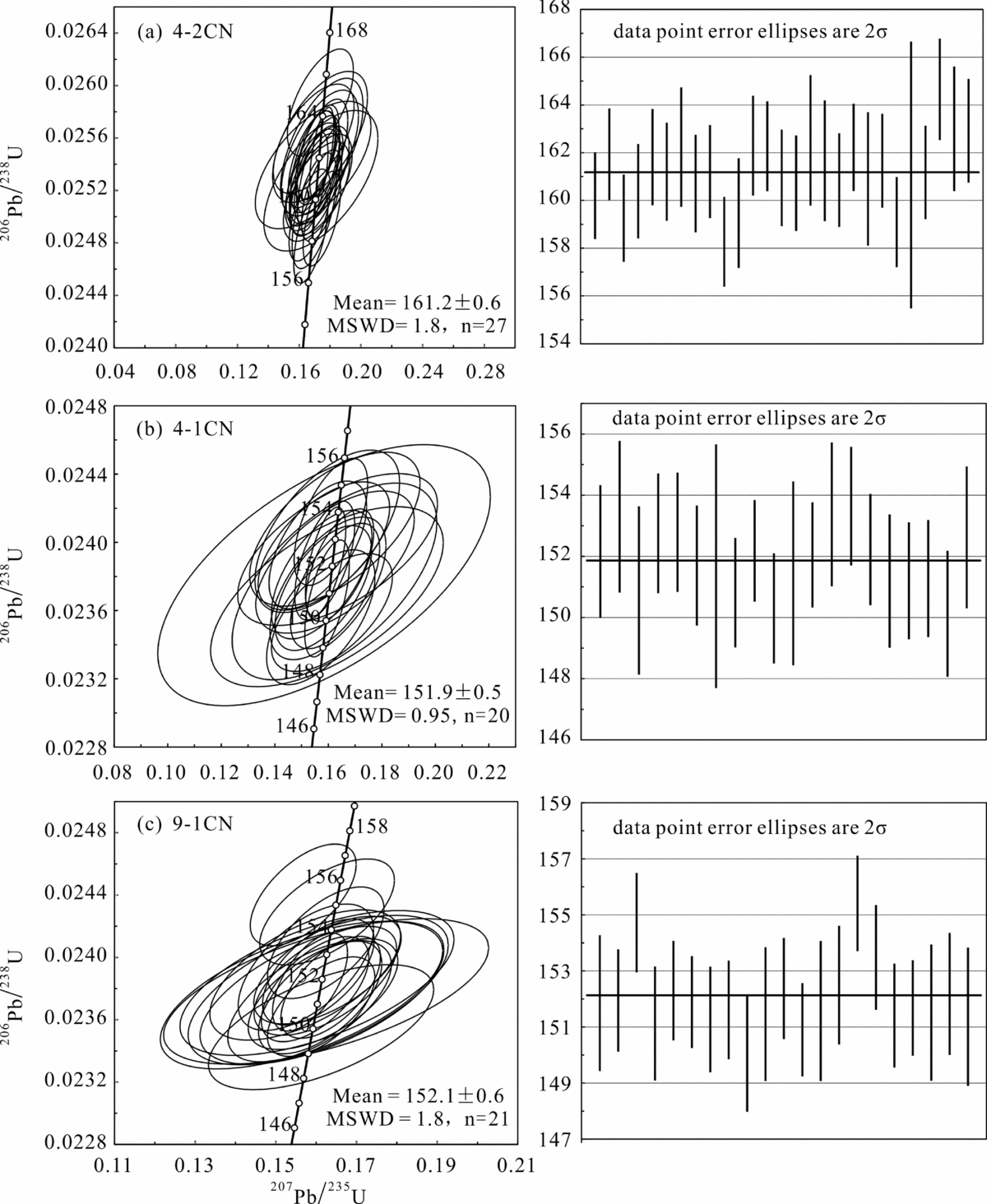
The results of the zircon U−Pb dating of selected samples from the Hailesitai pluton are listed in Table 2. The morphologies and internal structures of the zircon grains in the biotite and muscovite granites suggest characteristics of an igneous nature. Under the polarizing microscope, these zircon grains showed no obvious evidence of complex internal structures (inclusions or inheritance), and most of them were sub-rounded to rounded in shape with well-defined oscillatory zoning in the cathodoluminescence images (Fig. 5). The zircon grains are 40−150 μm long and 40−80 μm wide with short columnar−granular or euhedral–subhedral shapes. The core−rim structures in the zircon grains are developed. Generally, the core of the individual grain is euhedral−subhedral or rounded−ovular in shape with solution structures, and the internal banded and oscillatory zones are developed. The zircon Pb (average 5.6), U (average 213.2) and Th (average ~ 137.5) contents in both the biotite granite and muscovite granite are high and the Th/U ratios range from 0.4 to 1.1 (average ~ 0.7). The concordant age of the earlier biotite granite (No. 4−2CN) is 161.2 ± 0.6 (mean square weighted deviation (MSWD) = 1.8, n = 27), and the analysis points are distributed on or beside the concordant line at the age of the concordant diagram (Fig. 6a). The concordant zircon age of the latter biotite granite (No. 4−1CN) is 151.9 ± 0.5 (MSWD = 0.95, n = 20) (Fig. 6b) and the concordant age of the muscovite granite (No. 9−1CN) is 152.1 ± 0.6 (MSWD = 1.8, n = 21) (Fig. 6c). The concordant ages of the latter granites are c. 152 Ma.
Zircon U−Pb dating analysis results of the Hailesitai pluton. Sample numbers are 4-1CN, 4-2CN and 9-1CN.

Zircon cathodoluminescence photographs of Hailesitai pluton: (a) 4-2CN, (b) 4-1CN and (c) 9-1CN. Representative CL images of zircon. Solid circle is the position for U–Pb isotope analysis, and dotted circle is for Hf isotope analysis.

Concordia diagrams of zircon U−Pb dating of Hailesitai pluton: (a) 4-2CN, (b) 4-1CN and (c) 9-1CN. The unit of mean numbers are Ma.

4.c. Hf isotope
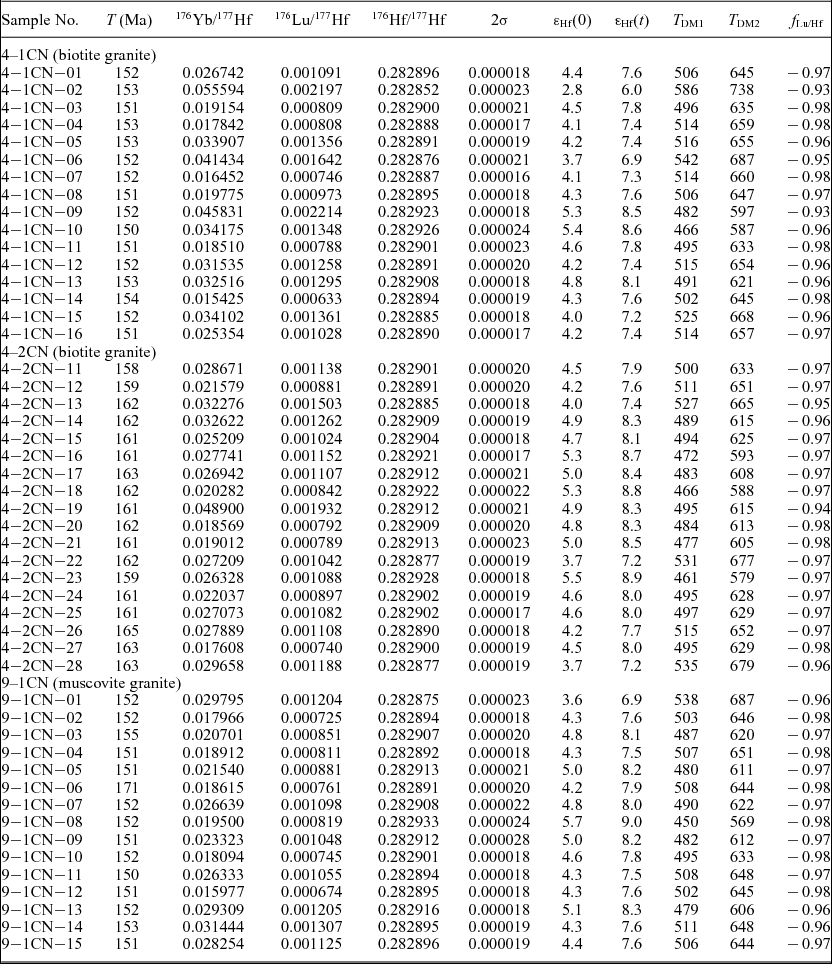
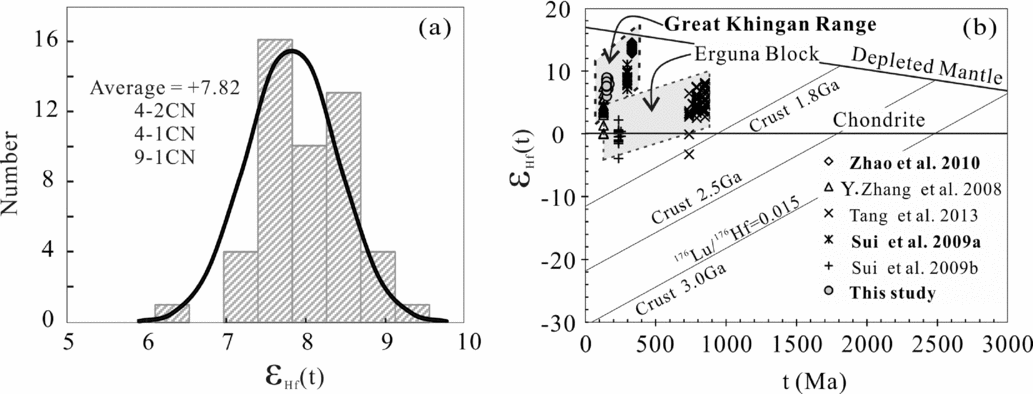
The results from the zircon Hf isotope analysis of selected samples from the Hailesitai pluton are listed in Table 3. The 176Yb/177Hf and 176Lu/177Hf ratios of the 49 zircon grains are 0.015425−0.055594 and 0.000633−0.002214, respectively. The 176Lu/177Hf ratio is less than or close to 0.002, indicating that these zircons formed only with reduced levels of radiogenic Hf accumulation. The one-stage depleted mantle model of the 49 zircons provides dates of 450–586 Ma, and the two-stage depleted mantle model provides dates of 569–738 Ma. In addition, the ε Hf(t) values, except for the value of No. 4−1CN−02 (+2.82), fluctuate around the average value of +4.51 with a range of 3.64–5.70. The 176Hf/177Hf ratios of the three samples (Nos. 4−1CN, 9−1CN, 4−2CN) range from 0.282852 to 0.282933. The Hf composition characteristics of the inherited zircon (Spot No. 9−1CN−6) is similar to the granite of the Hailesitai pluton. Therefore, these zircon granite samples have relatively homogeneous Hf isotope compositions (Fig. 7).
Hf isotope analysis (4-1CN, 4-2CN, 9-1CN) results of the Hailesitai pluton. Sample numbers are 4-1CN, 4-2CN and 9-1CN.

(a) Histogram of initial Hf isotope ratio. (b) Compilation diagram of ε Hf(t) versus U–Pb ages. The samples are 4-2CN, 4-1CN and 9-1CN. Data cited from Zhang, Ge & Liu (Reference Zhang, Ge, Wu, Wilde, Yang and Liu2008), Sui et al. (Reference Sui, Ge, Xu and Zhang2009 a, b), Zhao et al. (Reference Zhao, Chi, Liu, Wang and Hu2010) and Tang et al. (Reference Tang, Xu, Wang, Wang, Xu and Zhang2013).

5. Discussion
5.a. Genesis
Hailesitai granites exhibit the geochemical characteristics of peraluminous and high-K calc-alkaline (Table 1), which are similar to A-type granites (Eby, Reference Eby1990, Reference Eby1992). With respect to I- and S-type granites, A-type granites show geochemical characteristics of high Na2O+K2O, Fe*, Ga/Al and HFSE values, and low Sr, Ti, Ba and Eu values (Table 1; Fig. 4). The high Zr content (average 143 ppm) and the high zircon saturation temperatures (Table 1) (781.1−865.0°C, average 825.7°C) show a higher isothermal surface of formation, which indicates the A-type characteristics.
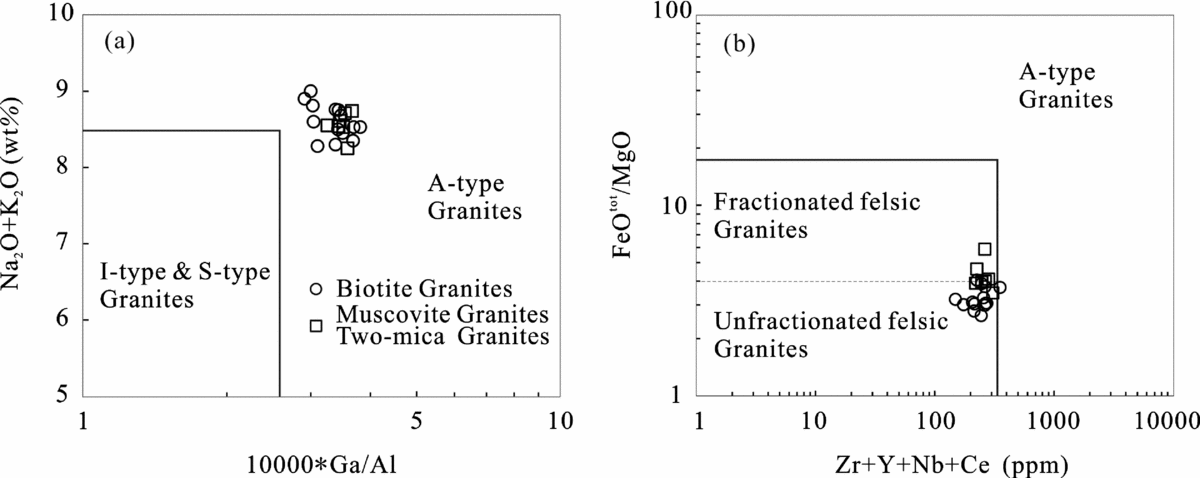
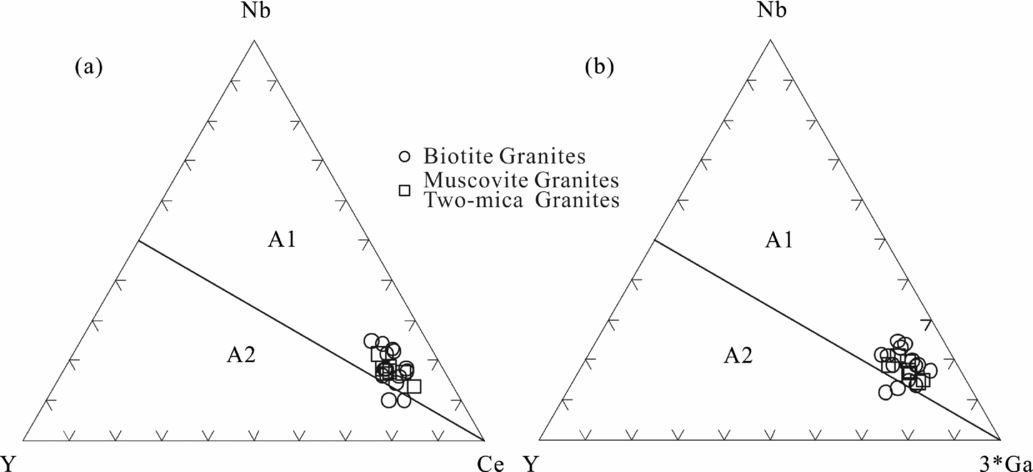
Eby (Reference Eby1990) suggests that A-type granites can be divided into two chemical groups and successfully discriminated by utilizing incompatible elements Rb, Ce, Y, Nb, Zr, Hf, Th and Ga. In the 10000*Ga/Al and Na2O+K2O diagram (Fig. 8), samples fall into the A-type granites field, and in the Nb−Y−Ce and Nb−Y−Ga diagram (Fig. 9) most of the samples intensively distribute in the A1-type granites field.
Diagram of discriminate genesis of Hailesitai granites. The original plot is after Whale (1987). (a) 10000*Ga versus Na2O+K2O diagram; (b) Zr+Y+Nb+Ce versus FeOtot/MgO diagram.

A1/A2 discrimination diagrams of Hailesitai granites. The original plot is from Eby (Reference Eby1992). (a) Nb-Y-Ce diagram; (b) Nb-Y-3*Ga diagram.

These A1-type granites are significantly enriched in K, Rb and REEs with strong Eu, Ba, P, Ti and Sr negative anomalies (Fig. 4).The characteristics of low Ba and Sr indicate a source region of relatively shallow depth, possibly within the plagioclase or hornblende stability field in the lower crust (Ge et al. Reference Ge, Lin, Sun, Wu and Li2000; Ma et al. Reference Ma, She, Xu and Wang2004). During the partial melting of plagioclase and hornblende, their residual phases reside in the source region, resulting in both the depletion of Ba, Sr and Eu and the heavy REEs (Ma et al. Reference Ma, She, Xu and Wang2004; C. Zhang et al. Reference Zhang, Holtz, Koepke, Berndt and Ma2014), which coincide with the presence of alkali feldspar and quartz as the characteristic principal phenocryst minerals. In terms of peraluminous (ASI, average 1.1, Table 1) and calc-alkaline (Fig. 3), Hailesitai granites are similar to the peraluminous granitoids that may be formed by partial melts of granitic crust at low pressure (Frost & Frost, Reference Frost and Frost2010).
Therefore, the geochemical characteristics indicate that the Hailesitai granites belong to A-type granites defined as alkaline, anhydrous and anorogenic (Loiselle & Wones, Reference Loiselle and Wones1979) and emplaced into a non-orogenic setting within plate and along plate tectnic (Eby, Reference Eby1990).
5.b. Substance origin
Three sets of chronological data used in this study indicate that the Hailesitai granites were erupted during the Late Jurassic. This is consistent with the findings of former studies of Mesozoic intrusive rocks in the GKR, which were mainly erupted during the middle Jurassic to early Cretaceous (Wang & Zhao, Reference Wang and Zhao1997; Wang et al. Reference Wang, Xu, Liu and Zhu2012; Cui et al. Reference Cui, Zheng, Xu, Yao, Shi, Li and Xu2013; Sun et al. Reference Sun, Gou, Wang, Ren, Liu, Guo, Liu and Hu2013, Reference Sun, Chi, Zhao, Pan, Liu, Zhang and Quan2014; Zhu et al. Reference Zhu, Chen, Wu, Li, Zhang, Wu, Liu, Wang and Liu2013; X. Zhang et al. Reference Zhang, Wei, Fu, Chen, Tan, Li, Shi and Tian2015). The geochemical characteristics of the samples could represent the source region and reflect the genesis of the plutons (L. Zhang et al. Reference Zhang, Ge, Wu, Wilde, Yang and Liu2008; Zhang, Zuo & Cheng, Reference Zhang, Zuo and Cheng2014). The biotite and muscovite granites exhibit similar geochemical and chronological characteristics, which suggests they are products of the same geological environment and origin. The Hailesitai pluton has significantly lower Nb/Ta (average 11.53, Table 1) and HFSE values than the chondrite and primitive mantle (Table 1) (McDonough & Sun, Reference McDonough and Sun1995). This might be due to the crystallization of rutile, ilmenite and titanomagnetite (Barth, Nough & Rudnick, Reference Barth, Nough and Rudnick2000). The lower Nb/U values (1.07−6.03; average 2.83) of the Hailesitai samples compared with the MORB and OIB (average 47 ± 10) also suggest the appearance of crustal contamination (Hofmann, Reference Hofmann1986). Therefore, the melting originating from dehydrated oceanic crust might have acted on the magma sourced from the mantle. Eby (Reference Eby1990, Reference Eby1992) has discussed the origin of the A1-type granites and has argued that they are the fractional crystallization product of mantle-derived magmas with/without interaction with crustal rocks (Foland & Allen, Reference Foland and Allen1991; Kerr & Fryer, Reference Kerr and Fryer1993). Furthermore, the Hf isotopic compositions of the Hailesitai samples (Fig. 8) also show that the Hailesitai pluton likely originated from a mixture of juvenile and crustal source rocks. Zhou et al. (Reference Zhou, Ying, Zhang and Zhang2009) suggested that the mantle end-member components in the GKR were inherited from enriched lithospheric mantle beneath old blocks with overprint of subducted juvenile island arc materials. The Sr−Nd−Pb isotope ratios of late Mesozoic volcanic rocks in the GKR are similar to an enriched (EM1-type) mantle component originated by an ancient metasomatic event (Zhou et al. Reference Zhou, Ying, Zhang and Zhang2009; Huang et al. Reference Huang, Zhu, Hou, Wang, Liu, Chen, Wang and Li2014). Thus, the Hailesitai pluton might be sourced from enriched (EM1-type) mantle that was a mixture of juvenile and crustal source rocks.
5.c. Tectonic setting and geodynamic model
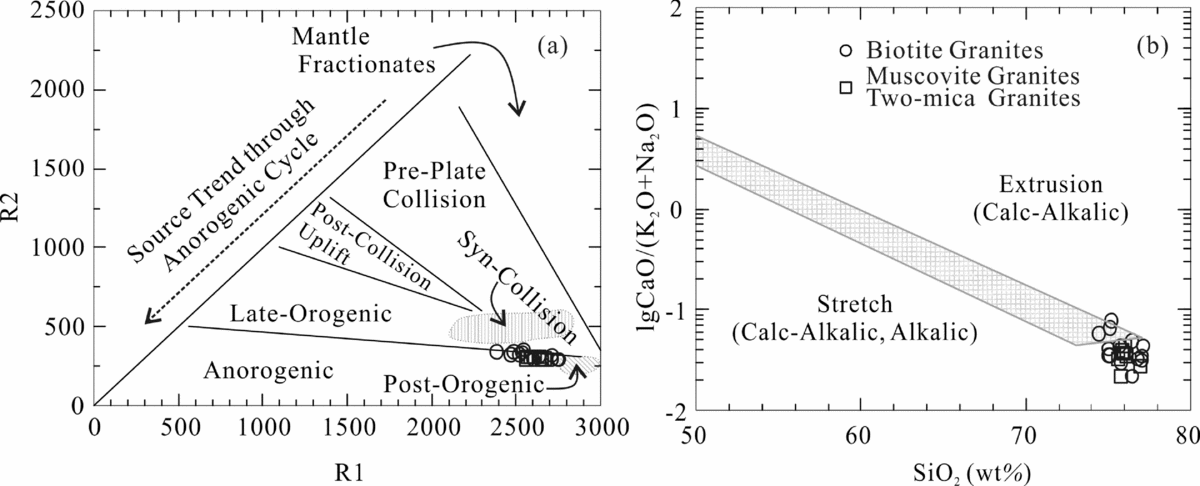
The A1-type granites represent differentiates of magmas derived from sources like those of oceanic-island basalts but emplaced in continental rifts or during intraplate magmatism (Eby, Reference Eby1992). In the R1 and R2 diagram (Fig. 10), Hailesitai granites show the anorogenic tectonic setting. The coarse crystalline particles in the Hailesitai granitic pluton indicated slow uplift of the magma chamber (Zhang, Sun & Mao, Reference Zhang, Sun and Mao2006). This was related to the underplating of the mantle-derived magma, which might have resulted in a closed magma chamber under extensional conditions (Wang et al. Reference Wang, Guo, Zhang, Yang, Zhang, Tong and Ye2015).
Tectonic discrimination diagrams of Hailesitai granites. (a) R1 versus R2 is after Batchelor & Bowden (Reference Batchelor and Bowden1985), R1 = 4Si − 11(Na+K) − 2(Fe+Ti), R2 = 6Ca+2Mg+Al, molecular ratio; (b) lgCaO/(K2O+Na2O) versus Si2O is from Allègre & Minster (Reference Allègre and Minster1978).

Several schemes interpreting the Mesozoic extensional tectonic setting of the GKR have been proposed. A mantle plume has been considered responsible for the formation of such large volumes of granite (Ge et al. Reference Ge, Lin, Sun, Wu, Won, Lee, Jin and Yun1999; Lin et al. Reference Lin, Ge, Cao, Sun and Lim2003; Shao et al. Reference Shao, Mu, Zhu and Zhang2010). However, the linear distribution of the Mesozoic granitic rocks along the GKR, even extending into eastern China, does not support this interpretation. Moreover, magmatic activities within the GKR extended from 185 to 105 Ma (Wang et al. Reference Wang, Zhou, Zhang, Ying, Zhang, Wu and Zhu2006; Wu et al. Reference Wu, Sun, Ge, Zhang, Grant, Wilde and Jahn2011), which is much longer than the normal period of magmatic activity associated with a mantle plume (Larson & Olson, Reference Larson and Olson1991; Maruyama, Santosh & Zhao, Reference Maruyama, Santosh and Zhao2007). Therefore, the Hailesitai pluton might not have been generated under a mantle-plume environment.
A second model suggests that the Mesozoic granite rocks formed because of the subduction of the Mongol−Okhotsk Ocean and subsequent orogenic collapse (Fan et al. Reference Fan, Guo, Wang and Lin2003; Wang et al. Reference Wang, Zhou, Zhang, Ying, Zhang, Wu and Zhu2006). Although it might be argued that the Jurassic basalt, exposed in western parts of the GKR, might be related to such subduction and closure of the Mongol−Okhotsk Ocean, the following lines of evidence do not support this interpretation. The Mongol−Okhotsk Ocean subducted northward beneath the Siberia Block and did not subduct southward beneath the GKR, as is required in this model (Sun et al. Reference Sun, Gou, Wang, Ren, Liu, Guo, Liu and Hu2013; Tang et al. Reference Tang, Xu, Wang, Wang, Xu and Zhang2013). However, according to available seismic tomography data (Meng, Reference Meng2003), the Mongol−Okhotsk Ocean subducted southward beneath the GKR. This means that the Mesozoic granitic rocks in the GKR could not have been formed only by subduction of the Mongol−Okhotsk Ocean, because these rocks are distributed not only in the GKR of China but also in eastern Mongolia and Russia (Graham et al. Reference Graham, Hendrix, Johnson, Badamgarav, Badarch, Amory, Porter, Barsbold, Webb and Hacker2001). Furthermore, if rocks in the GKR are considered to be the products of post-orogenic evolution, it is difficult to explain why they extend not in a WE direction but in a NNE direction, which parallels the Mongol−Okhotsk Ocean suture (Li et al. Reference Li, Liu, Zhao, Zhang and Han2005). Moreover, coeval Mesozoic granitic rocks are widely distributed within the main continental area of eastern China, which cannot be explained only based on the collapse of the Mongol−Okhotsk Orogen (Fig. 1b). The Erguna block has lower ε Hf(t) values, from −9.7 to +2.5, and higher Nd model ages from 1800 to 1200 Ma, whereas the GKR block has higher ε Hf(t) values, from +0.6 to +14.16, and lower Nd model ages from 1000 to 500 Ma (Zhang et al. Reference Zhang, Liu, Li, Han, Zhang, Zhao, Jian and Guo2013; Table 1; Fig. 7b). The Hailesitai granite ε Hf(t) values (average +11.1; Table 3) are similar to those of the GKR block (Fig. 7b). Higher ε Hf(t) values and lower Hf second-stage model ages compared to the Erguna block suggest that the period of continental crust growth of the GKR is latter. Furthermore, Siberia subduct south down the Palaeo-Asia Ocean and Mongol–Okhotsk (M-O) belt (Fig. 1). The M-O belt may have enhanced the fertility of the magmatic source areas in NE China.
The third model that has been proposed involves the subduction of the Palaeo-Pacific Plate beneath eastern China (Wang et al. Reference Wang, Zhou, Zhang, Ying, Zhang, Wu and Zhu2006), and several lines of evidence support this interpretation. Firstly, the Mesozoic granitic rocks in NE China and the surrounding areas are distributed in a NNE direction, which parallels the NNE-oriented Asian continental margin. Secondly, the geophysical data indicate the existence of a high-velocity zone beneath eastern China, which is commonly considered to be the result of subducted oceanic crust (Huang & Zhao, Reference Huang and Zhao2006). Thirdly, it has been documented that Jurassic−Cretaceous accretionary complexes are extensively developed along the entire Asian continental margin, undoubtedly indicating a subduction regime related to the Palaeo-Pacific Plate (Wu et al. Reference Wu, Han, Yang, Wilde, Zhai and Park2007). However, the following lines of evidence do not support this interpretation. Firstly, the last suture between the northern and southern GKR is the Hegenshan suture zone (Ren, Niu & Liu, Reference Ren, Niu and Liu1999), which is located to the east of Hailesitai pluton. Moreover, the formation age of the Mongol−Okhotsk Ocean suture is c. 170 Ma at latest (Tomurtogoo et al. Reference Tomurtogoo, Badarch, Liu, Windley and Kröner2005). This implies that granites older than c. 170 Ma and west of the suture in the GKR are mainly affected by the subduction of the Mongol–Okhotsk. This hypothesis is supported by the distribution of the Itype granites aged from 156 to 195 Ma in the Chabaqi area of the GKR (Dai et al. Reference Dai, Yang, Ma and Gong2013). Thus, the Hailesitai pluton might be not the product of the subduction of the Palaeo-Pacific Plate beneath eastern China. Furthermore, the direction shift of the Pacific plate subduction and the regional tectonic setting transfers from the extrusion to the extension is at the Late Jurassic (~145 Ma) in the GKR (Sagong, Kwon & Ree, Reference Sagong, Kwon and Ree2005; Maruyama et al. Reference Maruyama, Isozaki, Kimura and Terabayashi2006) at latest. In other words, the intrusion age of the A1-type granite in the GKR, which is mainly affected by the subduction of the Pacific Ocean, will not exceed ~145 Ma, and this makes it difficult to explain the intrusion age (~152 and ~161 Ma) of A1-type Hailesitai granites. Eby (Reference Eby1990, Reference Eby1992) has discussed the fact that the A1-type granite occurred in an intraplate anorogenic rift, post-collisional magmatism, or mantle-plume environment. In the tectonic-setting discrimination diagrams, the Hailesitai granites display the characteristics of an an orogenic environment (Fig. 11). From the Late Jurassic to Early Cretaceous, the granitoids evolved compositionally from highly fractionated I-, transitional I-A or A-type (Wang et al. Reference Wang, Guo, Zhang, Yang, Zhang, Tong and Ye2015). This evolution coincided with a tectonic transition from contractional crustal thickening to extensional thinning. The Hailesitai A1-type granites aged c. 161 and 152 Ma suggest that intra-plate orogenesis started from c. 161 Ma at latest. Therefore, the formation of the Hailesitai pluton might not have been only affected by the western subduction of the Palaeo-Pacific Plate.
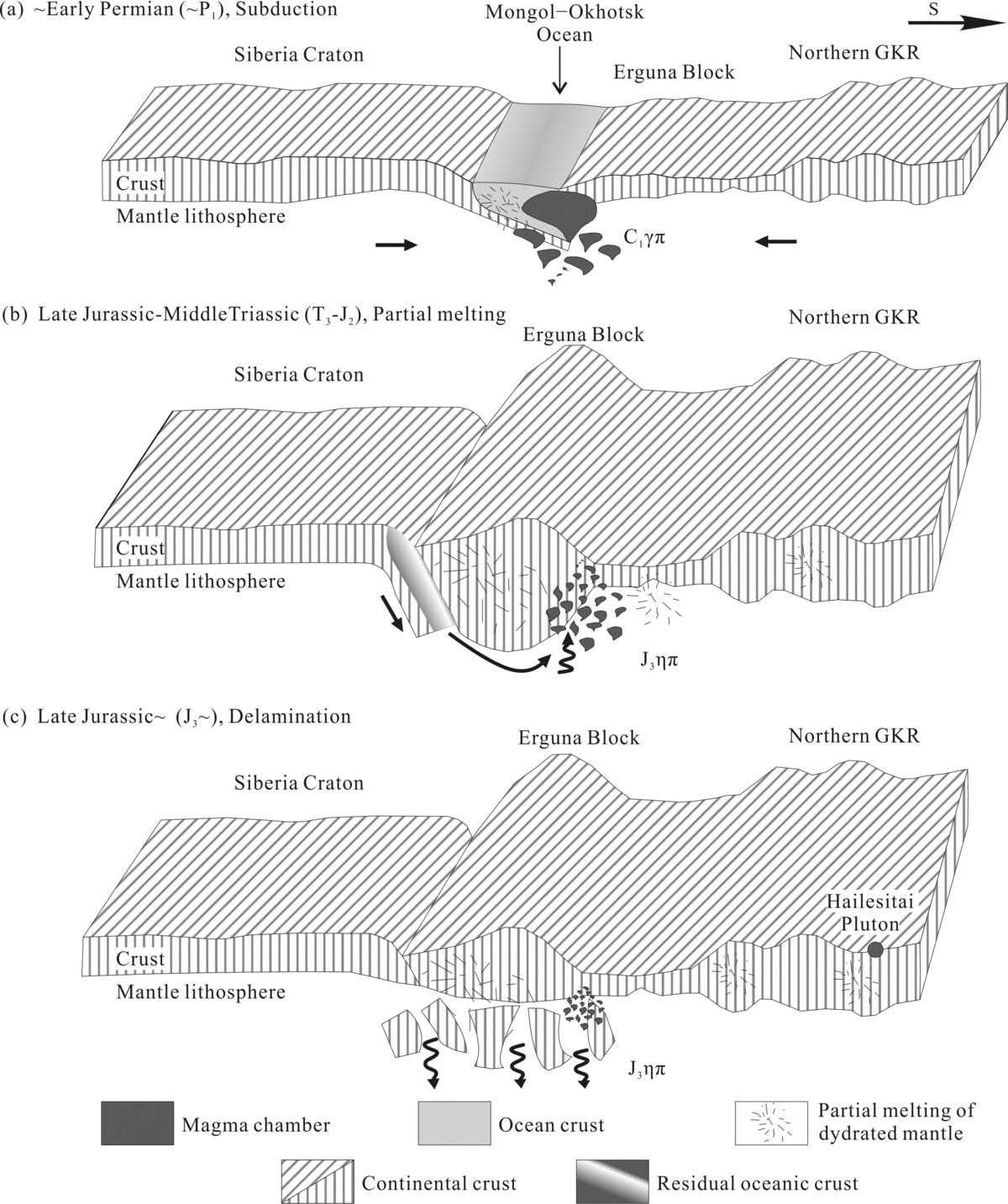
The illustration genesis and dynamics model diagrams of Hailesitai pluton. (a) The Mongol−Okhotsk Ocean (Palaeo-Asian Ocean) subducted southern beneath to the GKR block. (b). The underplating mafic–ultramafic rocks beneath the micro-blocks were weak lithosphere with existence of partial melt affected by Mongol−Okhotsk Orogen tectonic regime, and, simultaneously, minor ocean crust material was also involved in magmatism. Hailesitai granitic magmas generated in basaltic underplating conditions that provide heat and material (=mantle component). Initial basaltic magma was produced by partial melting of mantle peridotites at the lithosphere interface after delamination of the oceanic lithosphere (Jahn, Reference Jahn, Malpas, Fletcher, Ali and Aitcheson2004). (c) Delamination of the thick crust, and intraplate evolution was activated.

On the basis of the above discussion, we postulate that Hailesitai pluton might be related both to the post-collapse of the Mongol−Okhotsk Orogen and to the subduction of the Palaeo-Pacific Plate. Moreover, the Mongol−Okhotsk Orogen plays a more important role in the evolution of the Hailesitai pluton. The Mongol−Okhotsk Ocean (Palaeo-Asian Ocean) had not disappeared until the Late Permian, when intra-continental orogeny was activated (Li, Reference Li2006; Chen et al. Reference Chen, Li, Liu and Liu2014; Eizenhöfer et al. Reference Eizenhöfer, Zhao, Zhang and Sun2014) (Fig. 11a). From the Late Triassic (c. 230 Ma) to Middle Jurassic (c. 170 Ma), the underplating mafic-ultramafic rocks beneath the micro-blocks were weak lithosphere with the existence of partial melt affected by Mongol−Okhotsk. The Orogen tectonic regime and, simultaneously, minor ocean crust material were also involved in magmatism (Chen et al. Reference Chen, Li, Liu and Liu2014) (Fig. 11b). According to granitoid zircon ages in the GKR and adjacent area, 165−145 Ma is the peak age published (Wang et al. Reference Wang, Guo, Zhang, Yang, Zhang, Tong and Ye2015). This means that these granitoids might be formed in a delamination setting related to closure of the Mongol−Okhotsk Ocean. At the end of the Late Jurassic, westward flat-slab subduction of the Palaeo-Pacific Oceanic plate changed direction to the N or NW, and this caused a transformation in tectonic regime from compression to extension in the Cretaceous (c. 145 Ma) and induced large-scale delamination of the thickened lower crust and lithospheric mantle (Zhang et al. Reference Zhang, Gao, Ge, Wu, Yang, Wilde and Li2010). Because of the subduction of the Palaeo-Pacific Plate under the GKR, intercontinental extension occurred in the deep crust (Zhang, Ran & Li, Reference Zhang, Ran and Li2012) and the Hailesitai magma chamber was reactivated at the ascent zone (Fig. 11c). The magma continued to upwell, differentiate and crystallize, and some dehydrated oceanic crust substances, which might have softened the previously thickened lithosphere and resulted in the delamination of the subducted Palaeo-Pacific Plate, were mixed within the upwelling. Therefore, under these circumstances, the coarse-grained A1-type Hailesitai granites could have been formed. And this might be the best model to explain the geochemical characteristics of the Hailesitai pluton.
6. Conclusions
The zircon U−Pb dating and Hf isotope studies for the Hailesitai pluton in the GKR have led to the following conclusions:
-
(1) The Hailesitai pluton (Late Jurassic coarse granites) was formed in two stages: the earlier stage (c. 161 Ma) was formed of biotite granite and the latter stage (c. 152 Ma) was formed of biotite and muscovite granites.
-
(2) The Hailesitai A1-type granitic pluton was sourced from enriched (EM1-type) mantle and a mixture of juvenile and crustal source rocks.
-
(3) The intra-plate orogenesis of the northern Greater Khingan Range started from c. 161 Ma at latest.
-
(4) The intrusion of the Hailesitai pluton in the GKR formed in response to post-orogenic extensional collapse of the Mongol–Okhotsk belt, coupled with back-arc extension related to Palaeo-Pacific plate subduction.
Acknowledgements
This work was supported by the National Nature Science Foundation of China (NSFC) (4143000344 and 41572315) and the China Geological Survey (12120113056200 and 12120113089000). We thank Lianxun Wang for help with the zircon U−Pb dating and zircon Hf isotope analyses. We are grateful to Nick M.W. Roberts for constructive and helpful reviews and to Mark B. Allen for thoughtful comments on, and editorial handling of, the manuscript.