Implications
This paper explains which of the current selection criteria are relevant to agroecology, namely fertility, animal health and welfare, and adaptation to roughage, a warm climate or fluctuating environmental conditions. It offers clues for breeders who wish to combine these criteria in order to improve animal robustness under agroecological systems, and explains how new criteria can be determined in order to target improved animal health and adaptation to harsh environments. Whereas similar selection criteria are important to all livestock sectors, this paper describes the variable impacts of genotype by environment interactions in ruminants, pigs and poultry, and recommends that these interactions should be taken into account in the prediction of breeding values.
Introduction
Industrial livestock farming systems are criticized as being unsustainable because of their contributions to greenhouse gas emissions, environment pollution and biodiversity losses, and because feeding livestock using crop resources directly competes with human food production (FAO, Reference Ellis2006; Herrero et al., Reference Herrero, Havlik, Valin, Notenbaert, Rufino, Thornton, Blümmel, Weiss, Grace and Obersteiner2013). Livestock production systems will thus increasingly be constrained by the need to operate in a carbon-constrained economy and to cope with changing environmental and socio-cultural values. Nevertheless, agroecology cannot be developed if both market and societal expectations are not taken into account at the same time as the economic viability of farms. In developed countries, the consumption of meat and milk products is stagnating (Thornton, Reference Thornton2010) and many production systems are trying to increase their efficiency while simultaneously limiting their environmental footprint (Herrero et al., Reference Herrero, Havlik, Valin, Notenbaert, Rufino, Thornton, Blümmel, Weiss, Grace and Obersteiner2013). Agroecology offers a scientific and operational framework to move animal production systems towards greater sustainability. In its scientific definition, agroecology applies the concepts and principles of ecology to the design and management of sustainable agro-ecosystems. It can be broken down into a set of practices that aim to stimulate natural processes in order to design production systems that are weakly artificialized, environmentally friendly and less dependent on inputs, particularly those of a chemical nature. Dumont et al. (Reference De Verdal, Narcy, Bastianelli, Meme, Urvoix, Collin, Le Bihan-Duval and Mignon-Grasteau2013) considered the prospects for agroecology across a broad diversity of livestock systems and proposed five principles to be optimized in livestock production systems: (i) achieve integrated animal health management, (ii) decrease the external inputs needed for production, (iii) decrease pollution by optimizing the metabolic functioning of farming systems, (iv) enhance diversity within livestock production systems to strengthen their resilience and efficiency and (v) preserve biological diversity by adapting management at the farm and landscape scales. Each of these principles is based on ecological processes, so that animal husbandry is perceived through a paradigm which is derived from ecology. These principles could then be used as guidelines when introducing combinations of agroecological practices into the design of farming systems adapted to local conditions.
Agroecology thus pays particular attention to diversity. Animal genetic resources and local breeds offer opportunities to adapt livestock to constrained feeding environments, so that their preservation is highly relevant when developing agroecological systems (Dumont et al., Reference De Verdal, Narcy, Bastianelli, Meme, Urvoix, Collin, Le Bihan-Duval and Mignon-Grasteau2013). There is currently much debate about the type of animals that would best fit these systems. It is uncertain whether animals which have been bred for conventional systems are able to survive, reproduce and maintain production in less controlled environments. Quantitative genetics, genomics and reproduction technologies have transformed animal breeding from a small-scale farm-based or regional activity into a global system based on standardized practices, particularly in the pig and poultry sectors but also in cattle. Farmers use reproducers from a single selection programme, or in other words animals bred for high added value in a conventional production environment (Nauta et al., Reference Nauta, Baars, Groen, Veerkamp and Roep2001). By contrast, agroecology calls for animals with different performance characteristics and the need to breed for robustness across environments. The main challenges are to identify sets of selection criteria that are highly correlated with animal robustness, and to consider genotype×environment interactions in the prediction of breeding values (Dumont et al., Reference Dumont, Fortun-Lamothe, Jouven, Thomas and Tichit2014). However, the literature on breeding goals and selection criteria that can match the requirements of farmers engaged in low-input production systems is very scarce; only four studies have addressed these issues to date. Three of them dealt with organic farming, either using a general approach across livestock sectors and countries (IFOAM, 2014), or an approach focussed on particular livestock systems in Sweden, that is milk production (Ahlman et al., Reference Ahlman, Ljung, Rydhmer, Röcklinsberg, Strandberg and Wallenbeck2014) and pig production (Wallenbeck et al., Reference Wallenbeck, Rydhmer, Röcklinsberg, Ljung, Strandberg and Ahlman2015). The fourth survey was recently carried out in France on the ruminant, pig, and poultry sectors, at the request of the Ministry of Agriculture. Representatives of breeding schemes and breeders already involved in agroecological transition were interviewed about their breeding goals and strategies (Phocas et al., Reference Phocas, Belloc, Delaby, Dourmad, Ducrot, Dumont, Ezanno, Foucras, Gonzales-Garcia, Hazard, Lamothe, Larzul, Mignon-Grasteau, Moreno, Tixier-Boichard, Brochard, Bidanel, Frappat and Lubac2015); the survey outputs are summarized in this paper. The aim of the present review is therefore to offer insights into breeding goals and selection criteria that may help to provide farmers with animals which are better suited to agroecological systems. While adapting animals to less controlled environments is a key common objective, analyzing breeding goals in ruminants, pigs and poultry at the same time will clarify the differences between generic and specific objectives and criteria across sectors. It should be noted that the methods used to determine breeding objectives in developing countries differ somewhat from those applied in developed countries, where they are more clearly determined by strong market signals. Breeding objectives for smallholder production systems in developing countries need to take account of the usually harsher environmental conditions, while considering the broad range of socio-economic and cultural values attached to livestock in different societies, including the keeping of livestock for finance and insurance or religious purposes, etc. We have therefore limited the scope of this review to developed (mostly temperate) countries.
Are the traits selected in conventional breeding still relevant to livestock production systems based on agroecological principles?
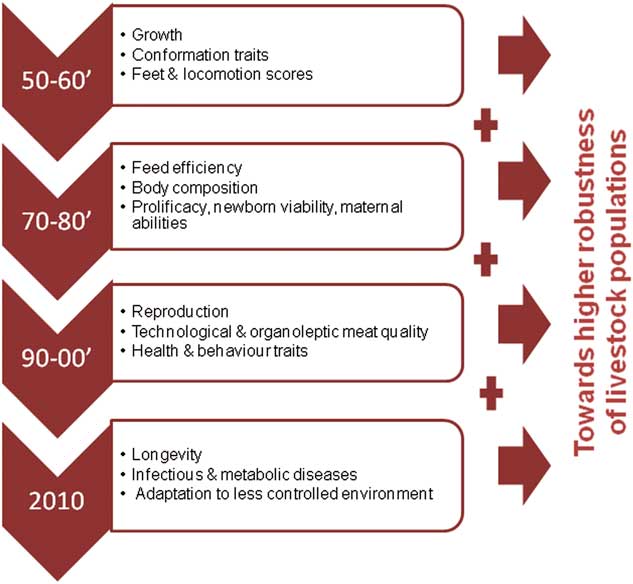
Between the early 1960s and the mid-2000s, carcass weights rose by about 30% in chickens and beef cattle, and by 20% in pigs. Increases in milk production per animal reached around 30% for cows’ milk, about the same as the rise in egg production per chicken over the same period (Thornton, Reference Thornton2010). Since the 1990s, genetic improvement programmes have gradually been reoriented towards reducing production costs and accounting for societal and environmental expectations with respect to product quality and image, the limitation of pollution, biodiversity conservation and animal welfare. This reorientation has involved an increasing number of traits being included in the breeding goals of a population, as illustrated in Figure 1 relative to the meat production sector in France. The inclusion of a new trait is performed cumulatively in a breeding programme: the new trait complements those already selected, and the weight given to each trait in the breeding goal varies over time in line with evolutions in the socio-economic context and the introduction of new selection criteria. Such a reorientation becomes even more crucial as adverse effects on functional traits such as health and reproduction have been observed due to intensive selection on production traits (Rauw et al., Reference Rauw, Kanis, Noordhuizen-Stassen and Grommers1998). Therefore, during the past decade, there has been growing interest in selecting for robustness in farm animals (Lawrence and Wall, Reference Lawrence and Wall2014). To improve the robustness of animals involved in a production process, breeding goals now are constituted by a combination of traits related to the biological functions of production, reproduction, survival, health and welfare.
Historical evolution of breeding goals in livestock selection programmes for meat production.

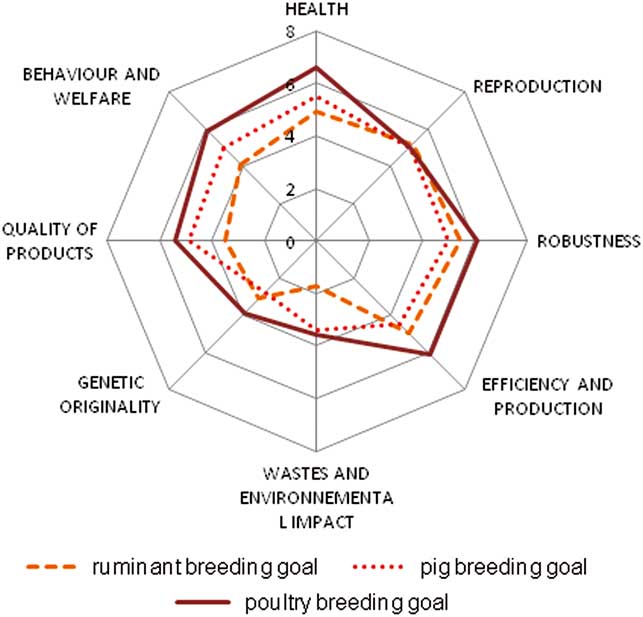
To determine whether current breeding goals are aligned or not with the expectations of farmers who are already applying agroecological principles, 62 semi-structured interviews concerning selection priorities for developing agroecological livestock production systems were conducted with French breeders (47) and representatives of breeding programmes (15) in the ruminant, pig and poultry sectors (Phocas et al., Reference Phocas, Belloc, Delaby, Dourmad, Ducrot, Dumont, Ezanno, Foucras, Gonzales-Garcia, Hazard, Lamothe, Larzul, Mignon-Grasteau, Moreno, Tixier-Boichard, Brochard, Bidanel, Frappat and Lubac2015). The 47 farmers were sampled because they were already applying agroecology principles to management of their systems. They were asked to rank (from 1: lowest priority to 8: highest priority) the following eight groups of breeding goals: ‘Health’, ‘Reproduction’, ‘Robustness’, ‘Efficiency and Production’, ‘Wastes in the environment’, ‘Genetic originality’, ‘Product Quality’ and ‘Behaviour and Welfare’. All the interviewees shared general priorities across the species (Figure 2); namely the need to produce animals resilient to sanitary risks that are also efficient in feed use, reproduce well and are easy to raise (animal behaviour).
Agroecological priorities (8 ranking highest) among the different animal characteristics in breeding goals, according to French breeders and representatives from livestock breeding programmes.

Breeding goals for ruminants
In ruminant sectors, farmers play an important role in animal selection at either an individual level when replacing females in their herd or at a collective level in terms of breeding programmes for AI males when breeding companies are cooperatives owned by farmers (which is frequently the case, at least in European countries). Their expectations are therefore naturally taken into account. The first expectation for farmers is efficient production. Furthermore, the need for simplified farming practices becomes a priority as herd and farm sizes increase. The aim is to produce more autonomous animals that are easy to breed (unassisted calving or lambing, docile animals, etc.), with good reproduction performance (fertility, maternal qualities), good disease resistance and good feed efficiency in order to limit inputs while achieving targeted growth rates or milk yields. In meat sectors, the traits of principal interest are carcass weight and conformation, a lack of fat cover and meat organoleptic qualities (tenderness, flavour). In dairy production, the most important traits are milk production (milk yield, protein and fat content), functional abilities (udder health, fertility, longevity, etc.), and conformation traits. In general, the expectations expressed by farmers who apply agroecological practices in France (Phocas et al., Reference Phocas, Belloc, Delaby, Dourmad, Ducrot, Dumont, Ezanno, Foucras, Gonzales-Garcia, Hazard, Lamothe, Larzul, Mignon-Grasteau, Moreno, Tixier-Boichard, Brochard, Bidanel, Frappat and Lubac2015) cover a range of traits for which genetic evaluations are available in French ruminant sectors (dairy and suckling cows, dairy and meat ewes and dairy goats), with the important exception of feed efficiency for roughage. Farmers do not like to establish priorities (as shown in Figure 2) among the various animal performance characteristics, but prefer to speak of balanced characteristics and an overall capacity for productive efficiency. Such a combination of performance characteristics is very often referred to as robustness or ‘hardiness’ by farmers. One notable exception concerns the limitation of wastes in the environment, which is not considered to be a direct selection objective, but only a favourable consequence of selection for animal feed efficiency.
A critical examination of the current selection index based on conventional dairy production and expectations of Swedish dairy producers in terms of organic production (Ahlman et al., Reference Ahlman, Ljung, Rydhmer, Röcklinsberg, Strandberg and Wallenbeck2014) also showed that the same traits are important to all breeders, irrespective of their production systems, although organic farmers give slightly more importance to health traits (especially resistance to mastitis and parasites) and place less emphasis on milk production. By comparing the main reasons for culling between conventional and organic dairy farms in Sweden, Ahlman et al. (Reference Ahlman, Berglund, Rydhmer and Strandberg2011) showed that the principal causes were the same in both systems, although their ranking differed slightly. Under conventional breeding, the leading reason for cow culling during first or second lactations was fertility (25% of culling), followed by udder health (22%). In an organic setting, this order was reversed, with 31% for udder health and 22% for fertility. This could be explained in part by the limits on the use of drugs in organic systems, and in part by the lower production targets of organic systems, which have a greater reliance on grass and harvested forage in the diet of animals. Insufficient production was the third reason for culling (6% in the Holstein breed), with comparable levels between systems but with different rates between breeds, being higher for insufficient production in the least productive breeds (10% to 11% for Swedish Red).
Breeding goals in pig and poultry species
In pigs and poultry, pure-bred lines are used to produce cross-breds for the market. In terms of the future expectations of conventional farmers regarding improvements to livestock productivity by reducing feed inputs, veterinary costs and labour in the monogastric sectors, selection still needs to focus on enhancing production and reproduction traits. In sire lines, this includes improving feed efficiency and increasing growth rate and the lean content of carcasses, while maintaining technological quality of the product (ham in pigs, meat in broiler poultry and eggs in laying hens), while in maternal lines the goal is to increase the profligacy of sows and laying poultry. In addition, selection is taking account of the feed efficiency of growing animals, the maternal abilities of sows, and more generally the health of animals. Interviews conducted with actors in the French pig sector (Phocas et al., Reference Phocas, Belloc, Delaby, Dourmad, Ducrot, Dumont, Ezanno, Foucras, Gonzales-Garcia, Hazard, Lamothe, Larzul, Mignon-Grasteau, Moreno, Tixier-Boichard, Brochard, Bidanel, Frappat and Lubac2015) revealed that the animal performance characteristics sought by pig farmers primarily concerned health, regardless of the production system (outdoor, organic, conventional agriculture), the aim being to sustain good stability of the herd microbism. A desire to reduce or suppress the use of veterinary health products was consistently cited. Animal robustness was the second priority of pig breeders, with farmers wanting animals to cope with their environment and perform well. Animal behaviour was identified as the third leading priority for farmers, who mentioned sow autonomy and an absence of aggressive animals from the herd (Figure 2).
In the poultry sector, the same interests were expressed as by pig breeders, with priority being given to improving health traits, followed by robustness and animal behaviour traits, while at the same time enabling a continuous improvement in production efficiency (Figure 2). However, priorities are different according to the stage considered in the sector. The selection stage concerns a small number of breeding companies which ensure the selection of pure lines and choose the crosses to be made in response to downstream demand and to balance their often conflicting priorities to achieve the best product compromise. The hatching stage opts for selection criteria targeting reproduction to obtain the optimum number and quality of day-old chicks. Producer groups choose cross-breds to supply their farmers from the lists proposed by hatcheries. Their aim is to further improve feed efficiency in order to reduce production costs. For egg production, they also wish to reduce behavioural problems that lead to high mortality rates. The role of farmers is minimal when it comes to choosing the genotypes because they are affiliated to a producer group that supplies the chicks. Through technical monitoring, the producer group gains a global vision of production and animal requirements, and presents its observations and demands to the hatchery and breeding company. In this context, independent farmers do not have sufficient power to influence the genetic policies adopted by breeding companies.
Generally speaking, whatever the sector and production system, all studies have emphasized the fact that the traits of central interest to breeders are those that affect the robustness of animals, especially their health and ability to reproduce well in more fluctuating environments, and their feed efficiency. For these reasons, the answer to the initial question is: yes, the traits selected during conventional breeding are still relevant to livestock production systems based on agroecological principles. However the weightings in overall breeding goals may differ as a function of production systems. These weightings can either be obtained through surveys (Ahlman et al., Reference Ahlman, Ljung, Rydhmer, Röcklinsberg, Strandberg and Wallenbeck2014; Wallenbeck et al., Reference Wallenbeck, Rydhmer, Röcklinsberg, Ljung, Strandberg and Ahlman2015) or derived from bio-economic models that consider different production systems (Leenhouwers et al., Reference Leenhouwers, Ten Napel, Hanenberg and Merks2011).
Selection for environmental fit
Because agroecological farming conditions are less controlled and fluctuate more than industrial conditions, the objective is to obtain animals whose performance is less sensitive to environmental changes (Dumont et al., Reference Dumont, Fortun-Lamothe, Jouven, Thomas and Tichit2014). The concept of robustness therefore relates to the assessment of genotype by environment (G×E) interactions, which can provide indicators of animal adaptability across a broad range of environments, that is environmental sensitivity. The primary breeding goals, and the development of corresponding selection criteria for low-input systems, are therefore strongly dependent on G×E interactions. The greater the differences between high-input and low-input systems, the less likely it is that the same performance characteristics will be targeted. In addition, the conditions to measure selection criteria should be those that are targeted for breeding in the event of significant G×E interactions. Assessment of the importance of these is therefore an pre-requisite to answering the question as to whether animals bred for conventional farming are suitable for agroecological farming systems. Before 2001, no scientific attempts were made to compare the possible G×E interactions affecting functional and production traits between conventional and low-input production systems in temperate countries (Nauta et al., Reference Nauta, Baars, Groen, Veerkamp and Roep2001).
Genotype by environment interactions in ruminant species
Research projects based on long-term experiments are often designed to assess different types (breeds, genetic values) of animals in controlled environments that are generally differentiated by their nutrient inputs (energy and protein contents using the same feed ingredients, or not). The interactions studied mainly concern production traits (lactation, growth), and sometimes reproduction and health. Performance-related studies conducted in commercial cattle farms analyze these interactions under uncontrolled conditions identified using environmental descriptors such as geography (country, intra-country region), climate (temperature, humidity), production level and reproduction management.
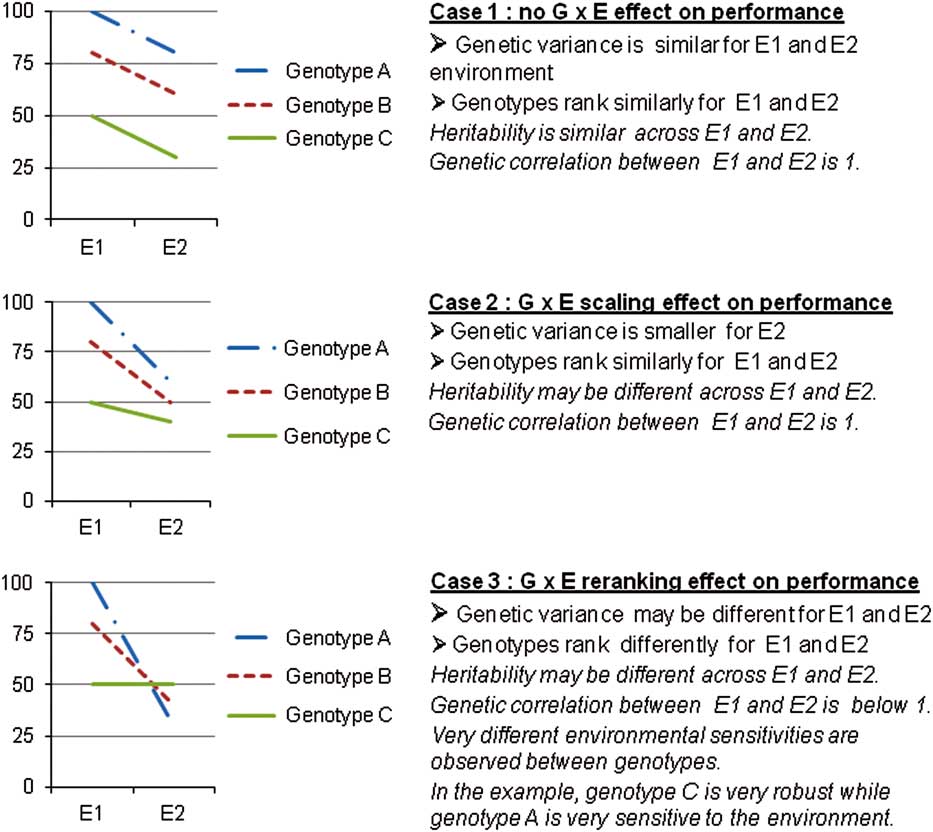
There is general agreement that very weak G×E interactions exist for production traits in ruminant species. This has been based on estimates of genetic correlations (Rg) across environments that are usually higher than the threshold value of 0.80 proposed by Robertson (Reference Robertson1959) in order to quantify non-significant differences from a correlation of 1 where no re-ranking occurs across the environments (Figure 3). The literature mostly indicates that G×E interactions in dairy cattle are very weak for milk traits. This has been evidenced on farms subject to markedly differing environmental conditions within a country (Haile-Mariam et al., Reference Haile-Mariam, Carrick and Goddard2008), such as intensive v. grazing systems (Boettcher et al., Reference Boettcher, Fatehi and Schutz2003; Kearney et al., Reference Kearney, Schutz, Boettcher and Weigel2004), or different production levels (Huquet et al., Reference Huquet, Leclerc and Ducrocq2012). For international breeds such as the Holstein (Mark, Reference Mark2004) this difference has also been demonstrated between countries, with some of the weakest correlations (0.72 to 0.76) being seen between New Zealand and countries from Europe or North America. In beef cattle, there have been far fewer studies on G×E interactions based on commercial farm conditions. Pabiou et al. (Reference Pabiou, Nilforooshan, Laloë, Hjerpe and Venot2014) showed that genetic Rg for weaning weight in Limousin and Charolais cattle across different European countries were on average about 0.75 (ranging from 0.6 to 0.9 for two by two country estimates), which is lower than across country Rg for milk production traits (on average 0.88; Mark, Reference Mark2004), but still sufficiently high (>0.6) not to recommend splitting limited cattle populations for the purposes of efficient breeding programmes (Mulder et al., Reference Mulder, Veerkamp, Ducro, van Arendonk and Bijma2006).
Impact of Genotype by Environment (G×E) interactions on genetic parameters and ranking of genotypes according to environmental conditions.

As for small ruminants, G×E interactions need to be taken into account as a long-term and high-priority research topic as very few studies have been performed to assess G×E interactions on overall productivity, health and welfare, even in vulnerable groups such as lactating ewes and newborn lambs (Gavojdian et al., Reference Fulkerson, Davison, Garcia, Hough, Goddard, Dobos and Blockey2014). Sheep production systems vary considerably between countries and regions. Sheep are generally regarded as being quite robust to variations in environmental factors, and some breeds (such as Lacaune or Eastern Friesian) are being reared in different countries under an extremely broad range of conditions. A recent investigation of sire sensitivity across diverse farm environments proved that some genotypes were sensitive whereas others were robust with respect to meat sheep production (McLaren et al., Reference McLaren, Brotherstone, Lambe, Conington, Mrode and Bunger2015). In future genetic evaluations, accounting for environmental sensitivity could enable the identification and selection of sires predicted to be best suited to specific environments (McLaren et al., Reference McLaren, Brotherstone, Lambe, Conington, Mrode and Bunger2015; Huisman et al., Reference Huisman, Brown and Fogarty2016).
Unlike production traits, there is a trend towards seeing stronger G×E interactions with respect to fertility, health and survival traits, although the literature is limited on this topic. In beef cattle, continental breeds with high genetic potential for muscle growth have been shown to have lower fertility levels than British breeds, but only when they are reared in the least favourable environments (Morris et al., Reference Morris, Baker, Hickey, Johnson, Cullen and Wilson1993).
In dairy cattle, the few estimates available regarding heritability for female reproduction traits in low-input and organic dairy cattle herds differ from those estimated for high-input production systems (Yin et al., Reference Yin, Bapst, Borstel, Simianer and König2012). These authors argued that these differences underline the need to implement an organic breeding programme based on data obtained only from cows in organic or low input herds. In our opinion, this statement requires further validation, because it was not based on estimates of genetic correlations between conventional and alternative production systems. Nevertheless, in Holstein cattle, there is some evidence that certain fertility traits, and particularly calving-to-first service, have displayed G×E interactions when considering the herd-average production as the environmental descriptor. These interactions have differed markedly depending on the study, being relatively substantial (Rg of around 0.6) between extreme conditions such as those observed in Australia (Haile-Mariam et al., Reference Haile-Mariam, Carrick and Goddard2008) and Canada (Boettcher et al., Reference Boettcher, Fatehi and Schutz2003), but quite moderate (Rg of around 0.8) in UK dairy systems (Strandberg et al., Reference Strandberg, Brotherstone, Wall and Coffey2009), or even non-existent between grazing v. confinement in US herds (Kearney et al., Reference Kearney, Schutz, Boettcher and Weigel2004).
Under a temperate climate in Europe, seasonality in terms of the quantity and quality of forage production encourages the phasing of herd feed demand with resource availability. Pasture-based systems for beef and dairy production can therefore optimize this synchronism by grouping calving in late winter/early spring. Indeed, the peak needs of breeding females appear a few weeks after calving, which corresponds to the period of full pasture production and grass with a nutritional value which matches the energy and protein needs of animals. The ability of an animal to calve at a selected time, and to breed each year within a limited period (between 8 and 13 weeks), is a crucial factor that is often evaluated during G×E experiments (Fulkerson et al., Reference Friggens, Ingvartsen and Emmans2008). When comparing Holstein and Normande cows in two environments that differ by opposing high and low feed inputs, Delaby and Fiorelli (Reference Delaby, Faverdin, Michel, Disenhaus and Peyraud2014) were able to show that in terms of their ability to calve after a breeding period limited to 90 days, Normande cows were relatively insensitive to the level of nutrient inputs (respectively 70% and 68% of calvings under both systems), while Holstein cows were less able to reproduce when reared under low input conditions (47% v. 57% of calvings). However, Fulkerson et al. (Reference Friggens, Ingvartsen and Emmans2008) in Australia, or Delaby et al. (Reference de Haas, Windig, Calus, Dijkstra, de Haan, Bannink and Veerkamp2009) in France, were not able to reveal any clear interactions between different genotypes and nutrient input levels in the case of grouped spring calving systems. The response will actually depend on the degree of under-feeding relative to the cow’s genetic merit for production. An excessive mobilization of body reserves to compensate for the gap between nutrient intake and mammary gland demand in an animal with high dairy potential will result in a failure to ensure gestation within a limited period.
Genotype by environment interactions in pigs and poultry
Because of the multi-stage structure of these sectors, animals from selection nuclei are reared under highly controlled and optimized conditions, while their cross-bred offspring have to produce under highly diverse conditions. The three potential sources of interactions are the farming system (extensive v. intensive), the climate and feed (optimized diet or not), and the level of sanitary pressure. The stronger the G×E interactions, the less efficient will selection be for commercial herds, and the choice of genotypes as a function of rearing environments will be crucial.
In poultry, this is especially true for Label Rouge chickens, for which the production environment (with access to outdoor runs) differs markedly from the confined selection conditions. N’Dri et al. (Reference N’Dri, Sellier, Tixier-Boichard, Beaumont and Mignon-Grasteau2007b) showed that animals selected on their food conversion ratio in individual cages or on the floor were very different. De Verdal et al. (Reference De Verdal, Narcy, Bastianelli, Chapuis, Meme, Urvoix, Le Bihan-Duval and Mignon-Grasteau2013b) showed that although genetic correlations between wheat and corn diets could be high for protein and lipid digestibility (0.84 to 0.88), they were lower for energy and starch digestibility (0.63 to 0.73) in broilers. In pigs, the genetic correlation between growth performance or body composition as measured in selection, and the same traits measured at the production stage, could be low to moderate, and even negative in some cases. Under Swedish production conditions, Wallenbeck et al. (Reference Wallenbeck, Gustafson and Rydhmer2009a and Reference Wallenbeck, Rydhmer and Lundeheim2009b) studied G×E interactions by comparing conventional and organic farming systems. They showed that the nesting behaviours of sows were more pronounced, post-natal piglet mortality was higher and sows had more lactation oestrus in organic farming systems (Wallenbeck et al., 2009a). As for growth rate and backfat thickness, a significant G×E interaction was observed. The rank correlation of boars evaluated under conventional and organic systems reached only 0.48 for growth and 0.42 for adiposity, leading the authors to propose a specific genetic evaluation index for organic farming systems (Wallenbeck et al., Reference Wallenbeck, Rydhmer and Lundeheim2009b). Such findings have sometimes led to implementing measures closest to the production conditions, as well as those applied during selection. However, even if G×E interactions have been highlighted, their magnitude does not necessarily justify specific treatment. Brandt et al. (Reference Brandt, Werner, Baulain, Brade and Weissmann2010) showed that the differences between standard and local pig breed genotypes were reduced under organic compared to conventional farming systems, while standard genotypes still maintained superior performance irrespective of the farming system. From an economic point of view, they concluded that modern breeds should also be used in organic production systems.
As a general rule, it may be necessary to take account of some G×E interactions in genetic evaluations, especially in monogastric species for which conventional and agroecological farming systems are highly differentiated. However, scaling interactions (differences in heritability across environments) appear to occur more frequently than important re-ranking interactions (Rg <0.80), meaning that the same reproducers will be selected whatever the environmental conditions under which the selection criteria are measured.
New selection criteria to better adapt animals to less controlled environments
New selection criteria could be envisaged in order to contribute to the agroecological principles detailed in the introduction to this paper.
Sparing natural resources
To improve the efficiency of transforming feed into animal product, breeders have long been selecting animals on feed efficiency (ratio between the amount of feed consumed and the amount of milk, meat or eggs produced) or on residual feed intake (difference between actual consumption and the theoretical intake based on energy needs for maintenance and production), since individual feed intake can be measured reliably, at least in selection nucleus herds under high-energy diets. In addition to being accurate, satisfactory measures of feed intake need to be recorded with the minimal disruption of animal behaviour regarding feed access, particularly in groups of thousands of animals, such as birds reared on the floor. Another issue concerns estimates of the quantities of grass ingested by ruminants in order to investigate feed efficiency relative to forages and other sources of fibre. The difficult and expensive implementation of classical techniques based on indigestible markers limits the possibilities of a large-scale phenotyping of grass intake. The dynamics (mobilization/accretion) of body reserves is also an important adaptive trait required to cope with fluctuations in natural resources (Friggens et al., Reference Flori, Gao, Laloë, Lemonnier, Leplat, Teillaud, Cossalter, Laffitte, Pinton, de Vaureix, Bouffaud, Mercat, Lefevre, Oswald, Bidanel and Rogel-Gaillard2004; González-García et al., Reference Gavojdian, Kusza and Javor2014) that need to be measured indirectly (such as body condition score or imaging technologies) in order to easily quantify stored fat levels. Numerous research programmes are under way throughout the world on these subjects, focussed on different livestock sectors, but no generic and validated solutions have yet been found. Approaches based on high-frequency automated measurements on living animals, such as imaging for body condition score, accelerometers or videos for feeding behaviour and ingestion, and thermography, are promising but yet to be developed for routine use (Phocas et al., Reference Phocas, Agabriel, Dupont-Nivet, Geurden, Médale, Mignon-Grasteau, Gilbert and Dourmad2014). Further work is also ongoing to facilitate the measurement of digestive efficiency using infrared spectroscopy in both ruminants and monogastric animals.
Regarding feed efficiency from an agroecological perspective, the question is not really which criteria should be used but rather the need to determine the environmental conditions under which they should be measured, and in particular with which diet. Therefore, we must seek after more efficient animals, reducing their waste outputs, while feeding more grass for ruminants and providing feedstuffs with a lower energy content and protein quality for monogastrics. Using local feed resources is a basic principle in agroecology, but these may vary considerably depending on the regions, seasons and years of production. New, high-protein feedstuffs containing insects or algae may also offer interesting solutions as protein sources (Becker, Reference Becker2007; Harinder et al., Reference Harinder, Makkar, Tran, Heuzé and Ankers2014) without having a negative impact on livestock efficiency. The aim is to improve the efficiency of transforming such alternative diets into animal products. It is also necessary to further quantify the targeted level of production that might be consistent with these alternative diets, characterized by lower energy and protein densities than so-called ‘optimal’ diets.
Another key issue for all species in the future relates to the use efficiency of proteins and minerals. Most work on feed efficiency to date has assumed that intakes of amino acids and minerals will satisfy all nutritional requirements for animal maintenance and production. However, in order to increase farm autonomy in the supply of vegetable proteins, as well as to limit nitrogen release into the environment, it may be necessary to explore opportunities to improve protein efficiency. Very few results have been obtained to date on this subject, although some suggest an individual variability in terms of both digestive and metabolic efficiencies (de Verdal et al., Reference De Verdal, Narcy, Bastianelli, Chapuis, Meme, Urvoix, Le Bihan-Duval and Mignon-Grasteau2013b). But it remains unclear in all species precisely why an animal is more efficient than another in depositing protein.
Limiting the environmental impact of livestock production
One important point to highlight from an agroecological perspective is that animals with the highest feed efficiency are also those which produce less effluent per unit of product. For instance, de Verdal et al., Reference De Verdal, Mignon-Grasteau, Bastianelli, Même, Le Bihan-Duval and Narcy2013a) showed that selection on digestive efficiency could reduce by 14% to 17% the surface areas required for the spreading of poultry manure in line with European regulations.
Although the first factor to be controlled in order to limit wastes is obviously the match between inputs and nutritional requirements, the variable conversion efficiency of dietary proteins induces environmental nitrogen emissions that vary between animals. Few attempts have been made to determine direct selection criteria on excreta characteristics that might influence this environmental impact. For instance, the ratio of nitrogen to phosphorus is an important parameter because European regulations limit the quantities of these elements that can be spread on fields to prevent leaching. De Verdal et al. (Reference Delaby and Fiorelli2011) showed that the ratios between excretion and phosphorus and nitrogen intake are heritable in poultry. However, these criteria are quite complex to measure as this requires dry droppings collected in individual cages.
Last but not the least in terms of environmental footprint, greenhouse gas emissions (mainly methane and nitrous oxide) are today a major concern for all livestock sectors. With respect to enteric methane production by ruminants, agroecology has to address the dilemma of enhancing pasture-based production systems while reducing methane emissions. Indeed, ruminants produce more methane when they are fed forage-based diet than with a high-concentrate diet (Martin et al., Reference Martin, Morgavi and Doreau2010). In this context, one challenge is to propose both feeding and breeding practices that can reduce methane emissions while competing less with human food (Dumont et al., Reference Dumont, Fortun-Lamothe, Jouven, Thomas and Tichit2014). Part of the solution lies in the genetic variability of methane emissions that has been evidenced in cattle (Bell et al., Reference Bell, Potterton, Graignon, Saunders, Wilcox, Hunter, Goodman and Garnsworthy2014) and sheep (Pinares-Patiño et al., Reference Pinares-Patiño, Hickey, Young, Dodds, MacLean, Molano, Sandoval, Kjestrup, Harland, Hunt, Pickering and McEwan2013). Lower methane emissions could be achieved through indirect selection on correlated traits such as residual feed intake; reductions in methane emissions per cow of around 11% to 26% within 10 years are thus theoretically possible by selecting more efficient cows de Haas et al., Reference González-García, Gozzo de Figuereido, Foulquie, Jousserand, Autran, Camous, Tesniere, Bocquier and Jouven2011). A modelling study (Bell et al., Reference Bell, Wall, Russell, Simm and Scott2011), based on data from a long-term experiment in Holstein cattle in Scotland, compared the environmental impact (CO2-eq production) of dairy systems differing in terms of the intake of concentrate (moderate (25%) with high summer pasture v. high (50%) without grazing) depending on the genetic level (medium or high) of cows for milk fat and protein contents. The system without grazing and with highly selected cows produced the least CO2-eq and used less surface area per kg of milk produced (at constant energy), but was also that which emitted the most CO2-eq per hectare. These results further emphasize the difficulty in finding a single answer in terms of environmental footprint, depending on the unit of expression of the emissions (per kg of product, per hectare). However, regardless of the production system considered, the only trait capable of significantly reducing CO2-eq emissions was to reduce intake at constant production, which equates to a lower residual feed intake.
Improving animal adaptation to warm climatic conditions
The best estimates obtained by climate models regarding rises in global average temperatures over this century range from 1.0°C to 3.7°C higher than those seen between 1971 and 2000, under the lowest and highest representative concentration pathway (RCP) scenarios. The United Nations target of limiting the rise in global average temperatures to <2°C above pre-industrial levels is projected to be exceeded between 2042 and 2050 by the three highest of the four RCP scenarios. Even in temperate European countries, global warming will increase the number and length of heat waves (temperature above 25°C) with which animals will have to cope. The average annual land temperature over Europe is projected to increase by more than the global average temperature for the rest of this century, by around 2.4°C under the intermediate RCP scenario and by 4.1°C under the highest RCP scenario (http://www.eea.europa.eu/data-and-maps/indicators/global-and-european-temperature-1/assessment).
In this context of climate change, ensuring sustainable livestock production systems with low energy and pharmaceutical inputs will mean that breeders will require animals that are resistant to both abiotic stresses (heat, humidity) and biotic stresses (pathogens, particularly parasites) because of the sanitary risks induced in herds of grazing ruminants and animals bred on the floor (monogastric species).
Regarding robustness in less controlled environments, the most active field of study in monogastric species undoubtedly concerns the resistance of animals to heat stress. In addition to the scientific aspect of adaptation to climate change, this research is mainly linked to the economic interests of international companies that are seeking to disseminate the same genotypes in tropical countries as in temperate countries. It is then necessary to resolve the conflict between production and adaptation to hot climates: a high level of feed intake is necessary for an animal to produce, which in turn induces intense feed thermogenesis, making it poorly suited to hot conditions. This problem could be solved by either reducing its feed intake or improving its ability to dissipate heat.
Because rapid growth is associated with increased feed intake, birds selected on growth rate are more sensitive to heat conditions. Using slow growing birds is therefore a way to reduce their heat sensitivity. By comparing slow growing Label Rouge and rapid growing broiler chickens at 32°C, N’Dri et al. (Reference N’Dri, Mignon-Grasteau, Sellier, Tixier-Boichard and Beaumont2007a) obtained comparable quantities of meat per day because of the marked reduction in growth and the high mortality among broilers, whereas Label Rouge chickens were not affected by the temperature. In chickens, heat dissipation is limited by their plumage. One way to improve the heat dissipation capacity of birds is therefore to use less feathered birds, such as those carrying the naked neck, frizzle or scaleless genes, which have all been shown to be able to grow better than fully feathered birds under heat stress (Azoulay et al., Reference Azoulay, Druyan, Yadgary, Hadad and Cahaner2011; Zerjal et al., Reference Zerjal, Gourichon, Rivet and Bordas2013).
Pigs are generally considered to be little heat resistant. The reproductive performance of sows can be affected by outside temperatures higher than 20°C. At high temperatures, both reproductive performance and growth are affected. Several comparisons of local and standard genotypes have been performed in the context of pig production in the tropics, and they gave an advantage (or at least no disadvantage) to local genotypes (e.g. Renaudeau et al., Reference Renaudeau, Huc and Noblet2007). To date, there have been no real selection criterion on heat resistance in pigs, except regarding the measurement of production and reproduction performances under thermal stress conditions (Bloemhof et al., Reference Bloemhof, Kause, Knol, Van Arendonk and Misztal2012).
In ruminant species, numerous studies have also been based on the production performance of different breeds raised under tropical conditions. Berman’s review (Reference Berman2011) did not lend support to the notion that ‘breeds which evolved in warm climates (e.g. the Bos indicus and Bos Taurus Sanga types) share attributes that endow them with higher capacity for heat dissipation’. With the exception of the slick hair gene and the hairy mutation (Littlejohn et al., Reference Littlejohn, Henty, Tiplady, Johnson, Harland, Lopdell, Sherlock, Li, Lukefahr, Shanks, Garrick, Snell, Spelman and Davis2014), hair coat attributes in warm climates largely reflect the effects of nutrition, management and climate during the animal’s lifetime, rather than differences in genetic constitution. However, within a breed, sufficient genetic variation exists to enable successful selection for heat tolerance. The question therefore arises as to whether it might be useful from an agroecological perspective to develop specific breeding programmes for international breeds to be used in production regions experiencing long periods of hot days. This would obviously be worthwhile in the tropics, but also in Europe due to climate change. Indeed, Hammami et al. (Reference Hammami, Bormann, M’hamdi, Montaldo and Gengler2013) showed that the heat stress thresholds under a continental temperate climate (Luxembourg) for production traits and somatic cell counts in Holstein cows were really lower (18°C v. values between 23°C and 30°C) than other estimates under tropical or Mediterranean climate conditions. Carabano et al. (Reference Carabano, Bachagha, Ramon and Diaz2014) showed for Holstein cows bred in Southern Spain in hot but dry conditions that their comfort thresholds could differ markedly depending on the production trait: about 29°C for milk yield, 18°C for protein yield and only 15°C for fat yield and somatic cell count. Selection criteria other than those which target production levels are now being sought in order to better evaluate the heat resistance of ruminants. For example, changes in body temperature, heat generation and respiratory rate have been used to search for genomic associations in sheep (Alhidary et al., Reference Alhidary, Shini, Al Jassim and Gaughan2012). It may also be necessary to determine whether the genomic introgression of some gene variants with major effects on heat tolerance needs to be performed.
Improving animal health in less controlled environments
The emergence of disease at the herd scale is multifactorial: the source and virulence of pathogens, climatic conditions, herd management factors such as animal density and the timing of animal grazing, feed availability, the use of preventive or curative measures and intrinsic animal resistance/tolerance to diseases. In low-input systems, disease-resistant animals are necessary because treatments have to be limited and outdoor access increases the risks of exposure to various pathogens, such as gastrointestinal parasites. Although it is a matter of great importance in all livestock sectors, our current knowledge of the genetics of animal health is scant. In particular, there remain many questions regarding the traits that could be measured to obtain an efficient response to selection for overall disease resistance. Three different methods have been studied in order to improve resistance against infectious diseases.
The first approach is based on selective breeding that directly targets increasing animal resistance to specific infectious diseases. This has mainly focussed on diseases with a high incidence and major economic impact, such as mastitis in dairy ruminants, infection by helminths during grazing in small ruminants and in outdoor poultry systems. Selection against infection by a given pathogen or group of pathogens has been successful during several experiments, despite low to moderate heritability values in poultry (Pinard-van der Laan et al., Reference Pinard-van der Laan, Lillehoj and Zhu2003), pigs (Kadowaki et al., Reference Kadowaki, Suzuki, Kojima-Shibata, Suzuki, Okamura, Onodera, Kojima-Shibata and Kano2012), and ruminants (Morris, Reference Morris2007; Rupp et al., Reference Rupp, Bergonier, Dion, Hygoneng, Aurel, Robert-Granié and Foucras2009). However, this type of selection may impair the ability of animals to resist pathogens other than those targeted by the selection process. The results of selection may even be dependent on the pathogenic strain used for selection, such as during a selection experiment for resistance to Marek’s disease (Lamont et al., Reference Lamont, Pinard-van der Laan, Cahaner, Van Der Poel and Parmentier2003). Moreover, even if it is possible to select on resistance to a specific pathogen, it is very difficult to choose it, as this may be dependent on production conditions and there is rarely one pathogen that predominates. Under less controlled environments, it is therefore essential to develop a more holistic strategy to improve the overall capacity of animals to be healthy.
One alternative is to select simultaneously on resistance to several major pathogens by identifying patterns of resistance common to several pathogens and considering genes such as those in the major histocompatibility complex (MHC) system which have been shown to be involved in resistance to various pathogens that affect poultry (Lamont et al., Reference Lamont, Pinard-van der Laan, Cahaner, Van Der Poel and Parmentier2003), pigs (Warner et al., Reference Warner, Meeker and Rothschild1986) or cattle (Ellis, Reference Dumont, González-García, Thomas, Fortun-Lamothe, Ducrot, Dourmad and Tichit2004). However, it is important to maintain high MHC diversity in order to retain the population’s ability to respond as a whole against highly variable and rapidly evolving pathogens. Indeed, the selection of particular MHC haplotypes may become inefficient in the long term.
Finally, a more general approach is to try to improve the immunocompetence of animals by selecting a set of immune function traits that are heritable and crucial for resistance to infections, such as antibody production, cellular response and phagocytic activity. Indeed, the immune system protects the organism against pathogenic challenges through its innate and adaptive defences. Significant genetic variations in immune response traits have been observed in pigs (Flori et al., 2011), poultry (Lamont et al., Reference Lamont, Pinard-van der Laan, Cahaner, Van Der Poel and Parmentier2003) and cattle (Thompson-Crispi et al., Reference Thompson-Crispi, Sewalem, Miglior and Mallard2012a). In dairy cattle, selection for high immune responders has been linked to reductions in the incidence of mastitis, ketosis, metritis and retained placenta in cows with both high antibody and cell-mediated immune responses when compared to average or low responders for these traits (Thompson-Crispi et al., Reference Thompson-Crispi, Hine, Quinton, Miglior and Mallard2012b). However, the efficiency of selection on these criteria in terms of improving the overall health of farm animals is far from being established; insufficient results have been obtained in this area whatever the livestock sectors, and selection experiments have produced contrasted results in poultry (Lamont et al., Reference Lamont, Pinard-van der Laan, Cahaner, Van Der Poel and Parmentier2003) or pigs (Wilkie and Mallard, Reference Wilkie and Mallard1999).
Consequences
The development of innovations in genomics and high-throughput phenotyping should eventually enable us to rethink and diversify selection criteria while shortening the interval between breeding goals being set and actual improvements in livestock. However, faced with spectacular developments in the knowledge of the genome, there is a major lack of knowledge on relevant phenotypes that could enable us to better exploit the genetic variability of animal performance in order to improve the efficiency and robustness of animals under diverse and fluctuating environmental conditions. The standardization of both animals and breeding conditions seems antithetical to the very principles of agroecology, which tries to enhance diversity within livestock farming systems so as to improve their resilience, and to benefit from complementarities and interactions between the resources available. Therefore, if we are to meet the needs of agroecology, breeding programmes in all livestock sectors need to evolve towards increasingly diverse genotypes, rather than targeting the myth of an ‘ideal animal’ that will fit an ‘ideal agroecological system’. In a second paper, we will be further discussing the breeding strategies that may help to diversify genetic resources in different livestock sectors.
Acknowledgements
The authors would like to acknowledge support from the French Ministry of Agriculture in funding our review of the literature and carrying out interviews (study SSP-2014–061). They also thank all the breeders and representatives of breeding programmes in the ruminant, pig, and poultry sectors for the time they gave for our interviews. Thanks also go to staff from Institut de l’Elevage, Institut de la Filière Porcine, and Institut de l’Aviculture, who helped with the interviewing.