



1 Introduction
The Muckenhoupt class, introduced by Muckenhoupt [Reference Muckenhoupt75], is of fundamental importance in harmonic analysis and partial differential equations. Let
$q\in (1,\infty )$
 and
$\omega $
 be a weight on
$\mathbb {R}^n$
 , that is, a nonnegative locally integrable function. It is well known that some classical operators (for instance, the Hardy–Littlewood maximal operator and the Calderón–Zygmund operators) are bounded on the weighted Lebesgue space

if and only if
$\omega $
 belongs to the Muckenhoupt class
$A_q(\mathbb {R}^n)$
 , that is,

where the supremum is taken over all cubes
$Q\subset \mathbb {R}^n$
 whose edges are all parallel to the coordinate axis. Furthermore, the Muckenhoupt weights have deep connections with the elliptic partial differential equation

where
$p\in (1,\infty )$
 . So far, the Muckenhoupt classes and the theory of weighted function spaces have been developed in a comprehensive manner (see, for example, [Reference Cruz-Uribe and MacLellan19–Reference Cruz-Uribe, Martell and Pérez22, Reference Hytönen38–Reference Hytönen, Pérez and Rela41]). Moreover, there exists a well-established theory related to the Muckenhoupt weights with applications in partial differential equations (see, for example, [Reference Fabes, Kenig and Serapioni28, Reference Hajłasz and Koskela36, Reference Hebisch and Saloff-Coste37, Reference Lacey and Li54, Reference Li and Wick57, Reference Moser71]).
From the perspective of partial differential equations, in addition to the Muckenhoupt classes related to (1.2), there also exist parabolic Muckenhoupt classes with time lag, introduced by Kinnunen and Saari [Reference Kinnunen and Saari50], tailored to the doubly nonlinear parabolic partial differential equation

Here and thereafter, we always fix
$p\in (1,\infty )$
 . The definition of parabolic Muckenhoupt weights with time lag is based on the following definition of parabolic rectangles. For any
$x\in \mathbb {R}^n$
 and
$L\in (0,\infty )$
 , let
$Q(x,L)$
 be the cube in
$\mathbb {R}^n$
 centered at x with edge length
$2L$
 .
Definition 1.1 Let
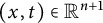
$(x,t)\in \mathbb {R}^{n+1}$
 and
$L\in (0,\infty )$
 . A parabolic rectangle R centered at
$(x,t)$
 with edge length L is defined by setting

Let
$\gamma \in [0,1)$
 . The
$\gamma $
 -upper part
$R^{+}(\gamma )$
 and the
$\gamma $
 -lower part
$R^{-}(\gamma )$
 of R are defined, respectively, by setting
$R^+(\gamma ):=Q(x,L)\times (t+\gamma L^p,t+L^{p})$
 and

where
$\gamma $
 is called the time lag.
Denote by
$\mathcal {R}_{p}^{n+1}$
 the set of all parabolic rectangles in
$\mathbb {R}^{n+1}$
 . For any locally integrable function f on
$\mathbb {R}^{n+1}$
 and for any measurable set
$A\subset \mathbb {R}^{n+1}$
 with
$|A|\in (0,\infty )$
 , let

Here and thereafter, we always omit the differential
$dx\,dt$
 in all integral representations to simplify the presentation if there exists no confusion. The following is the definition of parabolic Muckenhoupt classes with time lag (see also [Reference Kinnunen and Saari50, Definition 3.2]).
Definition 1.2 Let
$\gamma \in [0,1)$
 and
$q\in (1,\infty )$
 . The parabolic Muckenhoupt class
$A_q^+(\gamma )$
 is defined to be the set of all nonnegative locally integrable functions
$\omega $
 on
$\mathbb {R}^{n+1}$
 such that

If the above condition is satisfied with the direction of the time axis reversed, then
${\omega \in A_q^-(\gamma )}$
 which is also called the parabolic Muckenhoupt class and consists of all such
$\omega $
 .
Different from the classical case, in (1.4), Euclidean cubes in (1.1) are substituted by parabolic rectangles, which respects the natural geometry of (1.3). Indeed, if
$u(x,t)$
 is a solution of (1.3), then so does
$u(\lambda x,\lambda ^pt)$
 for any
$\lambda \in (0,\infty )$
 . It turns out in Moser [Reference Moser72, Reference Moser73] and Trudinger [Reference Trudinger89] that any nonnegative weak solution u of (1.3) satisfies a scale and location invariant Harnack inequality, that is, for any given
$\gamma \in (0,1)$
 , there is a positive constant C such that, for any
$R\in \mathcal {R}_p^{n+1}$
 ,

where the time lag
$\gamma $
 appears naturally. The Harnack inequality further implies that any nonnegative weak solution of (1.3) is a parabolic Muckenhoupt weight with time lag. Kinnunen and Saari [Reference Kinnunen and Saari50] also introduced the centered parabolic Hardy–Littlewood maximal operators with time lag and showed that these operators are bounded on the weighted Lebesgue space if and only if the weight belongs to the corresponding parabolic Muckenhoupt class with time lag. Their results in [Reference Kinnunen and Saari50] were streamlined and complemented by Kinnunen and Myyryläinen [Reference Kinnunen and Myyryläinen45] in which they replaced the centered maximal operator by the uncentered version to include the endpoint case. On the other hand, as proved in [Reference Kinnunen and Saari50, Lemma 7.4], the parabolic Muckenhoupt classes with time lag give a Coifman–Rochberg-type characterization of the function space with parabolic bounded mean oscillation which was explicitly defined by Fabes and Garofalo [Reference Fabes and Garofalo27] and is essential in the regularity theory for (1.3). We refer to [Reference Bögelein, Duzaar, Kinnunen and Scheven11–Reference Bögelein, Heran, Schätzler and Singer15, Reference Gianazza and Vespri32, Reference Kinnunen and Kuusi44, Reference Kuusi, Siljander and Urbano53, Reference Moser74, Reference Vespri91] for more studies about (1.3), to [Reference Aimar2, Reference Kinnunen, Myyryläinen and Yang47, Reference Kong, Yang, Yuan and Zhu52, Reference Myyryläinen and Yang77, Reference Saari84, Reference Saari85] for more studies of parabolic function spaces, and to [Reference Kinnunen and Myyryläinen45, Reference Kinnunen and Myyryläinen46, Reference Kinnunen, Myyryläinen, Yang and Zhu48–Reference Kinnunen and Saari50, Reference Ma, He and Yan61] for recent studies of the parabolic Muckenhoupt classes with time lag.
The other motivation to study the parabolic Muckenhoupt classes with time lag is due to the theory of the one-sided Muckenhoupt classes introduced by Sawyer [Reference Sawyer86] in connection with ergodic theory. Recall that, for any
$q\in (1,\infty )$
 , the one-sided Muckenhoupt class
$A_q^+(\mathbb {R})$
 is defined to be the set of all nonnegative locally integrable functions
$\omega $
 on
$\mathbb {R}$
 such that

is finite. Actually, the parabolic Muckenhoupt classes with time lag are higher-dimensional generalizations of the one-sided Muckenhoupt classes in some sense. The one-sided weighted theory has been extensively investigated (see, for example, [Reference Aimar, Forzani and Martín-Reyes3, Reference Chill and Król17, Reference Cruz-Uribe, Neugebauer and Olesen25, Reference Martín-Reyes63–Reference Martín-Reyes, Pick and de la Torre65, Reference Martín-Reyes and de la Torre67–Reference Martín-Reyes and de la Torre69, Reference Riveros and de la Torre81]). There also exists several inspirational studies about higher-dimensional extensions of the one-sided weights and related topics (see, for example, [Reference Berkovits8, Reference Berra9, Reference Forzani, Martín-Reyes and Ombrosi29–Reference Ghosh and Shuin31, Reference Lerner and Ombrosi56, Reference Lorente and Martín-Reyes59, Reference Ombrosi78]).
On the other hand, both the fractional maximal operators and the fractional integral operators occupy an important position in potential theory, harmonic analysis, and partial differential equations (see, for example, [Reference Adams and Hedberg1, Reference Bhat and Kosuru10, Reference Chen, Jia and Yang16, Reference Guliyev35, Reference Turesson90]). Recall that, for any given
$\beta \in (0,n)$
 , the fractional maximal operator
$M_\beta $
 and the fractional integral operator
$I_\beta $
 are defined, respectively, by setting, for any locally integrable function f on
$\mathbb {R}^n$
 and any
$x\in \mathbb {R}^n$
 ,

and

Let
$\beta \in (0,n)$
 ,
$1<r\leq q<\infty $
 with
$\frac 1r-\frac 1q=\frac {\beta }{n}$
 , and
$\omega $
 be a weight on
$\mathbb {R}^n$
 . It is well known that the fractional integral operator
$I_\beta $
 (or the fractional maximal operator
$M_\beta $
 ) is bounded from
$L^r(\mathbb {R}^n,\omega ^r)$
 to
$L^q(\mathbb {R}^n,\omega ^q)$
 if and only if
$\omega $
 belongs to the off-diagonal Muckenhoupt class
$A_{r,q}(\mathbb {R}^n)$
 , that is,

where the supremum is taken over all cubes
$Q\subset \mathbb {R}^n$
 whose edges are all parallel to the coordinate axis. We refer to [Reference Cruz-Uribe and Moen23, Reference Lu, Ding and Yan60, Reference Muckenhoupt and Wheeden76, Reference Welland92] for more studies on the one-weight case and to [Reference Cruz-Uribe and Moen23, Reference Cruz-Uribe and Suragan26, Reference Kokilashvili, Meskhi and Zaighum51, Reference Lacey, Moen, Pérez and Torres55, Reference Melchiori and Pradolini70, Reference Pérez80, Reference Sawyer87, Reference Sawyer and Wheeden88] for more investigations on the two-weight case of the weighted boundedness of the fractional integral operators and the fractional maximal operators. As for the one-sided situation, Andersen and Sawyer [Reference Andersen and Sawyer6] obtained the characterizations of the weighted boundedness of one-sided fractional maximal operators and the Weyl (and the Riemann–Liouville) fractional integral operators in terms of the one-sided off-diagonal Muckenhoupt classes. For more studies of the one-sided fractional maximal operators and the one-sided fractional integral operators, see, for example, [Reference Lorente58, Reference Macías and Riveros62, Reference Martín-Reyes and Rivera-Ríos66, Reference Ombrosi and de Rosa79, Reference de Rosa and de la Torre82]. In the parabolic setting, Ma et al. [Reference Ma, He and Yan61] introduced the centered parabolic fractional maximal operator with time lag and showed that it is bounded on the weighted Lebesgue spaces if and only if the weight belongs to the corresponding off-diagonal parabolic Muckenhoupt class with time lag. Inspired by these, it is natural to ask what is the most appropriate definition of parabolic fractional integral operators with time lag and whether or not the weighted boundedness of such operators can characterize the parabolic off-diagonal Muckenhoupt class with time lag. We give positive answers to these two questions in this article (see Definition 5.1 and Theorems 5.8 and 5.10).
The main goal of this article is twofold. One is to generalize the parabolic Muckenhoupt class with time lag in [Reference Kinnunen and Myyryläinen45, Reference Kinnunen and Saari50] and the off-diagonal parabolic Muckenhoupt class with time lag in [Reference Ma, He and Yan61] to the two-weight case. The other is to characterize such two-weight parabolic Muckenhoupt class with time lag in terms of the weighted boundedness of some fractional operators, namely the centered and the uncentered parabolic fractional maximal operators with time lag and the parabolic fractional integral operators with time lag. More precisely, inspired by the regularity theory of (1.3), we introduce the off-diagonal two-weight version of the parabolic Muckenhoupt class with time lag. Then we introduce the uncentered parabolic fractional maximal operator with time lag and characterize its two-weighted boundedness (including the endpoint case) in terms of these weights under an additional mild assumption (which is not necessary for one-weight case). The most novelty of this article exists in that we further introduce a new parabolic shaped domain and its corresponding parabolic fractional integral with time lag and, moreover, applying the aforementioned two-weighted boundedness of the uncentered parabolic fractional maximal operator with time lag, we characterize the (two-)weighted boundedness (including the endpoint case) of these parabolic fractional integrals in terms of the off-diagonal (two-weight) parabolic Muckenhoupt class with time lag; as applications, we further establish a parabolic weighted Sobolev embedding and a priori estimate for the solution of the heat equation. The key tools to achieve these include the parabolic Calderón–Zygmund-type decomposition, the chaining argument, and the parabolic Welland inequality which is obtained by making the utmost of the geometrical relation between the parabolic shaped domain and the parabolic rectangle.
The organization of the remainder of this article is as follows.
In Section 2, we introduce the concept of parabolic Muckenhoupt two-weight classes with time lag. Several elementary properties of parabolic Muckenhoupt two weights, such as the nested property, the duality property, and the forward in time doubling property, are presented. Moreover, we give a characterization of the parabolic Muckenhoupt two-weight class with time lag in the endpoint case in terms of the uncentered parabolic maximal operator with time lag (see Proposition 2.5).
In Section 3, under an additional mild assumption (which is not necessary for one-weight case), applying the chaining argument we show that the parabolic Muckenhoupt two-weight class is independent of the choice of the time lag (see Theorem 3.1). As an application, we obtain the self-improving property of the parabolic Muckenhoupt two-weight (see Corollary 3.5).
Section 4 is devoted to characterizing the parabolic Muckenhoupt two-weight class with time lag in terms of the uncentered parabolic fractional maximal operator with time lag (see Theorem 4.1). To achieve this, we utilize a covering argument in [Reference Kinnunen and Saari50] and Theorem 3.1 to change the time lag. As a corollary, we prove the strong-type parabolic weighted norm inequality for the uncentered parabolic fractional maximal operator with time lag (see Corollary 4.4). All these results are both the fractional variants of the counterparts in [Reference Kinnunen and Myyryläinen45, Reference Kinnunen and Saari50] and the generalization of the counterpart of [Reference Ma, He and Yan61] from the centered one to the uncentered one. We also obtain the weak-type parabolic two-weighted norm inequality for the centered parabolic fractional maximal operator with time lag (see Theorem 4.7). Notice that Theorems 4.1 and 4.7 are respectively the generalizations of the counterparts of [Reference Kinnunen and Myyryläinen45, Reference Ma, He and Yan61] from the one weight to two weights.
In Section 5, based on a new parabolic shaped domain, we introduce the parabolic forward in time and back in time fractional integral operators with time lag (see Definition 5.1). Then we establish the pointwise relation between the centered parabolic fractional maximal operator with time lag and the parabolic fractional integral operator with time lag by showing a parabolic Welland type inequality (see Lemmas 5.3 and 5.4). Using this, we prove the weak-type parabolic two-weighted inequality and the strong-type parabolic weighted inequality for the parabolic fractional integrals with time lag (see Theorems 5.5 and 5.7 and Corollary 5.6).
The aims of Section 6 are two aspects. One is to establish the parabolic weighted boundedness of the parabolic Riesz potentials introduced in [Reference Jones42] for a special class of parabolic Muckenhoupt weights with time lag (see Theorem 6.4). Applying this, we establish a parabolic weighted Sobolev embedding theorem and obtain a priori estimate for the solution of the heat equation (see, respectively, Corollaries 6.6 and 6.7).
At the end of this introduction, we make some conventions on notation. Throughout this article, let
$\mathbb {N}:=\{1,2,\ldots \}$
 ,
$\mathbb {Z}_{+}:=\mathbb {N} \cup \{0\}$
 , and
$\mathbb {R}^{n+1}_+:=\mathbb {R}^n \times (0,\infty )$
 . For any
$s\in \mathbb {R}$
 , the symbol
$\lceil s\rceil $
 denotes the smallest integer not less than s. For any
$r\in [1,\infty ]$
 , let
$r'$
 be the conjugate number of r, that is,
$\frac 1r+\frac {1}{r'}=1$
 . For any
$x:=(x_1,\dots ,x_n)\in \mathbb {R}^n$
 , let
$\|x\|_\infty :=\max \{|x_1|,\dots ,|x_n|\}$
 and
$|x|:=\sqrt {|x_1|^2+\dots +|x_n|^2}$
 . For any
$A\subset \mathbb {R}^{n+1}$
 , let

and

be the projections of A, respectively, onto the space
$\mathbb {R}^{n}$
 and the time axis
$\mathbb {R}$
 . Let
$\mathbf {0}$
 denote the origin of
$\mathbb {R}^{n}$
 . For any
$A\subset \mathbb {R}^{n+1}$
 and
$a\in \mathbb {R}$
 , let

For any measurable set
$A\subset \mathbb {R}^{n+1}$
 , we denote by
$\vert A\vert $
 its
$(n+1)$
 -dimensional Lebesgue measure. For any
$R\in \mathcal {R}_{p}^{n+1}$
 , denote by
$(x_R,t_R)$
 its center and by
$l(R)$
 its edge length. The top of
$R\in \mathcal {R}_{p}^{n+1}$
 means
$Q(x_R,l(R))\times \{t_R+[l(R)]^{p}\}$
 and the bottom of R means
$Q(x_R,l(R))\times \{t_R-[l(R)]^{p}\}$
 . Let
$L_{\mathrm {loc}}^1(\mathbb {R}^{n+1})$
 (resp.
$L_{\mathrm {loc}}^1(\mathbb {R}^{n+1}_+)$
 ) be the set of all locally integrable functions on
$\mathbb {R}^{n+1}$
 (resp.
$\mathbb {R}^{n+1}_+$
 ). The symbol
$f\lesssim g$
 means that there exists a positive constant C such that
$f\le Cg$
 and, if
$f\lesssim g\lesssim f$
 , we then write
$f\sim g$
 . Finally, when we show a theorem (and the like), in its proof we always use the same symbols as those appearing in the statement itself of that theorem (and the like).
2 Parabolic Muckenhoupt two-weight classes with time lag
In this section, we introduce the concept of parabolic Muckenhoupt two-weight classes with time lag and present their several basic properties. We begin with the following definition.
Definition 2.1 Let
$\gamma \in [0,1)$
 .
-
(i) Let $1<r\leq q<\infty $
 . The parabolic Muckenhoupt two-weight class
$TA_{r,q}^+(\gamma )$
with time lag is defined to be the set of all pairs
$(u,v)$
of nonnegative functions on
$\mathbb {R}^{n+1}$
such that If the above condition holds with the time axis reversed, that is,then $(u,v)\in TA_{r,q}^-(\gamma )$
which is also called the parabolic Muckenhoupt two-weight class with time lag and consists of all such
$(u,v)$
.
-
(ii) Let $q\in [1,\infty )$
. The parabolic Muckenhoupt two-weight class
$TA_{1,q}^+(\gamma )$
with time lag is defined to be the set of all pairs
$(u,v)$
of nonnegative functions on
$\mathbb {R}^{n+1}$
such that If the above condition holds with the time axis reversed, that is,then $(u,v)\in TA_{1,q}^-(\gamma )$
which is also called the parabolic Muckenhoupt two-weight class with time lag and consists of all such
$(u,v)$
.








Remark 2.2
-
(i) Let $\gamma \in [0,1)$
and
$1<r\leq q<\infty $
. Recall that the parabolic Muckenhoupt class
$A_{r,q}^+(\gamma )$
with time lag, introduced in [Reference Ma, He and Yan61], is defined to be the set of all nonnegative functions
$\omega $
on
$\mathbb {R}^{n+1}$
such that and the parabolic Muckenhoupt class $A_1^+(\gamma )$
with time lag, introduced in [Reference Kinnunen and Myyryläinen45, Reference Kinnunen and Saari50], is defined to be the set of all nonnegative functions
$\omega $
on
$\mathbb {R}^{n+1}$
such that Then we are easy to prove that, if $\omega \in A_{r,q}^+(\gamma )$
, then
$(\omega ,\omega )\in TA_{r,q}^+(\gamma )$
and, if
$w\in A_1^+(\gamma )$
, then, for any
$s\in [1,\infty )$
,
$(w^{\frac 1s},w^{\frac 1s})\in TA_{1,s}^+(\gamma )$
. Thus, the parabolic Muckenhoupt two-weight class with time lag in Definition 2.1 is indeed a generalization of both
$A_{r,q}^+(\gamma )$
and
$A_1^+(\gamma )$
.
-
(ii) Let $0\leq \gamma _1\leq \gamma _2<1$
and
$1\leq r\leq q<\infty $
. Then
$TA_{r,q}^+(\gamma _1)\subset TA_{r,q}^+(\gamma _2)$
. Moreover, for any
$(u,v)\in TA_{r,q}^+(\gamma _1)$
,
$[u,v]_{TA_{r,q}^+(\gamma _2)}\leq (\frac {1-\gamma _1}{1-\gamma _2})^{1+\frac {q}{r'}} [u,v]_{TA_{r,q}^+(\gamma _1)}$
.















For the parabolic Muckenhoupt two-weight class with time lag, we have the following nested property which can be directly deduced from Definition 2.1 and the Hölder inequality.
Proposition 2.3 Let
$\gamma \in [0,1)$
 .
-
(i) Let $1\leq \widetilde {r}<r\leq q<\infty $
. Then
$TA_{\widetilde {r},q}^+(\gamma )\subset TA_{r,q}^+(\gamma )$
. Moreover, for any
$(u,v)\in TA_{\widetilde {r},q}^+(\gamma )$
,
$[u,v]_{TA_{r,q}^+(\gamma )} \leq [u,v]_{TA_{\widetilde {r},q}^+(\gamma )}$
. -
(ii) Let $1\leq r\leq \widetilde {q}<q<\infty $
. Then
$TA_{r,q}^+(\gamma )\subset TA_{r,\widetilde {q}}^+(\gamma )$
. Moreover, for any
$(u,v)\in TA_{r,q}^+(\gamma )$
,
$[u,v]_{TA_{r,\widetilde {q}}^+(\gamma )} \leq [u,v]_{TA_{r,q}^+(\gamma )}^{\frac {\widetilde {q}}{q}}$
.








Next, we introduce the uncentered parabolic fractional maximal function with time lag.
Definition 2.4 Let
$\gamma ,\beta \in [0,1)$
 . For any
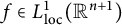
$f\in L_{\mathrm {loc}}^{1}(\mathbb {R}^{n+1})$
 , the uncentered forward in time parabolic fractional maximal function
$M^{\gamma +}_\beta (f)$
 with time lag and the uncentered back in time parabolic fractional maximal function
$M^{\gamma -}_\beta (f)$
 with time lag of f are defined, respectively, by setting, for any
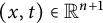
$(x,t)\in \mathbb {R}^{n+1}$
 ,

and

Notice that, for any
$\gamma \in [0,1)$
 ,
$M_0^{\gamma +}$
 coincides with the uncentered parabolic forward in time maximal operator
$M^{\gamma +}$
 with time lag introduced in [Reference Kinnunen and Myyryläinen45, Definition 2.2]. We present the following characterization of the parabolic Muckenhoupt two-weight class
$TA_{1,q}^+(\gamma )$
 in terms of the uncentered back in time parabolic maximal operator
$M^{\gamma -}_0$
 .
Proposition 2.5 Let
$\gamma \in [0,1)$
 ,
$q\in [1,\infty )$
 , and
$(u,v)$
 be a pair of nonnegative functions on
$\mathbb {R}^{n+1}$
 . Then
$(u,v)\in TA_{1,q}^+(\gamma )$
 if and only if there exists
$C\in (0,\infty )$
 such that, for almost every
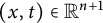
$(x,t)\in \mathbb {R}^{n+1}$
 ,

Proof We first show the sufficiency. Assume that
$(u,v)$
 satisfies (2.1). By this and Definition 2.4, we find that, for any
$R\in \mathcal {R}_p^{n+1}$
 and for almost every
$(x,t)\in R^+(\gamma )$
 ,

Taking the essential infimum over all
$(x,t)\in R^+(\gamma )$
 , we then obtain

and hence
$(u,v)\in TA_{1,q}^+(\gamma )$
 with
$[u,v]_{TA_{1,q}^+(\gamma )}\leq C$
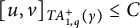 . This finishes the proof of the sufficiency.
Now, we prove the necessity. Assume that
$(u,v)\in TA_{1,q}^+(\gamma )$
 and let

To show that (2.1) holds almost everywhere for some
$C\in (0,\infty )$
 , it suffices to prove that
$|\mathcal {N}|=0$
 . Indeed, from Definition 2.4, we infer that, for any given
$(x,t)\in \mathcal {N}$
 , there exist
$R_{(x,t)}\in \mathcal {R}_p^{n+1}$
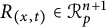 and
$\epsilon \in (0,\infty )$
 such that
$(x,t)\in R_{(x,t)}^+(\gamma )$
 and

Since
$\text {pr}_t(R_{(x,t)}^+(\gamma ))$
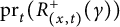 is an open interval and
$(x,t)\in R_{(x,t)}^+(\gamma )$
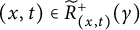
 , it follows that there exists
$\widetilde {R}_{(x,t)}:=Q(x_0,L_0)\times (t_0-L_0^p,t_0+L_0^p)\in \mathcal {R}_p^{n+1}$
 with
$(x_0,t_0)\in \mathbb {R}^{n+1}$
 and
$L_0\in (0,\infty )$
 such that the following statements hold:
-
(i) $(x,t)\in \widetilde {R}_{(x,t)}^+(\gamma )$
; -
(ii) $R_{(x,t)}^-(\gamma )\subset \widetilde {R}_{(x,t)}^-(\gamma )$
and
$|\widetilde {R}_{(x,t)}^-(\gamma )\setminus R_{(x,t)}^-(\gamma )|<\epsilon $
; -
(iii) all the vertices of $Q(x_0,L_0)$
belong to
$\mathbb {Q}^n$
and
$t_0-L_0^p\in \mathbb {Q}$
.




Combining (2.2), (ii), and
$(u,v)\in TA_{1,q}^+(\gamma )$
 , we conclude that

which further implies that

Let
$\{R_k\}_{k\in \mathbb {N}}$
 be the sequence of all
$R:=Q(z,L)\times (r-L^p,r+L^p)\in \mathcal {R}_p^{n+1}$
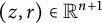
 with
$(z,r)\in \mathbb {R}^{n+1}$
 and
$L\in (0,\infty )$
 such that all the vertices of
$Q(z,L)$
 belong to
$\mathbb {Q}^n$
 and
$r-L^p\in \mathbb {Q}$
 and, for any
$k\in \mathbb {N}$
 , let

Then
$|\mathcal {N}_k|=0$
 for any
$k\in \mathbb {N}$
 . Moreover, from (i), (iii), and (2.3), it follows that
$\mathcal {N}\subset \bigcup _{k\in \mathbb {N}} \mathcal {N}_k$
 , which further implies that
$|\mathcal {N}|\leq \sum _{k\in \mathbb {N}}|\mathcal {N}_k|=0$
 . This finishes the proof of the necessity and hence Proposition 2.5.
Throughout this article, we always omit the variables
$(x,t)$
 in the notation if there is no ambiguity and, for instance, for any
$A\subset \mathbb {R}^{n+1}$
 , any function f on
$\mathbb {R}^{n+1}$
 , and any
$\lambda \in \mathbb {R}$
 , we simply write

The following proposition indicates that the parabolic Muckenhoupt two-weight class is closed under taking the maximum and the minimum.
Proposition 2.6 Let
$\gamma \in [0,1)$
 and
$1\leq r\leq q<\infty $
 . Then, for any
$(u,v),(\widetilde {u},\widetilde {v})\in TA_{r,q}^+(\gamma )$
 ,
-
(i) $(\max \{u,\,\widetilde {u}\},\max \{v,\, \widetilde {v}\})\in TA_{r,q}^+(\gamma )$
and $$ \begin{align*} \left[\max\{u,\,\widetilde{u}\}, \max\{v,\,\widetilde{v}\}\right]_{TA_{r,q}^+(\gamma)} \leq[u,v]_{TA_{r,q}^+(\gamma)} +[\widetilde{u},\widetilde{v}]_{TA_{r,q}^+(\gamma)}. \end{align*} $$
-
(ii) $(\min \{u,\,\widetilde {u}\}, \min \{v,\,\widetilde {v}\})\in TA_{r,q}^+(\gamma )$
. Moreover, if
$r=1$
, then $$ \begin{align*} \left[\min\{u,\,\widetilde{u}\}, \min\{v,\,\widetilde{v}\}\right] _{TA_{1,q}^+(\gamma)} \leq\max\left\{[u,v] _{TA_{1,q}^+(\gamma)},\,[\widetilde{u},\widetilde{v}] _{TA_{1,q}^+(\gamma)}\right\} \end{align*} $$and, if $r\in (1,\infty )$
, then $$ \begin{align*} [\min \{u,\,\widetilde {u}\}, \min \{v,\,\widetilde {v}\}]_{TA_{r,q}^ +(\gamma )} \leq [u,v]_{TA_{r,q}^+(\gamma )} +[\widetilde {u},\widetilde {v}]_{TA_{r,q}^+(\gamma )}. \end{align*} $$





Proof Let
$(u,v),(\widetilde {u},\widetilde {v})\in TA_{r,q}^+(\gamma )$
 . We first show (i). Let
$W_1:=\max \{u,\,\widetilde {u}\}$
 and
$W_2:=\max \{v,\,\widetilde {v}\}$
 . We consider the following two cases for r.
Case 1:
$r=1$
 . In this case, by Definition 2.1(ii), we find that, for any given
$R\in \mathcal {R}_p^{n+1}$
 ,

Taking the supremum over all
$R\in \mathcal {R}_p^{n+1}$
 , we conclude that
$(W_1,W_2)\in TA_{1,q}^+(\gamma )$
 and

Case 2:
$r\in (1,\infty )$
 . In this case, from Definition 2.1(i), we deduce that, for any given
$R\in \mathcal {R}_p^{n+1}$
 ,

Taking the supremum over all
$R\in \mathcal {R}_p^{n+1}$
 , we obtain
$(W_1,W_2)\in TA_{r,q}^+(\gamma )$
 and

Combining the above two cases, we then finish the proof of (i).
Next, we prove (ii). Let
$w_1:=\min \{u,\,\widetilde {u}\}$
 and
$w_2:=\min \{v,\,\widetilde {v}\}$
 . Similarly to the proof of (i), we consider the following two cases for r.
Case 1:
$r=1$
 . In this case, using Definition 2.1(ii), we conclude that, for any
$R\in \mathcal {R}_p^{n+1}$
 ,

Taking the supremum over all
$R\in \mathcal {R}_p^{n+1}$
 , we find that
$(w_1,w_2)\in TA_{1,q}^+(\gamma )$
 and

Case 2:
$r\in (1,\infty )$
 . In this case, from Definition 2.1(i), we infer that, for any
$R\in \mathcal {R}_p^{n+1}$
 ,

Taking the supremum over all
$R\in \mathcal {R}_p^{n+1}$
 , we obtain
$(w_1,w_2)\in TA_{r,q}^+(\gamma )$
 and

Combining the above two cases, we then complete the proof of (ii) and hence Proposition 2.6.
The following duality property follows directly from Definition 2.1(i); we omit the details.
Proposition 2.7 Let
$\gamma {\kern-1pt}\in{\kern-1pt} [0,1)$
 and
$1{\kern-1pt}<{\kern-1pt}r{\kern-1pt}\leq{\kern-1pt} q{\kern-1pt}<{\kern-1pt}\infty $
 . Assume that
$(u,v)$
 is a pair of positive functions on
$\mathbb {R}^{n+1}$
 . Then
$(u,v)\in TA_{r,q}^+(\gamma )$
 if and only if
$(v^{-1},u^{-1})\in TA_{q',r'}^-(\gamma )$
 .
At the end of this section, we give a characterization of the diagonal parabolic Muckenhoupt two-weight class in terms of a forward in time doubling condition. In what follows, for any nonnegative function
$f\in L_{\mathrm {loc}}^1(\mathbb {R}^{n+1})$
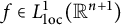 and any measurable set
$E\subset \mathbb {R}^{n+1}$
 , we denote
$\int _Ef$
 by
$f(E)$
 .
Proposition 2.8 Let
$\gamma \in [0,1)$
 and
$(u,v)$
 be a pair of positive functions on
$\mathbb {R}^{n+1}$
 . Then the following statements are equivalent:
-
(i) There exists $q\in (1,\infty )$
such that
$(u,v)\in TA_{q,q}^+(\gamma )$
. -
(ii) There exist $C\in (0,\infty )$
,
$\delta \in (0,1)$
, and
$r\in (\frac {1}{\delta },\infty )$
such that, for any
$R\in \mathcal {R}_p^{n+1}$
and any measurable set
$E\subset R^+(\gamma )$
, (2.4) $$ \begin{align} \frac{|E|}{|R^+(\gamma)|}\leq C\left[\frac{(v^r)(E)}{(u^r)(R^-(\gamma))}\right]^{\delta}. \end{align} $$




Proof We first show
$(\mathrm {i})\Longrightarrow (\mathrm {ii})$
 . Assume that
$(u,v)\in TA_{q,q}^+(\gamma )$
 for some
$q\in (1,\infty )$
 . Then, from the Hölder inequality, we deduce that, for any
$R\in \mathcal {R}_p^{n+1}$
 and any measurable set
$E\subset R^+(\gamma )$
 ,

which further implies that (2.4) with
$r:=q$
 ,
$\delta \in (0,\frac {1}{q}]$
 , and
$C:=[u,v]_{TA_q^+(\gamma )}^{\delta }$
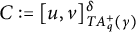 holds. This finishes the proof of
$(\mathrm {i})\Longrightarrow (\mathrm {ii})$
 .
Now, we prove
$(\mathrm {ii})\Longrightarrow (\mathrm {i})$
 . Assume that (ii) holds. According to (2.4), we conclude that, for any
$R\in \mathcal {R}_p^{n+1}$
 and any measurable set
$E\subset R^+(\gamma )$
 ,

Fix
$R\in \mathcal {R}_p^{n+1}$
 and, for any given
$\lambda \in (0,\infty )$
 , let
$E_\lambda :=R^+(\gamma )\cap \{v^{-r}>\lambda \}$
 . Then
$(v^r)(E_\lambda )\leq |E_\lambda |/\lambda $
 . Combining this and (2.5), we find that, for any
$\lambda \in (0,\infty )$
 ,

which further implies that

Since
$r\in (\frac {1}{\delta },\infty )$
 , it follows that
$\frac {r'}{r}\in (0,\frac {\delta }{1-\delta })$
 . From the Cavalieri principle (see, for example, [Reference Grafakos34, Proposition 1.1.4]), the obvious fact that
$E_\lambda \subset R^+(\gamma )$
 for any
$\lambda \in (0,\infty )$
 , and (2.6), we infer that

where the implicit positive constant depends only on C, r, and
$\delta $
 . Taking the supremum over all
$R\in \mathcal {R}_p^{n+1}$
 , we conclude that
$(u,v)\in TA_{r,r}^+(\gamma )$
 , which completes the proof of the sufficiency and hence Proposition 2.8.
3 Independence of choices of time lag and self-improving property of
$TA_{r,q}^+(\gamma )$

In this section, under an additional mild assumption (which is not necessary for one-weight case), we show that the parabolic Muckenhoupt two-weight class is independent of the time lag and the distance between the upper and the lower parts of parabolic rectangles. As an application, we prove that the parabolic Muckenhoupt two-weight class has the self-improving property. Recall that, for any
$\gamma \in [0,1)$
 ,
$A_\infty ^+(\gamma ):= \bigcup _{q\in (1,\infty )}A_q^+(\gamma )$
 and, for any
$A\subset \mathbb {R}^{n+1}$
 and
$a\in \mathbb {R}$
 ,
$A-(\mathbf {0},a):=\{(x,t-a):\ (x,t)\in A\}$
 .
Theorem 3.1 Let
$0<\gamma <\alpha <1$
 ,
$\tau \in [1,\infty )$
 , and
$(u,v)$
 be a pair of nonnegative functions on
$\mathbb {R}^{n+1}$
 . Assume that
$u\in A_\infty ^+(\gamma )$
 . Then the following statements hold:
-
(i) If $1<r\leq q<\infty $
, then
$(u,v)\in TA_{r,q}^+(\gamma )$
if and only if there exists a positive constant C such that, for any
$R\in \mathcal {R}_p^{n+1}$
, (3.1) -
(ii) If $q\in [1,\infty )$
, then
$(u,v)\in TA_{1,q}^+(\gamma )$
if and only if there exists a positive constant C such that, for any
$R\in \mathcal {R}_p^{n+1}$
, (3.2)







Proof We first show the necessity of (i) and (ii). Assume that
$(u,v)\in TA_{r,q}^+(\gamma )$
 . Fix
$R:=R(x,t,L)\in \mathcal {R}_p^{n+1}$
 with
$(x,t)\in \mathbb {R}^{n+1}$
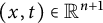 and
$L\in (0,\infty )$
 . Let

Then

where
$\widetilde {\alpha }:=\frac {2\alpha +(\tau -1)(1+\alpha )} {2+(\tau -1)(1+\alpha )}\in (\gamma ,1)$
 . Moreover, we have

From Remark 2.2(ii), we deduce that
$(u,v)\in TA_{r,q}^+(\widetilde {\alpha })$
 , which, combined with (3.3) and (3.4), further implies that

This finishes the proof of the necessity of (i). Letting
$r\to 1^+$
 in the above argument, we find that the necessity of (ii) holds. Here and thereafter,
$r\to 1^+$
 means that
$r\in (1,\infty )$
 and
$r\to 1$
 .
Then we prove the sufficiency of (i) by the chaining argument. Suppose that (3.1) holds. Fix
$R\in \mathcal {R}_p^{n+1}$
 . Without loss of generality, we may suppose that R is centered at the origin
$(\mathbf {0},0)$
 . Let
$m\in \mathbb {N}$
 be such that there exists
$\epsilon \in [0,1)$
 satisfying

Partition each spatial edge of
$R^+(\gamma )$
 into
$2^m$
 equally long intervals and divide the temporal edge of
$R^+(\gamma )$
 into
$J:=\lceil (1-\gamma )2^{pm}/(1-\alpha )\rceil $
 equally long intervals. Then we obtain
$2^{nm}J$
 subrectangles of
$R^+(\gamma )$
 and denote them by
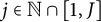
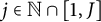
$\{V_{i,j}^+\}_{i\in \mathbb {N}\cap [1,2^{nm}], j\in \mathbb {N}\cap [1,J]}$
 . Fix
$i\in \mathbb {N}\cap [1,2^{nm}]$
 and
$j\in \mathbb {N}\cap [1,J]$
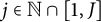 . Notice that there exists
$R_{i,j}\in \mathcal {R}_p^{n+1}$
 such that the tops of both
$R_{i,j}$
 and
$V_{i,j}^+$
 coincide,
$V_{i,j}^+\subset R_{i,j}^+(\alpha )$
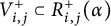 , and

Divide
$R^-(\gamma )$
 in the same manner as we partition
$R^+(\gamma )$
 . Then we obtain
$2^{nm}J$
 subrectangles of
$R^-(\gamma )$
 and denote them by
$\{U_{k,\iota }^-\} _{k\in \mathbb {N}\cap [1,2^{nm}],\iota \in \mathbb {N}\cap [1,J]}$
 . Fix
$k\in \mathbb {N}\cap [1,2^{nm}]$
 and
$\iota \in \mathbb {N}\cap [1,J]$
 . Observe that there exists
$\widetilde {R}_{k,\iota }\in \mathcal {R}_p^{n+1}$
 such that the bottoms of both
$\widetilde {R}_{k,\iota }^+(\alpha )-(\mathbf {0}, \tau (1+\alpha )[l(\widetilde {R}_{k,\iota })]^p)$
 and
$U_{k,\iota }^-$
 coincide,
$U_{k,\iota }^-\subset \widetilde {R}_{k,\iota }^+(\alpha )-(\mathbf {0}, \tau (1+\alpha )[l(\widetilde {R}_{k,\iota })]^p)$
 , and

We claim that there exists
$\mathfrak {R}\in \mathcal {R}_p^{n+1}$
 satisfying that, for any
$i,k\in \mathbb {N}\cap [1,2^{nm}]$
 and
$j,\iota \in \mathbb {N}\cap [1,J]$
 , there exist
$N_j,\widetilde {N}_\iota \in \mathbb {N}$
 and chains
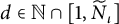
$\{P_d^{i,j}\}_{d=0}^{N_j}$
 and
$\{\widetilde {P}_d^{k,\iota }\}_{d=0}^{\widetilde {N}_\iota }$
 consisting of congruent parabolic rectangles such that the following statements hold.
-
(i) $\mathfrak {R}\subset R^+(0)$
and
$\mathfrak {R}^+(\alpha )-(\mathbf {0},\tau (1+\alpha ) [l(\mathfrak {R})]^p)\subset R^+(0)$
. -
(ii) For any $i\in \mathbb {N}\cap [1,2^{nm}]$
and
$j\in \mathbb {N}\cap [1,J]$
,
$P_0^{i,j}=R_{i,j}$
and
$P_{N_j}^{i,j}=\mathfrak {R}$
. For any
$k\in \mathbb {N}\cap [1,2^{nm}]$
and
$\iota \in \mathbb {N}\cap [1,J]$
,
$\widetilde {P}_0^{k,\iota }=\widetilde {R}_{k,\iota }$
and
$\widetilde {P}_{\widetilde {N}_\iota }^{k,\iota }=\mathfrak {R}$
. -
(iii) For any $j\in \mathbb {N}\cap [1,J]$
, $$ \begin{align*} N_j\leq2^{\frac{p}{p-1}+3p+1}\left[\frac{\tau(1+\alpha)} {1-\alpha}\right]^p\left[\frac{\tau(1+\alpha)}{\gamma}\right] ^{\frac{p}{p-1}}=:C_1. \end{align*} $$For any $\iota \in \mathbb {N}\cap [1,J]$
,
$\widetilde {N}_\iota \leq 2C_1$
.
-
(iv) For any $i\in \mathbb {N}\cap [1,2^{nm}]$
,
$j\in \mathbb {N}\cap [1,J]$
, and
$d\in \mathbb {N}\cap [1,N_j]$
, $$ \begin{align*} \frac{|(P_d^{i,j})^+(\alpha)\cap(S_{d-1}^{i,j})^-(\alpha)|} {|(P_d^{i,j})^+(\alpha)|}\in \left[\frac{1}{2^{n+1}},1\right], \end{align*} $$where $(S_h^{i,j})^-(\alpha ):= (P_h^{i,j})^+(\alpha )-(\mathbf {0}, \tau (1+\alpha )[l(P_h^{i,j})]^p)$
for any
$h\in \mathbb {Z}_+ \cap [0,N_j]$
. Moreover, for any
$k\in \mathbb {N}\cap [1,2^{nm}]$
,
$\iota \in \mathbb {N}\cap [1,J]$
, and
$d\in \mathbb {N}\cap [1,\widetilde {N}_\iota ]$
, $$ \begin{align*} \frac{|(\widetilde{S}_d^{k,\iota}) ^-(\alpha)\cap(\widetilde{P}_{d-1}^{k,\iota})^+(\alpha)|} {|(\widetilde{S}_d^{k,\iota})^-(\alpha)|}\in \left[\frac{1}{2^{n+1}},1\right], \end{align*} $$where $(\widetilde {S}_h^{k,\iota })^-(\alpha ):= (\widetilde {P}_h^{k,\iota })^+(\alpha )-(\mathbf {0}, \tau (1+\alpha )[l(\widetilde {P}_h^{k,\iota })]^p)$
for any
$h\in \mathbb {Z}_+\cap [0,\widetilde {N}_\iota ]$
.



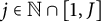





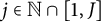












Indeed, fix
$i\in \mathbb {N}\cap [1,2^{nm}]$
 and
$j\in \mathbb {N}\cap [1,J]$
 . We will specify
$\mathfrak {R}$
 and
$N_j$
 and construct the chain
$\{P_d^{i,j}\}_{d=0}^{N_j}$
 in the following two steps.
Step 1. In this step, we construct the chain corresponding to spatial variables. Assume that
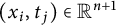
$R_{i,j}=Q(x_i,l)\times (t_j-2l^p,t_j)$
 with
$(x_i,t_j)\in \mathbb {R}^{n+1}$
 and
$l:=l(R)/2^m$
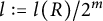 . Let
$Q_0^i:=Q(x_i,l)$
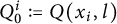 . For any
$d\in \mathbb {N}\cap [1,M_i]$
 with
$M_i\in \mathbb {N}$
 determined later, let

where
$\theta _i\in [1,\sqrt {n}]$
 , depending only on the angle between
$x_i$
 and the spatial axes, is such that the center of
$Q_d^i$
 belongs to the boundary of
$Q_{d-1}^i$
 . Notice that there exists
$b_i\in \mathbb {N}\cap [1,2^m-1]$
 , depending only on
$\vert x_i\vert $
 , such that

From this and (3.8), it follows that, to ensure that
$Q_{M_{i}}^i=Q(\mathbf {0},l)$
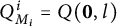 , we need to choose

Observe that, for any
$d\in \mathbb {N}\cap [1,M_i]$
 ,

Then
$\{Q_d^i\}_{d=0}^{M_{i}}$
 forms a chain in
$\mathbb {R}^n$
 starting from
$Q(x_i,l)$
 and ending with
$Q(\mathbf {0},l)$
 .
Step 2. In this step, we specify
$\mathfrak {R}$
 and
$N_j$
 and construct the chain
$\{P_d^{i,j}\}_{d=0}^{N_j}$
 based on the chains in Step 1. For any
$d\in \mathbb {Z}_+\cap [0,M_i]$
 , let

Then
$P_0^{i,j}=R_{i,j}$
 and
$\text {pr}_x(P_{M_i}^{i,j}) =Q(\mathbf {0},l)$
 . To determine
$\mathfrak {R}$
 , we first assume that
$j=1$
 and
$i\in \mathbb {N}\cap [1,2^{nm}]$
 such that
$Q(x_i,l)$
 intersects with the boundary of
$\text {pr}_x(R)=Q(\mathbf {0},l(R))$
 . From (3.9) and (3.10), we infer that
$b_i=1$
 and hence
$M_i=2^m-1$
 in this case. Let
$N:=2^m-1$
 and
$\mathfrak {R}:=P_N^{i,1}$
 . We show that (i) holds. Indeed, on the one hand, notice that

On the other hand, by (3.5), we obtain

which further implies that
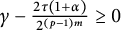
$2^{(p-1)m}\geq \frac {2\tau (1+\alpha )}{\gamma }$
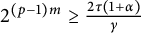 and hence
$\gamma -\frac {2\tau (1+\alpha )}{2^{(p-1)m}}\geq 0$
 . From this, the definitions of both J and l, and the fact that
$\lceil s\rceil \leq 2s$
 for any
$s\in [1,\infty )$
 , we deduce that

This, together with both the fact that the bottom of
$\mathfrak {R}^+(\alpha )-(\mathbf {0},\tau (1+\alpha ) [l(\mathfrak {R})]^p)$
 is

and (3.12), further implies that (i) holds.
Then we suppose that
$j=1$
 and
$i\in \mathbb {N}\cap [1,2^{nm}]$
 such that
$Q(x_i,l)$
 does not intersect with the boundary of
$\text {pr}_x(R)=Q(\mathbf {0},l(R))$
 . In this case,
$b_i\neq 1$
 and hence
$M_{i}\in \mathbb {N}\cap [1,N)$
 . For any
$d\in \mathbb {N}\cap [M_i,N-1]$
 , let
$P_{d+1}^{i,j}:=P_d^{i,j}-(\mathbf {0},\tau (1+\alpha )l^{p})$
 . Then we are easy to see that
$P_{N}^{i,j}=\mathfrak {R}$
 .
Now, we consider the residual situation
$j\in \mathbb {N}\cap [2,J]$
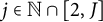 and
$i\in \mathbb {N}\cap [1,2^{nm}]$
 . In this case, we first extend the chain
$\{P_d^{i,j}\}_{d=0}^{M_i}$
 to the chain
$\{P_d^{i,j}\}_{d=0}^N$
 in the same way as we did in the above case. Then we can easily verify that
$\mathrm {pr}_x(P_N^{i,j})=\mathrm {pr}_x(P_N^{i,1})$
 . However, in the temporal variable, the distance between the top of
$P_N^{i,j}$
 and that of
$P_N^{i,1}$
 is
$(j-1)(1-\gamma )[l(R)]^p/J$
 . We can shift every
$P_d^{i,j}$
 for
$d\in \mathbb {N}\cap [1,2^{m-1}]$
 and add
$\widetilde {M}_j$
 parabolic rectangles into the chain to guarantee that the eventual parabolic rectangle is
$\mathfrak {R}$
 . To be specific, we can choose
$\beta _j\in [0,1)$
 and
$\widetilde {M}_j\in \mathbb {Z}_{+}$
 such that

Indeed, notice that there exists
$\eta \in [1,2)$
 such that

and hence we can rewrite (3.13) as

Choose
$\widetilde {M}_j\in \mathbb {Z}_{+}$
 such that

That is, let
$\widetilde {M}_j\in \mathbb {Z}_{+}$
 be such that

Let
$\xi _j:=\frac {(j-1)(1-\alpha )}{\eta } -\widetilde {M}_j(1+\alpha )$
 . Using this and the choice of
$\widetilde {M}_j$
 , we find that
$\xi _j \in [0,\tau (1+\alpha ))$
 . Select
$\beta _j\in [0,\infty )$
 such that
$\xi _j=2^{m-1}\beta _{j}(1-\alpha )$
 . From this and (3.5), we infer that

By this and
$\xi _j\in [0,\tau (1+\alpha ))$
 , we conclude that

which, together with the choices of both
$\widetilde {M}_j$
 and
$\beta _j$
 , further implies that (3.14) holds. Finally, for any
$d\in \mathbb {N}\cap [1,2^{m-1}]$
 , we modify the definition of
$P_d^{i,j}$
 by setting

If
$\widetilde {M}_j\in \mathbb {N}$
 , then, for any
$d\in \mathbb {N}\cap [N,N+\widetilde {M}_j-1]$
 , let
$P_{d+1}^{i,j}:=P_d^{i,j}-\left (\mathbf {0},\tau (1+\alpha ) l^p\right )$
 . Then
$P_{N+\widetilde {M}_j}^{i,j}=\mathfrak {R}$
 . For convenience, let
$\widetilde {M}_1:=0$
 .
In conclusion, for any
$i\in \mathbb {N}\cap [1,2^{nm}]$
 and
$j\in \mathbb {N}\cap [1,J]$
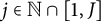 , we have constructed a chain
$\{P_d^{i,j}\}_{d=0}^{N+\widetilde {M}_j}$
 starting from
$R_{i,j}$
 and ending with
$\mathfrak {R}$
 . Let
$N_j:=N+ \widetilde {M}_j$
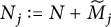 . Applying the definitions of both N and J, (3.15), and (3.5), we obtain

From (3.11), the fact that
$\beta _j\in [0,\frac {1}{2})$
 , and the construction of
$\{P_d^{i,j}\}_{d=0}^{N_j}$
 , we deduce that, for any
$i\in \mathbb {N}\cap [1,2^{nm}]$
 ,
$j\in \mathbb {N}\cap [1,J]$
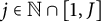 , and
$d\in \mathbb {N}\cap [1,N_j]$
 ,

Similarly, for any
$k\in \mathbb {N}\cap [1,2^{nm}]$
 and
$\iota \in \mathbb {N} \cap [1,J]$
 , we can construct a chain
$\{\widetilde {P}_d^{k,\iota }\}_{d=0}^{\widetilde {N_\iota }}$
 such that
$\widetilde {N}_\iota \in \mathbb {N}\cap [1,2C_1]$
 ,
$\widetilde {P}_0^{k,\iota }=\widetilde {R}_{k,\iota }$
 ,
$\widetilde {P}_{\widetilde {N}_\iota }^{k,\iota }=\mathfrak {R}$
 , and

for any
$d\in \mathbb {N}\cap [1,\widetilde {N}_\iota ]$
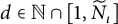 . This finishes the proof of (ii)–(iv) and hence the above claim.
Next, based on (i)–(iv), we can build a chain connecting
$R_{i,j}$
 and
$\widetilde {R}_{k,\iota }$
 for any
$i,k\in \mathbb {N}\cap [1,2^{nm}]$
 and
$j,\iota \in \mathbb {N}\cap [1,J]$
 . More precisely, for any
$i,k\in \mathbb {N}\cap [1,2^{nm}]$
 ,
$j,\iota \in \mathbb {N}\cap [1,J]$
 , and
$d\in \mathbb {Z}_+\cap [0,\widetilde {N}_\iota +N_j]$
 , let

and
$(S_d^{i,j,k,\iota })^-(\alpha ):= (P_d^{i,j,k,\iota })^+(\alpha )-(\mathbf {0},\tau (1+\alpha ) [l(P_d^{i,j,k,\iota })]^p)$
 . Then, for any
$i,k\in \mathbb {N}\cap [1,2^{nm}]$
 and
$j,\iota \in \mathbb {N}\cap [1,J]$
 , we have constructed a chain
$\{P_{d}^{i,j,k,\iota }\}_{d=0}^{\widetilde {N}_\iota +N_j}$
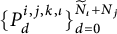 consisting of congruent parabolic rectangles. From (i) through (iv), it follows that the following statements hold.
-
(v) For any $i,k\in \mathbb {N}\cap [1,2^{nm}]$
,
$j,\iota \in \mathbb {N}\cap [1,J]$
, and
$d\in \mathbb {Z}_+\cap [0,\widetilde {N}_\iota +N_j]$
,
$P_d^{i,j,k,\iota }\subset R$
. -
(vi) For any $i,k\in \mathbb {N}\cap [1,2^{nm}]$
and
$j,\iota \in \mathbb {N}\cap [1,J]$
,
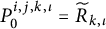
$P_0^{i,j,k,\iota }=\widetilde {R}_{k,\iota }$
and
$P_{\widetilde {N}_\iota +N_j}^{i,j,k,\iota }=R_{i,j}$
. -
(vii) For any $i,k\in \mathbb {N}\cap [1,2^{nm}]$
,
$j,\iota \in \mathbb {N}\cap [1,J]$
, and
$d\in \mathbb {N}\cap [1,\widetilde {N}_\iota +N_j]$
, $$ \begin{align*} \frac{|(S_d^{i,j,k,\iota})^-(\alpha) \cap(P_{d-1}^{i,j,k,\iota}) ^+(\alpha)|}{|(S_d^{i,j,k,\iota})^-(\alpha)|} \in\left[\frac{1}{2^{n+1}},1\right]. \end{align*} $$






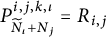




Now, we prove that there exists a positive constant
$C_2$
 such that, for any given
$i,k\in \mathbb {N}\cap [1,2^{nm}]$
 and
$j,\iota \in \mathbb {N}\cap [1,J]$
 ,

Indeed, by [Reference Kinnunen and Saari50, Lemma 7.4], [Reference Kinnunen and Myyryläinen45, Theorems 3.1 and 4.1], and the assumption that
$u\in A_\infty ^+(\gamma )$
 , we find that there exist
$K,\delta \in (0,\infty )$
 such that, for any
$R\in \mathcal {R}_p^{n+1}$
 and any measurable set
$E\subset R^+(\alpha )$
 ,

From this and (vii), we infer that, for any
$d\in \mathbb {N} \cap [1,\widetilde {N}_\iota +N_j]$
 ,

Iterating this inequality and using (iii) and (vi), we obtain

Hence, (3.16) holds with
$C_2:=[2^{(n+1)\delta }K]^{3C_1}$
 .
To show
$(u,v)\in TA_{r,q}^+(\gamma )$
 , we still need the following estimate. From the fact that
$\lceil s\rceil \leq 2s$
 for any
$s\in [1,\infty )$
 , (3.5), and the definition of J, we deduce that

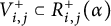
Applying the obvious facts that

$V_{i,j}^+\subset R_{i,j}^+(\alpha )$
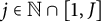
 for any
$i\in \mathbb {N}\cap [1,2^{nm}]$
 and
$j\in \mathbb {N}\cap [1,J]$
 , (3.6),
$U_{k,\iota }^-\subset \widetilde {R}_{k,\iota }^+(\alpha ) -(\mathbf {0},\tau (1+\alpha )l(\widetilde {R}_{k,\iota })^p)$
 for any
$k\in \mathbb {N}\cap [1,2^{nm}]$
 and
$\iota \in \mathbb {N}\cap [1,J]$
 , (3.7), (3.16), (3.17), (3.1), the definition of J, and the fact that
$\lceil s\rceil \leq 2s$
 for any
$s\in [1,\infty )$
 , we conclude that

Taking the supremum over all
$R\in \mathcal {R}_p^{n+1}$
 , we obtain
$(u,v)\in TA_{r,q}^+(\gamma )$
 and

which completes the proof of the sufficiency of (i).
Finally, to prove the present theorem, it remains to show the sufficiency of (ii). Indeed, using [Reference Grafakos34, Exercises 1.1.3(a)] and letting
$r\to 1^+$
 in (3.18) with the assumption therein replaced by (3.2), we find that the sufficiency of (ii) holds, which then completes the proof of Theorem 3.1.
Remark 3.2
-
(i) The assumption that $u\in A_\infty ^+(\gamma )$
is only used to prove the sufficiency of Theorem 3.1. -
(ii) Theorem 3.1 when both $r=q$
and
$u=v$
coincides with [Reference Kinnunen and Myyryläinen45, Theorem 3.1].


The following is a direct consequence of Theorem 3.1.
Corollary 3.3 Let
$\gamma \in (0,1)$
 ,
$1\leq r\leq q<\infty $
 , and
$(u,v)$
 be a pair of nonnegative functions on
$\mathbb {R}^{n+1}$
 . Assume that
$u\in A_\infty ^+(\gamma )$
 . Then the following statements hold:
-
(i) For any $\alpha \in (0,1)$
,
$(u,v)\in TA_{r,q}^+ (\gamma )$
if and only if
$(u,v)\in TA_{r,q}^+(\alpha )$
. -
(ii) $(u,v)\in TA_{r,q}^+(\gamma )$
if and only if there exists a positive constant C such that, for any
$R\in \mathcal {R}_p^{n+1}$
, where $R^{--}(\gamma ):=R^-(\gamma )-(\mathbf {0},(1+\gamma )[l(R)]^p)$
.







Remark 3.4 Corollary 3.3 when
$u=v$
 coincides with [Reference Ma, He and Yan61, Lemma 2.1(3)].
Using Corollary 3.3, we obtain the following self-improving property of the parabolic Muckenhoupt two-weight class with time lag.
Corollary 3.5 Let
$\gamma \in (0,1)$
 ,
$1<r\leq q<\infty $
 , and
$(u,v)\in TA_{r,q}^+(\gamma )$
 . If
$u\in A_\infty ^+(\gamma )$
 , then there exists
$\delta _0\in (0,\infty )$
 , depending only on n, p,
$\gamma $
 , r, q, and
$[u,v]_{TA_{r,q}^+(\gamma )}$
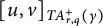 , such that, for any
$\delta \in (0,\delta _0)$
 ,
$(u,v)\in TA_{r,q+\delta }^+(\gamma )$
 .
Proof From the assumption that
$u\in A_\infty ^+(\gamma )$
 and [Reference Kinnunen and Saari50, Lemma 7.4], it follows that there exists
$q_u\in (1,\infty )$
 such that
$u^q\in A_{q_u}^+(\gamma )$
 . By this and [Reference Kinnunen and Myyryläinen45, Corollary 5.3], we conclude that there exist positive constants C and
$\delta _0$
 , depending only on n, p,
$\gamma $
 , q, and the weight constant of
$u^q$
 , such that, for any
$R\in \mathcal {R}_p^{n+1}$
 ,
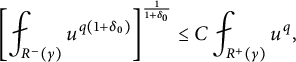
which further implies that

From this and Corollary 3.3(ii), we infer that
$(u,v)\in TA_{r,q+\delta _0}^+(\gamma )$
 . This, together with Proposition 2.3(ii), further implies that, for any
$\delta \in (0,\delta _0)$
 ,
$(u,v)\in TA_{r,q+\delta }^+(\gamma )$
 . This finishes the proof of Corollary 3.5.
4 Characterizations of weighted boundedness of parabolic fractional maximal operators with time lag
In this section, we characterize the parabolic Muckenhoupt (two-weight) class with time lag in terms of the (weak-type) weighted boundedness of the parabolic fractional maximal operator. Recall that, for any given
$q\in [1,\infty )$
 and any nonnegative locally integrable function
$\omega $
 on
$\mathbb {R}^{n+1}$
 , the weighted weak Lebesgue space
$L^{q,\infty }(\mathbb {R}^{n+1},\omega )$
 is defined to be the set of all measurable functions f on
$\mathbb {R}^{n+1}$
 such that

Specifically, if
$\omega \equiv 1$
 , then
$L^{q,\infty }(\mathbb {R}^{n+1},1)$
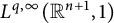 is exactly the weak Lebesgue space and we simply write
$L^{q,\infty }(\mathbb {R}^{n+1}):= L^{q,\infty }(\mathbb {R}^{n+1},1)$
 . The following theorem is the main result of this section. We borrow some ideas and techniques from [Reference Forzani, Martín-Reyes and Ombrosi29, Reference Kinnunen and Myyryläinen45].
Theorem 4.1 Let
$\gamma \in (0,1)$
 ,
$\beta \in [0,1)$
 ,
$1\leq r\leq q<\infty $
 ,
$\beta =\frac {1}{r}-\frac {1}{q}$
 , and
$(u,v)$
 be a pair of nonnegative functions on
$\mathbb {R}^{n+1}$
 . If
$u\in A_\infty ^+(\gamma )$
 , then
$(u,v)\in TA_{r,q}^+(\gamma )$
 if and only if there exists a positive constant C such that, for any
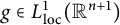
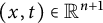
$f\in L^r(\mathbb {R}^{n+1},v^r)$
 ,

Proof We first show the sufficiency. Assume that (4.1) holds for any
$f\in L^r(\mathbb {R}^{n+1},v^r)$
 . Fix
$R\in \mathcal {R}_p^{n+1}$
 . From Definition 2.4, we deduce that, for any
$\lambda \in (0,|R^+(\gamma )|^\beta (v^{-r'})_{R^+(\gamma )})$
 and for almost every
$(x,t)\in R^-(\gamma )$
 ,

which further implies that
$R^-(\gamma )\subset \{M^{\gamma +}_\beta (v^{-r'} \boldsymbol {1}_{R^+(\gamma )})>\lambda \}$
 up to a set of measure zero. Combining this and (4.1), we obtain

Letting
$\lambda \to |R^+(\gamma )|^\beta (v^{-r'})_{R^+(\gamma )}$
 , dividing both sides by
$|R^+(\gamma )|$
 , and using
$\frac {1}{r}-\frac {1}{q}=\beta $
 , we find that

Taking the supremum over all
$R\in \mathcal {R}_p^{n+1}$
 , we conclude that
$(u,v)\in TA_{r,q}^+(\gamma )$
 and
$[u,v]_{TA_{r,q}^+(\gamma )}\leq C$
 , which completes the proof of the sufficiency.
Next, we prove the necessity. Let
$(u,v)\in TA_{r,q}^+(\gamma )$
 ,
$f\in L^r(\mathbb {R}^{n+1},v^r)$
 , and
$\lambda \in (0,\infty )$
 . We need to show that (4.1) holds. To this end, we divide the proof into the following five steps.
Step 1. In this step, we make the following simplification.
-
(i) We may assume that f is bounded and has compact support. Indeed, for any $k\in \mathbb {N}$
, let $$ \begin{align*} f_k:=\max\left\{|f|,\,k\right\}\mathbf{1}_{R(\mathbf{0},0,k)}. \end{align*} $$Then, for any $k\in \mathbb {N}$
,
$f_k$
is bounded and has compact support and
$f_k\to f$
almost everywhere on
$\mathbb {R}^{n+1}$
as
$k\to \infty $
. From this and the monotone convergence theorem, it follows that (4.2) $$ \begin{align} \int_{\mathbb{R}^{n+1}}|f_k|^rv^r\to\int_{\mathbb{R}^{n+1}} |f|^rv^r \end{align} $$as $k\to \infty $
. In addition, by an argument similar to that used in the proof of [Reference Cruz-Uribe and Fiorenza18, Lemma 3.30] and the monotone convergence theorem again, we find that $$ \begin{align*} \left(u^q\right)\left(\left\{M^{\gamma+}_\beta(f_k)>\lambda \right\}\right)\to\left(u^q\right)\left(\left\{M^{\gamma+} _\beta(f)>\lambda\right\}\right) \end{align*} $$as $k\to \infty $
. From this and (4.2), we deduce that, to prove (4.1) for f, it suffices to show that (4.1) holds for any
$f_k$
with
$k\in \mathbb {N}$
and the positive constant C independent of k,
$\lambda $
, and f.
-
(ii) We may assume that both $u^q$
and
$v^r$
have a lower bound A for some
$A\in (0,\infty )$
. Indeed, applying Proposition 2.6, we conclude that
$(\max \{u,\, A^{\frac {1}{q}}\},\max \{v,\,A^{\frac {1}{r}}\})\in TA_{r,q}^+(\gamma )$
. If we have $$ \begin{align*} \left(\max\{u^q,\,A\}\right) \left(\left\{M^{\gamma+}_\beta(f)>\lambda\right\}\right) \lesssim\frac{1}{\lambda^q}\left[\int_{\mathbb{R}^{n+1}}|f|^r \max\left\{v^r,\,A\right\}\right]^{\frac{q}{r}}, \end{align*} $$where the implicit positive constant is independent of A, $\lambda $
, and f, then we obtain (4.1) by letting
$A\to 0$
and taking the supremum over all
$\lambda \in (0,\infty )$
.
-
(iii) Fix $a\in (0,1)$
. Let
$M_{\beta ,a}^{\gamma +}$
denote the truncated uncentered parabolic forward in time maximal operator, that is, for any
$g\in L_{\mathrm {loc}}^1(\mathbb {R}^{n+1})$
and
$(x,t)\in \mathbb {R}^{n+1}$
, To prove (4.1), we only need to show that(4.3) $$ \begin{align} \left(u^q\right)\left(\left\{M_{\beta,a}^{\gamma+}(f)>\lambda \right\}\right)\lesssim\frac{1}{\lambda^q} \left(\int_{\mathbb{R}^{n+1}}|f|^rv^r\right)^{\frac{q}{r}}, \end{align} $$where the implicit positive constant is independent of a, $\lambda $
, and f. Indeed, in (4.3), letting
$a\to 0$
and taking the supremum over all
$\lambda \in (0,\infty )$
, we then obtain (4.1).
-
(iv) To prove (4.3), it suffices to show that
(4.4) $$ \begin{align} \left(u^q\right)\left(\left\{\lambda<M_{\beta,a}^{\gamma+}(f) \leq2\lambda\right\}\right) \leq\frac{1}{\lambda^q}\left(\int_{\mathbb{R}^{n+1}}|f|^rv^r \right)^{\frac{q}{r}}, \end{align} $$where the implicit positive constant is independent of a, $\lambda $
, and f. Indeed, from (4.4), we infer that $$ \begin{align*} \left(u^q\right)\left(\left\{M_{\beta,a}^{\gamma+}(f)>\lambda \right\}\right)&\leq\sum_{k\in\mathbb{Z}_+}\left(u^q\right) \left(\left\{2^k\lambda<M_{\beta,a}^{\gamma+}(f)\leq 2^{k+1}\lambda\right\}\right)\\ &\lesssim\sum_{k\in\mathbb{Z}_+}\frac{1}{2^{kq}\lambda^q} \left(\int_{\mathbb{R}^{n+1}}|f|^rv^r\right)^{\frac{q}{r}}\\ &\sim\frac{1}{\lambda^q} \left(\int_{\mathbb{R}^{n+1}}|f|^rv^r\right)^{\frac{q}{r}} \end{align*} $$and hence (4.3) holds.
-
(v) Fix any compact set $K\subset \{\lambda <M_{\beta ,a}^{\gamma +}(f) \leq 2\lambda \}$
. Then, to prove (4.4), it suffices to show (4.5) $$ \begin{align} \left(u^q\right)(K)\lesssim\frac{1}{\lambda^q} \left(\int_{\mathbb{R}^{n+1}}|f|^rv\right)^{\frac{q}{r}}, \end{align} $$where the implicit positive constant is independent of K, a, $\lambda $
, and f. Indeed, using the inner regularity of the Lebesgue measure (see, for example, [Reference Rudin83, Theorem 2.14(d)]) and taking the supremum over all compact subsets of
$\{\lambda <M_{\beta ,a}^{\gamma +}(f)\leq 2\lambda \}$
, we then obtain (4.4).











Step 2. In this step, we aim to prove that there exist
$N\in \mathbb {N}$
 and a sequence
$\{P_i\}_{i=1}^N$
 of parabolic rectangles such that

where
$\alpha :=\frac {\gamma }{5^p}$
 . To begin with, from the definitions of both K and
$M_{\beta ,a}^{\gamma +}$
 , we deduce that, for any given
$(x,t)\in K$
 , there exists
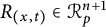
$R_{(x,t)}\in \mathcal {R}_p^{n+1}$
 such that
$(x,t)\in R_{(x,t)}^-(\gamma )$
 ,
$l(R_{(x,t)})\in [a,\infty )$
 , and

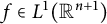
Using the assumption on f in (i) of Step 1, we find that
$f\in L^1(\mathbb {R}^{n+1})$
 . This, together with (4.7), further implies that

Combining this and the fact that
$l(R_{(x,t)})\in [a,\infty )$
 , we conclude that

Let
$P_{(x,t)}:=5R_{(x,t)}$
 . Here and thereafter, for any
$R:=\prod _{i=1}^{n}[y_i-L_i,y_i+L_i]\times (s-L^p,s+L^p)\subset \mathbb {R}^{n+1}$
 with
$\{y_i\}_{i=1}^{n}\subset \mathbb {R}$
 ,
$\{L_i\}_{i=1}^{n}\subset (0,\infty )$
 ,
$s\in \mathbb {R}$
 , and
$L\in (0,\infty )$
 and for any
$\Lambda \in (0,\infty )$
 , define
$\Lambda R:=\prod _{i=1}^{n}[y_i-\Lambda L_i,y_i+\Lambda L_i]\times (s-(\Lambda L)^p,s+(\Lambda L)^p)$
 . Then it is easy to verify that
$R_{(x,t)}^+(\gamma )\subset P_{(x,t)}^+(\alpha )$
 and
$R_{(x,t)}^-(\gamma )\subset P_{(x,t)}^-(\alpha )$
 . In addition, from the fact that K is compact and (4.8), it follows that
$\bigcup _{(x,t)\in K}P_{(x,t)}$
 is bounded and hence
$u^q$
 is integrable on
$\bigcup _{(x,t)\in K}P_{(x,t)}$
 . Applying this, the absolute continuity of the Lebesgue integral, (4.8), and (ii) in Step 1, we find that there exists
$\epsilon \in (0,1)$
 such that, for any
$(x,t)\in K$
 ,

which further implies that

On the other hand, let

From the finite covering theorem and the fact that

we deduce that there exist
$N_1\in \mathbb {N}$
 and
$\{(x_k,t_k)\}_{k=1}^{N_1}\subset K$
 such that

where, for any
$E\subset \mathbb {R}^{n+1}$
 ,
$\mathrm {int\,}(E)$
 denotes the interior of E.
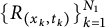
Now, we select a subsequence of
$\{R_{(x_k,t_k)}\} _{k=1}^{N_1}$
 by two steps. Assume that, for any
${k\in \mathbb {N}\cap [1,N_1]}$
 ,
$R_{(x_k,t_k)}:=R(y_k,s_k,L_k)$
 with
$(y_k,s_k)\in \mathbb {R}^{n+1}$
 and
$L_k\in (0,\infty )$
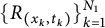
 . Without loss of generality, we may assume that the tops of
$\{R_{(x_k,t_k)}\}_{k=1}^{N_1}$
 are monotonically descending, that is, for any
$k,j\in \mathbb {N}\cap [1,N_1]$
 with
$k\leq j$
 ,
$s_k+L_k^p\geq s_j+L_j^p$
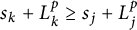 ; otherwise, we can rearrange
$\{R_{(x_k,t_k)}\}_{k=1}^{N_1}$
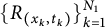 in terms of the t-coordinates of their tops.
Then we make the first selection inductively. Select
$R_{(x_1,t_1)}$
 and denote it by
$R_{(x_{k_1},t_{k_1})}$
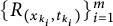
 . Suppose that we have selected the subsequence
$\{R_{(x_{k_i},t_{k_i})}\}_{i=1}^{m}$
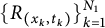
 of
$\{R_{(x_k,t_k)}\}_{k=1}^{N_1}$
 , where
$m\in \mathbb {N} \cap [1,N_1)$
 and
$k_m<N_1$
 . Let

with the convention
$\inf \emptyset =\infty $
 . If
$j_m\in \mathbb {N}$
 , then select
$R_{(x_{k_m+j_m},t_{k_m+j_m})}$
 and denote it by
$R_{(x_{k_{m+1}},t_{k_{m+1}})}$
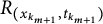 ; otherwise, we terminate the selection process. In this manner, we have obtained a subsequence
$\{R_{(x_{k_i},t_{k_i})}\}_{i=1}^{N_2}$
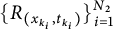 of
$\{R_{(x_k,t_k)}\}_{k=1}^{N_1}$
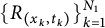 , where
$N_2\in \mathbb {N} \cap [1,N_1]$
 . This finishes the first step of selection process.
Without loss of generality, we may assume that the edge lengths of
$\{R_{(x_{k_i},t_{k_i})}\}_{i=1}^{N_2}$
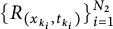 are monotonically decreasing; otherwise, we can rearrange
$\{R_{(x_{k_i},t_{k_i})}\}_{i=1}^{N_2}$
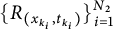 in terms of their edge lengths. Then we make the second selection inductively. Select
$R_{(x_{k_1},t_{k_1})}$
 and denote it by
$R_{(x_{k_{r_1}},t_{k_{r_1}})}$
 . Assume that we have selected the subsequence
$\{R_{(x_{k_{r_i}},t_{k_{r_i}})}\}_{i=1}^m$
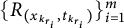 of
$\{R_{(x_{k_i},t_{k_i})}\}_{i=1}^{N_2}$
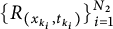 , where
$m\in \mathbb {N}\cap [1,N_2)$
 and
$k_{r_m}<N_2$
 . Let

with the convention
$\inf \emptyset =\infty $
 . If
$j_{r_m}\in \mathbb {N}$
 , then select
$R_{(x_{k_{r_m+}+j_{r_m}},t_{k_{r_m}+j_{r_m}})}$
 and denote it by
$R_{(x_{k_{r_{m+1}}},t_{k_{r_{m+1}}})}$
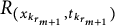 ; otherwise, we stop the selection process. By this way, we have obtained a subsequence
$\{R_{(x_{k_{r_i}},t_{k_{r_i}})}\}_{i=1}^N$
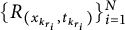 of
$\{R_{(x_{k_i},t_{k_i})}\}_{i=1}^{N_2}$
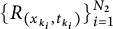 , where
$N\in \mathbb {N}\cap [1,N_2]$
 , which completes the second step of selection process. For convenience, for any
$i\in \mathbb {N} \cap [1,N]$
 , we simply write
$R_{(x_{k_{r_i}},t_{k_{r_i}})}$
 as
$R_i$
 . In conclusion, we have selected a subsequence
$\{R_i\}_{i=1}^N$
 of
$\{R_{(x_k,t_k)}\}_{k=1}^{N_1}$
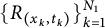 .
According to the above selection, we conclude that the following statements hold:
-
(i) For any $i,j\in \mathbb {N}\cap [1,N]$
with
$i\neq j$
, , which is a direct consequence of the first selection. -
(ii) For any $k\in \mathbb {N}\cap [1,N_1]$
, there exists
$i\in \mathbb {N}\cap [1,N]$
such that
$(x_k,t_k)\in P_i^-(\alpha )$
. Indeed, if
$R_{(x_k,t_k)}\notin \{R_{(x_{k_i},t_{k_i})}\} _{i=1}^{N_2}$
, then, based on the first selection, there exists
$i\in \mathbb {N}\cap [1,N_2]$
such that
$(x_k,t_k)\in P_{(x_{k_i},t_{k_i})}^-(\alpha )$
. If
$R_{(x_{k_i},t_{k_i})}\notin \{R_i\}_{i=1}^N$
, then, in light of the second selection, we have
$P_{(x_{k_i},t_{k_i})}^-(\alpha )\subset \bigcup _{i=1}^N P_i^-(\alpha )$
. -
(iii) For any $k\in \mathbb {N}\cap [1,N_2]$
, there exists
$i\in \mathbb {N}\cap [1,N]$
such that (4.12) $$ \begin{align} R(x_k,t_k,5a\widetilde{\epsilon})\subset(1+\epsilon) P_i^-(\alpha).\\ \end{align} $$Indeed, let $i\in \mathbb {N}\cap [1,N]$
be such that $$ \begin{align*} (x_k,t_k)&\in P_i^-(\alpha)=P_{(x_{k_{r_i}},t_{k_{r_i}})}^-(\alpha)\\ &=Q\left(y_{k_{r_i}},5L_{k_{r_i}}\right)\times \left(s_{k_{r_i}}-\left(5L_{k_{r_i}}\right)^p, s_{k_{r_i}}-\alpha\left(5L_{k_{r_i}}\right)^p\right). \end{align*} $$Then $\|x_k-y_{k_{r_i}}\|_{\infty }\in [0,5L_{k_{r_i}}]$
and
$s_{k_{r_i}}-t_k\in (\alpha (5L_{k_{r_i}})^p, (5L_{k_{r_i}})^p)$
. From this, (4.8), and (4.10), we infer that, for any
$(y,s)\in R(x_k,t_k,5a\widetilde {\epsilon })$
, $$ \begin{align*} s&<t_k+(5a)^p\widetilde{\epsilon}^p <s_{k_{r_i}}-\alpha\left(5L_{k_{r_i}}\right)^p +(5a)^p\widetilde{\epsilon}^p\\ &\leq s_{k_{r_i}}+(\widetilde{\epsilon}^p-\alpha) \left(5L_{k_{r_i}}\right)^p\\ &\leq s_{k_{r_i}}-\frac{1+\alpha}{2}\left(5L_{k_{r_i}}\right)^p +\frac{1-\alpha}{2}(1+\epsilon)^p\left(5L_{k_{r_i}}\right)^p, \end{align*} $$
$$ \begin{align*} s&>t_k-(5a)^p\widetilde{\epsilon}^p >s_{k_{r_i}}-\left(5L_{k_{r_i}}\right)^p -(5a)^p\widetilde{\epsilon}^p\\ &\geq s_{k_{r_i}}-\left(5L_{k_{r_i}}\right)^p (1+\widetilde{\epsilon}^p)\\ &\geq s_{k_{r_i}}-\frac{1+\alpha}{2}\left(5L_{k_{r_i}}\right)^p -\frac{1-\alpha}{2}(1+\epsilon)^p\left(5L_{k_{r_i}}\right)^p, \end{align*} $$and
$$ \begin{align*} \left\|y-y_{k_{r_i}}\right\|_\infty&\leq\|y-x_k\|_\infty+ \left\|x_k-y_{k_{r_i}}\right\|_\infty\\ &\leq5a\widetilde{\epsilon} +5L_{k_{r_i}}\leq5L_{k_{r_i}}(1+\epsilon), \end{align*} $$which further implies that $(y,s)\in (1+\epsilon )P_i^-(\alpha )$
. By the arbitrariness of
$(y,s)$
, we obtain
$R(x_k,t_k,5a\widetilde {\epsilon })\subset (1+\epsilon ) P_i^-(\alpha )$
.
-
(iv) For any given $k\in \mathbb {Z}$
and
$R_i,R_j\in \{R_i\}_{i=1}^N$
with
$l(R_i),l(R_j)\in (\frac {1}{2^{k+1}},\frac {1}{2^k}]$
, we have (4.13) $$ \begin{align} R_i^-(\gamma)\cap R_j^-(\gamma)=\emptyset. \end{align} $$We show this by contradiction. Indeed, from the first selection, we deduce that
or . Without loss of generality, we may assume that . Suppose that there exist
$k_0\in \mathbb {Z}$
and
$R_i,R_j\in \{R_i\}_{i=1}^N$
satisfying
$l(R_i),l(R_j)\in (\frac {1}{2^{k_0+1}}, \frac {1}{2^{k_0}}]$
and
$R_i^-(\gamma )\cap R_j^-(\gamma )\neq \emptyset $
. Fix
$(y_0,s_0)\in R_i^-(\gamma )\cap R_j^-(\gamma )$
. Then, for any
$(y,s)\in R_i^-(\gamma )=R_{(x_{k_{r_i}},t_{k_{r_i}})}^-(\gamma )$
, $$ \begin{align*} s_{k_{r_j}}-s\geq\gamma\left(L_{k_{r_j}}\right)^p=\alpha \left(5L_{k_{r_j}}\right)^p, \end{align*} $$
$$ \begin{align*} s-s_{k_{r_j}}&=s-s_0+s_0-s_{k_{r_j}}>s-s_0- \left(L_{k_{r_j}}\right)^p\\ &>-(1-\gamma)\left(L_{k_{r_i}}\right)^p -\left(L_{k_{r_j}}\right)^p\\ &\geq-\left[2^p(1-\gamma)+1\right]\left(L_{k_{r_j}}\right)^p >-\left(5L_{k_{r_j}}\right)^p, \end{align*} $$and
$$ \begin{align*} \left\|y-y_{k_{r_j}}\right\|_\infty\leq\|y-y_0\|_\infty+ \left\|y_0-y_{k_{r_j}}\right\|_\infty\leq2L_{k_{r_i}} +L_{k_{r_j}}\leq5L_{k_{r_j}}, \end{align*} $$which implies that $R_i^-(\gamma )\subset P_j^-(\alpha )$
. This contradicts . Thus, (4.13) holds.


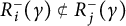 , which is a direct consequence of the first selection.

























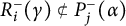 or
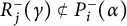 . Without loss of generality, we may assume that
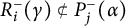 . Suppose that there exist








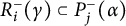
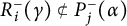 . Thus, (
Using (4.11) and (4.12), we conclude that

which, combined with (4.9), completes the proof of (4.6) and hence Step 2.
Step 3. In this step, we prove that there exists a positive constant C such that, for any
$i\in \mathbb {N}\cap [1,N]$
 ,

where
$\Gamma _i:=\{j\in \mathbb {N}\cap [1,N]:\ R_i^+(\gamma )\cap R_j^+(\gamma )\neq \emptyset ,\ l(R_j)<l(R_i)\}$
 . Fix
$i\in \mathbb {N}\cap [1,N]$
 and let

Then
$\Gamma _{i,1}\cup \Gamma _{i,2}=\Gamma _{i}$
 and
$\Gamma _{i,1}\cap \Gamma _{i,2}=\emptyset $
 . To show (4.14), it suffices to prove that there exist positive constants
$C_2$
 and
$C_3$
 , depending only on n, p, and
$\gamma $
 , such that, for any
$h\in \{1,2\}$
 ,

Indeed, from this and (4.7), we infer that

and hence (4.14) holds with
$C_1:=(C_2+C_3)2^{\frac 1{1-\beta }}$
 .
Next, we turn to show (4.15). Let
$k_0\in \mathbb {Z}$
 be such that
$l(R_i)\in (\frac {1}{2^{k_0+1}}, \frac {1}{2^{k_0}}]$
 . We first consider the case
$h=1$
 . We claim that, for any
$k\in \mathbb {Z}\cap [k_0,\infty )$
 , there exists a measurable set
$E_k\subset \mathbb {R}^{n+1}$
 such that

and

Indeed, fix
$k\in \mathbb {Z}\cap [k_0,\infty )$
 . Denote the
$2n+2$
 faces of
$R_i^+(\gamma )$
 by
$\{S_m\}_{m=1}^{2n+2}$
 , where
$S_1$
 and
$S_2$
 denote, respectively, the top and the bottom of
$R_i^+(\gamma )$
 . For any given
$j\in \Gamma _{i,1}$
 such that
$l(R_j)\in (\frac {1}{2^{k+1}},\frac {1}{2^k}]$
 , since
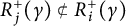 and
$R_j^+(\gamma )\cap R_i^+(\gamma )\neq \emptyset $
 , it follows that
$R_j^+(\gamma )$
 intersects with the boundary of
$R_i^+(\gamma )$
 , that is,

For any
$S_m$
 with
$m\in \mathbb {N}\cap [1,2n+2]$
 , there exists a rectangle
$E_{k,m}\subset \mathbb {R}^{n+1}$
 such that
![Union over j in Gamma sub i,1, l(R sub j) in (1/2^k+1, 1/2^k], R sub j^+ (y) intersect S sub m is not empty, of R sub j is a subset of E sub k,m](https://static.cambridge.org/binary/version/id/urn:cambridge.org:id:binary:20261028074545857-0771:S0008414X25000185:S0008414X25000185_eqnu93.png?pub-status=live)
and

Applying this, (4.16),
$l(R_j)<l(R_i)$
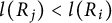 , and
$l(R_j)\in (\frac {1}{2^{k+1}}, \frac {1}{2^k}]$
 , we find that
![Union over j in Gamma sub i,1 with l(R sub j) in (1/2^k+1, 1/2^k] of R sub j equals union from m=1 to 2n+2 of union over j in Gamma sub i,1 with l(R sub j) in (1/2^k+1, 1/2^k] and R sub j^+ (y) intersect S sub m is not empty of R sub j subset E_k.](https://static.cambridge.org/binary/version/id/urn:cambridge.org:id:binary:20261028074545857-0771:S0008414X25000185:S0008414X25000185_eqnu95.png?pub-status=live)
and

This finishes the proof of the above claim.
Observe that, for any
$j\in \Gamma _{i,1}$
 ,
$l(R_j)<l(R_i)$
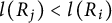 and hence

From this, (iv) in Step 2, the above claim, and
$l(R_i)\in (\frac {1}{2^{k_0+1}},\frac {1}{2^{k_0}}]$
 , we deduce that

which completes the proof of (4.15) when
$h=1$
 .
Now, we prove (4.15) in the case
$h=2$
 . Let

For any
$k\in \mathbb {N}\cap [k_0+1,\infty )$
 , we define
$\Omega _k$
 inductively by setting

Let
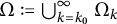
$\Omega :=\bigcup _{k=k_0}^\infty \Omega _k$
 . Notice that
$\{\Omega _k\}_{k=k_0}^\infty $
 are pairwise disjoint. In addition, for any
$j\in \Omega $
 , we have
$R_j^+(\gamma )\subset R_i^+(\gamma )$
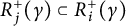 and hence
$R_j^-(\gamma )\subset R_i$
 . From these two facts and (iv) of Step 2, it follows that

Next, we show that, for any
$m\in \Gamma _{i,2}\setminus \Omega $
 , there exists
$j\in \Omega $
 such that
$R_{j}^-(\gamma )\cap R_m^-(\gamma )\neq \emptyset $
 ,
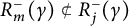 , and
$l(R_{j})\in (l(R_m),\infty )$
 . Indeed, let
$k_{\mathrm {min}}\in [k_0,\infty )$
 be the smallest integer such that there exists
$j\in \Omega _{k_{\mathrm {min}}}$
 satisfying
$R_m^-(\gamma )\cap R_j^-(\gamma )\neq \emptyset $
 . From (i) and (iv) in Step 2, we deduce that
$k_{\mathrm {min}}>k_0$
 and
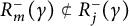 . Moreover,
$l(R_{j})\in (l(R_m),\infty )$
 . Otherwise, by the definition of
$k_{\mathrm {min}}$
 and (iv) in Step 2, we conclude that there exists
$k'\in \mathbb {N}\cap [k_0,k_{\mathrm {min}})$
 such that
$m\in \Omega _{k'}$
 , which contradicts the assumption that
$m\in \Gamma _{i,2}\setminus \Omega $
 . Thus,
$l(R_{j})\in (l(R_m),\infty )$
 .
For any
$j\in \Omega $
 , define

Let
$j\in \Omega $
 . Then there exists
$\widetilde {k}\in \mathbb {Z} \cap [k_0,\infty )$
 such that
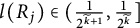
$l(R_j)\in (\frac {1}{2^{\widetilde {k}+1}},\frac {1}{2^{\widetilde {k}}}]$
 . We claim that, for any
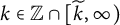
$k\in \mathbb {Z}\cap [\widetilde {k},\infty )$
 , there exists a measurable set
$\widetilde {E}_k\subset \mathbb {R}^{n+1}$
 such that

and

Indeed, fix
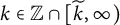
$k\in \mathbb {Z}\cap [\widetilde {k},\infty )$
 . Denote the
$2n+2$
 faces of
$R_j^-(\gamma )$
 by
$\{\widetilde {S}_d\} _{d=1}^{2n+2}$
 , where
$\widetilde {S}_1$
 and
$\widetilde {S}_2$
 denote, respectively, the top and the bottom of
$R_j^-(\gamma )$
 . For any given
$m\in \widetilde {\Omega }_j$
 such that
$l(R_m)\in (\frac {1}{2^{k+1}},\frac {1}{2^k}]$
 , since
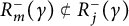 and
$R_m^-(\gamma )\cap R_j^-(\gamma )\neq \emptyset $
 , it follows that
$R_m^-$
 intersects with the boundary of
$R_j^-(\gamma )$
 , that is,

For any
$\widetilde {S}_d$
 with
$d\in \mathbb {N}\cap [1,2n+2]$
 , there exists a rectangle
$\widetilde {E}_{k,d}\subset \mathbb {R}^{n+1}$
 such that
![Union over m in Omega-tilde sub j such that l(R sub m) is in (1 all over 2 to the k+1 power, 1 all over 2 to the k power] and R sub m minus (gamma) intersect S sub d is not empty of R sub m minus (gamma) subset of E-tilde sub k,d](https://static.cambridge.org/binary/version/id/urn:cambridge.org:id:binary:20261028074545857-0771:S0008414X25000185:S0008414X25000185_eqnu101.png?pub-status=live)
and

Applying this, (4.21),
$l(R_m)<l(R_j)$
 , and
$l(R_m)\in (\frac {1}{2^{k+1}}, \frac {1}{2^k}]$
 , we obtain
![Union over m in Omega-tilde sub j with l(R sub m) in (1/2^k+1, 1/2^k] of R sub m minus (gamma) equals union from d=1 to 2n+2 of union over m in Omega-tilde sub j with l(R sub m) in (1/2^k+1, 1/2^k] and R sub m minus (gamma) intersect S sub d is not empty of R sub m minus (gamma) subset union from d=1 to 2n+2 of E-tilde sub k,d defined as E-tilde sub k.](https://static.cambridge.org/binary/version/id/urn:cambridge.org:id:binary:20261028074545857-0771:S0008414X25000185:S0008414X25000185_eqnu103.png?pub-status=live)
and

This finishes the proofs of (4.19) and (4.20). From this, the fact that

(iv) in Step 2, and
$l(R_j)\in (\frac {1}{2^{\widetilde {k}+1}},\frac {1}{2^{\widetilde {k}}}]$
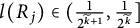 , we infer that

Combining this and (4.18), we conclude that

which completes the proof of (4.15) when
$h=2$
 . This, together with (4.17), further implies that (4.15) holds and hence (4.14).
Step 4. In this step, we prove that there exists a positive constant
$C_4$
 , depending only on n and p, such that, for any
$i\in \mathbb {N}\cap [1,N]$
 , there exists a measurable set
$F_i\subset R_i^+(\gamma )$
 such that

and

In what follows, for any finite subset
$A\subset \mathbb {N}$
 , we denote the cardinality of A by
$\sharp\! A$
 . For any given
$i\in \mathbb {N}\cap [1,N]$
 , we define
$F_i$
 by considering the following two cases for
$\sharp \Gamma _{i}$
 .
Case 1:
$\sharp \Gamma _{i}\leq 2^{\frac 1{1-\beta }}\lceil C_1\rceil $
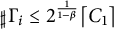 . In this case, let
$F_i:=R_i^+(\gamma )$
 .
Case 2:
$\sharp \Gamma _{i}>2^{\frac 1{1-\beta }}\lceil C_1\rceil $
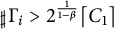 . In this case, for any
$k\in \mathbb {N}$
 , let

Notice that, for any
$k,k'\in \mathbb {N}$
 with
$k<k'$
 , we have

and, for any
$(x,t)\in R_i^+(\gamma )$
 ,

Then we define
$F_i:=R_i^+(\gamma )\setminus E_i^{2\lceil C_1\rceil }$
 .
We show that, for any
$i\in \mathbb {N}\cap [1,N]$
 ,
$F_i$
 satisfies (4.22). We consider the following two cases for
$\sharp \Gamma _i$
 .
Case 1:
$\sharp \Gamma _i\leq 2^{\frac 1{1-\beta }}\lceil C_1\rceil $
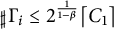 . In this case, from the definition of
$F_i=R_i^+(\gamma )$
 and (4.7), it follows that

Case 2:
$\sharp \Gamma _i>2^{\frac 1{1-\beta }}\lceil C_1\rceil $
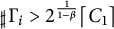 . In this case, using (4.24),
$E_i^k\subset R_i^+(\gamma )$
 for any
$k\in \mathbb {N}\cap [1,\sharp \Gamma _i]$
 , (4.25), and (4.14), we obtain

which, together with (4.7) and the definition of
$F_i$
 , further implies that

Combing the above two cases, we complete the proof of (4.22).
Now, we turn to prove (4.23). To this end, we first show that, for any
$(x,t)\in F_i$
 ,

Indeed, if
$\sharp \Gamma _i\leq 2^{\frac 1{1-\beta }}\lceil C_1\rceil $
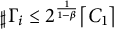 , then, for any
$(x,t)\in F_i$
 ,

If
$\sharp \Gamma _i>2^{\frac 1{1-\beta }}\lceil C_1\rceil $
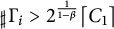 , then, from (4.25), we deduce that, for any
$(x,t)\in F_i$
 ,

which, together with (4.27), completes the proof of (4.26).
Then we prove that there exists a positive constant
$\widetilde {C}_4$
 , depending only on n, p, and
$\gamma $
 , such that, for any given
$(x,t)\in \mathbb {R}^{n+1}$
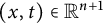 and
$k\in \mathbb {Z}$
 ,

To do this, let

and

Then, for any
$(x,t)\in \mathbb {R}^{n+1}$
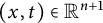 ,

Indeed, by the definition of
$I_{(x,t)}^k$
 , we find that, for any
$i\in I_{(x,t)}^k$
 and
$(y,s)\in R_i^-(\gamma )$
 ,

Therefore,
$(y,s)\in S_{(x,t)}$
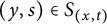 and hence (4.29) holds. From the definitions of
$I_{(x,t)}^k$
 and
$S_{(x,t)}$
 , (iv) in Step 2, and (4.29), we infer that

which completes the proof of (4.28).
Finally, we show (4.23). For any
$(x,t)\in \bigcup _{i=1}^N F_i$
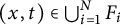 , there exists
$i_0\in \mathbb {N}\cap [1,N]$
 such that
$(x,t)\in F_{i_0}$
 and
$R_{i_0}$
 is the largest parabolic rectangle in the following sense: for any
$i\in \mathbb {N}\cap [1,N]$
 satisfying
$(x,t)\in F_i$
 ,
$|R_i|\leq |R_{i_0}|$
 . Let
$k_0\in \mathbb {Z}$
 be such that
$l(R_{i_0})\in (\frac {1}{2^{k_0+1}}, \frac {1}{2^{k_0}}]$
 . Applying the construction of
$i_0$
 ,
$F_i\subset R_i^+(\gamma )$
 for any
$i\in \mathbb {N}\cap [1,N]$
 , the definition of
$\Gamma _{i_0}$
 , (4.26), and (4.28), we obtain

This finishes the proof of (4.23) and hence Step 4.
Step 5. In this step, we prove (4.5) by considering the following two cases for r.
Case 1:
$r\in (1,\infty )$
 . In this case, from (4.6), (4.22), the Hölder inequality,
$F_i\subset R_i^+(\gamma )$
 ,
$\alpha =\frac {\gamma }{5^p}$
 ,
$P_i=5R_i$
 for any
$i\in \mathbb {N}\cap [1,N]$
 ,
$\frac {1}{r}-\frac {1}{q}=\beta $
 , Definition 2.1(i), and (4.23), we deduce that

This, together with Corollary 3.3, finishes the proof of (4.5) in this case.
Case 2:
$r=1$
 . In this case, by (4.6), (4.22),
$\alpha =\frac {\gamma }{5^p}$
 ,
$P_i=5R_i$
 for any
$i\in \mathbb {N}\cap [1,N]$
 ,
$\frac {1}{r}-\frac {1}{q}=\beta $
 , Definition 2.1(ii), and (4.23), we conclude that

This, together with Corollary 3.3, finishes the proof of (4.5) in this case. Combining this and (4.30), we obtain (4.5). This finishes the proof of the necessity and hence Theorem 4.1.
Remark 4.2 Theorem 4.1 when both
$r=q$
 and
$u=v$
 coincides with [Reference Kinnunen and Myyryläinen45, Theorem 6.1].
The proof of Theorem 4.1 also works for the case
$\gamma =0$
 and we present this result as follows.
Theorem 4.3 Let
$\beta \in [0,1)$
 ,
$1\leq r\leq q<\infty $
 ,
$\beta =\frac {1}{r}-\frac {1}{q}$
 , and
$(u,v)$
 be a pair of nonnegative functions on
$\mathbb {R}^{n+1}$
 . Then
$(u,v)\in TA_{r,q}^+(0)$
 if and only
$M^{0+}_\beta $
 is bounded from
$L^r(\mathbb {R}^{n+1},v^r)$
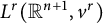 to
$L^{q,\infty }(\mathbb {R}^{n+1},u^q)$
 .
Notice that the condition
$u\in A_\infty ^+(\gamma )$
 is only used to show the necessity of Theorem 4.1. Moreover, using [Reference Ma, He and Yan61, Lemma 2.1(1)] and [Reference Kinnunen and Saari49, Lemma 7.4], we find that, for any
$1\leq r\leq q<\infty $
 and any nonnegative function
$\omega $
 on
$\mathbb {R}^{n+1}$
 ,
$\omega \in A_{r,q}^+(\gamma )$
 implies that
$\omega \in A_\infty ^+(\gamma )$
 . These, combined with Theorem 4.1 with
$u=v$
 , the self-improving property of
$A_{r,q}^+(\gamma )$
 with
$1<r\leq q<\infty $
 (see [Reference Ma, He and Yan61, Lemma 2.2]), and the Stein–Weiss interpolation theorem (see, for example, [Reference Bergh and Löfström7, Corollary 5.5.2]), further implies the following corollary. We omit the details.
Corollary 4.4 Let
$\gamma \in (0,1)$
 ,
$\beta \in [0,1)$
 ,
$1<r\leq q<\infty $
 ,
$\beta =\frac {1}{r}-\frac {1}{q}$
 , and
$\omega $
 be a weight on
$\mathbb {R}^{n+1}$
 . Then
$\omega \in A_{r,q}^+(\gamma )$
 if and only if
$M^{\gamma +}_\beta $
 is bounded from
$L^r(\mathbb {R}^{n+1},\omega ^r)$
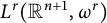 to
$L^q(\mathbb {R}^{n+1},\omega ^q)$
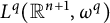 .
Remark 4.5 Corollary 4.4 when both
$r=q$
 and
$u=v$
 coincides with [Reference Kinnunen and Myyryläinen45, Theorem 6.2].
The following definition of centered parabolic fractional maximal operators can be found in [Reference Ma, He and Yan61, p. 187].
Definition 4.6 Let
$\gamma ,\beta \in [0,1)$
 . For any
$f\in L_{\mathrm {loc}}^{1}(\mathbb {R}^{n+1})$
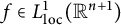 , the centered forward in time parabolic fractional maximal function
$\mathcal {M}^{\gamma +}_\beta (f)$
 with time lag and the centered back in time parabolic fractional maximal function
$\mathcal {M}^{\gamma -}_\beta (f)$
 with time lag of f are defined, respectively, by setting, for any
$(x,t)\in \mathbb {R}^{n+1}$
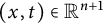 ,

and

At the end of this section, we prove the following weak-type parabolic two-weighted boundedness of centered parabolic fractional maximal operators with time lag.
Theorem 4.7 Let
$\gamma ,\beta \in [0,1)$
 ,
$1<r\leq q<\infty $
 ,
$\beta =\frac {1}{r}-\frac {1}{q}$
 , and
$(u,v)$
 be a pair of nonnegative functions on
$\mathbb {R}^{n+1}$
 .
-
(i) If $\gamma \in (0,1)$
and
$u\in A_\infty ^+(\gamma )$
, then
$(u,v)\in TA_{r,q}^+(\gamma )$
if and only if
$\mathcal {M}^{\gamma +}_\beta $
is bounded from
$L^r(\mathbb {R}^{n+1},v^r)$
to
$L^{q,\infty }(\mathbb {R}^{n+1},u^q)$
. -
(ii) $(u,v)\in TA_{r,q}^+(0)$
if and only if
$\mathcal {M}^{0+}_\beta $
is bounded from
$L^r(\mathbb {R}^{n+1},v^r)$
to
$L^{q,\infty }(\mathbb {R}^{n+1},u^q)$
.




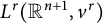



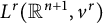

Proof We first show the sufficiency of both (i) and (ii). Let
$\gamma \in [0,1)$
 . Assume
$\mathcal {M}^{\gamma +}_\beta $
 is bounded from
$L^r(\mathbb {R}^{n+1},v^r)$
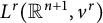 to
$L^{q,\infty }(\mathbb {R}^{n+1},u^q)$
 . Fix
$R:=R(x,t,L)\in \mathcal {R}_p^{n+1}$
 with
$(x,t)\in \mathbb {R}^{n+1}$
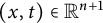 and
$L\in (0,\infty )$
 . Define
$S^+(\gamma ):=R^-(\gamma )+(1-\gamma )L^p+2^p\gamma L^p$
 and, for any
$\epsilon \in (0,\infty )$
 , let
$f_\epsilon :=(v+\epsilon )^{-r'}\boldsymbol {1}_{S^+(\gamma )}$
 . Then, for any
$(y,s)\in R^-(\gamma )$
 ,
$S^+(\gamma )\subset R(y,s,2L)^+(\gamma )$
 and
$|R(y,s,2L)^+(\gamma )|=2^{n+p}|S^+(\gamma )|$
 . From this and Definition 2.4, it follows that, for any
$\lambda \in (0,2^{(n+p)(\beta -1)} |S^+(\gamma )|^\beta (f_\epsilon )_{S^+(\gamma )})$
 and
$(y,s)\in R^-(\gamma )$
 ,

which further implies that
$R^-(\gamma )\subset \{M^{\gamma +}_\beta (f_\epsilon )>\lambda \}$
 . Combining this and the assumption that
$\mathcal {M}^{\gamma +}_\beta $
 is bounded from
$L^r(\mathbb {R}^{n+1},v^r)$
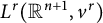 to
$L^{q,\infty }(\mathbb {R}^{n+1},u^q)$
 , we obtain

Letting
$\lambda \to 2^{(n+p)(\beta -1)} |S^+(\gamma )|^\beta (f_\epsilon )_{S^+(\gamma )}$
 and
$\epsilon \to 0$
 , dividing both sides of the above inequality by
$|R^+(\gamma )|$
 , using
$\frac {1}{r}-\frac {1}{q}=\beta $
 , and taking the supremum over all
$R\in \mathcal {R}_p^{n+1}$
 , we find that

Thus, if
$\gamma =0$
 , this and Definition 2.1(i) imply
$(u,v)\in TA_{r,q}^+(0)$
 and, if
$\gamma \in (0,1)$
 , then applying this and Theorem 3.1 [here, we use the assumption that
$u\in A_\infty ^+(\gamma )$
 ] we also conclude
$(u,v)\in TA_{r,q}^+(\gamma )$
 , which then completes the proof of the sufficiency of both (i) and (ii).
Next, we prove the necessity of (i). Let
$f\in L_{\mathrm {loc}}^1(\mathbb {R}^{n+1})$
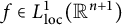 . From Corollary 3.3(i) and Theorem 4.1, we infer that, to show that
$\mathcal {M}^{\gamma +}_\beta $
 is bounded from
$L^r(\mathbb {R}^{n+1},v^r)$
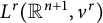 to
$L^{q,\infty }(\mathbb {R}^{n+1},u^q)$
 , it remains to prove that there exists a positive constant K, depending only on n, p,
$\gamma $
 , and
$\beta $
 , such that, for any
$(x,t)\in \mathbb {R}^{n+1}$
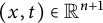 ,

Indeed, fix
$L\in (0,\infty )$
 and let
$P:=R(x,t+\frac {\gamma L^p}{2},L)$
 . Then we are easy to show that
$(x,t)\in P^-(\frac {\gamma }{4})$
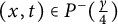 ,
$R(x,t,L)^+(\gamma )\subset P^+(\frac {\gamma }{4})$
 , and
$|P^+(\frac {\gamma }{4})|= \frac {1-\frac {\gamma }{4}}{1-\gamma }|R(x,t,L)^+(\gamma )|$
 . This further implies that

Taking the supremum over all
$L\in (0,\infty )$
 , we obtain (4.31), which completes the proof of necessity of (i).
The proof of the necessity of (ii) is a slight modification of that of (i) with Theorem 4.1 replaced by Theorem 4.3; we omit the details. This finishes the proof of Theorem 4.7.
Remark 4.8 In the case
$u=v$
 , Theorem 4.7 when
$r=q$
 coincides with [Reference Kinnunen and Saari50, Lemma 4.2] and when
$r<q$
 coincides with [Reference Ma, He and Yan61, Theorem 1.1].
The following is a simple corollary of Theorem 4.7 with
$u=v$
 , the self-improving property of
$A_{r,q}^+(\gamma )$
 with
$1<r\leq q<\infty $
 , and the Stein–Weiss interpolation theorem, which has been obtained in [Reference Kinnunen and Saari50, Theorem 5.4] when
$\beta =0$
 and in [Reference Ma, He and Yan61, Theorem 1.3] when
$\beta \in (0,1)$
 .
Corollary 4.9 Let
$\gamma ,\rho \in (0,1)$
 ,
$\beta \in [0,1)$
 ,
$1<r\leq q<\infty $
 ,
$\beta =\frac {1}{r}-\frac {1}{q}$
 , and
$\omega $
 be a weight on
$\mathbb {R}^{n+1}$
 . Then
$\omega \in A_{r,q}^+(\gamma )$
 if and only if
$\mathcal {M}^{\rho +}_\beta $
 is bounded from
$L^r(\mathbb {R}^{n+1},\omega ^r)$
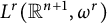 to
$L^q(\mathbb {R}^{n+1},\omega ^q)$
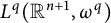 .
5 Characterizations of weighted boundedness of parabolic fractional integrals with time lag
In this section, we introduce the parabolic forward in time and back in time fractional integral operators with time lag. Then we give the weak-type parabolic two-weighted inequality and the strong-type parabolic weighted inequality for such operators. Recall that the parabolic distance
$d_p$
 on
$\mathbb {R}^{n+1}\times \mathbb {R}^{n+1}$
 is defined by setting, for any
$(x,t),(y,s) \in \mathbb {R}^{n+1}$
 ,

We then introduce the definitions of parabolic forward in time fractional integrals with time lag and parabolic back in time fractional integrals with time lag as follows.
Definition 5.1 Let
$\gamma ,\beta \in [0,1)$
 . For any
$f\in L_{\mathrm {loc}}^{1}(\mathbb {R}^{n+1})$
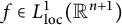 , the parabolic forward in time fractional integral
$I^{\gamma +}_\beta (f)$
 with time lag and the parabolic back in time fractional integral
$I^{\gamma -}_\beta (f)$
 with time lag of f are defined, respectively, by setting, for any
$(x,t)\in \mathbb {R}^{n+1}$
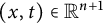 ,

and

Remark 5.2 The integral domain
$\bigcup _{L\in (0,\infty )} R(\mathbf {0},0,L)^+(\gamma )$
 in Definition 5.1 is the area above the surface
$t=\gamma \|x\|_\infty ^p$
 . In particular, when
$n=1$
 , the integral domain is exactly the area above the parabola
$t=\gamma |x|^p$
 ; see the following figure.

We have the following relation between the parabolic fractional integral with time lag and the centered parabolic fractional maximal operator with time lag.
Lemma 5.3 Let
$\gamma ,\beta \in [0,1)$
 . Then there exists a positive constant C, depending only on n,
$\gamma $
 , and
$\beta $
 , such that, for any
$f\in L_{\mathrm {loc}}^{1}(\mathbb {R}^{n+1})$
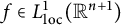 and
$(x,t)\in \mathbb {R}^{n+1}$
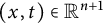 ,

Proof Let
$(x,t)\in \mathbb {R}^{n+1}$
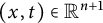 and
$L_0\in (0,\infty )$
 . Simply denote
$R(x,t,L_0)$
 by R. Observe that, for any
$(y,s)\in R^+(\gamma )$
 ,
$d_p((x,t),(y,s))\leq L$
 . From this, the fact that
$|R^+(\gamma )|=2^n(1-\gamma )L^{n+p}$
 , and Definition 5.1, we deduce that

Taking the supremum over all
$L_0\in (0,\infty )$
 , we conclude that (5.1) with
$C:=2^{n(\beta -1)}(1-\gamma )^{\beta -1}$
 holds, which completes the proof of Lemma 5.3.
The following lemma is a Welland type inequality in the parabolic setting. For the Welland inequality in the elliptic setting, see [Reference Welland92, equation (2.3)] and [Reference Andersen and Sawyer6, equation (1.2)].
Lemma 5.4 Let
$\gamma ,\beta \in (0,1)$
 and
$\epsilon \in (0,\min \{\beta ,\, 1-\beta \})$
 . Then there exists a positive constant C, depending only on n, p,
$\gamma $
 ,
$\beta $
 , and
$\epsilon $
 , such that, for any
$f\in L_{\mathrm {loc}}^{1}(\mathbb {R}^{n+1})$
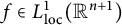 and
$(x,t)\in \mathbb {R}^{n+1}$
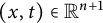 ,

Proof Let
$f\in L_{\mathrm {loc}}^{1}(\mathbb {R}^{n+1})$
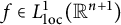 ,
$(x,t)\in \mathbb {R}^{n+1}$
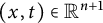 , and
$\Omega _{(x,t)}^{\gamma +}:=\bigcup _{L\in (0,\infty )}R(x,t,L) ^+(\gamma )$
 . Without loss of generality, we may assume that
$\mathcal {M}^{\gamma ^2+}_{\beta -\epsilon }(f)(x,t) \mathcal {M}^{\gamma ^2+}_{\beta +\epsilon }(f)(x,t)\in (0,\infty )$
 ; otherwise, (5.2) holds automatically. Fix
$\delta \in (0,\infty )$
 (which will be determined later) and define

and
$\Omega _2:=\Omega _{(x,t)}^{\gamma +}\setminus \Omega _1$
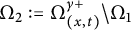 . Then

We first estimate
$I(x,t)$
 . Let
$\eta :=(\frac {1}{\gamma })^{\frac {1}{p}}$
 and, for any
$i\in \mathbb {N}$
 ,

Then the following four statements hold obviously:
-
(i) For any $i\in \mathbb {N}$
and
$(y,s)\in V_i^+$
,
$d_p((x,t),(y,s))\geq (\gamma ^i\delta ^p)^{\frac {1}{p}} =\eta ^{-i}\delta $
. -
(ii) For any $i,j\in \mathbb {N}$
with
$i\neq j$
,
$V_i^+\cap V_j^+=\emptyset $
. -
(iii) For any $i\in \mathbb {N}$
, the bottom of
$V_i^+$
contains the top of
$V_{i+1}^+$
. -
(iv) $\Omega _1\subset \bigcup _{i\in \mathbb {N}}V_i^+$
.





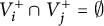



For any
$i\in \mathbb {N}$
 , let
$R_i:=R(x,t,\eta ^{-i+2}\delta )$
 . Then
$V_i^+\subset R_i^+(\gamma ^2)$
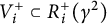 and
$|V_i^+|=\frac {\gamma }{1+\gamma } |R_i^+(\gamma ^2)|$
 . From this, the monotone convergence theorem, (i)–(iv), and the fact that

it follows that

Now, we estimate
$II(x,t)$
 similarly. For any
$i\in \mathbb {N}$
 , let

Then the following other four statements hold obviously:
-
(v) For any $j\in \mathbb {N}$
and
$(y,s)\in U_j^+$
,
$d_p((x,t),(y,s))\geq (\gamma ^{-j+2}\delta ^p)^{\frac {1}{p}} =\eta ^{j-2}\delta $
. -
(vi) For any $j,k\in \mathbb {N}$
with
$j\neq k$
,
$U_j^+\cap U_k^+=\emptyset $
. -
(vii) For any $j\in \mathbb {N}$
, the bottom of
$U_{j+1}^+$
contains the top of
$U_j^+$
. -
(viii) $\Omega _2\subset \bigcup _{j\in \mathbb {N}}U_j^+$
.





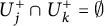


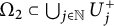
For any
$j\in \mathbb {N}$
 , let
$P_i:=R(x,t,\eta ^j\delta )$
 . Then
$U_j^+\subset P_j^+(\gamma ^2)$
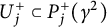 and
$|U_j^+|=\frac {\gamma }{1+\gamma } |P_j^+(\gamma ^2)|$
 . From this, the monotone convergence theorem, (v)–(viii), and the fact that

we deduce that

Combining this, (5.3), and (5.4) and choosing

we then obtain (5.2) and hence finish the proof of Lemma 5.4.
Next, we are ready to present the first main result of this section.
Theorem 5.5 Let
$\gamma ,\beta \in (0,1)$
 ,
$1\leq r<q<\infty $
 ,
$\beta =\frac {1}{r}-\frac {1}{q}$
 , and
$(u,v)$
 be a pair of nonnegative functions on
$\mathbb {R}^{n+1}$
 . If
$u\in A_\infty ^+(\gamma )$
 , then
$(u,v)\in TA_{r,q}^+(\gamma )$
 if and only if there exists a positive constant C such that, for any
$f\in L^r(\mathbb {R}^{n+1},v^r)$
 ,

Proof We first prove the sufficiency. Assume that (5.5) holds. By this, Lemma 5.3, and Theorem 4.7(i), we conclude that
$(u,v)\in TA_{r,q}^+(\gamma )$
 , which completes the proof of the sufficiency.
Then we show the necessity. Assume that
$(u,v)\in TA_{r,q}^+(\gamma )$
 . Let
$f\in L_{\mathrm {loc}}^{1}(\mathbb {R}^{n+1})$
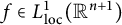 and
$\lambda \in (0,\infty )$
 . From Corollary 3.5, we infer that there exists
$\delta _0\in (0,\infty )$
 such that
$(u,v)\in A_{r,q+\delta }^+(\gamma )$
 for any
$\delta \in (0,\delta _0)$
 . Choose
$\epsilon \in (0,\min \{\beta ,\,1-\beta \})$
 such that

and let
$q_1,q_2\in (1,\infty )$
 satisfy

Then
$1<q_1<q<q_2<q+\delta _0<\infty $
 . Applying Lemma 5.4 and (4.31), we find that there exists a positive constant C, depending only on n, p,
$\gamma $
 ,
$\beta $
 , and
$\epsilon $
 , such that

and hence

On the one hand, according to the proven conclusion that
$q_1<q$
 , Proposition 2.3(ii), and Corollary 3.3(i), we obtain
$(u,v)\in TA_{r,q_1}^+(\frac {\gamma ^2}{4})$
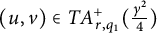 , which, together with (5.7) and Theorem 4.1, further implies that there exists a positive constant
$K_1$
 , depending only on n, p, r, q,
$\beta $
 ,
$\epsilon $
 , and
$[u,v]_{TA_{r,q_1}^+(\frac {\gamma ^2}{4})}$
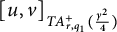 , such that

On the other hand, from the proven conclusions that
$q<q_2<q+\delta _0$
 and
$(u,v)\in TA_{r,q+\delta }^+(\gamma )$
 for any
$\delta \in (0,\delta _0)$
 and from Corollary 3.3(i), it follows that
$(u,v)\in TA_{r,q_2}^+(\frac {\gamma ^2}{4})$
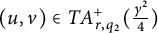 , which, combined with (5.7) and Theorem 4.1, further implies that there exists a positive constant
$K_2$
 , depending only on n, p, r, q,
$\beta $
 ,
$\epsilon $
 , and
$[u,v]_{TA_{r,q_1}^+(\frac {\gamma ^2}{4})}$
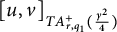 , such that

By this, (5.8), and (5.9), we find that

Taking the supremum over all
$\lambda \in (0,\infty )$
 , we then conclude that (5.5) holds. This finishes the proof of the necessity and hence Theorem 5.5.
For any given
$q\in [1,\infty )$
 , let
$A_{1,q}^+(\gamma )$
 be the set of all nonnegative functions
$\omega $
 on
$\mathbb {R}^{n+1}$
 such that
$[\omega ]_{A_{1,q}^+(\gamma )}:= [\omega ^{\frac 1q},\omega ^{\frac 1q}] _{TA_{1,q}^+(\gamma )}<\infty $
 . The following is a direct consequence of Theorem 5.5 when both
$u=v$
 and
$r=1$
 ; we omit the details.
Corollary 5.6 Let
$\gamma \in (0,1)$
 ,
$q\in (1,\infty )$
 ,
$\beta :=1-\frac {1}{q}$
 , and
$\omega $
 be a weight on
$\mathbb {R}^{n+1}$
 . Then
$\omega \in A_{1,q}^+(\gamma )$
 if and only if
$I_\beta ^{\gamma +}$
 is bounded from
$L^1(\mathbb {R}^{n+1},\omega )$
 to
$L^{q,\infty }(\mathbb {R}^{n+1},\omega ^q)$
 .
The second main result of this section is the following strong-type parabolic weighted inequalities for parabolic fractional integrals with time lag.
Theorem 5.7 Let
$\gamma ,\beta \in (0,1)$
 ,
$1<r<q<\infty $
 ,
$\beta =\frac {1}{r}-\frac {1}{q}$
 , and
$\omega $
 be a weight on
$\mathbb {R}^{n+1}$
 . Then
$\omega \in A_{r,q}^+(\gamma )$
 if and only if
$I^{\gamma +}_\beta $
 is bounded from
$L^r(\mathbb {R}^{n+1},\omega ^r)$
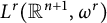 to
$L^q(\mathbb {R}^{n+1},\omega ^q)$
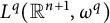 .
Proof To show the sufficiency, assume that
$I^{\gamma +}_\beta $
 is bounded from
$L^r(\mathbb {R}^{n+1},\omega ^r)$
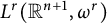 to
$L^q(\mathbb {R}^{n+1},\omega ^q)$
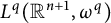 . Then, by Lemma 5.3, we find that
$\mathcal {M}^{\gamma +}_\beta $
 is bounded from
$L^r(\mathbb {R}^{n+1},\omega ^r)$
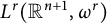 to
$L^q(\mathbb {R}^{n+1},\omega ^q)$
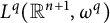 , which, together with Corollary 4.9, implies that
$\omega \in A_{r,q}^+(\gamma )$
 . This finishes the proof of the sufficiency.
Now, we prove the necessity. Assume that
$\omega \in A_{r,q}^+(\gamma )$
 . Using Corollary 3.5, we conclude that there exists
$\delta _0\in (0,\infty )$
 such that
$\omega \in A_{r,q+\delta }^+(\gamma )$
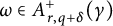 for any
$\delta \in (0,\delta _0)$
 . Fix
$\epsilon \in (0,\min \{\beta ,1-\beta \})$
 such that (5.6) holds and let
$q_1,q_2\in (1,\infty )$
 satisfy (5.7). Then
$1<q_1<q<q_2<q+\delta _0<\infty $
 and

From this, Lemma 5.4, and the Hölder inequality, we infer that, for any
$f\in L^r(\mathbb {R}^{n+1},\omega ^r)$
 ,

To estimate
$\mathrm {I}$
 , by the fact that
$q_1<q$
 and Proposition 2.3(ii), we find that
$\omega \in A_{r,q_1}^+(\gamma )$
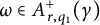 . From this, (5.7), and Corollary 4.9, we deduce that

To estimate
$\mathrm {II}$
 , by the proven conclusions that
$q_2-q\in (0,\delta _0)$
 and
$\omega \in A_{r,q+\delta }^+(\gamma )$
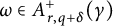 for any
$\delta \in (0,\delta _0)$
 , we obtain
$\omega \in A_{r,q_2}^+(\gamma )$
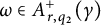 . From this, (5.7), and Corollary 4.9, it follows that

Combining this, (5.11), and (5.10), we find that
$I^{\gamma +}_{\beta }$
 is bounded from
$L^r(\mathbb {R}^{n+1},\omega ^r)$
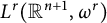 to
$L^q(\mathbb {R}^{n+1},\omega ^q)$
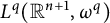 , which completes the proof of the necessity and hence Theorem 5.7.
The following theorem is a direct consequence of Corollary 3.3(i) and Theorems 4.1 and 5.5; we omit the details.
Theorem 5.8 Let
$\beta \in (0,1)$
 and
$1\leq r<q<\infty $
 satisfy
$\beta =\frac {1}{r}-\frac {1}{q}$
 . Let
$\{\gamma _i\}_{i=1}^3$
 be a sequence of
$(0,1)$
 and
$(u,v)$
 be a pair of nonnegative functions on
$\mathbb {R}^{n+1}$
 . Assume that
$u\in A_\infty ^+(\gamma )$
 . Then the following statements are mutually equivalent.
-
(i) $(u,v)\in TA_{r,q}^+(\gamma _1)$
. -
(ii) ${M}^{\gamma _2+}_\beta $
is bounded from
$L^r(\mathbb {R}^{n+1},v^r)$
to
$L^{q,\infty }(\mathbb {R}^{n+1},u^q)$
. -
(iii) $I^{\gamma _3+}_\beta $
is bounded from
$L^r(\mathbb {R}^{n+1},v^r)$
to
$L^{q,\infty }(\mathbb {R}^{n+1},u^q)$
.


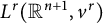


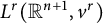

Remark 5.9 When
$r\in (1,\infty )$
 , if we replace the uncentered fractional maximal operator
${M}^{\gamma _2+}_\beta $
 in Theorem 5.8(ii) by the centered fractional maximal operator
$\mathcal {M}^{\gamma _2+}_\beta $
 , then Theorem 5.8 still holds.
The following theorem is a direct consequence of Theorems 4.1, 4.7(i), 5.5, and 5.7 and Corollaries 3.3(i), 4.4, and 4.9; we omit the details.
Theorem 5.10 Let
$\beta \in (0,1)$
 and
$1<r<q<\infty $
 satisfy
$\beta =\frac {1}{r}-\frac {1}{q}$
 . Let
$\{\gamma _i\}_{i=1}^7$
 be a sequence of
$(0,1)$
 and
$\omega $
 be a weight on
$\mathbb {R}^{n+1}$
 . Then the following statements are mutually equivalent.
-
(i) $\omega \in A_{r,q}^+(\gamma _1)$
. -
(ii) $M^{\gamma _2+}_\beta $
is bounded from
$L^r(\mathbb {R}^{n+1},\omega ^r)$
to
$L^{q,\infty }(\mathbb {R}^{n+1},\omega ^q)$
. -
(iii) $M^{\gamma _3+}_\beta $
is bounded from
$L^r(\mathbb {R}^{n+1},\omega ^r)$
to
$L^{q}(\mathbb {R}^{n+1},\omega ^q)$
. -
(iv) $\mathcal {M}^{\gamma _4+}_\beta $
is bounded from
$L^r(\mathbb {R}^{n+1},\omega ^r)$
to
$L^{q,\infty }(\mathbb {R}^{n+1},\omega ^q)$
. -
(v) $\mathcal {M}^{\gamma _5+}_\beta $
is bounded from
$L^r(\mathbb {R}^{n+1},\omega ^r)$
to
$L^{q}(\mathbb {R}^{n+1},\omega ^q)$
. -
(vi) $I^{\gamma _6+}_\beta $
is bounded from
$L^r(\mathbb {R}^{n+1},\omega ^r)$
to
$L^{q,\infty }(\mathbb {R}^{n+1},\omega ^q)$
. -
(vii) $I^{\gamma _7+}_\beta $
is bounded from
$L^r(\mathbb {R}^{n+1},\omega ^r)$
to
$L^q(\mathbb {R}^{n+1},\omega ^q)$
.
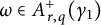

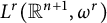


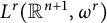
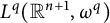

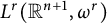


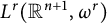
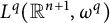

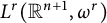


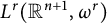
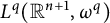
6 Applications to parabolic weighted Sobolev embeddings
In this section, we establish the weighted boundedness of the parabolic Riesz potentials and the parabolic Bessel potentials in [Reference Aliev and Rubin4, Reference Aliev and Rubin5, Reference Gopala Rao33] for some special parabolic Muckenhoupt weights. Then we apply the results to show the corresponding parabolic Sobolev embeddings.
Let
$p\in [2,\infty )$
 and
$\beta \in (0,n+p)$
 . For any
$(x,t)\in \mathbb {R}^{n+1}$
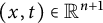 , let

As noted in [Reference Kinnunen, Myyryläinen and Yang47],
$h_p$
 is a solution of the doubly nonlinear parabolic partial differential equation (1.3) in
$\mathbb {R}^{n+1}_+$
 . In particular, if
$p=\beta =2$
 , then
$h_2$
 is the fundamental solution of the heat equation
$\frac {\partial u}{\partial t}-\Delta u=0$
 in
$\mathbb {R}^{n+1}_+$
 . Notice that, for any given
$\gamma \in (0,1)$
 and for any
$(y,s)\in \bigcup _{L\in (0,\infty )}R(\mathbf {0},0,L)^+(\gamma )$
 ,

with the positive equivalence constants depending only on n, p,
$\gamma $
 , and
$\beta $
 , where

Let
$\gamma \in [0,1)$
 . The parabolic Riesz potential
$\mathcal {I}^{\gamma +}_\beta $
 with time lag is defined by setting, for any
$f\in L_{\mathrm {loc}}^1(\mathbb {R}^{n+1})$
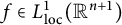 and
$(x,t)\in \mathbb {R}^{n+1}$
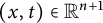 ,

According to (6.1) and Theorem 5.7, we easily obtain the following proposition.
Proposition 6.1 Let
$p\in [2,\infty )$
 ,
$\gamma \in (0,1)$
 ,
$\beta \in (0,n+p)$
 ,
$1<r<q<\infty $
 with

and
$\omega $
 be a weight on
$\mathbb {R}^{n+1}$
 . Then
$\omega \in A_{r,q}^+(\gamma )$
 if and only if
$\mathcal {I}^{\gamma +}_\beta $
 is bounded from
$L^r(\mathbb {R}^{n+1},\omega ^r)$
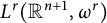 to
$L^q(\mathbb {R}^{n+1},\omega ^q)$
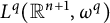 .
For any measurable functions
$f,g$
 on
$\mathbb {R}^{n+1}$
 , the convolution
$f*g$
 of f and g is defined by setting, for any
$(x,t)\in \mathbb {R}^{n+1}$
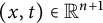 ,

Recall that, for any
$\beta \in (0,n+p)$
 and
$f\in L_{\mathrm {loc}}^1(\mathbb {R}^{n+1})$
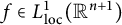 , the parabolic Riesz potential
$h_\beta *f$
 of f coincides with
$\mathcal {I}_\beta ^{0+}(f)$
 . It was proved in [Reference Gopala Rao33] (see also [Reference Aliev and Rubin4, Reference Aliev and Rubin5]) that, for any
$1\leq r<q<\infty $
 satisfying (6.2),
$\mathcal {I}_\beta ^{0+}$
 is bounded from
$L^r(\mathbb {R}^{n+1})$
 to
$L^q(\mathbb {R}^{n+1})$
 if
$r\in (1,\infty )$
 and is bounded from
$L^r(\mathbb {R}^{n+1})$
 to
$L^{q,\infty }(\mathbb {R}^{n+1})$
 if
$r=1$
 .
Next, we consider the parabolic weighted boundedness of the parabolic Riesz potential operator
$\mathcal {I}_\beta ^{0+}$
 . Observe that, for any
$\gamma \in (0,1)$
 ,
$\beta \in (0,n+p)$
 , and
$f\in L_{\mathrm {loc}}^1(\mathbb {R}^{n+1})$
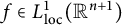 ,
$\mathcal {I}_\beta ^{0+}(|f|)\geq \mathcal {I}_\beta ^{\gamma +}(|f|)$
 , which, together with Proposition 6.1, further implies the following proposition.
Proposition 6.2 Let
$p\in [2,\infty )$
 ,
$\gamma \in (0,1)$
 ,
$\beta \in (0,n+p)$
 ,
$1<r<q<\infty $
 satisfy (6.2), and
$\omega $
 be a weight on
$\mathbb {R}^{n+1}$
 . If the parabolic Riesz potential operator
$\mathcal {I}_\beta ^{0+}$
 is bounded from
$L^r(\mathbb {R}^{n+1},\omega ^r)$
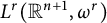 to
$L^q(\mathbb {R}^{n+1},\omega ^q)$
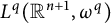 , then
$\omega \in A_{r,q}^+(\gamma )$
 .
Remark 6.3 Let p,
$\gamma $
 ,
$\beta $
 , r, q, and
$\omega $
 be the same as in Proposition 6.2. An interesting question is whether or not the converse of Proposition 6.2 holds, that is, whether or not
$\omega \in A_{r,q}^+(\gamma )$
 implies that
$\mathcal {I}_\beta ^{0+}$
 is bounded from
$L^r(\mathbb {R}^{n+1},\omega ^r)$
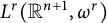 to
$L^q(\mathbb {R}^{n+1},\omega ^q)$
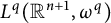 .
Let
$1<r\leq q<\infty $
 . Recall that, for any given
$E\subset \mathbb {R}$
 , the one-sided off-diagonal Muckenhoupt class
$A_{r,q}^+(E)$
 is defined to be the set of all nonnegative locally integrable functions
$\omega $
 on E such that

is finite; see, for example, [Reference Andersen and Sawyer6, equation (1.5)] when
$E:=(0,\infty )$
 . It can be easily verified that, if
$\omega \in A_{r,q}^+(\mathbb {R})$
 , then, for any
$\gamma \in (0,1)$
 ,

with the implicit positive constant depending only on
$\gamma $
 , r, and q. Note that the off-diagonal Muckenhoupt class
$A_{r,q}(\mathbb {R}^n)$
 is defined in (1.5). We provide a partial answer to the question in Remark 6.3 as follows.
Theorem 6.4 Let
$p\in [2,\infty )$
 ,
$\beta \in (0,n+p)$
 ,
$1<r<q<\infty $
 with

and
$\omega $
 be a weight on
$\mathbb {R}^{n+1}$
 . Let
$u\in A_{r,q}(\mathbb {R}^n)$
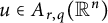 ,
$v\in A_{r,q}^+(\mathbb {R})$
 , and, for any
$(x,t)\in \mathbb {R}^{n+1}$
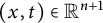 ,
$\omega (x,t)=u(x)v(t)$
 . Then the parabolic Riesz potential
$\mathcal {I}_\beta ^{0+}$
 is bounded from
$L^r(\mathbb {R}^{n+1},\omega ^r)$
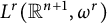 to
$L^q(\mathbb {R}^{n+1},\omega ^q)$
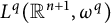 .
Proof Fix
$\gamma \in (0,1)$
 and
$f\in L^r(\mathbb {R}^{n+1}, \omega ^r)$
 . From the self-improving property of
$A_{r,q}(\mathbb {R}^n)$
 (see, for example, [Reference Lu, Ding and Yan60, Lemma 3.4.2]), we deduce that there exists
$\delta _0\in (0,\infty )$
 , depending only on n, r, q, and
$[u]_{A_{r,q}(\mathbb {R}^n)}$
 , such that, for any
$\delta \in (0,\delta _0)$
 ,
$u\in A_{r,q+\delta }(\mathbb {R}^n)$
 . Choose
$\epsilon \in (0,\min \{\widetilde {\beta },\, 1-\widetilde {\beta }\})$
 such that

and let
$q_1,q_2\in (0,\infty )$
 satisfy

Then
$1<q_1<q<q_2<q+\delta _0<\infty $
 . Therefore,
$u\in A_{r,q_2}(\mathbb {R}^n)$
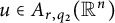 . On the other hand, by the Hölder inequality, we conclude that
$u\in A_{r,q_1}(\mathbb {R}^n)$
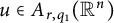 . Combining these and (6.3), we find that, for any
$\rho \in (0,\gamma ]$
 ,

For any
$j\in \mathbb {Z}_+$
 , define

From Remark 5.2, it follows that, for any
$j\in \mathbb {N}$
 and
$(y,s)\in \Omega _j\setminus \Omega _{j-1}$
 ,

and hence

which, together with the monotone convergence theorem and (6.1), further implies that, for any
$(x,t)\in \mathbb {R}^{n+1}$
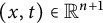 ,

Combining this, (6.4), and Theorem 5.7, we conclude that, to show that
$\mathcal {I}_\beta ^{0+}$
 is bounded from
$L^r(\mathbb {R}^{n+1},\omega ^r)$
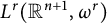 to
$L^q(\mathbb {R}^{n+1},\omega ^q)$
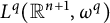 , it suffices to prove that there exists a positive constant C, independent of f, such that

To show (6.6), fix
$j\in \mathbb {N}$
 . From an argument similar to that used in the proof of Lemma 5.4 with
$\gamma $
 therein replaced by
$\frac {\gamma }{2^j}$
 , we infer that, for any
$(x,t)\in \mathbb {R}^{n+1}$
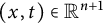 ,

which, together with the Hölder inequality and an argument similar to that used in the proof of (4.31), further implies that

Applying (6.4) and an argument similar to that used in the proof of Corollary 4.4, we find that there exists a positive constant
$C_1$
 , depending only on n, p,
$\gamma $
 , r, q,
$[u]_{A_{r,q}(\mathbb {R}^n)}$
 , and
$[v]_{A_{r,q}^+(\mathbb {R})}$
 , such that
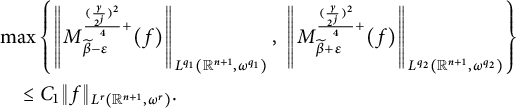
Combining this and (6.7), we obtain

where the implicit positive constant is independent of f and j. From this and (6.7), we deduce that

and hence (6.6) holds, which completes the proof of Theorem 6.4.
Remark 6.5
-
(i) Theorem 6.4 when $\omega \equiv 1$
coincides with [Reference Gopala Rao33, Theorem 3.1] . -
(ii) For any given $E\subset \mathbb {R}^{n+1}$
and
$1<r<q<\infty $
, define
$\mathcal {A}_{r,q}(E)$
to be the set of all nonnegative locally integrable functions
$\omega $
on E such that Obviously, $\mathcal {A}_{r,q}(\mathbb {R}^{n+1})\subset A_{r,q}^+(\mathbb {R}^{n+1})$
. By (6.5), the fact that
$(\mathbb {R}^{n+1},d_p,|\cdot |)$
is a space of homogeneous type, and the weighted boundedness of fractional integrals on spaces of homogeneous type (see, for example, [Reference Kairema43, Theorem 3.3]), we conclude that, if we replace the condition that there exist
$u\in A_{r,q}(\mathbb {R}^n)$
and
$v\in A_{r,q}^+(\mathbb {R})$
satisfying
$\omega (x,t)=u(x)v(t)$
by
$\omega \in \mathcal {A}_{r,q}(\mathbb {R}^{n+1})$
, then the conclusion of Theorem 6.4 still holds, that is, both
$\mathcal {I}_\beta ^{0+}$
and
$\mathcal {G}_\beta ^{0+}$
are bounded from
$L^r(\mathbb {R}^{n+1},\omega ^r)$
to
$L^q(\mathbb {R}^{n+1},\omega ^q)$
.






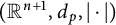
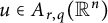





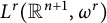
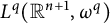
In what follows, we fix
$p=2$
 . Let
$\beta \in (0,n+2)$
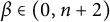 ,
$q\in [1,\infty )$
 , and
$\omega $
 be a weight on
$\mathbb {R}^{n+1}$
 . The weighted parabolic Sobolev space
$W^{\beta ,q}(\mathbb {R}^{n+1},\omega )$
 is defined by setting

For any
$f\in W^{\beta ,q}(\mathbb {R}^{n+1},\omega )$
 , define
$\|f\|_{W^{\beta ,q}(\mathbb {R}^{n+1},\omega )} :=\|g\|_{L^q(\mathbb {R}^{n+1},\omega )}$
 , where
$g\in L^q(\mathbb {R}^{n+1},\omega )$
 satisfying that
$f=h_\beta *g$
 . Theorem 6.4 and Remark 6.5(ii) immediately imply the following parabolic weighted Sobolev embedding result and we omit the details.
Corollary 6.6 Let
$\beta \in (0,n+2)$
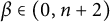 ,
$1<r<q<\infty $
 with
$\frac {1}{r}-\frac {1}{q}=\frac {\beta }{n+2}$
 , and
$\omega $
 be a weight on
$\mathbb {R}^{n+1}$
 . If either of the following two conditions holds:
-
(i) there exist $u\in A_{r,q}(\mathbb {R}^n)$
and
$v\in A_{r,q}^+(\mathbb {R})$
such that
$\omega (x,t)=u(x)v(t)$
; -
(ii) $\omega \in \mathcal {A}_{r,q}(\mathbb {R}^{n+1})$
,
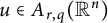



then
$W^{\beta ,r}(\mathbb {R}^{n+1},\omega ^r)\subset L^q(\mathbb {R}^{n+1},\omega ^q)$
 . Moreover, there exists a positive constant C such that, for any
$f\in W^{\beta ,r}(\mathbb {R}^{n+1},\omega ^r)$
 ,

We denote by
$\mathcal {S}(\mathbb {R}^{n+1})$
 the space of all Schwartz functions on
$\mathbb {R}^{n+1}$
 equipped with a well-known topology determined by a countable family of norms and by
$\mathcal {S}'(\mathbb {R}^{n+1})$
 the space of all tempered distributions endowed with the weak-
$*$
 topology. In addition, let
$\mathcal {S}'(\mathbb {R}^{n+1}_+):= \mathcal {S}'(\mathbb {R}^{n+1})|_{\mathbb {R}^{n+1}_+}$
 , that is, the restriction of
$\mathcal {S}'(\mathbb {R}^{n+1})$
 on
$\mathbb {R}^{n+1}_+$
 . Using both the Fourier transform formula of
$h_\beta $
 with
$\beta \in (0,n+2)$
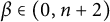 (see [Reference Gopala Rao33, equation (2.4)]) and several elementary properties of the Fourier transform and replacing
$\omega $
 and f, respectively, by
$\omega (x,t)\boldsymbol {1}_{(0,\infty )}(t)$
 and
$f(x,t)\boldsymbol {1}_{(0,\infty )}(t)$
 in Theorem 6.4 and Remark 6.5(ii), we obtain the following application of Theorem 6.4, which presents a priori estimate for the nonhomogeneous heat equations. We omit the details.
Corollary 6.7 Let
$1<r<q<\infty $
 with
$\frac {1}{r}-\frac {1}{q}= \frac {2}{n+2}$
 ,
$\omega $
 be a weight on
$\mathbb {R}^{n+1}_+$
 , and
$f\in L^r(\mathbb {R}^{n+1}_+,\omega ^r)$
 . If either of the following two conditions holds:
-
(i) there exist $u\in A_{r,q}(\mathbb {R}^n)$
and
$v\in A_{r,q}^+(\mathbb {R}_+)$
such that
$\omega (x,t)=u(x)v(t)$
, -
(ii) $\omega \in \mathcal {A}_{r,q} (\mathbb {R}^{n+1}_+)$
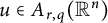
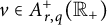


and if
$g\in \mathcal {S}'(\mathbb {R}^{n+1}_+) \cap L^1_{\mathrm {loc}}(\mathbb {R}^{n+1}_+)$
 satisfies

then
$g\in L^q(\mathbb {R}^{n+1}_+,\omega ^q)$
 . Moreover, there exists a positive constant C such that

Acknowledgements
After this article was finished, we found that Cruz-Uribe and Myyryläinen [Reference Cruz-Uribe and Myyryläinen24] simultaneously also introduced the off-diagonal parabolic Muckenhoupt class with time lag and studied the two-weighted boundedness of the centered parabolic fractional maximal operator with time lag. Except the definition and its two basic properties of the off-diagonal parabolic Muckenhoupt class with time lag, both articles have no substantial overlap. Weiyi Kong and Chenfeng Zhu would like to thank Professor Sibei Yang for some helpful discussions and suggestions on Section 6 of this article.



