With the imminent takeover of Beiping (later Beijing) by the People's Liberation Army, the North China People's Government, which had been established by the Chinese Communist Party (CCP), announced a ban on the activities of popular sects and secret societies on 4 January 1949:
Secret societies and superstitious sects (huimen daomen 会门道门) are not only feudal, superstitious organizations; they are also frequently controlled by reactionaries to conduct various antirevolutionary activities. During the previous War of Resistance against Japan and the current War of Liberation, they caused great harm, spying for enemies, for example, and gathering military intelligence, spreading rumours, misleading people, even staging armed uprisings, seriously disrupting the social order … Starting today, all secret societies and superstitious sects will be disbanded and no further activities allowed.Footnote 1
Attacks on “secret societies and superstitious sects” became even more pronounced and specific after the founding of the People's Republic of China (PRC). On 25 September 1950 the CCP North-west Bureau issued a directive to launch a campaign to eliminate “the activities of the Unity Sect (Yiguandao一贯道),” one of the most influential sects in north China and perceived as a major threat to the new government.Footnote 2
The official assault against heretical sects and secret societies was by no means a novelty. It is well known that sectarian religions and lay Buddhist associations thrived in traditional China, especially in times of dynastic change and social upheavals.Footnote 3 These religious sects, often censured by officials as “evil cults” (xiejiao 邪教) – particularly those espousing millenarian ideologies and messianic promises aimed at setting up new political orders – were viewed with great suspicion by the authorities, who feared they could form subversive, sometimes military, opposition to the regime and gravely disrupt the established political structure. The famous White Lotus Rebellion in the Qing dynasty is one example.Footnote 4 But the anti-Unity Sect campaign in the early days of the PRC is more than simply the familiar contention between the state and sectarianism. It also raises fundamental questions about the violent means the new regime used to bring about stability and its efforts to consolidate its legitimacy by mobilizing the masses in whose name it proposed to rule.
The Communists' prohibition against the Unity Sect has previously drawn the attention of scholars,Footnote 5 and recently the Campaign to Suppress Counterrevolutionaries (zhenya fangeming 镇压反革命, or the zhenfan 镇反 campaign) has also generated considerable interest.Footnote 6 The nature and implementation of the anti-Unity Sect campaign, however, has seldom been explored. This article argues that the anti-sect crusade that began in early 1949 paved the way for the subsequent, even more violent zhenfan campaign that was officially announced in July 1950 by the State Administrative Council (forerunner of the State Council) and the Supreme People's Court.Footnote 7 The CCP Central Committee's ensuing “Directive on the Suppression of Counterrevolutionary Activities” (or the “Double-ten Directive”), issued on 10 October 1950, signalled the Party's most authoritative endorsement of the campaign.Footnote 8 Clearly the anti-Unity Sect drive and the zhenfan movement were informed by the same political ideology and used similar strategies adopted by the government. However, the new archival sources and hitherto untapped governmental documents reveal a far more complicated picture of how the anti-sect campaign was actually waged. The entire campaign, conducted through a series of propaganda devices, was never simply a predictable policy against a religious sect mounted by an atheistic Communist Party. More importantly, it was a mass mobilization movement conducted by violent means to consolidate Party rule. Similar techniques would be applied in subsequent political movements, such as in the case of the Resist America and Aid Korea campaign.
The Threat
The Unity Sect, founded by Wang Jueyi 王觉一, first appeared in the late Qing but claimed that its doctrines were passed down by secret means from earlier times, especially after the Ming.Footnote 9 A complex and syncretic religion, distinctive in its esoteric teachings, the sect incorporates doctrines from Confucianism, Taoism and Buddhism, with influences from Christianity and Islam. Although espousing extremely diverse doctrines, the sect's core teachings, as Daniel Overmyer points out, centre on the Eternal Mother–Maitreya mythology. This proclaims that the world will soon descend into chaos as the last phase of the three kalpas – past, present and future – approaches. As the supreme deity of boundless compassion, the Eternal Mother sends Maitreya, the Buddha of the Future, and other saints to rescue people in crisis and persuade them to join the Unity Sect in order to avoid disasters.Footnote 10
Documents reveal that Wang Jueyi began to propagate the Unity Sect in the mid 19th century.Footnote 11 The sect gained wide acceptance in the early decades of the 20th century, when its charismatic and enigmatic leader, Zhang Guangbi 张光璧, also known as Zhang Tianran 张天然, spread his teachings extensively in north China, especially in the Tianjin area. During the War of Resistance against Japan, Zhang, a skilful patriarch, managed to work under the blessing of the Japanese occupiers. He once held a low-level position in Wang Jingwei's puppet government in Nanjing and attracted a number of high officials in Wang's administration to join the sect.Footnote 12 Zhang was arrested after the war ended for collaborating with the enemy,Footnote 13 and this greatly tarnished his reputation.Footnote 14 He died in 1947. After the victory over Japan, the Nationalist government banned all secret societies in 1946, especially the Unity Sect. But taking advantage of the sect's popularity among the populace, the government converted it into a charitable society known as the China Moral Philanthropic Association (Zhonghua daode cishanhui 中华道德慈善会) and maintained a tie with it. Later, this connection prompted the Communists to accuse the sect of falling “completely under the control of the Kuomintang spy network.”Footnote 15 With the impending victory of the Communists at the close of China's civil war, the sect warned in its planchette writings of the coming of the last kalpa. Many of its leaders fled the country, taking refuge in Taiwan and Hong Kong.Footnote 16
In 1951 Mao Zedong underscored the general importance of the Campaign to Suppress Counterrevolutionaries when he wrote: “The campaign is a great struggle. [Our] political power cannot be consolidated until this crusade is done well.”Footnote 17 But who were the counterrevolutionaries (fangeming 反革命)? And why were the sect members labelled counterrevolutionaries? The Common Programme, adopted by the Chinese People's Political Consultative Conference on 29 September 1949, raised the issue of counterrevolutionaries: “The People's Republic of China shall suppress all counterrevolutionary activities, severely punish all Kuomintang counterrevolutionary war criminals and other incorrigible counterrevolutionary elements who collaborate with imperialism, commit treason against the fatherland, and oppose the cause of the people's democracy.”Footnote 18 This rather vague description was clarified in a subsequent document, “Rules to Punish Counterrevolutionaries.” Issued by the government on 21 February 1951, it named as counterrevolutionaries, “traitors who conspired with imperialists, armed rebels, anti-revolutionary spies,” and those who “used feudal sects to conduct anti-revolutionary activities.”Footnote 19 However, the concept of a counterrevolution remains nebulous. It can be read as a Chinese Communist catch-all and ideological construct lumping together the Party's adversaries, including the hated unauthorized religious groups.
Without question, the new regime viewed the Unity Sect with great apprehension, hatred and fear. Several features of this mysterious religious group worried them deeply. First, the sect was exceedingly popular in north China. A 1950 New China News Agency internal circular announced that the sect was well entrenched in northern provinces such as Gansu.Footnote 20 In Suiyuan about 300,000 people, 11 per cent of the entire population, were sect members.Footnote 21 The situation was even worse in Hebei, especially in the vicinity of Beijing, where 15 per cent of the rural population were found to be involved in various sects, mostly affiliated with the Unity Sect.Footnote 22
Second, the sect was rapidly spreading, especially after the Communist takeover in 1949, a phenomenon consistent with the thriving of sectarian groups during dynastic transitions and sociopolitical uncertainties in traditional times. In September 1950 the North-west Bureau issued a report, warning that the sect was “spreading fast in Shaanxi, Gansu and Ningxia provinces.” In some locations, the report added, “peasants in the entire village were sect members.”Footnote 23
Third, like other popular sects, the Unity Sect's esoteric practices often made sect members difficult to detect, and hence unpredictable and dangerous in the eyes of the authorities. According to Beijing's Public Security Bureau chief, Feng Jiping 冯基平 (1911–83), they were “invisible enemies.”Footnote 24
Fourth, the government discovered that many comrades, including local Party chiefs and members of the Youth Leagues, had joined the sect, seriously destabilizing the Party.Footnote 25 In one Beijing district alone, 23 per cent of the police force were discovered to be Unity Sect members.Footnote 26 Even more alarming, an internal security check uncovered that “about 1,100 members of Beijing's Public Security Bureau had joined the sect.”Footnote 27
Finally, the sect was anti-communist. According to the Communists, the sect fabricated rumours that the arrival of the Red Army was tantamount to “sharing property and wives” (gongchan gongqi 共产共妻), grossly distorting the ideal of collectivism.Footnote 28 The sect also undermined the Communists' land reform programmesFootnote 29; worse still, evidence indicated that the group had forged close ties with anti-government forces. Hangzhou's Public Security Bureau concluded that the Unity Sect was under the control of American imperialism and the Kuomintang, and intended to wreak havoc in China.Footnote 30 With the outbreak of the Korean War in 1950 Chinese Communists charged that the Unity Sect leaders were spreading rumours of an approaching Third World War in which the CCP would lose its control over China, and thus the sect was maliciously subverting the nation's stability and erroneously creating, in the officials' words, an “America-phobia mentality” (kong mei xinli 恐美心理) among the populace.Footnote 31 In 1950 the Ministry of Public Security described the Unity Sect as “the biggest counterrevolutionary organization” and one that needed to be crushed.Footnote 32 Luo Ruiqing 罗瑞卿 (1906–78), Minister of Public Security, insisted that the anti-sect drive was at the core of the entire zhenfan movement. “Doing everything right,” he said, “led to the complete success of the campaign.”Footnote 33
The Suppression
Initially the government ferreted out the background of the Unity Sect. Mao commended the officials in Shanxi province for a job well done. It was there that local administrators conducted a year-long survey of the activities of the Unity Sect from 1949 to 1950, before making a successful move against sect leaders. Within a few days, key organizers were arrested and incarcerated.Footnote 34 The Beijing experience was also successful, providing a model for other cities to follow. The Beijing municipal authorities conducted a series of clandestine, systematic surveys of the sect's activities in villages near the capital, collecting, in the words of the officials, “criminal operation records” to “get the situation under control.” The number of sect members in this region was reported to be at a staggering 100,000, with 2,432 core members.Footnote 35
Originally the official policy was to “prosecute the leaders, ask no questions about the followers, and reward those who render service,” a strategy combining suppression with leniency according to the general principles laid down in the Common Programme.Footnote 36 The security forces first arrested senior leaders ranking from Grand Master (shizun 师尊) to the mid-level senior instructors (dianchuanshi点传师) in a hierarchy of nine ranks.Footnote 37 They then registered the junior leaders and encouraged rank-and-file followers to withdraw from the sect, a process commonly known as tuidao (“sect withdrawal,” 退道). Efforts were also made by local police to dismantle the sect's networks. In only a few months, from late 1950 to early 1951, more than 90,000 sect members in the Beijing area left the organization.Footnote 38 The government promised that once members relinquished their ties with the sect, abandoned religious practices and halted unauthorized gatherings, no further questions would be asked. In addition, ordinary followers were asked to become informers, developing a network to unmask and denounce their former leaders, “revealing their deceitful acts and reclaiming money and belongings that had been improperly taken,” officials said.Footnote 39
In the early phase of the campaign, from 1949 to the mid-1950s, key sect leaders were arrested, but severe measures such as capital punishment were rarely meted out. Initially Mao warned against “excessive killing.” “This would not only lose society's trust [of the regime], it would also reduce the labour force,” he said.Footnote 40 But in the summer of 1950, after the outbreak of the Korean War, the government quickly adopted a harsher stand. The Party saw the armed confrontation with the United States as an opportunity to rally people to support the new regime in silencing dissent and fighting against Western imperialists. In December 1950 Mao called for sterner measures to crush the adversaries: “We must hit the counterrevolutionaries with firmness, precision, and ruthlessness.”Footnote 41
At this point the early actions against the sect were criticized as too lenient, inconsistent and ineffective, committing what officials called “the rightist-leaning error” that underestimated the serious threat posed by the sect. The government warned against the danger of “limitless indulgence” (kuanda wubian 宽大无边) to religious sects. This was, as the Shanghai Municipal Party called it, a “paralysis disease,” caused by judging the enemy too lightly.Footnote 42 “To be lenient to counterrevolutionaries is to be cruel to the Chinese people,” stated an editorial in the People's Daily.Footnote 43 Luo Ruiqing criticized the officials' misjudgement of the widespread influence of the Unity Sect, citing Sichuan province as an example: “Though officials calculated the number of sect leaders in all of Sichuan to be 1,077, it turned out that there were actually 6,559 in one city alone.”Footnote 44 Making matters even more difficult, leaders of the Unity Sect continually changed the name of the sect to avoid detection. It was discovered that among the 217 newly identified sects in the south-west, 146, about 67 per cent, were actually the Unity Sect using an alias.Footnote 45
The anti-sect campaign went into high gear in the second half of 1950. The Beijing Municipal Party struck on the night of 18 December 1950, the eve of the city's major official announcement of the banning of the Unity Sect. A score of sect leaders were quickly rounded up, the sect's papers seized and its property confiscated.Footnote 46 To demonstrate its firm control, the Beijing Military Control Commission executed a number of Unity Sect leaders, with much publicity. Those put to death in January 1951 included two elder organizers: Liu Xieyuan 刘燮元, allegedly a Japanese spy who later served under the Kuomintang, and Liu Xiangting 刘翔亭, who also worked under the Japanese occupation authorities during the War of Resistance.Footnote 47 On its front page the People's Daily carried the headline: “Liu Xieyuan and other reactionary sect leaders executed!”Footnote 48
The executions continued, with great fanfare. On 18 February 1951 the Beijing Military Control Commission sentenced another 31 sect leaders to death, along with 27 Kuomintang spies. “On the same day they were tied up, sent to the locations where their crimes were committed, and then shot,” reported the Enlightenment Daily.Footnote 49 In March 1951 another 199 counterrevolutionaries were shot, including a certain Wang Tingshu 王廷枢. According to the government, Wang, a Unity Sect leader, was “a despotic landlord” nicknamed “South Overlord” (nanbatian 南霸天) and “King of Hell” (yanwangye 阎王爷), who once arrested dozens of patriotic students and was also responsible for the suicides of many destitute peasants. After Liberation, an unrepentant Wang continued to organize his followers secretly, and “repeatedly disseminated anti-revolutionary tracts and spread seditious rumours.”Footnote 50 Meanwhile, the erstwhile sect members became informers. In Xi'an, in the summer of 1951, 113 anti-revolutionaries and spies, as well as 159 Unity Sect “accomplices,” were identified and reported to the authorities by former sect followers.Footnote 51
The state-run media began to do its work, too. To be effective, the Party realized that propaganda had to be accompanied by known faces, making the evildoers concrete and visible. Photographs of key sect leaders were prominently printed in the newspapers (“guilty of the most heinous crimes,” wrote the official press),Footnote 52 as were the lists of those executed.Footnote 53 In an important editorial in the People's Daily entitled “Determined to eliminate the Unity Sect,” published in December 1950, the authorities called upon the Chinese people to eliminate this evil sect once and for all, declaring: “This work is important to consolidate the people's democratic dictatorship.”Footnote 54
This later phase of the campaign was undoubtedly better co-ordinated and more violently executed. Different localities set up “Anti-sect Suppression Offices” to spearhead the campaign.Footnote 55 In the critical Fifth National Conference on Public Security held in October 1952, it was decided that the suppression methods must be flexible and appropriate for different locales and social contexts.Footnote 56 In September 1952, during celebrations of the third anniversary of the founding of the PRC, Luo Ruiqing announced “the great achievements” of the zhenfan movement. “In the past three years,” he said, the government “has dealt a devastating blow to a large number of remaining Kuomintang forces in China, namely, bandits, local despots, spies, counterrevolutionary associations and reactionary sects.”Footnote 57 In 1953, four-and-a-half years after the initiation of the anti-Unity Sect campaign, the government declared it a huge success.Footnote 58 The exact number of people in the zhenfan movement who were executed remains in dispute, although some scholars place it at more than 710,000.Footnote 59 Of this figure, the number associated with the Unity Sect is even harder to gauge. Luo Ruiqing, in an earlier report to the State Administrative Council in August 1951, stated that among those counterrevolutionaries executed, 7.7 per cent were “leaders of the anti-revolutionary sects and reactionary political parties.”Footnote 60 This figure is only an approximation. The real number of sect leaders executed will not be known until more archives are opened in China. Nevertheless, the Party's violent means of suppression was decisive and effective.
Mobilizing the Masses
The significance of the anti-Unity Sect campaign cannot be fully comprehended without understanding its basic nature. The Communists called the zhenfan movement one of the “three greatest mass movements” (weida de qunzhong yundong 伟大的群众运动) in the early 1950s (the others were the land reform movement and the Resist America and Aid Korea campaign).Footnote 61 The anti-Unity Sect campaign was never simply anti-religious; essentially it was a crusade to politicize the masses. Luo Ruiqing pointed this out directly. On the one hand, he said, the anti-sect movement was a crushing attack against reactionary forces in China, and, on the other, “through this fierce struggle, we gave the masses an effective political and class education.”Footnote 62 Indeed, it was this latter aspect of the mobilization of the masses and their collaboration with the state that made the suppression of the Unity Sect so significant, soon making it a model for subsequent political movements.
Certainly government-sponsored mass mobilization programmes to advance official policies and augment state power are common in modern history, as in Stalin's Stakhanovite movement in the mid-1930s.Footnote 63 What distinguishes the CCP from others, Julia Strauss contends, was its “genuine desire for popular participation.”Footnote 64 But to ensure its success, a mass mobilization campaign requires close co-operation between the initiator, in this case the new PRC government, and the enthusiastic crowds that actively participated in the process in line with state-led plans. It would be too simplistic to view the PRC, even in its early years, as a police state that imposed its will freely and dictatorially from above. Such an assumption overemphasizes the state's role while relegating the masses to passive and insignificant players. In reality, the regime required plenty of help from below to articulate and execute its policies. In the anti-Unity Sect campaign, the agitated populace indeed played an active and enthusiastic role to help realize the CCP's goals.
Many Party leaders recognized that the success of a mass mobilization campaign depended on the skilful and effective use of propaganda. Mao ordered a massive operation to drive home the government's messages to “every household” in both urban and rural areas.Footnote 65 Liu Shaoqi, in his directive to the North-west Bureau concerning the threat of the Unity Sect in October 1950, was even more specific when he ordered that “mass propaganda education” be used to counter the cult.Footnote 66
The CCP used two common tactics from the outset: portraying the Unity Sect as a politically subversive force and associating it with the exploitative class. The first strategy linked the Unity Sect with remnant Kuomintang forces in China. In a score of Muslim riots in Gansu in June 1950 allegedly involving sect members, for instance, the official media asserted that the unrest was largely planned and instigated by “[Kuomintang] spies and bandits.”Footnote 67 A Unity Sect leader in western Beijing, Zhao Ziguang 赵子光, was exposed as a Kuomintang secret agent who had brutally stifled patriotic student demonstrations in the past and was now reportedly organizing a spy network to gather intelligence for subversive operations.Footnote 68
Second, Luo Ruiqing charged that many of these sect rebels were actually people with “bad class backgrounds,”Footnote 69 invoking class to stigmatize and denounce the sect leaders. The Unity Sect leaders were said to be “mostly landlords, rich peasants and capitalists,” according to a report issued by the Beijing Municipal Party.Footnote 70 These class enemies deceived people, stole money from their followers, raped hapless female disciples and spread rumours of pandemonium, the official media charged.Footnote 71 Clearly the Communists' strategy was to convince the Chinese people that their two key enemies – the Kuomintang and landlords – were conspiring to bring chaos and suffering to the masses. The alleged link reminded the people to be keenly vigilant and exhorted them to expose this reprehensible conspiracy.
On close examination, it appears that the communist propagandists carried out the mobilization along three fronts: organization, media and public trials. In terms of organization, the government's immediate task was to train sufficient trusted cadres to eradicate the sect. From the beginning, the campaign faced a serious shortage of manpower, which was a major obstacle for the Communists in their efforts to control the region immediately after defeating the Kuomintang in 1949.Footnote 72 Beijing's Public Security Bureau had no choice but to hastily train a large number of security forces which it called, hyperbolically, “a Unity Sect Smashing Army.”Footnote 73 Other major cities did the same. In Shanghai, for example, in the early 1950s, the municipal government assembled 7,280 people to form what it termed “a propaganda network.”Footnote 74 The numbers proved woefully inadequate, however, as the propagandists were dealing with a problem of enormous magnitude and on a national scale.
In 1951 Beijing's Public Security Bureau also called on cadres at different levels to organize and mobilize “under the leadership of the Beijing Municipal Government,” in order to “resolutely suppress the Unity Sect.” Citizens in the capital were encouraged to “assist the government in reporting (jianju 检举) the sect's activities.”Footnote 75 Beijing's mayor Peng Zhen 彭真 (1902–97), a vocal advocate for the active participations of citizens in the zhenfan movement, argued that, “to suppress so many anti-revolutionaries, relying merely on our public security forces, is unimaginable … We must mobilize the masses so that thousands of eyes and hands can greatly strengthen the public security forces and thereby reduce anti-revolutionary activities.”Footnote 76
In addition to training security forces, recruiting propagandists and actively involving different government agencies in the anti-sect campaign, the government used the powerful state-sponsored media to raise political consciousness among the masses. In this effort, aural and graphic methods such as yangge dance, cartoons and serial picture stories, and radio broadcasting were vital. The Chinese Communists were well aware that it was important to couch their propaganda in simple terms to the peasants. Targeting rural audiences, the propagandists relied on yangge, a familiar folk art, as a tool. New yangge – a reformed rural dance instilled with political themes extolling the achievements of communist rule – and its accompanying short plays (known as yangge ju 秧歌剧), popular since the Yan'an era, became a political instrument to channel anti-sect messages to the villagers.Footnote 77 In Beijing, a 900-man yangge company, divided into four groups, was formed in the early days of the PRC. These folk dance teams were sent to villages near the city to disseminate government policies.Footnote 78 This use of yangge indicated the propagandists' clear intention to reach different audiences by simple and specific means. A government document contended that: “In the suburbs the audience targeted is quite different from that of the city. The principal audience there is peasants.”Footnote 79 The hope was that a well-liked, lively folk dance or play might draw more viewers and elicit a greater positive response for the official policy.
The attack against the Unity Sect was also carried out pictorially, underscoring the importance of visual propaganda in the mobilization process. By now communist artists were seasoned practitioners in the use of art and literature to serve political goals, a policy the Party had instructed them to follow since the Yan'an days, especially after Mao's famous “Yan'an talks” in 1942.Footnote 80 In 1952 a film entitled Yiguan hairen dao 一贯害人道 (“A reactionary sect,” literally “a sect that repeatedly does great harm to the people”) was made by the government-run Central Film Bureau to expose the crimes of the Unity Sect.Footnote 81 A cartoon in the People's Daily by staff cartoonist Fang Cheng 方成 portrayed Chiang Kai-shek as a Unity Sect instructor, preaching the “canon of destruction” to his devotees of different religious groups sitting around and listening to him with rapt attention. The image of conspiracy and sinister connection is again evident in this picture, telling the story of a network scheming to undermine the peace and social order established by the new regime.Footnote 82
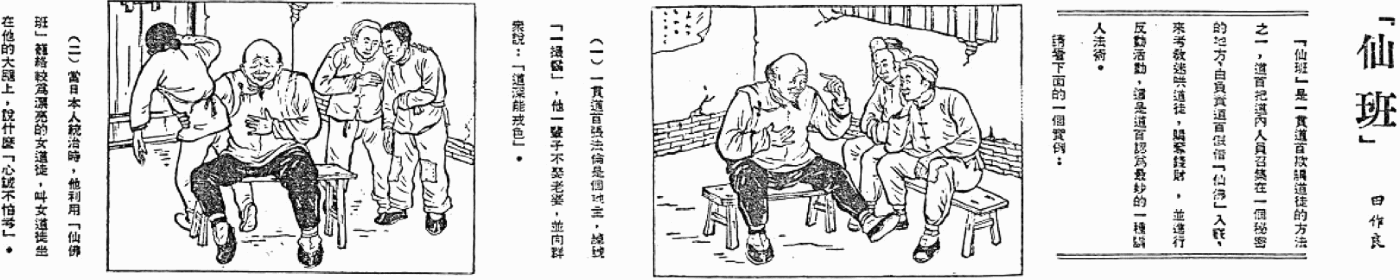
Another familiar means of communication was the use of serial picture stories (lianhuanhua 连环画), a string of consecutive pictorial narratives joined together by a theme. For a largely under-educated audience, this artistic format enjoyed great popularity among urbanites (especially in Shanghai and Tianjin) in 20th-century China. After 1949, predictably, it became another art of persuasion for the communist propagandists. Tian Zuoliang's 田作良 series, “The class of the immortals” (Xianban 仙班), is a case in point (Figure 1). Appearing in the People's Daily in May 1951, it chronicled the depraved career of the Unity Sect instructor Zhang Falun 张法伦, an unmarried landlord claiming to be Maitreya Buddha who has descended to the world to save mankind. Zhang assembles his followers in secret locations and preaches seditious ideas. In truth, Zhang misleads people, beats his followers, and defrauds them of their money and belongings. Although he advocates abstinence from sex, in reality he is a sex maniac and frequently molests young, attractive female converts. After 1949 Zhang is arrested by the police, and a search of his house unearths evidence that he has surreptitiously hidden anti-communist tracts. In the end, Zhang grudgingly confesses his “anti-revolutionary crimes.”Footnote 83
“The Class of the Immortals” Chronicles the Debauched Life of a Unity Sect Leader
In addition to pictorial assaults, radio broadcasts were also used to spread propaganda. In the early 1950s the Propaganda Bureau of the Shanghai municipal government instructed the propagandists to design special anti-sect radio programmes in order to mobilize “factory workers, local residents, to tune in.”Footnote 84 To promulgate the public trials of sect leaders, officials relied heavily on radio. In a mass trial of counterrevolutionaries in Shenyang in May 1951, for example, more than one million people reportedly listened to the trial on the radio.Footnote 85
The Communists also called upon religious leaders sympathetic to socialist causes to openly support this campaign, essentially using one religion to attack another. The renowned Buddhist leader Juzan 巨赞 (1908–84) was said to have enthusiastically endorsed the policy. “The Unity Sect has no theories or canons,” the monk stated, “but is only a feudal, reactionary organization intent on cheating and harming people.”Footnote 86 We cannot know, of course, whether Juzan genuinely supported the policy or if his statement was merely a ploy to ensure his safety. In either case, the CCP received much-needed backing when the new regime's policy was endorsed by an influential religious leader who was also a member of the People's Consultative Conference.
Chinese officials generally portrayed the followers of the Unity Sect as illiterate or ignorant commoners who had been coaxed into joining the cult, a hapless bunch with little recourse. But officials realized that these rhetorical devices would not generate maximum impact among the populace unless victims were given a face and a voice. The best strategy was to highlight the ordeals of individual sect members, even if these were carefully selected and screened by the authorities. One member named Geng Zhizhong 耿志忠, a vendor in Beijing, came forward with the story of his regrettable encounter with the sect:
Three years ago, our only son died of an illness. It was a grave blow to a 50-year-old man like me. Losing our beloved son was unbearable. It was at this time that the Unity Sect entered the picture and persuaded me to join the sect. I was told that, if I joined, I would be released from hundreds of predestined disasters and would also see my departed child again. I was a bit superstitious, so when they encouraged me I joined … Since I had no money to contribute, the sect leader suggested that, instead, I could clean the worship hall every day… I was [also] asked to persuade others to join … The sect leader told me, “Recruiting a rich convert is a thousand times better than recruiting countless commoners.” Why rich people are so superior that even deities would favour them escapes me.Footnote 87
In the end, reportedly, Geng was rescued by “a worker” (someone with the right class background) clever enough to spot the shadowy side of the religious organization. “The sect leaders have done every bad thing imaginable,” Geng said, but “now the people are the masters, and we definitely would not permit them to wreak havoc again.”Footnote 88
For the propaganda to be effective, the government had to gather physical evidence to support its criminal charges against the condemned sect. It did so by publicly exhibiting evidence and holding public trials. Of course, public exhibitions or displays were not new in the history of the CCP. During the Yan'an era, many exhibitions, such as factory production displays, were held in the communist-controlled border regions to showcase the CCP's outstanding achievements.Footnote 89 But unlike those exhibitions, which focused on the Communists' accomplishments, the anti-Unity Sect displays showcased the transgressions of an evil cult. The post-1949 shows were staged in accessible locations such as parks or in the streets. An ideal location was the popular Zhongshan Park 中山公园 near Beijing's Tiananmen Square. In mid-January 1951 the city's Security Bureau mounted an exhibition there displaying the criminal evidence against the Unity Sect to show, in the words of officials, “the evil deeds of the Unity Sect leaders and the schemes they used to deceive the people.”Footnote 90
Several exhibition rooms set up in the park were filled with four types of evidence reportedly confiscated from sect leaders. The first category was precious metals, including jewels and gold bracelets that the masters allegedly stole from their followers. Some of the treasure was said to be discovered in the possession of the patriarch Zhang Tianran, who, the exhibition organizers maintained, had amassed a hefty amount of gold extorted from his followers. The second group of items was certificates of appointment issued to sect leaders by the Kuomintang, along with pictures of the leaders alongside warlords and Chinese traitors who had worked with the Japanese occupation forces. Even American flags were on display, confirming, officials said, the disturbing connections between the sect and foreign imperialists. The third category illustrated the sect leaders' licentious lifestyles, and included luxurious household furnishings and pornographic paintings they secretly collected. Finally, there was a display of ritual texts and planchette writings that the leaders used to trick novices to join.Footnote 91 By juxtaposing these various pieces of evidence, the government showed not only that the sect masters lived a debauched life but that their political ties with the Kuomintang and foreign imperialists made them extremely dangerous. The exhibition brought in big crowds, according to the People's Daily, “with long queues lined up every day outside the park to see the show.”Footnote 92 Shanghai held similar exhibitions including movable street displays,Footnote 93 and in Guisui (now Hohhot), Suiyuan province, one exhibit opposing the Unity Sect drew 170,000 viewers in one month.Footnote 94 Local governments were responsible for ensuring that the exhibitions were a success.
Perhaps the most arresting and controversial attacks against the Unity Sect were the public trials. These raucous gatherings were largely staged and controlled by the authorities, but they also revealed enthusiastic participation by the crowds. The trials were loosely known as “public trials” (gongshenhui 公审会), “accusation meetings” (kongsuhui 控诉会), “mass gatherings” (qunzhong dahui 群众大会), “mobilization meetings” (dongyuan dahui 动员大会) or simply “the grand meeting” (dahui 大会).Footnote 95 Similar to the Soviet show trials of the 1920s and 1930s,Footnote 96 the Chinese public trials were essentially open hearings and show tribunals to chronicle and expose the offences of the Unity Sect to the public. The authorities chose a format that was both politicizing and entertaining to arouse community interest. The goal was to elicit positive responses from the audiences and encourage them to champion the official anti-sect cause.
Predictably, Beijing and Shanghai were again the leading centres in staging public trials.Footnote 97 In the early 1950s the Shanghai Municipal Party asked different districts to organize accusation gatherings for the purpose of “deploring the reactionary sects who had inflicted great harm on the people.”Footnote 98 By June 1951 the city reported that between 700,000 and 800,000 inhabitants had taken part in them.Footnote 99 Trial gatherings also appeared in major cities such as Tianjin. For instance, a public-trial banner hoisted in Wande village near Tianjin announced the nature of the gathering as an “accusatory meeting of the residents of Wande village.”Footnote 100
The accusation meetings could be held in practically any setting with space large enough to accommodate huge throngs, including, as noted, public parks (Zhongshan Park in Beijing), ritual sites (the capital's Temple of Heaven), open county grounds and school dining halls.Footnote 101 Typically they began with local officials assembling the crowd. Makeshift stages were built. The accused would either be put on the stage or in the centre of the public space and told to kneel, which newspapers described as “kneeling in front of the people.”Footnote 102 The accuser, or accusers, would stand up and berate the accused, charging him with the crimes he had committed, particularly those preceding the communist takeover in 1949. The audience generally responded with rage, shouting in unison and calling for severe punishment of the accused. The meeting often ended with the ritual incantation of thanking Chairman Mao and the CCP for finally bringing justice to the nation.Footnote 103
In an accusation meeting held in Beijing on 20 May 1951, a certain Hou Yongchang 侯永昌 stood up to denounce Zhang Yonghai 张永海, a local tyrant as well as a Unity Sect leader. Nicknamed “local tiger,” Zhang was also identified as a Kuomintang spy. He was accused of bullying and killing people without mercy. After his village was liberated by the communist troops, he secretly called on Kuomintang remnant forces to retake the village, but the Liberation Army defeated them. In this meeting, citizen Hou, in a rage, ran to the accused, who was kneeling on the stage. Hou first detailed Zhang's past evil deeds, and then, with tears in his eyes, “turned around, faced the portrait of Chairman Mao, bowed deeply, and shouted, “Long Live Chairman Mao! Long Live the Chinese Communist Party!” The audience responded as one, and shouted: “Shoot the spy, shoot Zhang Yonghai!” Two days later Zhang was sentenced to death by the Beijing Military Control Commission.Footnote 104
Like Pavlik Morozov, the Soviet Young Pioneer who openly denounced his own father for cheating the state by hoarding grain,Footnote 105 denunciation of an elder family member by a junior was not uncommon in these public meetings. We find numerous cases of wives berating their husbands, sons scolding their fathers and nephews humiliating their uncles for blindly following the Unity Sect and causing unspeakable damage to their kin and neighbours.Footnote 106 “These [denunciations] were touching scenes (dongren changmian 动人场面),” the state media commented approvingly.Footnote 107 When the Unity Sect leader Yu Yiqing 余一清 was arrested in Shanghai, his son, according to official sources, came forward and bitterly denounced his father, shouting: “It is true he is my father, but in terms of his [political] stand, he is my adversary!”Footnote 108 Like Morozov, the junior Yu was extolled by the official media as an exemplar of the virtuous citizen selflessly putting public interests above family allegiance.Footnote 109
Perhaps the most notorious case of all was when Feng Shaoqian 冯绍谦 accused his grandfather of multiple crimes associated with his membership in the Longhua Sect, an influential sect in north China:
My grandfather's name is Feng Jinxiu 冯锦修, a native of Feng village of Ba county, Hebei province. In the past he was the Buddhist Longhua Sect leader in Miaofeng Mountain. During the Japanese occupation, he worked under Okamura Yasuji 冈村宁次 [Japanese Army Commander-in-Chief in China] and the major collaborator Wang Yitang 王揖唐. Fifteen years ago, he sucked people's blood in Ba county. I was still young then and cannot remember the exact details. But I recall that people lost everything because they put their faith in the sect. In order to give money to my grandfather – the living Buddha – they had to sell their children … I never knew that my grandfather's hands were tainted with blood or that he was such a sinister and shameless person. He forced my father to cruelly beat my mother … My mother lived a life of great suffering because of him; she later died at the hands of this thug. So nine years ago I became a motherless child … I now know that my grandfather is an absolute villain and should not be pardoned. So I reported him to the local police station. Three or four days later he was arrested. I was so elated that I became speechless. I hope the government quickly shoots him, avenging the folks of Ba county, my mother and all the people he hurt …
I wanted to take part in his public trial … I cannot allow this enemy of the people to continue to live … I wanted to see with my own eyes that he dies in front of the people!Footnote 110
In the public trials the accused were repeatedly shown to be inhuman. The accusation meetings often reached a pitch of group hysteria in the participants' hunt for sect leaders and other counterrevolutionaries, especially in a mass gathering where crowds were inflamed by suspicion, hatred and rage. Like the Stalinist show trials of the 1930s, the Chinese anti-sect trials were designed to appeal to public opinion and arouse massive emotion. But public trials are complex political texts difficult to dissect. Denunciatory language is customarily blunt, emotional and often inflammatory, but it is also extremely hard to read for it is couched in stereotypical rhetoric and official discourse that easily drowns authentic voices. And because it is formulaic and controlled, it forbids unauthorized opinions and disallows unpredictable views.
On the surface, denunciations were voluntary, but they were highly orchestrated dramas carefully scripted by officials. That the government often called these occasions “mobilization meetings” (dongyuan dahui 动员大会) says it all.Footnote 111 Even the denouncers' motivations were difficult to fathom. They were not necessarily motivated by a sense of justice, for they could be prompted by malice or to settle a personal score. Moreover, the frenzied occasion served as an ideal time and place for declaring one's loyalty to the new regime, especially at a time of revolutionary euphoria in the early days of the PRC.
The public accusation meetings can be read as theatrical performances that incorporated elements of drama, public reproof, frenzied crowds, heightened tension and, to some extent, entertainment. They combined education and suppressive measures. As such the meetings resembled both the school and the court. Strictly speaking, public trials did not necessarily have to follow justice or legality. Often the line between private and public was blurred. They were public forums of intimidation and shaming, with the state clearly trying to direct every move in the process.
The results of these meetings were predictable: the accused was convicted and justice seemed to have been served. These outcomes were declared possible only under the new government, exemplifying the correctness and superiority of the CCP's rule. Although the exact impact of these trials was difficult to fathom, they created a network of loyalists and voluntary agents, prepared to join the fray and render their services to the new government. Meanwhile, a new culture of surveillance and mutual suspicion was shaped, permeating society.
Problems Encountered
The government declared a triumphant conclusion of the campaign by mid-1953. But archival sources and internal circulars reveal a campaign beset with difficulties. The first problem was finding enough propagandists to undertake the assignment. Even among those who had been trained, many were found to be unqualified to serve. To their chagrin and embarrassment, officials discovered that many propagandists had actually come from dubious class backgrounds. In a county in Hubei, for instance, among the 105 propagandists, “13 were either landlords or rich peasants, 32 were hooligans and local ruffians, and only 25 met the required criteria.”Footnote 112 Such discoveries revealed the difficulties in recruiting and training frontline staff in the campaign.
How to identify Unity Sect leaders posed an even greater problem. In categorizing the sect leaders, two key official criteria were used: they were political foes who collaborated with the Kuomintang and, in some cases, even served under the Japanese authorities during the occupation; and they were class enemies – landlords, rich peasants, and capitalists. But the term counterrevolutionary was a political construct with a strong ideological prejudice. The sect leaders' alleged associations with the Kuomintang and foreign imperialists were not always proven. Moreover, the assertion that sect leaders were mostly landlords and capitalists was sometimes based on flimsy evidence. Public trials turned out to be controlled and manipulated spectacles based more on the emotions of the crowd than on reaching a verdict through established legal procedures. Very often they were political exercises acting out an official script. True, Mao earlier had warned against “excessive killing” of counterrevolutionaries, but because “counterrevolutionary” was more a political denigration than a legal verdict, reckless executions were not uncommon in the zhenfan campaign, especially in the environment of a frenzied crowd.Footnote 113
Another major problem for the government was the infiltration of Unity Sect members in the local militia, rural administrations and Party apparatuses. Some even took up important posts in the government, so that unmasking them became very difficult.Footnote 114 In implementing suppression policies, the government also encountered resistance from local law enforcers. Some security forces, one source revealed, “were reluctant to take action against sect leaders,”Footnote 115 perhaps because of complicated social networks and personal ties.
Did the campaign messages get across to the people? In general, the mass mobilization effort worked better in urban areas than in the countryside.Footnote 116 Some local officials complained that even after meetings were held, “the majority of the people still had no clue about the nature of the event.”Footnote 117 In other words, public gatherings did not always end as organizers had anticipated. Local officials complained that many of these gatherings were hurriedly staged and poorly organized. And some, instead of being a solemn political event, turned into a boisterous circus that, according to one Tianjin report, “failed to arouse citizens' hatred against reactionaries.”Footnote 118
Conclusion
The Unity Sect never completely faded away even after the official declaration of a successful conclusion of the zhenfan movement in 1953. In all likelihood it went underground. Later it and other similar religious groups resurfaced from time to time, continuing to cause the government frustration and pain.Footnote 119 In the 1980s, for instance, the Unity Sect reappeared in Henan and Yunnan.Footnote 120
Although the Unity Sect was banned in mainland China, it enjoyed greater fortune in Taiwan. Once outlawed in the island, the sect was legalized in the mid-1980s when the Kuomintang under Chiang Ching-kuo began to loosen its grip on the political system. The sect is now thriving on the island.Footnote 121 Even in today's China many religious sects are making a comeback in the countryside. This certainly poses a challenge for the PRC. As Pitman Potter has argued, the post-Mao government confronts the problem of granting more freedom of religious practices in order to present a new image of religious tolerance but still maintain the Party's grip on power by stifling perceived religious challenges to its authority.Footnote 122 In reality, the Chinese government continues to keep a close eye on religious activities, and it will never hesitate to use force to crush dissent. The suppression of falun gong 法轮功 is an example. The government's national campaign against falun gong, a healing sect blending folk Buddhist practices and qigong (breathing exercises), closely resembles the anti-Unity Sect drive of half a century ago in terms of its rationale, targets and the strategies it uses. In April 1999 falun gong's massive peaceful protest in front of Zhongnanhai, the leadership compound in Beijing, shocked the Party. Like the Unity Sect in the 1950s, falun gong had drawn a large following in China and, similarly, it had included in its membership a large number of Party officials and bureaucrats.Footnote 123 Also like its predecessor, falun gong was perceived not just as a religious congregation but, more importantly, as a subversive association that needed to be swiftly and ruthlessly stifled by any means. The widely publicized arrest of its leaders and the mass mobilization mounted by the authorities to discredit the healing sect were familiar tactics used in the past.
This article has argued that the anti-Unity Sect campaign, part of the zhenfan movement, was more than an anti-religious drive to outlaw a cult that threatened government authority. More significant, it was a mass mobilization on a grand scale to indoctrinate the populace in order to win its support for the communist government at a critical juncture of its founding. Through various propaganda channels – state-run media and public trials – the Party was relentless during this period in spreading its political messages to consolidate its legitimacy. By associating the Unity Sect with the discredited Kuomintang and the reviled landlords and capitalists, the CCP proclaimed itself to be the creator of a new China that ruled in the interest of the people.
It is too simplistic to view the CCP merely as a tightly controlled apparatus that ruled with arbitrary repression and countless control mechanisms. Through its anti-sect campaign, the Party also determined to educate the masses and elicit their support, while its mass mobilization efforts turned many citizens into active supporters and agents of the regime. This new alliance between an authoritarian state and recently converted citizens also reshaped China's political landscape, creating a troubling milieu in which, to borrow Hannah Arendt's words, “mutual suspicion … permeates all social relationships.”Footnote 124