Background
According to the World Bank, the utilization of technology by conventional agriculture, rather than greater acreage under cultivation, has accounted for an estimated 70–90% of the worldwide food production increase that has been seen over the past 50 years (Gold, Reference Gold2007). However, soil erosion, water pollution and scarcity, and the extensive use of pesticides, fertilizers and external energy inputs are associated with conventional or modern industrial agriculture methods (Pimentel et al., Reference Pimentel, Hepperly, Hanson, Douds and Seidel2005; Gold, Reference Gold2007; Montgomery, Reference Montgomery2008). Due to environmental consequences of conventional methods coupled with increasing consumer demand for locally sourced produce (Feldman and Hamm, Reference Feldman and Hamm2015; Grebitus et al., Reference Grebitus, Printezis and Printezis2017), alternative agricultural systems have been attracting many who seek alternatives to the conventional model (Kirschenmann, Reference Kirschenmann2010), including farmers interested hydroponic production methods in controlled environments (Walters et al., Reference Walters, Behe, Currey and Lopez2020).
Hydroponic production is defined as growing plants without mineral soil, using ‘an inert medium such as gravel, sand, peat, vermiculite, pumice, perlite, coco coir, sawdust, rice hulls, or other substrates’, and adding the nutrients necessary for plant growth (Resh, Reference Resh2013). While commercial scale hydroponic production systems were developed in the 1940s (Bouchar, Reference Bouchar1998), and controlled environment food crop production has existed for many years (Walters et al., Reference Walters, Behe, Currey and Lopez2020), hydroponic shipping container farms (HSCFs) – shipping containers whose interior includes a soilless growing system – are one of the most recent agricultural innovations using hydroponic methods in a controlled environment. HSCFs entered the global market in 2010 through vendors such as Freight Farm in Boston, Massachusetts; Urban Farm Unit in Paris, France; and PodPonics in Atlanta, Georgia. Due to market growth, there are now HSCF suppliers around the world who are continually improving their designs. HSCFs have common key features, specifically they employ hydroponic (or aquaponic) growing systems, and use controlled agriculture environment technology such as LED lighting, temperature regulators, humidity controls and software to monitor growing conditions and maximize production (Michael, Reference Michael2017).
The technology of hydroponic crops grown in controlled environments may offer farmers a way to target the growing demand for local produce (Wortman and Lovell, Reference Wortman and Lovell2013; Hempel and Hamm, Reference Hempel and Hamm2016; Grebitus et al., Reference Grebitus, Printezis and Printezis2017) by enabling year-round production on non-arable land, often closer to the consumer base (Van Ginkel et al., Reference Van Ginkel, Igou and Chen2017). Other benefits that may attract farmers and consumers are that hydroponic technologies in controlled environments have reported to use 70–90% less water than traditional (field-based) farming methods (Raviv and Lieth, Reference Raviv, Lieth, Raviv and Lieth2008), eliminate soil-borne pathogens that cause illness (Postma, Reference Postma, Gisi, Chet and Gullini2009; Wortman et al., Reference Wortman, Douglass and Kindhart2016), eliminate weeds and thus herbicides (Freight Farms, 2016), enable fewer pests (Freight Farms, 2016) and reuse nutrients rather than contribute to run-off and leaching of nutrients (Lee and Lee, Reference Lee and Lee2015; Van Ginkel et al., Reference Van Ginkel, Igou and Chen2017). Moreover, hydroponic systems can be automated, thus reducing labor and eliminating traditional practices such as cultivating, weeding, watering and tilling (Jovicich et al., Reference Jovicich, Cantliffe and Stoffella2003).
Regarding other benefits for farmers, HSCF suppliers promote higher yields in a shorter amount of time than conventional agriculture. In a comparison of hydroponic vs conventional methods, Lages Barbosa et al. (Reference Lages Barbosa, Gadelha, Kublik, Proctor, Reichelm, Weissinger, Wohlleb and Halden2015) found that hydroponic-grown lettuce yielded 11 times higher than conventionally produced lettuce, and Van Ginkel et al. (Reference Van Ginkel, Igou and Chen2017) found that hydroponically grown vegetables had productivity 29 times higher than California-grown vegetables. Also, by enabling year-round production, farmers can increase the number of harvests and have a more consistent monthly income (Michael, Reference Michael2017). To a farmer, the promise of higher productivity in a shorter amount of time may affect the choice to use a HSCF over a seasonal greenhouse, or obtaining land for field-based production.
Additionally, HSCF suppliers promote the applicability of a variety of crops, moderate upfront investment and reduced labor requirements for their users (Growtainer, 2020; Freight Farms, 2020a, b). Yet, moderate investment may be subjective; a Freight Farm unit in 2017 cost approximately $85,000, and between $8000 and $16,500 to operate annually (Hicks, Reference Hicks2017). Alesca Life, a HSCF supplier, states that due to their incorporation of technology, only one to two people are needed to operate their HSCF (Bischoff, Reference Bischoff2014). Freight Farms (2020a) estimates 15–20 labor hours per week are needed ‘to run a revenue-generating farm’ – after the initial phase of implementing a HSCF, which requires 20–25 h/week. Some of these aspects may or may not make farming more accessible in an industry known for economic challenges, such as land access and labor costs, especially for beginning and smallholding farmers (National Young Farmers Coalition, 2017).
By 2014, the highest produced hydroponic crops were cucumber, fresh cut herbs, lettuce and tomato, which were 91%, 21%, 70% and 86% of the total production of each of these crops, respectively (USDA, 2015). According to Newswire (2019), the growth of the hydroponics market is driven by higher yields compared to conventional agriculture methods in areas with limited land and other resources. Additionally, increasing consumer demand for local food may be amplifying interest in HSCFs. U.S. local food sales were at least $12 billion in 2014, and experts estimated sales to hit $20 billion by 2019 (USDA, 2016).
With the large volume of some fresh vegetables being produced hydroponically, shipping container farms may sound like a promising alternative to traditional, soil-based crop production. Farmers may encounter challenges, however, with high electrical demand and lack of user knowledge. While controlled environment agriculture systems, such as greenhouses and HSCFs, produce ‘yields up to 10 to 20 times higher than the same crop grown outdoors’, they are energy intensive and expensive (Royte, Reference Royte2015). Lages Barbosa et al. (Reference Lages Barbosa, Gadelha, Kublik, Proctor, Reichelm, Weissinger, Wohlleb and Halden2015) found that hydroponic-grown lettuce required 82 times more energy compared to conventionally produced lettuce, and Van Ginkel et al. (Reference Van Ginkel, Igou and Chen2017) found hydroponically grown vegetables consumed 30 times more energy than California-grown vegetables. Energy costs, depending on location, can even negate profits for farmers (Royte, Reference Royte2015). Shipping container farms, through their use of hydroponics, controlled environment and precision agriculture technology, also require sophisticated user knowledge. As co-founder of Alesca Life Oda noted, ‘Soil is incredibly forgiving. With our technology, the margin of error is incredibly small’ (Yoo, Reference Yoo2015). Notwithstanding low margin of error, the need for user knowledge, and high energy use, HSCF suppliers are continuing to improve their designs to lessen these challenges.
Despite interest and market growth in HSCFs, as well as hydroponic and local food production, there is little objective on-farm data available on resource use, production and success by HSCFs farmers. By surveying HSCF farmers, we can identify the motivations behind choosing this method of agricultural production, as well as its benefits and challenges. To better understand the potential of HSCFs to supply a growing market for local and sustainable produce, as well as their efficiency and expectations of profitability, the objectives of this study were to: (1) identify the benefits and challenges of operating a HSCF, and (2) explore farmers' experiences utilizing HSCFs, including their expectations and overall satisfaction.
Materials and methods
A mixed methods study, via a survey and phone interviews with business owners/farmers was undertaken to assess benefits, challenges, expectations and overall user satisfaction. Farmers utilizing commercial HSCFs were the targeted population. Largely due to the novelty of this method of crop production, the farmer population was limited, thus the findings of this study are preliminary. Forty-six farmers were found to be operating a commercial HSCF via an online search, including the social media sites, Facebook and Twitter. After contacting these 46 businesses, 12 farmers participated in the survey, and six farmers participated in the qualitative interviews.
Each survey took approximately 15 min to complete. Survey participants were asked to indicate their level of agreement with statements about their HSCF, such as the ability to use sustainable methods, enter a local market, and meet their expectations in terms of efficiency, production, ease of use and profitability. The level of difficulty encountered with various factors, such as startup costs, lack of user knowledge and finding a market, was discussed in general.
Survey participants were also asked if they would be willing to participate in a phone interview. If so, they were contacted, and follow-up phone interviews were conducted with the purpose of obtaining a deeper understanding of an individual's online survey responses and overall HSCF use. Participants who agreed to a phone interview were asked a list of designed open-ended questions including the following:
1. What is your background?
2. How did you become familiar with HSCF and why did you choose to use one?
3. Why did you choose the model/vendor?
4. What are your goals/motivations?
5. Have those goals/expectations been met? Why or why not?
6. Who operates the HSCF?
7. How do you feel about your HSCF?
8. Do you plan to continue using your HSCF? Why or why not?
9. What do you think the future looks like for HSCF farmers?
10. What have you done to be successful?
11. What does it take to be profitable?
Furthermore, each participant was invited to include any other benefits or challenges encountered. Interviews were conducted by phone, recorded using the Voice Recorder app, transcribed and analyzed in search of reoccurring themes.
After obtaining Institutional Review Board approval, the survey was emailed to 46 HSCF business owners via Qualtrics on January 22, 2018. On February 23, 2018, follow-up phone calls were made to farmers who did not complete a survey. Some farmers on the initial survey list were no longer in business, and phone numbers found online were not in service. Online data collection ended on April 20, 2018 with a total of 12 commercial HSCF business owners participating.
Frequencies and percentages were calculated to examine the data for influential factors, benefits, challenges, expectations and overall satisfaction. SPSS 24.0 for Windows software was used to analyze the data.
Results
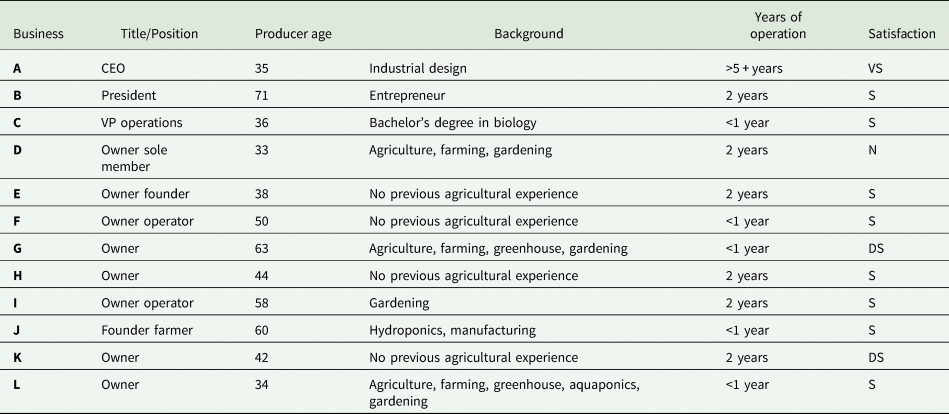
An overview of each HSCF business was deemed essential to convey the position of the farmer surveyed, their age, gender, ethnicity, background experience and the total years their HSCF has been in operation. These data can be found in Table 1. The age of farmers/business owners ranged from 33 to 71 years. The gender of the responding business owners consisted primarily male (n = 10; 83.3%). The ethnicity of the business population was made up of predominately white (n = 11; 91.7%) owners and one African American (n = 1; 8.3%) owner. Participants had a variety of background experiences. While five participants had an agricultural background, including farming, gardening and hydroponic production, seven participants had no previous agricultural experience, yet had backgrounds in engineering and business. These results show that interest in HSCFs may be coming from those with backgrounds outside of traditional agriculture. In addition, all but one farmer in this small sample had been in business for a very short time, approximately two years or less.
Business snapshot A including title, age, background, years of operation and satisfaction level of HSCF producer.

Levels of satisfaction were rated as: VS = ‘very satisfied’ S = ‘satisfied’ N = ‘neutral’ DS = ‘dissatisfied’ VDS = ‘very dissatisfied’.
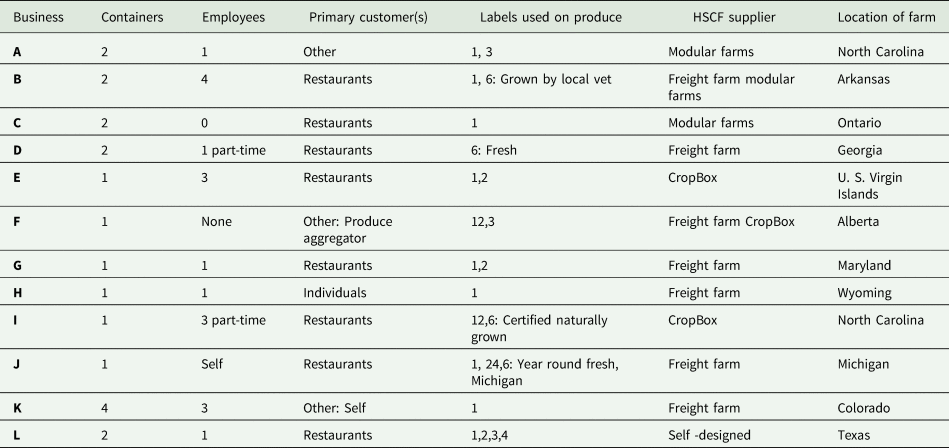
Farmers were also asked questions regarding the use of their HSCF, such as number of containers in operation within their business, their number of employees and their primary customer base (Table 2). The results show that most farmers include ‘local’ on their label, have four or less employees, and direct market to consumers and restaurants.
Business snapshot B including labels used on produce and primary customers.

Labels Used on Produce: 1 = ‘Local’ 2 = ‘Sustainable’ 3 = ‘Organic’ 4 = ‘Green’ 5 = ‘None of the above’ 6 = ‘Other’.
Benefits and challenges
Benefits
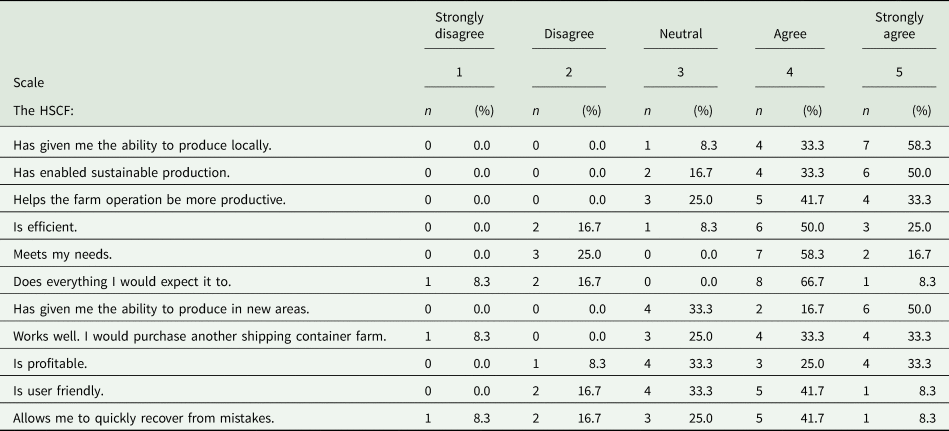
Farmers were asked to respond to their level of agreement regarding the benefits experienced by utilizing hydroponic shipping containers, where 5 = strongly agree, 4 = agree, 3 = neutral, 2 = agree and 1 = strongly disagree. Farmers strongly agreed or agreed that the HSCF has given me the ability to produce locally (91.6%), and has enabled sustainable production (83.3%). Additionally, 75.0% farmers strongly agreed or agreed that the HSCF: helps the farm operation to be more productive, is efficient, meets their needs, and does everything they would expect it to do. Some benefits had levels of lower agreement. Specifically, farmers strongly agreed or agreed that the HSCF is profitable (58.3%), is user friendly (50.0%), and allows them to quickly recover from mistakes (50.0%). Table 3 shows the level of agreement farmers had regarding all statements.
Level of agreement regarding the benefits experienced by operating a hydroponic shipping container farm(s) as a business.

Via open-ended questions in the online survey and during phone interviews, farmers were also provided with the opportunity to include any additional benefits they experienced while using their HSCF. A common response included the quantity of high-quality produce grown in a short amount of time in an environmentally friendly manner. Farmers also commented that the HSCF was affordable to purchase and enabled comfortable, year-round farming, which made HSCF more feasible than traditional farming methods. Furthermore, farmers remarked that the ease of use and flexibility required fewer work hours, making the HSCF self-manageable which greatly reduced labor costs, and allowed for them to be run with fewer employees. Farmers viewed the implementation of HSCF technology instrumental in providing them with independence and the ability to provide custom crops for chefs and educational activities.
Challenges
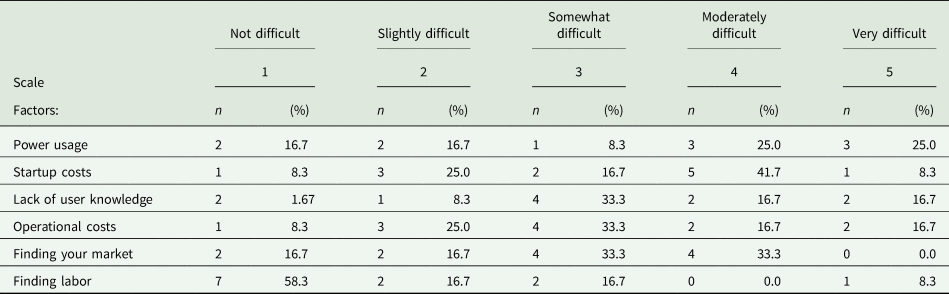
Farmers identified challenges regarding HSCF implementation, HSCF operation and customer support from HSCF suppliers. Some stated that they ran into more issues than anticipated, however, common farming problems such as finding labor and a market were the least challenging. Table 4 illustrates difficulty encountered by farmers when implementing and operating a HSCF, where 5 = very difficult, 4 = moderately difficult, 3 = somewhat difficult, 2 = slightly difficult and 1 = not difficult. Six business owners (50.0%) indicated power usage and startup costs as the most difficult factors when operating the HSCF. The least difficult factor indicated by seven (58.3%) of the business owners was finding labor.
Level of difficulty regarding factors when implementing and operating a hydroponic shipping container farm(s) as a business.

In phone interviews, some farmers noted additional issues faced during implementation including city regulations and zoning, access to clean water and ability to keep the container precisely level. Others mentioned operational challenges such as a cramped workspace, cleaning, pest management and the steep learning curve required for consistent production. Some farmers noted that cleaning and pest management were potential issues addressed and minimized during a training by the HSCF supplier, yet they were still problematic. While several farmers noted comfortable working conditions, others found working in a confined space difficult, especially when harvesting produce, and some experienced damage to their crops when harvesting due to the tight quarters. A business owner who encountered several of these unexpected issues commented that due to the controlled environment agriculture aspect of a HSCF, it was easy to overlook that severe weather could still be influential.
Farmers identified several issues with the technology incorporated into the HSCF. Issues included rural internet that was too slow to run the unit; too many technological components that break; and not enough people who know how to fix issues that arise in these container farms. Lastly, a producer stated that the rapid technology advancement required constant refinement.
Other challenges identified by farmers stemmed from perceived misinformation presented by the HSCF supplier. These included that the ‘turn-key system’ was not ‘plug-and-play’; a single HSCF was not a sole income generator such that additional income was necessary; and running the unit was much more time consuming than promoted by the vendor. Most farmers noted a major challenge they faced was the lack of customer support from one HSCF supplier. This lack of support led several farmers to switch to a second HSCF supplier and a new design. Issues with HSCF suppliers proved to be a common theme as most of the six farmers who participated in phone interviews discussed issues such as misinformation, lack of farming support and knowledge, and lack of response from some suppliers.
Expectations, success, profitability and satisfaction
Expectations
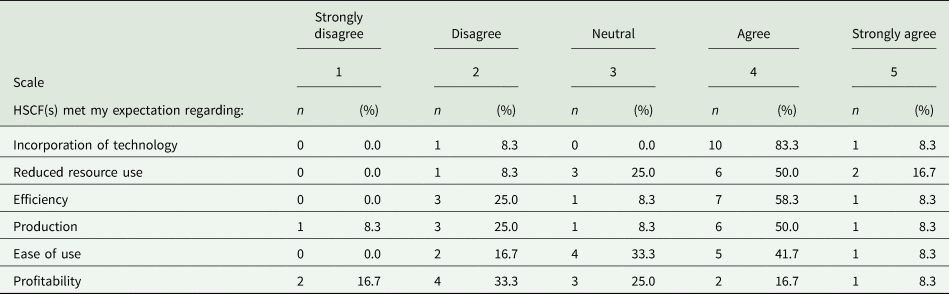
Some HSCF suppliers provide metrics for the expected number of plants grown per crop cycle and per year, such that farmers can calculate expected production per year. Because of the data presented by suppliers, farmers were asked if their production and profitability expectations had been met, where 5 = strongly agree, 4 = agree, 3 = neutral, 2 = disagree and 1 = strongly disagree. As shown in Table 5, farmers strongly agreed or agreed that their expectations had been mostly met in the following areas: incorporation of technology (91.6%), reduced resource use (66.7%) and efficiency (66.7%). Fifty percent of the farmers disagreed or strongly disagreed that the HSCF was profitable.
Level of agreement by farmers that their HSCF met expectations.

Farmers were also asked about their goals when purchasing a HSCF for commercial production. Several stated that their goals were to be profitable, fill a demand, create supplemental income/retirement and be self-managing. Others' goals were to provide the community fresh, local food year-round, and utilize a HSCF as a demonstration of sustainability to the community while addressing food issues such as the aging farmer population, a growing population and increasing demand for local/sustainable food.
While a couple of farmers said that their goals were ‘definitely met’, others shared that their goals had been mostly met, despite many obstacles that made achieving them difficult. Obstacles identified and overcome by farmers included a steeper learning curve than expected, higher operating costs and lower yields than expected. One farmer noted that because of these issues – due to misinformation presented to farmers by HSCF suppliers – their income had not yet met their goal. Lastly, several farmers noted that while their goals had not yet been reached and a clear conclusion could not yet be made, there were signs of success, economic viability and sustainability. This result could be attributed to HSCFs still being in their infancy and the limited years of farmer experience.
Success
Participants were all utilizing HSCFs to generate primary or supplemental income and operating the container as a business. Success and profitability were treated as two separate questions because not all businesses had yet become profitable. Through phone interviews, farmers were asked what they have done to be successful. Common responses included marketing, knowing your community, riding the wave of local enterprise, increasing local food demand and capitalizing on the strong food culture. Farmers emphasized that working with their community was key to their success; if their community was not behind them, then they would not be successful no matter what method of production was used. Several farmers mentioned that ‘riding the local wave’ was the key to their success, and knowing how to market oneself to align with these trends was vital. One farmer stated that due to the presence of a strong food culture, their business could thrive in their community. If they were to operate in the neighboring rural community, however, they believed they would not be as successful because of the relatively lower demand for local, organic, and/or high-quality produce.
Other HSCF owners attested to the power of the story – that describing what you are doing, why you are doing it, and sharing that story with others was key to their marketing strategy, and ultimately their success. Similarly, farmers indicated that it was by bringing something new to the community and educating their community on this novel approach to agriculture that led to their success. Furthermore, farmers remarked that finding the right crop to grow was instrumental to the success of their business. As described by several farmers, identifying attractive crops to grow resulted from knowing the surrounding community, building relationships and talking to customers. Lastly, farmers stated that living close to their farm, working with their family (eliminating the need for additional employees), persistently finding customers and demonstrating the value of their product enabled them to be successful.
Profitability
During the phone interview, farmers were asked what they have done to be profitable, especially since many farmers who purchased a HSCF were unsuccessful in managing the unit and creating a viable business according to Michael (Reference Michael2017). While not all six of the farmers interviewed had yet become profitable, a few shared what they had done to become profitable. The latter farmers attributed their profitability to producing a consistent product and ensuring that their customers knew what to expect in terms of quality. Two farmers stated that they were able to achieve profitability by managing finances carefully and paying attention to details. One such producer explained that they were able to drastically reduce their marketing costs by labeling products themselves. Additionally, a few farmers attributed their profitability to dedicating time, effort and money into the operation. And, a couple of farmers credited profitability by understanding their market and the value proposition that one brings to that market, offering something that no one else can offer, and listening to customers. Farmers contended that to be profitable, one must have consistency in their sales pitch, ask for a well-deserved price, network and offer taste samples.
Satisfaction
Via the online survey and phone interview, farmers were also asked to share their overall satisfaction with their HSCF. While eight farmers were satisfied (66.7%), one was very satisfied (8.3%), one was neutral (8.3%) and two users were dissatisfied (16.7%) with their unit. Of special note, of the farmers with an agriculture background (Table 1), one was dissatisfied, one was neutral, and one was satisfied regarding the overall performance of HSCFs.
HSCF farmers were asked during the phone interview how they felt about their experience utilizing a HSCF. Common answers included that HSCFs have their place in agriculture, however it depends on the farmer's objectives, as farmers have found that the HSCF work incredibly well in very specific applications. Others felt that HSCFs were a good compromise though there were some tradeoffs, such as a confined workspace and limited scalability. Most farmers felt HSCFs offer an opportunity to enter the field of agriculture. Finally, farmers added the HSCFs were more challenging to operate than expected, but they were glad that they purchased one.
Discussion
Despite this study's limitations due to the novelty of this production method, and thus the relatively small number of commercial farmers adopting this technology, this study contributes to a broader understanding of how HSCFs perform in terms of producer expectations, especially of those who have two or less years of HSCF production experience; identifies opportunities and limitations associated with HSCFs; and provides demographic insight, specifically that HSCFs are attracting new farmers from non-farm backgrounds. Additionally, the results of this research illustrate an interest in the technology employed by HSCFs, as well as the potential for local, high-quality, year-round production and profit. Moreover, the small footprint of the shipping container enabled farmers to overcome one of the major barriers faced by beginning farmers – the ability to find and acquire arable land (Key and Lyons, Reference Key and Lyons2019).
The most difficult operating challenges faced by HSCF farmers in the study were power usage, as noted by Lages Barbosa et al. (Reference Lages Barbosa, Gadelha, Kublik, Proctor, Reichelm, Weissinger, Wohlleb and Halden2015), and the high startup costs when purchasing and implementing the container farm, which aligned with barriers faced by beginning farmers, namely capital acquisition and startup costs (Key and Lyons, Reference Key and Lyons2019). This finding was also consistent with a report by Michael (Reference Michael2017), which addressed reasons many HSCF businesses start up only to be soon shut down. Among other reasons, Michael (Reference Michael2017) attributed this trend to the substantial amount of electricity it takes to operate a HSCF. Depending on location, the energy requirement costs can negate profits for farmers (Royte, Reference Royte2015). Another challenge noted by the study respondents and others (Hicks, Reference Hicks2017) that warrants further explanation is the lack of people who know how to fix issues that arise in HSCFs.
Based on the frequency of challenges reported by HSCF business owners, such as access to clean water, keeping the HSCF precisely level, finding people who can fix technologically complex components, and getting answers from HSCF supplier customer support, it is possible that HSCF suppliers may be overlooking key aspects of operation when marketing to potential users. These results are supportive of Michael's report on why commercial HSCFs are currently short-lived, specifically due to unrealistic expectations perpetuated by HSCF vendors of smart farm technology, yields, and labor requirements (Michael, Reference Michael2017). Furthermore, some farmers interviewed were adamant that certain HSCF suppliers do not understand how to grow produce for profit or do not ‘think like a farmer,’ which made HSCF operations, communication with suppliers and the overall grower experience difficult for users. Findings from this study also support Michaels' report (2017) that HSCFs may not be as turn-key, user-friendly, or profitable as they may seem. Participants experienced an additional required amount of time, effort and money invested than expected for their HSCF to become profitable. One producer commented, ‘You can purchase the newest and most sophisticated model available, but if you don't know how to use and don't put in the time and effort, it's not going to work for you.’
Evidence of cases where HSCFs were successful parallel recommendations that farmers must offer high-quality and unique products to consumers, focus on value, and avoid competition with mass marketers (Ikerd, Reference Ikerd, Francis, Flora and Olson2008). Based on the data collected, placement and marketing of a HSCF is essential to the overall success of this type of crop production business. As evident by the labels used on their produce to differentiate themselves, HSCF owners are targeting niche markets to sell their produce.
Overall, this study shows that of the 12 study participants, most were satisfied (66.7%) or very satisfied (8.3%) with their HSCF. Variations in satisfaction levels between farmers may be partly attributed to their selection of HSCF supplier and model, and/or experience level. Therefore, those interested in purchasing a HSCF should vet all possible HSCF suppliers, and ask operating procedures and crop production questions ahead of time to gage the responsiveness of the supplier.
Conclusion
This study may provide insight for those investigating HSCFs for crop production and resource use. Despite study limitations, largely due to the novelty of this production method and thus the relatively small number of commercial farmers adopting this technology, some general observations can be made. First, HSCF farmers were typically benefiting from a shorter crop cycle and a reduced need for some inputs, excluding power usage. Some farmers reported that HSCFs are efficient in production, despite the units not being as productive and profitable as they were led to believe or initially expected. HSCFs were not yet meeting all farmers' expectations in terms of production or profitability. Evidence suggests some HSCF models may not be as productive or profitable as advertised, and that there was a learning curve and more time needed to achieve expected production and profitability levels. However, nine out of 12 farmers sampled were satisfied to very satisfied with their HSCF. Despite this, only three agreed or strongly agreed that their HSCF(s) met their expectations regarding profitability. Due to the limitations of this study, HSCF profitability warrants further exploration, including collecting data on number of growing cycles to become profitable, start-up costs and unexpected costs. While HSCF shortcomings were identified, this technology may have advantages especially in areas with limited arable land and water resources. Continual design improvements may lead to increased production and resource use efficiency.
The data that support the findings of this study are available from the corresponding author, Nicole Wagner, upon reasonable request.
Acknowledgements
This research was supported in part by the USDA National Institute of Food and Agriculture Hispanic Serving Institution Education Program, grant 2015-38422-24072.