Introduction
Plastic deformation is generally considered primarily a distortion that occurs without volume changes. As such, it should only be sensitive to deviatoric stresses (deviation from hydrostatic) and not to pressure. Pioneering experiments performed following the developments in high-pressure techniques by Bridgman showed that hydrostatic pressure loading significantly affects the mechanical properties of solids. Both yield strength and ductility of metals Reference Bridgman1 and rocks Reference Griggs2 increase with applied confining pressure. The pressures involved were initially relatively small (1–3 GPa), and the increase in ductility was mostly due to the inhibiting effect of pressure on propagation of preexisting microcracks.
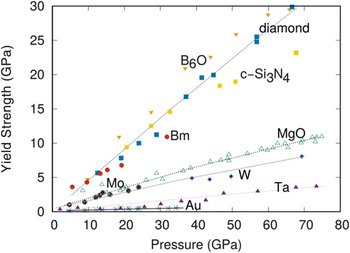
The development of diamond anvil cells has allowed the application of static pressures reaching and exceeding 100 GPa. Evaluation of shear stresses sustained by samples compressed between the diamond anvils has provided compelling evidence that the yield strength is pressure dependent when several tens of GPa are applied (see Figure 1 ). Reference Sung and Goetze3–Reference Duffy, Shen, Heinz, Shu, Ma, Mao, Hemley and Singh13 Using radial x-ray diffraction, the polycrystalline texture can be analyzed in situ providing further information on the deformation history and mechanisms of the samples. Reference Wenk, Matthies, Hemley, Mao and Shu14 Higher pressures can be reached using dynamic compression. Standard shock wave techniques use explosives or gas guns to accelerate a flyer plate to several km s–1, which impacts a sample. Multiterapascal conditions are now experimentally accessible following the development of powerful pulsed lasers and magnetic pulsed power facilities. Besides very high pressures, these experiments also involve extremely high rate loadings on the order of 106 to 1010 s–1.
Summary of differential stress measurements in selected materials up to 100 GPa: MgO periclase; Reference Marquardt and Miyagi5 diamond; Reference Duffy, Elert, Furnish, Chau, Holmes and Nguyen6 B6O, Reference He, Shieh and Duffy7 c-Si3N4, a spinel type silicon nitride; Reference Kiefer, Shieh, Duffy and Sekine8 MgSiO3 bridgmanite Reference Merkel, Wenk, Badro, Montagnac, Gillet and Mao9 (Bm), a high-pressure silicate with a perovskite structure; metals: molybdenum, Reference Duffy, Shen, Shu, Mao, Hemley and Singh10 tungsten, Reference He and Duffy11 tantalum, Reference Dewaele and Loubeyre12 and gold. Reference Duffy, Shen, Heinz, Shu, Ma, Mao, Hemley and Singh13 Lines are shown as guides for the eyes.

At the turn of the century, new deformation apparatus have been developed that can perform rheological measurements at relatively high pressures (up to 10–20 GPa) and high temperatures (up to 1000–2000 K)—including the rotational Drickamer apparatus Reference Yamazaki and Karato15 and deformation-DIA. Reference Wang, Durham, Getting and Weidner16 Compared to the diamond anvil cell or shock experiments, the P, T range is smaller in these, but deviatoric stress (in compression or in torsion) can be applied at typical strain rates of 10–5 s–1 and controlled independently from the confining pressure. Also, in situ strain and stress measurements during high-pressure deformation experiments are possible using these pieces of apparatus when coupled with synchrotron x-rays. At present, we have a better understanding of the elementary mechanisms of plasticity influenced by pressure. The main results are reviewed in this article.
Bonds under pressure
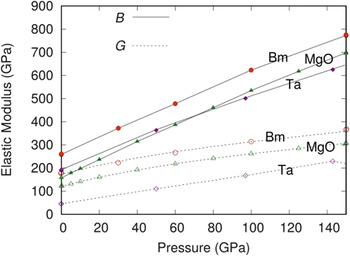
The first indication of the influence of pressure on mechanical properties of solids is obtained from elasticity. Since the pressures considered here (from a few to a few hundreds of GPa) are comparable to most elastic moduli, one can expect pressure to have a profound influence on the electronic structure of solids. This influence is well illustrated by the pressure dependence of elastic constants and elastic moduli (see Figure 2 ). Reference Liu, Li, Cai and Jing17–Reference Wentzcovitch, Karki, Karato and Da Silva19
Influence of pressure on elastic moduli (bulk modulus B and shear modulus G) for tantalum, Reference Liu, Li, Cai and Jing17 MgO periclase, Reference Karki, Stixrude, Clark, Warren, Ackland and Crain18 and MgSiO3 bridgmanite (Bm). Reference Wentzcovitch, Karki, Karato and Da Silva19

Beyond small strains, computation of ultimate properties of solids such as ideal shear stresses also show a strong increase with applied pressure (e.g., in Ta20). This reflects the typical tendency of bonds to strengthen when becoming shorter under compression. Pressure-induced changes in crystal structure can further contribute to this tendency by producing more compact structures. Such is the case of the well-known transition in carbon from weak graphite to strong diamond. In crystals with more complex crystal chemistries, the situation is more complex, as seen in some high-pressure silicates. Lattice instabilities and soft modes accompanying some phase transitions might also have a distinct softening effect in the vicinity of the transition. Nevertheless, this general trend is currently guiding the search for materials with extreme mechanical strengths among compounds with short and strong covalent bonds.
The role of defects—From semiconductors and metals to high-pressure phases of planetary interiors
Understanding the influence of pressure on mechanical properties, such as crystal plasticity and strength, requires a description that goes beyond atomic bonding to describe the fundamental aspects of defects responsible for deformation processes—point defects, dislocations, and grain boundaries. Pressure may have different effects on dislocations depending on the class of materials. It may affect the structure, the stability, or the mobility of the core of dislocations (i.e., the region close to the dislocation line where atomic arrangements differ significantly from the bulk and where linear elasticity does not apply).
Pizzagalli et al. Reference Pizzagalli, Demenet and Rabier21 carried out a systematic investigation of the plasticity of covalent materials (silicon, diamond, and cubic silicon carbide) under pressure using atomic-scale calculations (first-principles and tight-binding calculations). The study of dislocation core stability showed that up to 2% compression (corresponding to confining pressures of 6.6 GPa for Si, 20.3 GPa for β-SiC, and 37.5 GPa for diamond), ½ 〈110〉 dislocations located in the so-called glide plane correspond to the most stable configuration, stabilized by core reconstruction along the dislocation line. (In the diamond cubic structure, there are two nonequivalent families of {111} planes—the so-called widely spaced “shuffle” and narrowly spaced “glide” planes.) Pressure effects are not strong enough in the pressure range investigated to stabilize another core (i.e., in the shuffle plane) but seem to affect the energy barrier for dislocation core mobility (quantified by the Peierls potential or its spatial derivative, the Peierls stress). Computing the energy barriers associated with a core displacement in either {001} or {111} shuffle, it was further shown that the magnitude of the Peierls potential for gliding in {001} increased with pressure, whereas those for {111} gliding shuffle decreased, in agreement with experiments reporting shuffle dislocation activities during high-pressure confinement experiments. Such a study suggests that pressure should be carefully taken into account to understand the plasticity of semiconductors under pressure.
In metals, it has been experimentally demonstrated that hydrostatic pressure has an effect on the flow stress in low-temperature plasticity processes, Reference Spitzig and Richmond22 with a linear dependence of flow stress on pressure. Later, based on atomistic simulations, this effect in aluminum was attributed to either a dilatation state of the dislocation core or transient dilatancy as the dislocation moves through the lattice Reference Bulatov, Richmond and Glazov23 from one stable position to the next. Yang and co-workers Reference Yang, Söderlind and Moriarty24,Reference Yang, Tang, Moriarty, Hirth and Kubin25 provide another example of the high-pressure effect on intrinsic strength of metals, on the fundamental properties of ½ 〈111〉 dislocations in body-centered-cubic (bcc) metals using tantalum as an archetypal case. As commonly reported in bcc metals, the stable dislocation core in Ta is located inside a triangle formed by three central atoms in the bcc structure. It was shown that high pressure (up to hundreds of GPa) does not change the stable location of the core, but strongly affects its polarization (defined as the simultaneous displacement of the three central atoms surrounding the dislocation core). Moreover, atomistic calculations reveal that the Peierls stress τP increases drastically as hydrostatic pressure increases. The evolution of the Peierls stress τP as a function of pressure (up to 1 TPa) shows good scaling of τP with the shear modulus G of Ta, with τP /G = 0.01. Since, at finite temperatures, dislocation mobility occurs by thermally assisted processes of nucleation and migration of kink pairs along the dislocation line, it was shown that the kink pair formation energy also scales with ∼0.1Gb 3 (where b is the modulus of the Burgers vector) with any of the geometrically possible types of kinks. Reference Yang, Söderlind and Moriarty24 Such an elastic effect on dislocation core properties seems to be rather generic to all bcc metals as the same trend was also observed in Mo and V. Reference Yang, Tang, Moriarty, Hirth and Kubin25
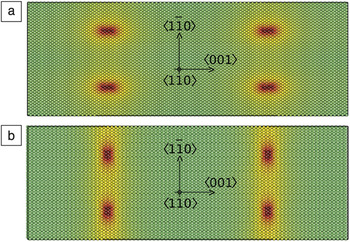
In simple ionic systems such as MgO, recent atomistic simulations Reference Amodeo, Carrez and Cordier26,Reference Carrez, Godet and Cordier27 (including first-principles calculations) have highlighted a strong pressure effect on the dislocation core configuration of ½ 〈110〉 screw dislocations. The dislocation core evolves from spreading in {110} to a narrower configuration, which then spreads in {100} as pressure increases ( Figure 3 ). Subsequently, the pressure dependency of the Peierls stress does not scale anymore with the elastic moduli, and an inversion of the easiest slip system (from ½ 〈110〉 {110} to ½ 〈110〉 {100}) is predicted between 30 GPa and 60 GPa. Reference Amodeo, Carrez and Cordier26 Recent experiments Reference Marquardt and Miyagi5 confirm this pressure-induced slip system change in MgO.
½ 〈110〉 screw dislocation core structures in MgO periclase computed within quadrupolar arrangements. (a–b) Calculations performed at 0 and 100 GPa, respectively. The core structure, imaged according to a local von Mises shear–strain invariant, reveals the strong tendency of ½ 〈110〉 screw dislocation to spread in {110} at low pressure and to evolve into a more compact configuration spread in {100} as pressure increases.

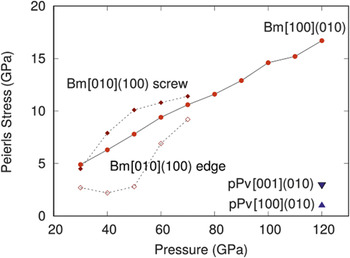
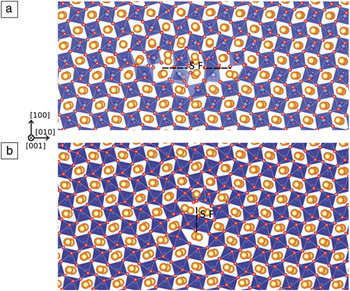
In a more complex ionic system, another example of dislocation core configuration stability is found for the [010](100) edge dislocation in bridgmanite Reference Hirel, Kraych, Carrez and Cordier28 (a high-pressure polymorph of MgSiO3 with a perovskite structure stable up to pressures in excess of ca. 25 GPa). Atomistic calculations of [100] and [010] screw dislocation properties in bridgmanite have highlighted the strengthening effect of high pressure on dislocation Peierls stresses for [100](010) and [010](100) slip systems. As already observed in bcc metals, increasing pressure drastically increases Peierls stresses Reference Hirel, Kraych, Carrez and Cordier28 ( Figure 4 ) and kink energies, but normalizing both quantities to the shear modulus suggests that pressure sensitivity is mostly driven by the pressure dependence of the elastic constants. Reference Kraych, Carrez and Cordier29 However, it has been shown that edge dislocations exhibit a different behavior leading to inhibition of a slip system as hydrostatic pressure reaches 80 GPa. Reference Hirel, Kraych, Carrez and Cordier28 In bridgmanite, as pressure increases (above ca. 50 GPa), edge [010](100) dislocations spontaneously switch from a glissile configuration (which can move in the glide plane under an applied shear stress) to a climb dissociated core ( Figure 5 ), which by essence becomes unable to glide (sessile). Such a climb dissociated process was originally reported in cubic perovskite (e.g., SrTiO3) as a high-temperature process. In the case of lower-symmetry orthorhombic perovskites (such as bridgmanite), the same mechanism can be driven by a nonelastic effect of pressure on stacking fault energy.
Peierls stress versus pressure for [100](010) and [010](100) slip systems in MgSiO3 bridgmanite. The sudden increase in Peierls stress for the [010] edge dislocation around 60 GPa highlights the change in the core structure from a glissile configuration at low pressure to a sessile climb dissociation at high pressure. For comparison, the Peierls stresses of two slip systems in post-perovskite (pPv) are also shown.

Edge [010](100) dislocation core in MgSiO3 bridgmanite. (a) Typical glissile core configuration at low pressure (illustrated at 30 GPa) for which the stacking fault lies in (100). (b) Sessile core configuration stabilized at high pressure (here 80 GPa) with a stacking fault lying in (010). Note: SF, stacking fault.

Above 120 GPa, MgSiO3 undergoes a phase transition from the perovskite structure of bridgmanite to a Cmcm orthorhombic structure called post-perovskite (pPv), which exhibits an alternate sequence of nonequivalent cation layers parallel to (010). The mechanical properties of pPv have been numerically studied based on ab initio calculations. Reference Goryaeva, Carrez and Cordier30 Particular attention was given to the [100](010) slip system. Surprisingly, compared to the original perovskite phase (Figure 4), pPv shows a low Peierls stress when dislocation glide is restricted to the Mg layer in such a way that propagation of shear occurs without cutting the strong Si–O bonds.
Conclusion
Under high pressure, the electronic structure of solids is strongly affected. This effect can be first apprehended by elastic (linear and nonlinear) properties, which provide an average description of bond strengths. This trend provides a robust first-order understanding of the influence of pressure on mechanical properties. Complexities may arise, however, when pressure-induced phase transformations involve strong changes in bonding. Such is the case in the transformation from graphite to diamond, or, in silicates, the transition from fourfold coordinated silicon at the surface of the Earth to sixfold coordinated silicon in the interior of planets. Finally, since the strength of real solids depends on the presence of defects, the influence of pressure on their structure and dynamics can lead to complex behaviors.
Pressure is thus a parameter that strongly influences the mechanical response of solids. This has profound implications in understanding and modeling the dynamics of planetary interiors, but it also opens up the possibility of designing materials with extreme properties.
Acknowledgment
The authors are supported by funding from the European Research Council under the Seventh Framework Programme (FP7), ERC Grant No. 290424–RheoMan.

Philippe Carrez is professor of physics at the Unité Matériaux et Transformations at the University of Lille, France, where he received his PhD degree in materials science in 2002. He has co-authored more than 50 papers. Carrez can be reached by phone at +33-320434861 or by email at philippe.carrez@univ-lille1.fr.

Patrick Cordier is a professor of physics at the University of Lille, France, where he received his PhD degree in materials science in 1989. He has co-authored more than 160 papers and serves as chief editor for the European Journal of Mineralogy. He is an Advanced Grant Laureate of the European Research Council and has been awarded the Dana Medal by the Mineralogical Society of America. He is also vice president of the International Mineralogical Association. Cordier can be reached by phone at +33-320-434341 or by email at patrick.cordier@univ-lille1.fr.