INTRODUCTION
One of the most pressing contemporary issues Native American nationsFootnote 1 face is the recognition and protection of their sovereignty (Corntassel and Wittmer, Reference Corntassel and Witmer2008; Gordon Reference Gordon2018; Wilkins and Stark, Reference Wilkins and Stark2018). Since its formation, the U.S. government recognized Native nations as inherently sovereign separate nations with their own governments. Reflecting this stance, up until 1871, the U.S. government entered into treaties that acknowledged the governmental authority of Native nations. These treaty agreements, along with federal legislation and Supreme Court decisions, formed the basic legal framework governing the relationships between the United States and Native nations used today (Goldberg-Ambrose Reference Goldberg-Ambrose1994).
Throughout U.S. history, Native nations encountered numerous formidable challenges to their sovereignty (Corntassel and Wittmer, Reference Corntassel and Witmer2008; Gordon Reference Gordon2018; Wilkins and Stark, Reference Wilkins and Stark2018). These challenges came from the U.S. government, local and state governments, non-Native individuals, and non-Native groups (Corntassel and Wittmer, Reference Corntassel and Witmer2008; Dudas Reference Dudas2008; Kunesh Reference Kunesh2009; Strommer and Osborne, Reference Strommer and Osborne2014; Wilkins and Stark, Reference Wilkins and Stark2018). Exemplifying these challenges, the U.S. government dissolved some Native nations (e.g., Menominee of Wisconsin, Klamath of Oregon), broke-up Native reservations into individual land allotments resulting in loss of ninety million acres of Native land, and forcibly removed Native children from their Native nations into federally-run boarding schools.
Scholars have argued that early challenges to Native nation sovereignty were rooted in a desire on the part of White Americans and the U.S. government to take ownership of Native land and resources. In other words, settler colonialism drove early policies and actions restricting Native nation sovereignty and fueled a sense that Native nations obstructed the social and economic development of the United States (Berkhofer Reference Berkhofer1978; Blackhawk Reference Blackhawk2006; Chang Reference Chang2010; Harmon Reference Harmon2010). To bolster and justify restrictions placed on Native nation sovereignty, White colonial settlers constructed and drew on negative stereotypes of Native Americans. For example, the U.S. government and White Americans justified seizure of Native nation lands by stereotyping Native Americans as bloodthirsty aggressive savages, and they justified control over Native nations and policies meant to assimilate Native Americans into U.S. society by stereotyping Native Americans as noble, but childlike, savages (Berkhofer Reference Berkhofer1978).
More recently, threats to Native nation sovereignty continued in the context of rising economic development in Native nations and ongoing legal battles over treaty and land rights (Dudas Reference Dudas2008; Mackey Reference Mackey2016; McCune Reference McCune, Gercken and Pelletier2018). While Native economic development cuts across a variety of business ventures, it is the gaming success of some Native nations that seemed to receive the most attention from media, state governments, and the general public (Colley Reference Colley2018; Dudas Reference Dudas2008; Gordon Reference Gordon2018). With the rise of Native nation gaming establishments, White Americans generated a new “casino Indian” stereotype to characterize all Native nations and Native Americans as wealthy from casino income—even though many Native nations do not operate casinos. In fact, only a small number of Native nations have made substantial amounts of money from gaming, and, as a whole, Native Americans remain one of the most impoverished groups in the United States (Cattelino Reference Cattelino2008; Darian-Smith Reference Darian-Smith2004; Gordon Reference Gordon2018; U.S. Census Bureau 2017). Jessica R. Cattelino (Reference Cattelino2008) and Eve Darian-Smith (Reference Darian-Smith2004) observed that the casino Indian stereotype includes perceptions that Native Americans are greedy, manipulative, and lawless, attributes that may adversely impact White attitudes toward Native nations and Native Americans. Thus, this stereotype may pose a new threat to Native nation sovereignty.
Attitudes toward Native nation sovereignty among non-Natives in the United States may play a significant role in the development of policies that diminish or support this sovereignty. Yet, there is very little scholarship on White American attitudes towards Native nation sovereignty or the factors that may affect these attitudes. The primary goal of this study is to address this shortcoming in the literature.
Many social forces and personal beliefs may affect attitudes toward Native nation sovereignty, some of which may not be specific to Native Americans (e.g., individualistic thinking that may render the collectivity of Native nations incomprehensible or unacceptable; micro- and macro-economic conditions that may generate or increase scapegoating of out-groups, including Native nations; and White expectations that Whites should be in control, which may elicit opposition to increased control by out-groups such as Native nations). Settler colonial theory and other Indigenous Studies perspectives encourage the exploration of social forces and beliefs rooted in the specific colonial history and continued domination of Native Americans in the United States. In this case, important phenomena to explore may include: prejudicial beliefs specifically focused on Native Americans (e.g., the belief that Native Americans are “a people of the past,” which renders them incapable of contemporary governance), beliefs that White American control is justified by colonial conquest (and thus Native nations should not exist), and beliefs that colonialism rendered Native Americans a racial group just like other persons of color (i.e., eliminating their rights to exist as separate nations).
In this study, we followed the lead of Lawrence D. Bobo and Mia Tuan (Reference Bobo and Tuan2006), who found that group position theory best explained non-Native opposition to Chippewa treaty rights in Wisconsin, by exploring whether group position theory helps to explain White attitudes toward Native nation sovereignty. In particular, we explored whether attitudes toward Native nation sovereignty can be explained by associations between the presence of Native nation gaming, the negative stereotype of Native Americans as “casino Indians,” and perceptions that Native interests conflict with those of Whites.
In order to explain the rationale for our study, we first review evidence suggesting that some Whites in Canada and the United States perceive Native peoples as posing an economic threat and that these perceptions are associated with their views on Native American policies, including policies related to sovereignty. After this, we draw on group position theory to discuss associations between negative stereotypes, perceived conflict of interests, and attitudes toward policies. Based on this existing literature, we posit that the casino Indian stereotype will play a role in generating or amplifying the effect of perceived conflict of interests on opposition to sovereignty. Then, we discuss literature associated with the possibility that the presence of Native nation gaming itself may affect attitudes toward sovereignty.
Perceptions of Conflicting Interests and Attitudes toward Policy
In the United States, non-Native people have expressed mixed opinions about rights and “policies” (broadly construed) that support Native Americans, including pro-sovereignty policies (Rouse and Hanson, Reference Rouse and Hanson1991), treaty rights (Bobo and Tuan, Reference Bobo and Tuan2006; Rouse and Hanson, Reference Rouse and Hanson1991), and Native nation gaming (Conner and Taggart, Reference Conner and Taggart2014; Gonzales et al., Reference Gonzales, Ahlquist and Lyson2009; Spears and Boger, Reference Spears and Boger2002). According to the research, individuals who are female, younger, more educated, and liberal are more likely to support Native rights (Bobo and Tuan, Reference Bobo and Tuan2006; Conner and Taggart, Reference Conner and Taggart2014).
Scholars have argued that, prior to the late 1800s, White opposition to rights and policies beneficial to Native Americans was driven by perceptions that Native Americans represented a threat to the U.S. nation, including to Whites’ possession of land and their physical safety (Berkhofer Reference Berkhofer1978; Blackhawk Reference Blackhawk2006; Chang Reference Chang2010; Harmon Reference Harmon2010). In fact, Alexandra Harmon (Reference Harmon2010) argued that Native nation sovereignty and Native American control of resources are interdependent, meaning that sovereignty enables control of resources and control of resources enables sovereignty, and thus White colonial development depended on restricting Native nation sovereignty in order to secure resources otherwise under Native American control.
Research focused on the contemporary period (i.e., after 1980) demonstrates that opposition to Native rights is associated with perceptions that Native interests conflict with those of non-Native people (Barker Reference Barker2005; Bobo and Tuan, Reference Bobo and Tuan2006; Denis Reference Denis2015; Dudas Reference Dudas2008; Krause and Ramos, Reference Krause and Ramos2015; Langford and Ponting, Reference Langford and Ponting1992). For example, Joanne Barker (Reference Barker2005) observed backlash against Native nation economic development, land reacquisition, and political power in recent years. As part of this backlash, people working against Native nation sovereignty and gaming rights argued that Native nation sovereignty is racial discrimination (against Whites) and grants Native Americans unfair economic opportunities. Jeffrey R. Dudas (Reference Dudas2008) reported that the movement opposing Native nation treaty rights in the United States is mainly composed of people who feel that their personal economic interests are threatened by these treaty rights and who portray these rights as unfair “special rights” that are un-American.
Recent studies reveal that some non-Native people perceive Native nation gaming as threatening or conflicting with their interests (Bodinger de Uriarte Reference Bodinger de Uriarte2007; Cattelino Reference Cattelino2008; Dudas Reference Dudas2008; McCune Reference McCune, Gercken and Pelletier2018). For example, Meghan Y. McCune (Reference McCune, Gercken and Pelletier2018) studied opposition to Haudenosaunee land-into-trust applications which were associated with gaming development, and found that the opposition believes that Haudenosaunee are engaged in “unfair business practices” that are harmful to non-Native people. Similarly, Jessica R. Cattelino (Reference Cattelino2008) argued that success in Native nation gaming increased perceptions that Native nation sovereignty is a threat among some non-Natives and led them to challenge this sovereignty.
In this study, we explored whether opposition to Native nation sovereignty is associated with beliefs that Native American interests conflict with those of White Americans. The premise that dominant group opposition to policies that benefit subordinate groups is associated with perceptions that subordinate group interests conflict with and threaten dominant group interests is a central aspect of group position theory.
Group Position Theory: The Association between Negative Stereotyping, Perceived Conflict of Interest, and Attitudes toward Policy
Group position theory emerged from the scholarship of Herbert Blumer (Reference Blumer1958), who asserted that prejudice is rooted in “a sense of group position” and that prejudice functions to protect the position of the dominant group (p. 3). This theory presumes that many dominant group members feel a sense of superiority that manifests in negative stereotypes of other groups. Also important to this theory, many dominant group members feel a proprietary claim to their relative group position (of having greater resources, power, and prestige) and are concerned that subordinate group members represent a competitive threat to their group position and (perceived) associated interests (Bobo Reference Bobo1999; Bobo and Tuan, Reference Bobo and Tuan2006). Bobo and Tuan (Reference Bobo and Tuan2006) made the case that group position theory focuses on the interaction between perceived in-group interests and negative affect, beliefs, and stereotypes about the out-group.
There is empirical support for group position theory. Research reveals that some people perceive a group threat or conflict of interest between their in-group and out-groups (Bobo Reference Bobo1983; Bobo and Hutchings, Reference Bobo and Hutchings1996; Bobo and Tuan, Reference Bobo and Tuan2006; Denis Reference Denis2015; Schlueter and Scheepers, Reference Schlueter and Scheepers2010; Semyonov et al., Reference Semyonov, Raijman, Tov and Schmidt2004; Wilson Reference Wilson2001). Further, higher levels of perceived group threat or conflicting interests are associated with greater prejudicial attitudes and less support for policies helpful to out-groups (Bobo Reference Bobo1988; Scheepers et al., Reference Scheepers, Gijberts and Coenders2002; Schleuter et al., Reference Schlueter, Schmidt and Wagner2008; Schlueter and Scheepers, Reference Schlueter and Scheepers2010; Semyonov et al., Reference Semyonov, Raijman, Tov and Schmidt2004; Stephan and Renfro, Reference Stephan, Renfro, Mackie and Smith2002; Stephan and Stephan, Reference Stephan, Stephan and Oskamp2000). Yet, the direction of these associations varies. In some cases, greater perceived threat/conflict predicts more prejudice which in turn predicts less policy support, whereas in other cases the order is flipped such that greater prejudice predicts more perceived threat/conflict which in turn predicts less policy support (Scheepers et al., Reference Scheepers, Gijberts and Coenders2002; Schlueter et al., Reference Schlueter, Schmidt and Wagner2008; Semyonov et al., Reference Semyonov, Raijman, Tov and Schmidt2004; Stephan and Renfro, Reference Stephan, Renfro, Mackie and Smith2002). In general, group position theory suggests that stereotyping or prejudice about an out-group, and perceived conflict of interest with this out-group, work together to generate opposition to policies that benefit this out-group (Blumer Reference Blumer1958; Bobo Reference Bobo1999; Bobo and Tuan, Reference Bobo and Tuan2006).
Two large-scale quantitative studies provide support for using group position theory to explain non-Native attitudes towards Native rights.Footnote 2 In particular, these two studies examined the relationship between negative stereotypes/prejudice, perceptions of threat/conflict of interests, and attitudes toward Native nation rights. In the first study, Tom Langford and J. Rick Ponting (Reference Langford and Ponting1992) analyzed interview data from a 1986–1987 Canadian national probability sample of 1834 non-Native adults. They found that prejudice against Native Canadians and perceived conflict between Native and non-Native Canadian interests were significantly associated with opposition to Native nation sovereignty. They discovered an interaction between the variables of prejudice and perceived conflict of group interests, such that opposition to Native nation sovereignty was higher when both prejudice and perceived conflict of group interest were higher, but opposition to Native nation sovereignty was much lower when one of these variables was low. In the second study, Bobo and Tuan (Reference Bobo and Tuan2006) analyzed data from phone interviews conducted in 1990 with 784 mostly White Wisconsin residents in order to examine their attitudes toward Chippewa fishing, hunting, and gathering treaty rights. These researchers found that negative racial prejudice and perceived conflict of group interests merged to generate opposition to treaty rights. These two studies suggest that the combination of negative attitudes toward, and perceived conflict of interest with, Native people generate opposition to Native nation rights.
Building on the scholarship of Bobo and Tuan (Reference Bobo and Tuan2006), we examined the question of whether group position theory helps to explain White American attitudes toward Native nation rights. Our study differs from Bobo and Tuan (Reference Bobo and Tuan2006) in several important ways. First, rather than focus on attitudes toward the specific treaty rights of one Native nation, we focused on general attitudes toward Native nation sovereignty. Second, we used a national sample rather than one composed of residents from one U.S. state. Lastly, unlike Bobo and Tuan (Reference Bobo and Tuan2006), who explored several stereotypes of Native Americans (related to poverty, work ethic, welfare, and respect for nature), we more narrowly focused on the stereotype of “the casino Indian.”
The casino Indian stereotype characterizes all Native nations as operating casinos, all Native Americans as being rich from casinos, and these riches being a result of Native American greed, manipulation, and lawlessness (Cattelino Reference Cattelino2008; Darian-Smith Reference Darian-Smith2004). Alexandra Harmon (Reference Harmon2010) noted that, historically, many White Americans viewed “rich Indians” as undeserving and greedy while not perceiving White wealth in this same manner. Yet, unlike rich Native persons or nations of the past, who lived in particular geographic areas (e.g., the Osage nation in Oklahoma in the early 1900s, whose wealth was derived from oil), wealth generated by Native nation gaming resulted in more widespread economic improvements, and thus, contemporary beliefs about rich Native persons are more prevalent now throughout the country.
Recent research documents the emergence of the casino Indian stereotype in White Americans’ attitudes toward Native Americans (Burkley et al., Reference Burkley, Durante, Fiske, Burkley and Andrade2016; Robertson Reference Robertson2015; Senter and Ling, Reference Senter and Ling2017) and in contemporary media representations of Native Americans (Ashley and Jarratt-Ziemski, Reference Ashley and Jarratt-Ziemski1999; Boxberger Flaherty Reference Boxberger Flaherty2013; Colley Reference Colley2018; Lacroix Reference Lacroix2011). While we are not aware of any research focused on how and why the casino Indian stereotype emerged, we know that when groups that are not dominant, such as Jewish and Asian Americans, improved their economic situation, White Americans generated stereotypes of them that overstated the extent of their success and attributed this success to negative group characteristics (Editors Reference Editors1996; Glick and Fiske, Reference Glick, Fiske, Jost and Major2001; Ho and Jackson, Reference Ho and Jackson2001; Kawai Reference Kawai2005; Rosenfield Reference Rosenfield1982).
Recent assertions of sovereignty by Native nations, including Native nation gaming and other economic activities, improved the economic situation of some Native nations (Akee and Taylor, Reference Akee and Taylor2014; Costello et al., Reference Costello, Erkanli, Copeland and Angold2010; Gordon Reference Gordon2018; HPAIED 2008).Footnote 3 Rather than celebrating economic achievement among Native Americans, some White Americans created and adopted the casino Indian stereotype to exaggerate and discredit these successes.
The rise of Native nation gaming in the context of minimal understanding of Native Americans among non-Natives may have contributed to the emergence of the casino Indian stereotype. Scholars have demonstrated that many non-Native Americans have limited understanding of Native Americans (Conner et al., Reference Conner, Fryar and Johnson2017; Reclaiming Native Truth Project 2018), and Gordon (Reference Gordon2018) suggested that this limited knowledge allows misleading beliefs to fill this void.
There is evidence that the casino Indian stereotype (i.e., that Native nation gaming involves greed and manipulation) may be associated with perceptions that Native Americans represent a threat to non-Native interests. Celeste C. Lacroix (Reference Lacroix2011) concluded that portrayals of Native nation gaming on six television programs portrayed Native Americans as both immoral/corrupt and politically/economically threatening. Anne F. Boxberger Flaherty (Reference Boxberger Flaherty2013) found that the Syracuse Post-Standard newspaper coverage of Native nation land rights and gaming often depicted Native Americans as greedy, threatening, and pursuing unfair privileges. One example of how this newspaper utilized language that conveyed both greed and threat is: “Dorr said one faction of the Cayuga Nation has openly stated that in addition to demanding payment of $1 billion, it intends to occupy the entire claim area, remove churches and disinter remains from all cemeteries” (p. 75).
The rise of Native nation gaming and the simultaneous emergence of the casino Indian stereotype in the United States prompted us to explore whether these new social phenomena were associated with perceived conflict of interests with Native Americans and opposition to Native nation sovereignty. Based on this possibility, we conceived the following model: Belief in the casino Indian stereotype would be associated with perceptions that White American interests conflict with Native American interests. This perceived conflict of interests would then be associated with White American opposition to Native nation sovereignty. After we devised this model, we decided to explore whether this model would be equally applicable in U.S. states with and without Native nation gaming.
Presence of Native Nation Gaming
Does a larger presence of Native Americans in a geographical location impact non-Native attitudes toward Native nation rights? Two studies revealed that there is less support among non-Natives for Native nation rights in areas of the United States with higher percentages of Native Americans and located near Native reservations (Bobo and Tuan, Reference Bobo and Tuan2006; Rouse and Hanson, Reference Rouse and Hanson1991). Bobo and Tuan (Reference Bobo and Tuan2006) found that non-Native Wisconsin residents who lived in the area covered by Chippewa treaty rights were more likely than other non-Native Wisconsin residents to believe negative stereotypes about Native Americans, feel negative affect toward Native Americans, perceive that their interests conflicted with and were threatened by Native American interests, and oppose Native nation treaty rights.
Scholars found mixed results in studying whether there is more or less opposition to Native nation gaming near Native reservations (Boehmke et al., Reference Boehmke, Branton, Dillingham and Witmer2012; Darian-Smith Reference Darian-Smith2004; Dudas Reference Dudas2008; Gordon Reference Gordon2018). Frederick J. Boehmke et al. (Reference Boehmke, Branton, Dillingham and Witmer2012) offered an explanation for these mixed findings. Voters who lived close to non-gaming Native nations were less likely to support Native nation gaming, but voters who lived close to gaming Native nations were more apt to support Native nation gaming. They explained this finding by arguing that non-Natives living closer to Native nation gaming have more information about the benefits of this gaming, while non-Natives who do not live near Native nation gaming have less information about the benefits and thus are more concerned about costs of this gaming to their communities.Footnote 4
These mixed results make it difficult to predict how the presence or absence of Native nation gaming may affect belief in the casino Indian stereotype, perceived conflict of interest with Native Americans, and attitudes toward Native nation sovereignty. But, it does seem plausible to hypothesize that non-Native individuals who live in states without Native nation gaming would be less likely (than those who live in states with Native nation gaming) to believe the casino Indian stereotype, because it is likely that these individuals are less exposed to discourse about Native nation gaming, including discourse evidencing the casino Indian stereotype.
The Present Study
To our knowledge, there is only one academic publication focused on U.S. public opinion about Native nation sovereignty.Footnote 5 In this publication, Linda P. Rouse and Jeffrey R. Hanson (Reference Rouse and Hanson1991) reported survey findings from 1987–1988 based on three samples of students enrolled in American Indian studies, anthropology, economics, and sociology courses at the University of North Dakota (n = 83), the University of Texas–Austin (n = 226), and the University of Wisconsin–LaCrosse (n = 153). We previously discussed two other related studies, one focused on attitudes toward Native nation sovereignty in Canada (Langford and Ponting, Reference Langford and Ponting1992) and one focused on Wisconsin residents’ attitudes toward Chippewa treaty rights (Bobo and Tuan, Reference Bobo and Tuan2006).
Our study differs from, and advances, these three earlier studies in two fundamental ways. First, we used a nationwide U.S. sample to study Native nation rights. Second, we focused on contemporary White attitudes toward Native nation sovereignty. Common exercises of Native nation sovereignty include making and enforcing laws and policies related to land use, education, environmental quality, courts and justice, public safety, child welfare, and economic development. Native nation sovereignty, however, remains limited by U.S. laws and policies, and Native nations strive to exercise their sovereignty more fully.
We decided to limit our sample to White participants because group position theory is focused on explaining dominant group attitudes. Also, the sample size for other groups was small and we expected the relationships between our variables to be different for other racial groups.Footnote 6 Testing these additional relationships is beyond the scope of this study.
In our research, we examined whether group position theory could help to explain contemporary opposition to Native nation sovereignty. According to group position theory, negative stereotypes/prejudice about out-groups play a role in generating in-group opposition to policies that benefit out-groups, but negative stereotypes/prejudice have this affect in combination with perceptions that the interests of the out-group conflict with the interests of the in-group.
Other scholars have discussed the possibility that the relationship between stereotypes/prejudice and perceived conflict of interests (or, threat) is reciprocal. Blake M. Riek et al. (Reference Riek, Mania and Gaertner2006) conducted a meta-analysis of studies which included examination of associations between negative stereotypes, symbolic threat, and realistic threat. The results of their meta-analysis support the premise that while negative stereotypes, symbolic threat, and realistic threat have direct effects on negative out-group attitudes, negative stereotypes also have a significant effect on these two types of threat. Further, negative stereotypes have both a direct effect on negative out-group attitudes and indirect effects on these attitudes via both types of threat. Yet, Riek et al. (Reference Riek, Mania and Gaertner2006) also stated that there is “the possibility that negative stereotypes may also be a consequence of intergroup threat” (p. 345). Similarly, Lynne M. Jackson (Reference Jackson2020) concluded that although perceived competition seems to drive prejudice, “people who are inclined toward prejudice to begin with are more likely than others to view other groups as a source of competition” (p. 109). Given this, we determined that although the association between negative stereotypes and perceived conflict of interest is likely bidirectional, in order to examine how these two constructs work together to effect attitudes toward Native nation sovereignty we needed to use our own theorizing to determine which construct to use as a predictor and which to use as a mediator.
Accordingly, our theorizing began with the presence of Native nation gaming, so we examined the question of whether this gaming is associated with belief in the casino Indian stereotype. We suspect that the casino Indian stereotype is most likely to emerge and spread in states with Native nation gaming. In contrast to Boehmke et al. (Reference Boehmke, Branton, Dillingham and Witmer2012), who compared those who lived close to and distant from specific Native gaming operations within a state, we compared those who live in states with Native nation gaming to those who live in states without this gaming. Thus, our measure is likely to detect the effects of state-level political actions and media coverage, which we suspect generate, spread, and maintain the casino Indian stereotype. The next premise is that belief in the casino Indian stereotype may fuel perceptions that the interests of Native Americans conflict with the interests of non-Natives, because the casino stereotype depicts Native Americans as greedily manipulating non-Natives to maximize their wealth. We also theorized that the casino Indian stereotype both directly, and indirectly via perceived conflict of interests with Native Americans, links to opposition to Native nation sovereignty.
More specifically, we hypothesized that: (a) the presence of Native nation gaming in participants’ states would be associated with belief in the casino Indian stereotype, (b) this stereotype would be associated with perceived conflict of interest with Native Americans, and (c) this perceived conflict of interest would be associated with greater opposition to Native nation sovereignty. We began with a simple model in which we hypothesized that perceived conflict of interest with Native Americans would mediate the relation between belief in the casino Indian stereotype and negative attitudes toward Native nation sovereignty. Then, we tested a more complex model in which we predicted that the presence of Native nation gaming in a participant’s state would be indirectly associated with greater opposition to Native nation sovereignty via mediation first of belief in the casino Indian stereotype and then perceived conflict of interest with Native Americans. In all models, we controlled for age, gender, education level, and political ideology.
METHOD
Procedure and Participants
Participants were 2049 U.S.-born self-identified (mono-racial) White adults recruited through Amazon Mechanical Turk who completed their surveys in September of 2017. Mechanical Turk workers who reside in the United States were invited to take a thirty-minute survey about their feelings concerning contemporary issues (which was focused on a variety of issues associated with Native Americans), and those who completed the survey were compensated for their participation. Samples derived from Mechanical Turk are at least as representative of the United States as other samples commonly used in academic research (Berinsky et al., Reference Berinsky, Huber and Lenz2012; Paolacci et al., Reference Paolacci, Chandler and Ipeirotis2010) and are generally valid and reliable (Buhrmester, et al., Reference Buhrmester, Kwang and Gosling2011; Goodman et al., Reference Goodman, Cryder and Cheema2013).
The average age of participants was 39.76 (SD = 12.88), with a range from eighteen to eighty-eight. In terms of gender, 63% of participants identified as women, 36% as men, and approximately 1% used another personally meaningful gender identity label (e.g., transgender, genderqueer). In regard to religion, 55% reported Christian, 37% reported no religious affiliation, and 8% reported a non-Christian religious affiliation (e.g., Jewish, Buddhist). Educational status varied, as 28% had a high school degree or less, 20% reported an associate degree, 36% held a bachelor’s degree, and 16% reported a graduate or professional degree. Participants were asked to rate their political ideology on a scale from 1 = Extremely Conservative to 7 = Extremely Liberal. Scores used the full range of this scale, with a mean of 4.31 (SD = 1.75); 23% of the sample identified as “moderate,” 31% identified as “somewhat conservative” to “extremely conservative,” and 46% identified as “somewhat liberal” to “extremely liberal.”
Measures
Pro-Sovereignty
In this study, we designed two measures of attitudes toward Native nation sovereignty as outcome variables (see Appendix). The pro-sovereignty measure, which appeared first, did not utilize the word sovereignty, and consisted of five statements that assert that Native American tribes should be able to control their own schools, economic systems, governments, taxes, and laws. Participants were asked to indicate their level of agreement on a seven-point scale that ranged from “Strongly Disagree” to “Strongly Agree.” Exploratory factor analysis using principal components analyses and varimax rotation was conducted to assess the extent to which items aligned with one another. The analyses yielded one factor with an eigenvalue of 4.29, accounting for 71.47% of the variance. Item loadings ranged from 0.86 to 0.90. Cronbach’s alpha for the resulting scale was 0.93.
Anti-Sovereignty
Participants who are not knowledgeable about Native nation sovereignty may equate the statements about tribal control in the pro-sovereignty measure with local community control. Further, participants may be more apt to accept positive statements about tribal control in the pro-sovereignty measure than reject negative statements about eliminating tribal control. Our second measure of attitudes toward sovereignty, which we called “anti-sovereignty,” addressed both of these concerns. The anti-sovereignty measure appeared later in the survey than the pro-sovereignty measure and began with this statement about Native nation sovereignty: “Native American tribal sovereignty is derived from treaties signed between each tribe and the U.S. government. Tribal sovereignty means that each tribe has the authority to govern themselves.” This definition was followed by six statements, assessed on the same seven-point scale as the pro-sovereignty measure, four of which called for elimination of elements of this sovereignty, including elimination of treaties, reservations, tribal land, and tribal governments. Principal components analysis of the items in the anti-sovereignty measure yielded one factor with an eigenvalue of 2.86, accounting for 47.58% of the variance. Factor loadings ranged from 0.49 to 0.78. Cronbach’s alpha for the one factor scale was 0.77.
Belief in “the Casino Indian” Stereotype
This measure was adapted from research conducted by Edward Burkley et al. (Reference Burkley, Durante, Fiske, Burkley and Andrade2016) and Alexis Tan et al. (Reference Tan, Fujioka and Lucht1997). Participants were instructed, “Please indicate the extent to which you believe the following traits and behaviors are characteristic of Native Americans.” Participants then indicated their agreement on a seven-point scale ranging from “Definitely not true at all” to “Definitely True.” The casino Indian stereotype was measured by three items: “Native Americans are greedy,” “Native Americans are manipulative,” and “Native Americans are rich.”Footnote 7 The characteristics of greed and, especially, manipulation, suggest that wealth is illegitimate. None of the items in our measure of the casino Indian stereotype mentioned gaming or casinos. We view this as a strength of our measure, as many Native nations own collective economic enterprises other than those focused on gaming (e.g., fishing companies, travel plazas), which some of our participants may have associated with the items in our measure. Nevertheless, we suspect that most non-Native people in the U.S. would associate the items in this measure with Native nation gaming enterprises. Principal components analysis of these three items yielded one factor with an eigenvalue of 2.03, accounting for 67.68% of the variance. Factor loadings ranged from 0.66 to 0.90. Cronbach’s alpha for the one factor scale was 0.75.
Belief that Native American Interests Conflict with Others’ Interests
This measure consisted of three items Bobo and Tuan (Reference Bobo and Tuan2006) used to measure “group competition” between Native Americans and Whites in Wisconsin. We eliminated the phrase “in Wisconsin” from one item and changed “Indians” to “Native Americans” in all items. We excluded one item from their measure for reasons of face validity. The three items were: “Court rulings that protect the rights of Native Americans usually hurt the rights of non-Native Americans,” “Many Native Americans have been trying to get ahead economically at the expense of many non-Native Americans,” and “Native Americans share many basic values and goals with people who are not Native American” (reverse-scored). Participants responded on a seven-point scale ranging from “Strongly Disagree” to “Strongly Agree.” Principal components analysis of the three items yielded one factor with an eigenvalue of 1.75, accounting for 58.46% of the variance. Factor loadings ranged from 0.62 to 0.84. Cronbach’s alpha for the one factor scale was 0.64.
Presence of Native Nation Gaming in Participant’s State
We used a two-step process to develop a measure of presence of Native nation gaming in participants’ states. First, using data from the National Indian Gaming Commission (2018), we coded U.S. states in two categories: states with no Native nation gaming and states with at least one Native nation gaming operation. Second, we determined participants’ answers to the following question: “Please write the name of the state within the U.S. that you have lived in the longest.” All states and the District of Columbia were represented in the dataset, with the largest numbers of participants reporting they lived the longest in California (9.5%), New York (7.4%), Pennsylvania (5.8%), and Texas (5.7%). All other states were represented by less than 5% of respondents. Participants who lived in a state with Native nation gaming were coded as “yes” (n = 1137) and those who did not were coded as “no” (n = 911), with 44.5% of participants living in states with no Native nation gaming.
RESULTS
Preliminary Analyses
Means and standard deviations for all variables are found in Table 1. Means for belief in casino stereotype, conflict of interest, and anti-sovereignty attitudes are all below the midpoint of the scale, while the mean for the pro-sovereignty measure is above the midpoint. Bivariate correlations (see Table 1) demonstrate moderate to large significant correlations among all variables except Presence of Native Nation Gaming in Participant’s State, which is positively correlated (point biserial correlation) only with Belief in the Casino Indian Stereotype (r pb = 0.06). Not surprisingly, Pro-Sovereignty Attitudes is significantly negatively correlated with Anti-Sovereignty Attitudes (r = -0.63), but this degree of correlation also indicates that these two sovereignty measures are distinct. Belief in the Casino Indian Stereotype is positively correlated with Perceived Conflict of Interest with Native Americans (r = 0.55). As expected, Belief in the Casino Indian Stereotype is positively correlated with Anti-Sovereignty Attitudes (r = 0.41) and negatively correlated with Pro-Sovereignty Attitudes (r = -0.22). Similarly, Perceived Conflict of Interest with Native Americans is positively associated with Anti-Sovereignty Attitudes (r = 0.53), and negatively associated with Pro-Sovereignty Attitudes (r = -0.31).
Means, Standard Deviations, and Bivariate Correlations

Note: N = 2049
Possible range = 1 to 7
*p < .05, **p < .01
Primary Analysis
First, we tested a three-variable model to assess the indirect relationship between Belief in the Casino Indian Stereotype and Sovereignty Attitudes through the mediator of Perceived Conflict of Interest with Native Americans. Subsequently, we extended the model to include the presence of Native gaming. The fact that the presence of Native Nation Gaming in Participant’s State is only correlated with Belief in the Casino Indian Stereotype suggests a four-variable model: First from Presence of Native Nation Gaming in Participant’s State to Belief in the Casino Stereotype, second from Belief in the Casino Indian Stereotype to Perceived Conflict of Interest with Native Americans, and finally from Perceived Conflict of Interest to Sovereignty Attitudes.
Tests of mediation were conducted using the PROCESS macro in SPSS (Hayes Reference Hayes2013). The PROCESS macro utilizes bootstrapping techniques and ordinary least squares regression to calculate direct effects of predictor variables on outcome variables (Pro-Sovereignty Attitudes and Anti-Sovereignty Attitudes), as well as the indirect effects of predictor variables (Presence of Native Nation Gaming in Participant’s State or Belief in the Casino Stereotype) through mediators (Perceived Conflict of Interest with Native Americans and Belief in the Casino Stereotype). We used an alpha level of 0.05 to determine statistical significance.
All models included age, education, political beliefs, and gender as control variables. In every model, more liberal political attitudes and younger age are significantly related to higher pro-sovereignty attitudes, lower anti-sovereignty attitudes, and lower endorsement of the casino Indian stereotype. All four control variables are significantly associated with perceived conflict of interest, such that less liberal political attitudes, higher age, lower education, and male gender are associated with higher perceptions of conflict of interest.
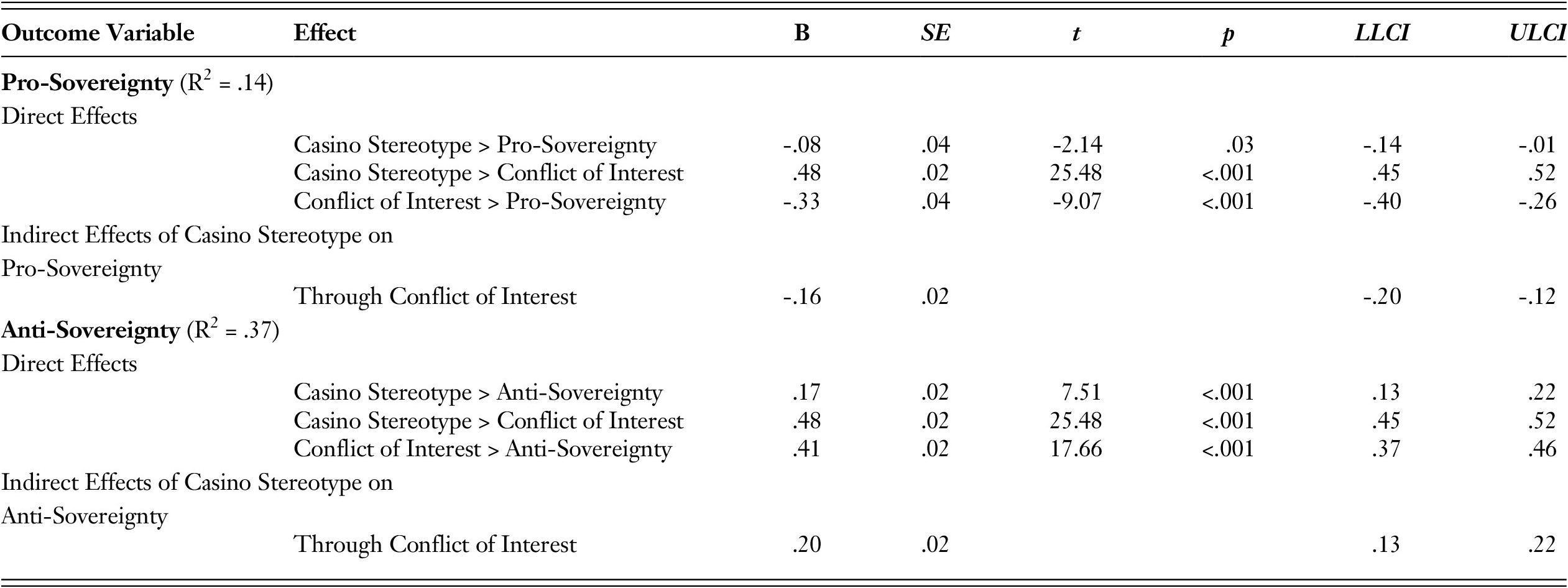
Table 2 presents the results of two separate regression models assessing direct and indirect effects of Casino Stereotype Belief on Sovereignty Attitudes through Perceived Conflict of Interest. Upper and lower bounds for 95% confidence intervals are presented for all direct and indirect effects. Confidence intervals that do not include zero indicate significant effects. Effects reported in Table 2 are taken from the final models that included covariates, Casino Stereotype Belief, and Perceived Conflict of Interest. Strong, significant direct relationships emerge from both Casino Stereotype Belief and Perceived Conflict of Interest to both measures of Sovereignty Attitudes. In other words, greater belief in the casino Indian stereotype and greater belief that Native American interests conflict with White American interests predict more negative attitudes toward Native nation sovereignty (i.e., higher scores on Anti-Sovereignty Attitudes and lower scores on Pro-Sovereignty Attitudes).
Direct and Indirect Effects of Stereotype Beliefs on Sovereignty Attitudes

LLCI: Lower Level Confidence Interval; ULCI: Upper Level Confidence Interval
The indirect relationships from Casino Stereotype Belief to Sovereignty Attitudes through Perceived Conflict of Interest are significant for models with both sovereignty variables. In other words, greater belief that Native American interests conflict with White American interests serves as a mechanism through which endorsement of the casino Indian stereotype is associated with more negative attitudes toward Native nation sovereignty (i.e., higher scores on Anti-Sovereignty Attitudes and lower scores on Pro-Sovereignty Attitudes). Figure 1 presents a summary of direct and indirect effects.
Direct and indirect effects from endorsement of casino Indian stereotype to sovereignty attitudes.

A second set of more complex mediation analyses are presented in Tables 3 and 4. The more complex indirect effects tested links from the Presence of Gaming Native Nations in Participant’s State of Residence (none vs. any gaming Native nations in participant’s state of residence) to Sovereignty Attitudes through endorsement of the Casino Stereotype Belief (first mediator) and Perceived Conflict of Interest with Native Americans (second mediator) (see Fig. 2). Table 3 presents results for the model assessing Pro-Sovereignty Attitudes, and Table 4 presents the results assessing Anti-Sovereignty Attitudes. The models presented are final models with covariates (age, gender, education, and political beliefs), and all variables are included in the models.
Direct and Indirect Effects of Presence of Gaming Native Nations on Pro-Sovereignty Attitudes

LLCI: Lower Level Confidence Interval; ULCI: Upper Level Confidence Interval
Direct and Indirect Effects of Presence of Gaming Native Nations on Anti-Sovereignty Attitudes

LLCI: Lower Level Confidence Interval; ULCI: Upper Level Confidence Interval
Direct and indirect effects from presence of Native gaming toward sovereignty attitudes.

The Presence of Gaming Native Nations in Participant’s State of Residence is not related directly to the Perception of Conflict of Interest with Native Americans, Pro-Sovereignty Attitudes, or Anti-Sovereignty Attitudes. However, Presence of Gaming Native Nations in Participant’s State is positively associated with endorsement of the Casino Indian Stereotype, which in turn is positively associated with greater Perceived Conflict of Interest with Native Americans, and then greater Perceived Conflict of Interest with Native Americans is positively associated with Anti-Sovereignty Attitudes and negatively associated with Pro-Sovereignty Attitudes. In other words, an indirect path emerges from the presence of Native nation gaming in a participant’s state to greater belief in the casino Indian stereotype to greater perceived conflict of interest with Native Americans to more negative attitudes toward Native nation sovereignty. See Figure 2 for a summary of effects.
DISCUSSION
Native nation sovereignty is critical to the existence of Native nations. Native nations are distinct political and cultural entities. Sovereignty ensures their continued political existence and enables them to govern their communities in accordance with their unique laws and traditions. Without sovereignty, Native nations would cease to exist as self-governing nations. Research has demonstrated that Native nation sovereignty enhances the quality of life of Native Americans (e.g., economic improvements, cultural maintenance) (Jorgensen Reference Jorgensen2007). In this study, we focused on three phenomena that may be associated with White attitudes toward Native nation sovereignty: presence of Native nation gaming in participants’ states, belief in the casino Indian stereotype, and perceived conflict of interest between Native and non-Native Americans.
The median scores for the main measures utilized in our study indicate that over half of our White American participants to some degree support Native nation sovereignty, do not perceive Native American interests as conflicting very much with their own, and do not hold strong belief in the casino Indian stereotype. Notably, the U.S. population is likely less supportive of Native people than is our sample, because our sample has higher percentages of female, educated, and liberal people than the U.S. population generally, and these categories of people tend to be more supportive of Native peoples (Bobo and Tuan, Reference Bobo and Tuan2006).
Our results support two different models that help explain White American attitudes toward Native nation sovereignty. The findings for our first model demonstrate that both belief in the casino Indian stereotype and perceived conflict of interests with Native Americans are positively associated with negative attitudes toward Native nation sovereignty. Further, perceived conflict of interest with Native Americans helps to explain the relationship between belief in the casino Indian stereotype and negative attitudes toward Native nation sovereignty. In our second model, the presence or absence of gaming Native nations in participants’ states is not directly associated with attitudes toward Native nation sovereignty nor with perceptions that White American interests conflict with the interests of Native Americans, but the presence of Native nation gaming in participants’ states is indirectly associated with attitudes toward Native nation sovereignty via two sequential mediators: belief in the casino Indian stereotype and then perceived conflict of interest with Native Americans. We are not sure why the presence of Native nation gaming is not directly associated with perceived conflict of interests. It may be that the measure of perceived conflict of interests is tapping a wider range of perceived conflicts than those associated with gaming, such as perceived conflicts focused on land, child adoption, jurisdiction, and government programs.
Although the main goal of our study was to help explain White attitudes toward Native nation sovereignty, our study also involved investigating the relevance of group position theory. We built on the scholarship of Bobo and Tuan (Reference Bobo and Tuan2006), in the sense that they also tested the relevance of group position theory to explaining attitudes toward Native nation rights. Unlike Bobo and Tuan, we studied attitudes toward Native nation sovereignty generally rather than particular treaty rights associated with a specific Native nation, and we used a national sample rather than one focused more narrowly on the geographic area in which the treaty rights apply. We focused on Native nation sovereignty because it is critical to the existence of all Native nations, and Native nations throughout the U.S. continue to face challenges to their sovereignty. Further, only two prior studies examined attitudes toward Native nation sovereignty (Rouse and Hanson, Reference Rouse and Hanson1991; Langford and Ponting, Reference Langford and Ponting1992), neither of which used a nation-wide U.S. sample and both of which analyzed data collected in the late 1980s, prior to the rise of Native nation gaming and the casino Indian stereotype.
Consistent with group position theory (Blumer Reference Blumer1958; Bobo Reference Bobo1999; Bobo and Tuan, Reference Bobo and Tuan2006), and empirical research focused on Native rights (Langford and Ponting, Reference Langford and Ponting1992; Bobo and Tuan, Reference Bobo and Tuan2006), our results suggest that in-group negative attitudes towards out-group rights are affected by the combination of negative prejudice/stereotypes about the out-group and perceptions that in-group interest conflict with (and thus are threatened by) the interests of the out-group. In our particular case, negative attitudes towards Native nation sovereignty are related to both belief in the casino Indian stereotype and perceptions that White Americans’ interests conflict with the interests of Native Americans.
Given the large bivariate correlations we observe between endorsement of the casino Indian stereotype, perceived conflict of interest, and sovereignty attitudes, it is clear that the direct effects of both variables (stereotype and conflict of interest) are important considerations in understanding sovereignty attitudes, and a reverse model that positions stereotype beliefs as the mediator might also be theoretically and empirically defensible. Like some others (Jackson Reference Jackson2020; Riek et al., Reference Riek, Mania and Gaertner2006), we suspect that the association between stereotypes and perceived conflict of interest is often bidirectional. However, our finding that presence of Native nation gaming is only directly associated with the casino Indian stereotype supports our ordering of the variables in the larger model. We are not suggesting that the endorsement of negative stereotypes as an antecedent to perceived conflict of interest is applicable to studies focused on other topics, but our results suggest that belief in the casino Indian stereotype is more common in states with Native nation gaming, while perceived conflict of interest is not directly tied to the presence of gaming. Given that research has revealed that Native nation gaming often increases jobs and the tax base for non-Native persons (Gordon Reference Gordon2018), and non-Native people who reside in communities near Native nation gaming approved of this gaming at higher levels than those who do not reside in these communities (Boehmke et al., Reference Boehmke, Branton, Dillingham and Witmer2012), there may be some discursive forces (e.g., media) that are fueling perceived conflict of interest by generating and reinforcing the casino Indian stereotype. This stereotype, which consists of exaggerated perceptions of Native American wealth and attribution of this wealth to Native Americans’ greedy manipulation of other Americans, is likely to generate a sense that Native American interests threaten and conflict with White American interests. Although this theorizing is logical, our cross-sectional method does not allow determination of causal order. Longitudinal and experimental studies may enable scholars to determine a causal association between negative attitudes and perceived conflict of interest.
Our research findings, which evidence the harmful correlates of the casino Indian stereotype, are best understood in the context of information about the actual economic status of Native Americans and stereotypes associated with this economic status. Native Americans experience relatively high rates of poverty, health problems, and educational challenges (Musu-Gillette et al., Reference Musu-Gillette, Robinson, McFarland, KewalRamani, Zhang and Wilkerson-Flicker2016; U.S. Census Bureau 2017; U.S. Department of Health and Human Services 2015). Ignoring colonization, problematic U.S. government policies, discrimination, and structural disadvantages, many White Americans have long explained such problems via the stereotype of “the Broken Indian” (aka “the Degraded Indian”), which consists of the belief that Native Americans are poor, uneducated, and unhealthy due to their flawed “culture”Footnote 8 (Berkhofer Reference Berkhofer1978; Fryberg Reference Fryberg2002; Larson Reference Larson2006).Footnote 9 Advancements in Native nation sovereignty recently enabled some economic, education, housing, health, and criminal justice improvements in the lives of Native Americans (Akee and Taylor, Reference Akee and Taylor2014; Deer Reference Deer2015; Dudas Reference Dudas2008; HPAIED 2008; Jorgensen Reference Jorgensen2007). Scholars observed that some of these positive developments, especially Native nation economic initiatives, are perceived by some Whites as threats to White power and economic resources (Cattelino Reference Cattelino2008; Dudas Reference Dudas2008; Mackey Reference Mackey2016; McCune Reference McCune, Gercken and Pelletier2018). Our study contributes to understanding this reaction by providing evidence that the casino Indian stereotype is associated with these perceptions of threat. Further, our findings suggest that the casino Indian stereotype is damaging beyond its inaccuracy and association with perceptions of threat, because this stereotype may ultimately diminish White American support for Native nation sovereignty, which is critical to the existence of Native American nations and a primary driver of recent improvements in Native American lives.
Prior researchers found that proximity to Native nations and exercises of their sovereign rights, particularly when those exercises are perceived to conflict with White American interests, is related to greater prejudice/stereotyping, and more negative attitudes towards Native nation rights. Specifically, Bobo and Tuan (Reference Bobo and Tuan2006) found that non-Natives who lived in regions in Wisconsin where Chippewa had off-reservation treaty rights had more negative attitudes about Native Americans and their rights compared to non-Natives who lived in regions in Wisconsin where Chippewa did not have off-reservation rights. Similar to these findings, our results demonstrate that living in a state with Native gaming is directly related to greater stereotyping. Then, this stereotyping is related to greater perceptions that Native American interests conflict with White Americans, and more negative sovereignty attitudes. Notably, however, the relationship between proximity and negative attitudes is not absolute. Specifically, Boehmke et al. (Reference Boehmke, Branton, Dillingham and Witmer2012) demonstrated that communities with Native nation gaming are more supportive of said gaming than communities without Native gaming. This support, the authors suggested, stems from the fact that people in close proximity can see first-hand the benefits of Native nation gaming (Boehmke et al., Reference Boehmke, Branton, Dillingham and Witmer2012). It may be that those further away do not have direct evidence that counters political and media discourse that reflects the casino Indian stereotype. It is possible that in states with Native nation gaming, the dearth of understanding of Native nation sovereignty (that enables Native nation economic activities, such as gaming) is more often filled with misleading ideas (Gordon Reference Gordon2018), such as the casino Indian stereotype (Boxberger Flaherty Reference Boxberger Flaherty2013; Colley Reference Colley2018; LaCroix Reference Lacroix2011). Given that our analyses were at the state-level, future research will benefit from investigating variation at more local levels, and whether the type of assertion of sovereignty rights (e.g., those which more obviously benefit the entire community vs. Native peoples primarily) affect attitudes.
Our findings, along with those of others (Bobo and Tuan, Reference Bobo and Tuan2006; Boehmke et al., Reference Boehmke, Branton, Dillingham and Witmer2012; Conner et al., Reference Conner, Fryar and Johnson2017; Gordon Reference Gordon2018), suggest that reducing misinformation about Native American nations could improve attitudes toward Native nation sovereignty and Native Americans more generally. Our findings suggest provision of the following information may improve White American attitudes toward Native nation sovereignty. First, accurate descriptions of Native American economic status, Native gaming regulations, and ways Native nation economic development improve Native and non-Native lives could undermine belief in the casino Indian stereotype. Second, information that demonstrates the multiple ways that Native American interests align with the interests of non-Native people could help debunk perceived conflicts of interest. For example, Native nation sovereignty can improve the lives of non-Native people by providing jobs, reducing pollution, increasing public safety, generating revenue for local governments, and enhancing the moral integrity of U.S. society (Boehmke et al., Reference Boehmke, Branton, Dillingham and Witmer2012; Deer Reference Deer2015; Dudas Reference Dudas2008; Gordon Reference Gordon2018; HPAIED 2008; Mackey Reference Mackey2016). Third, given that many non-Native Americans know little about Native nation sovereignty (Conner et al., Reference Conner, Fryar and Johnson2017; Reclaiming Native Truth Project 2018), education about Native nation sovereignty itself is critical.
Scholarship suggests that while there are realistic (i.e., actual) conflicts of interest, some perceived conflicts of interest are not realistic (Jackson Reference Jackson2020). Certainly, there have been realistic conflicts of interest with Native nations, as corporations and governments exploited, and attempted to exploit, Native nations. At the same time, many conflicts between Native nations and non-Native persons are not realistic, are overstated, or can be perceived through different lenses. Our suggestions for reducing misinformation and increasing accurate information are meant to address the latter, and are aligned with Blumer’s (Reference Blumer1958) insight that perceived group interests are often not objective interests, but rather are generated and fueled by institutions that shape societal ideology. Thus, working for accurate and diverse historical and contemporary portrayals of Native Americans and Native American nations in media and schools is essential. Some Native American organizations, such as IllumiNative and the Native American Journalists Association, aim to do just that. In doing so, these organizations face many barriers, including non-Native corporations and government entities (e.g., school boards, state governments) that are not sufficiently motivated to make change.
Our study has both limitations and strengths. In terms of limitations, although our sample consisted of participants from across the nation, samples from Mechanical Turk are not representative of the U.S. population in regard to demographic dimensions such as age, gender, and income (Weinberg et al., Reference Weinberg, Freese and McElhatan2014). Second, our cross-sectional method leaves open the possibility that the order of variables in our models, although theoretically viable, does not represent a causal pathway. We speculate that analysis of longitudinal data would reveal a complex pattern of reciprocal and bidirectional relationships among variables. A third limitation of our study is that our measure of presence and absence of Native nation gaming in participants’ area of residence was at the state level. In any given state, some non-Native residents live close to Native nations and Native nation gaming facilities, while others live further away, and these differences in distance likely affect contact with Native nations and gaming facilities in meaningful ways (Boehmke et al., Reference Boehmke, Branton, Dillingham and Witmer2012).
One strength of our study is that we used two multi-item measures of attitudes toward sovereignty, in one case presenting positive statements about Native nation control without mentioning the term sovereignty and in the other case presenting a definition of Native nation sovereignty along with negative statements focused on elimination of Native nation control. A second strength of our study is our large nationwide sample, which included participants from all U.S. states. This is important because U.S. states differ significantly in regard to the number of federally recognized Native nations and Native nation gaming establishments within their borders. Further, our sample included participants who varied considerably in age, level of education, religious belief, and political ideology. Scholars have argued that although samples drawn from Mechanical Turk do not accurately represent the U.S. population in terms of demographic characteristics such as age, gender, education, income, religiosity, and political ideology, these samples do not constitute a “wildly distorted view of the U.S. population” (Berinsky et al., Reference Berinsky, Huber and Lenz2012, p. 361; Buhrmester et al., Reference Buhrmester, Kwang and Gosling2011; Weinberg et al., Reference Weinberg, Freese and McElhatan2014). Another strength is that we believe we are the first scholars to explore the association between attitudes toward Native nation rights and the casino Indian stereotype.
We have some suggestions for future research. One obvious suggestion is to replicate our study with different samples. It would be useful to include other components of group position theory in future studies of Native nation rights, such as degree of commitment to White U.S. identity. Experimental research could be used to determine the causal order of the casino Indian stereotype and perceived conflict of interest relative to sovereignty attitudes via manipulation of these two constructs. Given the importance of Native nation sovereignty, we urge scholars to explore additional factors that may be associated with attitudes toward sovereignty. There are many possibilities, including: beliefs associated with colonialism, endorsement of nationalism, endorsement of individualism, affect felt toward Native Americans, traditional and modern prejudice against Native Americans, beliefs about economic inequality, beliefs about the role of government, and micro- and macro-economic conditions. We believe that it is most important to test whether exposure to the information mentioned earlier in this section improves attitudes toward Native nation sovereignty. Along these lines, Thaddieus Conner et al. (Reference Conner, Fryar and Johnson2017) already demonstrated that provision of information about the relationship between Native American tribes and the U.S. government improves attitudes toward Native nation sovereignty.
CONCLUSION
Sovereignty is critical to the survival of Native American nations. Within the context of the hegemonic U.S. nation, Native nation sovereignty is affected by the actions of the U.S. government, and the U.S. government is influenced by the public—especially White Americans since they hold the most power in U.S. society. Yet, we know little about contemporary U.S. attitudes toward Native nation sovereignty, and there is no previous scholarship that systematically examines the relevance of Native nation gaming to public opinion about Native nation sovereignty. Building on the small number of existing publications focused on non-Native attitudes toward Native rights in North America, we investigated whether group position theory could help to explain White American attitudes toward Native nation sovereignty. Using a national sample of White Americans, we examined the relationship between the presence of Native nation gaming, belief in the casino Indian stereotype, perceived conflict of interest with Native Americans, and attitudes toward Native nation sovereignty.
Overall, our findings demonstrate support for group position theory, as negative attitudes toward Native nation sovereignty in our White American sample are associated with belief in the negative casino Indian stereotype of Native Americans and perceived conflict of interest with Native Americans. Further, although living in a state with Native nation gaming is positively associated with belief in the casino stereotype, living in a state with Native nation gaming is only indirectly associated with opposition to Native nation sovereignty. We suspect that in states with Native nation gaming, discursive social forces such as media may play a role in generating more widespread belief in the casino Indian stereotype (Boxberger Flaherty Reference Boxberger Flaherty2013; Colley Reference Colley2018; Gordon Reference Gordon2018; Lacroix Reference Lacroix2011). And, those who embrace the casino Indian stereotype are more likely to espouse negative attitudes about Native nation sovereignty. We hope that our findings are useful to Native American nations and pan-tribal Native American political organizations as they work to maintain and enhance Native nation sovereignty.
ACKNOWLEDGEMENTS
The data discussed in this article is derived from one of three studies funded by a $65,000 grant from the Reclaiming Native Truth Project, managed by First Nations Development Institute and Echo Hawk Consulting, and funded by the W. K. Kellogg Foundation. These studies were led by Stephanie A. Fryberg (University of Michigan), and involved Arianne E. Eason (University of California, Berkeley) and Laurel R. Davis-Delano (Springfield College). Additionally, Arianne Eason’s work on this research was made possible by a National Science Foundation Graduate Research Fellowship, Ford Foundation Predoctoral Fellowship, Graduate Opportunity-Minority Advancement Program Presidential Fellowship, and through a National Institute of Aging (NIA) Aging and Development Training Grant (T32 AG0000030).
APPENDIX
Pro-Sovereignty Measure
-
(1) Native American tribes should be able to control their own schools.
-
(2) Native American tribes should be able to create and enforce their own rules, policies, and laws on reservations without interference from U.S. or state governments.
-
(3) Native American tribes should be able to control their own economic system without interference from U.S. or state governments.
-
(4) Native American tribes should be able to determine the nature/structure of their own government without interference from U.S. or state governments.
-
(5) Native American tribes should be able to control taxes paid by people living on their reservations.
Anti-Sovereignty Measure
Native American tribal sovereignty is derived from treaties signed between each tribe and the U.S. government. Tribal sovereignty means that each tribe has the authority to govern themselves. Related to this definition of sovereignty, please indicate the extent to which you agree or disagree with the following statements:
-
(1) The U.S. government should nullify all treaties between the U.S. government and Native American tribes.
-
(2) The U.S. government should not allow any Native American tribes to govern themselves.
-
(3) Native American reservations should be eliminated.
-
(4) Native American individuals should be able to own land, but Native American tribes should not be able to own land.
-
(5) On present-day Native American reservations, Native American tribes should not be subject to all U.S. laws, and should be able to create and enforce their own tribal laws. (Reverse Scored).
-
(6) Native American individuals and Native Americans tribes should be able to own businesses (e.g., tribal fishing or casino businesses). (Reverse Scored).