INTRODUCTION
Cuvier's beaked whale (Ziphius cavirostris G. Cuvier, 1823) has a cosmopolitan distribution in all oceans except in high polar waters, but low encounter rates through most of its range (Heyning, Reference Heyning, Ridgway and Harrison1989; MacLeod & Mitchell, Reference MacLeod and Mitchell2006). It is the only species of the Ziphiidae family present in the Mediterranean Sea that may be isolated from the Atlantic population (Dalebout, 2005).
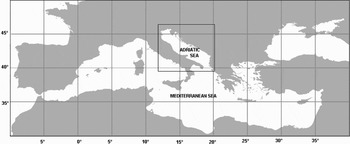
The Adriatic Sea is a semi-enclosed sea separated from the Ionian Sea by the Otranto Strait (780 m deep, 72 km length; Cushman-Rosin et al., Reference Cushman-Rosin, Gačić, Poulani and Artegiani2001) (Figure 1).
The position of the study area (Adriatic Sea).

The southern basin, deeper than the northern one, reaches depths of 1223 m and according to Holcer et al. (Reference Holcer, Notarbartolo di Sciara, Fortuna, Lazar and Onofri2007) it is probably a suitable habitat for Cuvier's beaked whale, which dives regularly to depths greater than 800 m (Baird et al., Reference Baird, Webster, McSweeney, Ligon, Schorr and Barlow2006). Dives deeper than 500 m are considered to be foraging dives (Tyack et al., Reference Tyack, Johnson, Aguilar Soto, Sturlese and Madsen2006). The diet of the species is described from patchy data only (Santos et al., Reference Santos, Pierce, Herman, Lopez, Guerra, Mente and Clarke2001). There are only four publications on stomach contents of Cuvier's beaked whale stranded in the Mediterranean Sea: two analysed from single strandings and two from mass strandings (Podestà & Meotti, Reference Podestà, Meotti and Evans1991; Carlini et al., Reference Carlini, Pulcini, Wurtz and Evans1992; Lefkaitou & Poulopoulos, 1998; Blanco & Raga, Reference Blanco and Raga2000). No information is yet available on diet in the Adriatic Sea.
The aim of this paper is to provide the dietary data of this species in the Adriatic Sea by presenting the analysis of two stomach contents obtained from four specimens stranded along the Croatian coast, and if results are able to establish that the species feeds in this area.
MATERIALS AND METHODS
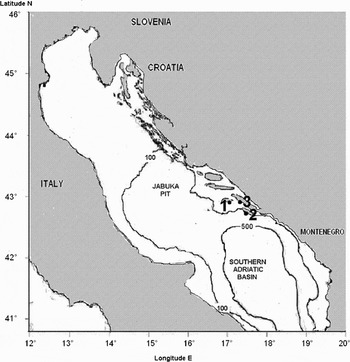
The gastro-intestinal tracks analysed in this study came from two whales stranded on Croatian coasts, between 17°00′E and 18°20′E; 42°30′N and 42°55′N (Figure 2): a male, quite decomposed, stranded on Mljet Island (on the southern shore) on 19 April 2004 and a newborn (estimated to be less then one week old according to H. Gomerčić) stranded on 11 June 2008 in Trstenica Bay near Orebić. Also a 5.10 m long male stranded on 2 February 2002 on Korčula Island but could not be considered for the study due to its very advanced state of decomposition. The two most distant strandings were 50 km apart.
Stranding locations of Cuvier's beaked whale in the eastern Adriatic Sea. (1) male, Korčula; (2) male, Mljet; (3) newborn.

The two decomposed carcasses had been identified using DNA analysis to confirm the identifications (Gomerčić et al., Reference Gomerčić, Gomerčić, Gomerčić, Lucić, Dalebout, Galov, Surković, Škrtić, Vuković and Huber2006).
Cephalopod beaks were identified using published cephalopod guides (Clarke, Reference Clarke1986) and a reference collection of oceanic cephalopod beaks. The total number of prey items per species was estimated according to Clarke (Reference Clarke1986) as the number of lower or upper beaks, whichever was higher. Rostral length (LRL) measurements of lower beaks were taken using calipers to an accuracy of 0.01 mm. Mantle length (ML) and body mass of prey were estimated using regression equations given by Clarke (Reference Clarke1986). Overall diet composition was calculated expressing the proportion of each cephalopod species number and mass in the total of all prey species.
RESULTS
Stomach contents were found in two whales: a newborn and one male.
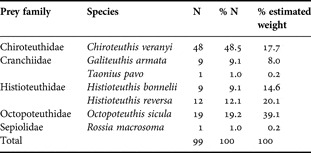
The newborn had only milk in its stomach. The stomach of the male contained food remains consisting only of cephalopod beaks: 99 lower and 90 upper beaks belonging to five families and seven species (Table 1).
Prey species found in the stomach of Cuvier's beaked whale stranded at Mljet (Croatia) in 2004.

Number of individuals (N) and percentages by number (% N) and by wet weight (% wt) in the sample for each prey species (sample size: N = 99).
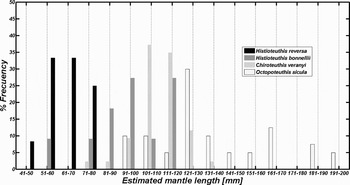
The higher weight percentage was obtained for Octopoteuthis sicula (Ruppel, 1844) and Histioteuthis reversa (Verrill, 1880) (Table 1); while Chiroteuthis veranyi (Férrusac, 1834) dominated in terms of prey numbers (N = 48). The estimated ML ranged between 46 and 75 mm for H. reversa with a mode of 66; between 59 and 119 mm with a mode of 95 and 115 for Histioteuthis bonnellii (Férussac, 1834); and between 89 and 170 mm with a mode of 148 for C. veranyi (Figure 3).
Frequency distribution of estimated size (dorsal mantle length) of Histioteuthis bonnellii, Histioteuthis reversa, Chiroteuthis veranyi and Octopoteuthis sicula eaten by the Mljet Cuvier's beaked whale.

DISCUSSION
The prey items found in the stomach of the Mljet Island whale are pelagic cephalopods associated with middle and lower slopes.
Histioteuthis reversa and Histioteuthis bonnellii have been found in the southern Adriatic basin at depths between 296–567 and 116–787 m respectively, but are also present down to 1000 m deep (Voss et al., Reference Voss, Nesis and Rodhouse1998).
Chiroteuthis veranyi, the main prey in number, has also been found in Jabuka Pit and the southern Adriatic basin (Bello, Reference Bello1990; Krstulović Šifner et al., Reference Krstulović Šifner, Lefkaditou, Ungaro, Ceriola, Osmani, Kavadas and Vrgoč2005). The adults of this species are bathypelagic living deeper than 700 m, while the young individuals are found between 300 and 600 m deep (Kaspiris & Tsiambaos, Reference Kaspiris and Tsiambaos1984). The ML of C. veranyi in the male stomach was less than half of the maximum species size according to Voss et al. (Reference Voss, Nesis and Rodhouse1998).
Octopoteuthis sicula, the main prey in weight, is not listed in the Adriatic fauna (Bello, Reference Bello1990), but was found in the eastern Mediterranean Sea (Salaman & Katağan, Reference Salaman and Katağan2002). This species was also found in the stomachs of Cuvier's beaked whales mass stranding in the Ionian Sea (Lefkaditou & Poulopoulos (Reference Lefkaditou and Poulopoulos1998).
Galiteuthis armata (Joubin, 1898), absent from the Adriatic Sea (Bello, Reference Bello1990) is rarely found in the eastern Mediterranean Sea (Lefkaditou et al., Reference Lefkaditou, Mytilineou, Maiorano and D'Onghia2003) but was in both stomachs of the Adriatic whale and the two whales stranded on the Spanish Mediterranean coast (Blanco & Raga, Reference Blanco and Raga2000). They reported ten cephalopod prey species: five also found in the Adriatic male (O. sicula, H. bonnellii, H. reversa, C. veranyi and G. armata) and Todarodes sagittatus (Lamarck, 1798), Chenpteryx sicula (Vérany, 1851), Ancistrocheirus lesueurii (Orbigny, 1842), Heteroteuthis dispar (Rüppell, 1844) and Ancistroteuthis lichtensteinii (Ferrusac, 1835).
Ancistroteuthis lichtenstenii was found in both whales stranded on the west coast of Italy. Podestà & Meotti (Reference Podestà, Meotti and Evans1991) also found Histioteuthidae and Cranchiidae, and the only octopod found in stomachs of Cuvier's beaked whales stranded in the Mediterranean: Eledone sp.
Prey of other specimens stranded in the same area were H. bonnellii, H. reversa, T. sagitattus, A. lichenstenii, O. sicula, C. veranyi and Heteroteuthis dispar (Rüppell, 1844), Ommastrephes barramii (LeSueur, 1821) (Carlini et al., Reference Carlini, Pulcini, Wurtz and Evans1992).
Histioteuthis bonnellii had been found in Cuvier's beaked whales' stomachs from all stranding locations in the Mediterranean Sea where stomach contents were examined, suggesting that this species, found in the whole of the Mediterranean Sea (Bello, Reference Bello1990; Salaman & Katağan, Reference Salaman and Katağan2002; Lefkaditou et al., Reference Lefkaditou, Mytilineou, Maiorano and D'Onghia2003), could be an important prey of Cuvier's beaked whale in the area. Octopoteuthis sicula, the most important species in weight in the Adriatic whale, was absent only in one whale stranded in Italy.
Octopoteuthis sicula and G. armata, both species being absent in the Adriatic Sea, their stomach content quantity suggests that the whale fed before entering the Adriatic Sea. However, as the distribution of the deep sea cephalopods is insufficiently known, we cannot exclude feeding in the Adriatic Sea.
ACKNOWLEDGEMENTS
We kindly thank B. Torres for his comments on the manuscript and assistance with the figures. Two anonymous referees provided very helpful comments on the manuscript. This work was supported by the Croatian Ministry of Science, Education and Sport.