Introduction
Flooding has become a major health and socioeconomic issue worldwide, with climate change as an increasingly important causal factor. Reference Doocy, Daniels, Murray and Kirsch1 Japan is no exception, and it has experienced a growing number of catastrophic experiences including typhoons of increasing intensity as well as a major tsunami. 2 The nation’s situation is now magnified with its now ‘super-aged’ society, where over 20% of the total population is aged 65 years or older. Mobility and physical activity gradually declines with age, making the super-aged particularly vulnerable. As seen during the 2005 Hurricane Katrina in the USA, the elderly population proved vulnerable to floods due to their decreased physical and cognitive functions. Reference Jonkman, Maaskant, Boyd and Levitan3 To minimize the impact of flooding, particularly on the elderly, it is important to establish practical and effective prevention, safety, and evacuation strategies.
In order to counteract the increasing intensity and frequency of flooding, the Japanese government issued an evacuation guideline, with timely updates. The latest version of the guideline, published on March 29, 2019, was updated based on the experiences of the 2018 Japan floods. The guideline now enables local governments to standardize the issue of evacuation advisories and related communication methods. In addition, when flooding is anticipated, the Japan Meteorological Agency publishes hazard expectations and alerts about potential damages across the country, and the information is disseminated via various media outlets. Based on this information, each local municipality issues an evacuation order via emergency evacuation sirens and mass media.
Typhoon Hagibis, one of the strongest typhoons ever recorded, which originally formed near the Mariana Islands on October 6, 2019, made initial landfall on Japan’s eastern Izu Peninsula at Shizuoka on October 12, 2019. The second landfall was in the greater Tokyo area, and subsequently, it tracked across central and eastern parts of the country, moving offshore at Fukushima the following day. At its first landfall, the Japan Meteorological Agency urged 45000000 residents in 6 prefectures including Tokyo to find a secure building or move to higher floors. 4 It is also reported that more than 800000 households across 11 prefectures were ordered to evacuate, 4 and 230000 people in Tokyo alone, reportedly sought safety by evacuating to storm shelters. Reference Kobayashi, Wakatsuki and Griffiths5 The highest wind speed was 260km/h over the Philippine Sea and the typhoon caused rainfall in excess of 922.5mm in nearby Hakone, a few miles from Mount Fuji, with recorded floodwaters over 10 meters high. The worst affected areas suffered record-breaking rainfall, massive flooding, and loss of electricity, and water supplies. Reference Abainza6 Japan’s Land and Infrastructure Ministry reported that 300 rivers had overflowed, notably in Nagano, Fukushima and Miyagi Prefectures; 25000 hectares of land were flooded; embankments collapsed in 140 locations; and there were over 950 incidents of landslides and mudflows. Hagibis caused devastating damage: 98914 houses were damaged or destroyed as a result of the floodwaters. 7 Economic costs from the damage, including the widespread disruption of the Rugby World Cup, and Japanese Grand Prix were estimated to be the equivalent of US$15000000000. Reference Kramer and Ware8 According to various news media, the typhoon reportedly led to the deaths of approximately 100 people, although proper assessments have not been done regarding the causes and other details.
This study thus clarifies the details of the deaths caused by Typhoon Hagibis. We believe that the study provides fundamental information and insights, with a sound evidence base to inform decision-makers, to develop effective measures to best cope with flooding, and its impact on the nation’s increasingly aging society.
Methods
Study Setting, Participants, and Data Sources
We considered all residents who lost their lives in Japan’s Typhoon Hagibis. The data source was the official website of the Fire and Disaster Management Agency in Japan, as we assumed that it provided the most comprehensive list of those who perished due to the impact and aftermath of the typhoon. 7 Since this list simply provided a number of the deceased, we double-checked their basic demographic profiles at the official websites of each relevant prefectural office.
Using Japanese reports from newspapers and other media outlets, data was collected on sex, age, cause of death, and the location in which the concerned deceased residents were found. Then, using these data as references, and specific media reports, the residents were identified. For those who reportedly drowned in their residences, data from these media reports were abstracted with regard to their house structure, number of co-habiting family members, and health status as well as how their deaths occurred. During the data collection process, the relevant articles were obtained, mainly using Nikkei Telecom, the largest commercial database for Japanese newspaper companies, and other media outlets, which have been used in previous studies. Reference Tani, Sawano, Kawamoto, Ozaki and Tanimoto9
Moreover, to determine if the victims’ residences were situated in high-risk flooding areas, the researchers used flood hazard maps published by each relevant local municipality. In Japan, virtually all municipalities have published flood hazard maps on their websites, which are freely accessible. For clarification, we employed American terminology, namely that the ‘first floor’ refers to ground level, which in British English is known as the ‘ground floor.’
Data Analysis
In order to clarify the characteristics of deceased victims, descriptive analyses were conducted for the obtained data. Furthermore, for those who reportedly drowned indoors, further details on their deaths were evaluated, as it was assumed that analyses may provide important lessons for future flood safety strategies.
Results
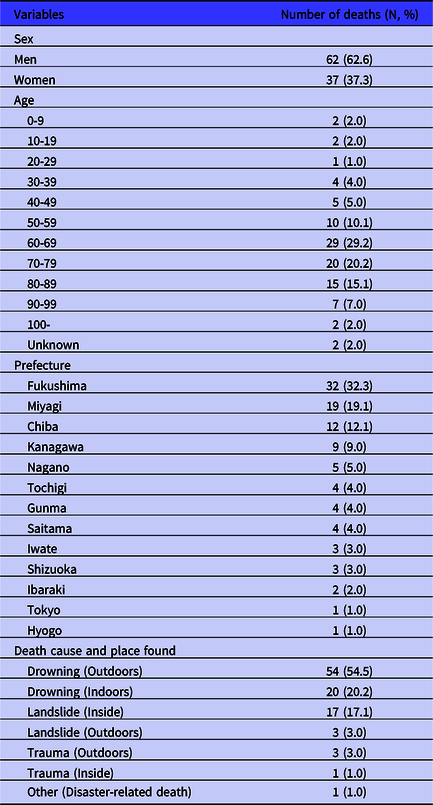
Table 1 shows the basic characteristics of the 99 residents killed by Typhoon Hagibis. Of the total with known age, 65 (73.0%) were aged 65 years or above. Regarding the cause of death, 54 drowned outdoors (54.5%), 20 drowned indoors (20.2%), 20 were involved in landslides outdoors or indoors (20.2%), 4 died of trauma or injuries (4.0%), and 1 was considered a “disaster-related death” (1.0%). This disaster-related death refers to a male resident who was evacuated to several shelters, but his chronic condition worsened to the point where he died from pneumonia.
Demographic data and cause of deaths among the residents killed by Typhoon Hagibis in Japan

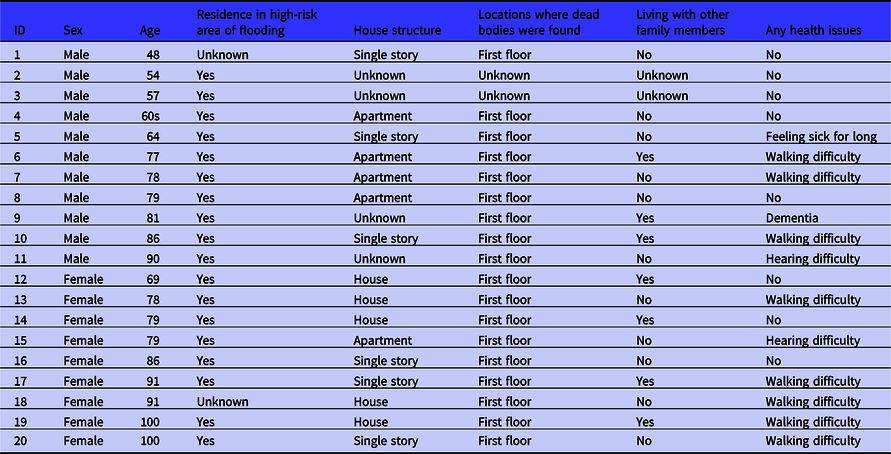
Table 2 shows detailed characteristics of the 20 residents who drowned indoors. For 2 individuals (ID 2 and 3), information was unavailable regarding the places where their bodies were found. The remaining 18 (90.0%) residents lived in areas at high risk of flooding, as depicted in flood hazard maps. Their bodies were found on the first floor of their residences. Of the 18, 6 lived in single-story houses (33.3%) and 10 (55.6%) lived in at least 2-storied houses.
Characteristics of those who drowned indoors during Typhoon Hagibis in Japan

House: a house with second or upper floors; Single story: a house with only 1 floor; Apartment: a building of 2 or more floors containing several individual apartments.
Of the 10 residents who drowned indoors in multiple-storied apartments or residences, it was reported that 6 (ID 6, 7, 13, 15, 18, and 19) (60.0%) could not move upstairs due to their physical disabilities: 5 (ID 6, 7, 13, 18, and 19) had walking difficulties, and 1 (ID 15) had a hearing problem and missed the disaster alert to evacuate.
In contrast, 4 (ID 4, 8, 12, and 14) (40.0%) did not seek refuge upstairs, although they were physically capable of doing so, as reported in interviews with their neighbors or families. Among them, 2 (ID 12 and 14) lived in their own multi-storied homes, while the others (ID 4 and 8) lived in apartments. These people did not evacuate outdoors or move upstairs for reasons including pets, as reported in the media reports. A male aged in his 60s (ID 4) reportedly had 4 pets and was not able to find shelters where he could stay with them. His neighbors asked him to evacuate to a higher floor in their houses, but he felt it was not acceptable to take all his pets with him, so he decided to stay in his home. Thus, he did not evacuate before the typhoon hit his residence. The second man, aged 79 (ID 8) reportedly lived by himself and did not interact with his neighbors. Thus it is difficult to determine what information he had prior to the typhoon striking. A female aged 69 (ID 12), who was reportedly living with other family members was hit by the flood while sleeping. Her neighbors reported that she tried to swim through the flooded first floor but it was too late. A female aged 79 (ID 14), reportedly underestimated the dangers of flooding. Although her daughter asked her to evacuate, she refused and her body was later found on the first floor of her house.
Discussion
In the present study, we illuminated that approximately 66% of those who died due to the impact of Hagibis were aged 65 years or above. Overall, this finding is in line with the previous evidence. For example, it was previously reported that in Italy, in the 50-year period from 1965 to 2014, the percentage of flood-related fatalities among those aged 60 years and above was 27.3%, and 42.3% among males and females, respectively. Reference Salvati, Petrucci, Rossi, Bianchi, Pasqua and Gender10 Additionally, in the US, during 1959 to 2005, people older than 60 years were found to be highly vulnerable to flooding. Reference Ashley and Ashley11 Furthermore, during Hurricane Katrina, 60% of the total deaths occurred among those aged 65 years or above in New Orleans, Reference Jonkman, Maaskant, Boyd and Levitan3 while 49% of total deaths were among those aged 75 years or older in Louisiana. Reference Brunkard, Namulanda and Ratard12 Vulnerabilities to flooding among the elderly reportedly roots from normalcy bias, and deteriorating physical and cognitive functions. Reference Brunkard, Namulanda and Ratard12 The present study reinforces previous findings by demonstrating that a timely evacuation of the elderly population should be prioritized to help reduce injuries and deaths during floods.
There were several important findings with respect to the existing evacuation strategies currently used in Japanese municipalities. Notably, the residents who drowned indoors, specifically those whose locations were identified, died in their homes in locations that are at high risk of flooding. This finding suggests a need to prioritize and enforce evacuation measures among those who live in or around such high-risk areas. It also suggests that evacuation may not be absolutely necessary among those who live in locations that are not considered high-risk areas. Flooding is relatively easier to predict than other disasters, such as earthquakes, owing to historical records, previous flood experiences, and geographical and environmental characteristics. Analyses of past records, as well as current anti-flooding measures, are used to develop flood hazard maps published at the local municipality level. Reference Artigas, Bosits, Kojak, Elefante and Pechmann13 Also, past experiences have led to important improvements in evacuation strategies in Japan. For example, based on experiences during Japan’s 2011 triple disaster (earthquake, tsunami, and nuclear disaster), the Basic Act on Disaster Management was revised in 2014, and presently, in the context of disasters, municipalities are legally required to list all residents who have special care needs. Consequent to this revision, 98.9% (1720/1740) of the municipalities that were surveyed responded that they had already prepared the relevant lists by June 1, 2019, 14 accounting for approximately 6840000 vulnerable people. 15 However, the current legal frameworks continue to have some shortcomings. Specifically, the law currently does not specifically require the preparation of evacuation plans for these vulnerable populations at the individual level. 15 Thus, further improvement is needed in the prevailing evacuation strategies so that municipalities and residents can fully comprehend, in advance, the necessity of evacuating when faced with the prospect of severe flooding, and can provide particular care for those whose mobility and possibility of escape to higher floors is restricted.
Additionally, our study confirmed the importance of reevaluating the timing of evacuation orders issued by municipalities, given the finding that 54 people drowned outdoors. A warning regarding the potential landing of Typhoon Hagibis and subsequent flooding was widely disseminated a week before its actual landfall via numerous media outlets and central government announcements. Evacuation is an effective safety strategy if residents reach shelters before the possible dangers manifest. Reference Lane, Charles-Guzman, Wheeler, Abid, Graber and Matte16 However, in this case, a majority of the local municipalities issued evacuation orders to their residents on the day before the typhoon landed and, in some instances, on the actual day, exposing residents to the risk of drowning during evacuation. Reference French, Ing, Von Allmen and Wood17,Reference Du, FitzGerald, Clark and Hou18 It is clear that relevant stakeholders should revisit evacuation guidelines, as proposed by either national or local governments, and consider how these guidelines should be communicated and enforced in order to minimize damage and loss of life. Reference Pfister19 Additionally, local residents should independently prepare for evacuation, seek information, check hazard maps when necessary, and devise optimal escape routes, irrespective of instructions from local municipalities
In the case of the 18 residents who drowned indoors, details on the locations of their deaths were available, which indicated that their bodies were found on the first floor of their residences. In other words, no death occurred among those evacuated to the second floor or above, a finding which is consistent with the observations from Hurricane Sandy. 20 This finding also confirms the obvious fact that evacuation to higher locations in a building may be a practical strategy to avoid rising flood waters, when an escape from the building is no longer an option. Further, this can be considered a reasonable option, given the finding that more than half of the deceased residents drowned outdoors.
However, in this context, it is meaningful to consider the case of the 10 people who reportedly died on the first floor of their residences, despite the presence of a second floor in the buildings. Of these 10, evacuation of the 6 who had physical disabilities would not have been straightforward. It would have required action from their family members, neighbors, and other volunteers to either assist them in evacuation or to move them to higher floors. Similarly, those living in single-story houses, and in areas where the floodwater could exceed the second floor of a residence, should consider evacuating immediately after being advised to, and the shelters are opened, preferably before flood waters start to rise. Thus, it is reasonable to say that evacuation to a higher location is only possible if (1) the building has 2 stories or more, (2) residents can go up or be transferred to higher floors, and (3) the final floodwater depth is not greater than the height of the highest floor or roof of the building. This once again demonstrates the importance of individual evacuation strategies for those with special care needs and even those with intact physical and mental functions. Hazard maps are useful in this respect since they generally show potential areas that would be submerged by floods with a scale of once in 1000 years. Reference Ozaki, Kanemoto and Wada21 Those living in areas at high risk of flooding should heed warnings and evacuate to safety early. Those unable to do so should put in place essential safety measures.
The remaining 4 victims did not seek higher locations or evacuate outdoors despite their intact physical functions. Plausible explanations according to available information, are lack of awareness of actual dangers, normalcy bias, and other personal priorities as shown in previous research. Reference Ozaki, Kanemoto and Wada21–Reference Ozaki, Leppold and Tsubokura24 It must be noted that 2 residents (ID 4 and ID 14) refused to evacuate despite requests from others. Whatever the reasons, such attitudes would put not just themselves, but others, such as neighbors, rescuers, and first responders, at risk. Also, 1 resident living by themselves (ID 8) may have benefited from the support of neighbors or other persons. Based on the lessons learned from the Brisbane flood, Reference Brockie and Miller25 it is essential to build strong and healthy communities; an individual approach to successfully manage evacuation, and ideally, determine community responses beforehand, as much as possible. Reference Burger, Gochfeld and Lacy26
Limitations
This study has several limitations, as the dates and articles from the Fire and Disaster Management Agency and newspapers were surveyed, and unpublished cases could not be captured, thus leading to underestimation of the number of victims. Interviews should have been done to overcome this limitation; however, it was difficult due to lack of contact information. Nonetheless, this study is quite unique compared to previous researches because a comprehensive review of the media reports and public data enabled an analysis of the detailed description of the residents’ deaths and their surroundings, including the locations where their bodies were found, the building structure of their residences, and their household compositions. Our data also clarified how they lived before their deaths, enabling inferences regarding their character. In the future, studies should evaluate the experiences of victims and their family members based on information gained from interviews.
Conclusions
In conclusion, a majority of those who died as a consequence of Typhoon Hagibis were elderly persons. While evacuation plans can be put in place to help avoid the damages caused by life-threatening floods, once floodwaters build (and they can do so very quickly), moving to higher levels is the only recourse. Thus, people need to access higher ground or move upward in any type of building. In houses, this means going to a higher floor or, in extreme circumstances, climbing onto the roof. This will only be possible for those who are physically able to do so. For those with restricted mobility or inability to move to higher locations in a building, alternatives have to be considered and made available. This might include mandatory evacuation protocols carried out by local emergency services. Family members, neighbors, or community groups may also be required to take on this responsibility. However, unless a mechanism is put in place to deal with such scenarios, individuals with restricted mobility and minimal evacuation options who live in flood-prone locations will continue to be at risk of injury or loss of life during Japan’s regular typhoons.
Author Contributions
Conceptualization: all authors; Data curation: Yoshida, Ozaki; Formal analysis: Yoshida, Ozaki; Funding acquisition: Tsubokura, Kami; Investigation: Yoshida, Ozaki; Methodology: Yoshida, Ozaki, Kami; Project administration: Ozaki, Kami; Resources: Yoshida, Ozaki, Kami; Supervision: Ozaki, Kami; Validation: Morita; Visualization: Yoshida, Ozaki; Writing, original draft: Yoshida, Ozaki; Writing, review & editing: All authors
Conflicts of Interest
Akihiko Ozaki receives personal fees from MNES Inc., outside the submitted work.