In their excellent article, Kooij et al. (Reference Kooij, Zacher, Wang and Heckhausen2020) introduce a self-regulatory model of successful aging at work. Their approach defines successful aging as “the proactive maintenance of, or adaptive recovery (from decline) to, high levels of ability and motivation to continue working among older workers” (p. 14). Their model proposes that person–environment fit (P–E fit) is a proximal determinant of successful aging. When misfit occurs or is anticipated, individuals engage in a self-regulation process of proactive or adaptive goal engagement and disengagement strategies to restore or maintain P–E fit. Although they identify contextual factors, such as age bias and meso-level (job, team, and organizational) factors, as antecedents of P–E fit and as catalysts for the self-regulation process, the model assumes these factors have their effects via individual processes. We believe this approach overemphasizes the role of individuals (i.e., the “person”), and understates the role of context (i.e., the “environment”), in achieving and maintaining P–E fit.
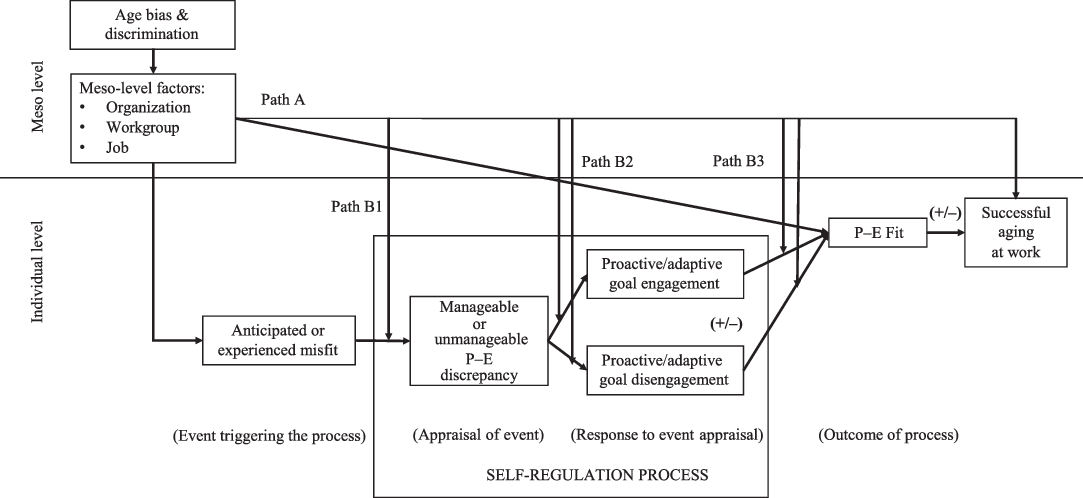
In this article, we propose several modifications to the process model of successful aging at work (see Figure 1). We draw on Johns’s (Reference Johns2006) review of the role of context on organizational behavior to describe the way environmental factors facilitate or constrain successful aging at work. First, we identify opportunity as a proximal determinant of successful aging at work (Path A in Figure 1) that explains the direct effects of context. Second, we argue that contextual factors (age bias and meso-level factorsFootnote
1
) can moderate the misfit–self-regulation–fit process described in the model (Paths B1 to B3 in Figure 1). Finally, we use our proposed expanded model to suggest strategies that organizations can use to enhance employees’ successful aging at work.
Figure 1.
Modified process model of successful aging at work. Note: Path A depicts the direct effect, and Paths B1 to B3 show the moderating effects contextual factors (here meso-level factors) can have on successful aging at work.
Opportunity as a proximal antecedent (Path A)
Meso-level factors can have a direct influence on successful aging at work by denying older workers the opportunity to participate fully in work (Path A in Figure 1). Blumberg and Pringle (Reference Blumberg and Pringle1982) reasoned that behavior “depends on the help or hindrance of uncontrollable events and actors in one’s environment” (p. 564), which they labeled as opportunity. They observed that ability and motivation, in the absence of opportunity, fail to adequately explain observed differences in employees’ behavior and ascertained that environmental factors outside of the individual’s control play a central role in predicting performance.
Applied to aging, individual ability and motivation alone cannot result in successful aging at work without having the opportunity to work. Indeed, a recent meta-analysis (Pak et al., Reference Pak, Kooij, De Lange and Van Veldhoven2019) revealed that organizational factors (i.e., job resources) were positively associated with older workers’ ability, motivation, and opportunity to continue working.
Contextual factors, such as age bias and organizational features, can influence successful aging at work by creating opportunities or imposing constraints (Johns, Reference Johns2006). For example, despite extensive empirical refuting evidence (Postuma & Campion, Reference Postuma and Campion2009), negative older worker stereotypes often shape the way that individuals in organizations view and behave towards older workers, which may in turn limit work-related opportunities available to older workers. At the extreme, negative age-biased work practices result in excluding older workers from participating in the workforce altogether, such as through layoffs or being denied employment. Albeit less extreme than total exclusion, negative age biases can also reduce opportunities such as the chance for training or engaging in interesting tasks. The extent to which mature workers have been denied work opportunities was revealed in our survey of Australian workers (Andrei et al., Reference Andrei, Parker, Constantin, Baird, Iles, Petery, Zoszak, Williams and Chen2019), which found that among working adults aged 55 to 64, 18% reported experiencing age discrimination at work. Similarly, in a survey of workers in the United States (Perron, Reference Perron2019) 61% of respondents over age 45 reported experiencing or witnessing workplace age discrimination, and 16% had personally experienced not being hired or losing their job because of their age. Therefore, negative age bias in the environment can deny employment opportunities, directly preventing successful ageing at work.
The impact that older worker stereotypes and biases can have on employment opportunities is further shaped by other aspects of context. For instance, older worker stereotypes can be particularly influential for jobs or industries that are perceived as having a “correct age” (e.g., the commonly held belief that the technology sector is a “young” industry; Posthuma & Campion, Reference Postuma and Campion2009). When an older applicant’s actual age does not match the perceived correct age of the job, they are less likely to be successful in obtaining the job, regardless of their ability or motivation to perform. According to Johns’s (Reference Johns2006) taxonomy, this is an example of omnibus context affecting base rates of behavior due to social norms and attitudes. Social norms, attitudes, and biases held by those responsible for making hiring decisions influence the occurrence of mature workers being offered employment opportunities, which in turn shapes the base rate of mature workers successfully aging at work. In these cases, older workers do not have the option of adapting to misfit in the environment because they have been denied the opportunity to work.
Consider the example of John, the construction worker from the focal article who anticipated misfit due to declining physical abilities. One suggestion was that John could look for a new, less physically demanding job to rectify the misfit. If John were to leave his job and seek employment elsewhere, biased and discriminatory recruitment and selection processes at other organizations might hinder his success in securing new employment. On the other hand, if John were to remain in the physically demanding job, his employer might fire him for being unable to meet the demands of the job. In either case, John’s opportunities are constrained, as is his successful aging at work.
The proposed opportunity pathway (Path A) is critical in that it bypasses the self-regulation process and highlights organization’s responsibility to create opportunities that enable mature workers to fully participate in work, thereby enhancing the potential for successful aging at work.
Moderating effects (Path B1 to B3)
Kooij et al. (Reference Kooij, Zacher, Wang and Heckhausen2020) recognize that age-supportive, meso-level factors enable self- regulation. That said, their model suggests that successful aging at work is achieved via an individual-level process prompted by misfit between the employee and the environment. We contend that contextual factors can also have a top-down moderating effect on the misfit–self-regulation–fit process (Paths B1, B2, and B3 in Figure 1). For example, the meso context can influence the extent to which misfit is considered manageable (Path B1), the extent to which the employee engages or disengages from the goal (Path B2), and the extent to which goal reorientation can achieve P–E fit (Path B3).
When misfit is anticipated or experienced, situational factors can moderate the extent to which the misfit is appraised as manageable or unmanageable (Path B1 in Figure 1). Johns (Reference Johns2006) observed that work design and organizational norms can create “strong situations,” which are contexts in which employees experience rigid work environments that restrict options. By contrast, weak situations offer more decision-making latitude and avenues for goal adaptation. Consider the case of mature workers whose current work schedule doesn’t allow them to fulfil their increased elder care responsibilities. In weak environments, this may be viewed as manageable because there are many ways to adapt to the new situation. However, in strong situations with few options, mature workers are more likely to appraise the situation as unmanageable. Therefore, although contextual factors can trigger misfit, appraising misfit as manageable or unmanageable is influenced, at least in part, by the perception that the work environment offers options to restore fit.
It is not enough to just perceive options. The top-down moderating effect of context can limit the self-regulation process by restricting the range of behaviors individuals can engage in to achieve the new goal (Johns, Reference Johns2006; Path B2 in Figure 1). For instance, there may be many options for different work schedules in an organization, but not all workers can access the full range of schedules. A worker with increased eldercare responsibilities might perceive there is scheduling flexibility at work (P–E discrepancy appraised as manageable), but in reality, the job only allows employees a choice of two schedules, which might not fit their needs, thereby restricting their ability to engage fully with their goals. Thus, even when individual workers reorientate and select new goals, organizational factors can limit those goals.
The work environment can also moderate goal reorientation (goal engagement and disengagement) efforts (Path B3 in Figure 1). Organizational support is often required to enable the enactment of goals directed at restoring P–E fit and for fit to be successful.
Returning to the early example of John, suppose he feels his misfit is manageable and decides he wants to learn new skills to enrich his current job (goal engagement, Path B2), as suggested in the focal article. In an age-inclusive work environment, where training is provided and learning needs are accommodated regardless of age, John’s employer would support his goal reorientation, enabling the reestablishment of P–E fit. However, in a nonsupportive work climate, John might be denied or not offered the opportunity to participate in training and development activities due to his age, thereby impeding his efforts to restore P–E fit. This is a reality for a large proportion of older workers. Our survey of Australian workers (Andrei et al., Reference Andrei, Parker, Constantin, Baird, Iles, Petery, Zoszak, Williams and Chen2019) revealed that 39% of respondents aged 55 and older believed they had been overlooked for training opportunities due to age. Now imagine that John deems the misfit as unmanageable and decides to look for a new job (goal disengagement, Path B3). However, the jobs for which he is qualified are other physically demanding jobs, leaving him stuck in poor-fitting work. Regardless of the goals that are selected, the organization’s or environment’s response ultimately determines whether individuals can achieve fit by either supporting or constraining their goal-directed behavior.
An important feature of these examples is that adaptations strongly depend on contextual features and situations. Work environmental factors can moderate how misfit is appraised, the effectiveness of the goal adaptation response, and the ability to achieve fit. Often these meso-level influences are invisible to employers and employees because they are part of the “taken-for-granted’” environment and norms. Yet, at the same time, small adjustments to the context can have profound effects on employee outcomes (Johns, Reference Johns2006). Organizations can facilitate opportunities for workers to successfully age at work by changing the work environment, as changing the “E” is a powerful way to achieve P–E fit.
Strategies to support successful aging at work
We maintain that context has a more powerful role in facilitating or hindering mature workers’ successful aging at work than is suggested in the focal article. Although it is not impossible for employees to change their environment (such as through proactive work behavior; Parker and Collins, Reference Parker and Collins2010), it can be difficult for employees to control or shape these conditions. Therefore, organizations have a responsibility to adapt the environment to enable successful aging at work.
To guide organizations in creating a workplace that empowers workers to successfully age at work, we draw on a framework of three broad metastrategies for supporting mature workers, namely the 3I model of include, individualize, and integrate (Parker & Andrei, Reference Parker and Andrei2020). We briefly describe this framework and provide in Table 1 examples of how each strategy can be used to support the additional pathways proposed above.
Table 1.
Examples of Organizational Intervention Strategies to Support Individual Efforts to Successfully Age at Work
Include strategies attempt to reduce age discrimination and create a workplace where workers of all ages feel welcomed and valued. Evolving from social identification theory and self-categorization theory (Tajfel & Turner, Reference Tajfel, Turner, Worchel and Austin1986), include strategies recognize that humans tend to use identifiable traits (such as age) to differentiate themselves from others and more strongly identify with those who are similar to them. Include strategies go beyond simply complying with mandatory employment legislation to proactively enacting and promoting inclusive and nondiscriminatory work practices, such as targeted recruitment of mature workers. Optimally, include strategies create a sense of belonging while at the same time valuing the unique contributions diverse employees make to the workplace (Shore et al., Reference Shore, Randel, Chung, Dean, Ehrhart and Singh2011).
Individualize strategies focus on tailoring and redesigning work to better fit the worker. These strategies draw on lifespan development theories, including selective optimization with compensation theory (Baltes & Baltes, Reference Baltes, Baltes, Baltes and Baltes1990) and socioemotional selectivity theory (Carstensen, Isaacowitz, & Charles, Reference Carstensen, Isaacowitz and Charles1999), and encourage organizations to adjust work to accommodate the changing needs, skills, and abilities of workers as they age. Such strategies include top-down, organization-led initiatives, such as implementing flexible work practices, and bottom-up, individually instigated actions, such as job crafting. Combining both bottom-up and top-down approaches can generate powerful and lasting results.
Integrate strategies drawing on team diversity theories (e.g., van Knippenberg et al., Reference van Knippenberg and Schippers2006) and emphasize improving interactions and collaborations between age diverse workers. Strategies involve encouraging intergenerational contact and bidirectional knowledge sharing and learning. Integrative strategies not only increase collaboration; they can strengthen the positive, age-inclusive climate foundation established with include strategies.
Conclusion
The process model described by Kooij et al. (Reference Kooij, Zacher, Wang and Heckhausen2020) paints an individualistic vision of successful aging at work. In reality, complex and dynamic contextual factors within organizations can restrict opportunities and foil an individual’s motivation, ability, and actions directed toward successfully aging at work. Our 3I framework can help organizations to capitalize on the unique knowledge, skills, and abilities of an age-diverse workforce while cultivating an environment in which workers are able and empowered to age successfully.





 You have
Access
In their excellent article, Kooij et al. (Reference Kooij, Zacher, Wang and Heckhausen2020) introduce a self-regulatory model of successful aging at work. Their approach defines successful aging as “the proactive maintenance of, or adaptive recovery (from decline) to, high levels of ability and motivation to continue working among older workers” (p. 14). Their model proposes that person–environment fit (P–E fit) is a proximal determinant of successful aging. When misfit occurs or is anticipated, individuals engage in a self-regulation process of proactive or adaptive goal engagement and disengagement strategies to restore or maintain P–E fit. Although they identify contextual factors, such as age bias and meso-level (job, team, and organizational) factors, as antecedents of P–E fit and as catalysts for the self-regulation process, the model assumes these factors have their effects via individual processes. We believe this approach overemphasizes the role of individuals (i.e., the “person”), and understates the role of context (i.e., the “environment”), in achieving and maintaining P–E fit.
In this article, we propose several modifications to the process model of successful aging at work (see Figure 1). We draw on Johns’s (Reference Johns2006) review of the role of context on organizational behavior to describe the way environmental factors facilitate or constrain successful aging at work. First, we identify opportunity as a proximal determinant of successful aging at work (Path A in Figure 1) that explains the direct effects of context. Second, we argue that contextual factors (age bias and meso-level factorsFootnote 1 ) can moderate the misfit–self-regulation–fit process described in the model (Paths B1 to B3 in Figure 1). Finally, we use our proposed expanded model to suggest strategies that organizations can use to enhance employees’ successful aging at work.
Modified process model of successful aging at work. Note: Path A depicts the direct effect, and Paths B1 to B3 show the moderating effects contextual factors (here meso-level factors) can have on successful aging at work.
Opportunity as a proximal antecedent (Path A)
Meso-level factors can have a direct influence on successful aging at work by denying older workers the opportunity to participate fully in work (Path A in Figure 1). Blumberg and Pringle (Reference Blumberg and Pringle1982) reasoned that behavior “depends on the help or hindrance of uncontrollable events and actors in one’s environment” (p. 564), which they labeled as opportunity. They observed that ability and motivation, in the absence of opportunity, fail to adequately explain observed differences in employees’ behavior and ascertained that environmental factors outside of the individual’s control play a central role in predicting performance.
Applied to aging, individual ability and motivation alone cannot result in successful aging at work without having the opportunity to work. Indeed, a recent meta-analysis (Pak et al., Reference Pak, Kooij, De Lange and Van Veldhoven2019) revealed that organizational factors (i.e., job resources) were positively associated with older workers’ ability, motivation, and opportunity to continue working.
Contextual factors, such as age bias and organizational features, can influence successful aging at work by creating opportunities or imposing constraints (Johns, Reference Johns2006). For example, despite extensive empirical refuting evidence (Postuma & Campion, Reference Postuma and Campion2009), negative older worker stereotypes often shape the way that individuals in organizations view and behave towards older workers, which may in turn limit work-related opportunities available to older workers. At the extreme, negative age-biased work practices result in excluding older workers from participating in the workforce altogether, such as through layoffs or being denied employment. Albeit less extreme than total exclusion, negative age biases can also reduce opportunities such as the chance for training or engaging in interesting tasks. The extent to which mature workers have been denied work opportunities was revealed in our survey of Australian workers (Andrei et al., Reference Andrei, Parker, Constantin, Baird, Iles, Petery, Zoszak, Williams and Chen2019), which found that among working adults aged 55 to 64, 18% reported experiencing age discrimination at work. Similarly, in a survey of workers in the United States (Perron, Reference Perron2019) 61% of respondents over age 45 reported experiencing or witnessing workplace age discrimination, and 16% had personally experienced not being hired or losing their job because of their age. Therefore, negative age bias in the environment can deny employment opportunities, directly preventing successful ageing at work.
The impact that older worker stereotypes and biases can have on employment opportunities is further shaped by other aspects of context. For instance, older worker stereotypes can be particularly influential for jobs or industries that are perceived as having a “correct age” (e.g., the commonly held belief that the technology sector is a “young” industry; Posthuma & Campion, Reference Postuma and Campion2009). When an older applicant’s actual age does not match the perceived correct age of the job, they are less likely to be successful in obtaining the job, regardless of their ability or motivation to perform. According to Johns’s (Reference Johns2006) taxonomy, this is an example of omnibus context affecting base rates of behavior due to social norms and attitudes. Social norms, attitudes, and biases held by those responsible for making hiring decisions influence the occurrence of mature workers being offered employment opportunities, which in turn shapes the base rate of mature workers successfully aging at work. In these cases, older workers do not have the option of adapting to misfit in the environment because they have been denied the opportunity to work.
Consider the example of John, the construction worker from the focal article who anticipated misfit due to declining physical abilities. One suggestion was that John could look for a new, less physically demanding job to rectify the misfit. If John were to leave his job and seek employment elsewhere, biased and discriminatory recruitment and selection processes at other organizations might hinder his success in securing new employment. On the other hand, if John were to remain in the physically demanding job, his employer might fire him for being unable to meet the demands of the job. In either case, John’s opportunities are constrained, as is his successful aging at work.
The proposed opportunity pathway (Path A) is critical in that it bypasses the self-regulation process and highlights organization’s responsibility to create opportunities that enable mature workers to fully participate in work, thereby enhancing the potential for successful aging at work.
Moderating effects (Path B1 to B3)
Kooij et al. (Reference Kooij, Zacher, Wang and Heckhausen2020) recognize that age-supportive, meso-level factors enable self- regulation. That said, their model suggests that successful aging at work is achieved via an individual-level process prompted by misfit between the employee and the environment. We contend that contextual factors can also have a top-down moderating effect on the misfit–self-regulation–fit process (Paths B1, B2, and B3 in Figure 1). For example, the meso context can influence the extent to which misfit is considered manageable (Path B1), the extent to which the employee engages or disengages from the goal (Path B2), and the extent to which goal reorientation can achieve P–E fit (Path B3).
When misfit is anticipated or experienced, situational factors can moderate the extent to which the misfit is appraised as manageable or unmanageable (Path B1 in Figure 1). Johns (Reference Johns2006) observed that work design and organizational norms can create “strong situations,” which are contexts in which employees experience rigid work environments that restrict options. By contrast, weak situations offer more decision-making latitude and avenues for goal adaptation. Consider the case of mature workers whose current work schedule doesn’t allow them to fulfil their increased elder care responsibilities. In weak environments, this may be viewed as manageable because there are many ways to adapt to the new situation. However, in strong situations with few options, mature workers are more likely to appraise the situation as unmanageable. Therefore, although contextual factors can trigger misfit, appraising misfit as manageable or unmanageable is influenced, at least in part, by the perception that the work environment offers options to restore fit.
It is not enough to just perceive options. The top-down moderating effect of context can limit the self-regulation process by restricting the range of behaviors individuals can engage in to achieve the new goal (Johns, Reference Johns2006; Path B2 in Figure 1). For instance, there may be many options for different work schedules in an organization, but not all workers can access the full range of schedules. A worker with increased eldercare responsibilities might perceive there is scheduling flexibility at work (P–E discrepancy appraised as manageable), but in reality, the job only allows employees a choice of two schedules, which might not fit their needs, thereby restricting their ability to engage fully with their goals. Thus, even when individual workers reorientate and select new goals, organizational factors can limit those goals.
The work environment can also moderate goal reorientation (goal engagement and disengagement) efforts (Path B3 in Figure 1). Organizational support is often required to enable the enactment of goals directed at restoring P–E fit and for fit to be successful.
Returning to the early example of John, suppose he feels his misfit is manageable and decides he wants to learn new skills to enrich his current job (goal engagement, Path B2), as suggested in the focal article. In an age-inclusive work environment, where training is provided and learning needs are accommodated regardless of age, John’s employer would support his goal reorientation, enabling the reestablishment of P–E fit. However, in a nonsupportive work climate, John might be denied or not offered the opportunity to participate in training and development activities due to his age, thereby impeding his efforts to restore P–E fit. This is a reality for a large proportion of older workers. Our survey of Australian workers (Andrei et al., Reference Andrei, Parker, Constantin, Baird, Iles, Petery, Zoszak, Williams and Chen2019) revealed that 39% of respondents aged 55 and older believed they had been overlooked for training opportunities due to age. Now imagine that John deems the misfit as unmanageable and decides to look for a new job (goal disengagement, Path B3). However, the jobs for which he is qualified are other physically demanding jobs, leaving him stuck in poor-fitting work. Regardless of the goals that are selected, the organization’s or environment’s response ultimately determines whether individuals can achieve fit by either supporting or constraining their goal-directed behavior.
An important feature of these examples is that adaptations strongly depend on contextual features and situations. Work environmental factors can moderate how misfit is appraised, the effectiveness of the goal adaptation response, and the ability to achieve fit. Often these meso-level influences are invisible to employers and employees because they are part of the “taken-for-granted’” environment and norms. Yet, at the same time, small adjustments to the context can have profound effects on employee outcomes (Johns, Reference Johns2006). Organizations can facilitate opportunities for workers to successfully age at work by changing the work environment, as changing the “E” is a powerful way to achieve P–E fit.
Strategies to support successful aging at work
We maintain that context has a more powerful role in facilitating or hindering mature workers’ successful aging at work than is suggested in the focal article. Although it is not impossible for employees to change their environment (such as through proactive work behavior; Parker and Collins, Reference Parker and Collins2010), it can be difficult for employees to control or shape these conditions. Therefore, organizations have a responsibility to adapt the environment to enable successful aging at work.
To guide organizations in creating a workplace that empowers workers to successfully age at work, we draw on a framework of three broad metastrategies for supporting mature workers, namely the 3I model of include, individualize, and integrate (Parker & Andrei, Reference Parker and Andrei2020). We briefly describe this framework and provide in Table 1 examples of how each strategy can be used to support the additional pathways proposed above.
Examples of Organizational Intervention Strategies to Support Individual Efforts to Successfully Age at Work
Include strategies attempt to reduce age discrimination and create a workplace where workers of all ages feel welcomed and valued. Evolving from social identification theory and self-categorization theory (Tajfel & Turner, Reference Tajfel, Turner, Worchel and Austin1986), include strategies recognize that humans tend to use identifiable traits (such as age) to differentiate themselves from others and more strongly identify with those who are similar to them. Include strategies go beyond simply complying with mandatory employment legislation to proactively enacting and promoting inclusive and nondiscriminatory work practices, such as targeted recruitment of mature workers. Optimally, include strategies create a sense of belonging while at the same time valuing the unique contributions diverse employees make to the workplace (Shore et al., Reference Shore, Randel, Chung, Dean, Ehrhart and Singh2011).
Individualize strategies focus on tailoring and redesigning work to better fit the worker. These strategies draw on lifespan development theories, including selective optimization with compensation theory (Baltes & Baltes, Reference Baltes, Baltes, Baltes and Baltes1990) and socioemotional selectivity theory (Carstensen, Isaacowitz, & Charles, Reference Carstensen, Isaacowitz and Charles1999), and encourage organizations to adjust work to accommodate the changing needs, skills, and abilities of workers as they age. Such strategies include top-down, organization-led initiatives, such as implementing flexible work practices, and bottom-up, individually instigated actions, such as job crafting. Combining both bottom-up and top-down approaches can generate powerful and lasting results.
Integrate strategies drawing on team diversity theories (e.g., van Knippenberg et al., Reference van Knippenberg and Schippers2006) and emphasize improving interactions and collaborations between age diverse workers. Strategies involve encouraging intergenerational contact and bidirectional knowledge sharing and learning. Integrative strategies not only increase collaboration; they can strengthen the positive, age-inclusive climate foundation established with include strategies.
Conclusion
The process model described by Kooij et al. (Reference Kooij, Zacher, Wang and Heckhausen2020) paints an individualistic vision of successful aging at work. In reality, complex and dynamic contextual factors within organizations can restrict opportunities and foil an individual’s motivation, ability, and actions directed toward successfully aging at work. Our 3I framework can help organizations to capitalize on the unique knowledge, skills, and abilities of an age-diverse workforce while cultivating an environment in which workers are able and empowered to age successfully.