Introduction
College courses can be stressful, with high workloads, deadlines and examinations. Medical courses can be particularly stressful (de La Rosa-Rojas et al. Reference de La Rosa-Rojas, Chang-Grozo, Delgado-Flores, Oliveros-Lijap, Murillo-Perez, Ortiz-Lozada, Vela-Ulloa and Carreazo2015; Khan et al. Reference Khan, Fatima, Shanawaz, Fathima and Mantri2016; Heinen et al. Reference Heinen, Bullinger and Kocalevent2017). Examinations, provide insight into the bio-psycho-behavioural response of students to a naturalistic stressor (Bloch & Brackenridge, Reference Bloch and Brackenridge1972). Sources of stress are multidimensional, but academic performance is a key contributing factor to stress in medical students (Beiter et al. Reference Beiter, Nash, McCrady, Rhoades, Linscomb, Clarahan and Sammut2015). The brain interprets perceived stressors to determine physiological and behavioural responses. This process can promote adaptation, but when responses are exaggerated or overused, pathology can ensue (Bradley & Dinan, Reference Bradley and Dinan2010; Cohen et al. Reference Cohen, Janicki-Deverts, Doyle, Miller, Frank, Rabin and Turner2012; McEwen, Reference McEwen2017). A recent meta-analysis of mental illness in medical students found that the estimated pooled prevalence of depression or its symptoms was 27.2%, and that suicidal ideation occurred in an estimated 11.1% (Rotenstein et al. Reference Rotenstein, Ramos, Torre, Segal, Peluso, Guille, Sen and Mata2016).
In response to a stressor, the hypothalamic–pituitary–adrenal (HPA) axis initiates a hormonal cascade resulting in adrenal upregulation of cortisol, the main glucocorticoid in the body (Tsigos & Chrousos, Reference Tsigos and Chrousos2002). During periods of stress, cortisol levels increase (Chida & Steptoe, Reference Chida and Steptoe2009). Cortisol has a wide range of functions, including immune modulation and glucose control, to allow the body to cope with these stressors (McEwen & Seeman, Reference McEwen and Seeman1999). The system works as a negative feedback loop, whereby glucocorticoids modulate their own secretion by acting at various levels of the HPA axis, such as the hippocampus, hypothalamus and pituitary.
Physiological cortisol concentration follows a specific diurnal pattern that reaches an early morning nadir, and rapidly peaks 30–45 minutes after awakening before gradually falling again until the next morning (Weitzman et al. Reference Weitzman, Fukushima, Nogeire, Roffwarg, Gallagher and Hellman1971). The spike in cortisol concentration related to waking is called the cortisol awakening response (CAR). This has been shown to be increased in response to an acute stressor in healthy populations, though with individual variability (Pruessner et al. Reference Pruessner, Wolf, Hellhammer, Buske-Kirschbaum, von Auer, Jobst, Kaspers and Kirschbaum1997; Chida & Steptoe, Reference Chida and Steptoe2009; Kudielka et al. Reference Kudielka, Hellhammer and Wust2009).
Most studies investigating the relationship between the CAR and examination stress in students indicate an increase in cortisol output during examination periods (van Dulmen et al. Reference van Dulmen, Tromp, Grosfeld, ten Cate and Bensing2007; Hewig et al. Reference Hewig, Schlotz, Gerhards, Breitenstein, Lurken and Naumann2008; González-Cabrera et al. Reference González-Cabrera, Fernández-Prada, Iribar-Ibabe and Peinado2014). However, not all studies show this elevation in cortisol output during examination periods (Vedhara et al. Reference Vedhara, Hyde, Gilchrist, Tytherleigh and Plummer2000; Kenwright et al. Reference Kenwright, Liddell, Bloom, Zucker-Levin, Nolen, Faulkner and Batorski2011; Duan et al. Reference Duan, Yuan, Zhang, Qin, Zhang, Buchanan and Wu2013). Although, self-reported measures of stress increase during examination periods, there is no consistent and robust relationship between these psychological measures and the CAR (Weekes et al. Reference Weekes, Lewis, Patel, Garrison-Jakel, Berger and Lupien2006), and in the wider context, considerable heterogeneity exists in studies investigating the CAR (Ryan et al. Reference Ryan, Booth, Spathis, Mollart and Clow2016; Stalder et al. Reference Stalder, Kirschbaum, Kudielka, Adam, Pruessner, Wust, Dockray, Smyth, Evans, Hellhammer, Miller, Wetherell, Lupien and Clow2016).
Methods
Subjects
Approval of the study protocol was granted by the Cork University Hospital ethics committee and conducted in accordance with the ICH Guidelines on Good Clinical Practice, and the Declaration of Helsinki. Written informed consent was obtained from all subjects before any study procedures were conducted. Healthy fourth year medical students were recruited. Age, sex, alcohol consumption, height and weight were recorded.
Inclusion criteria were as follows: age between 20 and 35, able to provide written consent, fluent English, general good health and sitting the same examination. Exclusion criteria included were as follows: current or previous psychiatric illness, the presence of a significant acute or chronic illness, immunodeficiency, and the use of any medication that may interfere with the objectives of the study, pose a safety risk or confound the interpretation of results (including, but not limited to, anti-psychotics, anxiolytics, anti-depressants or any other serotonergic medications, or oral steroids) and tobacco use.
Design
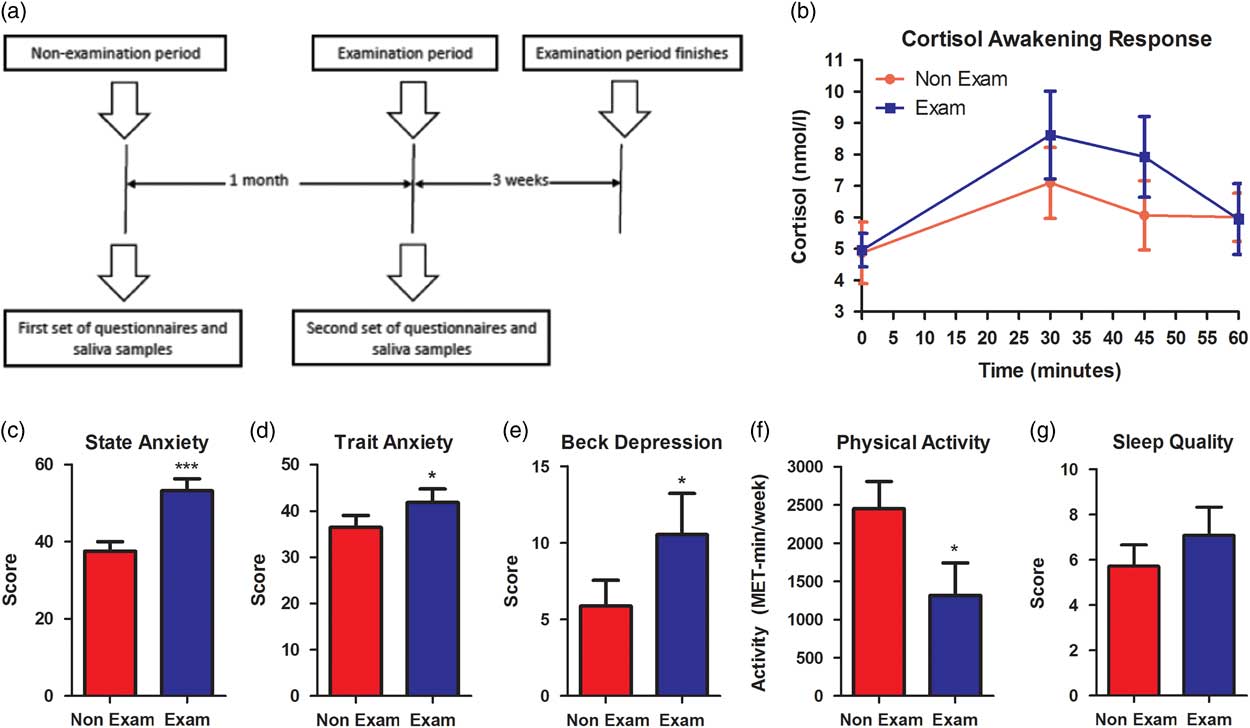
A repeated measures design was employed (see Fig. 1a ). The examination period chosen to represent the stressor in this study was a 3-week examination period, occurring in May 2016. This was necessary for student progression to the final year of the degree course. Multiple written examinations were performed during this period. Measurement occurred in two phases. The first phase of measurement was a non-examination period (low-intensity stress condition) in early April 2016. The second phase of measurement was the examination phase (high-intensity stress condition) in early May 2016. To reduce interference with individual examination preparation regimens, participants were given the option of completing the second phase of testing on the day before or the first day of the examination period. Participants completed questionnaires on the same morning as providing saliva samples.
Bio-psycho-behavioural response to examination period. A repeated measures design was employed (a). In total, 16 students completed self-reported stress, anxiety, mood and physical activity questionnaires, and saliva samples during a non-examination (low-intensity stress condition) and 4 weeks later during an examination (high-intensity stress condition). There was no significant difference in the cortisol awakening response (b). Anxiety levels increased during the examination period as measured by the State-Trait Anxiety Inventory (c,d). Depression scores measured using the Beck Depression Scale increased during the examination period (e). Physical activity questionnaires was decreased during the examination period (f) and although sleep quality worsened during the examination period, it did not reach significance (g).

Cortisol sampling and analysis
CAR was measured using saliva samples. Verbal and written instruction was provided to all participants. Participants were provided with four Salivettes (Sarstedt AG & Co., Germany) for both phases of measurement. Subjects were instructed to provide four saliva samples at, 0 minutes (upon wakening), 30, 45 and 60 minutes after waking on 1 day during each of the measurement phases. Participants were asked not to alter their usual waking time. The samples were refrigerated at −4°C until collection. Saliva samples were centrifuged at 1000 g for 5 minutes. They were aliquoted and stored at −80°C until analysis. Cortisol concentrations were determined using the Cortisol Enzyme Immunoassay Kit as per manufacturers’ instruction (Enzo®; Life Sciences, New York). Assay detection limit was 0.16 nmol/l. Inter- and intra-assay percentage co-efficients of variability were 11.24% and 8.2%, respectively.
Statistical analysis
SPSS Statistics v20 (IBM) was used to analyse the data. To assess normality, Shapiro–Wilk scores were used. Parametric data were analysed using paired t-test and Wilcoxon matched-paired signed-rank test for non-parametric data. Pearson’s correlation was used to assess for correlations between measured components.
Results
Participants
A total of 20 participants meeting inclusion and exclusion criteria were recruited. Four were lost to follow-up. In total, 16 participants completed the study. See Table 1 for demographic details.
Demographic data

BMI, Body mass index.
Bio-psycho-behavioural response to examination period
There was no significant difference in the CAR (F (1.82, 14.02)=0.91, p=0.42) (Fig. 1b ). The area under the curve with respect to ground, representative of the total cortisol secretion between timepoints (t (11)=−0.97, p=0.35), the change in total cortisol secretion, known as delta (t (11)=1.17, p=0.27) and the area under the curve with respect to increase (t (11)=1.10, p=0.29) was not significantly altered (data not shown). The State (t (12)=−5.05, p<0.001) (Fig. 1c ) and Trait anxiety (t (11)=−2.38, p=0.04) (Fig. 1d ) component of the State-Trait Anxiety Inventory increased during the examination period. Depression scores measured using the Beck Depression Scale (BDI) increased during the examination period (t (12)=−2.15, p=0.05) (Fig. 1e ). Physical activity (decreased during the examination period (t (12)=2.51, p=0.03) (Fig. 1f ). Although sleep quality worsened during the examination period, it did not reach significance (t (10)=−0.61, p=0.55) (Fig. 1g ).
Discussion
Using a bio-psycho-behavioural appraisal of a naturalistic stressor, we found that examination periods are associated with significantly increased anxiety levels and decreased mood in students. Furthermore, there was a decreased level of self-reported physical activity. This increase in self-reported stress and anxiety measures during examination periods is consistent with previous studies (Weekes et al. Reference Weekes, Lewis, Goto, Garrison-Jakel, Patel and Lupien2008; González-Cabrera et al. Reference González-Cabrera, Fernández-Prada, Iribar-Ibabe and Peinado2014). Both state and trait anxiety levels increased during the examination period in our study (Figs 1c,d ). Although, the increase in Perceived Stress Scale (PSS) was not significant (data not shown), the scores during both the non-examination and examination period indicate a moderate level of stress (Cohen & Janicki-Deverts, Reference Cohen and Janicki-Deverts2012). Other studies have demonstrated an increase in the PSS (Vedhara et al. Reference Vedhara, Hyde, Gilchrist, Tytherleigh and Plummer2000; Duan et al. Reference Duan, Yuan, Zhang, Qin, Zhang, Buchanan and Wu2013) and we note that the PSS scores in our study were lower than those identified in a group of science students by Vedhara et al. (Reference Vedhara, Hyde, Gilchrist, Tytherleigh and Plummer2000).
The Yerkes–Dodson law suggests an optimal amount of stress is required for the optimal performance of a difficult task, such as an examination (Yerkes & Dodson, Reference Yerkes and Dodson1908; Heins et al. Reference Heins, Fahey and Henderson1983). Excess stress may overwhelm coping mechanisms (Stowell et al. Reference Stowell, Tumminaro and Attarwala2008) and impact cognition (Lupien et al. Reference Lupien, Maheu, Tu, Fiocco and Schramek2007). Indeed, a large population-based study in adults showed that elevated cortisol was associated with poorer cognitive function (Lee et al. Reference Lee, Glass, McAtee, Wand, Bandeen-Roche, Bolla and Schwartz2007). As mentioned, the relationship between CAR and psychological stress measures is inconsistent (van Eck et al. Reference van Eck, Berkhof, Nicolson and Sulon1996; Gaab et al. Reference Gaab, Sonderegger, Scherrer and Ehlert2006; Weekes et al. Reference Weekes, Lewis, Patel, Garrison-Jakel, Berger and Lupien2006; Duan et al. Reference Duan, Yuan, Zhang, Qin, Zhang, Buchanan and Wu2013; González-Cabrera et al. Reference González-Cabrera, Fernández-Prada, Iribar-Ibabe and Peinado2014) and our study also failed to show a clear relationship between any of the cortisol measures and the psychological measures, suggesting a more complex relationship between psychological measures and the CAR. A study by Preuss et al. (Reference Preuss, Schoofs, Schlotz and Wolf2010) found a stronger HPA response to oral presentations compared to written examinations.
It is well established that mood and anxiety are interlinked. Using the BDI we show that mood significantly worsened during the examination period (Fig. 1e ). However, it is important to note that the BDI scores remained within the minimal range, and did not reach clinically relevant levels. This may not be surprising considering we excluded students with current or previous history of mental health-related disorders, but future studies following students throughout the year would provide insight into potential evolving mood-related problems. As mentioned above, depression-related symptoms in medical students are high (Rotenstein et al. Reference Rotenstein, Ramos, Torre, Segal, Peluso, Guille, Sen and Mata2016), and highlight the need to identify strategies for preventing the risk of developing these disorders in this population.
Stress-related disorders, such as depression and anxiety, are associated with an impaired regulation of stress hormones (Holsboer & Ising, Reference Holsboer and Ising2010), with adverse implications for cognition (Hinkelmann et al. Reference Hinkelmann, Moritz, Botzenhardt, Riedesel, Wiedemann, Kellner and Otte2009; Hinkelmann et al. Reference Hinkelmann, Muhtz, Dettenborn, Agorastos, Moritz, Wingenfeld, Spitzer, Gold, Wiedemann and Otte2013). Although, two meta-analyses concluded that cortisol levels in patients with depression were increased (Knorr et al. Reference Knorr, Vinberg, Kessing and Wetterslev2010; Stetler & Miller, Reference Stetler and Miller2011), the association between clinical subtypes and their biological substrates is inconsistent and variable at the individual level (Lamers et al. Reference Lamers, Vogelzangs, Merikangas, de Jonge, Beekman and Penninx2013). The CAR has been useful in understanding the psychobiology of stress, but in order to enhance this understanding and provide the means to assess novel therapeutic agents, multiple readouts are necessary (Allen et al. Reference Allen, Kennedy, Cryan, Dinan and Clarke2014).
Consistent with previous studies (Steptoe et al. Reference Steptoe, Wardle, Pollard, Canaan and Davies1996) we show that examinations interrupt normal physical activity of students (Fig. 1f ). Considering the positive impact of exercise on anxiety, mood and cognition, this study highlights the importance of maintaining regular exercise both in non-examination and examination periods. Exercise can also improve sleep quality (Loprinzi & Cardinal, Reference Loprinzi and Cardinal2011). The precise neurobiology of sleep is not completely understood, though the link between stress and sleep quality is more defined (Hirotsu et al. Reference Hirotsu, Tufik and Andersen2015). A recent preclinical study, showed that a core function of sleep is to renormalise overall synaptic strength (de Vivo et al. Reference de Vivo, Bellesi, Marshall, Bushong, Ellisman, Tononi and Cirelli2017). Student sleep quality worsened slightly during the examination period, but did not reach significance (Fig. 1g ). The ‘good’ quality sleep range for the Pittsburgh Sleep Quality Index (PSQI) is less than five (Buysse et al. Reference Buysse, Reynolds, Monk, Berman and Kupfer1989). With mean PSQI scores greater than five both before and during examinations, and a positive association between perceived stress and poor sleep quality during the non-examination period, our findings are consistent with the literature suggesting that students may have poor sleep quality (Tsai & Li, Reference Tsai and Li2004). Both acute and chronic sleep disturbance can negatively impact mood and cognitive performance in students (Curcio et al. Reference Curcio, Ferrara and De Gennaro2006; Hershner & Chervin, Reference Hershner and Chervin2014).
Limitations
This was a pilot study, and as such, our sample size was small. The phase of female participant menstrual cycle was not recorded during this study. The sympathoadrenal medullary system, intensity or duration of examination preparation and student coping style were not recorded.
Conclusions
We have characterised, using a naturalistic stressor, the bio-psycho-behavioural response to examination stress in students. We have shown that examination periods increase anxiety, decrease mood. In parallel, there was a decrease in physical activity levels. Taken together, our results highlight the importance of an awareness of the impact of stress on students, and paves the way to inform and refine interventions that may reduce the negative impact of stress, while optimising performance. Larger studies, investigating oral examinations, or objective structured clinical examinations to further develop our understanding of the bio-psycho-behavioural components, correlated with examination performance and cognition could assist with the identification of vulnerability factors in the student population.
Acknowledgements
The authors would like to thank the University College Cork Medical School, for providing the funding for this study via the Research Supplement Award.
Financial Support
This work was supported by the University College Cork Medical Research Supplement Award.
Conflicts of Interest
J.O.F. and J.R.K. report no conflicts of interest. T.G.D. reported that his research is supported by SFI (grant number SFI/12/RC/2273) and by the Health Research Board (HRB) through Health Research Awards (grants numbers HRA_POR/2011/23, HRA_POR/2012/32 and HRA-POR-2-14-647) and through EU GRANT 613979 (MYNEWGUT FP7-KBBE-2013-7). T.G.D. has been an invited speaker at meetings organised by Servier, Lundbeck, Janssen and AstraZeneca, and has ongoing research collaborations with Suntory Wellness, Danone Nutritia, Mead Johnson Nutrition, Cremo and 4D-Pharma.
Ethical Standards
The authors assert that all procedures contributing to this work comply with the ethical standards of the relevant national and institutional committee on human experimentation with the Helsinki Declaration of 1975, as revised in 2008. The authors assert that ethical approval for publication of this study has been provided by the Cork University Hospital ethics committee.