

Introduction
Mosquitoes pose serious public health hazards in developing countries in the tropics, through their ability to act as vectors of disease-causing pathogens. Despite significant advances in control techniques, the mosquito Culex quinquefasciatus Say (Diptera: Culicidae), the vector of lymphatic filariasis, is still widely distributed in the tropics. The disease infects nearly 120 million people worldwide, with 44 million being chronically infected.
A common technique for mosquito control is the periodic application of larvicides to breeding areas. However, the outcome is often complicated by resistance development, adverse impacts of the insecticides used on non-target organisms and the introduction of undesirable pesticide residues into the aquatic environment. Alternative larval control strategies are thus being sought.
A number of plant extracts and essential oils are currently in use in mosquito control, thanks to their action as larvicides, growth inhibitors, repellents or antifeedants (Shaalan et al., Reference Shaalan, Canyon, Younes, Wahab and Mansour2005). Among these are the chloroform (CHCl3) extracts of Cryptotaenia canadensis DC (Apiaceae) foliage, roots and fruits (Eckenbach et al., Reference Eckenbach, Lampman, Seigler, Ebinger and Novak1999) and of Millettia dura Dunn (Leguminosae) seeds (Yenesew et al., Reference Yenesew, Derese, Midiwo, Heydenreich and Peter2003); ethyl acetate extracts of Excoecaria indica Müll. Arg. (Euphorbiaceae) seed kernels (Kabir et al., Reference Kabir, Hasan, Rahman and Mosaddik1999); acetone extracts of Feronia limonia (L.) Swingle (Rutaceae) leaves (Rahuman et al., Reference Rahuman, Gopalakrishnan, Ghouse, Arumugam and Himalayan2000); and methanol (CH3OH) extracts of Kaempferia galanga L. (Zingiberaceae) rhizomes (Kim et al., Reference Kim, Byun, Cho, Chung and Ahn2008). Many species of Annonaceae are known to have biologically active compounds, including alkaloidal and non-alkaloidal compounds (polyphenols, flavonoids and terpenes) (Leboeuf et al., Reference Leboeuf, Cavė, Bhaumik, Mukherjee and Mukherjee1980; Rupprecht et al., Reference Rupprecht, Hui and McLughlin1990; Cássia Seffrin et al., Reference Cássia Seffrin, de Shikano, Akhtar and Isman2010).
We assessed the larvicidal effects of a CHCl3-extracted alkaloidal fraction from the stem bark of an Indian Annonaceae species, Artabotrys odoratissimus (kantali champa, common name in India) against C. quinquefasciatus larvae. The extract has been previously tested against Meloidogyne incognita for anti-fertility effect and anti-helminthic activity (Chattopadhyay and Mukhopadhyaya, Reference Chattopadhyay and Mukhopadhyaya1990).
Materials and methods
Test insects
A laboratory culture of C. quinquefasciatus larvae was maintained in 600-ml glass beakers containing c. 450 ml distilled water at 25 ± 1 °C, under ambient conditions of 40–60% relative humidity (RH) and a 12 h light–12 h dark photoperiod. Larvae were reared on powdered brewer's yeast (Red Star®, Milwaukee, Wisconsin, USA), and any dead larvae were removed daily. Early second, third and fourth instars were used in assays.
Test plant
Stem bark of A. odoratissimus was collected from the University of Rajshahi Campus in April 2000, and species identity was authenticated by Professor A. T. M. Nadiruzzaman, Department of Botany, University of Rajshahi, Bangladesh. A voucher specimen has been deposited at the Bangladesh National Herbarium, Dhaka, Bangladesh.
Extraction and fractionation
Air-dried stem bark (200 g) of A. odoratissimus was ground to a coarse powder and extracted with analytical grade CH3OH (3 × 300 ml) by cold percolation in a separating funnel. The CH3OH extract was concentrated in a rotary evaporator (Eyela; Type: N-N; Tokyo Rikakikai Co. Ltd, Tokyo, Japan) under reduced pressure at 50 °C, yielding a brownish residue (2.50 g). The residue was then treated with dilute HCl (5%) to separate out the alkaloids, following which the acid layer was extracted three times through solvent portioning with CHCl3 to remove any non-alkaloidal material. The acid layer was then neutralized with NH2OH, and the solution was re-extracted with CHCl3 to yield an alkaloidal fraction (1.20 g), which was concentrated in a rotary evaporator and stored at 4 °C. The presence of alkaloids in the fraction was detected according to Harborne (Reference Harborne1984), with slight modification, and was further confirmed by thin layer chromatography on silica gel. Using the solvent system cyclohexane–CHCl3–diethyl amine (5:4:1), a single brown spot (R f 0.57) was detected after spraying with Dragendorff's reagent.
Test solutions
Into 100-ml glass beakers containing 50 ml distilled water, the requisite volume of a stock solution of the alkaloidal fraction in CHCl3 containing one drop of dimethyl sulfoxide (DMSO) was added, to prepare test concentrations (w/v) of 10, 20, 40, 80, 160 and 320 ppm. Three replications for each concentration were set up. One positive and two negative controls were also prepared: distilled water+powdered brewer's yeast as the positive control; and distilled water+CHCl3 and distilled water+DMSO as negative controls.
Assays for larvicidal activity
The larvicidal effect of the test samples was determined using the WHO (1996) standard procedure under laboratory conditions of 25 ± 1 °C, 40–60% RH, with brewer's yeast provided to larvae as diet. Mortality was corrected according to Abbott (Reference Abbott1925), and data were then subjected to probit analysis (Busvine, Reference Busvine1971) to determine lethal concentration 50 (LC50) values.
Results and Discussion
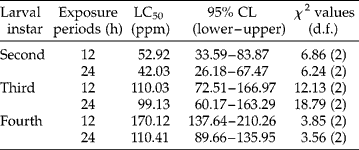
The LC50 values (concentration causing 50% mortality of the larvae compared with the control) and 95% confidence limits (CL) for the CHCl3-extracted alkaloidal fraction of A. odoratissimus against C. quinquefasciatus larvae are shown in Table 1. The LC50 values increased with the age of larvae, differing significantly only between second and fourth instars. This indicates that higher concentrations of the alkaloidal compounds are needed to control the older, larger larvae. LC50 values decreased significantly with time (12 vs. 24 h after treatment) in all the instars (Table 1). LC50 values of the fractions tested after 3 days of exposure were lower than at 24 and 12 h for all the instars (data not shown).
Larvicidal effect of the CHCl3-extracted alkaloidal fraction from the stem bark of Artabotrys odoratissimus on Culex quinquefasciatus larvae at different instars+
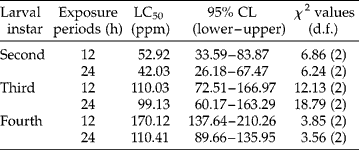
+ Values are based on six concentrations (10, 20, 40, 80, 160 and 320 ppm) and three replications with 25 insects each.
Following treatment, abnormal behaviour of the larvae, such as circular movements near the periphery of the beakers as opposed to the zigzag motion observed in the control sets, was also observed, suggesting that the alkaloidal fraction of A. odoratissimus affected the neuromuscular system. Neurotoxicity of insecticides has been previously observed in locusts (Proux et al., Reference Proux, Alaoui, More Teau and Baskali1993) and other insects. Cássia Seffrin et al. (Reference Cássia Seffrin, de Shikano, Akhtar and Isman2010) suggested that acetogenins from Annonaceae are responsible for the toxicity of this plant family to insects.
In conclusion, further laboratory testing and field testing are necessary to determine the applicability of the CHCl3 extract of A. odoratissimus in mosquito control. Additional research is also recommended to identify the biologically active alkaloids from this species and to determine their mode of action and their human and environmental safety.
Acknowledgements
The author is grateful to the Director, Institute of Biological Sciences, University of Rajshahi, Bangladesh, for providing laboratory facilities; and to the Ministry of Science and Technology, Government of the People's Republic of Bangladesh, for the National Science and Technology Fellowship under which this work was done.