INTRODUCTION
Delirium is one of the most common syndromes in hospice and palliative care settings. Prevalence ranges are wide and have been reported to be up to 85%, depending on the patient population and diagnostic criteria being used (Bucht et al., Reference Breitbart and Strout1999; Breitbart & Strout, Reference Breitbart, Marotta, Platt, Weisman, Derevenco, Grau, Corbera, Raymond, Lund and Jacobson2000; Cole, Reference Carter, Dawson and Lopert2004; Massie et al., Reference Massie, Holland and Glass1983; Bruera et al., 1992). Nonterminal delirium can occur in nearly half of cancer patients admitted to hospital or hospice and may be reversible in up to 50% of cases (Centeno et al., Reference Bruera, Miller, McCallion, Macmillan, Krefting and Hanson2004). Terminal delirium may occur in up to 88% of terminally ill patients (Kehl, Reference Hepp2004), and will often have a reversible cause (Plonk & Arnold, Reference Plonk and Arnold2005; Lawlor et al., Reference Lawlor, Gagnon, Mancini, Pereira, Hanson, Suarez-Almazor and Bruera2000).
The symptoms of delirium are often underrecognized and misdiagnosed in this patient population (Bross & Tatum, Reference Breitbart, Cohen, Chochinov and Breitbart1994; Inouye, Reference Conn and Lieff1994; Cole, Reference Carter, Dawson and Lopert2004). This may partially be attributed to confusion regarding terminology and inconsistent use of diagnostic classifications (Inouye, Reference Inouye1994; Breitbart et al., 1995). In addition, the symptoms of delirium are varied and can be mistaken for other psychiatric disorders (Bross & Tatum, Reference Breitbart, Cohen, Chochinov and Breitbart1994; Breitbart & Cohen, Reference Breitbart, Bruera, Chochinov and Lynch2000). Delirium can also interfere significantly with the recognition and control of other physical and psychological symptoms, such as pain (Stiefel & Holland, Reference Stiefel and Holland1991).
In addition to being underrecognized, delirium is frequently undertreated in patients with advanced, life-threatening illnesses (Hepp, Reference Cole2002). Treatment of delirium is complicated by the fact that the underlying etiology is not always reversible and/or discernable in hospice settings. However, there are effective pharmacologic and nonpharmacologic interventions to help control the behavioral manifestations of delirium (Carter et al., Reference Bross and Tatum1996; Trzepacz, Reference Trzepacz1996; Conn & Lieff, Reference Centeno, Sanz and Bruera2001; Jackson & Lipman, Reference Jackson and Lipman2004; Kehl, Reference Kehl2004; Cobb et al., Reference Cobb, Glantz, Nicholas, Martin, Paul-Simon, Cole and Corless2000; Breitbart et al., 1996; Inouye et al., Reference Inouye, Bogardus, Charpentier, Leo-Summers, Acampora, Holford and Cooney1999), and many cases of delirium can be prevented or reversed (Gustafson et al., Reference Gustafson, Lundstrom and Bucht2002; Weber et al., Reference Weber, Coverdale and Kunik2004; Inouye et al., Reference Inouye, Bogardus, Williams, Leo-Summers and Agostini2003).
The intent of this study was to retrospectively evaluate the recognition of delirium in a large cohort of hospice patients by interdisciplinary hospice care teams. Documentation of delirium in the medical record was used as a proxy for the recognition of delirium; however, the rate of actual delirium was not determined in this baseline study.
METHODS
Human Protections
This study was approved by the San Diego Hospice & Palliative Care (SDHPC) Institutional Review Board and the University of California, San Diego Human Research Protection Program.
Study Population
This retrospective chart review was conducted in patients enrolled in hospice care at SDHPC who received home/long-term care or inpatient care between January 1, 2005, and December 31, 2005.
SDHPC provides hospice and/or palliative care for patients of all ages (including perinatal), with any diagnosis, anywhere in San Diego County (a large multicultural urban and rural county with a population of almost 3 million in 2005). The majority of patients receive care in their own homes or long-term care facilities. Most patients who needed an increased level of care received inpatient care in a 24-bed Inpatient Care Center (ICC). Patients who received hospice care had an advanced life-threatening (terminal) illness “with a prognosis of less than 6 months if the disease runs its expected course” (Medicare, 1983).
During 2005, 45.7% of the 18,649 nonviolent/nontraumatic deaths in San Diego County received hospice care. More than 2850 of those deaths (or 33.5% of those receiving hospice care) received hospice care from SDHPC in 2005. While on hospice care at SDHPC, patients received care from an interdisciplinary team that included a chaplain, nurse, social worker, and volunteers. Medical input was provided by the patient's primary care physician and/or a palliative medicine specialist associated with each team. When necessary, patients were seen by other medical consultants.
Interdisciplinary teams providing home/long-term care met every 2 weeks to discuss all patients under their care. Teams providing inpatient care met daily to discuss every inpatient. During each patient encounter, all members of every interdisciplinary team, including the physicians, documented their assessments and management strategies in the same section of the medical record, the interdisciplinary clinical notes.
Chart Review Process
The medical records of all 2716 patients enrolled in hospice care at SDHPC between January 1, 2005, and December 31, 2005 were reviewed retrospectively. Patients who received only home/long-term care had an electronic medical record, whereas patients who received inpatient care had a paper medical record regarding inpatient care and an electronic medical record with demographic data and any clinical notes from home/long-term care. Patients who received care in both settings had separate records for each. All disciplines documented in the same section of either record; this included staff physicians, consultants, fellows, residents, nurses, social workers, chaplains, integrated health practitioners, and volunteers.
For 2168 patients receiving home/long-term care during 2005, a query of their electronic medical record (Misys Healthcare Systems, Raleigh, NC) was conducted for all admissions. Included in the query were patient identification number, gender, age, ethnicity, marital status, terminal diagnosis, whether delirium was listed as a diagnosis using the ICD-9 codes 290.3, 291, 292.81, 293, or 293.1 or in the problem list, and the total length of time the patient received hospice care.
For 548 patients admitted to inpatient care in the ICC during 2005, each paper medical record for all admissions was reviewed by one of six trained physicians. A number of documents were reviewed in sequence looking for any evidence that delirium had been recognized as either a diagnosis or a significant problem by the interdisciplinary team. The documents included (1) the face sheet and health records coding form looking for any of the ICD-9 delirium diagnoses codes 290.11, 290.2, 290.3, 290.41, 291, 292.81, 293, and 293.1. If these ICD-9 codes were not present, (2) the death summary (if the patient died) was reviewed. If this was not present, (3) the discharge summary (if the patient was discharged) was then reviewed. Finally, if this was not present, (4) the physician history and physical and progress notes were reviewed looking for delirium listed as a diagnosis or problem in the assessment and/or plan sections. Gender, age, ethnicity, marital status, and terminal diagnoses were obtained from the electronic medical record.
Statistical Analyses
Demographic characteristics and the percentage of patients with a documented delirium diagnosis or problem were determined by simple descriptive statistics. Patients with documented delirium were compared to those without delirium using chi-square analyses looking for differences in gender, age, ethnicity, terminal diagnosis, and marital status. An analysis of variance was also performed looking for differences in length of inpatient stay or total time receiving hospice care. No differences were found in the rate of reviewer identification of delirium as a diagnosis or problem in 20 charts reviewed by all reviewers.
RESULTS
Home/Long-Term Care
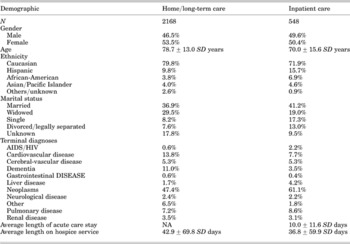
Demographic data for patients receiving home/long-term care are presented in Table 1. Of the 2168 patients admitted for home/long-term care, 17.8% had delirium documented as a diagnosis or significant problem.
Demographic characteristics of patients in the home/long-term and inpatient hospice care settings

When patients with delirium were compared to those without, there were significant differences in distributions for
1. marital status: delirium was recognized more in widowed patients (χ2 = 25.12, 3 df, p < .001)
2. ethnicity: delirium was documented more in Caucasian patients (χ2 = 15.39, 3 df, p < .01)
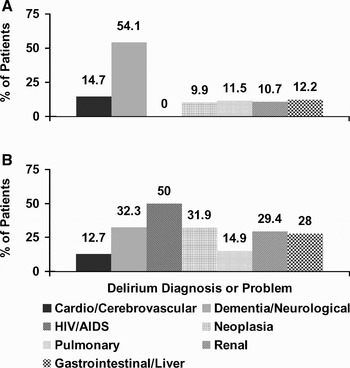
3. hospice diagnosis: delirium was observed more in patients with dementia/neurological issues and less often in those with HIV/AIDS (χ2 = 325.54, 6 df, p < .001; Fig. 1A)
4. age: delirium was documented more in older patients (t[2168] = 22.55, p < .001).
Hospice diagnosis of patients with documented delirium. There was a significant difference in the distribution of hospice diagnoses between those with a documented diagnosis or problem of delirium and those without for those enrolled in (A) home/long-term care (χ2 = 325.54, 6 df, p < .001) and (B) inpatient care (χ2 = 18.00, 6 df, p < .01).

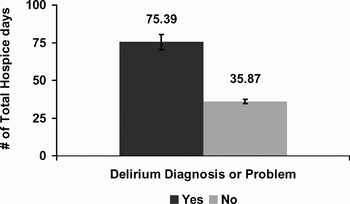
Patients with delirium had a significantly longer total time on hospice care (75.39 ± 4.96 SE days vs. 35.87 ± 1.42 SE days; t[2168] = 130.96, p < .001; Fig. 2). There were no significant differences for gender.
Total time in hospice care. Patients with documented delirium received hospice care significantly longer in the home/long-term care setting (75.39 ± 4.96 SE days vs. 35.87 ± 1.42 SE days; t[2168] = 130.96, p < .001).

Inpatient Care
Demographic data for patients receiving inpatient care are presented in Table 1. Of the 548 patients admitted for inpatient care, 28.3% had delirium documented as a diagnosis or significant problem.
When patients with delirium were compared to those without, there were significant differences in the distributions for
1. gender: delirium was documented more in male patients (χ2 = 4.41, 1 df, p < .05)
2. ethnicity: delirium was recognized more in Caucasian patients (χ2 = 7.96, 3 df, p < .05).
3. hospice diagnosis: delirium was observed more in patients with HIV/AIDS (χ2 = 18.00, 6 df, p < .01; Fig. 1B).
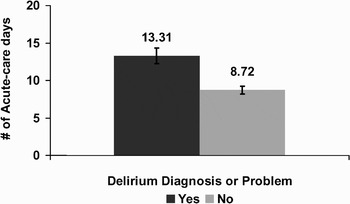
In addition, inpatients with delirium had a significantly greater average length of inpatient care (13.31 ± 1.06 SE days vs. 8.72 ± 0.54 SE days; t[548] = 4.57, SE .001; Fig. 3). There were no significant differences in marital status or total time receiving hospice care.
Length of inpatient care stays. Patients receiving inpatient care with documented delirium had a significantly greater average lengths of inpatient stays (13.31 ± 1.06 SE days vs. 8.72 ± 0.54 SE days; t[548] = 4.57, p < .001).

DISCUSSION
This study evaluated the recognition of delirium in patients receiving hospice care by interdisciplinary teams, as documented in the medical records. Low recognition rates were found in this study when compared with other reported delirium prevalence rates, which are as high as 50% in cancer patients (Centeno et al., Reference Bruera, Miller, McCallion, Macmillan, Krefting and Hanson2004) and up to 88% in the palliative care setting (Breitbart & Strout, Reference Breitbart, Marotta, Platt, Weisman, Derevenco, Grau, Corbera, Raymond, Lund and Jacobson2000; Kehl, Reference Hepp2004). We suspect the delirium documentation rate is on the lower end of the reported prevalence ranges because actual delirium was underrecognized.
In the home/long-term care population, higher rates of delirium were found in patients who were older, widowed, and had a diagnosis of dementia. This is consistent with risk factors identified by other studies in similar patient populations (Bross & Tatum, Reference Breitbart, Cohen, Chochinov and Breitbart1994; Cole, Reference Carter, Dawson and Lopert2004; Pancrazi & Metais, Reference Pancrazi and Metais2003) and suggests that younger age, intact cognitive function, and the presence of social support may all be protective against delirium. In the inpatient care population, higher rates of delirium were found in males and those with diagnoses of HIV/AIDS. This is also consistent with previously identified risk factors (Centeno et al., Reference Bruera, Miller, McCallion, Macmillan, Krefting and Hanson2004; Fernandez et al., Reference Fernandez, Levy and Mansell1989) and may indicate higher levels of baseline cognitive impairment in some of these patients (Woo, Reference Woo1988; Jose Pereira, Reference Jose Pereira and Bruera1997). We also found that patients in home/long-term care who had documented delirium received hospice care for significantly longer, and inpatients with documented delirium had longer inpatient stays.
To our knowledge, this is the first study that measures what is actually being done by front-line hospice care clinicians with respect to delirium diagnosis. Other studies have reported “gold-standard” or “screening” prevalences under research conditions, but have not linked them to patient care or clinician behavior.
These findings are significant, as underrecognition of delirium will lead to undertreatment and unwanted outcomes. Delirium in hospice patients is associated with significant morbidity, mortality, and health care costs. Indeed, elderly and critically ill patients, such as those commonly treated in hospice, are at particular risk for delirium (St Pierre, Reference St Pierre1996). The behavioral manifestations of delirium, such as agitation, may result in unnecessary medical intervention, stress to family caregivers, or inpatient hospice admission (Cobb et al., Reference Bucht, Gustafson and Sandberg2000). Delirium also appears to be independently associated with increases in length of hospital stay, functional disability, and death rate (Cole, Reference Carter, Dawson and Lopert2004). Active efforts to prevent delirium can result in shorter lengths of nursing home stay and reduced cost of care (Leslie et al., Reference Leslie, Zhang and Bogardus2005). The annual health care cost of delirium has been estimated at up to $2 billion (Inouye, Reference Conn and Lieff1994).
The main limitation of this study is the use of chart documentation as a proxy for the recognition of actual delirium. It seems reasonable to assume that significant issues that an interdisciplinary hospice care team was thinking about would be documented in the medical record at least once by a physician or picked up in chart coding. As all clinicians give input to every patient's plan of care and document in the same medical record, we believe that if delirium was not documented, it was not considered to be an important issue for the patient and was likely not treated. Alternatively, just because “delirium” was documented in the medical record does not mean that the patient had actual delirium, though this would be evidence of at least addressing significant cognitive issues. Nothing further was done in this baseline study to substantiate if documentation accurately reflected the actual prevalence of delirium in these patients.
As we found in this study, many other hospice, palliative, and long-term care programs could be underrecognizing delirium and may need to reevaluate their delirium assessment strategies.
ACKNOWLEDGMENTS
We acknowledge the support from the staff of the Center for Palliative Studies at SDHPC, including Eugene Grimshaw, Paula Brown, and Lisa Olmos; Information Technology at SDHPC, including Barbara Radice and Mark Hahn; and the medical records staff at SDHPC, including Jean Piekarz, Jesus Blass, and Katrina Pritchard. We also thank Diane Munson for her hard work, Karen Garman for statistical consultation, and Charles von Gunten and Joel Dimsdale for their helpful comments on the manuscript as well as Sid Zisook and UCSD Outpatient Psychiatric Services for their encouragement of this project. This work was supported by donated time from The Center for Palliative Studies at San Diego Hospice & Palliative Care and the UCSD Department of Psychiatry.