INTRODUCTION
Parvicapsula minibicornis is a myxozoan kidney parasite of salmonids (Oncorhynchus spp.) in the Pacific Northwest of North America. It has been detected in 4 major drainage basins (Fig. 1): the Sacramento, Klamath, Columbia and Fraser Rivers (Kent et al. Reference Kent, Whitaker and Dawe1997; Jones et al. Reference Jones, Prosperi-Porta, Dawe and Barnes2003, Reference Jones, Prosperi-Porta, Dawe, Taylor and Goh2004; Foott et al. Reference Foott, Harmon and Stone2004). In its salmon host, P. minibicornis sporulates in capillaries of the glomerulus, with myxospores occasionally observed in the lumen of renal tubules, although most are probably shed in urine soon after maturation (Kent et al. Reference Kent, Whitaker and Dawe1997). Myxospores infect the freshwater polychaete Manayunkia speciosa in which further development results in fish-infective actinospores (Bartholomew et al. Reference Bartholomew, Atkinson and Hallett2006). The widespread distribution of M. speciosa in western North America (Hazel, Reference Hazel1966; Bartholomew et al. Reference Bartholomew, Whipple, Stevens and Fryer1997) suggests that it plays a role in the life cycle of P. minibicornis throughout its range. The annelid occupies low-flow habitats, which appear to be regions of elevated risk of infection to salmon, especially in lower river reaches where adult salmon migrating into fresh water are vulnerable (St-Hilaire et al. Reference St-Hilaire, Boichuk, Barnes, Higgins, Devlin, Withler, Khattra, Jones and Kieser2002; Jones et al. Reference Jones, Prosperi-Porta, Dawe and Barnes2003). In the Fraser River, severe infections have been observed near the time of spawning, with parasite development in most glomeruli and even gills (Raverty et al. Reference Raverty, Kieser, Bagshaw and St-Hilaire2000; St-Hilaire et al. Reference St-Hilaire, Boichuk, Barnes, Higgins, Devlin, Withler, Khattra, Jones and Kieser2002; Bradford et al. Reference Bradford, Lovy, Patterson, Speare, Bennett, Stobbart and Tovey2010). In the Klamath River, infection has been observed in out-migrant juvenile salmon (Foott et al. Reference Foott, Harmon and Stone2004) and, although there is some suggestion that infections may resolve, the longer-term health consequences to juvenile fish are not well understood (S. Foott personal communication).
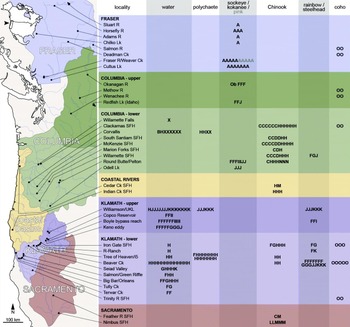
Parvicapsula minibicornis collection localities and sample types: river water, polychaetes (Manayunkia speciosa), Chinook salmon (Onchorynchus tschawytcha), sockeye and kokanee salmon (O. nerka – anadromous and resident forms), pink salmon (O. gorbusha), steelhead and rainbow trout (O. mykiss – anadromous and resident forms) and coho salmon (O. kisutch). Letters A–D, F–O are genotypes recovered from each sample; multiple letters indicate either the number of samples at a locality or multiple genotypes within a sample. X, Parvicapsula-like amplicon; O, Oa + Ob.

Previous research has shown that characteristics of P. minibicornis infection differ among river drainage basins. Typical histological presentation of the parasite was observed in the glomeruli of pre-spawning adult sockeye (O. nerka), pink (O. gorbuscha) and coho (O. kisutch) salmon from the Fraser River and juvenile Chinook salmon (O. tschawytscha) from the Klamath River (Kent et al. Reference Kent, Whitaker and Dawe1997; Jones et al. Reference Jones, Prosperi-Porta, Dawe and Barnes2003; Foott et al. Reference Foott, Stone, Wiseman, True and Nichols2007). In the Columbia River Basin, there was little histological evidence of infection in sockeye salmon, despite PCR confirmation (Jones et al. Reference Jones, Prosperi-Porta, Dawe, Taylor and Goh2004). DNA sequence variation of 0·3% in the P. minibicornis small subunit ribosomal RNA gene (ssrRNA) was observed between Chinook salmon in the Klamath River (southern Oregon) and from sockeye salmon in the Fraser River (British Columbia) (Bartholomew et al. Reference Bartholomew, Atkinson and Hallett2006). These data suggest that distinct populations of P. minibicornis occur among river drainage basins. Population structuring has been observed for the closely related myxozoan, Ceratomyxa shasta (see Atkinson and Bartholomew, Reference Atkinson and Bartholomew2010a,Reference Atkinson and Bartholomewb), whose geographical and host ranges overlap with P. minibicornis. Distinct genotypes of C. shasta occur in different localities and in different salmonids.
In the present study, we hypothesized that P. minibicornis populations are structured both by geography and host species. We tested this by looking for sequence variation in the small subunit ribosomal RNA gene of representative samples taken throughout the known range of the parasite. Accordingly, we sequenced the most informative ∼900 nt segment of P. minibicornis ssrRNA from 197 samples from multiple river basins, in a range of salmonid species. In the Klamath River we undertook higher resolution parallel sampling of river water and infected polychaete worms in addition to several fish species. Our results provided evidence that P. minibicornis has genotypes that segregate geographically and among fish hosts.
MATERIALS AND METHODS
Sample contributors
Multiple organizations contributed fish kidney samples: Department of Fisheries and Oceans, Canada (DFO), Oregon Department of Fish and Wildlife (ODFW), Oregon State University (OSU), California Department of Fish and Game (CDFG), Idaho Department of Fish and Game (IDFG) and the U.S. Fish and Wildlife Service (USFWS).
Sampling localities (Fig. 1)
Fraser River Basin
Pre-spawn adult sockeye (n=18), pink (5) and coho (4) salmon from 8 localities were collected by DFO staff. Supplied as purified DNA that had tested PCR-positive for P. minibicornis.
Upper Columbia River Basin
Pre-spawn adult sockeye (6) and coho (4) salmon from 4 localities were collected as part of routine surveys by DFO and USFWS. Supplied as purified DNA that had tested PCR-positive for P. minibicornis.
Lower Columbia River Basin (Willamette and Deschutes systems)
Adult Chinook (19) and coho (2) salmon and steelhead trout (1) returning to 6 hatcheries to spawn were collected by ODFW for Renibacterium salmoninarum monitoring; supplied as digested kidney tissue. Wild adult kokanee salmon (3) were caught in Odell Lake as part of an ODFW fish survey; supplied as whole kidneys. Water (10) and polychaetes (4) were collected by OSU from the Willamette River, adjacent to the OSU Salmon Disease Laboratory (SDL), and water from Willamette Falls (1). Pre-spawn adult sockeye salmon (4) from the lower Deschutes River were collected by DFO and USFWS and supplied as purified DNA that had tested PCR-positive for P. minibicornis.
Oregon Coastal River Basin
Chinook (4) and coho (4) salmon from fish hatcheries in the Nestucca and Rogue River Basins were collected by ODFW. Supplied as digested kidney tissue.
Klamath River Basin
Adult Chinook (3) and coho (5) salmon and steelhead trout (2) that returned to the Iron Gate (IGH) and Trinity River (TRH) hatcheries were collected by CDFG and USFWS as part of routine C. shasta monitoring (e.g. Stone et al. Reference Stone, Foott and Fogerty2008); supplied as extracted DNA that had tested positive for P. minibicornis by PCR. Our most comprehensive, parallel dataset came from material collected by OSU as part of a multi-year monitoring effort for C. shasta above and below dams in the Klamath River. We assayed water samples (49), polychaete worms (18) and the following groups of juvenile ‘sentinel’ fish: rainbow trout (Roaring River hatchery strain: 11; redband: 5), Chinook salmon (IGH strain: 8) and coho salmon (IGH strain: 5).
Sacramento River Basin
Frozen kidney samples from adult Chinook salmon (4) that returned to Feather River and American River fish hatcheries were provided by CDFG.
Sample types and DNA extraction methods
Fish
Adult salmon were typically caught in rotary screw traps in rivers while returning from the ocean to spawn, or collected directly from fish hatchery raceways at the time of spawning. Juvenile fish were netted from either infected hatchery stocks, or from naïve ‘sentinel’ fish (Stocking et al. Reference Stocking, Holt, Foott and Bartholomew2006). Sentinel exposures comprised groups of fingerlings, n=40–80, held in cages anchored in the river for ∼72 h, then transferred to the OSU SDL where they were monitored at 18°C for 90 days post-exposure (p.e.). Juvenile fish were killed with an overdose (500 ppm) of buffered MS222 anaesthetic. In a few cases, fresh kidney was available and examined visually for mature P. minibicornis myxospore stages. Most samples were frozen for later digestion and PCR assay. Tissue was digested either using the QIAGEN DNeasy Blood and Tissue kit (Valencia, CA, USA) or by a boiling method: tissue was diluted 1:4 weight-to-volume (1:8 for juveniles) with Tween20 phosphate-buffered saline, homogenized, boiled for 15 min then centrifuged 10 min at 10 000 g. The supernatant from the boiled sample was diluted 1:50 with distilled water prior to PCR analysis. DNA extracted with the kit was used undiluted.
Water samples
River water was sampled to detect waterborne myxospore and actinospore parasite stages following the protocol of Hallett and Bartholomew (Reference Hallett and Bartholomew2006). Briefly, 1L water samples were vacuum-filtered through a 5 μm membrane and total DNA extracted from the retained material using a QIAGEN DNeasy kit. Extracted DNA often had to be diluted 1:5 with water to reduce the concentration of PCR inhibitors that co-purified with the DNA.
Polychaete worm
Methods for collecting, isolating and assessing infection status of M. speciosa have been published (Stocking and Bartholomew, Reference Stocking and Bartholomew2007). Briefly, worms were collected with substrate then isolated with fine forceps or probes under a dissection microscope. Individual, live worms were placed on a microscope slide in a small volume of water then covered gently with a cover-slip and examined under bright field microscopy. Parvicapsula minibicornis infections presented as collections of spores and sporogonic stages freely floating in the body cavity of the worm. Infected worms were placed in a 1·5 ml microcentrifuge tube and frozen for DNA extraction with a QIAGEN DNeasy kit. Occasionally, worms were pooled without visual examination, DNA extracted and the presence of P. minibicornis determined by PCR.
Standard molecular detection assays for P. minibicornis
Fish and polychaete samples were assayed for P. minibicornis by either regular PCR or qPCR. We used a standard PCR assay (St-Hilaire et al. Reference St-Hilaire, Boichuk, Barnes, Higgins, Devlin, Withler, Khattra, Jones and Kieser2002) with primers parvi1f and parvi2r (Kent et al. Reference Kent, Khattra, Hedrick and Devlin2000) to specifically amplify a ∼1000 nt segment at the 5′ end of the parasite's ssrRNA gene (Fig. 2). A more sensitive, qPCR assay (True et al. Reference True, Purcell and Foott2009) employing 2 primers and a probe, was used to amplify a 92 nt ssrRNA fragment. Water samples were analysed with a different qPCR assay that amplified a 72 nt ssrRNA fragment (Hallett and Bartholomew, Reference Hallett and Bartholomew2009).
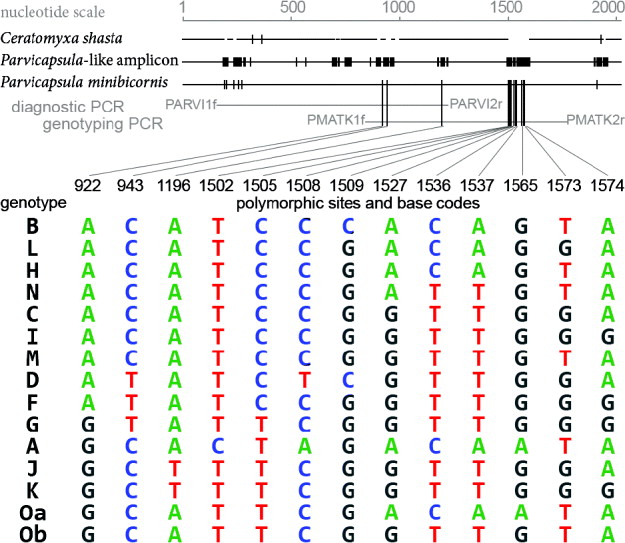
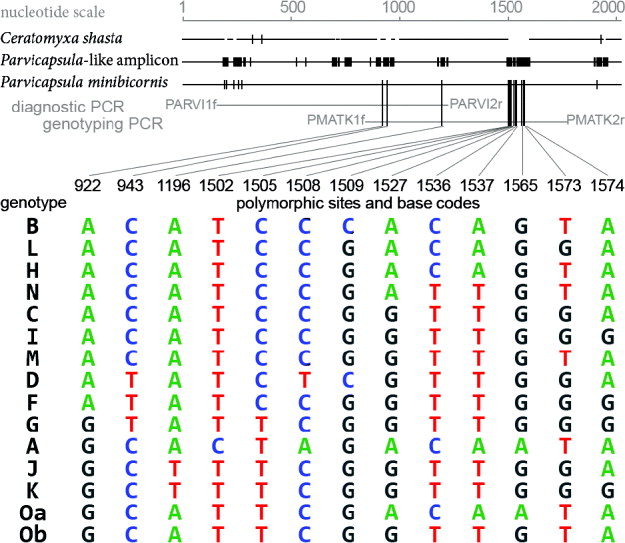
Comparative schematic representation of the ssrRNA genes of several myxozoans. Variable sites shown as vertical bars: C. shasta has only 3 polymorphic ssrRNA loci; the Parvicapsula-like amplicon has 200 sites that vary from P. minibicornis, which itself has at least 17 polymorphic loci, of which 13 were used to define genotypes. Primer pairs are shown for the published P. minibicornis detection assay and for the novel genotyping assay. Genotypes Oa and Ob always co-occurred in coho salmon.
Sequencing and genotyping P. minibicornis
To determine whether different genetic types of P. minibicornis existed, we used a similar approach to previous genetic investigations of Myxobolus cerebralis and Ceratomyxa shasta (Arsan et al. Reference Arsan, Atkinson, Hallett, Meyers and Bartholomew2007; Atkinson and Bartholomew, Reference Atkinson and Bartholomew2010a). We compared 9 geographically distinct P. minibicornis samples, from the Klamath, Deschutes, Rogue and Fraser rivers, to identify the most variable region of the ssrRNA gene. Single Nucleotide Polymorphisms (SNPs) were defined as specific bases that differed in at least 2 sequences compared with the rest. We then designed a P. minibicornis-specific primer pair that encompassed the most SNPs in a single ∼1000 nt read, to facilitate cost-effective characterization of numerous samples. Primers PMATK1f (GAATAGCGTAGGTGTTTTCC) at position 855 and PMATK2R (GAGCTTTGTAATTTGCTCATG) at position 1788 amplified a 934 nt fragment (note: all position numbers are relative to the 5′ end of primer ERIB1 in reference sequence HQ624972). PCRs were of 20 μl volumes that comprised: 1–2 μl of template DNA; 0·25 μ m each primer; 1·25 units Go Taq Flexi polymerase (Promega, San Luis Obispo, CA, USA); 4 μl of 5× Go Taq Flexi clear buffer; 1·5 mm MgCl2; 1 μl of Rediload dye (Invitrogen, Carlsbad, CA, USA); 250 ng/μl bovine serum albumin; 0·2 mm each dNTP; water. PCR was performed on a PTC-200 thermocycler (MJ Research Inc., Watertown, MA, USA) using initial denaturation 120 s at 95°C, then 35 cycles of 30 s at 94°C, 45 s at 53°C, 60 s at 72°C, then terminal elongation 600 s at 72°C. If no amplicon was detected by gel electrophoresis, the PCR was repeated with 0·5 μl of first-round product as template. PCR products were purified using a Qiagen PCR Purification kit per manufacturer's instructions, then quantified using a DNA spectrophotometer (NanoDrop Technologies, Wilmington, DE, USA).
After initial validation of the assay, amplicons were usually sequenced with PMATK2r only. Reactions were carried out with an ABI BigDye Terminator Cycle Sequencing Kit v3.1 and ABI3730 Genetic Analyzer (Applied Biosystems, Foster City, CA) at the OSU Center for Genome Research and Biocomputing. Sequence fragments were aligned by hand in BioEdit (Hall, Reference Hall1999). Chromatograms were examined visually to identify polymorphic loci, indicated by 2 or more coincident peaks, which signalled the presence of mixed alleles/genotypes. Where the proportions of the component genotypes were sufficiently different, genotype composition of the sample was assigned visually, as we have done previously with genotypes of C. shasta (Atkinson and Bartholomew, Reference Atkinson and Bartholomew2010a). If the signal was ambiguous, the sample was set aside as indecipherable. Analysis of mixed chromatograms was an iterative process that improved as our database of pure genotype sequences grew. Older sequences were re-evaluated to ensure a standard analytical approach was applied to all data.
Phylogenetics and network construction
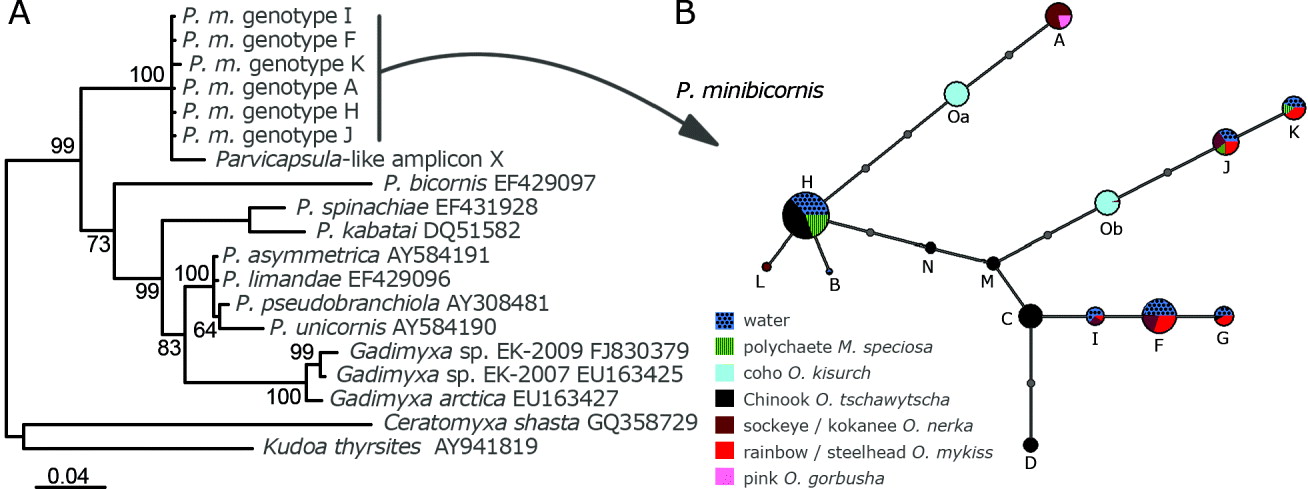
To show the relative genetic distance of the P. minibicornis genotypes within the Myxozoa, we created an alignment using Clustal W (running within MEGA v4.4028; Tamura et al. 2008) with known closely related taxa (Fiala, Reference Fiala2006; Koie et al. 2007). Taxa and GenBank Accession numbers are given in Fig. 2. Pairwise alignment parameters: gap opening 15, extension 6·66, IUB DNA weight matrix. Multiple alignment parameters: as for pairwise, with delay divergent sequences 30%, DNA transition weight 0·5. The alignment was then trimmed to remove poorly aligned regions or regions not represented in most taxa. The optimum evolutionary model for the dataset was selected by the Akaike Information Criterion using MrModelTest v2.3 (Nylander, Reference Nylander2004). Bayesian analysis was conducted using MrBayes (v3.1.2; Huelsenbeck and Ronquist, Reference Huelsenbeck and Ronquist2001) and used the GTR+I+G model, as suggested by JMODELTEST. Phylograms were visualized in MEGA (v4.4028; Tamura et al. 2008) then annotated in Adobe Photoshop (Version CS3, Adobe Systems, Palo Alto, CA, USA). The consensus tree (Fig. 3A) was visualized in MEGA then annotated in Photoshop. A genotype network diagram of P. minibicornis genotypes (Fig. 3B) was constructed using Network (version 4.5.1.6, fluxus-technology.com) then annotated in Photoshop.
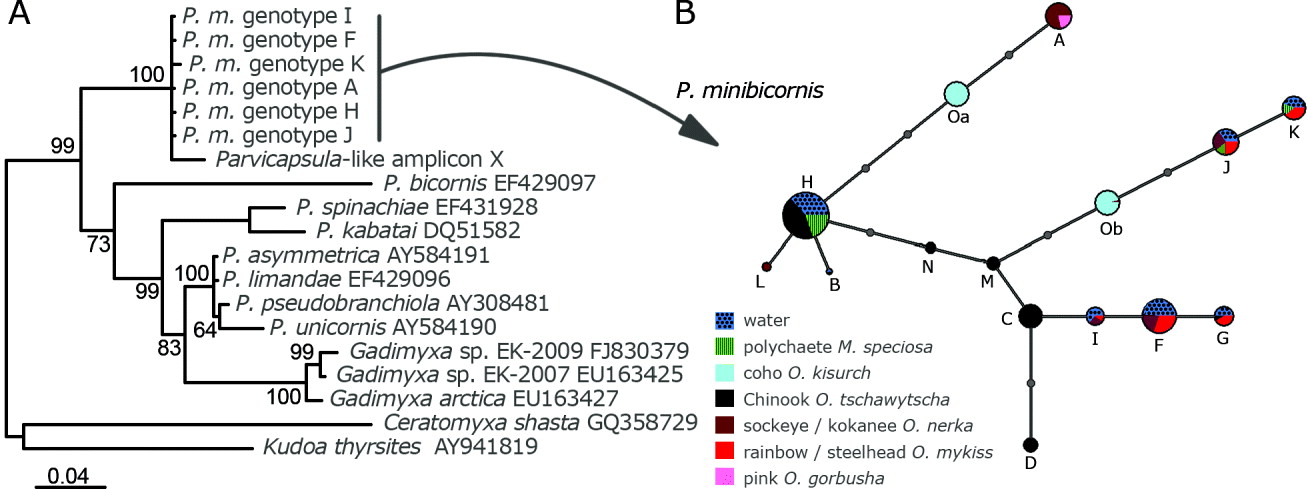
(a) Phylogram generated from Bayesian analysis of closest known taxa to Parvicapsula minibicornis and the novel Parvicapsula-like amplicon detected in Willamette River water and polychaetes. Six P. minibicornis genotypes for which we had entire ssrRNA sequence data were used. (b) Network diagram of the 15 P. minibicornis ssrRNA genotypes. Pie charts show relative sample size and composition of each genotype. Genotypes Oa and Ob were found in all coho. Hypothetical intermediate genotypes are indicated by smallest circles.
RESULTS
Parvicapsula minibicornis was detected visually in fresh tissues only from rainbow trout and kokanee salmon from the lower Columbia River Basin; all other detections were by PCR. Initial sequencing of 9 geographically distinct P. minibicornis samples yielded 6 unique sequences (GenBank Accession numbers HQ624972-HQ624977). We identified 17 SNPs over the entire ssrRNA gene, with 13 in the 934 nt fragment amplified by genotyping primers PMATK1f and PMATK2r (Fig. 2). These primers were used to amplify and sequence P. minibicornis from 197 samples: 60 river water samples; 22 polychaetes; and 115 fish (comprising 38 Chinook salmon, 31 sockeye salmon, 22 coho salmon, 5 pink salmon and 19 rainbow and steelhead trout). We used the 13 SNPs to define 15 genotypes of the parasite, types A–O (Fig. 2). We observed mixed genotype infections, indicated by multiple overlapping peaks at the SNP positions in the chromatograms, in 50% of water samples, 69% of fish and 14% of polychaetes. Visual comparison of these chromatograms yielded 288 genotype reads from the 197 samples (Fig. 1). We discriminated against low amplitude or ambiguous secondary peaks in 23 samples, and only reported the primary genotype.
The P. minibicornis population was structured by both geography and fish host species. Geographical structure was most evident in the Fraser River Basin, where a single genotype only (type A) was found in sockeye and pink salmon. Sockeye salmon in the upper Columbia River Basin had genotypes F and J, and in the lower Columbia River Basin 3 sockeye salmon had type I in addition to F and J. Four genotypes, C, D, H, and N were detected in the 19 Chinook salmon from the lower Columbia River Basin, none of these genotypes were detected in the sympatric sockeye salmon. In the Klamath River Basin, water samples showed spatial patterns of genotype distribution both between upper and lower parts of the river, and along the length of the lower river. Genotypes I and J were only detected in the upper basin, while genotypes F, G, H and K were detected both above and below the dams. The proportions of genotypes F and G relative to H were higher in the upper basin, and decreased with distance downstream from Iron Gate dam in the lower basin. The same genotypes were coincident in river water and polychaete worms at 2 localities: genotypes J and K in the upper basin, and genotype H in the lower basin. In fish, genotypes J and K were detected in rainbow trout only and genotype H was in Chinook salmon only. Genotype F was detected in all Klamath sample types except coho salmon (which had type O as for all other basins from which they were sampled).
Structuring by specific fish host was most evident in coho and Chinook salmon. All coho salmon, irrespective of river basin, were consistently infected only with a mix of 2 genotypes (Oa and Ob; collectively referred to as type O). Individually, Oa was never detected in any other fish and Ob was detected unambiguously in a single sockeye salmon from the upper Columbia River Basin. Despite the presence of genotypes Oa and Ob in coho salmon in 4 river basins, the concentration of parasites with these genotypes was below our detection limit in water and in the polychaete samples. In Chinook salmon, P. minibicornis genotypes varied by river basin. Type H was present in Chinook salmon from the lower Columbia, coastal and Klamath Basins but not in those from the Sacramento Basin, the most southerly locality. Type M was detected in Chinook salmon only, and only from the coastal localities and the Sacramento River. Types C and D were also detected in Chinook salmon only, but predominantly from Columbia Basin fish.
Overall, sequence similarity of P. minibicornis samples was >98·9%. A unique sequence only 91·2% similar with the P. minibicornis type was amplified from 2 polychaetes and 9 water samples from 2 sites in the Willamette River (lower Columbia River Basin) GenBank Accession HQ624978. This sequence (referred to herein as X or the ‘Parvicapsula-like amplicon’) was not detected in any fish samples and hence no myxospores were found, which prevented formal taxonomic description of this material. All P. minibicornis genotypes clustered tightly with each other relative to the marine Parvicapsula and Gadimyxa species (Fig. 3A). The Parvicapsula-like amplicon clustered as a very close sister taxon to P. minibicornis, distinct from all other known Parvicapsula. The network analysis (Fig. 3B) revealed an initial dichotomous branching, resulting in one lineage whose terminal node (A) was unique to the Fraser River, and a second lineage which, upon subsequent bifurcation resulted in 3 terminal nodes, 2 of which were unique to the Klamath (K) and Columbia (D) River systems. Nodes associated with the coho salmon genotypes (Oa, Ob) were intermediate along both the Fraser River and Klamath River lineages.
DISCUSSION
Parvicapsula minibicornis was detected in 5 species of salmon, water and polychaete samples from 4 major and several minor river drainage systems along the Pacific coasts of Canada and the United States. Within this broad geographical range, small subunit ribosomal RNA gene sequences provided evidence for population structure of the parasite and that this structure was associated with river system and fish host species. For the first time, the parasite was detected in non-anadromous salmonid hosts: resident kokanee salmon from Odell Lake and rainbow trout from the Klamath River. We confirmed the presence of the parasite both in its invertebrate polychaete host, Manayunkia speciosa, and in water samples from the Willamette River and the upper Klamath River Basin (Williamson River/Upper Klamath Lake). Established populations of P. minibicornis in these upper river basin localities extends the zone of transmission to fish, which previously had been thought to be only lower river basin reaches and estuaries (St-Hilaire et al. Reference St-Hilaire, Boichuk, Barnes, Higgins, Devlin, Withler, Khattra, Jones and Kieser2002).
We obtained 197 partial ssrRNA gene sequences and observed that P. minibicornis exhibited 1–2% variation at this locus. This variation comprised 13 polymorphic sites in our 934 nt typing amplicon, and defined 15 genotypes of the parasite within the P. minibicornis metapopulation. At 3 sampling localities, the genetic composition of P. minibicornis was found to be the same in both polychaetes and water samples. At the same sites, however, additional genotypes were found in fish. We suspect that water sampling has an inherent bias for the numerically dominant genotypes in the river. These genotypes were found in the most numerous salmonid species present: Chinook salmon in the lower Klamath River Basin and rainbow trout in the upper Klamath River Basin. The parasite genotypes found in coho salmon were not detected in water samples from the lower basin, which possibly reflected the relatively low abundance of parasites with these genotypes in the water and the relatively low number of coho salmon in the system. Similar findings were reported for Ceratomyxa shasta, another myxozoan parasite of salmon in this river (see Atkinson and Bartholomew, Reference Atkinson and Bartholomew2010b).
Evidence of population structure based on river basin was best shown by detection of genotype A exclusively in the 18 sockeye and 5 pink salmon obtained from the Fraser Basin. Genotype A was not detected in the 13 sockeye salmon from the neighbouring Columbia River Basin, or any other species of salmon from any other river basin. While low sample numbers limited the resolution of our analyses, the restriction of genotype A to the Fraser River Basin prompted us to speculate on the rates and mechanisms of parasite transfer among drainage basins. It has been suggested that myxosporean ssrRNA genes evolve according to a fast-clock process (Kent et al. Reference Kent, Hervio, Docker and Devlin1996) to explain the observed high sequence variability among myxozoan species that may be closely related (e.g. Schlegel et al. Reference Schlegel, Lom, Stechmann, Bernhard, Leipe, Dykova and Sogin1996). If we assume that the P. minibicornis ssrRNA locus undergoes sequence divergence at a relatively high rate that is similar in all drainage basins, then the limited genotypic diversity within the Fraser River relative to that observed in the other large river systems suggests a relatively recent introduction of the parasite.
Natural dispersal of P. minibicornis among river basins is very likely a slow process, given the sedentary nature of the invertebrate host and the infrequency of straying infected fish. Measured straying rates of returning adult Pacific salmon among large river drainage basins are low (e.g. Groot and Margolis, Reference Groot and Margolis1991). Additionally, very few of the fish that do stray are infected: P. minibicornis is undetectable in most adult sockeye salmon prior to migration into the Fraser River to spawn (St-Hilaire et al. Reference St-Hilaire, Boichuk, Barnes, Higgins, Devlin, Withler, Khattra, Jones and Kieser2002; Jones et al. Reference Jones, Prosperi-Porta, Dawe and Barnes2003). Both the low straying rate and low infection prevalence suggest that P. minibicornis dispersal occurs on a geological time-scale. We propose that a putative ancestral genotype of P. minibicornis colonized the Fraser drainage basin after re-establishment of its host populations, following the Wisconsinan glaciation approximately 15 000 years ago (McPhail and Lindsey, Reference McPhail, Lindsey, Hocutt and Wiley1986; Taylor et al. Reference Taylor, Foote and Wood1996). River basins south of the Fraser were unglaciated, and thus served as refugia for host and parasite populations. The apparent absence of genotype A outside the Fraser River basin suggests that it arose de novo within the basin from the ancestral genotype, possibly genotype Oa or a related intermediary. It would be interesting to determine whether the pattern of exclusive, limited P. minibicornis genotypic diversity also extends to Fraser River Chinook salmon, compared with Columbia River Basin populations.
The differences in ssrRNA gene sequences between P. minibicornis in Fraser and Columbia River Basin sockeye salmon parallels the previously observed pathological differences in P. minibicornis infections in sockeye salmon from the two basins (St-Hilaire et al. Reference St-Hilaire, Boichuk, Barnes, Higgins, Devlin, Withler, Khattra, Jones and Kieser2002; Jones et al. Reference Jones, Prosperi-Porta, Dawe, Taylor and Goh2004). Similarly, Jones et al. (Reference Jones, Prosperi-Porta, Dawe, Taylor and Goh2004) reported differences in pathology of P. minibicornis infection in coho salmon: in Columbia River Basin fish the parasite did not exhibit histological signs of infection while in the Fraser River Basin, the parasite was detected by histology and by PCR. A more thorough characterization of the parasite genome is required to improve our understanding of the genetic correlates of pathogenicity among parasite genotypes and susceptible host species.
The P. minibicornis genotype findings from coho salmon presented a contrasting and perplexing dataset. Parasite ssrRNA sequences from all 4 river basins were an identical, heterogeneous mix of genotypes Oa and Ob and no other P. minibicornis genotypes were detected in coho salmon. The near-exclusivity to coho salmon of type O indicates strong host specificity. While undefined selective mechanisms appear to have both isolated P. minibicornis type O in this host and excluded infection by other genotypes, how the genetic uniformity of the parasite is maintained within the coho metapopulation is not understood. Future work could include both additional sampling of coho salmon to boost statistical confidence in the results, and to sequence more variable genetic loci to determine the limit of uniformity in the coho P. minibicornis population.
Mixed genotypes within samples were not limited to Coho, and were observed in the majority of water and fish samples. The presence of multiple genotypes in water samples indicated that P. minibicornis genotypes occurred sympatrically and contemporaneously, although we were unable to distinguish between actinospores or myxospores in the water samples. In fish, our sampling methodology may have contributed to mixing of genotypes within fish samples. We extracted DNA from portions of the kidney that contained both spores and sporogenic material, and blood-borne pre-sporogonic stages. Transmission experiments with C. shasta have shown greater genotypic heterogeneity in the blood than is subsequently evident from intestinal infections (C. Hurst, personal communication). It is unknown whether multiple P. minibicornis genotypes can enter a fish, but only species-specific genotypes go on to establish and produce myxospores. Separate sampling of blood and actual myxospores from the kidney may be useful in resolving multiple-genotype infections. However, unlike many pseudocyst-forming or coelozoic myxozoan species, P. minibicornis myxospores mature asynchronously in the kidney tubules and are probably shed continuously.
Within-sample genotypic heterogeneity may have resulted also if spores contained a mixture of ssrRNA alleles. While the ssrRNA gene copy number has been estimated to range from 4·9×103 (True et al. Reference True, Purcell and Foott2009) to 1·6–3·5×104 (Hallett and Bartholomew, Reference Hallett and Bartholomew2009) in each spore – hundreds to thousands per cell – the number of distinct alleles is thought to be low in any individual due to molecular turnover mechanisms such as concerted evolution (Dover, Reference Dover1982). The coho salmon P. minibicornis genotype data strongly suggested that at least 1 heteroallelic strain exists, and may indicate the relatively recent emergence of this type (i.e. molecular turnover has yet to purge the subdominant allele). Ultimately, emerging technological solutions, for example cost effective, high throughput sequencing, should improve the resolution of mixed genotype samples.
The presence of sympatric P. minibicornis genotypes with a range of host affinities raises the question of whether we should consider the taxon a cryptic species complex – i.e. a set of closely-related taxa that are difficult to separate morphologically. Morphometric analysis of different P. minibicornis genotypes would be difficult and ultimately of limited value as myxospores are difficult to isolate given their asynchronous development and constant shedding as they mature in the fish. Myxospores of P. minibicornis are also morphologically plastic, lacking the thickened valve cell walls found in many other myxozoan taxa. These factors place a limit on the precision with which spores can be categorized by morphology alone, hence the incorporation of genetic data. Atkinson and Bartholomew (2010a,b) faced similar issues when attempting to characterize multiple genotypes of C. shasta from different Klamath River Basin salmonids. Variation in the C. shasta ssrRNA gene was only 0–0·2% compared with 0·1–1·1% among the 15 P. minibicornis genotypes, including the 2 from coho salmon. This variation is less than the 2% to >10% typically reported for morphologically distinct species of myxozoans (e.g. Arsan et al. Reference Arsan, Atkinson, Hallett, Meyers and Bartholomew2007; Ferguson et al. 2009). Gunter et al. (Reference Gunter, Whipps and Adlard2009) reported sequence variation of 1·3–28% among morphologically distinct marine Ceratomyxa spp., compared with 0–0·5% intra-specific variation. Regardless, the species concept is not linked to a particular level of genetic difference alone, but rather stems from the holistic interpretation of evidence from genetics, morphology and biology. While not ruling out that incipient speciation may be occurring due to barriers to gene flow imposed by host species and geography, we consider it premature to split P. minibicornis into multiple species. Rather, we highlight that the genetic types documented for this parasite should be considered when undertaking fisheries management programmes; such as translocation of potentially infected fish. The markers we have identified may also be of use to track migrating salmonids and indicate origins of straying fish, especially between the major river basins. Clearly, this study builds a momentum for research to correlate parasite genotype with host pathogenicity and host immuno-competence.
ACKNOWLEDGEMENTS
We greatly acknowledge sample contributions from the following personnel and organizations: Gina Prosperi-Porta, John Richard, Garth Traxler (Department of Fisheries and Oceans, Pacific Biological Station, Nanaimo, British Columbia, Canada); David Patterson (Department of Fisheries and Oceans, Cultus Lake Laboratory, British Columbia, Canada); Tony Amandi, Craig Banner, Leslie Lindsay (Oregon Department of Fish and Wildlife, Corvallis, Oregon, USA); Mark Engleking (Oregon Department of Fish and Wildlife, Clackamas, Oregon, USA); Charlene Hurst, Adam Ray, Rich Holt, (Department of Microbiology, Oregon State University, Corvallis, Oregon, USA); Scott Foott (U.S. Fish and Wildlife Service, California-Nevada Fish Health Center, Reading, California, USA); Sonya Mumford (U.S. Fish and Wildlife Service, Olympia, Washington); Keith Johnson (Idaho Fish and Game, Eagle Fish Health Laboratory, Idaho, USA). Michael Blouin (Department of Zoology, Oregon State University, Corvallis, Oregon, USA) suggested methods and interpretive approaches for genetic analyses.
FINANCIAL SUPPORT
Funding for DNA sequencing was provided by an Oregon State University General Research Fund Grant (Fall 2005–2006). Funding for OSU field studies was provided by the U.S. Federal Bureau of Reclamation.