




No CrossRef data available.
Codevelopment of externalizing and internalizing problems in early childhood
Published online by Cambridge University Press: 01 June 2004
Abstract
Using cross-domain latent growth modeling, we examined trajectories of externalizing and internalizing problems in disadvantaged boys followed from ages 2 to 6 years (N = 303). On average, externalizing problems gradually decreased and internalizing problems gradually increased. However, we found significant variability in individual-level trajectories. Higher levels of externalizing problems were associated with higher levels of internalizing problems; rates of change were also positively correlated across domains. In addition, high levels of externalizing problems predicted rapid increases in internalizing problems. In follow-up analyses involving child and parenting factors, the combination of high negative emotionality, low fearfulness, and high negative maternal control preceded high, nondecreasing externalizing trajectories. The combination of high negative emotionality, high fearfulness, and high negative maternal control preceded high, increasing internalizing trajectories. Taken together, the results indicate both general and specific processes in the development of early externalizing and internalizing problems.This research was supported by National Institute of Mental Health (NIMH) Grants MH50907 and MH01666 to the second author and NIMH National Research Service Award 1F31MH12226 to the first author. We thank Emily Winslow and Elizabeth Owens for developing the Early Parenting Coding System and the Negative Emotionality Coding System, respectively. We also thank the study participants for teaching us about child development.
Information
- Type
- Research Article
- Information
- Copyright
- © 2004 Cambridge University Press
In recent years, researchers have sought to trace individual-level trajectories of externalizing problems and internalizing problems from their origins in early childhood. These efforts stem from evidence that extreme behavioral and emotional difficulties in preschool regularly precede psychopathology in middle childhood and beyond (Caspi, Moffitt, Newman, & Silva, 1998; Egeland, Pianta, & Ogawa, 1996; Hofstra, van der Ende, & Verhulst, 2002; Mesman & Koot, 2001). By determining when and how children embark on pathways toward chronic dysfunction, researchers hope to lay the groundwork for more timely and effective interventions.
Although interest in early problem trajectories has fueled a growing research literature, most studies have focused on either externalizing problems or internalizing problems. This piecemeal approach has produced several gaps in understanding. For example, it is unclear whether changes in early externalizing problems are related to changes in early internalizing problems or whether predictors of growth are the same or different across the two domains. The present study examined the codevelopment of early externalizing and internalizing problems in a sample of boys from low-income families. This population was targeted because disadvantaged males are at elevated risk for a variety of negative mental health outcomes, including violence (Lipsey & Derzon, 1998), depression (Anderson, Williams, McGee, & Silva, 1987; Keenan, Shaw, Walsh, Delliquadri, & Giovannelli, 1997), and suicide (Beautrais, Joyce, & Mulder, 1996; Brent, Baugher, Bridge, Chen, & Chiappetta, 1999). The study sought to model externalizing and internalizing trajectories from toddlerhood to school entry and to relate these trajectories to each other and to child and parenting factors.
Modeling Individual-Level Trajectories of Early Externalizing and Internalizing Problems
Externalizing problems of early childhood usually take the form of overt disruptive behaviors such as aggression, defiance, and hyperactivity. In contrast, early internalizing problems typically appear as anxiety, withdrawal, and sad affect (Campbell, 1995).1
Some authors also include somatic complaints (e.g., aches and pains, nausea) within the category of internalizing problems (e.g., Achenbach et al., 1991); others do not follow this convention (e.g., Rubin & Mills, 1991). In any case, somatic problems seldom appear in theories of internalizing problems. On the basis of these considerations, we did not examine somatic complaints in this study.
Developmentalists attribute these patterns to age-related changes in cognitive functioning and the social environment. For example, decreases in aggression are thought to result from advances in verbal problem solving skills and the onset of parental limit setting (Maccoby, 1980; Tremblay, 2000). In contrast, normative increases in internalizing problems may reflect improvements in the capacity to remember and anticipate negative events (Kaslow, Brown, & Mee, 1994; Vasey, Crnic, & Carter, 1994).
A new class of quantitative methods has enabled researchers to move beyond normative trajectories and study individual-level patterns of change. Examples of this class include hierarchical models (Bryk & Raudenbush, 1992), latent growth models (McArdle & Bell, 2000; Muthén, 2001), and mixed models (Cudeck & Klebe, 2002). Although these procedures differ in important ways (Raudenbush, 2001; Willett & Sayer, 1994), all estimate trajectory parameters (e.g., initial level and rate of change) for each person under study and specify how these parameters vary throughout the population. Until recently, technical limitations restricted analyses of individual change to one measurement series at a time. However, advances in latent growth modeling now permit researchers to estimate trajectories in several domains simultaneously and to examine how these trajectories relate to one another (Willett & Sayer, 1996). These innovations provide a means to investigate the codevelopment of early externalizing and internalizing problems at the level of the individual.
What empirical findings or theoretical propositions are available to guide such analyses? First, a large body of cross-sectional findings suggests that externalizing and internalizing problems often occur together (Achenbach et al., 1991; Anderson et al., 1987; Lavigne, Gibbons, Christoffel, Arend, Rosenbaum, Binns, Dawson, Sobel, & Isaacs, 1998; Rose, Rose, & Feldman, 1989). This relationship has been found at all stages of development and holds whether adjustment problems are evaluated using dimensional rating scales or categorical measures based on diagnostic information. These findings suggest that levels of externalizing and internalizing problems change together over time. Indeed, in a prior cross-domain growth analysis with school-aged children, Keiley, Bates, Dodge, and Pettit (2000) found a modest positive relationship between changes in externalizing problems and changes in internalizing problems. We sought to replicate this association in early childhood.
Second, Patterson and Capaldi (1990) have proposed a failure model to account for the fact that conduct problems often antecede internalizing disorders The model posits that conduct problems lead to failures in social situations that, in turn, gradually lead to depression and anxiety. Consistent with this hypothesis, Capaldi (1991) found that boys' conduct problems in Grade 6 predicted depression symptoms in Grade 8, controlling for depression in Grade 6. In this study, we extended Patterson and Capaldi's (1990) failure model to early childhood using a multiple time-point design.
Predictors of Individual-Level Trajectories of Early Externalizing and Internalizing Problems
Research on the nonsymptomatic precursors of psychopathology is essential for understanding etiological pathways. Individual-level trajectory analyses can aid in this process by identifying factors related to the escalation or persistence of symptoms over time. To what extent do such factors overlap for early externalizing and internalizing trajectories? Is the manner in which risk factors relate to one another in predicting growth similar across the two domains? Answers to such questions are important because they may indicate the extent to which causal processes underlying externalizing and internalizing disorders are the same or different. No etiological theories are available that encompass both forms of dysfunction. However, examination of more circumscribed models leads to several basic conjectures about some of the factors involved.
First, child temperament characteristics and parental treatment likely are key influences on both externalizing and internalizing trajectories during early childhood. According to “early-starter” theories of antisocial behavior, chronic externalizing problems arise from the interplay of difficult temperament characteristics and inept parenting (Lahey, Waldman, & McBurnett, 1999; Moffitt, 1993; Patterson, Capaldi, & Bank, 1991). Similarly, theories of the development of internalizing problems focus on dispositional emotionality and the emotional support (or lack thereof) of caregivers (Cicchetti & Toth, 1998; Rubin & Mills, 1991). These models incorporate contextual factors (e.g., divorce, neighborhood, poverty) as secondary rather than primary contributors to child outcomes. That is, the impact of contextual variables during early childhood depends, in theory, on the extent to which they alter parent–child interchanges. Thus, as for proximal risk factors, the types of predictors for early externalizing and internalizing trajectories are probably similar.
Second, the theoretical literature suggests that some aspects of temperament and parenting are linked to both externalizing and internalizing problems whereas others are outcome specific. Consider two contemporary models: Lahey et al.'s (1999) account of the origins of antisocial behavior and Rubin and Mills' (1991) account of the origins of internalizing disorders. Lahey and colleagues' model emphasizes two infant temperament characteristics, high negative mood and low fearfulness, and insensitive, power-assertive parenting.2
Lahey and colleagues' (1999) model also includes child callousness or lack of empathy. At present, the field lacks a clear operational definition of callousness in very young children (Frick & Ellis, 1999). For this reason, callousness is not among the temperamental traits considered here.
Rubin and Mills' (1991) model also includes infant negative mood and insensitive, power-assertive parenting, but replaces an uninhibited behavioral style with a fearful, inhibited one. In this scenario, negative, fearful infants become distressed when exposed to novel or potentially threatening stimuli. Negative parental control techniques provide a “quick fix” in minimizing expressions of distress but ultimately interfere with the development of self-initiated coping skills. The result is a vulnerability to anxiety and depression in the face of social challenge.
A third conjecture, which is implicit in the preceding discussion, is that interactions among temperament and parenting variables may provide the most accurate predictions of externalizing and internalizing trajectories in early childhood. Developmentalists have increasingly recognized that the long-term impact of any particular risk factor often depends on the levels of other risk factors (Cicchetti & Rogosch, 1996; Lewis, 2000; Sameroff & Chandler, 1975; Thomas & Chess, 1977). Consistent with such an interactional perspective, the models of Lahey and colleagues (1999) and Rubin and Mills (1991) propose that the conjunction of negative emotionality, fearlessness (or fearfulness), and negative parenting confers risk for dysfunction beyond these variables' individual effects.
To date, few studies have examined factors ascertained in the first years of life in relation to both externalizing and internalizing trajectories. As a result, we lack a clear understanding of the processes underlying growth in these two domains. Following Lahey et al. (1999) and Rubin and Mills (1991), this investigation focused on the interplay of child negative emotionality, child fearlessness versus fearfulness, and negative parental control.
Negative emotionality and early externalizing and internalizing problems
Individual differences in negative emotionality are apparent at birth and are moderately stable by 6 months of age (Rothbart & Bates, 1998). Many studies examined the relations between temperamental emotionality and adjustment problems (see Rothbart & Bates, 1998, for a review), but only a handful were initiated in infancy or toddlerhood before the onset of more serious difficulties. Those studies begun in the first years of life have found modest but reliable associations with both externalizing and internalizing problems in early childhood (Bates, Bayles, Bennett, Ridge, & Brown, 1991; Earls & Jung, 1987; Keenan, Shaw, Delliquadri, Giovannelli, & Walsh, 1998; Sanson, Oberklaid, Pedlow, & Prior, 1991). These links remained after controlling for parenting and demographic variables and thus are not simply artifacts of family functioning (Bates et al., 1991). In spite of the consistency of these findings, two issues arise regarding their interpretation. First, most investigators have used a single informant for emotionality and adjustment problems. As a result, reporter bias may have inflated the strength of association between these constructs. Second, most investigators have assessed negative emotionality in a single context. Kagan, Snidman, McManis, Woodward, and Hardway (2002) and others have questioned whether this practice can render valid measures of dispositional traits. The present study used observer and maternal ratings of negative emotionality.
Fearfulness and early externalizing and internalizing problems
Beginning with Kagan (1989), researchers have observed stable individual differences in children's tendency to approach or avoid novel situations. Some children are relatively fearless and quick to interact with unfamiliar surroundings and people; others find unfamiliar situations aversive and tend to withdraw. These two profiles show evidence of heritability and are associated with distinct physiological response patterns (Kagan, 1997). In studies with middle-class, university samples, Kagan and colleagues have shown that fearlessness in toddlerhood predicts elevated externalizing problems in childhood (Biederman, Hirshfeld–Becker, Rosenbaum, Herot, Friedman, Snidman, Kagan, & Faraone, 2001; Schwartz, Snidman, & Kagan, 1996), whereas fearfulness predicts elevated internalizing problems (Biederman et al., 2001; Reznick, Kagan, Snidman, Gersten, Baak, & Rosenberg, 1988; Schwartz, Snidman, & Kagan, 1999). It is unclear whether this pattern generalizes to other populations. In prior analyses with this sample (Shaw, Gilliom, Ingoldsby, & Nagin, 2003), we found that fearless responses to a nonsocial stimulus preceded chronic externalizing problems. This study used a more traditional measure that included both social and nonsocial components.
Negative parental control and early externalizing and internalizing problems
In the second year of life, increases in physical mobility and psychological autonomy require parents to expend more effort in controlling their children (Shaw & Bell, 1993). Simultaneously, developments in language skills render toddlers more vulnerable to repressive, hostile commands (Kopp, 1991). Recent studies show that early parenting characterized by harsh, power-assertive control techniques and the absence of warmth is predictive of later externalizing problems, particularly in high-risk populations (Campbell, Pierce, Moore, Marakovitz, & Newby, 1996; Shaw, Winslow, Owens, Vondra, Cohn, & Bell, 1998). Less is known about the relationship between parenting in toddlerhood and subsequent internalizing outcomes. In a cross-sectional study of first graders, Stormshak, Bierman, McMahon, Lengua, and The Conduct Problems Prevention Research Group (2000) found that self-reported harsh discipline predicted internalizing scores in multivariate analyses, following similar results among older children and adolescents (see Rapee, 1997). In this study, a composite measure of negative maternal control was created from observations in the lab and the home based on structured and unstructured tasks, respectively.
Goals and Hypotheses
Overall, this study had three goals. First, we sought to estimate individual trajectories of mother-reported externalizing and internalizing problems in a sample of disadvantaged young boys. To ensure that these trajectories generalized beyond maternal report, we used estimated trajectory parameters to predict teacher-reported adjustment problems at age 6.
Our second goal was to describe interrelationships between early externalizing and internalizing trajectories. From prior cross-domain analyses with school-age children (Keiley et al., 2000), we anticipated a positive relationship between changes in externalizing problems and changes in internalizing problems. From Patterson and Capaldi's (1990) failure model, we anticipated a positive relationship between initial levels of externalizing problems and changes in internalizing problems.
Third, we sought to identify dimensions of temperament and parenting that predict, independently or in concert, the course of early externalizing and internalizing trajectories. From contemporary theoretical models (Lahey et al., 1999; Rubin & Mills, 1991) and prior research, we anticipated positive relationships between negative emotionality, fearlessness, and negative maternal control on the one hand and the level and rate of change in externalizing problems on the other. We expected a similar pattern for internalizing problems, with the exception that a fearful temperament would predict more elevated trajectories. Consistent with an interactional perspective, we also hypothesized that interactions among child and parent variables would enhance the prediction of problem trajectories after accounting for main effects. Specifically, we expected that the combination of negative emotionality, fearlessness, and harsh parenting would predict the most severe externalizing trajectories and that the combination of negative emotionality, fearfulness, and harsh parenting would predict the most severe internalizing trajectories. Finally, from previous research showing modest relations between sociodemographic factors and early adjustment problems (e.g., Keiley et al., 2000; Repetti, Taylor, & Seeman, 2002), maternal age and child race were included in the analysis. We expected the effects of temperament and parenting to be obtained after controlling for maternal age and child race.
Method
Participants
Mothers with male infants were recruited from Women, Infants, and Children (WIC) sites in the Pittsburgh, Pennsylvania, metropolitan area (Shaw et al., 1998). WIC provides nutritional supplements for low-income families with young children. Mothers were asked to take part in a longitudinal study of child and family development. Of 421 families approached at WIC sites, 310 participated in the first assessment when boys were 1.5 years old. Five subsequent assessments occurred at intervals ranging from 6 months to 1.5 years. The average participation rate was 85% (range = 74–92%). Participation was lowest for the age-5.5 assessment (74%), which was conducted as part of a dissertation project. Retention efforts at that time point were limited by funding constraints and by scheduling restrictions imposed by age-5 and age-6 visits. This study focused on growth in externalizing and internalizing problems from ages 2 to 6; thus, the sample included those boys who completed one or more assessment during this period (N = 303).
At the time of the first assessment, mothers ranged in age from 17 to 43 years, with a mean age of 28. The sample comprised primarily European American and African American children (53 and 36%, respectively), with a small number of biracial and Hispanic participants. Mean per capita monthly income was $241 ($11,568/year for a family of four).
Procedures
Families took part in assessments when boys were 1.5, 2, 3.5, 5, 5.5, and 6 years of age. Data were gathered during lab visits at ages 1.5, 2, 3.5, and 6 and during home visits at ages 2, 5, and 5.5. At each visit, mothers completed questionnaires about boys' adjustment; teachers completed similar measures as part of the age-6 assessment. Lab visits at ages 1.5 and 2 also included an initial freeplay period (10 min) and a series of structured interactive tasks. Structured tasks were selected to vary in stress level so that mother and child behavior could be observed across a broad spectrum of conditions. All tasks were recorded on videotape for future coding.
At age 1.5 the lab tasks included a teaching paradigm (Matas, Arend, & Sroufe, 1978) in which mothers and sons worked together on puzzles or games (4 min); a clean-up task (Martin, 1981) in which mothers instructed sons to put away toys (5 min); and the Strange Situation, a series of episodes in which boys were briefly separated from their mother and exposed to an unknown examiner over 10 min (see Ainsworth, Blehar, Waters, & Wall, 1978). The age-2 visit also included a clean-up and the Strange Situation; in addition, boys were observed in a behavioral inhibition task adapted from the work of Kagan (1989). For this task, examiners first cleared the lab room of toys and gave the mother several questionnaires. Upon leaving the room, they started an audiotape containing 2 min of silence followed by 2 min of scary gorilla noises. The recording was compiled from a scene from the movie Gorillas in the Mist in which gorillas howled in a threatening manner. The tape player was stationed in an enclosed cabinet located across the room from the mother so that the child could easily identify the source of the sounds and choose to approach or stay away.
Measures
Maternal age and child race
Examiners gathered information about maternal age and child race as part of a demographic interview conducted at the age-2 assessment. Child race was converted to a dummy code: European American boys were assigned a value of 0; all other boys were assigned a value of 1.
Negative emotionality
Child negative emotionality was assessed in two ways. First, coders rated negative emotionality during the entire age-1.5 lab visit (approximately 90 min) using one molecular and three global scales (Owens, 1998). For the molecular rating, coders recorded the amount of time spent fussing and crying (s). The same coders made global ratings of the amount and intensity of negative emotionality. Coders also made a global rating of difficulty, which reflected the infant's overall temperamental difficulty compared to others his age. Interrater agreement in the form of weighted kappa coefficients for all components of the measure was calculated across 10 randomly selected tapes and ranged from .77 to .88, with a mean of .83. The molecular and global ratings were standardized and summed to create an observed negative emotionality score (Cronbach's α = .90).
Second, mothers completed the Difficultness factor of the Infant Characteristics Questionnaire (ICQ; Bates, Freeland, & Lounsbury, 1979) at ages 1.5 and 2. The ICQ, a popular measure of early temperament, has good reliability and validity characteristics (Bates, Maslin, & Frankel, 1985). The Difficultness factor assesses the intensity and frequency of fussy, irritable affect. Difficultness scores from ages 1.5 and 2 were highly correlated (r = .62, p < .0001). To create an overall measure of negative emotionality based on both maternal perceptions and examiner ratings, we standardized and summed the observed negative emotionality score at age 1.5 and the average of the Difficultness scores from ages 1.5 and 2. Composition was supported on empirical grounds by a moderate correlation between the observed negative emotionality score and the average Difficultness score (r = .30, p < .001).
Fearfulness
Using molecular and global scales, two coding teams rated boys' approach/avoidance behavior during three segments of the age-2 lab visit: the initial freeplay period and the Strange Situation (Team 1) and the behavioral inhibition task (Team 2). For molecular coding, the freeplay and Strange Situation were each divided into 20 intervals of 30 s. In each interval, coders recorded the presence/absence of the following behaviors: initiate or maintain contact with mother, approach examiner, and active exploration. For the freeplay, coders also rated the presence/absence of examining or playing with toys. For the Strange Situation, coders also rated the presence/absence of comfortable interaction with examiner (e.g., maintains eye contact, responds to/makes social overtures) and wary response to examiner (e.g., avoids eye contact, withdraws from examiner) in coding intervals in which the examiner was present. For the relatively brief (2 min) behavioral inhibition task, coders recorded latency to approach the cabinet and time spent in close proximity with mother (s). In addition to making these molecular ratings, coders also assigned global approach/withdrawal from the unfamiliar scores for each of the three tasks. Interrater reliability was .9 or greater on all scales based on 20% of cases coded by two raters. A principal components analysis (PCA) was conducted for each of the three segments. All three PCAs yielded a single factor with an eigenvalue of >1. These factors were significantly correlated with one another (rs = .35–.66, ps < .001). To create a single measure of fearful versus fearless behavior in both social and nonsocial contexts, we averaged the three factor scores.
Maternal negative control
The measure of negative maternal control was derived from two sources. First, coders used the Early Parenting Coding System (EPCS; Winslow & Shaw, 1995) to rate maternal behavior during the clean-up tasks at ages 1.5 and 2. The EPCS captures a range of parenting behaviors that are typically exhibited in interactions with young children. For the purposes of this study, only codes relevant to positive versus negative control were used. These include two molecular codes (verbal/physical approval and critical statements) and three global codes (hostility, warmth, and punitiveness). Hostility was defined as the expression of anger by the mother toward the child. The warmth code assessed positive affect directed toward the child. Punitiveness was defined as the extent to which the mother was too strict or harsh, considering the child's behavior. The kappa reliability ranged from .83 to .94 for the individual codes.
PCAs of age-1.5 and age-2 codes yielded single factors with an eigenvalue of >1. We created a composite rating of maternal control by averaging scores from ages 1.5 and 2 (r = .38, p < .0001).
Second, examiners completed the infant version of the Home Observation for Measurement of the Environment (HOME; Bradley & Caldwell, 1984) during the age-2 home visit. The HOME, a widely used and well-validated measure of support and stimulation in the child's home environment, employs observational and interview methods. This study used two HOME subscales: Acceptance of Child's Behavior and Responsivity. The Acceptance subscale taps parents' responses to child misbehavior or distress (e.g, “Parent does not express annoyance with or hostility to the child” or “Parent does not shout at child”). The Responsivity subscale measures the tone of physical and verbal responses to the child in ongoing interactions (e.g., “Parent's voice conveys positive feelings toward child,” “Parent caresses or kisses child at least once”). To create a measure of parenting in the home, we averaged Acceptance and Responsivity scores (r = .29, p < .01). This composite was negatively correlated with the EPCS parenting measure (r = −.39, p < .001). To create an overall measure of negative parenting that included both harsh control techniques and the absence of warmth, we averaged the HOME composite (reverse scored) and the EPCS.
Mother's ratings of externalizing and internalizing problems
Mothers rated boys' adjustment problems at ages 2, 3.5, 5, 5.5, and 6 with the Child Behavior Checklist (CBCL; Achenbach, 1991a, 1992). There are two versions of this popular measure: one designed for children ages 2–3 and one for children ages 4–18. Both versions contain items tapping externalizing and internalizing problems, although the content of some items varies across versions to capture developmental changes within these domains. Growth curve modeling requires measurement equivalence across time points (Willett & Sayer, 1994). To meet this requirement, we selected externalizing and internalizing items that appear on both versions of the CBCL. For externalizing problems, nine items were chosen (“Can't sit still, restless, or hyperactive,” “Cruel to animals,” “Destroys his own things,” “Destroys things belonging to his family or others,” “Disobedient,” “Doesn't seem to feel guilty after misbehaving,” “Get in many fights,” “Physically attacks people,” and “Temper tantrums or hot temper”). Six items were selected for internalizing problems (“Too fearful or anxious,” “Self-conscious or easily embarrassed,” “Shy or timid,” “Unhappy, sad, or depressed,” “Withdrawn, doesn't get involved with others,” and “Worries”). Mothers responded to CBCL items using a 3-point scale: 0 = not true, 1 = somewhat or sometimes true, and 2 = very true or often true. Internal consistency was high for the externalizing scale (Cronbach's α = .75–.80 across time points) and moderate for the internalizing scale (α = .65–.69). Externalizing and internalizing scores were positively skewed (mean γ1 = 0.94, range = 0.76–1.46, ps < .05) and leptokurtic (mean γ2 = 0.59, range = 0.01–1.08, ps < .20). To decrease nonnormality, we transformed the scores by taking their natural logarithm. The transformed scores exhibited nonsignificant skew (mean γ1 = −.07, range = −.19–.27, ps > .05) and kurtosis (mean γ2 = −.23, range = −.50–.19, ps > .10). Following growth curve analyses, we returned to the original metric in order to present estimated trajectories.
Teacher's ratings of externalizing and internalizing problems
Teachers assessed boys' externalizing and internalizing problems at age 6 using the Teacher Report Form (TRF; Achenbach, 1991b). Like the CBCL, the TRF has good validity and reliability characteristics. We used the full-scale Externalizing and Internalizing t scores for this study.
Results
Descriptive statistics
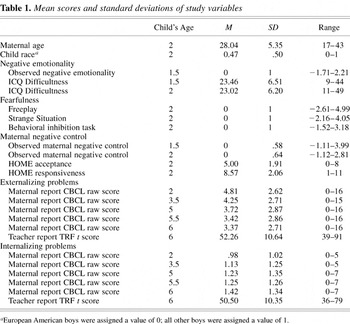
The descriptive statistics for all study variables appear in Table 1. As noted above, observational codes were converted to factor scores; hence, the means for these variables are zero. The pattern of descending externalizing problems and increasing internalizing from ages 2 to 6 is consistent with past research (Achenbach et al., 1991; MacFarlane et al., 1954).
Mean scores and standard deviations of study variables

Cross-domain growth analysis
We conducted cross-domain growth analyses for early externalizing and internalizing problems within a structural equation modeling framework using the Mplus software package (Muthén & Muthén, 2001). Mplus accommodates participants with incomplete assessment histories by using maximum likelihood (ML) estimation. Under the assumption of missing at random (MAR), ML estimation with missing data estimates each parameter using all data available for that particular parameter (Little & Rubin, 1987). The percentage of participants with missing data ranged from 8 to 26% on the outcome variables (externalizing and internalizing problems measured at five time points) and from 2 to 8% on the predictors (negative emotionality, fearfulness, and negative maternal control). Consistent with MAR, participants with missing data did not differ significantly on any of the study variables from those with complete data.
Like other procedures for studying individual change, cross-domain growth analysis estimates a two-stage mathematical model. The first stage (Level 1) specifies individual-level trajectory parameters in each domain; the second stage (Level 2) specifies how these parameters vary in the population of persons. Assuming individuals follow different trajectories, one can examine the intercorrelations among trajectory parameters and attempt to explain the variability in the parameters by including predictor variables at Level 2.
As a first step in the growth analysis, we plotted boys' externalizing and internalizing scores against time. Through visual inspection of the plots, we inferred that individual change in both domains was linear. That is, boys seemed to follow straight-line trajectories from ages 2 to 6.
Our next step was to fit a baseline growth model with no predictors at Level 2. This model served several functions. First, it provided an opportunity to test whether individual change was in fact linear or whether it followed a more complex, curvilinear pattern. Second, the baseline model revealed average trajectories of externalizing and internalizing problems and the extent of heterogeneity in individual trajectories. Third, it estimated correlations among the trajectory parameters, thereby enabling us to examine the relations between externalizing and internalizing problems across early childhood.
In our baseline model, we allowed the error variances of the outcome variables to vary across time points. Under the assumption that mothers' measurement errors for externalizing problems were related to those for internalizing problems, we also allowed the error variances to covary within time points. Finally, for each domain we included two Level-1 parameters: an intercept parameter representing the initial symptom level (i.e., symptom level at age 2) and a slope parameter representing the rate of change.
The baseline model fit the data well: χ2 = 81.43, df = 41, p < .001, χ2/df = 1.99; comparative fit index (CFI) = .98; root mean square error of approximation (RMSEA) = .034, 90% confidence interval (CI) = .022 and .046; standardized RMS residual (SRMR) = .026. To test the applicability of curvilinear (rather than straight-line) trajectories of individual growth, we added quadratic terms to the baseline model. The quadratic terms were not significantly different from zero, nor did their inclusion improve the model fit. On the basis of these results, we concluded that growth was linear in both domains.3
We also evaluated the form of externalizing and internalizing trajectories in separate univariate models. As in the bivariate model, straight-line trajectories provided the best fit.
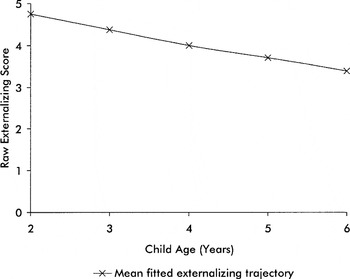
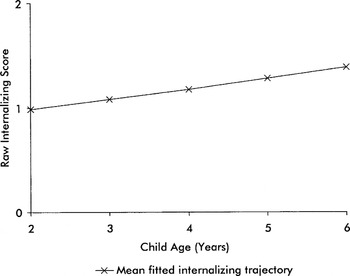
The fitted mean trajectories appear in Figures 1 and 2. These trajectories correspond to the estimated mean intercept and slope parameters from the baseline model. To facilitate interpretation, we transformed the trajectories from logged scores back to the original metric of the CBCL. On average, boys exhibited relatively high levels of externalizing problems at age 2, mean intercept (logged) = 1.75, p < .0001, and gradually improved thereafter, mean slope (logged) = −.07, p < .01 (see Figure 1). In contrast, boys' internalizing problems began at low levels (mean intercept) (logged) = .69, p < .0001, and then gradually increased, mean slope (logged) = 0.04, p < .01 (see Figure 2). Not all boys followed these patterns, however: we found significant variability in all four trajectory parameters. For externalizing problems, the estimated variances for the intercept and slope were .165 and .012, respectively (ps < .01). For internalizing problems, the intercept and slope variances were .084 and .007, respectively (ps < .05).
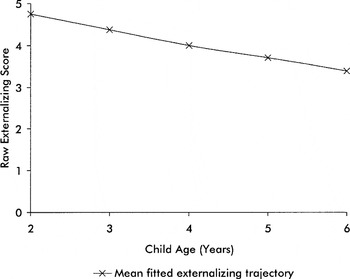
The mean fitted trajectory of externalizing problems.
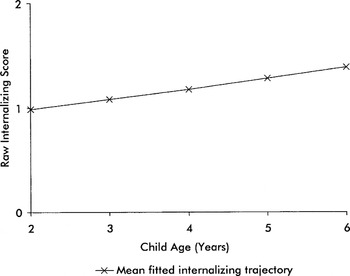
The mean fitted trajectory of internalizing problems.
Before examining the correlations among the individual-level trajectory parameters, we tested the trajectories' generality by relating them to teacher-reported problems at age 6. Specifically, we fit a model in which the estimated externalizing and internalizing parameters were used to predict teacher-reported externalizing and internalizing problems, respectively. For externalizing problems, both trajectory parameters were positively related to teacher-reported symptom levels at age 6 (intercept: β = .13, p < .05; slope: β = 2.47, p < .01). For internalizing problems, both parameters were also positively related to teacher-reported symptom levels, but only the slope reached statistical significance (intercept: β = .13, p < .10; slope: β = 1.96, p < .01).
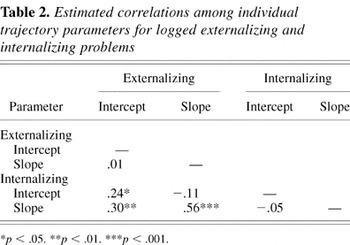
The estimated correlations among the trajectory parameters appear in Table 2. Overall, the trajectories of early externalizing and internalizing problems were significantly interrelated. We found a modest positive correlation between the intercept parameters, indicating that at age 2 the boys who were perceived as aggressive, defiant, and hyperactive also tended to be perceived as anxious, sad, and withdrawn. Consistent with cross-domain analyses with older children (Keiley et al., 2000), the slope parameters were also interrelated, such that boys who remained elevated or increased over time in one domain also tended to remain elevated or to increase in the other domain. Finally, consistent with Patterson and Capaldi's (1990) failure model, the initial status of externalizing problems was positively associated with the rate of change in internalizing problems. Thus, boys who were highly disruptive and aggressive increased more rapidly on internalizing problems than those who lacked these characteristics. In contrast, internalizing problems at age 2 were unrelated to the rate of change in externalizing problems.
Estimated correlations among individual trajectory parameters for logged externalizing and internalizing problems
In the final stage of the growth analysis, we attempted to predict individual differences in externalizing and internal trajectories using child temperament and parenting variables. For this purpose, child negative emotionality, child fearfulness, and maternal negative control were included in the growth model as Level-2 predictors. To test for the moderator effects hypothesized by Lahey and colleagues (1999) and Rubin and Mills (1991), statistical interactions (i.e., cross-products) among the temperament and parenting variables were also added as predictors. Although we were most interested in the three-way interaction of negative emotionality, fearfulness, and negative control, we included the three two-way interactions on an exploratory basis. Finally, because the sample was characterized by potentially important demographic variability, child race and maternal age were added as control variables. All independent variables were centered to reduce collinearity.
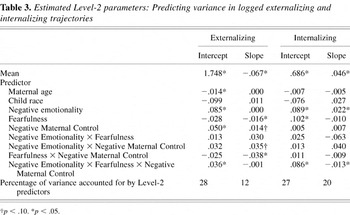
The growth model with Level-2 predictors provided an adequate fit to the data (χ2 = 224.20, df = 95, p < .001, χ2/df = 2.36; CFI = .95; RMSEA = .049, 90% CI = .037–.061; SRMR = .040). Table 3 contains the estimated Level-2 parameters from the final model and the proportion of variance in Level-1 trajectory parameters accounted for by the set of predictors. Figures 3 and 4 illustrate the effects of the independent variables of primary interest: temperament and maternal parenting. Specifically, the figures present fitted trajectories associated with combinations of negative emotionality, fearfulness, and negative maternal control when each variable is either 1 SD below or 1 SD above the sample mean. Given the large number of resulting trajectories, we attempted to simplify the presentation by separating those associated with low negative emotionality (Figures 3a and 4a) from those associated with high negative emotionality (Figures 3b and 4b). The fitted trajectories are in the original metric of the CBCL.
Estimated Level-2 parameters: Predicting variance in logged externalizing and internalizing trajectories
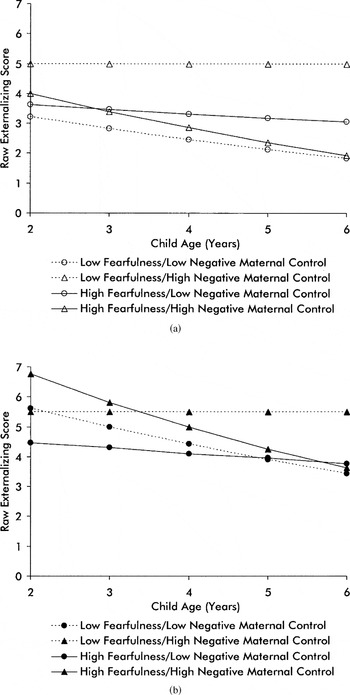
(a) The fitted trajectories of externalizing problems based on the combination of low negative emotionality (1 SD below the sample mean) and high or low fearfulness and negative maternal control (each variable 1 SD above or below the sample mean). (b) Fitted trajectories of externalizing problems based on the combination of high negative emotionality (1 SD above the sample mean) and high or low fearfulness and negative maternal control (each variable 1 SD above or below the sample mean).
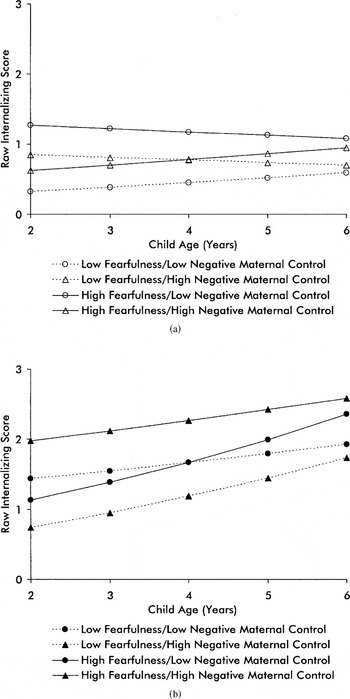
(a) Fitted trajectories of internalizing problems based on the combination of low negative emotionality (1 SD below the sample mean) and high or low fearfulness and negative maternal control (each variable 1 SD above or below the sample mean). (b) Fitted trajectories of internalizing problems based on the combination of high negative emotionality (1 SD above the sample mean) and high or low fearfulness and negative maternal control (each variable 1 SD above or below the sample mean).
Turning first to externalizing intercepts, we found that of the two demographic variables, only maternal age was a significant predictor, with younger mothers reporting more severe externalizing problems at age 2 than older mothers. After controlling for maternal age and child race, higher levels of negative emotionality and negative maternal control were also associated with more severe problems at age 2. However, the main effects of negative emotionality and maternal control were qualified by a significant three-way interaction effect. To examine the interaction more closely, we computed post hoc models testing the relationship between maternal negative control and externalizing intercepts in boys with different levels of negative emotionality and fearfulness (low/low, low/high, high/low, and high/high, with low and high defined as below and above the sample mean, respectively). Contrary to expectation, higher levels of negative maternal control corresponded with higher intercepts only among boys who were negative and fearful (β = .042, p < .05). Negative maternal control had no significant association with externalizing intercepts in the three other groups.
Moving next to the rate of change in externalizing problems, after controlling for maternal age and child race, lower levels of fearfulness were associated with less rapid declines over time. However, a significant two-way interaction effect indicated that the impact of fearfulness was moderated by negative maternal control. Follow-up analyses revealed that higher levels of negative maternal control predicted less rapid declines in externalizing problems among fearless boys (i.e., those below the sample mean on fearfulness; β = .014, p < .05). In contrast, negative maternal control was unrelated to the rate of change in externalizing problems among fearful boys. This pattern is evident in Figure 3. For boys who were 1 SD below the sample mean on fearfulness and 1 SD above the sample mean on negative maternal control at age 2, the level of externalizing problems did not decline over the span of the study. All other risk configurations were associated with decreasing trajectories.
In all, the predictors accounted for 28% of the variance in the externalizing intercepts and 12% of the variance in the externalizing slopes. Another way to evaluate the cumulative impact of the predictors is to compare trajectories associated with high versus low risk on all three independent variables. As seen in Figure 3, boys who were characterized by high negative emotionality, low fearfulness, and high negative maternal control in toddlerhood followed a high, nondecreasing trajectory whereas those who were characterized by low negative emotionality, high fearfulness, and low negative maternal control followed a low, declining trajectory. By age 6, the high-risk fitted trajectory is approximately 1 SD higher than the low-risk fitted trajectory.
Within the domain of internalizing problems, higher levels of negative emotionality and fearfulness predicted higher intercepts after accounting for the two demographic variables. Once again, however, a significant three-way interaction constrained the interpretation of the main effects. Follow-up analyses revealed that the pattern of the three-way interaction was identical to that for externalizing intercepts. That is, higher levels of negative maternal control predicted more severe symptoms at age 2 only among boys who were both negative and fearful (i.e., above the sample mean on both variables; β = .053, p < .05).
Finally, negative emotionality was related to changes in internalizing problems over time after controlling for maternal age and child race. Higher levels of negative emotionality predicted sharper increases. Yet again, this main effect was qualified by a significant three-way interaction. Follow-up analyses of the interaction showed that negative maternal control was associated with changes in internalizing problems only among boys who were both negative and fearful. Unexpectedly, higher levels of negative maternal control were associated with slower increases in internalizing problems in the negative, fearful group (β = −.013, p < .05). This pattern is apparent in Figure 4b: boys who were 1 SD above the sample mean on all three predictors began at high levels and increased gradually over time. Those who were 1 SD above the sample mean on negative emotionality and fearfulness and 1 SD below the sample mean on negative maternal control began at low levels and increased rapidly. By age 6, these two groups exhibited similar symptom levels.
Taken together, the predictors explained 27% of the variance in the internalizing intercepts and 20% of the variance in internalizing slopes. As noted above, and as apparent in Figure 4, negative, fearful boys who experienced negative maternal control in toddlerhood followed high, increasing trajectories. In contrast, boys who were low on negative emotionality, fearfulness, and negative maternal control followed trajectories that were relatively low and nearly flat. By age 6, the high-risk fitted trajectory in Figure 4 exceeds its low-risk counterpart by approximately 1.5 SD.
Discussion
This investigation sought to clarify the development of early psychopathology by examining externalizing and internalizing trajectories from ages 2 to 6. We believe our study makes three principal contributions. First, the results replicate prior findings on the normative course of externalizing and internalizing problems across early childhood. Beginning with MacFarlane and colleagues (1954), researchers have noted that, on average, aggressive, hyperactive, and oppositional behaviors slowly become less common whereas anxious and depressive states slowly become more common (Achenbach et al., 1991; Tremblay et al., 1996). To the best of our knowledge, this study is the first to replicate these gradual, inverse growth patterns in a young, at-risk sample. Our findings suggest that the developmental processes that regulate normative changes in behavior problems in middle-class children (e.g., age-related changes in cognitive processing and social standards) also operate in disadvantaged boys.
Second, the results illuminate the linkages between individual-level externalizing and internalizing trajectories in young children. As expected, externalizing intercepts were positively correlated with internalizing intercepts and externalizing slopes were positively correlated with internalizing slopes. These associations corroborate and extend previous cross-sectional findings on child maladjustment (e.g., Hinshaw, Han, Erhardt, & Huber, 1992; Lavigne et al., 1998; McConaughy & Skiba, 1993): not only are levels of externalizing problems related to levels of internalizing problems, but also changes in one domain correspond with changes in the other domain.
We also found that higher initial levels of externalizing symptoms were associated with greater increases in internalizing problems over time. This finding is consistent with a cumulative process in which disruptive young children experience social failures that, in turn, increase feelings of sadness and anxiety (Patterson & Capaldi, 1990). Although this interpretation is compelling, it invites several follow-up questions. First, what kinds of social failures might follow from externalizing problems in early childhood? Parent–child conflict is one candidate (Ingoldsby, Shaw, & Garcia, 2001); rejection by siblings and peers is another (Calkins, Gill, & Williford, 1999). If the process outlined by Patterson and Capaldi (1990) does, in fact, operate in early childhood, such experiences should mediate the relationship between externalizing problems and changes in internalizing problems. This possibility deserves attention in future research. Second, do changes in externalizing problems precede changes in internalizing problems (as opposed to merely accompanying such changes), as would be expected by the failure model? The methods used here cannot address this question; however, suitable techniques have recently become available. Working within a latent growth modeling framework, McArdle and colleagues (McArdle & Hamagami, 2001; McArdle & Nesselroade, 1994) have demonstrated how individual-level changes in one domain can be used to predict subsequent individual-level changes in another domain. This procedure should provide new insights into the dynamic forces that shape individual-level growth patterns.
A third contribution of this study is its test of interactional theories bearing on the shared and specific origins of externalizing and internalizing problems. In general, we found support for both of the models under consideration. As predicted by Lahey and colleagues (1999), the combination of negative emotionality, fearlessness, and negative maternal control was associated with a high, nondecreasing externalizing problem trajectory. As predicted by Rubin and Mills (1991), the combination of negative emotionality, fearfulness, and negative maternal control was associated with a high, increasing internalizing problem trajectory. As predicted by both models, interactions among temperament and parenting variables explained the unique variance after accounting for the main effects. Beyond this broad pattern of support, there were several unexpected findings that deserve mention.
In the prediction of externalizing trajectories, we were surprised to find high fearfulness among the characteristics associated with elevated symptoms at age 2 (along with high negative emotionality and negative maternal control). From an interactional perspective, the combination of fearfulness, negative emotionality, and negative parenting could set into motion aversive exchanges in which (a) the child retreats to the caregiver for support, (b) the caregiver harshly rebuffs the child, and (c) the child reacts angrily or aggressively. In this scenario the child might eventually stop relying on the parent, leading to a decrease in negative encounters. Indeed, fearful boys with negative mothers followed steadily declining externalizing trajectories across early childhood.
The only boys who did not decrease in externalizing problems were those who were low on fearfulness and high on negative maternal control. The coercive power struggles that might emerge in dyads with this combination of risk factors are not difficult to imagine. Attracted to new and potentially dangerous situations and undaunted by the threat of punishment, the fearless child may consistently exceed the limits of his parents' patience. Hostile, aggressive disciplinary actions, which are potentially effective in gaining the compliance of most children, may in this case serve only to teach new strategies for getting one's way (Patterson, 1982; Shaw & Bell, 1993). Interestingly, negative emotionality predicted initial levels of externalizing problems but was unrelated to changes over time. This pattern of results suggests that child negativity is partly responsible for the onset of early externalizing problems but not their persistence.
In the prediction of internalizing trajectories, the most severe symptoms at age 2 were found among negative, fearful boys who experienced negative maternal treatment. As noted above, this combination of risk factors was also associated with the highest initial levels of externalizing problems. However, whereas boys with this risk profile followed decreasing externalizing trajectories, their long-term prognosis in the internalizing domain was poor. The latter finding is consistent with the idea that temperamental negativity and fearfulness jeopardize the acquisition of autonomous coping skills, particularly when combined with harsh, noncontingent parenting (Rubin & Mills, 1991).
Our results also suggest, however, that negative parental control is not necessary for the development of relatively severe (albeit subclinical) internalizing problems if both negative emotionality and fearfulness are present. Positive parenting may be insufficient to prevent a sharp rise in internalizing problems under these circumstances. Alternatively, dimensions of parenting that were not measured here may have contributed to the rapid growth rates found among negative, fearful boys whose mothers were low on negative control. In recent writings, Rubin, Hastings, Stewart, Henderson, and Chen (1997) emphasized overprotective parenting as a risk factor for social withdrawal, anxiety, and other internalizing problems. Future investigations should examine multiple aspects of parenting to determine which are most closely associated with chronic adjustment problems.
Several methodological limitations warrant caution in the interpretation of these results. First, the study was intended to illuminate the codevelopment of early externalizing and internalizing problems in disadvantaged males. Further work with boys and girls from diverse backgrounds is needed to replicate or qualify our findings. Second, we relied on mothers' reports of adjustment problems in estimating individual-level trajectories; therefore, the trajectories reflect both maternal perceptions and objective behavior. The fact that these trajectories predicted teacher-reported adjustment problems at age 6 strengthens their external validity. However, it is possible that the reports of other caregivers, had they been available, would have produced different developmental patterns from those seen here. Third, our measure of externalizing problems focused on overt disruptive behaviors and did not include covert behaviors (e.g., theft, vandalism). This emphasis is justified because overt externalizing behaviors are common in early childhood, whereas covert behaviors occur at extremely low levels before middle childhood (Stanger, Achenbach, & Verhulst, 1997). Nonetheless, the field needs research that traces individual-level trajectories of covert externalizing problems from the preschool period to clarify the onset and early development of these behaviors (Willoughby, Kupersmidt, & Bryant, 2001).
A final limitation concerns the indices of temperament and parenting. In creating these indices, we sought to maximize generality by combining measures derived from different methods, raters, and occasions. We note, however, that correlations among the measures, although statistically significant, were modest in most cases. This may have been a result of our pluralistic approach in creating the composite indices (i.e., minimal shared error and method variance). From a psychometric perspective, stronger associations would have been preferable.
This study has several implications for clinical assessments and interventions with young children and their families. First, the findings draw attention to links between externalizing and internalizing symptoms over time. Externalizing problems are the primary basis for mental health referrals in early childhood (Luby & Morgan, 1997). Our data suggest that disruptive young children are likely to experience internalizing difficulties, either at the time of referral or within the next several years. Interventions that target social failures associated with externalizing problems (e.g., relationship difficulties with parents, siblings, and peers) may help reduce or prevent co-occurring internalizing problems. The results also suggest that clinicians must address child characteristics, parenting style, and their goodness of fit (or lack thereof) to successfully reduce externalizing and internalizing problems. Although several main-effect relationships emerged in the prediction of trajectories, the impact of each independent variable ultimately depended on the level of at least one other predictor. Thus, although parent training may help to decrease harsh and hostile discipline practices, our results suggest that it should be tailored to the particular demands of the child. In some cases, the clinician will be required to assist parents to provide firm, consistent limits when their child encounters new people or new situations; in other cases, the primary focus will be to help parents support autonomous functioning.
References
REFERENCES
Achenbach, T. M.
(1991a).
Manual for the Child Behavior Checklist/
4–18 and 1991 Profile.
Burlington, VT:
University of Vermont, Department of Psychiatry.
Achenbach, T. M.
(1991b).
Manual for the Teacher's Report Form and 1991 Profile.
Burlington, VT:
University of Vermont, Department of Psychiatry.
Achenbach, T. M.
(1992).
Manual for the Child Behavior
Checklist/2–l>3 and 1992 Profile.
Burlington, VT:
University of Vermont, Department of Psychiatry.
Achenbach, T. M.,
Howell, C. T.,
Quay, H. C., &
Conners, C. K.
(1991).
National survey of problems and competencies among 4 to
16-year-olds: Parents' reports for normative and clinical
samples.
Monographs of the Society for Research in Child Development
56.Google Scholar
Ainsworth, M. S.,
Blehar, M. C.,
Waters, E., &
Wall, S.
(1978).
Patterns of attachment: A psychological study of the Strange
Situation.
Oxford:
Erlbaum.
Anderson, J. C.,
Williams, S. M.,
McGee, R., &
Silva, P. A.
(1987).
DSM-III disorders in preadolescent children: Prevalence in
a large sample from the general population.
Archives of General Psychiatry
44,
69–76.Google Scholar
Bates, J. E.,
Bayles, K.,
Bennett, D. S.,
Ridge, B., &
Brown, M. M.
(1991).
Origins of externalizing behavior problems at eight years of age.
In
D. J. Pepler &
K. H. Rubin (Eds.),
The development and treatment of childhood aggression (pp.
93–120).
Hillsdale, NJ:
Erlbaum.
Bates, J. E.,
Freeland, C. A., &
Lounsbury, M. L.
(1979).
Measurement of infant difficultness.
Child Development
50,
794–803.Google Scholar
Bates, J. E.,
Maslin, C. A., &
Frankel, K. A.
(1985).
Attachment security, mother–child interaction, and
temperament as predictors of behavior-problem ratings at age three
years.
Monographs of the Society for Research in Child Development
50(1–2),
167–193.Google Scholar
Beautrais, A. L.,
Joyce, P. R., &
Mulder, R. T.
(1996).
Risk factors for serious suicide attempts among youths aged 13
through 24 years.
Journal of the American Academy of Child and Adolescent Psychiatry
35,
1174–1182.Google Scholar
Biederman, J.,
Hirshfeld–Becker, D. R.,
Rosenbaum, J. F.,
Herot, C.,
Friedman, D.,
Snidman, N.,
Kagan, J., &
Faraone, S. V.
(2001).
Further evidence of association between behavioral inhibition and
social anxiety in children.
American Journal of Psychiatry
158,
1673–1679.Google Scholar
Bradley, R. H., &
Caldwell, B. M.
(1984).
The HOME Inventory and family demographics.
Developmental Psychology
20,
315–320.Google Scholar
Brent, D. A.,
Baugher, M.,
Bridge, J.,
Chen, T., &
Chiappetta, L.
(1999).
Age- and sex-related risk factors for adolescent suicide.
Journal of the American Academy of Child and Adolescent Psychiatry
38,
1497–1505.Google Scholar
Bryk, A. S., &
Raudenbush, S. W.
(1992).
Hierarchical linear models: Applications and data analysis methods.
Thousand Oaks, CA:
Sage.
Calkins, S. D.,
Gill, K., &
Williford, A.
(1999).
Externalizing problems in two-year-olds: Implications for patterns
of social behavior and peers' responses to aggression.
Early Education and Development
10,
267–288.Google Scholar
Campbell, S. B.
(1995).
Behavior problems in preschool children: A review of recent
research.
Journal of Child Psychology and Psychiatry and Allied Disciplines
36,
113–149.Google Scholar
Campbell, S. B.,
Pierce, E. W.,
Moore, G.,
Marakovitz, S., &
Newby, K.
(1996).
Boys' externalizing problems at elementary school age:
Pathways from early behavior problems, maternal control, and family
stress.
Development and Psychopathology
8,
701–719.Google Scholar
Capaldi, D. M.
(1991).
Co-occurrence of conduct problems and depressive symptoms in early
adolescent boys. I. Familial factors and general adjustment at Grade
6.
Development and Psychopathology
3,
277–300.Google Scholar
Caspi, A.,
Moffitt, T. E.,
Newman, D. L., &
Silva, P. A.
(1998).
Behavioral observations at age 3 years predict adult psychiatric
disorders: Longitudinal evidence from a birth cohort. In
M. E. Hertzig &
E. A. Farber (Eds.),
Annual progress in child psychiatry and child development: 1997 (pp.
319–331).
Philadelphia, PA:
Brunner/Mazel.
Cicchetti, D., &
Rogosch, F. A.
(1996).
Equifinality and multifinality in developmental psychopathology.
Development and Psychopathology
8,
597–600.Google Scholar
Cicchetti, D., &
Toth, S. L.
(1998).
The development of depression in children and adolescents.
American Psychologist
53,
221–241.Google Scholar
Cudeck, R., &
Klebe, K. J.
(2002).
Multiphase mixed-effects models for repeated measures data.
Psychological Methods
7,
41–63.Google Scholar
Earls, F., &
Jung, K. G.
(1987).
Temperament and home environment characteristics as causal factors
in the early development of childhood psychopathology.
Journal of the American Academy of Child and Adolescent Psychiatry
26,
491–498.Google Scholar
Egeland, B.,
Pianta, R., &
Ogawa, J.
(1996).
Early behavior problems: Pathways to mental disorders in
adolescence.
Development and Psychopathology
8,
735–749.Google Scholar
Frick, P. J., &
Ellis, M.
(1999).
Callous-unemotional traits and subtypes of conduct disorder.
Clinical Child and Family Psychology Review
2,
149–168.Google Scholar
Hinshaw, S. P.,
Han, S. S.,
Erhardt, D., &
Huber, A.
(1992).
Internalizing and externalizing behavior problems in preschool
children: Correspondence among parent and teacher ratings and behavior
observations.
Journal of Clinical Child Psychology
21,
143–150.Google Scholar
Hofstra, M. B.,
van der Ende, J., &
Verhulst, F. C.
(2002).
Child and adolescent problems predict DSM-IV disorders in
adulthood: A 14-year follow-up of a Dutch epidemiological sample.
Journal of the American Academy of Child and Adolescent Psychiatry
41,
182–189.Google Scholar
Ingoldsby, E. M.,
Shaw, D. S., &
Garcia, M. M.
(2001).
Intrafamily conflict in relation to boys' adjustment at
school.
Development and Psychopathology
13,
35–52.Google Scholar
Kagan, J.
(1989).
Temperamental contributions to social behavior.
American Psychologist
44,
668–674.Google Scholar
Kagan, J.
(1997).
Temperament and the reactions to unfamiliarity.
Child Development
68,
139–143.Google Scholar
Kagan, J.,
Snidman, N.,
McManis, M.,
Woodward, S., &
Hardway, C.
(2002).
One measure, one meaning: Multiple measures, clearer meaning.
Development and Psychopathology
14,
463–475.Google Scholar
Kaslow, N. J.,
Brown, R. T., &
Mee, L.
(1994).
Cognitive and behavioral correlates of childhood depression: A
developmental perspective. In
W. M. Reynolds &
H. F. Johnston (Eds.),
Handbook of depression in children and adolescents (pp.
97–121).
New York:
Plenum Press.
Keenan, K.,
Shaw, D. S.,
Delliquadri, E.,
Giovannelli, J., &
Walsh, B.
(1998).
Evidence for the continuity of early problem behaviors: Application
of a developmental model.
Journal of Abnormal Child Psychology
26,
441–454.Google Scholar
Keenan, K.,
Shaw, D. S.,
Walsh, B.,
Delliquadri, E., &
Giovannelli, J.
(1997).
DSM-III-R disorders in preschool children from low-income
families.
Journal of the American Academy of Child and Adolescent Psychiatry
36,
620–627.Google Scholar
Keiley, M. K.,
Bates, J. E.,
Dodge, K. A., &
Pettit, G. S.
(2000).
A cross-domain growth analysis: Externalizing and internalizing
behaviors during 8 years of childhood.
Journal of Abnormal Child Psychology
28,
161–179.Google Scholar
Kopp, C. B.
(1991).
Young children's progression to self-regulation. In
M. Bullock (Ed.),
The development of intentional action: Cognitive, motivational, and
interactive processes. Contributions to human development
(Vol. 22, pp.
38–54).
Basel, Switzerland:
S. Karger AG.
Lahey, B. B.,
Waldman, I. D., &
McBurnett, K.
(1999).
The development of antisocial behavior: An integrative causal
model.
Journal of Child Psychology and Psychiatry and Allied Disciplines
40,
669–682.Google Scholar
Lavigne, J. V.,
Gibbons, R. D.,
Christoffel, K. K.,
Arend, R. A.,
Rosenbaum, D.,
Binns, H.,
Dawson, N.,
Sobel, H., &
Isaacs, C.
(1998).
Prevalence rates and correlates of psychiatric disorders among
preschool children. In
M. E. Hertzig &
E. A. Farber (Eds.),
Annual progress in child psychiatry and child development: 1997 (pp.
303–318).
Philadelphia, PA:
Brunner/Mazel.
Lewis, M.
(2000).
Toward a development of psychopathology: Models, definitions, and
prediction. In
A. J. Sameroff,
M. Lewis, &
S. M. Miller (Eds.),
Handbook of developmental psychopathology
(2nd ed., pp.
3–22).
New York:
Kluwer Academic/Plenum Press
Lipsey, M. W., &
Derzon, J. H.
(1998).
Predictors of violent or serious delinquency in adolescence and
early adulthood. In
R. Loeber &
D. P. Farrington (Eds.),
Serious and violent juvenile offenders: Risk factors and successful
interventions (pp.
86–105).
Thousand Oaks, CA:
Sage.
Little, J. A., &
Rubin, D. B.
(1987).
Statistical analysis with missing data.
Hillsdale, NJ:
Erlbaum.
Luby, J. L., &
Morgan, K.
(1997).
Characteristics of an infant/preschool psychiatric clinic
sample: Implications for clinical assessment and nosology.
Infant Mental Health Journal
18,
209–220.Google Scholar
Maccoby, E.
(1980).
Social development: Psychological growth and the parent–child
relationship.
New York:
Harcourt Brace.
MacFarlane, J. W.,
Allen, J. P., &
Honzik, K.
(1954).
A developmental study of the behavior problems of normal children
between twenty-one months and fourteen years.
Berkeley, CA:
University of California Press.
Martin, J. A.
(1981).
A longitudinal study of the consequences of early
mother–infant interaction: A microanalytic approach.
Monographs of the Society for Research in Child Development
46.Google Scholar
Matas, L.,
Arend, R. A., &
Sroufe, L. A.
(1978).
Continuity of adaptation in the second year: The relationship
between quality of attachment and later competence.
Child Development
49,
547–556.Google Scholar
McArdle, J. J., &
Bell, R. Q.
(2000).
An introduction to latent growth models for developmental data
analysis. In
T. D. Little &
K. U. Schnabel (Eds.),
Modeling longitudinal and multilevel data: Practical issues,
applied approaches, and specific examples (pp.
69–107).
Mahwah, NJ:
Erlbaum.
McArdle, J. J., &
Hamagami, F.
(2001).
Latent difference score structural models for linear dynamic
analyses with incomplete longitudinal data. In
L. M. Collins &
A. G. Sayer (Eds.),
New methods for the analysis of change (pp.
139–175).
Washington, DC:
American Psychological Association.
McArdle, J. J., &
Nesselroade, J. R.
(1994).
Using multivariate data to structure developmental change. In
S. H. Cohen &
H. W. Reese (Eds.),
Life-span developmental psychology: Methodological contributions (pp.
223–267).
Hillsdale, NJ:
Erlbaum.
McConaughy, S. H., &
Skiba, R. J.
(1993).
Comorbidity of externalizing and internalizing problems.
School Psychology Review
22,
421–436.Google Scholar
Mesman, J., &
Koot, H. M.
(2001).
Early preschool predictors of preadolescent internalizing and
externalizing DSM-IV diagnoses.
Journal of the American Academy of Child and Adolescent Psychiatry
40,
1029–1036.Google Scholar
Moffitt, T. E.
(1993).
Adolescence-limited and life-course-persistent antisocial behavior:
A developmental taxonomy.
Psychological Review
100,
674–701.Google Scholar
Muthén, B.
(2001).
Second-generation structural equation modeling with a combination
of categorical and continuous latent variables: New opportunities for
latent class-latent growth modeling. In
L. M. Collins &
A. G. Sayer (Eds.),
New methods for the analysis of change (pp.
291–322).
Washington, DC:
American Psychological Association.
Muthén, L. K., &
Muthén, B. O.
(2001).
Mplus user's guide
(2nd ed.).
Los Angeles:
Author.
Owens, E. B.
(1998).
Resilience to chronic psychosocial stressors: A longitudinal study
of preschool-aged boys at risk for developing externalizing
problems.
Unpublished doctoral dissertation,
University of Pittsburgh.
Patterson, G. R.
(1982).
Coercive family process
(Vol. 3).
Eugene, OR:
Castalia.
Patterson, G. R., &
Capaldi, D. M.
(1990).
A mediational model for boys' depressed mood. In
J. E. Rolf &
A. S. Masten (Eds.),
Risk and protective factors in the development of psychopathology
(pp.
141–163).
New York:
Cambridge University Press.
Patterson, G. R.,
Capaldi, D. M., &
Bank, L.
(1991).
An early starter model for predicting delinquency. In
D. J. Pepler &
K. H. Rubin (Eds.),
The development and treatment of childhood aggression (pp.
139–168).
Hillsdale, NJ:
Erlbaum.
Rapee, R. M.
(1997).
Potential role of childrearing practices in the development of
anxiety and depression.
Clinical Psychology Review
17,
47–67.Google Scholar
Raudenbush, S. W.
(2001).
Toward a coherent framework for comparing trajectories of
individual change. In
L. M. Collins &
A. G. Sayer (Eds.),
New methods for the analysis of change (pp.
35–64).
Washington, DC:
American Psychological Association.
Repetti, R. L.,
Taylor, S. E., &
Seeman, T. E.
(2002).
Risky families: Family social environments and the mental and
physical health of offspring.
Psychological Bulletin
128,
330–366.Google Scholar
Reznick, J. S.,
Kagan, J.,
Snidman, N.,
Gersten, M.,
Baak, K., &
Rosenberg, A.
(1988).
Inhibited and uninhibited children: A follow-up study. In
S. Chess &
A. Thomas (Eds.),
Annual progress in child psychiatry and child development, 1987
(pp.
256–290).
Philadelphia, PA:
Brunner/Mazel.
Rose, S. L.,
Rose, S. A., &
Feldman, J. F.
(1989).
Stability of behavior problems in very young children.
Development and Psychopathology
1,
5–20.Google Scholar
Rothbart, M. K., &
Bates, J. E.
(1998).
Temperament. In
W. Damon
(Ser. Ed.) &
N. Eisenberg
(Vol. Ed.),
Handbook of child psychology: Vol. 3. Social, emotional, and
personality development
(5th ed., pp.
105–176)
New York:
Wiley.
Rubin, K. H.,
Hastings, P. D.,
Stewart, S. L.,
Henderson, H. A., &
Chen, T.
(1997).
The consistency and concomitants of inhibition: Some of the
children, all of the time.
Child Development
68,
467–483.Google Scholar
Rubin, K. H., &
Mills, R. S.
(1991).
Conceptualizing developmental pathways to internalizing disorders
in childhood.
Canadian Journal of Behavioural Science
23,
300–317.Google Scholar
Sameroff, A. J., &
Chandler, M. J.
(1975).
Reproductive risk and the continuum of caretaking causality. In
F. D. Horowitz (Ed.),
Review of child development research
(Vol. 4, pp.
187–244).
Chicago:
University of Chicago Press.
Sanson, A.,
Oberklaid, F.,
Pedlow, R., &
Prior, M.
(1991).
Risk indicators: Assessment of infancy predictors of pre-school
behavioural maladjustment.
Journal of Child Psychology and Psychiatry and Allied Disciplines
32,
609–626.Google Scholar
Schwartz, C. E.,
Snidman, N., &
Kagan, J.
(1996).
Early childhood temperament as a determinant of externalizing
behavior in adolescence.
Development and Psychopathology
8,
527–537.Google Scholar
Schwartz, C. E.,
Snidman, N., &
Kagan, J.
(1999).
Adolescent social anxiety as an outcome of inhibited temperament in
childhood.
Journal of the American Academy of Child and Adolescent Psychiatry
38,
1008–1015.Google Scholar
Shaw, D. S., &
Bell, R. Q.
(1993).
Developmental theories of parental contributors to antisocial
behavior.
Journal of Abnormal Child Psychology
21,
493–518.Google Scholar
Shaw, D. S.,
Gilliom, M.,
Ingoldsby, E. M., &
Nagin, D. S.
(2003).
Trajectories leading to school-age conduct problems.
Developmental Psychology
39,
189–200.Google Scholar
Shaw, D. S.,
Winslow, E. B.,
Owens, E. B.,
Vondra, J. I.,
Cohn, J. F., &
Bell, R. Q.
(1998).
The development of early externalizing problems among children from
low-income families: A transformational perspective.
Journal of Abnormal Child Psychology
26,
95–107.Google Scholar
Stanger, C.,
Achenbach, T. M., &
Verhulst, F. C.
(1997).
Accelerated longitudinal comparisons of aggressive versus
delinquent syndromes.
Development and Psychopathology
9,
43–58.Google Scholar
Stormshak, E. A.,
Bierman, K. L.,
McMahon, R. J.,
Lengua, L. J., &
The Conduct Problems Prevention Research Group
(2000).
Parenting practices and child disruptive behavior problems in early
elementary school.
Journal of Clinical Child Psychology
29,
17–29.Google Scholar
Thomas, A., &
Chess, S.
(1977).
Temperament and development.
New York:
Brunner/Mazel.
Tremblay, R. E.
(2000).
The development of aggressive behaviour during childhood: What have
we learned in the past century?
International Journal of Behavioral Development
24,
129–141.Google Scholar
Tremblay, R. E.,
Boulerice, B.,
Harden, P. W.,
McDuff, P.,
Perusse, D.,
Pihl, R. O., &
Zoccolillo, M.
(1996).
Do children in Canada become more aggressive as they approach
adolescence? In
Human Resources Development Canada and
Statistics Canada (Eds.),
Growing up in Canada: National longitudinal survey of children and
youth (pp.
127–137).
Ottawa:
Statistics Canada.
Vasey, M. W.,
Crnic, K. A., &
Carter, W. G.
(1994).
Worry in childhood: A developmental perspective.
Cognitive Therapy and Research
18,
529–549.Google Scholar
Willett, J. B., &
Sayer, A. G.
(1994).
Using covariance structure analysis to detect correlates and
predictors of individual change over time.
Psychological Bulletin
116,
363–381.Google Scholar
Willett, J. B., &
Sayer, A. G.
(1996).
Cross-domain analyses of change over time: Combining growth
modeling and covariance structure analysis. In
R. Schumacker &
G. A. Marcoulides (Eds.),
Advanced structural equation modeling techniques (pp.
125–157).
Hillsdale, NJ:
Erlbaum.
Willoughby, M.,
Kupersmidt, J., &
Bryant, D.
(2001).
Overt and covert dimensions of antisocial behavior in early
childhood.
Journal of Abnormal Child Psychology
29,
177–187.Google Scholar
Winslow, E. B., &
Shaw, D. S.
(1995).
Early parenting coding system.
Unpublished manuscript,
University of Pittsburgh.
Mean scores and standard deviations of study variables
The mean fitted trajectory of externalizing problems.
The mean fitted trajectory of internalizing problems.
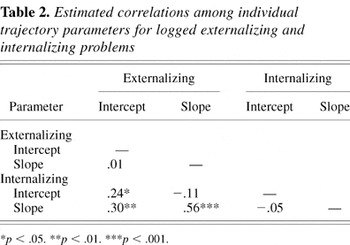
Estimated correlations among individual trajectory parameters for logged externalizing and internalizing problems
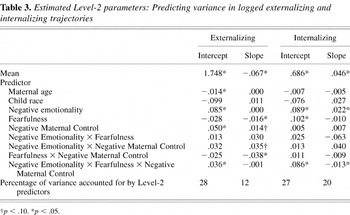
Estimated Level-2 parameters: Predicting variance in logged externalizing and internalizing trajectories
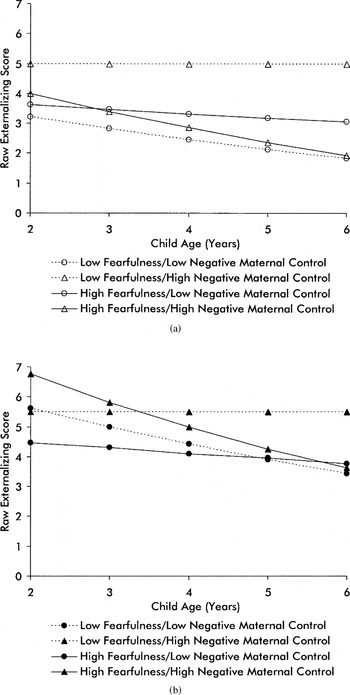
(a) The fitted trajectories of externalizing problems based on the combination of low negative emotionality (1 SD below the sample mean) and high or low fearfulness and negative maternal control (each variable 1 SD above or below the sample mean). (b) Fitted trajectories of externalizing problems based on the combination of high negative emotionality (1 SD above the sample mean) and high or low fearfulness and negative maternal control (each variable 1 SD above or below the sample mean).
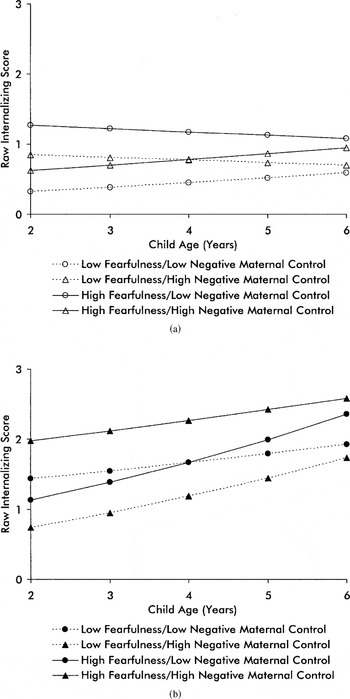
(a) Fitted trajectories of internalizing problems based on the combination of low negative emotionality (1 SD below the sample mean) and high or low fearfulness and negative maternal control (each variable 1 SD above or below the sample mean). (b) Fitted trajectories of internalizing problems based on the combination of high negative emotionality (1 SD above the sample mean) and high or low fearfulness and negative maternal control (each variable 1 SD above or below the sample mean).
 You have
Access
- 331
- Cited by