What is, or was, A history of the world in 100 objects? This may seem a strange opening question, as reviewers generally set out with at least a clear idea of what they have been asked to review. Usually in academic history publishing it is a book, and most often it is also one that the reviewer would rather like to own. However, the core of the History of the world project was a radio programme – at least, this was how it was principally billed during 2010 – and this is what I was initially asked to review: a year-long series of 100 fifteen-minute programmes, to be broadcast throughout 2010 on BBC Radio 4. A history of the world in 100 objects was intended to tell a narrative world history, from prehistory to the present, through 100 objects chosen from among the collections of the British Museum. Academic reviews in history rarely venture beyond traditional printed outputs and I was immediately intrigued by this project and the opportunity to review it.
But A history of the world turned out to be far more than just a radio programme. It was conceived from the start as a project that would operate across different media: in media terminology A history of the world is ‘multi-platform programming’. Alongside the core radio programmes and the website, which also carried the programme podcasts, the project also had a strong participatory dimension. It was associated with a ‘nationwide distributed programme of activity working with partner museums across the UK’Footnote 1 and provided an online resource where partner museums and the public uploaded and commented upon their own objects. As Neil MacGregor, the director of the British Museum, said, ‘Thanks to the incomparable reach of the BBC – radio, television, World Service and web – as the series develops, everybody across the UK and across the world will be able to participate, using not just the things in museums, but their own objects as well, to tell their history of the world.’Footnote 2 A constellation of tie-ins with regional TV and radio extended the world history agenda to every corner of the country; there was even a linked children’s programme on CBBC and a special edition of the Antiques Roadshow. Ensuring that one could not possibly miss, or perhaps escape, A history of the world, a weekly omnibus edition was also broadcast on the BBC World Service. There is also now a book of the series. The review at hand had suddenly mushroomed alarmingly!
While it might have been far simpler to review only the radio programmes or perhaps the final book, to do so would have been to artificially truncate a project that was deliberately complex, multi-centred, original, and ambitious. The multi-platform programme that is A history of the world raises as many questions about public history in the UK and the role of museums in this enterprise, as it does about world history as a subject, its ‘canon’, and its traditional sources. Both angles deserve attention and this review will engage with both. Before doing so, however, I will summarize the core approaches and contents of the project in more detail.
A history of the world explored human history from the very origins of modern-day humans in Africa through to the present – an impressive span of over two million years. Whilst presented chronologically and in a largely narrative mode, these two million years were structured into twenty thematic programmes, each focused around five objects. Every theme – from ‘Making us human, 2,000,000–9,000 bc’ to the final ‘The world of our making, ad 1914–2010’ – examined key phases or turning points in humanity’s political, social, economic, cultural, and religious history. Well-known objects from the British Museum’s collections – such as the Rosetta stone, the Ife bronzes, and the Elgin marbles – were included, but by far the majority of objects were not ‘iconic’ pieces.
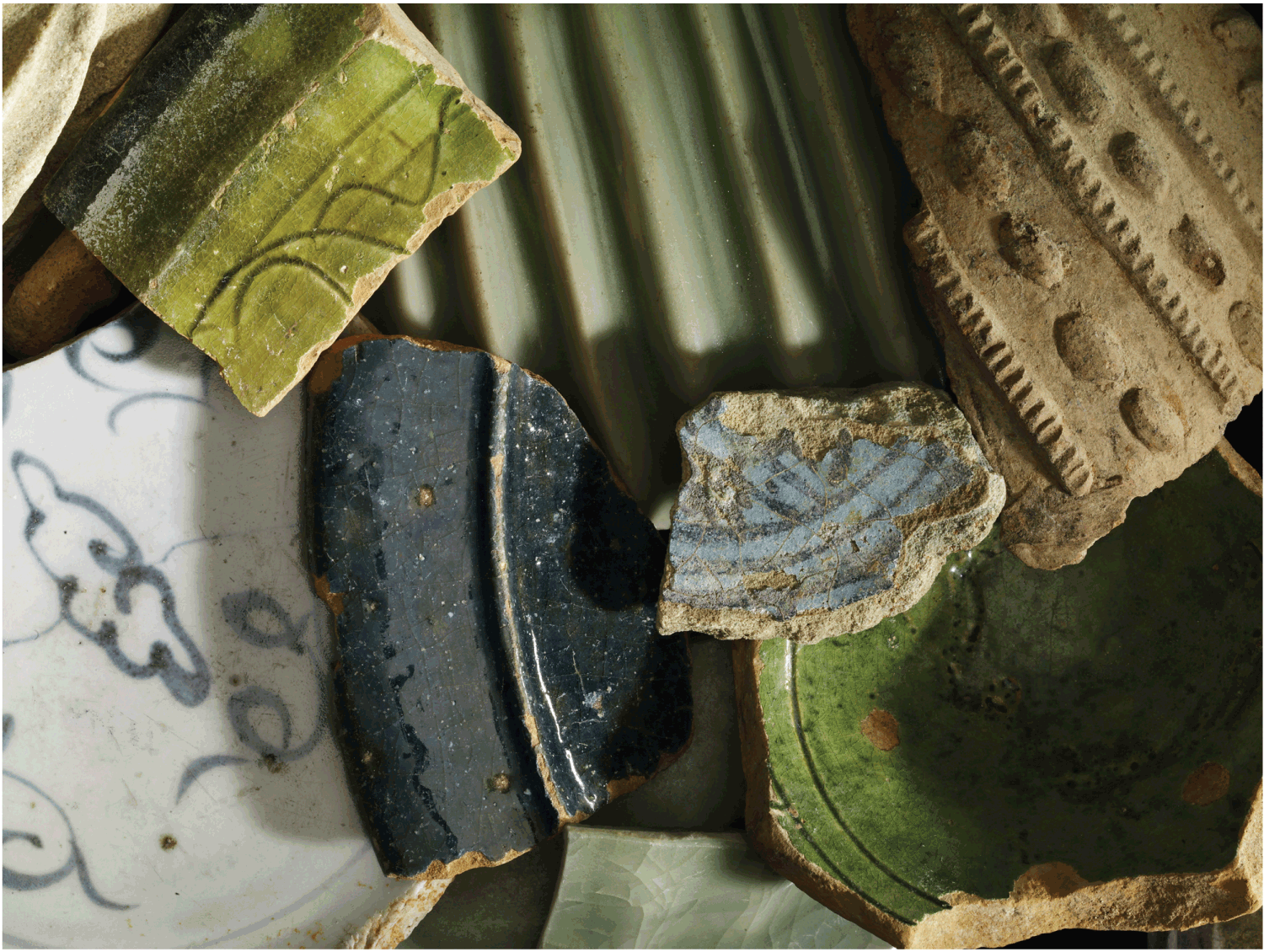
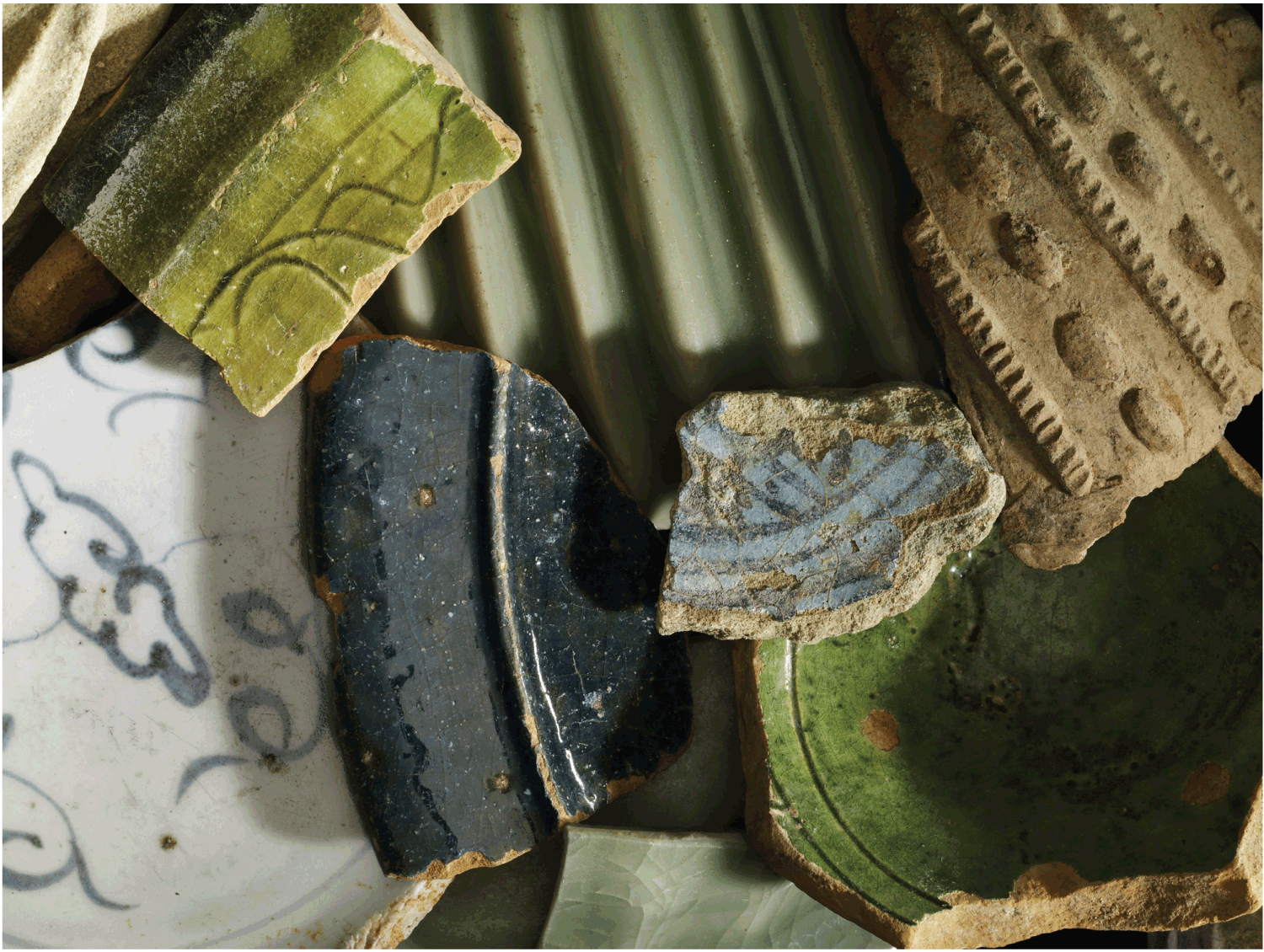
Object 60 – in fact a collection of ceramic fragments or sherds (Figure 1), from the port of Kilwa in east Africa and ranging in date between 900 and 1400 ce – illustrates the way in which ‘things’ centred and enriched this world history narrative. The Kilwa sherds were one of five objects selected for the theme of ‘Pilgrims, raiders and traders, ad 800–1300’, which focused on the development of Eurasian and African trade and cultural exchange during the medieval period. They represent exactly the type of material source that most historians have difficulty engaging with – these are not art objects but, in the words of Neil MacGregor himself, ‘broken pots and plates … the crockery of everyday life’.Footnote 3 Along with the utensils, coins, seals, and other mundane artefacts included among the 100 objects, the Kilwa sherds highlighted the range of material sources for history and refreshingly counterbalanced the high art so often selected when artefacts are used in history. The programme also made the point that its very indestructibility makes pottery one of the fundamental building blocks of archaeology, a faithful witness to trade and cultural contacts when the many more ephemeral or fragile items that accompanied them have simply vanished from the material record. The findspot of these sherds, the beach at Kilwa Kisiwani island, also allowed for a reflection on the fundamentally landlocked perspective of so much history: here instead was evidence for sea-centred worlds where global connections took place astoundingly early. The programme went on to situate Kilwa within the wider trade networks and rhythms of the Indian Ocean, mingling historical descriptions, contemporary recollections, and the results of the study of the sherds themselves. Here, in a handful of broken pots, are fragments of Chinese export celadons, glazed and unglazed ceramics from Iraq or Syria, Oman, and the Gulf, and local African cooking pots. The programme concluded with a reflection on the fundamentally hybrid character of Swahili society, its cosmopolitan connections, and its African core. As this example illustrates, the fifteen minutes allotted to each radio broadcast, which translated into roughly 2,000 words per object in the final book, allowed for a thoughtful and multifaceted exploration of each object and its place in the week’s overarching theme.
Kilwa sherds, 900–1400 ce. Reproduced courtesy of the Trustees of the British Museum.
Although the series was fronted by Neil MacGregor as director of the museum and included ‘guest appearances’ from a number of public figures, it is clear that the selection of the themes and objects, as well as the research behind each individual object, built upon the expertise of the museum’s many curators and scientific conservators. Hidden in the acknowledgements at the back of the book we find due recognition of the fact that ‘the series and this book … are in fact the work of many hands … in every sense a team effort’.Footnote 4 This collaborative effort has produced an accessible yet authoritative and research-grounded world history narrative.
Remarkably, A history of the world stands as the UK’s first overt foray into public world history. While world history has been a key approach in high school and university teaching in the United States since its emergence in the 1980s, beyond a few university programmes Britain has been remarkably slow to explore its potential, let alone adopt it wholeheartedly. The format was therefore not only ambitious but radical in a UK context, and all the more so given that this world history would be centred around objects rather than the more usual range of historical sources. As a museum-led project, this focus on objects was almost inevitable and indeed played beautifully to the British Museum’s truly world encompassing collections of ‘things’. However, the focus on objects also promoted a genuinely rounded and multi-centred world history. Disjunctures between prehistory and history or literate and non-literate societies dissolve markedly when objects rather than texts and writing become the key historical source; historical questions such as food and diet, dress and adornment, can all be explored extremely successfully through ‘things’. This focus on objects as sources for history also chimes with a marked ‘material turn’ in many areas of the humanities and social sciences over recent years, which has generated much innovative thinking about the ways in which ‘things’ and history, in its broadest sense, interrelate.
There can be no doubts about A history of the world’s success; the audience and participation figures speak for themselves. RAJAR (the official body in charge of measuring radio audiences in the UK) recorded an average of 3.958 million adults listening to the slots each week during the first quarter of 2010,Footnote 5 an exceptional figure for a cultural programme on radio. Although Radio 4’s audience demographic is traditionally middle class and middle aged, the multi-platform nature of the project, linked local initiatives, and schools outreach programme broadened this considerably, and by the end of 2010 there were 450 partner museums in the UK.Footnote 6 One might argue that this was a project that was bound to find a willing UK audience; the British public’s hunger for ‘history’ in its many expressions, and the regular servings of history, art history, conservation, and especially archaeology programming produced to satisfy this, has been debated by cultural historians.Footnote 7 However, this was also a discerning audience and not all the History of the world’s platforms thrived: its online blog never really took off and its Facebook group only ever managed a sad 5,000 or so members; as I don’t Tweet I cannot comment on the success of this platform but I suspect that it was similarly subdued. The relative failure of these platforms may be a reflection of the mean age range of those who finally engaged with the project. Nevertheless, these small failures cannot dull the project’s phenomenal world success: at the conclusion of the live radio broadcasts in 2010 over 5,456,000 people globally had downloaded the History of the world podcasts and the number is surely much higher by now.Footnote 8 A final total of 550 British museums engaged with the project, and in June 2011 the British Museum won the Art Fund’s Museum of the Year award in recognition of the History of the world project. If much public history programming in the UK might be argued to be more or less overtly nation-centred, the success of such a decidedly multi-centred project suggests a growing public interest in the deep history of global connections and the relationships between local and global.
There is no doubt in my mind that A history of the world in 100 objects has been the most ambitious, and arguably the cleverest, exercise in public engagement and education ever undertaken by a museum, and not simply in the UK. As many mainstream press reviews have commented, this project has done the British Museum a great deal of good: it has raised the museum’s national and international profile and has provided new platforms from which it can communicate its institutional mission afresh to completely new audiences. A history of the world has also refreshed a museum image too often burdened by tired accusations about the manner in which certain parts of its collection were acquired. The final three objects selected – Kester’s 2001 ‘Throne of weapons’ sculpture from Mozambique, a 2009 Visa credit card issued in the UAE, and a 2010 solar-powered lamp and charger manufactured in China – blew away any lingering perceptions of the British Museum as a place that only collects and curates ‘old things’. But A history of the world has not been a selfish exercise: in the course of fulfilling the museum’s public service remit it has also done a far wider service to the arts and to the beleaguered discipline of history. Simply put, it has made lots of people, of very diverse ages and backgrounds and in many countries, interested in world history and interested in ‘things’ as historical sources.
No less important is the political context against which A history of the world was broadcast. The project has coincided with a period of radical cuts and marketization in higher education and the arts in the United Kingdom: broadcasts began in the months running up to the May 2010 general election and continued into the autumn of that year, against the backdrop of the much-feared ‘comprehensive spending review’ and its aftermath. In universities and research institutions across the country we were all coming to terms with the new need to assess and measure the ‘impact’ of our research beyond academia. With serendipitous good timing – surely beyond even the planning capabilities of the canny British Museum – A history of the world spoke impartially, and on an almost daily basis, for the value of the arts and history in Britain, and proved the impact of its research through the participation figures. As pointed out in a recent article on the state of history teaching in Britain, unlike American historians, for whom the American Historical Association unites both university and high-school history teachers, British historians lack a single professional voice: ‘There is no single body that represents the discipline as a whole to the government or engages in systematic mapping and analysis of professional trends and patterns.’Footnote 9 In this vacuum, the British Museum played an unlikely role in speaking out for history – and not simply history but world history. The museum’s world history through ‘things’ contrasted markedly with another multi-platform project broadcast during the first quarter of 2010 – David Dimbleby’s The seven ages of Britain, a history of Britain over the last two millennia through its ‘things’. Together the two programmes encapsulate a debate that is now at the foreground of British educational policy: will Britain teach a narrowly defined national history, which is essentially a ‘modern island story of Britain’, as favoured by Secretary of State for Education Michael Gove, or will world history models win the day, focusing on local–global relationships and global connections.Footnote 10
In a project of this scale and diversity – a project in many ways so experimental – there are obviously things that worked better than others. The online resource, handled by the BBC rather than the British Museum, was initially confusing and far from intuitive, but is now substantially improved – fortunately so, as for the moment it constitutes the main public, truly free, legacy of the project. What I have also found remarkable during the process of following this project for review is the extent to which it has changed substantially over the course of its lifetime. The decision to develop radio programmes as the spine of the project, rather than the more obvious television format, was initially controversial. How can we discuss objects without seeing them? While Neil MacGregor’s answer was to argue that ‘to imagine a thing is to appropriate it in a very special way’,Footnote 11 here again time has resolved the problem as the online resource now presents images of each object before one actually progresses to the programmes, which can either be listened to as podcasts or read as scripts. The book of the project also associates text and image directly and clearly. Although the British Museum still refers to the radio programmes as the spine of the project, there is no doubt that the online resource and book have now taken their place and have thereby resolved the previously problematic relationship between the audio content and the objects.
Future multi-platform initiatives will undoubtedly face the same issues and will perhaps benefit from new technologies. The study of material culture has long suffered from the many obstacles that exist to the actual physical handling of objects – problems of access, of object fragility, and of the wear that handling causes. We are so used to using images to represent objects that we often forget how these, too, fail to communicate so many fundamental, non-visual qualities. Objects have qualities of heft, texture, shape, sound, movement, and even temperature that are entirely lost in images, and even in a visit to the museum case where they are on display. From this perspective we might well agree with Neil MacGregor that imagining an object is ultimately as satisfying and effective as ‘only’ seeing it, but as new 3D technologies and haptic software develop, we might also look forward to much more rounded sensory engagements with objects via online resources.
The History of the world project has clearly raised questions that will form and challenge future multi-platform initiatives in the arts and humanities.Footnote 12 How exactly should such multi-platform projects work – should they engage audiences across platforms, or does each platform attract substantially different audiences and is there such a thing as too much History of the world? How is the collaborative authorship of such projects acknowledged, or not? It seems to be simultaneously a danger and a great virtue of these projects that they are multi-centred and evolutionary, and therefore in a constant state of tension between coherence and fragmentation.
A history of the world in 100 objects stopped broadcasting in October 2010 but the concept is set to return in 2012 as part of the Cultural Olympiad when ‘the British Museum and a number of other museums will present … substantial “histories of the world” as exhibitions from their own collections’.Footnote 13 The wider English-speaking world will also be drawn into world history as the BBC, in partnership with Discovery Channel US, the Open University, and BBC Worldwide, produces History of the world, an eight-part television series that will tell the ‘epic story of human history’. Whether you think that this is a case of over-milking a good idea or not, A history of the world is set to return decisively at a global level. Who knows what political and cultural contexts it will enter by then, but perhaps its return will provide a good opportunity for historians to pick up the important debate about the history curriculum and the future role of history.