Implications
Selection practices carried out to develop fast-growing and high breast-yield hybrids resulted in growth-related alterations affecting the pectoral muscles of both turkeys and broilers. Although several studies recently evaluated the impact of white striping (WS) on quality and technological properties of broiler meat, only early and limited information (concerning muscle histology and histochemistry) are available on turkeys. Thus, considering the economic losses resulting from downgrading of abnormal meats, there is the need to deepen the current knowledge on the similar muscle abnormalities occurring in commercial turkey hybrids and understand to which extent WS affects the quality of the resulting meat.
Introduction
In the poultry industry, intense selection programmes have been carried out for decades in order to obtain high growth rate and breast yield meat-type chickens and turkeys (Havenstein et al., Reference Havenstein, Ferket, Grimes, Qureshi and Nestor2007; Petracci et al., Reference Petracci, Mudalal, Soglia and Cavani2015). In this context, the growth performances of broilers and turkeys were remarkably improved by modifying muscle morphology and biochemistry as well as modulating muscular development rates (Hocking, Reference Hocking2014; Velleman, Reference Velleman2015). However, selection for increased growth rate led to profound modification of the normal physiology and, affecting the musculoskeletal system, resulted in the occurrence of muscle fibre defects (Velleman et al., Reference Velleman and Clark2003; Hocking, Reference Hocking2014; Velleman, Reference Velleman2015).
Among the well-known muscle abnormalities, the pale, soft and exudative-like condition and the deep pectoral myopathy have been observed and extensively studied in the past in turkeys (Siller and Wight, Reference Siller and Wight1979; Strasburg and Chiang, Reference Strasburg and Chiang2009). In addition, the occurrence of leg weakness and oedema syndrome as well as focal myopathy was observed in turkey skeletal muscles and associated to fast-growing hybrids (Sosnicki et al., Reference Sosnicki, Cassens, McIntyre and Vimini1988; Ferket and Sell, Reference Ferket and Sell1989; Wilson, Reference Wilson1990; Sosnicki and Wilson, Reference Sosnicki and Wilson1991; Hocking, Reference Hocking2014). On the other hand, more recently, a group of growth-related abnormalities (i.e. WS, wooden breast and spaghetti meat) appeared in broilers (Petracci et al., Reference Petracci, Mudalal, Soglia and Cavani2015; Kuttappan et al., Reference Kuttappan, Hargis and Owens2016). In detail, the muscles affected by these defects macroscopically exhibit the appearance of white striations of variable thickness parallel to the muscle fibres direction (WS), an overall toughening coupled with the presence of out-bulging areas with pale colour (wooden breast) and the tendency towards the separation of the fibre bundles composing the muscle tissue itself (spaghetti meat) (Kuttappan et al., Reference Kuttappan, Hargis and Owens2016; Petracci et al., Reference Petracci, Soglia and Berri2017). Irrespective of the abnormality, similar histological alterations including profound degenerative myopathic lesions (myofibres degeneration and necrosis) and occasional regenerative processes were observed with a consequent complete reorganisation of the muscle architecture involving the proliferation of connective tissue and increased fat deposition (Sihvo et al., Reference Sihvo, Immonen and Puolanne2014; Velleman and Clark, Reference Velleman, Anderson, Coy and Nestor2015; Baldi et al., Reference Baldi, Soglia, Mazzoni, Sirri, Canonico, Babini, Laghi, Cavani and Petracci2017). Interestingly, in the past, gross and microscopic examinations of marketable turkeys revealed the occurrence of an overall toughening of the Pectoralis major muscles (Grey et al., Reference Grey, Griffiths, Jones and Robinson1986) (similar to wooden breast), the presence of several degenerative features such as focal necrosis, fragmentation along the longitudinal axis of the fibre as well as proliferation of connective tissue and fat infiltration within the endomysial and perymisial spaces (Sosnicki et al., Reference Sosnicki, Cassens, Vimini and Greaser1991). Intriguingly, although not defined with specific terms, these degenerative changes, remarkably affecting the quality of turkey breast meat (Dutson and Carter, Reference Dutson and Carter1985; Grey et al., Reference Grey, Griffiths, Jones and Robinson1986), overlap with those currently observed in broilers (Petracci et al., Reference Petracci, Soglia and Berri2017).
In this context, although the presence of white striations on the superficial layer (especially within the cranial portion) of the Pectoralis major muscle belonging to male heavy turkey hybrids has been observed since several years, it was not considered as a main quality issue by the poultry industry (personnel communication). Indeed, to the contrary of previous observations on broilers (Kuttappan et al., Reference Kuttappan, Lee, Erf, Meullenet, McKee and Owens2012), the occurrence of white striations on turkey breast meat seems not to impair consumers’ perception as the breasts belonging from heavy male turkeys are not usually sold as whole cut-up because of their size, but mainly used for manufacturing sliced (unprocessed, raw) and ready-to-eat products as well as ready meals (Remignon, Reference Remignon2004). Within this context, although several studies have been performed in order to investigate the effect of WS on quality traits of broiler meat, as recently reviewed by Petracci et al. (Reference Petracci, Mudalal, Soglia and Cavani2015 and Reference Petracci, Soglia and Berri2017), there is a lack of information concerning its impact on the main quality characteristics of the meat currently produced by the turkey industry. Thus, aiming at deepening the current knowledge concerning the WS abnormality, this study evaluated whether the occurrence of WS on Pectoralis major muscles of heavy male turkeys affects the quality traits and technological properties of meat to the same extent previously observed for broilers.
Material and methods
Sample collection
The investigation was performed in two separate trials on two flocks of heavy male turkeys (BUT BIG 6) reared and slaughtered under commercial conditions according to the Italian and European law for turkey production. Birds were fed ad libitum during the whole growing period using a feeding plan of six phases, depending on the age of the birds. The main feeding ingredients were wheat, soy and corn. In the diet, energy density (11.7 to 13.2 MJ/kg) was increased continuously, while protein (27% to 16%), calcium (1.4% to 0.7%) and phosphorus (0.7% to 0.4%) levels were progressively decreased according to the breeding company recommendations (Aviagen, 2015). Temperature was gradually decreased from 32°C to 18°C on 4 weeks and was kept constant thereafter. The lighting programme was 23L : 1D in the first week and 18L : 6D from 2 weeks to slaughter. Both flocks were processed at 137 days of age in the same commercial abattoir when reaching the most common slaughter weight of 20 kg used in the EU for heavy male turkeys (Remignon, Reference Remignon2004). At abattoir, birds were exposed to carbon dioxide for stunning, bled for 180 s and then, after being conveyed through scalding tanks (52°C for 180 s), plucked by rotating rubber fingers. After evisceration, carcasses were air-chilled passing through a two-step cold-air flow tunnel for 12 h (until reaching 2°C to 3°C at the core), breasts were deboned and cold stored until 48 h postmortem. For our purposes, a total of 72 boneless and skinless Pectoralis major muscles were selected 48 h postmortem and classified into the following three experimental groups (12 samples/group per trial):
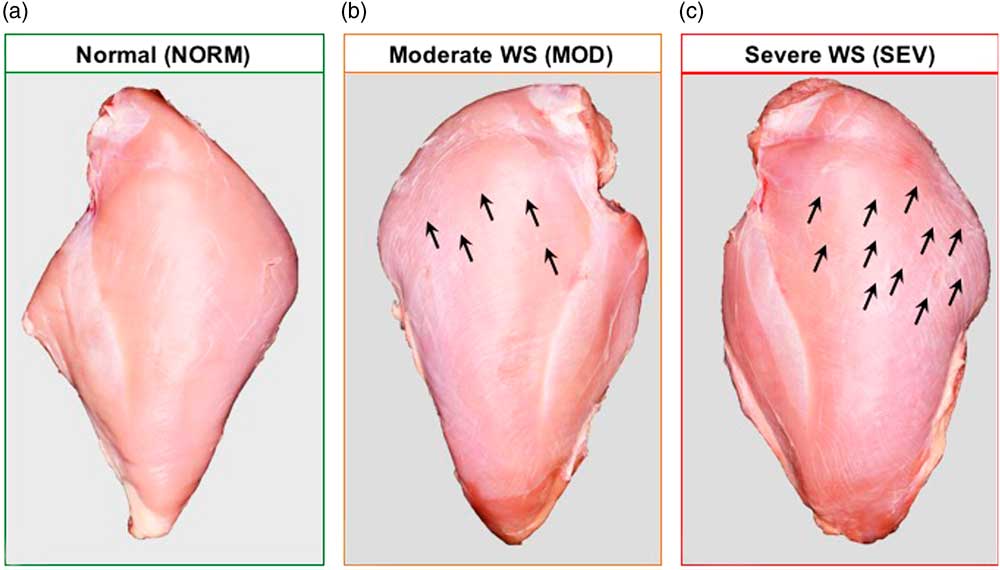
∙ Normal (NORM): macroscopically normal muscles exhibiting neither white striations nor any other defects;
∙ Moderate white striping (MOD): thin (up to 1-mm) white striations within the cranial part of the Pectoralis major muscle;
∙ Severe white striping (SEV): medium-to-thick (from 1 to a few mm) white striations within the cranial part of the Pectoralis major muscle.
Moderate and severe white-striped samples were identified according to the thickness of the white striations observed within the superficial layer of ventral surface of the pectoral muscles as clearly showed in Figure 1 (more close up images of normal, moderate and severe white-striped Pectoralis major muscles are provided in Supplementary Material S1). In addition, in order to avoid any interference, muscles contextually affected by other defects (i.e. haemorrhages, toughening, paleness, etc.) were not considered within this study.
Representative Pectoralis major muscles exhibiting (a) macroscopically normal appearance (normal=NORM, neither white striations nor any other defects), (b) moderate white striping (MOD WS) thin (up to 1 mm) white striations within the cranial part of the muscle and (c) severe white striping (SEV WS) medium-to-thick (from 1 to a few mm) white striations within the cranial part of the muscle.

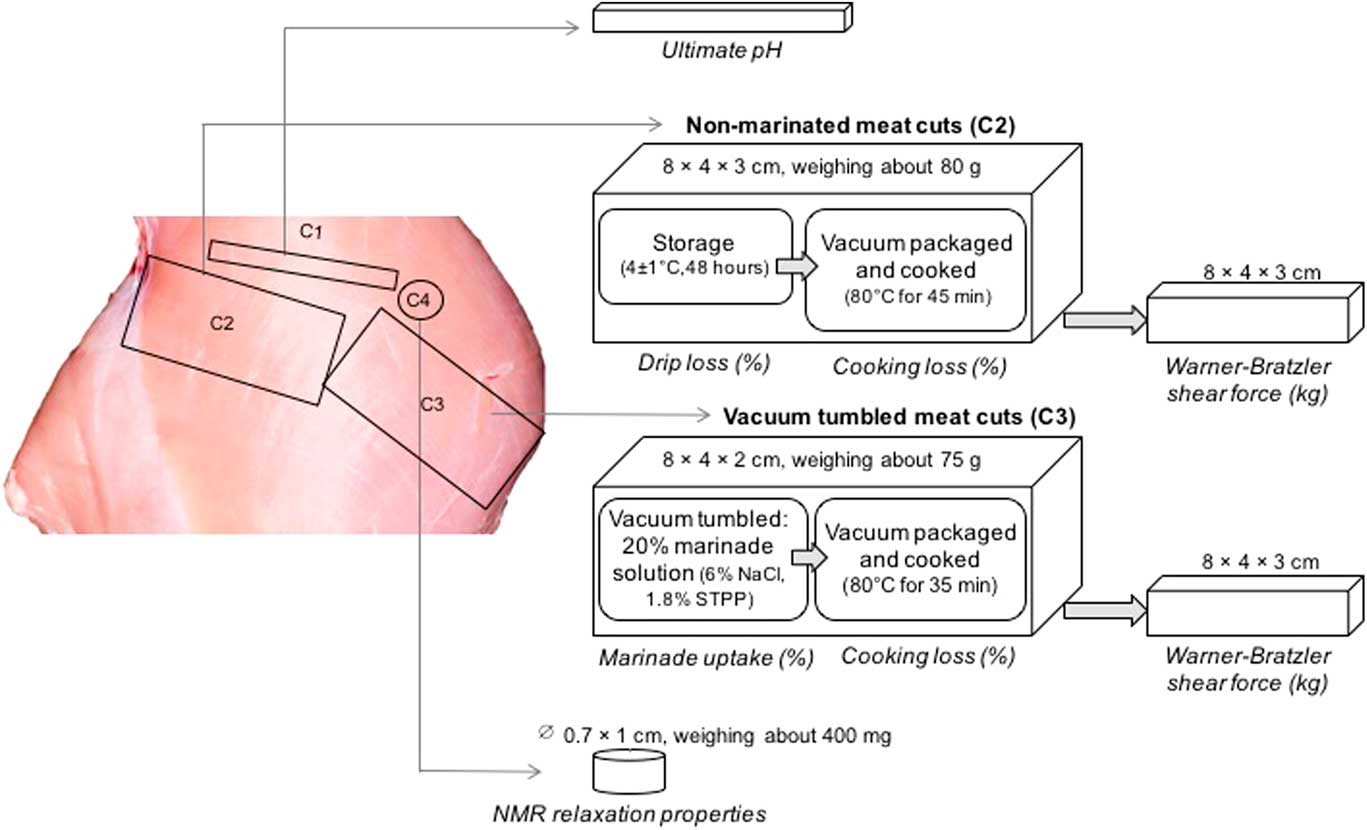
The samples were packed by group (12 Pectoralis major muscles/group/trial) and transported under refrigerated conditions to the laboratory. After trimming from visible fat, cartilage and connective tissues the Pectoralis major muscles were weighed and cut in order to assess colour (CIE, lightness (L*), redness (a*), yellowness (b*)) measured in triplicate on the bone-side surface of the cranial portion of the muscle with a Chroma Meter CR-400 (Minolta Corp., Milan, Italy), ultimate pH (C1), water holding and binding capacities (C2 and C3), NMR relaxation properties (C4) and textural traits (C2 and C3) according to the sampling procedures displayed in Figure 2.
Sampling procedure adopted in order to assess ultimate pH (C1), water holding/binding capacities (C2 and C3), NMR relaxation properties (C4) and textural traits (C2 and C3) of turkey breast meat.

A first subsample (C1) was excised from the cranial portion of the muscle and used to assess ultimate pH following the iodoacetate method proposed by Jeacocke (Reference Jeacocke1977). Then, quality traits of non-marinated meat (drip loss, cooking loss and Warner–Bratzler shear force) were evaluated in a parallelepiped meat cut (C2, 8×4×3 cm, weighing about 80 g) whereas another subsample (C3, 8×4×2 cm, weighing about 75 g) was excised and used to determine the main quality traits of marinated breast meat (marinade uptake, cooking loss and Warner–Bratzler shear force). In order to avoid any interference given by the sampling position, both subsamples C2 and C3 were excised from the cranial portion of each Pectoralis major muscles. In addition, NMR relaxation properties (relative intensity and transverse relaxation time) and proximate composition (moisture, protein, lipid, ash and collagen) were assessed on meat subsamples belonging from the same portion of the muscle.
Meat quality measurements
According to previous procedures adopted in a similar study conducted on broiler breast meat (Mudalal et al., Reference Mudalal, Lorenzi, Soglia, Cavani and Petracci2015), parallelepiped meat cuts (C2) were placed in covered plastic boxes over sieved plastic racks and stored for 48 h at 4±1°C in order to assess drip loss. Subsequently, the C2 cuts were individually packaged under vacuum and cooked in a water bath at 80°C for 45 min (80°C at the core thus avoiding any temperature gradient between the inner and the outer portion of the samples). Concurrently, after being individually labelled the C3 meat samples were vacuum tumbled by using a small-scale vacuum tumbler (model MGH-20; Vakona Qualitat, Lienen, Germany) with a 20% (wt/wt) aqueous solution containing sodium tripolyphosphate (1.8%) and sodium chloride (6.0%). The samples were then weighed (in order to estimate marinade uptake), individually packaged under vacuum and cooked (80°C, 25 min) in order to calculate cooking losses. After that, shear force was assessed on both non-marinated and marinated meat on a parallelepiped meat cut (4×2×1 cm) by using a TA.HDi heavy duty texture analyser (Stable Micro Systems Ltd., Godalming, Surrey, UK) equipped with a 25 kg loading cell and a Warner–Bratzler shear blade.
Proximate composition of normal and white-striped muscles was assessed following standard methods. In detail, moisture and ash contents were calculated as the percentage of weight lost after drying (105°C, 16 h) and incinerating (525°C, 4 h) a 5-g meat sample, respectively, according to the methods proposed by the standard Association of Official Analytical Chemists. Crude proteins were determined according to the Kjeldahl method from the amount of ammonia ions neutralized by sodium hydroxide whereas lipids extracted and quantified following the Folch chloroform-methanol extraction procedure. At last, being strictly related to total collagen content, the exact quantity of hydroxyproline was spectrophotometrically determined through the colorimetric method proposed by Kolar (Reference Kolar1990).
Proton transverse relaxation decay curves were recorded at the operating frequency of 20 MHz, with a Bruker (Milan, Italy) Minispec PC/20 spectrometer using a Carr–Purcell–Meiboon–Gill (CPMG) pulse sequence (Petracci et al., Reference Petracci, Laghi, Rocculi, Rimini, Panarese, Cremonini and Cavani2012). The C4 samples weighing about 400 mg did not exceed the active region of the radio frequency coil. All the measurements were performed at a constant temperature of 24°C. The CPMG decays were normalized considering the sample weight and converted into relaxograms (i.e. continuous distributions of relaxation times) through the programme UPEN (Borgia et al., Reference Borgia, Brown and Fantazzini1998). Each relaxogram was then interpreted in terms of bound, intra- and extra-myofibrillar proton pools and fit to the sum of three exponential curves (Petracci et al., Reference Petracci, Laghi, Rocculi, Rimini, Panarese, Cremonini and Cavani2012).
Statistical analysis
Data were analysed using the two-way ANOVA option of the GLM procedure by in SAS software (SAS Institute Inc., Cary, NC, USA) considering meat abnormality (NORM, MOD and SEV) and replication as main effects as well as interaction term. Then, means were separated by Tukey’s HSD test at a level of P<0.05.
Results and discussion
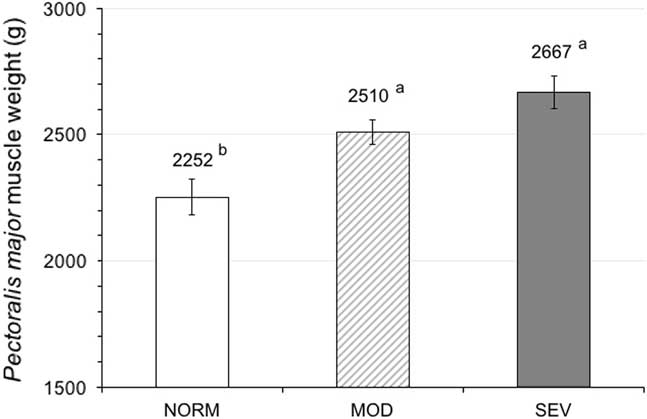
This study aimed at evaluating the impact of the WS abnormality affecting turkey Pectoralis major muscles with different levels of severity on quality traits of non-marinated and marinated meat. The results for breast size evidenced that, if compared with their NORM counterpart, MOD and SEV muscles exhibited remarkably higher weights (2252 v. 2510 and 2667 g, respectively; P<0.001) (Figure 3). This finding corroborates the hypothesis of a growth-related origin for the appearance of white striations on the surface of Pectoralis major muscle that frequently were found to affect high growth rate and BW birds. The 20% increased Pectoralis major weight observed for WS muscles (both moderate and severe cases) is consistent with recent studies performed on fast-growing broilers (Kuttappan et al., Reference Kuttappan, Lee, Erf, Meullenet, McKee and Owens2012; Mudalal et al., Reference Mudalal, Lorenzi, Soglia, Cavani and Petracci2015; Baldi et al., Reference Baldi, Soglia, Mazzoni, Sirri, Canonico, Babini, Laghi, Cavani and Petracci2017). Analogously, in the past, an association between muscle degeneration and growth rate of the birds was hypothesised in turkeys with the most rapidly growing hybrids being more severely affected cases (Wilson, Reference Wilson1990). Interestingly, this association between breast muscle development, slaughter age and the occurrence of muscular abnormalities demonstrated in turkeys (Wilson, Reference Wilson1990; Velleman et al., Reference Velleman and Clark2003) was recently confirmed in broiler chickens (Velleman and Clark, Reference Velleman, Anderson, Coy and Nestor2015; Kuttappan et al., Reference Kuttappan, Owens, Coon, Hargis and Vazquez-Anon2017). In this context, it should be pointed out that this study dealt with heavy male turkeys that, being slaughtered at 20 kg of live weight and having a pronounced development of the pectoral muscles, represent the commercial category more prone to undergo meat quality problems in comparison with both light hybrids and females that are commonly slaughtered about 10 weeks of age earlier (Remignon, Reference Remignon2004; Werner et al., Reference Werner, Riegel and Wicke2008).
Pectoralis major muscle weight as affected by the occurrence of WS abnormality with different levels of severity (normal=NORM, moderate=MOD and severe=SEV). Error bars indicate standard error of means. n=72 (24 samples/group). a,bMean values followed by different superscript letters significantly differ among the groups (P<0.05).

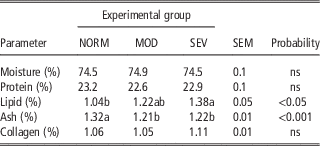
Furthermore, the occurrence of WS abnormality only partially affected the proximate composition of the meat (Table 1). Indeed, both lipid and ash contents were significantly modified within the white-striped (both MOD and SEV) groups. In detail, if compared with NORM muscles, SEV exhibited higher lipid content (1.04% v. 1.38%; P<0.01), whereas the MOD ones had intermediate values. On the other hand, irrespective of the severity of the WS abnormality, both MOD and SEV cases exhibited remarkably lower ash content in comparison with NORM (1.21% and 1.22% v. 1.32%; P<0.001). Eventually, no significant differences were observed for moisture, collagen and protein among the groups.
Effect of white striping abnormality affecting turkeys Pectoralis major muscles with different levels of severity (normal (NORM),moderate (MOD) and severe (SEV)) on proximate composition of meat

n=72 (24 samples/group).
a,b=P<0.05.
These findings were partly in agreement with the results of previous studies performed on white-striped broiler breast meat (Kuttappan et al., Reference Kuttappan, Lee, Erf, Meullenet, McKee and Owens2012; Petracci et al., Reference Petracci, Mudalal, Babini and Cavani2014). In detail, the complete reorganisation of the skeletal muscle tissue (observed microscopically) involving the proliferation of connective tissue and fat infiltration contributed to explain the different proximate composition of meat (Kuttappan et al., Reference Kuttappan, Brewer, Apple, Waldroup and Owens2013; Baldi et al., Reference Baldi, Soglia, Mazzoni, Sirri, Canonico, Babini, Laghi, Cavani and Petracci2017). The occurrence of WS in turkeys here found resulted in a lower remarkable increased lipid content within the muscle tissue in comparison with that previously observed in broilers, also coupled with significantly higher moisture and collagen. On the other hand, because of the degenerative processes taking place within the muscle, white-striped broiler breast meat exhibited overall reduced protein and ash levels (Kuttappan et al., Reference Kuttappan, Lee, Erf, Meullenet, McKee and Owens2012; Petracci et al., Reference Petracci, Mudalal, Babini and Cavani2014). Thus, as WS only partially affected the proximate composition of turkey meat, it might be hypothesised that WS occurrence is not related to profound muscle fibre degeneration.
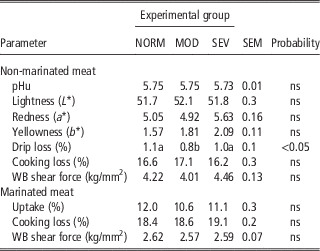
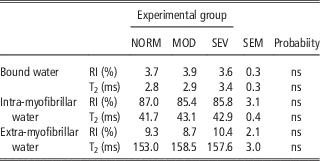
In addition, despite the variations in proximate composition, overall quality traits of raw (pH, colour, cooking losses and shear force) and marinated (uptake, cooking losses and shear force) meat were not affected by WS, with the only exception being the drip losses that significantly differed among the groups (Table 2). In detail, although the drip losses assessed on NORM and SEV muscles did not differ between each other (1.1% and 1.0%; P>0.05), the MOD cases exhibited lower (P<0.05) values (0.8%). However, by using an advanced analytical approach such as NMR, to investigate the water mobility within the muscle tissue, both the relative intensities and the T2 relaxation times recorded for each proton population did not differ among the experimental groups (Table 3). Thus, as no differences in the water mobility, cooking losses and marination performances were found between NORM and WS muscle tissues, overall, it appears that both water holding and binding capacities were not modified in WS turkey breast meat. These findings were unexpected as, aside from the occurrence of WS, heavier muscles belonging from modern poultry hybrids generally exhibited an increased cross-sectional area of their constituting fibres (Remignon et al., Reference Remignon, Zanusso, Albert and Babilé2000; Werner et al., Reference Werner, Riegel and Wicke2008) that, allowing for a lower packing density of the fibres themselves, negatively correlated with the water holding ability of meat (Updike et al., Reference Updike, Zerby, Sawdy, Lilburn, Kaletunc and Wick2005).
Effect of white striping abnormality affecting turkeys Pectoralis major muscles with different levels of severity (normal (NORM), moderate (MOD) and severe (SEV)) on quality traits of non-marinated and marinated meat

n=72 (24 samples/group).
a,b=P<0.05.
Effect of white striping abnormality affecting turkeys Pectoralis major muscles with different levels of severity (normal (NORM), moderate (MOD) and severe (SEV)) on relative intensity (RI) and T2 relaxation time of the three proton populations (ascribed to the bound, intra- and extra-myofibrillar water fractions) identified through nuclear magnetic resonance

n=72 (24 samples/group).
Generally speaking, the absence of adverse effects on breast meat quality resulting from the presence of white striations in turkeys, if compared with broilers, might be explained taking into account the difference in breast muscle morphology. Indeed, in broilers it was found a close association between breast thickness and yield (Scheuermann et al., Reference Scheuermann, Bilgili, Hess and Mulvaney2003) and a greater impact of Pectoralis major weight on muscle depth in respect with length and width dimensions (Brewer et al., Reference Brewer, Kuttappan, Emmert, Meullenet and Owens2012; Mudalal et al., Reference Mudalal, Lorenzi, Soglia, Cavani and Petracci2015). In addition, in a recent study, a cumulative logit mixed model was developed to understand the contribution of different growth parameters (such as Pectoralis major depth and yield) as predictors for the presence of degenerative changes typically associated with the occurrence of muscular abnormalities in broilers (Griffin et al., Reference Griffin, Moraes, Wick and Lilburn2017). According to these authors, the more the Pectoralis major depth and yield increase, the higher the likelihood to observe severe myopathic changes within the muscle tissue. Thus, the absence of adverse effects of WS on turkey meat quality might be attributed to an overall different specie-specific development of the pectoral muscles. Indeed, severe white-striped cases in broilers exhibited remarkable increased Pectoralis major depth measured in the cranial position whereas it is reasonable to hypothesise an overall and more harmonious muscle development in white-striped turkeys (associated to their higher slaughter age) that, being not barely restricted to the depth, might result in less pronounced myopathic changes within the muscle tissue.
Conclusions
The findings of the present study corroborate the hypothesis of a growth-related origin for the WS condition also in turkeys. Indeed, WS predominantly affects those heavy turkey hybrids exhibiting a more pronounced development of the pectoral muscles. However, the occurrence of white striations only partially affected the proximate composition (higher lipid and lower ash contents) of meat and therefore the main quality traits of both non-marinated and marinated meat were not altered. Thus, as in turkeys the quality traits and technological properties of the white-striped muscles were comparable to those of the unaffected cases, the downgrading of breast meat affected by WS can be avoided allowing to reduce the possible economic losses that are currently faced by the broiler industry. In this context, it should be considered that in the past decades both broilers and turkeys have been subjected to similar intense selection practices to develop high-growth rate hybrids. Therefore, as the occurrence of WS only marginally affected the quality traits of turkey meat, it seems reasonable to hypothesise a specie-specific physiological response towards the profound changes in muscle development resulting from genetic selection. Thus, further studies are needed in order to investigate the physiological and morphological features of turkeys Pectoralis major muscle and compare them with those of heavy broilers in order to properly explain the diverse effect of WS on meat quality traits.
Acknowledgement
The authors thank the Gesco Consorzio Cooperativo (Cesena, Italy), for supplying samples for this research.
Supplementary material
To view supplementary material for this article, please visit https://doi.org/10.1017/S1751731117003469