


Introduction
Propaganda is central to the stability of modern autocracies where power is not sustained by fear or ideology, but by skilfully convincing the public of the autocrat’s competence and popularity (Guriev and Treisman Reference Guriev and Treisman2022). The role of propaganda becomes especially prominent during autocratic elections when the need to produce favourable electoral results through genuine public mobilization to signal popularity is at its highest (Schulze and Zakharov Reference Schulze and Zakharov2025). Carter and Carter (Reference Carter and Carter2023) show that regular elections in autocracies not only increase the supply of propaganda before the voting day, generating electoral cycles, but also shift its objective towards persuasion and mobilization.Footnote 1 Yet, while often assumed, the persuasive power of electoral propaganda in autocracies has rarely been subjected to causal empirical tests. To our knowledge, the only two prominent studies in that area, Selb and Munzert (Reference Selb and Munzert2018) and Adena et al. (Reference Adena, Enikolopov, Petrova, Santarosa and Zhuravskaya2015), both focus on the historical case of Nazi Germany and arrive at conflicting results (as discussed in the Theoretical Framework section). The need to study modern cases becomes even more pressing as electoral propaganda evolves alongside the media environment. The proliferation of social media has prompted autocrats to expand their propaganda beyond traditional media into the digital domain (Bjola Reference Bjola2017; Kendall-Taylor et al. Reference Kendall-Taylor, Frantz and Wright2020; Keremoğlu and Weidmann Reference Keremoğlu and Weidmann2020; Rød and Weidmann Reference Rød and Weidmann2015), yet whether it can persuade social media users, who are more sceptical of the news media in general (Tsfati and Cappella Reference Tsfati and Cappella2003) and governmental information in particular (Tang and Huhe Reference Tang and Huhe2014; Ruijgrok Reference Ruijgrok2021), remains an open question.Footnote 2
To test the persuasiveness of electoral propaganda, both in general and conditional on media environments (traditional vs. social media), we conducted a field experiment during the 2018 presidential elections in Russia, a typical electoral autocracy where information control plays a central role in the survival of the regime (Frye Reference Frye2021; Guriev and Treisman Reference Guriev and Treisman2022).Footnote 3 Our empirical approach exploits an unanticipated attempt by the Russian regime to launch a viral video on the social media platforms VKontakte, Odnoklassniki, and YouTube on 8 March 2018, ten days before the elections. The video under the title ‘World Order 2018’ (‘Mиpoпopядoк 2018’), a documentary about Russian president Vladimir Putin’s role in world politics, was ‘leaked’ on social media by one of Russia’s leading propagandists, Vladimir Solovyov. Despite being advertised on Russian state TV, the video remained available exclusively on social media until after the elections, making it an ideal case study for examining the impact of electoral propaganda.Footnote 4 While the true motivation behind the video remains unclear, it is likely that it was an attempt to counter the highly successful investigative movie ‘Don’t Call Him Dimon’ produced by opposition leader Alexei Navalny and released on 2 March 2017, on YouTube.Footnote 5 Navalny’s video exposed the corruption and hidden wealth of Russian Prime Minister Dmitry Medvedev, gathering more than 7 million views in its first week and sparking nationwide political protests in the spring of 2017 (Dollbaum Reference Dollbaum2020; Glazunova Reference Glazunova2020; Glazunova Reference Glazunova2022).
The two videos are the main treatments of our experiment and we investigate their effect on voting and turnout. Shortly before the 2018 presidential elections, we conducted a telephone survey in six Russian provincial cities, asking respondents about their voting intentions. In the middle of the survey, we randomly promoted the pro-regime video among one-third of the respondents, while the anti-regime video was promoted among another third. After the survey, all treated respondents received an SMS with a YouTube link to the respective video, while the remaining respondents received no additional information, thus serving as a pure control group. In a follow-up wave after the elections, we asked all respondents about their actual voting behaviour as our primary outcome measure.
We find that, on average, promoting the pro-regime video did not change the likelihood of voting for Putin – a result that runs counter to the common preconception that propaganda in autocracies is all-powerful. The anti-regime treatment reduced votes for Putin by 9 percentage points, which is in line with the initial video causing mass protests in March 2017 and previous experimental evidence by Mironov and Petrachkova (Reference Mironov and Petrachkova2025), who find that anti-corruption messages can reduce voting for the incumbent in Russia.
We then differentiate between two categories of respondents: (1) respondents who normally consume news mostly from analogue (offline) media and, hence, are the typical target audience of pro-regime propaganda, with no or very limited access to anti-regime content; and (2) consumers of online news, who have the possibility to view opposition media, but who also became a potential target of the propaganda video due to its ‘leak’ to social media before the 2018 presidential elections. Studying the heterogeneous effects of our treatments across both types of respondents (offline and online news consumers) enables us to understand how the video performed among the traditional audience of Russian state propaganda and beyond.
Our results show that the pro-regime treatment was only effective among the traditional audience of offline news consumers, increasing self-reported voting for Putin by 15 percentage points. However, it had no effect for consumers of online news – the group for which it was de facto made available before the elections – suggesting that the reach of online propaganda campaigns in electoral autocracies remains limited.Footnote 6 The effect of promoting the opposition video was significant for both groups, reducing self-reported voting for Putin by 9 percentage points, indicating a similar salience of Navalny’s message for both audiences. In other words, our experimental setting is indicative of how much Navalny’s message might have resonated with the broader public had he been granted an equal playing field and access to state media.
Following recent developments in the literature, we then also account for initial beliefs, as they often play a key role in processing propaganda messages. For example, Shirikov (Reference Shirikov2024b) finds that Russian state propaganda reinforces regime support and builds trust through identity-consistent messages, but only among those who already support the regime, while it remains ineffective among regime opponents. Peisakhin and Rozenas (Reference Peisakhin and Rozenas2018) identify a similar effect for pro-Russian Ukrainians who watch Russian television, while among Ukrainians who are not pro-Russian, the message backfires.Footnote 7 The backlash effect, as we explain further in the theoretical section, might stem from a defensive cognitive process when new information conflicts with deeply held beliefs.
We test this prediction by including an interaction with regime satisfaction, which we measured prior to the treatment in our survey. We find that consumers of online news who were already unhappy with the government were less likely to report voting for Putin after receiving the pro-regime treatment, thus demonstrating how propaganda can backfire among an audience that is already sceptical.Footnote 8 However, pre-existing satisfaction did not play a big role for consumers of offline news. When looking at the opposition treatment, we find that all respondents initially satisfied with the government – regardless of their preferred source of news – were less likely to report voting for Putin after receiving the anti-regime treatment, while the video did not seem to affect respondents who were already unhappy with the government. This finding suggests that the Russian opposition was able to successfully target core supporters of the regime, denying frequent claims by the Russian authorities that Navalny’s movement did not have any real traction with the population.
Investigating the mechanism behind the effect of the treatment in the offline group, we show that respondents who were nudged to watch the pro-regime video were subsequently more likely to believe that Russia had a pre-eminent position in world politics or that its position had significantly improved over the six years prior to the survey, that is, the years 2012 to 2018. The video also increased perceptions that Russia was under threat from abroad (in line with the ‘besieged fortress’ belief; see, for example, Lipman Reference Lipman2015), but only for respondents dissatisfied with the government. We complete our experimental analysis with a series of robustness checks that confirm that our results are not driven by experimenter demand or social desirability bias and are unlikely to be spurious.
Considering the effectiveness of propaganda among consumers of traditional news sources and the prevalence of this group among the Russian public, we complement our experimental micro-evidence with an analysis of electoral outcomes across 177 major Russian cities. Addressing the endogeneity of propaganda consumption, we employ an instrumental variable strategy that exploits exogenous variation in weather conditions (specifically, rainfall on the first day after the video was released) to predict public interest in the video. This macro-level analysis reveals a positive and causal effect of the pro-government video on Putin’s vote share, confirming that the campaign’s success in rallying its core base was sufficient to generate a net electoral advantage, despite its failure to persuade online news consumers.
Our findings present novel evidence that pro-regime electoral propaganda in autocracies might be limited in its effect outside of its traditional audience. At the same time, its ability to co-opt the vast viewership of state-controlled media remains a testament to its power. Our experiment also reveals the impressive persuasive power of the opposition video by Alexei Navalny and his team. Taken together, our results show how the growing use of social media can gradually bolster opposition support under authoritarian rule, if viewers shift from traditional news consumption to the consumption of online news. Ceteris paribus, this might strengthen the autocrat’s incentives for repressing the opposition completely.Footnote 9
Our paper contributes to four different strands of literature. First and foremost, we relate to the growing literature on propaganda in non-democratic regimes (see Rosenfeld and Wallace Reference Rosenfeld and Wallace2024 for an excellent review), in particular the ability of propaganda to persuade. However, while most of the literature looks at how propaganda shapes attitudes and behaviour (Huang Reference Huang2018; Knight and Tribin Reference Knight and Tribin2019; Little Reference Little2017; Pan et al. Reference Pan, Shao and Xu2022; Stockmann and Gallagher Reference Stockmann and Gallagher2011; Yanagizawa-Drott Reference Yanagizawa-Drott2014), we focus on electoral propaganda and its ability to mobilize voters in favour of the incumbent – a question that has rarely been studied in modern autocracies, despite the ever-increasing supply of propaganda during autocratic elections (Carter and Carter Reference Carter and Carter2023).
Second, we advance a more distinct field of research on how autocrats manipulate information online. While previous studies have mainly looked at internet censorship (Deibert and Rohozinski Reference Deibert, Rohozinski, Deibert, Palfrey, Rohozinski and Zittrain2010; King et al. Reference King, Pan and Roberts2014; Roberts Reference Roberts2018, Reference Roberts2020), attempts to discredit the opposition online (Gunitsky Reference Gunitsky2015; King et al. Reference King, Pan and Roberts2017), disinformation (Tucker et al. Reference Tucker, Guess, Barberá, Vaccari, Siegel, Sanovich, Stukal and Nyhan2018), and online bots as a means of cyber warfare at home and abroad (Linvill and Warren Reference Linvill and Warren2020; Stukal et al. Reference Stukal, Sanovich, Bonneau and Tucker2017, Reference Stukal, Sanovich, Tucker and Bonneau2019; Wong and Liang Reference Wong and Liang2023), we examine the effectiveness of propaganda on social media. Importantly, we establish a heterogeneous effect of propaganda on recipients’ media consumption habits, connecting our results to an emerging literature on differential effects of political communication in online and offline environments (Chayinska et al. Reference Chayinska, Miranda and Gonzalez2021; Greijdanus et al. Reference Greijdanus, de Matos Fernandes, Turner-Zwinkels, Honari, Roos, Rosenbusch and Postmes2020; Lee et al. Reference Lee, Tao and Queenie Li2022; Strömbäck et al. Reference Strömbäck, Falasca and Kruikemeier2017; Vissers and Stolle Reference Vissers and Stolle2014).
Third, by documenting the effects of political messages under minimal political competition, a setting typical for non-democratic regimes, we add to the literature on media campaigns and voting behaviour that has traditionally focused almost exclusively on campaigning in democratic countries (for example, Gibson and McAllister Reference Gibson and McAllister2011) and the United States in particular (for example, Hill et al. Reference Hill, Lo, Vavreck and Zaller2013; Ridout and Franz Reference Ridout and Franz2011; Sides et al. Reference Sides, Vavreck and Warshaw2022).
Finally, our findings on the ability of anti-corruption messages to reduce electoral support for an incumbent contribute to the debate on electoral accountability of politicians. Our results align with Ferraz and Finan (Reference Ferraz and Finan2008) and Winter and Weitz-Shapiro (Reference Winter and Weitz-Shapiro2013) for Brazil, Chong et al. (Reference Chong, De La O, Karlan and Wantchekon2015) for Mexico and Vera (Reference Vera2020) for Peru, by demonstrating that even in relatively corrupt environments, voters penalize corrupt politicians at the ballot box.Footnote 10
Theoretical Framework
Authoritarian Elections and Propaganda
Elections are very common in autocracies.Footnote 11 Their purpose, however, is not to instil accountability or select the most capable politicians, but to legitimize the regime by showing that the autocrat is well-entrenched and popular (Geddes et al. Reference Geddes, Wright, Frantz, Geddes, Wright and Frantz2018; Magaloni Reference Magaloni2006; Simpser Reference Simpser2013), to co-opt the political elite and opposition (Gandhi Reference Gandhi2008; Gandhi and Przeworski Reference Gandhi and Przeworski2006; Gandhi and Reuter Reference Gandhi and Reuter2013; Malesky and Schuler Reference Malesky and Schuler2010; Lust-Okar Reference Lust-Okar2005; Reuter et al. Reference Reuter, Buckley, Shubenkova and Garifullina2016), to reinforce elite cohesion (Geddes Reference Geddes2018; Gehlbach and Simpser Reference Gehlbach and Simpser2015), and to provide valuable information about popular discontent and the strength of the opposition (Ames Reference Ames1970; Blaydes Reference Blaydes2011; Brownlee Reference Brownlee2007; Gehlbach and Sonin Reference Gehlbach and Sonin2014; Malesky and Schuler Reference Malesky and Schuler2011). Strong performance at the polls is often supported by electoral manipulation, but also requires large-scale public participation in the electoral process, as electoral results cannot be entirely falsified due to concerns that electoral fraud, when exposed, can undermine the credibility of the regime (Reuter and Szakonyi Reference Reuter and Szakonyi2021) and spark protests (Daxecker et al. Reference Daxecker, Di Salvatore and Ruggeri2019). In addition, broad public participation in voting is crucial for creating the image of popularity (Higashijima Reference Higashijima2022; Schedler Reference Schedler2002). To secure genuine turnout and electoral support, autocratic regimes rely on providing a large volume of electoral propaganda (Carter and Carter Reference Carter and Carter2023).
Effectiveness of Electoral Propaganda
Propaganda is traditionally defined as ‘the attempt to transmit social and political values in the hope of affecting people’s thinking, emotions, and behaviour’ (Kenez Reference Kenez1985). It is highly diverse, encompassing a range of forms, objectives, and dissemination techniques. Our exclusive focus on electoral propaganda provides analytical advantages for assessing propaganda effectiveness. First, this distinct form of propaganda explicitly aims to influence electoral outcomes, enabling a straightforward assessment of its effectiveness. Second, electoral campaigns are usually discrete events with clear timing and content – a format that lends itself to measuring the effects of electoral propaganda in an experimental setting.
Propaganda is launched to persuade an audience. The current literature has documented its ability to foster positive views of governance and scepticism about democracy in China (Cantoni et al. Reference Cantoni, Chen, Yang, Yuchtman and Zhang2017), discredit privatization in Argentina (Di Tella et al. Reference Di Tella, Galiani and Schargrodsky2012), or incite violence in Rwanda (Yanagizawa-Drott Reference Yanagizawa-Drott2014). Interestingly, while the persuasiveness of electoral campaigns has been well-studied in democratic settings (for example, Spenkuch and Toniatti Reference Spenkuch and Toniatti2018), it has rarely been addressed in autocracies. The two existing studies look at Nazi Germany. Selb and Munzert (Reference Selb and Munzert2018) evaluate the effect of Hitler’s speeches on the electoral performance of the Nazi party and conclude that their overall effect was almost negligible, while Adena et al. (Reference Adena, Enikolopov, Petrova, Santarosa and Zhuravskaya2015) find radio availability and Nazi propaganda to have a positive but moderate effect on electoral support for Hitler’s party in the last semi-competitive election in pre-WWII Germany. As the primary aim of electoral propaganda in an autocracy is to induce voting behaviour in favour of the incumbent, our first testable hypothesis is as follows.
H1: Electoral propaganda increases voting for the incumbent autocrat.
The persuasiveness of propaganda campaigns might differ depending on patterns of news consumption. Traditional media consumers may be more receptive to pro-regime messages that align with their informational preferences, since online electoral campaigns would largely resemble the typical pro-government content on TV, for example. However, online users are typically more sceptical towards the media in general (Tsfati and Cappella Reference Tsfati and Cappella2003) and information from the government in particular (Tang and Huhe Reference Tang and Huhe2014), and, thus, might be less likely to be moved by the campaign.Footnote 12 Our division by the consumption of news media is, however, not only conceptual, but also functional: traditional outlets are typically state-controlled and tend to disseminate information that resembles electoral propaganda, so that one additional piece of the familiar narrative before the election might not impress the audience used to this type of content, or, on the contrary, might reinforce their trust in the regime (similar to Shirikov Reference Shirikov2024b). Therefore, our second hypothesis is the following.
H2: Electoral propaganda increases voting for the incumbent autocrat more among traditional media news consumers than among social media news consumers.
Sometimes, a persuasive propaganda campaign might not only fail but also generate an opposite effect by decreasing public support for the regime. This effect was, for example, observed in a survey experiment by Huang (Reference Huang2018) for the case of hard propaganda in China. Rozenas and Stukal (Reference Rozenas and Stukal2019) find that Russian propaganda transmitted in Ukraine discouraged pro-Russian voting among the relatively pro-Ukrainian population, although the effect was statistically weak. In the pre-war Russian context, a study by Enikolopov et al. (Reference Enikolopov, Rochlitz, Schoors and Zakharov2026) explicitly shows that social media users in Russia are more susceptible to an affective response when confronted with counter-attitudinal information than non-social media users.
The backfiring mechanism emerges through affective polarization driven by motivated reasoning, a well-established concept in political psychology (Ditto and Lopez, Reference Ditto and Lopez1992; Lord et al. Reference Lord, Ross and Lepper1979; Taber and Lodge Reference Taber and Lodge2006) and political economy (Gehlbach and Sonin Reference Gehlbach and Sonin2014; Gentzkow and Shapiro Reference Gentzkow and Shapiro2006), which posits that information contradicting deeply held beliefs activates defensive cognitive processes – identity protection, confirmation bias, emotional resistance, and motivated scepticism – that reinforce pre-existing attitudes rather than updating or altering them (Fuller et al. Reference Fuller, de la Cerda and Rametta2026). Consequently, we propose the following hypothesis.
H3: Electoral propaganda reduces (increases) electoral support for the incumbent autocrat conditional on the prior negative (positive) beliefs about the autocrat’s regime.
This hypothesis is tested separately in subgroups by news consumption (as in H2), since the previous literature suggests that the online environment may be particularly prone to motivated reasoning and affective polarization (for example, Bail et al. Reference Bail, Argyle, Brown, Bumpus, Chen, Hunzaker, Lee, Mann, Merhout and Volfovsky2018; Enikolopov et al. Reference Enikolopov, Rochlitz, Schoors and Zakharov2026; Guess et al. Reference Guess, Malhotra, Pan, Barberá, Allcott, Brown, Crespo-Tenorio, Dimmery, Freelon, Gentzkow, González-Bailón, Kennedy, Kim, Lazer, Moehler, Nyhan, Rivera, Settle, Thomas, Thorson, Tromble, Wilkins, Wojcieszak, Xiong, de Jonge, Franco, Mason, Stroud and Tucker2023). We may thus expect propaganda to be especially likely to backfire in this environment.Footnote 13
If electoral propaganda persuades some groups, it is worth examining which parts of it the public embraces. A recent study by Baturo and Tolstrup (Reference Baturo and Tolstrup2024) indicates that, around elections, autocrats often resort to broad patriotic discourses that distract the electorate from pressing domestic issues. This is precisely the type of electoral propaganda we study in this paper. But patriotism can be induced either by a positive narrative that highlights the autocrat’s competence in international politics or by a negative frame that emphasizes an external threat from other countries. Recent research has defined the former category of propaganda as a central component of contemporary autocracies (Guriev and Treisman Reference Guriev and Treisman2020) and underscored its effectiveness (Voigtländer & Voth, Reference Voigtländer and Voth2026, for example), while the persuasiveness of negative claims remains less clear. In fact, a recent study by Hale and Lenton (Reference Hale and Lenton2024) found that using the image of foreign threats has not been very advantageous for Putin’s regime. Building on this debate, our experiment allows us to test the following two hypotheses.
H4: Exposure to electoral propaganda increases public assessments of the autocrat’s competence in international politics.
H5: Exposure to electoral propaganda increases public perceptions of an external threat to Russia.
These two hypotheses concern the first-order mechanisms of propaganda: they test whether the video succeeds in updating the specific beliefs it targets, rather than its downstream electoral consequences. To the extent that propaganda achieves persuasion, as tested in H1–H3, we expect it to do so by operating through these belief channels.
Effectiveness of the Electoral Campaign by the Opposition
While the main focus of our study is on the persuasiveness of electoral propaganda by the autocratic state, we utilize an electoral campaign by the opposition as a benchmark and comparison. We would expect an opposition message containing critical information about the incumbent, particularly accusations of corruption, to discourage voters from supporting the autocrat. This expectation is in line with experimental evidence from Mironov and Petrachkova (Reference Mironov and Petrachkova2025), who find that a newspaper exposing the corruption of Moscow’s mayor discouraged voting in his favour.Footnote 14 A recent experimental study by Baysan (Reference Baysan2022), however, shows that the result of opposition campaigns may be less straightforward. It finds that the information treatment distributed by an opposition party in Turkey polarized the electorate, making it vote less pro-government in areas with higher pre-existing support for the opposition, but more pro-government in the rest of the country. These considerations provide us with our last two, alternative hypotheses.
H6: Opposition electoral campaigns reduce voting for the incumbent autocrat.
H7: Opposition electoral campaigns reduce (increase) electoral support for the incumbent autocrat, conditional on prior negative (positive) beliefs about the autocrat.
The 2018 Electoral Campaign in Russia
Presidential Elections and the Pro-regime Video
The winner of the presidential elections in Putin’s Russia is easy to predict, as is often the case with autocratic elections around the world. Their main goal is not to select the most capable candidate, but to signal the strength of the incumbent through a landslide victory at the polls (for example, Gandhi and Lust-Okar Reference Gandhi and Lust-Okar2009; Seeberg Reference Seeberg2014). A landslide victory manufactured exclusively by electoral manipulation is, however, risky, as it often triggers protests (Tucker Reference Tucker2007; Wig and Rød Reference Wig and Rød2016) and disaffects core regime supporters (Reuter and Szakonyi Reference Reuter and Szakonyi2021). To make the signal credible, autocrats must also deploy convincing propaganda. The Russian political regime gains credibility through sweeping electoral support by producing a remarkable volume of propaganda via state-controlled media (for example, Paul and Matthews Reference Paul and Matthews2016). However, because these media are mostly analogue, electoral propaganda is traditionally manufactured for an offline audience, sometimes overlooking internet users.Footnote 15
This was different during the 2018 presidential election, when Putin’s regime attempted to launch a viral online video to foster political support among online audiences shortly before the elections. For this purpose, Vladimir Solovyov, one of Russia’s leading propagandists, produced a 90-minute documentary about President Vladimir Putin’s role in world politics and privately uploaded it to several social media platforms, including YouTube, VKontakte, and Odnoklassniki, the Russian equivalents of Facebook. Filmed as an interview, the video allowed Putin to present his views on major international issues, including the wars in Syria and Libya, the European refugee crisis, NATO expansion, nuclear weapons, the annexation of Crimea, and Ukrainian politics. Although it focused exclusively on international affairs, the video conveyed two distinct narratives: one highlighting President Putin’s competence in enhancing Russia’s global standing, and another emphasizing an imminent external threat posed by other countries as well as NATO.Footnote 16 Overall, Putin’s interview was complemented by numerous opinion pieces from international leaders, journalists, and policy analysts, reinforcing the credibility of the president’s words.Footnote 17 Notably, the video’s patriotic focus on foreign affairs over domestic concerns reflects a very common electoral-period propaganda strategy (Baturo and Tolstrup Reference Baturo and Tolstrup2024), which makes us optimistic about the external validity of our findings beyond the Russian context.
Importantly, the video remained exclusively online until after the election, indicating that it was intended for an online audience. Along with its unexpected release shortly before the election, this made it an ideal setting for testing how social media propaganda affects voting for an incumbent in an authoritarian regime.
The Opposition Video
As in many autocracies, the Russian opposition is forced to function on a highly uneven playing field. Without access to state-controlled traditional media, in 2018 the internet remained the only uncensored channel for political campaigns. This raises two empirical questions. First, how persuasive is an opposition video relative to state propaganda when targeting an online audience? Second, how would it affect an offline audience, to which it normally has no access? We address both questions by using an opposition video as the second, alternative treatment in our experiment.
During the 2018 presidential election, Russia’s opposition was led by the prominent anti-corruption activist Alexei Navalny. Navalny aspired to run for the presidency despite having little chance of being officially registered. For this reason, he had already launched his electoral campaign in March 2017. The campaign was centred on revealing the corruption of the regime, a topic many opposition movements tend to mobilize around in autocratic regimes (for example, Aburamoto Reference Aburamoto2019). The campaign began with the release of an online video about the corruption of Russian Premier Dmitry Medvedev, posted on Navalny’s YouTube channel on 2 March 2017. The video, with the name ‘Don’t Call Him Dimon’, is a 49-minute-long documentary investigating Medvedev’s wealth, estimated at 1.2 billion dollars, and financed by kickbacks from oligarchs and state-owned enterprises. Although the main target of the film is Medvedev, in his conclusion, Navalny presents this case as representative of the systemic corruption permeating the Putin regime:
It’s time to sum up our video investigation, and the conclusion is rather sad. The former president and acting prime minister, the leader of the ruling United Russia party, has created a corrupt network of charity foundations that he uses to receive bribes from oligarchs. He spends this money to build himself palaces and dachas all across the country like some kind of maniac. He also buys yachts and medieval castles abroad. He’s not even really hiding it, because thousands of people are engaged in servicing Medvedev and his real estate. These secret palaces are guarded by the state security service. So, basically, the secret is only kept from you and me – from the people of Russia, at whose expense all of this is built, but within the corridors of power, everyone knows everything. And Medvedev can steal so much and so openly because Putin does the same, but on a greater scale. Because everyone in the government does this. Because the judges, the prosecutors, and the security service are also doing the same, they are becoming millionaires and billionaires with the help of corruption. And this is the main conclusion of our investigation: the system is so rotten that there is nothing healthy left.Footnote 18
The YouTube video received over 7 million views in the first week and triggered massive protests across the country, increasing Navalny’s popularity and attracting a large share of new supporters (Dollbaum Reference Dollbaum2020). It is highly likely that the success of the video was one of the reasons why the state started working on its own social media propaganda movie, as the government realized the critical role of social media platforms and YouTube in particular.Footnote 19 Eventually, Alexei Navalny was barred from running for president, but the electoral campaign and the viral video ‘Don’t Call Him Dimon’ have likely shaken electoral support for Putin.
Although many articles have studied the influence of the movie on inciting protests (Dollbaum et al. Reference Dollbaum, Semenov and Sirotkina2018; Fomin and Nadskakuła-Kaczmarczyk Reference Fomin and Nadskakuła-Kaczmarczyk2022; Glazunova Reference Glazunova2020, Reference Glazunova2022; Litvinenko Reference Litvinenko2021), none has yet attempted to quantify its electoral effect. Our experimental design allows us not only to address this gap in the literature but also to test the potential effect of the video on an audience of traditional media users, who would normally remain outside the reach of online videos. We can thus gauge how persuasive Navalny’s videos might have been for the Russian public, had he been granted access to state media in a competitive election.
Experimental Design
Survey Implementation, Timing, and Sampling
Methodology
We implemented a standard pretest–posttest experimental design using a two-wave telephone survey, shortly before and after the 2018 presidential elections. In the first wave, we collected information about individual characteristics and voting intentions. We then randomly split the respondents into three groups: one treatment group received information about the pro-regime video, another about the opposition video, while the control group received no treatment. In the second survey wave, we contacted the same respondents again and asked them about their actual voting behaviour. This design allows us to eliminate individual biases in responding, which will cancel out when we control for the intention to participate in the election and to vote for the incumbent.
Timing and location
The pro-regime video was published on the evening of 7 March, ten days before the elections. As we had already been preparing a survey for the elections, we took the opportunity to use the video as the main treatment for our study. We conducted the first wave of interviews over three days, 14–16 March, ending it two days before the elections. The second wave was carried out a week after the elections, on 26 and 27 March.Footnote 20
We targeted six medium-sized cities in the European part of Russia with populations between 400,000 and 500,000. We presume that their citizens are more representative of the whole country than those of Moscow and St. Petersburg, while internet access and social media penetration remain relatively high compared to less urbanized areas. In this, we follow the logic of Enikolopov et al. (Reference Enikolopov, Rochlitz, Schoors and Zakharov2026), who studied the effects of independent media in cities of median size in the European part of Russia. We take the six largest cities from their sample, which excludes ethnic republics and cities with abnormal voting patterns.Footnote 21
Representativeness of the sample
The dataset is a sample of individuals randomly drawn from the populations of these six cities. We compare our average respondent profile to respondents from a separate nationally representative survey that was carried out by the Levada Center a week before ours. As Table B1 shows, age and gender composition are very similar across the two surveys, but respondents are more likely to have a university degree and to fall into higher material well-being categories, reflecting the urban composition of our sampling frame. Crucially, the variables most relevant to our research question – past turnout and voting for United Russia in 2016 – show no significant differences between our sample and the nationally representative benchmark, indicating that our sample closely mirrors the national electorate in its prior political behaviour.
Splitting the sample by news consumption
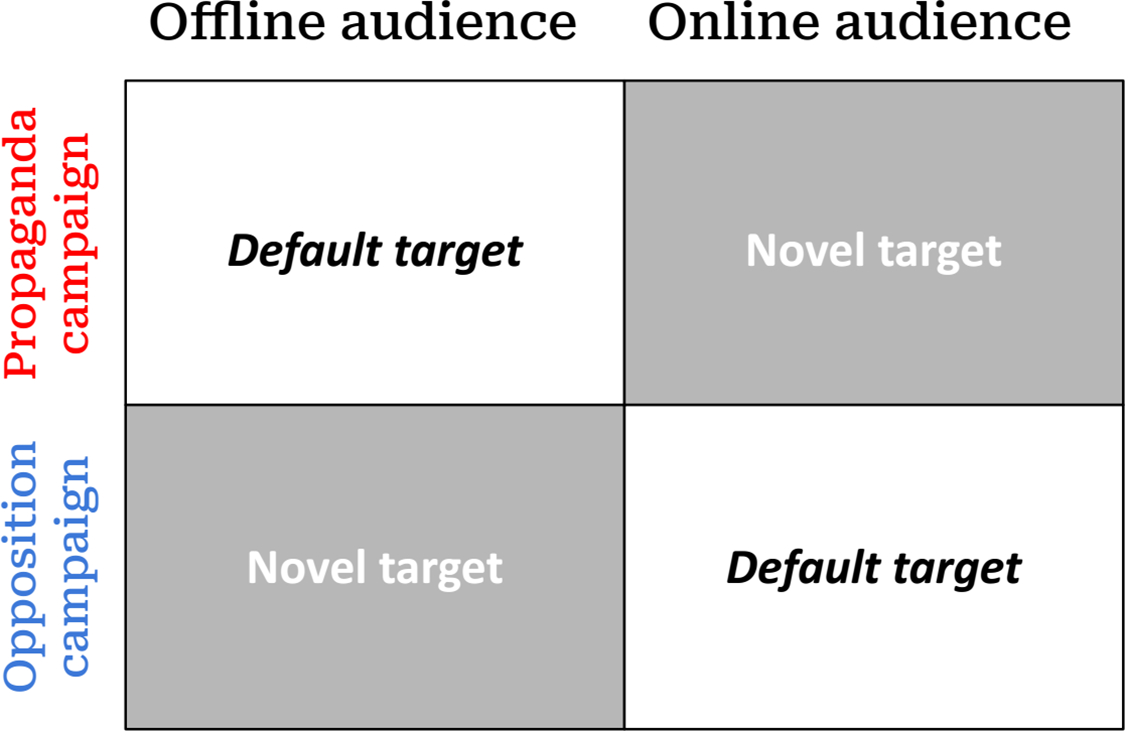
It is important to acknowledge that the Russian public is not uniform with respect to our experimental treatments. Instead, Russians differ with respect to their potential access to the content of our treatments, depending on whether an individual prefers to consume their news online or offline.Footnote 22 Most Russian propaganda is produced for offline news consumers, such as TV viewers. Before the 2018 presidential election, however, our propaganda treatment – the documentary about Vladimir Putin – was available only to Russians who normally consume news online. By contrast, Alexei Navalny’s investigative content would typically be watched only by online news consumers. Figure 1 schematically summarizes this mapping of each treatment to its default and novel target audiences. In our experiment, we promoted the opposition video to both groups, including the traditional offline audience that would normally have remained beyond its reach.
Since the public is heterogeneous, we analyse the effects of both treatments in two separate subsamples by habit of news consumption: (1) respondents who have reported mainly using the internet or social media for consuming news; (2) respondents who have reported consuming news only from traditional (analogue) media (for example, television, newspapers, radio), and who do not use the internet or social media for receiving news.Footnote 23
Schematic categorization of the target audiences for each treatment.

First Wave
Survey design
We interviewed 1,533 respondents in the first wave. Online Appendix A provides the questionnaire of our survey. We started the survey by asking about place of residence, age, preferred sources of information, past voting behaviour, and voting intentions for the upcoming elections, followed by a question about satisfaction with government performance. The sample was then split into three treatment groups: one treated with the pro-regime video, one treated with the opposition video, and a control group with no video treatments. After the treatment, we asked additional questions about approval of Putin and Medvedev (for addressing potential experimenter demand effects) and standard individual characteristics such as gender, education, employment, and income.
Treatment groups
For the treatment, respondents were randomly allocated to three equal subgroups. Group 1 received the pro-regime treatment, group 2 received the opposition treatment, and group 3 received no additional information. Both treatments consisted of questions about the pro-regime and opposition social media videos. The pro-regime treatment was formulated in the following way: ‘Last week, a new movie about Russian President Vladimir Putin with the title “World Order 2018” was released by Vladimir Solovyov. After the first day, it achieved over 1 million views online. In this movie, Putin speaks about defending Russian interests in the world and about the success of Russian politics. Have you already watched this movie?’ Unsurprisingly, since the movie was uploaded on YouTube just a couple of days before our survey, 87 per cent of the respondents reported not having seen the movie, indicating a large base for our treatment and allowing us to avoid ceiling effects.
The second treatment was introduced with the following question: ‘In March 2017, the famous blogger Alexei Navalny released a movie about the wealth and corruption of Russian Prime Minister Medvedev, with the title “Don’t Call Him Dimon”. As of this moment, the movie has been watched over 26 million times and has sparked a wave of political protest across the country. Have you watched this movie?’ As in the pro-regime case, 86 per cent of respondents reported not yet having watched the movie. This was in line with our expectations that Navalny’s movie was not well-known outside of Russia’s capital and larger cities.
At the end of the interview, both treatment groups also received a text message (SMS) with a link to the respective YouTube video to improve uptake rates. To avoid deterring respondents from following the links (for example, due to malware concerns), we distributed authentic (unaltered) YouTube links; however, this technical implementation precluded tracking whether respondents actually watched the video after receiving the link – that is, whether the informational treatment was received. We acknowledge that our estimates should be interpreted as intention-to-treat effects; to the extent that some respondents did not watch the video, these estimates constitute a lower bound on the true informational effect – a common feature of field experiments using digital media treatments.
Following the intention-to-treat approach, we use the initial treatment assignments in the first wave as the main explanatory variables: the pro-regime and opposition videos variables take the value 1 if the respondent received the respective informational treatment and 0 otherwise.
Second Wave
Voting
The second wave was carried out shortly after the election (26–27 March). The follow-up survey achieved a response rate of 52 percent – a rate significantly better than the standard of 40 per cent for this type of experiment (Asher Reference Asher2016; Gerber et al. Reference Gerber, Karlan and Bergan2009). The final sample thus consists of 798 respondents: 586 reported at least some online news consumption, and 212 reported exclusively consuming news from analogue media sources such as TV, newspapers, and radio. To ensure that attrition was not driven by our treatments, we ran a simple regression of the non-response rate in the second wave on the treatment’s binary variables and found an almost precise null effect for the full sample and the subsamples, as shown in Table B2. Further, the balance tests in Tables B3 and B4 in Online Appendix B confirm the successful randomization of our treatments in the final sample, as well as in our subsamples of online and offline news consumption.
In the second wave, we asked respondents whether they voted and, if so, for which candidate. Accordingly, we construct our two main outcome variables as binary: Individual turnout equals 1 if the respondent has voted, and 0 otherwise; and Vote for Putin equals 1 if the respondent has voted for Putin, and 0 otherwise.
Opinion about world politics
To discern the persuasion mechanisms behind the propaganda treatment, we include two questions on the perceptions of the Russian role in world politics discussed in the movie. The first question asks ‘How has the position of Russia in world politics changed over the last six years under Putin?’, with available options for answers being either ‘Russia has started to play a leading role’ and ‘the position of Russia has substantially improved’, or ‘the position of Russia has slightly weakened’, ‘the position of Russia has substantially weakened’, and ‘no answer’. We code a dependent variable that equals 1 if any of the two positive answers are selected and 0 otherwise. The second question asks about the perception of external threats: ‘Do you see a threat to Russia in the foreign policy of other countries?’, using a standard 4-point Likert scale, for which we code a dependent variable to equal 1 if answers are ‘Yes’ or ‘Somewhat yes’ and 0 otherwise (‘No’, ‘Somewhat no’, ‘No answer’). These questions allow us to determine whether the persuasiveness of propaganda stems from convincing respondents of Putin’s geopolitical performance – that is, updating their beliefs about Russia’s standing in world affairs, the central claim of the video – or from a rally-around-the-flag effect due to perceived external threats. While the first question captures alignment with the regime’s geopolitical narrative rather than technocratic competence in the narrow sense (Guriev and Treisman Reference Guriev and Treisman2022), it directly measures whether respondents absorbed the central claim of the propaganda video. We therefore use it as the outcome for H4, which tests first-order belief updating rather than downstream electoral consequences.
Results
Treatment Effects on Voting and Turnout
We estimate the following probit regression model:
 $$\eqalign{ {Y_i} =& \,\,\alpha + {\beta _1}Pro - regime\;vide{o_i} + {\beta _2}Opposition\;vide{o_i} \,+ \cr & + {\beta _3}{\it\hbox{ [}Voting\;intentions\!:Yes\it\hbox{]}_i} + {\beta _4}{\it\hbox{[}Voting\;intentions\!:Putin\it\hbox{]}_i} + \cr & + {\beta _5}{\it\hbox{[}Voting\;intentions\!:No\;answer\it\hbox{]}_i} + {X_i} + {C_i} + {T_i} + {\epsilon_i}, \cr}$$
where i indicates a respondent; Y i is either actual turnout or self-reported voting for Putin; Pro − regime video i and Opposition video i are dummy variables indicating each treatment group; and [Voting intentions: Yes] i , [Voting intentions: Putin] i , and [Voting intentions: No answer] i are the pre-treatment intentions surveyed in the first wave and equal 1 if the respondent intended to vote in the upcoming election, to vote for Putin, or did not specify a candidate she intended to vote for. X i is a vector of additional controls that include gender, age, age squared, income levels, education, occupation, news sources, and past voting in the parliamentary election in 2016. C i and T i are fixed effects for the city and the day of the interview in the first wave, respectively. The ϵ i is the error term.
Our main results for the full sample and both subsamples by news consumption are presented in Figure 2. Panel A shows the marginal effects of both treatments on voting for the incumbent, thus rejecting H1. The pro-regime video yielded a null effect in the full sample, as Putin’s vote shares did not increase. However, the effects differ across subgroups by news consumption: respondents who consume news only from traditional media are 15 percentage points more likely to vote for Putin than the control group, while online news consumers seem unaffected by the treatment. While we do not observe a consistent increase in turnout due to the propaganda treatment, the positive (though not statistically significant at conventional levels; p = 0.11) coefficient suggests that there might be mobilization of a subgroup of respondents, as we show later. Overall, this finding implies that the pro-government video was effective only for the audience traditionally targeted by state-controlled television but failed to engage the relatively novel audience of online users, consistent with H2.
Main results.
Note: probit, average marginal effects, 95 per cent CI. All regressions include city and day fixed effects, intentions to vote (dummies for turnout, vote for Putin, and for providing no answer to the question), and additional controls (gender, age, age squared, income levels, education, occupation, news sources, and past voting in the 2016 parliamentary election). Estimation results are reported in Table C1.

Figure 2. Long description
The image contains two sets of graphs, each with three sub-graphs. The first set, labeled Panel A, examines the dependent variable of voting for Putin. It includes three sub-graphs: Full sample, Online news, and Only offline news. Each sub-graph compares the effects of pro-regime and opposition videos on voting behavior. The pro-regime video is represented by a red circle, and the opposition video by a blue square. The Full sample sub-graph shows a b value of -0.00 with a p value of 0.94 for the pro-regime video and a b value of -0.09 with a p value of 0.01 for the opposition video. The Online news sub-graph shows a b value of -0.03 with a p value of 0.41 for the pro-regime video and a b value of -0.09 with a p value of 0.01 for the opposition video. The Only offline news sub-graph shows a b value of 0.15 with a p value of 0.01 for the pro-regime video and a b value of -0.10 with a p value of 0.06 for the opposition video. The second set, labeled Panel B, examines the dependent variable of individual turnout. It also includes three sub-graphs: Full sample, Online news, and Only offline news. The Full sample sub-graph shows a b value of 0.01 with a p value of 0.79 for the pro-regime video and a b value of -0.03 with a p value of 0.19 for the opposition video. The Online news sub-graph shows a b value of 0.00 with a p value of 0.95 for the pro-regime video and a b value of -0.04 with a p value of 0.21 for the opposition video. The Only offline news sub-graph shows a b value of 0.07 with a p value of 0.11 for the pro-regime video and a b value of -0.08 with a p value of 0.08 for the opposition video. All values are approximated.
Looking at the opposition campaign, we notice that the Navalny video reduced the likelihood of voting for Putin by about 9–10 percentage points (Panel A, Figure 2) in line with H6. The effect is statistically significant for online news consumers, whereas for offline consumers it is of similar magnitude but falls slightly short of conventional significance levels (p = 0.06). Interestingly, turnout decreased only slightly under the opposition treatment, but the statistical significance does not reach conventional levels.
For reference, we also present the original probit regression results for Figure 2 in Online Appendix C, Table C1. This also applies to the remaining figures (see the figure notes).
Satisfaction with Government Performance as Moderator
We proceed to test the effects of both treatments conditionally on pre-treatment satisfaction with government performance. This permits us to verify whether each video persuaded respondents to update their prior opinions or triggered affective polarization when presented with incongruent information. We modify Equation (1) by including an interaction term with satisfaction of the government and estimate the following Equation (2):
 $$\eqalign{ {Y_i} =\,& \alpha + {\beta _1}Pro - regime\;vide{o_i} + {\beta _2}Pro - regime\;vide{o_i} \times Government\;satisfactio{n_i} \cr & \!+ {\beta _3}Opposition\;vide{o_i} + {\beta _4}Opposition\;vide{o_i} \times Government\;satisfactio{n_i} \cr & \! + {\beta _5}{ \it\hbox{[}Voting\;intentions\!:Yes\it\hbox{]}_i} + {\beta _6}{\it\hbox{[}Voting\;intentions\!:Putin\it\hbox{]}_i} + \cr & \! + {\beta _7}{\it\hbox{[}Voting\;intentions\!:No\;answer\it\hbox{]}_i} + {X_i} + {C_i} + {T_i} + {\epsilon_i}, \cr}$$
where Government satisfaction i is a dummy variable that equals 1 if a respondent answered the question ‘To what extent does the current government fulfil its obligations?’ with either ‘to some extent’ or ‘to the full extent’. We present the results for the marginal conditional effects in Figure 3. For respondents satisfied with the government, the pro-government video increased votes for Putin only among consumers of traditional news media, underscoring the power of authoritarian propaganda when addressing its traditional audience. Even when preaching to the choir, a well-conceived propaganda video can further increase support for the regime, thus casting doubt on the thesis that constant propaganda leads to saturation effects. The message was even more effective among consumers of offline news who were initially unsatisfied with the government’s performance, increasing the likelihood of self-reported voting for Putin by 23 percentage points. However, when dealing with the more sceptical public that typically consumes news from online sources, the pro-regime video backfired, reducing the likelihood of voting for Putin by 16 percentage points. This pattern is consistent with H3. Regarding turnout, among offline news consumers who were satisfied with the government, the pro-regime video increased the probability of voting by approximately 7 percentage points, suggesting that the propaganda also mobilized core regime supporters to vote. No significant turnout effects are observed for any other subgroup.
Heterogeneous effects on voting by government satisfaction.
Note: probit, average marginal effects, 95 per cent CI. All regressions include city and day fixed effects, intentions to vote (dummies for turnout, vote for Putin, and for providing no answer to the question), and additional controls (gender, age, age squared, income levels, education, occupation, news sources, and past voting in the 2016 parliamentary election). Estimation results are reported in Table C2.

Figure 3. Long description
The image contains two sets of graphs labeled Panel A and Panel B. Panel A focuses on the dependent variable ‘Vote for Putin,’ while Panel B examines ‘Individual turnout.’ Each panel is divided into three subgraphs: Full sample, Online news, and Only offline news. The graphs compare the impact of pro-regime and opposition videos on government satisfaction, both positive and negative. In Panel A, the Full sample subgraph shows that positive government satisfaction with pro-regime videos has a slight positive effect (b = 0.02, p = 0.54), while negative government satisfaction has a slight negative effect (b = -0.08, p = 0.21). The Online news subgraph indicates a small positive effect for positive government satisfaction (b = 0.01, p = 0.78) and a negative effect for negative government satisfaction (b = -0.16, p = 0.02). The Only offline news subgraph shows a significant positive effect for positive government satisfaction (b = 0.12, p = 0.04) and a highly significant positive effect for negative government satisfaction (b = 0.23, p = 0.01). In Panel B, the Full sample subgraph shows negligible effects on individual turnout for both positive (b = 0.01, p = 0.77) and negative (b = 0.01, p = 0.88) government satisfaction. The Online news subgraph also shows negligible effects (b = 0.01, p = 0.73 for positive; b = -0.02, p = 0.71 for negative). The Only offline news subgraph indicates a slight positive effect for positive government satisfaction (b = 0.07, p = 0.05) and a significant negative effect for negative government satisfaction (b = -0.22, p = 0.01). The graphs use red circles for pro-regime videos and blue squares for opposition videos, with lines indicating the confidence intervals. All values are approximated.
The results for the Navalny video also show an interesting pattern. For respondents who were satisfied with the regime, the opposition treatment significantly reduced the likelihood of voting for Putin, regardless of media consumption patterns. We hypothesize that this may result from the tight control over information and the media in Putin’s Russia. If you are not yet aware of the deficiencies of the Putin regime, a convincing movie depicting corruption at the highest levels of the state can break the informational cascade of propaganda and discourage you from voting for the incumbent. However, among respondents already unhappy with the government, the opposition video had no additional effect, except a negative effect on turnout among consumers of offline media (Panel B). These heterogeneous results, conditional on prior satisfaction, are broadly in line with H7.
Propaganda Messages
Our results show that the propaganda video did not exert a uniform persuasive effect on respondents’ voting intentions towards Putin; instead, it succeeded among consumers of news from traditional sources. Our next step is to test for the mechanisms behind these results. Did the propaganda video succeed in updating beliefs about the autocrat’s competence in international politics, or in heightening the perception of an external threat – the two first-order mechanisms posited in H4 and H5? We follow the same estimation strategy as in Equation 2 to test how the pro-regime treatment influences responses to the two questions ‘How did the position of Russia in world politics change over the last six years under Putin?’ and ‘Do you see a threat to Russia in the foreign policy of other countries?’.
The conditional marginal effects are presented in Figure 4. As in Figure 3, we observe statistically significant effects of the pro-regime treatment only in the offline group: regardless of government satisfaction, respondents in the treated group become more convinced of Putin’s achievements in foreign policy, thus confirming H4. The perception of a foreign threat, however, increased only among offline news consumers who were not satisfied with the government in the first place. These results suggest that pro-regime propaganda persuades respondents of the incumbent‘s competence, but it can also incite fear of foreign threats among those unhappy with the regime. This result implies only partial support for H5.
Perceptions of Russia’s role in world politics.
Note: probit, average marginal effects, 95 per cent CI. All regressions include city and day fixed effects, intentions to vote (dummies for turnout, vote for Putin, and for providing no answer to the question), and additional controls (gender, age, age squared, income levels, education, occupation, news sources, and past voting in the 2016 parliamentary election). Estimation results are reported in Table C3.

Figure 4. Long description
The image contains two panels of graphs. Panel A shows the perception of Russia’s position in the world arena, while Panel B shows the perception of foreign threat. Each panel is divided into three sections: Full sample, Online news, and Only offline news. The graphs use red circles for pro-regime video and blue squares for opposition video. The x-axis represents the change in perception, and the y-axis represents government satisfaction, both positive and negative. The values and p-values for each condition are displayed on the graphs. Panel A indicates that only offline news with positive government satisfaction shows a significant change in perception. Panel B shows that only offline news with negative government satisfaction indicates a significant perception of foreign threat.
We also note a positive association between the opposition treatment and perceptions of foreign threat among dissatisfied offline consumers – a result that looks counter-intuitive at first but may reflect the Russian media environment: offline consumers steeped in state-media narratives that consistently frame Navalny as a Western-backed agent may have associated exposure to his video with foreign interference rather than with its anti-corruption message. This interpretation is speculative as we have no data to test it empirically, yet it is consistent with the absence of any opposition treatment effect on voting in this subgroup, and we treat it as a suggestive pattern for future research.
Robustness Tests
To ensure the validity of our findings, we conducted two robustness checks (detailed fully in Online Appendix D).
First, to rule out a spurious correlation or broad emotional priming, we conducted a placebo test. We estimated the effect of our treatments on a theoretically unrelated outcome: respondents’ perceptions of how fairly the presidential election was conducted at the local level. Since both videos focused exclusively on national-level narratives (geopolitics and federal corruption), we expected no effect on perceptions of local electoral fraud. Confirming this, we find no significant treatment effects on this placebo outcome (see Figure D1 in Online Appendix D), suggesting our main results capture a specific mobilization effect rather than generalized sentiments.
Second, we address the concern of experimenter demand effects (the risk that respondents adapt their answers to align with the political cues provided by the interviewer). We analysed data from the first survey wave, where we asked respondents to rate the performance of Vladimir Putin and Dmitry Medvedev immediately after receiving the treatment cues. If respondents were merely trying to please the interviewer or to falsify their preferences out of fear, we would expect an immediate shift in these approval ratings. However, we find no statistically significant difference between the treatment and control groups (see Figure D2 in Online Appendix D), indicating no demand bias.
Nationwide Evidence
The experimental evidence reveals two opposing effects of electoral propaganda. Among respondents who rely on traditional media for political news, exposure to the regime’s video increased electoral support, confirming the mobilizing potential of state propaganda for its core audience. Among dissatisfied online news consumers, however, the same video backfired and reduced support. The key aggregate question is which effect dominated: did the pro-regime video increase Putin’s nationwide vote share despite this backfire among online dissidents? The city-level analysis in this section addresses that question. Because offline news consumers still constituted the large majority of the Russian electorate at the time of our study (for example, Levada, 2014), we expect the positive mobilization effect to outweigh the backfire in the aggregate, yielding a net positive effect on electoral outcomes.Footnote 24 To test this, we combine data on electoral statistics at the city level from the Central Election Commission of Russia with online search statistics from Yandex, Russia’s dominant search engine, which publishes weekly numbers of searches for any keywords at the level of major Russian cities.Footnote 25 In this way, we assemble a cross-sectional dataset of all 177 major Russian cities with a population over 80,000 (excluding Moscow, St. Petersburg, and Sevastopol – the three cities of federal status – as potential outliers).
The unique, one-word title of the video enables us to precisely measure internet searches for the interview with Putin at the local level. Figure 5 displays the national time series for the absolute number of searches of the keyword ‘World order’ (one word in the Russian language ‘Mиpoпopядoк’). Before the online release of the propaganda video, searches for the movie’s title were virtually nonexistent. In the week of its publication (5–11 March), search activity increased to nearly 250,000 queries, corresponding to roughly 0.015 per cent of all Yandex searches. The following week, which directly preceded the election, searches dropped by about two-thirds to approximately 85,000 and continued to decline rapidly thereafter.Footnote 26 Our main explanatory variable Online Searches is thus constructed as the number of searches of the video keyword title per 100,000 overall searches. The interest in the propaganda video is, however, most likely endogenous: those who already support the regime are likely to self-select into watching it, since its content aligns with their political preferences (for example, Mummolo Reference Mummolo2016), thus biasing our estimates upward. To tackle endogeneity, we employ an instrumental variables (IV) approach, instrumenting interest in propaganda with rainfall on the very first day after the evening the video was released. The logic is straightforward: the regime released the video strategically before the long weekend of 8–11 March, so that people could comfortably view it in their free time. Long weekends in March are, however, traditionally used to enjoy the outdoors (for example, to start the gardening season at the dacha), and good weather can distract from staying at home and watching media. Hence, we hypothesize that rainfall on the first day of the long weekend increases interest in the propaganda video, providing us with exogenous variation in propaganda consumption. We test this prediction by regressing Online Searches on the incidence of rainfall across the cities in our sample, following a simple OLS model:
Time trend in online searches for propaganda video.

Figure 5. Long description
The line graph titled ‘Yandex online searches for World order (Mиpoпopядoк)’ shows the number of searches on the y-axis, ranging from 0 to 250000, and the time period on the x-axis, spanning from January 1 to April 29. The graph features a single data line that remains relatively flat and low from January 1 to March 4. Starting around March 5, there is a sharp increase in searches, peaking dramatically around March 11 with approximately 250000 searches. Following this peak, the number of searches declines steeply, dropping significantly by March 18. The searches continue to decrease gradually through April, stabilizing at a low level by April 29. All values are approximated.
 $$ \textit {Online}\ {searches}_{i} =\alpha + \beta \textit {Rainfall}_{i} + W_{i} + \epsilon _i,$$
where Online searches i is the number of online searches for the keyword ‘World order’ per 100,000 searches in the two weeks before the election in city i, and Rainfall i is a binary variable that equals 1 if a city i experienced rain on 8 March (the first day after the release of the video). Additionally, we control for cloud coverage, which equals 1 if the sky was not clear, and temperature (C∘), both included in the vector W i .Footnote 27
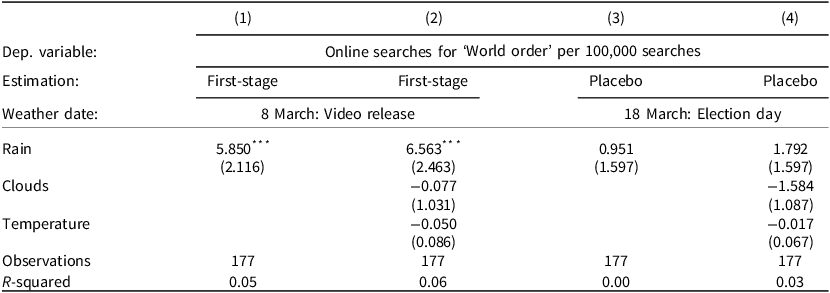
Table 1 displays the first-stage estimates. As shown in Column 1, rainfall exerts a positive and significant effect on interest in the propaganda video. The magnitude is notable: the increase in online searches due to rainfall is almost one-third of the mean of Online searchesi (or almost one standard deviation). Including additional weather controls in Column 2 does not change the results, as cloud coverage and temperature do not seem to influence behaviour. Finally, in Columns 3 and 4 we conduct a placebo test using weather data from election day (March 18), which is unrelated to the release of the video, and find no association between rainfall on this alternative date and prior search behaviour.
The effect of rainfall on interest in propaganda (first stage)

Table 1. Long description
The table presents data on the effect of rainfall on interest in propaganda, focusing on first-stage results and placebo tests. It includes four columns: first-stage results for video release on March 8 and placebo results for election day on March 18. Each column shows the impact of rain, clouds, and temperature on online searches for ‘World order’ per 100,000 searches. The first two columns indicate a significant positive impact of rain on potential viewership of the propaganda video, with an increase in online searches due to rainfall. The latter two columns, using weather data from election day, show no significant effect of rainfall, serving as a placebo test. The table includes 177 observations for each column, with R-squared values indicating the proportion of variance explained by the models.
***p < 0.01. SE in parentheses are clustered at the regional level.
As the next step, we test the impact of propaganda on voting at the city level using both OLS, as the naive approach, and an IV to tackle the endogeneity issues, following this simple estimation model:
 $${\Delta \ {Voting\ outcome}_{i} =\alpha + \beta {Online\ searches}_{i} + V_{i} + \epsilon _i, }$$
where Δ Voting outcome i is either the difference in votes cast for Putin (votes per 100 registered voters) between the actual presidential election in 2018 and the previous presidential election in 2012 in each specific city i, or the difference in turnout between the same elections; Online searches i is, as before, the number of online searches for the keyword ‘World order’ (‘Mиpoпopядoк’) per 100,000 total online searches in Yandex in the city i in the two pre-electoral weeks; and V i is a vector of controls that include the weather variables for election day.Footnote 28
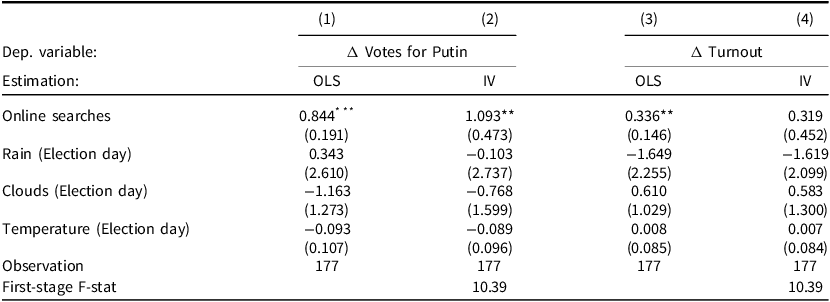
We report our main estimates in Table 2. As shown in Column 1, we find a significant positive effect of propaganda on the increase in Putin’s vote share relative to 2012. This result holds in the IV specification (Column 2), where we address potential endogeneity using rainfall (first-stage F-statistic is over 10). The effect is sizeable: variation in propaganda interest accounts for roughly half of the standard deviation in the change in Putin’s vote share. In contrast, while we observe a positive correlation with turnout in the OLS model (Column 3), the effect becomes statistically insignificant when instrumented. This suggests that the video had a negligible effect on turnout, in line with the evidence from our experimental microdata.
The effect of propaganda on voting for Putin

Table 2. Long description
The table presents data on the effect of propaganda on voting for Putin, with four columns and multiple rows. The columns are labeled with different estimation methods: OLS and IV for both votes for Putin and turnout. The rows include variables such as online searches, rain on election day, clouds on election day, and temperature on election day. Each cell contains coefficients and standard errors. Notable trends include a significant positive effect of online searches on votes for Putin in both OLS and IV specifications, while the effect on turnout is positive in OLS but becomes insignificant in IV. The first-stage F-statistic for the IV specifications is also provided.
**p < 0.05, ***p < 0.01. SE in parentheses are clustered at the regional level.
The positive and significant city-level effect confirms the prediction we derived from the experimental evidence: the consolidated support of the offline majority was sufficient to generate a net electoral advantage for Putin, outweighing the countervailing effect among online dissatisfied respondents. The macro-level finding is therefore complementary to the micro-level evidence by design. The experimental data identify the heterogeneous mechanisms at work; the aggregate analysis quantifies the net outcome of these opposing forces within the existing composition of the Russian electorate.
Finally, we acknowledge electoral fraud as a potential concern for the macro-level analysis, since the outcome is based on official electoral statistics known to be subject to manipulation (Enikolopov et al. Reference Enikolopov, Korovkin, Petrova, Sonin and Zakharov2013; Klimek et al. Reference Klimek, Yegorov, Hanel and Thurner2012; Reuter and Szakonyi Reference Reuter and Szakonyi2021). Fraud would likely add noise to the dependent variable, biasing estimates downward and making a genuine propaganda effect harder to detect. The fact that we nonetheless find a positive and significant association therefore reinforces rather than undermines our conclusion. We cannot, however, rule out the possibility that fraud co-varies with propaganda interest across cities – for example, if local administrators in high-viewership cities were also more strongly incentivized to inflate turnout and vote shares. If so, our IV estimates would capture a mix of genuine persuasion and administrative mobilization rather than the effect of propaganda on voluntary voter preferences alone. We treat this as a caveat in interpreting the magnitude of our macro-level estimates.
Conclusion
Our study confirms the formidable power of authoritarian propaganda: cities with greater public interest in the pro-regime video recorded substantially larger increases in Putin’s vote share. Experimental evidence reveals, however, that this aggregate effect is driven by the regime’s traditional offline base, while online news consumers remained largely unaffected – and, among them, those already dissatisfied with the regime even reduced their reported support for Putin – indicating a hard limit on propaganda’s reach. This sharp online–offline segmentation implies that in a world where social media is rapidly displacing television, autocracies will increasingly be challenged by agile opposition movements capable of dominating the digital narrative.
The demonstrated success of the opposition’s anti-corruption campaign validates this threat. It suggests that the digital domain offers a genuine foothold for dissent that state propaganda cannot easily neutralize. This dynamic provides a rational explanation for the recent global trend towards digital authoritarianism: unable to win the online argument, regimes like Putin’s Russia are forced to abandon relative tolerance in favour of harsh repression to silence the versatile opposition they cannot persuade.
These findings are likely to extend beyond the Russian context. We view our setting as a ’most observable’ case of the struggle between analogue propaganda and digital dissent. Our results likely extrapolate to other digitizing autocracies with partial platform openness, such as Turkey, Venezuela, or parts of Southeast Asia, where incumbents face the dual challenge of maintaining their offline base while containing an increasingly hostile online public.
Supplementary material
The supplementary material for this article can be found at https://doi.org/10.1017/S0007123426101604.
Data availability statement
Replication data for this article can be found at Zakharov et al. (Reference Zakharov, Rochlitz and Schoors2026) (Harvard Dataverse, https://doi.org/10.7910/DVN/J5IQFG).
Financial support
This research received no specific grant from any funding agency, commercial, or not-for-profit sectors.
Competing interests
The authors declare none.
Ethical standards
The field experiment and survey were reviewed and approved by the Ethics Committee of the Faculty of Economics and Business Administration, Ghent University (decision UG-EB 2022-K, 24 June 2022). All participants provided informed consent before participating in the telephone survey, and all personal identifiers were removed from the released replication data to preserve respondent anonymity.




 Open access

