In May of 2010, the Ministry of State for Development of Northern Kenya and other Arid Lands held a meeting with northeastern Kenyan community representatives at the Sarova Shaba Game Lodge near Isiolo. The upscale lodge caters to international tourism and offers panoramic views of the surrounding savannah as well as a pristine turquoise pool. This oasis, situated in the Shaba Game Reserve, is fittingly illusory. It presents an esthetic of an untouched and wild Africa to visitors on game safaris yet it did not come into being until the 1970s, after the Kenyan state had largely succeeded in asserting control over the former Northern Frontier District (now the Eastern Province and North Eastern Province). The Sarova Shaba's antecedents do no exist in the deep past. Rather, they are the officers’ clubs and lodges of the colonial era. The sweeping views and rustic decor may offer the appearance of an unbounded and timeless Africa to the outside observer but the lodge is emblematic of enclosure and a very different form of timelessness, from a local viewpoint.
During the meeting, elder Hussein Mursalle put a voice to the local perspective when he claimed ‘people are becoming more and more settled. This is because government services are only provided to settled people, people in towns. This is where food relief is delivered. People now sit in towns waiting for relief – those that are mobile don't get relief.’Footnote 1 The observation is important because it highlights the way that citizenship in northeastern Kenya remains linked to settlement. No doubt, settling in towns and integrating into the cash economy has become an option attractive to many people from pastoral communities throughout Kenya. Mursalle himself had told interviewers years earlier that ‘the life I want for my children is a settled life and not a nomadic one, a settled life where they can go to school and do some business’.Footnote 2 In this sense the colonial project of establishing currency and semi-permanent labor initiated by the British had largely been realized under Kenyan stewardship. However, Mursalle's tone had changed by the time he addressed the Kenyan government in 2010, with the plea that ‘we already have enough people living under iron sheets in the towns. Don't bring us as squatters to these towns.’Footnote 3 Neighboring elder Diba Golicha spoke for those still operating in the mobile livestock economy when he stated ‘The key thing is livestock mobility. But when there is insecurity, we can't move and this makes us very vulnerable to drought.’Footnote 4 Golicha's invocation of drought is notable here beyond its literal deployment because it is a common idiom of war and suffering among northeastern pastoralists. Following from Golicha, elder Halkano Huqa connected the incongruence of mobility and stability directly to the venue of the meeting noting ‘we have three big game reserves in Isiolo – so we are squeezed’.Footnote 5 What are we to make of all of this? Why should people be ‘squeezed’ by the open spaces of game reserves? How does insecurity cause immobility and drought? What is lost by living ‘under iron sheets?’
To answer these questions and explore the paradox of citizenship as stasis we have to look back to the 1960s. As Halkano Huqa remembers it, the 1960s was the time when ‘independence came and the elders started to lose power’.Footnote 6 Given these elders’ cyclical approach to time the 1960s, the gaf Daba (time stopping) is the key moment for understanding stasis. Without attention to how cyclical time clashed with linear time, the testimony of these elders can be easily misread as romantic and inconsistent. The result then is to miss the point and ignore the voices of potential citizens in the present as they describe themselves vis-à-vis the government by analogy to the past. In other words, when Mursalle says he wants his children to live in town he is indicating that time is moving again and advocating for a place in the Kenyan nation. But if his children are to be confined ‘as squatters’ in those towns, within that nation, then the movement of time can be little more than a regression back towards the stagnation of the gaf Daba.
SPACES AND STASIS
This article advances two related arguments tied to forced settlement under the rubric of maendeleo (development) in northeastern Kenya. First, that changes in space were linked to changes in temporal perception, pitting sedentary and migratory visions of progress against each other. Second, that the Kenyan state altered space based on suspicion of northeastern populations. The restrictions on mobility that came with ‘manyattazation’ are best understood through the Boran idiom of the gaf Daba, time stopping. From 1963–8, the Kenyan government instituted a project of ‘manyattazation’ or forced settlement as part of its effort to defeat ‘shifta’ or bandits. ‘Manyattazation’ is derived from the word manyatta denoting a homestead inclusive of livestock in the same way as boma or kraal in other African contexts. The term manyatta refers both to individual households and the aggregate of those households. A person inhabited a manyatta in a manyatta because the individual and the group were inextricable. State ‘manyattas’ under ‘manyattazation’ were distinguished from local manyatta that dotted northeastern Kenya in that they were actually entire semi-urban settlements, generally district capitals.
‘Manyattazation’ was started in earnest in 1964 throughout the former Northern Frontier District (NFD) and became firmly established by 1966. In the North Eastern Province (NEP) there were initially 13 government ‘manyattas’, of which the largest were Mandera, Wajir, and Garissa.Footnote 7 In Eastern Province there were also 13 mandatory settlements and Isiolo, Marsabit, and Moyale were the largest of these.Footnote 8 After 1967, the trading center of Takabba near Mandera became a government ‘manyatta’ as well. Including Lamu and Tana River in Coast Province, the total number of mandatory settlements was 29. Clear numbers are difficult to come by for the mobile populations of northeast Kenya during the gaf Daba. Out of a population reckoned to be as high as 400,601, historian Nene Mburu has reasonably, if conservatively, estimated that about 79,903 northeastern pastoralists, or about 20 per cent of the population, were confined to government ‘manyattas’ during the period of the so-called Shifta War.Footnote 9 These government ‘manyattas’ were typically eight miles in circumference and surrounded by barbed wire reinforced with ‘ziriba’ thorn bushes.Footnote 10 The ‘manyattas’ were lit with florescent lighting. These enlarged ‘manyattas’, tangled in barbed wire and flickering and buzzing with florescent light at night, distinctively marked the landscape. At these sites the state was both alien and highly visible. Such settlements were the main form of development in 1960s northeastern Kenya.
The ‘manyattazation’ initiative was aimed at providing security and was based on suspicion of local people and a desire to impose sedentary agro-pastoralism on the mobile populations of the northeast. Somalis, and to a lesser extent ‘Europeans’, many of whom had been born in Kenya, were suspected of plotting against Kenya in the interest of incorporating the NEP into Somalia. Kenyan government officials often complained that local populations were either ‘shifta’ or ‘shifta sympathizers’ bent on sabotaging national development. Suspicion was a facet of ‘manyattazation’ in that government ‘manyattas’ were ‘required to facilitate close watch over the activities of Somalis, as well as for their own protection’.Footnote 11 Though Somalis were considered inherently nefarious, ‘shifta sympathizers’ and even ‘shifta’ could ultimately come from any northeastern population. So, ‘manyattazation’ was applied to all local groups, particularly Boran, Sakuye, Gabbra, and Rendille.
Ostensibly, shifta and their collaborators attacked the police and military in order to forestall Kenyan development efforts and thereby win over the population for secession to Somalia. The thinking of the government was that Kenya and Somalia were locked in a race to develop the former NFD. Such thinking has continued to find expression in much of the secondary literature on the subject that frames the conflict as a proxy war between Kenya and Somalia within the climate of the Cold War. This rendering falls short of accounting for participation among non-Somali populations in the violence. It also fails to explain the continuation of violence in the region even after the collapse of Somalia's formal government in the 1990s. Key among the changes on the ground during the period of the gaf Daba were the changes in time, expressed in that designation, as well as the restriction of free movement and alteration of space, expressed in ‘manyattazation’. Boran called government ‘manyattas’ daba – meaning stops – highlighting the association between stasis and these spaces.Footnote 12
‘Manyattazation’ for the purpose of establishing a sedentary population integrated into the cash economy was a key component of the state's developmentalism. Mobile populations were harder to tax and they maintained control over if, when, and how they chose to engage with currency. According to a 1963 Annual Report for Marsabit District, even though locals ‘welcomed Independence’ they were ‘unused to change [and] found the frequent and often abrupt constitutional and governmental changes unsettling’.Footnote 13 As such, ‘the irresponsible elements in the district were not slow to seize upon this unsettled state of affairs to further their own ends’.Footnote 14 These ‘irresponsible elements’ were ‘shifta’ and the unsettling ‘constitutional and governmental changes’ were those entailed in the Kenyan state's development plans. In this regard the situation in the 1960s was similar to that of contemporary northeastern Kenya. The Marsabit Annual Report further claimed that ‘the nomadic people of this area will need separate treatment to the more educated parts of Kenya’.Footnote 15 The immediate manifestation of that separate treatment was ‘manyattazation’. The violence that accompanied forced settlement rendered development primarily as immobility and thus for northeastern peoples, Kenyan progress was stasis; the gaf Daba.
Understanding the gaf Daba requires disaggregating notions of time – time being simply the measure of motion – via historical contextualization. Analyzing temporality has occupied historians, anthropologists, and philosophers, in particular, since the early days of their professionalization. Scholars have deconstructed and reconstructed in a looping, and often willfully impenetrable, fashion Heidegger's concept of dasein, or ‘being’, as relative to time and done the same with the debates of Hegel and Marx about time.Footnote 16 They have also focused their critical lenses on the arguments of Clifford Geertz and Maurice Bloch on the subject of cyclical versus linear time.Footnote 17 The core elements of contention arising from these bodies of scholarship are about how and where to distinguish between synchronic or symbolic, versus diachronic or historical time, and the relationship between these modes of temporality and othering.
This study draws upon John Mbiti's welcome simplification of these nebulous engagements with time. Mbiti observed at the end of the 1960s that ‘the change from the … traditional concept of time, to one which should accommodate this new discovery of the future dimension, is not a smooth one and may well be at the root of … the political instability of our nations.’Footnote 18 This observation coincides with the Boran convention that the watershed period of the so-called Shifta War was actually the gaf Daba or moment when time stopped. Mbiti advised that ‘the traditional concept of time is intimately bound up with the entire life of the people, and our understanding of it may help to pave the way for understanding the thinking, attitude, and actions of the people.’Footnote 19 Given that in northeastern Kenya time was reckoned through migration following natural cycles, the way movement was bounded had a significant impact on how time was experienced. As Mario Aguilar, an anthropologist of the Waso Borana (Ajuran), puts it: ‘to be Boorana then is to respect and be aware of the past that influences the present’.Footnote 20 In order to do justice to this approach, the concept of time stopping needs to be taken seriously.
Mbiti's broad claims that African conceptions of time tend to lack a distinct iteration of the future have, ironically, been taken as negatively portraying African cognition. However, his streamlined rendering of temporality is more nuanced than he receives credit for. He states ‘what has not taken place or what has no likelihood of an immediate occurrence falls in the category of “No-time”’.Footnote 21 Meanwhile ‘what is certain to occur, or what falls within the rhythm of natural phenomena, is in the category of inevitable or potential time’.Footnote 22 Anthropologist Peter Rigby deems Mbiti's observations ‘inexcusable’ but suggests that even though the Maasai, whom he studies, have a concept of the distant future it is one ‘commensurate with the nature of their social formation and … not a mere replication of … the future embodied in capitalist ideology’.Footnote 23 Thus both he and Mbiti dissociate the future from linear time, through attention to cultural distinctions. However, Rigby describes the movement of time as ‘the relations of past and present in the creation of a future’.Footnote 24 But he adds the caveat that this movement is an ‘adaptation to an always uncertain future’ thereby finding himself back in the company of Mbiti's rendering of time.Footnote 25
Such temporal arguments are highly charged because they are, at one level, about defining the future. While Rigby optimistically recognized the political utility of the future as hopeful and potentially better, Mbiti saw its potential for division, false promises, and violence. In synthesizing the observations of Mbiti and Rigby, both of whom worked in Kenya, it is perhaps best to broadly define time as moving in spirals, neither fully returning to nor superseding the past. In this rendering both the future and the deep past are potentially in the realm of ‘No-time’ and it is only through attention to memory that either can be cogently apprehended in terms of probability. It is particularly interesting therefore that the Boran think of the 1960s, still in living memory, as akin to ‘No-time’.
Through the term gaf Daba, the Boran associate a temporal watershed, like birth or death, with confinement and the memory of war. But ‘time stopping’ is dissonant in a way that birth and even death are not, such that the gaf Daba was truly a ‘new thing’. Whether positive or negative, a temporal framework absent of an articulated future is not one closed to innovation. This is inasmuch as memory is concerned because as a historical analysis this article does not make claims to surpass a diachronic understanding of time. It strives only to attentively represent how memories were narrated by northeastern peoples in the 1960s, thereby placing a particular set of memories in dialog with a history that has largely been deaf to them. Having listened, this article conveys how a local model of cyclical time competed with the Kenyan state's adoption of linear time through changes in settlement and economic patterns. Forced settlement imposed linear time, under the rhetoric of maendeleo (progress), upon cyclical time, expressed in free movement, in a manner that halted both. These changes in temporal frameworks and mobility were indeed at the root of political instability and bound time to suspicion and stasis in violent ways.
TRADING SPACES
Life in northeastern Kenya was necessarily mobile. To remain in one place too long was to be out of sync with the ecological phenomenon that determined survival, particularly perennial water and grazing sources. Sedentary living was contrary to religious rituals and temporal cycles that ensured rainfall and healthy communities. Boran and Somali alike believed that life moved through yearly cycles, key among these being the small cycle of eight years, by which age groups were spaced, and the large cycle of forty or fifty years, which demarcated a generation. Based on ethnographic research conducted in the 1950s, P. T. W. Baxter observed of the Boran that ‘the rule of generational succession within a set-line and the rule which insists on the eight and forty year time spans are absolutely inflexible’.Footnote 26 Similarly, Somali scholar Muuse Galaal explained in the 1960s that Somalis ‘recognize at least five different kinds of cycles … the second is an eight-year cycle (SIDEED-GUURO), supposed never to fail’ while ‘the fourth is one of fifty years [also] thought never to fail’.Footnote 27 Rendille and Gabbra operated on a related seven-year cycle with generations spaced forty years apart. In 1943, J. K. R. Thorp noted that ‘Rendille years go in cycles of seven, like our week.’Footnote 28 Drawing on late 1950s ethnography, Günther Schlee points out that ‘the age-set systems of the Gabra and Rendille … [are] modelled after the seven-day week, by the seven-year cycle linked to it and multiples thereof which form the different sectors of the generation-set cycle’.Footnote 29 Experts invested with knowledge of these cycles informed northeastern communal decisions of when to move and where to go. If, for instance, a drought occurred during the seven- or eight-year cycle it was expected to occur again in seven or eight years. Such drought years were likely to see increased conflict due to competition for resources, thus the common idiomatic association between drought and war. The cyclical interplay between mobility and time permeated everyday life and the ways that life was described. Being in the world involved moving through the world and settlement patterns in northeastern Kenya reflected this.
The homes of northeastern peoples were temporary. Women were responsible for their construction and upkeep. As anthropologist Carol Eastman observed of Gabbra, Turkana, and Boran, ‘each nomadic woman builder begins by pacing out a circumference (or spiral) for the structure to be built; she literally knows the house as memory – the house she was born in is the very house she recreates again and again.’Footnote 30 The Gabbra phrase ‘wara jecum nad'eni’ (home means woman) further emphasizes the point.Footnote 31 Since women were invested with the knowledge of home building and carried it in their memories: home truly did mean woman. But what memories of home did women have after the gaf Daba? Eastman, working in the 1980s, was able to document the building of pastoral homes in the old style. Therefore, memories must have persisted or been successfully reconstituted. However, she also documented important changes in settlement. For instance, the Boran residing in Marsabit town were not building temporary round homes with woven mats anymore, rather they built permanent rectangular homes with corrugated roofing. Furthermore, they were engaging contractors to construct such homes instead of relying upon women to do so.Footnote 32 The trend was the same across the former NFD. How did such changes in the use of space impact upon memory and vice versa? Where did time fit into the equation?
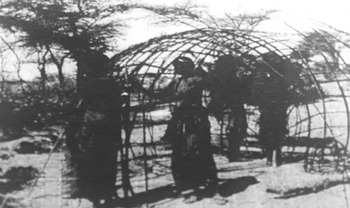
The spirals carried in the memories of pastoral women were the blueprints of the individual homes that collectively made up manyatta. These homes were geodesic huts constructed from local materials. For instance, Boran houses were round and built from a frame of tiba mina, which were tree branches dyed red by pigments derived from boiling bark.Footnote 33 The tiba mina were then strengthened through a smoking process. The frames of homes were created by lashing together tiba mina (Fig. 1), which were then covered with sisal woven mats called dase. The interior of the hut was divided into three parts. The entryway was the bada and took up half the home. The remaining half-circle at the back was called the haffo and was split down the middle by a wall constructed of branches and mats and called the dibu. On one side of the dibu was the male space and on the other was the female space. In a typical household, husband and wife slept together in the male space, while children slept in the female space. However, in some cases husband and wife slept on separate sides of the dibu.Footnote 34 During the dry season women and children inhabited the home while men slept out in the open with the fora, or dry herd that grazed a considerable distance from the milk stock that remained at the manyatta.
Boran women tying together tiba mina, 1954. Source: KNA PC/NFD/4/5/1.

A manyatta in northeastern Kenya was a collection of such homes and herds. It bears repeating that these settlements were mobile. The tiba mina and dase of at least one home was packed up and carried with Boran when they moved their manyatta. The materials for other homes could then be prepared at the new site within the relocated hut, which was used as a smokehouse.Footnote 35 With a few particular differences the layout of homes was very similar among Somali, Rendille, Sakuye, Turkana, and Gabbra and elements of each could find expression across the artificial boundary of ‘tribe’. For example, Boran in Kenya covered their homes in dase, the weaving of which they borrowed from the Sakuye, while their kin in Ethiopia preferred to cover their homes in grasses and animal skins.Footnote 36 Another similarity among pastoral groups in northeastern Kenya was their tendency to build their manyatta around a ritual space.
Beyond spaces for living, manyatta were physical embodiments of cyclical time. Communities sprang up in particular places for important events rather than important events taking place in particular settlements. For instance, when a Boran boy was to be named, ‘a large party of women go to the chosen place and there build a large hut, about three times the size of the normal building’.Footnote 37 These large huts were called galma. The galma was constructed of temporary materials, which were not cured for durability in the manner of living quarters. After rituals for communal codependence and the subsequent naming of the child, the galma was abandoned and left to fall apart. Anyone interfering in the galma’s natural disintegration by taking materials from it was subject to punishment.
Other northeastern groups favored fire for marking important moments in time. Rendille built habo in the center of their manyatta. The habo was a ‘small circular boma where a fire is continuously kept burning’.Footnote 38 After being called to the habo by a man holding aloft a brand from the fire ‘each evening all the fully grown men assemble [there] for prayer’.Footnote 39 Somali also used fires for ritual purposes. Pastoral Somali celebrated the dab shid or ‘night of fire’ by building fires in front of their homes that the male head of household would either jump over or throw a spear through.Footnote 40 The dab shid marks a new year and ‘forms the base for astrological calculations for the whole year’.Footnote 41 Gabbra and Sakuye gauged time with fires at their respective manyatta as well. For instance, each group lit special fires once a week for eight weeks leading up to the autumn rains.Footnote 42 After completing such rituals, which could take from days to months, manyatta were often packed up and moved. The impermanence of fires, which burned out, and galma, which fell apart, reinforced the transience of pastoral life.
All groups moved their manyatta as dictated by yearly cycles and environmental factors. These cycles were known through the reoccurring rituals of the community. This building and rebuilding in coincidence with seasons and age-grades was a key facet of knowing the world through mobility. Outside observers have in turn understood that world as chaotic and unpredictable based upon comparison with sedentary norms of settlement. In actuality both sedentary living and transhumant pastoralism are potentially stable or chaotic. Negotiating the interplay between settlement and migration became extremely difficult during the gaf Daba and continues to be an exercise in misunderstanding.
Symbolically, the camel caravan remains an iconic image of northeastern Kenya, buttressing a romantic vision of rootless nomads. This vision renders pastoralism as a remnant of the deep past to be nostalgically admired but ultimately recognized as futile. The camelid ‘ships of the desert’ that made up caravans derived from a nautical colonial imaginary that still informs Western engagement with the region. A recent ethnographer of the Gabbra described the desert area around Marsabit as ‘undulant, like the open sea’ with winds as ‘incessant as surf and sails’.Footnote 43 He even framed his theoretical discussion of poststructuralism around Herman Melville's novel Billy Budd.Footnote 44 Clearly, the fantastic distance of nautical imagery remains a heuristic for translating the unfamiliar much as it did in the colonial era. The district commissioner of Isiolo in 1954, R. G. Brayne-Nicholls, provided a ready example of the link when he described one of his informants, elder Wario Guyo, as the ‘old man of the sea’.Footnote 45 Brayne-Nicholls in turn dismissed Guyo, with a measure of admiration, as ‘full of tales of the great past’.Footnote 46 Around this same time, camels also began to be viewed as relics. Though camels still play an important role in everyday life in northeastern Kenya, automobiles largely replaced them in the 1940s and 1950s, within the realm of trade. During that time the British sought to transform trade in the interest of cementing cash economy in place of the bartering that had preceded it and continued to compete with it.
Trade within the cash economy was centered in towns. From very early on and into the early colonial period, permanent settlement occurred primarily along the coast. Interior sites, when and where they existed along caravan routes, were often very small and situated near permanent water.Footnote 47 After the early twentieth century, as the British became a significant presence in what they labeled as the Northern Frontier District, they sought to encourage greater permanent settlement. In 1912, the British established an administrative station and a fort at Wajir.Footnote 48 In 1922, Mandera was founded as a trading center and in 1932 Garissa sprang up around an administrative station.Footnote 49 Such stations were referred to as ‘bomas’, drawing on the term boma, which similar to manyattta described a pastoral homestead.
A key component of British settlement in the NFD was the institution of the duka trade. Duka (pl. maduka) are small shops that provide goods for cash. Duka were intended to expand the cash economy and replace the barter system that predominated in the area in order to provide a ready tax base for the state and center economic activity in settlements. Towns rapidly became sites of the nascent cash economy. Initially Wajir only had one small duka, but by 1922 it had five stone shops and a mosque.Footnote 50 In 1948, Wajir gained a school.Footnote 51 Similar situations prevailed around other bomas throughout the NFD and attracted foreign and local populations in small numbers. At the end of 1941, Garissa had eight duka, while the tiny outposts of Balambala and Saka had four apiece, and Bura, Ijara, and Mudogashi each had three.Footnote 52 The major items of trade were livestock, hides and skins, and miraa (Catha edulis).Footnote 53
These items were frequently bartered rather than bought and sold. In 1961, the district commissioner of Isiolo gave the frustrated reply to a request, from Ismail Elmi Hersi, to trade camels for small stock, that ‘all camel barter in the Province has now stopped’ and he could only grant ‘permits to sell camels’.Footnote 54 Ismail Hersi was a self-styled ‘stock trade pioneer’ and wanted to ‘buy 200 head of camels from Wajir and take to Turkana district to barter with [sic] sheep and goats’.Footnote 55 In his desire to buy camels, Hersi was perhaps a ‘pioneer’ but his plan to then barter them for small stock employed the cash economy in a way that ran contrary to British objectives. In attempting to divorce resources from their ecological bounds and render their relationship to people into the abstract form of currency, the cash economy was intended to marry the state to a linear model of time via the principle of progressive accumulation.
Many northeastern peoples moved through towns for trade but did not settle. In 1962, the population of Garissa was tallied at 875 people, while Mandera counted 523 residents and Moyale had 291 people.Footnote 56 Wajir and Marsabit had more notable populations at 1,055 and 2,470 respectively.Footnote 57 Isiolo was the largest town with 5,445 people but was made up primarily of Somali, Turkana, and ‘down country tribes’, especially Meru. In 1962, there were only 227 Boran, 270 if counting Ajuran among them, and one Rendille recorded living within the township of Isiolo.Footnote 58 These spaces represented a small percentage of the overall population, even Isiolo accounted for less than 10 per cent of the district population while the other spaces barely registered. The people who did settle tended to be duka owners and civil servants, typically police. The elderly, the sick, and people who had lost their herds constituted the remainder of local town settlers. Yet, even the elderly and impoverished, when they chose or were forced to settle in towns, generally set up their homes at the edge of town.Footnote 59
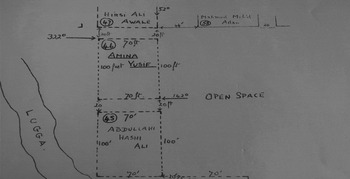
The establishment of privately-owned plots around the boma and its maduka distinguished towns from manyatta. Within towns ritual space was allocated to trade. The tendency of socially marginalized peoples to put up homes at a distance from town centers also created artificial ‘open spaces’ in the geography of semi-urban settlements (Fig. 2). Further, the British convention of rectangular plots altered the personal space of individual houses. The spatial order of township plots was enforced through codes. Town dwellers were required to inhabit plots and ‘adhere to the area laid down and make no alteration to its boundaries’.Footnote 60 Thus, local memories of home were replaced with British imaginings of space.
Detail from official plan situating the 70×100 ft plots of Amina Yusif and Abdullahi Hashi Ali in Bulla Pesa, 26 Jan. 1962. A lugga is a stream. Source: KNA DC/ISO/3/28/26.

However, within the rectangular boundaries of town plots and their concomitant rectangular homes, northeastern peoples recreated familiar spaces. Boran women applied the interior divisions between male and female space from the round homes of their memory to the rectangular dwellings of town. But these memories became distant when not reinforced through the frequent destruction and rebuilding that migration required. Eastman writes that ‘nomadic women construct the present by reconstructing the past in woven shells or spirals’.Footnote 61 She compares this practice to sedentary people who ‘have shelters constructed for them incorporating (and changing) forms from the past into present cultural memories.’Footnote 62 In towns home no longer meant woman, except as a memory. On the move, homes remained inseparable from women.
The movement of memory from lived reality to a remembered imaginary, the memory of movement so to speak, was the basis of a new town-centered episteme tied to the idea of citizenship. Eastman observed in the 1980s that ‘sedentarisation, urbanization, and increasing cultural contact may, in effect, be seen as Kenyanising formerly nomadic people’.Footnote 63 The key moment of this change was the gaf Daba, the 1960s, when time stopped, when the elders began to lose power. But with the cessation of forced settlement in April of 1968, government ‘manyattas’ emptied as residents attempted to remake their memories through flight to Somalia, Ethiopia, and the bush. In 1968, there were 11,084 people confined to Mandera.Footnote 64 One year later just 946 individuals remained.Footnote 65 Moyale was in a similar situation with only 353 residents in 1969.Footnote 66 Perhaps the starkest contrast was in Garissa, which shrank to only 205 residents in 1969, representing a decline of 670 people from even its modest prewar population.Footnote 67 Most people availed themselves of the chance to move again and put distance between themselves and government ‘manyattas’. However, the gaf Daba had impacted time in a ‘new’ way and in its aftermath it presented the opportunity for creating new memories to a small portion of the population.
These changes in time and space were supposed to usher in an era of stability, citizenship, and maendeleo (progress/development) for northeastern peoples. Following the confiscation and slaughter of herds that took place in the gaf Daba, such promises took on a powerful significance, especially for the destitute and infirm who had always represented the core of settlement populations. Perhaps this is why some towns were able to retain pastoral settlers, with populations ranging from 1,003 in Mudogashe to 8,201 in Isiolo.Footnote 68 Wajir stood between the pulls of migration and adaptation to this new vision of time. Wajir saw an exodus of 3,947 people between 1968 and 1969, leaving it with 7,513 residents, or about 9 per cent of the population at the time of the 1969 census.Footnote 69 Marsabit was somewhat more popular, given a history of long-term settlement on and around Marsabit Mountain, and housed about 12 per cent of the district population, or 6,635 residents.Footnote 70 But the paradox of the equation between settlement and citizenship was that progress meant stasis. Even in the 1980s, the district development officer for Marsabit noted ‘it will take long for the Borana to adopt this type of building covered with iron sheets and walled by cement blocks’.Footnote 71 He appears to have been correct since in 2010 Boran elders continued to question life ‘under iron sheets’. Such evasion made the government suspicious of them. Their entwinement in cyclical time was hard to reconcile with the linear model that the Kenyan state adopted from the colonial era. During the gaf Daba this temporal restructuring became violent. The remainder of this article explores the suspicion and stasis that typified the forcible imposition of linear time and sedentary living that characterised the gaf Daba.
SUSPICION
The Shaba Game Reserve is a good example of the spatial order prevailing after the gaf Daba. It was ‘open space’ clearly delineated and bounded and therefore not really open space. There was no settlement allowed within the reserve and settlements around it determined the outer boundaries of the reserve. In this regard it was like towns where marginalized groups settled at the periphery creating ‘open spaces’ around the center. Within the ‘open space’ of reserves, game rangers and soldiers patrolled to enforce the restriction of space that kept the reserve ‘open’. Little wonder then that nomadic pastoralists were ‘squeezed’ by such spaces, which encroached on their free movement.
The war and its scorched earth strategies decimated the livelihood of most northeasterners, which was stock raising. Predations on livestock impacted nearly all northeastern peoples. After the war many locals came forward to make compensation claims for livestock that the Kenyan government had confiscated or killed. The government policy was to seize or slaughter livestock believed to belong to shifta. Section Thirteen of the Preservation of Public Security Act codified suspicion as a justification for confiscating stock. It found legal expression in the following meandering prose
Section 13 … gives police wide powers in seizing stock which belongs to shifta or anyone in the prescribed area who has consorted with or has been found in the company of another person whom he knows or has reasonable cause to believe to be a person who intends to act or is about to act or has recently acted in a manner prejudicial to the preservation of public security.Footnote 72
Essentially livestock could be confiscated at will. These confiscated livestock were held at veterinary camps, before being shipped to urban markets such as Nairobi. Livestock seizure was the most frequent application of the Preservation of Public Security Act. In a single raid on 21 March 1965, the Kenyan army seized 5,125 cattle from the area surrounding Isiolo.Footnote 73 In September of the same year, Bruce McKenzie, head of the Kenya Meat Commission (KMC) observed
What is unfortunately happening because of the Shifta trouble in the North-Eastern Region, we all of a sudden receive a call from the security forces … asking us to take 10,000 cattle from the Moyale/Wajir area. Now if we did not take them the security people maintain that … they would have had to eliminate them.Footnote 74
He went on to explain that the KMC was moving 1,000 head a week from Lamu down country due to ‘shifta’ livestock confiscation. Many residents in Eastern Region also complained that the neighboring Samburu took advantage of the war to raid for cattle.Footnote 75 The fact that so many cattle were seized points to an economic impetus behind confiscation. Proceeds from the sale of confiscated cattle were officially placed in the Special Districts Administration Act Fund.Footnote 76
However, it was not at all uncommon for livestock to be killed as part of a military strategy based on attrition. For instance, Ahmed Dahir, who resided in Eastern Province, complained that ‘during the recent shifta campaign I lost 85 heads of cattle being killed by our armed forces while in the course of their operations against insurgents’.Footnote 77 Outright slaughter was even more common in the NEP. This was because it was harder to move confiscated livestock out of the region based on its distance from Nairobi and susceptibility to shifta counter-raids along the way. Some cases of such abuses were cruel but may appear relatively benign. In Habaswein, near Wajir, ‘five trespassing camels’ were shot by security forces.Footnote 78 Other instances impacted upon entire communities. The most extreme case occurred in the NEP, there the majority of the Sakuye herd was rounded up and machine-gunned. Soldiers took the remaining livestock and the Sakuye were forcibly moved into government ‘manyattas’, fully indigent.Footnote 79
STASIS
The number of locals who fell foul of security forces, appearing fleetingly, as a name here, or a number there, in an arrest or casualty column within the available records is staggering. Over the course of 1965, there were a total of 786 men and 128 women locked in Mandera prison.Footnote 80 That same year the average daily lock up at Wajir was 86.17 while in 1966 Isiolo had an average lock up of 90.93.Footnote 81 Most prisoners were incarcerated for pass violations. As the government ‘manyattas’ around prisons began to serve the purpose of confinement, incarceration rates dropped. For instance Mandera Prison decreased its inmate population to 536 men and 98 women in 1966 and 123 men and 21 women in 1967.Footnote 82 The data around everyday experience indicates the conflict inherent to forced settlement in a society based around free movement. For instance, Bidu Arero was imprisoned for one month after being caught in Isiolo without a permit in 1963 and so was Hasan Abdi. Meanwhile Omar Ali Mohamed was sentenced to three months imprisonment for the same offense while Yusuf Haji Mohamed served two weeks.Footnote 83 Hundreds of others served sentences ranging from two weeks to one year for pass violations. Providing examples of death and confinement during the gaf Daba is like plucking names from a blood-soaked hat. Bidu, Hasan, Omar, and Yusuf had moved too freely and encountered the power that the state had invested in colonial spaces and boundaries. Free movement threatened the state, so its agents stepped in where they could to halt it.
Mobility could make someone subject to the state but it was also a means of avoiding and/or combating the state. ‘Shifta’ proved to be particularly agile, traveling throughout the former NFD to attack security forces and resupply. On 8 August 1964, ‘shifta’ attacked a convoy of merchants near Laisamis in Marsabit District. In the ambush they killed ‘an Arab’ and a ‘Somali driver’ and looted the vehicles.Footnote 84 On 23 November 1964, ‘shifta’ at Mudogashe, between Isiolo and Wajir, ‘broke into the shop of an ex-police inspector’ and looted the impressive sum of 7,940 shillings worth of goods.Footnote 85 In 1965, four ‘gangs’ of ‘shifta’ went to ‘Loiyangalani Safari Lodge and killed two Europeans’.Footnote 86 They then hijacked a Land Rover and ‘after a considerable distance abandoned the vehicle and killed the [Italian] driver’.Footnote 87 In 1964 alone Isiolo, Marsabit and Moyale reported 56 separate violent incidents involving ‘shifta’ and resulting in at least 113 deaths among shifta, security forces, and civilians combined.Footnote 88
The targets of shifta attacks are significant given that they complicate official suspicions about shifta and their supposed sympathizers. Shifta proved ready to kill their presumed co-conspirators within the Somali and ‘European’ population. However, they were also involved in violent incidents in which security forces and members of other local communities were killed. For instance, on 23 November 1964, a group under Abdi Mohamed Yusuf raided a Meru manyatta killing five people and taking ‘a large number’ of cattle.Footnote 89 Thirteen days later, the same group attacked a manyatta where Samburu and Turkana were living together and killed eight people.Footnote 90 Thus, most communities in the former NFD had reason to fear both shifta and security forces. These northeastern peoples fell in between the categories of shifta and soldier and were more interested in the livestock that provided their livelihood. They also recognized that the two categories were not necessarily exclusive to begin with.
Under state scrutiny, police were among the only ‘local’ people with ready access to weapons and the mobility necessary to maintain herds. Thus police and shifta were sometimes the same person, both between settlement and bush and across national boundaries. Indeed, the crossing of such boundaries could determine whether or not someone was shifta or police, underscoring the importance of mobility to identity. David Hurd, a settler kidnapped by shifta during a raid on the coastal town of Kiunga, claimed he was taken to Somalia where he was surprised to find that many of his captors were serving as police.Footnote 91 Within Kenya, the North Eastern Regional Security Committee noted with some embarrassment that in Wajir ‘the local population had expressed annoyance at seeing known shifta being trained as Home Guards’.Footnote 92 However, the state married as it was to suspicion of all northeastern groups made it difficult for these groups to negotiate their embattled position. In fact, the state solution was to confine local populations in order to eliminate the threats inherent to mobility. This effectively separated compliant residents from their livestock, which were then taken either by shifta or government forces.
As ‘manyattazation’ became firmly established, the number of ‘shifta’ casualties increased dramatically. From November of 1965 to August of 1966 there were 665 ‘shifta’ killed in the former NFD.Footnote 93 Meanwhile security forces saw a dramatic decrease in casualties that same year. They suffered only 14 deaths, while civilian losses climbed to 230.Footnote 94 Given the inexactitude of the category ‘shifta’ these statistics are better parsed out as 665 able-bodied males and 230 women, children, and infirm. ‘Manyattazation’ was effective in limiting security force casualties because it offered soldiers free range within the restricted area. As police and soldiers moved more freely the migrations of northeastern peoples became increasingly constricted. Boran elders had communicated their concerns about this to the government right from the start of the conflict. In 1964, the elders of Sericho, Mudogashe, Merti, and Garba Tulla complained that ‘innocent citizens are being killed by the security forces during operations’ and that ‘everybody in the countryside was considered to be Shifta, indiscriminately.’Footnote 95 They went unheeded. Even in late 1967 after an amnesty was reached, 120 ‘shifta’ were killed and one Kenyan soldier lost his life.Footnote 96 Being a potential ‘shifta’ was an extremely dangerous identity and one that belied the promise of progressive citizenship in Kenya.
Northeastern peoples did not have support within the government. After people like Bidu Arero, Hassan Abdi, Omar Ali Mohamed, and their numerous cellmates served prison sentences, those who survived went to the hinterlands where they were considered ‘shifta’. Outside of government ‘manyattas’ they were subject to additional Emergency Legislation, which included the clause ‘security forces have the right to shoot without challenge in the prohibited area.’Footnote 97 Ultimately, each local was a potential ‘shifta’ or at least a probable collaborator and the logic of imprisonment was extended to settlement in general. This ‘manyattazation’ process of confining locals to secured settlements was both a punitive and a security measure. As the Eastern Region Commissioner of Police put it ‘we shall never control these gangs of dacoits (Shifta is the wrong word) unless we thump the ordinary people for shielding, helping, and feeding them’.Footnote 98 Through special operations and ‘manyattazation’ the state and its agents were fairly successful at beating, imprisoning, and killing (thump is the wrong word) ordinary people.
The state's treatment of the people who resided in forced settlements underscores both its paranoia and its failure to deliver on the promises of independent Kenya. Of the people confined in government ‘manyattas’, the sick, elderly, and destitute were overrepresented. The remaining ‘manyatta’ dwellers were mainly individuals open to the possibilities foreseen in Kenyan citizenship. When such promises rang hollow, the state blamed shifta. At the funeral of a former shifta, the district commissioner of Garissa gave a speech in which he claimed ‘if all the inhabitants of this land co-operate with the Government … and fight against our enemies, the children of this land would be educated, medical facilities would be made available and business projects would be established. There would be peace and everybody would be happy.’Footnote 99 The message here was clear. The inhabitants of government ‘manyattas’ were suspected of helping shifta and being generally uncooperative. The district commissioner's promises of peace and happiness in the ‘future’ underscored the instability, lack of schooling, rampant disease, and general economic malaise that characterized life in forced settlement during the 1960s.
SOLDIERS AND SLUMS
The direct violence of ‘manyattazation’ took a number of forms. Frequently a combination of stock seizure, slaughter, demolition, and theft transpired. In Isiolo alone there were claims for 18,782 cattle, 2,645 sheep and goats (shoats), 241 donkeys, 46 camels, 60 homes, and 12,500 Kenyan Shillings.Footnote 100 Khatima Abdi Noor and many others lost livestock to both culling and confiscation. In a letter seeking recompense, Noor stated that she ‘had 35 cows and among this [sic] cows some were shot and the remaining taken by the Government’.Footnote 101 She also pointed out that her sixty-year-old husband was ‘shot dead in cold blood in the mosque’.Footnote 102 Clearly she and her husband had been residing in the government ‘manyatta’, where they were ostensibly being protected. Khatima, now eighty years old, claimed to have lived in Isiolo since she was born and that all her relatives were buried there. In this sense she was an exceptional case. She also stood out in that she asked for compensation because in her old age she had ‘no strength to cultivate land’.Footnote 103 Farming was an atypical occupation in the region. Those who did apply for mashamba, or farms, were overwhelmingly ‘down country’ Meru.Footnote 104 In her sedentary existence and embrace of agriculture, Khatima should have been an ideal candidate for incorporation into the Kenyan state. Instead, her husband was killed and she lost all her cattle. In this regard, however, she was not exceptional.
Many of those whom were forced to live in, or sought refuge within, government manyattas, ended up destitute. Buildings believed to be temporarily inhabited by shifta were demolished during the war. Under amendment to Emergency Legislation, security forces could destroy ‘buildings and manyattas where persons are found to be actively assisting Shifta’.Footnote 105 Isiolo residents had attempted to claim compensation for sixty homes that had been destroyed because they were deemed to be housing ‘shifta’ or ‘shifta sympathizers’. In Garissa, residents were warned to ‘dismantle their houses’ because they had been ‘built without proper authority’.Footnote 106 Ultimately, their homes were destroyed after a shifta attack in the area.Footnote 107 Outside government ‘manyattas’ the threat of shifta was also grounds for demolition. For instance, the small trading enclave of Kom, which straddled the border of Isiolo and Maralal districts, was demolished because the maduka, and few homes there, were believed to occasionally harbor shifta.Footnote 108 Although ‘shifta’ provided a ready excuse for the destruction of property, a great irony of settlement in the former NFD was that ‘progress’ was even more frequently cited as a reason for demolition.
Throughout the 1960s people living in ‘manyattaized’ townships were subjected to slum clearing. In 1964, at Dadaab, near Garissa, soldiers ransacked and destroyed homes and maduka during a government survey.Footnote 109 In 1965, the residents of the western portion of Garissa were ordered to demolish their ‘huts’ and rebuild them according to code.Footnote 110 The pell-mell of shacks that came to constitute entire sections of towns resulted from the filling in of ‘open space’ between plots. The residents of government ‘manyattas’ required shelter and generally had no means of providing it to themselves in accordance with building codes. What exactly those codes were in 1965 was unclear for nearly two years. However, it was eventually determined in 1967 that they entailed building with cement blocks and corrugated roofing ‘in accordance with Township Building Rules’.Footnote 111 While still vague, these rules required contiguous rectangular plots that could be readily taxed and regulated, as they had been during colonial rule.
Slums, which nobody particularly wanted to live in in the first place, were periodically cleared and sprung up in previously unoccupied ‘open spaces’ out of necessity. These in turn were sometimes demolished in the name of progress, continuing the process. As Isiolo engulfed Bulla Pesa in the 1970s there was happy news that the township would finally acquire running water. But the senior water officer complained that he was ‘unable to lay the pipes in Bulla Pesa because of obstruction from housing’.Footnote 112 County Councilman Abdulkadir Mohamed noted ‘the problem of poor people who if asked by the survey to remove the building and construct elsewhere would be left without home[s] since they cannot afford [sic]’.Footnote 113 Such was their crucible as running water eventually made its way into Isiolo. The price of progress was destruction. It bears noting here that Dadaab, where soldiers had demolished homes after a survey, is now infamous as the largest refugee camp in the world. This new clambering migration of the poor from slum to slum was oppressively static, lacking the familiarity of pastoralism, but equally based on survival.
CONCLUSION
Violence was the tangible core of the gaf Daba, the stoppage of movement and therefore time. The violence of the gaf Daba was expressed in the halting of beating hearts and beating hooves. Progress for the state was stasis for northeastern peoples. During the 1960s the state forced a model of linear time and its spatial foundation upon northeastern Kenyans. This inextricably bound them to the state, while emphasizing their distance from it. Because people were indiscriminately considered shifta, the prospect of actually becoming shifta was made more attractive. To be shifta came with the possibility of obtaining cattle and maintaining mobility. The potential of the state to provide the same had proven limited at best. ‘Manyattas’ were a glaring representation of the confinement that Kenyan suzerainty brought with it. This was augmented by the tendency of the state to ignore and rationalize the violence of police and soldiers against northeastern peoples.
Confinement was a part of the violence and the logic of imprisonment overlaid that of settlement. This was not just an epistemically violent process, though it was that, but also a physically violent one. Livestock were slaughtered and families were murdered. Men and women were raped. Such things were not without precedent but they were unique nonetheless. Nobody could recall anything like the total decimation of the Sakuye herd prior to the gaf Daba. Northeastern Kenyans had never been forced to live en masse in government ‘manyattas’ before, surrounded by barbed wire and security lighting. These were the sites where people were ‘confined as squatters’ to live ‘under iron roofs’ and the legacy of that history continues to trouble the region.
In this period the desire to establish a settled and productive tax base, integrated into the national economy clashed with deep-rooted suspicion of mobile northeastern peoples, united under the political ethnicity of ‘shifta’. Animosity went both ways. Suspicion went both ways. The state sought to impose linear time and locals sought to retain cyclical time. The state strove to create a sedentary population and locals strove to remain mobile. The Kenyan nation was comprised of citizens who would ideally live in rectangular permanent homes. Northeastern peoples carried home in the memories of women. Their homes were round, indicating a separate ontological repertoire. The differences between circles and lines are thus more profound than they appear at first. Neither are they insurmountable. But the way that reconciling these differences was approached was a violent struggle remembered in references to dwelling types and through the idiom of the gaf Daba. In that struggle, time stopped.