Introduction
Each year, millions of Americans will assume the role of the surrogate decision-maker (SDM) for an incapacitated, critically ill loved one (Pisani et al., Reference Pisani, McNicoll and Inouye2003; Critical Care Statistics, 2019). Guided by a shared decision-making framework, SDMs collaborate with critical care clinicians and palliative care specialists to make decisions regarding the management of the patient's bothersome symptoms and, often, end-of-life care (Aslakson et al., Reference Aslakson, Curtis and Nelson2014; Critical Care Statistics, 2019). Most SDMs are unprepared to make such profound decisions and resultantly experience a severe degree of psychological distress (Netzer and Sullivan, Reference Netzer and Sullivan2014).
Accordingly, SDMs of the critically ill may lack family decision-making self-efficacy, which is one's confidence in their ability to make healthcare decisions for a loved one (Bandura, Reference Bandura and Ramachaudran1994; Nolan et al., Reference Nolan, Hughes and Kub2009). Individuals with low self-efficacy levels may behave impulsively, lack persistence, experience feelings of helplessness, and are generally less successful in achieving their goals (Strecher et al., Reference Strecher, McEvoy DeVellis and Becker1986; Multon et al., Reference Multon, Brown and Lent1991; Stajkovic and Luthans, Reference Stajkovic and Luthans1998; Gullo et al., Reference Gullo, Dawe and Kambouropoulos2010). Therefore, SDMs with low levels of family decision-making self-efficacy may struggle serving in the SDM role (Nolan et al., Reference Nolan, Hughes and Kub2009).
The only reported measure of family decision-making self-efficacy is the Family Decision-Making Self-Efficacy Scale (FDMSE). Guided by qualitative work, the first version of the FDMSE possessed 23 items, encompassing 6 themes of family decision-making self-efficacy: being a surrogate, choosing treatments, accepting palliative care, meeting spiritual needs, maintaining family harmony, and communicating with health professionals (Nolan et al., Reference Nolan, Hughes and Kub2009). In a subsequent pilot study, Nolan et al. (Reference Nolan, Hughes and Kub2009) reduced the scale to its current version (13 items), by deleting items with at least one inter-item correlation less than r = 0.40, and provided evidence of its known-groups validity, content validity, and internal consistency. Presently, there are two versions of the FDMSE. Version selection depends on whether the patient possesses (conscious version) or lacks (unconscious version) decisional capacity.
The FDMSE has been used to measure decision-making self-efficacy in SDMs of patients with cancer (Dionne-Odom et al., Reference Dionne-Odom, Ejem and Azuero2018), amyotrophic lateral sclerosis (Sulmasy et al., Reference Sulmasy, Hughes and Yenokyan2017), dementia (Thompson et al., Reference Thompson, Bridier and Leonard2018), and other chronic illnesses (Green et al., Reference Green, Van Scoy and Foy2018). Despite its recent use, reports of the scale's psychometric performance in other populations are limited to reports of its relationship to other constructs (Dionne-Odom et al., Reference Dionne-Odom, Ejem and Azuero2018) and its internal consistency (Duckworth et al., Reference Duckworth, Forti and Russell2014). Of note, the examination of the FDMSE's construct validity, i.e., its ability to measure the six aforementioned themes of family decision-making self-efficacy has not been performed. Bandura (Reference Bandura2006) recommends performing a factor analysis of self-efficacy scales to establish item relatedness to the construct under examination. Self-efficacy scales need to evaluate one particular domain of behavior. However, Bandura (Reference Bandura2006) acknowledges that self-efficacy domains may be multidimensional if the behavioral domain in question is complex. Thus, self-efficacy scales may be able to capture multiple dimensions of a particular self-efficacy domain.
Family decision-making for SDMs of critically ill patients is complex, dynamic, and possesses multiple behavioral facets (White, Reference White2011; Daly et al., Reference Daly, Douglas and O'Toole2018). The diversity and independent complexity of these actions suggest that family decision-making self-efficacy may be a multidimensional concept with distinct behavioral domains. To this point, Nolan et al. (Reference Nolan, Hughes and Kub2009) originally designed the FDMSE items to reflect six underlying themes. Thus, it is reasonable to suggest that family decision-making self-efficacy is a multidimensional concept. To our knowledge, factor analysis of the FDMSE has not been reported in any sample. Also, the FDMSE's validity and reliability have not been examined among SDMs of the critically ill.
Given the increased prevalence of critical illness, chronic diseases, and dementia, more Americans will assume the SDM role in the upcoming years (Prince et al., Reference Prince, Ali and Guerchet2016; Raghupathi and Raghupathi, Reference Raghupathi and Raghupathi2018; Critical Care Statistics, 2019). Regardless of the clinical domain, serving as an SDM elicits a negative emotional response that can persist for months (Wendler and Rid, Reference Wendler and Rid2011). As such, measuring family decision-making self-efficacy may allow us to identify those who may struggle in the SDM role and allow for the proactive provision of informational or emotional support for family members facing difficult treatment or end-of-life decisions. Examining the underlying structure of the FDMSE will enhance the validity of its measurement, informing the development of family decision-making self-efficacy focused interventions. Furthermore, the examination of the FDMSE's validity and reliability in new, novel populations enhances its overall generalizability. Therefore, the purpose of this study was to evaluate the psychometric properties (i.e., validity and reliability) of the FDMSE among a sample of SDMs for the critically ill.
Methods
Design
This study was a secondary analysis of a parent study. The parent study was a three-arm, randomized clinical trial comparing the effectiveness of two electronic decision aids to a usual care (i.e., control) group. Data used in the present analysis were collected at the enrollment interview for participants prior to their exposure to a decision aid if they were allocated to an intervention group.
Parent study
The parent study was designed to advance current paradigms of ICU decision support to promote the provision of value-concordant care for critically ill patients lacking the capacity to express their care preferences. Decision aid 1 was video-based, representing an active control. Decision aid 2 incorporated the use of avatar-based technology to give SDMs the opportunity to practice communicating with critical care clinicians in a simulated environment using a designated communication strategy. The control group did not receive any decision support as a part of the research study but received the typical care and assistance routinely provided by members of the critical care team. The decision aid exposure consisted of a single 5–10 min dose. The dose for decision aid 1 involved watching a video, whereas the dose for decision aid 2 involved learning and applying a communication strategy.
Sample and setting
A convenience sample of 215 SDMs was recruited from four intensive care units (ICUs) at a tertiary hospital in Cleveland, Ohio. Participants were aged 18 or older, English speaking, and the next of kin or legal proxy for healthcare decision-making for decisionally impaired patients who required a minimum of 72 h of mechanical ventilation and expected to remain in the intensive care unit for two days after their qualifying dates.
Instruments
Patient and demographic characteristics were, respectively, captured through electronic chart reviews and an investigator-derived form. In addition to additional instruments administered in concordance with the parent study's procedures, subjective measures of decision-making self-efficacy, decisional fatigue, and decision-making preparation were also collected.
Family Decision-Making Self-Efficacy Scale
The Unconscious Version of the FDMSE was used for this study. This scale has 13-items that are scored on a five-point Likert scale ranging from “cannot do at all” (1) to “certain I can do” (5). Items scores are summed, with higher scores indicating a greater amount of family decision-making self-efficacy. The FDMSE has acceptable convergent and known-groups validity, as well as internal consistency among SDMs for patients with ALS and pancreatic cancer (Nolan et al., Reference Nolan, Hughes and Kub2009).
Preparation for Decision-Making Scale
The Preparation for Decision-Making Scale (PrepDM) measures one's preparedness to make a healthcare decision (Bennett et al., Reference Bennett, Graham and Kristjansson2010). The PrepDM has 10 items scored on a five-point Likert scale ranging from 1 (not at all) to 5 (a great deal). A total score is created by summing the item scores, with higher scores indicating greater decision-making preparation. The PrepDM possesses convergent validity with decisional conflict, can discriminate between those who find a decision-support intervention useful, and possesses acceptable test–retest reliability (Bennett et al., Reference Bennett, Graham and Kristjansson2010). In this sample, the internal consistency of the PrepDM internal consistency reliability (Cronbach's α) was 0.91.
Decision Fatigue Scale
Decision fatigue describes an impaired self-regulatory state resulting in impaired-decision-making behaviors (Pignatiello et al., Reference Pignatiello, Martin and Hickman2018). The Decision Fatigue Scale (DFS) measured decision fatigue (Hickman et al., Reference Hickman, Pignatiello and Tahir2018). The DFS measures symptoms of decision fatigue over the previous 24 h with 10 items scored on a four-point Likert scale ranging from “Strongly Disagree” (0) to “Strongly Agree” (3). Higher scores indicate a greater amount of decision fatigue. The DFS possesses convergent and discriminant validity, as well as acceptable test–retest and internal consistency reliability among SDMs of the critically ill (Hickman et al., Reference Hickman, Pignatiello and Tahir2018). In this sample, the internal consistency (Cronbach's α) of the DFS was 0.84.
Procedures
Institutional review board (IRB) approval was obtained prior to ensuing study recruitment. Participants were recruited five to seven days per week with a three-phase approach. During phase one, a research assistant screened the electronic medical records of all ICU patients to identify patients who had received at least 72 consecutive hours of MV. Phase 2 consisted of verifying the remaining patient inclusion criteria with the critical care team. If patients met all inclusion criteria, SDMs were contacted and evaluated for study inclusion (phase 3). Participants willing to participate provided written, informed consent. Upon obtaining informed consent, the research assistant led the participant to a private interview location.
Data were collected during a structured face-to-face interview that lasted approximately 30–40 min. Following the collection of SDM demographic characteristics, a research assistant administered the FDMSE, the PrepDM, and the DFS. Data were directly entered in a Research Electronic Data Capture (REDCap) database (Harris et al., Reference Harris, Taylor and Thielke2009) and exported to SPSS (Version 25) for statistical analysis.
Statistical analysis
Descriptive statistics for participants and DMSE items
For participants and patients, descriptive statistics (frequencies, means, standard deviations) were used to describe the sample. Univariate statistics (e.g., frequencies, means, standard deviation, skewness, kurtosis) were computed for each of the 13 FDMSE items.
Validity
For this study, the evidence of the FDMSE's validity was generated by the evaluation of its internal structure (structural validity) and its relationship to other constructs (discriminant validity).
Internal structure
The FDMSE's internal structure (i.e., dimensionality) was evaluated through an exploratory factor analysis (EFA). Factors were extracted using principal axis factoring (PAF) and were rotated through the use of direct oblimin, which allows the extracted factors to be correlated with one another (Pett et al., Reference Pett, Lackey and Sullivan2003).
Assessing item appropriateness for EFA
Before interpreting the EFA, the FDMSE item correlation matrix was inspected for highly collinear (r > 0.80) or unrelated (r < 0.30) items and Barlett's test of sphericity was interpreted for non-significance (≥0.05), which would suggest the inter-item relationships were inappropriate for an EFA (Pett et al., Reference Pett, Lackey and Sullivan2003; Johnson and Morgan, Reference Johnson and Morgan2016). To verify that the sample size was adequate for the EFA, the Kaiser–Meyer–Olkin (KMO) coefficient and measures of sampling adequacy were examined for values less than 0.60 and 0.70, respectively (Pett et al., Reference Pett, Lackey and Sullivan2003).
Specification of factor structure
Upon extraction, factors were retained for interpretation if their Eigenvalues were greater than one. Interpretation of the Eigenvalue plot using Cattell's (Reference Cattell1966) scree test was performed as a secondary method to support factor retention. The item's factor loadings were interpreted by observation of the pattern matrix. If an item's factor loading was <|0.40|, the EFA was repeated without the item(s) until all items possessed a primary factor loading ≥|0.40|. If more than one item failed to load, the item with the lowest primary loading was removed and the EFA was repeated (Costello and Osborne, Reference Costello and Osborne2005).
Relationship to other constructs
Another way to provide evidence for an instrument's validity is by evaluating its correlation with similar (i.e., convergent validity) constructs (Gillespie and Perron, Reference Gillespie and Perron2015). To provide evidence for the FDMSE's convergent validity, we hypothesized it would demonstrate a moderate correlation with levels of decision fatigue (Hickman et al., Reference Hickman, Pignatiello and Tahir2018) and a strong correlation with preparation for decision-making (Miller et al., Reference Miller, Hudson and Egleston2013). Interpretation of correlation magnitude was derived from Cohen (1988), as cited in Shultz et al. (Reference Shultz, Whitney and Zickar2013) (correlations of 0.10 are small, 0.30 are moderate, and 0.50 are large).
Reliability
Reliability refers to the extent that measurements obtained from a particular sample are free from error (Perron and Gillespie, 2015). To evaluate the FDMSE's reliability, its internal consistency was measured through the computation of Cronbach's α coefficients. While qualitatively labeling Cronbach's α levels is discouraged, we followed standard convention and designated an α value ≥0.70 as a minimum threshold for acceptable internal consistency (Taber, Reference Taber2018).
Results
Patient and SDM characteristics
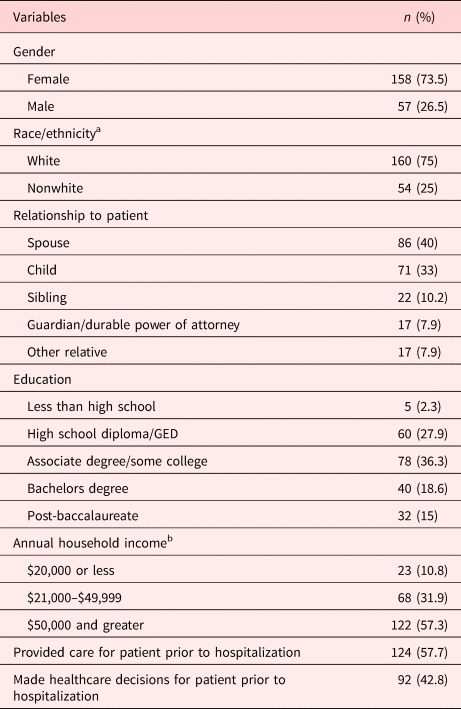
Patients were on average 60.9 years old (SD = 16.8 years) and the majority were White (74%). Half of the patients were males (53%) receiving care in a neuroscience (40%) or medical (30%) ICUs. Mean SDM age was 54.2 years (SD = 13.4 years). Consistent with prior work (White et al., Reference White, Angus and Shields2018), the majority of SDMs in this sample were women (73%) and either the patient's spouse (40%) or child (33%). Additional SDM characteristics can be seen in Table 1.
Sample characteristics (N = 215)

a N = 214.
b N = 213.
Univariate and multivariate item statistics
Descriptive statistics of the 13 FDMSE items are reported in Table 2. Visualization of the item histograms suggests that all FDMSE items were negatively skewed. However, the absolute value of the respective skew and kurtosis coefficients were less than 2 and 7 for the majority of the items, suggesting the items were normally distributed (Curran et al., Reference Curran, West and Finch1996). The majority of each item's inter-item correlations were less than 0.80 and exceeded 0.30, except for items 5 (“stop urging to eat”) and 13 (“talk to other family members”). Item 5 had 8 inter-item correlations less than 0.30 and all of the inter-item correlations for item 13 were less than 0.30. Nonetheless, Barlett's test of sphericity was significant (χ 2 = 1,140.34, p < 0.001), indicating the items were appropriately related to EFA. All of the items’ MSAs were >0.70 and the KMO coefficient was 0.89, suggesting the sample size was large enough for the conduct of EFA.
Item statistics for the Decision-Making Self-Efficacy Scale

Internal structure
The EFA of the 13-item FDMSE yielded a three-factor solution. Each respective factor's Eigenvalue was 5.5, 1.3, and 1.0, and explained 42.4%, 9.7%, and 7.8% of the respective items’ variances. However, interpretation of the scree plot suggested a two-factor solution. Items 1 (“make decisions about healthcare”), 5 (“stop urging to eat”), and 13 (“talk to other family members”) failed to load onto a factor, with the highest primary loadings of 0.35, 0.33, and 0.17, respectively. Given the scree test interpretation and that item 13 (“talk to other family members”), possessed the weakest primary loading, item 13 was removed and the EFA was repeated.
The EFA of the 12-item FDMSE yielded a two-factor solution. Each factor possessed eigenvalues of 5.5 and 1.2, and explained 45.7% and 10.2% of the variance. All items demonstrated primary loadings ≥|0.40| except for item 5 (“stop urging to eat”), with a primary loading of −0.25. Thus, item 5 was removed and the EFA was repeated.
Similarly, the third EFA yielded a two-factor solution. Each factor possessed eigenvalues of 5.3 and 1.2 and explained 47.8% and 11.1% of the items’ respective variances. All items demonstrated a single primary loading ≥|0.40| and there were no cross-loading items (Table 3). The two rotated factors were strongly correlated with one another (r = −0.67). Consistent with recommendations from Williams et al. (Reference Williams, Onsman and Brown2010), the two respective factors were named via inspection of common themes between factors’ items. We named factor 1 “treatment decision-making” and factor 2 “palliation decision-making”.
Factor structure of the Decision-Making Self-Efficacy Scale (N = 215)

Note. Extraction method was principal axis factoring with oblique rotation (direct oblimin using the following parameters: δ = 0; κ = 4). The reported factor loadings were derived from the interpretation of the pattern matrix. The bolded coefficients represent an item's highest loading on the two extracted factors.
Relationship to other constructs
The 11-item FDMSE, as well as its subscales were significantly correlated with preparation for decision-making and decision fatigue. These correlation coefficients (Table 4) support the convergent validity of the modified two-factor, 11-item FDMSE.
Correlations among variables (N = 215)

Note. Scores for Factors 1 and 2 were computed through summation of each factors’ respective items.
a N = 212.
** p < 0.01.
Reliability
Factors 1 (items 1, 2, 3, 7, 8, and 9) and 2 (items 4, 6, 10, 11, and 12), as well as all items of the 11-item FDMSE, possessed acceptable internal consistency, with respective Cronbach's α coefficients of 0.82 and 0.84. The internal consistency of the total 11-item scale was also acceptable (α = 0.88). Deletion of subsequent items would not improve the internal consistency of either factor or the 11-item scale.
Discussion
Our findings indicate the Unconscious Version of an 11-item FDMSE scale possesses a two-factor structure and demonstrates acceptable convergent validity and internal consistency reliability in a sample of SDMs for critically ill patients.
Our exploratory factor analyses identified that a two-factor, 11-item version of the FDMSE was the most parsimonious structure in this sample of SDMs. A content analysis of the items of each factor was conducted. Each factor possessed a marker item (factor 1: “make decisions he/she would make” and factor 2: “make decisions that promote his/her comfort”). Interpretation of these marker items along with the other items from each respective factor suggests that factor 1 broadly reflects self-efficacy in making treatment decisions for the patient, whereas factor 2 reflects self-efficacy in making palliation-related decisions. Given the strong negative correlation between the two rotated factors (r = −0.67), we suggest the two factors represents polarization in the factors orientation to the aggressiveness of care with Factor 1 representing a focus on treatment or life-sustaining decisions, and factor two embodying a palliative-focused care orientation. This conceptual organization is consistent with prior work examining treatment preferences among those with advanced illness (Mack et al., Reference Mack, Weeks and Wright2010) and corresponds to two of the aforementioned themes initially used to create the 13 items of the original FDMSE (Nolan et al., Reference Nolan, Hughes and Kub2009). Therefore, clinically, it may be worth independently evaluating each domain of family decision-making self-efficacy to ensure SDMs are confident in their ability to make decisions ranging across this continuum. For example, if SDMs lack self-efficacy in making palliative-related decisions, they may be unable to make decisions regarding the aggressiveness of care related to symptom management or coping with their role concerning end-of-life care, which may result in the patient's receipt of care that is incongruent with his or her preferences and goals.
Additionally, we were able to provide ample evidence for the 11-item FDMSE's convergent validity through its relation to other constructs. To the best of our knowledge, this is the first empirical data describing the relationship between decision-making self-efficacy and decision fatigue, an impaired self-regulatory state that results in diminished decision-making quality (Pignatiello et al., Reference Pignatiello, Martin and Hickman2018). There is a growing body of evidence claiming SDMs of the critically ill may experience impaired reasoning and decision-making (Netzer and Sullivan, Reference Netzer and Sullivan2014). Elucidation of this relationship further contributes to this evidence collection. Behavioral and decision scientists may benefit from exploring the mechanistic relationships of other negative cognitive and behavioral states, such as decision fatigue, with family and other types of decision-making self-efficacy.
On the contrary, family decision-making self-efficacy and preparation for decision-making were weakly correlated — not moderately correlated as hypothesized. This finding is inconsistent with prior work describing a strong (r > 0.65) correlation between decision-making self-efficacy and preparation for decision-making among a sample of patients with cancer, who were contemplating enrollment in a cancer clinical trial (Miller et al., Reference Miller, Hudson and Egleston2013). This discrepancy may partially be the result of instrumentation, as Miller et al. (Reference Miller, Hudson and Egleston2013) used a different self-efficacy scale. However, as before, this finding may be unique to the context of family decision-making in the ICU. For example, SDMs are usually overconfident in their ability to make decisions that are actually consistent with the patient's preferences (Majesko et al., Reference Majesko, Hong and Weissfeld2012; Song et al., Reference Song, Ward and Lin2012; Fried et al., Reference Fried, Zenoni and Iannone2019). Furthermore, high self-efficacy levels may contribute to overconfidence, which can impair one's ability to perform a task (Vancouver et al., Reference Vancouver, Thompson and Tischner2002). Thus, it is possible our sample of SDMs were overly confident in their ability to engage in family decision-making. This overconfidence manifested as an attenuated relationship between family decision-making self-efficacy and their preparation for decision-making, which is another significant determinant of an SDM's decision-making ability (O’Connor et al., Reference O'Connor, Tugwell and Wells1998).
Notably, two of the original FDMSE items failed to load onto either of the factors. These items were item 5, “Make decisions about whether to stop urging him/her to eat”, and item 13, “Talk to other family members about his/her healthcare”. During critical illness, SDMs may possess unrealistic optimism about their loved one's prognosis and clinicians may adopt a survival-focused mindset that precludes the consideration of withholding particular treatments (Zier et al., Reference Zier, Sottile and Hong2012; Kruser et al., Reference Kruser, Cox and Schwarze2017). Furthermore, the majority of patients within the ICU are too ill to eat (Hoffer and Bistrian, Reference Hoffer and Bistrian2016). Thus, item 5 may have failed to load onto a factor because it was not actively relevant to the SDM's current experience — the patient was too ill to eat or the SDM could not consider decisions that, in the moment, would detriment the patient's recovery.
Regarding item 13 (talk to other family members), communicating with other family members about the patient's plan of care is a vital part of the SDM role (White, Reference White2011). However, this was the only item that pertained to communication, which could explain why it failed to load on the other factors, which focused more on decision-making. In addition, “health care” is an ambiguous term, as it can represent many different facets of care delivery within the ICU. We would advise modification or potential addition of the item(s) to reflect specific and contextually relevant components of healthcare communication. A sample modification could be, “Talk to other family members about how the plan of care aligns with the patient's preferences”.
Our work also possesses clinical implications. Clinicians can use the 11-item FDMSE to validly evaluate an SDM's family decision-making self-efficacy, which may serve as an indicator of their readiness or ability to make decisions on behalf of their critically ill loved one. Consistent with expert recommendations, SDMs with low scores on either of the 11-item FDMSE's subscales may require tailored clinician support to meet their decisional needs (Kon et al., Reference Kon, Davidson and Morrison2016). Thus, we believe critical care practice can be enhanced by routinely screening SDMs for cognitive or emotional limitations, such as low family decision-making self-efficacy, that can compromise an SDM's ability to make value-concordant decisions for the patient. However, we caution clinicians from using the 11-item FDMSE as the sole indicator of one's capacity to engage in family decision-making, as SDMs are typically overconfident in their ability to make decisions and suffer from additional physiological, cognitive, and emotional disturbances that can derail the self-regulatory processes necessary for decision-making (Netzer and Sullivan, Reference Netzer and Sullivan2014; Dionne-Odom et al., Reference Dionne-Odom, Ejem and Azuero2018; Fried et al., Reference Fried, Zenoni and Iannone2019).
This study possessed several limitations. First, the use of a cross-sectional design prevented the authors from examining the structure of the FDMSE across time or generating evidence of the FDMSE's predictive validity or test–retest reliability. Furthermore, the authors did not collect any other type of SDM or decision-making self-efficacy measure, preventing the evaluation of the FDMSE's criterion validity (Perron and Gillespie, 2015). In addition, this study's generalizability is limited due to the specificity of its inclusion criteria. Thus, our findings may be non-replicable in other samples.
In conclusion, the Unconscious Version of the 11-item FDMSE was valid and reliable among a sample of SDMs for critically ill patients receiving mechanical ventilation. We identified two dimensions of the FDMSE that capture self-efficacy related to making treatment and palliation-related decisions. This may help clinicians further identify who may struggle in the SDM role and determine the types of decisions they may struggle making. Furthermore, family decision-making self-efficacy moderately correlated with states of decision fatigue and weakly correlated with preparation for decision-making. Thus, assessing an SDM's family decision-making self-efficacy may be useful in identifying individuals who need further evaluation for decision-making ability — SDMs with low levels may be in an impaired cognitive state such as decision fatigue, whereas SDMs with high levels may be overconfident and not as prepared as one may think. To enhance the generalizability of these findings, we recommend psychometric evaluation of the FDMSE in other samples where family decision-making is likely to occur.
Acknowledgments
The authors would also like to acknowledge Mr. Matthew McManus for his editorial assistance.
Funding
Financial support for this study was provided entirely by NIH grants (NINR; R01NR015750-02S1 and T32NR015433). The funding agreement ensured the authors’ independence in designing the study, interpreting the data, writing, and publishing the report.
Conflict of interest
The content is solely the responsibility of the authors and does not necessarily represent the official views of the National Institutes of Health.