Introduction
For many years, food security along with that of grain self-sufficiency had been the major goals of China's agricultural policy. In the course of the transformation process, land use rights returned to farmers, price liberalization took place and the grain procurement quota was abolishedReference Wu and McErlean1. This led to a steady change of cropping systems, with a remarkable shift in the production of high-value crops such as fruits and vegetables. In Hebei province, the production of vegetables increased from 30 million tons in 1997 to 63 million tons in 2007. As the production of vegetables generates higher income possibilities to the rural population, it is an important option for reducing the ever widening rural–urban income gap.
The North China Plain is East Asia's largest alluvial plain, accounting for one-fifth of China's total food production2, Reference Deng, Shan, Zhang and Turner3. The farming structure is dominated by smallholders with approximately 0.5 ha of arable landReference Zhang, Wang, You and Liu4. High production intensities ensured steadily increasing yields over the past few decades. However, this has mainly been achieved by increased inputs of fertilizer, irrigation and plant protectionReference Zhang, Wang, You and Liu4. Consequently, negative impacts on the environment and resource availability are aggravating. Ongoing contamination and depletion of water resources and degradation of arable land severely compromise the production base for future generationsReference Jia, Yu and Liu5–Reference Chen9.
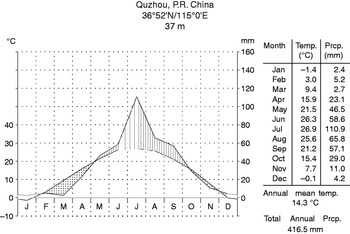
Southern Hebei province is located at the center of the North China Plain. The climate is a continental monsoon climate with average temperatures ranging from below zero in January to 27°C between June and August. Annual rainfall ranges from 300 to 700 mm with most precipitation in the summer monthsReference Zhu10. Due to the arid conditions between October and April (Fig. 1), irrigation is mandatory to extend the cropping season. Major crops are wheat, maize, cotton and, increasingly, fruits and vegetables11.
Climate graph of Quzhou Experimental Station, Handan city region, Hebei; based on daily data from 2001 to 2009.

Intercropping, the simultaneous cultivation of two or more crops on the same field, is a traditional system in the North China PlainReference Chandler12–Reference Li, Sun, Zhang, Guo, Bao, Smith and Smith14. According to various studies, intercropping can use environmental resources more efficiently. When cultivating two crops in a mixture, the variation in the canopy structure and rooting patterns can facilitate a better capture of solar radiation, soil nutrients and soil waterReference Alene and Hassan15, Reference Carrubba, la Torre, Saiano and Aiello16. Therefore, intercropping can lead to higher yieldsReference Innis17 and at the same time groundwater pollution can be minimized by the control of nutrient leachingReference Whitmore and Schröder18. Due to the often improved ground cover, weed pressure is reducedReference Baumann, Bastiaans and Kropff19–Reference Liebman and Davis21 and erosion can be controlledReference Laloy and Bielders22. Pest and disease pressure can be reduced in intercropping, as the companion crop can offer a habitat for parasitoids or might have a repellent effect on certain pestsReference Altieri23. Therefore, intercropping of vegetables is promising to provide farmers' incomes and at the same time save environmental resources.
In the past decade, intercropping became a big issue in agricultural research in China. Different research groups examined various intercropping systems from an agronomic point of view. The focus was mainly on nutrient use efficiency and yield components in grain and grain–legume systems in the North China PlainReference Zhang and Li24–Reference Gao, Duan, Sun, Li, Liu, Liu and Liu26. The findings confirm the positive effects of intercropping regarding yield, resource use and environmental aspects. However, vegetable intercropping systems have so far been neglected by research.
Another aspect that has not been taken notice of is the adoption of these potentially sustainable and high yielding production systems by local farmers. Experience shows that it is still a major issue to bridge the gap between theory and practice in sustainability researchReference Knowler and Bradshaw27, Reference von Wirén-Lehr28. Production techniques that proved successful in experiments do not necessarily work out in the field. The socio-economic framework and socio-technological regimes farmers are acting in are often insufficiently considered. Furthermore, under changing frame conditions, traditional production systems run the risk of extinctionReference Feintrenie and Levang29.
To maintain the potentially sustainable vegetable intercropping systems in the North China Plain and to be able to adjust them to a permanently changing environment, it is essential to understand farmers' underlying motives and concepts. Therefore, the present study reveals what kind of vegetable intercropping systems are practiced as well as how and why farmers do or do not practice intercropping. By assessing past developments and recent changes in the socio-economic framework farmers in Hebei are exposed to, the future potential of certain systems is evaluated and suggestions are given on how to adjust them to suit upcoming demands.
Materials and Methods
The main goal of the present study is to create an overview on the existing intercropping systems in southern Hebei province, with a special focus on vegetable intercropping practices. Due to the complete lack of literature and data on vegetable intercropping in the region, a qualitative inquiry was conducted. Stakeholders involved in developing, disseminating and practicing vegetable intercropping were included in the survey. Local farmers, employees of the state extension service from the local to the provincial level and agricultural researchers, who are engaged in intercropping research, were interviewed. The following were the specific objectives of the inquiry: (1) to identify and characterize prevailing intercropping systems, especially vegetable intercropping systems in the region; (2) to understand factors influencing the dissemination and adoption of vegetable intercropping; (3) to understand the farmers' knowledge, awareness and perception of different intercropping components; (4) to assess the future potential and constraints of vegetable intercropping systems (i.e., the necessity for and possibility of mechanization); (5) to identify demand for future research. Semi-structured in-depth interviews were conductedReference Case30. The farmers' questionnaires consisted of 25 questions, whereas the questionnaire for researchers and extensionists consisted of 28 questions. The farmers' questionnaire focused on the agronomic details of the practiced intercropping system, the individual's intercropping history, perceived benefits and drawbacks of the system and on the awareness of environmental connectivity. Additionally, the interviews with researchers and extensionists inquired on a meso- and macro-level, addressing the generation and transfer of research findings as well as the perception of the farmers' knowledge and motives. As the goal of the study was to obtain the greatest possible information from the cases in the sample, snowball samplingReference Garforth and Usher31 was applied.
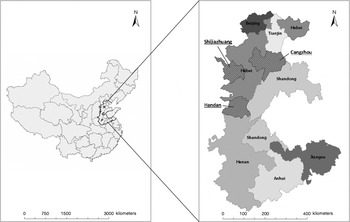
The survey was conducted in the Cangzhou, Handan and Shijiazhuang regions (Fig. 2) from October 2007 to April 2008 with the help of a previously trained interpreter. In total, 35 farmers (21 intercropping, 14 non-intercropping), ten extensionists and six researchers were interviewed. All interviews were recorded, translated and transcribed into English, according to the transcription guidelines of McLellan et al.Reference McLellan, MacQueen and Neidig32, while the analysis was done drawing on the contentReference Mayring33. Additionally, data from provincial and national yearbooks were consulted to understand and describe the changes in the frame conditions for rural farm households in Hebei. Due to the vastness of the surveyed region, with some 5 million farmersReference Zhang, Wang, You and Liu4, the scope of the inquiry was neither to determine the share of intercropping among all cropping systems nor to determine the share of certain intercropping systems among the entire intercropped area. However, the area under cultivation of a certain intercropping system in the surveyed counties, as reported by the local farmers and extension service, is displayed.
The North China Plain in mainland China (left) and the location of the surveyed city regions in Hebei province and the North China Plain (right).

Results and Discussion
Existing intercropping systems
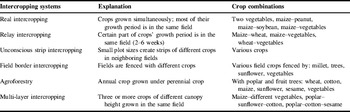
A huge variety of intercropping systems exist in southern Hebei province. In Table 1, the most common systems and the crops used in the systems are categorized.
Common intercropping systems and crop combinations in southern Hebei province.

As most intercropped species differ highly in their growing period, only in the case of spinach–garlic (Fig. 3A), maize–chili (see Fig. 6), maize–peanut and maize–soybean does the definition of intercropping, ‘two crops being cultivated most of their growing period together in the same field’, hold true. In relay systems, the intercropped components only share parts of their growing period. This is especially the case in most maize–vegetable systems, where the vegetable components have a much shorter growing period. Due to the high average temperature of just below 30°C between June and August, the production of leafy vegetables is restricted to spring and autumn. If farmers want to combine the production of leafy vegetables with the production of maize, relay intercropping is a suitable option (Fig. 3B).
Real intercropping of spinach with garlic (A) and relay intercropping of maize with Chinese cabbage (B).

The case of unconscious strip intercropping happens, due to the given small plot sizes in the North China Plain. Most farm households in southern Hebei province cultivate less than half a hectareReference Zhang, Wang, You and Liu4. On an average, each household cultivates more than five plots with an average plot size of 0.07 haReference Dong34. The extreme land fragmentation happened in the course of the implementation of the household responsibility system. The land within each village, which had been cultivated collectively before, was classified according to quality and then allocated equally among farm householdsReference Tan, Heerink and Qu35, Reference Dou, Chen, Jiang, Wang, Li and Zhang36. As a consequence, it often occurs that farmers grow different crops in neighboring fields. The crops of the neighboring plots influence each other above and below the ground, especially in the rows near the neighboring crop, and can thus be considered as intercropping.
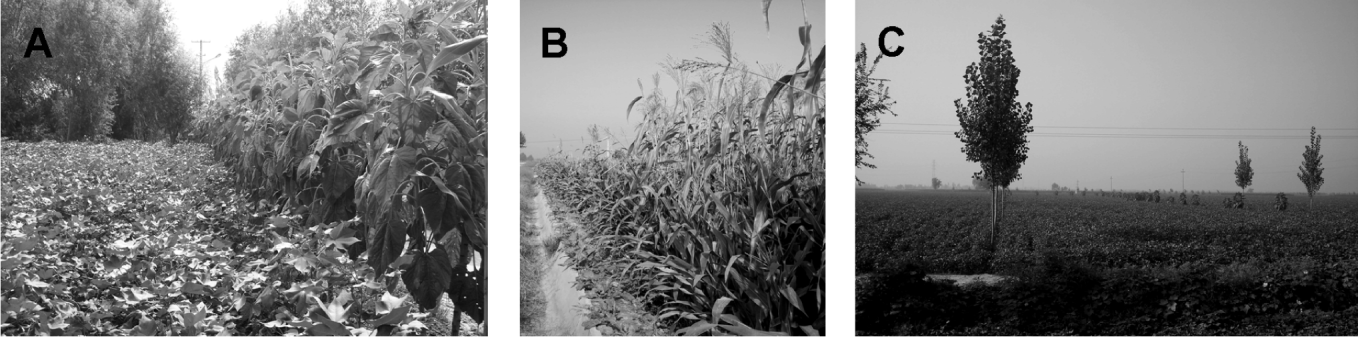
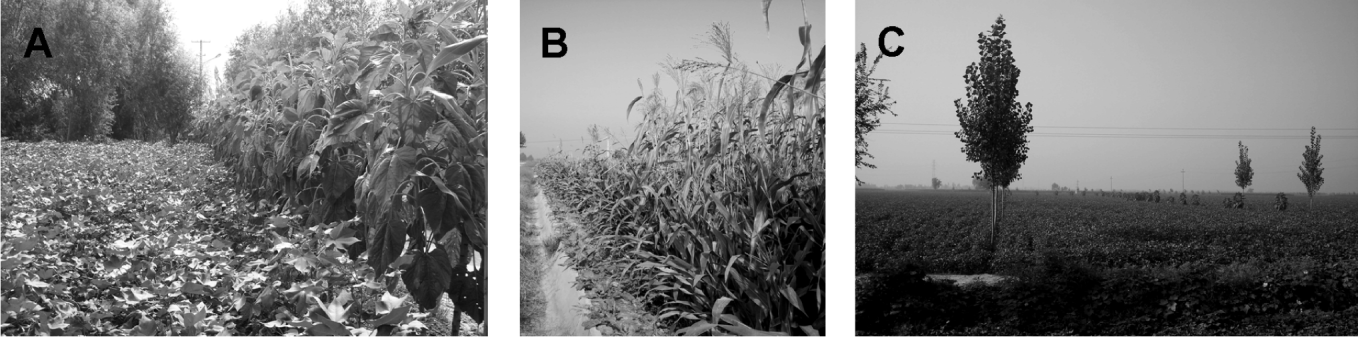
Field border intercropping (Fig. 4), the fencing of fields with various crops, is a common practice all over the region. The fencing crop indicates the boarder to the neighbors' fields in vast monocropping areas, while at the same time it supplies an additional food stock for home consumption.
Examples of field border intercropping. (A) Cotton field fenced by sunflower. (B) Maize field fenced by a row of millet and Chinese cabbage. (C) Cotton fields fenced by poplar and sunflower.
Agroforestry systems have increased tremendously in recent years (Fig. 5). The main reason is a government policy, which encourages farmers to plant 10–50 m strips of trees along all major roads throughout the country. The main goal is to counteract the deforestation of the past few decades and at the same time cover future timber demand. Farmers make use of the land between the trees for the next 2–3 years, until light absorption by the trees' canopies impedes satisfying yields of the understory crops. Similar practices can be observed in young orchards, where farmers plant vegetables in-between rows of fruit trees.
Examples of tree–crop intercropping systems. (A) Poplar with cotton and maize. (B) Poplar with various vegetables. (C) Cherry with cauliflower.

Vegetable intercropping systems
In the following section, two vegetable intercropping systems of southern Hebei province are described in detail. The two systems were selected as they are of growing importance, with the area under cultivation increasing steadily in recent years.
Chili–maize intercropping
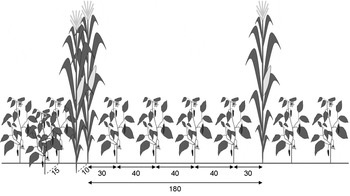
In the Cangzhou county (Cangzhou region), farmers intercrop chili with maize on approximately 750 ha. Chili seedlings are planted at a four-leaf stage into the plastic mulched soil in the beginning of April and harvested from the middle to the end of October. Maize is sown in May and harvested at the end of August. Irrigation is applied in spring according to demand. The system yields 4.5 tons of dried chili and 5 tons of maize cobs. Farmers report that pest and disease pressure are reduced in the intercropped chili, compared to the monocropped plants. High quality chili has to be free from the visible damage caused by pests and be unaffected by rotting or any other deterioration. Additionally, threshold values for pesticide residue concentrations have to be compiled. These standards are more easily fulfilled by the intercropped chili, which can thus generate higher returns. A sketch of the spatial arrangement in the field is given in Figure 6.
Spatial arrangement of chili–maize intercropping middle of August. Distances between plant rows and single plants, respectively, are given in centimeters.

Onion–cotton relay intercropping
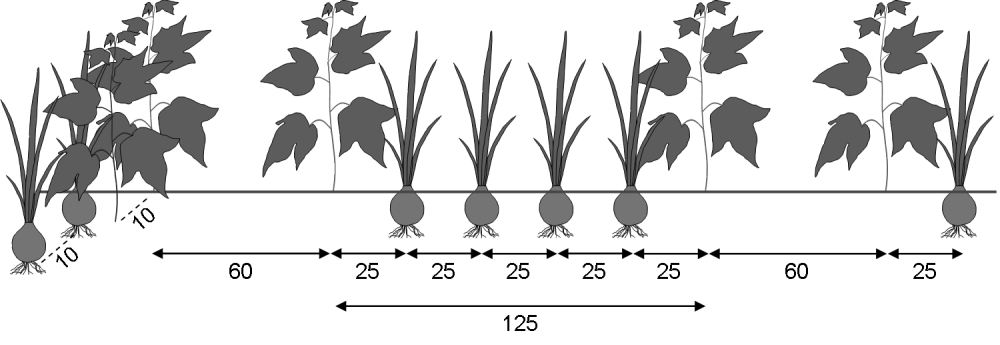
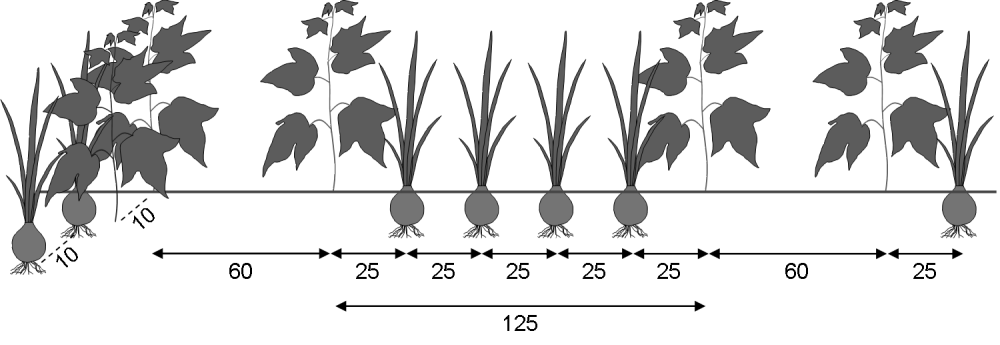
A vegetable-relay-intercropping system of onion–cotton is practiced in the Feixiang county (Handan region), comprising approximately 550 ha. Onion is planted in the middle of October and grown over winter. One month before the harvest of onion, around the 25th of April, cotton is sown directly in double rows between four rows of onion. For both crops plastic mulching is applied. Therefore, weed control measures are reduced to the crop-free strips. During winter, the low soil temperature in the unmulched cotton strip impedes severe weed infestation. In spring, the cotton strip is tilled by a hand hoe or two-wheel rotary tiller. This prepares the seedbed and at the same time emerging weeds are controlled. After the harvest of onion, cotton is grown in a monoculture. Before cotton canopy closure, mechanical weed control is repeated according to the demand. Cotton harvest starts in the middle of August and ends in the beginning of October. Farmers harvest approximately 8 tons of onion and 4.5 tons of seed cotton. A scheme of the spatial arrangement of this system is shown in Figure 7.
Spatial arrangements of onion–cotton relay intercropping just before harvest of onion, end of May. Distances between single rows and plants, respectively, are given in centimeters.
Farmers' motives
The most important factor that convinces farmers to practice intercropping is to make full use of space and thus achieve a higher income from their limited land resources, as stated by all interviewed farmers. In the case of the chili–maize system, ‘protection of vegetables by the maize’ plays the major role. Farmers experience reduced pest and disease pressure on chili in the intercropping system. They can produce higher quality (i.e., free of visual damage and lower pesticide residues), and at the same time reduce inputs for plant protection. The often stated advantage of intercropping ‘avoidance of crop failure’Reference Iqdal, Cheema and An37, Reference Rao and Willey38 was never mentioned by the interviewees. This might be due to two reasons. First, the farming structure in the region is already highly diversified. As a result of the small scattered land, farmers tend to cultivate different crops in different plots. Thus, the argument for intercropping, of being on the safe side in case of crop failure, is besides the point. Second, the supply and application of farming inputs, especially pesticides, fertilizer and irrigation water, is ensured and has steadily increased over the past few decades39. As a consequence, the risk of crop failure due to drought, lack of nutrients or pest and disease is negligible. Another strong argument for intercropping, its potential environmental benefit, is not considered by the Chinese farmers. Only very few farmers showed some awareness of connectivity between their cropping activities (use of pesticides, fertilizer and irrigation) and the possible effects on ground water and thus human health. However, all interviewed extension staff (and researchers) stated that intercropping has certain potential to counteract environmental pollution.
When talking about the drawbacks of intercropping, one has to distinguish between farmers experienced in intercropping and those who never practiced intercropping. A higher labor input required along with the inconvenience of management is reported by all farmers who practice intercropping. Sowing or planting of a second crop into an already established stand of another crop is difficult. Additionally, one has to be very cautious during harvest in systems with two crops of different harvest periods. In case of the onion–cotton relay intercropping, discussions with the local state extension service were ongoing on adjusting the system to enable mechanized mulching and sowing of cotton.
Farmers who so far had not been involved in intercropping stated a ‘lack of cash’ as one reason why they never practiced intercropping. Limited financial resources restricted the purchase of two kinds of seeds. The main reason, however, is that farmers simply had never heard of intercropping.
The factors influencing the distribution of intercropping can be summarized as follows. Pressure on land resources is highly influenced by the available land resources per farm household and the extent of off-farm income possibilities. Intercropping is more widespread in remote rural areas compared to suburban areas, where farm households can generate greater parts of their income in the non-agricultural sectors. Looking at the systems itself, the possibility of mechanization plays an important role, and, with the steadily increasing use of machineryReference Zhang, Wang, You and Liu4, will become a key issue for the future of intercropping in the region. Tradition and knowledge, along with that of the role of extension, also have a strong influence on the distribution.
Knowledge transfer
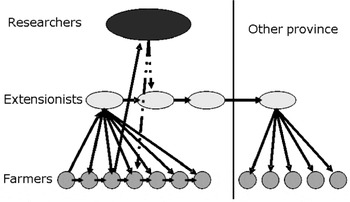
As reported in all examined cases, the intercropping systems have been developed by the farmers themselves or their ancestors. Successful systems are then picked up by neighbors, relatives and other farmers in the village. According to farmers and extensionists, the dissemination on a larger scale is accomplished by the state extension service. After testing and improving, promising systems are redistributed to farmers in the region and also passed on to other extension agents at regional and provincial levels. Due to its interesting features, various intercropping systems have been examined by agricultural researchers. However, generated knowledge is rarely reverted to the extension service or farmers directly (Fig. 8). Extension agents claim that researchers would not know about the farmers' problems and keep the results in their laboratories. On the other hand, researchers state that extension staff are often not well trained in the field of agriculture and should be re-educated. For the development and distribution of sustainable production systems, another fact has a crucial impact. The implementation of a series of self-sufficiency reforms encouraged the agricultural extension service to generate at least parts of their budgets through commercial activitiesReference Lu40. Employees of the state extension service are often involved in the trading of fertilizer, pesticides and other farm inputsReference Huang, Qiao, Zhang and Rozelle41. Therefore, their interest in promoting input-saving production systems such as intercropping is small. A wide adoption of such systems among farmers would decrease their sales and income directly.
Schematic description of knowledge transfer of intercropping in southern Hebei.

Future of intercropping
In the beginning of the 1990s, one-third of all grains in the North China Plain were produced in intercropping systemsReference Tong42. When comparing the observations in our survey, it becomes obvious that the intercropping area has been greatly reduced in the past two decades. The question arises, whether this trend is going to continue in the future and what are the reasons behind it. Therefore, we link the findings of the inquiry with the developments of the socio-economic frame conditions over the past few decades.
As discovered during the inquiry, the future potential of intercropping is perceived differently by farmers, extensionists and researchers. Farmers practicing intercropping are often very confident about their systems and predict that the area under cultivation is going to increase in the near future. On the contrary, a great share of the interviewed extensionists wonder whether intercropping as a traditional system can be combined successfully with the demands of modern agriculture. All researchers recognize the potential of intercropping as a more sustainable production system. However, skepticism prevails as to whether intercropping can be disseminated on a large scale.
Assessing the future developments regarding certain types of intercropping, we can say that the area of unconscious strip intercropping is going to reduce slowly but steadily. Between 1986 and 1990, the average plot size decreased from 0.08 to 0.07 haReference Dong34. However, since then, land consolidation has been put on the agenda and set as an urgent task in the ‘eleventh five year plan’ of the state council of the People's Republic of ChinaReference Dou, Chen, Jiang, Wang, Li and Zhang36. Even though radical changes in the land consolidation policy are unlikely to happen, especially with the current system of land allocation at the village levelReference Tan, Heerink and Qu35, land fragmentation is considered to reduce steadily in the next few decadesReference Wan43. As a consequence of larger fields, field border intercropping is also going to diminish.
The major driving force changing the agricultural production systems in Hebei and the whole of China is the increasing use of machinery. The number of agricultural tractors in Hebei province increased from 0.3 million in 1985 and 0.9 million in 1995 to 1.6 million in 2007Reference Zhang, Wang, You and Liu4. At the same time, the labor force in the agricultural sector and the dependency on income from agriculture is decreasing. In Hebei province, the number of agricultural laborers decreased from nearly 18 million in 1990 to less than 15 million in 2007Reference Zhang, Wang, You and Liu4. On a national basis, the share of income from agriculture fell from 82.4% in 1990 to 68.3% in 200544. As both trends are most likely to continue, systems that demand a large share of manual labor are going to diminish. Efforts are already underway to develop systems that maintain the advantages of intercropping in a mechanized system. Strip systems adjusted to the working width of the machinery in use might increase in the future. Certainly, vegetable production is less exposed to the pressure of mechanization, since in ‘modern’ agricultural systems a great share of vegetable production is still harvested by hand. Therefore, the arrangement of the vegetable component in intercropping systems is going to be less affected by this trend.
With the increasing opportunity costs for labor, the economics of intercropping systems in rural China have to be reconsidered. In the past, farmers hardly set any price for their invested labor. If the two-component crops in the intercropping system produced a higher yield compared to their monocropping equivalents, the system seemed more profitable to the farmer ignoring the increased input of labor. Nowadays, farmers are becoming more and more aware that higher labor input has to be overcompensated by a higher gross margin. Reduced pest and disease pressure not only reduces expenditures on pesticide inputs, but also offers the opportunity to receive a significantly higher sales price for higher quality produce, as is the case in the chili–maize system. Increased fertilizer and irrigation water use efficiency in intercroppingReference Alene and Hassan15, Reference Carrubba, la Torre, Saiano and Aiello16, Reference Zhang and Li24–Reference Gao, Duan, Sun, Li, Liu, Liu and Liu26 can contribute additionally to its profitabilityReference Alabi and Esobhawan45. This point becomes even more important with the ongoing advances in agricultural and environmental policy-making in China. The development of water pricing systemsReference Zhong and Mol46 and the establishment of payments for environmental services such as the ‘grain for green’ programReference Uchida, Xu and Rozelle47 could directly or indirectly increase the returns of intercropping systems.
Conclusions
A huge variety of sophisticated vegetable intercropping systems implemented by farmers was identified in southern Hebei province. Apart from the beneficial effects of plant health and product quality (chili–maize system), the fact that rural farm households often have to generate all income from their limited land resources explains the development and widespread practice of these labor-intensive intercropping systems. There is strong evidence that most traditional intercropping systems, which depend on high inputs of manual labor, are going to reduce steadily in the course of the economic development and increased mechanization of agriculture. Thus, the potential benefits that are connected with intercropping are also likely to disappear. To maintain intercropping and the associated potential to counteract environmental degradation, a new research approach has to be developed. After the first very important step of identifying the yield potential and positive effects of certain intercropping systems on the environmentReference Zhang and Li24–Reference Gao, Duan, Sun, Li, Liu, Liu and Liu26, research has to focus on the applicability of systems and its adjustment to future demands. Therefore, research should not only focus on one particular aspect of intercropping but also has to integrate multiple disciplinary perspectives. An agronomic and environmental assessment has to go along with the testing of appropriate machinery and economic evaluation of certain systems. Only systems that fit the farmers' requirements will be able to considerably benefit the environment. A transdisciplinary research approach, which involves farmers and the extension service right from the start, seems most promising in this context. Hence, improved communication between all stakeholders is a precondition. Finally, one important point that severely counteracts sustainable development in China's agricultural sector in general has to be revised. The dependency of extension agents on income from farm input sales has to be overcome, to create a real interest in input saving systems such as intercropping.
Acknowledgements
We want to thank the German Research Foundation (DFG) and the Ministry of Education of the People's Republic of China for their financial support (GRK 1070).