INTRODUCTION
In the context of protected areas, the assessment of visitor and tourist preferences for the biological attributes of such areas is important to raising awareness and supporting conservation (Di Minin et al. Reference Di Minin, Fraser, Slotow and MacMillan2013a; Skibins et al. Reference Skibins, Powell and Hallo2013). Although tourists are mainly interested in large, charismatic species (Leader-Williams & Dublin Reference Leader-Williams, Dublin, Entwistle and Dunstone2000; Veríssimo et al. Reference Veríssimo, Fraser, Groombridge, Bristol and MacMillan2009), they might also be interested in the ecological quality of protected areas (Cerda & Losada Reference Cerda and Losada2013), and might even be willing to pay to support specific conservation actions (Cerda et al. Reference Cerda, Ponce and Zappi2013b). If the preferences of tourists and visitors for the conservation of particular biological attributes of protected areas are to be used in the design of such areas’ conservation strategies, it will be necessary to attend to broader aspects of biodiversity than merely those of large charismatic species (Di Minin et al. Reference Di Minin, Fraser, Slotow and MacMillan2013b).
In many protected areas of the world with high conservation values, less charismatic species, such as insects and plants, comprise most of the biodiversity and are essential for ecosystem functioning (Martín-López et al. Reference Martín-López, Montes and Benayas2007). Negative impacts on less charismatic species might represent a relatively greater ecological threat because these species may have greater biological significance to the ecosystem (Martín-López et al. Reference Martín-López, Montes and Benayas2007; Ressurreição et al. Reference Ressurreição, Gibbons, Dentinho, Kaiser, Santos and Edwards-Jones2011). However, this part of biodiversity has traditionally received a low proportion of conservation funds (Zamin et al. Reference Zamin, Baillie, Miller, Rodríguez, Ardid and Collen2010). Therefore, positive tourist preferences towards less charismatic biodiversity might represent an opportunity to raise funds. This role requires wider assessments that incorporate a broader variety of biological attributes of protected areas, including less charismatic biodiversity and even species that are not threatened (Martín-López et al. Reference Martín-López, Montes and Benayas2007). In addition to biodiversity, wider assessments may also analyse visitors’ preferences for maintaining pristine landscapes (Cerda et al. Reference Cerda, Barkmann and Marggraf2014). Integrating visitors’ preferences for landscapes in making conservation decisions can contribute to promoting win–win results for both biodiversity conservation and human well-being (Hausmann et al. Reference Hausmann, Slotow, Fraser and Di Minin2017: 92).
Particularly in research related to terrestrial protected areas, few studies (e.g. Cerda et al. Reference Cerda, Barkmann and Marggraf2013a, Reference Cerda, Ponce and Zappi2013b; Hausmann et al. Reference Hausmann, Slotow, Fraser and Di Minin2017) have provided a comprehensive overview of the preferences that visitors express for these areas’ diverse biological attributes. Previous research has explored tourists’ preferences, especially for charismatic animals (birds, Veríssimo et al. Reference Veríssimo, Fraser, Groombridge, Bristol and MacMillan2009; large-bodied mammals, Di Minin et al. Reference Di Minin, Fraser, Slotow and MacMillan2013a). Broader assessments have analysed tourists’ preferences for less charismatic organisms, such as amphibians, insects, reptiles and vegetation (Cerda et al. Reference Cerda, Ponce and Zappi2013b; Hausmann et al. Reference Hausmann, Slotow, Fraser and Di Minin2017), and a sense of wilderness (Hausmann et al. Reference Hausmann, Slotow, Fraser and Di Minin2017). People may express positive preferences for a broad range of biological attributes, including less popular biodiversity (Cerda et al. Reference Cerda, Ponce and Zappi2013b; Hausmann et al. Reference Hausmann, Slotow, Fraser and Di Minin2017). Cerda and Losada (Reference Cerda and Losada2013) found that visitors also value basic tourist infrastructure for maintaining areas’ pristine landscapes. These results highlight the need to incorporate the diverse biological attributes of protected areas into the assessment of visitors’ preferences.
In this study, we explored the financial contribution that visitors are willing to make to protect both well-known and lesser-known mammals, birds, amphibians, reptiles, pollinating insects (arthropods), succulents (cacti of genus Copiapoa and Eriosyce), woody shrubs, pristine landscapes and soil quality in the Llanos de Challe National Park, a protected area located in the biodiversity hotspot of the Atacama Desert in Chile. The intrinsic value of the Atacama Desert's plant and animal communities lies in the unique nature of their composition, high levels of endemism and some species’ remarkable adaptation for survival in some of the world's most demanding conditions.
Pollinating insects are key to the manifestation of a flowering desert, which is a phenomenon of worldwide interest (Cerda & De la Maza Reference Cerda and De la Maza2015). Soil is a fragile element of the park (Cerda & De la Maza Reference Cerda and De la Maza2015), and the Cactaceae family requires urgent conservation action in Chile (Larridon et al. Reference Larridon, Shaw, Cisternas, Paizanni Guillén, Sharrock, Oldfield, Goetghebeur and Samain2014). The distribution area of many Chilean cacti holds one of the world's greatest deposits of copper, which has been exploited by a steadily growing mining industry since the 1980s (Duarte et al. Reference Duarte, Guerrero, Carvallo and Bustamante2014). Woody shrubs contribute to maintaining both the biological diversity and the physical integrity of desert ecosystems (Jorquera-Jaramillo Reference Jorquera-Jaramillo, Squeo, Arancio and Gutiérrez2008), preventing and reducing soil erosion.
We built on previous findings of tourists’ and visitors’ preferences for ecosystem attributes (Cerda & Losada Reference Cerda and Losada2013; Cerda et al. Reference Cerda, Barkmann and Marggraf2013a; Hausmann et al. Reference Hausmann, Slotow, Fraser and Di Minin2017) by filling an information gap in visitors’ preferences for a broad spectrum of biological attributes in protected areas (Ressurreição et al. Reference Ressurreição, Gibbons, Dentinho, Kaiser, Santos and Edwards-Jones2011; Hausmann et al. Reference Hausmann, Slotow, Fraser and Di Minin2017). This was done by conducting a choice experiment (CE) (Bateman et al. Reference Bateman, Carson, Day, Hanemann, Hanley, Hett, Jones-Lee, Loomes, Mourato, Özdemiroglu and Pearce2002; Hensher et al. Reference Hensher, Rose and Greene2005; Carson & Louviere Reference Carson and Louviere2011) to evaluate which attributes are more important for visitors to protect. With the CE, we estimated the willingness to pay (WTP) of visitors for ecosystem attributes. Techniques that assess the WTP of people for biodiversity conservation are broadly used to inform conservation policy decision making (Bateman et al. Reference Bateman, Carson, Day, Hanemann, Hanley, Hett, Jones-Lee, Loomes, Mourato, Özdemiroglu and Pearce2002). In addition, we aimed to inform decisions regarding park conservation by suggesting not only which attributes are likely to attract funds for conservation, but also which might be useful for increasing awareness of conservation. Our approach may be relevant to protected areas of the world with high conservation values, little funding and a lack of large, charismatic species.
MATERIALS AND METHODS
Study area
The Llanos de Challe National Park covers 457.08 km2 of the Atacama Desert and contains 206 species of native flora. Cacti are a dominant floristic element of the Park and most species are threatened by the mining industry (Larridon et al. Reference Larridon, Shaw, Cisternas, Paizanni Guillén, Sharrock, Oldfield, Goetghebeur and Samain2014).
The main threats to the Park are the presence of stray dogs inside the area that threaten populations of guanacos (Lama guanicoe), the environmental impacts of public highways, mining and inappropriate practices, such as fishing and hunting by some surrounding communities. The location of the Park is presented in Supplementary Material S1 (available online).
Choice experiment
Stated preference methods allow for the assessment of visitor economic preferences for nature conservation by directly asking individuals about their WTP for the protection of natural attributes (Bateman et al. Reference Bateman, Carson, Day, Hanemann, Hanley, Hett, Jones-Lee, Loomes, Mourato, Özdemiroglu and Pearce2002). CEs are well known for this purpose (Bateman et al. Reference Bateman, Carson, Day, Hanemann, Hanley, Hett, Jones-Lee, Loomes, Mourato, Özdemiroglu and Pearce2002; Hensher et al. Reference Hensher, Rose and Greene2005; Carson & Louviere Reference Carson and Louviere2011). CEs involve asking individuals to state their choices over sets of hypothetical alternatives. Each choice is described by several characteristics, known as attributes (Carson & Louviere Reference Carson and Louviere2011). By defining one of these attributes as a cost attribute, marginal WTP estimates for the changes in attribute levels can be calculated (Hensher et al. Reference Hensher, Rose and Greene2005).
In this study, seven attributes were selected based on the Park's ecological complexity. The attributes were presented to the respondents as outcomes of a governmental programme based on the implementation of the Strategic Development Plan for protected areas of the Atacama (Cerda et al. Reference Cerda, Barkmann and Marggraf2014).
The following CE attributes were selected.
Mammals
To select mammals, we considered conservation status, whether a mammal has a recognized ecological role in the literature and whether it has a documented special meaning to or considerable impact on humans. We also assumed that some species would be well known to visitors, whereas others would be less well known. In the well-known group, we included the guanaco (L. guanicoe), the chilla (Pseudalopex griseus) and the culpeo fox (Pseudalopex culpaeus). The guanaco was considered well known because its conservation is intensively promoted through awareness campaigns in Atacama and it is a regional icon (González et al. Reference González, Palma, Zapata and Marín2006). Foxes are highly valued by visitors to protected areas in Chile (Cerda & Losada Reference Cerda and Losada2013). In the lesser-known group, we focused on the marsupial elegant fat-tailed mouse opossum (Thylamys elegans), the pampas cat (Leopardus colocolo) and Darwin's leaf-eared mouse (Phyllotis darwini). We assumed that these species are less well known because it is rare that visitors will see them in the Park.
Each species was included with an attribute level. The status quo was presented as the current research that is focused on a few species. We explained to the respondents that although some research at the species level was being conducted in the Park at the time of the study, additional research efforts are necessary to improve the management of the Park, even for the species for which scientific data already exist. The species were presented simultaneously through images that were carefully selected. When presenting the images, we explained that the Park hosts different species, that some of these species are more cryptic than others and that some of them present more serious conservation problems than others. The selected species and their conservation status, ecological roles and impacts on humans are provided in Supplementary Material S2.
Guaranteed protection of soil
Due to the inherent differences in landscape, climate and plant and animal life between the coastal and interior areas of the Park, we divided the study area in two zones (i.e. coastal and interior), as in some previous studies (Domínguez-Torreiro & Soliño Reference Domínguez-Torreiro and Soliño2011). Two zones were used just for the soil attribute. Tourist activities are concentrated in the coastal area close to the beach. Due to their ecological fragility (Espinosa et al. Reference Espinosa, Cepeda, Louit, Meléndez and González-Maya2014), the interior areas (also called aguadas) are less visited and usually more controlled by Park rangers because they represent wetland-type ecosystems inside the Park that are important to the conservation of the ecological interactions in the area (Espinosa et al. Reference Espinosa, Cepeda, Louit, Meléndez and González-Maya2014). We adopted the concept of soil quality, defined as the soil's capacity to function in terms of maintaining productivity, storing and cycling nutrients, regulating and partitioning water flow and filtering, and buffering and detoxifying organic and inorganic materials (Karlen Reference Karlen, Wall, Bardgett, Behan-Pelletier, Herrick, Helfin Jones, Ritz, Six, Strong and van der Putten2012). Thus, we explained to the respondents that this idea implicates the soil's ability to function as a vital system in an ecosystem that not only contains animals and plants, but also maintains and improves air and water quality (Karlen Reference Karlen, Wall, Bardgett, Behan-Pelletier, Herrick, Helfin Jones, Ritz, Six, Strong and van der Putten2012). We proposed to visitors the continuous monitoring of soil quality in the coastal area, because the increasing tourist impact could affect the quality of the soil in public use areas and the aguadas of the Park, because economic activities surrounding the area, such as mining, could affect soil quality inside the Park. Images of both sections of the Park were presented to the respondents.
To present the status quo, we explained to respondents that the current lack of soil quality monitoring does not guarantee the soil's quality over the long term.
Other animals and plants
Different bird species were incorporated and classified into the three groups of interior birds (scavenger raptors), interior birds (passerine raptors) and shorebirds. Each group of birds was considered to be an attribute level.
We also included amphibians, reptiles and pollinating insects (arthropods). Each group was considered to be an attribute level. The knowledge gap and the insufficiency of the research with regards to these species were presented as the status quo. The three classes were presented simultaneously to the respondents. We explained that the Park managers were assessing the possibility of researching these other animals and that it is relevant to know the opinions of Park users. To present these attributes, we used images of the exemplary species of each class that are present in the Park.
For the valuation of the plants within the choice alternatives, we selected cacti and shrubs; each type was included as an attribute level. The status quo was presented as the existing research on plants being insufficient to improve Park management.
Maintenance of the pristine landscape
The increase in the number of visitors increases the need for additional infrastructure, which can affect both the pristine nature of the landscape and the feeling of being in a pristine landscape. This attribute was operationalized dichotomously into two levels, with ‘yes’ indicating the maintenance of the current tourism development over the long term (i.e. no additional infrastructure or improvements to the existing infrastructure) and ‘no’ indicating an additional 25% of tourist infrastructure development, such as adding several camping sites in the coastal area of the Park. We also explained that more visitors will positively affect the economic revenue of the Park.
Cost of implementing the alternatives
Other studies consider donations per year or once in a lifetime, but Chileans are used to committing themselves to monthly donations. Hence, we designed a voluntary payment per month over 5 years, as in some other studies (e.g. Loomis et al. Reference Loomis, Kent, Strange, Fausch and Covich2000). A voluntary donation was selected because taxes are centralized in Chile, and their distribution towards regional needs cannot be ensured (Barrena et al. Reference Barrena, Nahuelhual, Báez, Schiappacasse and Cerda2014).
We explained that to implement the presented alternatives, financial support is required, and the National Forest Corporation of the Region of Atacama has developed a proposal to establish the Atacama Protected Areas Fund, part of which will be earmarked for the Llanos de Challe National Park. The cost of the attribute had nine levels ranging from US$4 to US$20 per month. We explained to the respondents that both the funding and the fulfilment of their objectives would be evaluated after 5 years in order to design long-term strategies.
The pairwise comparisons of the alternative park management situations (64 in total) that are composed of the attributes and levels were obtained following Louviere et al. (Reference Louviere, Hensher and Swait2000) and Hensher et al. (Reference Hensher, Rose and Greene2005). The situations were randomly blocked into eight different questionnaire versions (eight choice sets per block). An example of a choice set is presented in Supplementary Material S3.
Questionnaire structure, contents and pilot
The questionnaire first explained the objective of the study, then each attribute and its levels. Photographs of the involved species in the study and Park landscapes were used (Van Riper et al. Reference Van Riper, Manning, Monz and Goonan2011).
The third section allowed examination of the choice sets, after which we asked visitors to select which of the attributes was the most important and to explain why. This information was collected using an open question (results are presented in Supplementary Material S5).
The fourth section contained sociodemographic questions. Finally, we asked for the visitors’ specific interests in visiting the Park, the activities that they performed in the area and their thoughts concerning the role of the Park. Using a five-point Likert scale, we also asked the respondents how sure they were that they would truly pay the stated amount if the hypothetical alternatives would be implemented.
A pilot study was conducted with 100 Park visitors at the end of 2012 to verify the study's viability. The main questionnaire was distributed among Chilean visitors inside the Park between January and March 2013. We did not interview foreign visitors because only Chileans were found at the time of the interview, and foreign visitors are extremely rare in this area. The sample was selected randomly in the public use area of the Park, which is a coastal boardwalk with access to the beach that concentrates all of the visitors to the Park. The sample was conducted to be representative of the population of visitors who visited the area. Visitors older than 18 years of age and who had an income were interviewed (Cerda et al. Reference Cerda, Ponce and Zappi2013b). The average time to complete the questionnaire was approximately 25 minutes per visitor. A total of 504 questionnaires were collected, of which 493 were used in the final statistical analysis.
Econometric analysis and estimation of WTP
To analyse the choice data, we estimated a random parameters logit (RPL) model (Hensher et al. Reference Hensher, Rose and Greene2005). A maximum likelihood estimation of the model parameters was conducted by using 500 Halton draws in LIMDEP/NLogit 9.0. An alternative-specific constant (ASC) was coded as 1 for the non-status quo options of A and B and as 0 for the status quo option. Eight socioeconomic variables (age, sex, income, number of children, years of education, rural–urban respondent, region of residence and probability of real payment) were introduced into the model as interaction terms with the ASC to test for their influences on choice (Bateman et al. Reference Bateman, Carson, Day, Hanemann, Hanley, Hett, Jones-Lee, Loomes, Mourato, Özdemiroglu and Pearce2002; Hensher et al. Reference Hensher, Rose and Greene2005). The participants’ interests in visiting the Park and their perceptions of the role of the Park were also evaluated by using the ASC to detect the influence of these factors on choice (Bateman et al. Reference Bateman, Carson, Day, Hanemann, Hanley, Hett, Jones-Lee, Loomes, Mourato, Özdemiroglu and Pearce2002).
The attributes were assessed by using dummy codes to derive point estimates of the utility of each attribute level (Bateman et al. Reference Bateman, Carson, Day, Hanemann, Hanley, Hett, Jones-Lee, Loomes, Mourato, Özdemiroglu and Pearce2002; Hensher et al. Reference Hensher, Rose and Greene2005), for which we assumed a 0 value for the status quo condition. The cost attribute was entered into the model as a continuous variable by using the actual attribute levels. For the RPL model, we assigned parameterized normal distributions to all of the attribute levels, except cost, which was fixed (Hensher et al. Reference Hensher, Rose and Greene2005). For the attribute levels, we assumed normally distributed parameters because the respondents may like or dislike an attribute level (Bateman et al. Reference Bateman, Carson, Day, Hanemann, Hanley, Hett, Jones-Lee, Loomes, Mourato, Özdemiroglu and Pearce2002). Standard χ 2 statistic and McFadden pseudo-R 2 values were used to test the overall significance and goodness of fit of the model (Hensher et al. Reference Hensher, Rose and Greene2005). Measures of the WTP for specific attribute levels were calculated as the ratio of the attribute-level parameter to the costs (Hensher et al. Reference Hensher, Rose and Greene2005). Using parametric bootstrapping (Krinsky & Robb Reference Krinsky and Robb1986), we estimated a distribution of 10,000 observations for each WTP estimate.
RESULTS
Sample characteristics
The most common groups were young (18–30 years old; n = 265; 54%), middle-aged (31–41 years old; n = 123; 25%) and highly educated people (technical or university studies; n = 439; 89%). Individual monthly income was variable among the respondents (mean income = US$1050/month). A total of 281 respondents (57%) stated that they were sure or very sure of paying for the chosen alternatives in the CE. Some 473 respondents (96%) were from Chile's urban areas; 409 respondents (83%) associated the role of the Park with biodiversity and 83 (17%) with tourism. The socioeconomic characteristics of the sample from Llanos de Challe National Park are summarized in Supplementary Material S4.
Econometric results
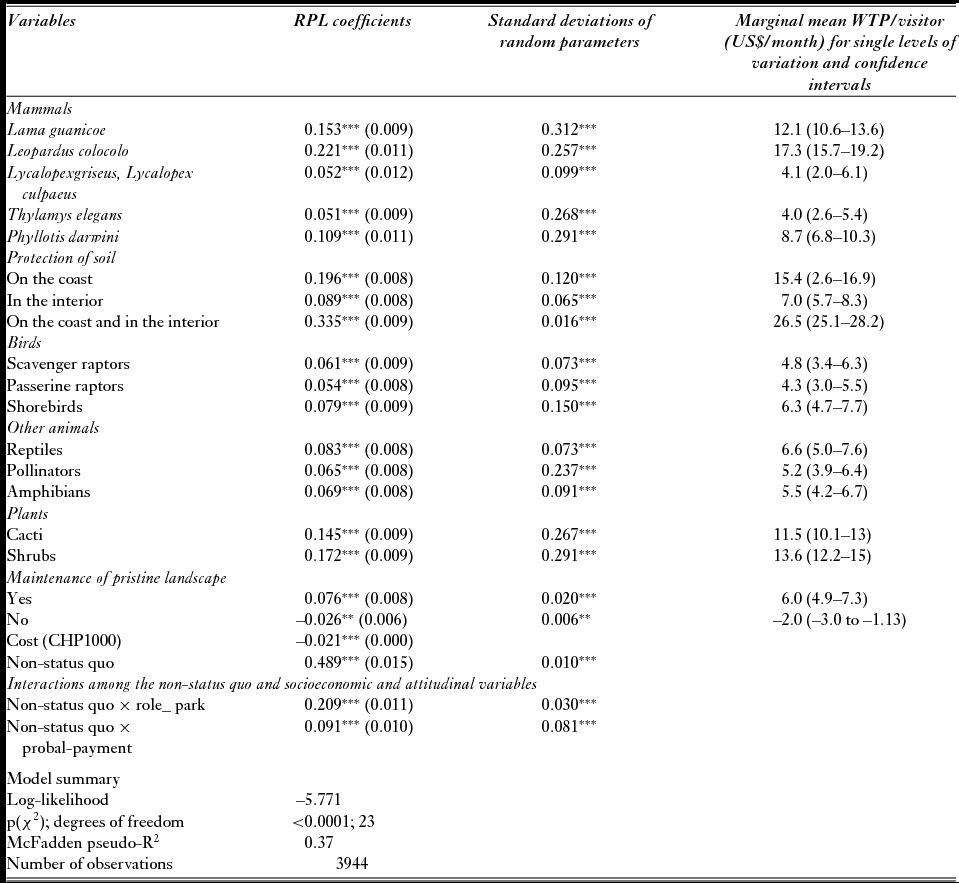
The model presented in Table 1 was highly significant (p < 0.0001; McFadden pseudo-R 2 = 0.37). The standard deviations of the coefficients were significant at the 95% level, which suggests substantial random heterogeneity in preferences. All the attributes and attribute levels were significant (p < 0.001), and the model showed the expected signs for the coefficients of the attribute levels. A positive WTP for less-valued components, such as reptiles, amphibians, pollinating insects, plants and soil, emerged from the results.
Random parameters logit (RPL) model estimations (standard errors in parentheses) and willingness to pay (WTP) values (Krinsky and Robb's (Reference Krinsky and Robb1986) 95% confidence intervals in parentheses). Cost coefficients for 1000 Chilean Pesos (CHP). ***p < 0.001; **p < 0.01.

Among mammals, the respondents showed the highest preference for the pampas cat (L. colocolo) and guanaco (L. guanicoe), with mean WTP values of US$17.3 and US$12.1, respectively (Table 1). The lesser-known popular elegant fat-tailed mouse opossum (T. elegans) received the lowest mean WTP of US$4, and the Darwin's leaf-eared mouse (T. darwini) mean WTP was US$8.7. Among birds, participants were more interested in supporting research on shorebirds (mean WTP US$6.3), although they were also willing to pay to support research on birds occurring in the interior areas of the Park. The mean WTP for reptiles was the highest of the other animals, reaching US$6.6. The mean plant WTP was the highest for shrubs (WTP US$13.6). There was large WTP for soil quality (mean WTP US$26.5), but respondents had a greater WTP for preserving the soil quality in the coastal area (mean WTP US$15.4) than in the interior (mean WTP US$7.0).
Visitors were willing to pay a positive mean amount of US$6 in order to maintain the pristine landscape. Changes in the pristine landscape caused by increases in tourist infrastructure had a negative mean WTP of US$2.0.
The interactions among the ASC and socioeconomic and attitudinal characteristics that were not significant at the 95% level were dropped from the final model. In the end, only the variables ‘role of the Park’ and ‘probability of real payment’ were significant in both models and therefore impacted choice. The positive sign of the interaction between the ASC and the ‘role of the Park’ variable indicates that the visitors who consider the role of the Park to be biological diversity conservation will be more likely to move from the status quo to an alternative conservation management option. In addition, when the respondents felt more certain that they could pay the cost of the offered options, they more positively valued the choice of an offered alternative. Other motivations are presented in Supplementary Material S5.
DISCUSSION
Visitors placed economic value on multiple attributes beyond recreational services and well-known species, and they valued the ecological characteristics of the ecosystem. Similar to other studies (Cerda & Losada Reference Cerda and Losada2013), the visitors were interested in high ecological quality and would favour a strong biodiversity conservation scenario for the Park. This is important at a global level and evidences ecotourism's potentially real support for biodiversity conservation. The higher value placed on ecosystems when multiple rather than charismatic single species are protected is corroborated by other studies of national park visitors in Latin America (Cerda & Losada Reference Cerda and Losada2013; Cerda et al. Reference Cerda, Barkmann and Marggraf2014).
Because this study included not only particular species and classes, but also other ecosystem components, such as soil quality and landscape, comparisons that are used to infer preference rankings must be performed with caution. Nevertheless, some pertinent aspects emerge. Among mammals, we found that there was no great bias towards well-known charismatic mammals. On the contrary, previous research (e.g. Maciejewski & Kerley Reference Maciejewski and Kerley2014) found that larger and charismatic species of animals contributed more to tourist satisfaction than did smaller species.
Indeed, the support for Darwin's leaf-eared mouse was stronger than the WTP for the charismatic well-known foxes. We expected that the guanaco would have a large WTP because it is an icon of the Atacama Desert (González et al. Reference González, Palma, Zapata and Marín2006); however, its WTP was lower than the WTP for the pampas cat, although the latter was unknown to the visitors. The CE's combinatorial design might have caused the financial support for some species to decrease because of budget constraints (Tisdell & Wilson Reference Tisdell and Wilson2006), but the arguments given by the visitors during the interview regarding the attributes (Supplementary Material S5) support the explanation that the decision to allocate funds might also be affected by ethical and ecological considerations (Kotchen & Reiling Reference Kotchen and Reiling2000; Cerda et al. Reference Cerda, Barkmann and Marggraf2013a, Reference Cerda, Barkmann and Marggraf2014). Based on our results, there is demand to protect an endemic rodent and a marsupial about which the respondents knew nothing, thus suggesting that there is public demand to conserve less well-known species. Visitors’ actual quotations such as “all these species that we do not see are in the Park and must be protected” indicate existence values (i.e. the utility that people derive from knowing of the existence of such species) for obscure or previously unknown wildlife species (Krutilla Reference Krutilla1967). The argument that “species present conservation problems” and that “they suffer from fragility, vulnerability, risk of being killed by people” might indicate a sense of moral obligation of respondents to protect these species (Cerda et al. Reference Cerda, Barkmann and Marggraf2013a). The argument that “there are few in Chile” might indicate a worry about species population sizes. People also derive satisfaction from knowing that a particular species has a sustainable population in its native habitat (Loomis & White Reference Loomis and White1996).
The type of ecosystem that is valued might also affect the valuation process. Here, the WTP for birds did not substantially differ from the WTP for some lesser-known mammals, amphibians, reptiles or pollinating insects. However, in an area of Chile protected for Nothofagus forests, Chilean visitors’ highest WTP was for birds (Cerda & De la Maza Reference Cerda and De la Maza2015). One possible explanation for this difference is that in desert ecosystems, contact with terrestrial mammals, amphibians, reptiles and even insects and plants might be more significant than bird watching. Our results differ from studies that found that birds received some of the highest social preferences for protection (Martín-López et al. Reference Martín-López, Montes and Benayas2007). Here, cacti and shrubs received a substantial positive WTP, whereas other studies have found that people are more interested in animals than in plants (Martín-López et al. Reference Martín-López, Montes and Benayas2007). Our results indicate that this pattern might differ depending on which ecosystem is being perceived and which type of vegetation is being valued. Visitors direct quotations such as “they are specific to this site,” “they are ecologically relevant in the desert,” “they are unique and fragile” and “they contribute to the beauty of the desert” indicate that the valued plants are important cultural components of the desert ecosystem landscape and are fragile attributes in a place devoid of vegetation. In our case, the degree of attachment to the study site was possibly a stronger driver of valuation than the level of income or education (Ressurreição et al. Reference Ressurreição, Gibbons, Dentinho, Kaiser, Santos and Edwards-Jones2011).
The large positive WTP for monitoring soil quality maintenance was underpinned by respondents’ arguments such as “soil is life sustaining,” “soils provide food for animals and plants” and “soils are important for the ecological equilibrium,” evidently capturing the perceived functional value of the ecosystem.
Visitors were also unwilling to accept additional tourism infrastructure in the Park and favoured the pristine landscape. This result is relevant for conservation policies both inside the Park and in the surrounding areas because it raises the possibility of developing tourism infrastructure outside the Park.
Although we did not interview conservation professionals, visitor preferences are aligned with scientific reasoning about specific attributes to be protected in the Park (e.g. Duarte et al. Reference Duarte, Guerrero, Carvallo and Bustamante2014; Espinosa et al. Reference Espinosa, Cepeda, Louit, Meléndez and González-Maya2014), thus raising the possibility of integrating insights from both groups of actors in the design and implementation of conservation strategies.
We have empirically demonstrated that Chilean visitors would be willing to pay to protect nature, and this willingness is motivated not only by well-known species, but also by lesser-known species, and includes maintaining both the pristine landscape and the soil quality. On a local scale, the WTP values set by the visitors might be useful for identifying which of the Park's features are more likely to raise funds for conservation and expanding awareness efforts, which have traditionally focused on the guanaco, to other equally environmentally relevant attributes (Espinosa et al. Reference Espinosa, Cepeda, Louit, Meléndez and González-Maya2014), where the probability of social acceptance would be positive given the results of this study.
With new empirical results from a globally relevant desert ecosystem, we contribute to the literature on tourists’ preferences for biodiversity conservation. Hausmann et al. (Reference Hausmann, Slotow, Fraser and Di Minin2017) warn of the need to expand the assessment of tourists’ preferences to include more diverse attributes of protected areas, given that many of the world's protected areas present high conservation values but lack charismatic species. Our methodological approach may be relevant to protected areas elsewhere that conserve a broad variety of ecologically fragile attributes, have a low scale of tourism development and simultaneously confront important threats posed by economic development and lack of funding. Visitors’ WTP for the conservation of such areas suggests that they are relevant actors that should be included in strategies for obtaining monetary resources.
We are aware that only in-country visitors were interviewed. It is likely that the attributes are better understood by Chileans than by foreign tourists. Thus, the use of our findings in other regions of the world must be implemented with caution. A general tendency is that tourists have narrow viewing preferences for charismatic species that may limit the potential to conserve less well-known biodiversity (Leader-Williams & Dublin Reference Leader-Williams, Dublin, Entwistle and Dunstone2000). Our findings should be complemented with in-depth analysis of foreign tourists’ preferences for unique environmental aspects of protected areas in Chile in order to determine the level of international support and to protect a broad spectrum of biological attributes.
The demographics of our participants also deserve consideration. Notably, 75% of our sample population was under age of 41, and 50% earned low incomes. The general trend worldwide is that ecotourists and nature-based tourists are older and earn high incomes (Buffa Reference Buffa2015). Research exploring the young segment of tourist demand is increasing (Pendergast Reference Pendergast, Benckendorff, Moscardo and Pendergast2010) and has emerged as an interesting area of study for increasing knowledge regarding the interest of this group in biodiversity conservation.
Divergences between park visitors and other interest groups (e.g. local communities) are not new (Loomis & Larson Reference Loomis and Larson1994; Hartter et al. Reference Hartter, Solomon, Ryan, Jacobson and Goldman2014). In our case, local communities that surround the area, such as fishermen and kelp collectors, may show divergent interests with tourists in the Park because of the immediate extractive character of their activities. Thus, understanding how the local people value the area is also critical to successful conservation policies, and we are aware that we are providing only a part of the complete image of social preferences. Future efforts will assess the preferences of the surrounding communities.
Future research should also explore heterogeneity in the demand for broader biodiversity by using split samples of visitors, focusing either on well-known species or on a broader spectrum of species.
CONCLUSION
Visitors to an Atacama Desert park stated WTP for well-known and lesser-known species; moreover, they are willing to pay for maintaining both the pristine landscape and the soil quality.
These results are relevant to conservation actions that are strongly influenced by economic interests. Providing opportunities to the visitors of protected areas to perform behaviours that conserve multiple natural attributes can effectively contribute to the development of conservation policies in protected areas. Conservation studies from Latin America will help to provide an opportunity to demonstrate to the leaders of less-developed and developing countries where biodiversity is threatened by land-use conversion and productive activities that conserving ecosystems is important.
ACKNOWLEDGEMENTS
We thank the park rangers Isla Troncoso, Leoncio Paredes, Alberto Villegas, Sergio Araya and Pedro Salazar for their essential support. We also thank the Chilean Forest Corporation (CONAF) for authorizing and supporting our research.
FINANCIAL SUPPORT
Funding was provided by the Native Forest Research Fund, Project 0029/2012.
ETHICAL STANDARDS
The authors assert that all procedures contributing to this work comply with applicable national and institutional ethical guidelines on the care of humans.
Supplementary material
To view supplementary material for this article, please visit https://doi.org/10.1017/S0376892917000200