Introduction
Trematodes are major components of aquatic ecosystems and thought to be important for ecosystem function (Kuris et al., Reference Kuris, Hechinger and Shaw2008; Morley, Reference Morley2012). The complex life cycles of trematodes, which include at least one intermediate and one definitive host, have a high ecological significance, because, in many instances, they can impact the population size of critical species in food webs, which, in turn, influences ecosystem dynamics (Gordon & Rau, Reference Gordon and Rau1982; Lafferty et al., Reference Lafferty, Dobson and Kuris2006; Bullard & Overstreet, Reference Bullard, Overstreet, Eiras, Segnar, Wahli and Kapoor2008). However, we are still far from understanding properly how environmental forcings affect trematode transmission dynamics, especially in tropical latitudes. The wealth of publications dealing with trematode transmission dynamic aspects refer to their life cycles, and most studies are confined to the analysis of seasonal dynamics of infection in either intermediate or definitive hosts. Most of this literature comes from temperate and subtropical latitudes emphasizing the role of temperature as one of the main environmental forcings driving the infection levels of both larval and adult stages of trematodes (e.g. Chubb, Reference Chubb1979 (and references therein); Hughes & Answer, Reference Hughes and Answer1982; Galaktionov, Reference Galaktionov1992; Kube et al., Reference Kube, Kube and Bick2002; Jiménez-Garcia & Vidal-Martínez, Reference Jiménez-García and Vidal-Martínez2005; Galaktionov et al., Reference Galaktionov, Irwin, Prokofiev, Saville, Nikolaev and Levakin2006; Fermer et al., Reference Fermer, Culloty, Kelly and O'Riordan2010). The few extant long-term studies on trematode infections have suggested that the infection-level fluctuation has an association with several factors, such as the life span of the hosts (Fernandez & Esch, Reference Fernandez and Esch1991a, Reference Fernandez and Eschb; Snyder & Esch, Reference Snyder and Esch1993; Loy & Haas, Reference Loy and Haas2001; Klockars et al., Reference Klockars, Huffman and Fried2007; Faltynková et al., Reference Faltynková, Valtonen and Karvonen2008), temporal heterogeneity of host abundance (Fernandez & Esch, Reference Fernandez and Esch1991a, Reference Fernandez and Eschb; Snyder & Esch, Reference Snyder and Esch1993; Mouritsen et al., Reference Mouritsen, Jensen and Jensen1997; Granovitch et al., Reference Granovitch, Sergievsky and Sokolova2000; Levakin et al., Reference Levakin, Nikolaev and Galaktionov2013), eutrophication (Hofmann et al., Reference Hofmann, Blasco-Costa, Knudsen, Matthaei, Valois and Lange2016), variations in rainfall (Pech et al., Reference Pech, Aguirre-Macedo, Lewis and Vidal-Martínez2011; Vidal-Martínez et al., Reference Vidal-Martínez, Pal, Aguirre-Macedo, May-Tec and Lewis2014; Namsanor et al., Reference Namsanor, Sithithaworn, Kopolrat, Kiatsopit, Pitaksakulrat, Tesana, Andrews and Petney2015) and water temperature patterns (Vidal-Martínez et al., Reference Vidal-Martínez, Pal, Aguirre-Macedo, May-Tec and Lewis2014; Zemmer et al., Reference Zemmer, Wyderko, Da Silva Neto, Cedillos, Clay, Benfield and Belden2017), as well as the effects of hydrometeorological phenomena such as hurricanes (Aguirre-Macedo et al., Reference Aguirre-Macedo, Vidal-Martínez and Lafferty2011). Recently, Nikolaev et al. (Reference Nikolaev, Levakin and Galaktionov2020) published a long-term study (11 years) emphasizing the effect of water temperature on the temporal dynamics of larval trematode stages from the subarctic region.
In the case of tropical trematodes, many authors have speculated that they have a weak seasonal pattern of transmission with almost no inter-annual variation (Chubb, Reference Chubb1979; Fernandez & Esch, Reference Fernandez and Esch1991a; Väyrynen et al., Reference Väyrynen, Siddall, Tellervo Valtonen and Taskinen2000; Kube et al., Reference Kube, Kube and Bick2002; Yurlova et al., Reference Yurlova, Vodyanitskaya, Serbina, Biserkov, Georgiev and Chipev2006; Gérard et al., Reference Gérard, Carpentier and Paillisson2008; Namsanor et al., Reference Namsanor, Sithithaworn, Kopolrat, Kiatsopit, Pitaksakulrat, Tesana, Andrews and Petney2015; Byers et al., Reference Byers, Holmes and Blakeslee2016; Zemmer et al., Reference Zemmer, Wyderko, Da Silva Neto, Cedillos, Clay, Benfield and Belden2017; Galaktionov et al., Reference Galaktionov, Nikolaev, Aristov, Levakin and Kozminsky2018). However, this speculation has been made without proper long-term data sets. Relatively long-term (five years at most) data sets from tropical latitudes have demonstrated that the infection levels of trematodes and nematodes show strong seasonal patterns every year, with infection peaks every two years (Pech et al., Reference Pech, Aguirre-Macedo, Lewis and Vidal-Martínez2011; May-Tec et al., Reference May-Tec, Pech, Aguirre-Macedo and Vidal-Martínez2013; Vidal-Martínez et al., Reference Vidal-Martínez, Pal, Aguirre-Macedo, May-Tec and Lewis2014). Therefore, the question is whether these peaks occur every two years independently of longer-term climate oscillations, such as the El Niño-Southern Oscillation (ENSO), or if they appear after these oscillations occur. An additional, but no less important, environmental forcing is the tropical hurricane. Aguirre-Macedo et al. (Reference Aguirre-Macedo, Vidal-Martínez and Lafferty2011) showed that in 2003, following Hurricane Isidore over the coastal lagoon of Celestun, Yucatan, Mexico, the populations of the snail Cerithidea pliculosa and its parasite community were severely affected, and it took six years to recover the original parasite species composition. Indeed, there are many relevant ecological questions that have not been properly addressed, mainly because the length of the available data sets used to date is not enough (five years) to capture the temporal variability of longer-term climate oscillations such as El Niño or La Niña, which can last between two and seven years (NOAA, 2005).
During the last 13 years, one of us (M.L.A.-M.) has been collecting monthly data on the prevalence of the trematode Oligogonotylus mayae in snail (first intermediate ‘1IH’) and the prevalence and mean abundance in fish second (‘2IH’) and definitive (‘DH’) hosts, as part of a long-term ecological monitoring program. Thus, the time series of O. mayae is suitable to tackle questions such as whether the population dynamics of the trematode are affected by seasonal events each year, or every two years, or by longer-term climate oscillations such as the ENSO. Oligogonotylus mayae is an abundant parasite in Celestun, where its parthenitae (mother rediae, daughter rediae, sporocysts and cercariae) are found in the hydrobiid snail Pyrgophorus coronatus (Ditrich et al., Reference Ditrich, Scholz, Aguirre-Macedo and Vargas-Vazquez1997), and the metacercarial and adult stages are in the native cichlid fish Mayaheros urophthalmus (Scholz et al., Reference Scholz, Lavadores, Vargas, Mendoza, Rodríguez and Vivas1994, Reference Scholz, Vargas-Vázquez, Moravec, Vivas-Rodríguez and Mendoza-Franco1995a, Reference Scholz, Vargas-Vázquez, Moravec, Vivas-Rodríguez and Mendoza-Francob; Salgado-Maldonado & Kennedy, Reference Salgado-Maldonado and Kennedy1997). Two aspects of the life cycle of O. mayae are peculiar within the Cryptogonimidae. First, M. urophthalmus acquires cercariae of O. mayae from two sources, mainly by eating P. coronatus infected with cercariae of this trematode. These cercariae develop into metacercariae and encyst mainly in the anterior intestine (Scholz et al., Reference Scholz, Lavadores, Vargas, Mendoza, Rodríguez and Vivas1994). Additionally, M. urophthalmus acquires cercariae released by P. coronatus into the water column, which become encysted in skin, lateral line and fins (Salgado-Maldonado & Kennedy, Reference Salgado-Maldonado and Kennedy1997). Second, young M. urophthalmus and eight additional fish species develop metacercariae of O. mayae from the two previous sources in Celestun lagoon (Sosa-Medina et al., Reference Sosa-Medina, Vidal-Martínez and Aguirre-Macedo2015); subsequently, these young fish are eaten by older M. urophthalmus, which develop the adult stages of the trematode. Our hypothesis was that it is more likely that the transmission patterns of O. mayae, in both the first and second (and definitive) host in Celestun, respond more to annual patterns of temperature, salinity and rainfall than to climate oscillations such as El Niño or La Niña, or to extreme weather events such as hurricanes or tropical storms. Consequently, in this study, we examined the monthly temporal variability of the infection parameters of the trematode O. mayae on its first intermediate host P. coronatus and its second (and definitive) host M. urophthalmus, with the aim to determine whether annual (or longer than annual) environmental forcings affect these transmission patterns.
Materials and methods
Study site and sampling procedures
Celestun is a tropical coastal lagoon located in the north-west of the Yucatán Peninsula (20°52′46.68″N, 90°21′15.4″W) (supplementary fig. S1). It receives fresh water from an interconnection of the freshwater spring hydrodynamic flow and groundwater discharges, which vary with rainfall (Herrera-Silveira, Reference Herrera-Silveira1994; Herrera-Silveira & Morales-Ojeda, Reference Herrera-Silveira and Morales-Ojeda2009).
Long-term data of the prevalence of O. mayae were obtained monthly from samples collected of the snail P. coronatus (from May 2007 to December 2016) from the Baldiosera freshwater spring (20°52′N, 90°21′W). Prevalence and mean abundance (sensu Bush et al., Reference Bush, Lafferty, Lotz and Shostak1997) of O. mayae were obtained monthly from the cichlid fish M. urophthalmus (from January 2003 to December 2016) inhabiting the brackish water zone of the Celestun lagoon.
In total, 22,772 P. coronatus snails (0.5–8.0 mm length) were collected from the submerged vegetation (10–80 cm depth) on the freshwater spring known as ‘Baldiosera’ within the Celestun lagoon. Supplementary table S1 shows the sample size of snails collected and examined. Snail sampling size was based on the method proposed by des Clers (Reference des Clers1994). In this method, it is assumed that the prevalence of the parasite follows a Poisson frequency distribution in the host population, the accepted level of risk is α = 0.05 and that the diagnostic sampling method has a 75% sensitivity due to human error (handling and identification) (May-Tec et al., Reference May-Tec, Pech, Aguirre-Macedo and Vidal-Martínez2013). Based on these assumptions, the formula n = 4/prev was used, where n was the snail sample size, 4 originated from –Ln (α x sensitivity of the diagnostic method) and prev was the prevalence of the O. mayae in the snail. Preliminary samplings have shown that the prevalence values of O. mayae in P. coronatus were in the range of 2–5%. Based on this result, we determined that a monthly sample size as near as possible to 200 snails would be safe to detect the lowest prevalence value detected (2%). For this reason, in the supplementary table S1, the sample size was around 200 snails for most months. However, there were months in which, due to tropical storms or small hurricanes, we were not able to obtain the planned sample size, and, therefore, the prevalence values for those months should be considered with care (supplementary table S1). For the entire 116 months sampled, the mode of the number of snails sampled per month was 210, with a mean value of 198.24 ± 31.02 snails per month, and the lowest and highest sampling size values were 29 and 234 for one month each (supplementary table S1). The species M. urophthalmus was caught by hook and line near the freshwater spring ‘Baldiosera’. This sampling method provided us a partial control of the fish size, making these samples comparable over time. The mean values of the standard fish length were between 12.68 and 21.57 cm (17.28 ± 1.76) without significant differences in size per month (Kruskal–Wallis test, H (123–166) = 130.89, P = 0.29). The fish sampling size per month was also based on the method proposed by des Clers (Reference des Clers1994). Based on previous samplings, the minimum prevalence values of O. mayae in M. urophthalmus in metacercarial and adult stages were 60 and 30%, respectively. Based on the des Clers (Reference des Clers1994) method, the adequate sample size to detect the lowest prevalence value was 13 fish per month. Since we sampled 15 fish per month, we safely represented the prevalence of both the metacercarial and adult stages. However, there were months where we were unable to obtain the planned sample size due to tropical storms or small hurricanes. For the entire 166 months sampled, the mode of the number of fish sampled per month was 15, with a mean value of 14.65 ± 1.32 fish per month; the lowest sampling size value was 4 for only one month during the entire sampling period (supplementary table S1).
In situ, water temperature (°C) and salinity (PSU) were measured using a multiparameter meter Hanna© model HI9829 (Hanna instruments, Mexico, Mexico city). Rainfall (mm) data were obtained from the National Water Commission (Comisión Nacional del Agua) situated 5 km from Celestun. The fish captured were transported alive in lagoon water and oxygenated with a battery pump to the laboratory using a 200-L tank. The snails were transported alive in 1-L plastic bottles with water and vegetation from the lagoon. All hosts were examined for parasites, usually within 24–72 h after capture.
In the laboratory, the snails were removed from the shell and then examined under a stereomicroscope using the compression method. The parthenitae of O. mayae were observed in temporary mounts for identification, and some specimens were fixed in hot 4% formaldehyde solution for subsequent specific identification following standard recommended procedures (e.g. Yamaguti, Reference Yamaguti1971; Scholz et al., Reference Scholz, Lavadores, Vargas, Mendoza, Rodríguez and Vivas1994; Ditrich et al., Reference Ditrich, Scholz, Aguirre-Macedo and Vargas-Vazquez1997; Scholz & Aguirre-Macedo, Reference Scholz, Aguirre-Macedo, Salgado-Maldonado, García Aldrete and Vidal-Martinez2000). The fish were weighed, measured (total body length) and dissected following the procedures recommended by Vidal-Martínez et al. (Reference Vidal-Martínez, Aguirre-Macedo, Scholz, González-Solís and Mendoza-Franco2001). With the exception of blood, all organs of each fish were examined for parasites. Enumeration of O. mayae metacercariae and adults was performed by opening half of the fish stomach and intestine and placing them between two glass slides (12 × 10 × 0.3 cm) marked with 1 × 1-cm squares under the dissecting microscope. Other organs, such as skin, fins and gills, were also examined under the dissecting microscope using dissection needles.
Data analysis
Spectral analysis by Fourier series was used to observe the variability and periodic cycles of O. mayae in their hosts and the environmental variables per month. In this study, the temporal data sets were equally spaced in time and based on a monthly sampling frequency. The data were transformed into harmonic frequencies of different amplitudes measured as spectral density that collectively smooth the original time series, which represent temporal trends in a periodogram (Scharlemann et al., Reference Scharlemann, Benz, Hay, Purse, Tatem, Wint and Rogers2008). The extraction of cyclical patterns was expressed as a combination of a set of waves, allowing us to detect recurrent cyclic patterns in the variables (Chatfield, Reference Chatfield1980; Scharlemann et al., Reference Scharlemann, Benz, Hay, Purse, Tatem, Wint and Rogers2008). The frequency peaks were interpreted as the temporal scale of maximum variability in the temporal distribution of prevalence (parthenitae, metacercariae and adult stages), mean intensity (metacercariae and adults) of O. mayae, rainfall, water temperature and salinity of Celestun. All these variables were then used to calculate cross-correlation coefficients to quantify temporal interactions between the dependent variables (the infection parameters) and the independent environmental variables (Legendre & Legendre, Reference Legendre and Legendre1998; Olden & Neff, Reference Olden and Neff2001). Cross-correlation provides a measure of the positive or negative association of the values of the dependent and independent variables at different time lags and determines the extent to which data sets exhibit correlated periodic variations. Time lags refer to delayed responses in the dynamics of dependent variables following fluctuations in independent variables (Olden & Neff, Reference Olden and Neff2001). The time lag with the highest correlation coefficient is taken as the smallest time lag between the two time series (Wei, Reference Wei1990). Each lag used is equivalent to one month in this study. The significance of all statistical analyses was established at α < 0.05. Statistical analyses were performed in Statistica version 6 (Statsoft©, Tulsa, Oklahoma, USA ). The results obtained were reported with ranges (minimum and maximum values) and their mean ± standard deviation.
Results
Oligogonotylus mayae infecting P. coronatus (2007–2016)
Parthenitae stages
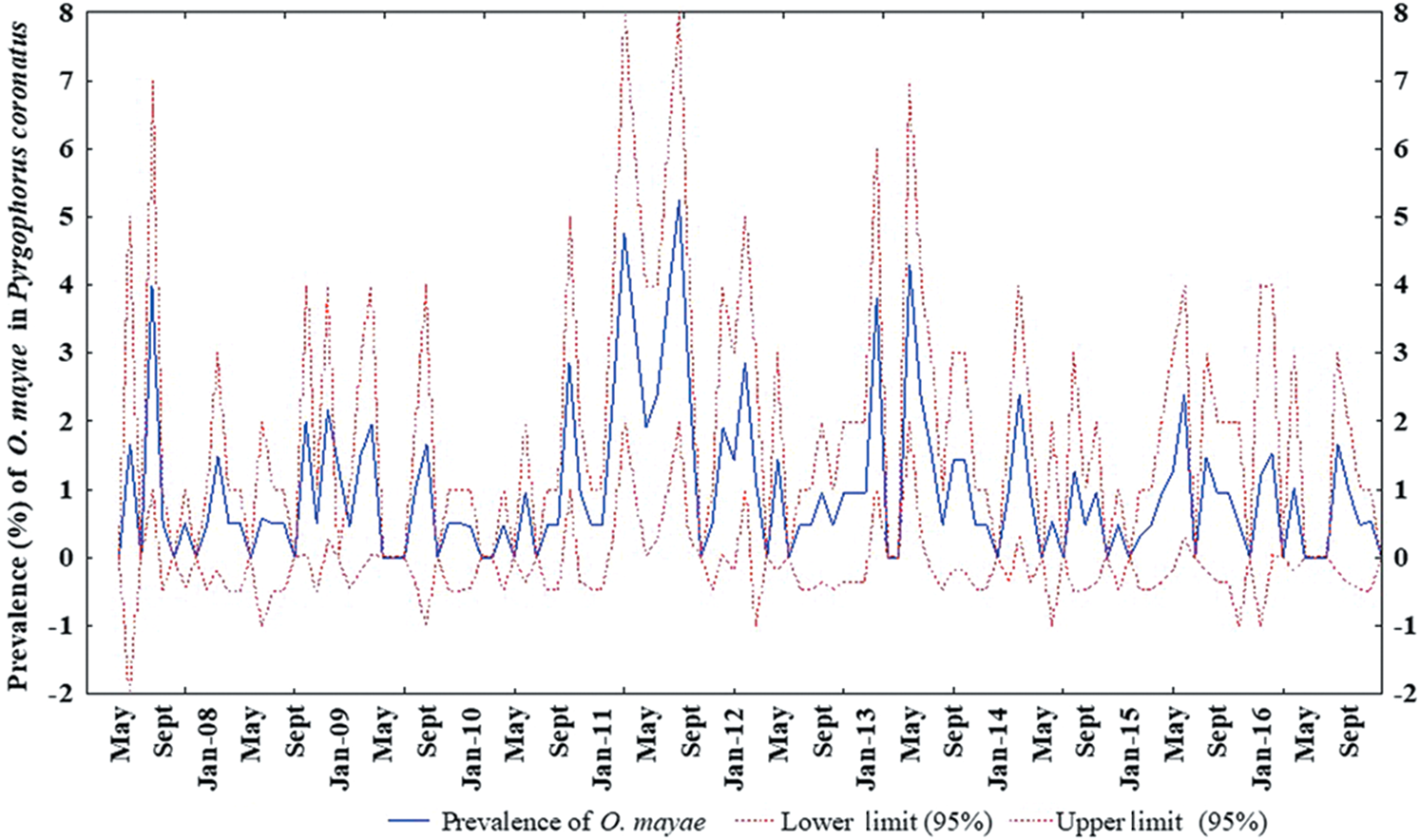
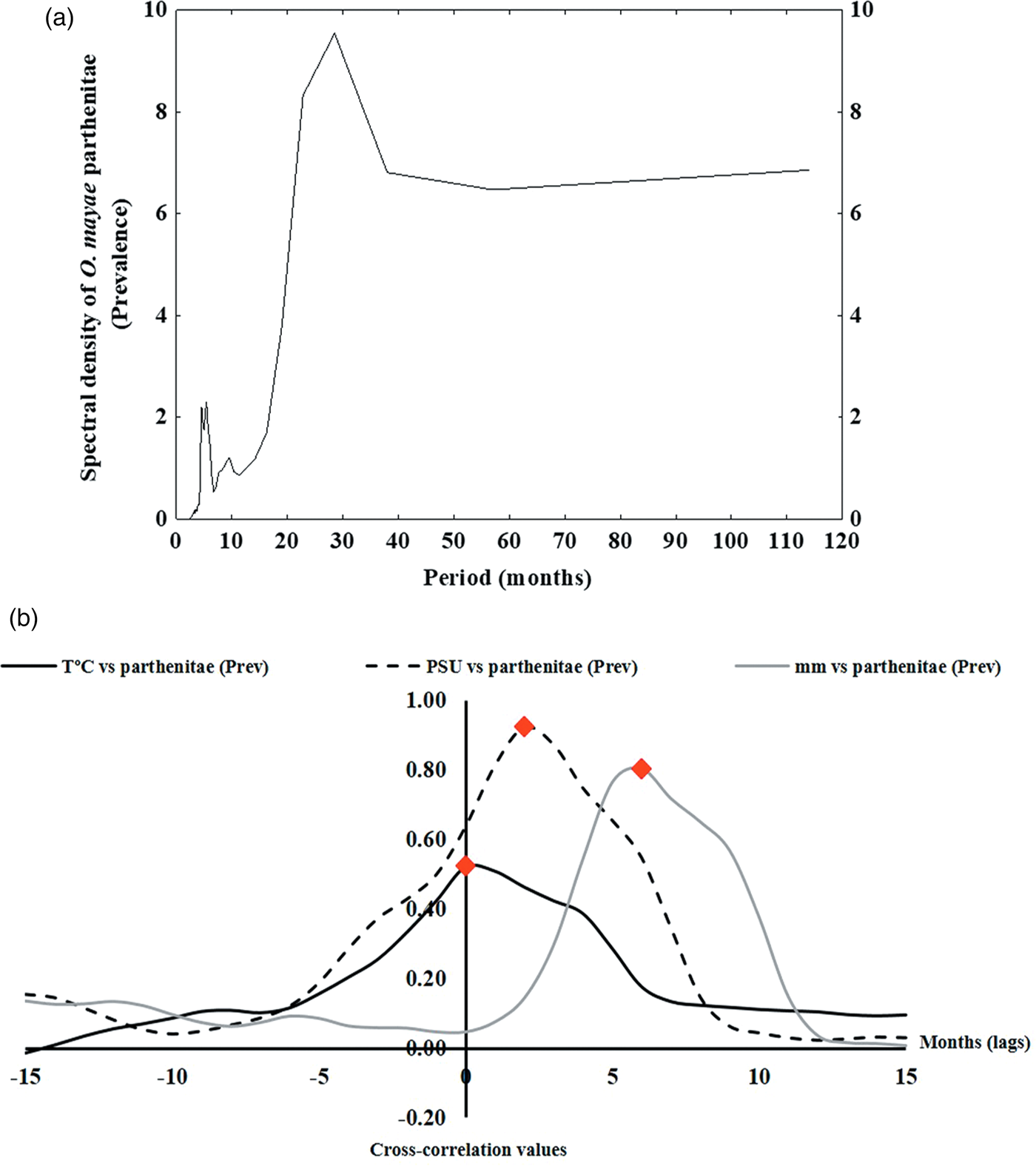
Between 2007 and 2016, the prevalence in P. coronatus infected with parthenitae stages fluctuated between 1 and 5%, with the maximum prevalence value observed during August 2011 (fig. 1). Spectral analysis of O. mayae showed peaks of high variability every six, ten and 24 months (fig. 2a). In situ, the water temperature fluctuated between 18.20 and 30.6°C (26.36 ± 1.92), while observed salinity values were between 3 and 28.50 PSU (13.82 ± 7.10); the maximum month rainfall value was 278 mm (60.32 ± 62.70) (supplementary fig. S2a).
Temporal variation of prevalence of Oligogonotylus mayae parthenitae in Pyrgophorus coronatus from the Baldiosera freshwater spring of Celestun, Yucatan (2007–2016).

(a) Spectral analysis of Oligogonotylus mayae prevalence and (b) cross-correlation between O. mayae prevalence and environmental variables.

Water temperature presented peaks of variability every six, 18 and 56 months. Salinity values showed a marked high variability every 12 and 24 months. Rainfall presented only one peak of high variability every 12 months (supplementary fig. S2b). There was a significant association at lag 0 between the prevalence of O. mayae parthenitae and water temperature (fig. 2b). We found a delay of six months (lag 6) between rainfall and the prevalence of O. mayae. Salinity and the prevalence of O. mayae showed a significant association with a lag of three months (fig. 2b).
Oligogonotylus mayae infecting M. urophthalmus (2003–2016)
Metacercariae stages
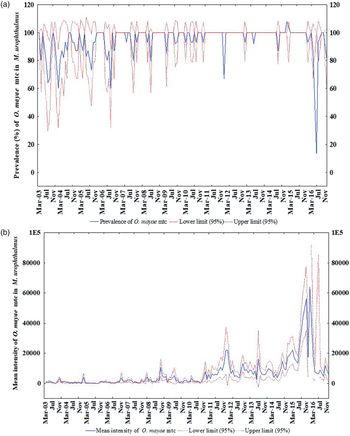
The prevalence of O. mayae metacercariae in M. urophthalmus fluctuated between 13 and 100% (fig. 3a). The mean intensity value fluctuated between 4 and 63,984 (6380 ± 9880), reaching a maximum value during January 2016 (fig. 3b). A highly important pattern in the metacercarial stages of O. mayae in M. urophthalmus was the increase of the mean intensity values through the 13 years of the sampling program. The O. mayae prevalence did not correlate with M. urophthalmus total length (r = −0.118, P = 0.13), nor with the mean intensity (r = 0.114, P = 0.14).
Temporal variation of Oligogonotylus mayae metacercariae (mtc) infecting Mayaheros urophthalmus from Celestun, Yucatan (2003–2016). (a) Variability of prevalence of O. mayae in metacercariae stages in M. urophthalmus; (b) mean intensity of O. mayae in metacercariae stages in M. urophthalmus. The red lines represent the lower limit (95%) and upper limit (95%).

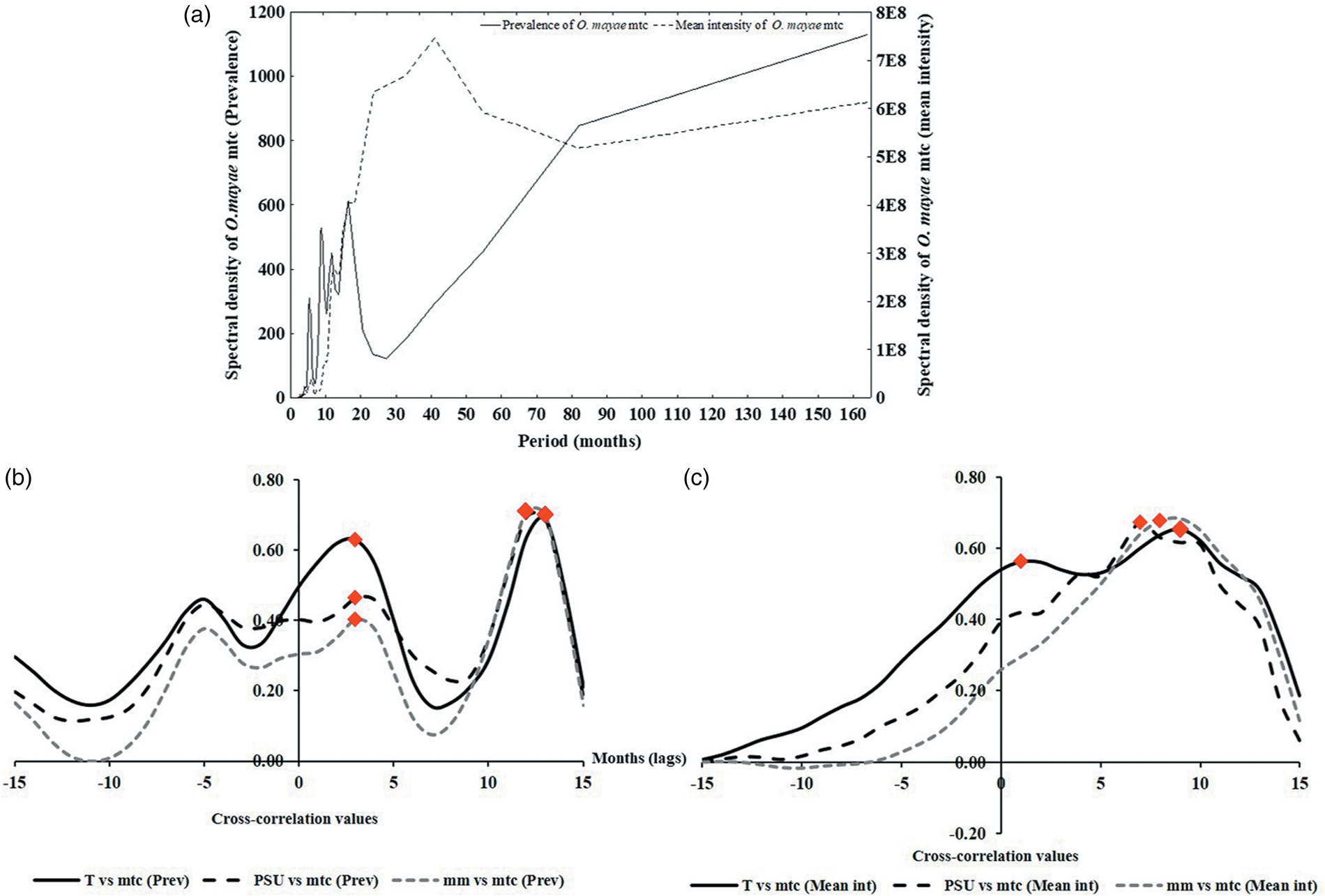
Spectral analysis showed peaks of maximum variability for O. mayae prevalence every six, nine and 15 months (fig. 4a). The O. mayae mean intensity showed a peak of maximum variability every 12, 24 and 40 months (fig. 4a).
(a) Spectral analysis of prevalence and mean intensity of Oligogonotylus mayae metacercariae (mtc) in Mayaheros urophthalmus; (b) cross-correlation between prevalence of O. mayae mtc and environmental variables; (c) cross-correlation between mean intensity of O. mayae mtc and environmental variables.

Cross-correlation analysis showed significant associations in lags 4 and 12 between O. mayae prevalence and water temperature, salinity and rainfall (fig. 4b). Significant associations between the mean intensity of O. mayae and the water temperature were found in lags 1 and 8 (fig. 4c). Salinity and rainfall had a significant association with the mean intensity of O. mayae in lags 6 and 7, respectively (fig. 4c).
Adult stages
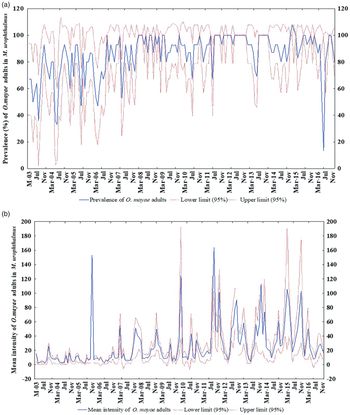
The prevalence values of O. mayae adults in M. urophthalmus fluctuated between 13 and 100% (fig. 5a). The mean intensity value of O. mayae was 2–164 (26.13 ± 28.37), with the maximum value during September 2011 (fig. 5b). The O. mayae prevalence did not correlate with M. urophthalmus total length (r = −0.118, P = 0.12) or with the mean intensity (r = 0.23, P = 0.003).
Temporal variation of Oligogonotylus mayae adults infecting Mayaheros urophthalmus from Celestun, Yucatan (2003–2016). (a) Variability of prevalence of O. mayae adults in M. urophthalmus; (b) mean intensity of O. mayae adults in M. urophthalmus. The red lines represent the lower limit (95%) and upper limit (95%).

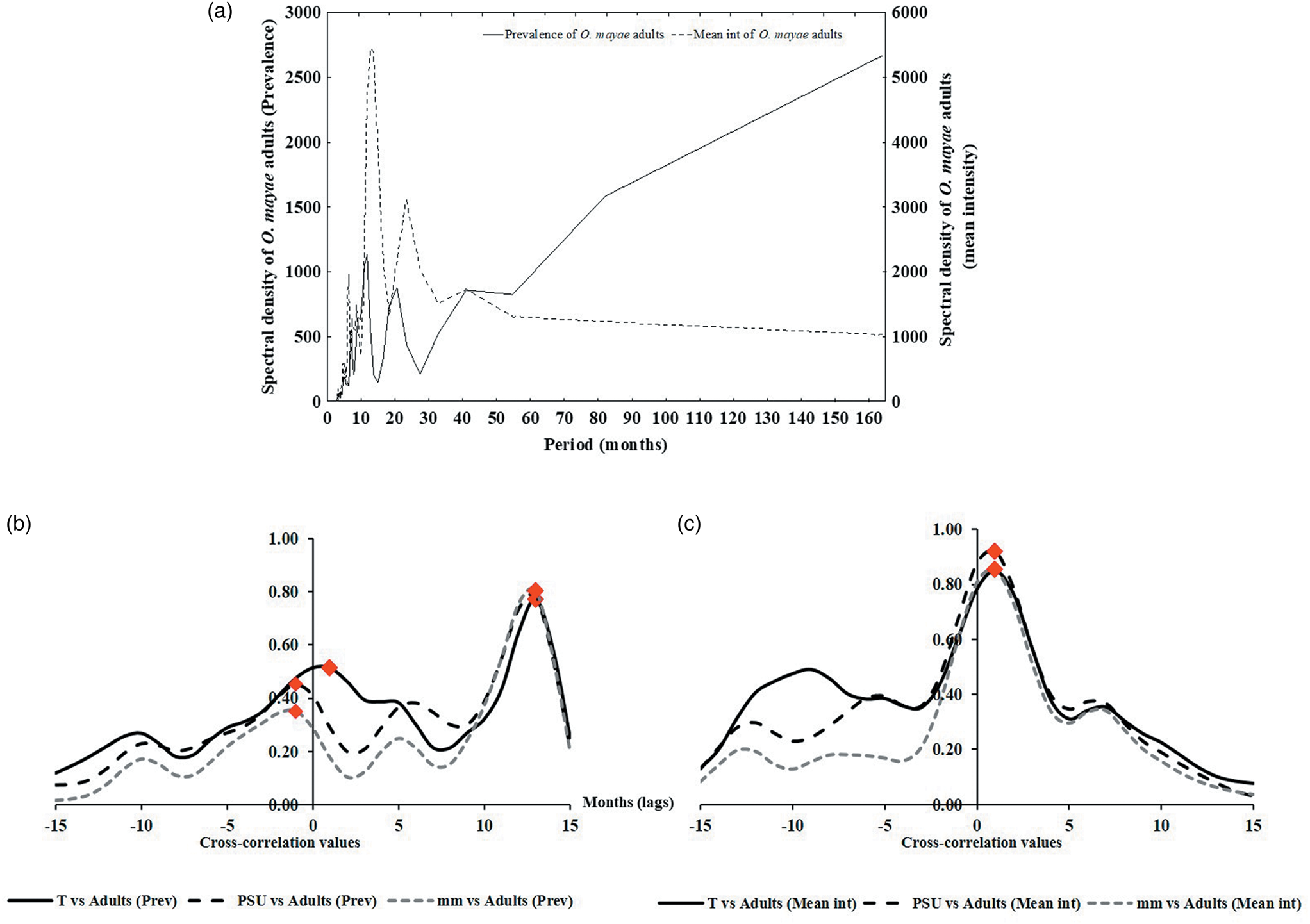
Spectral analysis of O. mayae prevalence showed peaks of high variability every ten, 22 and 40 months (fig. 6a). With respect to O. mayae mean intensity, peaks occurred every 12, 24 and 40 months (fig. 6a). Cross-correlation of O. mayae prevalence showed a significant association (lags −1, 1 and 12) with salinity, rainfall and water temperature, respectively (fig. 6b). The O. mayae mean intensity showed significant associations with the water temperature, salinity and rainfall at lag 1 (fig. 6c).
(a) Spectral analysis of prevalence and mean intensity of Oligogonotylus mayae adults in Mayaheros urophthalmus; (b) cross-correlation between prevalence of O. mayae adults and environmental variables; (c) cross-correlation between mean intensity of O. mayae adults and environmental variables.

Cross-correlation analysis of the lifecycle stages of O. mayae
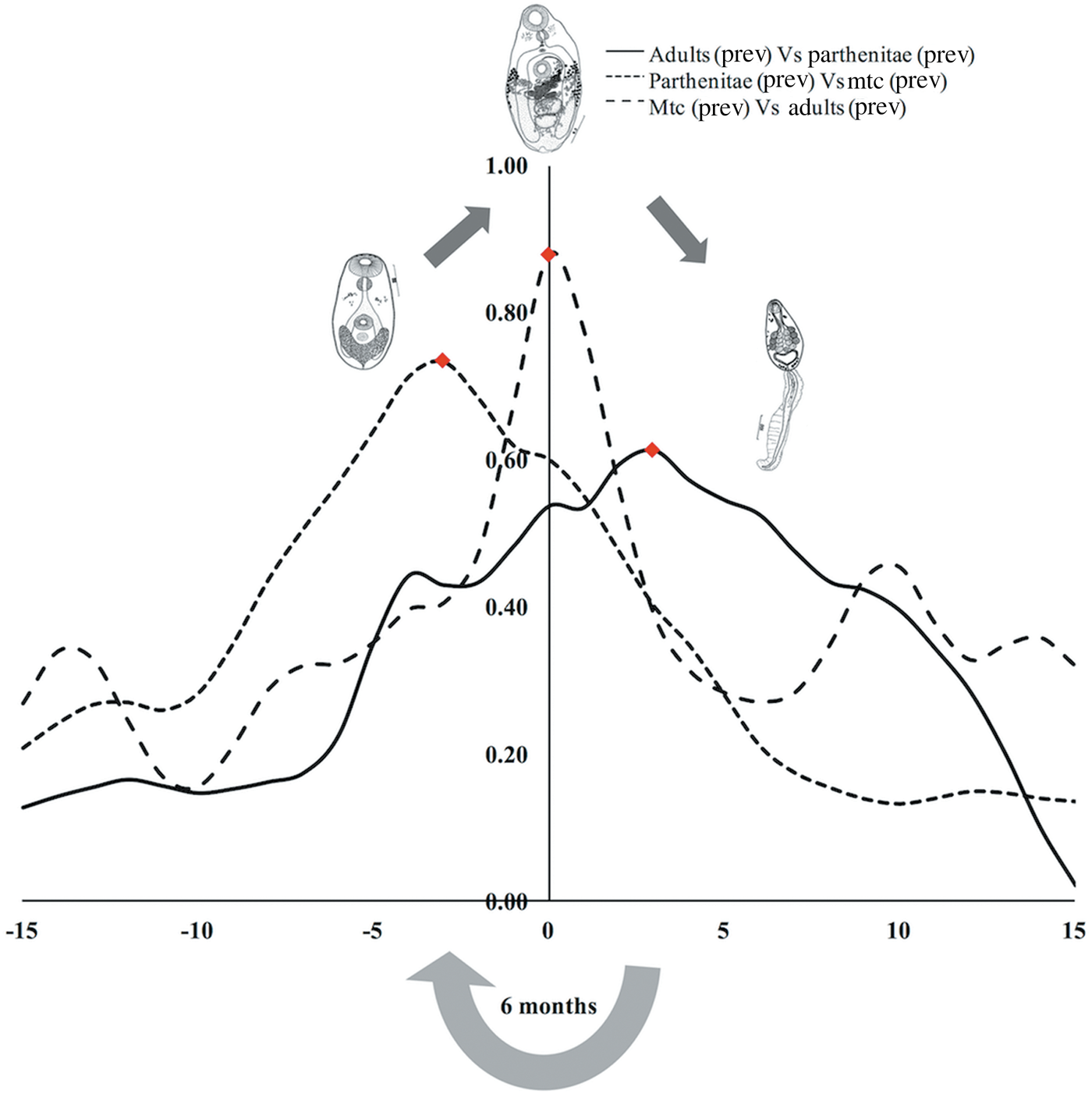
Cross-correlation analysis among the prevalence of O. mayae (parthenitae, metacercarial and adult stages) in its intermediate, P. coronatus, and second (and definitive) hosts, M. urophthalmus, showed significant associations with a delay of three to six months (fig. 7). These associations suggest that three months after the occurrence of maximum variability in the prevalence of O. mayae adults, there is an increase in the parthenitae prevalence in the snail. Then, three months after the maximum variability of parthenitae, an increase in the prevalence of O. mayae metacercariae was observed in the fish. Finally, cross-correlation analysis showed a significant association between the maximum prevalence of metacercariae and the maximum prevalence value of adult stages in the fish (lag 0).
Cross-correlation among the prevalence (prev) of snails infected with Oligogonotylus mayae parthenitae, prevalence of metacercariae (Mtc) and prevalence of adult stages of O. mayae in M. urophthalmus through time.

Discussion
Our results suggest that the original hypothesis in this paper was partially correct since transmission patterns of O. mayae in both the first and second (and definitive) host at Celestun coastal lagoon were responding at the annual temporal scale where yearly patterns of temperature, salinity and rainfall occur. However, there was an increasing accumulation pattern of O. mayae metacercariae over time. This increase has at least two competing explanations. The first one is that climate oscillations occurring at larger temporal scales, such as the ENSO, influence water temperature, which could affect the O. mayae population dynamics in the long term. The second explanation is that the O. mayae population is still recovering from Hurricane Isidore, which occurred in 2002 (Aguirre-Macedo et al., Reference Aguirre-Macedo, Vidal-Martínez and Lafferty2011). Apart from these explanations, the peaks in prevalence and mean intensity of O. mayae life stages at 24 and 40 months were apparently replicates of the original annual pattern. These strong patterns in the infection parameters of O. mayae were most likely produced by the seasonal, annual and interannual fluctuation patterns of the abiotic factors (rainfall, salinity and water temperature) in Celestun. In the following paragraphs, we present a detailed account of the influence of abiotic factors on the different life stages of O. mayae at different time scales.
Yearly patterns and their replicates
The O. mayae prevalence presented a marked seasonality apparently associated with high temperatures (fig. 2a). During the dry season in Yucatan (March to May), high temperatures, low rainfall and organic matter decomposition in Celestun lagoon (Tapia Gonzalez et al., Reference Tapia González, Herrera-Silveira and Aguirre-Macedo2008) apparently influence the reproduction of trematodes in the definitive host, increasing the availability of O. mayae eggs to infect the snails. An important number of these infected snails are eaten by M. urophthalmus since they are an important food item for the cichlid fish (Martínez-Palacios & Ross, Reference Martínez-Palacios and Ross1988, our own observation). Those P. coronatus not eaten by the fish but infected can eventually release free-swimming cercariae, which become established in the body skin, fins and gills of M. urophthalmus (Scholz et al., Reference Scholz, Lavadores, Vargas, Mendoza, Rodríguez and Vivas1994). These authors suggested that M. urophthalmus is infected by cercariae of O. mayae by ingesting infected snails, which is the main pathway through which metacercariae develop and encyst in the intestine (Scholz et al., Reference Scholz, Lavadores, Vargas, Mendoza, Rodríguez and Vivas1994). Adult M. urophthalmus predate upon the young stages of nine fish species (including those of M. urophthalmus) in the Celestun lagoon infected with metacercariae of O. mayae (see table 2 in Sosa-Medina et al., Reference Sosa-Medina, Vidal-Martínez and Aguirre-Macedo2015 for a complete list of all these 2IH) and develop the adult stages of this trematode. Several of these fish species acting as 2IH, such as Floridichtys carpio, Eucinostomus argenteus, Lutjanus griseus, Sphoeroides testudineus and M. urophthalmus are abundant in Celestun (Vega-Cendejas, Reference Vega-Cendejas2004). Since the density of intermediate hosts is an important factor in the transmission of trematodes (Voutilainen et al., Reference Voutilainen, Van Ooik, Puurtinen, Kortet and Taskinen2009), the greater abundance of hosts increases the probability of encounters with transmission stages in the environment (Wilson et al., Reference Wilson, Bjornstad, Dobson, Merler, Poglayen, Randolph, Read, Skorping, Hudson, Rizzoli, Grenfell, Heesterbeek and Dobson2002) and facilitates the completion of the O. mayae life cycle.
The infection levels of O. mayae in P. coronatus apparently respond to seasonal variability in water temperature during the dry season (fig. 2b), which, in turn, can influence the number of cercariae released from infected snails. These cercariae released by P. coronatus into the water column become encysted in skin, the lateral line and fins (Salgado-Maldonado & Kennedy, Reference Salgado-Maldonado and Kennedy1997). Similar patterns have been observed for other trematode species in different latitudes such as Acanthoparyphium sp., Himasthla rhigedana and Parorchis acanthus, with an increase in the number of cercariae released from their intermediate host when temperature increases (Takahashi et al., Reference Takahashi, Mori and Shigeta1961; Fingerut et al., Reference Fingerut, Zimmer and Zimmer2003; Koprivnikar & Poulin, Reference Koprivnikar and Poulin2009; Koprivnikar et al., Reference Koprivnikar, Ellis, Shim and Forbes2014; McCreesh et al., Reference McCreesh, Arinaitwe, Arineitwe, Tukahebwa and Booth2014, Mehlhorn, Reference Mehlhorn and Mehlhorn2016; Schade et al., Reference Schade, Raupach and Wegner2016).
There is one caveat in fish size before starting with the patterns of metacercariae and adult stages. It has been postulated that there is a positive correlation between fish length and larval helminth intensity (Pulkkinen & Valtonen, Reference Pulkkinen and Valtonen1999; Poulin & Valtonen, Reference Poulin and Valtonen2001). However, in our study, fish size did not significantly correlate with O. mayae prevalence or with mean intensity, most likely because the hook size used to capture the fish excluded small individuals. Therefore, there is bias in the sampling procedure. However, the advantage of this procedure is that, month after month, individual fish of approximately the same size were examined for parasites, making samples comparable over time.
The peaks in the number of metacercariae in fish occurred from May to July and from November to January (fig. 3a), just at the beginning of the rainy and north seasons. During these seasons, the increases in organic matter, water flow and turbidity in the coastal lagoon (Orduña-Rojas et al., Reference Orduña-Rojas, Robledo and Dawes2002) could act as environmental triggers, probably enhancing both the increase in the number of the first intermediate host (P. coronatus) and the number of cercariae released looking for the second intermediate fish hosts. Pech et al. (Reference Pech, Aguirre-Macedo, Lewis and Vidal-Martínez2011) also suggested that freshwater discharges from the water springs along the Celestun coastal lagoon during the rainfall season would also enhance the transmission of cercariae.
The seasonal increase in the number of adult stages of O. mayae in M. urophthalmus corresponds to the period July–November (fig. 5) – the time of the reproductive peak of M. urophthalmus and when parental care takes place (Martínez-Palacios & Ross, Reference Martínez-Palacios and Ross1988). We speculate that during this time the sexually mature adult stages of O. mayae shed eggs into the intestine of M. urophthalmus, which eventually release them into the nest area, where they are ingested by P. coronatus. The infection patterns of O. mayae metacercariae and adult stages in the fish showed a delay time with respect to maximum values of water temperature and rainfall (figs 4b, c and 6b, c). A possible explanation for the first peak is that high temperatures trigger the intensity of mollusc consumption by the fish (Martínez-Palacios & Ross, Reference Martínez-Palacios and Ross1988); regarding the second peak, rainfall influences the dispersion of infected snails and cercariae, which subsequently encyst in the fish (Pech et al., Reference Pech, Aguirre-Macedo, Lewis and Vidal-Martínez2011; Vidal-Martínez et al., Reference Vidal-Martínez, Pal, Aguirre-Macedo, May-Tec and Lewis2014).
Our results show that prevalence peaks of adults and metacercarial stages in fish occurred approximately three to six months after the increase in the prevalence peaks of parthenitae in the mollusc (fig. 7). However, in experimental studies, it has been observed that the development of cercariae into infective metacercariae of O. mayae was relatively quick (14–20 days) (Scholz et al., Reference Scholz, Lavadores, Vargas, Mendoza, Rodríguez and Vivas1994), similar to that of other Cryptogonimidae (Greer & Corkum, Reference Greer and Corkum1979). Therefore, it is evident that the transmission of O. mayae is persistent throughout the entire year, but with peaks previously described throughout the year.
Long-term temporal patterns
The long-term data set of all lifecycle stages of O. mayae (parthenitae, metacercariae and adult stages) in their hosts (P. coronatus and M. urophthalmus) showed interannual patterns every two years, with an increase in the mean intensity values especially evident in the last five years (figs 1, 3 and 5). This biannual accumulation pattern has previously been observed for O. mayae and other larval trematodes such as Ascocotyle (Phagicola) nana in M. urophthalmus from the Celestun lagoon (Pech et al., Reference Pech, Aguirre-Macedo, Lewis and Vidal-Martínez2011; May-Tec et al., Reference May-Tec, Pech, Aguirre-Macedo and Vidal-Martínez2013; Vidal-Martínez et al., Reference Vidal-Martínez, Pal, Aguirre-Macedo, May-Tec and Lewis2014). The biannual accumulation pattern found in this study might be related to the life span of the hosts. The life span of P. coronatus, being a Hydrobiidae, is estimated to be about 13–24 months with annual recruitment (Drake & Arias, Reference Drake and Arias1995; Mladenka & Minshall, Reference Mladenka and Minshall2001). Young P. coronatus begin their life uninfected. However, as these snails become older there is an increase in the probability that they could ingest O. mayae eggs and develop miracidia. Since these snails live up to 24 months, the older members of the population would be the ones with the highest prevalence, which, in turn, would explain the biannual peak of prevalence shown in fig. 2a. Further support for this interpretation comes from Sousa (Reference Sousa, Esch, Bush and Aho1990) and Faltynková et al. (Reference Faltynková, Valtonen and Karvonen2008), who have recognized that as snails aged there is an increase in the prevalence of trematode infections. A similar pattern of increase of prevalence and mean abundance can be expected in M. urophthalmus with increasing age. This is because older fish have more time and major probabilities of ingesting infected snails and small fishes infected with metacercariae of O. mayae.
Based on the fact that the captured M. urophthalmus were always in the same size range due to the bias in the fishing procedure (see Material and Methods section), we would expect to have more or less the same mean intensity range over time. However, this was not the case – there was an increase in the mean intensity values of metacercariae in fish over time (fig. 3b). Apparently, this increase in O. mayae mean intensity was associated with the variability in water temperature and rainfall observed through the entire sampling period, but with marked increases from 2011 up to 2016 (fig. 3b). This last period of time also coincided with high values of parthenitae prevalence and the mean intensity of metacercariae and adults in the fish (figs 1, 3b and 5b). In 2015 particularly, rainfall values were below average in Celestun (656.10 ± 35.41 mm) (SMN, 2015). In this sense, the combined effect of high temperature and lower rainfall promoted an increase in the availability of infected first intermediate hosts, which, in turn, enhanced the accumulation of metacercariae of O. mayae in M. urophthalmus. In addition, during 2015, there were record values for the annual average temperature associated with ENSO (Varotsos et al., Reference Varotsos, Tzanis and Sarlis2016). This climate oscillation occurs every two to seven years, influencing the variability of temperature and rainfall (Stenseth et al., Reference Stenseth, Ottersen, Hurrell, Mysterud, Lima, Chan, Yoccoz and Dlandsvik2003; NOAA, 2005). In the same way, the increased water temperature and decreased salinity as a consequence of the ENSO have been associated with the increase in the number of cases of Perkinsus marinus in Crassostrea virginica from the Gulf of Mexico (Soniat et al., Reference Soniat, Hofmann, Klinck and Powell2009). Therefore, the ENSO periodicity may explain the general increase observed over time in the number of O. mayae in fish (figs 3 and 5), but this is difficult to test without a much longer time series.
A second but equally possible explanation for the increase in the number of metacercariae throughout the 13 years of the sampling program is that of the recovery of the O. mayae population in Celestun following the 2002 Hurricane Isidore. The point is that the values of prevalence and mean intensity of O. mayae metacercariae before Isidore were in the range of those we report herein for 2016 (31,480.98 ± 17,379.17). Salgado-Maldonado (Reference Salgado-Maldonado1993) reported a mean abundance value of 42,808 ± 82,116 metacercariae of O. mayae infecting M. urophthalmus at Celestun. Therefore, it is possible that the population of O. mayae has been recovering from Hurricane Isidore during the last 13 years, and is only now reaching the number of metacercariae prior to the hurricane.
In conclusion, our results suggest that the transmission patterns of O. mayae in both the first and second (and definitive) host at Celestun are influenced by environmental forcings (temperature, salinity and rainfall) acting at the annual temporal scale. With respect to long-term temporal patterns, at this point it is not possible to distinguish whether the increasing accumulation pattern of the metacercarial stages of O. mayae over time was affected by the ENSO, by the recovery process following Hurricane Isidore or by both forcings. However, taking O. mayae as an example of what could be happening to other trematodes, it is becoming clear that environmental forcings acting at long-term temporal scales affect the population dynamics of these parasites, at least in the Gulf of Mexico.
Supplementary material
To view supplementary material for this article, please visit https://doi.org/10.1017/S0022149X20000875
Acknowledgements
Our sincere thanks to all of the staff at the Laboratorio de Patología Acuática CINVESTAV-IPN Unidad Mérida, including Clara Vivas-Rodríguez, Gregory Arjona-Torres, Nadia Herrera-Castillo, Francisco Puc-Itza, Efrain Sarabia-Eb and Arturo Centeno-Chalé who helped with field and laboratory work at different times over the past 13 years. We would also like to thank anonymous reviewers fort heir helpful comments that contribute to improve the manuscript.
Financial support
This study was supported by the Consejo Nacional de Ciencia y Tecnología (CONACyT), Mexico, project D 44590-Q ‘Invertebrados como hospederos intermediarios de helmintos de Lutjanus griseus y otros peces de importancia comercial en dos lagunas costeras de Yucatán’ (M.L.A.-M., grant number 44590); SEP-PROMEP, who supported our project ‘Propuesta sobre Calentamiento Global y Cambio Climático de la Red Académica de Instituciones SEP-PROMEP del Sureste: área Sensibilidad Marina’, and a FOMIX Yucatán award in support of the project ‘Sensibilidad y vulnerabilidad de los ecosistemas costeros del sureste de México ante el Cambio Climático Global’ YUC-2008-C06-108929; CONACyT (J.Q.G.-M., grant numbers 15689-2014 and 251622-2015); and by the National Council of Science and Technology of Mexico–Mexican Ministry of Energy–Hydrocarbon Trust (project number 201441). This is a contribution of the Gulf of Mexico Research Consortium and the Coastal Resilience Laboratory research CONACyT project 299063 ‘Laboratorio Nacional de Resiliencia Costera’.
Conflicts of interest
None.
Ethical standards
All procedures were reviewed and approved by the Institutional Animal Care and Use Committee (IACUC) of the Center for Research and Advanced Studies (CINVESTAV) of the National Politechnical Institute (Protocol number: 0138-15).