INTRODUCTION
Forest-steppe areas of Eastern Europe, including the Central Russian Upland, represent a transitional zone between forests and steppes. This was the first region to generate discussions in search of solutions to a number of issues:
∙ What is the oldest ecosystem in the study region—steppes or forests, gray forest soils (forest Phaeozems and Luvisols) or Chernozems?
∙ Did the evolutionary development of forest-steppe soils proceed in the sequence “Chernozems → Phaeozems → Luvisols,” or in the reverse sequence?
∙ Is it correct to identify forest and steppe landscapes and corresponding types of soils in the forest-steppe area as original, equal-age, and ancient formations?
Discussions about the problem of soil formation in the forest-steppe have continued for more than a century, and a number of hypotheses have entered the history of soil science. One of the first was a hypothesis about forest invasions onto steppe as a self-developing phenomenon resulting in the evolutionary transformation of Chernozems into gray forest (Phaeozems) and podzolic (Luvisols) soils (Korzhinskii Reference Korzhinskii1891; Tyurin Reference Tyurin1930). Another hypothesis states that gray forest soils are quite specific soils in the forest-steppe zone, whose development under insular groves of broadleaved forests began in the Early Holocene simultaneously with the development of Chernozems under meadow steppe ecosystems, and whose areas have remained stable during that period (Akhtyrtsev Reference Akhtyrtsev1979). A hypothesis on climatically driven evolution of Chernozems into Phaeozems and Luvisols as a result of cooling and humidization of the climate is also being discussed. It states that the substitution of forests for steppe ecosystems in the forest-steppe zone took place in the Late Holocene (Aleksandrovskiy Reference Aleksandrovskiy1988; Chendev and Aleksandrovskii Reference Chendev and Aleksandrovskii2002). The influence of the economic activity of humans on forest-steppe soils is well known. It has been suggested that the areas of Chernozems could appear in the forest-steppe zone as a result of forest cutting and replacement of former forests by agricultural lands (Taliev Reference Taliev1902; Tyurin Reference Tyurin1930).
In the second half of the 20th–early 21st centuries, the discussion on the relationship between grassy and forest landscapes with corresponding soils became relevant for many other regions of the Earth. In Central Europe, discussions on the origin of Chernozems studied in modern and archaeological landscapes in many places have been initiated (Bork Reference Bork1983; Eckmeier et al. Reference Eckmeier, Gerlach and Gehrt2007; Vyslouzilova et al. Reference Vyslouzilova, Ertlen, Sefrna, Novak, Viragh, Rue, Campaner, Dreslerova and Schwartz2015). The dark gray color of these soils is considered the result of anthropogenically provoked fires of forests in the Neolithic time with the further distribution of fine charcoal particles along the soil profile (Lorz and Saile Reference Lorz and Saile2011; Gerlach et al. Reference Gerlach, Fischer, Eckmeier and Hilgers2012). Some authors believe that the more arid climate in the Early and Middle Holocene favored the development of steppe and forest-steppe environments with Chernozems that later evolved into modern forest soils after climatic cooling and invasion of forests onto grasslands in the Late Holocene (Bork Reference Bork1983; Hejcman et al. Reference Hejcman, Součková, Krištuf and Peška2013). In a natural ecotone between equatorial forests and savannahs of Brazil, the study of the isotopic composition of carbon (12C, 13C, and 14C) of the soil organic matter made it possible to establish changes in the boundaries between forests and savannahs in the Holocene. The polygenetic nature of the soil profiles as a result of the shifts in these boundaries and, in particular, the invasion of forests onto savannas during the last 3000 years was substantiated (Pessenda et al. Reference Pessenda, Gouveia, Aravena, Gomes, Boulet and Ribeiro1998). The invasion of forests onto prairies with corresponding transformation of Mollisols into soils of forest genesis as a result of cooling and moistening of the climate in the Late Holocene was also shown for the Central and Great Plains of the United States (Ruhe and Schotles Reference Ruhe and Schotles1956; Buol et al. Reference Buol, Hole and McCracken1973; Bettis III et al. Reference Bettis, Benn and Hajic2008).
In our recent studies, we have obtained new results that clarify existing ideas about the origin and evolution of soils developing under broadleaved forests in the forest-steppe zone (Haplic Luvisols and Greyzemic Phaeozems) under the influence of both natural and anthropogenic factors. Radiocarbon (14C) dating plays an important role in these studies.
The main goal of this paper is to analyze temporal variations in the development of soils in the forest-steppe zone of the Central Russian Upland under the impact of climate and biota (natural factor) and long-term soil cultivation (anthropogenic factor). The results of 14C dating of Phaeozems and Luvisols are used to explain a number of questions of their geneses and evolution.
The particular tasks are as follows:
∙ determine the age and duration of the natural evolutionary stages of Luvisols and corresponding stages of changes in the climate and biota of the region;
∙ assess the trends of the anthropogenic transformation of forest Phaeozems and Luvisols under the impact of long-term (for centuries) rainfed agricultural practices; and
∙ perform a combined analysis of evolutionary changes in the forest Phaeozems and Luvisols specified by the natural factors (changes in the bioclimatic conditions) on the one hand, and by the anthropogenic factors (long-term soil cultivation), on the other hand.
As far as we know, the conjugated study of the natural (bioclimatic) and anthropogenic (under the influence of long-term plowing) evolution of soils using the 14C dating method has not been performed so far.
MATERIALS AND METHODS
Automorphic soils developing under broadleaved forests on level interfluves in the southern part of the Central Russian Upland forest-steppe were studied. Parent materials are represented by calcareous loesslike loams of various thicknesses. The major soils under broadleaved forests in the study area are represented by two subtypes of gray forest soils: typical gray forest soils (Greyzemic Haplic Luvisols according to the WRB system) and dark gray forest soils (Luvic Greyzemic Phaeozems). Further, we will use soil names according to the WRB (IUSS Working Group WRB 2015).
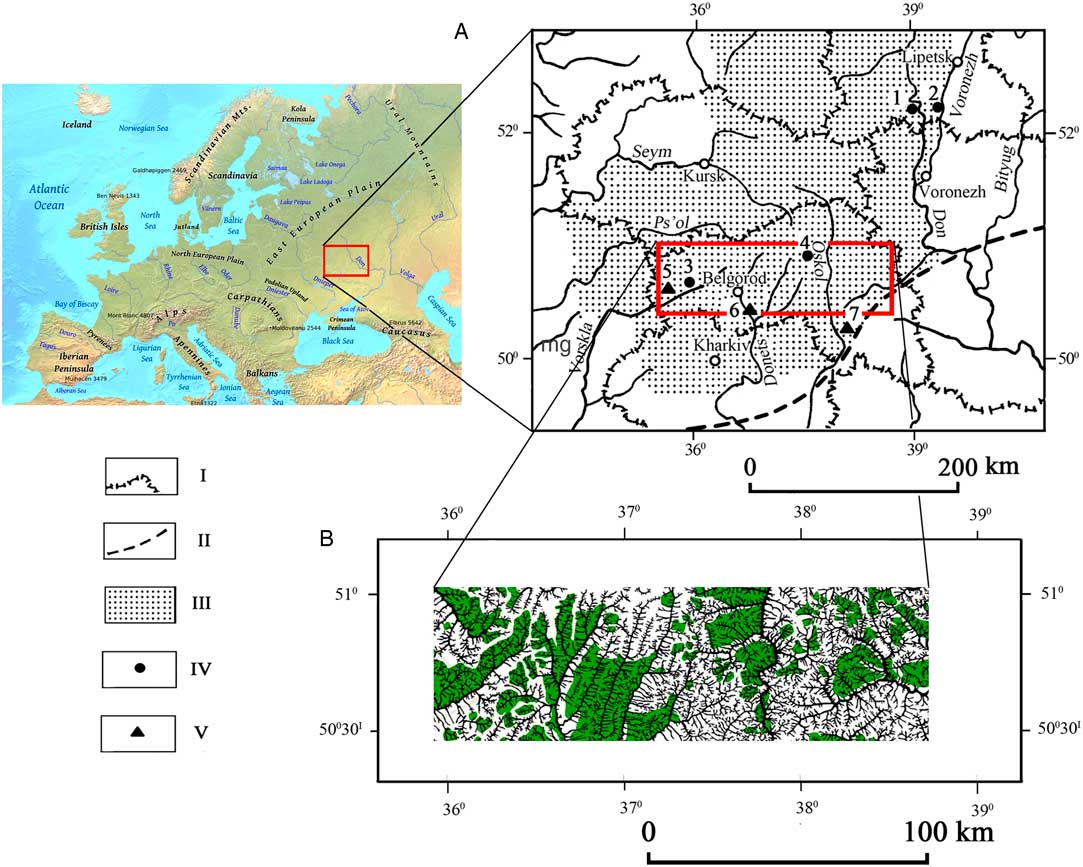
We studied the natural (bioclimatic) and the anthropogenic (agrogenic) evolution of soils in the Late Holocene. The choice of key sites (Figure 1) was dictated by the presence of common soil-forming conditions despite the wide geographical coverage of the territory. First, we studied the territory of forest-covered natural landscapes reflecting typical zonal character of forest vegetation in the forest-steppe (broadleaved forests with a predominance of oak). Second, all the sites were characterized by similar relief conditions (level interfluves), parent materials (carbonate loesslike loam), and texture (silt loam) of the upper humus horizon. Third, the bioclimatic evolution of the soils was studied at archeological sites of similar ages and construction type (settlements from the Early Iron Age protected by defensive earthen ramparts, under which the buried paleosols were examined). Fourth, the anthropogenic evolution of soils under the impact of long-term plowing was studied on the fields with similar history of farming practices typical of the investigated region.
(A) Location of key sites and (B) fragment of the study area with areas of native forests in the preindustrial period (17th century) (Chendev Reference Chendev2004): (I) administrative borders of oblasts; (II) boundary between forest-steppe and steppe; (III) Central Russian Upland within the forest-steppe zone; (IV) key sites of the study of climate-driven evolution of soils (1—Mukhino, 2—Podgornoye, 3—Borisovka, 4—Petropavlovka); and (V) key sites of the study of the agrogenic (under the impact of plowing) evolution of soils (5—Kazachya Lisitsa, 6—Polyana, and 7— Samarino).

Field studies were performed in 2009–2016 on seven key sites. Each key site was considered a replicate of the conducted study. At all of them, close tendencies of temporal soil changes under the impact of natural (four key sites) and anthropogenic (three key sites) factors were revealed. The similarity of the trajectories of soil evolution in different parts of the forest-steppe allowed us to consider them typical of the studied region.
To study the natural evolution of soils, modern soils were compared with their paleoanalogs buried under dated earthen ramparts of archaeological sites and developed from similar parent materials and under similar relief conditions. Thus, the soil-archeological method, or the method of soil chronosequences (Gennadiev Reference Gennadiev1978; Aleksandrovskiy Reference Aleksandrovskiy1988; Chendev and Aleksandrovskii Reference Chendev and Aleksandrovskii2002) was applied. In this paper, we discuss the results of our analysis of soil chronosequences at four archaeological sites (ancient settlements) in the forest-steppe zone. From north to south, these were the sites Mukhino and Podgornoye in Lipetsk oblast and Borisovka and Petropavlovka in Belgorod oblast. Their names were given according to the names of the local modern settlements. These sites were studied by archaeologists together with pedologists. The ancient settlements were found on high plateau-like interfluves not far from their contacts with steep slopes of river valleys and/or deep gully systems. The parent materials were represented by loess-like loams of different thicknesses overlying ancient alluvial sands of the Neogene and Early Quaternary ages.
The agrogenic evolution of forest soils in the forest-steppe was studied using the method of soil agrochronosequences [this term was proposed by Kozlovskiy (Reference Kozlovskii2003)]. It consists of the comparative analysis of soil profiles under background virgin forest vegetation and under arable lands that appeared in different periods in place of the former native vegetation similar to that of the background plots. The search for the key sites was performed with due account for the following conditions. In the past (before the beginning of agricultural development), the whole study area had to be covered with uniform broadleaved forests. The compared plots had to represent the preserved fragments of the broadleaved forests and the adjacent arable fields with different duration of cultivation.
The search for cultivated lands of different ages was performed with the help of historical-cartographic method, which implied the work in the Russian State Archive of Ancient Acts (Moscow) for identifying key study areas. Large-scale plans created at different times (the period of the General Land Survey in the 1780s–1790s and the period of the Special Land Survey in the 1860s–1870s), their comparison with modern topographic plans, and identification of areas with preserved soils under natural vegetation located in immediate vicinity of soils with different durations of agricultural development. This method was first applied by Gedymin and coauthors in 1964 (Gedymin and Pobedintseva Reference Gedymin and Pobedintseva1964). The agrogenic evolution of forest soils was studied on three key sites in the forest-steppe part of Belgorod oblast, namely, the Kazachya Lisitsa, Polyana, and Samarino sites (Figure 1). Their names were given according to the names of the nearby modern settlements.
In the field, detailed morphological descriptions of the soil profiles were made. Soil sampling at archaeological sites was performed from vertical walls of archaeological excavations, which increased the accuracy of identification of sampling locations, taking into account the studied soil characteristics, in contrast to a less representative method of soil sampling by drilling of archeological earthen monuments, which is quite common in practice of soil studies and dating of soil organic matter at archaeological sites of Central Europe (Kristiansen et al. Reference Kristiansen, Dalsgaard, Holst, Aaby and Heinemeier2003; Molnar et al. Reference Molnar, Joo, Barczi, Szanto, Futo, Palcsu and Rinyu2004).
Sampling of charcoals was conducted in places of their most expressed concentration in archaeological pits of earthen ramparts immediately above the surface of buried soils. Charcoal samples derived from small branches of trees, the burning of which, according to information of archaeologists, was synchronous with the time of construction of the defensive ramparts, were taken. Soil sampling for 14C dating on arable fields was performed layer by layer with a 10-cm interval, or, in the case of thin (12–14 cm) soil horizons, from these horizons. The sampling of dark-colored humified filling of mole tunnels (krotovinas) was performed from the entire section of the fillings in the 10-cm vertical interval. The bulk soil samples containing soft and hard carbonate nodules and diffused carbonates was collected from the upper 10 cm of the horizon of their first occurrence in the soils under native forests and arable soils. To determine bulk density, soil sampling with steel rings of known volume was performed for 10-cm-deep soil layers along the vertical soil profiles.
Samples for the 14C dating (charcoals, pedogenic carbonates, and bulk soil organic matter) were taken from individual pits in one replicate. Samples for laboratory determination of the bulk density, particle size distribution, and the contents of soil organic matter and soil carbonates were taken in three replicates from each of the studied profiles.
The dating of soils buried under archeological monuments was based on the archaeological evidence (artifacts) and on the 14С age of charcoals. It was important to determine the time when the buried soil was “switched off” from the active pedogenesis, i.e., when its properties formed under the combination of environmental factors (including climate and vegetation) before the burying could be preserved under defensive ramparts.
The 14C dating of the total organic carbon (TOC) and the inorganic carbon of carbonates from the soils of agrochronosequences was also performed. 14C dates of the TOC of surface soils characterize the mean residence time (MRT) of gradually accumulating soil organic carbon (the carbon of soil humus). According to Scharpenseel and Becker-Heidmann (Reference Scharpenseel and Becker-Heidmann1992) and other researchers (Rutberg et al. Reference Rutberg, Schimel, Hajdas and Broecker1996; Fazle Rabbi et al. Reference Fazle Rabbi, Hua, Daniel, Lockwood, Wilson and Young2013) these data for surface soils characterize the intensity of carbon exchange processes in them rather than the age of the soils. An increase in the activity of carbon exchange processes and, hence, the rejuvenation of 14C dates attest to the input of young organic matter (OM) to the soils, whereas more ancient dates attest to the increase in the portion of the ancient OM.
The 14C dating was mainly performed in the Radiocarbon Laboratory in Kiev (Ukraine) and (one charcoal sample) in the Radiocarbon Laboratory of the Institute of Geography of the Russian Academy of Sciences in Moscow (Russia). The 14C content of the samples (charcoals, TOC, carbonates) was measured by liquid scintillation counting (LSC).
Fragments of charcoal were crushed to a size of 5–10 mm and dried at 100°C for 2 hr. Then, a 2–4% solution of hydrofluoric acid (HF) was added in a ratio of 1:5, and the samples were kept for 6–12 hr with intermittent stirring. The remains of roots floating on the surface were mechanically removed. Under the action of hydrofluoric acid, amorphous silicon oxide was dissolved, and particles of humic substances, lipids, proteins, and other products of the living activity of soil microorganisms adsorbed on silicon oxides were released into the solution. The action of hydrofluoric acid also ensured purification of charcoal from carbonates. Hydrofluoric acid does not destroy the biodegradable part of organic carbon in the charcoal, allowing maximum preservation of the dating fraction. After treatment with hydrofluoric acid, the samples were washed on a sieve and dried for 6–12 hr at 120–150°C. For dating, lithium carbide was used, which was obtained by fusing charcoal with metallic lithium in a vacuum.
The soil before 14C analysis of TOC was dried and sieved (<1 mm). Roots and plant residues were discarded from the soil samples manually and small remnants, by flotation. Samples was then washed calcium-ion-free in 0.1 M HCI. After drying at 140–160°C for 6–12 hr, the samples were placed in a vacuum pyrolysis reactor to produce lithium carbide using manganese dioxide as an oxidizing agent (Skripkin and Kovaliukh Reference Skripkin and Kovaliukh1998).
Carbonates were pretreated with 1% HCl solution for 2–5 min to remove contaminated layers on the surface. After that, the samples were dried in an oven at 450°C for 30–60 min. At the same time, the residues of organic impurities underwent pyrolysis, and the organic carbon left the carbonate material. Lithium carbide from the carbonates was obtained by vacuum pyrolysis technology in a single step without the use of manganese dioxide (Skripkin and Kovaliukh Reference Skripkin and Kovaliukh1998).
The TOC content in the soil samples was determined according to the Tyurin method of wet combustion with potassium dichromate and concentrated sulfuric acid (Vorobieva Reference Vorobieva1998). The carbon of carbonates was measured chromatographically after the reaction with 10% HCl added in excess to flasks with rubber stoppers one hour after the beginning of the reaction.
Particle-size distribution analysis of the fine earth (<1 mm) was performed by routine pipette method with sodium pyrophosphate pretreatment (Kachinskiy Reference Kachinskiy1965). Particle size data were calculated for the conventional groups of fractions accepted in Russia with separation of physical sand (>0.01 mm), physical clay (<0.01 mm), and clay (<0.001 mm).
RESULTS
Bioclimatic Evolution of Soils
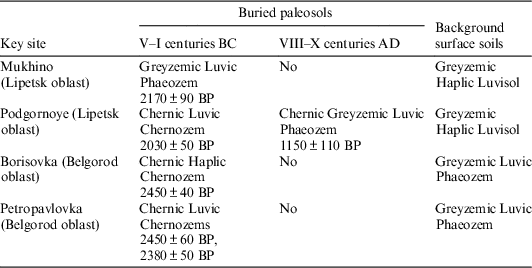
Under the ramparts of the Early Iron Age constructed in the first quarter of the Subatlantic period (2450–2030 BP), dark-colored soils with the features of the Middle Holocene steppe pedogenesis were described. These soils were identified as Chernozems either without morphologically distinct features of forest pedogenesis (Haplic and Luvic Chernozems) (at the Borisovka, Petropavlovka, and Podgornoye key sites). Only at one of the sites found in somewhat cooler conditions of Lipetsk oblast (the Mukhino site), the soil buried under the rampart dating back to 2170±90 BP (IGRAN-4159, charcoal dating) was identified as a Luvic Greyzemic Phaeozem; the background surface soil in this case was identified as a Greyzemic Haplic Luvisol (Table 1).
Classification position of soils (WRB) studied at ancient settlements in the forest-steppe zone of the Central Russian Upland.

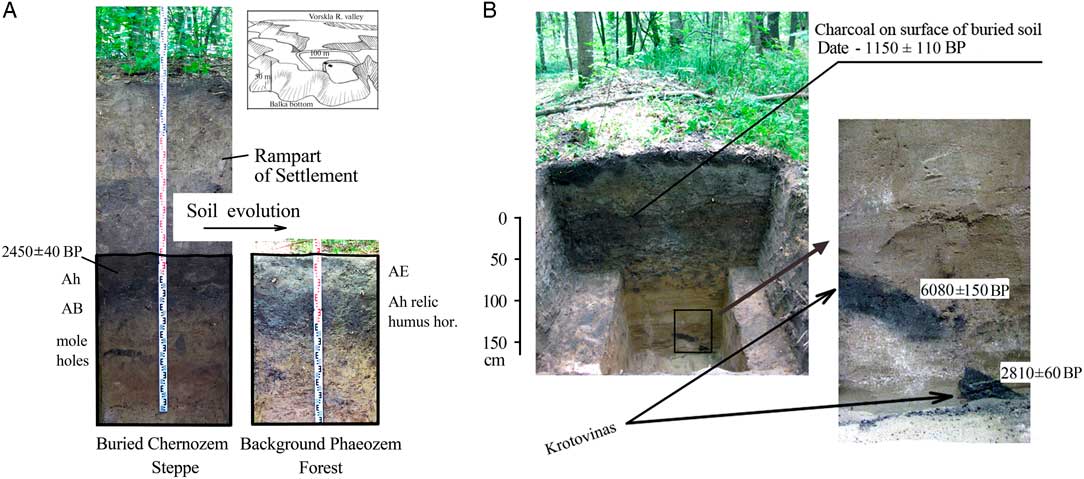
At other sites, the background (modern) analogs of the Chernozems buried under the ramparts of the Scythian settlements were identified as Greyzemic Haplic Luvisols or Luvic Greyzemic Phaeozems developing for a long time under forest vegetation. The difference in the morphology of the background surface soil and the ancient buried Chernozem at the Borisovka site is illustrated in Figure 2A.
(A) Chronosequence of soils studied at the Borisovka key site with indication of the direction of soil evolution as a result of changes in the bioclimatic conditions. (B) Example of krotovinas filled with Chernozemic soil material in forest soils as an evidence for the steppe nature of pedogenesis in the Middle and the beginning of the Late Holocene. The dating of krotovinas was made on the basis of TOC of Chernozem’s filling of the tunnels of mole rats (typical steppe animals). Soil under the rampart of the second defense line at Podgornoye settlement.

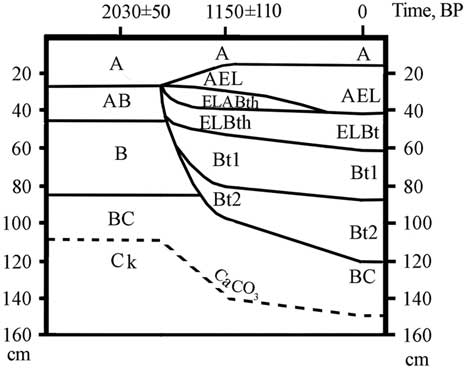
Evidence of the ancient pedogenesis after the Scythian time was studied for the Early Iron Age archaeological culture at the Podgornoye key site. The soil buried under the rampart dating back to 2030±50 BP was identified as a Chernic Luvic Chernozem. The soil buried under the rampart dating back to 1150±110 BP already reflected a sufficiently long stage of forest pedogenesis on the interfluve. It was identified as a Chernic Greyzemic Luvic Phaeozem (Table 1). The features of forest pedogenesis in this Phaeozem were manifested by whitish skeletans on ped faces in the AB horizon and by the angular blocky structure with illuviation coatings on ped faces in the Bt horizon. Hence, it can be supposed that the transformation of Chernozems into Luvisols after the appearance of forest vegetation in former steppes proceeded through a transitional stage of Phaeozems.
Striking proof of the steppe past of the soils buried under the studied ramparts is the presence of inclusions of burrows (krotovinas) of typical steppe animals—mole rats; these krotovinas are filled with well-structured loamy humus material of Chernozems. One of the examples is the dark-gray krotovinas found in the lower part of the soil buried under the rampart of the second defense line at the Podgornoye site (1150±110 BP, Ki-19108, dating by charcoal). The 14C age of soil organic matter filling one of the krotovinas is 2810±60 BP (Ki-19110) (boundary of Subboreal and Subatlantic periods of the Holocene); in another krotovina, it reached 6080±150 BP (Ki-19109) (Atlantic period of the Holocene) (Figure 2B). The dating of the soil organic matter filling the krotovina may seem problematic since it may well be the material that migrated from different sources with significant age dispersion. Indeed, krotovinas are filled with redeposited material from different sources. However, in separate sections of krotovinas, their filling is usually derived from a relatively small area of a given horizon with the certain age and properties (including plant pollen and phytoliths). Essential mixing can be due to multiple redeposition of the material, but such sections of a krotovina are clearly visible because of the mottled color pattern. The period characterized by the filling of a given section of krotovina is not as short as when analyzing pollen in lacustrine sediments or peat; the interpretation of data on it is analogous to that on soil horizons. At the same time, data on the filling of krotovinas are often better than those on the upper soil horizons and make it possible to identify the conditions of the paleoenvironment more adequately, because the material of the filling at a considerable depth is better isolated from external influences that greatly affect the upper soil horizons. The importance of information from krotovinas and their filling for paleoclimatic and paleogeographic reconstructions was clearly demonstrated in a recent study (Pietsch Reference Pietsch2013).
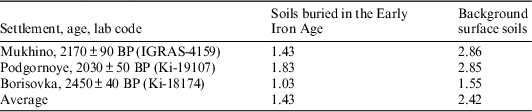
One of main processes of the evolutionary transformation of Chernozems into Phaeozems and Luvisols is intensification of their textural differentiation (Table 2) as a result of lessivage under the broadleaved forest canopy. In more humid northern regions of the forest-steppe (Mukhino and Podgornoye key sites), we detected a tendency for an increase in the degree of textural differentiation of the soil profiles in comparison with that in more southern territories (Borisovka key site).
Coefficients of textural differentiation (ratio of the clay content in the B horizon to the clay content in the A horizon) in soils of the Early Iron Age and of the present period in chronosequences studied on level interfluves near river valleys in the forest-steppe zone of the Central Russian Upland.Footnote *

* Data from the Petropavlovka key site were not considered because the background there was formed under grassy vegetation in place of the forest cut down more than 100 years ago. Soil animals (mole rats) with their loosening activity could disturb the distribution pattern of clay in the soil profile developed in the former forest environment.
The eluvial–illuvial differentiation of the profiles as a result of lessivage caused the appearance of genetically linked horizons of eluviation and illuviation of soil substances: AEL-ELB-Bt. Evolutionary transformation of morphogenetic horizons of Chernozems into horizons of Phaeozems and Luvisols is demonstrated by the soil chronosequence studied at the Podgornoye site (Figure 3).
Chronosequence of soil profiles reflecting the evolution of loamy Chernozem into Luvisol in the central part of the Central Russian Upland forest-steppe (Podgornoye key site). Dashed line shows the depth of effervescence.

Anthropogenic Evolution of Soils
The second important aspect of the study was the analysis of the anthropogenic evolution of automorphic Phaeozems and Luvisols formed under broadleaved forests in the forest-steppe zone under the impact of their agricultural development and long-term plowing.
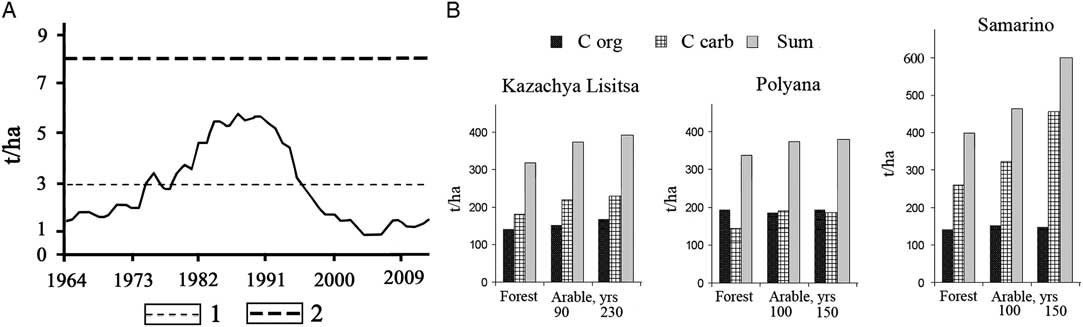
Agrochronosequences of extensively managed soils were studied in the areas with a typical history of agricultural development and traditional farming technologies [rainfed agriculture, moldboard tillage, application of farmyard manure at low (<6 t/ha annually) rates] (Figure 4A).
(A) Dynamics of the annual rates of application of farmyard manure to arable soils of the studied agrochronosequences (average for three key areas): 1—average rate, 2—recommended rate for maintaining the zero balance of organic carbon in the cultivated soil. Before 1964, the rates of organic fertilizers were lower than the average rate in 1964–2009. (B) Carbon pools in the soil organic matter and carbonates and their sum in the 2-m-deep layer of soils in the studied agrochronosequences at three key sites.

At the Kazachya Lisitsa site, an agrochronosequence consisting of the background Luvic Greyzemic Phaeozem under native forest and its arable analogs cultivated for 90 and 230 years was studied. At the Polyana site, an agrochronosequence of the Luvic Greyzemic Phaeozem under native forest and its arable analogs cultivated for 100 and 150 years was examined. At the Samarino site, the background Greyzemic Haplic Luvisol was studied together with its arable analogs cultivated for 100 and 150 years.
The results obtained at all the key sites indicate an increase in the thickness of the upper, enriched in the organic matter part of the profiles of arable soils with time, as well as a unidirectional enhancement of the features of zoogenic turbation of the arable soils by mole rats and earthworms.
Data on the contents of organic (Corg) and inorganic (Ccarb) carbon in the soil profiles and on the soil bulk density were used to calculate their individual pools and the total pool of pedogenic carbon in the entire soil profiles and in separate layers down to the depth of 2 m.
The most general regularity revealed by us in the arable soils is that the pools of pedogenic carbon do not decrease in comparison with those in the background (forest) soils. Moreover, they increase by 15–30% (up to 50%), mainly at the expense of the carbon of carbonates (Figure 4B). The increase in the pool of Ccarb is clearly seen in the soil after 100 (or less) years of plowing. An increase in the Corg pool in the profiles is only seen in the soils cultivated for more than 200 years; it is mainly due to the accumulation of humus in the subsoil (the Kazachya Lisitsa site).
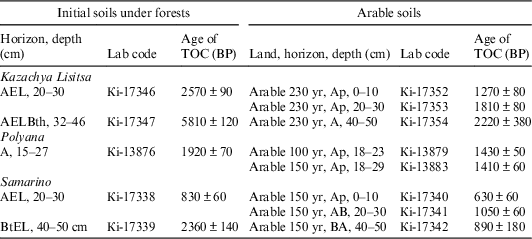
14C dating demonstrates the rejuvenation of soil organic matter (humus) in the upper horizons of arable soils compared to their background analogs under forest. This is obviously due to the replenishment of the soil humus pool with fresh organic matter formed during the arable stage of the soil evolution (Table 3). We emphasize once again that the all the studied soils have been treated with low rates of organic fertilizers (Figure 4A), so that the established increase in the pools of organic matter in the cultivated Phaeozems and Luvisols cannot be explained by the agrochemical reclamation measures applied to the arable fields.
Radiocarbon ages of TOC of soils in the studied agrochronosequences (data from Kiev Radiocarbon Laboratory of the National Academy of Sciences of Ukraine).

The 14C dating of carbonates in the studied agrochronosequences yielded the following results. At the Polyana site (Belgorod oblast), pedogenic carbonates found at the depth of 170–180 cm (the depth of their appearance in the background soil under forest) were dated for the entire agrochronosequence (forest → arable land 100 yr → arable land 150 yr); their 14C ages comprised 8000±100 BP (Кі-16057), 8270±150 BP (Кі-16046), and 9150±100 BP (Кі-16044), respectively.
At the Samarino site, the carbonates from the depth of 90–100 cm (the depth of their appearance in the background soil under forest) were dated. Their 14C ages for the forest soil and the soils cultivated for 100 and 150 years comprised 6500±90 BP (Кі-16042), 7150±100 BP (Кі-16064), and 12360±230 BP (Кі-17343), respectively.
Thus, an increase in the 14C-age of pedogenic carbonates in the arable soils in comparison with the soils under forests takes place; this increase is more pronounced in the soils with a longer duration of plowing.
DISCUSSION AND CONCLUSIONS
As shown in many studies, climate changes of different duration and intensity have been the main cause of the natural evolution of soils in different regions of Europe and the entire world in the Holocene (Buol et al. Reference Buol, Hole and McCracken1973; Aleksandrovskiy Reference Aleksandrovskiy1988; Hejcman et al. Reference Hejcman, Součková, Krištuf and Peška2013).
The Early and Middle Holocene (10,300–4000 BP) in the southern part of the forest-steppe zone of the Central Russian Upland was generally more arid than the Late Holocene (the last 4000 yr) period, as evidenced, in particular, by the results of palynological study of wetland and floodplain sediments in this area (Serebryannaya and Ilves Reference Serebryannaya and Il’ves1973; Klimanov and Serebryannaya Reference Klimanov and Serebryannaya1986; Serebryannaya Reference Serebryannaya1992). According to palynological data, intense afforestation of the southern part of the Central Russian Upland took place in the Subatlantic period of the Holocene in the past 2800 yr (Serebryannaya and Ilves Reference Serebryannaya and Il’ves1973).
The main part of landscapes with broadleaved forests as zonal component of the forest-steppe environment on the Central Russian Upland is assumed to be secondary in relation to meadow-steppe landscapes (Klimanov and Serebryannaya Reference Klimanov and Serebryannaya1986; Serebryannaya and Ilves Reference Serebryannaya and Il’ves1973). Indeed, as shown in our study, Chernozems with relatively deep humus horizons existed in place of the modern texturally differentiated Phaeozems and Luvisols at the beginning of the Subatlantic period, which attests to the long steppe stage of soil formation during the Middle Holocene and the beginning of the Late Holocene. Our studies of soil chronosequences at archaeological sites of ancient settlements with defensive ramparts of the Early Iron Age on the Central Russian Upland confirm the relatively recent natural afforestation of river valleys and adjacent parts of the interfluves in response to climatic moistening during the Subatlantic period of the Holocene. The close patterns of the evolutionary transformation of Chernozems into Luvisols (Alfisols) under the canopy of forest vegetation in relation to the climatically driven invasion of forests onto steppe in the Late Holocene have also been noted for other regions of the northern hemisphere, including Central Europe (Bork Reference Bork1983; Hejcman et al. Reference Hejcman, Součková, Krištuf and Peška2013) and North America (Ruhe and Schotles Reference Ruhe and Schotles1956; Buol et al. Reference Buol, Hole and McCracken1973; Bettis III et al. Reference Bettis, Benn and Hajic2008).
The trend of natural evolution of modern forest-steppe soils under broadleaved forests consists of a gradual transformation of Chernozems covered by forests at the beginning of the Subatlantic period into Luvisols through the stage of Phaeozems. Texture-differentiated Phaeozems studied under modern forests should probably be considered an intermediate stage of the evolution of Chernozems into Luvisols. As a result of deforestation and subsequent plowing of Phaeozems and Luvisols in the forest-steppe, the properties of these soils have changed in the direction of their better agronomic quality with a general tendency of their transformation into Chernozems.
Despite the extensive farming practices with low rates of application of organic fertilizers, the cultivation of the studied soils with time leads to the accumulation of TOC in their profiles, which is clearly demonstrated by the decrease in the MRT of organic carbon in the arable soils in comparison with that in the similar layers of the background soils under native forests.
Our results are in line with the data obtained in another region of the world in a comparative study of the MRT of soil organic matter in Alfisols of Australia (analogs of the European Luvisols) in a natural state under forest and in arable lands. In Alfisols under the forest, the MRT of the TOC in the upper soil horizons is also characterized by higher values than those in similar layers on arable lands (Fazle Rabbi et al. Reference Fazle Rabbi, Hua, Daniel, Lockwood, Wilson and Young2013). At the same time, studies conducted for soils formed in grassland ecosystems of the United States (Mollisols of Nebraska) indicate a decrease in the humus content and an increase in the MRT of TOC in the plowed soils as a result of the priority utilization of labile organic carbon stocks with low MRT in the course of agricultural development of these soils (Rutberg et al. Reference Rutberg, Schimel, Hajdas and Broecker1996).
Taking into account the morphological observations and the results of 14C dating of carbonates in the arable soil profiles of the studied agrochronosequences, we argue that carbonates from parent materials migrate upwards along the capillary pores in summer under the impact of strong heating and drying of the plow horizons. An increase in the 14C dates of “agrogenic” carbonates indicates that “old” carbon of lithogenic carbonates from the parent material in the form of colloidal suspensions enters the profile of arable soils (Khokhlova et al. Reference Khokhlova, Chendev, Myakshina and Shishkov2013). Otherwise, if the carbon of carbonates were precipitated from the soil solution (i.e., from the ionic form), the 14C-age of the carbonates would be zeroed.
The assumed reason for the “Chernozemic” trend of transformation of the arable soils is the change in the soil climate regime after the replacement of forests by arable land and in the course of the long-term soil plowing. Under the new hydrothermic conditions, the soil-forming potential of arable soils is directed towards the maintenance of positive carbon balance of the soil organic matter, even taking into account the annual removal of organic matter with harvested crops. Because of changes in the hydrothermic regime, the change from “forest” to “agro-steppe” pedogenesis takes place in the soils of the studied agrochronosequences; the pools of Ccarb increase due to the ascending migration of carbonates in the colloidal suspensions from the lower horizons of the soil profiles or from parent materials, which is the main reason for an increase in the 14C age of pedogenic carbonates.
Thus, the combined study of the natural (bioclimatic) and anthropogenic (upon soil cultivation) evolution of Phaeozems and Luvisols of the Central Russian Upland forest-steppe allows us to make an assertion about divergent lines of their development. The natural evolution of soils in the Late Holocene has been directed towards transformation of steppe Chernozems into forest Phaeozems and Luvisols, while the long-term plowing of forest soils changes them in the direction of steppe (Chernozemic) soils. This major conclusion confirms complex nature of the regional soil development under the influence of natural and anthropogenic factors, which, as noted at the beginning of this paper, is reflected in a complicated history of understanding the genesis and evolution of soils in the forest-steppe landscapes of Eastern Europe.
Taking into account this conclusion, the results of a recent study of the origin of Chernozems in Central Europe by Vyslouzilova with co-authors (Reference Vyslouzilova, Ertlen, Sefrna, Novak, Viragh, Rue, Campaner, Dreslerova and Schwartz2015) can be interpreted differently: the Chernozems of “forest genesis” identified by the authors of this work along with the normal Chernozems of steppe genesis, can be the product of anthropogenic changes of Phaeozems and Luvisols by analogy with the trend established in our work. For Europe, these changes have probably been observed since the Neolithic times due to intensive deforestation and agricultural development of territories according to data from other studies (Eckmeier et al. Reference Eckmeier, Gerlach and Gehrt2007; Lorz and Saile Reference Lorz and Saile2011).
ACKNOWLEDGMENTS
This study was supported by three scientific grants. Data on the natural evolution of Phaeozems and Luvisols were obtained with support from the Russian Science Foundation (project no. 14-17-00171). Data on the evolution of these soils in agrochronosequences were obtained with support from the Russian Foundation for Basic Research (project no. 09-05-97513-r_center_a). Radiocarbon dating of pedogenic carbonates was done with support of the Russian Academy of Sciences State program AAAA-A18-118013190175-5.