Polinsky and Scontras (Polinsky & Scontras, Reference Polinsky and Scontras2019) state that “aspects of phonetics and phonological competence appear to be robust in heritage languages” (p. 10), albeit observing that “heritage speakers are not perfect in their knowledge of sound systems”.Footnote 1 Herein, I proceed from the assumption that the sound systems of heritage speakers (HSs) are vulnerable and subject to similar mechanisms as other aspects of language. It is true that HSs are often perceived as sounding more native-like than late L2ers, but they also outperform L2ers on other aspects of language. The idea that HSs’ sound systems are relatively robust is compromised by widely-reported instances of cross-linguistic influence (CLI) in child bilinguals (e.g., Kehoe, Reference Kehoe2018, Lleó, Reference Lleó2018) and the fact that many HSs end up sounding foreign in their native, heritage language (HL). Polinsky and Scontras refer to a “heritage accent” (p. 10); other studies show that HSs are (mis)identified as L1-speakers of their dominant language (DL) (e.g., Kupisch, Barton, Hailer, Lein, Stangen & van de Weijer, Reference Kupisch, Barton, Hailer, Lein, Stangen and van de Weijer2014; Lloyd-Smith, Einfeldt & Kupisch, Reference Lloyd-Smith, Einfeldt and Kupisch2019). Nevertheless, when looking at specific properties of HSs’ sound systems, it becomes clear that CLI does not always occur when HL and DL features differ. Polinsky and Scontras provide us with an excellent basis for predicting the make-up of these systems. In what follows, I speculate that HSs’ sound systems, too, are characterized by (i) avoidance of ambiguity, (ii) resistance to irregularity and (iii) shrinking of structure. I provide examples for (i-ii) and add another characteristic feature, namely (iv) variation.Footnote 2
Avoidance of ambiguity
Ambiguities can arise if two phonologically distinct sounds merge into one category. For example, Italian has geminate consonants, i.e., the difference between long and short consonants is phonemic, e.g., /ˈfato/ “fate” vs. /ˈfatːo/ “done”, while German makes no such distinction. HSs of Italian with German as their DL might be expected to lose the ability to distinguish long and short consonants due to CLI, unless it was crucial to avoid ambiguities. Einfeldt, Kupisch and van de Weijer (Reference Einfeldt, Kupisch and van de Weijerforthcoming) have analysed production data of Italian HSs, whose speech was perceived to be accented, in terms of the durations of their singletons vs. geminates, comparing them to monolingual and Italian-dominant bilingual (HL German) controls. The HSs maintained the durational contrast and did not differ from monolinguals.
Future research could expand to include prosody, an allegedly “vulnerable area” (Polinsky and Scontras, p. 10), exploring what happens if prosodic differences are distinctive. The Italian sequence Ci sono molti linguisti “there are many linguists” is affirmative when produced with falling intonation, while being interrogative when produced with rising intonation, and there is no alternative way of expressing yes-no questions. Following Polinsky and Scontras, the contrast should be maintained or even over-marked, regardless of its realization in the contact language.
Resistance to irregularity
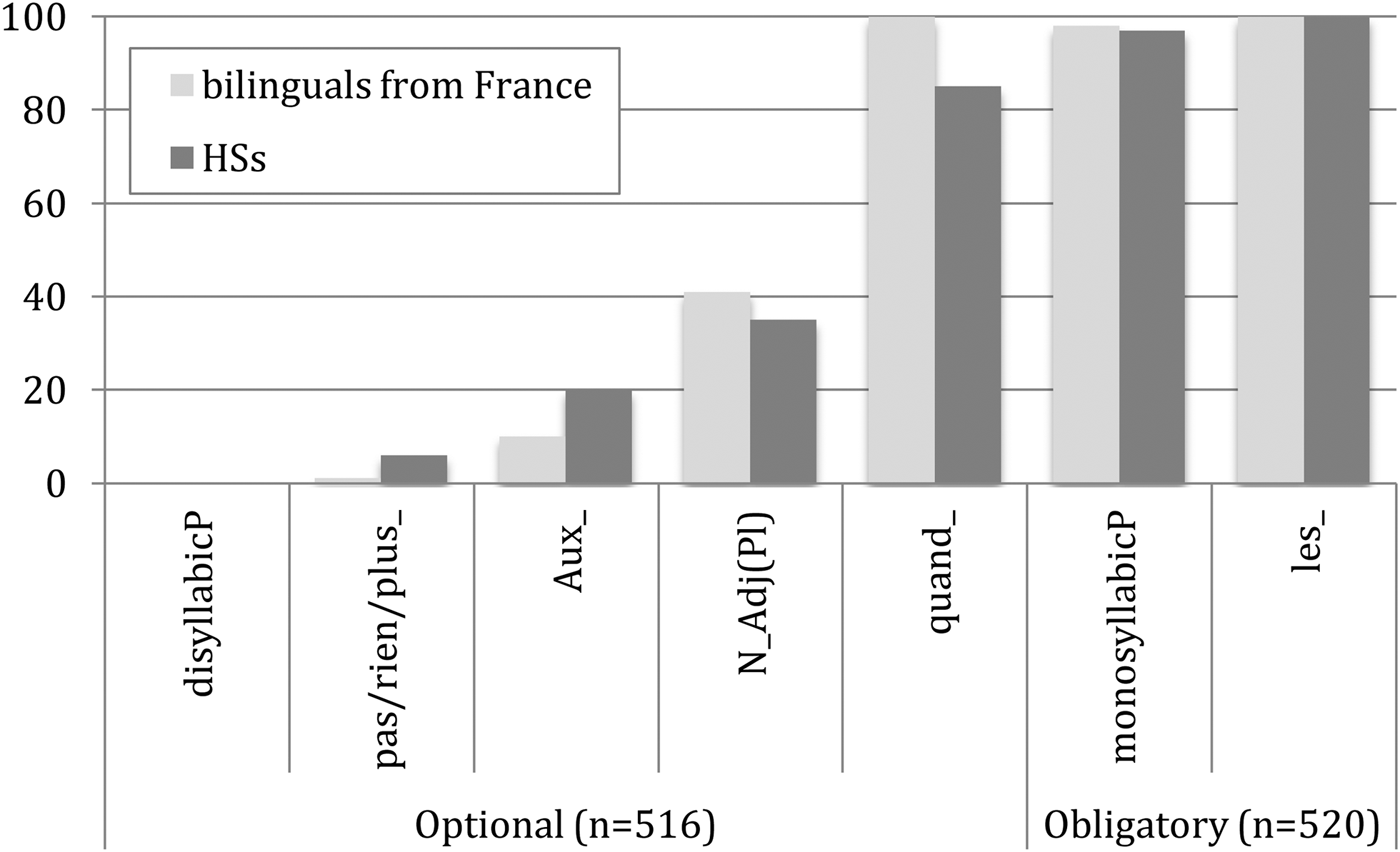
Examples for irregularities are not restricted to morphology. An example from phonology concerns French liaison, whereby the final consonant of a word is pronounced as the onset of the following word, e.g., les amis [le.zami] “the friends”. The effect of liaison is a regularization of syllable structure: avoidance of a hiatus, formation of CV-structures. While liaison is obligatory in some contexts, it is optional in others. Moreover, there is a tendency for younger speakers to use fewer optional liaisons, although rhythm thereby becomes less regular. Based on Polinsky and Scontras, we would predict that HSs maintain liaisons, even optional ones, because liaisons regularize the phonotactic structure of the language. An exploratory study of French HSs has indeed shown that HSs produce obligatory and optional contexts to the same degree as a mirror-image bilingual baseline group from France (Figure 1).
Fig. 1.Realizations (%) of liaison
Variation
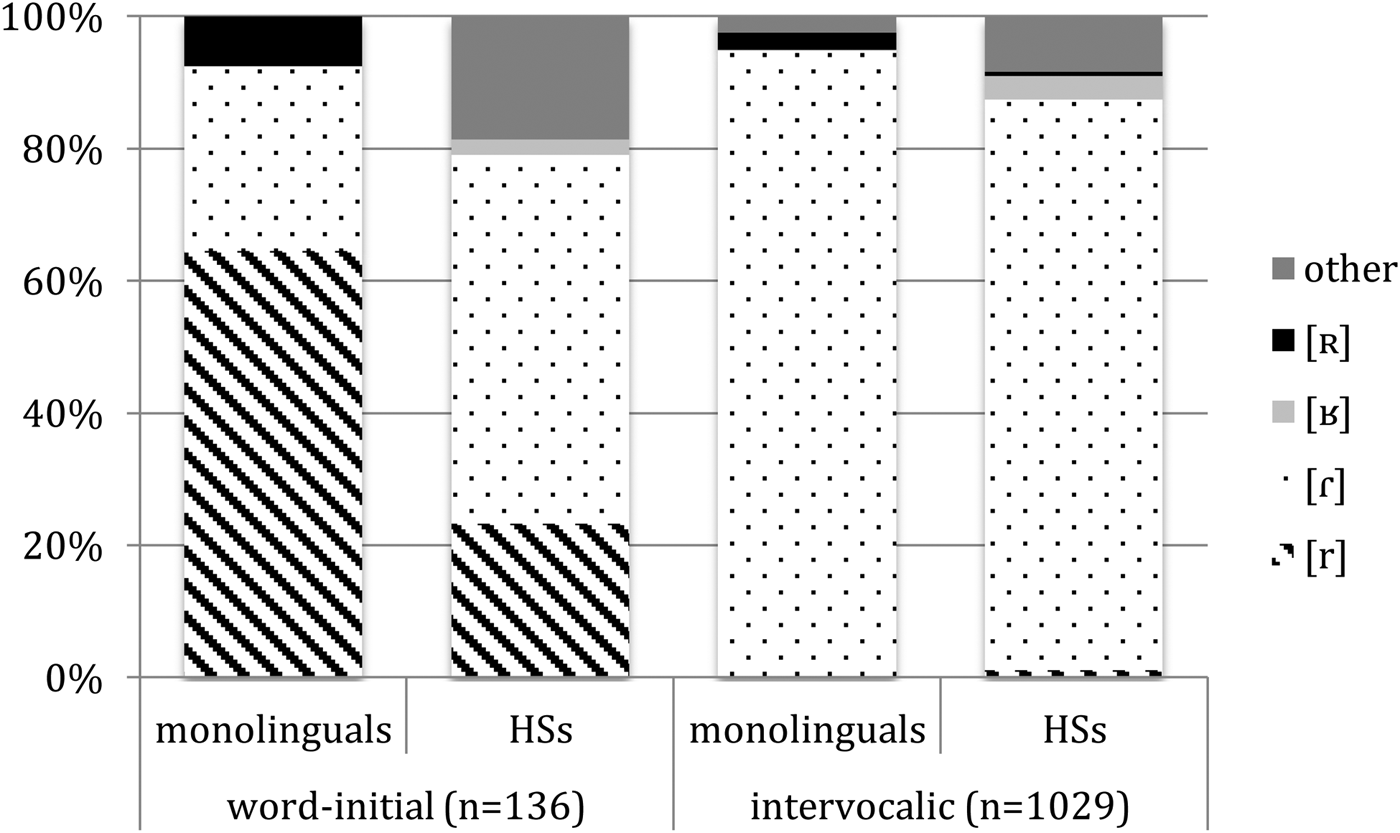
HSs do not simply develop a merged system of their DL and HL phonologies. In Italian, the prototypical r-sound is an alveolar trill [r] − an articulatorily complex sound. It varies with the flap [ɾ] in unstressed positions, e.g., leggere [lεgːεɾε] “read”. Moreover, many Italians realize /r/ as erre-moscia (“soft-r”), the voiced uvular trill [ʀ], due to dialectal variation and, possibly, pronunciation difficulties. In Standard German, /r/ is described as a voiced uvular fricative [ʁ], although there are dialectal variants; /r/ is vocalized postvocalically. We compared monolingual Italian speakers (n = 20) with HSs (n = 18), both groups representing various regions; we classified all productions of word-initial and word-medial intervocalic /r/ in semi-elicited speech as [r], [ʀ], [ʁ], [ɾ] or “other” (mostly retroflex /r/). Figure 2 shows that the two groups behave similarly where [ɾ] is required but differently where [r] is required, mostly due to the HSs producing fewer instances of [r], using [ɾ] and other sounds instead. The study indicates that the HSs tend to avoid the more marked sound [r], while exploiting the variation inherent to the Italian system. However, they refrain from adopting the German r-sound.
Fig. 2./r/-sounds in monolingual Italian speakers compared to Italian HSs
In summary, Polinsky and Scontras provide an excellent starting point for exploring mechanisms that lead to differential acquisition outcomes in HSs’ sound systems. Future work should integrate the notion of variation and investigate whether there is a hierarchy amongst the various mechanisms.




 You have
Access
Polinsky and Scontras (Polinsky & Scontras, Reference Polinsky and Scontras2019) state that “aspects of phonetics and phonological competence appear to be robust in heritage languages” (p. 10), albeit observing that “heritage speakers are not perfect in their knowledge of sound systems”.Footnote 1 Herein, I proceed from the assumption that the sound systems of heritage speakers (HSs) are vulnerable and subject to similar mechanisms as other aspects of language. It is true that HSs are often perceived as sounding more native-like than late L2ers, but they also outperform L2ers on other aspects of language. The idea that HSs’ sound systems are relatively robust is compromised by widely-reported instances of cross-linguistic influence (CLI) in child bilinguals (e.g., Kehoe, Reference Kehoe2018, Lleó, Reference Lleó2018) and the fact that many HSs end up sounding foreign in their native, heritage language (HL). Polinsky and Scontras refer to a “heritage accent” (p. 10); other studies show that HSs are (mis)identified as L1-speakers of their dominant language (DL) (e.g., Kupisch, Barton, Hailer, Lein, Stangen & van de Weijer, Reference Kupisch, Barton, Hailer, Lein, Stangen and van de Weijer2014; Lloyd-Smith, Einfeldt & Kupisch, Reference Lloyd-Smith, Einfeldt and Kupisch2019). Nevertheless, when looking at specific properties of HSs’ sound systems, it becomes clear that CLI does not always occur when HL and DL features differ. Polinsky and Scontras provide us with an excellent basis for predicting the make-up of these systems. In what follows, I speculate that HSs’ sound systems, too, are characterized by (i) avoidance of ambiguity, (ii) resistance to irregularity and (iii) shrinking of structure. I provide examples for (i-ii) and add another characteristic feature, namely (iv) variation.Footnote 2
Avoidance of ambiguity
Ambiguities can arise if two phonologically distinct sounds merge into one category. For example, Italian has geminate consonants, i.e., the difference between long and short consonants is phonemic, e.g., /ˈfato/ “fate” vs. /ˈfatːo/ “done”, while German makes no such distinction. HSs of Italian with German as their DL might be expected to lose the ability to distinguish long and short consonants due to CLI, unless it was crucial to avoid ambiguities. Einfeldt, Kupisch and van de Weijer (Reference Einfeldt, Kupisch and van de Weijerforthcoming) have analysed production data of Italian HSs, whose speech was perceived to be accented, in terms of the durations of their singletons vs. geminates, comparing them to monolingual and Italian-dominant bilingual (HL German) controls. The HSs maintained the durational contrast and did not differ from monolinguals.
Future research could expand to include prosody, an allegedly “vulnerable area” (Polinsky and Scontras, p. 10), exploring what happens if prosodic differences are distinctive. The Italian sequence Ci sono molti linguisti “there are many linguists” is affirmative when produced with falling intonation, while being interrogative when produced with rising intonation, and there is no alternative way of expressing yes-no questions. Following Polinsky and Scontras, the contrast should be maintained or even over-marked, regardless of its realization in the contact language.
Resistance to irregularity
Examples for irregularities are not restricted to morphology. An example from phonology concerns French liaison, whereby the final consonant of a word is pronounced as the onset of the following word, e.g., les amis [le.zami] “the friends”. The effect of liaison is a regularization of syllable structure: avoidance of a hiatus, formation of CV-structures. While liaison is obligatory in some contexts, it is optional in others. Moreover, there is a tendency for younger speakers to use fewer optional liaisons, although rhythm thereby becomes less regular. Based on Polinsky and Scontras, we would predict that HSs maintain liaisons, even optional ones, because liaisons regularize the phonotactic structure of the language. An exploratory study of French HSs has indeed shown that HSs produce obligatory and optional contexts to the same degree as a mirror-image bilingual baseline group from France (Figure 1).
Realizations (%) of liaison
Variation
HSs do not simply develop a merged system of their DL and HL phonologies. In Italian, the prototypical r-sound is an alveolar trill [r] − an articulatorily complex sound. It varies with the flap [ɾ] in unstressed positions, e.g., leggere [lεgːεɾε] “read”. Moreover, many Italians realize /r/ as erre-moscia (“soft-r”), the voiced uvular trill [ʀ], due to dialectal variation and, possibly, pronunciation difficulties. In Standard German, /r/ is described as a voiced uvular fricative [ʁ], although there are dialectal variants; /r/ is vocalized postvocalically. We compared monolingual Italian speakers (n = 20) with HSs (n = 18), both groups representing various regions; we classified all productions of word-initial and word-medial intervocalic /r/ in semi-elicited speech as [r], [ʀ], [ʁ], [ɾ] or “other” (mostly retroflex /r/). Figure 2 shows that the two groups behave similarly where [ɾ] is required but differently where [r] is required, mostly due to the HSs producing fewer instances of [r], using [ɾ] and other sounds instead. The study indicates that the HSs tend to avoid the more marked sound [r], while exploiting the variation inherent to the Italian system. However, they refrain from adopting the German r-sound.
/r/-sounds in monolingual Italian speakers compared to Italian HSs
In summary, Polinsky and Scontras provide an excellent starting point for exploring mechanisms that lead to differential acquisition outcomes in HSs’ sound systems. Future work should integrate the notion of variation and investigate whether there is a hierarchy amongst the various mechanisms.
Acknowledgements
I wish to thank Marieke Einfeldt and Anika Lloyd-Smith for valuable comments and Chiara Ochsenreiter for supporting the data analysis.