Introduction
The newly discovered mineral gorerite, with the ideal chemical formula CaAlFe11O19, represents an addition to the magnetoplumbite group. This group encompasses minerals characterised by the general formula AB 12O19, where the cations A may include elements such as Ba, Pb, Ca, or K, while the B cations can include Mg, Al, Ti, Cr, Mn, Fe, Zn and Sb, among others (Pullar, Reference Pullar2012; Holtstam and Hålenius, Reference Holtstam and Hålenius2020). Recent classification schemes have further refined this group by categorising it based on the predominant composition at the A site (Holtstam and Hålenius, Reference Holtstam and Hålenius2020). With calcium occupying the A site, gorerite, along with hibonite (CaAl12O19), constitutes the hibonite subgroup within the magnetoplumbite group.
The minerals belonging to the magnetoplumbite group exhibit structures characterised by an intercalation of two types of blocks along the hexagonal c -axis: S (spinel-like) blocks and R (rock salt type) blocks. The S blocks demonstrate a ccp (closest-packed cubic) arrangement of atoms with an overall composition of {B 9O12 }3+. On the other hand, the R blocks possess an hcp (hexagonal close packed) structure with an overall composition of {AB 3O7}3–. The stacking sequence is denoted as RSR*S*⋅, where the asterisk symbol indicates that certain blocks are rotated by 180° to maintain P63/mmc symmetry.
Gorerite was initially described as ‘hexaferrite’ and was first discovered in flamite–gehlenite hornfels located at the Jabel Harmun locality in the West Bank (Galuskina et al., Reference Galuskina, Galuskin, Pakhomova, Widmer, Armbruster, Krüger, Grew, Vapnik, Dzierżanowski and Murashko2017). However, due to the limited size of the grains, structural analysis could not be conducted on this particular sample. The holotype gorerite discussed here was found in esseneite–gehlenite–wollastonite–anorthite melted rock within the ‘olive’ subunit of pyrometamorphic rocks, as illustrated in figure 1C of Kruszewski et al. (Reference Kruszewski, Palchik, Vapnik, Nowak, Banasik and Galuskina2021). These ‘olive’ subunits are currently known to exist solely within the northern region of the Hatrurim Basin, located in the Negev Desert, Israel (Gross, Reference Gross1977).
It's worth noting that outcrops of Jabel Harmun in the West Bank, as well as those of the Hatrurim Basin in the Negev Desert, are part of a larger geological unit known as the Hatrurim Complex. The Hatrurim Complex, also referred to as the ‘Mottled Zone’ or ‘Hatrurim Formation’, comprises numerous other outcrops scattered across the South Levant territory on both sides of the Dead Sea Rift (Bentor, Reference Bentor1960; Gross, Reference Gross1977; Novikov et al., Reference Novikov, Vapnik and Safonova2013; Galuskina et al., Reference Galuskina, Vapnik Ye, Armbruster, Murashko and Galuskin2014).
Aside from gorerite, the Hatrurim Basin serves as the type locality for barioferrite (BaFe12O19), another mineral belonging to the magnetoplumbite group. Barioferrite was initially identified in altered baryte concretions (Murashko et al., Reference Murashko, Chukanov, Mukhanova, Vapnik Ye., Polekhovsky and Ivakin2011). Both gorerite and barioferrite are relatively widespread in rocks found within the Hatrurim Basin. These minerals typically occur as small plate inclusions within magnesioferrite from gehlenite–larnite (flamite) hornfels and rankinite–schorlomite paralava (Galuskina et al., Reference Galuskina, Galuskin, Pakhomova, Widmer, Armbruster, Krüger, Grew, Vapnik, Dzierżanowski and Murashko2017).
In addition to barioferrite and gorerite, hibonite (CaAl12O19) has been discovered in hematite segregations from the paralava of the ‘olive’ unit (Sharygin, Reference Sharygin2019). Minerals of the magnetoplumbite group within the Hatrurim Complex exhibit notable variations in magnesium, titanium and chromium contents (Sharygin, Reference Sharygin2019; Sharygin and Murashko, Reference Sharygin and Murashko2021; Krüger et al., Reference Krüger, Galuskin, Galuskina, Krüger and Vapnik2021). Furthermore, recently discovered β-alumina-type minerals, namely kahlenbergite (KAl11O17) and shagamite (KFe3+11O17), have been found in association with hibonite and gorerite (Krüger et al., Reference Krüger, Galuskin, Galuskina, Krüger and Vapnik2021; Galuskin et al., Reference Galuskin, Krüger, Galuskina, Krüger, Nejbert and Vapnik2021). Additionally, it's worth noting that although the β-alumina-type minerals were previously classified within the magnetoplumbite group, they are not currently included in the present nomenclature due to the requirement of isostructurality (Holtstam and Hålenius, Reference Holtstam and Hålenius2020).
Within the R-type blocks of the magnetoplumbite structure, one of the smaller B cations is five-coordinated. However, in the structure of β-alumina-type minerals, the smaller cations are tetrahedrally coordinated (Krüger et al., Reference Krüger, Galuskin, Galuskina, Krüger and Vapnik2021). This difference in coordination geometry contributes to the exclusion of β-alumina-type minerals from the current classification, as they do not exhibit the same structural topology as magnetoplumbite minerals.
The mineral gorerite (symbol Gor), has been approved officially by the Commission on New Minerals, Nomenclature and Classification (CNMNC) of the International Mineralogical Association (IMA) under the number IMA2019–080 (Galuskin et al., Reference Galuskin, Krüger, Galuskina, Krüger, Nejbert, Vapnik and Tomizaki2019a). Gorerite is named after Wadi Gorer in the Negev Desert, Israel. This wadi is situated in close proximity to the Hatrurim Junction along the road connecting Arad City with the Dead Sea, near the type locality of gorerite, described below.
The type material, which comprises a portion of the holotype specimen, has been deposited in the mineralogical collection of the Fersman Mineralogical Museum, located at Leninskiy pr., 18/k2, 115162 Moscow, Russia. It is catalogued under the number 5420/1.
Methods of investigation
The semi-quantitative composition and morphology of gorerite and associated phases were investigated using scanning electron microscopes Philips XL30 and Phenom XL at the Institute of Earth Sciences, University of Silesia, Poland. Additionally, the chemical composition of minerals was analysed using the Electron Microprobe Analyzer CAMECA SX100 at the University of Warsaw, Poland, operating in wavelength-dispersive spectroscopy mode. The analysis parameters were set with an acceleration voltage of 15kV, a beam current of 15 nA, and a beam diameter of ~1 μm.
For the analysis of specific elements, the following standards were utilised, with the corresponding Kα lines in parentheses: albite (Na), orthoclase (K, Na), dolomite (Mg), wollastonite (Ca, Si), rhodonite (Mn), rutile (Ti), V metal (V), celestine (Sr), Cr2O3 (Cr), hematite (Fe) and baryte (BaLα).
Raman spectra of gorerite and associated barioferrite and hibonite were collected using a WITec alpha 300R Confocal Raman Microscope at the Institute of Earth Science, University of Silesia, Poland. This microscope is equipped with an air-cooled solid laser operating at 532 nm and a CCD camera set to a temperature of –61°C. Laser radiation was transmitted to the microscope via a single-mode optical fibre with a diameter of 3.5 μm. An air Zeiss LD EC Epiplan-Neofluan DIC-100/0.75NA objective lens was utilised for focusing.
Raman-scattered light was directed through a broad-band single-mode fibre with an effective pinhole size of ~30 μm and a monochromator featuring a 600 mm–1 grating. The laser power at the sample position was ~10–15 mW. Integration times of 5 seconds with accumulation of 20 scans were selected, resulting in a resolution of 3 cm–1. The monochromator was calibrated using the Raman scattering line of a silicon plate at 520.7 cm–1. These parameters ensured accurate and reliable recording of the Raman spectra for analysis.
Single-crystal diffraction measurements were conducted under ambient conditions utilising synchrotron radiation with a wavelength of λ = 0.70849 Å. These experiments were carried out at the X06DA beamline located at the Swiss Light Source, Paul Scherrer Institute, Villigen, Switzerland. The data acquisition process was facilitated by the use of the DA+ software, as outlined by Wojdyla et al. (Reference Wojdyla, Kaminski, Panepucci, Ebner, Wang, Gabadinho and Wang2018). Following data acquisition, determination of lattice parameters was performed using CrysAlisPro (Rigaku, 2022). Subsequently, structure refinement was carried out with Jana2006 software, as described by Petříček et al. (Reference Petříček, Dušek and Palatinus2014).
Occurrence and gorerite description
Samples containing gorerite were collected in 2013 from the ‘olive’ unit outcrop of the Hatrurim Complex, situated near the Hatrurim junction on the Arad–Dead Sea road in the Negev Desert, Israel (coordinates: 31°13′58″N, 35°16′2″E), as depicted in Fig. 1a. The ‘olive’ units are characterised by grey–green to yellow–brown to pale yellow rocks consisting of paralava and hornfels. These rocks exhibit distinctive lens-like ferrite rich segregations, as illustrated in Fig. 1b (Vapnik et al., Reference Vapnik, Sharygin, Sokol and Shagam2007; Sharygin, Reference Sharygin2019; Galuskin et al., Reference Galuskin, Krüger, Galuskina, Krüger, Vapnik Ye. and Olieric2019b; Krüger et al., Reference Krüger, Galuskin, Galuskina, Krüger and Vapnik2021).
(a) Illustration of the distinct ‘desert patina’ observed on the surface of the ‘olive’ unit rock, captured at the Hatrurim Junction, Israel. (b) A dark-green rock belonging to the ‘olive’ unit displays a transition in colour to light brown around the edges of large rock blocks and adjacent to ferrite-rich segregations (as indicated by the arrow). This alteration in colouration is notable and characteristic of rocks within the ‘olive’ unit.

In the samples studied, three distinct zones are discernible. (1) The ferrite–celsian zone (zone II), characterised by abundant zonal aggregates of ferrites containing gorerite (see Fig. 2). This zone serves as an intermediate area situated between hematite segregations (zone I) and the host rocks (zone III) (see Fig. 2). (2) The hematite zone (zone I), which consists primarily of hematite along with other minerals such as magnesioferrite, maghemite, hibonite, dorrite–khesinite and barioferrite. (3) The host rocks zone (zone III), comprising pyroxene of the diopside–esseneite series, wollastonite, anorthite, gehlenite, andradite, hematite and celsian.
The holotype specimen showing a fragment of ‘olive’ unit paralava enriched in ferrites. The specimen is divided into three distinct zones: I – hematite zone; II – ferrite–celsian zone; and III – esseneite–wollastonite zone. These zones represent different mineralogical compositions and serve to delineate the spatial distribution of minerals within the paralava sample.

Additionally, in the later stages of mineralisation, zeolites, ettringite, calcite and baryte are observed within the samples studied.
In the hematite zone (zone I), gorerite was observed as rare, fine plates, typically only a few micrometres thick. These plates were found to occur within magnesioferrite. In contrast, in zone II, which is characterised by fine symplectites composed of wollastonite, gehlenite, andradite and esseneite, and enriched with celsian, gorerite is a constituent of the ferrite aggregates. These ferrite aggregates reach sizes of up to 100 μm (Figs 3, 4, Supplementary Fig. S1).
Back-scattered electron images of (a) Zone II, as illustrated in Fig. 2, characterised by fine symplectites composed of esseneite, wollastonite and gehlenite with relatively large celsian metacrysts and inhomogeneous ferrite aggregates; (b) example of the largest gorerite grains found in the sample. Fragments of these grains were utilised for structural investigation and Raman spectroscopic studies. Adr = andradite, Cls = celsian, Dor = dorrite, Ess = esseneite, Gh = gehlenite–åkermanite series, Gor = gorerite, Hem = hematite, Mfr = magnesioferrite, Wo = wollastonite, Zlt = zeolite.

Back-scattered electron images. (a) A relatively high concentration of ferrite aggregates containing gorerite (indicated by white arrows) in zone II, near the contact with the hematite zone (zone I, as shown in Fig. 2). The righthand white frame of a ferrite aggregate is magnified in part (b). The ferrite aggregate highlighted in the central frame was used for optical measurements (see Fig. 5a, b). (b) Gorerite crystals with hibonite relics, as commonly observed. The central part of the aggregate is filled with calcite. (c) Ferrite aggregate containing hematite and maghemite. The general zoning of ferrite aggregates from rim to core includes andradite, dorrite, magnesioferrite, hematite/maghemite, gorerite and hibonite. Key: Adr = andradite, Cal = calcite, Cls = celsian, Dor = dorrite, Ess = esseneite, Gh = gehlenite–åkermanite series, Gor = gorerite, Hem = hematite, Hbn = hibonite, Mfr = magnesioferrite, Mgh = maghemite, Wo = wollastonite, Zlt = zeolite.

(a,c) Gorerite exhibits well-marked bireflectance, which is clearly visible on crystals with different orientations (indicated by green and red arrows). These images were captured under reflected light using plane-polarised light (PPL). (b,d) Back-scattered electron images of the aggregates shown in Figs 5a and 5c, respectively. Abbreviations: Adr = andradite, Cal = calcite, Cls = celsian, Dor = dorrite, Ess = esseneite, Gor = gorerite, Hem = hematite, Hbn = hibonite, Mfr = magnesioferrite, Mgh = maghemite, Tch = tacharanite, Wo = wollastonite.

Ferrite aggregates (Figs 3b; 4b, c; S1b; S5) can be described as follows: the central part is filled by hematite (sometimes maghemite) which is overgrown by magnesioferrite; tabular gorerite crystals with hibonite relics are located inside this ferrite aggregate; and fine epitaxial barioferrite zones grow on gorerite. The ferrite aggregates exhibit a fine dorrite rim, which is in turn overgrown by andradite. Small cavities are commonly located in the central part of the ferrite aggregates and are filled by low-temperature minerals: zeolites, tacharanite, or calcite (Figs 4, 5).
The gorerite grain selected for single-crystal structural investigation exhibited chemical homogeneity and was characterised by the following empirical formula (Ca0.99Na0.01)Σ1.00(Fe3+9.51Al1.46Ti4+0.35Cr3+0.31Mg0.28Mn3+0.05Ca0.04)Σ12O19 (Table 1, analysis 1; Fig. 3b). Gorerite crystals containing hibonite relics displayed increased Al content and decreased Ti, Cr and Mg contents. The empirical formulas for these crystals were determined as follows: Ca1.00(Fe3+8.95Al2.49Ti4+0.22Cr3+0.07Mg0.20Mn3+0.02Ca0.04Si0.01)Σ12O19 (for the crystals in Fig. 4b,c Table 1, analysis 2) and (Ca0.99Ba0.01Sr0.01)Σ1.01(Fe3+9.00Al2.50Ti4+0.20Cr3+0.05Mg0.18Mn3+0.02Ca0.03Si0.01)Σ12O19 (for the crystals Fig. 5c,d; Table 1, analysis 3).
Chemical composition of gorerite from holotype specimen.

n.d. – not detected; S.D. – standard deviation
Hibonite, preserved as relics in gorerite from zone II (Figs 4c; 6c, d; Supplementary Table S1, analysis 1), and hibonite intergrown with an unusual high-strontium gorerite-like mineral at the boundary of zones I and II (Fig. S2; Table S1, analysis 2), exhibited higher impurity levels of Mg and Ti compared to gorerite. The high-strontium gorerite-like mineral (Fig. S2b; Table S1, analysis 3) requires further investigations because it is most likely a hexaferrite (of the M type) with a mixed-type structure (Iyi and Göbbels,Reference Iyi and Göbbels1996).

Barioferrite crystallised as the last of the minerals of the magnetoplumbite group, is the most ferrous and its empirical crystal chemical formulas are close to the end-member one (Fig. S2a; Table S1, analyses 4, 5).
Minerals of the oxyspinel group (spinel subgroup) are represented by magnesioferrite and maghemite (Table S2). Maghemite can be readily distinguished from hematite by its light-blue colouration in reflected light (see Fig. 5a) and typically exhibits higher aluminium content (refer to Tables S2, S3).
Gorerite is characterised by its black colour with a black streak, occasionally displaying a brown tint and submetallic lustre. It forms platy hexagonal crystals with {001} and {100} simple forms, and twins are not observed. The average micro-indentation hardness, based on 18 spot measurements (VHN10), is 718(15), ranging from 692 to 752 kg/mm2, corresponding to a Mohs hardness of 5–6. The cleavage is good on (001), while parting is observed on (100). The tenacity of gorerite is brittle, and its fracture is uneven perpendicular to (001). Density measurements were not conducted due to the small size and rarity of gorerite crystals; however, a density of 5.36 g⋅cm–3 was calculated based on the empirical formula and unit cell volume refined from single-crystal X-ray diffraction data for the holotype specimen. In reflected light, gorerite appears grey, with reflectance values ranging between 18% and 24% (refer to Table S4). The mineral is anisotropic and exhibits well-defined bireflectance: appearing dark grey perpendicular to Z and light grey parallel to Z. Additionally, rare brown–red internal reflections may be observed.
Raman spectroscopy
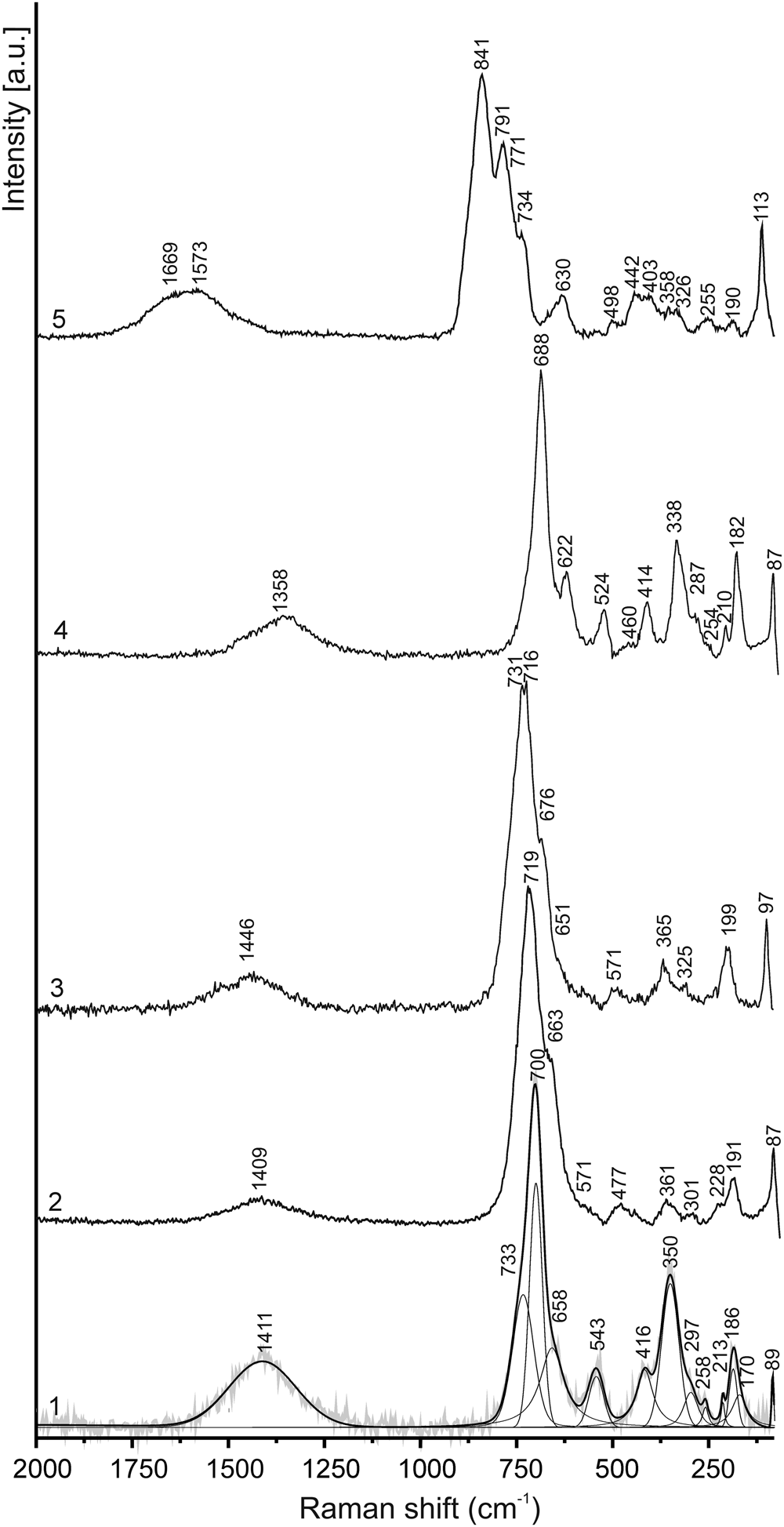
The Raman spectrum of the holotype gorerite reveals the following bands (see Fig. 6; cm–1): 1411, 733, 700, 658, 543, 416, 350, 297, 258, 213, 186, 170 and 89. The most prominent bands correspond to the vibrations of Fe3+–O bonds: 733 cm–1 ν3(FeO5) + ν1(FeO4); 700 cm–1 ν1(FeO5); 658 cm–1 ν1(FeO6); 543 cm–1 ν4(FeO5); 416 ν4(FeO5); and 350 cm–1 ν2(FeO5) (Kreisel et al., Reference Kreisel, Lucazeau and Vincent1998; Galuskin et al., Reference Galuskin, Galuskina, Widmer and Armbruster2018; Krzątała et al., Reference Krzątała, Panikorovskii, Galuskina and Galuskin2018). The band at 186 cm–1 is attributed to the vibrations of Ca–O bonds, whereas the band at 1411 сm–1 is an overtone.
In the spectra of minerals belonging to the magnetoplumbite group found in the ‘olive’ unit rocks, the most intense band is associated with vibrations in the trigonal bipyramid within the R layer and typically falls within the range of 850–600 cm–1 (Fig. 6). Specifically, in hibonite CaAl12O19, with AlO5 in R layers, this band occurs at 841 cm–1, whereas in barioferrite BaFe3+12O19, with AlO5 with minor Al impurity in the R layers, the band shifts to 688 cm–1 (see Fig. 6). Interestingly, in the high-strontium gorerite-like mineral, this band is split into two distinct bands at 731 and 716 cm–1 (see Fig. 6). In the Raman spectrum of the holotype gorerite this band is at 700 cm–1, whereas in Al-bearing gorerite it shifts to 719 cm–1. Undoubtedly, the type of A cation has influence on the position of this band, too.
Crystal structure
Single-crystal X-ray diffraction data were collected from a very small gorerite crystal fragment measuring 12 × 10 × 5 μm in size, by employing synchrotron radiation.
The crystal structure refinement process commenced with the atomic coordinates of CaAl12O19 (ICSD 202616).Footnote 1 The A site was found to be fully occupied by Ca. Total scattering densities on the remaining five M cation positions (named M1to M5 in the order given by Holtstam and Hålenius, Reference Holtstam and Hålenius2020) were determined through refinement of the individual site occupancies. Specifically, at the five-coordinated site, refinement was conducted for Ti versus Fe, whereas at the other four sites, refinement was performed for Al versus Fe. For comprehensive information regarding the data collection and structure refinement, please refer to Table 2. Final atomic coordinates are provided in Table 3 and anisotropic displacement parameters can be found in Table 4. Additionally, selected bond distances are outlined in Table 5. The crystallographic information file has been deposited with the Principal Editor of Mineralogical Magazine and is available as Supplementary material (see below).
Parameters for X-ray data collection and crystal-structure refinement for gorerite.

* w = 1/(σ2(F) + 0.0001F 2)
Atom coordinates (x,y,z), equivalent isotropic displacement parameters (U eq, Å2) and occupancies for gorerite.

Anisotropic displacement parameters (Å2) for gorerite.

Selected bond distances (Å) for gorerite.

The crystal structure of gorerite comprises two fundamental modules, as illustrated in Fig. 7: spinel-like S blocks and R blocks. The S modules comprise two identical sheets of edge-shared M5O6 octahedra with an additional octahedral (M1O6)/tetrahedral (M3O4) layer sandwiched between two octahedral layers. Within the S modules, there are three independent sites: M1, M3 and M5. At the M1 site, aluminium predominantly occupies over iron, whereas the M3 and M5 sites are mainly occupied by Fe3+ (Table 3).
Gorerite has a magnetoplumbite-type structure, where spinel-like S blocks are interspersed with rock salt type R blocks in the sequence of SRS*R*. The asterisk symbol denotes blocks that are rotated by 180° to maintain a P63/mmc symmetry. Drawn using CrystalMaker 2.7 for Windows.

Within each R module, layers are constructed from face-sharing (Fe2O9) octahedra (M4 site) which are connected by their apical vertices with (FeO5) trigonal bipyramids at M2 site. These layers feature cavities filled by Ca (Ca1) cations (Fig. 7). Notably, unlike structures of barioferrite, hibonite and others with similar characteristics (Nagashima et al., Reference Nagashima, Armbruster and Hainschwang2010; Krzątała et al., Reference Krzątała, Panikorovskii, Galuskina and Galuskin2018), a splitting of the M2 site is not observed in gorerite.
Due to the limited amount of pure gorerite, meaningful powder diffraction data could not be collected. Therefore, powder diffraction data were calculated from the structural data obtained through single-crystal analysis (Table S5).
Discussion
Structural and nomenclature aspects
The boundary of the R and S blocks, adopted for magnetoplumbite-group minerals in this work, passes through the oxygen atoms (polyhedra boundary; Fig. 7), which does not correspond to the generally accepted dividing boundary of these blocks that passes through the cations at the M5 site (Pullar, Reference Pullar2012). Such distinguishing of blocks is due to the fact that the structural models based on oxygen packing are used for hexaferrites (Pullar, Reference Pullar2012). This approach allows for the representation of the magnetoplumbite-type structure as the intercalation of two blocks: R{AM 6O11}2– and S{M 6O8}2+ (Holtstam and Hålenius, Reference Holtstam and Hålenius2020). With respect to the structural sites of magnetoplumbite the block formulas are written as R{AM2M42M53O11}2– and S{M1M32M53O8}2+, i.e. the M5 site is divided between the two blocks. This complicates the elaboration of the classification scheme of the magnetoplumbite group, because the M5 positions may contain different cations. In Fig. 7 the polyhedral structural model of gorerite with the boundary of the structural blocks along the polyhedra boundary is shown. In this case, the magnetoplumbite structure can be presented as the intercalation of two blocks: R{AM3O7}3– and S{M9O12}3+, or with respect to the sites – R{AM2M42O7}3– and S{M1M32M56O12}3+. The structural formula of gorerite can be expressed as follows: R[ACaM 2(Fe0.67Ti0.33)M 4(Fe0.852Al0.148)2] S[M 1(Al0.597Fe0.403) M 3(Fe0.774Al0.226)2 M 5(Fe0.751Al0.249)6]O19 = Ca(Fe8.83Al2.84Ti0.33)Σ12O19. To separate the R and S blocks, their respective content is given in square parentheses with left-superscripted ‘R’ or ‘S’. This formulation approximates the empirical formula: (Ca0.99Na0.01)Σ1.00(Fe3+9.51Al1.46Ti4+0.35Cr3+0.31Mg0.28Mn3+0.05Ca0.04)Σ12O19. It is notable that the empirical formula contains a lower Al(+Mg) content. Given that all measurements were conducted on a single grain, it is conceivable that hibonite relics, which are not visible in polished mounts (refer to Fig. 3b), may be present. The structural formula of gorerite can be simplified in two ways to derive the end-member: (1) R[Ca(Fe2.374Ti0.33Al0.296)]S(Fe6.457Al2.543)O19 → R(CaFe3)SFe9O19 → CaFe12O19; and (2) R[Ca(Fe2.374Ti0.33Al0.296)]S[M 1(Al0.597Fe0.403)(Fe6.054Al1.946)]O19 → R(CaFe3)S(AlFe8)O19 → CaAlFe11O19. The second variant, which considers Al > Fe at the M1 site, has been accepted by us for defining the gorerite end-member. We believe that resolving the issue of the end-member formula for gorerite should be addressed through the elaboration of criteria for defining end-member formulas within the magnetoplumbite group. In the recently approved nomenclature of the magnetoplumbite-group minerals, such criteria were not presented (Holtstam and Hålenius, Reference Holtstam and Hålenius2020).
Bond-valence sum calculations for gorerite with different variants of Ti incorporation at the M2 and M4 (R block) sites indicate that Ti can occupy these two sites simultaneously, similar to barioferrite (Table 6; Krzątała et al., Reference Krzątała, Panikorovskii, Galuskina and Galuskin2018). However, given the low content of TiO2 (<3 wt.%) in gorerite (Table 1), accurately determining its position in the gorerite structure remains a secondary concern. Meanwhile, the BVS calculation reveals a significant under-bonding of the 12-coordinated A(Ca1) site and four-coordinated M3 site (Table 6), which requires further explanation. A similar under-bonding phenomenon at the A site was observed during the investigation of the hibonite structure (Nagashima et al., Reference Nagashima, Armbruster and Hainschwang2010; Krüger et al., Reference Krüger, Galuskin, Galuskina, Krüger and Vapnik2021). The A(Ca1) site replaces oxygen within the close-packed layer formed by O3 in the R block at the (001) plane. Within this layer, Ca is coordinated by six oxygen atoms (6 × Са–О3 = 2.930(3) Å), while at the upper and lower parts of the layer, it is coordinated to six O5 oxygen atoms (Са–О5 = 2.781(3) Å). In hibonite-like structures, the A–O distances are largely independent of the cation types at the A site (Bermanec et al., Reference Bermanec, Holtstam, Sturman, Criddle, Back and Scavnicar1996; Krüger et al., Reference Krüger, Galuskin, Galuskina, Krüger and Vapnik2021). This characteristic results in a high inflexibility of the R blocks leading to increased distances and under-bonding of the Са–О bonds in gorerite.
Weighted bond valences (in valence units) for gorerite*.

* BVS calculations taking into account possible cationic occupancy of the site based on the empirical formula are shown in italics.
In the case of Fe-bearing hibonite from the ‘olive unit’ in Israel and gem-quality hibonite from Myanmar, the under-bonding of the M3 site is attributed to the substantial Mg content present at this site (Nagashima et al., Reference Nagashima, Armbruster and Hainschwang2010; Krüger et al., Reference Krüger, Galuskin, Galuskina, Krüger and Vapnik2021).
Genetic aspects
When describing ‘olive’ unit rocks, we employ the terms hornfels and paralava, which are essentially identical in mineral composition and originate from the same sedimentary protolith during pyrometamorphic processes. Hornfels, typically finer-grained compared to paralava, undergo transformation in the solid state through a metamorphic mechanism involving recrystallisation, with intergranular liquid playing an active role. Paralava formation within the ‘olive’ unit occurs during intense melting of the protolith. Notably, hornfelses and paralavas of the ‘olive’ unit were not homogenised during their formation. This lack of homogenisation is evident on a macroscopic scale, with the appearance of rounded hematite segregations (concretions) dispersed irregularly within the rock (Figs 1b, 2). On a microscopic scale it is characterised by the uneven distribution of ferrite aggregates within the fine-grained silicate matrix (Figs 3a, 4a, S1a).
Drawing an analogy to the processes of iron ore sintering (as described, for instance, by Webster et al., Reference Webster, Pownceby and Pattel2017), we can reconstruct a crystallisation sequence of minerals in ferrite segregations. During the progressive stage of ‘olive’ unit paralava formation, hibonite was probably the first mineral to crystallise within the drops of an iron-rich melt at temperatures exceeding 1300°C, possibly during the peak of pyrometamorphism. Concurrently, these metal drops would have reacted with surrounding silicate melt. Subsequently, magnesioferrite and later dorrite would have crystallised. It is probable that magnetite also formed during the peak of pyrometamorphism, and as the temperature decreased, it transformed into maghemite, which was in equilibrium with hematite (Fig. 4c). The decrease in temperature also prompted the reaction of the early-formed hibonite with iron oxides, resulting in its replacement and epitaxial overgrowth by gorerite (Figs 4b,c; 5c,d).
Within the ferrite drop, a small volume of silicate melt (glass) with elevated Al and Si contents could have formed, which was later replaced by low-temperature minerals such as calcite, tacharanite, or zeolites (Figs 4b; 5). In ferrite drops with higher barium content, gorerite is substituted by barioferrite (Fig. 5b). The process of ferrite aggregate formation was finalised by the growth of andradite zones (Figs 3b; 4c). Therefore, gorerite did not form directly from the melt. Instead, gorerite emerged as a result of a reaction of hibonite (which crystallised earlier) with an iron-enriched melt, leading to partial or complete replacement of hibonite by gorerite (Figs 4b,c; 5c,d).
Interestingly, the phase with an ideal composition, CaFe12O19, does not form (it is not stable) in the experimental system CaO–Fe2O3. Instead in the stoichiometric melt hematite, harmunite and CaFe4O7 tend to form (Phillips et al., Reference Phillips and Muan1959). It's worth noting that nano-sized CaFe12O19 has been synthesised using the sol–gel combustion method with its c-parameter significantly smaller than that of gorerite: a = 5.807–6.049 Å and c = 21.325–22.27 Å (Mamatha et al., Reference Mamatha Ch. and Sreedharc2017; Deshpande et al., Reference Deshpande, Rewatkar and Nanoti2017; Manjunatha and Rajashekara, Reference Manjunatha and Rajashekara2020; Shinde et al., Reference Shinde, Dahotre and Singh2020). Impurities added to the experimental system stabilised the structure of CaFe12O19. In our case, gorerite crystallisation was possible not only due to impurities such as Al, Ti, Cr, Mg and Mn stabilising its structure (Table 1), but also due to the mechanism of formation – metasomatic replacement and epitaxial overgrowth of early hibonite in the presence of an oxidised melt enriched in iron.
Supplementary material
The supplementary material for this article can be found at https://doi.org/10.1180/mgm.2024.30.
Acknowledgements
BK and HK acknowledge technical help from Takashi Tomizaki at the synchrotron and V. Olieric for access to the beamline. The authors thank Igor Pekov, Peter Leverett, and an anonymous reviewer for their remarks and comments that improved an earlier version of the manuscript. Investigations were partially supported by the National Science Centre of Poland Grant No. 2021/41/B/ST10/00130 (EG and IG).
Author Contributions
E.G., B.K. and I.G. contributed to the writing of the draft manuscript, Ye.V., I.O. and E.G. participated in the fieldwork, which led to the discovery of gorerite. E.G., I.G., Ye.V. and K.N. conducted petrological investigations, measured the composition of gorerite and associated minerals, performed Raman and optical studies, and selected grains for structural investigations. B.K. and H.K. performed SC XRD investigation using synchrotron radiation, B.K. refined the gorerite structure. All authors have read and agreed to the published version of the manuscript.
Competing interests
The authors declare none.