Externalizing behavior problems refer to a broad range of disruptive antisocial behaviors as captured by the diagnoses of conduct disorder and oppositional defiant disorder (American Psychiatric Association, 2000). One of the hallmark features of externalizing problems is interpersonal difficulties. Children with externalizing problems tend to have poor relationships with peers (Vitaro, Tremblay, & Bukowski, Reference Vitaro, Tremblay, Bykowski, Hill and Maughan2001) and parents (Greenberg, Speltz, DeKlyen, & Endriga, Reference Greenberg, Speltz, DeKlyen and Endriga1991). Social–cognitive theory provides one framework for understanding the relation between externalizing problems and interpersonal difficulties. Research examining social cognition in children with externalizing behavior problems has been dominated by what is now known as the social information processing (SIP) model of aggression (Dodge, Reference Dodge1993; Dodge et al., Reference Dodge, Lansford, Burks, Bates, Pettit and Fontaine2003). In this model, biases and deficits in several sequential cognitive processing steps are thought to be the proximal mechanisms for aggressive interpersonal behavior in specific social situations (Mize & Pettit, Reference Mize, Pettit, Sharp, Fonagy and Goodyer2008). Other social–cognitive constructs that have been shown to associate with externalizing behavior problems include theory of mind (e.g., Hughes & Ensor, Reference Hughes and Ensor2008; Sharp, Reference Sharp2008), distorted mentalizing (e.g., Fonagy et al., Reference Fonagy, Twemlow, Vernberg, Nelson, Dill and Little2009; Sharp, Croudace, & Goodyer, Reference Sharp, Croudace and Goodyer2007), emotional empathy (e.g., Lovett & Sheffield, Reference Lovett and Sheffield2007) and perspective taking (e.g.. Dodge, Reference Dodge1980).
Although the impact of the SIP model and other approaches has been substantial, there are some limitations to previous approaches. For instance, although associations between hostile interpretations of hypothetical vignettes and a history of aggressive behavior are replicable, the magnitude of observed associations is small (Dodge & Somberg, Reference Dodge and Somberg1987; Orobio de Castro, Veerman, Koops, Bosch, & Monshouwer, Reference Orobio de Castro, Veerman, Koops, Bosch and Monshouwer2002). Small effect sizes may be due to the “off-line” nature of the tasks by virtue of reliance on hypothetical scenarios. Tasks are therefore not administered in real time, they do not sample actual social interactions, and they are unlikely to elicit full emotional and behavioral engagement. Most social–cognitive tasks are also characterized by an overreliance on self-report, thereby “pulling for thinking” (Mize & Ladd, Reference Mize and Ladd1988; Mize & Pettit, Reference Mize, Pettit, Sharp, Fonagy and Goodyer2008) and eliciting socially desirable responses. More ecologically valid approaches are needed to build on existing social–cognitive research of psychological disorders in general, and externalizing problems in particular.
Experimental tasks from the economic exchange literature (for a review, see Camerer, Reference Camerer2003) offer a new approach to operationalizing social cognition in real-life, emotionally charged interaction in controlled settings (McClure et al., Reference McClure, Parrish, Nelson, Easter, Thorne and Rilling2007). One such experimental task, the trust task, is based on an evolutionary model that draws on game theory principles in which trust is defined as a tit-for-tat social exchange (reciprocal altruism; Axelrod, Reference Axelrod1986). The trust task was initially proposed by Camerer and Weigelt (Reference Camerer and Weigelt1988) and further developed by Berg, Dickhaut, and McCabe (Reference Berg, Dickhaut and McCabe1995). One player (the investor) is endowed with a certain amount of money (or points as proxies for money). The investor can keep all the money or decide to “invest” some amount with the partner (the trustee). The amount invested is tripled in value as it is sent to the trustee, who then decides what portion to return to the investor. Research has shown that the investor typically makes a substantial offer to the trustee so that the offer is perceived as fair (Camerer, Reference Camerer2003). In turn, the trustee responds to the initial offer from the investor with a reasonable relative return offer. In so doing, the investor displays “trust” (making himself vulnerable by taking a course of action that creates incentives for the other party to exploit him) while the trustee displays “trustworthiness” (reciprocity; Ashraf, Bohnet, & Piankov, Reference Ashraf, Bohnet and Piankov2006).
Although social–cognitive processes are not directly measured in these games, it is assumed that trust behavior relies on social–cognitive capacity. In particular, it has been suggested that trust behavior requires the capacity to detect or predict the intentions of the other player (Dufwenberg & Gneezy, Reference Dufwenberg and Gneezy2000; Falk & Fischbacher, Reference Falk and Fischbacher2006; McCabe, Smith, & LePore, Reference McCabe, Smith and LePore2000). Trust behavior also requires the capacity to view the game from the other player's perspective (Singer & Fehr, Reference Singer and Fehr2005). Recently, Van den Bos, Westenberg, Van Dijk, and Crone, in press) examined the role of perspective taking in trust game behavior by defining perspective taking as the ability to consider the intentions of others as well as the consequences of subjects' own trust game behavior for others. By varying these outcomes (risk vs. benefit) across different age groups (9–25 years), the authors demonstrated age-related changes in sensitivity to outcome for partners as indexed by subjects' behavioral choices. Specifically, they found age-related changes in sensitivity to the benefit of the other player in trust decisions. Although perspective taking was not directly measured, the behavioral results suggested that as social perspective taking capacity increased with age, so did trust behavior.
There are several reasons for believing that trust behavior, and the social–cognitive reasoning accompanying trust behavior, may be anomalous for children with externalizing behavior problems. First, as summarized above, links have already been established between externalizing behavior problems and perspective taking (Dodge, Reference Dodge1980), theory of mind (e.g., Hughes & Ensor, Reference Hughes and Ensor2008; Sharp, Reference Sharp2008), and mentalizing (e.g., Sharp et al., Reference Sharp, Croudace and Goodyer2007). Moreover, children with externalizing problems show hostile attribution biases in interpreting the intent of others in ambiguous social situations (Mize & Pettit, Reference Mize, Pettit, Sharp, Fonagy and Goodyer2008; Orobio de Castro et al., Reference Orobio de Castro, Veerman, Koops, Bosch and Monshouwer2002). If intentionality detection and perspective-taking abilities underlie trust behavior as suggested by Van den Bos et al. (in press), Singer and Fehr (Reference Singer and Fehr2005), McCabe et al. (Reference McCabe, Smith and LePore2000), and others (Pillutla, Malhotra, & Murnighan, Reference Pillutla, Malhotra and Murnigham2003; Malhotra, Reference Malhotra2004), it follows that children with externalizing behavior problems may be expected to show anomalous trust behavior. An important additional factor that may influence trust behavior is the identity of trust game partners. The identity of target characters in hypothetical scenarios has been shown to have powerful effects on children's assumptions about target characters' motives and behaviors (Mize & Pettit, Reference Mize, Pettit, Sharp, Fonagy and Goodyer2008). Dodge (Reference Dodge1980) showed that children were five times more likely to attribute hostile intentions to another child if that child was known to be aggressive.
Against this background, the current study had two aims. First, we aimed to test whether there were differences in trust and trustworthiness between boys with externalizing behavior problems and those without, and whether knowing the identity of game partners had differential effects on boys with and without externalizing problems. Based on established links between perspective-taking difficulties (e.g., Dodge, Reference Dodge1980), empathizing difficulties (Lovett & Sheffield, Reference Lovett and Sheffield2007), theory of mind (Sharp, Reference Sharp2008), and externalizing behavior disorders, we expected lower trust and trustworthiness in boys with externalizing problems. Based on research showing that empathy is increased during the trust game when the identity of partners are known (Camerer, Reference Camerer2003; Jenni & Loewenstein, Reference Jenni and Loewenstein1997), we also predicted that anonymity would attenuate trust and trustworthiness such that higher trust and trustworthiness will be displayed when the identity of trust game partners were known to subjects. We expected that this effect would be smaller for boys with externalizing behavior problems, because of reduced empathy associated with externalizing problems (Lovett & Sheffield, Reference Lovett and Sheffield2007).
Our second aim was to test whether social–cognitive capacity served as a proximal mechanism of trust behavior. This assumption has not yet been directly tested. It has become increasingly clear that social cognition is a multicomponent construct (Sharp, Fonagy, & Goodyer, Reference Sharp, Fonagy, Goodyer, Sharp, Fonagy and Goodyer2008). Therefore, we used two measures to assess social cognition. First, off-line theory of mind capacity was assessed using a standard and advanced test of theory of mind (the Child's Eye Task; CET; Baron Cohen, Wheelwright, Hill, Raste, & Plumb, Reference Baron Cohen, Wheelwright, Hill, Raste and Plumb2001), which has been shown to associate with conduct problems in preadolescent children (Sharp, Reference Sharp2008). The CET measures individuals' capacity to read the mental states of others in a standard set of stimuli of the eye region of the face only. Given the “off-line” nature of this task, we did not expect performance on this task to correlate with trust behavior. Second, the method for measuring social cognition involved assessment of subjects' own intentions and their reading of the intentions of their partners during the trust task. Subjects were asked to judge the intentions behind the behavior of their partners (nonverbal cue detection) and to provide rationalizations (intentions) for their own decision making. Given the on-line nature of task-related social–cognitive reasoning, we expected correlations between the latter and trust behavior. More specifically, we expected that boys with externalizing behavior problems would report hostile (as opposed to benevolent) intentions underlying their own behavior and the behavior of others.
To reiterate, the current study had two aims. First, we examined the relationship between externalizing problems (self-reported, parent reported, and peer ascertained), trust and trustworthiness, in particular, the differential modulating impact of knowing the identity of trust game partners. Second, we examined whether anomalies in trust behavior would correspond to hostile intentions reported by children with externalizing problems. Thus, the current study is the first to examine how trust and trustworthiness relate to externalizing behavior problems and social–cognitive reasoning in youth during real-life, real-time social interactions.
Methods
Participants
The study was approved by the relevant Institutional Review Board. A total sample of n = 171 of male youth between Grades 2 and 12 were recruited from community youth groups (Boy Scouts, 2010). Groups met weekly for activities and boys had known each other for an average of 2.3 years (SD = 1.4 years). Boy Scouts were purposefully recruited to exploit that these children have already established reputations (models) of each other. Recruitment procedures included first sending information about the study to parents. The research team's contact information was provided, and parents and children were encouraged to ask any questions they had about the study and/or consent procedures. Positive consent and assent were obtained from parents and children, respectively. Measures of externalizing behavior problems and demographic information were completed individually by parents and children. The collection of experimental data occurred during a single examination in groups of sizes between 6 and 15.
Thirteen boys did not have complete data on all measures and were excluded from analyses. They did not differ significantly from other subjects on any of the key study variables. The final data set consisted of 79 age-matched pairs of boys (n = 158). The mean age of the sample was 12.84 years (SD = 1.80) (seventh grade), with the youngest child aged 8 (n = 1) and the oldest aged 18 (n = 1). A total of 49.4% (n = 78) of children were between ages 8 and 12 and 50.6% (n = 80) of children were between ages 13 and 18.
Youths were matched only on age and were not screened for behavior problems before matching. Boys were randomly assigned to the role of investor or trustee, after which trust tasks and self-report measures were concurrently administered. It was therefore entirely possible that boys above or below cutoff on measures of externalizing behavior problems could be overrepresented in either the Investor or Trustee role. To ensure that this was not the case, we cross-tabulated the externalizing behavior variable with the trust game role variable. Although there were a higher number of boys in the above cutoff category for trustees (n = 28) compared to investors (n = 19), this was not significant (χ2 = 0.03, df = 1, p = .86). We also investigated age differences for boys above and below cutoff on externalizing behavior problems and found no difference (t = 0.52, df = 156, p = .60).
The sample was ethnically representative of the community from which they were drawn, approximately 62% Caucasians, 14% Hispanic, 11% African American, 10% Asian American, 2% Middle Eastern, and1 % represented other groups. Approximately 10% of sample's parents had obtained a high school diploma or equivalent certification, 18% received some college, 48% obtained a bachelors or associates degree, 17% received a masters degree, and 7% received doctorate level training. The socioeconomic status of the sample, based on parental educational attainment, was estimated to be primarily middle class.
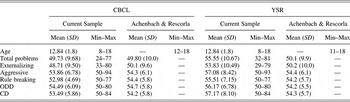
Boy Scout samples, although technically “community” samples, may differ from normal samples because prosocial values are purposefully instilled in scout troops. Scout groups recruit youth equally that are at risk for behavior problems, that is, youth who are economically disadvantaged, live in single- or no-parent homes, and/or are growing up in hostile environments such as crime- or drug-infested neighborhoods (“Scoutreach,” 2010). Although our sample was primarily middle class, our sample was comparable to community samples in terms of externalizing behavior problems. The ranges of scores on measures of externalizing behavior problems are presented in Table 1 along with comparison scores from community samples.
Comparison with nonreferred sample on CBCL and YSR scores
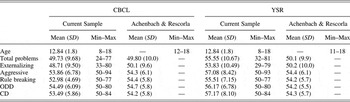
Note: CBCL, Child Behavior Checklist (Achenbach & Rescorla, Reference Achenbach and Rescorla2001); YSR, Youth Self-Report (Achenbach & Rescorla, Reference Achenbach and Rescorla2001); ODD, oppositional–defiant disorder; CD, conduct disorder.
It is clear from Table 1 that the current sample was almost a perfect match to the Achenbach and Rescorla (Reference Achenbach and Rescorla2001) sample in terms of parent-reported externalizing problems. In terms of self-reported externalizing problems, our sample showed slightly elevated levels of externalizing problems.
Experiments
Condition 1: Anonymous trust game procedure
To derive a measure of trust and trustworthiness, we adapted the basic, single-exchange trust game developed by Berg et al. (Reference Berg, Dickhaut and McCabe1995) in order to make it developmentally sensitive and appropriate for group administration (sizes 6–15) according to the procedure recommended by Sutter and Kocher (Reference Sutter and Kocher2007). Thus, the investor received 20 points of money (X = 20). The amount x sent by the investor was tripled as is typical for all trust games (Camerer, Reference Camerer2003). The trustee could then send back y, yielding final payoffs of 20 − x + y for the investor and 3x − y for the trustee.
The task was administered as a paper-and-pencil experiment where participants had to indicate their decisions on a decision form. The experiment began with the group of boys in the investor role. The game instructions were read out loud to investors, alongside written instructions. Investors were told that they were going to play a game with another boy (the trustee) from the same scout group whose identity would not be revealed. Investors were given the opportunity to ask questions about the instructions. None of the Investors asked for clarification indicating a good grasp of the instructions. Next, investors were asked to indicate on the decision form how many of 20 points they would like to send to the trustee. They were reminded that the number of points they sent would be tripled on the way to the trustee. Investors wrote down their decisions on the decision forms.
Verbal and written instructions were given to the trustees in a different room. Experimenters entered the investors' offers on trustees' decision forms. Trustees were reminded that the amount investors sent to them was tripled. Trustees then decided how much of the tripled amount they would like to send back to the investors. Decision forms were coded such that investor–trustee pairings would be known to the experimenter according to a randomly paired listing that was developed prior to the experimental session.
At the end of the testing session, participants received the dollar equivalent of their points in the form of a Best Buy gift voucher. The dollar-points equivalence table was constructed such that even if a subject earned no points during the game, they still received a minimum of $15 across games. However, subjects did not know during the task that they would receive rewards even if their partners did not share points with them. Subjects received the dollar equivalent of points only at the end of the completed testing session. This type of research requires that compensation be tied to performance, as monetary motivation and incentive have substantial effects on the decision-making behavior within this task and must be maintained across participants (Camerer & Hogarth, Reference Camerer and Hogarth1999).
Coding justifications and attributions
After each decision to share or keep a preferred number of points, subjects were asked a series of qualitative questions to probe the social–cognitive reasoning associated with each behavioral choice. First, the investor was asked to report the intention behind the initial offer to the Trustee (“Why did you make this choice?”). A careful content analysis of responses revealed five modal response types that could be reliably coded (a) fair intention (e.g., “It would be fair to give him half of my points. That way we start out with even footing—everyone wins” or “Because I thought it would be fair”), (b) intention to elicit cooperation (“Because if I'm generous and trust the trustee will probably be generous back” or “Because they might be generous enough to give the equal amount or more back to me”), (c) intention to mistrust (“Because I don't know if I can trust my partner” or “I didn't want to give away too many. Who knows if my partner will return any?”), (d) hostile intentions (“I gave him nothing so that I can have more points for myself” or “Because I want all the points for myself”), and (f) prosocial intentions (“Because I want to be kind” or “Because I'm feeling generous”). Responses were independently coded by coders who were provided with descriptions and examples of these categories for training purposes.
Second, upon receipt of the investor's offer, the trustee was asked to evaluate the investor's offer (“What do you think about the offer that has been made to you by the Investor?”). After a similar content analysis of responses, two modal categories of attributions emerged to categorize answers to this question: (a) fair offer (e.g., “That was a generous offer” or “He was generous so I will be”) and (b) unfair offer (e.g., “Greedy little miser” or “I don't like him”).
Third, the trustee was asked to justify his return offer (“Why did you make this choice?”). The same five categories described for the investor justification question were used to categorize trustee responses.
Fourth, upon receipt of the return offer of the trustee, the investor was asked to evaluate the trustee's return offer. Again, two modal categories of attributions emerged from the qualitative responses: (a) fair offer (e.g., “That was nice” or “That was kind of him”) and (b) unfair offer (e.g “I think that he is a greedy dirt bag” or “I don't like him”). The average interrater agreement across these four categories of responses was κ = 0.82–0.97, indicating “near perfect interrater agreement” (Cohen, Reference Cohen1960).
Condition 2: “Known identity” trust game procedure
Prior to the start of the second experiment, children were told that they had been randomly assigned new partners for the second experiment. This time, photos of their partners appeared on the decision form. They were told that they would play the same game, and that they would remain in the role of the investor, but this time, they would know the identity of the person they were playing with.
The same procedure for decision making and eliciting justifications and attributions was followed, also for boys in the trustee role who were now aware of the identity of investors. The same four qualitative questions were asked after each decision and only one additional content category was needed to code the justifications given. Because the identity of partners was known to boys in this condition, many boys justified their offers in both roles by referring to either the positive (e.g., “He's a cool guy”) or negative (e.g., “He is a nasty person”) attributes of their partners. These categories (positive attributes or negative attributes) were therefore added as categories for the known identity condition of the game.
Theory of mind
The CET (Baron Cohen et al., Reference Baron Cohen, Wheelwright, Hill, Raste and Plumb2001) is an “off-line” theory of mind task and based on a deficit approach to theory of mind or social cognition (Fonagy & Sharp, Reference Fonagy, Sharp, Sharp, Fonagy and Goodyer2008). It was adapted from the adult “Reading the Mind in the Eyes Test” developed by Baron-Cohen, Jolliffe, Mortimore, and Robertson (Reference Baron Cohen, Jolliffe, Mortimore and Robertson1997). The test includes 28 black and white photographs of the eye region and the participant is asked to pick one of four words that best describes what the person in the photo is thinking or feeling. Three of the four words are foil mental state terms, whereas the fourth is deemed “correct.” The position of the four words is randomized for each item. Correct answers are scored as 1 and then summed to produce a total “correct” score. Other studies have used the CET in examining theory of mind and externalizing problems in children (Sharp, Reference Sharp2008; Sutton, Reeves, Keogh, et al., Reference Sutton, Reeves and Keogh2000), and in comparing theory of mind in children with Asperger symptoms and those without (Baron-Cohen et al., Reference Baron-Cohen, Wheelwright, Skinner, Martin and Clubley2001). In a community sample of children aged 7 to 11, males scored at a mean of 17 (SD = 3.81), whereas females scored at a mean of 18 (SD = 3.15; Sharp, Reference Sharp2008). In contrast to the social–cognitive measure described above, the CET does not tap into on-line reporting of intentions of own behavior or the reading of intentions of partners' behavior.
Externalizing behavior problems
It is well known that different sources (e.g., parents, peer, and children themselves) often disagree on the presence and severity of problem behaviors (Verhulst & van der Ende, 1992). Low cross-informant correlations have often led researchers to cast doubt on one or both informants and have also been equated with unreliability (Gould, Bird, & Jaramillo, Reference Gould, Bird and Jaramillo1993). Still, it is important to keep in mind that different informants may validly contribute different information (Achenbach, McConaughy, & Howell, Reference Achenbach, McConaughy and Howell1987; Verhulst & Van der Ende, Reference Verhulst and Van der Ende1992). Multiple informants are needed to obtain a comprehensive picture of an individual's functioning (Verhulst & van der Ende, 1992). To this end, we combined three measures of externalizing behavior to include youth self-report, parent report, and peer nominations.
Youth Self-Report (YSR) and parent report
The YSR (Achenbach & Rescorla, Reference Achenbach and Rescorla2001) and Child Behavior Checklist (CBCL; Achenbach & Rescorla, Reference Achenbach and Rescorla2001) are well-established evidence-based assessment instruments (Holmbeck et al., Reference Holmbeck, Thill, Bachanas, Garber, Miller and Abad2008) that assess global and specific psychopathology among youth ages 6 to 18 years. It assesses behavioral and emotional symptoms during the past 6 months. The measure contains 112 problem items, each scored on a 3-point scale: 0 (not true), 1 (somewhat or sometimes true), to 2 (very or often true). The Total Problems Scale yields a T score of general psychiatric functioning and two broad subscales of externalizing behavior problems and internalizing behavior problems. Achenbach and Rescorla (Reference Achenbach and Rescorla2001) recommended using a T score cutoff at or above 65 to separate individuals at higher risk for psychopathology. Prior research indicates this threshold discriminates well between clinical and nonclinical populations (Achenbach & Rescorla, Reference Achenbach and Rescorla2001). For the current study, we used T score of 65 on the externalizing subscale to group youth in above and below cutoff categories for externalizing behavior problems. In the current sample, 27% of boys were above cutoff on the YSR, and 11% were above cutoff on the CBCL. As shown in Table 1, descriptive statistics on these measures in our sample were comparable to Achenbach and Rescorla's (2001) nonreferred sample.
Peer nomination as relationally aggressive or prosocial
A peer-nomination instrument developed by Werner and Crick (Reference Werner and Crick1999) was used to assess relational aggression and prosocial behavior. The measure consists of 24 items. Seven of the items tap into a relational aggression subscale. This subscale has been found to be highly reliable, with a Cronbach α value of 0.087. Nine items tap into a prosocial behavior subscale and have also been shown to be highly reliable (Cronbach α = 0.91; Werner & Crick, Reference Werner and Crick1999).
As recommended by Werner and Crick (Reference Werner and Crick1999), participants were provided with a group membership roster to be used during self-administration of the peer-nomination instrument. For each of the behavioral items, participants were instructed to nominate up to five peers who best fit each description. The number of nominations each participant received from his or her peers was summed for each item and totaled for each subscale.
Next, we used the 50th percentile to identify boys above and below the median for relationally aggressive and prosocial nominations. As is often the case with sociometric studies (Cillessen & Bukowski, Reference Cillessen and Bukowski2000) many boys were nominated as both prosocial and relationally aggressive, so many boys fell above the 50th percentile for both subscales. For the analyses we were interested in comparing trust and trustworthiness in boys who were perceived as “extreme” indicated by being nominated as “only prosocial” versus boys nominated in both categories. Similarly, we were interested in comparing boys who were “only relationally aggressive” to boys in both categories. Of the 79 boys in the Investor role, 14 were identified as “prosocial only” and 14 were identified as “relationally aggressive only.” In the Trustee role, 24 boys were identified as “prosocial only” and 9 as “relationally aggressive only.”
Combined measure of externalizing behavior problems
Because normality assumptions for externalizing behavior disorder variables were violated (possibly due to the fact that the sample was drawn from the community), all variables were submitted to a normalizing transformation. A boy was considered to meet criteria for externalizing behavior problems if he was above cutoff for parent report and self-report externalizing problems and described as “only relationally aggressive.” Using this variable, boys in the externalizing group showed significantly higher means for both self-reported (t = −7.82, df = 156, p < .001) and parent-reported (t = −7.49, df = 156, p < .001) externalizing behavior problems compared to boys without externalizing problems.
Data analytic strategy
The mean for investor offers was calculated by taking the average proportion (out of 20 points) that investors sent to the trustee. The mean for trustee return offers was calculated by averaging the ratios of trustee offers to the initial offer sent by the investor. For example, if the investor's tripled offer was 3 × 10 = 30 and the trustee decided to send back 10 out of 30 points, the ratio or relative return offer was 0.33. These means served as indices for “trust” (mean investor offer) and “trustworthiness” (mean trustee relative return offer). Preliminary analysis was carried out on the distribution of scores and their associations with demographic variables. Both trust and trustworthiness estimates appeared to be normally distributed and did not correlate with parental education or age.
The first aim of the study was to examine whether externalizing problems (self-reported, parent reported, and peer ascertained) were reflected in trust and trustworthiness behaviors. We were particularly interested in the differential modulating impact of known identity (vs. anonymity) of trust game partners. To this end, we ran one-way repeated-measures analyses of variance (ANOVAs) with the investor and trustee offers, respectively, with game version (anonymous vs. known identity) as the repeated measures factor and group status for externalizing disorder as a between-subject factor.
Our second aim was to examine whether the relationship among trust, trustworthiness, and externalizing behavior problems could be linked to and accounted for by anomalies in social cognition. We had two indicators of social cognition. For the first, zero-order correlations (Pearson r) between trust and trustworthiness variables and the total score of the CET were calculated.
For the second (on-line social–cognitive reasoning during the task), we separately analyzed intentions underlying subjects' own behavior (“Why did you make this choice?”) and assumed intentions of partners' behavior (“What do you think about the offer that has been made to you by the Investor?”). We divided participant responses into predominantly “benevolent intentions” (fair intention, intention to elicit cooperation, prosocial intentions, and attributions of positive characteristics) and “hostile intentions” (hostile intentions, intentions to mistrust, and attributions of negative characteristics) on the basis of the frequency of attributions. We then contrasted the mean scores of these types of responses in terms of associated trust/trustworthiness scores using independent sample t tests. For assumed intentions of partners' behavior, subjects' evaluation of outcome was classified as either fair versus unfair and analyzed for its relation to trust/trustworthiness scores using independent sample t tests. Relations between fair versus unfair evaluations of offers and group status in terms of externalizing behavior were examined using independent sample t tests.
Results
Comparison of trust (investor initial offer) across conditions taking group status (externalizing vs. no externalizing problems) into account
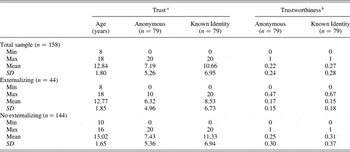
The means and standard deviations of a one-way repeated ANOVA are presented in Table 2. There was a significant effect for condition (anonymous vs. familiar), Wilks' λ < 0.001, F (1, 78) = 13.71, p < .001, multivariate η2 = 0.15 (large effect size; Cohen, Reference Cohen1988). The interaction between “experiment” and group status was not significant, Wilks' λ > .05, F (1, 78) = 1.02, p > .10, multivariate η2 = 0.01. Inspection of the means in Table 2 shows that for both groups the means increased with the known identity condition of the trust game compared to the anonymous condition.
Descriptive statistics
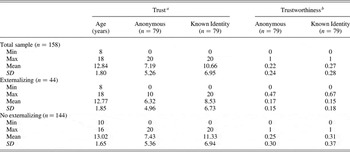
Note: The trustee relative return offers are calculated by dividing the trustee return offer into the investor investment.
aInvestor initial offer (range = 0–20).
bTrustee relative return offer (range = 0–1).
Comparison of trustworthiness (reciprocity; trustee relative return offer) across conditions taking group status (externalizing vs. no externalizing problems) into account
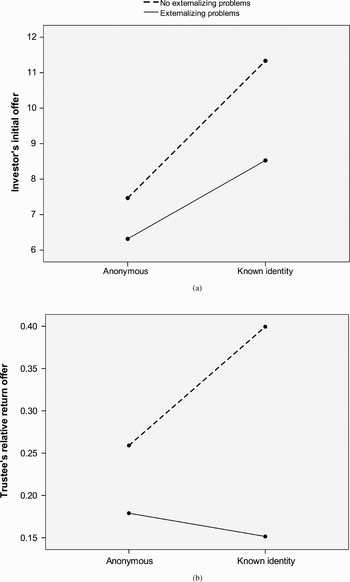
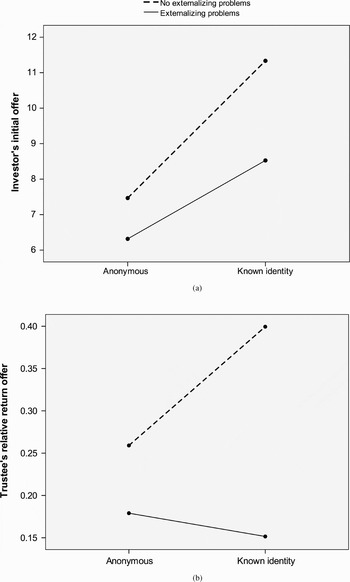
The means and standard deviations for a repeated one-way ANOVA for trustworthiness ratings are presented in Table 2. There was no condition effect, Wilks' λ = 0.11, F (1, 78) = 2.54, p > .05, multivariate η2 = 0.03. However, the interaction between condition and group status was significant, Wilks' λ = 0.02, F (1, 78) = 5.61, p < .05, multivariate η2 = 0.07 (moderate effect size; Cohen, Reference Cohen1988). Inspection of the means shows that although means in trustworthiness increased for boys without externalizing problems when playing with a known partner, means actually decreased for boys with externalizing problems. This interaction effect is represented visually in Figure 1.
The interaction between experimental condition (anonymous vs. known identity) and group status (externalizing vs. nonexternalizing). (a) Trust and (b) trustworthiness.
Relationship among social cognition, trust, and trustworthiness
Theory of mind
Pearson correlations between trust and trustworthiness variables and the total score of the CET were nonsignificant for investor offers on the anonymous (r = −.13, p = .24) and known identity (r = −.08, p = .47) conditions. Correlations were also nonsignificant for trustee relative return offers for the anonymous (r = −.19, p = .09) and known identity (r = −.001, p = .99) conditions. These results suggest no relationship between trust behavior and social cognition as indexed by an emotion recognition or theory of mind task such as the CET.
On-line social–cognitive reasoning to justify choices (intentions underlying own behavior)
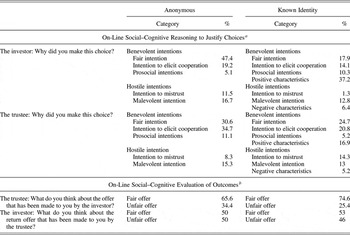
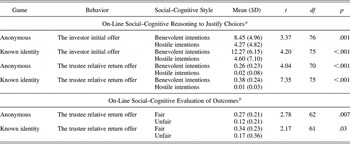
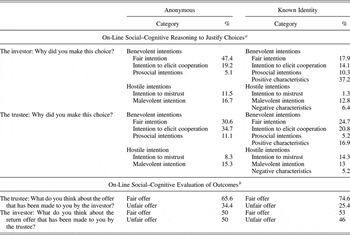
Table 3 summarizes the percentage of boys in each response category for the question “Why did you make this choice?” for the anonymous and the known identity conditions. For the anonymous game, most boys (47.4%) in the investor role decided to share points on the basis of a fair intention. It is interesting that, once the identity of partners was known, the modal justification was based on attribution of positive characteristics to their partners (37.2%).
Social–cognitive reasoning associated with behavioral choices and outcomes
aSubject's own intentions.
bEvaluation of other player's intentions.
In the anonymous condition, most boys in the trustee role based their choices on benevolent intentions with 34.7% doing so to elicit cooperation and 30.6% doing so to communicate fair intentions. This was also the case for the known identity condition, although several boys in this condition also based their choices on the attribution of positive characteristics to their partners (16.9%).
We grouped “benevolent intentions” (fair intentions, intention to elicit cooperation, prosocial intentions, attribution of positive characteristics) and “hostile intentions” (hostile intent, intent to mistrust, attributions of negative characteristics) together to form two groups for further analyses. For the anonymous condition 71.8% of boys in the investor role had benevolent intentions versus 28.2% with hostile intentions, whereas 76.4% of boys in the trustee role had benevolent intentions versus 23.6% with hostile intentions. For the known identity condition, 79.5% of boys in the investor role had benevolent intentions versus 20.5% with hostile intentions. Although in the trustee role 67.6% had benevolent intentions versus 32.5% with hostile intentions, comparison between the anonymous and known identity proportions of benevolent versus hostile intentions was nonsignificant.
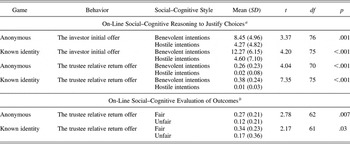
Table 4 summarizes the results of independent sample t tests to investigate the relation between social–cognitive style (benevolent versus hostile) and trust behavior (investor offers; trustee relative return offers).
Social cognition and game playing behavior
Note: Mean (SD) refers to the means of investor (trust) and trustee offers (trustworthiness) divided according to their social–cognitive reasoning style (benevolent vs. hostile intentions; fair vs. unfair evaluation of outcomes).
aSubject's own intentions.
bEvaluation of other player's intentions.
For both roles and for both games there were highly significant differences between boys with “benevolent” versus “hostile” intentions in game playing behavior. Boys with hostile intentions were significantly less trusting (M = 4.27, SD = 4.82) than boys with benevolent intentions (M = 8.45, SD = 4.96) during the anonymous game. They were also less trustworthy (M = 0.02, SD = 0.08) compared to boys with benevolent intentions (M = 0.26, SD = 0.23).
These results mirrored results in the known identity condition of the game. Boys with hostile intentions were significantly less trusting (M = 4.60. SD = 7.10) than boys with benevolent intentions (M = 12.27, SD = 6.15). They were also less trustworthy (M = 0.01, SD = 0.03) compared to boys with benevolent intentions (M = 0.38, SD = 0.24).
Boys with hostile intentions were also more likely to have higher self-reported externalizing behavior than boys with benevolent intentions, although these mean differences were significant only for Trustees in the known identity condition (M = 58.72 vs. M = 53.08, t = 0.12, df = 75; p = .02).
On-line social–cognitive evaluation of outcomes
As shown in Table 3, by and large, evaluations of investor offers by trustee partners were positive, with more than two-thirds judging offers as fair for both games. Investor evaluations of trustee relative return offers were less favorable, with around half of boys judging these as fair.
We investigated whether an “unfair” judgment of Investor's initial offers was related to trustee relative return offers. The results in Table 4 show that the relative return offers from trustees were significantly lower for boys who evaluated offers from investors as unfair (M = 12, SD = 0.21) compared to boys who viewed offers as fair (M = 0.27, SD = 0.21) in the anonymous game. Similar results were found for the known identity condition for boys who viewed offers as unfair (M = 0.17, SD = 0.36) versus boys with who viewed offers as fair (M = 0.34, SD = 0.23). When the offer was judged as fair, trustees were significantly more likely to make higher relative return offers compared to when initial offers were judged as unfair. Judgments of offers as unfair were, however, not related to externalizing problems.
Discussion
Over the last three decades the role of social cognition in the development and maintenance of externalizing behavior problems has been a topic of much interest. Experimental paradigms based on game theory principles offer a novel approach to operationalizing social–cognition in real-life, real-time, controlled settings. One such paradigm, the trust task, complements psychodynamic (Erikson, Reference Erikson1950) and social learning conceptualizations (Rotter, Reference Rotter1967, Reference Rotter1971) of trust by parametrically encoding trust and trustworthiness as the amount of money designated to partners during an economic exchange game (Montague, King-Casas, & Cohen, Reference Montague, King-Casas and Cohen2006). With the exception of a few studies (Harbaugh, Krause, Liday, & Vesterlund, Reference Harbaugh, Krause, Liday, Vesterlund, Ostrom and Walker2003; Sutter & Kocher, Reference Sutter and Kocher2007; van den Bos et al., in press), the trust task has not been used in youth samples. Further, bar one study (McClure et al., Reference McClure, Parrish, Nelson, Easter, Thorne and Rilling2007), economic exchange games have not been used in relation to psychopathology in youth.
In the current study, we used the trust task to investigate anomalous trust and trustworthiness in boys with and without externalizing behavior problems. Several authors have argued that trust and trustworthiness are clinically important factors in psychopathy and the development of criminal behavior (Bernath & Feshbach, Reference Bernath and Feshbach1995), difficulties in achieving satisfaction in work and interpersonal relationships (Mowrer & Ullman, Reference Mowrer and Ullman1945), delinquency and social irresponsibility (Mischel, Reference Mischel1961), as well as cheating and yielding to temptations (Mischel & Gilligan, Reference Mischel and Gilligan1964). Bernath and Feshbach (Reference Bernath and Feshbach1995) argued that children who fail to trust others may be at risk of developing an antagonistic defensive posture and may view social relations as “get them before they get you,” thus priming irresponsible, potentially criminal and delinquent behavior. Although early work has provided some evidence for the relationship between abnormal expectations related to trust and externalizing problems (e.g., Wentzel, Reference Wentzel1991; Wright & Kirimani, Reference Wright and Kirimani1977), direct evidence in relation to anomalous observed social behavior is lacking.
This is the first study to empirically link trust and trustworthiness to externalizing behavior problems indexed by parent report, self-report, and peer report. It is also the first study (in adults or children) to link on-line social–cognitive reasoning and concurrent real-life trust behavior with externalizing behavior difficulties. Results supported the conclusion that boys with externalizing behavior problems are generally less trustworthy, but not necessarily less trusting than boys without externalizing problems. More specifically, our results showed that knowing the identity of one's partner increased trust in both groups of children. This was also true for trustworthiness in nonexternalizing boys. However, in boys with externalizing problems trustworthiness was reduced in the known identity condition. Moreover, reduced trust and trustworthiness were associated with hostile intentions underlying subjects' own behavior as well as judgment of partners' behavior as unfair, which in turn related to externalizing behavior problems. Finally, although untrusting and untrustworthy behaviors were associated with hostile intentions and judgments of partners' behaviors as unfair, such behaviors were not associated with a general theory of mind deficit based on judgments of facial expressions of internal states as measured by the CET.
By demonstrating the link between on-line social–cognitive reasoning and concurrent real-life trust game behavior, we provide support for models of trust game behavior that fall within the class of intention-based accounts for adult (Dufwenberg & Gneezy, Reference Dufwenberg and Gneezy2000; Falk & Fischbacher, Reference Falk and Fischbacher2006; McCabe et al., Reference McCabe, Smith and LePore2000) and youth samples (Van den Bos et al., in press). These models emphasize players reading each other's intentions or motives (and not merely their actions). In contrast, outcome-based models focus simply on behavior and have suggested that a certain proportion of the population is altruistic or spiteful or have certain thresholds of inequity aversion (Bolton & Ockenfels; Fehr & Schmidt, Reference Fehr and Schmidt1999). The fact that boys with externalizing behavior problems showed problems in trustworthiness, but not trust, mitigates against a simple outcome-based interpretation of our results. After all, if boys with externalizing disorder were simply less altruistic or spiteful in their behavior, such behavior should have been evident in their Investor initial offers (trust). Instead, they show anomalies only in trustworthiness or reciprocity. Further, these anomalies appear to be associated with on-line hostile intentions.
Our results build on, and are explained by, findings from previous studies of social cognition and externalizing behavior problems, specifically findings demonstrating hostile attribution biases in boys with conduct problems (for a review, see Mize & Pettit, Reference Mize, Pettit, Sharp, Fonagy and Goodyer2008). The current study expands this research by showing that on-line hostile intentions underlying subjects' own behavior are associated with real-time, real-life behavior during a social exchange game; and that boys with externalizing behavior problems differ from normal controls both in their social–cognitive reasoning and associated game behavior. Our data cannot speak to why boys with externalizing behavior problems are less trustworthy or more hostile in their intentions. It is, however, worth speculating that the development of anomalous trust behavior associated with hostile social–cognitive reasoning may have its foundation in insecure attachment (Fonagy, Gergely, & Target, Reference Fonagy, Gergely and Target2007; Mize & Pettit, Reference Mize, Pettit, Sharp, Fonagy and Goodyer2008). Insecure attachment has been shown to relate to externalizing behavior problems (Green, Stanley, & Peters, Reference Green, Stanley and Peters2007; Greenberg et al., Reference Greenberg, Speltz, DeKlyen and Jones2001; Warren, Emde, & Sroufe, Reference Warren, Emde and Sroufe2000; Warren, Oppenheim, & Emde, Reference Warren, Oppenheim and Emde1996). Attachment in turn plays a role in the development of various social–cognitive capacities, including perspective taking, theory of mind, and mentalizing (Sharp & Fonagy, Reference Sharp, Fonagy, Sharp, Fonagy and Goodyer2008), potentially mediating the development of trust (Fonagy & Target, Reference Fonagy and Target1997). To test this hypothesis, future research should focus on including simultaneous measures of attachment, social–cognitive reasoning, and trust in samples of youth with externalizing behavior problems.
To understand why the known identity condition was associated with higher trustworthiness in normal controls, but lower trustworthiness in externalizing boys, we turn to literature investigating the effect of known identity on trust game behavior. Studies in adults have demonstrated that prior social and moral information about partners in the trust game modulate responses during economic exchange games. For instance, Delgado, Frank, and Phelps (Reference Delgado, Frank and Phelps2005) showed that prior social and moral information was associated with level of trust in partners, as well as actual sharing behavior. It has also been shown that knowing the identity of partners or opponents attenuates aggressive acts and promotes trust and trustworthiness during the trust game (Camerer, Reference Camerer2003), because knowing the identity of partners produces a greater empathic response accompanied by a greater willingness to make personal sacrifices to benefit another (Jenni & Loewenstein, Reference Jenni and Loewenstein1997). It is possible that this effect did not occur in boys with externalizing behavior problems due to reduced affective empathy demonstrated for this group of children (Lovett & Sheffield, Reference Lovett and Sheffield2007). Future studies in which anonymous and known identity versions of the trust task are administered alongside measures of empathy may further support this hypothesis.
The current study has several limitations. First, the sample was community based, which afforded us the opportunity to exploit real-life established relationships between boys. Despite our efforts to demonstrate comparability between the current sample and other community samples, it is possible that boys who self-select into the Scouts might differ in some ways from the general population. Therefore, the results should be replicated in other community samples. Moreover, this study aimed to elucidate potential disease mechanisms for externalizing behavior problems and should therefore also be replicated in a sample of clinically referred youth. Second, although 79 pairs afforded us enough power to detect differences, a larger sample size (combined with clinical characteristics) will result in larger effect sizes, thereby more strongly establishing the role of trust and trustworthiness in externalizing behavior problems. Third, we could not control for the past history of the relationship quality between partners, and we collected no information about this. We interpret our behavioral results as an indication of a bias of interpersonal behavior in externalizing individuals based on social cognition. The source of this bias may be based, in part, on past history of a relationship, for instance, friendship quality. The anomalous behavior of externalizing children may be based on the increased likelihood of actual negative relationship histories of externalizing children relative to normally developing children. Of course, the social–cognitive biases pointed to in this study may have played a role in creating such negative histories. Future studies will need to control for this important confounding effect. Fourth and finally, the two games were not counterbalanced. Thus, there is no way of knowing whether trusting behavior naturally increased as subjects gained more experience in playing the game. A replication study should therefore include counterbalancing.
Setting these limitations aside, this study identified the potential of economic exchange tasks in studying SIP biases in relation to clinical problems. We have provided concurrent validity for the behavioral measure by using more traditional verbal self-report measures of social–cognitive bias. The key advantage of methods such as the trust task is that it parameterizes aspects of abnormal interpersonal behavior that are central to many disorders in developmental psychopathology. The application of this approach opens the door to behavioral measures of cognitive biases currently inadequately measured by paper-and-pencil tests of limited ecological validity. It also has potential for the computational modeling of the anomalies associated with these disorders with knock-on advantages for interfacing with brain-based measurements (Montague et al., Reference Montague, King-Casas and Cohen2006). Further, if our initial demonstration of anomalies is replicated in future investigations, studies will be able to examine precursors of trust and trustworthiness problems by, for instance, addressing issues of causation in relation to past interpersonal experiences. Moreover, follow-up studies may focus on the malleability of these anomalies by psychosocial or pharmacological interventions, for example, addressing the question of whether parenting training approaches result in changes in trustworthiness.