Introduction
Specific language impairment (SLI) is characterized by the slow development of spoken language despite the absence of intellectual, hearing, neurological, or emotional impairments. Children with SLI present varied profiles of language deficits that may be more pronounced in some language components, especially phonology, morphology, and syntax (Leonard, Reference Leonard2014). Besides language disorders, difficulties in other cognitive domains (e.g., working memory, auditory domain, and motor domain) have also been reported. Taken together, these deficits have been attributed to an impaired procedural learning system (the Procedural Deficit Hypothesis [PDH]; Ullman & Pierpont, Reference Ullman and Pierpont2005), which may particularly affect implicit sequence learning (ISL), or the ability to learn underlying structured patterns that exist among a set of stimuli that are presented in a sequential manner (Conway & Christiansen, Reference Conway and Christiansen2001). Indeed, the PDH states that children with SLI should exhibit difficulties in ISL (both in linguistic and non-linguistic domains) because phonology, morphosyntax, and ISL share a common memory system, procedural memory. The PDH is based on the declarative-procedural model of normal language acquisition (Ullman, Reference Ullman2004), which claims that declarative memory supports lexical knowledge, whereas procedural memory supports phonology, morphology, and syntax.
Previous studies have reported variable results of the performance of individuals with SLI on different ISL tasks. An experimental paradigm frequently used is the visuospatial serial reaction time task (SRT; Nissen & Bullemer, Reference Nissen and Bullemer1987), in which participants have to respond as quickly and accurately as possible by pressing the key that corresponds to the location of a stimulus on the screen. Participants are typically unaware that the stimuli appear in a repeated sequence. In the past 10 years, a large number of studies using SRT have been conducted in SLI people. First, Tomblin, Mainela-Arnold, and Zhang (Reference Tomblin, Mainela-Arnold and Zhang2007) demonstrated slower learning rates in adolescents with SLI than in the age-matched control group; they found a positive association between SRT performance and grammatical abilities, which supports the claim that ISL difficulties might underlie the grammatical impairment observed in SLI. Although poor ISL has been replicated several times in children with SLI (see the meta-analysis of Lum, Conti-Ramsden, Morgan, & Ullman, Reference Lum, Conti-Ramsden, Morgan and Ullman2014), some studies challenged the PDH by finding preserved ISL in individuals with SLI (e.g., Gabriel, Maillart, Guillaume, Stefaniak, & Meulemans, Reference Gabriel, Maillart, Guillaume, Stefaniak and Meulemans2011; Lum & Bleses, Reference Lum and Bleses2012).
Attempts have also been made to test ISL in the verbal domain. Results suggested impairments in the implicit learning of adjacent sound sequence (Evans, Saffran, & Robe-Torres, Reference Evans, Saffran and Robe-Torres2009), in the implicit learning of discontinuous sequential relationships between words (Hsu, Tomblin, & Christiansen, Reference Hsu, Tomblin and Christiansen2014), and in the implicit acquisition of artificial grammar (Plante, Gomez, & Gerken, Reference Plante, Gomez and Gerken2002). However, verbal implicit learning appeared to be preserved in SLI participants when there was high variability in language input (Grunow, Spaulding, Gómez, & Plante, Reference Grunow, Spaulding, Gómez and Plante2006; Torkildsen, Dailey, Aguilar, Gómez, & Plante, Reference Torkildsen, Dailey, Aguilar, Gómez and Plante2013).
To enable conclusions about ISL between modalities, recent studies compared the performance of the same individuals on both verbal and visuomotor sequence tasks. Hsu and Bishop (Reference Hsu and Bishop2014) found that performances in children with SLI were worse than in age-matched controls in both the verbal (Hebb learning tasks) and motor (SRT) sequence tasks. Similar findings were observed by using SRT and artificial grammar tasks (Lukácz & Kemény, Reference Lukács and Kemény2014; Mayor-Dubois, Zesiger, Van der Linden, & Roulet-Perez, Reference Mayor-Dubois, Zesiger, Van der Linden and Roulet-Perez2012). Taken together, these studies suggest a domain-general ISL impairment in SLI, a claim which appeared to be countered by the results of Lee and Tomblin (Reference Lee and Tomblin2015), who found that adults with language difficulties performed significantly worse than their typical peers on a verbal sequence task (Nonword Repetition Priming task) but not on a motor one (SRT).
Differences in experimental paradigms used in these studies make direct comparison between modalities difficult. To overcome this issue, Gabriel, Meulemans, Parisse, and Maillart (Reference Gabriel, Meulemans, Parisse and Maillart2014) assessed sequence learning abilities in SLI and typically developing (TD) children using two SRT versions: a classical visual task and an auditory one. In the auditory SRT task, children had to associate the location of a sound in space with a location in a drawing displayed on the screen. Results showed that children with SLI were able to detect regularities both in visual and auditory modalities. However, it remained unclear whether children learned a perceptual or a motor sequence in the auditory condition. Indeed, the auditory SRT did not eliminate spatiomotor sequencing, given that auditory-presented stimuli followed a fixed manual response pattern.
The Serial Search Task (SST) developed by Goschke, Friederici, Kotz, and Van Kampen (Reference Goschke, Friederici, Kotz and Van Kampen2001) aimed to eliminate confounding between the stimulus and responses sequences. In this task, subjects view four letters on a screen in each trial, followed by a single letter presented auditorily, and they have to press the key corresponding to the letter’s location. From trial to trial, the arrangement of the visual letters is changed so that either the key-presses (motor sequence condition) or the auditory letters (verbal sequence condition) follow a repeating pattern, while the other sequence is random. Unlike the auditory SRT used by Gabriel et al. (Reference Gabriel, Meulemans, Parisse and Maillart2014), only the auditory stimuli repeat in a sequence in the verbal sequence condition. The SST is an interesting approach to investigate ISL in SLI, independent of motor responses patterns. Furthermore, it offers the advantage of directly comparing motor and language ISL, by using the same experimental paradigm and the same stimuli within the same sample of children. Interestingly, studies that have used the SST in Broca’s aphasia (Goschke et al., Reference Goschke, Friederici, Kotz and Van Kampen2001) and in developmental dyslexia (Gabay, Schiff, & Vakil, Reference Gabay, Schiff and Vakil2012) showed that participants were unable to learn the verbal sequence, whereas they demonstrated intact motor sequence learning in comparison to a control group, suggesting domain-specific implicit learning deficits in these populations.
Consequently, the aim of the current study was to use the SST to investigate verbal and motor ISL processes in children with and without SLI. If SLI was linked to a general ISL deficit (e.g., Hsu & Bishop, Reference Hsu and Bishop2014; Lukácz & Kemény, Reference Lukács and Kemény2014), we would observe poor SST performance in both the verbal and motor domains. However, children with SLI could be more impaired in learning word sequences than in learning motor sequences (see Goschke et al., Reference Goschke, Friederici, Kotz and Van Kampen2001 or Gabay et al., Reference Gabay, Schiff and Vakil2012), which would align with the proposal that partially non-overlapping verbal and non-verbal sequence learning processes may exist (Conway & Christiansen, Reference Conway and Christiansen2006). In addition, if ISL underlies language acquisition, then SST performance should be linked with measures of language components, especially phonology and morphosyntax (Ullman & Pierpont, Reference Ullman and Pierpont2005).
Methods
Participants
Twenty-four monolingual French-speaking children with SLI aged 7 to 12 years were recruited through speech-language therapists, in the French-speaking part of Belgium, from specific language classes. Participants had been diagnosed with SLI by speech-language pathologists and had been followed up longitudinally since diagnosis. Participants had no history of psychiatric or neurological disorders, no neurodevelopmental delays, and no sensory impairments. All children with SLI had a nonverbal intellectual quotient of 80 or greater (measured by the Wechsler Non Verbal Scale [WNV]; Wechsler & Naglieri, Reference Wechsler and Naglieri2006) and showed normal range hearing thresholds, as determined by audiometric pure-tone screening at 20 dB at 500, 1000, 2000, and 4000 Hz.
Moreover, they scored more than 1.25 SD below the expected normative performance in at least two language components. Children’s language abilities were assessed by four subtests of the Langage oral, Langage écrit, Mémoire et Attention battery (L2MA2; Chevrie-Muller, Maillart, Simon, & Fournier, Reference Chevrie-Muller, Maillart, Simon and Fournier2010; the nonword repetition, sentence repetition, picture naming, and morphosyntactic comprehension subtests), the Echelle de Vocabulaire en Images Peabody (EVIP; Dunn, Thériault-Whalen, & Dunn, Reference Dunn, Thiériault-Whalen and Dunn1993; a French adaptation of the PPVT-R), and the Epreuve Lilloise de Discrimination Phonologique (ELDP: Test of Phonological Discrimination; Macchi et al., Reference Macchi, Descours, Girard, Guitton, Morel, Timmermans and Boidein2012).
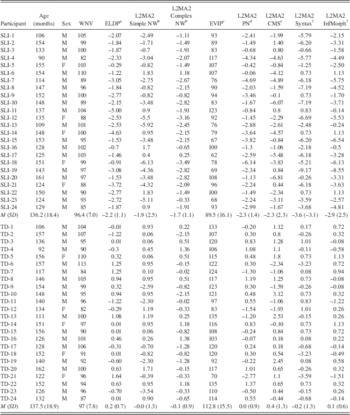
Twenty-four monolingual French-speaking TD children were recruited. Each child with TD was matched to a child with SLI by sex, chronological age (±3 months), and nonverbal IQ (±8 points). Both groups were significantly different on all standardized measures of language, but did not differ on the nonverbal IQ score or on chronological age (see Table 1).
Demographic data, non-verbal intelligence scores, and language measures in both groups

Note. WNV=Wechsler Non Verbal (Wechsler & Naglieri, Reference Wechsler and Naglieri2006); ELDP=Epreuve Lilloise de Discrimination Phonologique Test (Macchi et al., Reference Macchi, Descours, Girard, Guitton, Morel, Timmermans and Boidein2012); L2MA2=Langage Oral, Langage Ecrit, Mémoire et Attention 2 Test (Chevrie-Muller et al., Reference Chevrie-Muller, Maillart, Simon and Fournier2010); EVIP=French version of the Peabody Picture Vocabulary Test (Dunn et al., Reference Dunn, Thiériault-Whalen and Dunn1993).
a Phonological Reception.
b Phonological Production.
c Lexical Reception.
d Lexical Production.
e Morphosyntactic Reception.
f Morphosyntactic Production.
We received parental informed written consent for the 48 children. The local research ethics committee approved the study, which was carried out in accordance with the guidelines of the Helsinki Declaration.
Materials and Procedures
SST
Four familiar and concrete bisyllabic words [i.e., poisson, chaussure, banane, vélo (fish, shoes, banana, bike)], pronounced by a female voice, served as the auditory stimuli. The length of the auditory stimuli was approximately 250 ms, and each word began with a different syllable to allow for maximum distinction between stimuli. Four pictures were used to illustrate the four nouns. To ensure that these pictures elicited the corresponding words, 20 healthy 5-year-old children were asked to name the four pictures. All of them responded with the intended nouns. Moreover, all the children in the current study were able to name the four words and to point to each of them as they were named by the experimenter.
The pictures of these words were presented in a 2×2 design on the screen, and the arrangement of the four pictures varied for each trial. The four pictures were randomly assigned to the four locations in each trial, except that no specific arrangement occurred on two consecutive trials. As in Gabriel et al. (2012), a touchscreen was used as the response mode, to minimize the motor and cognitive constraints of the task. The children were also instructed to locate the picture depicting each auditorily presented word, and to use their dominant hand to touch the picture’s location on the screen. Response time and accuracy were measured from the onset of the spoken word and were controlled by E-Prime Software, version 2.1.
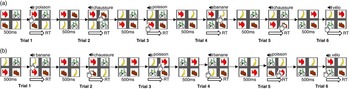
Participants were first familiarized with the task with 10 random practice trials before beginning the experiment. Similarly to Goschke et al. (Reference Goschke, Friederici, Kotz and Van Kampen2001), each trial started with the presentation of the visual display that consisted of the four pictures. After a delay of 500 ms, one of the four pictures was presented auditorily through headphones. Children had to touch, as quickly and accurately as possible, the picture on the screen that corresponded to the word they heard. After the response, there was a response-stimulus interval of 500 ms before the next trial was started. From trial to trial, the locations of the four pictures in the visual display changed, resulting in two different conditions: in the motor sequence condition, the manual responses followed a repeating pattern but the sequence of picture names was quasi-random; in the verbal sequence condition, the auditorily presented picture names followed a repeating pattern, while the sequence of responses was quasi-random (see Figure 1).
Schematic of six trials of the SST task. In the motor sequence condition (a), children implicitly learned a manual response sequence (1-2-3-2-4-3) and the auditory stimuli appeared quasi-randomly. In the verbal sequence condition (b), children implicitly learned a spoken word sequence (banane-chaussure-poisson-banane-poisson-vélo) and the manual response was quasi-random.

Each child was administered these two sequence learning conditions in two sessions that were separated by a 6-week delay. Half of the children began with the verbal SST, followed by the motor SST; the other half began with the motor SST and performed the verbal test 6 weeks later. Both sequence-learning tasks consisted of six blocks of trials. There were four learning blocks (block 1 to block 4), one random block (block 5), and a final learning block (block 6). The final learning block was added to ensure that an increase in RT in the random block could not be interpreted as an effect of fatigue but as an effect of sequence-specific learning (e.g., Gheysen, Van Waelvelde, & Fias, Reference Gheysen, Van Waelvelde and Fias2011).
One learning block involved 60 trials and consisted of a six-element length sequence repeated 10 times. In the fifth block, the sequence of both responses and picture names were uncorrelated, and the unconditional probabilities of each picture name and each response were the same as in the learning sequence. Children were allowed short break after block 3. According to Cohen, Ivry, and Keele (Reference Cohen, Ivry and Keele1990), the sequences used were hybrid in the following sense: they included four possible targets and were six positions long, with two positions repeating once and two positions repeating twice. In the motor sequence condition, the learning sequence was instantiated by the manual responses (1-2-3-2-4-3), while in the verbal one, the learning sequence was instantiated by the picture names [banane-chaussure-poisson-banane-poisson-vélo (banana-shoes-fish-banana-fish- bike)].
Explicit Awareness Test
After completing the last sequence learning task, half of the children carried out the generation task for the motor SST and the other half carried out the generation task for the verbal SST. This was determined by the learning task they had performed last. For example, children who performed the verbal condition as their last learning task were administered only the verbal generation task.
The test started with an interview to probe declarative knowledge of the sequence. Then children were informed about the existence of a regular sequence (i.e., of either the motor or picture names, according to the experimental condition they had performed last), and they were asked to reproduce the sequence as accurately as possible. This free generation task consisted of 30 trials where participants reproduced the repeating sequence they had previously seen/heard. In the motor SST, participants were asked to reproduce the sequence of motor responses, whereas in the verbal SST, participants were asked to verbally reproduce the picture names sequence. Following the procedure set by previous studies (Goschke et al., Reference Goschke, Friederici, Kotz and Van Kampen2001; Gabay et al., Reference Gabay, Schiff and Vakil2012), the number of correct chunks (with two to eight elements) was determined. Chunks were counted in a non-overlapping manner.
Results
To increase the homogeneity of variance (determined by the Shapiro-Wilk test), we performed logarithmic transformations for reaction times and number of correct responses (RC). All effects were assessed for significance at the p=.05 level.
Reaction Times Analyses
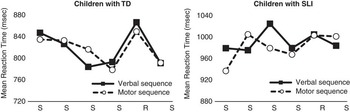
Median values for correct responses were calculated separately for each block and each child, and separately for the verbal and motor SST. We performed a student t test to ensure that there were no order effects due to task administration. No significant statistical difference was observed between the order effects during task administration for motor learning indexes (t(46) =−0.357; p=.722) and for verbal learning indexes (t(46) =−0.613; p=.542). The results, therefore, were analyzed across sequence order. Figure 2 shows the mean of the RTs as a function of blocks of the SST task for both groups.
Reaction times (RTs) as a function of blocks of the Serial Search Task (SST) task for both groups.

General practice effects
Mean RT in the four learning blocks was analyzed with a 2×2×4 mixed analysis of variance (ANOVA), using the independent variables sequence condition (motor vs. verbal), block (1–4), and group (SLI vs. TD). This analysis yielded a reliable main effect for group (F(1,46) =8.14; p=.006; partial η 2 =.150), indicating that children with SLI were generally slower than TD children. The main effect of block was significant (F(3,138) =4.98; p=.003; partial η²=.098) and, of interest, there was a significant interaction between block and group (F(3,138) =4.27; p=.006; partial η 2 =.085). Planned comparisons showed that RTs in TD children decreased between block 1 and block 4 (F(1,46) =10.84; p=.001), whereas children with SLI performed blocks 1 and 4 at a similar speed (F(1,46) =0.014; p=.905). The sequence condition main effect was not significant (F(1,46) =0.25; p=.621, partial η 2 =.005), indicating that RTs in both conditions were processed at a similar speed. There were also no significant interaction effects between sequence condition and group (F(1,46) =0.13; p=.725; partial η 2 =.002) or between block and sequence condition (F(3,138) =1.37; p=.253; partial η 2 =.029). Finally, the interaction between block, sequence condition, and group was not significant (F(3,138) =1.39; p=.249; partial η 2 =.029).
Sequence learning effects
A crucial test of whether children acquired specific sequence knowledge consists of the comparison between the random block (block 5) with both the preceding and succeeding sequence blocks (blocks 4 and 6). If learning was sequence specific, we would expect a difference in RTs between the random block and the sequence blocks that bookend it. To test for this, we performed a mixed ANOVA with condition (motor vs. verbal) and block (blocks 4–6) as within-participant variables, and group (TD vs. SLI) as a between-participant variable. This statistical analysis again found that children with SLI were significantly slower than their TD peers (F(1,46) =8.04; p=.007; partial η 2 =.148) and that the main effect of block was significant (F(2,92) =12.17; p<.001, partial η 2 =.209).
Interestingly, the interaction between block and group showed that these differences in RTs differed between groups (F(2,92) =3.22; p=.044). Planned comparisons contrasting the RTs of the random block against the RTs of the bookending sequence blocks revealed a significant sequence-specific learning for TD children only. Indeed, the difference between the random block and both surrounding sequence blocks was significant in TD children (F(1,46) =23.197; p<.001), but not for children with SLI (F(1,46) =2.525; p=.140). Once again, we did not find RT differences between both sequence conditions (F(1,46) =0.23; p=.636; partial η 2 =.004), the condition-by-group interaction effect was not significant (F(1,46) =0.03; p=.859; partial η 2 =.001), as well as the block-by-condition interaction effect (F(2,92) =0.60; p=.548; partial η 2 =.012). Finally, the triple interaction between group, sequence, and block was statistically not significant (F(2,92)=0.03; p=.967; partial η 2 =.000), indicating that the differences in RTs between groups were observed both in the verbal and in the motor conditions.
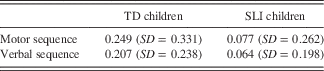
Because the SLI group performed the complete SST more slowly than the TD group, we computed a sequence learning index for each child and in each sequence condition (Table 2) to control for this difference in RT baselines (Lum & Bleses, Reference Lum and Bleses2012). To this end, we applied individual Z transformations: for each child, mean and standard deviations were computed separately, then the response latency for each item was Z transformed by subtracting the given child’s overall mean from the raw RT and dividing the value with the child’s standard deviation (e.g., Lukácz & Kemény, Reference Lukács and Kemény2014). Next, a single measure of sequence learning was computed for each child in each sequence condition. This corresponds to the value {block 5 – ([block 4+6]/2)}.
Sequence learning indexes of SLI and TD children in the motor and verbal sequence tasks

Student t tests indicated that the average learning index in the TD group was significantly greater than zero in both the verbal (t(23) =4.273; p<.001) and the motor conditions (t(23) =3.686; p=.001). However, children with SLI obtained an average learning index that was not significantly greater than zero in the verbal (t(23) =1.586; p=.126) and motor conditions (t(23) =1.438; p=.164). Finally, we compared the learning index obtained for the verbal and the motor conditions in the SLI group and found no significant difference (t(46) =−0.191; p=.848), suggesting that children with SLI were not more impaired in the verbal condition than in the motor one. These results were congruent with the previous analyses and suggested that TD children acquired specific-sequence knowledge in both conditions, while children with SLI did not demonstrate significant sequence learning in either the verbal or the motor condition.
Comparison of percentage and performance of learners
Following Lukácz and Kemény (Reference Lukács and Kemény2014), we categorized children as “sequence learners,” “mixed learners,” and “sequence nonlearners.” Thus, we compared the proportion of sequence learners in both SLI and TD groups in each sequence condition, and then we compared the level of sequence learning only for sequence learners. This method aims to better characterize the ISL deficit in SLI by observing whether or not sequence learners in the SLI group have the same level of sequence learning as TD sequence learners.
To this end, children were categorized as “sequence nonlearners” if their mean RT in block 5 (random) was lower than the two bookending sequence blocks (4 and 6): these participants failed to display even minimal implicit sequence learning because they produced faster responses latencies in the random block as compared to the two adjacent sequence blocks. Children were categorized as “mixed learners” if the RT difference between the random and the two bookending sequence blocks was below 35 ms: their performance was somewhat ambiguous because it could be attributed to sequence-specific and general skill learning together. Finally, children were categorized as “sequence learners” if they outperformed the two previous groups: the big difference between random and sequence blocks could certainly be attributed to sequence-specific learning.
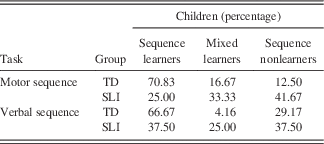
The choice of the 35-ms cutoff for sequence learners was set on the basis of our pilot study conducted in children with normal language under 12 years. We found that the mean RT difference between block 5 and the two adjacent sequence blocks (4 and 6) was 71 ms. Based on this result, we decided to use 35 ms as the arbitrary criterion to determine whether children are or not true sequence learners. For each sequence condition, the percentage of children in the “sequence learners,” “mixed learners,” and “sequence nonlearners” categories, by group, is provided in Table 3.
Percentage of sequence learners, mixed learners, and sequence nonlearners by group, in both the motor and verbal sequence tasks.

For each sequence condition, we applied a chi-square test comparing the percentage of children in each category (sequence learners vs. mixed learners vs. sequence nonlearners) by group (SLI vs. TD; see Table 3). Results indicated a significantly higher percentage of sequence learners in the TD group than in the SLI group, for both the motor SST (χ 2 (N=48; df=2)=10.818; p=.004) and the verbal SST [χ 2 (N=48; df=2) =6.199; p=.045]. Then, we compared the sequence learning index by group for sequence learners in each condition. We found that sequence learners in the SLI and TD groups obtained a similar sequence knowledge in both the motor condition (t(21) =−1.265; p=.219) and the verbal one (t(25) =−0.707; p=.486). These statistical analyses suggested that most but not all children with SLI present a deficit in ISL. Moreover, when learning occurred in children with SLI, it was similar to the learning in TD sequence learners.
Speed Accuracy Trade-Off
To rule out the possibility that group differences in sequence-specific learning was related to differences in accuracy, speed-accuracy trade-off was studied using correlation analyses between the gains in speed and accuracy in each group of children and in each sequence condition. Overall, speed and accuracy were negatively correlated in children with SLI in the verbal sequence condition, r=−0.42, p=.038, indicating that children who performed the task faster were also more accurate.
No significant correlation was found in children with SLI in the motor sequence condition, r=−0.05, p=.816, nor for TD group in the verbal, r=0.036, p=.887, and in the motor, r=−0.3573, p=.087, conditions, possibly due to a ceiling effect in accuracy. Indeed, SLI and TD children performed the SST tasks with high accuracy. Errors on the verbal SST constituted only 4.5% of trials in the SLI group and 3.99% of trials in the TD group. Similarly, errors on the motor SST constituted 4.04% of trials in the SLI group and 4.46% of trials in the TD group.
Links between ISL and Language Tasks
Following the predictions of the PDH (Ullman & Pierpont, Reference Ullman and Pierpont2005), ISL skills should be more strongly associated with morphosyntax and phonology than with lexical abilities. Like other studies (Hsu & Bishop, Reference Hsu and Bishop2014), these associations were examined with correlations (Pearson’s r) computed for each language ability measure in each group and in each sequence condition. For procedural memory, we used the SST learning indexes. For language abilities, we used the Z-scores for the lexical receptive test (EVIP), the receptive grammar test (L2MA2: morphosyntactic comprehension), and the phonological test (ELDP).
For children with SLI, correlation analyses revealed that learning indexes for the verbal SST correlated with the scores in vocabulary knowledge [r=.500; p=.013; 95% confidence interval (CI) (0.122–0.751)], but not with phonological abilities [r=−.398; p=.061; 95% CI (−0.69–0.006)] or with the morphosyntactic comprehension task [r=.292; p=.166; 95% CI (−0.126–0.622)]. For the motor SST, no significant correlations between sequence learning index and language abilities were found: vocabulary [r=.270; p=.200; 95% CI (−0.149–0.607)], phonology [r=−.158; p=.460, 95% CI (−0.527–0.262)], and morphosyntax [r=.143, p=.503, 95% CI (−0.276–0.516)].
For TD children, correlation analyses revealed a significant association between performance in the morphosyntactic comprehension test and the verbal sequence learning index [r=.528; p=.008; 95% CI (0.159–0.767). The other correlations between verbal SST and language abilities were not significant [i.e., phonology: r=.114; p=.595; 95% CI (−0.303–0.494); and vocabulary: r=.092; p=.668; 95% CI (−0.323–0.477)]. For the motor sequence task, the correlation between the learning index and the morphosyntactic comprehension test was significant [r=.407; p=.048; 95% CI (0.005–0.696)]. Motor SST did not correlate with the phonological [r=−.274; p=.194; 95% CI (−0.609–0.145)] and vocabulary [r=.079; p=.713; 95% CI (−0.335–0.467)] tests.
As a whole, these results suggested that ISL was associated with grammar in children with TD, whereas verbal ISL in children with SLI seems to be instead correlated with lexical abilities. Note that the confidence intervals for the correlations between the morphosyntactic comprehension test and the sequence learning tasks found in the TD group overlapped with those observed in the SLI group. Therefore, we cannot exclude the possibility that these correlations coefficients were equal in both populations. This possibility should be considered with caution due to the modest sample size in each group (n=24).
Sequence Awareness
The interview revealed that none of the children were aware of the presence of a repeated sequence in the task. A reproduction index was computed by determining the percentage of elements that were included in the correct chunks of two or more elements (Gabay et al., Reference Gabay, Schiff and Vakil2012; Goschke et al., Reference Goschke, Friederici, Kotz and Van Kampen2001). For example, a child who produced one correct three-element chunk and two correct four-element chunks would obtained a reproduction score of 100 × (1×3+2×4)/30=36.67. For the verbal SST, the mean reproduction indices for children with SLI was 28.33 (SD=18.006) and was 45 (SD=30.30) for TD children. For the motor SST, the mean reproduction indices for children with SLI was 38.33 (SD=24.43) and for TD children was 32.50 (SD=15.45). A factorial ANOVA with group (SLI vs. TD) and condition (verbal vs. motor) on the reproduction index revealed no reliable group difference (F(1,44)=0.678; p=.415; partial η 2 =.015), nor was there a condition difference (F(1,44)=0.036; p=.850; partial η 2 =.001). The interaction between group and condition was also non-significant (F(1,44)=2.923; p=.094; partial η 2 =.062). This analysis indicates that both groups did not differ in their explicit knowledge of the sequence, in both sequence conditions.
Discussion
In this study, we explored both verbal and motor ISL abilities across the same experimental design and within the same sample of children with and without SLI. The present findings can be summarized as follows. Results of both ISL tasks showed that children with SLI were as accurate as their TD peers, but slower than them. Furthermore, as a group, we did not find significant ISL in children with SLI, both in the verbal and the motor SST. Indeed, RTs neither decreased over sequence blocks, nor did they significantly increase in the random block in comparison to the two adjacent sequence blocks.
Children with SLI showed deficits in both types of learning; they were not more impaired in the verbal condition than in the motor one. In marked contrast, we found that control children learned both types of sequences, as indicated by a statistically significant lower RT when the repeating sequence switched to a random sequence. After the SST, a generation task indicated that the children’s degree of awareness of the sequence did not reach the chance level in neither the SLI nor the TD groups. In sum, the results of this study showed that TD children implicitly learned the repeating motor and spoken word sequences, while children with SLI did not.
These results, that is impaired verbal and motor sequence learning in children with SLI, was not in concordance with that of Gabay et al. (Reference Gabay, Schiff and Vakil2012) who found that adults with developmental dyslexia (DD) show learning of motor sequence while the ability to learn verbal sequence is impaired. This discrepancy in results could be accounted for by the age of tested individuals. Indeed, the participants in the study by Gabay et al. were all university and college students (aged approximately 25 years), and the possibility of compensation in the SST task by declarative memory may not be excluded. Research shows that declarative memory improves throughout childhood (Ofen et al., Reference Ofen, Kao, Sokol-Hessner, Kim, Whitfield-Gabrieli and Gabrieli2007) and may be able to compensate for some procedural memory impairments. In a meta-analysis on motor SRT task, Lum, Ullman, and Conti-Ramsden (Reference Lum, Ullman and Conti-Ramsden2013) found smaller differences between DD and TD groups in samples comprising older children or adults. Therefore, a compensation by the declarative memory could explain why motor procedural learning impairments were not apparent in adults with DD in the study by Gabay et al.
The pattern of results observed in the current study also differ from those of Gabriel et al. (Reference Gabriel, Meulemans, Parisse and Maillart2014), who found similar specific sequence learning indices in visual and auditory SRT tasks in children with and without SLI. This difference in results may not be explained by the number of exposures to the sequence (40 exposures in our study vs. 48 exposures in Gabriel et al.), by the age of participants (7 to 12 years old in the present study vs. 6 to 13 years old in that of Gabriel et al.), or by the response mode (both studies used a touchscreen). Alternatively, differences in stimuli could have contributed to the divergent findings of the two studies, as well as the experimental design. Stimuli for the auditory SRT in Gabriel et al. (Reference Gabriel, Meulemans, Parisse and Maillart2014) consisted of non-linguistic sounds, whereas the present study used concrete words.
Although we were careful to choose commonly used words that were sufficiently distinguishable from each other, it is also possible that these stimuli may have been more complex to process than non-linguistic sounds. In other words, the linguistic dimension of the stimuli used in our study may have prevented implicit learning mechanisms from operating in SLI. However, even if children with SLI present linguistic deficits, numerous studies have shown that they exhibit important difficulties in processing of non-linguistic stimuli as well, such as tones. For instance, individuals with SLI in the study of Evans et al. (Reference Evans, Saffran and Robe-Torres2009) were impaired at learning sequential regularities, regardless of the nature of the stimuli (linguistic vs. non-linguistic).
A second explanation for the complete absence of ISL in the SLI group is that motor sequencing does provide some support for learning a perceptual sequence, and vice versa (Dennis, Howard, & Howard, Reference Dennis, Howard and Howard2006). More specifically, even if motor learning is not necessary to learn a novel sequence, it could help perceptual learning. Likewise, perceptual learning can boost motor sequence learning. Therefore, one could argue that children with SLI need both motor and perceptual supports to learn a new sequence, while ISL can occur in the absence of motor or perceptual support in TD children. This explanation can account for the discrepancies between the current findings and those of Gabriel et al. (Reference Gabriel, Meulemans, Parisse and Maillart2014), who found preserved implicit auditory sequence learning in SLI.
Indeed, in their auditory SRT, sequence learning involved learning the pattern of movement of the auditory target (sound) as it moved from one location to another. Thus, both perceptual and motor sequences co-varied. To elucidate this issue, one interesting approach would be to propose a third condition in the SST, in which both perceptual and motor sequencing co-vary. If children with SLI need both motor and perceptual learning to learn a sequence, we would observe similar levels of sequence learning between SLI and TD children in this learning condition.
Besides showing impaired ISL in the SLI group, statistical analyses in individual data revealed interesting findings. We found that a deficit in ISL did not affect all children with SLI, but it did affect a majority of them: 75% and 62.5% of SLI participants showed no sequence learning effect in the motor and in the verbal conditions, respectively. In addition, motor and verbal sequences knowledge in SLI sequence learners was comparable with the level of sequence learning obtained by TD sequence learners, indicating that children with SLI who learned the sequence did not perform worse than TD learners. These findings are congruent with the study of Lukácz and Kemény (Reference Lukács and Kemény2014), who found a smaller proportion of learners in the SLI group, with the same level of individual learning in the SLI and TD groups. The fact that ISL is impaired for some children with SLI but not for others could be explained by the heterogeneity of SLI; this heterogeneity supports the existence of impaired domain-general mechanisms in addition to language disorders.
A sequential information processing deficit can be a problem for some children with SLI that may underlie some of their linguistic impairments (Lukácz & Kemény, Reference Lukács and Kemény2014). The PDH posits that phonology and grammar problems exhibited by children with SLI can be understood in terms of an impaired procedural memory system, especially in sequential processing. Previous studies (e.g., Tomblin et al., Reference Tomblin, Mainela-Arnold and Zhang2007) found associations between ISL and grammar. In our study, we tested whether individual differences in grammatical, phonological, and lexical knowledge were associated with ISL. We found that higher levels of motor and verbal sequence learning seemed to be associated with better grammatical abilities in children with normal language.
In contrast, in children with SLI, sequence learning did not correlate with the grammar test, but we found a significant positive correlation between lexical abilities and verbal sequence learning. Overall, this pattern of results suggests that grammar is linked with procedural memory only in TD children. The link between vocabulary and verbal ISL in children with SLI is not incompatible with the predictions of the PDH. Indeed, Ullman and Pullman (Reference Ullman and Pullman2015) posit that declarative memory remains intact in SLI and could compensate for the grammatical deficits observed in the disorder. Given the small sample size of our children with SLI, additional research with this population is required to substantiate the results observed in the present work.
In conclusion, the current study supported the theory of Ullman and Pierpont (Reference Ullman and Pierpont2005), who make the strong claim that SLI disorder is associated with procedural memory deficits. Our results confirmed also that children with SLI have difficulties implicitly learning sequential patterns in both the verbal or in the motor domain, which is congruent with the results of Hsu and Bishop (Reference Hsu and Bishop2014) and Lukácz and Kemény (Reference Lukács and Kemény2014), who both showed that deficits in ISL affect nonverbal as well as verbal information. Moreover, our results suggested that the procedural deficit is already apparent at the initial stage of the learning process, which appears to be a robust finding in SLI (Lum et al., Reference Lum, Conti-Ramsden, Morgan and Ullman2014). One interesting area for future research would be to assess later learning stages in sequence learning. Indeed, some studies reported an atypical consolidation phase in children with SLI (Hedenius et al., Reference Hedenius, Persson, Tremblay, Adi-Japha, Veríssimo, Dye and Ullman2011), but this has to be confirmed by additional future research. Likewise, future studies are needed to determine whether or not procedural learning is restricted to sequential pattern learning. Studies on the acquisition of nonsequential information are still scarce, and additional efforts should be made to better characterize the procedural learning deficits in children with SLI.
Acknowledgments
Support for this research was provided by the Belgian Fund of Scientific Research (FRESH-F.R.S.-FNRS). We thank all the children who participated in this study and their parents for their collaboration. We also thank Mélody Artaz for her assistance in data collection. The authors report no conflict of interest.