Even though variation is present in all languages, Auslan and other signed languages (SLs) appear to have considerable variation in lexicon and grammar. Some of this variation can be attributed to the sociolinguistic characteristics of SL-using communities—relating to the size of these communities, the integration of personal and social networks, and the degree of language contact (cf. Trudgill, Reference Trudgill2011). Atypical intergenerational transmission patterns and educational practices are also relevant. For Auslan users specifically, both the impact of the history of SL transmission from the United Kingdom to Australia through migration and its distinctive settlement patterns (simultaneously dispersed across an entire continent yet concentrated in a handful of urban centers) and the amount of ongoing contact with the UK SL-using community also need to be considered (Johnston & Schembri, Reference Johnston and Schembri2007).
The association of sociolinguistic variables such as sex, age, dialect, school, and family background with some types of variation in the lexicogrammar attests to the importance of all these factors in Auslan (Schembri, Johnston, & Goswell, Reference Schembri, Johnston, Goswell and Lucas2006) and other SLs (Lucas, Bayley, & Valli, Reference Lucas, Bayley and Valli2001; Sutton-Spence, Woll, & Allsop, Reference Sutton-Spence, Woll and Allsop1990). However, some of the observed variation, as with all languages, may also be symptomatic of ongoing grammaticalization. This study attempts to explore this possibility.
Grammaticalization is a process of historical language change in which content words in particular constructions are repeatedly used with a particular semantic and pragmatic force leading to their gradual reinterpretation as function words. As part of this change, the words in question often display some degree of reduction in phonological form that makes them distinct from the source forms with which they continue to coexist. Indeed, the very existence of some related variant word forms in similar constructional environments (as with the case of going to and gonna in modern English) is known as the principle of layering and is often taken to indicate ongoing grammaticalization when few other kinds of evidence exist (Chambers, Reference Chambers1995; Pagliuca, Reference Pagliuca1994).
Studies of grammaticalization (Bybee, Perkins, & Pagliuca, Reference Bybee, Perkins and Pagliuca1994; Hopper, Reference Hopper, Traugott and Heine1991) have uncovered a number of operative principles, several of which make predictions that can be translated into a variationist approach to language change. Under the principle of layering, we expect forms to covary within functional domains, though their patterns of distribution within that domain may be shaped by other principles (Walker, Reference Walker2010:106).
Naturally, the emerging function words usually display syntactic constraints that reflect both their position within the construction in which they are grammaticalizing and the type of syntactic constraints found in the language for words of the grammatical category into which they are moving. With syntacticization, we expect to see the emergence of fixed sequential constructional schemas and/or the presence of morphosyntactic coding that cannot be adequately accounted for in terms of verb or event type semantics.
Grammaticalization both feeds off and contributes to overall variation in language. Grammaticalization can most clearly be tracked diachronically through the examination of written language in which patterns of variation over time are documented and thus identifiable. However, grammaticalization can also be observed synchronically through comparisons within language families or within a language through variant word forms and multiword constructions in particular contexts, termed “synchronic contextual variation” (Heine, Reference Heine, Wischer and Diewald2002). Layering is a manifestation of synchronic contextual variation. It can be confidently discerned only by processing relatively large datasets (i.e., corpora).
The notion of synchronic contextual variation is fundamental to the current study because grammaticalization is a historical process, but there are no rich diachronic materials for any SL—they have no written literature, and few recordings of any significant historical depth. Our approach is thus similar to that adopted by variationist studies on pidgin and creole languages; many of which, similarly, do not have historical data (Baker & Syea, Reference Baker and Syea1996).
Our approach differs from what may be termed “internal reconstruction” (a similar synchronic method adopted in grammaticalization studies that face little diachronic evidence) in that we adopt a quantitative and not merely an “interpretive stance.” We seek evidence in patterns of variation in a representative sample corpus of Auslan in which relevant social and linguistic variables are identified. The interaction of relevant social factors (age, sex, dialect, language background), grammatical factors (grammatical class, event type, syntactic distribution), and formational factors (phonological reduction manifested in number of hands used, sign duration, and presence, absence, or completeness of mouthing) is evaluated for possible symptoms of grammaticalization, such as differential use according to age, the layering of variant forms in particular environments, or a reduction in the duration of signs used as function words. Without the support of representative usage data to map synchronic contextual variation, the danger is that internal reconstructions may result in overinterpretations of intuited, elicited, or fragmentary data (cf. Pfau & Steinbach, Reference Pfau, Steinbach, Heine and Narrog2011).
This study investigates the synchronic dimension of variation in Auslan with respect to a number of signs with the core meaning ‘finish’ and the relationship of this variation to the possible ongoing grammaticalization of perfective aspect marking in the language. Our underlying assumption is that some of the variation in Auslan (and other SLs) reflects grammaticalization in addition to the social factors and phonological processes that SL linguists have already identified.
PREVIOUS RESEARCH
The peculiar use of a sign glossed as finishFootnote 1 in American SL (ASL)—peculiar from the point of view of English, that is—was hard to ignore from the earliest days of the attempts to explain and teach the language (Baker & Cokely, Reference Baker and Cokely1980; Madsen, Reference Madsen1972). Not surprisingly, therefore, the great variety in the use of this sign was an early observation of the linguistic study of that language (e.g., Fischer & Gough, Reference Fischer and Gough1999 [1972]; Warren, Reference Warren and Siple1978). The similarity of some of its uses, for example, in temporal and aspectual marking, with the use of words for ‘finish’ in spoken creoles, was also observed (Fischer, Reference Fischer and Siple1978). Passing reference to a similar temporal or aspectual marking role for a sign glossed as finish in other SLs were also made relatively early (Bergman & Dahl, Reference Bergman, Dahl, Bache, Basboll and Lindberg1994; Brennan, Reference Brennan, Kyle and Woll1983; Johnston, Reference Johnston1989). However, it took some time before grammaticalization was used to explain the variation and emerging or multiple grammatical functions of finish in ASL (Janzen, Reference Janzen1995; Sexton, Reference Sexton1999). Both Janzen and Sexton concluded that a lexical verb finish has grammaticalized into a morpheme encoding perfective aspect (see also Maroney, Reference Maroney2004).
Over time, a comparable use of a similarly glossed sign in several other SLs has been reported (e.g., Rathmann, Reference Rathmann2005; Zeshan, Reference Zeshan2003; Zucchi, Reference Zucchi2009). Yet other lexical signs with slightly different semantics have also been observed being used in similar ways in other SLs (e.g., Meir, Reference Meir1999; Spaountzaki, Reference Spaountzaki2005). Today some linguists report that grammatical markers for perfective aspect in several SLs have emerged, through processes of grammaticalization, from a lexical verb sign that is often glossed as finish (e.g., Pfau & Steinbach, Reference Pfau, Steinbach, Heine and Narrog2011). Some believe this process is well-advanced and deeply entrenched, that is, some SLs are described as having fully grammatical markers for perfective aspect that have their own unique, and quite specific, syntactic and semantic properties (e.g., Pfau & Steinbach, Reference Pfau and Steinbach2006; Zucchi, Reference Zucchi2009). Consequently, an underlying assumption is that these properties can be relatively easily gleaned from the analysis of examples from individual native signers, or through various judgment and elicitation tasks, without the need for usage-based data drawn from corpora.
However, we believe there are two reasons to be cautious. First, there are the complicating sociolinguistic characteristics of SL-using communities, described in the introduction (and elaborated under Language Contact between Auslan and English), that may affect judgments and elicitations. Second, there appears to be many variable and indeterminate or ambiguous finish constructions to be found in real usage data that suggest the process is not well advanced (Janzen, Reference Janzen, Pfau, Steinbach and Woll2012). What is needed is the investigation of larger, more systematic datasets. This is what we present in this study of Auslan.
BACKGROUND
Tense and aspect systems and grammaticalization
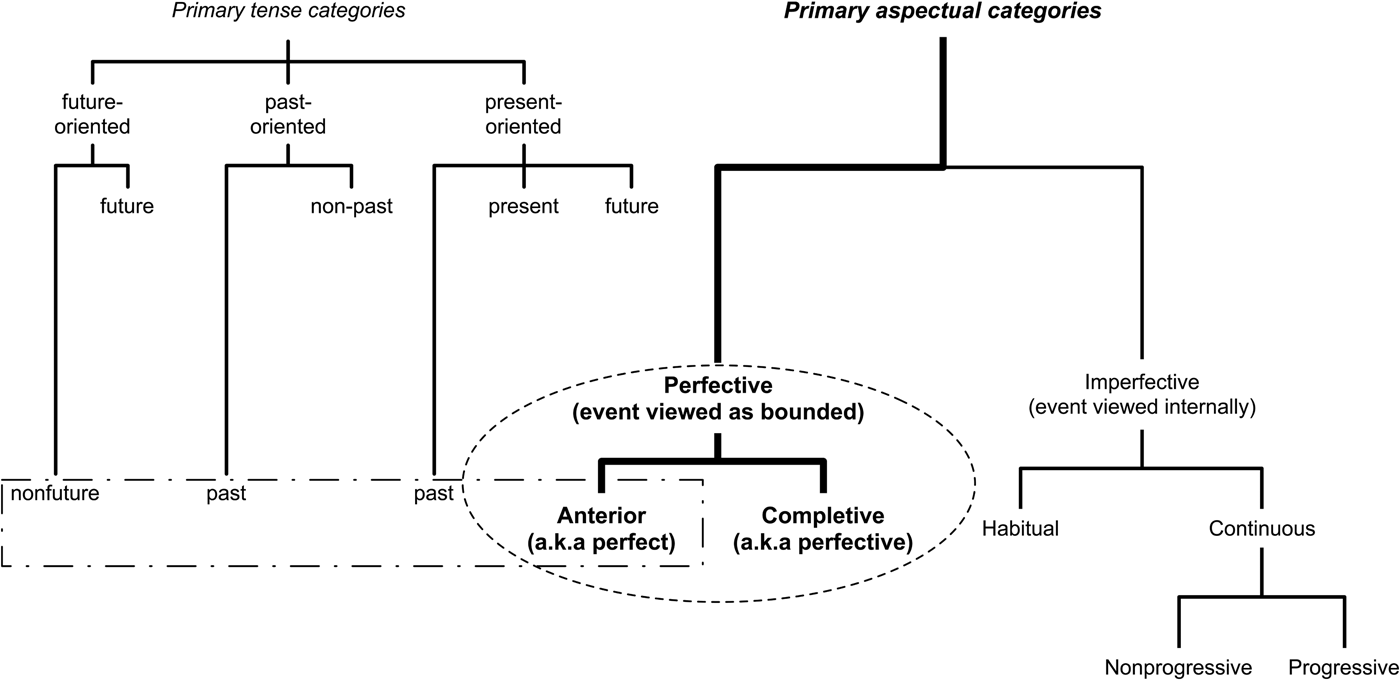
Cross-linguistically aspectual systems tend to make a distinction between perfective (an event viewed as bounded) and imperfective (an event viewed internally). The former often has particular reference to a specified point in time and is thus “close” to the category of tense marking for past tense. In Figure 1, we have taken a description of aspect systems in Comrie (Reference Comrie1976) and represented it visually on the right. We have juxtaposed this to a map of the most general possible tense systems on the left.
Primary aspectual categories and possible overlaps with past tense.

There is a subtle difference between two subtypes of perfective aspect shown in Figure 1. Completive refers to a bounded event that has relevance to a specified time of reference which is often, but not always, the time of speaking (also known as perfective in the literature). Anterior usually implies a bounded event in the past (but it is also known as the perfect in the literature). We reserve perfective as a superordinate term for both. Neither perfective aspect types are past tense markers as such—they simply mark the event as bounded.
However, as can be seen from Figure 1, perfective aspect (circumscribed by the dashed oval) is very close to marking events temporally (being “bounded” implies that it has been completed and is in the past). In particular, anterior aspect actually overlaps the semantic space of the past (outlined by the dashed rectangle). Depending on what tense and aspect distinctions are made and grammaticalized in a language, we may primarily label the semantic domain of distinctions as relating to aspect or tense. Moreover, if a language does not have a fully grammaticalized tense or aspect system, it may be difficult for the linguist to categorize a construction-type as “past tense” or “anterior” in the very first instance. Consequently, if we are observing an incipient grammaticalizing form that expresses these semantics in a language, a degree of uncertainty and indeterminacy may be unavoidable: a construction may be inherently ambiguous as to whether it primarily conveys perfective or past simply because the very distinction has not yet to fully emerge in the language.
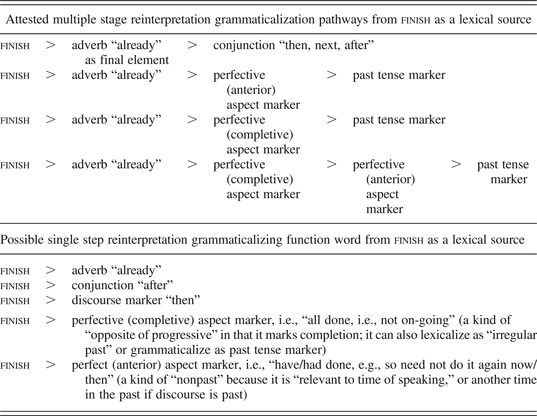
Cross-linguistically, the bounded completed nature of some events is often coded lexically (with content words) or grammatically as either tense or aspect markers (with grammatical words, morphemes, or inflections). The lexical and grammatical strategies often use words that mean ‘finish’ or derive from words meaning ‘finish’ through the process of grammaticalization. A number of such attested grammaticalization pathways have been identified and documented (Heine & Kuteva, Reference Heine and Kuteva2002). These pathways can involve multiple stages of reinterpretation or a single step of reinterpretation leading to a new functional use (which has not yet been involved in any further reinterpretation) (Table 1). It is our assumption that one or more of these pathways could partly explain the type of variation found with signs meaning ‘finish’ in Auslan.Footnote 2
Possible grammaticalization pathways
Lexical and sentential aspect
Considering the immediate linguistic environment of occurrences of signs meaning ‘finish’ naturally also includes considering the semantics of collocating verbs in terms of lexical aspect and/or sentential aspect (the clause in which they appear for their event or situation type).
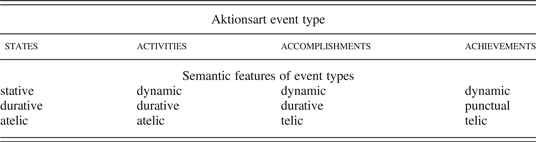
In the literature on lexical aspect, there are several contesting analyses with different feature networks and event type or situation type categories. A seminal early study of lexical aspect (Aktionsart) identified three major semantic features (±dynamic, ±duration, and ±telic) to identify four major event or situation types: states, activities, accomplishments, and achievements (Vendler, Reference Vendler1967). This was expanded to five major event types, with the addition of semelfactives, by Smith (Reference Smith1997). In this study, we use Vendler's simpler four-way distinction of states (nondynamic), activities (expressing action that can go on for an indefinite period of time), accomplishments (expressing action that has a logical endpoint), and achievements (expressing action that occurs instantaneously) (summarized in Table 2).
Event/situation types and their semantic features
It should be noted that the event type a verb may participate in is often able to change according to what other arguments and modifiers are used with the verb, in other words, the lexical aspect of any item should not be considered to be fixed (Xiao & McEnery, Reference Xiao and McEnery2004). This is particularly relevant for the Auslan data as both the multifunctionality and wide semantic range of many sign types render context-free categorization of aspect problematic. For this reason, we code and categorize for the event type of the situation represented by the clause in which the target signs occur—our aspectual tagging is sentential. Although we expect there to be associations of particular lexical verbs with particular event types—which may be taken to reveal their “core” semantics—we do not “assign” an event type to a clause based solely on the assumed core semantics of the verb, but on the clause as a whole.Footnote 3
Correlating our target signs with the different semantic features of different event type categories is used to determine whether the observed lexical or grammatical methods of expressing the completion of an event are constrained by the event type semantics. Grammaticalizing lexical items often undergo semantic shift or bleaching, especially it they also undergo significant phonological reduction or become bound morphemes. Given the semantics of “finish,” if this lexical source has become a stable and conventional grammatical perfective marker, one would expect it to be used with any event type and any state of affairs.
Language contact between Auslan and English
English is the language of the majority community and a second language (to various degrees of fluency and oral/aural ability) of almost all deaf Auslan signers. It is therefore assumed that Auslan is influenced by contact with spoken and written English (see Lucas & Valli, Reference Lucas, Valli and Lucas1989 for ASL and English) due to the small size of the deaf community, the loose social networks and the bilingualism that characterize this community (cf. Schembri, Johnston, Cormier, & Fenlon, Reference Schembri, Johnston, Cormier and Fenlon2013; Trudgill, Reference Trudgill2011)
All too often in the SL linguistics literature, the reverse assumption is made: namely, that SLs are independent and autonomous languages from their surrounding spoken languages (SpLs). Methodologically and theoretically, the result is that researchers sometimes do not take account of, or even mention, the fact that the putative SL-specific construction under discussion actually also exists in the surrounding SpL.
We believe this “isolationist” assumption is unwarranted; rather, we expect interaction (cf. Heine & Kuteva, Reference Heine and Kuteva2005). We expect in the context of this study, therefore, that the strategies used to express the semantics of aspect and tense by the Auslan signers will reflect contact with English to some degree. Consequently, as part of our methodology, we also need to consider how aspect is expressed in English, especially perfective aspect, as this influences what is coded in our study and, ultimately, how the results are interpreted.
In brief, summarizing Payne (Reference Payne1997:380), aspectual meanings are expressed in English sometimes lexically and sometimes morphologically. The nongrammaticalized analytic and lexical strategy uses the complement-taking verbs finish and begin (or start). Completive aspect is expressed as finish X-ing (Y) and inceptive aspect is expressed as begin/start X-ing (Y) or begin/start to X (Y). That these are lexical strategies is evidenced by the fact that in these constructions the verbs do not take on any special form, nor do they convey any idiosyncratic semantics. By way of contrast, anterior aspect (also known as perfect aspect) uses a fully grammaticalized strategy as in have/has X-ed (Y) or have/had X–en (Y). That this is a morphosyntactic strategy and not a lexical one is evidenced by the fact that the word have has taken on construction-specific semantics (it has nothing to do with possession, as in the lexical verb) and allows a reduced (contracted) form in environments where the lexical sign does not (compare they've eaten, *they've food).
THIS STUDY
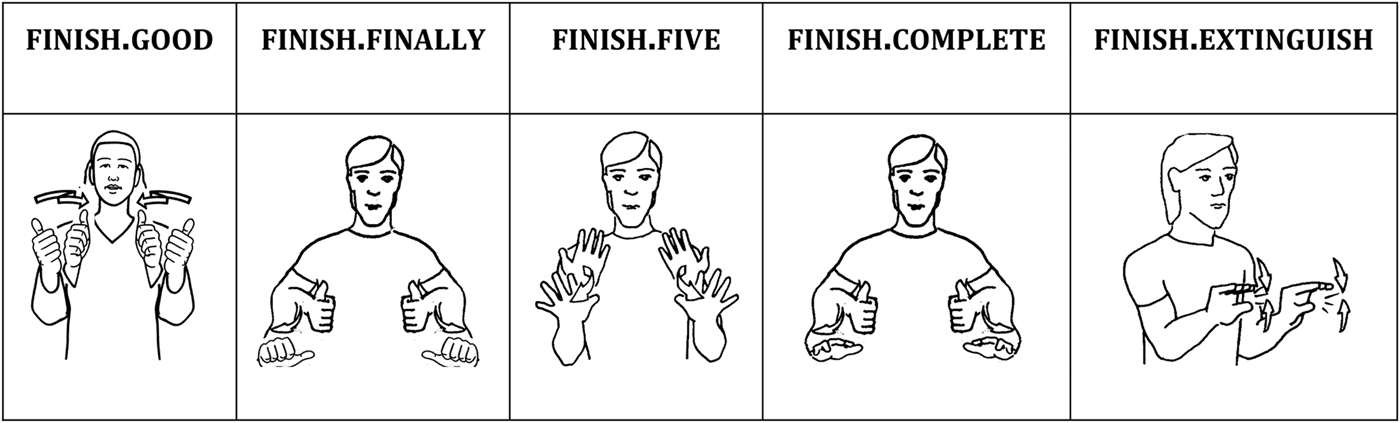
This study investigates the variation in Auslan between and in the forms for a number of signs that express the general concept ‘finish’ to determine which factors are driving this variation and to test whether this follows tendencies that would be predicted if grammaticalization is part of the explanation. In Auslan there are five sign types (lemmas) that express meanings related to finishing (e.g., finishing, completion, ending, succeeding, finality). They are glossed in this paper as finish.good, finish.five, finish.finally, finish.complete, and finish.extinguish (henceforth, they are referred to as the finish-type signs) and are illustrated in (Figure 2).Footnote 4
The finish-type signs.
Intuitions from signers, native or otherwise, are unable to account for the variation in most of the finish-type signs (i.e., why, when and where different types are used). It is simply not a part of most users' everyday language consciousness, let alone meta-linguistic knowledge. In the almost 30 years since lexicographical research into Auslan began, even two of the most well known and apparently most widely used of these finish-type signs (finish.good and finish.five), for example, have never been consistently reported by native signers as having any clearly identifiable systematic difference in meaning.
Some signers have suggested there are regional preferences for one or the other sign, but overall, most reported that they appeared to be in free variation with both being used in the same way with approximately the same frequency in discourse with perhaps finish.good being used more often than finish.five. (In the first sign lexical frequency study of Auslan, Johnston [2012] did indeed find that the ratio of finish.good to finish.five tokens was 2:1.) Most signers have thought that both were verbs, though researchers and a small minority of signers who had increased levels awareness of language use, such as some Auslan teachers, also have recognized that both signs can be used in an auxiliary-like way. They are aware that these two signs, at least, can also have a modifying “helper” verb role in some constructions.
In this study, we wish to determine the range of the uses and forms and the social and linguistic factors that may or may not determine their distribution at the type and token level in a sample corpus of Auslan. At the type level, we map the use of the different signs glossed as finish (the finish-type signs illustrated in Figure 2). We want to know whether any linguistic and social factors are correlated with the types that occur in particular environments. At the token level, we also wish to know whether different forms of each type (e.g., two-handed versus one-handed; fuller articulations verses more reduced articulations; mouthings versus no or incomplete mouthings) also correlate with any linguistic or social factors.
Hypotheses
We have three hypotheses:
1. Differences of form are associated with the use of these signs in different functional roles (grammatical part of speech). They have more than one main role in the language and certain roles favor certain variants.
2. The observed variation actually reflects ongoing grammaticalization (that one or more of the uses as particular parts of speech, especially auxiliaries coding perfective aspect, are actually “emergent”). This would be reflected in a layering of forms.
3. The grammaticalization and the variation have a regional dialectal dimension, that is, differential use of particular forms in certain grammaticalizing constructions are more prevalent in one Auslan dialect than the other. This hypothesis draws on the observation that different regions in a speech/language community may display different degrees of grammaticalization of a particular word/sign, and this may be a factor that explains or affects the distribution of the variants in different regions or dialects (Bybee et al., Reference Bybee, Perkins and Pagliuca1994; Hopper, Reference Hopper, Traugott and Heine1991).
METHODS
We adopt a quantitative corpus-based variationist methodology and use multivariate analysis to track variation with respect to possible grammaticalization, which is similar to a pioneering study by Poplack and Tagliamonte (Reference Poplack, Tagliamonte, Baker and Syea1996) that used variationist methodology to examine grammaticalization synchronically. This approach was then “somewhat unorthodox in comparison to those traditionally featured in variation studies” because the variable environments did “not correspond to the strict definition of variants of a variable as alternative ways of saying the same thing” (78). A variationist approach is increasingly regarded as appropriate for describing all types of variation and even for establishing form/function pairings in the lexicogrammar, which is inherently variable, using quantitative usage data (Walker, Reference Walker2010).
We identify the finish-type variants and examine the environments in which they are used, for example, identifying forms that are used as auxiliaries in constructions marking aspect, either completive aspect or anterior aspect. However, given the expression of aspect in English (described earlier), we also identify signs glossed as have that also function as auxiliaries (henceforth referred to as have-aux signs) to account for all the constructions Auslan signers are likely to use to overtly express perfective aspectual semantics. No systematic investigation of the factors that may influence the choice and use of the finish-type signs could be undertaken before the creation of the Auslan Corpus, which is where we source our data.
There are two methodological issues that must temper the interpretation of our findings. First, the identification of parts of speech in Auslan, as in many languages, is not straightforward. Indeed, it is particularly problematic in Auslan and most other SLs (Johnston, Reference Johnston2012, Schwager & Zeshan, Reference Schwager and Zeshan2008) because sign types in these languages (the lemmas) do not generally undergo morphological changes that mark grammatical class as such,Footnote 5 nor does sign order reliably signal grammatical role (SLs have relatively free constituent orders). In the annotation of the Auslan Corpus, tagging for grammatical class is thus made primarily on the basis of meaning. In the first instance, utterance units (clauses) are identified. The clause is delimited, paying attention to both form (intonation contours, boundary markers, pausing) and meaning, where the clause contributes an identifiable and coherent unit of meaning to the discourse and/or is a distinct move or turn in a dialogue. Furthermore, the semantic role each of its constituent signs appears to play in the state of affairs (participant, action, modifier) motivates the categorization as noun, verb, adjective, etc. The presence or absence of mouthing is also relevant in this procedure.
Regarding the identification of the grammatical role of finish-type signs specifically, when it is determined that a finish-type sign modifies another constituent sign, which is the main verb (i.e., the main verb identifies the core process or state described by that clause), it is tagged as an auxiliary sign (glosses as finish-type-aux here). To subcategorize finish-type-aux signs as conveying primarily completive or anterior meaning, we appeal to the discourse context: from the preceding and following clauses, a judgment is made if it is the completion of an event that is being foregrounded or the current relevance of a (past) completed event that is being foregrounded. Formal criteria cannot be applied because it is the very existence of any systematic lexical or morphological marking that is being investigated in this study.
The Auslan Corpus has been created in full knowledge of these issues and problems. The primary data and the related annotation files have been made accessible in an online archive precisely so that linguistic categorization is open to meaningful peer review (see Footnote note 3). Second, the annotated corpus is neither rich enough nor large enough for us to yet be able to find all instances in which a perfective meaning (whether anterior or completive) would appear to be a reasonable inference to be made by the interlocutor without any overt marking (lexical or morphological). Our corpus does not identify all instances where one of the possible realizations could have been found, in other words, where there is no marking whatsoever. The principle of accountability (Poplack & Tagliamonte, Reference Poplack, Tagliamonte, Baker and Syea1996, Tagliamonte, Reference Tagliamonte2011) requires that, in a corpus-based analysis of variation in the linguistic realization of a meaning under investigation, one should identify all instances where one of the variants could have been appropriate, including those environments where none was used, in order to have a comprehensive account of the phenomenon. With respect to richness, every clause in the corpus has yet to be identified (even in the study dataset) and hence every verb has yet to be identified (and thus cannot yet be tagged for perfective semantics). With respect to size, our dataset is skewed toward narratives, which are well known to have their own special linguistic characteristics. These limitations are unavoidable because the Auslan Corpus was one of the first digital SL linguistic corpora (2004) and it takes a very long time to create a richly annotated and machine-readable corpus of SL recordings (much more so than for SpL recordings).
These two caveats need to be borne in mind when interpreting our findings. This study does not attempt to give a complete account of variable perfective marking in Auslan—rather, its focus is on the distribution of the variable uses of finish-type signs and the possible role of grammaticalization in explaining the variation.
The data
The data in this study has been drawn from the Auslan Corpus of native or near-native signers (for further details, see Johnston & Schembri, Reference Johnston, Schembri, Barwick and Thieberger2006). All video clips from the Auslan Corpus that had previously been given at least a basic ID gloss annotation were used in this study. An ID gloss is a unique gloss used to identify a sign type/lemma (for more information on ID glossing, see Johnston, Reference Johnston2010). These 459 video clips contained over 105,000 manual sign tokens. Of these clips, 184 contained the 451 tokens of finish-type signs and the 36 tokens of have-aux signs investigated in this study.Footnote 6 The data come from 92 of the 100 individuals in the corpus and represent three text types: monologue, dialogue, and elicited.
Data preparation
All instances of finish-type and have-aux signs and the clauses in which they occur were identified. All target signs or the clauses they occurred in were tagged for factors relevant to the investigation, and ELAN data exports were used to extract additional relevant information, such as individual sign duration. These factors were grouped as follows:
Grammatical factors: specific grammatical class tagsFootnote 7; content or function tag; tag for position relative to main verb if acting as auxiliary, that is, preverbal or postverbal.
Formational factors: the number of hands used to articulate the sign (one-handed or two-handed), the duration of each sign (in milliseconds), the presence or absence of mouthing during the production of the sign (mouthing or no-mouthing).
Semantic factors: event type (states, accomplishments, achievements, and activities); event type semantic features (atelic or telic, stative or dynamic, durative or punctual); perfective subtype (anterior or completive).
Usage factors: text type (monologue, dialogue, elicited).
Social factors: individual (included as a random effect in a mixed effect model), nativeness, age, dialect, sex.
These factors were then quantified, described, and further analyzed for significance and interaction using Rbrul multivariate analysis software (Johnson, Reference Johnson2009) to determine whether the variant forms of the finish-type signs are associated with any identifiable linguistic or social factors.
Corpus examples
The following examples show the ranges of uses finish.good attested in the data and illustrate the coding in ELAN (Figures 3 to 8).Footnote 8 Single frames from each sign are shown. The finish.good sign in each example is outlined in a bold black line. Similar examples of multiple functional uses of other finish-types can be found in the corpus but space limitation prevents them from being illustrated here.
finish.good-verb [Auslan Corpus: MKBc4a].
finish.good-noun [Auslan Corpus: SBSc2b].
finish.good-aux [Auslan Corpus: PRFc3].
finish.good-adv [Auslan Corpus: MGCc3].
finish.good-conj [Auslan Corpus: MDPc6ii].
have-aux [Auslan Corpus: BSSc4a].
FINDINGS
The sign glossed for this study as finish.extinguish was excluded from the study after the initial data preparation because the two previously identified forms (one that closes, and one that closes then opens) were found to be associated with two different functions with no variation (there were also no one-handed forms of either). The closing form was always used as a verb meaning ‘stop/finish/extinguish’; and the closing-opening form was always used as a conjunction meaning ‘then/and-then/next/after-that/subsequently’. Not only was there no variation to consider within the terms of this study, but it could be argued that the conjunction has lexicalized from an iconic/metaphorical modification the former, that is, ‘stop (close), then start again (open)’, rather than through a process of grammaticalization. We are unable to comment further given the available evidence.
Overall distribution of sign types
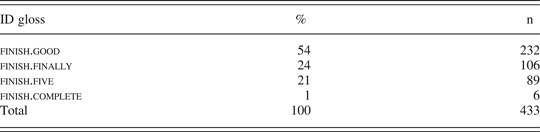
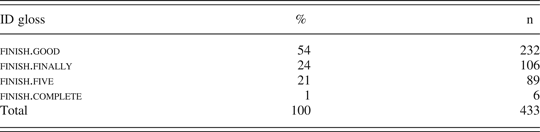
From Table 3 one can clearly see that over half of all finish-type signs in the dataset are tokens of finish.good. The ratio of finish.good to finish.five is higher, at 5:2, than previously thought (2:1) (Johnston, Reference Johnston2012).
Distribution of the finish-type signs
The sign glossed for this study as finish.complete was excluded from further quantitative description and multivariate analysis after the initial counts because (a) the number of tokens is very low for any meaningful comparison with the other variants and, more importantly, (b) we began to suspect that that the sign itself may actually be a compound or blend of finish.good or finish.finally and finish.five, which has become lexicalized as ‘finish-completely/completely-finished/complete-definitively/all-done/nothing-more-to-do’, etc., or may be an emphatic form of finish.five (i.e., with a closed initial handshape). It is analyzed as a lexical sign glossed as complete (see Relexicalization for further discussion).
Grammatical factors
Content/functional
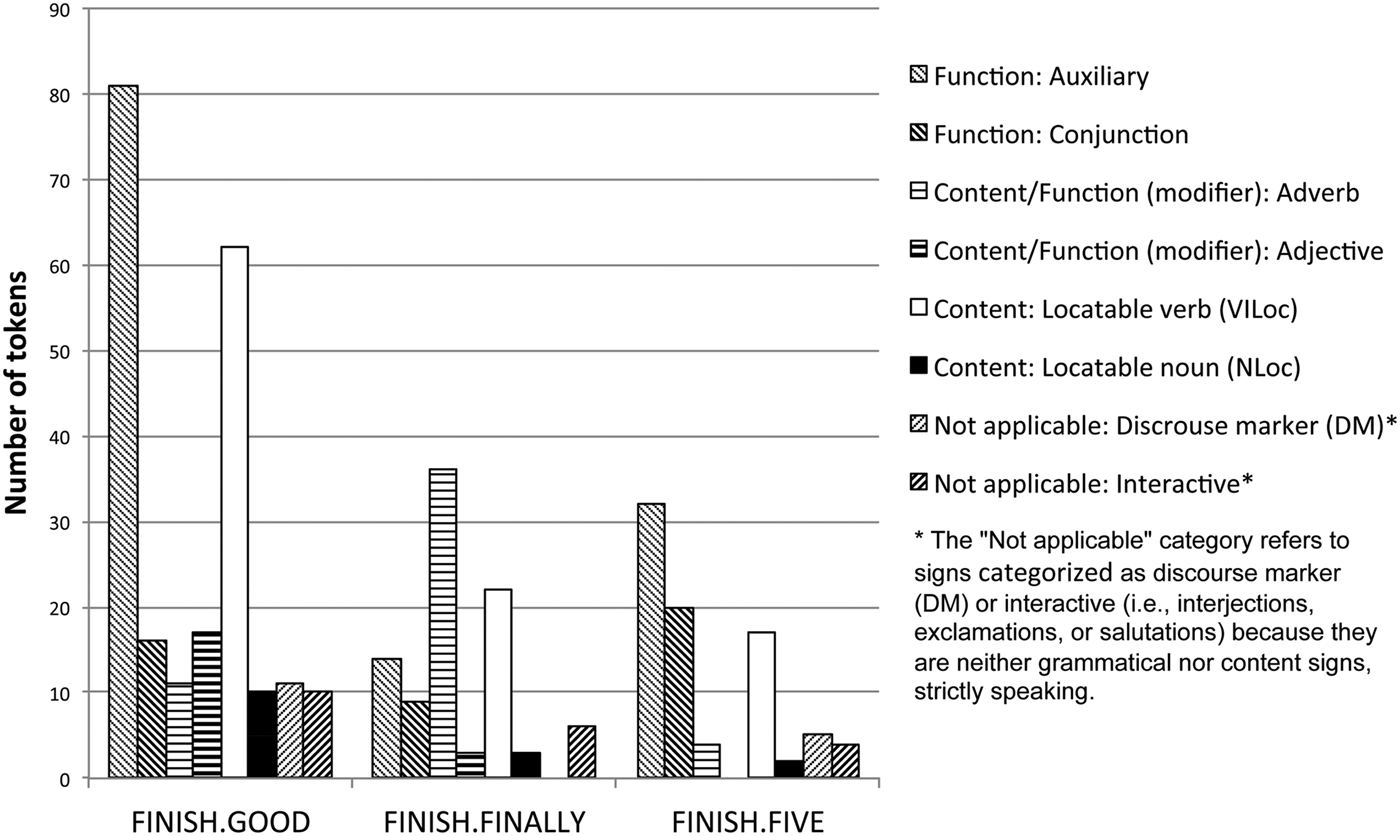
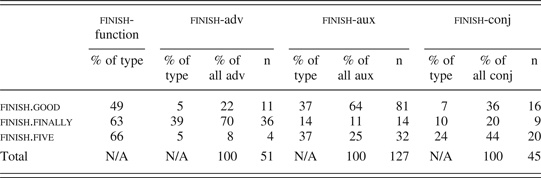
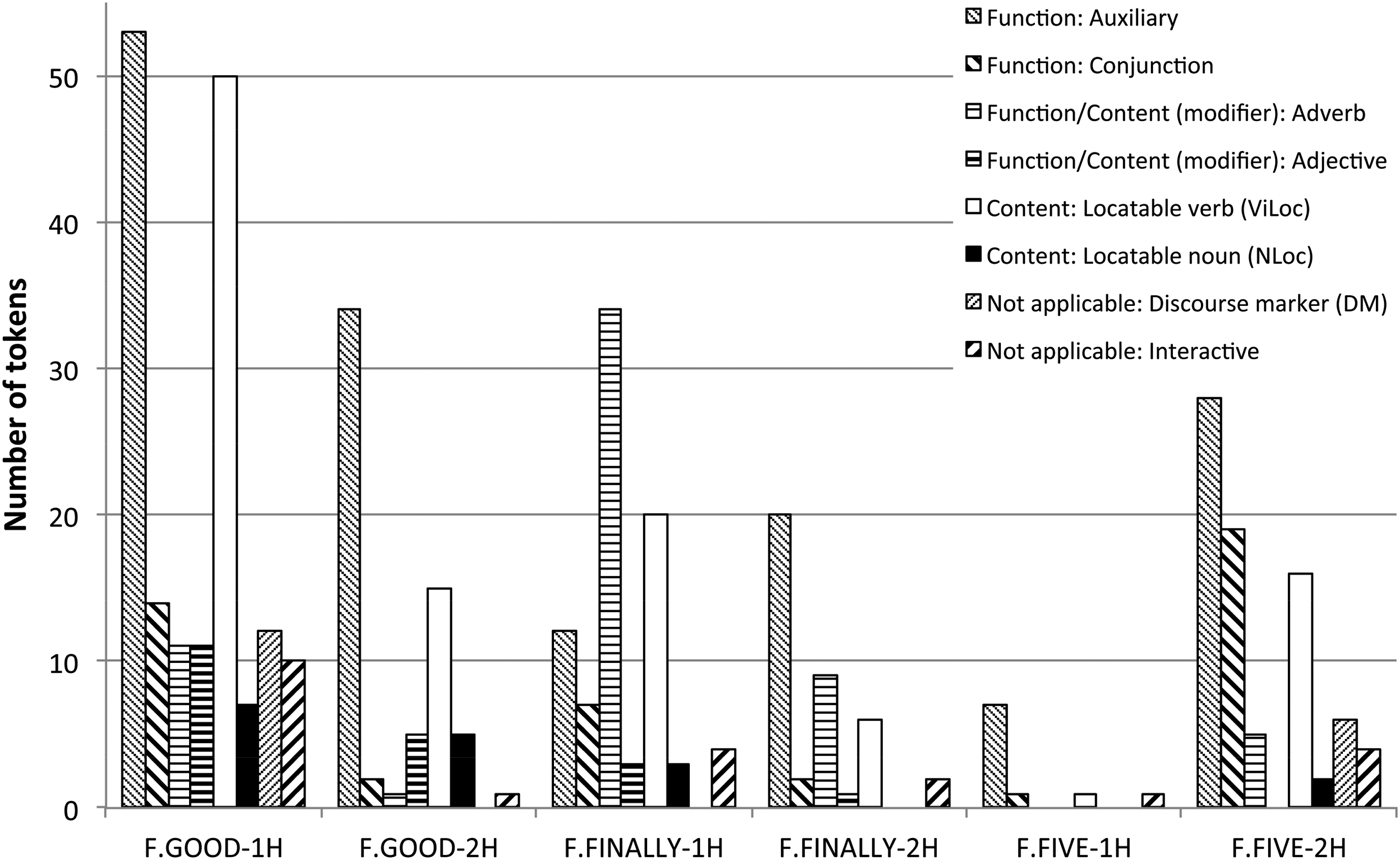
Figure 9 shows that most finish-type signs can function in more than one grammatical role, each sign type has tokens functioning in almost every possible role. However, finish.good is equally likely to be a function sign as a content sign, while finish.five is more likely to be a function sign (auxiliary and, in particular, conjunction), as is finish.finally (adverb). This is more clearly seen in Table 4 where 49% of finish.good are function signs, 63% are finish.finally, and 66% are finish.five.
finish-type signs by grammatical class.
Distribution of finish-adv, finish-aux, and finish-conj signs
Pre- or postmodifying
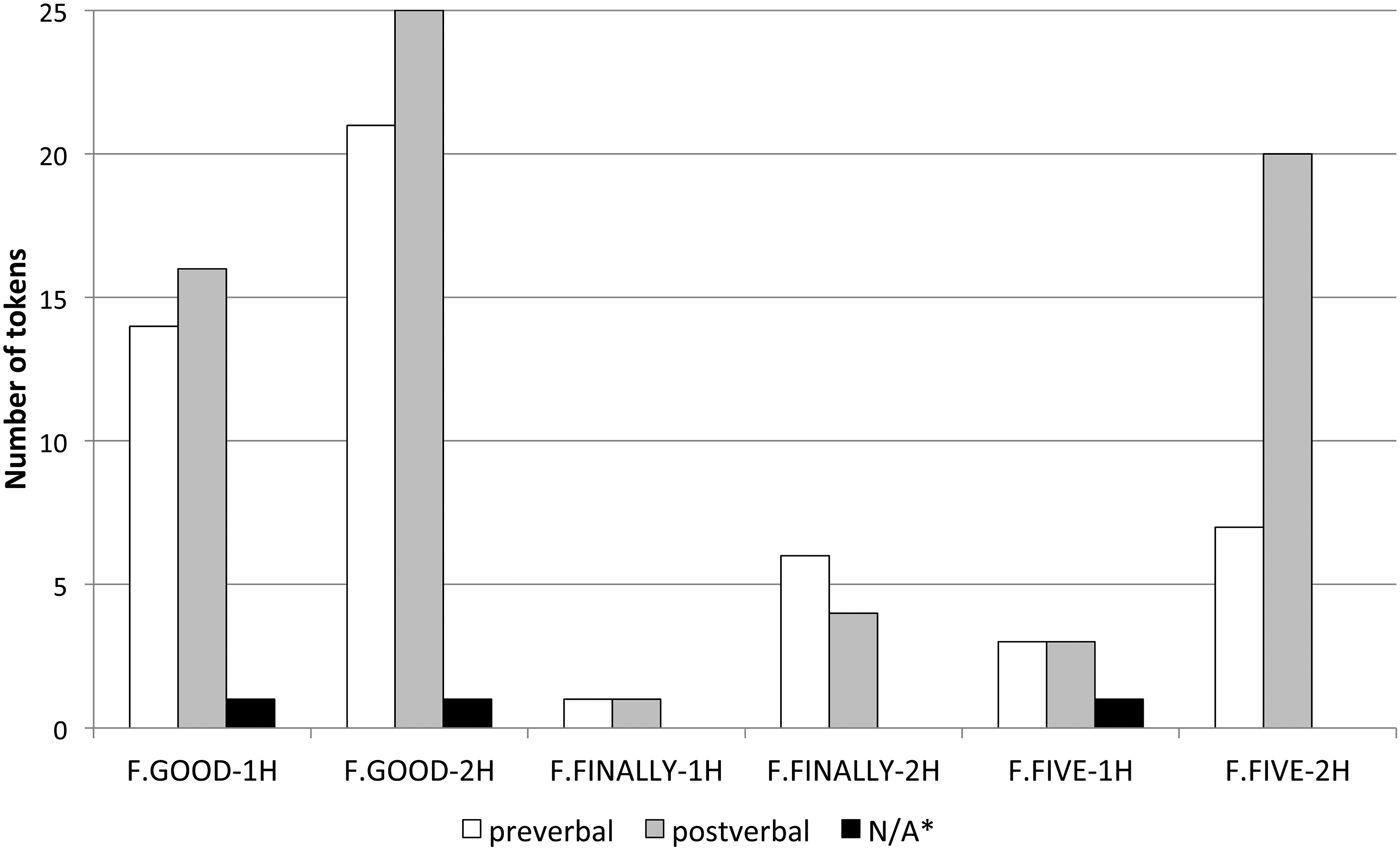
With respect to the placement of finish-aux signs, there appears to be no particular preference for a premodifying as opposed to a postmodifying position relative to the verbal head. About 50% of finish-aux occur either before or after the verb, though premodifying position slightly favors anterior meanings and the postmodifying position favors completive meanings (see Table 5). However, there is a difference with regards to subtype, with finish.five-aux 2:1 in favor of postmodification (Figure 10). (By way of contrast, of 36 have-aux tokens, only 3 are postmodifying.)
Position of finish-aux signs relative to head (*N/A = main verb elided). 1H indicates one-handed and 2H indicates two-handed.
Position of finish-aux signs relative to head by perfective subtype

Formational factors
Formational factors relate to the presence or absence of phonological erosion or reduction. In the SpL grammaticalization literature this is exemplified by loss of stress and/or deletion of segments, which tends to make a grammaticalizing word shorter in duration. We suggest, partly on the basis of the data itself, that there are two other modality-specific phenomenon in SLs that also deserve consideration in this light. The first is the use of one-handed forms as opposed to two-handed forms. The second is the presence, absence, or completeness of coarticulated English mouthing.
Number of hands used
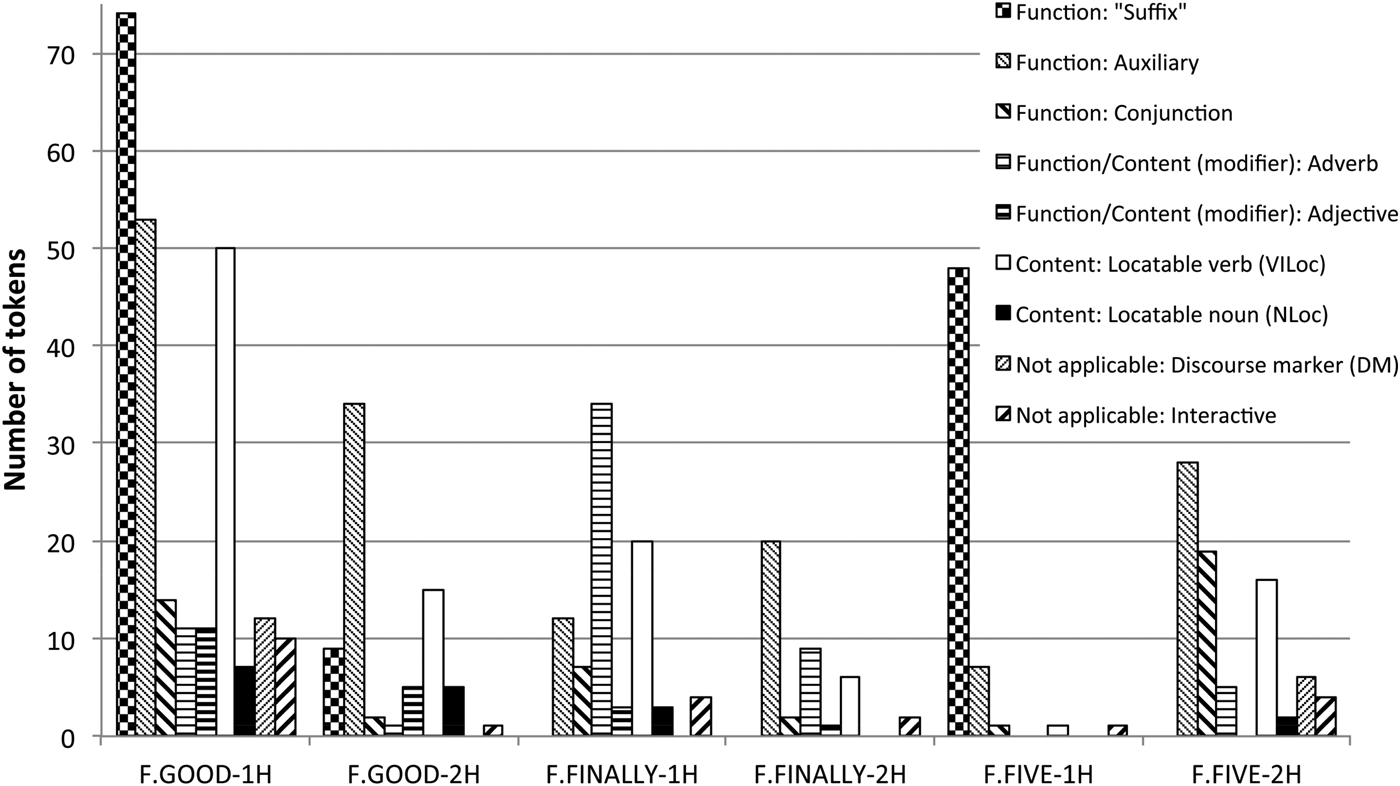
From Figure 11 one can see that there are far more one-handed tokens than two-handed tokens in the dataset for finish-good and finish.finally signs (a ratio of 5:2 and 2:1, respectively) and that the distribution in favor of one-handed forms for these signs is associated with their use as function signs. finish.five appears to be behaving quite differently: the ratio of one- to two-handed forms is reversed (at 1:8) and the two-handed forms seem strongly associated with function uses. The (apparent) anomaly is addressed in the Relexicalization section.
Number of tokens of one- and two-handed finish-type signs by grammatical class.
It is interesting to note that the number of hands used in finish-type-aux signs is much more likely to be similar to the number of hands in the adjacent modified verb than not, in a ratio of 3:1. More precisely, in two-handed forms, the ratio is 4:1 and in one-handed forms, the ratio is 2:1. (The ratio of one-handed to two-handed forms for all signs in the Auslan Corpus is approximately 1:1, so an overall tendency to two-handedness seems not to be implicated here.) Detailed textual analysis of the actual constructions in which reinterpretation may be occurring needs to occur before we are able to determine the true significance of this, but it is possible that this phenomenon could be linked to the auxiliaries starting to lose independent word status. They may be assuming some phonological characteristics of the head verb (in a modality-specific way).
Duration
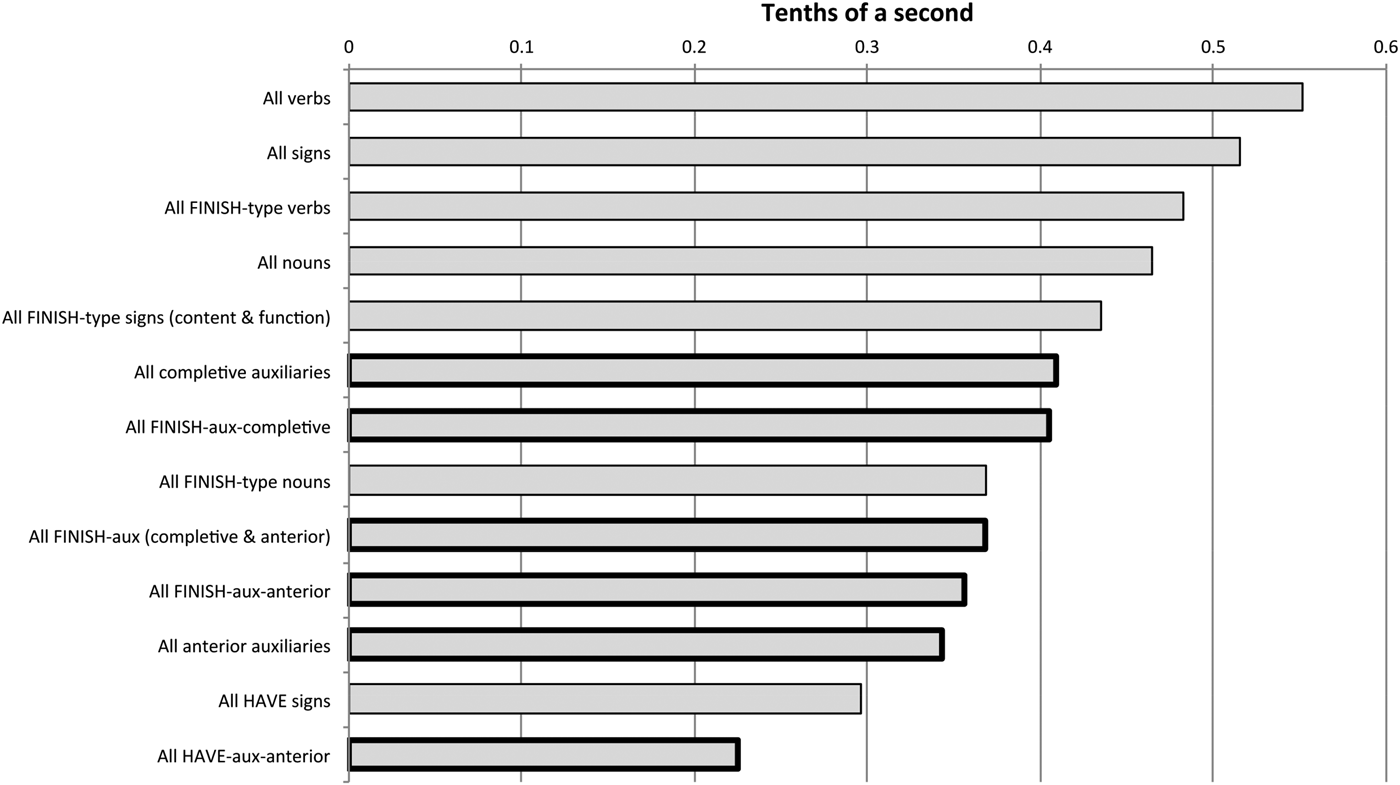
Duration data is available for all signs in the corpus. It is associated with each sign annotation in ELAN and can be exported, along with other tagged annotations, for processing and sorting in spreadsheets (e.g., averaged overall by various categories as listed in Figure 12). The data clearly show that target signs that are functional signs have a shorter duration than content signs (outlined in bold). It also confirms previous observations that as far as content signs are concerned, verb signs tend to take longer to produce than noun signs do in Auslan (Johnston, Reference Johnston2012). The averages for sign tokens across the entire Auslan Corpus (>105,000 tokens) do not differ in rank order with the study corpus subset averages where available (i.e., all verbs, all signs, all nouns, all have signs).
Average duration of sign types in tenths of a second (function sign types are outlined in bold).
Mouthing
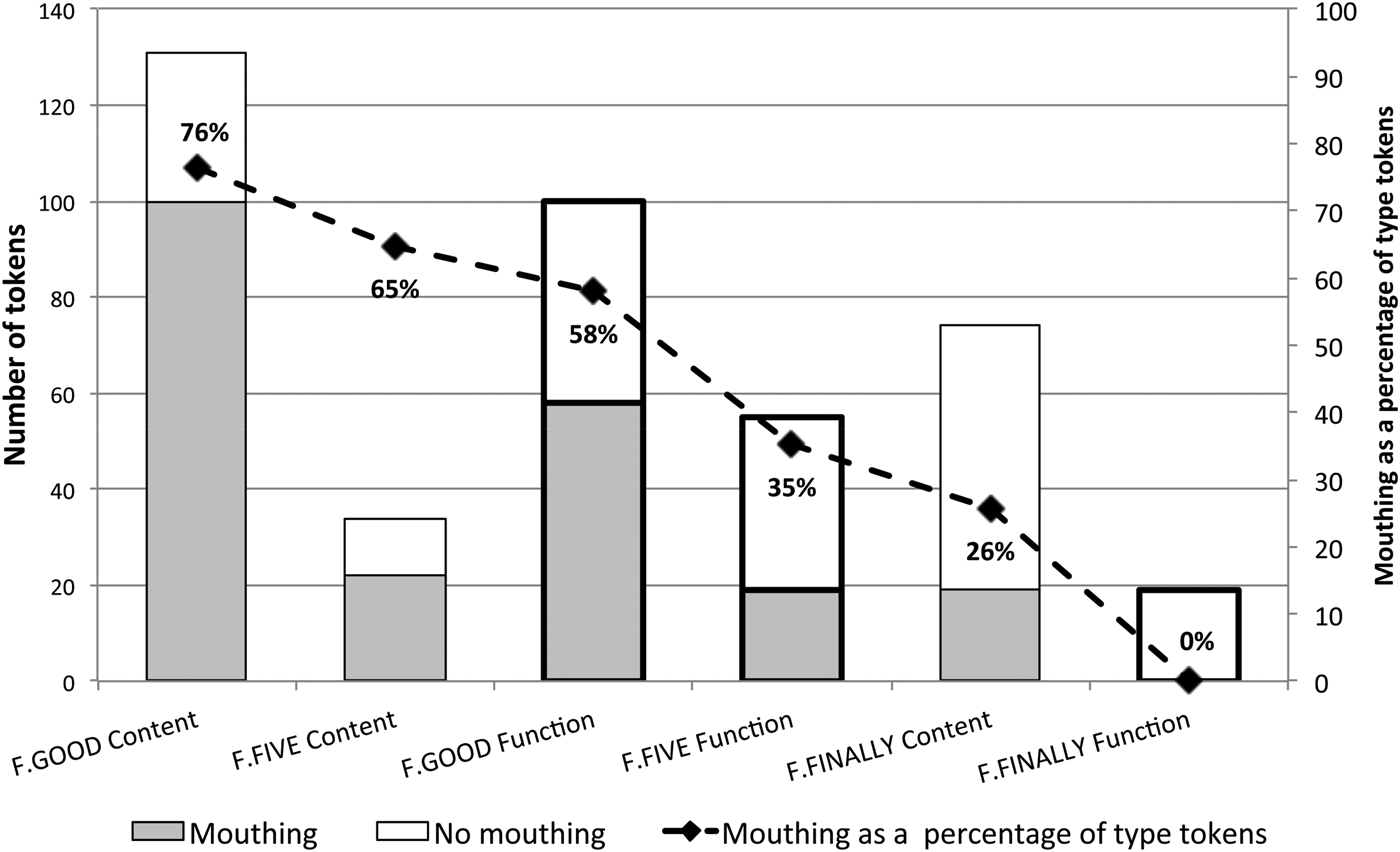
It is well known that the coarticulation of a (silent) mouthing derived from an associated word from the surrounding SpL occurs very frequently when signs are produced in a SL and that this occurs more with nouns than with verbs (Bank, Crasborn, & van Hout, Reference Bank, Crasborn and van Hout2011; Boyes-Braem & Sutton-Spence, Reference Boyes-Braem and Sutton-Spence2001; Johnston, van Roekel, & Schembri, in press). In the study dataset, the finish-type signs were found to be coarticulated with a mouthing at different rates depending on the function of the sign in each context. In Figure 13, the number of function and content tokens of each finish-type is plotted against the left-hand scale. The percentage of each group that is accompanied by a mouthing is plotted against the right-hand scale and the groups organized in descending order of the total percentage of tokens mouthed. One can see there was a strong tendency for less frequent mouthing with functional uses (the functional categories are outlined in bold).
Mouthing tokens per finish-types by content or function (in descending percentage of tokens mouthed for each type).
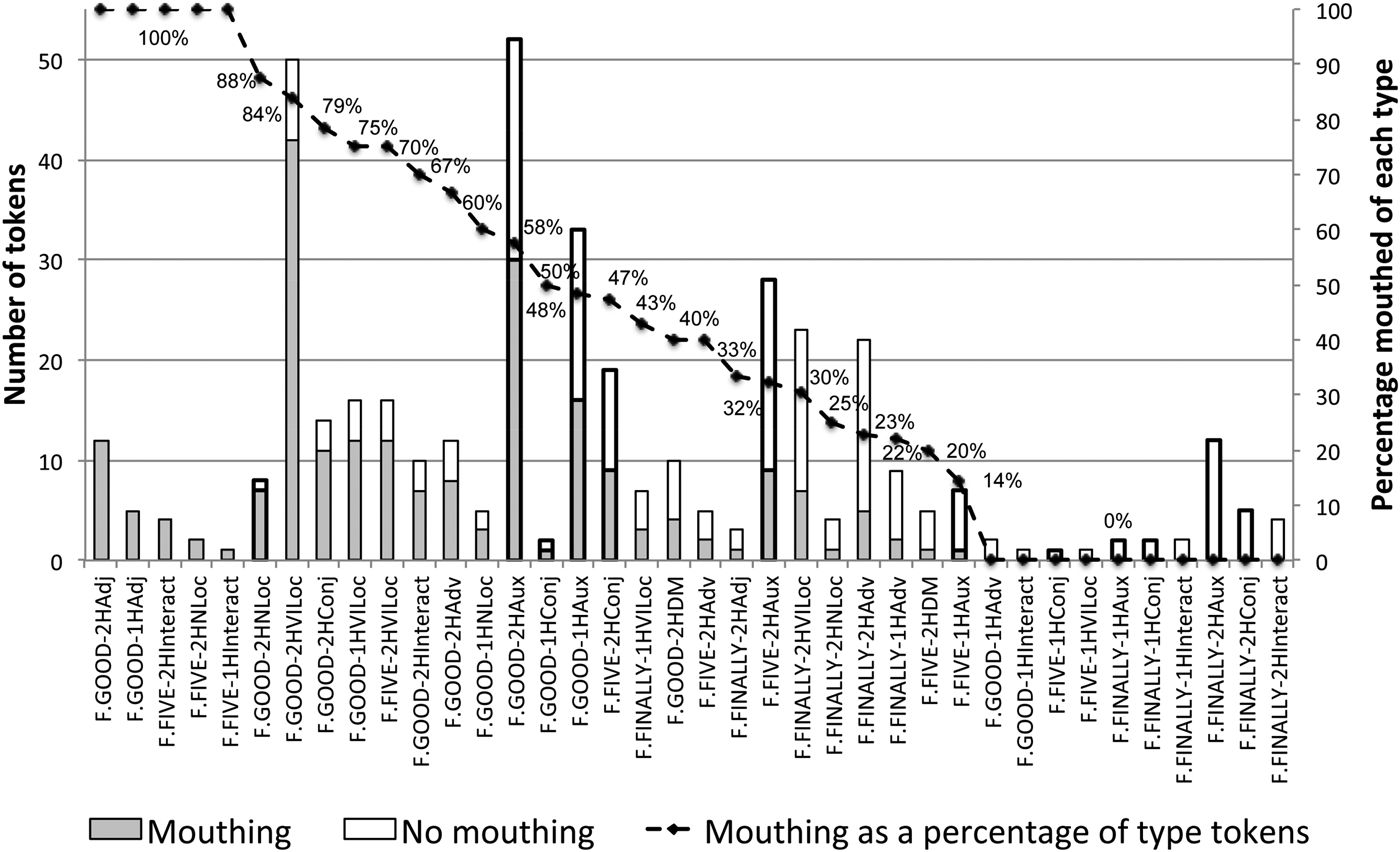
In Figure 14 the same data are displayed in much greater detail but with the finish-type signs separated out at each data point into one- and two-handed forms according to grammatical role. Content signs such as nouns and verbs, closely followed by adverbs and adjectives, are more likely to be mouthed than auxiliaries and conjunctions are. The word mouthed is most frequently “finish(ed)” but a few are accompanied by “success(ful),” “succeed,” “complete(d),” “gone,” and “done.” Adverbial and conjunctional uses are sometimes accompanied by “at last,” and “finally,” or “then” and “after,” respectively. Interestingly, mouthings that co-occurred with function finish-types were also more likely to be incomplete than when they appeared with content finish-types, for example, the ratio of partial mouthing to full mouthing with finish-nouns that were accompanied by mouthing was 1:12 and with finish-adjectives it was 1:16, but with finish-auxiliaries it was 1:3. Some content signs are always accompanied by mouthing and some function signs have no mouthing whatsoever.
Mouthings per finish-type sign by function (in descending percentage of tokens mouthed).
Semantic factors
Event type
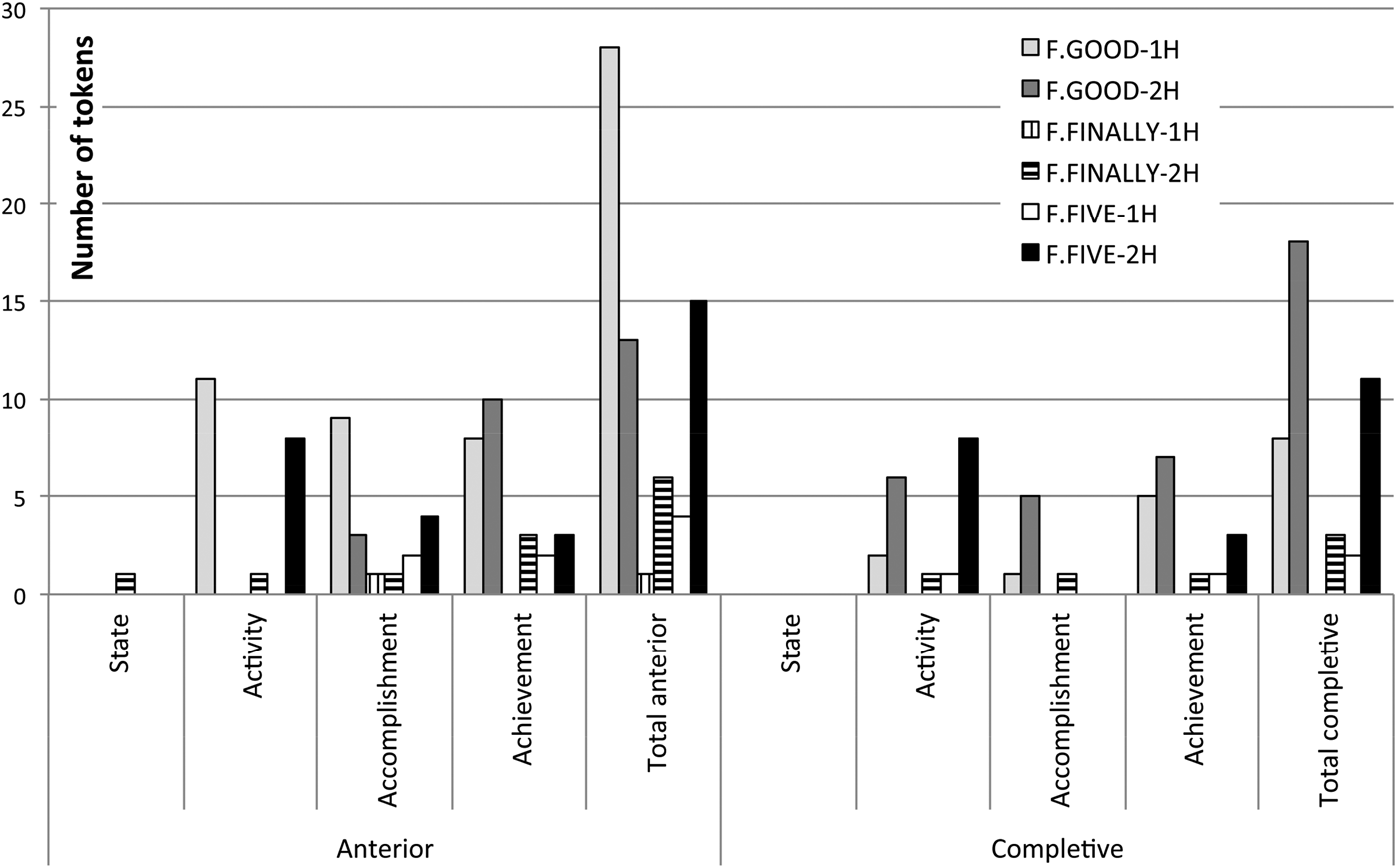
With respect to verb or event type semantics, the distribution of finish-aux signs in terms of telicity and Aktionsart suggests a strong role for semantics (Figure 15). For example, one can see a clustering of finish-aux signs used to express anteriority, in particular two-handed finish.five and one-handed finish.good with activities. Among the completives, two-handed finish.good appear to be the most frequent across all non-states, with only activities also occurring with a number of two-handed finish.five auxiliaries.
Perfective aspect, event type and finish-type sign type.
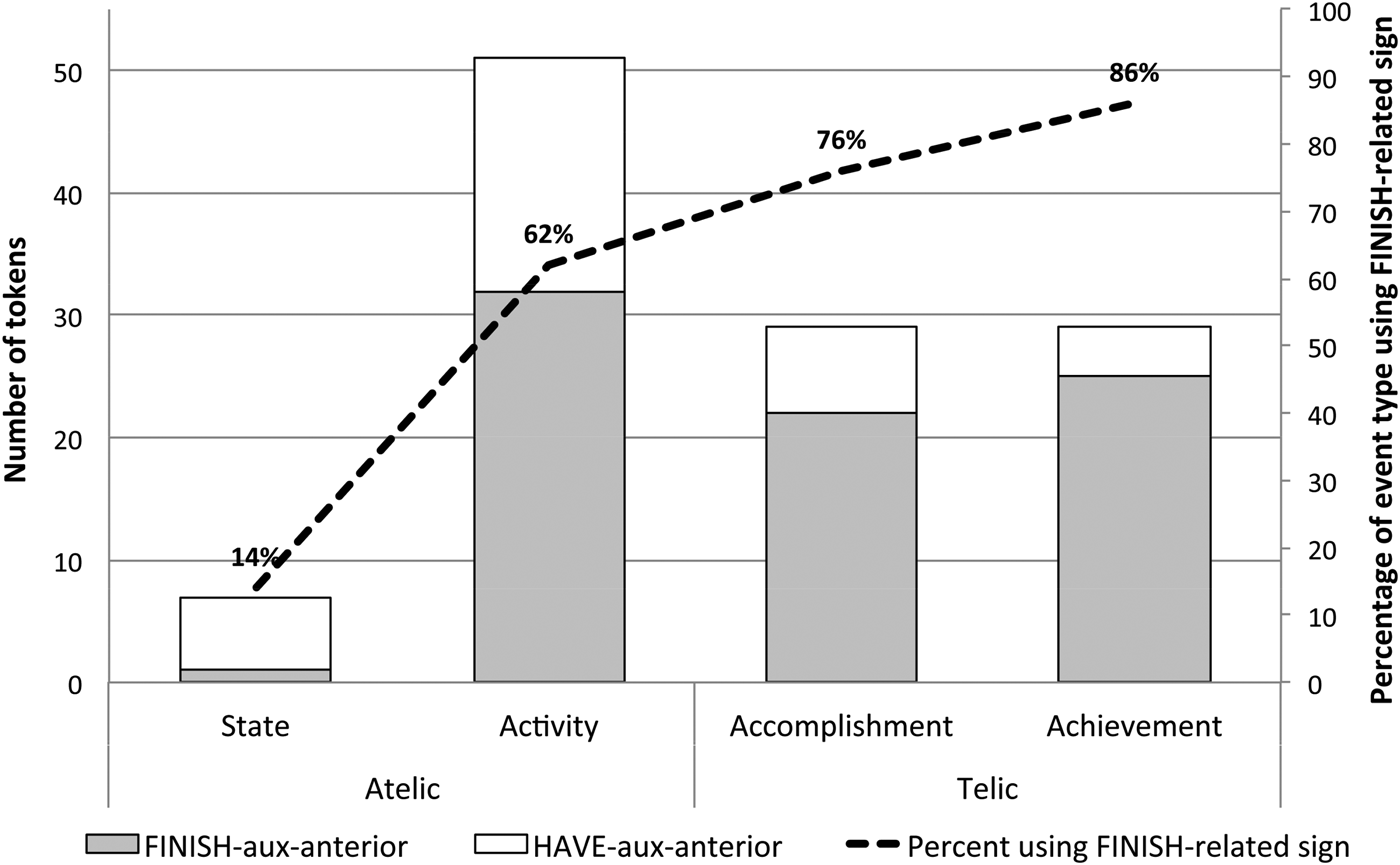
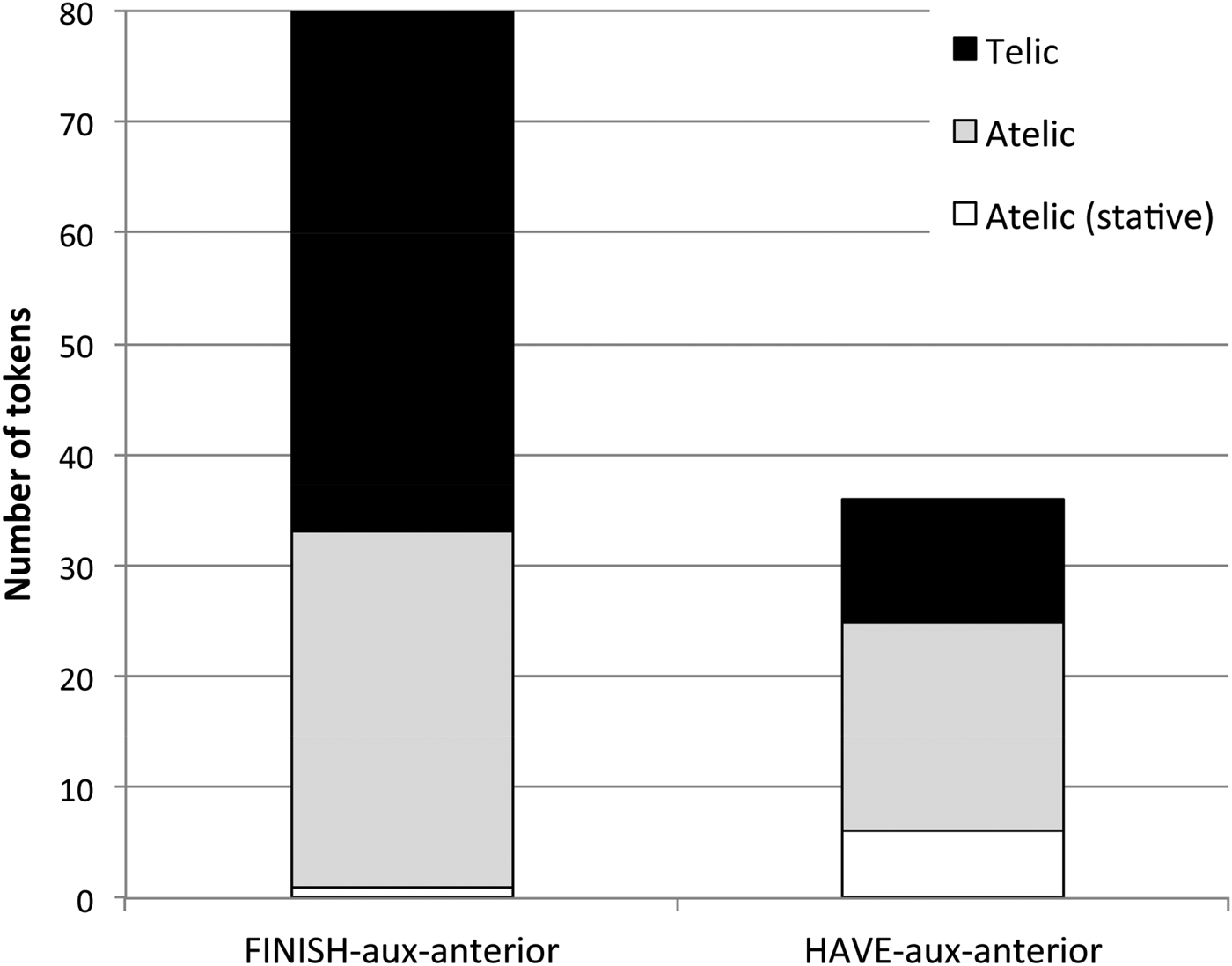
When we also consider the use of have-aux, it becomes very clear that the current relevance of a prior state (anterior) or the end or completion of a state (completive) do not occur with any finish-aux sign (with one exception), rather states take have-aux (Figure 16). Figure 16 also shows the almost exclusive use of have-aux with states (atelic states of affairs) and an increasing preference for finish-aux signs with the other event types in order of increasing telicity (activities, accomplishments, and achievements). This is even more clearly seen in Figure 17.
Distribution of finish-aux and have-aux as anterior aspect markers by event type.
Distribution of finish-aux and have-aux as anterior aspect markers by telicity of event type.
Usage and social factors
Usage factors relate to the text type (monologue, dialogue, elicited) and social factors relate to the background of the participants (sex, age, region, or nativeness). The corpus texts and the characteristics of the participants have been described in the Data section. We will not describe the distribution of forms with reference to these usage and social factors because no obvious patterns emerged at a descriptive level and the complex interaction of usage and social factors with the core linguistic factors is better dealt with in the multivariate analysis, to which we now turn.
MULTIVARIATE ANALYSIS (RBRUL)
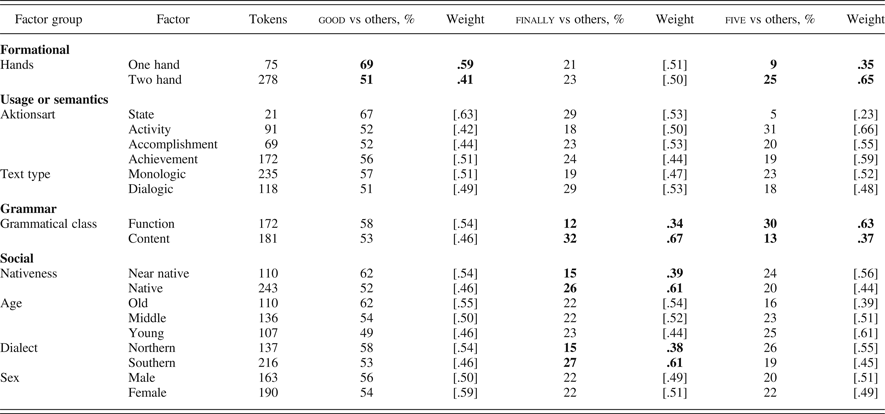
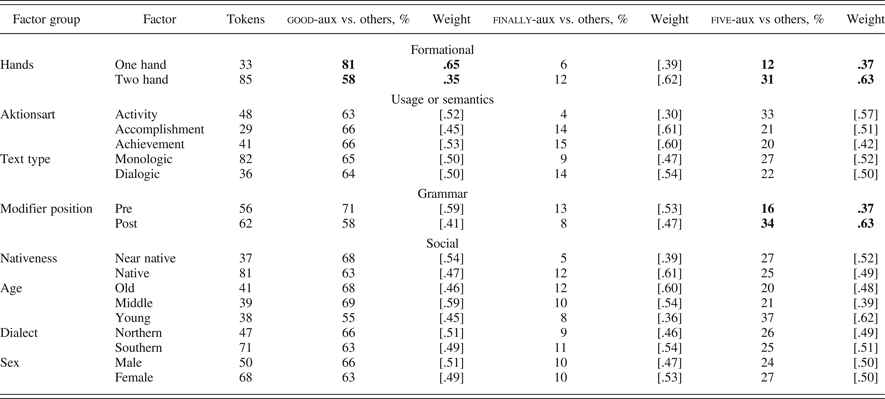
The linguistic factors that may account for the differential use of variant forms of the finish-type signs were further analyzed using Rbrul to test for their interaction and relative strength. We also tested for any impact of additional social factors, such as sex, age, region, or nativeness. Table 6 summarizes the interaction of these linguistic and social factors with each of the finish-type signs as the application value (the independent variable) from three separate runs.
Dataset (all tokens): application value (the three finish-type signs by three separate runs put into one table) by all of the factor groups
Note: Significant factor groups are in boldface. Nonsignificant factor groups appear in brackets.
For finish.good versus others, the only significant factor group was hands (p = .005) with finish.good significantly more likely to appear in one-handed form than the other signs were. For finish.finally versus others, the following factor groups were significant, in descending order of importance: (a) grammatical class (p ≤ .001), with finish.finally significantly more likely than other signs to act as a content sign rather than a function sign;Footnote 9 (b) dialect (p = .004, with southern signers using finish.finally more frequently than northern signers were; and (c) nativeness (p = .004, with native signers significantly more likely to use finish.finally than near-native signers were. For finish.five versus others, only two factor groups were significant: (a) grammatical class (p ≤ .001), with finish.five significantly more likely to appear as a function sign than other signs were, and (b) hands (p ≤ .001), with finish.five significantly more likely to appear in two-handed form than other signs were.
A similar multivariate analysis using Rbrul was conducted but with the dataset limited to only those finish-type signs that function as auxiliaries (Table 7). For finish.good-aux versus others, only one factor group was significant, hands (p = .011), with auxiliary uses of finish.good significantly favoring one-handed variants compared with auxiliary uses of other signs. For finish.finally-aux versus others, no factor groups were significant. For finish.five-aux versus others, only two factor groups were significant, which were (a) syntactic position relative to the main verb (p = .035), with auxiliary uses of finish.five significantly favoring postverbal position compared with auxiliary uses of other signs, and (b) hands (p = .042), with auxiliary finish.five significantly favoring two-handed variants compared with other signs.
Dataset (auxiliaries only): application value each finish-type sign (each finish versus the rest)
Note: Significant factor groups are in boldface. Nonsignificant factor groups appear in brackets.
Four other Rbrul runs were conducted with other application values and with additional factor groups, in particular the three finish-type signs themselves as independent variables. The datasets and the compared values with a summary of the results are as follows.Footnote 10
1. All finish-type tokens: for function versus content uses, only two factor groups emerge as significant: (a) Aktionsart (p ≤ .001) with function signs favoring activity or accomplishment event types and disfavoring states and achievement types; (b) variants (p ≤ .001), with finish.five favoring function uses, finish.good slightly favoring function uses, and finish.finally strongly disfavoring function uses.
2. All finish-type tokens: for auxiliaries versus others, only three factor groups were significant, in descending order of importance: (a) Aktionsart (p ≤ .001), with auxiliaries more likely to occur in accomplishment and activity event types than in achievement and states types; (b) variants (p ≤ .001) with both finish.good and finish.five significantly more likely to act as auxiliaries than finish.finally; and (c) hands (p = .004), with auxiliaries significantly more likely to appear in one-handed than two-handed form.
3. Only finish-aux tokens, for completive versus anterior (considering only linguistic factors), only one factor group emerged as significant: modifier position, or the position of the auxiliary relative to the full verb (p = .007). Namely, completive uses of auxiliaries significantly favored a position before the verb, relative to anterior uses and disfavored a position after the verb.
4. Only finish-aux tokens, for anterior versus completive uses (considering only social factors), two factor groups emerged as significant: (a) text-type (p = .004) with monologic data favoring completive uses of auxiliaries and dialogic data disfavoring them, and (b) sex (p = .040) as a weak effect with women favoring completive uses of auxiliaries and men disfavoring them.
In a separate Rbrul analysis, duration was treated as a continuous dependent variable. In this run, two factor groups were significant: (a) hands (p ≤ .001), with two-handed variants of finish.finally, finish.five, and finish.good significantly longer than one-handed variants (have never appeared in two-handed form); and (b) auxiliary (p = .004), with signs acting in auxiliary roles significantly shorter in duration than signs acting as other parts of speech.
With these results we are able to better understand the effects of linguistic and social factors on finish-type signs as a whole, and on finish-aux signs in particular. With respect to grammatical factors, across the whole dataset of finish-type signs, finish.finally is significantly more likely than other signs to act as a content sign, rather than a function sign (but recall note 9), whereas finish.five is significantly more likely to appear as a function sign than other signs and finish.good slightly favoring function uses. This effect is strengthened if one considers auxiliaries alone: finish.good and finish.five are much more likely to act as auxiliaries than finish.finally is. Completive auxiliaries are more likely to be in premodifying position in the clause, while anterior auxiliaries disfavor this position.
With respect to formational factors, across the whole dataset of finish-type signs, finish.good is significantly more likely to appear in one-handed form than other signs are, and finish.five is significantly more likely to appear in two-handed form than other signs are. Considering the set of finish-aux signs only, finish.good, compared with other signs, favors one-handed forms and finish.five favors two-handed forms.Footnote 11 Auxiliaries though are significantly more likely to appear as one-handed and, whether one-handed or not, they were also significantly briefer than content signs were. With respect to semantic factors, across the whole dataset of finish-type signs, their use as function signs generally and auxiliary signs specifically favored activity and accomplishment event types, and disfavored states and achievement types. With respect to usage factors, monologic texts favored the use of completive auxiliaries and dialogic texts disfavored them. With respect to social factors, across the whole dataset of finish-type signs, there appears to be only modest interaction with the social factors of nativeness, dialect, or sex with southern signers using finish.finally more frequently than northern signers and native signers are significantly more likely to use this sign than near-native signers are. There was also a very weak effect for sex, with women slightly favoring completives and men disfavoring them. All of these weak social effects evaporated when the dataset was restricted to auxiliary only finish-type signs.
The Rbrul results confirm that the tentative generalizations made on the basis of the descriptive statistics are statistically significant. They do identify one or two additional minor weak tendencies that may warrant addressing if they remain or become even more robust when larger and more diverse datasets are analyzed.
SUMMARY
The overall distribution of finish-type signs showed they can act in several different grammatical class roles, both function and content, with the majority of tokens of all three types (finish.good, finish.five, and finish.finally) acting as function signs. finish-aux signs—of any variant—do not appear to prefer any positions in the clause with respect to the main verb: they may appear on either side of the verb. However, in completives, the auxiliaries are significantly more likely to be preverbal. Almost no finish-aux signs are used with stative event types, and of the nonstatives, they favor activity and accomplishment event types. The English-like have-aux is preferentially used in this environment as well as being found in all other environments. Fully one in three auxiliary-like perfective constructions use have-aux, rather than one of the three finish-aux variants, as the auxiliary sign. Over half of all finish-type signs in the dataset were tokens of finish.good, with the remaining tokens almost equal between the two other variants. Overall, function signs were briefer than content signs, with auxiliaries shorter than other function signs (i.e., the adverbs and conjunctions). The fact that the majority of finish-type signs were also one-handed appears to be related: auxiliaries as a whole are significantly more likely to be one-handed.
DISCUSSION
The findings on the distribution of forms raises four issues. The first is the difference between Auslan-specific constructions from English-like constructions. The second is the influence of event type on the expression of perfective semantics. The third is the presence (or absence) of layered forms in the dataset. The fourth is the role of lexicalization in understanding the finish-type variation (and possible grammaticalization) that we have observed.
Auslan-specific versus English-like constructions
In the dataset, the “finish x” completive aspect construction has two possible analyses: it could be analyzed as a lexical verb taking a complement verb (as in the English nongrammaticalized analytic and lexical strategy), or it could be analyzed as a grammaticalizing “function” word modifying a full verb in an incipient Auslan-specific construction. This type of construction is an attested grammaticalization pathway for the emergence of a completive auxiliary (Heine & Kuteva, Reference Heine and Kuteva2002), but it is not clear from the data that this is the correct interpretation of the construction here because it could also be a product of contact with English (i.e., finish Xing), at least when the auxiliary form is preverbal. Indeed, an Auslan-specific analysis may be more appropriate for one constructional token while an English-like analysis may be more appropriate for another (especially if differing degrees of individual bilingualism were taken into account). This has not been given sufficient weight when similar constructions from other SLs embedded within English-speaking communities, such as American SL, British SL, and Irish SL (Leeson, Reference Leeson2001), have previously been discussed.
English-like calquing may actually be the better overall analysis for the Auslan data because not only do the constructions with a completive aspect reading have ‘finish’ in a preverbal position much more often (as they always are in English), but our data show that there is no significant phonological reduction or erosion of the finish-type sign in this position. (Recall from the findings that signs that appear to be undergoing grammaticalization often show evidence of phonological reduction and erosion: the grammatical or functional use is often shorter in duration than the content or lexical use. Yet finish-type signs in completive constructions are longer than anterior constructions.) This suggests the construction is primarily a calque of the English or at minimum that a grammaticalization process has barely begun.
This contrasts with the perfective constructions with an anterior aspect reading. The “finish-aux x” or “x finish-aux” constructions do not have two possible analyses—they are both Auslan-specific—for two reasons. First, English always uses a grammaticalized “have X” construction for this meaning. Second, Auslan does not favor a preverbal position for the finish-aux sign in this sense, but in the constructions that use have-aux, it is fixed in the preverbal position (just as in English). There is no fixed position for the finish-aux signs—of any variant—with respect to the main verb with this meaning: they may occur both before or after the main verb. The finish-aux signs used for anterior are thus unrelated to English and are clearly examples of emergent Auslan-specific constructions, in other words, they display independent but incipient grammaticalization.
Actually, perfective constructions using have-aux with an anterior aspect reading have their own special characteristics. First, these appear to be approximate calques of the English construction (approximate because Auslan does not have inflected or suppletive forms for the verb have, nor does it have such forms for virtually all other verbs). An example would be a construction like pro3 have know ... (He's known ...) in which “have” (“has” reduced to “‘s”) is a grammatical word/sign (an auxiliary), not a lexical word/sign expressing possession. Instances in which the complete inflectional morphology of English is represented either through fingerspelling or the addition of affix-like signs (e.g., pro3 fs:has eat fs:en) would be examples of code-switching, rather than calquing. There are no examples of this type of Signed English in the study corpus (as yet) because all the signers in the corpus are native or near-native signers who are signing to other native or near-natives and it would not be typical of native signers to do this in natural contexts unless, perhaps, when quoting someone.
Second, there is, again, a gray area. have can be used as an existential or presentative in Auslan (glossed here as have-existential). have-existential in Auslan would also be suitable to express these semantics because a construction like have-existential fear to mean ‘there existed fear and this is relevant to what I am talking about now’—a classic example of anterior semantics—is just as efficacious as have-aux fear meaning ‘had feared’ or ‘had been frightened’ (and relevant to now, i.e., anterior). Therefore the construction has two possible analyses: some would be English-like have-aux constructions, others could be Auslan-specific have-existential constructions. On the balance of probabilities, however, it appears appropriate to analyze the majority of perfective constructions using have-aux with an anterior aspect reading as English-like constructions because their distribution is skewed to atelic clause event types. The Rbrul analysis confirmed this as significant. We now turn to this issue.
Event type
Event type semantics clearly influence whether a finish-type sign can be used for perfective aspect marking. The Auslan-specific strategy using finish-type signs is clearly preferred for telic event types and the English-like for atelic event types. Almost no finish-aux signs are used with stative event types, and of the nonstatives, they favor activity and accomplishment event types.
An explanation may lie in the fact that some event types have an inherent end point (they are telic) that is congruent with being bounded. Thus, to say that what inherently must end, has in fact ended, makes sense. This is less so of atelic events (e.g., states). States have no inherent end point (atelic), so the semantically loaded word/sign meaning ‘finish’ may not initially be an appropriate or congruent marker in this sense. Consequently, it would seem that finish-aux signs have yet to become sufficiently conventional and abstract as markers of the current relevance of a past state or its recent completion (with statives the sense would be ‘cessation’) to be attached to any state of affairs, regardless of event type. One would expect this to be the case if the grammaticalization were robust and well advanced. This may partially explain the almost exclusive use of the English strategy for the anterior sense. Recall, nonetheless, that have-aux is also used with all other event types—fully one third of auxiliary-like perfective constructions in the dataset actually use have-aux, which is unambiguously a calquing of English.
Layering
The principle of layering predicts that, in a sufficiently large or representative sample of a language in use at any given time, there will be coexistence of the variant forms that are used in different ways. The Auslan finish-type signs are suitable lexical source words in Auslan for observing this phenomenon. And this is, indeed, what we can observe. However, not surprisingly, given the relatively small size of the Auslan Corpus (>105,000 sign tokens at the time of writing), only one potential example of this kind of layering has so far been identified—one specific finish.good sign occurring twice, each juxtaposed to the other, one modifying the other (Figure 18).Footnote 12 Nonetheless, there are several other examples in which two finish-type signs (but each is a different one of the three major types—finish.good, finish.finally, or finish.five) are juxtaposed to each other, again one modifying the other. If nothing else, these examples clearly show that only one of the finish-type signs is acting as a full verb; the second acts as an adverb (Figure 19) or auxiliary (Figure 20).
finish.good-aux modifying finish.good-verb (Auslan Corpus file: MDBc4a).
finish.finally-adv modifying finish.five-verb (Auslan Corpus file: STCc3).
finish.five-verb modified by finish.good-aux (Auslan Corpus file: PDHc4a).
Relexicalization
Some studies have shown that completives can grammaticalize into anteriors when the lexical source is ‘finish’ or ‘end’ (Heine, Reference Heine, Narrog and Heine2011), in other words, what becomes salient is the current relevance of the completed act rather than the simple fact that is has been completed at some given time. Anteriors can, in turn, further grammaticalize into past tense markers (Heine & Kuteva, Reference Heine and Kuteva2002). Recall Figure 1, which shows the relationship and ‘semantic proximity’ of these tense/aspect markers, and also Table 1 in which some relevant attested grammaticalization pathways are laid out. This progression from lexical to grammatical to yet more grammatical is, as we have seen, often linked to phonological reduction. The erstwhile lexical word can thus often end up as a bound suffix, such as a morpheme that encodes tense or aspect, and this results in a new word form.
Depending on the amount of phonological reduction that has occurred in this process, the phonotactics of a language may encourage further changes that mask or dissolve the suffix into the host word that then appears to subsequent learners of the language to be at best a suppletive form or a completely new word (and the word form may then take on new senses in addition to, or replacing, earlier senses). In other words, it may (re)lexicalize.
It should be noted that the phonotactics of Auslan—and most other SLs it would seem (e.g., Meir, Reference Meir, Pfau, Steinbach and Woll2012)—prefer signs with only one or, at most, two syllables. A lexical sign usually has one change in location, one change in hand shape, one change in orientation, or one change in movement. This constraint is evidenced in Auslan in the progressive or regressive phonological assimilations found in compound signs (Johnston & Schembri, Reference Johnston and Schembri2007) or frequently collocating pairs of signs in naturalistic texts (Schembri et al., Reference Schembri, Johnston, Goswell and Lucas2006).
In this study, we did not initially identify “suffixing” finish-type signs because they are not independent signs. Consequently, there may be a number of postverbal one-handed finish-type signs, especially finish.five signs, that are missing from our reported counts because they have become “embedded” in relexicalized forms (recall that finish.five strongly favored a postverbal position, so this tendency facilitates this process).
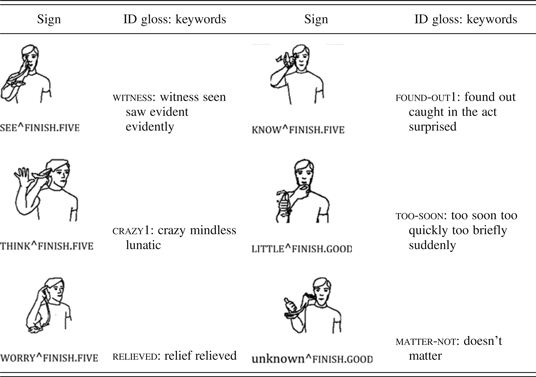
Even though we did not explicitly tag finish-type signs that appear to resemble bound morphemes (“suffixes”), they can still be identified. Fortunately, extensive lexicological and lexicographical work on Auslan in the 1980s and later had created a comprehensive lexical database of the language by the early 1990s that is still being added to today. The (apparent) morphological structure of the lexical signs is recorded in this database. Signs that appear to be derived from two independent signs (e.g., compounds) are also identified (e.g., check is documented as a compound of see^maybe). Early on, a number of signs were observed as having a finish-type sign as a much reduced second element of the sign and are described as compounds/blends in the database (some examples are shown in Table 8).
Examples of compounds/blends with a finish-type sign as the second/final element
It should be evident from the data presented in this study that many if not all of these signs are the result of postverbal finish.five-aux or finish.good-aux function signs grammaticalizing even further so that they are no longer independent morphemes but suffixes that become assimilated into a relexicalized sign. They can be easily searched for in the study dataset on the basis of their ID gloss despite the fact that the ID gloss gives no hint of their possible origin. On inspection of these signs, we do find evidence of relexicalization. First, mouthing associated with the component signs has changed. In most cases, no part of the word “finish” is any longer mouthed in association with these signs. Rather, there is no mouthing or another third word is preferentially mouthed instead, for example, “relief” or “relieved” for worry^finish.five, or “saw” or “witness” for see^finish.five. Second, and much more importantly, the verb signs can themselves be pre- or postmodified with another finish-type sign (Figures 21 and 22). A possible extended grammaticalization pathway that might explain these two examples could be:
Lexical (source: finish) > Grammatical (see already) > More grammatical-1 (see done/completive) > More grammatical-2 (see before/anterior) > More grammatical-3 (see +past) > Re-lexicalized (saw/witnessed)
However, without diachronic data on Auslan usage, we are simply unable to say what stages of the pathway (e.g., single or multiple, see Table 1) were involved, and in what order, before arriving at the relexicalized form and, furthermore, whether there was any period of time when it was a potential past tense marker. After all, there are examples of finish.five being used in all of these ways in the dataset.
witness (= see^finish.five) premodified by finish.finally-aux (Auslan Corpus file: MTFc2a).
witness (= see^finish.five) postmodified by finish.good-aux (Auslan Corpus file: PCNc7a).
Figure 23 shows the token counts of each type of finish-type sign when the lexicalized forms to which a finish-type sign appears to have attached, undergone further phonological reduction and assimilation, and then relexicalized. (We include token counts for finish.complete signs because they represent finish.five final signs regardless of whether they are blends of finish.good^finish.five or emphatic forms of finish.five. However, they are few.) Virtually all of the tokens of relexicalized signs are one-handed. Final blended finish.good tokens are represented by only one type (matter-not, a very frequent interjection [”interactive”] or discourse marker); finish-five, however, is represented by seven types. Evidently, postverbal one-handed finish.five is the most grammaticalized of the finish-type variants, that is, it appears more productive. The superficial “disappearance” of such tokens in relexicalized signs explains the apparent anomaly of the small token count of one-handed finish.five signs mentioned earlier.
finish-type variants bounded (checked) versus unbounded (all others).
Finally, but it can only ever be speculation because there is no diachronic data to support this suggestion, it is plausible that finish.finally itself is a further reduction of complete in which only the final outward twisting movement of the original “suffixed” finish.five remains (the hand shape has completely “dissolved”). The cliticization of a postverbal finish-type-aux morpheme to a host sign appears to have occurred on few signs and the subsequent relexicalization of these signs appears to have happened relatively quickly. That few signs are involved appears unsurprising given our characterization of the grammaticalization process with finish-type signs as incipient and inchoate. However, given the youth of Auslan (and other SLs), the relatively short period in which these signs have apparently grammaticalized and then relexicalized is somewhat unexpected.
By “quickly” here, we mean that if a two-sign collocation in Auslan experiences increasing phonological reduction, the result may lead to fusion rather than ”affixation.” It becomes a single sign. The resulting sign would certainly have no more than two syllables and is even likely to become monosyllabic. Consequently, a collocation of a specific lexical verb with a finish-type function sign conveying completion/anteriority/past in which the latter is “cliticizing” to the former so that it begins to be uttered as a single sign will merge almost instantaneously. Like two drops of water that get too close to each other, there is no lengthy intermediate stage where they are joined but still are separately visible. They instantly fuse.
This modality-specific phonotactic fact of Auslan—and other SLs—may have had an unanticipated impact on possible subsequent grammaticalization pathways within these languages. Namely, exemplar paradigms of affixes (suffixes or prefixes) may not have enough chance to form through repeated use. Binding morphemes do not really become bound; rather, they fuse and disappear. These transient affixes may thus be poor at generating productive constructional schemas in the mind of the language user. Appreciation of the phonotactics of SLs within a usage-based model on the emergence and entrenchment of various types of constructions thus offers another complementary dimension on the observation made by Aronoff, Meir, and Sandler (Reference Aronoff, Meir and Sandler2005) that youth and modality partly explain why concatenative and sequential morphology is so rare or virtually nonexistent in SLs.
CONCLUSION
As we have seen there are several constructional schemas that can be used to express the meanings associated with perfective aspect in Auslan. The majority use finish-type signs. With respect to our three hypotheses regarding the variants of the finish-type signs and their uses, the data in this study show that:
1. Yes, differences of form are associated with the use of finish-type signs in different functional roles.
2. Yes, the linguistic factors associated with the observed variation are consistent with typological patterns and predictions made by grammaticalization theory. Some of the data can be nicely accounted for by grammaticalization theory, which predicts phonological reduction as the process advances. The data suggest that phonological reduction of finish-type signs manifests itself in use of one-handed forms instead of two-handed forms as well as in briefer articulation (of both one- and two-handed forms) in function environments. However, no one form of the target signs appears to be exclusively a grammatical form coexisting alongside its potential source content sign. This means that grammaticalization—if this is indeed what is occurring—would be nascent with each form and all its variants being used in a wide range of environments from content through to function. The possible grammaticalization of order within constructions (syntacticization) is weak, but strongest with one-handed finish.five-aux signs, which have a preference for postverbal position.
3. No, unlike most variation observed to date in Auslan, there is as yet no strong evidence of differential use of particular forms in certain grammaticalizing constructions associated with signers using one Auslan dialect (i.e., region) rather than the other. This study had hoped to find some interaction with age as a surrogate marker of change in progress, or with dialect for community-specific usage symptomatic of localized reinterpretation feeding a semantic “drift” underpinning grammaticalization. However, the interaction with social/dialect factors were weak. Within the Auslan speech community, at least, these classic genre and sociolinguistic variables currently appear not to be strongly implicated. The picture may change if a larger proportion of the corpus were annotated to include more conversational text types, or if the dataset were to include tokens from British SL.
Four factors appear to be relevant for explaining these findings. First, shallow historical depth: there seems to have been insufficient time for the process of grammaticalization to produce more marked changes in form and function. Second, the sociolinguistics of deaf communities: looseness of social networks, small community size, and a high degree of language contact (many adult second-language learners of Auslan, including teachers and parents) have all been implicated in restraining language (morphological) complexity (e.g., Trudgill, Reference Trudgill2011). Third, the phonotactics of Auslan (and perhaps all SLs) prefer monosyllabic lexical signs and essentially disallow lexical signs of more than two syllables. Auslan disprefers the nongestural, noniconic concatenated morphemes or morphemes sequences that would result in single lexical signs of more than two syllables, making affixation problematic. Fourth, language borrowing/contact: the ready-to-use ambient SpL constructions that are of a lexical rather than a concatenative morphological type appear to be calqued and/or mapped onto the signed modality. The absence of inflectional morphology in Auslan may actually “prime” Auslan users to calque constructions in a majority language that are of this lexical type.
The data suggest that grammaticalization is congruent with the pattern of variation we see in these Auslan data, and that much the same type of source lexical sign can be used with similar effect in both SLs and SpLs. We must note, however, other studies of grammaticalization in SLs have argued that gestural material is also available and exploited in these languages (recall note 2). This study has provided unequaled quantitative data on the variable use of finish-type signs in a SL such that we now have a much better understanding of the nature of that variation and the role that grammaticalization theory might play in explaining the observed facts. Namely, each of the finish-type signs appears to participate variably in similar constructional types, one of which is as an auxiliary apparently marking for anterior or completive aspect. However, the form and placement with respect to the verb with each type has different characteristics (as we have described). This indicates the distinctiveness of each possible grammaticalization pathway with each finish-type sign, on the one hand, and the likely influence of English, on the other.
We are not suggesting that the finish-type signs have been borrowed into Auslan from English. Indeed, as we have seen, Auslan has several signs in this semantic domain, not just one. Rather, there appears to be a strong association of these signs with particular English words (overwhelmingly meaning ‘finish’). This surfaces in the use of lip patters (mouthing) and the use English-like constructions produced by second-language signers in Australia (hearing parents, teachers with poor Auslan skills, teachers signing Signed English, members of the community with a superficial knowledge of Auslan). Exposure to English uses of ‘finish’ and ‘have’ in aspect marking constructions (both in sign order and in mouthing) creates the potential for calquing into Auslan. An autochthonous stance would maintain that aspectual have constructions or some of the aspectual finish-type constructions that are very English-like have not been calqued or borrowed from English. Given that lexical and syntactic borrowing in lengthy language contact situations is a phenomenon attested cross-linguistically with respect to SpLs (e.g., the spread of areal features in a sprachbund), we think this is an uncontroversial observation. It is actually the best explanation for some of the data we have presented.
Had we presented and generalized from only those examples from our corpus that were maximally distinct from the English, we could easily have created the impression that there were only Auslan-specific ways in which native Auslan users overtly expressed perfective aspect. Indeed, elicitations and grammaticality judgments from Auslan signers would most likely have resulted in maximally distinct constructions also. Both of these types of data can be misleading, however, because they may not accurately reflect usage because of (unintentional) misreporting, exaggeration of differences between languages, or even unconscious attempts to please the researcher. An accurate description of the grammar would not be made generalizing on such data only. Auslan is not defined as “signing behavior that is not English or English-like”—it is what native signers of the language do with each other in naturalistic communicative situations.
In conclusion, this study suggests that the grammaticalization of finish-types in Auslan (if grammaticalization is indeed the explanation) is uneven and not well advanced. The data suggest that the Auslan-using community has only partially evolved a language-specific strategy of encoding and expressing perfective aspectual meanings, which exist alongside strategies that, for unsurprising language contact reasons, are more or less the same as those used by English speakers.