INTRODUCTION
The family Opistognathidae comprises three genera with about 80 described species of fish that inhabit shallow tropical seas (López & Bussing, Reference López and Bussing1982). They live in sandy burrows and most of their time is spent at the opening with only the head protruding (Allen & Robertson, Reference Allen and Robertson1991). Jawfish are represented in the Americas by Lonchopisthus spp., Opistognathus spp. from the Atlantic and Indo-Pacific, and by Stalix spp. from the Indo-West Pacific (Nelson, Reference Nelson1984). Usually the species of this family are small in size and difficult to observe due to their behavioural habits, nevertheless recent species descriptions (Castro-Aguirre & Villavicencio-Garayzar, Reference Castro-Aguire and Villavicencio-Garayzar1988; Allen & Robertson, Reference Allen and Robertson1991; Acero & Frake, Reference Acero and Franke1993; Smith-Vaniz, Reference Smith-Vaniz1997; Bussing & Lavenberg, Reference Bussing and Lavenberg2003) have proven that the family is far more specious than previously thought.
In the Eastern Pacific, jawfish included in the Ophistognathus genus are widespread from the outer coast of Baja California and the Gulf of California, south to Colombia, and in oceanic islands such as Isla del Coco and the Revillagigedo and Galapagos Archipelago (Bussing & Lavenberg, Reference Bussing and Lavenberg2003). Prior to the 1990s, only three nominal species of Opistognathus had been described in the Eastern Pacific (Allen & Robertson, Reference Allen and Robertson1991). Following this impasse, eight new species of Ophistognathus were added to the ichthyofauna (Allen & Robertson, Reference Allen and Robertson1991; Acero & Flake, Reference Acero and Franke1993; Bussing & Lavenberg, Reference Bussing and Lavenberg2003), including Ophistognathus panamaensis described by Allen & Robertson (Reference Allen and Robertson1991) at Isla del Coco. In the Mexican Pacific only seven species of the genus Opistognathus have been previously recorded, none of them corresponding to O. panamaensis which had only been recorded in Central America (Costa Rica to Colombia, including Isla del Coco and Malpelo). The purpose of this paper is to report the occurrence of O. panamaensis in Mexican waters, therefore extending its distribution range 1245 km north of its previous record in the equatorial zone.
MATERIALS AND METHODS
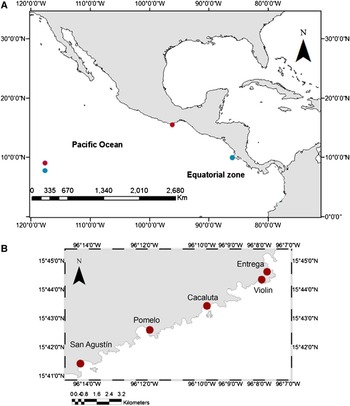
On 21 and 22 November 2012 several specimens of Opistognathus panamaensis were observed in south-western Mexico (Figure 1) at the coral reef zones of La Entrega (15°44′42.00″N 96°7′41.00″W), Violín (15°44′19.52″N 96°7′55.42″W), Isla Cacaluta (15°43′9.86″N 96°9′50.22″W), Pomelo (15°42′27.27″N 96°11′33.76″W) and San Agustín (15°41′15.53″N 96°14′13.08″W). A single specimen of O. panamaensis was collected with a Hawaiian sling after being detected in an underwater visual census (UVC). The specimen was preserved in 70% OH solution and deposited in the National Collection of Fishes in Mexico City. Finally, using geographical information systems we calculated the distance between the previous northernmost record and the location of the occurrence in the Huatulco area.
Location for the new record of Ophistognathus panamaensis.

RESULTS AND DISCUSION
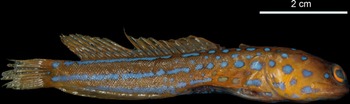
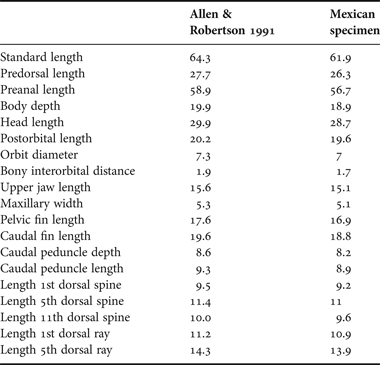
We observed and collected Opistognathus panamaensis from Huatulco bays, western Mexico (Figure 2). The description, along with morphometric and meristic characters of the collected specimen agreed with the information provided by Allen & Robertson (Reference Allen and Robertson1991) (Table 1). Opistognathus panamaensis was first collected close to Isla del Coco and further collections showed positive records of the species in the Galapagos Archipelago and the mainland of Central America (Allen & Robertson, Reference Allen and Robertson1991). In this regard, this report is the first record of the species from the equatorial zone, therefore indicating a considerable extension of range from its previous known distribution in Central America.
Ophistognathus panamaensis: CNPE-IBUNAM 17220, 61.9 mm standard length from Isla Cacaluta, Mexico.

Morphometric comparison of Opistgnathus panamaensis (% standard length mm) from Mexico with the holotype (Allen & Robertson, Reference Allen and Robertson1991).

The record of O. panamaensis in western Mexican waters raises questions about the suggested endemism of jawfish species in Eastern Pacific oceanic islands (Bussing & Lavenberg, Reference Bussing and Lavenberg2003). Also recent evidence suggests considerable changes in oceanographic conditions in the Eastern Pacific (Chavez et al., Reference Chavez, Ryan, Lluch-Cota and Ñiquen2003), therefore causing considerable shifts in the distribution of several marine fish as has been reported in other parts of the world (Perry et al., Reference Perry, Low, Ellis and Reynolds2005). In addition, the oceanographic processes largely determine the degree of dispersal of planktonic stages and thus subsequent connectivity within and among populations of species (Cowen et al., Reference Cowen, Gawarkiewicz, Pineda, Thorrold and Werner2007). In the Eastern Pacific these processes can connect the populations of several marine groups (Brow et al., Reference Brown, Jackson, Holt and Holt2005; Coleman et al., Reference Coleman, Roughan, Macdonald, Connell, Gillanders, Kelaher and Steinberg2011). Our record supports the faunal connectivity hypothesis between Central America and western Mexico via the Costa Rica Coastal Current (Fiedler & Talley, Reference Fiedler and Talley2006; Pineda et al., Reference Pineda, Hare and Sponaugle2007).
Variants of the UVC have formed the basis of studies addressing species composition and community dynamics of the icthyofauna in the Eastern Pacific (Willis, Reference Willis2001). While the use of the UVC has boosted the knowledge about reef associated fish fauna, assemblages of small, cryptic fish that are strongly associated with the benthos have been largely ignored, mainly due to the methodological bias associated with the method (Brock, Reference Brock1982). In this regard methods and techniques used in monitoring the icthyofauna in the Eastern Pacific, need to put more emphasis on cryptic crevice, bottom and burrow dwelling species in order to attain a much more realistic picture of the current diversity of the ichthyofauna in the region. We recommend the method proposed by Stewart & Beukers (Reference Stewart and Beukers2000) for developing an accurate, non-destructive protocol for census of both cryptic and mobile species for the specific conditions of the Eastern Pacific coral reefs.
Finally, this record is relevant and can help to provide a better understanding of the distribution of the Opistognathus in Central and North America, but it is still necessary to implement studies of connectivity and biogeography in order to provide a better understanding of the distribution of species in the region.
ACKNOWLEDGEMENTS
We thank Hector Salvador Espinosa Pérez from the National Collection of Fishes (CNPE-IBUNAM) for all his help and support in the process of the specimen deposit. Additional help provided by Daniel Alberto López López is gratefully acknowledged. This research was supported by Universidad del Mar and grants from CONABIO (HJ029) and CONACYT (80228) awarded to Andrés López Pérez.